PRESIDENT Bola Ahmed Tinubu has approved a ₦4 trillion bond to settle verified debts owed to power generation companies (GenCos) and gas suppliers, a move the Federal Government said will stabilise the country’s troubled electricity market and restore investor confidence.
The Minister of Power, Adebayo Adelabu, disclosed the approval at the Expert Forum on “Uninterrupted Power: The Industrial Imperative” organised by the Nigeria Economic Summit Group (NESG) in Abuja on Monday, October 6.
Adelabu said the debt clearance is part of a broader financial reform plan under the Renewed Hope Agenda, aimed at strengthening liquidity and sustainability across the power value chain.
“To stabilise the market, Mr President has approved a ₦4 trillion bond to clear verified debts owed to GenCos and gas suppliers,” he said, adding that a targeted subsidy framework is also being developed to cushion the impact of energy cost adjustments on low-income households while sustaining commercial viability for operators.
According to the minister, the government is adopting a multi-dimensional approach to revive the sector, including tariff reforms, infrastructure expansion, local content promotion, and an energy transition plan designed to boost generation and transmission capacity.
He noted that tariff adjustments for certain consumer categories have already improved supply reliability and revenue collection. “Industry revenue has grown by 70 per cent, reaching ₦1.7 trillion in 2024, and is projected to exceed ₦2 trillion in 2025,” Adelabu said.
The approval of the ₦4 trillion bond comes amid an escalating liquidity crisis in Nigeria’s power sector. In September 2025, The ICIRreported that GenCos were owed ₦5.6 trillion by the Federal Government as of August, according to the Association of Power Generating Companies (APGC).
The association’s managing director, Joy Ogaji, told The ICIR that monthly unpaid invoices from the government average ₦200 billion, adding that the sector’s financial strain had become “an existential threat” to electricity generation and gas supply.
She noted that although President Tinubu had promised to intervene through a ₦4 trillion bond issuance after meeting with GenCos in July 2025, operators had expressed concern about the lack of clarity and timelines for implementation.
Ogaji explained that the debt affects both GenCos and gas suppliers, and that inadequate remittance from Distribution Companies (DisCos) remains a major source of the recurring liquidity shortfall.
Learning from Ghana’s payment model
Energy experts have consistently warned that without a sustainable payment structure, the Nigerian Electricity Supply Industry (NESI) will continue to face revenue leakages.
In an earlier interview with The ICIR, Ogaji urged Nigeria to emulate Ghana’s “cash waterfall mechanism”, a structured model that prioritises payment to gas transporters and independent power producers before other expenditures.
“In Ghana, the system ensures that funds from electricity sales are distributed transparently and promptly to operators. That model has helped them maintain stability,” Ogaji said.
Analysts believe adopting a similar payment hierarchy in Nigeria could improve liquidity flow, reduce gas supply disruptions, and prevent recurring shutdowns by GenCos.
Government’s reform drive
While speaking on Monday at the Expert Forum on “Uninterrupted Power: Adelabu reiterated that the government is committed to overhauling the power sector through legislative and policy interventions, enhanced regulation, and infrastructure investment.
He stated that the Presidential Power Initiative (PPI), jointly implemented with Siemens Energy and other international partners, has already added 700 megawatts (MW) of transmission capacity through its Phase Zero rollout. Phase One, he said, is designed to inject an additional 7,000 MW into the national grid, supported by financing from Power China, Elswedy Electric, and China Machinery Engineering Corporation (CMEC).
The minister also revealed that rehabilitation works are ongoing at several National Integrated Power Projects (NIPPs) to recover about 345 MW. At the same time, the 700 MW Zungeru Hydropower Plant has been successfully integrated into the grid.
“These interventions are expected to improve energy access, reduce technical losses, and strengthen the financial health of the electricity market,” he said.
SCREENSHOTS have become a staple of online communication, circulating from viral tweets to breaking news headlines, and are often treated as instant proof.
But screenshots can be misleading or completely fake. A doctored tweet attributed to a politician, an edited bank alert, or a fabricated news headline can spread online in seconds, convincing thousands before fact-checkers even weigh in.
The FactCheckHub has debunked some of these instances listed above, which can be seen here, here, and here.
Because screenshots look authentic and are easy to share, they have become one of the simplest tools for fuelling misinformation, especially in fast-moving news cycles where people are less likely to question their accuracy.
False proof in a click
Creating a fake screenshot is a fast and easy process. Free editing apps let anyone alter names, wording, or even the number of likes and comments on a post in seconds; some fabricators go further and invent entire tweets or headlines that were never published.
Another common tactic is to change a news headline in a screen grab so it appears to come from a reputable outlet, also known as manipulated headlines, and because screenshots are static images, they carry no clickable links or metadata to prove authenticity. Those features make screenshots a perfect vehicle for misinformation: they look plausible, spread quickly, and are hard for casual users to verify at a glance.
Even unedited screenshots can distort the truth. A simple crop might remove the date, making an old post appear recent, or hide key replies that shift the meaning of a conversation.
In some cases, satirical comments have been screen – shotted and re-shared as if they were accurate statements, misleading audiences who never see the full thread. Beyond this, screenshots strip away important digital cues such as timestamps, source links, and engagement history that would normally help verify authenticity. Once those details are gone, it becomes harder for readers to judge credibility, and easier for misinformation to spread unchecked.
How to verify screenshots
Check the source
Go straight to the account or website shown in the screenshot — don’t rely on the image itself. Confirm the handle or URL exactly (look for impostor accounts with extra characters), check for verification marks where relevant, and scan the profile for history and tone: does the account regularly post that kind of content? Look for the original post on the platform (not just reposts) and note the publish date and time. If the screenshot claims to be from an organisation, check the organisation’s official site or other verified social accounts for the same story.
Search the wording
Copy the exact text (or type a short, unique phrase) and run it in quotes through a search engine and the social-platform search bar. This reveals exact matches, earlier posts, or reputable coverage that confirms or contradicts the claim. Search variations and translations that are too misquoted or paraphrase the text can hide the original context.
Do a reverse image search
Upload the screenshot to Google Lens, Google Images, TinEye, or Yandex. Look for the earliest appearance of the image, alternative captions, or higher-resolution originals. If the same image appears with different dates, captions, or locations, that’s a clue it’s being reused or misrepresented. Also, watch out for older timestamps, different captions, source credited to a stock photo site or a different event/location.
Look at the details
Inspect the screenshot closely and observe User Interface (UI) elements such as platform logos, buttons, fonts, alignment, spacing, and image quality. Poor cropping, inconsistent fonts, odd punctuation, mismatched icons, or blurred/warped areas usually indicate editing. On news screenshots, check if the headline style matches that outlet’s usual layout (font, byline placement, dateline).
Check metadata and original files
Screenshots strip metadata, but if you can access the original image or video file check the Exchangeable Image File Format. EXIF/metadata for creation date, device info, and geolocation. Use an EXIF viewer or forensic tool. If metadata is missing or clearly altered, treat the image with caution.
Many platforms and messaging apps remove EXIF data. Absence alone isn’t proof of fakery, but the presence of conflicting metadata is useful.
Corroborate with other sources
Look for independent reporting, eyewitness posts, official statements, or on-the-ground photos from multiple users. For location-based claims, try geolocation: match visible landmarks, road signs, or building features with satellite imagery or Street View. If only one account is pushing the claim and nobody else, especially local media, is reporting it, treat it as unverified.
Mind timeline and context
Screenshots can be decontextualised, an old tweet made to look recent, or a satirical post reused seriously. Verify timestamps, check the thread/replies for clarification, and see whether the screenshot omits surrounding conversation that changes meaning.
Use verification tools and experts
When available, consult reverse-search tools, archived pages such as Wayback Machine, or the archive.is and social monitoring platforms. Try reaching out to the original poster and requesting the live link or source. If you can’t verify quickly, flag the content as unverified rather than share it. Encourage readers to wait for corroboration, and report the post to the platform if it violates policies.
A SUIT has been filed before the Federal High Court (FHC) in Abuja seeking to stop former President Goodluck Jonathan from contesting the 2027 presidential election.
The suit, marked FHC/ABJ/CS/2102/2025, was filed by an Abuja-based lawyer, Johnmary Chukwukasi Jideobi, who asked the court to declare that Jonathan is constitutionally ineligible to contest for the office of the President of Nigeria.
In the originating summons, Jideobi prayed the court to issue a perpetual injunction restraining the former president from presenting himself to any political party for nomination in the 2027 presidential election or any subsequent poll.
He also sought an order directing the Independent National Electoral Commission (INEC) not to accept or publish Jonathan’s name as a candidate of any political party, and another directing the Attorney General of the Federation (AGF) to ensure compliance with any order of the court.
According to the court papers, INEC and the AGF were listed as the second and third defendants, respectively.
The plaintiff raised a single legal question for determination—whether, in view of the provisions of Sections 1(1), (2), (3) and 137(3) of the 1999 Constitution (as amended), Jonathan remains eligible under any circumstance to contest for the presidency again.
Jideobi argued that Jonathan, having completed the unexpired tenure of the late President Umaru Musa Yar’Adua in 2010 and subsequently served a full four-year term after winning the 2011 election, has already reached the constitutional limit of two terms in office.
In a supporting affidavit deposed to by Emmanuel Agida, the plaintiff described himself as an advocate of constitutionalism and the rule of law. He said his suit was in the public interest to prevent what he termed a “breach of the Constitution” if the former president were to contest again.
The lawyer told the court that Jonathan was first sworn in on May 6, 2010, following Yar’Adua’s death, and again on May 29, 2011, after winning the 2011 presidential election. He maintained that a third swearing-in, if Jonathan wins in 2027, would violate Section 137(3) of the Constitution.
That section states that “a person who was sworn in to complete the term for which another person was elected as President shall not be elected to such office for more than a single term.”
Legal experts have often noted that this provision was introduced in the Fourth Alteration to the 1999 Constitution (2018), following debates over term limits and succession after the Yar’Adua–Jonathan transition.
Jideobi, however, maintained that “if the former president is allowed to contest and wins, he would be taking the oath of office as president for the third time, contrary to constitutional intent.”
He said the suit was necessary to “preserve the integrity of Nigeria’s constitutional order” and prevent what he described as an “unconstitutional extension of tenure.”
No date has been fixed for the hearing of the matter.
Under Nigeria’s 1999 Constitution (as amended), Section 137(3) provides a clear restriction on how many times a person can occupy the office of the President through election. A person who completes the tenure of another president and then serves one full elected term cannot seek re-election again.
Jonathan handed over power to President Muhammadu Buhari in May 2015 after losing his re-election bid.
If the Federal High Court agrees with the plaintiff’s interpretation, the ruling could set a major precedent for how the constitutional two-term limit applies to former presidents who assumed office mid-term.
Recall that the Minister of Aviation and Aerospace Development, Festus Keyamo, argued that the People’s Democratic Party (PDP) risks having no candidate in the 2027 general elections if it gives its presidential ticket to Jonathan.
Keyamo, a senior advocate, argued this in a post on his X handle on Sunday, August 31, citing Section 137 (3) of the 1999 Constitution (Fourth Amendment).
He said the PDP has tipped Jonathan as one of its targets for presidential candidate because of the ex-president’s purported eligibility to run for only one term.
“But, if he is fielded, the party runs the risk of not having a candidate at all by virtue of Section 137 (3) of the 1999 Constitution (Fourth Amendment).
“The constitutional amendment was made AFTER the court judgment which cleared him to run in 2015, so nothing is decided yet on that new amendment, hence I use the word ‘RISK’ advisedly,” Keyamo argued.
THE controversy surrounding allegations of certificate forgery against the Minister of Innovation, Science and Technology, Uche Nnaji, deepened on Monday, October 6, after the Federal High Court (FHC) in Abuja stalled the hearing in the minister’s suit against the University of Nigeria, Nsukka (UNN), and other respondents.
The case, marked FHC/ABJ/CS/1909/2025, could not proceed before Hauwa Yilwa due to the failure of the university’s lawyers to file their responses within time. The judge Yilwa consequently adjourned the matter until November 10 for hearing.
Nnaji had approached the court to challenge what he described as the university’s interference with his academic records following media reports that his Bachelor of Science degree was forged.
He joined the Minister of Education, the National Universities Commission (NUC), the University of Nigeria, Nsukka (UNN) and several of its senior officials as respondents in the suit.
Through his counsel, Sebastine Hon, a senior advocate, Nnaji sought several reliefs, including an order of mandamus compelling the release of his academic transcript and prohibiting the university from “tampering” with his academic records.
The Minister also asked the court to direct the Minister of Education and the NUC to exercise supervisory powers over UNN to ensure compliance.
Although the judge earlier granted some preliminary reliefs, she refused to issue an injunction restraining the respondents from making public statements about the issue.
When the matter was called on Monday, he informed the court that, despite being served with court papers, UNN’s Vice Chancellor, Simon Ortuanya, a professor, wrote a letter to an online newspaper, PREMIUM TIMES, disowning Nnaji’s certificate.
Hon alleged that the respondents violated court procedure by making public statements on a matter already before the court. Counsel to the university, E.M. Asogwa, however, said his clients would maintain the status quo pending the substantive hearing.
The controversy stems from aPREMIUM TIMES investigation, which found that Nnaji’s Bachelor’s degree and National Youth Service Corps (NYSC) discharge certificate were forged.
In a letter dated October 2, 2025, signed by the Vice Chancellor, Ortuanya, UNN stated that, based on all available records, it could not confirm that Nnaji graduated from the institution in July 1985, as there were no documents showing he completed his studies. The university added that it therefore did not, and could not, have issued the certificate being paraded by the minister.
The reportalso reported that forensic analysis of the National Youth Service Corps (NYSC) discharge certificate showed irregularities, including a forged signature of a corps official who only assumed office 18 months after the date on the document. The certificate also carried an invalid numbering system and indicated that Nnaji served for 13 months, contrary to the statutory 12-month service year.
Meanwhile, reacting to the development, the 2023 Labour Party presidential candidate, Peter Obi, condemned the prevalence of certificate fraud among public officials, warning that it undermines national integrity and encourages criminality.
Obi said, those who are supposed to be exemplary have become the very source of the nation’s decay. According to him, when dishonest behaviour is modelled by public officials, it corrodes the moral standards available to young Nigerians.”
Citing global best practices, Obi noted that countries such as Indonesia disqualify and prosecute any political aspirant found guilty of falsifying academic records. He urged the electoral body to begin mandatory verification of certificates submitted by political aspirants and appointed officials at least six months before elections, saying that “true leadership must begin with truth.”
The ICIR has reported that the Nnaji case adds to a long list of credential scandals involving public officials that escaped detection by Nigeria’s Senate and the State Security Service (SSS) during the screening of political appointees.
Under Section 147(2) of the 1999 Constitution, ministerial nominees must be screened and confirmed by the Senate before appointment, while the State Security Service (SSS) is mandated by the National Security Agencies Act of 1986 to conduct background checks, including verifying educational qualifications.
However, investigations show these processes are often compromised by political considerations and the informal “bow and go” practice, where nominees—especially former lawmakers—are cleared without rigorous scrutiny.
THE Academic Staff Union of Universities (ASUU) has commenced mobilising its members nationwide for possible industrial action as the federal government fails to address the issues raised in its 14-day ultimatum, which expires next week.
In a letter dated October 5, 2025, and sent to all ASUU branches, the union’s president, Chris Piwuna, said the government’s continued silence had left the union with no choice but to prepare for strike action.
The circular, which was reported by Daily Trust, noted that the National Executive Council (NEC), at an emergency meeting held on September 29, 2025, reviewed the results of a nationwide referendum and resolved to give the government two weeks to act on the renegotiated agreement transmitted since February 2025.
He stated in the letter that despite earlier communication with the Minister of Labour, the Minister of Education, and the Nigeria Labour Congress (NLC), there has been no meaningful development.
“It was further resolved that the union will proceed on a two-week warning strike at the expiration of the ultimatum if the government fails to take acceptable and satisfactory steps to address the lingering issues.
“The resolutions were immediately communicated to the Honourable Minister of Labour, the Honourable Minister of Education and the Nigeria Labour Congress,” the letter stated.
Piwuna urged all branches to commence full mobilisation of members for the proposed action, stressing that the union remained united in its demand for improved welfare, better funding of universities, and the implementation of the renegotiated agreement.
“The days ahead call for the mobilisation of every member of our union to ensure unity of purpose. No one should be left out of the struggle for our welfare, stem the Jupa syndrome and reposition the Nigerian University System (NUS) for global competitiveness,” the letter was quoted to have read.
He also encouraged members to take directives only from their branch chairpersons and zonal coordinators, adding that the strength of the union lies in collective action.
Background
ASUU had earlier issued a 14-day ultimatum to the Federal Government after its NEC meeting at the University of Abuja on September 29, 2025, where it decried the neglect of the nation’s universities and the government’s failure to implement agreements reached in previous negotiations.
The ICIR reported ASUU’s demands to include renegotiating the 2009 federal government and ASUU agreement, providing revitalisation funds for public universities, paying all earned academic allowances and withheld salaries, and addressing promotion arrears.
The union is also demanding the payment of outstanding third-party deductions, such as check-off dues and cooperative contributions.
Other issues raised by ASUU include the proliferation of public universities, the non-payment of arrears of earned academic allowances and non-release of owed salaries, “creeping fascism” in some Nigerian universities and the core curriculum minimum academic standard.
Meanwhile, should the strike hold, it will be ASUU’s first industrial action under the Tinubu administration since he assumed power on May 29, 2023.
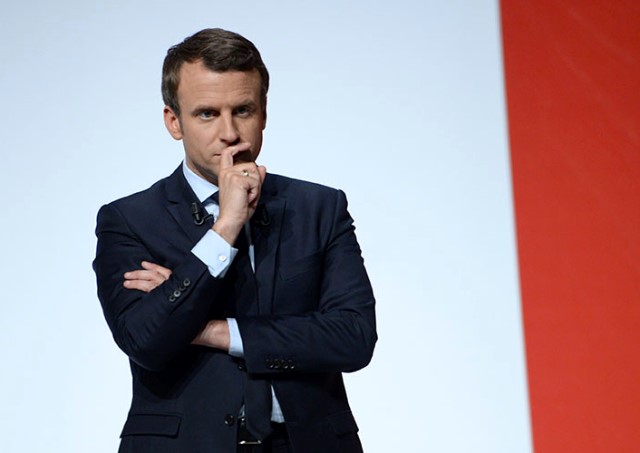
FRANCE new Prime Minister, Sébastien Lecornu, and his cabinet resigned on Monday, October 6, just hours after he unveiled his ministerial lineup, a dramatic escalation of the country’s political crisis that sent stocks and the euro tumbling.
According to Reuters, Lecornu, Macron’s fifth prime minister in just two years, held the position for only 27 days, and his government lasted 14 hours, making it the shortest-lived in modern French history at a time when parliament is deeply divided and the euro zone’s second-largest economy is struggling to put its finances in order.
Recall that the ICIR reported that the former Prime Minister François Bayrou’s government collapsed in September following a failed confidence vote, raising uncertainty over President Emmanuel Macron’s future and the stability of the eurozone’s second-largest economy.
The 74-year-old political veteran, who had been in office for just nine months, triggered the vote himself in an attempt to pressure lawmakers into supporting his proposal.
Protesters have taken to the streets across France for weeks, blocking roads, setting fire to rubbish bins, and clashing with police in a campaign to “Block Everything” in anger against President Emmanuel Macron and proposed budget cuts.
Many protesters directed their frustration at President Macron, who is already grappling with political upheaval.
Teachers, train drivers, pharmacists, hospital staff and other workers embarked on strike in France on September 18, while teenagers blocked access to their high schools, joining nationwide demonstrations against planned budget cuts.
Workers and other protesters have continued demanding the suspension of the former government’s fiscal policies, increased investment in public services, higher taxes on the wealthy, and the reversal of a widely opposed reform that raised the retirement age.
Reuters reports that the swift and unexpected resignation followed mounting threats from both allies and opponents to bring down the new government, prompting Lecornu to say the situation made it impossible for him to carry out his duties.
Opposition parties swiftly called on President Emmanuel Macron to step down or dissolve parliament and hold snap elections, insisting those were the only viable solutions to end the crisis.
Reports indicate that French politics has grown increasingly unstable since Macron’s 2022 re-election, as no single party or coalition holds a parliamentary majority. His decision to call a snap election last year further worsened the turmoil, resulting in an even more fragmented legislature.
THE Group Chief Executive Officer (GCEO) of the Nigerian National Petroleum Company (NNPC) Limited, Bayo Ojulari, has linked the recent surge in the price of Liquefied Petroleum Gas (LPG), popularly known as cooking gas, to the nationwide strike action by the Petroleum and Natural Gas Senior Staff Association of Nigeria (PENGASSAN).
Ojulari made this known to State House correspondents on Sunday after a courtesy visit to President Bola Tinubu at the Presidential Villa, Abuja.
Videos circulating on social media show Nigerians queuing in some cities to buy LPG. According to media reports, the price of LPG per litre has increased to between ₦2,000 and ₦2,300.
According to him, the spike in prices was temporary and largely “artificial,” caused by delays in product movement and loading during the strike period.
“The increase you saw was relatively artificial because, for the period of the strike, what that meant was movements and loading were delayed by about two, three days,” Ojulari explained.
“And because of that, you see that impact as things return to normal. It takes some time for distribution to be fully restored. And of course, as you know, in Nigeria, people take the opportunity. With that delay, some of the people who have existing resources and reserves had to put up the price.”
He, however, expressed optimism that the market would soon stabilise as normal operations resume.
“I expect that now that things are back to normal, prices should return to what they were before the strike,” the NNPC boss added.
Background
Ojulari’s comments follow the temporary suspension of the nationwide strike by PENGASSAN on October 1, 2025, after an intense intervention by the Federal Government.
The ICIR reported that the industrial action, which began on September 28, 2025, was triggered by disputes between the union and the Dangote Refinery over the alleged dismissal of more than 800 Nigerian workers who had unionised, and their replacement with foreign nationals.
The standoff escalated when PENGASSAN ordered its members to cut gas and crude oil supplies to the refinery, resulting in a significant drop in electricity generation nationwide.
By September 30, the Nigerian Independent System Operator (NISO) confirmed that the strike had forced several gas-powered plants offline, reducing national power generation by about 1,100 megawatts and plunging cities such as Lagos and Abuja into darkness.
Following negotiations mediated by the Minister of Labour and Employment, Mohammed Maigari Dingyadi, PENGASSAN agreed to suspend the strike after reaching a truce with the refinery’s management and the government.
However, the union warned that it would immediately resume the industrial action if any part of the agreement was breached.
“We are only suspending, not calling off this strike,” he said, adding that “If any part of this agreement is broken, we will not give any warning. We will immediately resume our suspended industrial action.”
Recall that as part of the truce, the Federal Government earlier announced that workers recently disengaged by the refinery will be redeployed to other subsidiaries within the Dangote Group.
Minister of Labour and Employment, Mohammed Maigari Dingyadi, disclosed this in Abuja, confirming that the affected staff would retain their salaries and benefits.
“After examining the procedure used in the disengagement of workers, the meeting agreed that the management of Dangote Group shall immediately begin the process of redeploying the disengaged staff to other companies within the group, with no loss of pay. No worker will be victimised arising from their role in the impasse between Dangote and PENGASSAN,” Dingyadi said.
DATAPRO Limited, a consulting firm in Nigeria and one of the country’s licensed credit rating agencies, will mark its 30th anniversary with a virtual webinar on Wednesday, October 9, 2025.
The event, themed “The Role of Credit Rating Agencies in a Dynamic Global Economy,” will focus on how credit rating institutions can contribute to financial stability and economic development in emerging markets.
A statement signed by the Executive Director Operations of the firm, Oladele Adeoye, disclosed that the keynote address will be delivered by Mahesh Kotecha, a professor and President of the New York-based Structured Credit International Corporation (SCIC) and a respected global authority in financial market development. He is expected to speak on “Leveraging Credit Rating for Economic Growth in Developing Countries.”
He added that a panel session will follow the keynote presentation, featuring prominent industry leaders, including Angela Jide-Jones, CEO of Sewa Capital Limited; Obed Mbuzi, Director at Premier Rating Services; and Vidhyasagar Lingesan, CEO of Care Ratings.
Others on the panel are Zwelibanzi Maziya, COO of Sovereign Africa Ratings, and Dauda Sembene, CEO of AfriCatalyst. Adeoye will moderate the discussion.
The event will also feature goodwill messages from key regulators and stakeholders, including Emomotimi Agama, Director-General of the Securities and Exchange Commission (SEC), Nigeria; Halima Singateh, Director at SEC, The Gambia; and Bonaventure Okhaimo, Managing Director of the National Credit Guarantee Company (NCGC).
According to DataPro, the virtual event will be streamed live on YouTube and other social media platforms. It will include the cutting of the anniversary cake and the launch of the biography of the company’s founder, Abimbola Adeseyoju.
All registered participants will receive a complimentary copy of the founder’s autobiography and other 30th-anniversary souvenirs.
Founded in 1995, DataPro is Africa’s first compliance consulting company and a licensed Credit Rating Agency (CRA) recognised by the SEC. The company has provided risk management, compliance, and credit rating services to clients across Nigeria’s financial sector.
The organisation describes itself as a technology-driven agency committed to redefining credit rating standards and promoting transparency and accountability in financial reporting.
Registration for the anniversary webinar is free and open to professionals in finance, banking, investment, and regulatory sectors.
CRIES of neglect echo across Osun State’s Local Government Areas (LGAs), where communities are left stranded in poverty and despair as the Federal Government and the Osun State administration lock horns over political control of local councils.
From dilapidated schools to abandoned health centres and confused workers, ordinary citizens are caught in the middle of a bitter feud that shows no sign of abating.
In towns like Ede, Ilobu, Ejigbo, Osogbo, Ife and Ilesa, residents say life has become unbearable. Markets are shrinking, youth unemployment is on the rise, and basic services are collapsing.
The local councils, which should be the closest tier to the people, have become powerless, stripped of resources, and reduced to spectators in a political tug-of-war.
While the legal and political issues rage on, this investigation focuses on the human dimensions of the crisis—exposing the real cost of partisan powerplay on ordinary people.
Genesis of the crisis that has left citizens in misery
The Federal Government (FG) withheld Osun’s local government allocations earlier in 2025, citing a dispute over council elections.
While billions meant for schools, clinics, and rural roads remain frozen, communities sink deeper into neglect.
The federal government, through the Attorney General of the Federation (AGF) and Minister of Justice, Lateef Fagbemi, declared that the local government chairmen elected on the platform of the PDP are illegal.
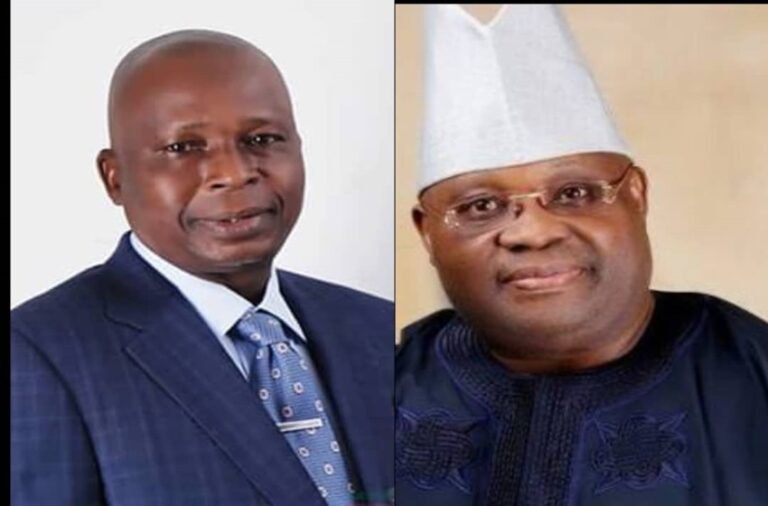
AGF Lateef Fagbemi and Osun state governor, Ademola Adeleke
According to him, the All Progressives Congress (APC) chairmen elected under former governor Gboyega Oyetola are the legal occupants of the LGAs because their tenure had not expired.
The Osun State government under Ademola Adeleke has continued to challenge that. As far as his administration is concerned, PDP chairmen and councillors that emerged in an election conducted by the Osun State Independent Electoral Commission (OSSIEC) in February are the authentic leaders.
The February election
The ICIR reports that the AGF, Fagbemi, told Adeleke before the February election to direct OSIEC to suspend the election.
In a statement on Thursday, February 20, he warned that conducting a new local government poll would be invalid and unconstitutional.
Voters during the LG poll in Osun State on Saturday, February 22. PC: OSSIEC_INFO/ X
Adeleke went on to conduct the election and inaugurated the newly elected chairpersons and councillors in the state capitalon Sunday, February 23.
Reacting, the director of media of the APC in the state, Kola Olabisi, alleged that the election results were manufactured.
The grass suffers
What began as a policy dispute has now turned into a battleground of political ego, with citizens left abandoned in the ruins.
While the bickering continues, billions meant for schools, clinics, and rural roads remain frozen, and communities sink deeper into neglect.
A dilapidated school in Ede, Osun State
The crisis that has continued to slow down the progress of the state stems from a long-standing conflict over who the authentic local government leaders are — the APC chairmen and councillors’ backed by the FG, or the state government-backed PDP chairmen elected in February 2025.
With dwindling infrastructure and rising insecurity in some communities, the political stalemate is fast turning into a humanitarian crisis.
For many in rural communities, the war between Abuja and Osogbo is more than a headline. It is a daily struggle for survival. Children trek miles to schools without teachers, patients travel long distances to find drugs, and families go to bed hungry. The disconnect between the leaders and the led has never been more glaring.
Supreme Court landmark ruling in favour of LG autonomy
The FG had draggedthe 36 state governors before the Supreme Court over the age-long debate of full autonomy for local governments.
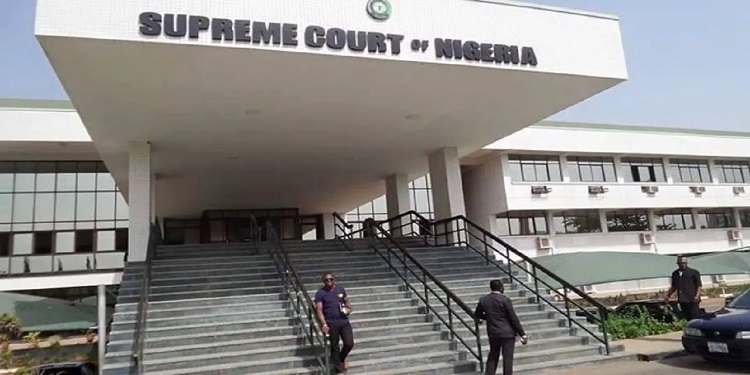
In its ruling on Thursday, July 11, 2024, the apex court said it is unconstitutional for governors to hold council funds. The apex court thereby granted the nation’s 774 LGAs financial autonomy.
Supreme Court of Nigeria
The court also ruled that it was unconstitutional for the state governments to hold on to or manage such allocations and directed the 774 LGAs to commence managing their funds.
The judgement was received with joy across the nation and was supposed to free the LGAs from the grip of the state governors. But for the people of Osun, their joy has been short-lived by the freezing of council funds due to what many termed an unnecessary political power play.
Legal battles for the soul of Osun LGAs
While the FG has insisted that the withholding is necessary pending judicial clarification of the issue, the Osun State government, insists that the elected councils under PDP are valid and that the continued freeze of funds is unlawful.
The APC contested the outcomes, and subsequent actions led to parallel claims over who legitimately controls councils.
There have been Federal High Court decisions in Osun about local government matters referenced by state lawyers as subsisting, which the state says support its position. The AGF and others, however, say further litigation and inconsistencies justify caution.
Meanwhile, the Court of Appeal have issued rulings that have been used by both sides to press claims of legitimacy. The state points to appellate decisions affirming the legitimacy of councils elected on February 22, 2025, while opponents claim jurisdictional or procedural defects inlower court orders.
Where things stand
In August 2025, the Osun State government headed to the Supreme Court, where it asked the apex Court to order the FG to refund several months of allocations.
Osun State government is seeking an order restraining the AGF, CBN and Accountant General from withholding funds and asking the court to declare the councils duly constituted. The AGF has also pressed the Supreme Court for relief against the state. The case remains live, and the final judicial resolution at the apex court will determine access to the withheld funds.
Parallel LG chairmen and councillors in Osun
The ICIR discovered that while the February 22, 2025,Local government elections conducted by the Adeleke administration produced one set of chairmen and councillors (reported as PDP winners in many accounts), there also exists chairmen and councillors from the APC who are laying claim to the seat.
On March 26, 2025, the AGF, in a letter, directed that Osun’s local government funds be withheld pending resolution of the dispute. This is the administrative action that led to the freeze of statutory transfers.
Many have labelled the existence of two sets of LG chairmen and councillors in Osun State as an aberration.
When The ICIR visited some local council secretariats in Osun, it was discovered that while the PDP chairmen and councillors elected in February are staying far away from the councils as advised by the governor, some of the APC chairmen elected under former governor, Oyetola have taken control of the secretariats which are nearly empty and deserted due to the absence of local government workers under the aegis of NULGE.
Weeds, grass take over LG secretariats
The ICIR observed during a visit that, as the bickering and power play continue, most of the LG secretariats are surrounded by overgrown grass and are a shadow of themselves.
At the Ede South LG secretariat, no single person was available when visited. Abandoned trucks belonging to the council were seen wasting away while the offices remain locked.
Empty Osogbo LG secretariat, Osun state
At Olorunda LGA, apart from policemen who were seen sleeping on duty, the once bubbling LGA was a ghost of its old self.
Similarly, no single activity or person was seen at the Ilesa East LG secretariat, while the place looked abandoned, deserted and neglected.
At Ilesa West, the secretariat looks like a ghost town; completely non-functional and unkempt.
Osun Entrance to Ede South LG Secretariat
Same as the Oshogbo LG secretariat, where policemen were seen chatting with no sign of any activity.
We are suffering, in pains, Osun residents cry out
The political tussle between the Federal and Osun State governments over the authenticity of local government leaders has left citizens across the state stranded, with residents lamenting that the paralysis of local councils has shut down essential services, deepened poverty and cut them off from the tier of government closest to them.
From Osogbo to Ilesa, Ilobu to Olorunda, residents who spoke with The ICIR expressed frustration, pain and helplessness. While their experiences differ in detail, from stalled economic activity to inaccessible council offices, their common cry is that politics has turned them into collateral damage.
“They are not working. Staff are not going there now,”said Ademola Oladejo, who described how the partisan fight between APC and PDP chairmen in the state had crippled local councils.
Ademola Oladejo, Osun State resident
He insisted that,as far as he is concerned, the February elections produced authentic chairmen from the PDP, yet he doesn’t understand why citizens have been left stranded.
“The federal government should release allocation to local government so everything can go smoothly. To me, it’s APC people that caused this,” he added.
For Tahiru Ismail in Osogbo, a motorcycle (Okada) rider who spoke in Yoruba, the breakdown has brought everyday life to a halt.
Tahiru Ismail, Osun State resident
“People who need important documents like a certificate of origin or marriage documents cannot get them. The council secretariats are shut down. People are really suffering, there is no money in town, and you know the local government is the closest to the masses,” he said.
In Ilesa, Komolafe Abiodun painted a picture of lost opportunities. “If local governments are working, new things would have entered this town because they are the closest to the masses. They would have employed new people. In my area we are suffering poor power supply — we would have cried to them to help us, but when they are not functioning, who do we cry to?” he asked.
A food seller in front of one of the local government offices, who also spoke in Yoruba, Lateefah Adeshina (Not real name), said she has been thrown into economic debt and crisis due to the continuous closure of the offices.
The single mother of four said she is not sure her children will be resuming school this session because she cannot afford their school fees and other basic needs.
“I am in pain, I am in debt. I don’t know how to cope. The council has not functioned since February. This is wickedness on the part of the government,” she lamented.
At Ilobu, Ibrahim Muyideen, a Muslim cleric, stressed the toll of the closure.
“It is affecting us badly. Most times, you have something to do at the council secretariat but cannot because the offices are closed. Workers are just idling away at home. Everything is dull. We are not happy at all,” he lamented, urging the federal government to “show mercy on us they are governing.”
For some, like Aminu Semiu in Ede South, the pain is economic. As a trader, he explained how the absence of council workers has hit his pocket.
“Sometimes, they buy through their different cooperatives and since they are not working, we that were benefiting before are no more doing so. I am personally affected because I do business around them. The times are hard due to the frozen funds,” he noted.
Muftau Lawal of Olorunda, likened the crisis to ordinary people being trampled in a battle of giants.
Muftau Lawal of Olorunda LGA, Osun State
“Local governments are the closest to the people. When people need drainage or roads, we go to them, but now none of them is working. The permits they issue to traders are also affected, and that is the cause of the high cost of items everywhere.
“If two elephants are fighting, it is the grass that suffers. We are the grass suffering. We beg them, whatever is between them, they should resolve it for the sake of the masses,” he pleaded.
Across all voices, the themes are clear: citizens want functioning councils, access to basic services, and a stop to what they see as a needless political war. They all agreed that the longer the funds remain frozen and the councils are idle, the more they feel abandoned in their own communities.
We are not partisan, our safety and security paramount – NULGE
Since the crisis began, local government workers under the aegis of the Nigeria Union of Local Government Employees (NULGE) have stayed at home, far away from the LG secretariats where they earn their living.
Speaking to The ICIR in his office at the NULGE Secretariat in Osogbo on behalf of the workers, the Osun State NULGE President, Nathaniel Kehinde Ogungbangbe, said their absence from the secretariats across the state is based on security and safety issues and not political.
Ogungbangbe insisted that their decision to stay at home is driven purely by safety concerns and not politics.
Osun NULGE President, Nathaniel Ogungbangbe
According to him, the union had to act after tensions erupted between rival political camps seeking to take over local government councils.
He recalled that on February 16, NULGE directed its members to stay away from council offices to avoid being caught in political crossfire. His fears, he said, were confirmed the very next day when a violent clash between rival groups left six people dead, including a party chieftain.
“Imagine if my members were on duty, what would have happened? I would not begin to count scores,” he said.
Not a strike, but self-preservation
The NULGE president rejected suggestions that the workers were on strike. “If we say strike, that means we have a problem with our employer. Presently, our employer is the governor of the state, and we don’t have any problem with him. This one, we are afraid of our lives. I cannot endanger the lives of my members,” he explained.
Ogungbangbe said the union would only resume normal duties when there is clarity on who the legitimate political heads of the councils are.
“Our concern is safety. Until we know the authentic or the legal political head of the local government, we will remain at home,” he said, adding that the matter is for the courts to resolve.
The NULGE boss, flanked by some of his excos, also dismissed accusations that the union was taking sides with the ruling PDP.
“That is where they are missing it. Majority of them don’t understand what unionism is about. My duty is to protect my members, not politicians. Politicians did not put me here; it is my members,” he stated.
He underscored that NULGE members are career civil servants and not political appointees.
“As civil servants, we serve any government in power. Which government is in power today? It is PDP. When APC was there, we supported them. We are not supporting any party. Our concern is the safety of our members,” he clarified.
He appealed to members across the state for patience and understanding.
“Whatever the union is doing is for their own good. Death is an irreversible reaction. It is only when you are alive that you can work, collect salary, or enjoy benefits,” he said.
On critics who accuse local government workers of “collecting salary without working,” he maintained that the safety-first stance was legitimate and backed by the national leadership of the Nigeria Labour Congress (NLC).
Adeleke accused of blocking LG staff from going to the office, defying court orders
The chairman of Ede North Local Government (APC), Elliot Adeyemi, accused Governor Adeleke of deliberately preventing local government workers from resuming duties despite a Court of Appeal judgment reinstating them (APC) as chairmen.
Speaking in his office in Ede, Adeyemi claimed that the governor’s directive has crippled grassroots governance across the state.
The APC chieftain said that since February 10, 2025, when the Court of Appeal returned them as the authentic chairmen, the governor has insisted that local government staff must not resume work.
Chairman of Ede North LGA, Elliot Adeyemi
“He is still paying them salaries, but they are not allowed to discharge their duties,” Adeyemi said.
He argued that the refusal to comply with the appellate court ruling has robbed communities of vital services such as education, civil registration, and community development.
“Students seeking school documents have been denied. Couples wanting to register their marriages have been denied. Traditional rulers who depend on statutory allocations have been denied their entitlements. This crisis has paralised development not only in Ede North but across the state,” he stressed.
Adeyemi, who insists his tenure legally began in February following the judgment, accused Adeleke of double standard.
“The governor himself is a product of the courts. It was the same court that validated his election. But when the same judiciary reinstated us, he refused to comply. That is disobedience to the rule of law,” he said.
The chairman also stated that despite the legal recognition of APC chairmen, they have yet to access statutory allocations from the Federation Account.
He said he believes that the federal government will act because the APC chairmen are recognised by law.
“Even the Attorney General and the CBN know the judgment is in our favour. It is only a matter of time before the funds are released,” Adeyemi boasted.
For now, Adeyemi explained that his administration is surviving on internally generated revenue (IGR) to handle pressing community needs.
Grassroots in crisis, FG bias, says Osun governor’s aide
The Special Adviser (SA) to the Osun State Governor on Legal Matters, Nurudeen Kareem, in an interview accused the Federal Government of plunging local governance into chaos by unlawfully withholding allocations meant for local governments in the state since February 2025.
Kareem described the impact as devastating, stressing that critical grassroots services have collapsed.
SA Legal to Osun Governor, Nurudeen Kareem
“Governance at the local level has been crippled since February when the federal government withheld allocations.
“Primary school teachers, health workers and even traditional rulers depend on these funds. Today, billions of naira are lying fallow at the Central Bank while our people suffer,” he said.
Kareem, a lawyer, traced the crisis to the controversial local government elections hurriedly conducted by the APC-led administration of former Governor Oyetola in 2022. He explained that the polls violated the Electoral Act, which requires at least 360 days’ notice before such elections.
“Oyetola’s government gave just two months’ notice. Both PDP and APP challenged the illegality in court and by November 2022, two separate judgments nullified the elections and sacked the APC chairmen and councillors,” Kareem noted.
The SA revealed that the Osun State Government had filed suits at the Supreme Court demanding that funds be released directly to the elected PDP chairmen in line with last year’s Supreme Court ruling on local government autonomy.
“The NBA itself is not a wing of PDP, but it has said the Federal Government is setting a dangerous precedent. If this continues, any administration could decide to punish opposition states by withholding allocations,” he warned.
Kareem further alleged that the APC’s forceful occupation of local councils with police support earlier this year led to violence that claimed lives. He said to avert further bloodshed, Governor Adeleke appealed to the elected PDP chairmen to stay away temporarily.
He insisted that the matter is no longer about politics but about law, governance and survival at the grassroots.
He blamed the Attorney General of the Federation, who he claimed should uphold court judgments but chose to disregard them.
“Meanwhile, our people, including teachers, health workers and traditional rulers, are bearing the brunt,” he lamented.
Osun LG funds safe with us — OAGF
The Office of the Accountant General of the Federation (OAGF), in an interview, has clarified that the statutory allocations meant for local governments in the state remain in its custody and have not been disbursed to any party.
The spokesperson, Bala Mokwa, explained that the funds are being withheld due to a pending court case over the matter.
He dismissed claims that the allocations had been diverted, noting that the money is domiciled in the appropriate office and will be released once the legal process is concluded.
According to Mokwa, “the fund has not been released to anyone… it will be released as soon as the court clears the air.”
NBA demands release of Osun LG funds
In its intervention on the matter, the Nigeria Bar Assoc9atin, NBA, urged the FG to release statutory allocations owed to LGAs in Osun State, describing the prolonged withholding of funds as a violation of constitutional provisions and a blow to judicial authority.
The NBA, in a letter to the AGF and Minister of Justice, Fagbemi, urged the central government to respect the rule of law and refrain from setting what it termed a “dangerous precedent” that weakens confidence in democratic institutions.
The association insisted that, “the continued withholding of the funds is unconstitutional, illegal, and a dangerous affront to judicial pronouncements.”
Afam Osigwe, president of the Nigerian Bar Association (NBA)
In the letter jointly signed by its President, Mazi Afam Osigwe, a Senior Advocate of Nigeria and General Secretary, Mobolaji Ojibara, respectively, voiced concern over unrefuted reports that allocations from the Federation Account meant for Osun councils have been withheld since February 2025 and stressed that the funds were crucial to the effective administration of the grassroots.
AGF’s office declined comment
When contacted, the AGF’s spokesperson, Kamar Ogundele, Asaid he could not comment on a case already before the courts.
He told The ICIR that it would be inappropriate to speak on the issue while litigation is ongoing. “I will not like to talk about it because the matter is in court. You, as a journalist, know that when a matter is in court we don’t discuss it,” he said.
Ogundele confirmed that the dispute has escalated to the Supreme Court, and both parties involved have filed complaints.
“We are talking about a legal matter here… as the other side is complaining, the other side too is complaining. So let’s wait for the court,” he added.
He maintained that further clarifications on the Osun funds will only be possible after the court delivers its judgment.
IMISIOLUWA Eniola Ayanwale, otherwise known as Imisi, has emerged winner of the Big Brother Naija Season 10, walking away with N150 million prize money.
She was announced the winner by Ebuka, the host of the show, at the grand finale.
In her speech, Imisi thanked God, her fans, and everyone who supported her throughout the journey.
“I am very happy, I am very excited… Thank you to everyone who voted for me. I am so shocked, I never expected it. May God bless you beyond your imagination,” she stated.
The ICIR reports that the show began with 29 housemates vying for the prize in the course of ten weeks.
In the ninth week, the top ten contenders for the prize were announced: Isabella, Sultana, Kaybobo, Imisi, Mensan, Faith, Koyin, Dede, Jason Jae, and Kola.
However, during the tenth week, on Thursday, October 2, Faith, a top contender for the prize, was disqualified from the show after a physical altercation with Sultana over a basket, bringing the number of housemates to nine.
The disqualification marked the first time a housemate would be dismissed three days before the show’s end.
Viewers and netizens had mixed reactions to the decision, while some believed it was well-deserved due to his previous altercations with other housemates, others deemed it unfair as he had received no prior warning or strike before the disqualification.
The finale saw Ebuka evicting Kaybobo, Isabella, Mensan and Jason Jae, narrowing the competition to the top five.
Following another round of evictions, with Kola, Sultana and Koyin leaving, Dede and Imisi emerged as the top two finalists, after which Imisi was declared the winner.
The duo had captured viewers’ hearts in distinctive ways, Imisi, with her funny looks and makeup, jovial charm, and street slang; and Dede, with her soft-girl aura and premium demeanour.
Imisi had surpassed the other finalists with 42.8 per cent of the votes from viewers.
How viewers voted
The season came with many twists and turns introduced by its organisers, including a Head of House challenger, the Red Telephone twist that stirred up drama in the house with fake evictions, and various offers and different weekly themes.
A theme that particularly intrigued viewers was the Face Your Fears and Bare Minimum week, during which Big Brother introduced frightening elements to scare the housemates. In the following week, they were deprived of certain privileges such as using the washing machine, cooking gas, and even had to sleep on bare mats instead of mattresses.
The ICIR had earlier reported that as the show reached its tenth season, many viewers were uncertain about what to expect, following widespread complaints about the previous Season 9 concerning the quality of housemates and the game they brought.
But most viewers had applauded the performance of this season while noting that this has been one of the best seasons in recent years.