Home Blog Page 1808

Coscharis Motors yet to replace my faulty Jaguar Land Rover despite court ruling -Sofola

SENIOR Advocate of Nigeria (SAN) Olusina Sofola says the dismissal of an appeal for a stay of execution by a Lagos State High Court delivered sometime in February has not been honoured by Coscharis Motors.

In a phone conversation with The ICIR, Sofola explained that the carmaker was yet to replace his faulty Jaguar Land Rover as instructed by the court.

He said the court had refused to grant an appeal by Coscharis Motors to stay execution of the judgement given by a lower court pending the determination of an appeal on the said judgement.

“The High Court refused that prayer, that even if they want to appeal, they should still comply with the other judgement by releasing the new car to me,” he said.

In a phone conversation with The ICIR, the Spokesperson for the Coscharis group Abiona Babarinde, said the verdict passed by the magistrate was still being contested in court.

He, however, declined speaking extensively on the issue, as it was still being decided upon by the court.

“I’m not competent to speak about a case that is still in court,” he said.

According to a report, Olusina Sofola had, in 2019, dragged Coscharis Motors Ltd to a magistrate court in Lagos over a faulty Jaguar Land Rover valued at over N24million.

Sofola had described the car as a black 2015 model Jaguar XJ 2.0 Sedan, noting that the purchase had come with a three-year warranty which stipulated that he would enjoy the car without issues.

The SAN stated that the warranty pack, included as part of the car maintenance package, had been removed upon delivery of the car, and the car began to show signs of developing a fault within a few weeks.

Coscharis had disagreed with some of the claims, stating that the car was delivered in perfect condition.

They stated that the warranty terms only covered certain problems that the car may have during the warranty period.

The carmaker maintained that Sofola was not entitled to a replacement of the Jaguar Sedan as there was no such provision in the warranty.

However, the Igbosere Magistrate’s Court passed judgment in favour of the SAN, ordering Coscharis and Jaguar to replace the faulty car with a brand new one.

Coscharis Motors had filed for an appeal on the judgement and another appeal for a stay on the execution of the judgement, but the latter was dismissed by a high court in Lagos State earlier this year.

Three men sentenced to 33 years over killing of Nigerian student in Cyprus

A NIGERIAN Christopher Ezeh  and two others have been sentenced to 33 years imprisonment  by a Cyprus court for their roles in the murder of 25-year-old Nigerian student Walshak Augustine Ngok, whose lifeless body was found in a forest along Haspolat- Tashkent highway.

The two other persons linked to the crime and also sentenced are a Ghanaian Nana Nkansah and a Zimbabwean Wayne Moyo.

Judge Şerife Kâtip of the Lefkosa High Criminal Court on Monday, May 10, sentenced Ezeh, who was the principal suspect, to 27 years in prison for singlehandedly killing his roomate Ngok, while Nkansah and Moyo were given 3 years each for helping to transport his body to the forest.

Court president Nüvit Gazi said on April 19, 2019, Ezeh and Ngok got into a fierce argument over a girl which led to a fight. This resulted in the victim being beaten to a state of unconsciousness and later dumped in the forest.

“Christopher reportedly beat Walshak Augustine severely which made him unconscious. He dragged him down the stairs of the apartment and took him to the forest area where he dumped him after seeing that he was no longer breathing, instead of going to the hospital,” Gazi told the court.

Ngok is among 100 Nigerians who have lost their lives on the Island of Cyprus and the Nigerians in Diaspora Commission (NIDCOM) last August called for the country to be blacklisted over mysterious deaths occurring there without checks.

Chairman of the Commission Abike Dabiri-Erewa also warned parents to desist from sending their children to the country for studies, saying that Nigeria had no diplomatic ties with Cyprus and most of the courses offered by institutions in the country were unaccredited.

A judge in Kaduna State High Court Justice Amina Ahmad Bello, whose son was Ibrahim Khaleel Bello, died in the country under questionable circumstances, alleging that the vital organs of some of the students killed could have been harvested as her son’s stomach was opened and sutured when his corpse was released.

MySarsStory: From sleep to fear and frustration

WHEN a young video game repairer found himself on the radar of SARS, the drama that unfolded had all the intrigue of an action video game – except instead of the fun, it was all fear and frustration.

I’m Henry Ifeanyi. I sell and repair video games in New Haven, a suburb in Enugu.

My SARS experience cannot be described as a story. It was a nightmare.

In my 30 years of living, this experience counts as one of, if not the worst.

At about 6 am on February 8, 2017, I was forced out of sleep by a loud bang on my door. Six men wielding guns barged into my room, knocking down the door in the process. They ordered me to lie on the floor. I obeyed. I thought they were armed robbers. I had no money in the house and feared I would be relieved of my phone and beaten instead.

The men wanted to know the number of people in the house, and I told them it was just me. They seized my phone and ordered me to stand. They ransacked the house while I watched on and, after they found nothing of importance, asked me to put on my clothes, get the keys and lock the door.

Although at this point, I feared the men might be kidnappers, I obeyed without hesitation because I was overwhelmed by fear and confusion. I could not think straight and certainly, could not afford the time and concentration to guess who they were. The men helped me fix the door they had kicked down. Then they went out with me and locked it.

Outside, I saw a lady. I did not recognize her. It was odd how she had bent her head downwards, as though she did not want me to recognize her. Another person I remember seeing while being taken away was my female neighbour, who works in a bank. She had come out to wash her clothes, only to see me being taken away.

I noticed that the men’s guns were taped with colours identifiable with the Nigeria Police Force (NPF) – blue, yellow and green. But that was not enough to calm my nerves.

I asked the men where they were taking me. As an answer, one of them, who I later learnt was called Bassy, slapped me. “If you knew where you were going, you would just keep quiet,” he said.

The weight of that slap, coupled with how threatening the men looked, made me swallow all my complaints. The men wore mufti and, though I was unsure if they were police officers, I followed them to avoid being assaulted any further.

They took me to their parked car and deliberated on whether to throw me into the boot of the car or not before deciding to handcuff me and let me sit in the car with them.

I noticed another car apart from the one they had made me board. In the company of the mysterious lady, I had seen earlier, some of the men entered this other car.


You may wish to read

MySARSStory: Abba Kyari, Where is Eric Okwaji?

Brutalised by SARS: Out of nowhere

#MySARSSTORY: Caught in open fire


Soon, both cars drove off.

During the ride, the driver asked me a question: “Where is Darlington?”

Darlington was a friend of mine who had stayed in my house for about three weeks. I’d known Darlington, who owned a boutique in Delta state, for over seven years and often repaired his video games. After his stay at my place, Darlington had gone to Lagos, where he said he needed to meet someone.

The men checked my phone. They scrolled through call logs and read the text and WhatsApp messages, confirming that the last time Darlington and I spoke was when he had called to tell me he had arrived in Lagos.

Meanwhile, as the car went farther away from the places I knew, my fears intensified.

The men began sharing stories of people they had killed and the cruel things they had done in the past. I was not sure whether those were true stories or lies meant to scare me. I noticed that one of the men kept receiving text messages of people’s details. I wondered if that was the way the men had found me too.

Many times, my phone rang with calls and beeped with messages. I figured that someone had told my family members about what had happened to me. I suspect some of the calls were also from my clients – I had some meetings scheduled for the next morning. The officers refused to allow me to answer a single call.

By this time, the cars had left Enugu State and entered Anambra State. We drove into Awka, Anambra’s capital city, and drove out of it, journeying farther into places that were not familiar to me.

Soon, we reached our destination: Anambra Police Station in Awkuzu. I realized the men were officers of the Special Anti-Robbery Squad (SARS) in Awkuzu. Awkuzu is a town in the Oyi Local Government Area of Anambra State.

As I was being led through the building’s hallway, I began to remember the numerous gory stories I had heard about the Awkuzu SARS unit, ranging from killings to torture.

The men took me to the office of the Commanding Officer. The Commanding Officer asked me where Darlington was. I told him what I had told the men: Darlington was in Lagos. The Commanding Officer told the men to prepare because they were leaving for Lagos that same day to look for Darlington.

The men took me to a room, handcuffed me to a chair and told me to sit on the floor. I sat. They left me and went out. At 11 a.m., they returned and told me it was time to go to Lagos.

That was how I travelled with the SARS officer to Lagos on the same day I was arrested.

We left the mysterious lady at the station and drove out in two cars. I was told to call Darlington and ask if I could stay at his house in Lagos as I was on my way there to buy some electronics and would need accommodation. Darlington agreed. I felt bad having to contribute to a plan to trap Darlington, not least because I sensed the SARS men were up to no good.

At this point, I noticed my body and breath had begun to stink as I was yet to take a bath or brush my teeth since that rude awakening by the SARS officers back home.

My phone also kept buzzing with calls, and each time it did, the SARS men would ask me to identify who it was. To them, I ended up identifying a customer, my mum, and two of my brothers.

It was 7 pm when we arrived in Lagos that same day. I called Darlington, who said he couldn’t come and pick me up as it was late. Darlington, however, proposed to send me the contact number of somebody who lived nearby and who would accommodate me in his place.

The SARS officers told me to agree to the new plan.

I called Darlington’s contact, who told me Darlington had already called and told him to expect my call. The person’s name was Daniel. Daniel told me he was cooking, but he would wrap it up to come to pick me.

The SARS men told me they would shoot Daniel if he ran or did anything outside the plan. They also promised to let me go if they caught Daniel. They removed the handcuffs from my hands and stood aside, watching.

Soon afterwards, I saw a man alight from a bike. I called Daniel’s number, and this man answered. Daniel came close to me – and that is when the SARS officers grabbed him.

Daniel was shocked. He tried pushing the SARS officers off him. But the officers started to beat him.

The SARS officers put handcuffs on Daniel’s hands and pushed him into the car. He looked perplexed. I felt even worse about the situation and had to tell him I had had no choice but to do as the SARS officers had directed; that it was not personal or intentional.

The SARS officers took Daniel and me to a hotel, where we lodged.

Inside the room, the officers told us to sit in a chair close to the window. We were then handcuffed to the window. By this time, I was weak and hungry. Daniel and I slept in the chair while the officers slept on the bed.

On the morning of February 9, 2017, the SARS officers told Daniel and me that their main interest was Darlington and that it would be best for us both to come up with the idea that would help them trap their target, else whatever Darlington did would be on our heads. They said they would release us if we helped them catch Darlington. We started to rack our brains as to how we would make that happen.

Soon, a plan was hatched.

The SARS officers told Daniel to call Darlington and tell him that he and I wanted to hang out with him. Daniel made the call. Darlington agreed. Darlington was in Lekki and asked Daniel and me to come over,

All through the ride, the SARS officers kept promising us freedom if they managed to catch Darlington.

We made calls to Darlington and got him to come to a street in the Lekki area, where the SARS officers arrested him.

The officers asked Darlington where he was staying, and he said he was squatting in somebody’s apartment. They asked him to take them there, and he did.

There were two men in that apartment. The SARS officers handcuffed them, too. They asked the men where their car was, and they pointed at it – a Mercedes Benz. Some of the SARS officers got into the car, and the two men found at the apartment.

The convoy of three cars headed back to Awkuzu.

Along the way, the tires of one of the cars burst. Everyone slept on the road that night. The following morning, the journey to Awkuzu continued.

At Awkuzu, the Commanding Officer demanded that all of us –  Darlington, Daniel, the two other men and I – write statements. Daniel complained: Hadn’t the officers promised to let us go if we delivered Darlington? The officers started to beat him, and I used his experience to advise myself against complaining too. I didn’t want to add wounds to my hunger.

The SARS officers were the ones who eventually wrote statements for all of us. They did not allow any of us to see what they had written.

Afterwards, I remember being led to a place called ‘torture room’, which housed different weapons – knives, hammers, and others. It was a scary sight.

The SARS officers claimed Darlington’s case was a special case, so they took him behind the torture room. A few minutes later, I heard Darlington screaming – a kind of deeply disturbing screaming I had never heard before.

When the SARS officers brought Darlington back, he looked drained of strength. “Where is the car?” I heard the SARS officers ask him.

The SARS officers then told us to take off our clothes. We did, leaving only our boxer shorts. I remember having my wallet on me. I also remember another SARS officer coming in and asking us to follow her, which we did.

I begged this SARS officer to give me some money from my wallet. I had N4,000 in there and wanted her to give me 2000. I had heard prison stories of old inmates beating up new inmates and wanted to equip myself against any such assault. The SARS officer said she would give me N500 and keep the rest until my release. I agreed.

They put me in Cell 2, home to at least 50 inmates.

The inmates told those of us who had just come into the cell that we needed to sing and dance for them as entertainment as part of our ‘initiation’ into the cell. Nobody was in the mood to sing or dance, but what had to be done had to be done. Imagine being in pain and being asked to forget all of that to make merry.

The cell stank. Its floor was concrete and dirty. At night, unwashed bodies piled on top of one another. I could barely believe what my eyes were seeing. Everything felt strange and cold.

Darlington was kept in another cell, so I could not see him again.

The old inmates took my N500, then let me in on the rules and the culture of the cell.

There were leaders in the cell who ensured that everyone got a portion from what they (the leaders) collected from any other person.

If the leaders said, “This cell is locked,” it meant that every soul in the cell had to keep quiet. One day, those words were said, and I flouted them by speaking to someone by my side.

I was immediately told to ‘mount the wall’ as punishment. ‘Mounting the wall’ meant facing the wall and pretending to climb it.

There were other code-words like MP3 and Woofer. When a leader said, “Give him MP3 or Woofer,” he was instructing the man in charge of torturing inmates to either slapping someone on the back or walloped them.  MP3 was to a slap as Woofer was to a punch.

After ‘mounting the wall’, I received three MP3s. The MP3s were so sound that I made sure it was the last time I disobeyed cell rules.

In terms of food, Garri was the meal of the cell. Three people shared a bowl of Garri. They would pour Garri into a bowl and ask everyone to wait until the Garri would swell. They drank Garri in the morning and, in the afternoon, ate a tiny portion of bread.

Some inmates had family and friends coming to see them bring them food. But nobody came for me, so I depended on whatever I could beg from the next inmate.

I remember forcing myself to sleep many times, even when I didn’t feel sleepy.

I met a boy who looked less than 18-years-old in the cell. The boy said SARS had arrested him because he stole N4,000. He had wounds that looked infected all over his body.

Another inmate explained that his cousin had given him a phone and, unknown to him, the phone had been taken from someone who had been kidnapped. He was then traced and arrested by SARS.

Indeed, it seemed to me that most of the inmates were there due to unfair and unfortunate circumstances.

There was also a man, short in stature, who entertained inmates with stories of his adventures. But he was a mean and angry man. One day, he almost beat another inmate to death. I cannot remember exactly what the other inmate did, but what I saw ensue was traumatizing.

I ended up spending seven days in the cell, alone, with no family or friend seeing me.

Anytime I saw a SARS officer and asked what was going on with my case, they would tell me to relax as investigations were ongoing. I was broken at a point.

One night, I remember, a gunshot rang out. In the morning, news spread that the SARS officers had shot somebody.

I also recall an unforgettable night when the SARS officers brought in new people into the cell. A headcount was taken, and it showed there were ninety-two people inside a cell meant to accommodate only 20 persons.

On the seventh day of my stay in the cell, one of the SARS officers who went by the name Pele came and told me that I could bail myself if I had money. I agreed to his suggestion, being tired of the living conditions in the cell. Pele and three other officers—Naked Wire, Bassy and another officer whose name I’ve forgotten—brought me out from the cell.

“How much do you want,” I asked.

“N100,000,” they answered.

I could not afford that amount. I thus negotiated with them, and they settled for N50,000. I suggested making an online money transfer, but the officers rejected the idea; they wanted cash.

I was allowed to call a family friend called Emeka, who lived in Awka. I begged Emeka to come to my rescue at Awkuzu SARS. I assured Emeka that I had not done anything wrong; he just needed him to come and bail me. Emeka agreed.

I used my mobile phone to credit N55,000 to Emeka’s account and asked him to use N5,000 to cover his transport fare. Emeka brought the N50,000 to the SARS station. The SARS officers gave Emeka a bail bond to sign, and he did. The officers told me I would have to come back later for documentation. I agreed.

The officers looked for my clothes at the counter but could not find them. They looked for my wallet and couldn’t find it too. They gave me another person’s clothes to wear. I wasn’t given footwear.

It was night on Feb. 15, 2017, when I finally stepped out of the station. Emeka and I took a bike to Nnamdi Azikiwe University Junction, Awka. I struggled to secure a bus to Enugu and, while I stood by the roadside waiting for a bus, Emeka went home. By midnight, I was still stranded and desperate. I flagged down a bus carrying weave-on and told the driver about my predicament. The driver agreed to let me hitch a ride. I got to Enugu around 3 am.

When I stepped into the compound, my neighbours ran out to meet me, screaming in joy.

Before I left the SARS station, two of the officers had explained that they were only ‘doing their job.’ They gave me their numbers and told me to call them anytime I had any leads on drug dealers. They promised to give me a share of the money they would make. I cursed them a thousand times in my mind.

I took their numbers all the same, although I have since deleted them.

After my stay at Awkuzu SARS, I continue to live in fear, haunted by the experience, thinking they would come for me again. At some point in SARS custody, I genuinely thought I was going to die. I remember fearing that the officers would just bring out all the inmates one night and shoot us, leaving no trace or record of our lives.

Later, I found out that on the seventh day of my stay in SARS custody (which happened to be the day Pele came to meet me), my family had come with a lawyer to see me, but the officers had denied them access. The officers told my family and the lawyer to return the next day.

I also learnt that the officers had lied to my mother, telling her that they had been feeding me in the cell. They told her further that the cost of my feeding was either N5,000 or N10,000. Out of the relief of knowing I was alive and being well-taken care of, my mother paid them N10 000.

Behind the scenes, I continued to suffer. Not even the SARS officer who took my wallet once gave me anything to eat or drink.

I believe the SARS officers preyed on my desperation to leave the cell. If I had known my family was to visit the next day, I would have stayed put and not caved in.

Anyway, do you remember the mysterious lady I had spotted on the morning of my arrest? She was apparently Darlington’s girlfriend. I later found out that she visited him during Darlington’s stay at my house in my absence.

The SARS officers had tracked the girl, caught her and asked her where Darlington was. She directed them to my house, and that is how my nightmare started.

I know the lady could have called Darlington directly, but the thing is that SARS officers like to trap more than one person. Anytime they go to make an arrest, they like to take in the people who are with the target because that allows them to make more money through intimidation and extortion. They are not into law enforcement – they are into business.

I was later given the full story of the Darlington case: A car was stolen in Awka the same year I was arrested, and the camera that was in the car was given to Darlington to sell. Darlington sold it to someone who, when SARS tracked and caught, confessed that he got the camera from Darlington.

Darlington spent about two months and three weeks in SARS custody before being released. I still consider him a friend. Indeed, I am still on speaking terms not only with him but with Daniel too.

Meanwhile, I have been trying to mend broken relationships with my customers ever since my experience. Most of my clients grew impatient with me after I had failed to pick their calls or respond to their messages during my week-long SARS ordeal. Some have stopped doing business with me. A few have sympathized with me, while others have simply not cared.

My experience at the hands of SARS has changed me significantly. I have become increasingly insecure. I have also been trying to mend broken relationships with my customers ever since my experience. Most of my clients grew impatient with me after I had failed to pick their calls or respond to their messages during my week-long SARS ordeal. Some have stopped doing business with me.

During the #ENDSARS protests that swept across the country in October, I was proud to lend my presence and voice because the issue hit close to home.

When I heard people utter negative comments about those protesting, I found it interesting – if only they knew how it felt.

This story is part of a multimedia project by Tiger Eye Foundation and media partners across Nigeria, documenting police brutality in Nigeria and advocating for police reform.

Ndume replies southern governors, says Nigeria’s problem not open grazing

SENATOR representing Borno South Senatorial District Ali Ndume has replied southern governors, saying that Nigeria’s problem is not open grazing but insecurity.

Ndume said this on Thursday when he featured on Channels Tv programme Politics Today to discuss the southern governors’ resolution.

Ndume said security challenges in the country were peculiar to various regions and the governors should have presented their solutions to President Muhammadu Buhari in a closed-door meeting.


Read Also:

“We have serious security challenges in this country that are different in all the geopolitical zones and I was expecting the governors to come up with the solutions that they have mentioned and discuss with the president in a closed-session as we call it in the Senate, not to come out to the media and issue a blanket statement,” Ndume said.

He argued that he was expecting the governors to come out with a solution to other problems like they decided to ban open grazing in all southern states.

He argued that the governors’ resolutions were not practical and realistic, noting that it was a ‘blanket statement.’

The Borno senator also said the governors, being the chief security officers of their states in the south, should not politicise or grandstand over the security challenges.

The ICIR had reported on Tuesday that the 15 southern governors in Nigeria have banned open grazing in their states.

The governors made the resolution following a meeting held in Asaba, Delta State, over security challenges in the region.

Nigeria’s economy, security better now than in 2015 – Buhari

PRESIDENT Muhammadu Buhari has said that the Nigerian economy and security are now better than what he met in 2015.

Buhari stated this while addressing reporters after observing the Eid-il-Fitri prayers at the State House in Abuja on Thursday.

He said his administration would use all available resources and manpower in dealing with bandits to ensure that farmers returned to their farms and boost food security for the country and for export.

“The law enforcement agencies are working hard to regain confidence against bandits so that we can go back to the land. This is very important,” he said.

“This is what the agencies are busy doing right now. We want people to go back to the land so that we can get enough food for the country and even export.

“With the resources and manpower available to us, we are working very hard. We are hoping Nigerians will understand the problem. Nigerians know at what stage we came in 2015, what state we are today both on security and the economy and we are doing our best.”

READ ALSONdume replies southern governors, says Nigeria’s problem not open grazing

He commended the National Assembly for its support, saying, “it is cooperating very well. Within the resources available, they are certainly giving us priority on our (military) requests.”

He pleaded with the country’s elite to show understanding as his administration was working hard with available resources at its disposal to address insecurity in the country.

He said the military were making efforts to tackle the situation, but it would take a ‘very long process’ to achieve the desired results. The elite, he said, should make the attempt to understand the military.

“If we order weapons and armored vehicles, it takes time for the manufacturers.

“It takes time to ship them, and when brought here eventually, they are taken to training institutions, train the trainers before sending them to the field. This is a very long process. I expect Nigerians to be more understanding on the issues involved, looking at the time and available resources.

“For example, when we came in, in the Northeast, ask people in Adamawa and Borno States and the South-South in terms of security.

“Without security, you can’t do anything. Our big surprise and disappointment is what is happening in the North-West and we are dealing with it,” he said.

Boko Haram has taken over 23 local governments in Nigeria, according to military sources. This was not this bad before 2015 despite that the terrorists held some villages in the country then.

Kidnapping and farmer-heeder crisis have upset the country’s economy and sociognomy under Buhari-.

The Central Bank of Nigeria (CBN) Governor Godwin Emefiele had, in March, attributed the rising inflation in the country to devaluation of the naira and security crisis. The Nigerian economy has  survived  recession twice since Buhari took over in 2015.

The CBN governor added that in many parts of the country, particularly the food-producing areas, farmers faced frequent attacks by herdsmen and bandits in their farms.

The apex bank’s governor said that while the bank was making significant interventions in the agricultural sector, the rising insecurity was limiting expected outcomes in terms of supply to the markets.

According to the National Bureau of Statistics (NBS) Consumer Price Index (CPI) of March 2020,  Nigeria’s inflation rate increased to 18.17 per cent in March 2021, indicating the highest level since January 2017.

The report also revealed that food for the increasing number of poor Nigerians was not getting cheaper as food inflation increased from 21.79 in February to 22.95 percent in March, the highest point since the 2009 data series.

According to the World Poverty Clock, Nigeria has the highest number of poor people globally, with 105 million living in extreme poverty. Also, the country is home to one of the largest unemployment rates globally, with 33.3 percent of its working population out of jobs.


Photos of ‘unmarked helicopters flying over forest in Maiduguri’ were shot in USA, not Nigeria

A  Twitter post shared thousands of times has claimed that three photos of unmarked helicopters were taken while “flying over forest in Maiduguri airdropping packages.”

It noted that, in one of the instances, the chopper crashed and villagers who went to the crash site saw two caucasian men burning briefcases of dollar bills before fleeing. 

This tweet is the first in a thread alleging how foreign countries – France and Chad – fuel the Boko Haram crisis, hence frustrating the efforts of the Nigerian military.

The tweet made on May 11, 2021 read, “2015. Residents in several villages talk about unmarked helicopters flying over forests in Maiduguri air dropping packages. Especially at night. In one incident they watched the helicopter crashes. Villagers ran to the scene to rescue the occupants and were stunned to see two Caucasian men burning briefcases of hundred dollar bills before running away [from] the crash site.”

Within 24 hours, the post generated almost 4, 000 shares and over 4,500 reactions. The account from which it was shared, Defense Nigeria news [@DefenseNigeria], states in its bio that it is not related to Nigeria’s military. It has over 41, 000 followers.

The Claim

The photos of the helicopters were taken while they were flying over forest in Maiduguri.

The Findings

Findings by the FactCheckHub show that the claim is inaccurate and misleading.

Maiduguri is the capital of Borno State and its forest, Sambisa, is habited by Islamist terrorist group, Boko Haram, which made global headlines in 2014 when they abducted more than 270 school girls.

READ ALSOFACT CHECK: Trending video alleging Somalia’s president in fisticuffs with deputy is false

For over a decade, Nigeria has been battling insurgency at its North-East region. The prolonged fight has led to numerous conspiracy theories and counter theories ranging from  sponsorship of terror to make the country ungovernable to foreign forces’ involvement for financial gains or religious agenda.

The tweet by @DefenseNigeria comes at a time when visuals of some foreigners said to be mercenaries, allegedly killed by insurgents, are in circulation.

The FactCheckHub using a Reverse Image Search Technology, traced the first image to Mount Airy, a neighbourhood in Philadelphia, in the U.S, where residents panicked over a low-flying unmarked helicopter.

This incident happened in 2017.

The authorities of the Philadelphia Electric Company (PECO) confirmed that the helicopter was monitoring transmission lines against overgrown vegetation, PhillyVoice reported

“Yes, we do helicopter patrols of transmission lines and related equipment on a regular basis,” PECO Spokesperson Greg Smore stated. “It gives us different vantage points so we can document any conditions of concern and relay it back to the repair crews…”

It is clear that the photograph did not originate from Nigeria.

The second photograph did not also emanate from Nigeria but Medina County, in Ohio, U.S.

In June of 2016, residents told press that a  helicopter was flying as low as 40 yards and they heard gunshots which made them panic.

The 43-second of the 3-minute, 18-second video news report by News 4 San Antonio, showed a very clear similarity with the second image shared in the tweet under verification.

The image was either a screengrab taken from the video or a still one taken around the same time the video of the flying helicopter was recorded. Therefore, it is not in Nigeria as claimed in the tweet.

Further search showed the third picture was taken in May 2019 by Schuyler Kropf for The Post and Courier Newspaper, the latter being a US-based newspaper founded in 1803.

“An FBI helicopter above the Charleston area on Wednesday, May 22, 2019,” the photo caption read.

The photograph was embedded in an article with the headline FBI helicopters spotted above Mount Pleasant area. It’s not what you think. It was authored by Michael Majchrowicz.

The report was to clarify a misconception over the alleged hovering of helicopters in search of persons believed to be on the wanted list of the Federal Bureau of Investigation (FBI).

In conclusion, the Twitter user @DefenseNigeria misinformed the public.   Linking these photographs to helicopters “flying over forests in Maiduguri air dropping packages” is inaccurate and a misrepresentation because the photographs were all from different incidents that happened in the US in 2016, 2017 and 2019.

The Verdict

The three photos depict events that happened in the USA in 2016, 2017 and 2019. They do not show helicopters “flying over forests in Maiduguri air dropping packages.” Therefore, the videos are MISLEADING.

Buhari expresses surprise over insecurity in North-West

PRESIDENT Muhammadu Buhari has expressed surprise and disappointment with the deteriorating state of security in  North-West Nigeria.

Special Assistant to the President on Media and Publicity Garba Shehu, who said this in a statement on Thursday, pleaded with the country’s elite to show understanding as his administration was working hard with available resources at its disposal to address insecurity in the country.

He said the military were making efforts to tackle the situation, but it would take a ‘very long process’ to achieve the desired results.

“The elite should make the attempt to understand the military. If we order for weapons and armored vehicles, it takes time for the manufacturers. It takes time to ship them and when brought here eventually, they are taken to training institutions, train the trainers before sending them to the field. This is a very long process,” the statement read in part.

READ ALSORestructuring: Okowa, Wike hit critics of southern governors

“I expect Nigerians to be more understanding on the issues involved, looking at the time and available resources.

“For example, when we came in, in the Northeast, ask people in Adamawa and Borno States and the South South in terms of security. Without security, you can’t do anything. Our big surprise and disappointment are what is happening in the North-West and we are dealing with it.”

The North-West region, which comprises Jigawa, Kaduna, Kano, Katsina, Kebbi, Sokoto and Zamfara, has, in recent times, been plagued with the menace of banditry, terrorism as well as conflicts between herders and farmers. School children have, in most cases, been at the receiving end of criminals as they are kidnapped for ransom.

More than 600 students have been kidnapped from schools in the region since the beginning of this year. Recently, there have been kidnaps of 29 students of the Federal College of Forestry Mechanisation, Afaka, and those of Greenfield University, both in Kaduna State.


READ ALSO:


Students from the Federal College of Forestry Mechanisation were released after an undisclosed amount was paid as ransom.

Some of the students of Greenfield University are, however, not lucky as five of the kidnapped students were killed following failure to meet up with the sum of N100 million ransom.

The opposition Peoples Democratic Party (PDP) as well as social-political and civil society organisations has continued to criticise the manner the Buhari’s administration is handling the country’s security. They have asked him to sit up or resign to give way to a more competent hand.

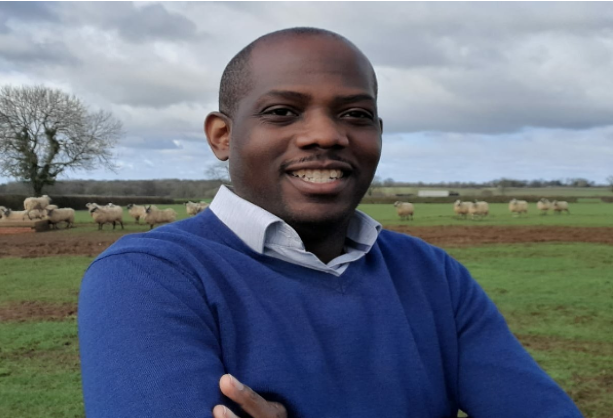
Newly elected councillor for Buckingham, Adekunle Osibogun, calls for indigenous Nigerian constitution


THE newly elected councillor in Buckingham Adekunle Osibogun says a constitution that is indigenous to the Nigerian people is required if the country is to overcome its current challenges.

Osibogun, who is a former House of Representatives candidate for Ijebu Central Federal Constituency on the platform of the Social Democratic Party (SDP) in 2019 general elections,  spoke with journalists against the backdrop of his election into the Buckinghamshire Council in England, United Kingdom.

The newly elected councillor, who hails from Ijebu-Ode, Ogun State, Nigeria, was elected under the Conservative and Unionist party after pooling 953 votes in the Buckingham town council election that took place on May 6.

He said the process of developing an ‘autochthonous’ constitution must be open, fair and transparent, with every Nigerian given the opportunity to contribute to the constitutional process through a referendum.

In his view, a constitution must reflect the hopes and aspirations of the people for whom it was being administered, otherwise it would only be another set of rules to be scorned and disparaged by the people, a fate currently being suffered by the 1999 Constitution.

Osibogun also shared his vision of an improved education system in the Buckinghamshire Council that would be accountable to the public.

“I am passionate about many issues, especially education. I would like to champion the cause for local schools to be more accountable to children, parents and our community, in areas of performance, standards, safeguarding, fair access and special education needs,” he said.

In addition to being a politician, Osibogun is also a practicing lawyer pursuing a doctorate in Constitutional Law at the University of Buckingham, where he got his degree in Law.

He was former Student Union President of the University of Buckingham and an active member of different voluntary associations in town, including Buckingham Rotary Club and Buckingham Twinning Association.

We are watching unfolding developments between Israel, State of Palestine -FG

THE Nigerian government has said it is watching the ongoing escalation of violence between the nation of Israel and the State of Palestine with great concern.

This is contained in a statement by the Spokesperson for  Ministry of Foreign Affairs Ferdinand Nwonye, on Thursday.

The statement urged both parties to de-escalate hostilities and remain committed to the two-state solution while ensuring that all citizens lived in peace and dignity.

“The Federal Ministry of Foreign Affairs wishes to state that the Federal Government of Nigeria is watching with great concern the unfolding developments with Israel and the State of Palestine and urges both parties to see reason and de-escalate the hostilities,” the statement said.

“The Federal Government further urges the two parties to remain committed to the two-state solution and, in the meantime, guarantee the rights of all citizens to live in peace and dignity.”

Violence has continued to escalate between Israel and Palestine as protests and airstrikes rock the region.

READ ALSO: Like Uganda, Ethiopian election could hold without international observers

More than 70 people in Gaza and seven people in Israel have been killed since the fighting began on Monday.

Hamas militants launched dozens of rockets at Israel again on Thursday, a day after Israeli airstrikes killed senior commanders and destroyed a multi-story building in Gaza.

Israel has moved troops towards the Gaza border to prepare for “all eventualities and an escalation.”

Here we take a look at why tensions have reached the boiling point yet again.

Why have the tensions escalated now between Israel and Palestine?

The recent protests have been sparked partly because of an imminent ruling on six Palestinian families facing eviction from their neighborhood in Sheikh Jarrah.

The lawsuit is connected to Israeli settlers and the protesters see it as part of an effort to get them out of East Jerusalem, leading to violent street clashes.

There have been further Palestinian protests at Damascus Gate in the Old City after Israeli police put up barriers.

Senate invites Nigerians to zonal public hearing on constitutional review

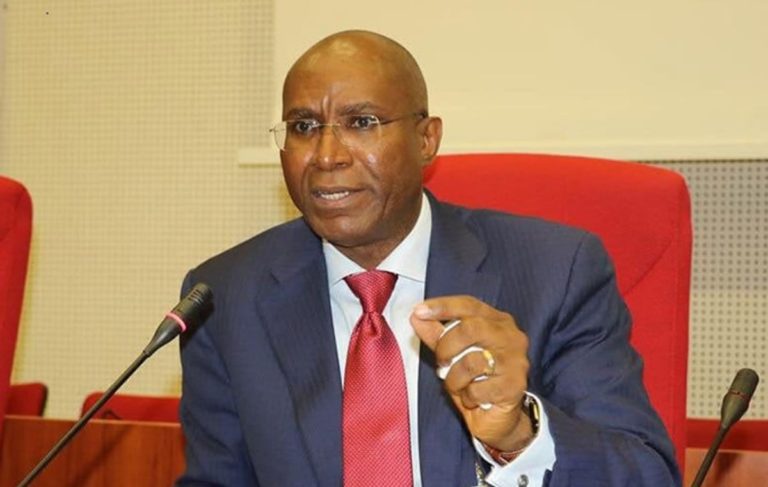
DEPUTY Senate President and Chairman of the Senate Committee on Constitution review Ovie Omo-Agege has invited all Nigerians to zonal public hearing on the review of the 1999 Constitution to be held this month.

Omo-Agege released the invitation on Tuesday, stating that the two-day zonal public hearing on ‘The Proposed Alteration to the Provisions of the Constitution of the Federal Republic of Nigeria’ would be held on Wednesday and Thursday, May 26 and 27, at two centres in each of the six geo-political zones in Nigeria.

Omo-Agege noted that the hearing in the North-Central would be held in Jos and Minna, while Bauchi and Gombe would host the hearing for the North-East.

In the North-West, Kaduna and Sokoto were chosen as centres for the public hearing, as Owerri and Enugu were selected to host the event in the South-East.

READ ALSOMajor sectors collapse, confusion reigns as labour shuts down Kaduna

The zonal public hearing for the South-South would be held in Port Harcourt and Asaba, while the South-West would have its hearing in the cities of Akure and Lagos.

The time for the hearing was fixed at 10.00 am- 5.00 pm for both days, and the issues for the public hearing included matters surrounding gender equality in governance, power devolution, local government autonomy, among several others.

According to Omo-Agege, other issues  promoting the unity and good governance of Nigeria would be discussed at the public hearing.

Members of the public were encouraged to contact Clerk to the Committee Innocent Mebiri on 08037092195, 08055307604 or via email: scrs8nass@gmail.com for further enquiries.

A 56-member committee was inaugurated in February 2020 by the President of the Senate Ahmad Lawan. The committee was set up under the leadership of Omo-Agege, to embark on another round of amendment of the 1999 Constitution in 2018.

Omo-Agege had promised that the committee would be all-inclusive and guarantee full participation of Nigerians who had expressed keen interest in the proposed constitutional review.