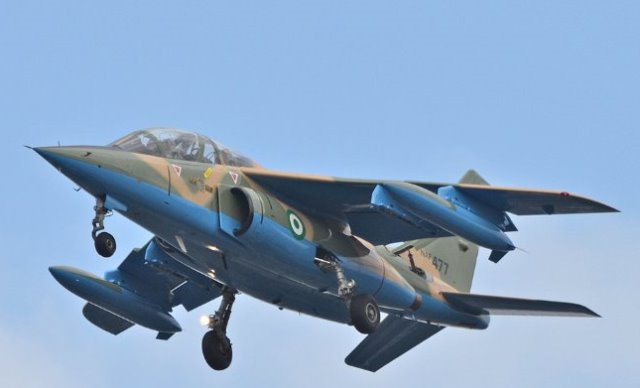
THE Nigerian Airforce (NAF) has said that one of its fighter jets earlier declared missing on Wednesday might have crashed along with two pilots of the force.
This is contained in a statement issued by NAF director of public relations and information Edward Gabkwet on Friday in Abuja.
Gabkwet said intelligence report gathered by the NAF indicated that the alpha jet aircraft (NAF475) that went off the radar with two crew members on board on March 31 might have crashed.
He also disclosed that the cause of the crash as well as the whereabouts of two pilots in the jet remained unknown.
According to Gabkwet, the pilots were John Abolarinwa and Ebiakpo Chapele -both Flight Lieutenants.
NAF said extensive search and rescue efforts were still ongoing by the force’s surveillance aircraft as well as NAF Special Forces and Nigerian Army troops on the ground.
“At this point, the NAF is not ruling out anything regarding the incident. It however remains hopeful that the crew would soon be found and rescued,” the statement read in part.
The ICIR had reported that the alpha jet was said to have lost contact with radar in Borno State while on an interdiction mission in support of ground troops fighting the insurgency.
“The mission was part of the ongoing counterinsurgency operations in the North East. The loss of radar contact occurred at about 5:08 pm on 31 March 2021,” The ICIR had reported.
Borno State, where contact was lost with the fighter jet, is one of the hotspots of the activities of Boko Haram insurgents that have terrorised North-East Nigeria for over a decade.
This is coming less than two months after seven officers lost their lives to a jet crash in Abuja after reporting engine failure.
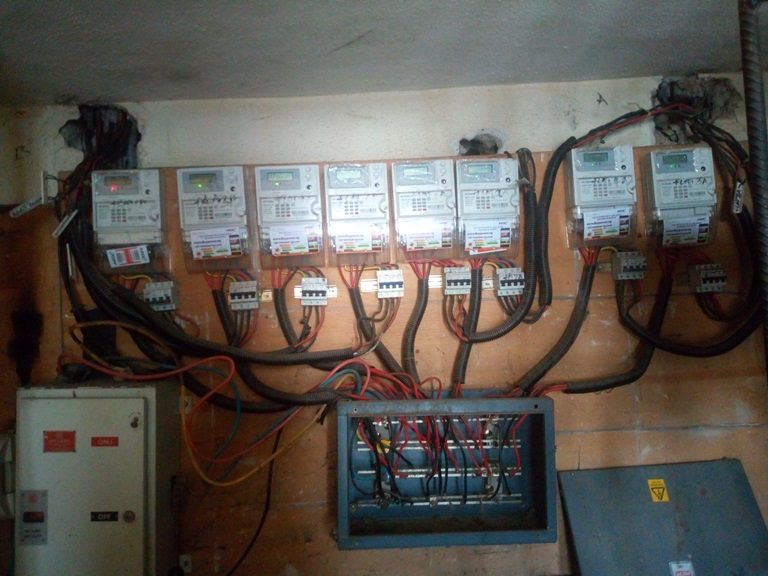
NIGERIANS may have to wait much more longer for meters as poor coordination between the Nigerian Electricity Regulatory Commission (NERC) and meter providers weakens access for millions of citizens.
The federal government began the distribution of one million free meters in October 2020. However, many Nigerians are yet to get theirs, leaving them in the hands of power distribution companies (DisCos) who estimate their bills and most times overcharge them.
Findings by The ICIR show that many indigenous meter manufacturers lack the capacity to close the metering gap on the back of weak production, importation and logistic concerns. These factors make it difficult for them to close the metering gap in excess of over six million meters.
Indigenous meter manufacturers have not been able to produce up to 20 percent of the needed meters, according to findings, putting unmetered Nigerians under the pressure of waiting endlessly.
“Currently, Nigeria cannot manufacture all the components of meter locally. There is still reliance on importation logistics for some of the components. Getting cargo across the ports comes with some difficulties. The issue of foreign exchange, pandemic, and Customs logistics cannot be perfect within months in terms of metering millions of Nigerians.” chairman of the Association of Nigerian Electricity Distribution (ANED) Sunday Oduntan told The ICIR.
Oduntan stressed that the over 500,000 meters had been provided through the Meter Asset Provider Policy of NERC, but admitted that a lot of work needed to be done to close the metering gap of over six million households.
Metering takes lots of efforts and logistics, and it is not like buying a phone and slotting a sim card on it, he stressed.
The NERC has failed to ensure that Nigerians who have paid for their meters through the Third Party Meter Asset Provider regulations and those in the National Mass Metering Programme (which is free) are not lumped together.
James Momoh, NERC Chairman
The Third-Party Meter Asset Provider Regulation is a scheme launched by NERC in 2018 to close metering gap through a third party policy regulation, working with the distribution companies. Some Nigerians are wondering why they should pay for meters when government says the items are free. They also wonder why the regulator, NERC, has failed to come up with a policy to properly define how the two schemes could be used to deliver meters to Nigerians.
Nigeria seeks to close the metering gap of over six million to help build a credible electricity market and attract investors to the fledgling power sector. However, analysts say the federal government should come up with multi-thronged approach, rather than rely on indigenous meter manufacturers who lack capacity to close the gap.
The federal government has, through the National Mass Metering Programme, which is a key component of the Economic Sustainability Plan, targeted bridging the metering gap by building capacity of indigenous local meter manufacturers in order to create wealth along the value chain, amid concerns of Covid-19 impact on the economy.
Meter manufacturers’ position
However, meter manufacturers say they can produce enough for Nigerians but call for convivial government policies and good operating enviromnent.
The Electricity Meter Manufacturers Association of Nigeria (EMMAN), in a recent press statement, said the directive to defer 35 percent import duty on pre-paid meters was an incentive for mass importation of the meters.
The association noted that local manufacturers were not being patronised by off-takers in the downstream power sector as they were not ready to cut corners. They said they were hampered by foreign exchange scarcity hurting the Nigerian economy – as meter parts were imported.
The association urged the government to encourage importers to set up factories so as to have a value chain that would create jobs for Nigerians.
The group had also noted that a recent presidential approval of tax deferment on importation of three million finished electricity meters was a disincentive and would have negative effects on local meter production.
Manufacturers’ challenge
Like manufacturers of other items, meter makers face challenges ranging from foreign exchange scarcity to high energy cost. The Manufacturers Association of Nigeria says the players are hard hit by the nation’s ports and lack of patronage.
Manufacturers struggle with poor infrastructure, high energy cost, regressive port system and multiple taxation, said MAN.
Capacity utilisation in the manufacturing sector slowed to 54.1 percent in the first half of 2019, from 54.50 percent recorded in same half of 2018, said MAN. Average number of power outage in the first half of 2019 increased to five times dally from four times daily recorded in the second half of 2018.
“Lingering foreign exchange (FX) crisis was perhaps the most significant challenge for the sector in 2020 as most industry players found it increasingly difficult to access FX meant for importation of critical factor inputs,” the Lagos Chamber of Commerce and Industry (LCCI) said in a 2020 economic review and 2021 outlook signed by Muda Yusuf, its director-general.
CBN N40bn disbursement
The Central Bank of Nigeria (CBN) has disbursed over N40 billion to indigenous meter manufacturers for the mass metering programme. However, findings have revealed the slow pace of the programme since October 2020 when it was launched.
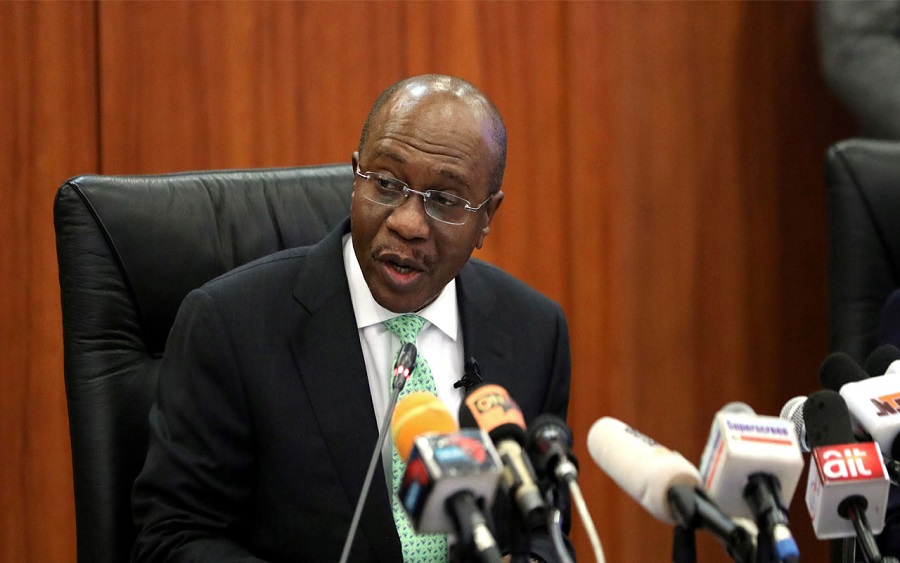
A file picture of Godwin Emefiele, Governor of CBN
One source said the CBN recently appointed consultants to track and monitor the disbursement of the mass metering from the indigenous meter manufacturers. The source raised concerns on why the apex bank would disburse funds for mass metering first before appointing consultants to monitor and track mass metering and capacity of indigenous companies.
” It means the apex bank did not do its due diligence before disbursing the funds,” the source, who did not want her name in print because she works for the government, said.
Available data from the NERC put the number of unmetered and unidentified customers at 4.09 million households. Obsolete meters for possible replacement are estimated at 1,7 million. Also, unidentified and disconnected customers have a recorded figure of 33.1 million customers.
The World Bank recently approved $750 million to support mass metering and network improvement, but has hinged the disbursement on credible electricity market reforms.
Analysts say the government, rather than pay billons of naira in electricity subsidy, needs to remove bottlenecks in metering programme ,while suggesting multi-thronged approach of allowing importation of meters while supporting indigenous local meter manufacturers to closie the metering gap.
“Metering is evolving and we would continue to come up with the right policies that ensure Nigerians are metered adequately, taking cognisance of emerging estates and housing expansion,” Frank Okafor, commissioner for engineering, NERC, told The ICIR.
FOR OVER 26 years, the family of Ayamolowo has been pursuing justice over an alleged killing of Prince Adekeye Nelson Ayamolowo by officers of the disbanded Special Anti-Robbery Squad (SARS).
The family had in several years petitioned the Nigeria Police Force, but all their efforts were futile because there was no positive response from the security agency before the family turned to the EndSars panel for justice.
Narrating the bitter experience the family had with the police to The ICIR, a son to the late victim, Okikiola Ayamolowo, said his father had an encounter with an officer of the Nigerian Police Force at Ijebu-Ode area of Ogun state while on his way from a visit to his mum.
Okikiola also explained that the police officer reportedly shot his father in the head, which eventually led to his death.
“While my dad, Prince Adekeye Nelson Ayamolowo was on his way back from his hometown where he had gone to visit his mum, he encountered the NPF around Ijebu Ode area, for reasons only known to the wicked and corrupt police officer, he shot my dad in the head and my dad died on the spot.
“The police officer in question ran back to the police station, abandoned his rifle and later went to the police barracks and absconded with his family, while he left another family in tears and despair.”
Late Prince Adekeye Nelson Ayamolowo
Okikiola, who said he was barely five years of age when the incident happened, said the family has been struggling to get justice for his deceased father for the past 26 years.
“We have been chasing and crying for justice over 26 years without any closure. Our pursuit for justice is why I and my family have approached the Ogun state judicial panel in the hopes that we may get justice and closure.
“I was barely 5 years old when the incident happened, older members of my family had reached out to the Nigeria police force at the time of the incident but the NPF was not forthcoming as you would expect a reputable organisation to,” he said.
Speaking on what the family lost financially, Okikiola said, “the financial loss is unquantifiable, starting with the destiny of a young man being cut short. He had a successful and thriving business at the time. Who knows if he would have grown to be in the financial class of Dangote and the likes today.”
He added that the untimely death of his father turned his mother, a poor widow to someone shouldering the responsibilities of four children.
“The wicked actions of the police officer also forced my mother to become a single mother to care for four children on her own. Toiling day and night to pay school fees, provide food and maintain a household.”
The story of Ayamolowo is not isolated; it reflect the experience many Nigerians go through in the hands of the security operatives. Many have been illegally arrested, detained and some even killed without getting justice.
One of such cases is that of Olaoluwa Bolarinwa. Narrating his experience, Bayo Adeshina said his brother, Bolarinwa alongside his nephew Oreoluwa Abiona, were arrested by policemen on 29th March 2020, but while Oreoluwa was released after paying the sum of N10,000, Olaoluwa was reportedly shuffled among various stations and eventually announced dead.
“I was on my way to Mokola Police Station Ibadan when I was informed that he (Olaoluwa) has been moved to Ayobo Police Station in Lagos State, I went to the police station to inquire about Olaolu, there I was told they do not have such name in their incident book, then a police officer later advised me to go to Mokola Police Station and ask of him.
“On getting to Mokola Police Station, I got to know he was taken to Obada Police Station in Ogun state and I saw the name of the police officer that arrested him, he was called “Ijoba System.” The following week, I went to Obada, but I didn’t find him there.
Adeshina said the policeman later told him he was using the boy to track some criminals.
“I got the number of Ijoba System from Oreoluwa the deceased’s brother and I called him to ask of Olaolu, he acknowledged that he knew Olaolu and that he didn’t have an offence against him but he is using Olaolu to track some people and as soon as he gets them, Olaolu will be released.”
He said the family learnt from different police sources that Olaoluwa had been moved to Obalende police station, then later Abuja. They were later told that Olaoluwa was an armed robber and had died in custody days after the arrest.
Adesina, who argued that there was no way Olaoluwa could have been involved in the robbery, added that the deceased was not even taken to court before he was convicted and pronounced an armed robber. He said more baffling was that the commander and her men refused to release Olaoluwa’s remains for proper burial.
Late Olaoluwa Bolarinwa
He narrated: “They called my brother an armed robber even without taking him to court. Nigerians should stand up and fight for us. My brother’s death is a case of extrajudicial killing. He was murdered!
“My brother was not a thief and neither was he an armed robber. My brother was a community leader in his community and everyone knew him.”
My wife’s concubine paid SARS operatives to torture me
A middle-aged man, Muraimo Akintunde also narrated how he was thoroughly tortured by officers of the Special Anti-Robbery Squad Operatives.
Akintunde said he was arrested by SARS operatives on June 14, 2020, with the help of one Mr Seun Akinwande, who had him reported and also paid the SARS operatives to have him tortured.
The victim disclosed that Seun Akinwande was his wife’s boyfriend and they have had altercations on the phone over Akinwande lusting after his wife.
He said, “The SARS operatives took me to their station at Magbon from Ayetoro where I live and they tortured me, they said I was a cultist and demanded where I kept my gun and where my gangs were, and also proceeded to search my house and found nothing”.
“They tortured me till the point I was bleeding from the left side of my face and my left leg till I was going in and out of consciousness.
Akinwande said the SARS operatives wrote a statement for him and forced his thumbprint on the statement.
“The SARS Operatives demanded 300,000 naira bail which my sister and wife later negotiated to N100,000, they released me not after they insisted I write an undertaking that I would not harm Mr Seun Akinwande, which I did.
“I thought I was going to die because I was bleeding seriously for a crime I did not know of.”
Victims put hope on Judicial Panel of Investigation
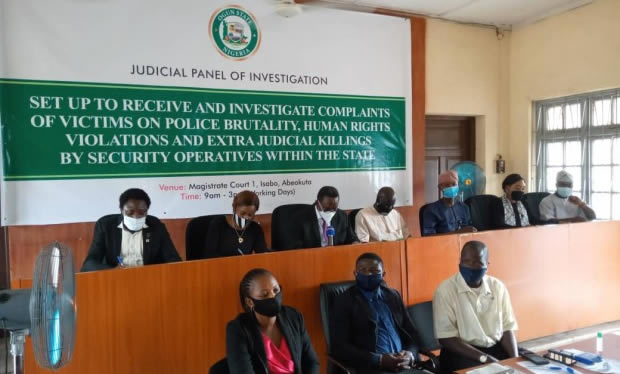
Despite despondency expressed towards the Nigerian judicial system, the recent composition of the judicial panel of investigation across the country, particularly the Ogun State judicial panel chaired by retired Justice Solomon Olugbemi has raised the hope of many victims of police brutality in the state.
Those who have had bitter experiences with the men of the Nigeria Police force in the past, who spoke with The ICIR expressed satisfaction over the composition of the panel.
Okikiola said he is optimistic that the panel will be able to give the family the justice they deserve.
He added, “I appreciate what the panel represents and the platform it has given the likes of myself, my family and other victims out there to have a voice and at the least, express our frustrations. However, there is nothing compared to having actual justice and closure.
“Justice is not just about financial compensation which is also a must to soothe a tiny part of the pains and agony caused by the NPF. Justice in this matter also involves the NPF doing their job which is to fight and deter crime by bringing the culprits to face the law. In our case, bringing my dad’s murderer to pay for his actions.”
Adesina expressed optimism that the panel would produce justice because of the way it was composed.
Over 2,500 petitions submitted across the country
While the hearings of petitions across the country are moving at a slow pace, The ICIR findings revealed that over 2,500 petitions have been submitted to the panels.
Data obtained from the Youth Initiative for Advocacy, Growth & Advancement (YIAGA) revealed that the following number of petitions submitted across the country: FCT – 250 petitions, Rivers State – 188 petitions, Anambra State – 310 petitions, Edo State – 164 petitions, Lagos State – 230 petitions, Imo State – 110 petitions, Abia State – 87 petitions, Akwa Ibom State – 159 petitions, Ekiti State – 81 petitions, Plateau State – 58 petitions, Cross River State – 61 petitions, Ogun State – 105 petitions, Oyo State – 50 petitions, Enugu State – 75 petitions, Benue State – 51 petitions, Ondo State – 44 petitions, Osun State – 32 petitions, Bayelsa State – 40 petitions, Kwara State – 24 petitions, Nasarawa State – 36 petitions, Delta State – 78 petitions, Ebonyi State – 37 petitions, Taraba State – 28 petitions, Adamawa State – 14 petitions, Gombe State – 15 petitions, Bauchi State – 10 petitions, Kaduna State – 29 petitions.
Data showing petitions received at ENDSARS panel across the couuntry
We will pursue the matters to a logical conclusion – Counsel
One of the counsels for the victims, Taiwo Olawanle from Falana & Falana Chambers, said the matters would be pursued to a logical conclusion.
Olawanle stressed that there is a need to end the impunity of some of the security forces by ensuring they get punished for offenses they committed.
His words, “As for us in Falana & Falana Chambers, we are interested in following the matters to a logical conclusion. We need to end the impunity of our security forces, get the operatives involved punished according to the dictates of the relevant laws and get the families of the victims compensated.”
He added that getting justice for the people would relieve them of the pains they have suffered.
“This would go a long way to relieve the relations of the victims and also serve as deterrence to the future occurrence of such extrajudicial killings by the Police.”
We will get justice for the victims – Panel
Meanwhile, one of the members of the judicial panel in Ogun State, Olayinka Folarin has disclosed that the panel is concerned about getting justice for the victims. Folarin explained that the panel would be making their recommendations after listening to the two parties involved.
He, however, noted that the essence of the panel is to ensure the victims get justice, stressing that the recommendation of the panel would ensure justice for the victim.
He said, “We have been hearing petitions and at the end of the day, we will make our recommendation which undoubtedly will aim to get justice for the victims. The essence of the panel is to achieve justice for the victim.
“Our first report will come in very soon. It will analyse cases that have been concluded because we don’t just conclude a case in a day. We have to give a fair hearing to everybody; we hear from the petitioner and the respondents before we form our opinion and then make our recommendations. Definitely, there shall be justice.”
We are not disturbing the panel from getting justice for victims – Police
Abimbola Oyeyemi, the Ogun State Police Command Public Relations Officer
The Ogun State police command says it has been been trying its best in ensuring the petitioners get justice at the panel. Abimbola Oyeyemi, the Ogun State Police Command Public Relations Officer, who spoke to The ICIR said the command has been producing the accused police at the panel.
“We are not in anyway preventing the petitioners from getting justice at the panel and that’s why we have been answering the panel’s summon.”
“I have personally appeared before the panel before,” says Oyeyemi.
When asked if the police officers indeed perpetrated and guilty of the crimes the petitioners accused them of, Oyeyemi said it is left for the panel to determine who is guilty of any crime or not.
THE Nigerian Bar Association (NBA), on Thursday, released a damning statement on the alleged assault on a private security guard by chairman of Code of Conduct Tribunal (CCT) Justice Danladi Umar at the Bannex Plaza, Abuja.
The statement, signed by the group’s publicity secretary Rapulu Nduka, said the ‘display of naked power’ by persons in the calibre of Umar would not be condoned by the association.
Umar was seen in a widely-circulated video on Monday, March 29, slapping a private guard repeatedly in company of his police escorts and driver before sympathisers at the market began to shout at him and forced him out of the plaza.
The private guard, Clement Sagwark. Credit: Premium Times
The victim, a 22-year-old Clement Sargwak, told Premium Times that he was slapped by Umar, his driver and police escorts severally before being whisked to Maitama police station where he was subsequently bailed by the plaza’s lawyer.
He said his sin was that he had called Umar’s attention to his car that was parked wrongly and was obstructing other visitors to the plaza.
Umar would not take such an effrontery from him as a top government functionary. He slapped the young man severally, stripped him naked, pushed him to the ground and stepped upon him, together with his security aides, Sargwak had told Premium Times.
NBA said an infraction like assault accusation against the CCT boss was more worrisome when it involved the head of an agency of government set up to ensure compliance with the code of conduct by public officers.
As a trained lawyer, NBA said Umar was expected by the extant rules regulating the conduct of legal practitioners in the country to maintain a high standard of professional conduct, and not to engage in any conduct unbecoming of a member of the legal profession.
It then vowed to probe circumstances leading to the incident and ensure justice was served.
The body, however, noted that prima facie (first/available) evidence on the incident raised questions on the extent to which the chairman had kept the rules of both his office and the association.
Earlier reports by The ICIR on the incident
The ICIR had, on Wednesday, March 31, reported how Umar defended assualt on the private guard in a message laden with grammatical, structural and ethical errors, as well as ethnic slurs.
Head of press unit of the organisation Ibraheem Al-Hassan issued the statement on the instruction of Umar.
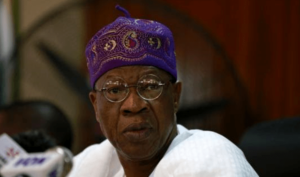
Minister of Information and Culture, Lai Mohammed. Picture for Illustration Purpose
He was, however, summoned by minister of information Lai Mohammed hours after the statement went viral on social media “to come and clear some issues” related to the statement.
The ICIRexclusively reported Al-Hassan admitting he wrote and gave out the statement to journalists but failed to proofread it.
He also said Umar instructed him to include ‘Biafran Boys’ in the statement.
Speaking in emotion-laden voice, Al-Hassan said he regretted his action and was unsure of his fate in the hands of the minister, whose ministry deployed him to serve as information officer at the CCT in 2013.
Al-Hassan’s statement went viral on social media as Nigerians derided him and his organisation (the CCT).
He used ‘video cliff’ in his statement, rather than ‘video clip.’ Also, he preferred using ‘packing lot’ to the correct version, ‘parking lot.’ He also used the phrase ‘had went’ instead of ‘had gone.’
“The boy was rode in his approached and threaten,” one of his sentences read. This should have read: “the boy was rude in his approach and threatened.”
He committed a grammatical gaffe mixed with ethnic slur against the people of the South-East Nigeria by categorising people he did not know their ethnicity as ‘Biafrans.’
In Al-Hassan’s words, the chairman was “overwhelmed by the mobs, consisting of BIAFRAN boys throwing matches and shape object to his car.” He should have said that his boss was “overwhelmed by the mob, consisting of BIAFRAN boys throwing matches and sharp objects at this car.”
The use of ‘BIAFRAN boys’ is ethically wrong because it is ethnic profiling. It possesses secessionist undertone and conflicts with Nigeria’s Constitution, which recognizes a united Nigerian state.
The full statement as issued by Al-Hassan on Tuesday, March 30, 2021
Press Statement from the Code of Conduct Bureau
Code of Conduct Tribunal. Source: FMIC’s website
Our attention was drawn on a report from some online publication with a video cliff suggesting Hon Chairman, Justice Danladi Y. Umar assaulted a Security Guard at Banex Plaza.
To start with, the said plaza has been his usual place of visits for the past 18 years for shopping and repairs of his phones, and in all these periods there have never been any time he had any turmoil with anybody.
Unfortunately, yesterday’s altercations started over a packing lot, which Chairman met vacant and it was directly opposite a shop he want to make a purchase and to fixe his phone, when the young Security guard sighted him, he ordered that Chairman should not pack his car in that particular empty space, but Chairman asked why, the security guard couldn’t convinced chairman, though Chairman didn’t identify himself, because to him is needless and is a place he visited often, but the boy was rode in his approached and threaten to deal with Chairman if he refuse to leave the scene.
Again, if Chairman had went there to cause trouble or intimidate some one, as suggested in the report, he would have gone there in his full official paraphernalia, but he went there alone with his younger brother.
The Police men seen in the video cliff were not the Chairman’s police team, they were policemen operating around the plaza whom at first instance intervened before the arrival of police team from Maitama Police station. As the few policemen in the complex were apparently overwhelmed by the mobs, consisting of BIAFRAN boys throwing matches and shape object to his car, which led to deep cut and dislocation in one of his finger, causing damage to his car, smashing his windscreen.
At a point he attempted to leave the scene, these same miscreants, BIAFRAN boy ordered for the closure of the gate thereby assaulting him before the arrival of police team from Maitama police station.
An incident like this when it happened, sympathy usually goes to the low personalities. Though is unfortunate as I said, it ought not to have happened.”
NBA’s statement as obtained by The ICIR on April 1, 2021
STATEMENT OF THE NIGERIAN BAR ASSOCIATION ON THE ALLEGED CASE OF ASSAULT BY UMAR YAKUBU DANLADI, ESQ.
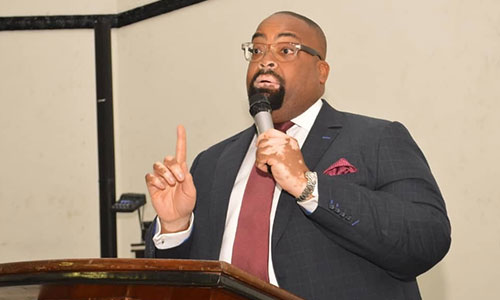
Olumide Akpata, newly elected NBA President. Credit: TheNigeriaLawyer
The attention of the Nigerian Bar Association (“NBA”) has been drawn to the video making the rounds where the Chairman of the Code of Conduct Tribunal (“CCT”) – Danladi Yakubu Umar Esq., was seen, together with his security detail, allegedly assaulting a citizen at Banex Plaza, in Wuse Abuja. We understand that this citizen turned out to be a 22-year-old employee of Jul Reliable Guards Services Limited, posted as a security guard to the Plaza and who is now reportedly hospitalised. The NBA has also read the statement credited to the Head, Press and Public Relations of the CCT in response to the actions of Mr Umar.
The NBA frowns at any display of naked power by a public officer especially one who, by virtue of his high office, is expected to exhibit a high standard of conduct. The situation is all the more critical when it involves the head of an agency of government set up to ensure compliance, by public officers, with the code of conduct.
Further, as a member of the legal profession, Danladi Yakubu Umar Esq. is expected, by the extant rules that regulate the conduct of legal practitioners in Nigeria, to maintain a high standard of professional conduct, and not to engage in any conduct which is unbecoming of a member of the legal profession. Prima facie evidence available at the moment raise questions regarding whether such standards have been met.
In view of the foregoing, the NBA shall through its relevant Committee, investigate the circumstances leading to the altercation, and depending on its findings, will ensure that appropriate action is taken to address this occurrence.
Africa No Filter (ANF) has announced a partnership with Western Union targeted at facilitating rapid, effective and secure disbursement of grants to emerging artists across the continent.
The grant disbursement will done through Kekere Storyteller’s Fund project, which was set up to provide the much-needed support to content creators, writers, performance artists, visual artists and journalists in Africa.
Storytellers who access the funds are expected to create and publish unique and compelling contents that shift prevailing stereotypical narratives about Africa.
The project addresses the need for more access to funding for emerging artists in Africa.
“The grants are for individuals under age 35 and range between $500 and $2000. Because the application process is deliberately accessible, it opens up new opportunities for artists and storytellers. With Western Union as a payment partner, accessing the funds once approved is now even easier,” said executive director of Africa No Filter Moky Makura, in a statement sent to The ICIR.
“Independent storytellers on the continent often do not have access to traditional grant-making organisations. They lack visibility into grant awards, the grant-application process, and the monitoring and reporting tools needed by the more traditional funders.”
“The Kekere grant amounts may be small, but a few hundred dollars can go a long way towards helping storytellers bring their content to life. As a grant-making organisation, having a safe, reliable financial partner to help us dispense the funds quickly is critical, and Western Union is a trusted payment brand,” Makura further said.
He added that the partnership with Western Union, which had a vast network of outlets that could deliver grants to individuals in small communities and those in large cities equally effectively, was an added advantage to Africa No Filter’s goal of grant disbursement.
“The Kekere Storytellers Fund is helping us build a pipeline of the continent’s next generation of creative talent, and we are pleased we can contribute to their work,” said ANF’s program lead Jessica Hagan.
“Art is one of Africa’s biggest exports, both within the continent and globally. It provides an opportunity for us to show the world our creativity, innovation and share our own stories that challenge the perceptions about our countries and communities,” Hagan noted.
Africa No Fliter will announce the first set of recipients for the grants in April 2021. A new call for application will go out in the next quarter and interested artists can register on the ANF website.
THE Cross River State government has refused to release information on the Yahe-Wanokom-Wanihem-Benue Border Road project, including the agreement of the contract awarded under a joint initiative of the state and the African Development Bank (AFDB) in 2010.
The ICIR, on March 15, 2021, through Freedom of Information Act (FOIA) request, asked for details of the road project, specifically name and address of the contractor approved for the construction of the road; the contract sum; duration and completion date; releases so far made to the contractor, including time and amount of each release and the contract document signed with the contractor.
The Yahe-Wanokom-Wanihem-Benue Border Road has been in a deplorable state since it was first awarded in 2010 despite several appeals made by the largely agrarian communities along the route.
Contrary to the provisions of the 2011 law that information requested should be made available promptly but not later than seven days from the receipt of the application, the state government is yet to respond to the request or give any reason for the denial weeks after acknowledging its receipt.
The ICIR reached out to Cross Rivers State commissioner for works Dane Osim-asu, but he did not respond to text messages and calls to his official line. In a frantic effort to get the required information, The ICIR reached out to the state project coordinator Charles Okongoh, an engineer. While acknowledging that he had the information, Okongoh said that he could not speak with our reporter because he did not have the authority to do so. He said that only the works commissioner could provide the information to the reporter.
It would seem there are vested interests involved in the project but the FOI Act, in unambiguous terms, clearly frowns at the willful withholding of information not injurious to public security and safety.
The access to information law was enacted in 2011 to make public records and information freely available to citizens and protect same to the extent consistent with the public interest, amongst others. However, many agencies of government at both state and federal levels continue to brazenly disobey the law by denying citizens access to publicly held information.
This was partly pointed out in a report by The ICIR in November 2020 that most government agencies brazenly ignore FOIA requests. For example, of 301 requests filed with federal agencies between 2018 and August 2020, as many as 187 – over 60 percent – were ignored by the affected agencies, while only 64 (20.65 percent) received a response. Also, 13 (4.19 percent) were referred to another agency while 46 (14.84 percent) were officially acknowledged but information denied by the agencies.
Although, enacted by the National Assembly, state governments have often argued over the legality of enforcing the FOIA in their states. However, this has been laid to rest in a judgement by Justice Oke-Lawal of Ikeja High Court in 2017, where he stressed that the FOI Act would apply to the government of the federation as well as to state governments and would not require ‘domestication’ by states to have effect.
CAN Nigeria ever be put back together? This question concentrated my mind many days ago as I watched the tragi-comedy of the deputy speaker of the House of Representatives Idris Wase, shutting down a petition by some Nigerians in the Diaspora during plenary.
There are die-hard optimists and it is good to be sanguine in life. In any case, given the circumstance we have found ourselves in, if you remove hope, what else is left? Optimism oils the wheels of everyday living in Nigeria.
As I noted in my New Year article, “2021: Beyond hope,”it helps when a people are having a rough patch, as Nigerians are right now, to look on the sunny side of life. That is where hope, which simply means being able to see that there is light despite all of the darkness around us, comes in.
But the utterances of some political leaders in Nigeria push most citizens into the dark hole of despair.
No matter how hard one tries to be buoyant in spirit, the truth is, whatever side of the political spectrum you pitch your tent right now, it is tough to be happy about the current state of the union where uppity and sense of entitlement have stymied national unity.
Every issue is viewed from the primordial prism of ethnicity. Each day the chasms of division become gorges of prejudice and, tragically, we all watch as the country spirals into hate-filled rhetoric.
Anyone who dares to complain is accused by those who claim to love Nigeria more than others of hating President Muhammadu Buhari. Yet, Nigeria has never been more divided than it is today. Political leaders have become angrier and more intolerant as political skins become thinner.
That was exactly what played out on the floor of the House of Representatives on March 11 when lawmaker Mark Gbillah (Gwer East-Gwer West Federal Constituency, Benue State) attempted to submit a petition on insecurity in Benue, Nasarawa, and Taraba filed by Tiv indigenes living in the United States under the umbrella of Mzough U Tiv Amerika (MUTA).
Wase, who presided at plenary, shot down the petition even before it was presented on the laughable grounds that Nigerians in the Diaspora had no right petitioning on issues happening in Nigeria.
In his desperation, Wase threw parliamentary caution to the winds asserting, without the backing of the Constitution, that Nigerians abroad were not eligible to file against the government at home petitions on insecurity. That was scandalous.
Gbillah had hardly finished explaining what the petition was all about when Wase brusquely cut him short, asking rather condescendingly: “Honourable Gbillah, did you say Tivs in America? What do they know about Nigeria? What is their business? They can’t sit in their comfort zones and know what is happening in Nigeria.” Then he self-importantly thundered, “I am not convinced that we have to take that petition,” and ordered a fellow lawmaker who represents his constituents to sit down.
Idris Wase
It was surreal. How can a lawmaker say that Nigerians automatically lose their citizenship when they live abroad? When the man who made this claim is the deputy speaker of the House of Representatives, it becomes even more tragic.
But make no mistake about this. Wase knew what he was saying. Implied in his submission was the subtle use of prejudice tropes to protect ethnic privilege.
Expectedly, Nigerians – at home and abroad – are outraged.
Former chairman of the National Human Rights Commission Chidi Odinkalu, a professor, captured the mood of the majority when he tweeted: “So, the House of Representatives can so blithely strip Nigerians outside the borders of the country of their citizenship and rights?”
Odinkalu wondered whether it was “ignorance or bias or biased ignorance that drives this presiding officer in this piece of inspired parliamentary silliness,” and concluded thus: “The same ninnies who pull this kind of nonsense habitually will show up tomorrow and tell you how Nigeria’s unity is not negotiable when they themselves have made it a tradable commodity.”
Nigerians in the Diaspora Organisation (NIDO) also protested. They wrote a petition to Speaker Femi Gbajabiamila demanding that Wase fully retract his statement and offer unconditional public apology to diasporans.
Signatories to the petition include Bashir Obasekola for Nigerians in Diaspora, Europe; Obed Monago (Nigerians in Diaspora, Americas); E. C. Ejiogu (Nigerians in Diaspora, Asia); Gary Linus Unamadu (Nigerians in Diaspora, Oceania); and Obinna Kingsman (Nigerians in Diaspora, Africa).
The group also insisted that Gbillah be allowed to represent the petition.
If this is not done within 14 days, they threatened further actions, which may include but not limited to calling out Nigerians in the Diaspora to withhold further home remittances with immediate effect.
Of course, they cannot do that because nobody living abroad will stop sending money to his aged parents at home for instance because of the indiscretions of the deputy speaker of the House of Representatives.
But Wase’s injudiciousness has exposed how wide the national fault lines of ethnicity and religion have become because of deliberate policies, particularly the Fulani supremacist agenda of the Buhari presidency.
Those who think that Wase just misspoke don’t get it. And it was not a question of ignorance of the law, either. He knew what he did. His body language on the video that went viral said it all. He was visibly angry at the audacity of the petitioners.
To appreciate what happened, we have to put certain things in context. Wase, who represents Wase Federal Constituency, Plateau State, is a Fulani and a member of the ruling All Progressives Congress (APC).
Gbillah, a member of the opposition Peoples Democratic Party (PDP), as well as the petitioners are Tiv. Those chased out of their ancestral homes in Benue, Taraba and Nasarawa and are living in poorly serviced IDP camps are Tiv. Those who attacked, maimed, killed and chased them out are Fulani.
Simply put, Wase is using his office paid for with tax payers’ money to protect ethnic privilege.
While those who own the ancestral lands, most of them farmers, are languishing in IDP camps, bandits – most, if not all of them, Fulani – have taken over their property and the government is looking the other way.
In order to be politically correct in the Buhari era, we often twist ourselves into “see no evil, hear no evil, speak no evil” pretzels to be called patriots and nationalists.
If that petition was written by the Fulani in the Diaspora, Wase wouldn’t have shot it down. He wouldn’t have bothered to know if the group was registered with the Corporate Affairs Commission (CAC).
Gbilla’s opening remarks that, “I have a petition from the Mutual Union of the Tiv in America against the Federal Government of Nigeria and the issue has to do with the ancestral land of the Tiv people that seems to have been possessed in recent times through various attacks and the fact that they are languishing in IDP camps till date without any intervention,” was what made Wase fly off the handle.
Of course, seeing the backlash, he has tried to walk back his comments, albeit unsuccessfully.
He claims that the trending video showing him preventing Gbillah from laying out the petition had been “doctored, slanted and bent to give political and ethnic colouration to an event that was otherwise strictly based on parliamentary procedures.” Lie!
When government officials claim that Nigeria is safe, they duplicitously fail to acknowledge that many Nigerians living in IDP camps have nowhere else to go because what used to be their ancestral homes have been taken over by bandits. They have become refugees in their own country.
The Nigerian State under Buhari’s watch knows that and is doing nothing about it. Instead, they are preaching peace and forgiveness.
Despite pockets of agitations for secession, the majority of Nigerians would love to live together in a united country. But that country must be one where equity, justice and equal rights trump bigotry, nepotism and ethnic supremacy. Peace will always be a mirage in a milieu where justice is an anathema.
Buhari has spent six years of his presidency to bring out the animal in us. There is every reason to believe that it will get worse in the remaining two years of his rule.
For Nigerians, stitching Nigeria back together again after the Buhari presidency will be the challenge of the millennium.
THE National Drug Law Enforcement Agency (NDLEA) says it has arrested a Chadian, Adama Uomar Issa, who allegedly supplies illicit drugs to Boko Haram insurgents.
NDLEA director of media & advocacy Femi Babafemi made this known in a statement issued in Abuja on Thursday.
Babafemi said the suspect was intercepted with assorted drugs in Jalingo, Taraba State, on Wednesday, and investigations had revealed that he supplied illicit drugs to Boko Haram terrorist group.
He said the suspect, a 35-year-old man, had bought the drugs in Onitsha, Anambra State, and concealed it in ladies’ bags before he was arrested by operatives of the NDLEA.
The statement, posted on the agency’s Twitter handle @ndlea_nigeria, was accompanied by video footage showing some operatives of the commission with bags containing drugs and a handcuffed suspect.
The NDLEA also noted that it confiscated 15.7kg of Exol.5; 100,050 France CAF and N61,000 from the Chadian.
“According to the commander, Taraba state command of the NDLEA, Suleiman Jadi, the suspect speaks only French and Arabic and claims he was taking the illicit substances to the Chad Republic before he was intercepted in Jalingo.
“Investigations have, however, shown that he is a major supplier of illicit drugs to Boko Haram… At the point of interdiction, the drugs, which he bought from Onitsha in Anambra state, were concealed inside new ladies’ handbags and shoes,” the statement read in part.
The arrest came days after the NDLEA had nabbed a 70-year-old Nigerien allegedly supplying illicit drugs to Boko Haram insurgents and bandits.
The drug prohibition agency also stated that it recently raided drug joints in Warri Street, Kaduna State. During the raid, NDLEA noted that it found 29.5 grammes of cocaine and heroin along with 456 grammes of Rohypnol tablets and two peddlers identified as Suleiman Yusuf and Abubakar Abdullahi were arrested in the ‘sting operation.’
THE minister of communication and digital economy Isa Pantami has revealed that Nigerians who fail to enroll for the National Identity Number (NIN) could risk 14 years in jail.
Pantami made the comment at the sixth edition of the ministerial briefing organised by the presidential media team at the State House in Abuja on Thursday.
While explaining that the action was in line with the amended 1999 Constitution, he stressed that no one should enjoy government services without the number.
Pantami emphasised that while obtaining a Subscriber Identity Module (SIM) card might be optional, NIN was mandatory, noting that a lot of transactions in the country should not be conducted without the NIN.
“For you to enjoy any government service without having a National Identity Number is an offence. Section 29 says, if you do any of these in Section 27 without obtaining national identity, you have committed a crime that will lead to fine or imprisonment or both of them and this is 14 years,” he said.
“For you to open a bank account without a National Identity Number is an offence. For you to pay tax, it is an offence. For you to collect pension, it is an offence.”
He noted that rather than the population census which could be manipulated, NIN would determine the accurate number of Nigerians because it was unique and tamper-proof.
According to the minister, no fewer than 51 million Nigerians had enrolled for NIN and it was important for transactions in the country to be conducted with the number.
Similarly, he announced that the aggregate registration for SIM across the country had hit 189 million.
He explained that out of the figure, 150 million were completed registration while the remaining had problems of improper registration.
The minister decried that improper registration of SIMs had posed a challenge and the government had begun to address them.
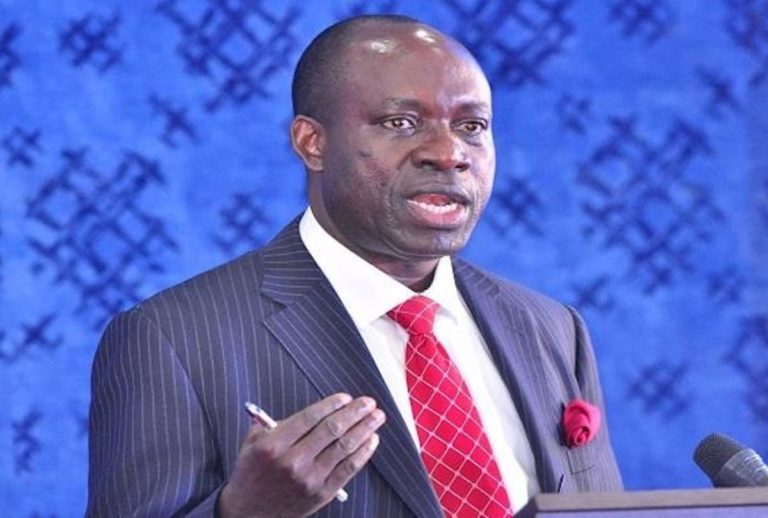
THE Anambra State Police Command has arrested a suspect connected with the attack on the former governor of the Central Bank of Nigeria(CBN) and a gubernatorial aspirant in the state, Chukwuka Soludo.
Anambra State police public relations officer Ikenganya Tochukwu disclosed this in a statement issued in Awka on Thursday.
Gunmen attacked Soludo on Wednesday during a political rally at Isuofia Civic Centre in Aguata LGA in the state.
The attack led to the killing of three police officers while the attackers also abducted the state commissioner for water resources and public utilities, Emeka Ezenwanne.
According to the police, the security operatives who sustained ‘severe gunshot injuries’ were confirmed dead in the state hospital.
Tochukwu said the state commissioner of police Monday, Bala Kuryas, had reinforced Soludo’s residence and community security operatives.
“To this end, the CP, while condemning the act, commiserates with the family and friends of the officers who paid the supreme price, ordered the immediate launch of a tacit investigation to unravel the mystery behind the incident, as well as to bring perpetrators of the barbaric act to book,” the statement read in part.
When asked about the omission of the suspect’s name in the statement, Tochukwu said the command deliberately withdrew it because it was an undercover investigation.
“Yes, we deliberately withdrew the name of the arrested suspect because it is an undercover operation, and we are currently on the trail of others,” Tochukwu said.
The attack came just about eight months to the gubernatorial election in Anambra State, when the second tenure of the incumbent Governor Willie Obiano will have been over.
Eight months to election in Anambra State
According to the Independent National Electoral Commission (INEC), the state’s gubernatorial election was scheduled to hold on Saturday, November 2021.
Soludo had declared his intention to contest for the seat under the All Progressives Grand Alliance (APGA) in February.
Political analysts say the attack could sow fear into the minds of intending voters in the upcoming election.
Head of Election Programs at YIAGA Africa Paul James said the attack raised a major concern.
According to James, whose civil society organisation focuses on promoting democratic governance, there were reasons to be concerned because it could hinder voter turnout during the election.
He said during the previous governorship election in 2017, only 21 percent voter turnout was recorded.
James further stated that another concern was that security operatives would not act on time to mitigate or curb electoral violence but rather do so a few weeks to the election.
“Another concern for me is the state of security in that region. You have the IPOB there, and you know Anambra State is known for having a good number of political big guns, so I feel we should be concerned that this is happening,” James said.
INEC chief press secretary Rotimi Oyekanmi did not respond to questions from The ICIR concerning the attack.