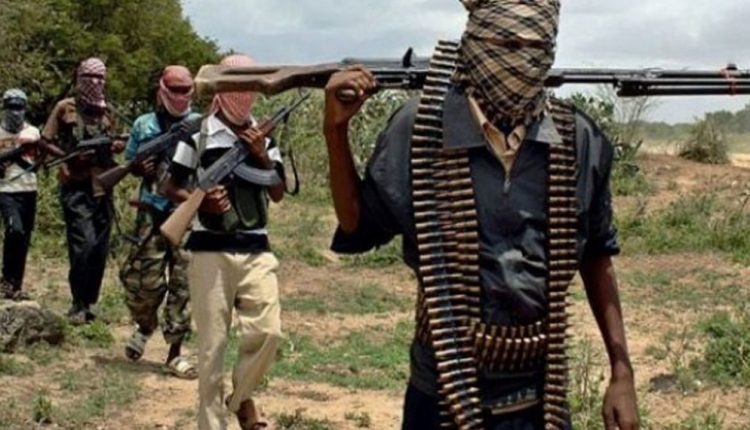
TO deal with and arrest the ugly menace of banditry in Kaduna State and other parts of the North-West, security experts have called for proper management of the nation’s forest reserves, most especially the ones in the troubled region.
They say various security agencies in the country must carry out their operations through enhanced and improved intelligence gathering.
Kaduna has, in recent times, become a major bandits’ hub in the region. Bandits appear to have left Zamfara, Kastina and Niger states for Kaduna, with series of attacks and kidnap cases in Nasir El-Rufai’s state .
In this month alone, the criminals have launched several coordinated attacks against schools, public places and communities in the state, raising so many security concerns.
No fewer than nine persons were kidnapped by the criminals from the staff quarters of the Federal Airports Authority of Nigeria (FAAN) at the Kaduna Airport on March 6th. Those kidnapped included a family of six, and another housewife and her two children. Although the military engaged them in a gun duel for several hours, the bandits went away with their victims on motorcycles.
Three persons were killed on March 9th after bandits attacked the residents of Ganji village in Igabi Local Government Area of the state, leaving about five persons with severe gun injuries.
On March 12th, more than 150 students of the Federal College of Forestry Mechanisation in Mando, Igabi Local Government Area of the state, were also kidnapped by bandits. Although some of them were rescued by security operatives, 39 of them are still being held in captivity for N500 million ransom.
In a similar vein, bandits stormed Government Science Secondary School, Ikara, Ikara local government area, in an attempt to kidnap students, but they failed after the students utilised the security warning system in place and alerted security forces.
While a failed attack was launched on a Turkish International Secondary School, another primary school in the Rema area of Kaduna State was also attacked.
Nine persons were equally shot dead by gunmen suspected to be bandits in separate attacks in Birnin Gwari and Giwa LGAs of Kaduna state on March 24th.
Commissioner for internal security and home affairs Samuel Aruwan, who confirmed the killings in a statement, said six persons were shot dead by the bandits after a barricade was mounted at Dogon Dawa-Kuyello road in Birnin Gwari LGA.
File photo: Malam Nasir El-Rufai is the governor of Kaduna State
He identified the deceased as Nura Rufai, Sanusi Gajere, Yakubu Labbo, Usman Dangiwa, Alhaji Abdulhamid, and Janaidu Tsalhatu.
Two others, Haruna Dotu and Hamisu Mohammad, were reportedly shot dead at Ungwan Maje in Birnin Gwari LGA.
He added that “armed bandits also attacked Kwama village in Giwa LGA and killed one Nasiru El-Rufai after he resisted their attempts to kidnap him.”
These renewed attacks have been attributed to the stance of Governor El-Rufai, who has publicly denounced the activities of the criminals. He has also vowed that he will not pay a dime of the state’s scarce resources to the criminals.
He warned that insecurity in the region would continue to escalate as long as the states refused to coordinate their policies in dealing with banditry.
El-Rufai, who spoke in an interview with BBC Hausa, said attempts were made at cooperation on tackling banditry among governors in the region, but it did not succeed because the governors adopted different policies in addressing the challenge.
Experts speak
Managing director of Agent-X Security Limited Timothy Avele said the escalating bandits’ attacks were a bargaining strategy. He argued that banditry and terrorism were political tools for achieving from the government what other methods could not achieve.
“In the end, as long as the security agencies and the military do not have any sustainable means to eliminate them, then the government will have only two options: negotiate with bandits (even secretly) or ‘we continue attacking and killing your people,” parts of interview with The ICIR read.
Avele expressed worry that the situation would get worse unless the government and the security agencies, especially the intelligence services, would come up with a new strategy to defeat the bandits and terrorists.
“For now, I am yet to see any of such a new tactical approach except the usual helicopter hovering and deployment of soldiers when there are new attacks,” he noted.
“Defeating bandits and terrorists is not as easy as many think. First, the political angle to it, many will read political meanings into it no matter the approach taken. Do not forget that banditry, militias and terrorists are all political means to get what other methods cannot get easily.
“However, to really end these bandits’ attacks, first, intelligence services must find and block access to the sophisticated weapons available to these non-state actors.”
He suggested that the Nigerian police should train and equip a specialised anti-banditry unit. This team, according to him, was not to be seen, but should always be in the forest for 24 hours of the week and could be monitored from a command and control centre. He added that the military could be used to support these team in joint covert operations.
He stressed that the state government should be responsible for logistics, team welfare and part or all of the equipment to be used.
“Communities and individuals who provide intelligence information must be rewarded and protected.
“The military and law-enforcement agencies must immediately start to recruit and train intelligence analysts if we are to expect any improvement in security generally in Nigeria.
“In security and intelligence, negotiations are not bad, but you must negotiate from the strongest position. Sadly, it is the bandits that have the upper hand in their current offensive.”
A retired senior officer of the Nigerian Air Force Sadeeq Shehu also agreed that the government at all levels must set up forest guards akin to the colonial eras to comb forests of criminal elements and protect economic resources.
He also called for both state and local police to address insecurity challenges in the country.
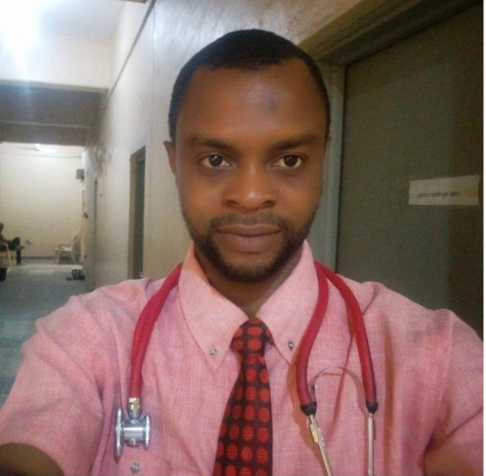
THE federal government owes the doctor who collapsed after working for 72 hours at the University of Port Harcourt Teaching Hospital (UPTH) three months’ salary arrears, The ICIR has found.
Venatus Okorie is a houseman or house officer, meaning a doctor who is training whileworking in a hospital, according to Encyclopedia. His January to March salaries have been withheld due to the feud between Medical and Dental Council of Nigeria (MDCN) and chief medical directors (CMDs) of tertiary health institutions in Nigeria.
In an interview with The ICIR, Okorie said he had not been paid a dime as emolument since January 1, 2021 by the government.
Venatus Okorie at the UPTH. He reportedly collapsed after working for uninterrupted 72 hours. Source: Linda Ikeji
He told The ICIR that he spent two weeks at the hospital after collapsing in February, 2021. His relations bore the cost of his drugs while the hospital footed his medical bill during the treatment.
Asked why he had continued to work despite his experience over the past weeks, Okorie said he had no choice.
“Do I have a choice? I have to keep working because I don’t have another work. Time is going. I cannot waste time anymore,” he said.
Okorie works for a minimum of 14 hours daily because the UPTH is understaffed. He is not entitled to any off-day throughout the one year period that his programme will run.
“Doctors don’t have number of working hours. We keep doing it as the work keeps coming. As you can see me now, I am in the hospital working,” he told our reporter.
Housemanship enables the interns to acquire more practical knowledge by working in hospitals and getting paid. The housemanship programme is required to enable the doctors to participate in the compulsory one-year National Youth Service Corps (NYSC) programme. Experience garnered during the housemanship helps the practitioners to excel in places of their primary assignment.
Other doctors tell their stories
Apart from Okorie, Michael Brens is also having his housemanship at the UPTH. Unlike Okorie, he has been paid the three months’ arrears by the government, but still faces problems.
“It’s hectic. Going to work without being paid is something else. It’s strenuous,” he said while speaking with The ICIR in a telephone interview.
He said if the house officers refused to work because they were not paid, they would get punished.
Leadership of the Nigerian Medical Association (NMA) came to assist house officers at the hospital by giving them N30,000 each when things were very hard for them. According to Brens, house officers were supposed to work for 12 hours per day for the whole year of their housemanship, but they often worked for more hours.
“We come to work by 8 ‘0 clock in the morning. We are supposed to close to 8 ‘0 clock in the evening, but because of shortage of manpower, we end up leaving by 10 ‘o clock or 11pm. That should be more than 13 or 14 hours. House officers don’t do off, we work for the whole day,” the doctor revealed.
Meanwhile, a resident doctor at the UPTH Onyiye Elekwa claimed she was owed six months’ salaries.
“I have not been paid. None of the resident doctors in any centre has been paid this year, but house officers in some centres have been paid.
“I have worked for 10 months and I have earned for only four months. Initially, we were supposed to be earning via the GIFMIS platform, but when we came in, the hospital was having some issues. They did not pay us for the first three months,” she said.
NARD reacts
President of National Association of Resident Doctors (NARD) Uyilawa Okhuaihesuyi told The ICIR that there were many house officers who had bitter experiences during the period.
He accused some heads of public tertiary hospitals of refusing to submit the list of interns in their facilities to the MDCN for vetting and onward transfer to appropriate authorities for payment of their emolument – an attitude he alleged spanned three months. NARD is an umbrella body of medical practitioners that cater to the welfare and other needs of the interns in Nigeria.
His allegation was confirmed to The ICIR by chairman of House Committee on Health Care Service Yusuf Sununu, who chaired the meeting of stakeholders where a directive on immediate payment for the interns was issued.
Hospitals that have paid the house officers
House of Representatives Speaker Femi Gbajabiamila had convened a meeting of stakeholders which eventually made some resolutions on the crisis. The meeting took place between Tuesday, March 9 and Wednesday, March 10, 2021, at the National Assembly Complex. It was headed by Sununu.
A major resolution made at the meeting was immediate payment of the trainee doctors.
The list of the hospitals that have complied with the directive are: Abubakar Tafawa Balewa University Teaching Hospital, Bauchi; University of Benin Teaching Hospital, Benin City; Ahmadu Bello University Teaching Hospital, Zaria; Federal Medical Center Lokoja, Kogi State; LUTH Idi Araba, Lagos State; and FMC Makurdi, Benue State.
Others are: National Hospital Abuja; FMC Birnin Kebbi, Kebbi State; FMC Jabi, FCT; FMC Gombe; FMC Bida; University of Port Harcourt, Teaching Hospital; FMC Asaba.
The list also includes: Jos University Teaching Hospital; FMC Gusau; Aminu Kano Teaching Hospital, Kano; University of Maiduguri Teaching Hospital; FMC Ido Ekiti, Ekiti State; and Specialist Teaching Hospital, Irrua. List of all Federal Teaching Hospitals in Nigeria docx
Ministry of Health responds
Director of hospital services in the Federal Ministry of Health Adebimpe Adebiyi responded to the claim of non-payment of house officers.
She said, “there has been much pressure on tertiary hospitals in the country and that many people are eager to work there. Where are the state hospitals? In some states, it is virtually the federal hospitals that are sustaining the health sector there. There is so much pressure that everybody wants to enter into the federal tertiary hospitals.”
Following the pressure, many of the hospitals employed people who were not captured on the IPPIS, Adebiyi said, adding that the doctors were eventually not paid because the platform on which hospitals could pay them had been suspended by the government.
The real issue
The ICIR had, on March 14, reported how rift between the Nigerian Medical and Dental Council of Nigeria (MDCN) and chief medical directors of public tertiary hospitals in the country denied house officers undergoing housemanship programme at the hospitals of their three months’ salaries.
Investigation by The ICIR revealed that the house officers had been engaged and paid by the hospitals until recently when the federal government took over the posting and payment of the doctors to avert alleged abuse.
Government’s decision did not go down well with the CMDs who then refused to forward the list of the interns to MDCN for vetting and onward salary payment.
According to Okhuaihesuyi, there was a shortage of house officers which he said stemmed from the feud between the MDCN and the CMDs.
The rift “is more like a rift between the chief medical directors and the MDCN. Because of that, they have not paid the house officers for over three months. We have written to federal ministries of health and labour, speaker of the House of Representatives and the Senate president,” he said.
After parrying questions from our reporter during a telephone interview, MDCN registrar Tajudeen Sanusi said his organisation had no issue with anybody. He insisted he would not respond to our reporter’s question which sought his reaction on the issues.
After much prevarication, he said, “Do not force words into my mouth. MDCN did not say ‘transfer this to us.’ There were problems and government wanted to resolve these problems. That was why they said MDCN should take over. MDCN taking over is not that they give us money. No, our own is to scrutinise the list and forward to the Accountant-General Office where further action would be taken on the interns’ payment.”
“There are quotas allotted to these people. You see, if you have a quota of 40 and you go and employ 80, what do you want me to do? That is the situation. You have a quota.”
Okorie’s experience shows that the end of the matter is not yet in sight.
Strike enters
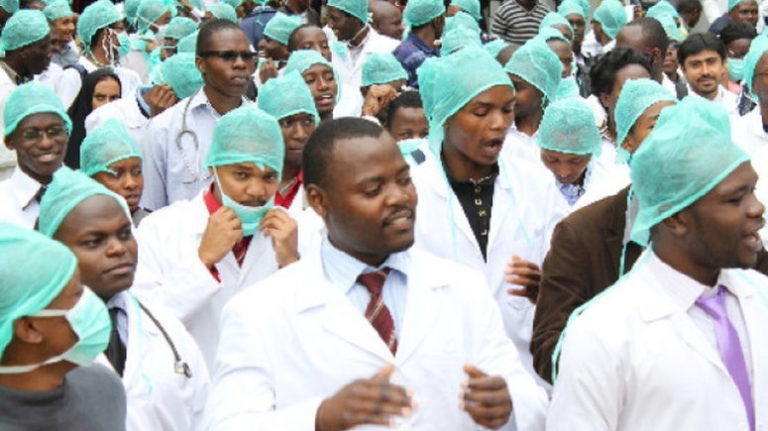
Barring a change in the current frosty relationship between Nigerian doctors and the federal government, medical practitioners under the aegis of National Association of Resident Doctors of Nigeria (NARD) will proceed on strike on April, 1, 2021, to protest failure of federal government to pay house officers working in federal tertiary institutions across the nation.
Notice of the impending strike was contained in a communique issued at the end of extraordinary national executive council (NEC) meeting of NARD on Saturday, March 28, 2021.
The NEC observed that its earlier ultimatum given to the federal government during a January meeting would expire by midnight on the 31st of March, 2021, “with no significant achievement.”
BARRING a change in the current frosty relationship between Nigerian doctors and the federal government, medical practitioners under the aegis of National Association of Resident Doctors of Nigeria (NARD) will proceed on strike on April, 1, 2021, to protest failure of federal government to pay house officers working in federal tertiary institutions across the nation.
Notice of the impending strike was contained in a communique issued at the end of extraordinary national executive council (NEC) meeting of NARD on Saturday, March 28, 2021.
The NEC observed that its earlier ultimatum given to the federal government during a January meeting would expire by midnight on the 31st of March, 2021, “with no significant achievement.”
It said though it supported the central placement of house officers by the federal government, failure of the government to pay house officers for three months had made them pass through pains.
The ICIR had on March 14 reported how rift between the Nigerian Medical and Dental Council of Nigeria (MDCN) and chief medical directors of public tertiary hospitals in the country denied house officers undergoing housemanship programme in the hospitals of their three months’ salaries.
Okorie Venatus, the doctor who collapsed after reportedly working for 72 hours at the University of Port Harcourt Teaching Hospital early this month, is among the doctors who are being owned by the government. He told The ICIR that he had not been paid a dime as emolument since January 1, 2021 by the government.
Venatus Okorie at the UPTH. He reportedly collapsed after working for uninterrupted 72 hours. Source: Linda Ikeji
Further findings by our reporter revealed that only 19 out of 42 tertiary hospitals have paid house officers working for them, despite directive by a committee set up by the Speaker of the House of Representative Femi Gbajabiamila that all the doctors be paid without delay – at a meeting that took place at the House of Representatives between March 10 and March 12, 2021.
House officers are graduates of medical schools who are employed to be further trained for a period of one year. The process, known as housemanship, enables the interns to acquire more practical knowledge by working in hospitals and getting paid. The housemanship programme is required to enable the doctors to participate in the compulsory one-year National Youth Service Corps (NYSC) programme. Experience garnered during the housemanship helps the practitioners to excel in places of their primary assignment.
Speaking with The ICIR on failure of the government to pay the doctors after the directive of the Gbajabiamila’s committee, chairman of House Committee on Health Care Service Yusuf Sununu, said he had not got an update from government and the doctors on what had transpired so far.
He said he would reach out to the leadership of NARD and MDCN. “I don’t have report on current situation. Our agreement is that NARD and MDCN should update us. If I haven’t seen update, I can’t comment.
“I’ve been trying my best. When I came, I met a lot of problems. Even the arrears, we fought it out. This one, we had a meeting and we agreed that they would update us. I’ve not heard from them,” the lawmaker added.
He noted that if the update showed that the issue had not been resolved, the parties would be summoned and the agreement would be reviewed.
Delay in payment caused by change in operation – Health Ministry
Director of hospital services at the Federal Ministry Health Adebimpe Adebiyi told The ICIR that the issue of non-payment “is just a teething problem” caused by transition from one system to another.
She said the delay was caused by central placement of the house officers, which was approved in 2017 and 2018. The first fund was released for the programme this year, after it was taken over by the federal government from chief executives of federal hospitals, she stated.
Empty ward in Nigerian hospital during a strike by doctors. Source: Vanguard newspaper
“There is a transition. It has been worked out between MDCN and the hospitals. The Ministry of Finance removed the money from the GITMIS platform of the hospitals. It is being worked out. As I speak, they are working over the weekend,” Adebiyi, a doctor, said.
When told how painful it was for workers not to receive salaries for three months, she said, “nobody likes it. I was with NARD (leadership) in my office on Thursday till about almost 9pm. We were in Ministry of Labour together, with the Committee of CMDs and the MDCN, Budget Office, Accountant-General and others. Some things will just happen without you planning for it. It is because of the transition.”
Efforts to reach registrar of MDCN Tajudeen Sanusi proved abortive, as his phone number was not reachable all through Saturday, March 27 and Sunday, March 28 when this report was being filed. He did not also respond to a text message sent to him, seeking his reaction to the new development.
The ICIR had reported him parrying questions over the issue in an earlier report published on the matter on March 14, 2021. After much prevarication, he had said: “Don’t force words into my mouth. MDCN did not say ‘transfer this to us.’ There were problems, government wanted to resolve these problems; that was why they said MDCN should take over. MDCN taking over is not that they give us money. No, our own is to scrutinise the list and forward to the Accountant-General Office” where he said further action would be taken on the interns’ payment.
Sanusi’s response was with regard to how the federal government took over the placement and payment of the house officers from hospitals managements in the country – the major reason for the current face-off.
“There are quotas allotted to these people. You see, if you have a quota of 40 and you go and employ 80, what do you want me to do? That is the situation. You have a quota of 40, you’re employing 80. The quotas were allotted based on available human and material resources, and they have no right to adjust the quota themselves, unless they invite Council for re-accreditation. Let us get things right in our society. People should not indulge themselves in acts of illegality, trying to legitimize the act of illegality. No. our Council will never allow that. That is just it. “
He had argued that the hospitals were taking more house officers than quotas allocated to them by the MDCN.
NARD had warned the government of impending strike early March
NARD had, on 7th March, 2021, informed health minister Osagie Ehanire, in a letter with reference number NARD/8G/2020-2021/070321/366, of the ‘unjust delay’ of salaries of its members on the GIFMIS platform for over three months, which it said had left them in agony.
In the letter titled “RE-NOTICE OF IMPENDING DANGER IN THE HEALTH SECTOR” and signed by president and secretary-general of the group Uyilawa Okhuaihesuyi and Jerry Isogun respectively, NARD listed some of its grievances to include non-payment of minimum wage and other salary arrears to its members nationwide, and nonpayment of medical residency funding for 2019, 2020 and 2021.
NARD said in the letter that 50 percent hazard allowance for all health workers was not implemented by the government, while it called for abolition of bench fee payment, which it said had brought untold hardship for the training of resident doctors.
The group posited that the federal government had failed to meet all the agreements in the Memorandum of Terms of Settlement signed with it on 21 April, 2020.
President Buhari receives COVID-19 vaccine. Source: Guardian newspaper
“We wish to remind you that some of these issues have lingered on for so long and had culminated in a nationwide industrial action on 14th September, 2020 which was later suspended to give room to further negotiations and possible settlement. In furtherance to the above, the NEC unanimously resolved to proceed on a recess to reappraise the outcomes of meetings on Tuesday 9th March 2021, following which industrial harmony cannot be guaranteed,” part of the letter reads.
Why April 1 strike may be unavoidable
The doctors lamented the ‘suffering’ of their members in GIFMIS platform whom they said had not been paid for four months due to delay in biometric capturing by IPPIS.
The group also said that despite efforts to review hazard allowance of health workers in the country, it had remained N5,000 monthly.
“The NEC also observed that despite the efforts of NARD, the erroneously paid 2020 Medical Residency Training Fund (MRTF) to non-resident doctors is yet to be addressed. Alos, the 2019 and some of 2020 and 2021 MRTF are yet to be paid.
“The NEC noted the non-payment of the arrears of salary shortfall dating back to 2014 to our members across the country, including state-owned tertiary institutions. The NEC observed that up till now, none of our members have benefitted from the death-in-service insurance scheme, despite our constant engagement with the relevant stakeholders, with the data of our colleagues who died in service in the nation…”
NARD also lamented the rate of brain drain of medical practitioners in the country, as it blamed it on lack of employment in hospitals, poor remuneration and poor conditions of service.
National Hospital, Abuja
The NEC resolved that NARD should proceed on a total and indefinite strike on the 1st of April, 2020 by 8am, if the government failed to pay all salaries owned the doctors, including March salaries before the end of work on March 31, 2021. It also demanded an upward review of the current hazard allowance to 50 percent of consolidated basic salaries of all health workers and payment of the outstanding COVID-19 inducement allowance, especially in public tertiary health institutions.
Others demands included: payment of death-in-service insurance for all health worker who died as a result of COVID-19 infection or other infectious in the country; immediate payment of 2019, the balance of 2020 and 2021 Medical Residency Training Funds to the doctors, including those under state government payroll; and immediate review of the act regulating post-graduate medical training in the country.
NARD had embarked on strike in June 2020 over lack of personal protective equipment (PPE) and poor welfare for its members in the midst of the nation’s fight against COVID-19. The group also proceeded on a similar action in September 2020 over unpaid allowances.
President of NARD Uyilawa Okhuaihesuyi said there were about 15,000 resident doctors in Nigeria as at March 2021. Resident doctors are medical practitioners who have finished their housemanship, National Youth Service Corps and are working to specialise in a specific area of medicine.
The MDCN regulates the activities of medical profession in the country but does not have data on the professionals on its website. However, NMA said on its website that it had over 40,000 members from 36 states in the country and the federal capital territory – with about 19,000 in the diaspora.
However, an official of government in a report in 2020 said there were 74,543 registered medical doctors in the country. The population of doctors in Nigeria serves over 200 million people in the country. Doctor-to-patient ratio is 1: 2753, which translates to 36.6 medical doctors per 100,000 persons in Nigeria.
In January 2020, the federal government said the country needed about 300,000 doctors to meet the doctor-patient ratio of 1:600 recommended by the World Health Organization.
In 2018, The ICIR reported how an average of 12 Nigerian medical doctors got registered in the United Kingdom weekly, a development that highlighted brain drain of the practitioners in the country.
AFRICA is experiencing a second coronavirus wave more severe than the first, according to a worrying new study published on March 24 by the medical journal The Lancet.
The Lancet said one reason for the rise was that some countries were implementing fewer public health measures such as mask wearing and social distancing, probably from adherence fatigue and economic necessity.
The first wave of the COVID-19 pandemic progressed more slowly in Africa than the rest of the world, but by December 2020, the second wave appeared to be much more aggressive with many more cases, the medical journal found.
To date, the pandemic situation in all 55 African Union (AU) member states has not been comprehensively reviewed, the panels of doctors said. “With further waves of COVID-19 infections expected in Africa,” the authors wrote, “we are calling for continued monitoring of COVID-19 data, improvements to testing capacity, and renewed efforts to adhere to public health measures.”
The report is the first-ever continent-wide analysis.
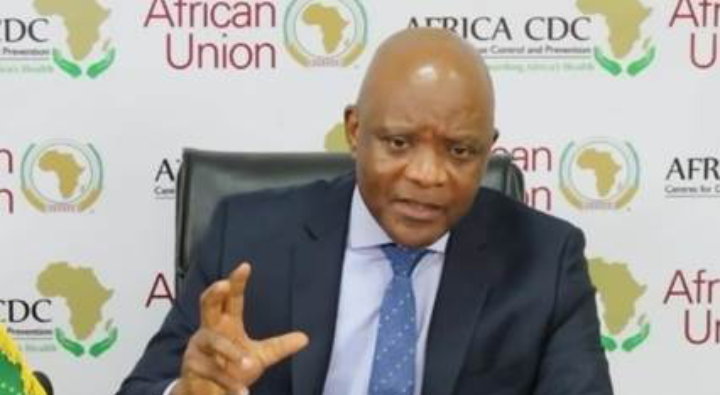
“These insights also reveal a need to improve testing capacity and reinvigorate public health campaigns, to re-emphasise the importance of abiding by measures that aim to strike a fine balance between controlling the spread of COVID-19 and sustaining economies and people’s livelihoods,” said John Nkengasong, from the Africa Centers for Disease Control and Prevention (Africa CDC).
Out of the 55 African Union countries, the most coronavirus-related deaths occurred in South Africa, Egypt, Morocco, Tunisia and Algeria.
Meanwhile, more African countries have received the long-awaited first deliveries of COVID-19 vaccines, with Kenya, Rwanda, Senegal and Lesotho benefiting from a global initiative called COVAX that aims to ensure doses for the world’s low-and middle-income nations.
African and other health officials have been frustrated by the sight of a handful of rich countries rolling out vaccines after snapping up large amounts for themselves.
“We will be known as the continent of COVID if Africa doesn’t quickly reach its target of vaccinating 60 percent of its population of 1.3 billion people,”Nkengasong, a doctor, said.
So far Ghana, Ivory Coast, Nigeria, Angola, Gambia and Congo have received their first vaccine doses via COVAX, with several other countries including Mali, Senegal, Malawi and Uganda set to receive them this week.
The numbers are still disappointing as the World Health Organization this week called the African continent ‘lagging’ in the race to vaccinate its people against the deadly coronavirus. Africa needs far greater access to COVID-19 vaccines to reach its goal of vaccinating 60 percent of the population by June 2022, the world health body said.
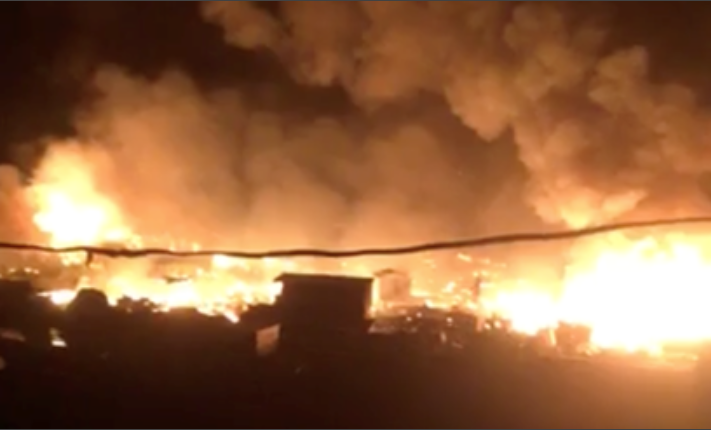
A scorching blaze that turned a crowded neighborhood of Sierra Leone’s capital city into rubble and ashes has left an estimated 4,500 residents homeless, with many searching for missing family.
The inferno, which broke out on Mar. 24 between 7 and 10 p.m. in Susan’s Bay, devastated a community of struggling families, mostly fishermen and petty traders, according to Save the Children in a report.
“I have lost all my uniforms – all was burnt in the fire. Right now we are taking exams and I didn’t go to school today because I have nothing,” said 16-year-old Musa (not his real name), who needs a uniform to be allowed to attend school. “My shoes, everything got lost,” he told Save the Children.
It is not clear what could have started the fire, wrote Abdul Rashid Thomas, reporter for the Sierra Leone Telegraph, but such an outbreak is not unusual in densely populated and overcrowded communities where houses are made of pieces of timber and metal sheets. Many households use kerosene lamps to light up their homes, he said. The community covers an area of 24 acres or 10 hectares.
“Devastating to witness yet another fire disaster in the wake of six others in recent weeks,” Freetown Mayor Yvonne Aki-Sawyerr was reported to say. “Once again, there was no access for the fire service. A six-storey building under construction at the Guinea Store entrance to Susan’s Bay blocked what access there would previously have been from that end.”
“Disaster risk reduction cannot happen without effective urban planning and a building permit regime which is focused on reducing environmental and man-made risks,” she continued, adding: “Please join us in praying for the victims”.
In the global ranking of natural hazard risks, Sierra Leone is ranked as the third most vulnerable country due to climate change, un-planned development and urbanization.
Last November, at the launch of the African country’s National Disaster Management Agency, World Bank country manager Gayle Martin stressed the importance of accountability, prudence and transparency in managing funding and other resources.This comes as investigative reporters at the Africanist Press say they have uncovered bank wire transfers showing that over three million leones, the local currency, was withdrawn by President Julius Bio and his wife Fatima Jabbe Bio for travel expenses in 2020 despite bans on international travel due to the coronavirus pandemic. The President and his wife could not be reached for comment.
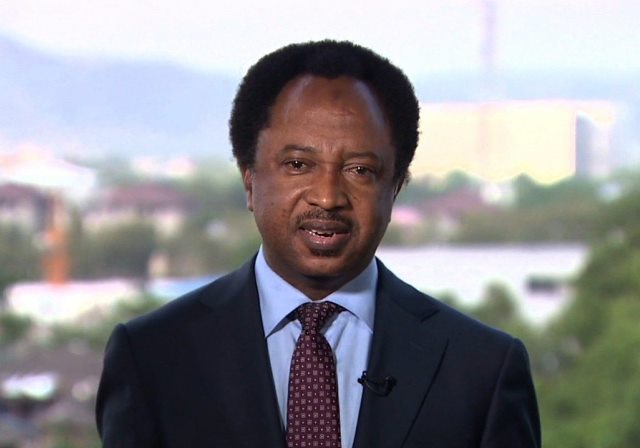
A former Senator who represented Kaduna Central Shehu Sani has visited an Islamic cleric Ahmad Gumi, asking him to help secure the release of students and members of Redeemed Christian Church separately kidnapped by bandits in the state.
Sani made this known via his Twitter handle @ShehuSani on Monday evening.
The Twitter post accompanied by a videoshowed the former Senator and Gumi having a discussion at the latter’s residence. They later shook hands and departed.
“Earlier today in Kaduna, I visited the home of Sheikh Dr Ahmad Gumi where I appealed to him to help to secure the release of the 39 Afaka students and members of the RCCG (Redeemed Christian Church of God) and their Pastor who are still in the hands of bandits,” Sani wrote on his Twitter page.
This is coming days after gunmen kidnapped about eight pastors and members of the Redeemed Christian Church of God (RCCG) in Kaduna State.
The church members were kidnapped on Friday evening while on transit along the Kachia Road in the southern part of the Kaduna State by unknown gunmen.
Public relations officer of the RCGG Kaduna Province Alao Joseph had said the abductors had established contact and demanded N50 million ransom from the church.
“The church has contacted security agencies over the incident with the hope that they will help in securing the immediate rescue of the members,” Joseph said.
For over 17 days, 39 students of the Federal College of Forestry Mechanisation, Afaka, Kaduna State, have remained in the kidnappers’ den.
The kidnappers of the students demanded N500 million from the government for the release of the students.
One of the fathers of the kidnapped students Ibrahim Shamaki was reported to have died from the anguish of his missing child.
Shamaki’s daughter was identified as Fatima Shamaki, one of the victims kidnapped by the armed gunmen now seeking ransom.
Parents and colleagues of the kidnapped students have also protested what they called ‘silence’ of the government over the release of the students.
Gumi is a controversial Islamic cleric who has called for support for bandits. He is severely criticised for his comments that seem empathetic with the bandits.
‘MULTIPLE senseless attacks’ on civilian populations by armed groups in the Tahoua and Tilabery regions of Niger were condemned by world leaders and the International Rescue Committee (IRC) which noted the recent killings of some 200 civilians, including children in the violence.
In the last 10 days alone, three attacks in Banibangou, Tahoua and Abala, near the West African nation of Mali also destroyed productive infrastructure such as granaries, jeopardising livelihoods in some of the most vulnerable regions of the country, the humanitarian group reported.
Chair of the African Union Commission Moussa Faki Mahamat expressed outrage at the attacks targeting civilians. United Nations secretary general Antonio Guterres also strongly condemned the March 20 attack by unidentified gunmen against civilians, according to his spokesperson.
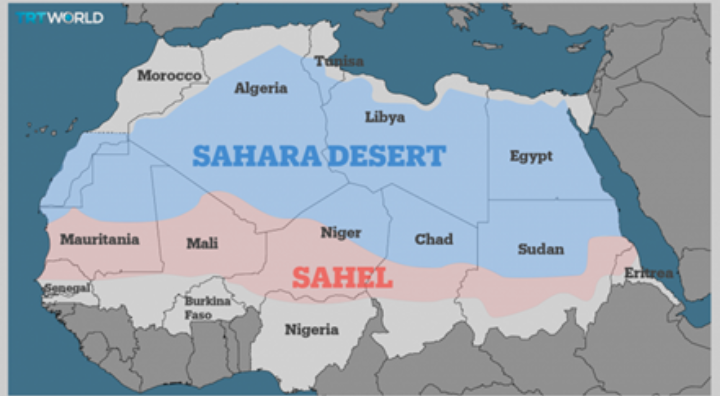
The security situation in the region is rapidly deteriorating. Terror attacks targeting civilians, as well as soldiers, have particularly risen in Burkina Faso, Mali and Niger despite the presence of peacekeeping forces from France, the EU and the UN.
Teams have been mobilised by the IRC in the so-called jihadi-plagued zone where the porous borders of Niger, Mali and Burkina Faso converge. Some 4,000 people across the three nations died in 2019 in violence and ethnic bloodshed stirred by Islamists, according to the U.N.
“We are appalled at the continuous attack on civilians who were just going about their business, fetching water,” said IRC Niger senior emergency coordinator Aboubakar Pefoura. “Not only were civilians killed in this latest attack, 22 of them were children. Civilians should never be a target, especially children, and this fundamental principle must be upheld in conflict situations by all parties.”
The attackers arrived in the villages on motorbikes on Wednesday, March 24, and set classrooms on fire, looted a health center and stole livestock. They reportedly surrounded the villages and those who tried to escape were chased and killed, according to an official who wished to remain anonymous.
One of the most insecure regions in the Sahel, Niger has been reeling from years of food insecurity, weather shocks, violence and extremism. In 2019, civilian deaths in the Niger region rose by a staggering 2400 percent compared to 2016, the IRC coordinator said.
No group has claimed responsibility for the attacks.
Recently, members of the U.S. Africa Command met with regional leaders during a brief trip to Chad, Mali, Burkina Faso and Niger.
Niger’s commander-in-charge Mamane Sani Rafini has promised justice. “This situation is simply horrible. Investigations will be conducted so that this crime does not go unpunished.”
The killings underscore the massive security challenges facing Niger’s President Mohamed Bazoum, who was elected in February. w/map of Sahel, the “jihadi-plagued” zone
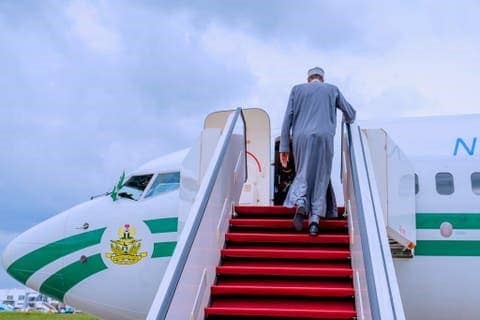
PRESIDENT Muhammadu Buhari is set to proceed to London, the United Kingdom, on Tuesday, March 30, for a routine medical check-up.
This was contained in a statement signed by his senior special assistant on media and publicity Garba Shehu.
The president is due to be back in the country during the second week of April, the statement said.
It also added that the president would be meeting with the security chiefs before jetting out of the country.
“The President meets with Security Chiefs first in the morning, after which he embarks on the journey,” the statement noted.
This is the first time the president will be travelling out of the country in 2021. Buhari had spent over 100 days in the UK for medical reasons in 2017 after leaving for London on May 7. His prolonged absence led to the calls for him to resign and hand over to his vice Yemi Osinbajo.
His first visit to the UK for the same reason had been in January 2017 and lasted nearly two months.
He is leaving Nigeria in the middle of COVID-19 pandemic when local hospitals are in bad shape. Insecurity has worsened under Buhari’s administration, with unemployment hitting 33 percent record level. Inflation is nearly 18 percent, with Nigeria rankling high in Hanke’s Misery Index.
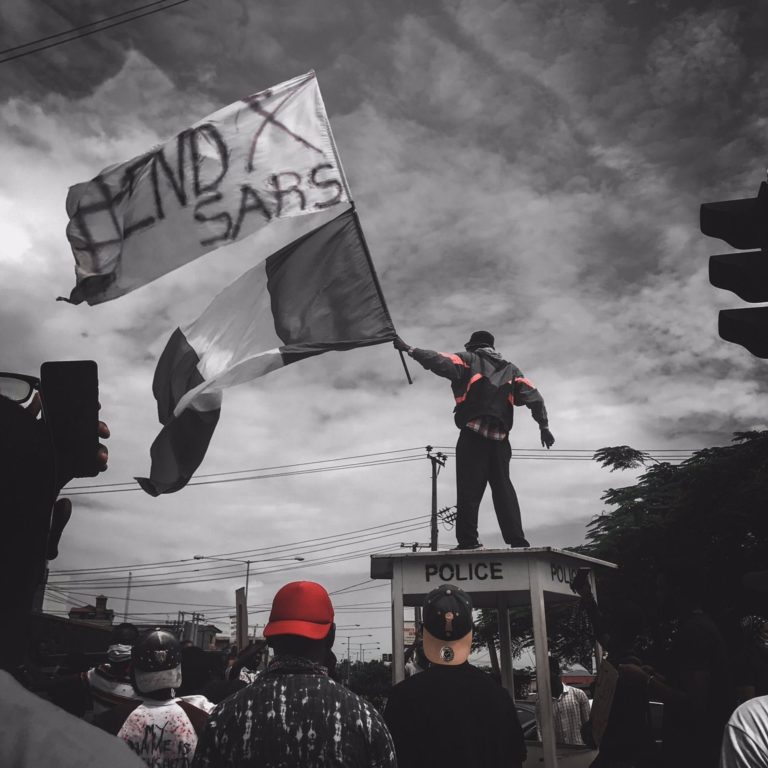
After a nationwide protest against police brutality, the federal government directed the 36 states, including FCT, to constitute judicial panels to hear victims’ petitions. The government’s directive gave hope to many police brutality victims until recently, when it became clear that many of them may never get justice. Lukman ABOLADE reports.
FOR more than six years, Amala Uju Nwabudu, a resident of Umuanugo, wakes up every morning wondering if she is indeed a widow or is caught in an endless trance.
Her inquiry started in March 2014, when her husband, Emmanuel Nwabudu, disappeared.
It was about five years into her marriage. Uju said the Awkuzu SARS unit in Anambra state invited her husband for questioning, but that was the last time she saw him.
Picture of Emmanuel and Uju Nwabudu before her husband disappeared.
Several days of waiting turned to weeks, then months, and months lapsed into years, but the reality remains the same: Her husband is gone.
In an interview with The ICIR in December 2020, Uju said she did not sit at home just waiting for the father of her then five-year-old daughter to reappear; she made efforts to secure his release.
According to her, on several occasions, the SARS operatives warned her to stay at home and stop coming for her husband’s release, but she refused to heed the warning.
Her unrelenting attempts to get her husband released became irritating to the SARS operatives, who eventually accused her of harbouring arms at her residence, claiming that the guns allegedly kept in her residence are used for her husband’s kidnapping operations.
So, one morning in March 2014, her house was raided by men from SARS and officers of the State Security Service (SSS) searching for weapons. Though they did not find guns, they carted away her property, including her generator set and her husband’s hand drums.
Uju Nwabudu, wife of the disappeared Emmanuel Nwabudu.
“When they came, they beat me up and arrested me alongside one of our neighbours who was later released on the road to Amawbia,” Uju narrated.
From custody of the SSS, she was transferred to SARS Awkuzu, where she was heavily beaten and maltreated for one month while her two and five-year-old daughters were left at home without parental care.
Uju’s brother, Pius Udenwa, who made efforts to secure his sister and her husband’s release, said the security agents also told him to desist. Otherwise, he would be branded a kidnapper.
After spending a month in police detention, Uju was bailed and was never contacted again by the police; until now, she doesn’t know whether her husband was alive or dead because he is yet to be found.
In October 2020, when she heard about the Anambra State Judicial Panel constitution, Uju, through her lawyer, Chiadi Obidi, sought justice. Still, her petition is yet to be heard, and she has not been called upon by the panel. Now, Uju’s hope for justice is dashed because there is nowhere else to go.
Pius Udenwa, a petitioner in Anambra state
In a separate petition to the Anambra State Judicial Panel, her brother is also seeking justice over his brother-in-law’s disappearance or possible death. Still, his case has also not been heard.
Udenwa told The ICIR that his petition has remained unrescinded. He is yet to be contacted since submitting the petition on November 3rd, 2020, six days after the Anambra State Judicial panel was constituted.
Just like the Nwabudu’s, Alfred Nwaofulundu awaits a call from the Anambra State Judicial Panel to hear his case.
Nwaofulundu is a resident of Etiti Awovu village in Anambra state, and he was arrested on March 15, 2017, by SARS operatives over the alleged kidnapping case.
Nwaofulundu was held in the custody of the SARS operatives in Akwuzu but later transferred to Neni command after several months of torture and brutality.
During his stay at Awkuzu, Nwaofulundu said he witnessed several dehumanising treatments unleashed by the SARS operatives on him and 23 other detainees, most of whom spent more time in detention.
Nwaofulundu recounted how he was stripped naked and starved by those paid to protect him.
One day, he was transferred to the SARS command at Neni, a move he recalled was to ‘hasten his death’ because he had refused to accede to the allegation that he is a kidnapper.
According to Alfred, he heard the SARS operative sing him a song every day, saying, “you are a kidnapper, and you must die”.
Nwaofulundu added he was kept in the worst cell, alongside 43 other detainees who have not been charged to court and denied a visit by relatives.
Nwaofulundu said inmates were left with no choice but to sleep naked on top of each other.
After spending months in detention, he made a friend, Onyedika, who had spent several months in the SARS detention before him.
Nwaofulundu said Onyedika was arrested and detained but was never charged to court. Instead, he was steadily tortured and made to confess to crimes he did not commit.
“Constantly, teargas was thrown into the cell to suffocate us and force us into admitting crimes we did not commit,” Nwaofulundu said.
One day, a police officer threw teargas again, which suffocated Onyedika so much that he died while groaning in excruciating pain. Nwaofulundu was made to watch his body decompose for five days.
“On one occasion, when teargas was thrown into the cell by the cell guard, five persons amongst us died from the effect. Onyedika, my friend, also died eventually with his decomposing bodies left with us for about five days before he was removed but never returned to his people,” Nwaofulundu said.
After eight months in the SARS detention, pressure from the then Deputy Governor of Anambra State, Nkem Okeke, helped pave the way for his release. Nwaofulundu noted that Okeke told the police commissioner to either charge him to a court or release him.
Finally, he was charged to court by the SARS operatives under the command of one Okpenye as the OC SARS and Uzo, aka Onyeluoukaofunanya as the investigating officer.
The Magistrate Court of Anambra State sitting at Ukpo discharged and acquitted him after Ifeanyickuhwi, who was accused of kidnapping, appeared before the court and testified that Nwaofulunduwas not among his captors.
According to the court ruling, Nwaofulundu was tortured and manhandled by the police concerning a crime he never committed.
The brutalised victim is seeking justice through a petition addressed to the Anambra State Judicial Panel dated November 11, 2020.
According to documents available to The ICIR, Nwaofulundu’s petition was received by the Office of the Anambra.
Copies of petitions
State Secretary to the Government on November 13, 2020, but he was never called upon or contacted by the state judicial panel.
Nwaofulundu’s petition is one of the many ignored in the Anambra state judicial panel.
Aside from the endless wait for petitions to be heard, The ICIR also gathered that some state panels struck out victims’ petitions on the ground that human rights groups find questionable.
But Anambra state panel said it has only dismissedtwo casesbecause they are currently being heard at a competent court of justice. Therefore it is beyond the power of the panel to hear such cases.
Before Judicial Panels were set up across Nigerian states, the only course of seeking justice for police brutality victims in Nigeria was through the court, but the process is slow.
Currently, there are cases of ENDSARS victims seeking the implementation of a court order that ruled that compensation be paid to victims of police brutality. Still, the police have refused to comply, and an indication that if the victims get justice at the court, there are slim chances that the police would comply considering their record of disobeying court orders to pay damages or compensation to victims.
In February, Sunday Kehinde, a petitioner before the panel to investigate police brutality organised by the Nigeria Human Rights Commission, presented a certified true copy of the judgement from an FCT high court awarding him Two million (two million naira) due to injustice meted out to him by the police, however, since 22nd January 2011, the police haven’t complied with the order.
During a panel executive session on petitions relating to the enforcement of judicial decisions /awards attended by The ICIR in Abuja on Thursday, March 18, Sulaiman Galadima, the Chairman of the IIP-SARS panel, said there are exactly 44 petitions before it that borders on the police’s refusal to pay compensations to victims of police misconduct after Court rulings.
Galadima stated that 20 of the petitions bordered on extrajudicial killings, unlawful arrest and detention, cruel, inhuman and degrading treatment and torture, alleged enforced disappearance, confiscation of property, among others.
Inside Anambra State Judicial Panel; failure of a state
In Nigeria, Anambra state has the highest number of petitions on police brutality, with 313 petitions, followed by Lagos. However, The ICIR observed that the state is apathetic in the pursuit of justice for the citizens.
Despite the high number of victims approaching the panel, the state has failed to address the allegations levied against the police properly.
Anambra Judicial Panel
Rita Onyeka, the Secretary of the Anambra State judicial panel, in an interview with The ICIR, said truly it has not heard up to half of the total 313 petitions received because of the time frame allocated to it by the state government.
Onyeka said the panel had filed for an extension to the Anambra State Government since December 2020, but it has not been granted when filing this report.
According to available documents, The ICIR can also confirm that only a few of the panel’s petitions have been heard, and just a very few has been concluded. Still, no recommendation has been made yet to address the agitations of the victims.
An analysis of the petitions before the panel shows that most victims bothered on disappearance and allegations of extrajudicial killing by the police while a few others were on maltreatment and high handedness of the security operatives.
The ICIR also found out that the panel received about 40 petitions from the Nigerian Police against those accused of either assaulting the police officers or destroying the Force’s properties.
The Anambra state judicial panel has also been fractured, as youth representatives resigned due to the state government’s ‘unseriousness’ in getting
The youth members of the Anambra State Judicial Panel of Inquiry
justice for the many victims of police brutality.
Announcing their resignations, the youth representatives lamented that the governor of the state, Willie Obiano, has refused to provide adequate logistics to ensure the panel’s smooth running, an attitude they said has hampered the hearing of petitions by victims.
“We are, however, now convinced that the Anambra State Government has no regard for the victims of human rights violations by the police. The Government has totally ignored the panel and had set up the panel to play to the gallery,” said Chijioke Ifediora, a lawyer and one of the youth representatives at the panel.
As of the time of filing this report, the panel has not been able to sit or hear other cases three months after the closure.
The untouchable James Nwafor and his many sins
James Nwafor, a former commander of the Awkuzu SARS and special assistant to Willie Obiano, the Anambra State Governor, is not unpopular.
He had supervised and commanded a series of illegal killings, disappearance, torture and brutality of Anambra residents during his tenure that lasted between 2012 till 2016 when he was transferred to Bauchi State, according to victims who spoke at the panel. In September 2016, Nwafor was again transferred to his Awkuzu office, where he retired in 2018. Governor Obiano later appointed him as a senior special assistant on security.
James Nwafor, a former commander of the Awkuzu SARS accused of supervising many killings in Anambra State
Several testimonies by victims and their families confirmed the atrocity of the former police officer. From the unknown destination of Emmanuel Nwabudu to the illegal detention of his wife, Uju Nwabudu, the disappearance or possible death of 20-year-old Chijioke Iloanya, who was arrested by the SARS operatives in 2012 and has never been seen again, many cases of police brutality hang around the neck of Nwafor, but he remains untouchable by the law.
Onyeka, secretary to the state judicial panel, had also told The ICIR that many of the submitted cases are against Nwafor.
Anambra state panel summoned Nwafor before it to explain the alleged crimes, but the summon was dishonoured.
In an interview with The ICIR, Haruna Muhammed, the Anambra State Public Relations Officer, said Nwafor is no longer a police officer and cannot be arrested without a court order.
The Anambra state panel said it had made efforts to bring Nwafor before it, including sending letters to the state police command and Abuja’s police headquarters.
While the state police command responded, the headquarters rejected the letter and did not respond; the panel told The ICIR.
Onyeka said the state panel has no other legal backing within the purview of its power to ‘forcefully’ make Nwafor appear before it.
Nwafor himself did not respond to the text message sent to him by The ICIR.
Sources close to him said he changed his contact number after the allegations against him were brought to open.
The number he was known with during his time as Commander of the Awkuzu SARS and SSA to Anambra governor was not reachable.
Also, text and WhatsApp messages sent to the number were not responded to.
Nigerian Human Rights Commission overwhelmed to take more cases
Out of the 36 states and the federal capital territory, only 13 states heard police brutality cases as directed by the presidential panel on SARS.
The states are Akwa Ibom, Benue, Delta, Enugu, FCT, Gombe, Imo, Kaduna, Kogi, Kwara, Lagos, Ogun, and Rivers. At the same time, there is no hearing or decision in respect of the remaining states.
The NHRC oversees another panel called the Independent Investigative Panel on allegations of human rights violations by the defunct Special Anti-Robbery Squad (SARS) and other units of the Nigerian Police sitting in Abuja, where a few cases are being heard.
When asked about the seeming lack of commitment from some state governments, Fatimah Agwai Muhammed, the NHRC Assistant Director of Public Affairs, said states that think they can not carry on with their cases are expected to pass it on the panel sitting in Abuja.
According to Agwai, the panel sitting in Abuja would absorb such cases and commence trial from where the state panel had stopped.
The ICIR asked Agwai why the NHRC has refused to look out for states whose panel are not effective to absorb the petitions; Agwai retracted, saying the panel sitting in Abuja is already overwhelmed with several petitions, therefore, may be unable to accept more cases.
Speaking with Mike Onyekwelu, a Lawyer with Human Rights Law Service (HURILAW), a non-profit organisation that provides legal service on human rights in Anambra State, he expressed disappointment over the way the panel is being handled in Anambra state.
According to Onyekwelu, there is no seriousness on the part of the governor to get justice for victims of police brutality in the state.
“I don’t think the Anambra State government is committed to giving justice to these people (victims), because of what we have seen so far, now some of the panel members have resigned, and since then we have not heard anything from the governor, it shows lack of seriousness,” Onyekwelu said.
For many of the over 300 victims that have approached the panel, their wait for justice seems endless as there is no green light yet for restitution.
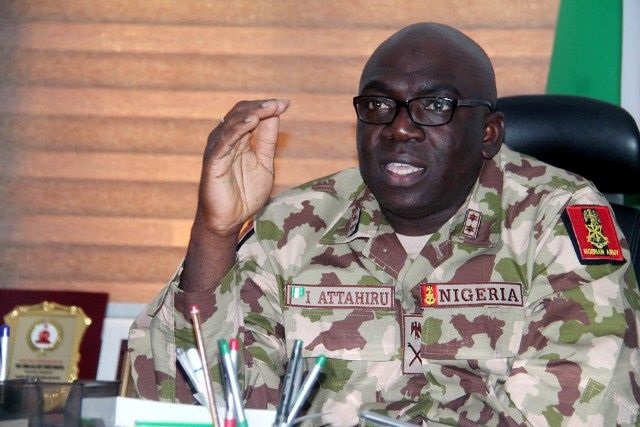
Chief of Army Staff Ibrahim Attahiru has pledged to fix fighting equipment few days after soldiers’ protest in Borno State.
Attahiru said this on Monday during his address at the Chief of Army Staff First Quarter Conference and Nigerian Army Operations Retreat held at the Army Headquarters Command Officers’ Mess, Abuja.
The COAS said he was determined to rebuild fighting skills and capacity of the Nigerian Army across theatres of operation in the country.
“I will ensure that through functional training, officers and soldiers of the Nigerian Army are equipped with the right competences and skills to effectively undertake missions in addition to developing special operations forces.
“This would be closely followed by procurement that ensures appropriate kitting and provision of protective gear, weapons, equipment and platforms,” Attahiru noted.
On Saturday, some soldiers of the Operation Lafiya Dole protested lack of adequate equipment and poor welfare in Borno State.
The soldiers, who shot sporadically into the air, said some of their officers who went to the battleground were killed due to lack of proper arms and ammunition and superior firepower of their targets.
Recently, national security adviser Babangana Monguno said $1 billion meant for the purchase of arms and ammunition was missing under the immediate past service chiefs.
Monguno, who later recanted his words, had said the funds and the weapons were not there.
The ICIR had also reported that Nigerian soldiers fighting insurgency in the northern part of the country had, on several occasions, lamented poor equipment and welfarism.
Some of the soldiers that have come out to speak openly about lack of weapon have either been arrested, demoted or disciplined by the Army authorities.
A major general and former commander of the operation Lafiya Dole Olusegun Adeniyi was demoted after spraking about inadequate weapon for his team at the battle front.