THE Lagos State judicial panel investigating activities of the defunct State Anti-Robbery Squad (SARS) has awarded a total of N16. 25 million to a widow Tolulope Openiyi and three other victims of police brutality.
Chairperson of the panel Doris Okuwobi gave the ruling on Saturday.
Apart from the widow, the three other victims were Blessing Esanbor, Felicia Opara, and Tella Adesanya.
The panel awarded N10 million to Openiyi, and N 5 million to Esanbor. Opara received N750,000, while Adesanya got N500,000.
Openiyi had approached the panel over the death of her husband Olusegun Openiyi whom she said was shot by one police sergeant Jide Akintola with the force number 32405.
The widow had told the panel that her husband, who worked for Airtel, was shot on his chest by officers of the Nigeria police while he was on his way from an official outing at the University of Lagos in August 2007.
Another victim Opara,who also got compensation, had told the panel that some police officers assaulted her with guns after she was arrested for making videos during the #EndSARS protest earlier in October 2020.Felicia Opara, victim of police brutality receives compensation.
She was one of the ladies taken to the Ojuelegba Police Station during the #EndSARS demonstrations in October 2020.
Another petitioner Esanbor, who was also awarded compensation, had approached the panel to narrate how a police officer shot her on February 10, 2012, during an argument, alleging that she sustained injuries and had spent over N5 million in the hospital on treatment.
Blessing Esanbor, victim of police brutality receives compensation
During her testimony as a witness before the Lagos panel, Adesanya said police officers seized his car while driving along LASU/Ibadan road in June 2018, after some persons had accused him of hitting someone along Igando Junction.
Adesanya alleged that he spent three days in a police cell, after which he paid N10,000 for bail and his car damaged at the station.
Tella Adesanya receives compensation from Lagos ENDSARS panel
Adesanya added that he had written letters to the police, Office of the Public Defender, the National Human Rights Commission (NHRC) and the presidency seeking justice, but all to no avail.
The #ENDSARS panel was constituted across the 36 states and FCT to hear, investigate and make recommendations about petitions bordering on police high-handedness and other misconducts.
NIGERIANS with ‘unexplained wealth’ could be forced to forfeit their assets when the ‘lifestyle audit’ planned by the federal government comes into force. The lifestyle audit is to be targeted at individuals who live above their known means of livelihood.
An aide to President Muhammadu Buhari Lauretta Onochie recently revealed plans by the Independent Corrupt Practices and Other Related Offences Commission (ICPC) to commence the implementation of the lifestyle audit in the country.
Lauretta Onochie, a presidential aide
In a tweet on her Twitter handle, @Laurestar, on March 21, Onochie disclosed that anybody could be called upon to explain the source (s)of their wealth.
“Lifestyle audit is now legal in Nigeria. Those who flaunt lifestyles they cannot afford, can now be investigated by any of the anti-graft agencies to produce evidence of the sources of their wealth. You can now be called upon to explain how you acquired certain properties.”
Although the presidential aide did not provide many details on the lifestyle audit, checks by The ICIR show that the initiative, which marks a new approach in the age-long campaign against corruption in the country, will involve the forfeiture of assets by persons with unexplained sources of wealth.
The lifestyle audit will also serve as a means of revenue generation for the government as individuals possessing hitherto undeclared and undocumented wealth could be made to pay taxes on their assets.
Research by The ICIR into how the lifestyle audit works in different countries shows that, beyond being utilised as a means of fighting corruption, it also serves as a revenue-generating mechanism for government through asset forfeiture and taxation.
Countries which have notable lifestyle audit mechanisms include South Africa and the United Kingdom.
The South African revenue service has been subjecting private individuals to lifestyle audit since 2007
Section 46(1) of the Tax Administration Act (TAA) empowered the South African Revenue Service (SARS) to compel individuals to submit relevant materials for the lifestyle audit.
According to a report by Business Insider, lifestyle audits had been a part of the South African lexicon for several years.
The South African Revenue Service (SARS) implements the lifestyle audit using it mostly to target and identify individuals who are not paying adequate taxes to the government. But beyond taxation, the policy is also aimed at identifying and prosecuting corrupt persons. SARS encourages members of the public to report anyone living beyond their apparent means. South Africans are advised to report any individual “displaying unusually high lifestyle patterns for a person with similar forms of known income.”
Lifestyle audit in South Africa is targeted at both the public and private sectors, with the main objective being to establish whether an individual is living above their means, and if that lifestyle is funded by fraud or corruption.
In South Africa, reporting institutions such as banks, the Deeds Office and vehicle registration authorities are required to submit information on individuals whenever such is requested by the revenue service. The revenue service may also identify an increase in reported assets that are not reflected in income. Individuals who flaunt their wealth in public or on the social media may inadvertently flag themselves for a lifestyle audit.
In 2019, SARS hinted that religious leaders might be ideal candidates for lifestyle audits.
SARS lifestyle audit questionnaire asks suspects to provide information on all their assets
Individuals who are subjected to lifestyle audit in South Africa are asked to fill out a ‘lifestyle questionnaire’ and the revenue service will crosscheck the answers provided in the questionnaire against the evidence obtained using alternate sources.
Subjects of lifestyle audit cannot decline the requirement, as a court has ruled that the revenue service has a right to enforce the completion of the questionnaire. A typical lifestyle audit questionnaire issued by SARS compels individuals to provide information on incomes, investments and assets. The questionnaire is used to establish a taxpayer’s living expenses, which will play a central role in the “capital reconciliation’ of a taxpayer’s affairs.
If, during the course of the audit, the individual is unable to prove source of funds or income, SARS may tax those assets as ‘undisclosed income.’
In a recent speech, South Africa’s finance minister Tito Mboweni warned that individuals with wealth and complex financial arrangements would be subjected to lifestyle audit in April 2021. According to Mboweni, the revenue service would establish a unit that would be dedicated to subjecting wealthy individuals to lifestyle audit in order to recover unremitted taxes that should accrue to the government.
In the UK, the Unexplained Wealth Order targets persons with unclear sources of income
In the United Kingdom (UK), the lifestyle audit is implemented through a legislation known as ‘Unexplained Wealth Orders‘ (UWO), which came into force in January 2018 to help authorities identify and seize property suspected to have been bought with laundered criminal funds, especially from foreign sources.
In the UK, the UWO places the burden on the individual, rather than the government, to prove how they have accumulated their wealth and to raise evidence to verify the sources of the wealth. A UWO can be issued by the high court when an individual is reasonably suspected of involvement or connected to a person involved in serious crime. It obliges the individual to explain how property was obtained. The major question raised is, are there reasonable grounds to suspect that the individual’s lawfully obtained income would be insufficient to fund the purchase of a property?
If the individual is unable to prove that a property was purchased through legitimate means, the asset would be deemed recoverable and recovery proceedings will be instigated, and an interim freezing order may be brought to prevent the respondent from disposing of the assets. Also, a criminal investigation may be launched into the nature of the ownership of the asset.
If the respondent is found to have knowingly made a false or misleading statement, a criminal conviction could be instituted with a corresponding sentence of two years imprisonment, a fine, or both.
Instances where lifestyle audit was applied in the UK
In one of the most celebrated cases of application of the lifestyle audit or UWO in the UK, a businessman and gangster Mansoor Mahmood Hussain was forced to forfeit assets valued at about £10 million to the government after he failed to prove the source of the property. Hussain was targeted with the UWO after his social media accounts showed him living a luxury lifestyle involving high-performance cars, executive jets, super yachts and appearance at VIP events.
In the UK, Manni Hussain handed over 45 properties after investigators used an Unexplained Wealth Order
After he was charged under the UWO, Hussain eventually agreed to a settlement which saw him handing over 45 properties to the government. He was left with four small properties that are still mortgaged, and cash in a bank account that was not part of the original investigation.
One of the houses forfeited by Manni Hussain after a lifestyle audit procedure in the UK
In another case of lifestyle audit in the UK, wife of a jailed banker Zamira Hajiyeva was investigated under the UWO after it was discovered that she spent a whopping sum of £16 million at Harrods, a supermarket chain. The Court of Appeal in February 2020 halted Hajiyeva’s attempt to stop the UWO from being implemented against her, and instead, ordered her to prove the source of her wealth. A further appeal by Hajiyeva against the UWO was rejected by the Supreme Court in December 2020 and she might now lose her £12m London home – and a separate golf course – if she can’t explain her riches.
One of the houses Zamira Hajiyeva could lose to the UK government through an Unexplained Wealth Order after she was investigated for spending £16m at a supermarket
Earlier in November 2018, 49 items of jewellery worth more than £400,000 were seized from Hajiyeva by the National Crime Agency as part of investigations into the case.
Jewellery seized from Zamira Hajiyeva by UK authorities
In another instance, property worth £3.2 million belonging to a Northern Ireland woman suspected to be linked to paramilitary groups was frozen as part of an investigation by the National Crime Agency in July 2019.
Also, three London homes worth more than £80 million were frozen in May 2019 through the application of the UWO. The National Crime Agency asked the suspect – a politically exposed person who is not a citizen of the UK – to explain the source of their wealth, failing which the high court would be asked to order a seizure of the properties.
In February 2018, a government official disclosed that Russian oligarchs suspected of corruption would be asked to explain their luxury lifestyles in the UK under the UWO law. The UK government also said suspicious assets worth more than £50,000 could be seized.
ICPC says there is legal backing for lifestyle audit in Nigeria
Onochie had suggested that Nigeria’s lifestyle audit would mirror the UK’s UWO when she tweeted, “I have always looked forward to Nigeria having a policy similar to UK’s Unexplained Wealth. We do now. It is called Lifestyle Audit. Beautiful name!”
She added that “there’s no need having a fit if you have nothing to hide.” Although she did not provide details, she noted that the ICPC had gone all the way to the Supreme Court to secure the implementation of the lifestyle audit in the country.
The ICIR contacted the ICPC for more details on the lifestyle audit
Spokesperson of the agency Azuka Ogugua did not specify when the lifestyle audit would commence. “Please anytime we say we are doing something we will let you know when it is starting, even now we are doing it. We don’t need to reveal it. When it is time the media will be the first to know,” Ogugua said in response to our correspondent’s enquiries. She added, “The chairman said he’s doing something you ask when is it taking off? It is not a campaign. Just give us time. When we do it it will be shown, Nigerians will see it. It will not be hidden.”
But she noted that the lifestyle audit was backed by existing legal provisions.
“We have several legal instruments, like the Code of Conduct, which says you should be able to justify whatever you have. You should be able to say this is the source of your income. We might be thinking what you have is not justifiable not knowing that you have a rich uncle somewhere that died and left wealth for you,” the ICPC spokesperson said.
In addition to existing provisions on asset forfeiture in the EFCC, ICPC and other laws, the Asset Tracing, Recovery and Management Regulations came into force in October 2019 to replace the Proceeds of Crime Regulation, 2012. The Asset Tracing, Recovery and Management Regulations, which was issued by the attorney general of the federation (AGF), set out procedures for all law enforcement and anti-corruption agencies in the investigation of illegally acquired assets and proceeds of crime, the tracing and attachment of assets and proceeds of crime of persons under investigation, including the seizure and disposal of assets of crime that are subject to forfeiture as well as recovery of stolen assets that are outside Nigeria.
Under the regulations, the AGF’s office will conduct all forfeiture proceedings – both conviction and non-conviction based. An Asset Recovery and Management Unit also operates under the Office of the AGF. While the law exists, some experts say its implementation has been a major problem, stressing that the country has relied on EFCC and ICPC Acts to execute asset forfeitures.
In what appeared to be a setback for the federal government’s push to confiscate assets suspected to have been acquired through dubious means, a Lagos High Court, on March 4, 2021, set aside an interim order of forfeiture made against a former Senate president Bukola Saraki. The court had, in October 2019, granted the request of the EFCC to confiscate Saraki’s properties located at 17 and 17A MacDonald road, Ikoyi, Lagos.
Ruling on EFCC’s application for final forfeiture of the properties, the court held that the anti-graft agency failed to prove that the assets were proceeds of illegal activity under the corruption laws. According to the court, the onus was on the applicant, being the EFCC, to prove that the assets subject to forfeiture were proceeds of a criminal activity.
In an interview with The ICIR, a Senior Advocate of Nigeria (SAN) Rotimi Jacobs, who has been involved in the prosecution of corruption cases, noted that even as provisions of the EFCC and ICPC laws empowered the federal government to implement the lifestyle audit by investigating persons living above their means, it would have to be proven in court that property subject to forfeiture were acquired through criminal activities before individuals could be forced to forfeit their assets.
Rotimi Jacobs
“You cannot just do the forfeiture of such assets, you have to dig deeper to see the source of the assets, whether it is legitimate or not. You have to prove,” Jacobs said, adding that the EFCC failed to obtain the final forfeiture of Saraki’s assets because “the people who went to the court thought it was automatic that when you file something you will get a result.”
“But you have to prove it, the law does not presume illegality, you have to prove it,” he stressed.
Jacobs further observed that while the EFCC and ICPC Acts allowed for the investigation of persons living above their known means of livelihood, the law did not criminalise living above one’s means, except in the case of civil servants, as prescribed in the Code of Conduct legislation.
Lifestyle audit should start with political office holders
Meanwhile, some Nigerians, including members of civil society organisations, who spoke with The ICIR on the planned lifestyle audit, said it should start with political office holders.
Noting that there were legal and taxation justifications for the lifestyle audit, a lawyer and lead director at the Centre for Social Justice (CSJ) Eze Onyekpere said, “The lifestyle audit should start from the top political office holders. The people in the executive, Senate and House of Representatives should tell us how they got the money they are spending.”
In the same vein, executive director at Resource Centre for Human Rights and Civil Education (CHRICED) Ibrahim Zikirullahi, while noting that the lifestyle audit was a welcome idea, insisted that government had to set the tone for such an initiative to work.
“The point is that the government has to lead the way by example. Government officials living ostentatious lifestyles at the expense of tax payers have to be scrutinised and made to fall in line first,” Zikirullahi said.
Whistle-blowers should be protected for lifestyle audit to work
Executive director at Parent-Child Intervention Centre Peggy Chukwuemeka told The ICIR that, to ensure the success of the lifestyle audit, the federal government should revisit the whistle-blowing policy. The policy is an anti-corruption programme that encourages people to voluntarily disclose information about fraud, bribery, looted government funds, financial misconduct, government assets and any other form of corruption or theft.
Peggy Chukwuemeka
Chukwuemeka noted that people were no longer volunteering information about corruption to government because whistle-blowers were not protected.
“I do not think it (lifestyle audit) is realistic unless we revisit the whistle blowing policy because they are related. Who will blow the whistle? Are they protected? Look at what has happened to the whistle blowers, why are people no longer blowing whistle? We need to revisit the policy before the lifestyle audit can work,” she observed.
Chukwuemeka equally stressed that the lifestyle audit should start with political office holders.
THE International Centre for Investigative Reporting (ICIR) in conjunction with the ICFJ Knight Fellowship in Nigeria will, on Wednesday, March 31st, 2021, hold a webinar on fake news.
Former education minister and World Bank vice president, Africa region, Oby Ezekesili will deliver the keynote address at the conference themed, ‘Public Accountability in Stemming Misinformation.’
A previous edition of the webinar had earlier being hosted, where the youths and sports minister Sunday Dare delivered the keynote speech.
The panelists scheduled to speak at the forthcoming conference include: executive director/editor-in-chief of Daily Trust newspapers Naziru Mikail Abubakar; executive director of the Centre for Democracy and Development (CDD) Idayat Hassan, and founder of BudgIT Oluseun Onigbinde.
The ICFJ Knight fellow for Nigeria Hannah Ajakaiye will moderate the session.
Intending participants are expected to register for the webinar, which will commence at 12 pm, via this link.
Speaking on the webinar, Ajakaiye said the webinar would curate discussions around combating the misinformation pandemic and galvanise citizens to advocate for good governance.
She added that the event would arm the citizens with ideas on how they could promote public accountability through fight against misinformation and disinformation.
“The virtual event promises to be a well-rounded discussion, intellectually guaranteed to provide possible solutions and ideas on how citizens can promote public accountability by owning the fight against misinformation and disinformation in the Nigerian society.”
The FactCheckHub is the fact-checking arm of The ICIR.
ENERGY experts have told the federal government to stop fixing the price of Premium Motor Spirit (PMS), also known as petrol, saying that doing so weakens investor confidence in the petroleum downstream sector while dampening push for deregulation.
Professor of Energy Economics at the University of Ibadan Adeola Adenikinju told The ICIR that the federal government’s lack of firm stance in the ‘no subsidy regime’ and its influence on the pricing regime were not healthy for the nation’s economy. He noted that the oil and gas sector was at the heart of the nation’s economy, but was being hampered by the subsidy regime.
“This going back and forth by the government is not helping matters. The government must be ready to make the necessary sacrifice to redeem this sector. There may be short-term painful consequences, but we must look at the long-term implications of ‘no subsidy regime,” he said.
Adeola Adenikinju, Professor of Energy Economics
He said,” We spend billion of dollars yearly to import petroleum products. We need to get the confidence of Nigerians, labour, but we can’t keep postponing the doomsday which has its negative consequences on our economy.”
He stressed that the Petroleum Industry Bill (PIB) must be passed by the National Assembly to give better fiscal framework to the sector, expressing concern that the legislators had delayed so much on that.
On the $1.5 billion being courted for Port Harcourt Refinery rehabilitation, he said he did not support that.
“I do not buy into it. I support privatisation and full liberation of the sector. That’s only when the government can reap the benefits of a vibrant petroleum downstream sector.”
Group Managing Director of the Nigerian National Petroleum Corporation (NNPC) Mele Kolo Kyari had, last year, while fielding questions from newsmen, confirmed that the unsustainable subsidy on petrol had been removed permanently by the government, emphasising that it was gone forever.
On the contrary, Kyari admitted, during a media briefing on Thursday, that the government paid as much as N120 billion to subsidise the price of petrol monthly.
Also, the NNPC has insisted that it will continue to maintain the ex-depot price of PMS until it concludes its engagement with labour.
The government has been engaging with labour unions across the country on planned petroleum price increase, with labour citing concerns of impeding hardship on Nigerians as a key reason for refusing fuel hike.
However, energy analysts have said that deregulation of the sector was inevitable. In a deregulated petroleum sector, prices are not fixed, but are determined by the forces of demand and supply, experts say.
Oil sector governance expert Henry Ademola Adigun told The ICIR that petroleum sat at the heart of the Nigerian economy, prompting various political interests.
He noted that government was not the driving equity partner in the the Liquefied Natural Gas (LNG) model often referred to, which was why it succeeded.
According to Adigun, “The NNPC governance code is the problem. It puts all the power in the minister and not the board. In LNG,NNPC is holding the equity on behalf of the federal government. The only thing that is protecting the NNPC in LNG is the inability of the government to intervene and take control hold on them.”
“The refineries are not working not because of equity ownership, they are structural. What is the issue? There is no cue for diesel, aviation fuel, kerosene in the last five years. Why is petroleum different? What does that tell you? It is pricing. The government can make the price look like other commodity and not interfere in it.,” he noted.
He suggested that government should remove subsidy, get out of the business and allow the price to be market-determined.
In his remarks,, former president of the Nigerian Society of Petroleum Engineers Joe Nwakwue said the political will to enforce the ‘no subsidy regime’ was key.
“Labour continues to resist the ‘no subsidy regime’ and the government’s response to it is to keep the unsustainable subsidy regime going as they obviously do not want to expend political capital,” he said.
He said price fixing was still common, stressing that the only sustainable solution was full deregulation.
Joe Nwakwue, former President of Nigerian Society of Petroleum Engineers
“That was what happened with the telecoms and Nitel and today we are better off,” he stated.
“Note that government did not wait to amend the laws before removing subsidies on diesel and kerosene. We can still deregulate PMS and fix the laws subsequently. It is down to the will,” he explained.
“There’s is the issue of trust deficit between the government and the people such that when the government wants to take decisions that will require sacrifice from the people, the people rightly expect to see those in government sacrificing also. Deregulation will hurt in the short run and sacrifices will have to be made, but it is the right thing for the economy. It is more like you want us to tighten our belt, but have you tightened yours? Removing subsidy and deregulation point to people tightening their belt.”
SOLDIERS from an unidentified battalion of Operation Lafiya Dole, a theatre prosecuting the war against insurgency in the North-East of the country, have protested poor equipment and non-payment of their salaries.
According to Channels Television, the aggrieved soldiers protested on Thursday following their redeployment to a location in the Theatre of Operation.
Unnamed sources at the Maimalari Barracks said the troops besieged the headquarters of the Theatre Command in Borno State, shooting sporadically into the air to express their grievances and misgivings.
Some of the soldiers who spoke under anonymity recalled how a whole unit that went for reinforcement when Marte was captured last month perished under superior firepower of the enemy forces.
This protest is coming on the heels of arms procurements scandal recently exposed by national security adviser Babagana Monguno.
No less than $1 billion was released for the procurement, according to Monguno, a retired major general.
The director of army public relations Mohammed Yerima told The ICIR that it was the Central Bank of Nigeria (CBN) that was responsible for the payment of troop salaries and not the army.
“The army is not responsible for the payment of salaries. It is the CBN that does,” he said.
When further asked why there was a complaint of poor equipment despite the huge funds dedicated to that by the government, he directed this reporter to the defense headquarters, noting that the army would only make use of the equipment made available to it.
The defense headquarters could not be reached for comments as several calls made to its spokesperson Clement Onyeama Nwachukwu were not answered.
A report that confirmed the resignation of 386 soldiers from the Nigerian Army in the second quarter of 2020 by the House of Representatives earlier this month had noted that the welfare of soldiers across army formations “has been a recurrent challenge over the years,” stating that though there was an improvement in their welfare packages, and “soldiers still stressed on an urgent need for the Army to do more.”
The lawmakers recommended that the Nigerian Army should improve on the welfare of their personnel, especially those on battlefields or other combat operations to further make the soldiers more committed to their jobs and to the nation at large.
“That there should be effective monitoring or follow-up in the delivery of the welfare packages in all the army formations to ensure that they reach out to all the beneficiaries (the soldiers) in a fair and equitable manner.
“That the army should continuously embark on an orientation of soldiers – both old and new – about the reality of their jobs and the need to be committed to their country. This will reduce the number of soldiers leaving the army due to loss of interest.”
According to the report, the number of disengagements was far lower than the enlistment in the army in the last five years.
It stated that about 6,752 personnel were disengaged and 25,655 were enlisted, adding that not all the soldiers who voluntarily resigned were actively involved in combat operations.
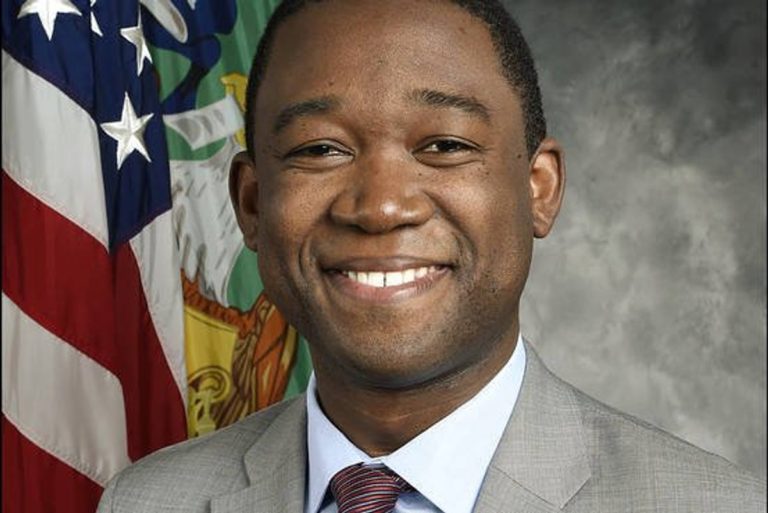
THE United States Senate has confirmed the nomination of a Nigerian-American Wally Adeyemo as deputy secretary of Treasury.
Adeyemo, who was nominated by President Joe Biden in December 2020, was confirmed on Thursday after a unanimous vote.
The 39-year-old has struck a hardline tone on China, vowing to fight what he called Beijing’s ‘unfair economic practices’ while advocating that China be held accountable to international rules.
Adeyemo will play a key role in shaping U.S. economic policy on issues ranging from financial regulation to relief for everyday Americans, including U.S. sanctions on foreign governments.
His family emigrated from Nigeria to the US in the ’80s to pursue the famous ‘American dream.’ He obtained a Bachelor’s of Arts degree from the University of California at Berkeley.
He also earned a law degree from Yale Law School. Apart from a private law practice which spans a few years, Adeyemo’s life has always revolved around politics.
Popularly known as ‘Wally,’ he has spent most of his career convening companies, governments and organisations, until he got his first stint with Barack Obama government in 2009 after serving at the United States Department of the Treasury.
Adeyemo served as senior international economic adviser to former US president Barack Obama, responsible for coordinating the policymaking process related to international finance, trade and environmental issues.
He served as Obama’s representative to the G7 and G20 summits and was also chief negotiator for the Trans-Pacific Partnership’s provisions on macroeconomic policy.
Adeyemo was appointed first chief of staff at the Consumer Financial Protection Bureau (CFPB) where he helped to protect US consumers from unfair or abusive consumer financial practices.
Treasury secretary Janet Yellen welcomed the Senate vote, calling Adeyemo ‘a master of shuttle economic diplomacy’ who would help boost U.S. economic and national security interests.
A former senior adviser at asset manager at BlackRock Inc and the child of Nigerian immigrants, Adeyemo served as a top national security and economic adviser to Obama and held senior jobs at the Treasury.
Yellen said Adeyemo was also ‘a tireless advocate for the working class’ who helped build the Consumer Financial Protection Bureau after the global financial crisis of 2008-2009.
“Those values – and that managerial experience – will be a tremendous asset to Treasury now as we continue implementing the American Rescue Plan,” Yellen said.
THE Pulitzer Center has opened application for 2021 Persephone Miel Fellowships for journalists outside the United States and Western Europe.
Pulitzer Center announced on its website that the Persephone Miel Fellowships was designed to support journalists from outside the U.S. and Western Europe pursuing ambitious reporting projects.
The fellowship would benefit journalists with limited access to other fellowships and those whose works were not routinely disseminated internationally.
The fellowship is named in honour of former senior advisor of Internees Persephone Miel, who dedicated her life to advancing the work of journalists across the globe.
Successful applicants for the fellowship would report from their native countries.
The Pulitzer Centre on Crisis Reporting said it would provide a grant of $5,000 each for reporting projects on topics and regions of global importance, with an emphasis on issues that had gone unreported or underreported in the mainstream media.
The Centre said payment of the first half of the grant would be disbursed at the beginning of the project, upon receipt of required materials, and the second half on submission of the principal work for publication/broadcast.
According to the Pulitzer Centre, female journalists and journalists from developing countries were strongly encouraged to apply. Applicants must be proficient in the English Language.
Pulitzer Centre wrote that selection would be based on the strength of the proposed topic and the strength of the applicant’s work as demonstrated in their work samples.
The Centre noted that it was seeking projects exploring systemic issues in applicants’ native countries and that provide an overarching thesis, rather than individual spot reports from the field.
Specific grant terms are negotiated during the application process based on the scope of proposed work and intended outcomes.
The Pulitzer Center also offers the fellow the opportunity to be mentored by a journalist from the global network of grantees.
Interested applicants can apply here . The deadline for the submission of applications is April 23, 2021
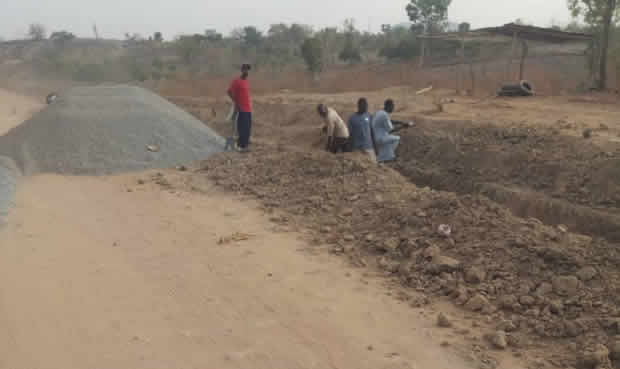
FOUR MONTHS after The ICIR report detailed how a 14–kilometre road connecting Pegi community to Kuje area of Abuja, Nigeria’s capital, was left uncompleted for over nine years, work has resumed on the road.
The Federal Capital Territory Administration (FCTA) has mobilised the contractor, Verallen Nigeria Limited back to the site.
The development first came to light during a radio programme, Public Conscience, produced by the Progressive Impact Organisation for Community Development, PRIMORG, where residents announced that work had again commenced on the road.
PRIMOG had late last year called The ICIR’s attention to the bad condition of the road after a similar radio program, leading to an earlier investigative report published in November 2020.
In a letter dated March 3, and seen by The ICIR, the FCTA said the contractor had been mobilised back to the site, adding that the authorities were processing the contractor’s payment for the completion of the abandoned road project.
The ICIR had in the earlier reported detailed how residents of the community had been experiencing miscarriages, kidnapping and even death, despite the fact that a sum of N676 million was awarded for the road project in 2011.
Speaking to The ICIR on the recent development, Pegi Estate Community Development Association (PECDA) chairman Isaac Aderibigbe said it was true that the contractor had been mobilised back to the site but decried the pace at which the work was moving.
“We are glad that work has resumed back on the road after over 10 years that the road has been awarded.”
Aderibigbe, however, alleged that the contractor had on March 12, stopped work on the road again, adding that the community was optimistic that the road would be completed this time.
The PECDA spokesperson Oyedeji Oyetunji said the contractor had only done about 100-metre concrete drainage.
“The contractor has absconded again. He has only done about 100 metre concrete drainage and we have not seen him again since March 12.”
Part of the drainage done on the road
Managing director of the Verallen Nigeria Limited Allen Egbe told The ICIR that he had returned to site, but declined to speak further on the road project.
“It is true that I have been mobilised back to the site but you can get in touch with the FCTA on any further information on the road project,” Egbe told The ICIR during a telephone conversation.
The ICIR also contacted the permanent secretary to the FCTA Olusade Adesola, who promised to get back to this reporter, but he was yet to do so as of press time.
“I’m currently in a meeting, I will get back to you,” Adesola told The ICIR via telephone conversation.
A study conducted by a research development and policy advocate Zinariya Consults estimates that over 300,000 people have been displaced with 1, 868 deaths recorded in four states since 2018 due to clashes between farmers and herders in Nigeria.
An associate research professor with the Institute for Peace and Conflict Resolution and one of the lead researchers commissioned for the study by Zinariya Consults Joseph Ochogwu said this while presenting the findings on Thursday in Abuja
During his presentation, Ochogwu said the research was conducted in partnership with the Open Society for West Africa (OSIWA) and the Global Rights.
According to him, the research presentation titled ‘Trends and Dynamics of Conflict between Farmers and Pastoralists in Nigeria’s Benue Valley’ was conducted in Benue, Plateau, Nasarawa and Taraba states.
Zinariya Consult presentation of Study in Abuja
He said the study found that between 2018 and 2019, access to water and grazing land became more competitive, leading farmers and herders into frequent arguments.
The researcher stated that the study revealed that the conflicts escalated when herders began to violate laid-down rules and livestock began to contaminate the only source of drinking water in some villages.
Ochogwu also said between 2012 – 2017, suspected herders carried out 49 attacks against communities in the study areas.
Some other key findings of the report included gender dimension of the conflict, mental and health implications of the conflict, demographic shift, community engagement, among others.
Speaking on some of the recommendations of the group, Ochogwu said, due to the complex nature of the conflict, it required participatory, inclusive and coordinated solutions.
The lead researcher said government should strengthen already existing community policing as well as work together to deploy a joint task force comprising army, navy, air force, police, para-military and civil institutions to restore law and order and build the population’s confidence in the government.
He further said that the research recommended that development partners partner with the government and community-based organisations to ensure that women were mainstreamed in peace-building programmes.
Ochogwu also urged the governments in key states to work with civil society organisations, the media, as well as gender and peacebuilding experts to develop programmes using conventional and social media, among others, to deconstruct social norms.
Speaking at the event, partner and chief executive officer of NexTier Ned Nwokolo advised the government to also look at the economic value of the farmers-herders conflict, including how much the country had lost and how much it could have made from pastoral farming.
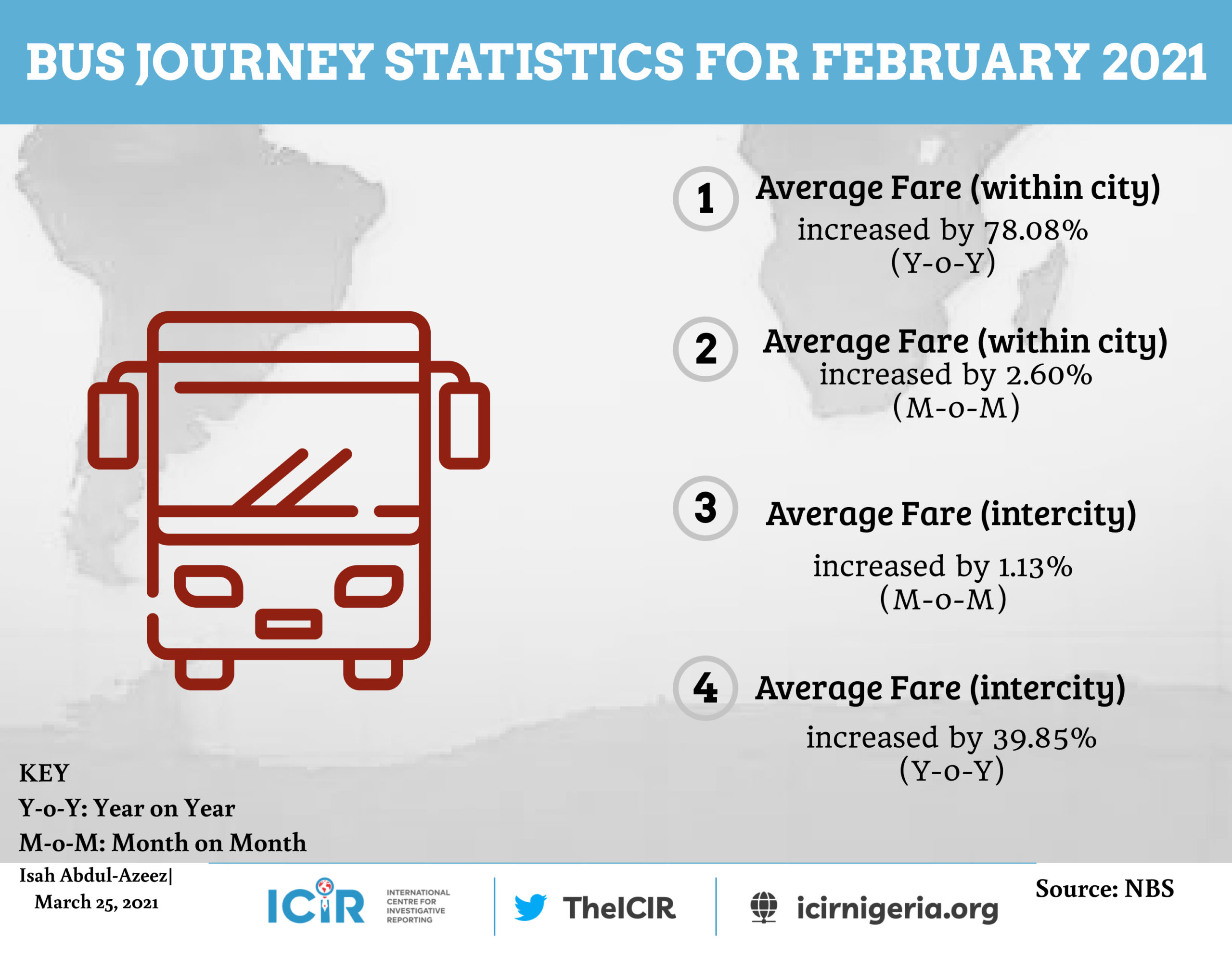
ON the average, transport fare by bus within Nigerian cities increased by 78.08 percent in the last one year, according to a report released on Thursday by the National Bureau of Statistics (NBS).
The 78 percent rise in the cost of transportation across Nigerian cities means that commuters, who have mostly been hit by COVID-19 pandemic, inflation and other economic woes, have had to pay almost double what they paid a year ago as transportation fares.
The report says that commuters’ average fare for bus journeys within cities increased by 2.60 percent month-on-month to N361.31 in February 2021, from N352.15 in January.
This increase may have been fueled by the consistent rise in inflation and confusion in the price of premium motor spirit (PMS), otherwise known as petrol. In February 2021, the NBS reported highest inflation rate in four years – 17.33 percent.
Bus journey statistics for February 2021. Infographics by Isah AbdulAzeez
The NBS further reports that, in the period under review, states with the highest bus fares within cities were Zamfara- N620.15; Bauchi- N530.1, and Ekiti- N475.25.
On the other hand, states with lowest bus fares within cities were Oyo, N190.42; Abia- N208.55, and Borno- N250.72.
According to the report, commuters’ intercity average fare for bus journeys increased by 1.13 percent month-on-month and by 39.35 percent year-on-year to N2,372.87 in February, from N2,346.41 in January 2021.
Also, it was more expensive travelling from the Federal Capital Territory (FCT), Sokoto, and Lagos states to other cities as intercity fares were highest in these three states: FCT- N4,500.88; Sokoto- N3,350.60; and Lagos- N3,340.60. On the other hand, states with lowest bus fares within cities were Bayelsa- N1,650.32; Bauchi- N1,690.80, and Enugu-N1,700.
The average fare paid by air passengers for single journeys decreased by 0.02 percent month-on-month, but increased by 17.97 percent year-on-year to N36,458.11 in February 2021, from N36,463.65 in January 2021.
The NBS reports that states with highest airfares were Delta/Lagos-N38,600; Anambra/Bayelsa- N38,500; Bauchi- N38,400, while states with lowest airfares were Akwa-Ibom- N32,500; Sokoto- N33,600, and Gombe- N35,000.
The NBS Transport Fare Watch report for February 2021 covered categories such as bus journey within the cities per drop constant route; bus journey for intercities, state routes, charge per person, and airfare charges for specified routes (single journeys).
It also covered the journeys by motorcycles (okada) per drop and waterways passengers transport.
The NBS reports that motorcycle commuters paid more in February as fares increased by 2.86 percent month-on-month and by 97.68 percent year-on-year to N266.74 in February 2021, from N259.33 naira in January 2021.
States with the highest fares by motorcycle per drop were Taraba- N436.20; Yobe- N425.02, and Kogi- N400.12.
On the other hand, states with lowest fares by motorcycles per drop were Adamawa- N86.47, and Katsina- N140.12.

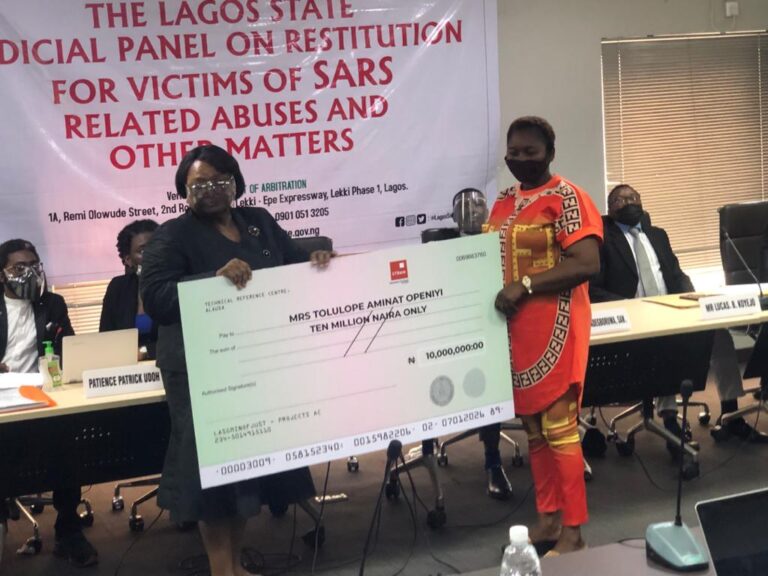
 Felicia Opara, victim of police brutality receives compensation.