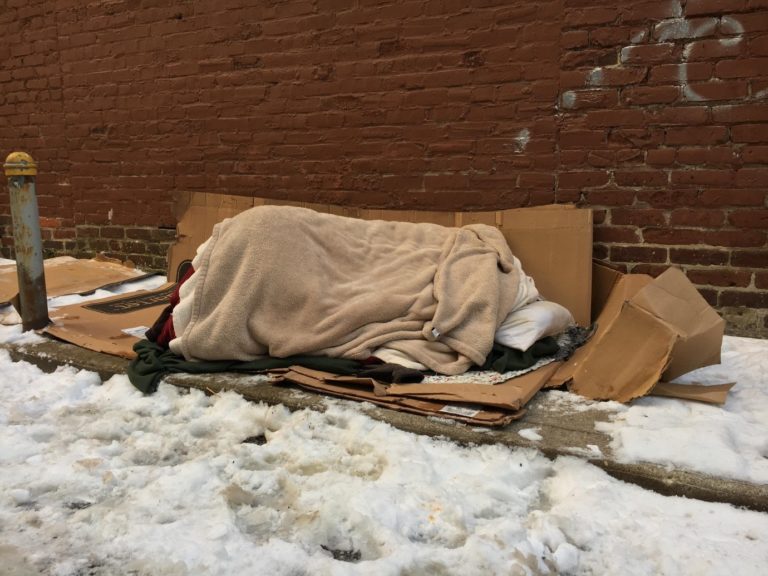
A homeless 46-year-old Nigerian man living in Rome has died from exposure to cold after he was “ignored by all (and) abandoned”, Pope Francis said from the Vatican City on Sunday, calling attention to the plight of the poor and needy.
The man simply identified as Edwin was discovered dead just a few meters from St. Peter’s Square on January 20.
“Let us think of Edwin, let us think of what this 46-year-old man felt in the cold, ignored by all, abandoned, even by us. Let us pray for him,” the Pope said before pausing for a few seconds in prayer for the deceased.
Sant’ Egidio, a Catholic charity group dedicated to social service said Edwin was at least the fourth homeless person to die of the cold in the city this year and the 10th since November.
The Charity along with other groups search the streets of Rome for the homeless to direct them to shelters and give out blankets and food.
An estimated 8,000 people are homeless in Rome, of whom only 4,000 to 5,000 are in shelters provided by the council or charities.
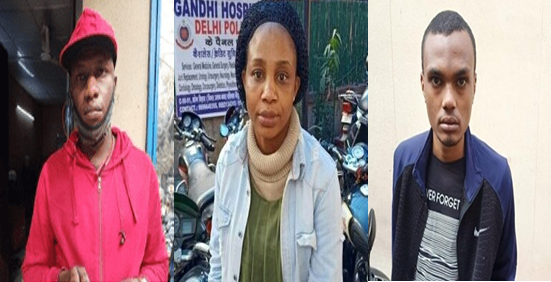
TWO Nigerians have been deported from India for overstaying their visas, the Delhi Police said on Thursday, bringing to six the total number of Nigerians expelled from the country since the beginning of this year.
According to a statement released on its official Twitter page, the Dwarka Police said the two Nigerians and a Sudanese were arrested and deported by officers from Uttam Nagar Police Station, after they were found to be living in India without valid visas and passports.
“2 #Nigerian Nationals & 1 from #Sudan were found living without having valid #Visa & #Passport during area #Patrolling duty, were deported by the staff of PS Uttam Nagar,” the statement read, using the hashtag #ActionAgainstIllegalStaying.
It was gathered that the two Nigerians recently deported were among 10 Nigerian nationals picked up by the police from the Uttam Nagar in Dwarka district on Wednesday, January 6.
Previous Deportees
Two Nigerian males were deported from the country on January 13th, 2021, by officers from the Mohan Garden Police Station and another male with one female were deported on January 11 in a similar sting operation by men from Uttam Nagar Police Division.
The deputy commissioner of police, Dwarka, Santosh Kumr Meena, who confirmed the development, described their action as a gross violation of the Indian visa norms.
“Their visas have also expired but they are continuously staying in India which is a gross violation of the Indian visa norms. They have not provided any suitable reason and supportive documents for their overstay in India,” he said.
Over the years, several Nigerians residing in the country have been arrested and deported. The offences charged against them include illegal stay, internet fraud, online romance scams and drug peddling.
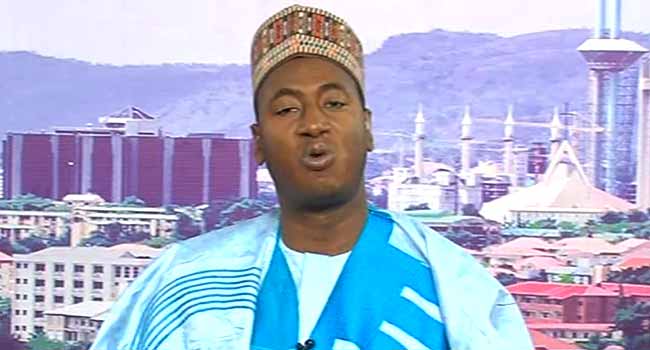
SALEH Alhassan, national secretary of Miyetti Allah Kautal Hore, says President Muhammadu Buhari has done nothing for the Fulani herdsmen except create enemies for them.
In an interview with Punch Newspapers, Alhassan said herdsmen were being marginalised in the country and that Buhari as President had not in any way made their lives better.
His statement is coming on the heels of the controversy generated by Rotimi Akeredolu, Ondo State governor, who ordered herders to vacate the state forest reserves over rising insecurity in the state.
Also, Sunday Adeniyi Adeyemo, a Yoruba youth leader, also known as Sunday Igboho, had issued an ultimatum giving herdsmen seven days to leave Igangan, Ibarapa North Local Government Area of Oyo State following cases of increased kidnapping and killings by suspected Fulani herdsmen in the area.
On Friday, he reportedly stormed the Fulani settlement in the town to eject the Seriki Fulani, Salihu Abdukadir, and other herdsmen accused of fuelling insecurity in the area.
Alhassan said, “The mistake people make is that they think when they put pressure on herders they are getting at President (Muhammadu) Buhari. Buhari has no relationship with the herders. That is the truth. When people say he is our grand patron, was Jonathan from the South-South not our grand patron?”
“If the President is a Fulani, it doesn’t in any way affect the life of a herder. In fact, they are worse off under Buhari. What are they benefitting? They don’t access any government facility or social amenity, yet they are responsible for the bulk of animal protein we produce in this country. I think it’s deliberate for people to think otherwise.”
“Buhari has not done anything for us other than creating enemies for us. Herders are being chased around. Let us look at the larger picture and not allow enemies penetrate us. If Buhari loves the herders, he would have created the grazing reserves for them.”
Herdsmen in 10 years, killed 3652 people in 478 attacks
According to data obtained from Nigerian Security Tracker (NST), between 2012 and 2021, Fulani herdsmen conducted 478 attacks and killed 3,652 people in Nigeria.
The data captures the yearly number of attacks and deaths by Herdsmen across the country from 2012 to January 2021.
NST, which relies on data from media reports and verified independently by a team of researchers, shows attacks and killings orchestrated by herdsmen.
A breakdown analysis of the data indicates that in 2016, there were 56 attacks resulting in the killing of 799 people, while in 2018, the attacks rose to 147 and resulted in a bloodbath that caused 1,196 deaths.
In 2020, according to the data, there were 74 attacks, and 248 people killed.
Deaths per year, however, showed that 7 attacks with 43 deaths were recorded in 2012. In 2013, the number of attacks rose to 17 with 149 deaths. The following year, specifically in 2014, it further rose to 32 attacks with 374 deaths, while in 2015 it dropped to 14 attacks with 100 deaths.
In 2016, the number of casualties rose 56 attacks with 799 deaths. The following year, specifically in 2017, it declined to 55 attacks with 483 deaths, while in 2018, 147 attacks and 1,196 deaths were recorded. in 2019, attacks dropped to 71 with 255 deaths. In 2020, there were 74 attacks and 248 reported deaths.
As of January 2021, five attacks have been recorded with five reported deaths.
The predicament of Nigerian traders in Ghana have in recent time been an issue of debate nationally and within the West Africa sub-region. This is due to the controversial Ghana Investment Promotion Centre (GIPC) $1 million levy that mandates every foreign investor in Ghana to either provide the huge sum in cash or as raw materials before legally being recognised to do business in the country. Olugbenga ADANIKIN who recently visited Ghana reports on the dilemma of Nigerian traders.
It was 2:44 pm, on a sunny day of December 6, 2020. Godwin Anthony had just returned from the ‘street,’ sapped out. “Abeg, give me malt,” he reached out to Eric, a fellow Ghanaian trader but his request was cunningly disregarded.
Anthony, a Ghanaian by birth, trades in mobile phones and phone accessories at the popular Kwame Nkrumah Circle Market in the Greater Accra Region, Ghana. His father, a Nigerian, from Imo State married from Ujape, a local community in the Volta Region, Ghana.
Besides being born in Ghana, the 36-year-old father also married a Ghanaian, just like his father but prefers to be identified as a Nigerian and has suffered similar prejudice as scores of Nigerian business owners challenged by the $1 million investment levy promulgated by the Ghanaian government for foreign investment in the country.
His stall was shut since November 2019 by the multi-stakeholder enforcement Committee on Foreigners in Retail Trade; as a result, he lost over 80 per cent of his customers and survival has been a great challenge. He now roams street around the popular market to eke out a living.
His ties with his country of birth and marriage to a Ghanaian spouse did not spare him from the GIPC policy, mostly considered prejudicial on Nigerian businesses in the country. Nevertheless, he would sometimes help his friends involved in the same line of business to import goods from China to Ghana.
The story of alleged hostile treatments meted out at foreigners in Ghana, especially Nigerians have remained a burning discussion of public interest, and perhaps a regional concern. These worries evidently became more pronounced following the decision of the Nigerian government to shut its land borders at Seme, Illela, Maigatari and Nfun in August, 2019 – a move the federal government attributed to increased smuggling of arms and agricultural produce.
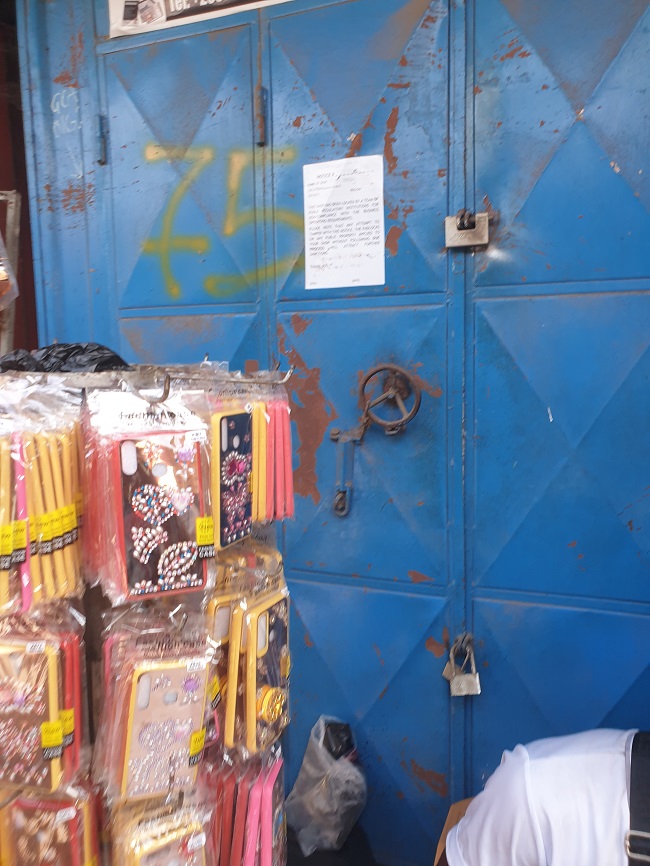
One of the locked-up stalls belonging to a Nigerian at the Circle Market, Accra. Photo Credit: Olugbenga Adanikin, The ICIR
The Ghanaian government was displeased with the border closure such that, Nana Akufo-Addo, the Ghanaian president appealed to President Muhammadu Buhari to consider Ghanaian businesses affected by the policy.
In September, 2020, Patrice Talon, Benin president also sought the suspension of the policy, but the federal government appeared adamant, as the policy remained active until December 16, 2020 – more than a year after the decision was taken.
Nigerian traders in Ghana, consequently, believed the apathy was exacerbated by the land border closure. Moreover, the decision came at a time when the continent was aiming at trade integration.
“The whole drama started around November 2019,” says Anthony, “I will tell you they basically focus on Nigerians because there were Lebanese whose shops were left untouched.”
The perceived attack, he said, led to demonstrations. Representatives of the Nigerian traders ran to the Nigerian High Commission for possible interventions. Few meetings were held by governments of both nations but nothing productive eventually emanated from the interventions.
“If a customer visits your shop and sees it locked, he will probably look for an alternative. From there, you have lost that one,” Anthony adds emphasising on the ripple effects of the Ghana Investment Promotion Centre (GIPC) law.
Like several others affected by the policy, he has lost hope, yet, he resolves to remain on the street, at least, to satisfy family needs until the policy is overturned – that is, if it would. Still, he acknowledged legal provisions in the Ghanaian law which prohibits foreigners from engaging in retail trade.
“Foreigners interested in trading business in Ghana ought to be wholesalers while Ghanaians do the retail trade. Their law disallows trading enterprises in the market,” he said.
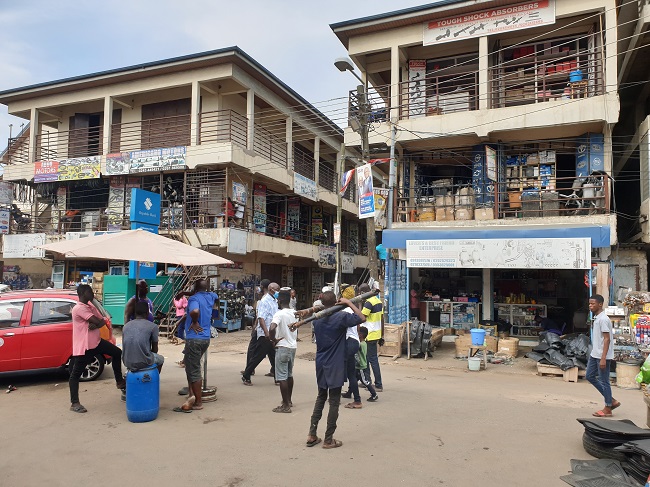
Locked-Up and Open Stalls at the popular Abusiokahi Market, Accra, Ghana. Photo Credit: Olugbenga Adanikin, The ICIR
Its Jealousy against Nigerians
Blessing Ogomeana engages in the same business as Anthony. He hails from the Niger Delta Region, Nigeria but resides in Ghana. In 2018, Ogomeana commenced his phone repair business with great expectations. He subsequently incorporates the trading of phone accessories, yet unmindful of the legal implications.
He has enjoyed a steady growth in the business until 2019 when he started encountering confrontations from the Ghanaian traders at the market. “The people were harassing us,” he said in a troubled voice. “They will say you are a Nigerian; you should return to your country,”he added.
Some of the traders were executive members of the Ghana Union of Traders Association (GUTA) working with the GIPC law enforcement committee. He said they would clamp on their stalls and shut down shops of those flouting the business registration requirements.
Ogomeana’s stall was eventually shut towards November 2019, just like Anthony. “They came to raid at about 1 am when we least expected,” he said. “We were caught unaware and at some point, the Ghana police joined in the action,” he continued. Due to the unpleasant experiences, he concluded the action against Nigerian businesses was premeditated and fuelled by “jealousy and envy”.
He averred that some Nigerians had satisfied the required conditions but were still made to face similar pitiable treatments and that even though retail trading by foreigners is prohibited in Ghana, the legislation was not new, only that it was not being enforced as at the time he commenced his business. The ICIR subsequently visited selected markets where the alleged prejudice against Nigerians was carried out but could not find a Nigerian who had met with the most controversial requirement. Though most had their tax payments receipts and other tickets from the municipal area council, the $1 million was an issue.
The ICIR’s observations show most business owners including the Ghanaians only occupy small stalls at the markets. As a result, paying the $1 million levy was a challenge to most foreign traders, particularly those who are into mobile phone and automobile spare parts businesses. Some of the affected Nigerian business owners have since resolved to sublet their shops to Ghanaians,others engaged the locals to manage their businesses while those who could not take the risks, resign to their fate; actions that are indirectly creating more jobs and opportunities for Ghanaian citizens.
Endkojo Nkrumah, Ghana’s Minister of Information, had in September, denied allegations of maltreatment against Nigerians and Nigerian businesses in his country. Responding to earlier reactions of the Nigerian government through Lai Mohammed, the Minister of Information and Culture, Nkrumah accused Nigerians of violating the Ghanaian laws. He listed some of the offences to include, “tax evasion, immigration offences, trading in sub-standard products, violation of the GIPC law and improper registration of firms.”
He alleged Nigerian business owners among other nationals engage in “underpayment of business operating permits and falsification of documents.” Earlier, on August 24, 2020, Joseph Obeng, GUTA president also reacted alleging ‘80 per cent of those who deal in illegal trade’ were Nigerians.
Nevertheless, Ogomeana was one of those who disagreed with the claims. He presumed that the prejudice was because Nigerian businesses were flourishing than those of their Ghanaian counterparts. He also suspects that Ghanaians are becoming worried about the increasing population of Nigerians in their country. Since the border closure remains inclusive, Anthony, Ogomeana like many other foreigners have lost hope.
We will leave once we can no longer cope – NUTAG
Prior to The ICIR’s visit to Ghana, the leadership of the Nigerian Union of Traders in Ghana (NUTAG), had accused the local media of partial reportage on their predicaments. In an interview with Chukwuemeka Nnaji, NUTAG’s President, he accused the Ghanian authorities of unfair treatment against Nigerians. He said, “I must tell you, it has not been easy,” decrying how members of the association were harassed and in some situations, ‘beaten’. He said there is no fair play once it comes to doing business in Ghana, as every other national living in the country is better treated than Nigerians.
Nnaji is married to a Nigerian, but relocated to Ghana almost three decades (25 years) ago, where they had their children. By 2006, Nnaji started his automobile business and for 14 years, majored in the imports and exports of vehicle parts. He said his business is now on the verge of collapsing due to what he described as ‘hostility’ against Nigerian businesses in the English neighbouring country, describing the situation as unfortunate.
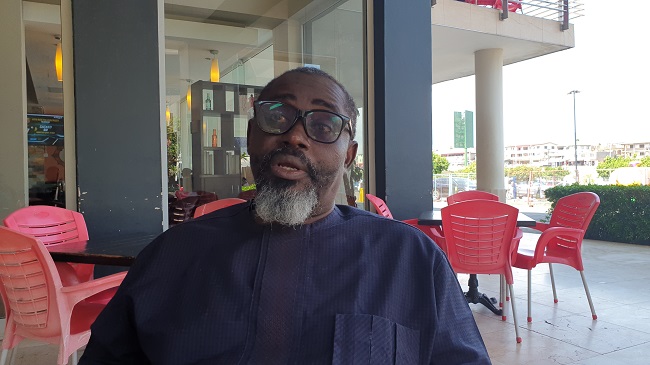
Chukuwuemeka Nnaji, President, Nigerian Union of Traders in Ghana (NUTAG) during an interview with The ICIR. Photo Credit: Olugbenga Adanikin, The ICIR
Nnaji had travelled to Nigeria in November 2020, when he received a call that his shop and 39 others had just been locked up. He said he was restless when he heard the news, but particularly concerned about his members. He is currently helping to raise funds that would help stranded traders who want to return to Nigeria to do so and has called for urgent action from the ECOWAS Commission and the Nigerian government.
“I’m ready to die if it comes to the worst situation,” a frustrated Nnaji said, explaining, “In 2020 alone, over one million Ghana Cedis was paid as taxes. I’m even the least, there are several others who import larger containers”.
Findings by The ICIR revealed Nnaji’s assertion about Nigeria’s contributions to the Ghanaian economy was valid. In 2019, Nigeria exported $4 billion worth of goods to Ghana while Ghana’s export to Nigeria in the same year was valued at $164.06 million. These trade volumes were based on data sourced from the United Nations Comtrade on International Trade in January 2021.
Nigeria imports from Ghana 1996-2019. Infographic by Damilola Ojetunde, The ICIR
Data from the Economic Community of West African States (ECOWAS) Commission also showed Nigeria’s huge contribution to the region. Nigeria accounts for 76 per cent of total trade in the region, followed by Ghana with 9.2 per cent and Cote d’Ivoire 8.2 per cent.
“The trade surplus of the region, estimated at about $47.3 billion is attributable to Nigeria ($58.4 billion) and Côte d’Ivoire ($3.4 billion) when all other Countries have a deficit in the trade balance,” the regional trade report reads.
So, as for Nnaji, the perceived hatred for Nigerians is not due to the border closure policy. Though it might have worsened the relationships between both countries, he strongly believes there was more to it.
“Since 2017, Nigerian traders have been harassed by Ghanaian traders,” he told The ICIR. The challenge, he said became worse as the Ghanaian authorities and the traders’ union allegedly became unwilling to dialogue, not to mention of reaching a consensus with the Nigerian traders and NUTAG leadership.
Nigeria’s export to Ghana 1996-2019. Infographic by Damilola Ojetunde, The ICIR
Heavy Revenue Loss
Our findings show that Nigerian stalls took the largest percentage of locked-up shops in the markets across Ghana, especially in Accra, resulting in heavy revenue loss for both the Nigerian businessmen and the Ghanian authorities. While the NUTAG President says 270 Nigerian-owned shops affecting over 1,000 traders have been shut as at December, 2020, Anthony puts the total number of Nigerian stalls shut in 2019 alone by the Ghanaian authorities at 600.
The Nigerian information minister had accused Ghana of locking up 300 shops belonging to Nigerians in 2018, 600 in 2019 and 250 shops in 2020, but responding, his Ghanian counterpart had said, “It is an incontestable fact that there are widespread abuse and disregard for local laws and regulations governing retail trade by some foreigners, including Nigerians, which need to be addressed without discrimination”.
Nigeria’s balance of trade with Ghana 1996-2019. Nigeria’s export to Ghana 1996-2019. Infograph by Damilola Ojetunde, The ICIR
Most Nigerians engaged by this reporter in the course of this investigation have argued that Nigerians should not have been a subjected to the heavy $1 million levy, considering the diplomatic relationship between both countries, and like the fact that Ghana, as an ECOWAS country, is signatory to the ECOWAS free trade and free movement treaty.
Ghanaians on the other hand, have maintained that as a sovereign nation, they are at liberty to develop a law and enforce it without interference.
The ECOWAS trade treaty, however, places emphasis on ‘rules of origin.’ This implies the treaty gives preference to products produced from member states. The ECOWAS Trade Liberalisation Scheme created in 1979 initially covered agricultural products and hand-made crafts, but, by 1990, it was extended to industrial products, which should comply with the ‘rules of origin.’
Due to non-compliance with the trade agreement, the National Approval Committee from the 15 member states met with other stakeholders last year November, between 11 – 12 to proffer lasting solutions. They re-emphasised on seeking a certificate of origin.
The ICIR further attempted to speak with Sandra Oulate, ECOWAS Director of Communications, regarding the trade dispute but she directed the reporter to send a text message as she was out of the country. The questions were forwarded to her, but she responded on January 19th, 2021, saying she was on leave and would refer our reporter to an appropriate authority. The next day, an email was sent to her as a reminder but she maintained her initial position. Her response read: “I am presently on leave with limited connectivity.”
What the GIPC law says
No doubt, foreign business ventures in any country are guarded by regulations. In Ghana, satisfying the GIPC requirement is cardinal. The law establishing the Centre created in 2013, prohibits foreigners from engaging in a retail business. And beyond this, the framework also outlines conditions that must be satisfied by foreign business owners before they are allowed to operate in Ghana.
Sections 27 and 28 of the GIPC law detail business entry requirements for foreigners and enterprises. It exclusively reserved retail trade for Ghanaians. For instance, Section 27.1. A says, “a person who is not a citizen or an enterprise which is not wholly-owned by a citizen shall not invest or participate in the sale of goods or provision of services in a market, petty trading or hawking or selling of goods in a stall at any place.”
Section 28.1. (A) allows joint partnership business with a Ghanaian but the partner must provide at least $200, 000 United States as foreign capital in cash or goods to the business; for a foreigner to wholly engage in trading enterprise, he or she, according to Section 28.1.B, must invest, “not less than $1 million US in cash or goods and services relevant to the investment.”
For the purpose of the above-mentioned sections, ‘trading’ includes the purchasing and selling of imported goods and services. Sub-section 3 of the law adds that the trader must employ at least 20 skilled Ghanaians in addition to satisfying the compulsory business registration requirement.
Foreigners who marry Ghanaian spouses are not excluded except if such an individual has been married to the Ghanian spouse for at least five years or holds an ‘indefinite’ resident permit. Some of these provisions showed the business laws have existed over time until strict implementation commenced in 2017.
Sections 40 and 41 of the GIPC law, also, clearly spelt out penalties for flouting the law. The sanctions extend to Ghanaians who serve as fronts to foreigners who want to evade the laid out requirements.
“The effect of this provision is that a person who is not a citizen of Ghana who engages in retail trade without meeting the minimum capital requirements set out in Section 28 of Act 865 commits an offence under Act 865. Ghanaians or non-Ghanaians who let out a stall or a store in a market to a foreigner also commit a breach of Act 865,” the GIPC states further on its official website.
We can’t compromise the law because Nigerians are our brothers – GUTA National Organising Secretary
Nana Kwabena Peprah, the National Organising Secretary, Ghana Union of Traders Association (GUTA) and member of the enforcement committee, was firm in making clear, positions on the matter. He said part of the mandates of the committee is to look at the investment law of Ghana and enforce it to the latter.
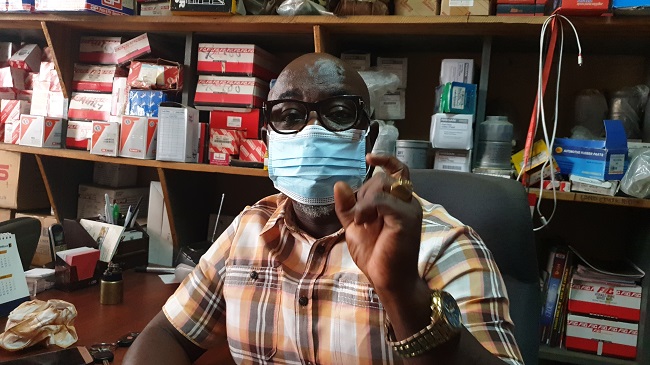
Nana Kwabena Peprah, National Organising Secretary, Ghana Union of Traders Association (GUTA) during an interview with The ICIR at his stall in Abbosey Okai Market, Accra, Ghana.
“All the Committee is doing is to uphold the law,” Peprah told The ICIR. “The law says if you want to do business in Ghana, you register with the GIPC. Once they issue a certificate, it will indicate the location as to where you can do business.”
According to him, GIPC emphasis has been on business locations and the $1 million levy, even though the same law prohibits foreigners from engaging in retail trade at the markets. He explained that the issuance of a certificate to an investor or foreigner implies that he/she has met all the requirement and is free to do business.
However, on the certificate, the location at which such an investor could operate would be indicated and the certificate is renewed biennially. It is from this stage that business owners could proceed to register with other agencies such as getting a work permit and the tax collection body.
“The law has come to stay and the payment is part of the major requirements which investors must satisfy, otherwise, their activities are considered illegal and could be disrupted,” Peprah maintained.
The ICIR raised a notable issue of how the global pandemic has affected nations, crippling economies and exacerbating poverty. The $1 million, for instance, could be a tough one for foreign investors, especially young entrepreneurs; but this appears to be of no concern to the official.
“No no…, it doesn’t follow,” he said with a bold face. “Are you telling me now that because Nigeria is going into recession, you are changing your laws to suit foreigners? Have you seen Ghanaians in Nigeria opening shops in your market?”, he queried.
Is the perceived attack on Nigerians a payback?
Since the Ghanaian government and trade union began to implement the GIPC law, public perception has been that the law was targeted at the Nigerian business owners and our findings revealed most Ghanaians appeared uncomfortable with the increasing population of Nigerians in their country and robbery cases, allegedly linked to Nigerians.
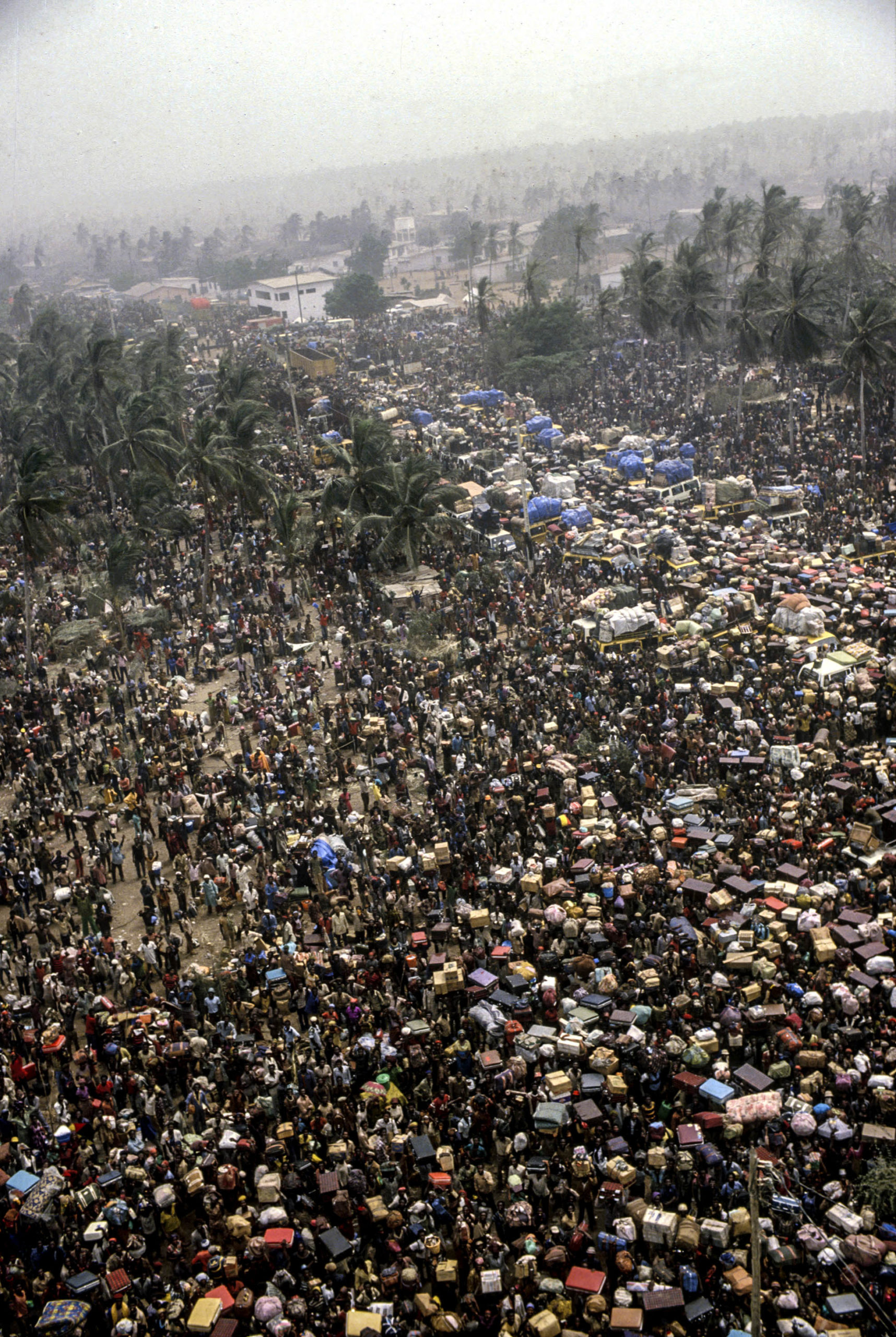
Recall that in early 2017, there were cases of robberies which after arrests, turned out that most of the suspects had Nigerian surnames. Two years after, a similar incident happened at Koans Estate, Amasama, Accra. Since then, coupled with the sad history of massive deportation of undocumented migrants from Nigeria in 1983 which gave birth to the “Ghana Must Go” phrase, some of the locals have continued to demand that Nigerians found guilty of breaching the laws are repatriated.
In 1969, former Ghanaian Prime Minister, Kofi Busia invoked the Aliens Compliance Order which led to the deportation of about 2.5 million African migrants, mostly Nigerians. Aremu Johnson and Ajayi Adeyinka, both from the Department of History and International Studies, Ekiti State University, in their paper published in a United Kingdom journal, attributed jealousy and xenophobia as factors that led to the 1969 expulsion. More Nigerians today believe the row between both nations has lingered for decades.
NIGERIA – 1982: Ghana Refugees leaving Nigeria waits at the border to enter Benin as part of their journey back to Ghana(Photo by Michel Setboum/Getty Images)
“The general sentiment has been that Nigerians should be sent back to their country,” a Ghanaian lady who pleaded anonymity told this reporter.
Somewhere around Osu Town, Accra, a Nigerian lady identified as Gladys painted almost similar scenario. After her Degree programme in Turkey, she decided not to return to Nigeria but chose to reside in Ghana for a while. Sharing her experience, she said “There is this unusual hatred once they know you are a Nigerian,” she told The ICIR. “It is worse, if you are probably doing well in a chosen career, they still feel threatened somehow and the attitude can be irritating.”
The stories were similar in the Ghanaian markets. Nigerians are perceived as naturally adept at wooing clients to their stalls. Their business skill is considered sharper and astonishing. They would not wait until customers walk into their stalls, unlike the Ghanaian counterparts. This marketing strategy and enterprising acumen, incidentally, is a common phenomenon in Nigerian markets. In what now appears like a business chain, young boys are strategically positioned to scout for customers and they get rewarded once a buyer buys a product from the stall.
As at 2019, the unofficial figure says there are over 2 million Nigerians residing in Ghana. The increasing population is more than other nationals, and due to this factor, it is believed more Nigerians would be affected by the policy. Still, GUTA members from other parts of the country want the GIPC law sustained to protect their local businesses.
On September 3, 2019, Speakers of Ghanaian Parliament and the Nigerian House of Representatives, Rt. Hon. Aaron Michael and Rt. Hon. Olufemi Gbajabiamila met in Ghana to propose a lasting solution to the trade issue caused by the GIPC Act but no clear solution has emerged from that meeting. Ghana’s Trade Minister, Alan Kyeremanteng, at the meeting insisted the GIPC law was not meant to target any particular national.
Marick Garick, a Ghaniain development expert, advised that the trade disputes should be seen as an avenue to build opportunities and consensus among the four neighbouring countries – Ghana, Nigeria, Togo and Benin Republic – since the last two countries are emerging markets and Nigeria has the largest market share in Africa. The trade problem, he said, could pose a threat to the African Continental Free Trade (AfCFTA) initiative.
“Why will I want to have diplomatic tension with a nation that will deliver the best business opportunity to my people? As a matter of fact, if we play this well, we could use Benin and Togo as a trading buffer and convert this rivalry to opportunity,” he reasoned.
Entrance to Nigerian High Commission in Ghana. Photo Credit: Olugbenga Adanikin, The ICIRDead silence from Nigerian High Commission
To understand interventions made by the Nigerian High Commission in Ghana, several efforts made to the embassy by The ICIR proved abortive.
In November last year, The ICIR sent a letter to the Embassy requesting permission to interview Mrs. Esther Arewa, the Charge d’affaires. The letter was received. Secretary to Arewa identified as Vider advised the reporter to check back the following week. This was done repeatedly through re-appointments and phone calls but the envoy was still unreachable. An office staff member told our reporter that the envoy was not still available and no specific time was given for her availability. An email sent to her at estherarewa@gmail.com on December 30, 2020, was neither acknowledged nor replied.
Ferdinand Nwonye, Spokesperson of the Federal Ministry of Foreign Affairs told this reporter he was not privy to any new information concerning the trade issue, except that, “the matter was being discussed at the highest level.” When asked if there were efforts to seek reduction in the $1 million levy, he simply responded, “not at the moment.”
While both governments continue to explore options for a resolution of the situation, the ultimate desire expressed by Nigerian traders in Ghana, is that the GIPC law is favourably reviewed, and that the Nigerian government creates a more permanent solution by reforming the country, creating more opportunities for Nigerians to thrive in Nigeria.
EMMANUEL Yawe, national publicity secretary of Arewa Consultative Forum (ACF), Saturday, warned of imminent civil war, except an urgent action is taken to address the conflict between the Fulani communities and natives of South-West states.
He urged the governors, federal government and other policymakers to, “stop the drift in the southwest,” and be more proactive in their interventions.
Speaking through a statement on behalf of the leading northern socio-political group, Yawe emphasised the need to swiftly address the ethnic crisis.
The warning is sequel to a reported attack on a Fulani community at Ibarapa North Local Government Area (LGA), Oyo State. The crisis reportedly led to the setting ablaze of houses belonging to Saliu Abdulkadir, Seriki of Fulani in the state.
Beyond the destroyed homes, cars were also set on fire while most of the Fulanis had to take cover in the nearby forest.
Two persons were reportedly killed in the incident allegedly incited by a notable Yoruba activist known as Sunday Igboho.
Igboho had earlier, in a viral video, issued a seven-day ultimatum to the Fulani communities to vacate the state due to persistent insecurity attributed to the northern group.
In a video interview granted to the British Broadcasting Corporation (BBC) Yoruba Service, Ighoho claimed the Fulani ethnic group was responsible for the murder of the son of the land, who recently returned to the country to invest in agriculture.
He also blamed the persistent killings, abductions and other forms of insecurity in the state to government’s negligence.
However, the ACF said the 1967 civil war, which extended to 1970, was caused by similar attacks and counter-attacks currently occurring in the south-west region.
“There are allegations that one Sunday Igboho, an agitator for the Oodua Republic and who issued an ultimatum giving Fulani people seven days to leave Yorubaland, is the instigator of the attack.
“The most disturbing aspect of the attack is the allegation that the security agents, who were earlier warned about its imminence, stood by helplessly as the attack was carried out.
“The ACF is worried about this trend and calls on the federal and state governments in the South-West to move quickly to avert a social upheaval that may destabilise the whole country,” the statement read in part.
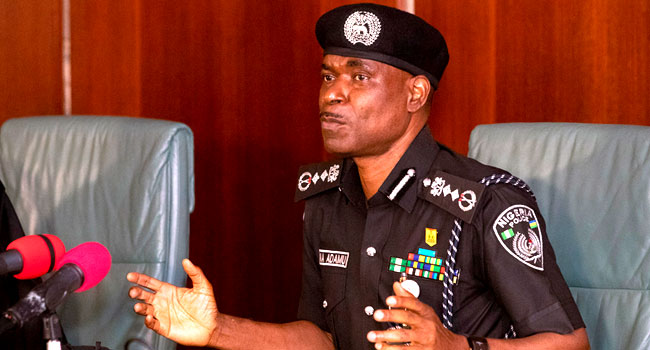
Though Mohammed Adamu, inspector-general of police (IGP), has issued a directive for the arrest of Ighoho, the ACF emphasised the need for the government to be more proactive and arrest perpetrators of the Friday attack.
“We recall that the Civil War in the 60s started with attacks and counterattacks like this. The governments must be proactive and stop history from repeating itself.
“If this is not done, there may be counterattacks in the north and the country will be up in flames. The authorities must act. The ACF is very worried and calls on them to act fast,” the statement added.
You can’t threaten us with war- Afenifere Group
In a swift reaction, Afenifere, a pan-Yoruba socio-cultural group, replied the ACF, saying the northern group should not threaten the South-West with war.
The Yoruba group said though it had strived to maintain peaceful coexistence with the northerners, the Fulani group was used to provoke and harass South-West people.
In a statement, Yinka Odumakin, spokesperson of the Afenifere group, described ACF’s comments on the crisis as very arrogant and insulting.
He told the ACF to call ‘their criminals to order,’ as the Yorubas would not wait to be killed.
However, Odumakin emphasised that Afenifere would not want a repeat of the 1966 civil crisis.
“We must make it clear to them that they cannot threaten us with war at this stage as we will not provoke war but never are we going to run for anybody on our land.
“We are miffed that a body like ACF that has never shown any response over the killings of our people can open their mouths anyhow now because there are consequences for the irresponsible actions of their people.
“We advise them to call their criminals to order and not expect our people to sheepishly wait to be killed by those who value cow lives more than human beings.,” the statement read.
“We do not want a repeat of 1966 event, but if there are people plotting such event again, the rain will be over their heads,” the statement added.
Recall that the spate of insecurity across the country has been a major concern to Nigerians from diverse backgrounds.
In the South-West, the herders have been accused of criminal activities, mainly kidnapping. Insecurity occurrences in the region partly led to the formation of the Amotekun Security Network adopted by governors from the South-West states.
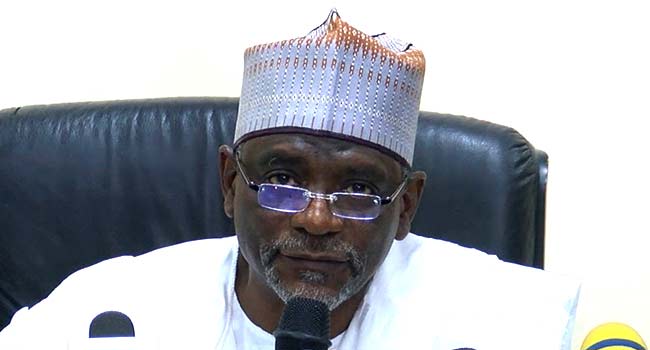
THE federal government has said it reduced the number of out-of-school-children in Nigeria by 31 percent in 2020.
The number of out-of-school children in Nigeria, which was 10.1 million in 2019, reduced to 6.946 million in 2020, according to Adamu Adamu, minister of education. Going by Adamu’s figure, this represents a 31.18 percent decrease over one year.
The reduction in the number of out-of-school children in 2020, as stated by the federal government, occurred in spite of the fact that schools across the country, at the local, state and federal levels, were shutdown for most of the year (2020) due to lockdowns occasioned by the coronavirus pandemic.
Academic activities were suspended and schools were closed when the country started going into lockdown, starting with Lagos and Abuja at the end of March 2020.
Schools eventually reopened towards the end of the year, from September, when the Presidential Task Force on COVID-19 (PTF) gave the nod to school administrators and state governments to resume academic activities.
However, despite the disruption in the education sector for most of 2020, Adamu said the government was able to reduce the number of out-of-school-children in the country during the year.
Adamu, who announced the development on January 21, at a ministerial press briefing organised to showcase the achievements of the Ministry of Education in 2020, claimed that, during the year in focus, 3.247 million children who were hitherto not in school were enrolled.
The minister said the enrolment was as a result of several activities undertaken by the ministry.
The improved enrolment was also boosted by a $611,000 World Bank credit facility secured by the federal government, under the Better Education Service Delivery for All (BESDA) initiative to strengthen Universal Basic Education(UBE) in 17 states, in line with the Ministerial-Strategic-Plan on Out-of-school-children.
Noting that impressive school enrolment figures have been recorded in the states where the BESDA is being implemented, Adamu said, “I can tell you that through the BESDA initiative, we have reduced the figure of out-of-school-children by 3.247 million as at 31st December 2020.”
The additional 3.247 million enrolment, the minister further claimed, was made up of 1.792 million enrolled in formal schools, and another 1.454 million that were enrolled through non-formal interventions such as the Almajiri programme, girl-child nomadic education and internally displaced persons camps.
The figures, according to him, were confirmed by the National Population Commission and the National Bureau of Statistics.
Adamu added the National Association of Proprietors and School Owners of Nigeria (NAPSON) contributed to the enrolment of over one million out-of-school-children in 2020 with each private school sponsoring five students.
A breakdown of the total enrolment of 3.247 million for the concerned states, where the BESDA initiative was implemented, shows states involved as Adamawa, 25,714; Bauchi, 83,391; Borno, 62,336; Ebonyi, 65,471; Gombe, 52, 600; Jigawa, 47, 616; Kaduna, 39,091; Kano, 302,434, and Katsina 26,555.
Adamu said the federal government intended to enroll even more out-of-school-children in 2021.
Already schools have resumed in many states across the country and the minister revealed that another 500 million dollar credit facility obtained from the World Bank to drive the Adolescent Girls Learning and Empowerment (AGILE) programme would ensure that many girls were taken off the streets, trained and empowered.
In addition to reducing the number of out-of-school-children in the country in 2020, Adamu further claimed that, despite the lockdown, the government was able to reach and train millions of adult, non-literate Nigerians on basic literacy and numeracy across 14 states.
The training, according to the minister, resulted in 900,000 Nigerians being ‘taken off the shelf of adult illiterates’ in 2020, despite the lockdown.
Analysts Speak
Odera Nwizu, a school proprietor in Lagos, said the minister might have mistaken the number of pupils enrolled in these programmes as the number actively participating.
“It is possible that pupils were enrolled before or during the lockdown, but many of them would not have started school after the lockdown. So, it is a poor metric to use enrollment to determine outcomes. People get names from anywhere and submit as long as money is involved, but how many of those names are genuine? How many of those pupils started school eventually? Was there any effort made to track those who actually attended school in September after the lockdown?” he asked.
Emmanuel Ekuma, an education analyst, urged Nigerians to focus more on human development than statistics.
“I believe in numbers, being a mathematician myself, but we can do better as a country if we focus on delivering results than reducing ugly statistics we do not like. If we want a fair assessment of our work, then we must involve local and international stakeholders to do an independent assessment,” he noted.
MOHAMMED Adamu, inspector-general of police (IGP), has ordered the arrest of Sunday Adeyemo, a youth leader in Oyo State, popularly known as Sunday Igboho, over his quit notice to herdsmen in the state.
Garba Shehu, senior assistant for media and publicity to President Muhammadu Buhari, confirmed this when he featured on BBC Hausa on Friday.
He said the IGP informed him of his directive to Ngozi Onadeko, Oyo commissioner of police, to arrest Igboho and transfer him to Abuja.
Following increased insecurity in Igangan North Local Government Area of Oyo, Igboho, during an address to a large crowd in Ibarapa, had asked herdsmen within the environment to leave within seven days.
He blamed herders and Fulanis, including Saliu Kadri, the Seriki Fulani, of being behind the rising insecurity in the area.
The quit notice has since generated tension and heated debates on social media with so many commending him for the move while others call for his arrest.
He reportedly led hundreds of youths to attack a Fulani settlement in Ibarapa yesterday, setting the house of Seriki Fulani, one Abdukadir, ablaze.
Properties worth millions of naira, including vehicles, were also destroyed during the raid that occurred on Friday evening.
It was a black Friday at Igangan in Ibarapa North Local Government Area of Oyo State as hundreds of residents led by Adeyemo attacked the Fulani settlement.
Seyi Makinde, state governor, has directed the police to arrest anyone stoking ethnic tension in the state.
“For people stoking ethnic tension, they are criminals and once you get them, they should be arrested and treated like common criminals,” the governor had told the police commissioner.
On Monday, Rotimi Akeredolu, governor of Ondo state, in a series of tweets, had ordered herdsmen within the state to vacate state forest reserves in seven days due to rising insecurity in the state.
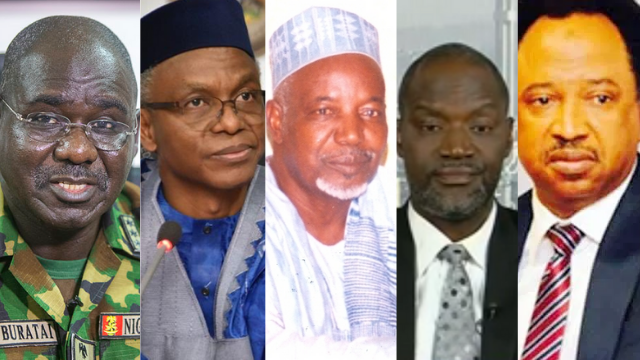
THE NEXT EDITION authoritatively reports that the Kaduna State Governor, Nasir El-Rufai, and Nigerian security forces ignored multiple warnings about the looming crisis in Southern Kaduna, and the rampant insecurity and abductions on the Kaduna-Abuja Expressway.
Cycles of violence and kidnappings in Southern Kaduna have led to the deaths of hundreds, and by not acting to pre-empt the bloodshed and lawlessness, some have accused El-Rufai and security agencies of contributing indirectly to the killings and looting in the area.
A former governor of the state, Balarabe Musa, said the violence was “politically-motivated.”
A former Attorney General and Commissioner for Justice in the state, Mark Jacobs, accused Governor El-Rufai of not only taking sides but also speaking for Fulani herders who have constantly killed people and plundered Southern Kaduna communities.
Jacob, who served as commissioner under Governor Ahmed Markafi said El-Rufai has at all times defended the actions of the killers and explained why Southern Kaduna people were being killed.
During a seven-month investigation, our reporter collected written documents, interviews and witness accounts showing that there was reliable intelligence that could have stopped several bloody attacks in the war-weary zone, but the government and the security agencies failed to act.
In the first part of this series, we recorded how, from June 10 to August 21, 2020, suspected Fulani herdsmen massacred 136 indigenous Southern Kaduna people and plundered their villages.
We also reported the chilling tales of 10 Fulani survivors who narrated how suspected youth of Atyap tribe and their allies murdered 85 Fulani from June 11, 2020 to August 2020.
Similarly, 10 indigenous Southern Kaduna survivors were identified and they recounted how heavily-armed Fulani militia unleashed mayhem on more than 24 villages across eight local government areas of the zone.
Details pieced from available records and interviews show how Governor El-Rufai and security agents overlooked vital intelligence, a situation that allowed militia groups to infiltrate and slaughter many in Southern Kaduna villages and settlements.
Our investigation shows that tribal groups and activists provided the governor and security agencies with reliable information about the location and mode of operation of bandits and militia groups responsible for the killings as early as 2016.
MACBAN warns El-Rufai, law enforcement agencies
Confidential reports addressed to El-Rufai and the Nigerian military by Miyetti Allah Cattle Breeders Association of Nigeria (MACBAN) have exposed how the government and the Nigerian military neglected credible intelligence sent to them.
In a letter dated October 18, 2016, which was stamped, signed and received at the Government House on October 20, 2016, MACBAN called the attention of the governor to the existence and activities of criminal elements in Kachia Local Government Area and its environs.
“Things are becoming deplorable; hence we feel duty-bound and obliged to inform Your Excellency and the Kaduna State Government of some goings-on; especially the unpleasant, gory and condemnable acts of some criminal elements in Kachia Local Government,” a part of the report reads.
“Sir, we are sad but constrained to say that there are still a pocket of recurring incidences mostly affecting Fulani herders, rustling, abduction, armed robbery, kidnapping, illegal possession of arms and even acts of terrorism as well as perpetration of other criminal activities.
“Places mostly noted for these crimes in Kachia LGA are Jan Dutse, Gidan Sambo, Mashigin Mai Bakko, Turinga, Gidan Auta, Gidan Gajere, Mai Ido Rafi, Mai Goro, Maraya, Atufa, Mashigin Doruwa,” MACBAN tipped the governor.
The group listed the settlements and villages inhabited by the criminals and the routes they use when launching assaults and their retreat routes to make the job of security forces easier.
The bandits were said to have used three major entry and exit points along the Kaduna – Kachia and Kaduna – Abuja roads.
The first entry and exit point is the Crossing-Maro Junction, a road leading to Rijana village on the Kaduna Abuja Expressway by Kilometre 49.
The second entry and exit point is at Sabon-Gari Kachia (Navy-Bus Stop) by the Government Secondary School Kacia.
According to MACBAN, the road leads to Kilometre 67 on the Kaduna-Abuja Expressway at Pole-Wire village (Sarkin Fawa Road Junction).
The third entry and exit point is at Awon Road Junction from Kachia Township on the road leading to Katari located at Kilometre 79 on the Kaduna-Abuja Expressway.
Due to the presence of the violent groups, MACBAN reported that over 100 herders’ settlements have migrated to other parts of Southern Kaduna, noting that the exodus of the herders would further worsen the crisis in the zone.
“Very soon plying the Kaduna-Abuja Expressway and the Kaduna-Kachia-Kafanchan Road will be almost practically impossible as these categories of criminals will completely take over and operate without let or hindrance,” the group had warned.
MACBAN asked the government and security agencies to “set up machineries to ensure that security is maintained on these roads otherwise, peace may soon elude Kaduna State (God forbid).
“Another implication is that the economy of the state will be crippled because these criminals have disclosed that they know buyers of agricultural produce in Kachia, Kagarko and Kajuru local government areas.
“They are even boasting that they have finished with Fulanis, it is now the merchants and farmers that will bear the consequences of their activities.
“There is, therefore, urgent and indispensable need for the government, military, DSS (department of state services) and the Police to carry out sweep operation to save the people of these areas and the economy of the state.
“It will be of good service and for optimum result that the Niger State Government must be involved in this operation for the overall success,” MACBAN had advised.
When the governor and security agencies failed to act forcefully on their report, the group again raised the alarm and called for immediate action in another report to Governor El-Rufai dated October 27, 2016.
The letter, signed by the North-West Zonal Chairman of the group, Ahmadu Suleiman, was stamped and received at Government House on November 1, 2016.
“Your Excellency may recall that our correspondence on “Recurring Incidences of Criminal Activities in some Parts of Kachia Local Government Area” dated 18/10/2016 highlighted the problem at hand.
“We wish to say that much more needs to be done. Again, this month we have witnessed the resurgence of these unfortunate activities.
“Your Excellency, the need for an immediate flush-out operation cannot be overemphasised. If possible, such an operation should be within hours from the submission of this piece.
“Piecemeal operations by the law enforcement agents are not capable of eliminating these crimes and criminals.
“Sir, save our souls, save us and order for a marathon sweeping operation in our area. Please Sir, come to our aid,” Mr. Suleiman had pleaded with the governor.
Not willing to take any chances, the leader of MACBAN wrote to the Commander, Sector 1; Operation Yaki on October 27, 2016, telling him of the presence of criminals in their neighbourhood and the urgent need to get rid of them.
“Sir, it is with deep-felt sadness that I am writing to inform you of a kidnapping incidence. On the night of Sunday, October 9, 2016 some kidnappers kidnapped a young Fulani girl, Sa’adiyya from her home (Ruga) in the residence of Alhaji Nawaila in Mai-Ido Kufai village.
“After the abduction, parents of the kidnapped girl secretly traced the kidnappers’ den. The kidnappers are spread (in camps and dens) around Gidan Auta, Gidan Gajere, Jan Dutse and Turinga villages of Akilbu, Doka and Mai-Ido Districts of Kachia Local Government Area.
“In another unfortunate related but different development, an Adara man was killed around Gidan Auta village by men of the underworld.
“This dastardly act has the tendency of causing reprisal and thereby escalating to full-blown bloodshed or crisis in the area because an innocent Fulani herder may be wrongly accused of the killing.
“A Fulani herder may subsequently be hacked to death, thereby sparking a chain of killings and massacre,” Mr. Suleiman had written to the military.
Despite the letters, top leaders of MACBAN and other Fulfulde organisations who spoke to our reporter insisted that no action was taken.
In a memorandum to the Judicial Commission of Inquiry into the Crisis in Kajuru, Kachia and Chikun Local Government areas, the Chairman of MACBAN, Kaduna State Branch, Haruna Usman, gave a damning rebuke of the government and security agencies.
The group said it was worried that every foundation for the survival of Fulani tribesmen in Southern Kaduna was either shaken or in ashes, maintaining that the looming conflict was predicted and reported to the government and security agencies before it occurred.
“These streaks and cycle of violence at various levels were either reported to the government as a secret Intel or to our ‘vibrant’ security agencies before they occurred.
“This noble association had in 2016 on several instances written alarming reports on the looming catastrophe and crisis that have engulfed us today to the government and designated security agencies.
“In our reports, we had graphically analysed, studied and submitted the strategic placement of the flashpoints, the growing tension within the axis and the emigration of hostile and criminal elements coming in to regroup after they had been degraded from other states.
“It is hereby revealing to mention to the commission that after two to three letters and verbal intelligence reports to the government and some sensitive security agencies, violence erupted on July 17 – 18, 2017 in various settlements scattered around the axis of Kajuru, leaving ashes, tears and heaps of corpses behind,” memoranda had indicated.
While MACBAN did not mention the identities of the emigrated hostile elements into Kaduna at the time of writing the report, a leader of another Fulfulde group told our reporter the immigrants were of Fulani origin.
The source, who pleaded not to be named because of the sensitive nature of the issue, said the government and security agencies were aware of the migration of hostile herders into the region.
“The governor and security agencies cannot say they were not aware of what was happening. Many groups and individuals alerted them, but they decided to do nothing.
“The Fulani who have lived all their lives in Southern Kaduna are suffering because of the activities of the migrants,” the source said.
The crises MACBAN warned about and tried to avert, began to unfold almost immediately after the memos were sent to the government and the security agencies.
Amnesty International in a report released in August 2020 said at least 1,126 villagers were killed by bandits from January to June 2020, adding the attacks threatens the country’s food security.
The report also lamented the failure of the government and security agencies to bring the perpetrators to justice.
In a most recent report released in July 2020, the Human Rights Watch insisted that the police have failed to name the identity of the killers in Southern Kaduna.
“The police haven’t commented on the identity of the perpetrators or the motivations behind the attacks.
“The state governor claimed the recent attacks were carried out by armed bandits terrorising Nigeria’s North-west states, but media reports included witnesses attributing blame to a militia targeting southern Kaduna communities on ethnic grounds,” the international rights groups stated in its report.
While both the police and MACBAN failed to name the killers, Governor El-Rufai in 2016 said the killers were largely armed foreign Fulani herdsmen who came into the country and admitted paying them to stop killing Southern Kaduna natives.
The governor, who spoke on a live show on Channels Television decried attempts by some Nigerians to bring religion or ethnicity into the wanton killings in that part of the state.
“The same Fulanis are killing Fulanis in Zamfara. It is not about religion or ethnicity; this is a pure case of banditry. They are criminals, their ethnicity, their religion does not matter,” El-Rufai had said.
But some victims and critics say some actions and comments made by the governor portray him and the government he leads as being sympathetic and even providing support to those who kill and maimed innocent Nigerians.
Many communities, same story
The people of the Gidan Zaki District in Zangon Kataf Local Government Area said they have no history of conflict with Fulani or any other tribe living in the area.
But between July 10 and 11, 2020 when suspected Fulani militia invaded the villages of Chibob and Sabon Kaura, killing dozens and plundering properties, the people fled the entire district out of fear.
Instead of going after those who killed innocent villagers in their sleep, people who talked to our reporter said the state government and security forces arrested and detained community and youth leaders.
A local, Yakubu Musa, whose real name cannot be mentioned for his security, who had temporarily returned to take his animals away, said Governor El-Rufai had ordered the arrest of the Gora and Gidan Zaki district chiefs after their chiefdoms were attacked.
“After Fulani militia attacked several communities in Gora and Gidan Zaki districts in Atyap land, instead of going after the criminals, the government ordered the arrest of the two district heads and also went for the youth leaders.
“The two district heads were arrested and taken to Kaduna for questioning and their mobile phones were seized. The governor has done that to almost every Southern Kaduna chief whose domain has come under attack by herdsmen.
“Majority of the chiefs will not speak out because the governor has consistently threatened to deal with them if they say anything or even blame the Fulani for the attacks on their communities,” Musa told our correspondent.
Persecuted monarch finally silenced
District Head of Gidan Zaki, Zangon Kataf LGA, Haruna Kuye during an interview with the Next Edition on August 1, 2020 (Photo by Ibanga Isine
For nearly two weeks in July 2020, our reporter was unable to meet with the district head of Gora, Elias Gora, and his Gidan Zaki counterpart, Haruna Kuye.
Except for security operatives who mounted roadblocks along the roads in the two districts, only a few residents were found trying to remove valuables from their homes to safe locations.
The entire area was under a 24-hour curfew besides a lockdown occasioned by the COVID-19 pandemic.
Attempts to speak to the monarchs on the phone were unsuccessful, as they were said to have switched off their cell phones after they were released by the police.
It was, however, on 1 August 2020 that Kuye, the district head of Gidan Zaki, was able to sneak into Asha Awuche, one of the villages in his chiefdom, to meet our reporter in a deserted compound.
At the time, 11 villages in the district were mostly deserted, except for Asha Awuche, which is located on the highway and had a strong presence of security operatives.
The visibly shaken traditional ruler said that his life and that of his people were in danger and accused El-Rufai and the Fulani militia of masterminding the Southern Kaduna crisis.
Kuye recalled the stories of attacks in his chiefdom, not only listing the casualties and properties lost, but also painting a picture of hopelessness and helplessness in the face of a relentless aggressor.
“When these killings and destructions were done to our people, we were looking forward to SARS (Special Anti-Robbery Squad) arresting the perpetrators but what we got was the police asking us to produce the Kataf youth who caused the problem,” the monarch stated.
“The police arrested me after the killings and kept me for over 24 hours and demanded that I should produce the troublemakers in my kingdom.
“When I was finally freed, we were invited to a meeting with the governor. At the meeting, we told Governor El-Rufai what had happened, and he told us that the Fulani people don’t forgive and that when they are offended, even if it takes 20 years, the Fulani will take revenge.
“After the first meeting, the governor invited us to another meeting with all the district heads where our handsets were seized.
“Some of the district heads got their phones back after three days while others are yet to get their phones.”
Before opening up on his fears, the monarch insisted that he did not want to be recorded, apparently because of the fear of a backlash from the governor, whom he said does not forgive anybody he considered as an enemy.
Assured of confidentiality, Kuye told our reporter that he believed that the governor was monitoring his movements and listening to his conversations on his cell phones.
Kuye said the reason our reporter could not talk to him directly on his mobile phone was because the device had been off most of the time.
He said he moved his family to a safe place, adding that they would not return to Gidan Zaki until their safety was assured.
But he was so wrong to believe that his safety and that of his family could be assured in Nigeria’s epicenter of bloody violence.
Barely three months after the interview and after Kuye and his family reluctantly returned to his home in Gidan Zaki, unknown gunmen struck in the early hours of November 17, 2020 and killed the monarch and his son, Destiny. His wife and daughter survived with life-threatening injuries.
With the killing of the Gidan Zaki monarch, it was almost predictable that his counterpart from Gora would be also targeted.
And the assailants did not disappoint as they launched a brutal attack on the home of the Gora monarch exactly a month after they slew Kuye and his son.
A source who pleaded not to be named for fear of her safety said the gunmen stormed Gan Gora at about 8.00pm on December 18, 2020 and went straight to the home of the district head.
“They shot sporadically and people fled into the bushes just as they made their way straight to the home of our district head.
“Fortunately, Gora Hakimi (Gora chief) wasn’t at home but they broke down the first layer of the security door to the house but couldn’t break the second door.
“Apparently angry, they moved into the neighbouring compounds, shooting and butchering innocent people. They almost wiped out an entire family in one of the compounds,” the source told our correspondent.
Those who were killed in Gan Gora were: Peter Akaho (70), Ayuba Steven Sheyin (67), Jummai Ayuba (55), Ishaya Joel (35), Yakubu Saviour (14), Ayuba Goodluck (11) and Patience Ayuba (6).
Gan Gora was hit three times in 2020 and the first attack occurred on January 17, 2020 when gunmen opened fire on the local market, killing two and injuring several persons.
The second attack occurred on July 20, 2020 and 11 persons were murdered, several others injured and properties looted.
“They have always targeted our monarch, but God has saved the man each time they come. They were able to kill the district head of Gidan Zaki. Now the government claimed they have arrested the killers,” a local who would not give his name said.
“We don’t believe them because we know those who attacked our village. We know the young man who brought the killers to our village and we reported to security agencies.
“The boy was born in this village and he grew up here. He knows everywhere here, and we saw him when he brought Fulani killers here in July. Why have they not arrested him if they are serious? We don’t believe the government,” a man, who gave his name as Bulus told our reporter.
More stories of persecution
A Kaduna-based lawyer, Auta Maisamari, who spoke to Next Edition, accused the Kaduna State government and security agencies of persecution when communities in Kanicho Chiefdom were attacked in 2016.
Sometime in October 2016, Maisamari said armed persons attacked Misisi, Pasakori and Mile One areas.
“Some people dressed in Army uniforms had come into Masisi and lured the village head, John Dogo, and he invited youth leaders to his house in the name of peace meeting,” he said.
“This happened after an initial attack in which the people were displaced. But while the meeting was ongoing, the visitors opened fire on the village head and the other leaders. Simultaneously, attackers invaded the village from behind and razed it down.”
The Kaduna State Police Command at the time confirmed the attack but said only four and not seven persons were killed.
It Public Relations Officer at the time, Aliyu Usman, who confirmed the attack, said the police had since commenced investigation into the matter.
After the killings in Masisi, Maisamari said some youths from neighbouring Mile One, who were guarding their village, spotted gunmen in the bush fleeing the area and gave chase.
He said the fleeing assailants who might have run out of bullets abandoned three of their rifles in the bush near Gidan Waya
“The village head of Mile One, Laca Garba, came back to his house and found three rifles which were recovered from attackers who were confronted by local youth along the road to Gidan Wayia.
“When the chief observed that the rifles belonged to the police and as a law-abiding citizen, he decided without compulsion to take them to the Police at Kafanchan.
“As soon as the police got the rifles, they arrested him and detained him on October 26, 2016. He was later transferred to the state CID (Criminal Investigation Department) in Kaduna.
“At the time they arrested him they said the three rifles he brought belonged to serving policemen who they claimed were missing. They asked him to either produce those who brought the rifles to him or they would conclude he killed and dispossessed the police officers of their arms.
“The police did not make categorical statements about the identities of officers who had the rifles. The only thing they continued to say was that they (policemen) were missing.
“When they arrested the village head, the police didn’t have the courtesy to inform the District Head of the area, Moses Barde.
“They took him from his house to Kafanchan Division and from there to the headquarters in Kaduna. After some days, the district head felt the need to go and plead with the commissioner of police to release the chief to him so they would go and look for those who brought the guns to his home.
“On the same day, the district head went to bail the village head; he too was arrested and detained,” he told our reporter.
After the two were detained for over one month without trial, Maisamari said he applied for them to be granted administrative bail pending the conclusion of their investigation and because of their failing health and position as traditional rulers.
“They threatened to arrest other village heads and district heads in the area. It was then we decided to file an action for the enforcement of their fundamental rights at the Federal High Court here in Kaduna.
“On the day we went to move our exparte application for the release of the three persons in detention, the judge declined, saying that the personalities involved including the President of Nigeria, the national security adviser, the governor of Kaduna State, the Inspector General of Police and Commissioner of Police are interested in the case.
“Instead of the judge hearing our application based on the Fundamental Human Right Rule, he chickened out claiming they have been warned never to grant exparte application.
“We argued that if the judge will not hear us exparte, he should fix the hearing of the application the next Monday because we approached him on a Thursday. That would have made it one week based on the rule.
“The judge adjourned the case sine die and that means adjourning it without fixing date for the next hearing. I told the judge he is not being fair to us.
“We were compelled to withdraw the case and took it to the state High Court. On the same day, the judge, Mohammed Bello granted them bail but the police quickly filed a first information report in the Magistrate Court alleging offences of kidnap and terrorism, thereby made the case of the gentlemen difficult.
“While the chiefs were being held for committing no crime, the other villages that were not attacked were razed by rampaging herdsmen.
“Over a hundred persons dressed in military uniforms came in and overwhelmed the few policemen and soldiers posted to Mile One and Pasakori and burnt the two villages. No fewer than 50 persons were killed during the attack,” the lawyer had recalled.
Maisamari, the lawyer who spoke to The Next Edition, died suddenly on June 18, 2020 after a brief illness.
Former Commissioner for Justice, Kaduna State, Mark Jacobs. (Photo by Ibanga Isine
Former Justice Commissioner, Jacobs collaborated the story of persecution of victims of the killings who are of Southern Kaduna indigenous communities.
“When communities are attacked, there is usually no response from the security forces and when they finally move in reluctantly, it is the victims that are arrested particularly youth (who) come out with dane-guns, bows and arrows to defend their communities from the killers.
“I have bitter experiences representing some of these people in court. They are arbitrarily arrested and detained for months. The government has never gone after the attackers.
“We have seen that in Jema’a, Sanga, Kauru, Kajuru, Chikun, and Zangon Kataf local government areas,” Jacob said.
A rights activist and former Kaduna Senator, Shehu Sani, in an interview with our correspondent partly blamed El-Rufai for the worsening Southern Kaduna crisis.
He faulted the governor for constantly saying that the killings in the area are retaliatory, adding that such statements emboldened the killers to do more havoc.
“I can tell you that Southern Kaduna crises are sustained by politics and prejudice and the idea of saying that every killing is revenge would blur us from seeing the reality of the terrorism in the area.
“When terrorists kill people in Zamfara or Katsina or in Niger and parts of Sokoto, they condemn them out right. But when the same people kill in Southern Kaduna, they try to say it is reprisal or try to blame the people.
“With that kind of mindset, they only bolster the terrorists and it seems like they are providing the swords that were used to murder innocent people in Southern Kaduna.
“As far as I am concerned, anybody who has sworn allegiance to defend the Constitution of the Federal Republic of Nigeria should treat every citizen with justice, equity and fairness irrespective of religion, ethnic or political background.
“I believe El-Rufai knows what he is doing. But right now, it seems there’s a standoff between the government and the people of Southern Kaduna,” Sani said.
On his part, a former Governor of Kaduna State, Balarabe Musa, said the Southern Kaduna crisis is politically motivated and also blamed the government for not providing the kind of leadership that could douse the problem.
“Although I don’t know all the facts; these days you can’t rely on the security agencies for information because they are a part and parcel of the manipulation that is taking place.
“The problem is not in Kaduna State alone. It is a national problem. People are being manipulated to the extent that they fight each other and they claim that they are revenging. I wonder why they are calling it revenge when the same thing is happening all over the country.
The former governor had spoken to our correspondent on August 11, 2020 and died after a brief illness on November 11, 2020.
Government’s Response
Samuel Aruwan
Several attempts were made to have Governor El-Rufai speak to the issues raised in the course of this report.
When all the attempts failed, a letter was dispatched to the governor on October 15, 2020 but no response has been received from him or his aides.
The letter was also sent to the governor and to Kaduna State government on October 16, 2020 via his personal email address elrfuain@gmail.com and info@kdsg.gov.ng respectively. There was no response to either letters.
But in a telephone conversation, the Commissioner for Internal Security and Home Affairs, Samuel Aruwan, said that the allegations against the governor are untrue.
“I was in the media office and now I am here (ministry of internal security and home affairs) and I can tell you that I now have a broader understanding of the Southern Kaduna crisis,” Aruwan began.
“I am an insignificant person. I am not the governor. I don’t know the district head of Gidan Zaki. But how will the governor trail the district head?
“These are things that will only prolong the crisis. I am telling you I have seen blood. Every day, I see blood. When I finish talking to you now, I am issuing a statement.
When reminded that the district head of Gidan Zaki complained that the governor was after him, Aruwan said, “I have heard that rhetoric. I have gone to Birnin Gwari, Kajuru, Giwa and across the state and I hear those stories. I don’t know the district head of Gidan Zaki. What has the governor got to do with the district head of Gidan Zaki?
“Some of these will rather complicate the Southern Kaduna security crisis. This is what I just want you to know. The governor did not threaten him. Why would the governor threaten him?
“From what you are telling me now, there is crisis in your report and Kaduna will burn. I am from Kaduna State. I was born in Kaduna and I have lived here in Kaduna. From what you are telling me from MACBAN to others, ‘Walai ta lai’ the state will burn.
“I am not the governor of Kaduna State but I want to tell you with all certainty that it is not correct. I do not doubt what you are saying. I am not also accusing you of fabricating the report. What I am trying to say is that these are conspiracy theories.
“Let me give you an example. In 2011, the Southern Kaduna Muslims said genocide was committed against them and they published a report.
“In 2020, the Southern Kaduna people also published a report that there is genocide against them. Do you understand? So, when I tell you that Kaduna is very delicate and complicated. The more you get closer to Kaduna issue, the more confusing it gets.
“I am inviting you to come to Kaduna so that I will explain to you the Kaduna crisis. But like I said, write a reminder to the governor about your request to interview him.”
Military’s response
Major General John Enenche Director of Defence Information Photo Credit: Channels TV
The Acting Director, Army Public Relations, Sagir Musa, told our reporter the Army Headquarters was not aware of the intelligence report by MACBAN.
Acting Director of Army Public Relations, Sagir Musa
“I cannot speak on that issue because I don’t know anything about it. It is like you are in my seat and someone is sending a letter to a command in Kaduna. There is no way you will know.
“Even the Chief of Army Staff will not know except the letter was forwarded to him because they were incapable of handling a situation and so that the Army Headquarters can help them.
“Or if they need additional troops or they are short of ammunition and want more or they want money before they bring such issues to the Army Headquarters.”
General Musa, however, referred our reporter to the Deputy Director, Public Relations, 1 Division, Kaduna, Ezindu Idimah.
However, in a telephone conversation, Idimah, a colonel, said, “What you spoke about are operational issues and we are not allowed to comment on operational issues.”
He referred our reporter to the Defence Headquarters; saying it is the sole authority vested with powers to speak on operational issues relating to the Nigerian Military.
When contacted on the telephone, the Director of Defence Information (DDI), John Enenche, said he does not respond to sensitive information on the phone.
“If you are doing an investigation, I don’t speak on the phone that way. Anything about journalism and the Armed Forces, it is a no no. I don’t discuss it on the phone.
“If you come for our press briefing and you want to clear the air on any issue, come on Thursday. The Armed Forces is very sensitive. I told journalist since March last year that I will no longer speak to the media on phone. Whatever I have said here remains. I don’t speak to journalists on the phone my dear.” Enenche said.
Shortly after the call ended, he sent a text message referring our correspondent to one Commander Sani, adding that the officer would be able to offer a clearer picture to our correspondent.
“Call him and explain what you want to him and say that I directed you to him. He will give you a clearer picture,” the text message read.
But when a call was put to Sani, he barely listened to our reporter when the phone went off and further attempts to call him or sent a text message to him were unsuccessful.
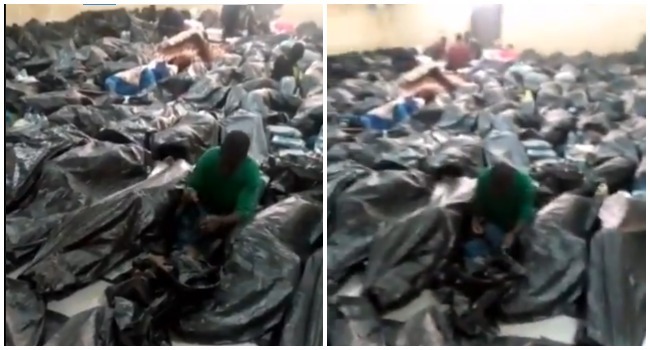
A viral video has emerged on the social media showing some Nigerians calling for help to return from Saudi Arabia.
The video shows that they have been stranded in the West Asian country for more than seven months.
The viral video, which showed bodies wrapped in black polythene bags lying on the floor in a packed room, was posted on Twitter by a user with the handle @KsaApc, who said he had spoken with the brother of one of the victims.
“I spoke with one of the brothers and he told me that his brother was among the detainees,” the tweet said. “Some of them have ended their stays and do not have the ability to renew and the others do not have regular residencies.”
Although The ICIR cannot independently verify the video or the individual who made it, chairman of the Nigerians In Diaspora Commission (NIDCOM), Abike Dabiri-Erewa, while reacting to the tweet on Friday said, “Nigerian irregular migrants in Saudi Arabia are due to be evacuated on the 28th and 29th of January, pending any unforeseen issues.”
The evacuation is expected to be carried out in two batches of 400 and 200 by the Ministry of Foreign Affairs, the NIDCOM chief said.
Dabiri-Erewa’s tweet appeared to confirm the scenes on the video.
“We are here for more than three months, six months, seven months, without any action, no better information on transport to Nigeria,” the male narrator in the video said.
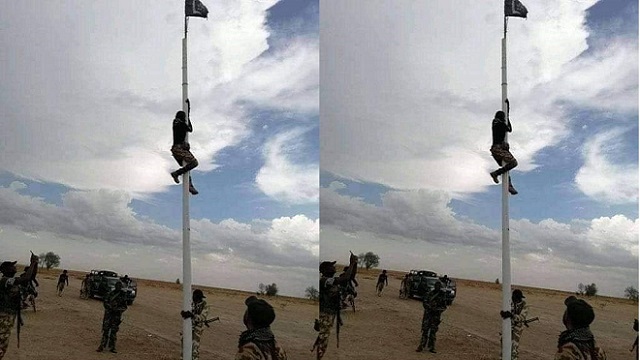
A photo of what appears to be Nigerian soldiers taking down a flag hoisted by Boko Haram insurgents was shared on social media as taken this year – 2021.
Replacing Boko Haram flag with Nigerian flag, after Boko Haram lost Marte, one of their strongholds. Congratulations brave soldiers of Nigeria.
The tweet which was shared over 1,500 times and liked 6,600 times alludes that the image depicts a recent event where the troops successfully laid ambushed and attacked insurgents at Marte, a town in North-Eastern region of Nigeria.
The photo with similar captions was also shared by other social media users.
@Edrees4P also tweeted the photo with the following captions:
Replacing Boko Haram flag with Nigerian flag, after country’s soldier succeeded the terrorist’s troops in the heart of Sambisa Forest.
The claim
Photo depicts Nigerian soldiers taking down insurgents’ flag after defeating them in January 2021.
The photo (and claim) as posted on Twitter.
The finding
The photo was not taken in 2021. It was also not showing the troops after successfully repelling an attack in Marte this year.
The photo is from 2020, but it, however, depicts soldiers removing a hoisted insurgents flag after a successful operation.
Using the Google Reverse Image search, the FactCheckHub traced the photo to a post made in May 2020 on the official Facebook page of the Nigerian Army.
The post also had photos of rescued women, an Armoured Personnel Vehicle, and a deceased Boko Haram Commander, among others.
The Army as of May 28, 2020, had released a press statement titled – Terror War: Remarkable Victory for Nigerian military as troops continue to dislodge terrorist camps in the North-East.
Picture originally found on verified Facebook account of the Nigerian Army posted in May 2020.
In the report, 20 terrorists were neutralised while 241 abductees were rescued. It reads in part:
“During the operation, contact was made with the terrorists which led to an exchange of fire which resulted in the extermination of five (5) terrorists and the capture of the following items: 2 x motorcycles, 2 x bicycles, 1 x amplifier, 1 x battery, 2 x sewing machines and 4 x BHTs’ flags,” the post reads.
“Additionally, the troops moved further to a recently identified Boko Haram terrorists’ infested settlement – Mudu village where 241 kidnapped victims – comprising of 105 women and 136 children were rescued from terrorists’ captivity. The village and other surrounding terrorists’ camps were equally destroyed by the courageous troops.”
Heroes of Nigeria, a dedicated social media platform managed by a non-governmental organisation, shared the photo via its Facebook page on May 28, 2020.
This was also reported by media organisations last year.
The verdict
The findings above show that the claim is MISLEADING. The photo was not taken in 2021. It is also not showing the troops after an operation in Marte. It’s from 2020. However, it depicts the Nigerian soldiers taking down a Boko Haram flag.
This report was originally published by Factcheckhub.