A TOTAL number of 50 journalists were killed globally in 2020, a report published by Reporters Without Borders (RSF) has shown.
The report which was published on Tuesday is the second part of its (RSF) annual round-up report of the abusive treatment and violence against journalists across the globe also shows that two journalists fell victim to the climate of violence accompanying protests, especially protests against the brutality of police operatives in Nigeria.
It noted that while the number of journalists killed in countries at war continues to fall, more are being murdered in countries not at war.
More concerns
RSF noted with concern that 32% of the fatalities are in war-torn countries such as Syria or Yemen or in countries with low or medium-intensity conflicts such as Afghanistan and Iraq. while 68 percent (more than two thirds) of the fatalities are in countries “at peace,” above all Mexico leading with eight journalists killed, India with four, the Philippines with three and Honduras, three.
It further stated that 84 percent of those that were killed in connection to their work were knowingly targeted and deliberately murdered, as compared to 63% in 2019. While some were murdered in a particularly barbaric manner.
In Mexico, Julio Valdivia Rodríguez, a reporter for the daily El Mundo, was found beheaded in the eastern state of Veracruz, while Víctor Fernando Álvarez Chávez, the editor of the local news website Punto x Punto Noticias, was cut to pieces in the western city of Acapulco. In India, Rakesh “Nirbhik” Singh, a reporter for the Rashtriya Swaroop newspaper, was burned alive in December after being doused with a highly flammable, alcohol-based hand sanitiser in his home in the northern state of Uttar Pradesh by men sent by a local official whose corrupt practices he had criticised, while Isravel Moses, a TV reporter in the southeastern state of Tamil Nadu, was hacked to death with machetes.
In Iran, it was the state that acted as executioner. Rouhollah Zam, the editor of the Amadnews website and Telegram news channel, was hanged after being sentenced to death in an unfair trial. Although executions are common in Iran, it was the first time in 30 years that a journalist has been subjected to this archaic and barbaric practice.
“The world’s violence continues to be visited upon journalists,” RSF secretary-general Christophe Deloire said. “Some may think that journalists are just the victims of the risks of their profession, but journalists are increasingly targeted when they investigate or cover sensitive subjects. What is being attacked is the right to be informed, which is everyone’s right.”
As in the past, the most dangerous stories are investigations into cases of local corruption or misuse of public funds (10 journalists killed in 2020) or investigations into the activities of organised crime (four killed). In a new development in 2020, seven journalists were killed while covering protests.
In Iraq, three journalists were killed in exactly the same way: by a shot to the head fired by unidentified gunmen while they were covering protests. A fourth was killed in Iraq’s northern Kurdistan region while trying to flee from clashes between security forces and demonstrators.
In Colombia, a reporter for a community radio station was fatally shot while covering an indigenous community protest against the privatisation of local land that was violently dispersed by regular police, riot police and soldiers.
In the 2020 annual round-up of journalists who are detained, held hostage or missing at the end of the year, published on 14 December, RSF reported that 387 journalists are currently detained in connection with their work. This is virtually the same as a year ago and means the number of journalists detained worldwide is still at a historically high level.
2020 has also seen a 35 percent increase in the number of women journalists arbitrarily detained, and a fourfold increase in arrests of journalists during the first three months of Covid-19’s spread around the world. Fourteen journalists who were arrested in connection with their coverage of the pandemic are still being held.
As Nigeria faces a second wave of COVID-19 pandemic, CBN’s COVID-19 loan hangs in the balance for small businesses;
Small business owners share mixed feelings over the disbursement of CBN’s ₦50bn COVID-19 credit facility;
Lagos, Abuja lead COVID-19 SME beneficiaries’ list as thousands still expect feedback from NIRSAL MfB;
NIRSAL MfB declined to respond to FOI request; lawyer says action violated section 7 of the Freedom of Information, warranting litigation.
“Submissions have closed, and we are working on applications for those who applied for the CBN’s COVID-19 stimulus package for Micro, Small and Medium Enterprises (MSMEs),” an official at the NIRSAL Microfinance Bank Headquarters told this reporter.
“If you applied online, you will get a text message on how to get your loan. There are still batches of applicants yet to come out. They are working on them,” she added preferring anonymity.
Her conversation with the reporter is the message of hope thousands of Nigerians are waiting to hear after submitting their loan applications since April, May, and June 2020.
Applicants speaking with front desk officials at NIRSAL MfB headquarters Abuja / Aderemi Ojekunle/Dataphyte
As Nigeria faces a second wave of COVID-19 pandemic, information inadequacy and lack of transparency continue to flaw credit facilities meant for small businesses during the period.
In this special report, Dataphyte’s Aderemi Ojekunle examines issues around the disbursement of the ₦50 billion Targeted Credit Facility (TCF) launched by the Central Bank of Nigeria (CBN) to assist small businesses.
In March 2020, the Central Bank of Nigeria (CBN) introduced the ₦50 billion soft loan to MSMEs whose economic activities have been significantly disrupted by the COVID-19 pandemic.
The Nigeria Incentive-based Risk Sharing System for Agricultural Lending (NIRSAL) Microfinance Bank Ltd (NMBL) disbursed the stimulus package. In April 2020, NIRSAL said it recorded 80,000 applications, but administrative bottlenecks involved in getting the funds made Nigerians described it as ‘audio money’ (non-existent fund).
Lack of transparency on loan disbursement – Applicants share mixed feelings
Mr Olu Oseni, a 32-year-old graduate of Ladoke Akintola University of Technology (LAUTECH) and an engineer, said he applied for the COVID-19 SME loan. Still, NIRSAL MfB changed it to a Household loan without stating any reason.
“I submitted my application for COVID-19 SME loan in June 2020 with a ₦500,000 request, but when I saw the offer, it has been changed to a Household loan for ₦200,000.”
I tried to get the attention of NIRSAL here in Lagos, but they said the processes were being done in Abuja.
“I later decided to accept the offer because the lockdown and COVID-19 affected my business and the family.”
Mr Oseni, howbeit, noted that the loan helped him to fix some things during the pandemic.
Another entrepreneur who identified himself simply as Oke describes NIRSAL Microfinance officials as ineffective in handling the COVID-19 loan. For Oke, the loan acquisition process is tedious and frustrating.
“I applied for the loan. I was shortlisted and went to the headquarters in Abuja on September 14. They gave me a note to their office at the Postal Service Office. At the office, the man in charge said he has his own time, and the head office cannot dictate to him.”
“The NIRSAL process is frustrating because the staff cannot do the job alone.” Mr Okeke advised the Central Bank of Nigeria (CBN) and other government agencies to consider other disbursement organisations.
The story remains unchanged for Mrs Aisha Aliyu, who was livid at NIRSAL’s sluggishness. However, the 34-year-old pharmacist and drug store owner remained optimistic about her second submission in early December.
“This is my fourth time coming here. Since I did not get the COVID-loan, I have decided to apply for the Youth investment loan. I came here to see If I can submit my documents.
“There is ₦75 billion again for youth investment. I am praying I can get this; it will really help my business.”
The CBN’s ₦75 billion Nigerian Youth Investment Fund (NYIF) was set up in October 2020 by the Federal Ministry of Youth and Sports Development to help build sustainable businesses and increase job opportunities in Nigeria.
Sharing her experiences with the COVID-19 SME loan, Mrs Aliyu also expressed dissatisfaction about the inefficient ways of handling loan disbursement by NIRSAL. “Some of my colleagues with whom I applied got a message to accept the loan offer in August, but they are yet to get their money, and this is December.”
But perhaps the most infuriating part for Ms Aliyu was the feedback or rather lack of it. “No one is saying anything, no email, no phone call. Not even on their (NIRSAL) social media accounts. We are just in the dark,” she added.
Repayment hurdles and communication gap
Kayode Adegbola, an advisor at Golborne Road Advisory, said he experienced a seamless process during application.
“For my team and me, it was a seamless process. I applied with my phone number online. A few weeks later, I got a text message and an email requesting me to follow a link to get the cash from a dedicated account created by NIRSAL MfB.”
He, however, decried the inadequate information on repayment plans.
“Unfortunately, we have tried to get information on repayments and the processes for paying back and if we can pay back early.
“We have written to the bank (NIRSAL) but no decisive information yet. My team also visited their offices in Abeokuta and Lagos to get feedback on repayment and how we are going to make a repayment, still no headway.”
Mr Adegbola said he needs to pay-off his loan since it has fulfilled its purposes. “I am trying to avoid harassment from any agent attached with the credit Bureau for defaulters.”
Hunye Adebayo, a barber and owner of a barbing salon in Satellite town, Lagos, said he received the money in August 2020. He also expressed worry over the lack of information about repayment, saying some of his friends are already insinuating that the government is not collecting the money back.
“I applied for ₦450,000 but got ₦700,000.
“I am thinking about how to repay my money, but there is no information on repayment. We submitted our Bank Verification Numbers (BVN), maybe they will start withdrawing at the moratorium date.”
Mr Adebayo urged the CBN to ensure effective communication and properly informed citizens about such facilities.
On the application form, NIRSAL fixed the interest rate at 5% per annum (all-inclusive) up to February 28, 2021. From March 1, 2021, beneficiaries are to pay 9% per annum (all-inclusive).
NIRSAL MfB declines response to FOI request, CBN elusive
For further clarity, Dataphyte sent Freedom of Information petitions to CBN and NIRSAL microfinance bank. The petition queried how much was disbursed so far, and the number of beneficiaries. While the apex bank acknowledged the request, NIRSAL dismissed the bid, noting that the FOI Act does not apply to a private institution as itself.
Responding to the request, Maishanu H.A, Head, Risk Management and Compliance, NIRSAL MfB Limited stated: “…the Freedom of Information Act 2011 (FOIA) which is created to improve transparency and public information disclosure by public institutions as specifically noted in the Act does not apply to this bank.”
However, this claim is untrue because the FOI act does not exempt private companies using public funds.
Section 2 (7) states thus: “Public institutions are all authorities whether executive, legislative or judicial agencies, ministries, and extra ministerial departments of the government, together with all corporations established by law and all companies in which government has a controlling interest and private companies utilising public funds, providing public services or performing public functions.”
Maishanu further claims that NIRSAL cannot comply with the FOI request because it could not disclose customers’ personal information.
“…As a financial institution, we are bound by the duty of confidentiality to the Customer of the Bank, and on this ground, the Bank is unable to disclose confidential customer information to a third party, save where there is a Court order, or the Customer authorises such disclosure.”
The Bank argued that one of the requests – a list of beneficiaries – is confidential information, forgetting that it was previously made public on its website, albeit temporarily. Thus, it begs the question as to whether beneficiaries of public funds constitute confidential information.
Mr Edetaen Ojo, a lawyer and the Executive Director of Media Rights Agenda, said the NIRSAL MFB position on the FOI is wrong and inaccurate.
“Under the act, once you utilise public funds or you are using public funds for the public good, the FOI applies to such entities.
“The unwillingness of NIRSAL MfB to release such information suggests something is wrong, and they have something they are hiding.”
The lawyer also noted how the microfinance bank’s actions could attract litigation, seeing as they violated section 7 of the Freedom of Information Act.
As for the money regulator, its tactic was less dismissive and more elusive. Mr Osita Nwasinobi, CBN’s spokesperson, asked the reporter to send questions via WhatsApp. But he never responded, despite repeated reminders and calls.
NIRSAL MfB also did not reply to messages sent to the company’s official email addresses. Subsequently, the company’s secretary requested that the reporter direct the email to the Managing Director, Mr Abubakar Kure.
Lagos, Abuja lead COVID-19 SME beneficiaries’ list
Notwithstanding, this reporter’s investigation revealed that the NIRSAL Microfinance Bank granted credit facilities to 382 small businesses across the country out of the 80,000 applications it has so far received.
COVID-19 Targeted Credit Facility SME Beneficiaries : Sheet1
Data from the NIRSAL MfB website showed that Lagos leads with 71 beneficiaries, followed by Abuja with 67 and Kaduna with 21 beneficiaries. Kwara and Kano came distant fourth and fifth with 16 and 13 beneficiaries, respectively.
Additional findings revealed that some small business owners registered their companies only to get the SME credit facility. At least four MSMEs registered businesses with the Corporate Affairs Commission (CAC) after the application deadline. They still got the loan.
The Central Bank of Nigeria and NIRSAL MfB announced the MSME loan applications in March and ended online applications by June 30, 2020.
Specifically, CAC records showed that Zee’S Planete Enterprise and Taimako Titus Farm Ltd applied for registration after the NIRSAL deadline. Also, Olaitan Ultimate Ventures Intl registered with the CAC on July 3, 2020. Another company, Isah Idris Poultry and Eggs Production, got the MSME loan before CAC registration. The company registered as a company on December 3, 2020, according to CAC records.
Questionable MSME COVID-19 grantees
Also, out of the 382 beneficiaries, 107 small business owners have no record on the CAC portal. Although, this might be due to technical inadequacies with the CAC database. The inadequacies include search query error, the omission of names on the portal, among others.
When contacted on the phone, Mr Aliyu Yazid, the Deputy Director of Public Affairs, Corporate Affairs Commission (CAC), said the commission frequently performs an upgrade on the public search portal.
“You can try it next time, but most times, if there is no result for the company, it is either the company has not registered, or the name of the company is not well written.
“Most times, they (business owners) may add space between the company name or change some letters. By doing so, it becomes difficult for a searcher to get the desired result.”
Thousands expecting feedback from NIRSAL MfB
Out of 80,000 applicants that applied within the first month, according to NIRSAL MfB, only 382 applicants have benefitted from the loan. This means that only 0.48 percent of the total applicants received a certain amount from the ₦50 billion credit facility. The remaining 79,618 business owners and other applicants are still expecting feedback from the NIRSAL MfB.
On December 9, 2020, this reporter sampled the opinion of members of a Facebook Group (platform created to help members and citizens secure NIRSAL Microfinance Bank CBN Covid-19 loan through interaction and information dissemination). More than 100 active online members claimed they applied for the loan and are still expecting feedback [E3] from NIRSAL.
For instance, one Abore Gembu said he applied for the MSME loan on June 27th and has not received any feedback from the NIRSAL. “I hope they will reconsider their position and grant approval to all outstanding successful applicants.”
Another applicant, Ms Obiunegbu Chigozie, said she also applied since June 27th and only received an automated message on July 1st, 2020, indicating that her application is in process.
Some entrepreneurs on the group also complained that the NIRSAL MfB portal failed to recognise their BVN details. “Whenever I put my BVN, the portal says it does not exist. I don’t know what is wrong,” Mr Orichi commented on a post seeking clarifications from members.
“When I put my BVN, the website says it does not exist. What is the problem,” Mr Suraj asks.
Mr Oladipo Olawumi Ezekiel said he applied for the MSME COVID-19 loan on the same date with his wife, and they are still expecting to hear from NIRSAL.
“Is there any hope, please I don’t think we will get approved?” another applicant, Abubakar Shehu Abubakar, posted.
NIRSAL MfB receives backlash on Social Media
On its official Facebook account, NIRSAL Microfinance Bank received backlash for lack of transparency and inadequate information dissemination on the disbursement of the COVID-19 loan.
Mr Bayode J. Omotola, one of the applicants, who commented on a NIRSAL MfB post, complained over the inability to reach the Bank on phone lines and email addresses. Another applicant, Ms Oviero Ebika Happiness Fruebi, the CEO of D’z Sellectionz Empire, also made such complaints on the Facebook page of NIRSAL MfB.
Mr Umarfaruk Dauda said the inability of NIRSAL MfB to respond via its official social media accounts and telephones are creating rooms for scammers and exploitation of grantees.
“I applied for the CBN Covid-19 loan under the SME category in June 2020. Till now, no approval yet. I want to know if the SME loan category is suspended or still pending?, one Mike Ejunka asked in late November without any response from the NIRSAL MfB team.
This reporter reached out to one of the complaints on Facebook, Mr Adebola Moses, founder of DictionCoach. Mr Moses, who complained about the lack of proper communication channels, said he later got the loan approved. He urged the NIRSAL MfB to work on the duration between documentation and disbursement of the loan.
He advised NIRSAL MfB to make more funds available so that a critical mass can access the offer.
On Twitter, applicants also expressed frustration over NIRSAL MfB inability to respond to queries and questions surrounding the COVID-19 MSME loan. In October, one Inno Saint, @sainte2k, lamented over the inability of NIRSAL MfB to respond to emails or even tweet.
Good morning. I've noticed that you people don't respond to mails or even tweet, I don't know why. But as a corporate organization I think that the interest of your client (customers) is paramount. I wonder why you careless about their view.
When this reporter visited the NIRSAL office in Abuja, it was the same pattern from the security post to the secretary desk. Applicants dropped their details and reason for visiting at the security post. Officials at the security and reception desks told applicants to continue to check their emails.
When the reporter requested to see the manager or someone in charge of the COVID-19 MSME, the receptionist said they are all not available.
Experts call for transparency, capacity building for effective loan disbursement
Celestine Okeke, a policy expert, said NIRSAL Microfinance Bank lacks the capacity to run smooth loan disbursement. Currently, they are managing five to six credit facilities for the government.
“Most of the NIRSAL staff were hired for Agric-based facilities, moving them into other capacities without requisite knowledge is a huge problem.
“There is no means to track progress. Progressions are no longer valid because of the exchange rate – people have lost jobs, those with businesses looking at how to get funds to run their businesses.
“Vital questions that NIRSAL MfB and CBN failed to answer border on application processes, selection procession, and criteria. Without adequate information on this, businesses that need loans will also want to engage in corruption to get the credit.”
Prof. Mike I. Obadan, a director and member of the CBN Monetary Policy Committee (MPC), urged the effective implementation of the apex bank’s Targeted Credit Facility aimed at households and MSMEs.
In his statement at the end of the 133 MPC Meeting in November 2020, Professor Obadan described the credit facility as one of the needs for Nigeria to exit recession quickly.
*This report was facilitated by the Wole Soyinka Centre for Investigative Journalism (WSCIJ) under its COVID-19 Reality Check project.
This report was originally published by DATAPHYTE.
Since the discovery of oil in Nigeria, the oil-producing communities have been a major target of major oil companies. Oil exploration though profits the oil-rich companies, but there has been a major loss and regrets for the host communities. The ICIR’s NIYI OYEDEJI reports about how the people of Ilaje communities battle for survival amidst constant oil spillage and sea surge.
SUNDAY, July 26, 1998 was like every other day at Ubale-Nla community in Ilaje Local Government Area of Ondo State.
The Christians in the fishing community were looking forward to another edifying Sunday service in their respective churches. Those who didn’t plan to go to church were looking forward to a bountiful fishing expedition on the river until someone raised an alarm – they found an oil slick on the river body.
At first, it seemed like a mere water pollutant that started at Ubale-Nla, but it continued many seasons after, and 22 years later the villagers in Ilowo and other neighbouring communities in Ilaje are still counting losses.
“That oil slick that covered the river on that fateful day was the beginning of our woes and since then, we have been struggling to make ends meet,” Sunday Omojoye, the eldest man in Ilowo, a neighbouring town to Ubale-Nla recounted.
“We did not only lose our farms, business, animals but we also lost our relatives,” Omojoye told this reporter who visited the 12 communities affected by the oil spillage.
Omojoye said the people could not understand at first, what it was, but they saw that the oil covered the entire part of the river with each water tide spreading across the water body.
A distraught Omojoye said that was the genesis of oil spillage that the 12 coastal communities have been battling with.
“When the oil spillage first happened, it spoiled so many things in this riverine areas. All the nets that were hanged on dry land were all destroyed and there is nothing that can wash off the oil, it was to our own shortage,” he lamented.
While the oil spillage spreads, it affects the aquatic life that serves as the villagers’ source of income.
“We could hardly get fishes from the sea because the oil was all over the water. It killed fishes; animals were just dying at the seaside including our cows and sea animals,” said Omojoye as he reclined on a wooden floor of his house that is raised on the sea.
There are health issues with the spillage and other domestic animals too.
“In Ilowo alone, over 65 cows died without counting the goats and sheep and then, once the sun shines, the oily water will become so hot. If you mistakenly put your leg into the water, such leg will be bruised and blistered.”
He recalled how he sustained a leg injury during one of the spillages that occurred at the community. For months, 68-year-old Omojoye stayed at home, down with terrible leg sore, depending on his wife, Ruth Omojoye, a petty trader, who now feeds the family from her daily sales.
“I had to rely on whatever my wife brought in to survive, life has been harsh.
“After 1998, we have witnessed some other spillages and it was one of those periods that I sustained this leg injury that have kept me away from fishing. I did not only get injured, but I also lost my fishing nets,” Omojoye said.
Sunday Omojoye and his wife
The real source of oil spillage
Ilowo is just one of the over 200 communities scattered along the Atlantic shoreline, where the vegetation is mostly mangrove and typically fragile. Residents of these communities are predominantly fishermen and farmers.
Part of the contaminated water at Ilowo community
However, the incessant oil spillage from the Chevron Nigeria Limited, one of the largest oil producers in Nigeria and one of its largest investors, has continued to frustrate the livelihoods of the people living in these areas. Chevron has been operating around the area for years.
Festus Uraye, 54, resident of Mese, another coastal community, lamented the seawater oozes offensive odour that has landed many children in the community hospital.
“The odour of the oil alone kills the fishes and even affects our children, that they keep visiting the hospital for various respiratory diseases,” Uraye said.
Uraye said his children, who could no longer bear the odour of the poisonous water in their community now live with his brother in Akure, Ondo State capital.
“I’ve sent my children to my brother in Akure, they just keep falling sick here and we don’t even have a health centre to cater for their treatment,” he stated.
Similar tales In Ogungbeje
According to a 2015 Amnesty International report, 1,693 numbers of oil spills with over 351,000 barrels were reported by Shell between the year 2007 and 2014 in the Niger Delta region.
Ogunbeje residents have no better stories to tell, their accounts are similar to that of other communities in Ilaje, where oil spillage is threatening the livelihoods of the residents.
When this reporter got to the community, it was a total silence. The villagers have for a long time been staying indoor because of the contaminated water body in which they could no longer fish or farm.
Owopebijo Omonuwa, a farmer in the community lamented how the oil spillage has taken over his maize farm.
Owopebijo Omonuwa.
Having been sacked by the spillage, the 56-year-old man said he is now jobless and stays idle, depending on his children for survival.
He added that the children are also facing their own problems, as the oil spillage also affect their fishing activities as well.
“My farm has been overtaken by the oil spillage, in fact, all the maize that I planted this year have been damaged. My children who are fishermen are also facing their own problem,” Omonuwa said.
Polluted water
According to the World Health Organisation (WHO), 63 million Nigerians do not have access to an improved source of drinking water. While 75 per cent of the urban population is served by improved water supply, just 42 per cent of people living in rural areas have access to clean water.
Before the oil spillage, communities in Ilaje Local Government had no access to clean water -they had relied on the river for their water source. Their plights have been compounded by the oil spillage.
Emilolorun Owoyele, a chieftain in Oju-Imole revealed how the community has been battling an age-long water crisis.
“There is no water here; we go too far distance to fetch water since the oil spillage has spoilt the machine they brought for us,” Owoyele lamented.
Due to the scarcity of clean and safe source of water in Ilaje communities, the residents now pay huge amount of money to get water, while those without money travel several kilometres.
“It cost our people N20 to buy a sachet water of water, N400 to buy a bag of sachet water and N600 to get a keg of water for domestic use,” he added
Despite different tanks and taps littering the whole community, none of them is functioning.
Residents said that the tanks have never worked as they were abandoned by the contractors.
A survey conducted by Nigeria’s Bureau of Statistics (NBS) and UNICEF shows millions of households in Nigeria do not have access to clean water sources.
At Molutehin, an abandoned water project embarked upon by the Ilaje Regional Development Council has also never worked. Community leaders at Molutehin said the water project was abandoned since it was brought to the community.
Foluso Gboluwaga, a teacher at Molutehin Comprehensive College, the only secondary school in the community narrated his ordeal of how he usually struggles to get a bucket of water for himself and his colleague.
Gboluwaga was a new teacher posted to Molutehin community, he accepted the posting despite many of his colleagues rejecting the posting based on the environmental challenges facing the community.
The only source of water at Molutehin Community
“I was newly posted to this place, I and my colleague could hardly get a bucket of water to bath, the little one we shared was full of impurities, but we had no choice,” he said.
“Most of the people don’t like coming here; they always reject the invitation to work here because of the scarcity of good source of water we battle here.”
While some residents of the community suffer from skin infections arising from the usage of the unhygienic water, some are losing their lives while travelling on the water in search of a good source of water.
Gbolahan Akinsipe, the Deputy Community Head of Molutehin told this reporter that his people are dying.
“There are people who have died in the process of going to fetch water from a far distance,” Akinsipe said.
“ A woman almost got drown with her child when she fell into the water; and she had to swim with her baby. The boat almost ran over her while she was raising her baby to swim to the riverbank. They rescued the tw- month-old baby, but the leg is bent till today.”
Ayenuro Kehinde, a primary school teacher at Ogungbeje community who also narrated his experience said his passion to impact the younger generation has kept him in the community despite having to contend with a poor source of water.
“The water we drink here is not good at all, we are just managing it. I am always managing myself anytime I am here, it is either I buy pure water or I preserve water during raining season.”
“Not only has this contaminated water caused water-borne disease for the people of these communities but has also endangered their lives,” Kehinde stated.
Sea incursion wiping out Ilaje communities
Apart from the oil spillage threatening the lives of the residents of Ilaje communities, sea incursion is yet another natural disaster inflicting hardship on these people, who are gradually becoming helpless.
Dirts littering Ayetoro community as a result of the sea incursion
At about 2 am, on Saturday, November 14, 2020, residents of Ayetoro community were visited by rising of the “Malokun Sea” (deep sea) that swept away many homes and destroyed properties. The whole community counted their losses all through the night.
Ayetoro community church and civic centre destroyed by sea incursion
Ayetoro community has been battling with sea incursion since the drilling of oil started in the area, it became worst when pipelines are being damaged under the sea. This menace has continued to render many of the residents of the community homeless, while some are losing their source of living.
Atimise Benson, Secretary of the Youth Committee in Ayetoro community who was part of those who came out at the middle of the night to rescue the affected residents said, “The water came unexpectedly, above sea level which brought all the dirt from the deep sea.”
Benson recounted the previous incidences which had kept shifting the community inward. According to him, the distance between houses in the community and the sea was more than 100meters but the rising of the sea have shortened the distance.
“This is not the first of its kind, something similar like this had happened in July. We were about 100meters distance far away from the sea, but the water has destroyed all the houses, about 10 houses have been submerged under the rising sea. We are now just three kilometres to the sea before.”
He lamented that Ondo State Government is doing nothing to alleviate the burden and hardship the sea incursion is inflicting on the residents.
“Ondo State government came here to do a survey and they conducted it through World Bank assistance but since then, the project has been lying fallow with no completion in sight,” Benson said.
He explained that “funds have been disbursed to cater for this place but unfortunately, they brought a fake contractor. The contractors could not complete the project and they left their equipment right here”.
“They even made some sample by pumping some sands. We had to expose them through Social Media before the World Bank came early this year, and did another survey and promised to be back. We were expecting them to come in October after the election but they did not show up,” Benson lamented.
While taking this reporter round to see the level of damages done by the sea incursion, Aralu Emmanuel, another resident of Ayetoro community, who has been sacked from his home by the sea incursion, said the rising of the sea comes at intervals; at the middle of the night and in the evenings.
Emmanuel expressed frustration over what he described as the government’s neglect of the community despite the huge sum of money allocated to address the menace. He also lamented the poor manner at which the situation is being used to play politics during the electioneering period.
“I am homeless now, the sea has wiped away my properties and my home has been occupied by water,” Emmanuel pathetically lamented.
Investigations revealed that in 2004, the Niger Delta Development Commission (NDDC) awarded the contract for the construction of a shoreline protective wall in Ayetoro community.
The contract was awarded to Gallet Nigeria Limited at a cost of N6.4billion. After paying about 25 per cent to Gallet for the commencement of the contract, they were considered not capable of handling the project.
Later in 2009, the contract was again re-awarded to Dredging Atlantic Limited. At that time, it was not disclosed how much was paid to the new contractor but 15 per cent of the cost of mobilisation was paid.
From 2004, when the contract was awarded, to 2009 when it was re-awarded, the situation remained unchanged in Ayetoro Community. The community is regularly plagued with the sea incursion that is gradually wiping it out.
At Obenla community, the story is not different from that of the Ayetoro residents, the water is gradually flooding the community, sacking residents and rendering some homeless.
The incursion has affected the drylands and as well destroyed the farmlands making it difficult for farmers to survive.
Omoyele Erooluwase, lamented how water waves from the rising sea have taken over his farm, adding that the situation was necessitated by the oil exploration in the community.
“Over N500, 000 that I invested on my farm is gone. We no longer have either dry season or dry land to plant because our land is always full of water.”
The situation was more pathetic at Mese community when this reporter visited Mese, a community in Ilaje Local Government that lies between Odofado and Gbagira along the coastal line at the middle of the sea.
The sea incursion displaced the residents and wiped out the entire community, destroying houses and properties. From afar, this reporter could see the woods used to erect the houses.
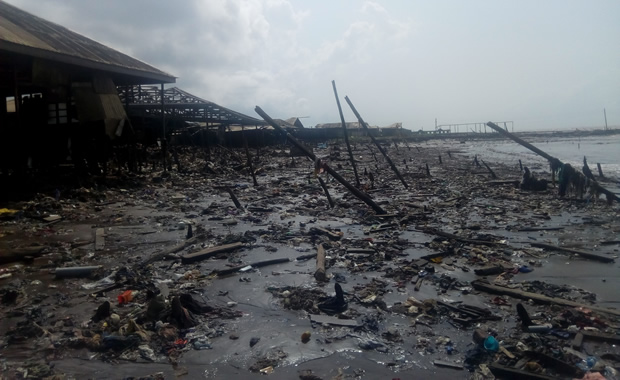
The remains of Mese community after being flooded by the sea surge
The more the sea wave comes, the more it penetrates into the community. The community is in total ruin with planks and dirt at the seashore, and the residents have fled to neighbouring communities.
OwopebijoOmonuwa, who has lost his home lamented how he and others have been abandoned to suffer despite being the host community to an oil well.
“We are the owner of the oil and we are the one suffering from it. If I had money, will my house be taken over by water? With my age, if I die in this present condition, will my children still continue like this?
“My house has been taken over by water when I am a citizen of Nigeria and from Ilaje, on the land that produces oil. Do you think this is fair?” Omonuwa rhetorically asked.
Odofado and Gbagira community are also at the risk of getting wiped out by the sea incursion. Not only are the residents living in fear, they are also afraid that the sea will force them to relocate to another yet to be known community.
Some of the destroyed houses in Odofado Community
Experts allay fear
Experts say oil spillage and sea incursion do not only poses threat to humans’ life but also violate United Nations resolution on access to water.
Temple Oraeki, the program coordinator, Nigeria Young Water Professionals says it is worrisome that millions of Nigerians do not have access to clean water, adding that it is more disheartening that oil spillage and sea incursion is further complicating the woes of the people.
“Nigeria is treaty to the 2010 UN resolution that recognises access to clean drinking water as a human right. Ten years after, millions of Nigerians are still without access to this basic necessity of life.
“While it’s worrisome that millions of Nigerians do not have access to clean drinking water, it is more disheartening that the available water bodies, though unwholesome, which most people rely on for source of water supply, are further been polluted by spills from oil exploration or wastewater discharges from industries.”
He stated that the ugly situation is forcing most Nigerians to ingest hydrocarbons, while trying to quench their thirst for water.
“The situation has resulted in most Nigerians ingesting hydrocarbons, in a quest to quench their thirst. This is a clear violation of fundamental human right.”
Another environmental expert, Elizabeth Ohuotu, the founder, Ecological for Good Inititative said it is worrisome that people have to go through the rigor of contending with environmental disasters that are avoidable.
“Sea surge and oil spillage are actually environmental disasters that are avoidable but it saddens the heart that people have to contend with them because of the negligence on the part of government and decision makers.”
Calls and text messages requesting for comments on what the government is doing to alleviate the burdens of people living in Ilaje communities that were sent to Funso Esan, Ondo State Commissioner for Environment were not answered.
NOSDRA, NESREA decline comment
The ICIR tried to speak with top officials of the National Oil Spill Detection and Response Agency (NOSDRA) and that of the National Environmental Standards and Regulations Enforcement Agency (NESREA) for their comments on the pollution in Ilaje communities. All the efforts were fruitless.
Mr. Idris Musa, The Director General (NOSDRA) and his counterpart, Professor Aliyu Jauro, The Director General (NESREA) were not available for comments.
An official of NOSDRA who spoke with this reporter asked him to send a letter to the office of the DG for comment on the subject.
Emails sent to the office of the DG NOSDRA and DG NESREA were neither acknowledged nor respond to till the time of publishing this report.
Additional reports by Ikulajolu Adesola
Support for this report was provided by the Premium Times Centre for Investigative Journalism (PTCIJ)’ through funding support from Ford Foundation.
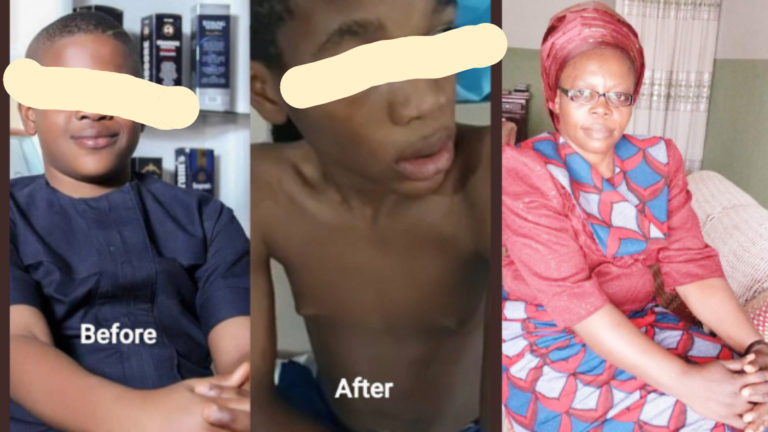
THE Management of Deeper Life High School has suspended its principal in Uyo, Akwa Ibom state campus over allegation of sodomy of an 11-year-old schoolboy, Don Davies.
The suspension followed a viral videoposted by the mother of the victim alleging that her child was being molested by senior students of the school.
When contacted by The ICIR, Mrs Solomon Ndidi, the school principal said she has been suspended from the school following the allegation.
She added that the Akwa Ibom State government has taken over the matter and is currently investigating the matter.
“Davies is my student I can’t deny it. What happened in the school is what the outsider cannot understand. The matter is under investigation now because the government has taken over,” Ndidi said.
“I won’t be able to talk much now because I am also under investigation. The School authorities have already suspended me. So, I am going to plead for patience until the government completes its investigation. The police and DSS are involved,” She added.
An official at Deeper Life High School headquarters confirmed to The ICIR that Ndidi has been suspended.
He said the school has also commenced an internal investigation into the matter but would wait for the outcome of the investigation by the Akwa Ibom State government.
“We do not want to preempt the outcome of government investigations,” the official said.
When told that there have been past allegations of molestation in Deeper Life High Schools across the country, he replied that there is no evidence that such criminal conduct had happened before. And whoever makes such a claim should provide evidence.
In the viral video currently trending on Social media platforms, a woman identified as Deborah Okezieh said her 11-year-old child who is a student of Deeper Life high school was severally sodomised by senior students of the school.
According to her, she discovered this when she requested a private meeting with Davies during her visit to the school.
When I met him in that condition, I took my son into the car, he was afraid, he said that if he talks, they would kill him,” Okezieh narrated in the video.
She noted that it took the help of another student in the school to know what was happening with her child.
“I had to beg a boy who talks like a parrot who told me that because he wees, he was taken from JSS 1 to SS1 and when he gets there, senior students in the hostel used hands and legs to penetrate his anus,” She further stated.
Confirming the allegations raised by his mother, Davies said, “When I get there, they would remove my boxers,” the 11-year-old said.
Davies added that the students would tell him that if he reports to the principal or his mum, they would have him killed.
In another video by the mother of the victim, she said the principal of the school, Ndidi pleaded to her not to go public with the matter adding that the school would pay the Child’s hospital bills.
Okezie said the principal did not want her to go public with the issue because of ‘who is involved’ in the case against her child before eventually removing her from the Whatsapp group of parents of children in Deeper Life High School, Uyo Campus.
IN factories owned by Chinese and Indian investors in Nigeria, low-cost labour, hazardous work without protection, breach of minimum wage law, and human rights abuse are the norms. And young Nigerian workers are vulnerable to avoidable bodily harm, physical and emotional injuries. Yet, these companies continue to exploit their workers, taking advantage of the Nigerian weak laws and poor regulatory system. LUKMAN ABOLADE reports.
AT 26, Vincent Enahoro left his hometown of Oah Okpuje Iuleha in Owan Local Government area, Edo State for Ota in Ogun State, in pursuit of greener pastures.
Against his parents’ advice, Enahoro left Okpuje for the industrial town in the southwest state, with s burning desire to make success of his life by dint of hard work. His dream to hit fortune outside his hometown was fired by Michael, his friend who came home from Ota during the yuletide in 2013. Michael had told him of endless opportunities in Ota, a town dotted by many factories. Enahoro did not want to miss such an opportunity. So, weeks later, he left home for Ota together with his friend.
The End Of A Dream
Vincent Enahoro, a former worker whose finger was cut off while working for MINL. Photo Credit: Lukman Abolade
Just as Micheal had told him that securing a job would not be difficult−he got a job factory job, but as a ‘helper’.
In factoryspeak, a ‘helper’ is casual or temporary worker engaged through a recruitment firm to work in the production factory.
Workers in this category are not given the good treatment of staff and can be easily stopped from working as there is no contract between them and the company.
Enahoro got a ‘casual’ job with a company called Manaksia Investment Nigeria Limited (MINL), a steel company sited inside the Ota Industrial Estate.
Late 2013 when he started work at Manaksia, he worked from 6 o’clock am till 7 pm every day and was paid N570 (less than $2) per day.
Helpers’ wages are calculated on a daily basis and the accumulation is paid to them at the end of the month.
In MINL, all helpers are to compulsorily work everyday including Sundays, while their accumulated wages are paid at the end of the month. Enahoro was later employed as a contract staff because he was hardworking, but with no employment letter and no increase in wages.
“When I joined as a helper in 2013, I was paid N570 per day to work from 6 am to 7 pm, Monday to Sunday, no resting day,” Enahoro said as he narrated his ordeal.
For his first three years at the factory, the hardworking young man, now a father of two, earned a total of N17, 100 at the end of every month. For working 365 days in a year, the highest Enahoro could earn in a year was N205, 200 if there were no deductions for late coming and other infractions.
“Sometimes when we come late, they deduct our money, so I mostly have about N13, 000 or less to go home with at the end each month.”
This continued until 2016 when he was considered for a promotion for working with the companyfor three years. His daily wage was increased from N570 to N600 in 2016− a N30 increase.
“In 2016 it was increased to N600 per day. One year later, they increased it to N700 per day but for Saturdays and Sundays, I was paid N750 since I am a contract staff,” Enahoro said.
This was what he earned while working as a machine operator in MINL factory, a role pivotal to the daily production of the company.
Enahoro said he was never trained to use the Cut to Length Machine but it was the only way through which he could get a job as a contract staff with the company.
“They did not train me on how to use the machine but they said if I want them to employ me as a staff, that is the only place they can employ me,” Enahoro said.
For a long period of time, the Cut to Length (CTL) machine developed continuous faults and when he complained, his complaints were disregarded as an excuse for being lazy.
This went on for years until one unforgettable Sunday morning.
He had just finished the night shift from Saturday, and he was made to work overtime on Sunday because ‘production materials just arrived’.
While he was using the machine, a heavy ruler in the machine forcefully held his finger down, and he groaned in excruciating pain as he helplessly watched an iron ruler chop off his left index finger.
A picture of Enahoro’s hand Photo Credit: Lukman Abolade
“I was trying to adjust something from the ruler, then I stopped the machine and raised up the ruler, while I was cleaning the ruler, I didn’t know how the ruler suddenly picked my hand with the hand glove, that was how I lost part of my hand,” Enahoro recalled the horrible experience.
Co-workers quickly took him to Shirish Clinic, a nearby hospital in the town, where he spent six weeks in the intensive care unit.
Another view of Enahoro’s hand after his incident at MINL Photo Credit: Lukman Abolade
During his time at the hospital, MINL continued to pay his wages so that he could give money to his wife and children to feed themselves and take care of the house he
just started building.
Immediately he was discharged, the company called him to resume work or his payment would be stopped; but Enahoro’s hand was not yet healed.
With bandages wrapped around his hand, he had to continue working on the same machine without it being fixed.
He had no option because he has a wife and children to feed.
“I would first go to the hospital for treatment, then go to work because the hand has not healed completely and I don’t want them to stop my salary,” he said.
After seven months of working on the same machine that chopped off his finger, his wife, Sandra and some friends convinced him to resign and demand compensation from MINL
He resigned, but as earlier threatened, his salary was stopped immediately he submitted a resignation letter to the factory.
MINL enrolled Enahoro on the Nigeria Social Insurance Trust Fund (NSITF) where he now receives N1,667 (less than $5) every month.
It took the intervention of rights organisation, Human Rights Initiative for the Downtrodden (HIRD) based in Lagos State before MINL placed him on a monthly arrangement of N18, 000.
For a few months, he received the N18,000 from MINL but when COVID-19 hit Nigeria and the world, the situation changed.
His monthly arrangement was slashed by 50 per cent, Enahoro now receives N9000 from MINL.
“I went there in April to receive the N18,000 then I saw that it was N9,000 that was written on the payslip for me to sign, I asked why and they said it is because of COVID-19,” Enahoro said.
During that April, he had borrowed up to N10, 000 with hopes that he would pay his debt after collecting the monthly stipend until he was told that this payment has been slashed.
“I didn’t have any other choice,” he sighed.
Enahoro said he has been unable to secure a job in another company due to his incomplete fingers.
“I have gone to four companies in this estate and they have refused to employ me because they say it is a partial disability,” he lamented.
He added that since the incident, he has refused to go home to his parents because they had kicked against his decision to go to Ogun State for work.
“I have not been able to go home since then because my father would say he had warned me not to go but I did not listen, I have not seen them since that incident,” Enahoro said as tears rolled down his cheeks.
He wants permanent compensation from MINL through which he can start a business of his own as companies have refused to employ him but MINL has refused to pay him.
MINL refused to reply to questions about Enahoro’s case.
One too many cases
Cases of injuries abound in Nigerian factories where victims of work-related hazards are denied compensation.
In some cases, after completing secondary school education, young Nigerians approach such factories for work in order to raise money for tertiary education.
Rather than realize their life goal, many of them who have opted to fend for themselves at factories owned by foreigner investors especially those owned by Indians and Chinese, often have their lives either cut short due to fatal work-related accident or sustain major injuries that lead to permanent disability.
In some other cases, they work for many years but are never able to save up for education due to poor remuneration from the foreign-owned companies.
Although the Nigerian Government does not have a database of labour incidents, there are several reports of industrial accidents in such factories.
In 2003, the International Labour Organisation (ILO) statisticstates that there are 63, 236 cases of work-related fatality in Nigeria while 16,673 are caused by dangerous chemical substances.
According to UNFPA, Nigerians within the age group of 15-64years are the highest proportion of the over 200 million population.
About 54 per cent of the total population are of working category representing a high rate of the working population.
Many see this population as prospects for a strong workforce for Nigeria. However, while the majority are unemployed, a large number of them are engaged as menial, casual or temporary workers, working more and earning less from factories owned and controlled by foreign investors.
A Day At Gemini Steel – Hazards That Nigerians Face While Working
To have a direct experience of what young Nigerians encounter in foreign-owned factories in Nigeria, the reporter went on to search for a job at some factories in Lagos and Ogun states industrial estates.
On August 26, at about 7:15 am, the reporter arrived at the Ikorodu Industrial estate in Lagos State.
Young men, women and few older ones’ flock around the industrial estate, some resuming work, while others are heading home after their night shift.
The reporter attempted to get a job with many factories in the estate but he was rejected, mostly on the excuse that it is almost the end of the month.
“If you can come on September 1st, I can assure you that you will get a job here but now, the voucher has closed, if you go to any of our contractors, they won’t employ you,” a security officer told the reporter.
After failed attempts at six factories inside the Ikorodu Industrial estate, the reporter eventually got a job with a steel company named Gemini Steel Investment Limited through a friend who introduced him to one of the supervisors in the factory.
The supervisor told the reporter that a section of the factory is in need of a worker.
Immediately, he introduced the reporter to his soon-to-be co-workers in the factory, Tosin and James.
Tosin is a 19-year-old, secondary school graduate of Odogunyan Senior Grammar school in Ikorodu Lagos State.
As he interacts with the reporter, Tosin said he has been changing jobs since he left secondary school with no clear plan of pursuing tertiary education due to his family’s finances.
Tosin lacks the financial means to pursue tertiary education but had learnt fashion designing while he was in secondary school. He had plans to save up to get two sewing machines and a shop to start tailoring business.
However, for three years now, his dream has remained elusive as he has been unable to save enough due to the pittance he earns as wages.
“I spend most of it on food and transportation and how much are they paying me, out of all the places I have worked in this estate, the highest I have ever earned is N700 per day,” Tosin disclosed.
His ‘co-worker’, James said he joined Gemini Steel three months ago. For him, he has no plans, he only wants to live each day as it comes.
As the reporter and the workers discussed, James flipped a rolling paper, mostly called ‘rizler’ out of his bag then a small wrapped Indian hemp in white leather, he lit it up then began to smoke.
Tosin and James; casual workers at Gemini Steel. Photo Credit: Lukman Abolade
As he blew the smoke, he said “bros, you no dey smoke? this our job, you need to get high before you start o’.
Shortly after, they both left the reporter and proceeded to their workplace to commence the day’s work.
After spending several hours waiting for the head of the section to approve the reporter as a worker, he finally appeared.
A full-bearded Indian man, in his late 30s, who eventually told the reporter to resume work the following day.
James had told the reporter that the Indian, whose name is Sassana but mostly called ‘master’ is the head of the section.
Pointing to one of the workers, the master said ‘tell him, tomorrow come’ the worker translated this to the reporter saying the Indian had asked him to resume the following day.
On Thursday, the reporter went back to Gemini Steel, he had already been introduced to the security personnel at the gate who opened the factory gate for the reporter that morning.
Without registration or issuance of an identity card, he was listed as a worker in the factory.
The day’s work began around 8:45 am, the reporter was not given any protective equipment to work with.
When he asked ‘master’ for one, he referred him to his co-workers in the factory. But James said hand gloves are seldom given. He said he had gotten his from a worker that left work a few weeks ago.
In Gemini Steel, irons are melted and reproduced through coke ovens, exposing the workers to very high heat radiation otherwise known as hyperthermia but they are left unprotected.
There are many departments in Gemini Steel, the reporter alongside other Nigerian workers were assigned to work at the heart of the company’s daily production, a section called CCM (Continuous Casting machine).
In the section, the Continuous Casting machine is used to cast the semi-solid metal as it comes directly from a cooling liquid metal machine
To cast the metal to the desired form, the metal needs to bebetween 30 to 65 per cent solid thereby generating high heat radiation.
In the department, some other workers are to lift the semi-solid hot metal with the aid of iron rods to where it would be cooled and eventually turned into a strong iron.
Despite the high risk of an industrial accident in the department, none of the workers including the reporter was equipped with any form of personnel protective equipment (PPE).
A Nigerian worker at Gemini Steel without proper protective equipment. Photo Credit: Lukman Abolade
As the deafening sound generated from the use of heavy machines fills the factory, the reporter was shown how to use some part of the machine.
All this without any form of protection for the reporter or the other workers, the company plays ignorant of the physical risks the workers are being exposed to.
In a steel company where the continuous casting machine is used, the workers are exposed to several dangers including high radiation heat, fire due to grease/hydraulic line leakage, burn injury that could be caused by a hot surface and other hot equipment in use.
Studies have shown that due to the usage of the Continuous Casting Machine, the workers are prone to suffer from Carbon Monoxide (CO) poisoning emitted from the machine.
Carbon monoxide is harmful when excessively inhaled because it displaces oxygen in the blood, the heart, brain and other vital organs the body. Large amounts can overcome the worker’s body system that could lead to loss of consciousness and suffocation.
The workers were not provided with a full-facepiece pressure-demand self-contained breathing apparatus to prevent them from inhaling too much CO as they spend the whole day working on the machines with only an hour break.
Apart from chemical dangers, there are wasted sharp pieces of iron scattered on the floor of the factory.
The reporter only had his palm sandals on all through the day.
One of the workers, Alex, who is in charge of casting the iron from the machine, was seen putting on bathroom flip flops and torn gloves instead of a safety boot and gloves.
Like other workers in the factory, Alex is unprotected and exposed to the dangers that may occur in case of an accident in the factory.
In the case of a fall from a height, injuries sustained could be fatal because none of the workers was provided with a safety helmet.
In fact, most of the worker Gemini Steel factory were seen wearing slippers, no helmet, no safety boot, no safety vest or eye shield.
Section 5.3 (III) of the policy states that employers are to ‘Provide at no cost to the worker, occupational health protection and personal protective clothing and equipment, which are appropriate for the nature of the job’ but Gemini Steel failed to do so and no one is checking.
The lack of provision of safety equipment for workers does not only happen in Gemini Steel but in many other factories too.
Andy Robinson, a former factory worker who worked with Shongai Technologies, a printing outfit in Ogun State-owned by Indians, also told the reporter that all through his span in the company, he was never provided with any safety equipment despite working with heavyweight machines.
Before he left the company, his Indian boss had hit him in the face that made him bleed through his ear before he lost consciousness.
Andy Robinson, bedridden after he was slapped by his Indian boss at Shanghai Technologies. Photo Credit: Lukman Abolade
Robinson was admitted in the hospital for days because of the injury sustained from the incident.
He said many workers in those factories usually suffer a series of human rights violation besides regular work-related accidents.
Used and Condemned
Young Nigerians who have suffered one form of accident and sustained life-threatening injuries while working in factories felt ‘used and condemned’ by their employers.
In the Ota Industrial Estate is Dada Stephen, who used to work for Aarti Steel Investment, a steel company also owned by Indian investors.
Dada Stephen, a former worker at Sonhart Investments. Photo Credit: Lukman Abolade
Stephen, a former worker with Sonhart investment was an assistant operator of a manufacturing machine in the steel factory, he told the reporter that during his stay, no glove, helmet or safety boot was ever provided.
His case is not so different from Enahoro’s, for he also had part of his thumb sliced by a factory machine in Sonhart Investments factory.
Dada Stephen’s hand after an accident while working for Sonhart Investments. Photo Credit: Lukman Abolade
Stephen said after his accident, he was given poor medical attention by his employers and the contracting firm before he was relieved of his job because his ‘hand is not complete’.
According to him, immediately the incident occurred, he was taken to Shirish hospital, where Sonhart staff are treated in case of accidents but he was not treated because he is not a full-time staff then he was taken to the State Hospital, Ota.
Maria Dada, Stephen’s wife, told the reporter that due to the poor medical attention given to her husband, he was made to suffer for many nights as he mostly groaned in pain, and in the middle of the night, he cried like a hungry infant but the company paid little or no attention to him.
Maria said that was the hardest part of her life as she was subjected to nursing her five months baby and injured husband at the same time.
Speaking on his work condition at the factory, Stephen said he was made to buy a safety overall for N2,000 and was not provided with any other protective equipment before he got injured.
Godwin Okoduwa, MINL’s Safety manager denied Stephen’s statement that he wasn’t provided with protective equipment.
However, he did not refute Stephen’s claim that he was made to buy his own safety overall.
Falling to provide safety tools is an act against the National Safety Policy of Nigeria.
Labour officers from the Nigerian Ministry of Labour and Employment are saddled with the responsibility of visiting and checking the factories for proper compliance with protective measures and other stipulated regulations. But this duty is rarely undertaken.
Earning N750 in 12 hours – The modern definition of slavery
Despite the tenacious and drudgery work conditions, as Nigerian workers strive to earn a living, the foreign-owned companies pay them very poorly and below the minimum wage in Nigeria.
For the companies, it is a system of work more, earn less, low-cost labour is a norm, minimum wage law of N30,000 in Nigeria is non-existent to most of them.
21-year-old Micheal, a worker at Merchant Investments, Ota Ogun State. Photo Credit: Lukman Abolade
Every morning, Michael, 21 years old, a worker with Merchant Investment Limited walks an hour to work. His house is far away from his workplace but the wages he earns cannot transport him to and from work. Micheal earns N500 every day.
“I stay in Ijoko, from Ijoko to Sango is N150 from Sango to the Estate gate is another N150 then I would have to walk about another 20 minutes in the estate to get to the factory, go and come I would spend N600,” said Michael as he explained his daily movement.
Spending N600 out of his N500 wage is impossible, staying home is an invitation to hunger, Michael treks from home to work and vice versa every day.
Despite the hurdles of getting to the factory, sometimes he goes to the factory and he is told that he is not needed for the day. There is no guarantee of working every day in Merchant, except for the few full-time staff in the factory.
On one Thursday, when this reporter met Micheal at the gate of the factory, he had just been told there is no work for him.
This caught the reporter’s attention then he joined other workers standing outside of the factory in the guise of also looking for a job.
Merchant Investors Limited has been in existence for more than a decade manufacturing mosquito insecticides, importation of foreign biscuits, bicycles, safety matches, pressure stoves among others.
Job seekers standing at the gate of Merchant Investment. Photo Credit: Lukman Abolade
At the gate of the factory, about ten workers were seen waiting to be granted entrance into the factory while other job seekers stood outside.
The reporter and other applicants waited outside of the gate for more than an hour but nothing happened.
Later, a few left to continue job hunting at other factories, but the reporter waited until the security officer opened the gate asking if the reporter wanted to work.
“Yes sir, ”, the reporter responded eagerly, then the gate was opened.
At the gatehouse was another security officer, a woman in her late 30s and another man who sat in front of a table where many green and red cards with the heading ‘Merchant Investment Limited’ were spread.
A quick inspection revealed that the cards belong to the workers in the factories according to their cadre.
The workers with the green card are the junior cadres who earn N750 every day working from 7 am till 6 pm while the red cards are for the senior workers who earn N850 per day.
For the green-card holders, they earn N19,500 per month while the red-card holders earn N21,450 at the end of each month.
The man in charge of the cards offered the reporter a job as a security officer with the company.
“The only position we have is security, you just have to open the gate for the people coming in and going out, it is not as stressful as working inside the factory but the pay is N15,000 monthly,” the man said.
He added that for the security job, there are no off days, “You will have to work from Monday to Sunday, you will resume by 7 am and close by 8 pm after every other worker has closed,” he added.
In all the factories visited by this reporter, it was discovered that they mostly engage the workers on contract and do not offer them employment thereby avoiding responsibilities.
Lekan Busari, a manager of Divine Identity, a recruitment firm that provides low-cost casual workers for factories in Ogun state. Photo Credit: Lukman Abolade
In another factory close to Merchant, Aarti Steel, the reporter sought employment through a contracting firm in the estate called Divine Identity Nigeria Limited registered with the Corporate Affairs Commission (CAC) in 2010 with registration number 915572.
A source had told the reporter that Divine Identity, owned and managed by one Lekan Busari provides low-cost labour workers to many factories in the company.
The reporter met Lekan inside a blue painted container where he calls his office. He gave a registration form to the reporter. When asked how much the company would pay he said, ‘Aarti steel is one of the companies that pay the most in the estate, you would get N800 per day’.
With N800 per day excluding the four Sundays in the month, the reporter would earn a total of N20,800 at the end of the month.
Lekan also said for the reporter’s first month on the job, he would deduct N800 from the worker’s wage as his own registration fee.
When he was later called over the phone to question him over recruiting workers below minimum wage, he dared the reporter to come to his office to ask the question but the reporter did not go.
In an interview with another executive director of an employment firm in the estate, he lamented that the foreign-owned companies in the estate see Nigerians as the cheapest labour in the world.
“I can tell you that these foreigners see Nigeria as the cheapest labour in the world. That is why they rush here, they don’t pay well and they know nobody would challenge or stop them,” he said.
He added that his employment firm operates in other parts of the country and the tradition is always the same.
“Even some industries owned by Nigerians are starting to imitate them in meting out various injustices to the workers most especially in terms of payment,” he added.
When asked why his firm and others in the estate indulge in contracting workers to the factories knowing they would not be paid up to the minimum wage, he said it has become a tradition in the industrial estate.
“If I refuse, another firm would get the workers and I am a businessman, I also need to survive” he noted.
On the disparity between full time and part-time workers, the director said practically, the latter deserves better pay than the former due to the nature of work they do.
He added that apart from working for more hours, the casual workers are made to do the hard work while the full-time workers are given supervisory roles.
TheNational Minimum Wage Act 2019 exempted workers employed on a part-time basis in the implementation of the new wage of N30,000.
According to the Act, ‘part-time work means work of a duration shorter than those for comparable full-time work in a sector or occupation,’ however, these workers and the full-time workers labour for the same hours.
Obsolete, outdated Labour Law
A study of the Nigerian Labour Act shows that the law is unable to properly address the many issues surrounding the use of casual workers in Nigeria.
Repeated checks of the Act as seen on the official website of the Federal Ministry of Labour and Employment reveal that there is no representation or acknowledgement of casual workers.
Despite the high rate of casual workers in Nigeria, the words ‘casual,’ ‘temporary worker’ and ‘part-time’ do not appear in the whole of the nation’s Labour Act.
Also in the Employee Compensation Act (ECA) of 2010, the word ‘casual’ and ‘part-time’ only appeared once.
However, unlike the Nigerian Labour act, theGhanian Labour Act dedicates a whole section to the casual and part-time workers in their country.
There are six subsections of Act that address issues of casual employment including remuneration on public holidays for part-time or casual workers in the Ghanian labour law.
“Our labour law has become obsolete and ineffective to fit the realities of today, reviewing it has become long overdue,” says David Eyongndi, a lecturer at the College of Law in Bowen University.
Eyongndi, who wrote a paper on casual employment in Nigeria added that he gathered that most companies in Nigeria including banks and other corporate organisations make use of more casual workers than permanent workers in order to avoid proper remuneration and other benefits deserved by the workers.
The Senate, however, seems to be quiet about the labour law but in the House of Representatives, the bill was sponsored by two lawmakers in a year after the other has been stuck.
In 2019, Femi Gbajabiamila, the Speaker of the House of Representatives sponsored a bill that scaled all readings in the green chamber but later got stuck.
In 2020, Tasir Raji, another member of the House Representatives sponsored the same bill which has passed first and second reading but is still lying on the shelf at the lower chamber.
Where is the Nigerian Labour Congress?
On its website, the NLC says the fundamental aims and objectives of the Congress are to protect, defend, and promote the rights, well being and the interests of all workers, pensioners, the trade unions and the working class in general, among others.
So, NLC is the only organisation saddled with the core responsibility to protect Nigerian workers, but the Union appears to have lacked the capacity to often discharge this duty.
Ayuba Wabba, the president of NLC had accused some establishments of forbidding their workers from joining the union in order to suppress their rights.
But there has been no publicly known move by the NLC to unionize casual workers despite making up a larger number of Nigeria’s workforce.
The reporter contacted the leadership of the Union several times to ask questions over this but there was no reply.
Text messages and calls to the secretary of the NLC were ignored.
A visit to the headquarters of the NLC was also futile as he was said to be in a meeting which had no stipulated time to end.
THE people of Ebijaw community and its environs in Odigbo Local Government Area of Ondo State may continue to pass through the proverbial hell whenever they travel out of their communities to urban areas if the road linking these communities, which was approved for construction by the Niger Delta Development Commission (NDDC) since 2017 remains abandoned.
The road, whose Invitation to Tender was published on Vanguard newspaper of March 15, 2017 (page 54) was consequently awarded to EDNAW James Limited on September 22, 2017 in the sum of 199,750, 000 (One hundred and ninety-nine million, seven hundred and fifty thousand naira).
Investigation reveals that ENDAW James Ltd actually commenced work April 2019 as expected but stopped after few months. The contractor was said to have commenced work at a wrong site (Asejire) rather than Obajare as awarded by the NDDC, which led to protest and resistance from the concerned communities. Following this outrage, the contractor abandoned the project in August 2019, and has not returned to site even as at the time of filing this report.
Speaking to this reporter on his trip to the area, Chief Amusa Ojo, Bale of Obajare and its environs said their joy knew no bound when one Engineer Alabi came to meet him and his people and told them he has been awarded the contract to construct road and bridges from Obajare to Ebijaw, adding that he (Alabi) thereafter requested to know the boundary so as to commence work immediately.
The nonagenarian, further speaking on the circumstances surrounding the abandonment of the project through Fatai Olasehinde, a former supervising councilor of Ebijaw ward, added that after supervising the site, Engineer Alabi left with the promise of getting back to them after eleven days to kick start work but later came to commence work at Asejire, a far distance from Obajare, and a different ward from Ebijaw ward. Chief Ojo noted that when he (Alabi) was confronted on the sudden change, the contractor said a politician directed him to commence work at that location.
The irony, however, is that the signpost bearing the contractor’s names and nature of the contract is mounted at the wrong site (Asejire) and still bears ‘construction of access road from Obajare-Edjaw’, even though the name ‘Ebijaw’ was wrongly spelt on the signpost. It must be noted that Asejire is under another ward, Onisere ward, and not Ebijaw ward.
Signpost bearing ‘construction of access road from Obajare-Ebijaw (Ebijaw wrongly spelt as Edijaw)’ yet mounted at Aseijre ( wrong site in another ward)
“One day I was traveling to Ore, I discovered they have brought equipment to commence work but from Asejire. And this was after one month when Engineer Alabi came to visit. Meanwhile, when I saw they were starting work from Asejire, I had to come down from the vehicle and enquired what happened that what the contractor told us was meant for Obajare has been changed to Asejire, and he told me some politicians directed him to commence work from there.
“I told him this was meant for us, so he ought to commence work from our place that was awarded to him. I told him it was given to us and reminded him that he was the one that categorically told us that it’s because of the oil deposit that NDDC enlisted Ebijaw ward under its coverage area.
“But not too long, indigenes of the land (the Ijaw) got very angry and they stopped the contract from progressing. They asked how come that which was meant for them was diverted. They said they were not going to accept that, so they went to stop the work and directed him to go and start work where they awarded the contract, but since then we have not seen the contractor,” he said.
He lamented that due to the oil deposit in the area their cocoa, kolanut and other farm produce are not surviving but dying, just as he added that the only project allocated to them from government has been diverted.
Chief Ojo, a farmer, further lamented: “Our cocoa is dying; our kolanut is dying, all our farm produce is dying, this is the only benefit we want to get from the government and it is being diverted.”
Shedding more light on the abandoned project, Mr. Karinate Odushu, a native of Ebijaw community accused Akinfolarin Mayowa, member representing Ileluji-Okeigbo/Odigbo federal constituency at House of Representatives of diverting the project, stressing that all pleas to him to allow the project commence at the approved site fell on deaf ears.
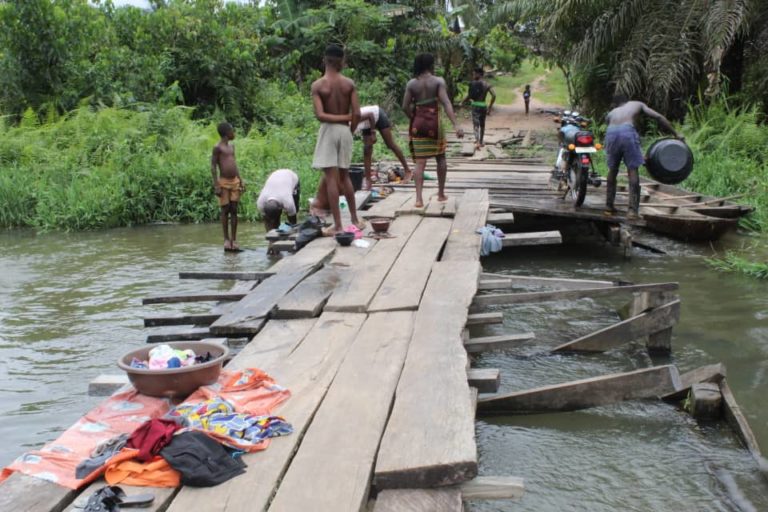
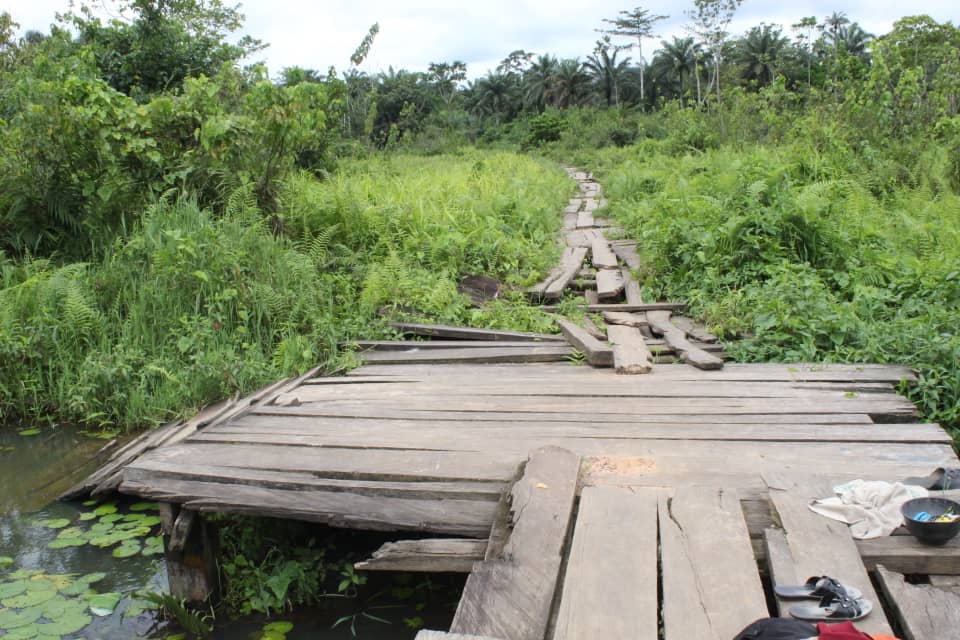
Tail end of the Eleriko plank-bridge along the Obajare-Ebijaw road.
He added that the lawmaker said ‘if they (Ebijaw people) refuse the project to start at Asejire then they should forget about it.’
He added that several meetings held with Mayowa to plead with him to direct the contractors to move to the approved site were not fruitful; adding that the legislator insisted it should be Asejire or nowhere else.
He said, “No work commenced at proposed site. To our greatest surprise, in 2019, we saw NDDC signpost bearing our community name in a different community (Asejire) along Lagos-Benin expressway, over 100km from project site in Ebijaw. From our investigation, we were told that it was Hon. Mayowa that instructed the diversion of the contract.
“We placed a stop on the work and asked the contractor to move to the approved site but he refused and he demobilized. The contract meant for us the Ijaw speaking people was diverted by Hon. Akinfolarin to his kinsmen,” Odushu lamented.
Efforts made to reach Hon. Akinfolarin were unfruitful, as several calls put across to him
were not picked, likewise sms and WhatsApp messages sent to him were not replied.
Our reporter called Akinfolarin three times on November 9, 2020, but he did not pick.He also did not respond to sms and WhatsApps messages sent to him at the time.
Also, November 29, 2020, calls were put across to the lawmaker several times with no response. This made this our reporter to send sms and WhatsApp messages to him about the same time but no reply. In the messages, the journalist asked him to clarify allegations against him “of masterminding the abandonment of Ebijaw to Obajare road project of the NDDC.
Akinfolarin is not reachable neither is he traceable even in the constituency as efforts to reach him through his constituency office proved abortive. Findings in the major towns of Ore, Odigbo, Okeigbo and Ileoluji, all under his constituency show he has no constituency office in any of the major towns under his constituency,
The contractor handling the road project can be likened to ghost because the firm has no traceable office address either online or offline. It has no website, neither could anyone states where the contractor has office or where his office is located.
deplorable condition of the Oladosa bridge along the Ebijaw-Obajare road.
How Obajere-Ebijaw road project was approved by the NDDC
Narrating how the road project got approval of the House of Representatives and its consequent award by the NDDC, Mr. Odushu said the sudden and untimely death of residents occasioned by lack of healthcare facilities and the bad road linking them to where they could get such healthcare made them to approach Mayowa for assistance.
He further narrated a pathetic story of how a young lady bled to death due to lack of healthcare services and their inability to rush her to a nearby hospital in Ore owing to the bad road.
“On January 1st, 2016, a young lady from one of our communities, Gbenewei to be precise, under Ebijaw ward, bled to death with a baby in the course of giving birth to twins. This pathetic incident prompted some of us in the Ijaw-language speaking communities to approach the member representing our constituency (Ileluji-Okeigbo/Odigbo) at the federal House of Representatives, Hon. Akinfolarin Samuel Mayowa in an appeal for an access road to our area. We believe that had there been an access road, the lady would have been rushed to a nearby hospital at Ore and that could have saved her and the remaining unborn baby from untimely death,” Odushu narrated.
He said Mayowa, while sympathising with them on the demise of their loved one, however, said he was not ready to spend his personal fund on grading of any road or putting any road in shape but promised to present their plights before the House committee chairman on NDDC, Nicholas Ebomo Mutu, who happens to be an Ijaw man.
According to Odushu, who also facilitated the visit to Mayowa, he (Mayowa) told them the NDDC Committee does not believe there are Ijaw people in his constituency; hence he gave Ebijaw people Mutu’s contact so as to facilitate approval of the project, and on December 2016, after speaking with the NDDC committee chairman, an engineer from the NDDC visited the place, taking coordinates of the area.
Consequently, March 15, 2017, invitation to tender for the construction of access road/bridges from Obajare to Ebijaw was published in the newspaper. It is worth noting that these two communities and others are under the same ward: Ebijaw ward.
Odushu’s words, “He sympathised with us and promised to present our case before the House committee chairman on NDDC, Nicholas Ebomo Mutu. He also gave us Mutu’s phone number to contact being an Ijaw man, and that they do not believe him when he told them that there are Ijaw in his constituency. We called and spoke with Mutu, in the Ijaw language, and he promised to have further discussion with Akinfolarin. On December 30, 2016, an Engr. from NDDC came to access the said road, taking coordinates.
“It was approved and was published on page 54 Vanguard newspaper of Wednesday, March 15, 2017 for invitation to tender. Hon. Akinfolarin called me that our road has been approved; he advised that we write a letter of appreciation to Hon. Nicholas Ebomo Mutu. We did that and also sent a copy to Hon. Akinfolarin for pursuing our course. Those letters were written on March 27th, 2017 and dispatched.”
Findings show that, Ebijaw, a riverine community and headquarters of Ebijaw ward 6 with oil deposit (not yet extracted) qualifies Odigbo Local Government to be enlisted in the NDDC franchise area. Ebijaw is an Ijaw community dominated by fishermen and women, peasant farmers and petty traders, while Obajare is dominated by Yoruba from Osun, Oyo and Kwara states who are into peasant farming and petty trading.
The deplorable state of the road
Due to the deplorable condition of the road, it took several efforts and extra charges to convince motorcyclist to convene our reporter to the approved site and other locations. The road, which according to findings, was first opened in 1991, is abandoned by motorcyclists during raining season. Anyone travelling to some of the communities in this area has to follow other routes because of the pitiable state of the road.
For instance, to access Ebijaw and other communities through Ore, the headquarters of Odigbo LGA, one either goes through Irele-Ajagba route under Irele Local Government, very far journey of about 500 km when compared to the Ebijaw-Obajare route, or through waterways by wooden engine boat or canoe, through Edo State.
More so, these people who lack social amenities ranging from drinkable water, electricity, healthcare and schools, have to wake up as early as 1:00am or 2:00am, whenever there is need for them to travel to Ore particularly the Ore market, and join the only waiting Hiace Bus in order to travel.
Oladosa and Eleriko bridges have made Ebijaw and communities under it to be cut off as far as this road is concerned. Any downpour in raining season covers these plank-bridges up making the road impassable.
Speaking to our reporter, Seyi Akinsuyi, a motorcyclist who plies the road said he never ventures that route in rainy season.
“There is no amount offered me that will make me to take the route in raining season,” he said after our reporter had already climbed his bike to take off to Ebijaw. When he was told the route to take was Obajare axis, rather than the alternative Irele-Ajagba, at this point, the motorcyclist discontinued the journey, wondering why the reporter would prefer to take such an abandoned route when there was an alternative. However, Irele-Ajagba to Ebijaw is also a bad road barely passable even in raining season and a much longer stressful route to take.
* This report is done with support from The International Centre for Investigative Reporting (ICIR) and McArthur Foundation.
BILL GATES, the Co-chairman Bill and Melinda Gates Foundation says the world doesn’t have enough data yet to understand why the numbers of coronavirus disease (COVID-19) pandemic deaths in Africa aren’t high as first predicted.
The American philanthropist in his end of the year note also said said he was happy to have been wrong about—”at least, I hope I was wrong—is my fear that COVID-19 would run rampant in low-income countries.”
Cases in Africa have remained relatively low compared to Europe, Asia and the Americas.
According to data obtained from The ICIR COVID-19 Dashboard that tracks cases of virus, 80,281,154 cases have been reported, while 1,759,131 deaths reported as of the time of this report.
Africa has only reported 2,638,562 cases and 62,052 deaths.
While Europe has a total cases of 22,477,627 with 517,332 deaths, Northern America reported 22,065,100 cases, with 493,870 deaths, South America 12,817,926 cases and 355,079 deaths, Asia 20,233,351 cases and 329,731 deaths.
According to him, “So far, this hasn’t been true. In most of sub-Saharan Africa, for example, case rates and death rates remain much lower than in the U.S. or Europe and on par with New Zealand, which has received so much attention for its handling of the virus.”
“The hardest-hit country on the continent is South Africa—but even there, the case rate is 40 percent lower than in the U.S., and the death rate is nearly 50 percent lower.”
“We don’t have enough data yet to understand why the numbers aren’t as high as I worried they would get. It helped that some countries locked down early.”
He further said the reason for low deaths in Africa may be that the population is young compared with the rest of the world’s, and young people are less susceptible to the virus.
“Another reason could be that its large rural population spends a lot of time outside, where it’s harder to spread the virus. It is also possible—though I hope this is not the case—that the true numbers are higher than they look because gaps in poor countries’ health care systems are making it hard to monitor the disease accurately.”
Bill Gates had during the early days of coronavirus outbreak said Africa could be the worse hit by COVID-19, saying the virus would overwhelm health systems in the world’s poorest continent.
Gates during a presentation at the American Association for the Advancement of Science (AAAS) in Seattle said that the virus could hit Africa worse than China.
“This disease, if it’s in Africa … it’s more dramatic than if it’s in China, even though I’m not trying to minimize what’s going on in China in any way,” Gates said, according to a report by The Telegraph. “Will this get into Africa or not and if so, will those health systems be overwhelmed?”
Melinda Gates, also a co-chair at Bill and Melinda Gates Foundation had said her belief is that the coronavirus pandemic will have the worst impact in the developing world.
She said she foresees bodies lying around in the street of African countries.
COVID-19 impact on Africa
On the impact of the pandemic in Africa, Gates said one of his fear, which has proven to be justified is that “COVID-19 is having a ripple effect with other diseases. Last month, I was surprised to learn that it was only the 31st most common cause of death in Africa. By comparison, it has ranked number four around the world, and number one in America.”
“Why does it rank so low in Africa? It’s not just the relatively low incidence of COVID-19 there. It’s also because shifting health workers to focus on the coronavirus disrupted efforts to detect and treat HIV/AIDS, malaria, tuberculosis, and other diseases. As a result, COVID-19 stayed low on the list of health threats, but other problems came roaring back.”
“Another reason is that patients are more reluctant to go to clinics for fear they might become infected—and that means more severe conditions are going undiagnosed. In India, for example, the diagnosis rate for tuberculosis has dropped by roughly a third. With more undetected cases, more people will probably die from the disease.”
“This is another reason why the world’s goal should be to make sure that lifesaving tools reach—and are practical for—every country, not just rich ones.”
FOUR weeks after The ICIR published a special report that exposed the travails of the retired Osun pensioners, the state government has on Friday paid a part of the owed arrears of some primary and secondary school retired teachers in the state.
According to information made available to The ICIR by the leadership of the pensioners union under Contributory Pension Scheme (CPS), workers have started receving credit alerts on their respective mobile phones on Friday morning being a payment of the owed ‘half salary’ of a month out of 29-month backlogs.
The ICIR placed a call to all the zonal chairpersons of the union and confirmed the payment was made to the majority of their members without documentation issues.
However, checks by this paper showed that the retired public school primary and secondary school teachers under CPS in the state are owed 29 months ‘half salary’ arrears excluding a full month salary they received during the heat of Osun 2018 elections, December 2017.
Aside the monthly pension and gratuity, the pensioners are now being owed 28 months ‘half salary’ arrears.
As confirmed by The ICIR, pensioners who retired on level 9 step 8 were paid N32,450.56, Level 12 step 7 were paid N40,224.63, Level 13 step 10 got N40,224.63, Level 14 step 11 received N54,279.26 and Level 15 step 9 got N62,225.50.
Recall that The ICIR recently reported here the death of Pa Amiola Sunday, a 64-year-old retired headmaster who was owed several months in salaries and pension before he died.
According to one of the deceased’s children, Odunayo Amiola, who spoke to The ICIR on Thursday, said aside from chronic Glaucoma which rendered her father sightless, Pa Amiola was suffering from swollen testicles which he could not afford to treat until his death.
He was among the thousands of Osun civil servants affected by the modulated salary scheme introduced in 2015 by former governor Rauf Aregbesola.
LAWAL Yahaya Gumau, senator representing Bauchi South Senatorial District who was fingered for implementing dubious constituency projects has on Wednesday “donated” 27 used Sharon buses to Muslims’ and Christians’ associations drawn from the seven local governments of his constituency.
Senators Lawal Yahaya Gumau and Adamu Bulkkachuwa, all from Bauchi State in an investigative report by WikkiTimes were found to have implemented questionable constituency projects marred by corruption.
The WikkiTimes investigation found that the two lawmakers not only politicised the constituency training, but the beneficiaries were all trained in one day for less than six hours, jam-packed in a single hall for all the trades without the chance to choose which trade they preferred.
The investigation also found that many of the beneficiaries were neither given start-up capital nor did they get working equipment to practice the trades for which they were prematurely trained.
Few days after the investigation was published, Mr Gumau presented 27 vehicles to religious groups in his Gumau town of Toro local government of the state.
Lawal Yahaya Gumau & Adamu Bulkachuwa
The Christians Association of Nigeria, (CAN), Jama’atul Izalatul Bidia Wa Ikamatus Sunnah (JIBWIS), and Jama’atul Nasrul Islam (JNI) were the beneficiaries of Gumau’s used buses.
A representative of the lawmaker who was a former member of the house of representatives Honourable C. Nuhu, was quoted to have said that “the gesture was in recognition of the roles played by the religious leaders in nation-building.”
The representative said the vehicles were distributed to “constituents and party loyalists.”
Reacting over the distribution of the used buses, Mohammed Ciroma Hassan of the Centre for Information Technology and Development, CITAD, described Gumau’s action as “peak of irresponsibility.”
“With N220, 000, 000 (Two Hundred and Twenty Million Naira) budgeted for constituency projects, this senator decided to buy and distribute “Used Buses” to religious groups. Are Buses the priority of your constituents? When and where did you discuss this with your constituents?
This is public fund so; public Must be part of the decision-makers in spending this money. What you have just done connotes nothing but a high sense of irresponsibility”, Hassan said in a Facebook post.
THE Hungarian Parliament in Central Europe on Tuesday, December 15, 2020 made a startling discovery that: “The mother is a woman, the father is a man.”
This is an open secret we in Africa have known for thousands of years. It took 134 Members of the Hungarian Parliament to ratify this despite the determined efforts of five parliamentarians who remain unconvinced.
The victorious parliamentarians say their intention is to protect Hungarian families, children and individuals’ rights to self-identify in accordance with their sex at birth. In giving way to religious intrusion in a secular state, the politicians said under the new law, children will be nurtured and cultured on the basis of the country’s new constitutional identity and Christian values.
A fundamental part of the new law is Paragraph 1(L) which states that: “Hungary protects the institution of marriage as the association between a man and a woman and the family as the basis for the survival of the nation. The foundation of the family is marriage and the parent-child relationship. The mother is a woman, the father is a man.”
This law, in the areas of sexual relations, marriage and definition of the nuclear family, fundamentally, aligns the Hungarians and the Africans in emphasising collective, traditional and cultural rights over individualism in an increasingly globalised but fractured world.
I have come across some Africans who feel alienated in a world that seems confusing. They had been taught by the church that their traditional polygamy is not only sinful, but criminal because it is called bigamy.
Now they are being taught that gayism and lesbianism which they thought were a sin and a crime, are neither sinful nor criminal, but are actually fundamental human rights, sanctioned, for instance, by The Church of England. Now, I ask, if the habitually conservative English gentry can be so radical, where can the traditional radicals seek sanctuary?
In France, a new gender war is imminent as there is an attempt at reversal of roles with women oppressing men. This creeping discrimination against men was evident in Paris with the city appointing almost twice as many women to leadership positions as men. Paris Mayor, Anne Hidalgo revealed that: “In 2018, the city hall employed 11 women and five men for management positions, meaning that 69 per cent of the appointments went to women.” This violates the French quota system which states that representatives of the same gender cannot hold more than 60 per cent of leadership positions.
Consequently, the Paris City Hall was fined 90,000 euros (109,477 dollars). This will serve as a warning to French women that they will not be allowed to ride roughshod over the Emmanuel Macrons and Dominique Strauss-Kahns of this world. It is also necessary to ensure that the gender peace treaty in France is not violated.
The Hungarians and Africans seem light years away from the world of the American, Bruce William Jenner who at 64 in 2015 called his children Kylie, Kendall, Brody, Cassandra, Brandon and Burt to declare that their father was now a woman. Bruce, now calls himself Caitlyn Marie Jenner with all former documents and organs remaining valid.
While the Obama administration had been supportive of the Lesbian, Gay, Bisexual and Transgender, LGBT, community, the Trump administration has not. But don’t worry, help is on the way as President-Elect, Joseph Biden, credited with pushing the Obama administration to support gay marriage, is like a cowboy hero, galloping to the rescue.
He has started on a good footing by appointing former Presidential Aspirant, Pete Buttigieg as Secretary of Transport. Buttigieg who may make history as the first openly gay to make it to a cabinet rank, had in 2019, made world headlines by openly hugging his husband, Chasten Buttigieg after winning the Iowa caucuses. If he had won the American Presidential elections, would he had been referred to as Mr. President, mindful of the fact that he is a wife?
The American President-Elect has also appointed another gay, Carlos Elizondo as White House Social Secretary while Vice-President-Elect, Kamala Harris has named Karine Jean-Pierre, a Lesbian, as Chief of Staff.
In Nigeria, the most famous ‘Jenner’ is Mr. Okuneye Idris Olarenwaju better known as Bobrisky who has amassed some wealth building his image as a woman. But he states quite clearly that ‘Bobrisky’ is a business brand he built to sell his cosmetics and beauty products and that he is no transgender, but merely a cross-dresser.
In sports where marked discrimination exists especially in the prize money of female and male athletes, there are no plans to end the gender war. In fact, when the Williams sisters; Serena and Venus were playing good tennis, some in the international sports establishment concluded that they must be males and subjected them to various tests. At a point, the Head of the Russian Tennis Federation, Shamil Tarpishev said on television that the sisters are the “Williams brothers.”
Caster Semenya, the reigning 800 metres Olympic champion has been subjected to international harassment since 2009 for running quite well and dominating the tracks. The International Association of Athletics Federations, IAAF, made rules specifically to knock her off the tracks. It ruled that female athletes whose bodies produce high testosterone which is a hormone that promotes increased muscle and bone mass, must take drugs to suppress such hormone. As far as the male-dominated body is concerned, no woman should run so fast. In challenging this stereotype, she declared: “I am Mokgadi Caster Semenya. I am a woman and I am fast.”
There have been gender conflicts since evolutionary times when according to the good book, God carried out the first act of genetic engineering when he created the woman from the ribs of Adam who was clearly on anaesthetics. There might be a debate whether the Original Sin which resulted from Eve giving Adam the forbidden apple, might have been avoided had the latter been absent from the Garden of Eden. But what is clear is that there have been the mythical War of The Sexes in which both sexes flex muscles or try to out-play themselves rather than accept that all human beings are equal.
One advantage of the LGBT ascendancy is that the gender lines might be blurred leading to calling a truce in The War of The Sexes. I am not sure United Nations peacekeepers will be needed to maintain a buffer zone. Also, titles like Mr, Mrs, Miss or Ms will become obsolete or undergo transformation as it would be difficult to determine the sex of a husband, wife, boyfriend or girlfriend.
I need to apply the brakes here before I get into trouble. There are three things you do not debate: religion, Zionism and homosexuality.