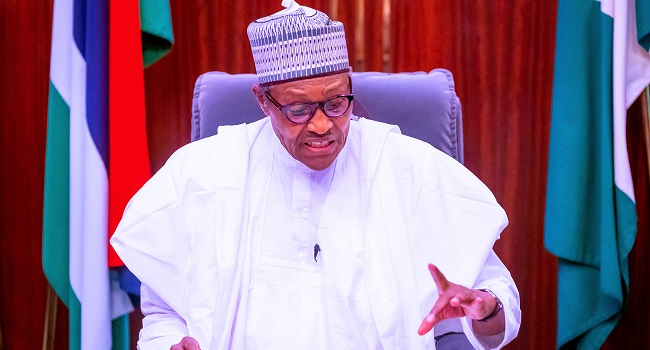
President Muhammadu Buhari has said that Nigeria’s economy is too fragile to bear another round of fresh COVID-19 lockdown.
The President disclosed this via his verified Twitter handle on Thursday.
Buhari said, compliance with COVID-19 protocols by all Nigerians is crucial to avert a second wave of the pandemic in the country.
“Looking at the trends in other countries, we must do all we can to avert a second wave of Covid-19 in Nigeria. We must make sure that our cases, which have gone down, do not rise again. Our economy is too fragile to bear another round of lockdown,” he tweeted.
He, therefore, urged Nigerians to obey all protocols recommended by health authorities to curtail the spread of the lethal coronavirus.
It will be recalled that Buhari had in March imposed a total lockdown on parts of the country including Lagos, Abuja and Ogun which lasted for over five weeks.
Nigeria, on Wednesday, recorded 147 new cases of COVID-19 bringing the total number of confirmed cases to 62,371.
According to the Nigeria Centre for Disease Control (NCDC), with Wednesday’s figure, the total tally of infected people in the country rose to 62,371, from 62,111 reported on Tuesday evening.
To date, 62,371 cases have been confirmed, 58,095 cases have been discharged and 1,139 deaths have been recorded in 36 states and the Federal Capital Territory.
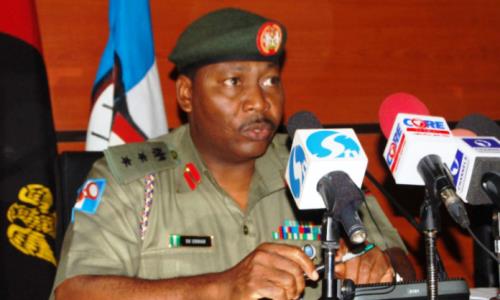
KUKASHEKA Usman Sani, the former military spokesperson, has said that military personnel present at the Lekki shooting in Lagos state were armed soldiers trained to kill, but they did not take any life, despite the reports of protesters dying of gunshots.
Sani said this during an interview on Arise News on Thursday while addressing the controversy over the shooting that took place in Lekki, Tuesday, October 20.
“Remember, the military is armed, and by the nature of their training they are trained to kill, they are supposed to come at a point in time and exit.
“There are procedures for taking over and handing over. But over time, we have neglected the time tested mechanism of conflict resolution. So the military in their wisdom decided to use blank armour which is meant for training to fire blank and not live ammunition.”
He reiterated that blank armours don’t kill.
“I think they should be commended for that otherwise, there could have been serious collateral damage but they were reasonable and professional enough to have done that,” Sani said.
When asked why did hospitals report that they have protesters with gunshot wounds if the military had fired blank armours, Sani failed to give a definite answer but instead said that some of the celebrities at the scene of the shooting had armed bodyguards.
“There were a lot of key actors at the scene which includes well-known celebrities and so-called big boys and we know that some of them had bodyguards that are well armed and a lot of things happen and I believe there are lots of recording that would be reviewed by the inquiry commission,” Sani stated.
Sani also did not answer clearly if protesters holding a flag and singing the national anthem is protected from being attacked.
“The National Flag is very sacred and symbolic to the fact that whenever they are having their parade they have the colour party and tradition, has it for whatever reason, if you allow the flag to fall not just the national flag or even the unit flag, definitely you will be court-martialled,” he said.
He added that the National Anthem is also symbolic for the military, that wherever it is being sung, a military officer or security operative is supposed to salute or come to attention.
“But the issue now is and I would like to even ask you this question, let’s assume that Reuben Abati sitting with you there and you saw someone carrying the national flag and definitely he was aiming to kill Reuben Abati, and you are also armed, what are you supposed to do,” Sani asked.
The ICIR checked the video footages several times but did not see any protesters shooting or aiming to kill the soldiers.
On the allegations of the military mopping up bodies of ENDSARS protesters who were shot, Sani said there are standard principles and procedures of which accountability is cardinal.
“Accountability means they are conscious of the fact that whenever the military is called upon, definitely there would be an investigation, and it has happened several times over especially in the early 2000s where we had an internal crisis, especially in Kaduna.
“Therefore, you must be accountable and the military is not the public health agency of the government that they will have to clear scene or they have to tamper with evidence, no, they don’t but they must be accountable, take a record of everything that transpired because they know definitely they would be asked questions,” Sani stated.
When asked if soldiers could mop up corpses in order to give account, Sani stonewalled. “No, don’t put words in my mouth, I already said they are not public health agencies”.
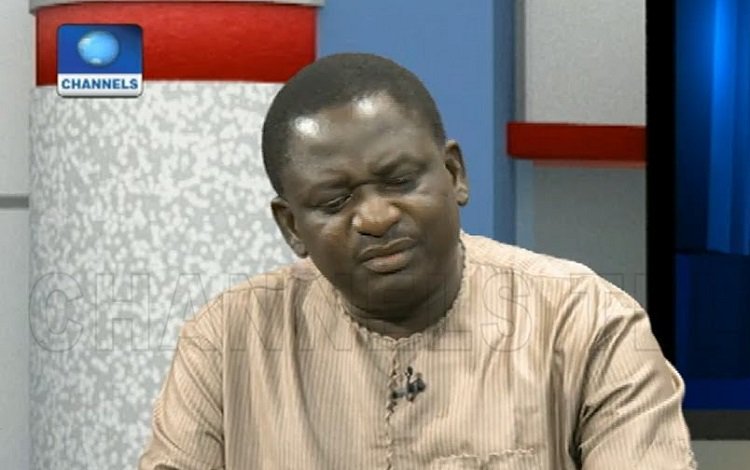
FEMI Adesina, the Special Adviser on Media and Publicity to President Muhammadu Buhari has condemned the looting and destruction of properties that have followed the #EndSARS protests, characterizing it as unjustifiable criminality.
But the president’s spokesman appears to ignore data on poverty in Nigeria.
Speaking on Sunrise Daily, a Channels Television programme, on Thursday, Adesina said being poor isn’t a justification for anyone to take to armed robbery, referring to the series of looting recorded in different states across the country.
“Criminality is criminality. Would it justify armed robbery because the man was poor? Would you justify armed robbery because the man didn’t have money?
“Just as you cannot justify armed robbery because a man was poor and took a gun to rob another person, you can’t also justify the lootings going on because it is pure criminality. My view is that it is not everybody that is hungry that engaged in that looting. This is the truth, it is greed and pure criminality,” Adesina said.
Following the discovery of government storehouses for COVID-19 palliatives, several states across Nigeria have recorded incidents of looting by Nigerians believed to be the most vulnerable.
The palliatives which the Federal Government announced it was distributing to lower class Nigerians at the peak of the COVID-19 pandemic in Nigeria, were found to be stored in warehouses, yet to be shared with those it was meant for.
Follow The Money, a Civil Society Organisation said during the wake of the COVID-19 pandemic, a total of 57 Freedom of Information (FOI) request letters were received by 27 State Government agencies, requesting details of COVID-19 funds and the distribution of palliatives— only six responded.
The group said the six states that responded assured that the palliatives were distributed accordingly, even though they refused to provide details of distribution and evidence of the same.
However, evidence now shows that most states in fact never shared the government-provided palliatives.
In Abuja, a crowd stormed a government-owned warehouse, suspected to be filled with COVID-19 palliatives. Several media have reported that many angry youths could not access the palliatives until they forcefully retrieved it from various warehouses where the food items were stored.
“We need our palliatives. It is our right. My neighbor almost died of hunger because of COVID-19,” David Ojo told VOA. He said his neigbour used to work as a security guard at a government institution, but he was sacked. “What do you want him to do? I gave him beans and rice, he almost died of hunger,” Ojo said.
Nigerians have condemned the hoarding of palliatives meant to minimize the effect of the COVID-19 pandemic.
“…it is a product of government’s ineptitude, greediness and wickedness,” Francisco August, a Nigerian said, reacting to the discovery of palliatives hidden in warehouses.
Another Nigerian identified as Mafeg Pam expressed frustration that agents of the government were intentionally starving people during the pandemic.
“So during the lockdown, they were just hiding the food. I wonder about the kind of government we have. Many people have died of hunger,” Pam, who lives in Jos told TheJakartaPost.
According to a 2019 United Nations Human Development Report, Nigeria’s Human Development Index value for 2018 is 0.534— which put the country in the low human development category—positioning it at 158 out of 189 countries and territories, This indicates that the majority of Nigeria’s estimated 200 million population live below the poverty line and at the peak of the pandemic, had a tougher reality than people in other countries.
Adesina however believes that the #EndSARS protests led to the looting that ensued. According to him, the protests birthed anarchy that then led to criminality.
“I don’t agree that it is all about poverty. Yes in any country, you will have people that are poor, hungry…that is one of the reasons you have a government to ensure that the number of the poor reduces progressively.
“So this crowd of people you see going to loot are not necessarily hungry or angry; they are taking advantage of the collapse of law and order that came as a result of the protest,” Adesina said.
Adesina’s view appears to ignore the statistics of poverty in Nigeria. According to Action Against Hunger, a global humanitarian organization, Nigeria continues to suffer a rising level of food insecurity. The World Poverty Clock estimates the number of Nigerians living in extreme poverty at over 105 million as of 2020. Out of this number, over 53 million men and 52 million women live in extreme poverty.
SEVERAL fake and misleading information has circulated online following the EndSARS protest that rocked Nigeria.
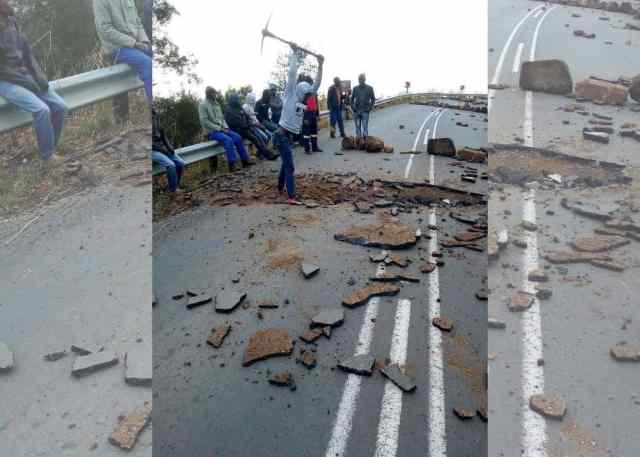
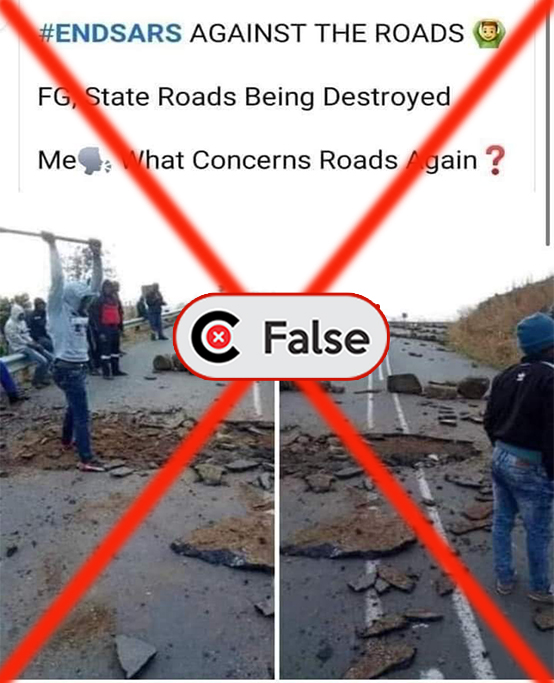
One of such claims is a post shared with The FactCheckHub on October 24, 2020. It shows two images of a tarred road being destroyed by a group of persons destroying Nigerian roads.
One of the images shows an individual holding what looked like a digger, while others stood by watching.
The photograph was attributed to the EndSARS protest, claiming that the protesters were destroying the rods to express their grievances against police brutality and bad governance.
The photo is captioned, “#ENDSARS against the roads. FG, State roads being destroyed. Me: What concerns roads again?”
This image is unrelated to the EndSARS protest in Nigeria.
THE CLAIM:
That the #EndDSARS protesters destroy a section of a highway to protest police brutality, bad governance in Nigeria.
THE FINDINGS:
The ENDSARS protests erupted in Nigeria in early October across major cities in the country to push for the disbandment of the Special Anti-Robbery Squad (SARS), a controversial unit in the Nigerian Police Force. The protest was largely championed by young persons.
The SARS unit which focuses on cases of kidnapping, robbery and high profile crimes was repeatedly accused of extortions, extrajudicial killings, corruption and abuse of people’s rights. As a result, the protesters sought a complete overhaul of the force among other demands for a better nation.
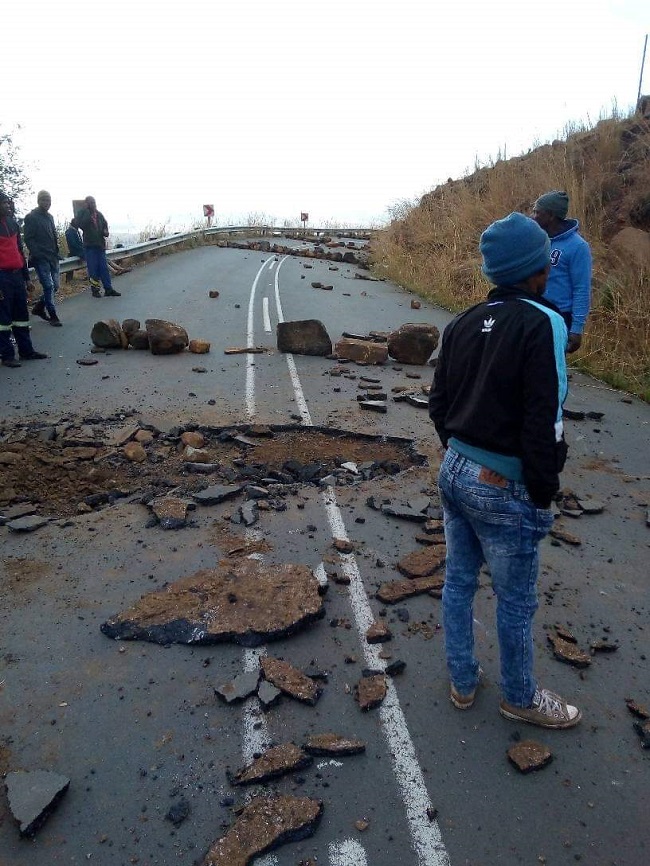
Image traced to South Africa
The FactCheckHub check on the image using the Google Reverse Image Search shows that the viral image did not originate from Nigeria but South Africa.
Protesters in South Africa destroy an access road over service delivery. Image via: uMzinyathi District Municipality from The South African.
The image surfaced on the internet last month- September and the incident was reported by several South African media organisations.
The road being damaged was part of a protest exercise that occurred along the R33 road on September 22.
The R33 road is a major highway in South Africa that stretches through three provinces Limpopo, Mpumalanga and KwaZulu-Natal. It links Pietermaritzburg with Greytown, Paulpietersrburg, Carolina, Belfast and Vaalwater.
The aggrieved demonstrators had protested against poor government performances in providing basic infrastructure such as electricity, water.
Some of the protesters particularly from uMzinyathi District Municipality and Msinga Local Municipality had decried poor access to water.
Nomonde Nzimakwe, Head of Communications for uMzinyathi District confirmed the incident to local newspapers.
Petros Mthandeni Ngubane, Umzinyathi Mayor criticised the actions of the protesters, while noting that “it’s not the mayor’s fault,” that community lacks electricity.
The South African citizens through the South African Citizen Satisfaction Index (SA-CSI) monitor deliverables of government authorities in comparison with public expectations and executed projects.
THE VERDICT:
The claim that the photo shows #EndDSARS protesters destroying a section of a highway to protest police brutality, bad governance in Nigeria is FALSE. This is because the image is from an unrelated protest in South Africa.
This report was originally published by FactCheckHub
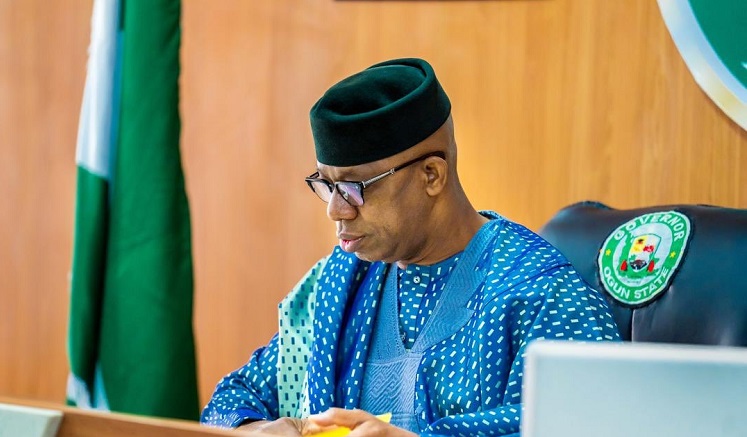
THE Ogun State government has directed that religious houses, hotels and other entertainment centres can now fully reopen after months of COVID-19 partial lockdown in the state.
Kunle Somorin, Chief Press Secretary to Governor Dapo Abiodun, who revealed this in a statement said the decision was necessitated by a sharp decrease in the numbers of COVLD-19 new cases in recent times in the state
“Government is aware of the excruciating implications of COVID-19 lockdown but we have emplaced measures and improved on testing to stem the tide,” he said.
“Empirical field research indicates that we have managed to stem community spread and treatment of the virus very well.
“We are convinced that the opening of schools and entertainment centres would not harm our people. We would continue to monitor the development.”
It, however, warned that the hospitality establishments are to scrupulously adhere to a set of guidelines before reopening and in order to keep up with the protocols aimed at further flattening the curve of the pandemic.
The conditions set for the reopening are: Observance of temperature checks at all entry points; compulsory use of face masks within the premises/facilities; maintenance of two-metre social distancing by marking the floor to guide their customers on physical distancing; owners of business premises are required to offer only 50% of their space capacity to guests.
Others are: maintenance of physical distancing with a maximum of four persons per table, while Buffet services are not allowed; prior to holding any event, licence and safety clearance must be obtained from the Government; and the operation of all cinemas must not exceed 10 pm.
In addition, all centres are to provide noise-proof equipment in the various facilities to ensure that they do not disturb the serenity of the neighbourhoods where they operate.
While calling on owners of these facilities to cooperate with the State Government, Governor Abiodun warned that facilities that defy these guidelines would be sanctioned.
“Let me say that our Task Force is already on the ground and is moving about to ensure compliance.
“And, if perchance we discover that any of our centres is not complying or adhering to the laid down protocols, we will not hesitate to close down the centre,” he warned.
Violation of these conditions, the statement concluded, would attract severe sanctions including, but not limited to fine and closure of premises.
The governor had in March ordered the closure of the businesses over the COVID-19 pandemic in the country.
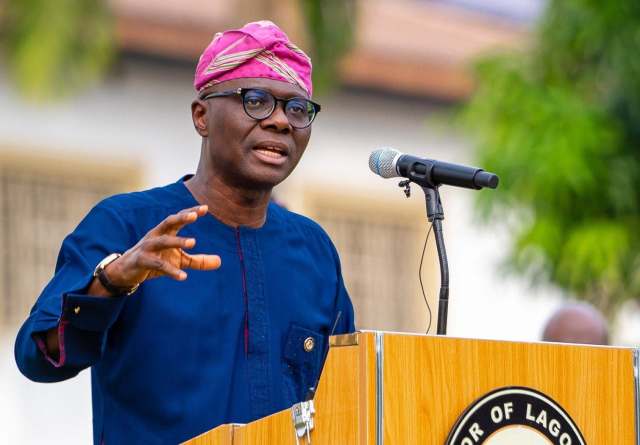
BABAJIDE Sanwo-Olu, the governor of Lagos state has ordered the re-opening of schools for all classes in public and private schools following the restoration of peace in the state.
Folasade Adefisayo, the Lagos state commissioner for Education, made this known in a statement on Thursday.
According to Adefisayo, all schools in the state are to resume from Monday, November 2, 2020, while boarders in public schools are to resume on Sunday, November 1.
She added that following the closures occasioned by COVID-19 and the ENDSARS protests, the government hopes that there would not be further disruption of the academic calendar.
“We pray and hope that there will be no more disruptions in the academic calendar. However, the State Government will always regard the safety of pupils/students, parents and all staff as a matter of priority, we recommend that when schools resume on Monday, teaching and learning should continue unhindered till the end of the term,” said Adefisayo.
The ICIR had reported that the Lagos State Government ordered the suspension of activities in all public and private schools in the state due to the ENDSARS protests.
The State government had said the action was necessary for the safety of the pupils and students, parents, and all staff working in in the school.
In Lagos and some other part of the state, the ENDSARS protest escalated into violence as some residents of the states resorted into violence and invasion of private and public properties while discovering and taking possession of COVID-19 palliative.
SEVERAL Nigerian publications on Wednesday, October 28, 2020, reported that Ngozi Okonjo-Iweala has emerged as the Director-General of the World Trade Organisation (WTO).
Okonjo-Iweala was a former Minister of Finance as well as Coordinating Minister of the Economy in Nigeria.
She, alongside Yoo Myung-Hee, from South Korea are in competition for the top job.
THE CLAIM:
That Ngozi Okonjo-Iweala has emerged as the Director-General for the World Trade Organisation (WTO).
THE FINDINGS:
Checks by the FactCheckHub indicates that this is false.
The information that Okonjo-Iweala has emerged the WTO’s boss was reported by Vanguard Newspaper, which has an online following totaling several millions across platforms.
Peoples Gazette, a newly launched publication also published a similar story about Okonjo-Iweala clinching the WTO’s job.
Within a short period, the report tweeted on the verified handle of the publication @GazetteNGR garnered over 1,800 retweets, more than 2, 600 likes on Twitter, with several reactions and congratulatory messages.
Peoples Gazette, particularly made reference to Arise Television News which had earlier broadcasted the news at about 12:31 pm on Wednesday (October 28).
Newswire also followed suit, but later updated the report after diverse reactions questioning why the publications chose to report the news without official disclosure from the WTO authorities.
Meanwhile, as at press time, no such information about Okonjo-Iweala emerging the WTO’s boss has been officially made available on the website of the WTO as well as its verified social media handles.
None of the publications attributed their reports to any official information from the WTO.
The story so far…
On Wednesday, October 28, 2020, the WTO panel recommended Okonjo-Iweala for the WTO top position, but this was rejected by the United States.
Bloomberg report noted that but for the United States’ position, the WTO would have announced Nigeria’s former finance minister as the new Director-General of the global body.
Although, Okonjo-Iweala is a Nigerian-American, the US government declared its support for the South Korean candidate, Yoo Myung-Hee. The US government had insisted Washington would not recognise the Nigerian as the consensus candidate, despite the WTO’s recommendation.
As of the time of this verification, the WTO is yet to officially announce Okonjo-Iweala as the new WTO DG. No such information on its verified Twitter handle, @wto, or its website.
As a result of the US position, the general counsel in charge of election process has postponed the announcement for November 9, 2020.
This will not be the first time that misinformation around this job will flood the cybersphere. The FactCheckHub had on two occasions; in July here and early October here debunked such misinformation.
THE VERDICT:
Based on the available information, there is no official record to validate the claim that Ngozi Okonjo-Iweala has emerged the WTO’s Director-General. Therefore, the claim is FALSE.
Okonjo-Iweala was only endorsed by the WTO panel.
This report was originally published by FactCheckHub
THE office of the United States trade representative has issued a statement to explain why the United States is opposed to the candidacy of Ngozi Okonjo-Iweala, Nigeria nominee for the Director-General of the World Trade Organization (WTO, job.
The US said it supported Okonjo-Iweala’s counterpart and opponent, Yoo Myung-hee, Korean Trade Minister as the next WTO Director-General because she is “a bona fide trade expert who has distinguished herself during a 25-year career as a successful trade negotiator and trade policy maker.”
It further stated that Yoo Myung-hee has all the skills necessary to be an effective leader of the organization.
While stating that the WTO is facing a very difficult time because of the challenges confronting it, the US said it needs to be led by someone with trade experience to drive the reforms it needs.
“This is a very difficult time for the WTO and international trade. There have been no multilateral tariff negotiations in 25 years, the dispute settlement system has gotten out of control, and too few members fulfill basic transparency obligations. The WTO is badly in need of major reform. It must be led by someone with real, hands-on experience in the field,” the statement said.
The ICIR reported on Wednesday how Okonjo-Iweala was poised to become the first woman and African to head the WTO after securing the overwhelming support of 164 members of the international trade body.
But the US has insisted that the South Korean candidate remains in the race for the DG job, as it could not build a consensus around Okonjo-Iweala’s candidacy.
A spokesperson for the WTO on Wednesday said Okonjo-Iweala’s candidacy would be put to a meeting of the body’s governing general council on November 9.
THE EndSARS protest has been described as probably one of the landmark acts of resistance in the history of Nigeria. And the invasion of food warehouses by angry Nigerians has sent an unmistaken message to the ruling class that injustice of any form will no longer be taken with silent equanimity.
Thousands of protesters from various states had occupied major cities from seventh to 20 October, demanding the disbandment of the Special Anti-Robbery Squad (SARS) unit amidst agitations for good governance.
Though initially peaceful and coordinated, the protest suddenly took a new twist immediately it was hijacked by the fiery youth. A day after the Lekki shootings, it culminated in forceful retrieval of public and private properties, widely blamed on years of systemic failure and lack of public trust in governments.
But of particular interest are the CACOVID food warehouses invaded by Lagos residents. Incidents were recorded in Plateau, Osun, Taraba, Adamawa and the Federal Capital Territory (FCT), where the palliatives were allegedly kept away from the people, a position widely contested by the state government authorities.
Roof to a warehouse in Jos used to store COVID-19 palliative being removed by members of the public. Photo Source: UK Daily Mail
“Both the state emergency management agency as well as the state governments are in the position to prepare food items and other materials in case of any eventualities. So, it is not true that the state governments and the FCT are withholding foods,” Abbas Idris, Director-General FCT Emergency Management Agency said Tuesday while debunking the allegation.
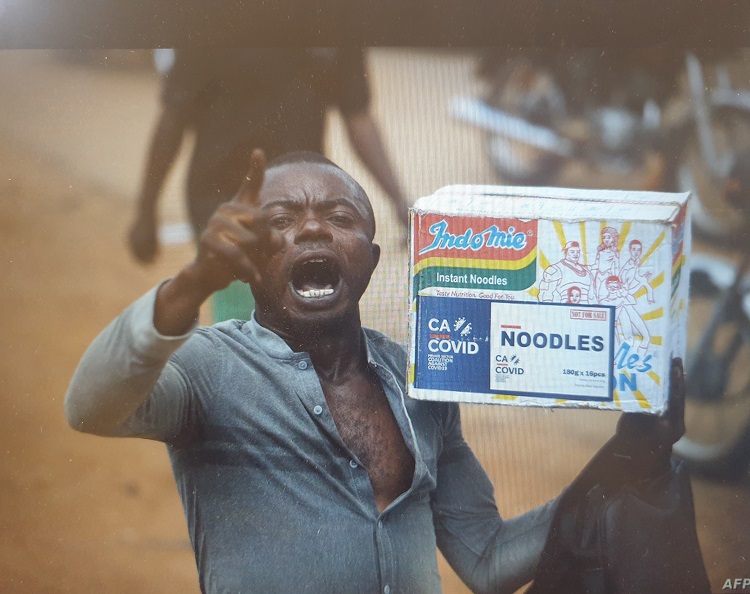
Several videos and pictures have shown how aggrieved persons stormed the various locations carting away bags of rice, cartons of noodles and other food items.
On October 23, Osun State government raised alarm about the attack on its warehouse used to store palliative supports received from the Cacovid. The next day, a similar attack took place in Ekiti state as residents stormed a warehouse oblivious of the fact that the Cacovid was earlier disbursed while what the public termed as the interventions were poisonous grains kept in the state’s silos for cultivation purpose.
Many believe the state governments deliberately hoarded the palliatives despite evidence of hardship in the country.
CACOVID, a group of private sector alliance working to support the federal government and the World Health Organisation (WHO) to address relevant problems posed by the global pandemic raised about N30 billion part of which was used to provide the looted food items. Though it is yet to make an official statement on the incidents, reports show that the group gave reasons for the staggered distribution of the palliatives.
Drawing the line between morality and poverty
During first quarter of the year, at the onset of the Coronavirus Disease (COVID-19) outbreak, a report from the National Bureau of Statistics (NBS) revealed a high level of poverty in the country. The NBS report titled, 2019 Poverty and Inequality in Nigeria says 40 per cent of Nigerians, almost 83 million people live below the poverty line of N137, 430 yearly.
In August, Kingsley Moghalu, former Deputy Governor of the Central Bank of Nigeria (CBN) shared concerns on the extreme poverty rate in the country. His concerns were particularly on how poor governance and corruption have affected the nation’s growth, thus driving the socio-economic problem.
“90 million Nigerians live in extreme poverty and the country is essentially bankrupt…” he tweeted.
Extreme poverty is defined by the United Nations as a situation characterised by severe deprivation of basic human needs, drinkable water, shelter, food and even sanitation facilities. Current reality has further shown level of poverty in the land. Majority lack access to these basic needs. Most worrisome are the homes of politicians and the Oba of Lagos raided by the aggrieved persons.
So the question is how justified is the action of those who invaded warehouses? Should they have allowed reason and morality to overshadow their hunger? There were concerns the palliative might not get to the beneficiaries due to the corruption of the public officers.
The federal government, for instance, had repeatedly claimed the nation is food secured, independent findings by The ICIRshowed otherwise.
Nigeria Poverty Clock shows 51 per cent of Nigerians living in extreme poverty. Photo Credit: Poverty Clock
The World Poverty Clock, a global initiative used to measure the extreme poverty rate across nations further adduced to the above findings on the rising poverty rate in the nation.
As of date, the clock shows that 51 per cent of Nigerians are living in extreme poverty. The figure amounts to 105, 097, 856. A further breakdown shows 53, 133, 553 males and 51, 964, 303 females.
From the perspective of the United Nations Human Development Index (HDI), Nigeria still appears to be on a low ranking. The 2020 HDI rates Nigeria 0.53 among the least developed countries, two places to Sudan and six to Yemen.
First launched in 1990, the HDI is ranked on a scale of 0 to 1.0. While nations within the range of 0.8 to 1.0 are considered high in the HDI ranking, those below 0.55 takes the lowest ranking.
The HDI is measured using indicators such as per capita income, education and life expectancy. As such nations with high HDI have a higher level of education, higher lifespan and greater wealth but that’s not the case with Nigeria.
Hoarding of palliatives proof of government wickedness, ineptitude – Nigerians
“…it is a product of government’s ineptitude, greediness and wickedness,” Francisco August said, reacting to the incident.
“So during the lockdown, they were just hiding the food. I wonder about the kind of government we have. Many people have died of hunger,” Mafeg Pam, who lives in Jos told TheJakartaPost.
Chinoso Eze said the government should be blamed for hoarding the palliatives, and not the people who retrieved it. “They hid the COVID-19 palliatives, now the citizens found it by themselves. So it is not looting. They are taking the COVID-19 palliative that was meant for them.”
This argument is perhaps, the most popular among the people, but despite this submission, opposing opinions posit that no matter the condition, taking food items without permission should not have been an option.
In the meantime, Plateau and Osun state governments, for instance, have issued a 48-hour deadline for looters to return palliatives earlier taken from the warehouses. In Abuja, security officials have also been visiting individual’s homes to recover the food items, and parading the suspects including those who have taken items other than food items.
BOLAJI Akinyemi, a professor of political science and former external affairs minister said the probe of the shooting at Lekki toll gate should be given top priority before considering petitions filed by people abused by the disbanded Special Anti-Robbery Squad (SARS).
Akinyemi disclosed this on Wednesday during a current affairs programme on Arise TV, saying the focus of the Lagos state panel probing the disbanded Special Anti-Robbery Squad (SARS) should first be on the shooting at Lekki toll gate.
“I wish the panel had really started with the shooting at the toll gate rather than the petitions, filed by people who have issues with SARS. This does not deny the fact that people have issues with SARS, because this is what touches them.
“Given the national and international attention that is focused on Nigeria if I was the Chairman, of the panel, that issue would be first, but the panel itself knows best,” he said.
The former minister described Nigeria’s #ENDSARS protests as both lucky and unlucky within the international community, saying the outcome of the Lagos panel would decide Nigeria’s fate.
“Within the international context, Nigeria is both lucky and unlucky. Nigeria is lucky in the sense that our own crisis side has come in that season of protests, Black lives matter in the US, Thailand protests, Chile protests amongst others.
“The #ENDSARS protests do not paint Nigeria as being a bad boy within the international community but rather unlucky because, after 13 days of protests several protesters were being shot. Compared to Thailand where protest has been going on for more than a month or Chile there has been no shooting,” he said.
Last week, men in army uniform stormed the Lekki toll gate where #EndSARS protesters had gathered for 13 days and dispersed them using live bullets.
The incident had triggered an outrage locally and condemnation from the international community though, the army had denied being responsible while the federal government said it would investigate the tragic incident.
“I think the international community itself is probably still waiting for that Lagos panel’s decision. And I hope they are not going to take all the time about it because the US elections are seven days away.
“And the world is going to move on, if we want to keep the attention of the world on this issue, then the panel has to speed up its procedure and processes,” he said.
On the speech by President Buhari on the shooting of the #ENDSARS protesters, Akinyemi said the speech was uncivil and lacked finesse, describing the choice of words in the speech was inappropriate.
“I don’t think the speech was helpful because when a Head of State decides to demonise the international community by basically asking them to either mind their business or that they don’t know what they’re talking about. It’s insulting.
“Invariably, because of technology, the international community actually knows what they are talking about but if you are going to disagree with them you have to do so in a civil way,” he said.
Speaking on Nigeria’s global human rights rating, he stated that the country is still an important regional player despite its human rights flaws.
“Nigeria for all its worth is still perceived as a regional player with sufficient capability to impose its views in West Africa.
Buttressing his point, he stated that former Nigeria’s dictator, Sani Abacha intervention in Sierra Leone was an international relations contradiction.
“We still teach our students the Abacha contradiction who was a brutal dictator, but was trying to reintroduce democracy in Sierra Leone while the world watched because his objective in Sierra Leone was what the world wanted,” he said.
Akinyemi stressed that restructuring the nation’s polity, was not a power shift from North to South saying the #ENDSARS protests was an eye-opener.
“We’ve just seen how every governor was scrambling over the past two weeks to control the outbreak of violence when hoodlums hijacked the protests. If you allow each state to have state police, you wouldn’t have had this situation where governance in almost every state was threatened by hoodlums.
“People tend to think that restructuring is taking power from the North and giving it to the South but that is not the case. I may be wrong but if these issues are not addressed within two weeks don’t be surprised if the youths come back to streets,” he said.