Home Blog Page 229

How impact of flooding, insecurity can be minimised – Agbugba

0

Ikechi Agbugba is an Associate Professor of Agricultural Marketing at the Rivers State University. In this interview with the ICIR, he speaks on ways to minimise the impact the recent flooding in Niger and insecurity in Benue are likely to have on food production in the coming harvest season.


The ICIR: To what extent do you think the recent flood incident in Niger state and insecurity in Benue will affect food supply in the next harvest season?

Agbugba: The recent flooding and insecurity in Niger and Benue states, respectively, will have significant negative impacts on the food supply chain in the next harvest season. Undoubtedly, the fusion of these factors could lead to reduced harvests and escalate food prices.

On the one hand, floods can demolish crops, damage farmlands, and displace communities. Sadly, it can inundate farmlands, affect staple crops, such as rice, maize and yam, which are abundantly grown in the region. So, the extent of damage depends on the flood’s duration, depth, and the crops’ growth phase.

Flood can also degrade the topsoil, erode farmland, and contaminate water sources, affecting soil fertility and making it difficult to cultivate crops. More so, floodwaters can force farming communities to abandon their farms and livelihoods, disrupting planting and harvesting cycles.

These factors can result in reduced harvests, creating food shortages and increasing food prices. It can also impact food utilisation, affecting the food nutritional value, food safety, and the ability of communities to access and prepare food properly.

On the other hand, insecurity can disrupt farming activities and restrict farmland access. The impact of the insecurity situation in Benue can be colossal. We must not forget that Benue is referred to as the ‘Food Basket of the Nation’. As the leading producer of several key crops in Nigeria, including yam, rice, maize, cassava, and soybeans, the impact can be felt in many ways, including disruption in farming activities, lean access to cultivate farmlands, and forceful abandonment of farmland by farmers, which could lead to a loss of livelihoods and exacerbate food insecurity.

The ICIR: How can we address the expected shortfall in agricultural produce from these two states in the next harvest season? 

Agbuba: First, to mitigate potential shortfalls in agricultural produce, a multi-faceted approach like the Brain Re-Engineering Initiative can help. In my position, it’s not just a policy initiative, but also an entrepreneurial approach, educational strategy, business model, as well as a sustainability framework. The initiative involves addressing perception challenges, fostering ideation and entrepreneurship, integrating technological solutions, promoting sustainability and circular economies, and advancing social equity in public policy. Food chain security is intricately connected and can be enhanced through these strategies.

Second, to address the expected shortfall in Niger state’s agricultural produce, there will be a need to focus on both immediate flood mitigation and long-term resilience building. This will include improving flood management infrastructure, adopting climate-smart agricultural practices, and strengthening farmer support systems. Immediate flood mitigation entails strengthening flood defences by constructing or reinforcing levees, dikes, and flood walls along rivers and flood-prone areas can physically prevent water from inundating farmland.

Third, there is a need to fortify drainage systems by improving drainage networks, including canals and pumping stations, which can help quickly remove excess water from fields.

Fourth, implementing offline flood storage ponds or reservoirs can temporarily hold excess water during heavy rainfall, reducing the impact on agricultural land. And fifth, there will be a need for long-term resilience building, which will include climate-smart agriculture.

Other considerations will be to strengthen support for farmers by establishing a fund to provide low-interest loans. This can help them recover and replant. Also is to train them on risk management, climate-smart agriculture, and post-harvest storage.

Ikechi Agbugba, agricultural economist
Flooding can demolish crops, damage farmlands, and displace communities while insecurity can disrupt farming activities and restrict farmland access – Ikechi Agbugba

Infrastructure upgrades are also needed to improve road networks and bridges which can help ensure access to markets and facilitate the transportation of agricultural inputs and outputs. There should also be a focus on upgrading irrigation infrastructure, to provide more efficient water management, especially in areas prone to drought. By combining these strategies, Niger State can enhance its ability to withstand future flood events and maintain a robust agricultural sector.

To mitigate the expected shortfall in agricultural produce due to insecurity in Benue state, there will be a need to promote bolstering security in farming areas, promoting peaceful coexistence between farmers and herders, investing in modern farming techniques and infrastructure, and ensuring access to resources like fertilisers and credit. In addition, addressing climate change impacts and strengthening food storage and distribution are crucial steps.

Enhanced security measures will entail deploying more security personnel to vulnerable farming areas and establishing community policing initiatives can deter criminal activities and protect farmers. Utilising drones and other surveillance tools can enhance monitoring and early warning systems, helping to identify and prevent potential threats. Strengthening the implementation of laws like the Benue Open Grazing Prohibition Law can help reduce conflict between farmers and herders.

The need to foster a peaceful coexistence has become imperative by establishing designated grazing reserves for herders. This can minimise conflicts over land use and reduce the likelihood of attacks on farms. Also, facilitating dialogue between farmers and herders can help resolve disputes peacefully and promote understanding. The local communities should be empowered to participate in conflict resolution and security efforts which can foster a sense of ownership and responsibility.

Let me explain that modernising agriculture is the focus of the brain re-engineering agenda. It’s created for driving sustainable change in the agriculture sector among the younger generation to foster their entrepreneurial capabilities through new dimensions in agricultural technologies. This agenda proposes that stakeholders of agricultural development provide farmers with the training and support in modern farming techniques, such as using high-yield crop varieties and implementing climate-smart agricultural practices, which can enhance productivity and resilience.

Further is to ensure that farmers have access to quality fertilisers, pesticides, and other essential inputs at affordable prices. This is crucial while investing in irrigation systems, storage facilities, and transportation infrastructure, which can improve productivity and reduce post-harvest losses. Farmers need to be provided access to credit and other financial resources that can enable them to invest in their farms and adopt new technologies.

I’ll add that strengthening food and agricultural systems can lead to improved storage facilities, efficient food distribution networks, diversified production, and promoting local food systems. With these suggestions, the capacity of Benue State to mitigate the impact of insecurity on agricultural production and build a more resilient and sustainable system can be actualised.

The ICIR: Tomatoes and peppers have been scarce, especially in markets in Lagos state. Are there major issues to this that we don’t know?

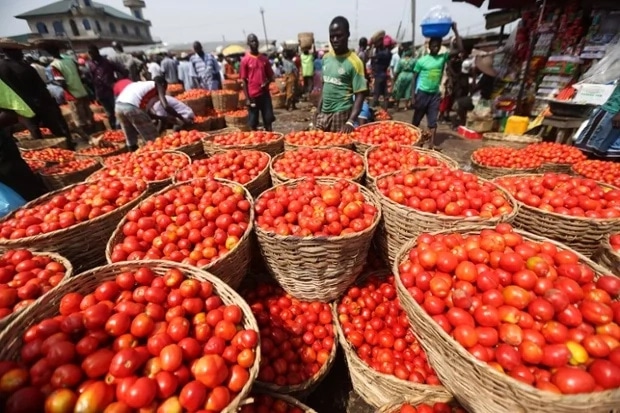
Agbugba: A mini research I carried out indicates that the scarcity situation and high prices of tomatoes and peppers in Lagos can be traced to the interplay of factors, including the tomato ebola disease (Tuta absoluta), withdrawal of fuel subsidies, and the rainy season. These issues have led to increased cost of transportation, lower harvests, and ultimately, lofty prices for buyers. Due to these challenges, some farmers are hesitant to invest in tomato and pepper cultivation. Despite the high prices, the demand for tomatoes and peppers remains strong, contributing to the scarcity and price hikes.

Regarding its impacts on consumers and traders, there will be high prices, low patronage and difficulty in restocking. While consumers are struggling to afford tomatoes and peppers, with prices reaching unprecedented levels, the traders are reporting low patronage as consumers cut back on purchases due to the high prices, while some traders are finding it challenging to restock their supplies due to the scarcity and high prices.

As a food and agricultural economist, may I underline that the hidden issues surrounding the scarcity of crops resonate around five factors. First, the crops are not native to Nigeria. Second, the scarcity is also a seasonal issue, with fluctuations in supply and price cycles depending on the time of year and harvest cycles. Third, the scarcity of tomatoes and peppers is not an isolated issue. Other food items like rice, beans, garri, and yam are also experiencing price surges, suggesting a broader food security concern. Fourth, the government has taken steps to address the situation, including deploying experts to tackle the insect infestation and sensitising farmers about weather patterns. Fifth, there is hope for improvement as efforts are underway to develop solutions to the Tuta absoluta infestation and stabilise the tomato market.

Consequently, resilient Nigerians have devised new ways to survive the scarcity of tomato and pepper by now cooking their stews with different ingredients. However, the possible ways of tackling these issues rise and fall on pest control measures, improvement of infrastructure, and government support.

The ICIR: There is relative peace in the south compared to the north. What critical steps can be followed to improve agricultural production in this region?

Agbugba: Yes, there is relative peace in the region and I could categorically speak about this because my primary affiliation and place of work, Rivers State University, is situated in this region. The critical steps that can be taken to improve agricultural production and foster peace include investing in infrastructure, providing access to finance and markets, improving soil health and water management, and promoting sustainable farming practices. Addressing climate change, empowering communities, and fostering social cohesion are also crucial for long-term stability and agricultural development.

Let me also highlight the need to connect smallholder farmers with reliable markets for their produce. Importantly, strategies to adapt to climate change, such as water conservation, drought-resistant crops, and improved irrigation systems should be implemented.

From the angle of government and policy, strengthening policy dialogue and coordination among different stakeholders to ensure effective agricultural development strategies will benefit the stakeholders. I believe strongly that by implementing these steps critically, the region would be in the position to leverage its agricultural potential to achieve both food security and sustainable peace and development.

LG autonomy unrealistic, says Fashola

0

A former Lagos State governor, Babatunde Fashola, said it is “unrealistic” to expect local governments in Nigeria to function independently under the current constitution.

Fashola, a senior advocate, SAN, shared this view on Channels Television’s Sunrise on Saturday, July 19.

This came amid the growing call for local government autonomy, following a recent Supreme Court ruling.

In July 2024, the apex court barred governors from dissolving democratically elected local government councils and granted financial autonomy to local governments in Nigeria, The ICIR reported.

In his argument, Fashola pointed out that local councils cannot carry out their responsibilities without the interference of the State House of Assembly and the State Government.

He said the state houses of assembly make laws for local governments, which are external influences that contradict the idea of autonomy.

“I think that the debate we must have is whether we really want autonomous local governments. It’s a debate that must be heard. As it stands today, it is unrealistic to expect autonomy for local governments created by the Constitution.

“They were not meant to be autonomous; that is my view after a very close reading of certain provisions of the Constitution. Some of those provisions provide, for example, that the local government in its economic activities and all of that will have laws made for it by the state House of Assembly,” Fashola said.

According to him, the legal and ordinary meaning of autonomy suggests that one is acting independently without any outside influence and authority.

The fact that state houses of assembly make laws on how local governments function, Fashola maintained that this external influence contradicts the idea of autonomy.

He further posited that land, which is an asset that local governments require to provide infrastructure, is controlled by the state governments.

“The next thing, of course, is to look in the Fourth Schedule of the constitution and look at all of the responsibilities that are assigned to local governments, such as the operation of slaughterhouses, abattoirs for animals, cemeteries, building of rules, advertising hoardings, primary schools, primary healthcare centres, all of those responsibilities are dependent on one item, land.

“And to the extent that the state government controls land, which affects how the local governments will carry out these functions, I didn’t think that autonomy was intended. Now, if we decide that we want autonomous local governments, those are some of the things we have to free up if that is our decision, Fashola argued.

To Fashola, autonomy was not intended, but what he thinks is some sort of collaboration, supervision, and oversight of local governments.

This is what is inherent and can be found in Section 162 of the Constitution, which he cites, that deals with the state’s joint local government account.

He further argued that the cases of many local governments defaulting in the payment of salaries and pensions of primary healthcare workers, primary school teachers, at the return of democracy in 1999, partly gave rise to a joint account between the states and the councils.

“And there’s history behind the enactment of that section because up till 1999, the local governments used to collect their money directly from the Federation account under a process that I think was known as JAAC (Joint Accounts and Allocation or something).

“But in the advent of the democratic era, it was found out that there were so many of them, or not a few of them, who had defaulted in the very basic obligation of paying staff salaries, primary healthcare workers, primary school teachers, salaries and pensions, and there was a backlog of debt, and I met some of that debt when I became Governor and we were working there,” Fashola explained.

He, however, noted that the conduct of council elections was a good step towards making local governments independent.

Traditional worshippers threaten to sue Ogun govt over late monarch burial rites

0

TRADITIONAL worshippers also known as Isese under the aegis of the International Council For Ifa Religion (ICIR), has threatened to sue the Ogun State Government and the family of the late Awujale of Ijebuland, Sikiru Adetona, for violating the legal and laid down procedures of burying a traditional ruler in the state.

In a statement signed by its President, Fayemi Fakayode, spokesperson, Ayanladun Fajemisin and the legal representative, Ifasola Opeodu on Saturday July 19  in Ibadan, vowed to challenge the method of the Awujale’s burial.

The ICIR reports that the Awujale passed away on Sunday, July 13, 2025 at the age of 91, and was buried according to Islamic rites on Monday July 13.

The burial which was performed by Islamic clerics has however generated controversy across the land.

Reacting to the way the revered monarch was buried, the ICIR vowed to correct what they termed an anomaly.

The group of Isese worshippers described the manner the Awujale was buried as a departure from the laid down traditional practice of the Yoruba.

According to the ICIR, the last judicial pronouncement over the matter upheld the burial of traditional rulers according to the customs and traditions of the Yoruba people as against that of foreign religions like Islam and Christianity.

The group said after the recent controversy surrounding the burial rites of Awujale in Ogun State, they commended the Osugbo Confraternity of Ijebu-Ode for their exemplary show of courage in the face of adversity, a virtue which they said aligns with their teachings.

“The Islamic clergies as led by the Chief Imam of Ijebu-Ode violated the law of the land and as a result, demonstrated the lawlessness character and nature of their religion.

“This poignant moment reminds us that the gentleness of a lion is not a sign of weakness, but rather a testament to its wisdom and strength.

The Ifa council added that any action contrary to the judgment of the court and the laws of the land would be a disregard for the customs and traditions that have been the cornerstone of their heritage.

It stressed that the burial of the late Kabiyesi was not in consonance with the law of the state, and it is obvious that the burial arrangement contravened Part 8, Section 55, Sub-section ii of the Ogun State Chieftaincy law.

“This issue transcends a mere burial rite; it represents a challenge to the very fabric of our customs and traditions, the actions taken at the event were part of a larger agenda to erode the cultural practices that have defined us for generations and strategic plan towards annihilation of our race by invaders who mischievously naturalized and whose offsprings are now pursuing their fore fathers’ agenda,” ICIR stated.

The group urged the sons and daughters of Ijebu-Ode and the entire Yoruba race to recognize that the institution of Obaship is not only a sacred tradition but also a choice that demands respect for cultural heritage.

Charly boy’s 2024 comment falsely attributed to Emir Sanusi

0

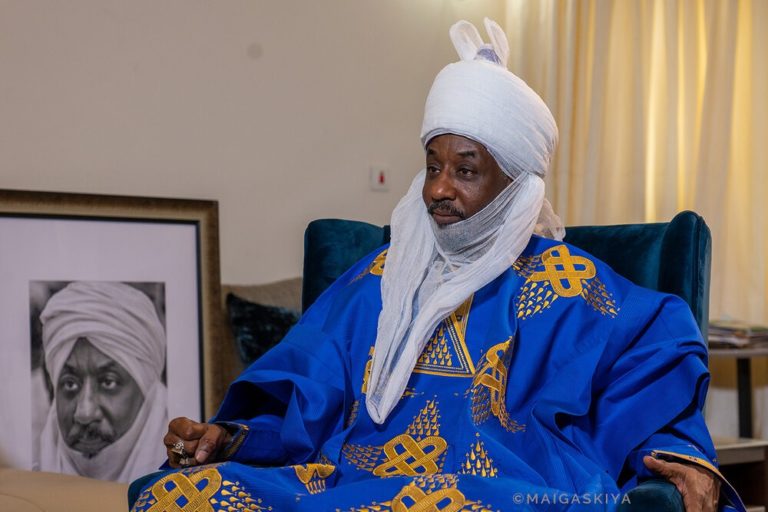
A statement attributed to the Emir of Kano, Muhammad Sanusi II,, allegedly responding to President Bola Tinubu’s assertion that he inherited a dilapidated Nigeria from former President Muhammadu Buhari, has surfaced online.

Tinubu, during a courtesy visit to Anambra in May 2025, had stated that he inherited a near-insolvent treasury and a chaotic economic structure upon assuming office in 2023. He said his administration had since undertaken bold and painful reforms to stabilise the country.

A Facebook user, Mary Idonibiye Freeborn, posted the lengthy message claiming it was from the Emir responding to Tinubu’s assertaion.

According to the statement, he disagreed with the assertion and criticised the president for extravagant public spending, listing several multi-billion-naira allocations for government renovations, luxury vehicles, allowances for top officials, and controversial infrastructure projects.

The message concluded by describing Tinubu’s cabinet as the largest ever and questioned the government’s spending pattern, given the president’s earlier claim of inheriting an empty treasury.

The post read:

“BREAKING !!!
EMIR SANUSI REPLIES TINUBU ABOUT BUHARI
President Bola Ahmad Tinubu I Totally Disagree With You That You Inherited A Dilapidated Nigeria From The Former President Muhammadu Buhari Below Are My Reasons – Emir Mohammed Sanusi Mohammed Message to Tinubu.
How Can A President That Claimed To Have Inherited A Dilapidated Nigeria Be Spending Public Funds Extravagantly As If You Inherited A Rich And Prosperous Country
How Would You Justify The Following Extravagant Spendings Under Your Government
21 Billion Naira To Renovate The Vice President House
70 Billion Naira To The National Assembly Members To Buy SUVs At The Cost 160 Million Naira Per One For Senators And House Of Representatives Members Specifically
4 Billion Naira To Renovate Dodan Barrack Lagos Another 3 Billion Naira To Renovate Aguda House
5 Billion Naira Was Given To Presidential Tax Reforms Committee Of Less Than Twenty People Headed By Taiwo Oyedele With Nothing To Show For It
1.5 Billion Naira To Purchase Cars For Your Wife Senator Oluremi Tinubu Despite The Fact That First Lady Office Is Not Recognised By Our Constitution
300% Salary Increase For The Judges Which Was Speedily Passed By The Insensitive And Irresponsible Senators
5 Billion Naira Was Budgeted For Presidential Fleet Of Cars For President Bola Ahmad Tinubu
5 Billion equally budgeted for Presidential Yatch
225 Billion naira spent on so-called Presidential Jet
90 Billion naira spent on 2024 Hajj pilgrimage
Billions of Naira Was Budgeted For Your Trips Including The Vice President Kashim Shettima To The Detriment Of The Citizens
Every Senator Is Paid 21 Million Naira Monthly
House Of Representatives Are Earning 13.5 Million Monthly All The Increment Was Done By Your Government
15 Trillion Naira Lagos Calabar Coastal Road Was Awarded Illegally To Your Friend A Lebanese Gilbert Chagoury Who Was Repatriated Back To His Country By The Former President Obasanjo
You Have The Largest Ministers Ever.”

Since it was posted on Tuesday, July 15, 2025, the claim has attracted significant engagement on social media. It can also be seen here and here.

CLAIM

Sanusi criticised President Tinubu over his claim of inheriting a dilapidated Nigeria from Buhari.

THE FINDINGS 

Findings by The FactCheckHub reveal that the claim is FALSE!

Screenshot of the claim ; INSERT False verdict
Screenshot of the claim; INSERT False verdict

A keyword search on Google did not reveal any credible report or evidence showing that the Emir of Kano, Muhammad Sanusi II, made such a statement criticising President Tinubu.

Similarly, no reputable Nigerian media outlet published the claim, which is unusual for a figure of Sanusi’s stature, whose public comments typically receive wide coverage.

Further checks showed that the quote being circulated was from Nigerian entertainer Charles Oputa, popularly known as Charly Boy. He posted the statement via X (archived here) on August 4, 2024.

This statement was also reported by BusinessDay and attributed to him.

In addition, a review of Sanusi’s known social media platforms, including his verified Instagram page, provided no record or related post referencing President Tinubu or the allegations of extravagant spending.

There was also no evidence of any recent public commentary matching the viral quote.

The FactCheckHub has previously debunked multiple misattributed quotes and statements to Sanusi in the past, which can be seen here and here.

THE VERDICT

The claim that Emir Sanusi criticised President Tinubu over his claim of inheriting a dilapidated Nigeria from Buhari is false; the quote was originally authored by Charly Boy in August 2024.

This report is republished from the FactCheckHub. 

Despite declining inflation, business perception remains high – CBN

THE Central Bank of Nigeria (CBN) said business perception of inflation remained high despite the consecutive drop in inflationary pressure in recent times.

It stated this in its latest Inflation Expectations Survey for June 2025.

The report compared public perception of inflation in June with the previous month.

According to the report, business sentiment did not mirror the broader trend of a declining inflation rate as reported by the National Bureau of Statistics (NBS).

It indicated that the percentage of business respondents who perceive inflation as high rose from 71.5 per cent in May to 72.3 per cent in June.

Business perception of Nigeria's inflation
Respondents’ views on the business perception of inflation. Source: CBN

An analysis of the business sizes – large, medium, small and micro – indicated that the respondents expressed perception that the inflation rate is very high relative to those who see it as moderate or low.

“Respondents (Businesses and Households) identified energy, exchange rate and transportation as the top three inflation drivers,” CBN stated.

It stated further that natural disasters, activities of middlemen and infrastructure challenges were perceived as less significant contributors to inflation drivers in the review period.

A total of 3,365 respondents were interviewed, comprising 1900 firms and 1665 households during the survey, the report added.

The ICIR reported recently that Nigeria’s headline inflation moderated to 22.22 per cent in June, from 22.97 per cent in May, marking the third consecutive month of decline.

Inflation has dropped sharply from 34.80 per cent in December 2024 to 24.48 per cent in January after the NBS rebased the Consumer Price Index (CPI), a metric used to calculate the inflation figure.

Since the rebased CPI, inflation has continued to moderate but has failed to reflect on the general price level of goods and services.

Food prices and other items are increasing and skyrocketing daily as households and businesses struggle to survive.

The latest report on business activity in the Nigerian private sector in June revealed a further slowdown, tending towards a negative territory as output levels hit a seven-month low, The ICIR reported.

Police stop Peter ‘Obidients’ rally in Kaduna  

0

THE Kaduna State Police command has stopped a rally plannned for the Labour Party 2023 presidential candidate, Peter Obi by his supporters in the state.

The rally planned to celebrate the 64th birthday of the former Anambra State governor was halted to prevent crisis in the state, according to the police.

The Kaduna State police command in a statement signed by its spokesperson, Mansir Hassan, on Saturday July 20 threatened to take necessary legal action against any individual or group that violated its directive.

The command said that intelligence information at its disposal revealed that certain criminal elements were planning to hijack the proposed rally as a springboard to cause mayhem, incite violence, and disturb the prevailing public peace in the state.

According to the police, all forms of political rallies and public gatherings of a political nature in Kaduna State remain suspended until the official commencement date of political activities as stipulated by the Independent National Electoral Commission (INEC).

“While the primary elections by political parties are scheduled by INEC to hold on the same date the Obi supporters planned for their rally,  the Kaduna police command notes that the rally will overlap and disrupt several areas designated for the conduct of other parties primaries,  thereby posing a significant risk of tension,  clashes and breakdown of law and order in the state,” the command stated.

The police advised the organisers of the planned Obi rally to suspend any gathering or procession to ensure public safety and prevent potential hijacking by miscreants.

The command said the forthcoming  elections in the state are scheduled by INEC to take place on the same date as the proposed rally, and the parties have formally notified the Police of their the planned rally.

The police said the planned Obi rally is expected to overlap with and disrupt several areas designated for the conduct of the other political parties’ primaries, thereby posing a significant risk of tension, clashes, and breakdown of law.

“While the command respects the right of individuals to associate and celebrate their political leaders, it is important to emphasise that all forms of political rallies and public gatherings of a political nature remain suspended across the State until the official commencement date of political activities, as stipulated by the Independent National Electoral Commission (INEC),”the command added.

The order to stop Obi rally in Kaduna State is coming hours after the Edo State Governor, Monday Okpebholo issued a strong warning to Obi, cautioning him against coming into the state without prior notification and approval.

Okpebholo’s warning marks the second time Obi has been warned by an All Progressives Congress (APC), led state over visits, including those reportedly for humanitarian purposes.

Addressing a gathering of political supporters in a video that has since gone viral on social media, the Okpebholo made said Obi’s security would not be assured should he enter Edo State without officially informing the state government.

Recall that in April, Obi was reportedly warned against visiting Benue State by the state governor , Hyacinth Alia who threatened that he could not guarantee the security of Obi who at the time, was planning to visit an internally displaced persons (IDP) camp hosting victims of herdsmen-related violence.

Recall that as part of its strategies to dislodge the ruling APC in the 2027 elections, leading opposition figures, including former Vice President Atiku Abubakar, Obi, former Rivers State governor Rotimi Amaechi, and Nasir El-Rufai, launched a coalition in Abuja on July 5 and adopted the African Democratic Congress (ADC) for the purpose.

Gospel singer, others jailed over cybercrime

0

A FEDERAL High Court in Ilorin, Kwara State, has sentenced a gospel singer, Moses Otitoju, and others to jail for offences bordering on misappropriation of funds, cybercrime, and conspiracy.

Otitoju, a self-styled gospel singer, was sentenced alongside Adeoye Joseph, Abubakar Abdulmalik, and Ayodele Joseph.

The alleged offences were brought against them by the Ilorin Zonal Directorate of the Economic and Financial Crimes Commission (EFCC), and they were charged.

The spokesperson of the commission, Dele Oyewale, in a statement on Friday, July 18, said the 31-year-old gospel singer, Otitoju, hails from Iyamoye in Ijumu Local Government Area of Kogi State.

He was sentenced to six months without the option of a fine by the judge, Abimbola Awogboro.

Otitoju was found guilty of retaining the proceeds of unlawful activities amounting to over N8.4 million in his bank account.

The charge against him reads that Otitoju allegedly retained control of N8,404,339 in his account between October 2024 and December 2025, which was proceeds of criminal conduct.                  This act was said to be contrary to and punishable under Section 17(a) and (b) of the EFCC Act, 2004.

On his part, Ayodele, who was found to have retained N243,750 in his bank account, was sentenced to eight months imprisonment without the option of a fine.

He was ordered to forfeit his Tecno 19 phone to the federal government.

Another suspect, Adeoye, from Okene LGA of Kogi State, was handed eight months imprisonment without an option of fine as well.

Similarly, Adeoye was ordered to forfeit the sum of $220, an iPhone 13, and a Tecno Pop 9 phone to the federal government.

Abubakar was sentenced to six months imprisonment, with an order of forfeiture of his iPhone -16 and Samsung S10 to the federal government.

The EFCC prosecution team, led by Aliyu Adebayo, Sesan Ola, Rashidat Alao, and Mustapha Kaigama, presented evidence, including statements, exhibits, and recovered funds, in court.

In a related development, judges Haleema Saleeman and Sulaiman Akanbi of the Kwara State High Court convicted Emeka Achi, Isaac Oluwafemi, Afolabi Olatoye, Zubeiru Junior, and Abdulkadir Taofeek on charges including cybercrime and misappropriation.

Abdulkadir  was sentenced to three years with an option of a N500,000 fine and ordered the final forfeiture of N800,000, one iPhone 14 Pro Max, and a Samsung phone to the Federal Government.      Emeka, Isaac, and Afolabi bagged six months each with an option of a N100,000 fine.

Emeka was further directed to refund N3.35 million within three months and to report every fortnight with his parents to the EFCC until full repayment is made.

First Bank confirms Oba Otudeko’s N195.74 billion shares sale

THE parent company of First Bank of Nigeria Limited has confirmed its former chairman, Oba Otudeko’s sale of N195.74 billion worth of shares, ending rumours over the transaction but eliciting corporate governance concerns.

The confirmation, contained in a regulatory disclosure to the investing public on Friday, July 18, was signed by the FirstHoldCo secretary, Adewale Arogundade.

It revealed that Barbican Capital Limited, a firm linked to Oba Otudeko, sold its 6,314,116,229 units of shares at N31.00 per share in a transaction that took place on July 16.

The bank did not state the buyer in its notification despite the controversies that have trailed the sale of the shares and the corporate governance issue it has raised.

There had been unconfirmed reports making the rounds over who had taken over the stake of Oba Otudeko at the bank.

Earlier reports, on Thursday, July 17, allegedly claimed that the incumbent chairman of FirstHoldCo, Femi Otedola, acquired the shares.

On Friday, July 18, a news platform reverted its report, claiming that a trustee acting on behalf of the federal government acquired the shares.

Another media report on Friday claimed the transaction was executed by RC Investments Limited, a special purpose vehicle (SPV) linked to Renaissance Capital.

Amid this controversy, the Central Bank of Nigeria (CBN) and Securities and Exchange Commission (SEC), which are the apex regulators, have kept silent on the matter.

The ICIR contacted the head of corporate communications at CBN, Hakama Sidi Ali, and her counterpart at SEC, Efe Ebelo, but they have yet to respond to its enquiry about the sale of the transaction and the issue of corporate governance compliance it has evoked.

Corporate governance issues at play

The ICIR had reported on a similar concern that came up in 2023, after Oba Otudeko staged a comeback in July that year and acquired about 4.77 billion units of First Bank’s shares valued at N87.8 billion to retain his stake as the most substantial shareholder.

Following the intrigue that ensued over Otudeko’s huge volume purchase acquisition at the time which sparked a fresh battle for control of the bank, the CBN was prompted to tweak its corporate governance rule.

To protect shareholders’ rights, the CBN had to issue new corporate governance guidelines that took effect from August 1, 2023.

It states, section 20 (b) “CBN’s prior approval and No Objection shall be sought and obtained before any acquisition of shares of a bank (including through the capital market), that would result in equity holding of five per cent (5%) and above, by any investor.

(c) “Where the CBN has an objection on any acquisition as stated in Section 20.2.b above, notice of the objection shall be communicated to the bank, and the bank shall notify such investor(s) within fortyeight (48) hours.

(d) “Government’s direct and indirect equity holding in a bank shall not be more than ten per cent (10%), which shall be divested to private investors within a maximum period of five years from the date of investment.”

Shareholders blame CBN, SEC for regulatory failure

According to shareholders who spoke unanimously with The ICIR on the matter, Oba Otudeko has the right to sell his shares to anybody, whether a personal or corporate body.

They, however, raised concerns about the negotiated transaction which they said raises worries about critical systemic issues in the Nigerian capital market.

“I believe that the regulatory authorities have to ensure compliance with laid down rules and uphold the integrity of the transaction,” one shareholder said.

“The regulators are the problem the economy and the Nation are facing. Now Emefele [former CBN governor] did his own and got away, and the current CBN governor is now doing the same thing all over again. Who then set the rules? Another shareholder said.

He lamented that the laws are made for the common man, not for the big man in Nigeria, stressing that what CBN is doing is also what SEC is doing in the Name of regulation, asking whose interest.

Querying why CBN did not apply the same measures to the defunct Afribank, he further lamented what the CBN had done with the Union Bank it took over.

“What happened to the 10 per cent allowed as stated in the guidelines,” the shareholder asked.

Adding that any shareholders reserve the right to share his or her shares or divest holdings to another sector of the economy, he maintained, “If there is any lopsidedness in the transaction, those who should be blamed are CBN, SEC and NGX Limited.”

Buhari oversaw longest shutdowns of Nigerian universities since 1999. Now a varsity bears his name

AS public backlash continues over the renaming of the University of Maiduguri after former President Muhammadu Buhari, data obtained by The ICIR reveals that the late leader presided over the longest period of suspension of academic activities by public university lecturers in Nigeria since the country’s return to democracy in 1999.

Buhari, a retired major general, ruled Nigeria as military Head of State from December 1983 to August 1985, and as elected president from May 2015 to May 2023.

Between 2015 and 2023, federal universities were shut for 642 days due to strikes by the Academic Staff Union of Universities (ASUU). The figure represents 22 per cent of his total 2,922 days in office, which also means that more than one in every five days of his administration was lost to industrial action by public varsity lecturers.

The shutdowns, largely triggered by the administration’s failure to fulfil agreements on funding and welfare, left thousands of students stranded.

During this period, federal universities were closed for nine months in 2020 and another eight months in 2022 following unresolved disagreements between ASUU and the Federal Government over funding, salaries, and university revitalisation. 

The ASUU had repeatedly accused the Buhari-led administration of failing to honour agreements and neglecting the public education system.

Among others, the university lecturers demanded the deployment of the University Transparency and Accountability Solution (UTAS), payment of outstanding arrears of Earned Academic Allowances (EAA) and the release of an agreed sum of money for revitalising public universities (federal and state).

They also demanded payment of promotion arrears, the release of withheld salaries of academics, and payment of outstanding third-party deductions.

The ICIR reported how industrial actions adversely affected Nigerian students in public universities, as the suspension of academic activities led to prolonged academic calendars, disrupted students’ plans, and resulted in additional costs.

However, in what many critics described as a contradiction, the Federal Government under President Bola Tinubu on July 17 renamed the University of Maiduguri to honour Buhari.

Worse than his predecessors

A comparison of civilian administrations since 1999 shows that no president comes close to Buhari in the number of days that Nigerian public universities were shut down. 

While ASUU downed tools during the tenures of Buhari’s predecessors, the strikes under the late leader lasted longer, occurred more frequently, and often ended without meaningful resolution.

He was also accused of keeping a Minister of Education, Adamu Adamu, who many thought lacked knowledge and interest in helping the nation’s education system. 

Data shows that former President Olusegun Obasanjo lost 541 days to ASUU strikes in his eight-year tenure, accounting for 18.5 per cent of his time in office. 

Under former President Goodluck Jonathan, ASUU was on strike for 359 days, representing 19.4 per cent of his nearly five-year term. 

The late President Umaru Musa Yar’Adua, who spent less than three years in power before his death, had 127 days of strikes, amounting to 11.8 per cent of his presidency.

Reactions

Many Nigerians, including UNIMAID’s alumni and current students, rejected the renaming, noting that it was politically motivated and that Buhari did not deserve to have a public university named after him, especially given his administration’s perceived neglect of Nigeria’s public education system.     

Some pointed to the prolonged industrial actions by ASUU during his tenure as president, with federal universities shut down cumulatively for over 600 days – evidence that his government failed to prioritise education.

An X user, Ohijeme, criticised the move, arguing that Buhari “did not significantly contribute to the education sector, nor did he initiate major school renovation projects (sic).”

The user further alleged that Tinubu’s decision to rename the institution was a “desperate attempt to curry favour from the North.”

Another user, Jude, also condemned the decision. “It is not a welcome development as Alumni, we have core values and respect for the name UNIMAID. Renaming it is heartbreaking, and we reject it.”

Others also argued that naming a university after Buhari in Maiduguri, a place that is not his hometown, was a misplacement of tribute. They said if any institution should be renamed, it should be one in Katsina State, his home state, or a non-academic project, such as a hospital or a public facility that better aligns with his legacy.

Meanwhile, some Nigerians welcomed the renaming and lauded Buhari’s ‘achievements’ in the North-East, where the university is located, and the late leader’s fight against Boko Haram, which has its roots in the region.

They described the move as a tribute to Buhari’s legacy of restoring peace to Borno State after many years of battling insurgency.

A social media user, Mohammed Nuwar, lauded the move, stating that, “Most importantly, he (Buhari) came to the rescue of Borno in the worst days of insurgency when we couldn’t safely go about our activities, to restore peace and order.

“We can’t thank him enough even in his death.”

Another user, Yahaya Sadisu, wrote, “Naming UNIMAID after President Muhammadu Buhari is more than a tribute — it’s a recognition of discipline, sacrifice, and unwavering service to Nigeria. History will remember him not just for what he did, but for what he stood for.”