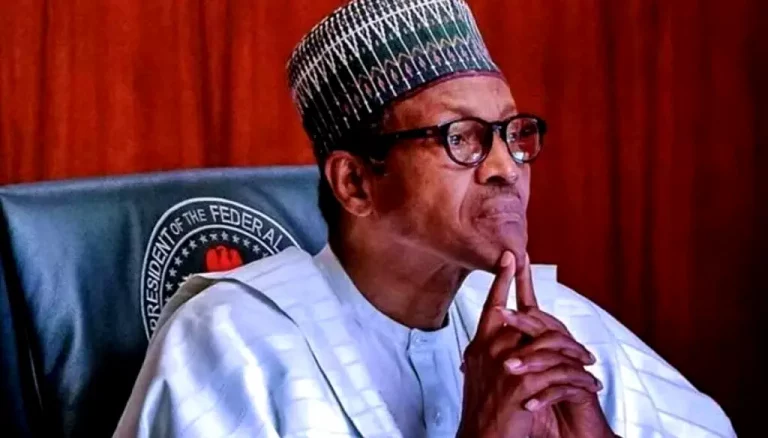
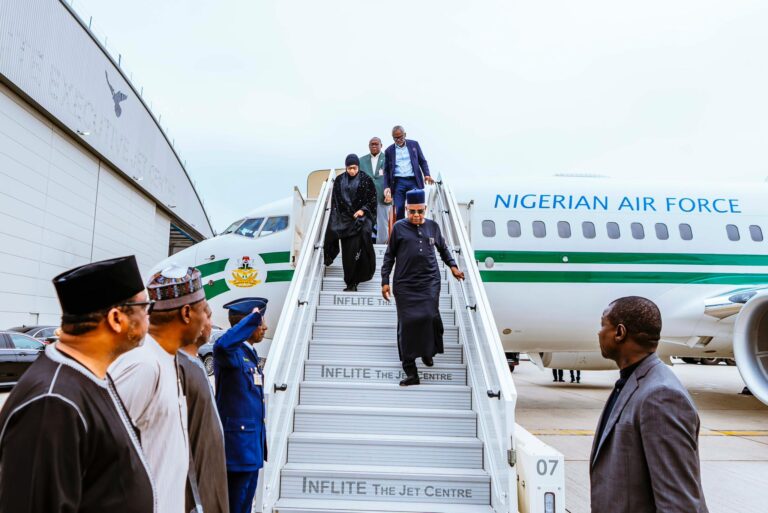
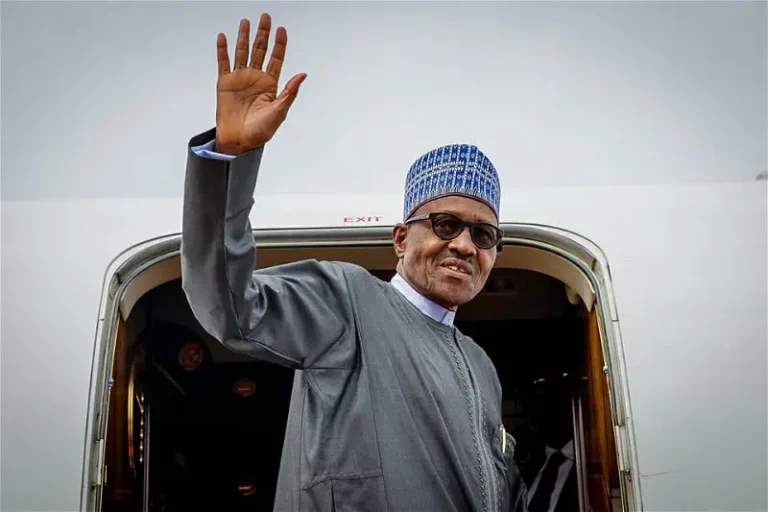
PRESIDENT Bola Tinubu is set to receive the body of the late former President Muhammadu Buhari in Katsina.
Tinubu will receive the body when it arrives from London before proceeding to Daura for funeral prayers at the Emir’s Palace by 2 p.m. today, Tuesday, July 15.
Earlier on Monday, Vice President Kashim Shettima and Femi Gbajabiamila, the Chief of Staff to Tinubu, arrived in London to receive the body of the late leader.
The ICIRreported that Katsina State Governor, Dikko Radda, on Monday announced that the late president’s body would arrive in Nigeria the following day.
Buhari, who served as Nigeria’s military Head of State from December 1983 to August 1985, and as a two-term civilian president from May 2015 to May 2023, passed away on Sunday, July 13, in London, where he had been since April for what was described as a routine medical check-up.
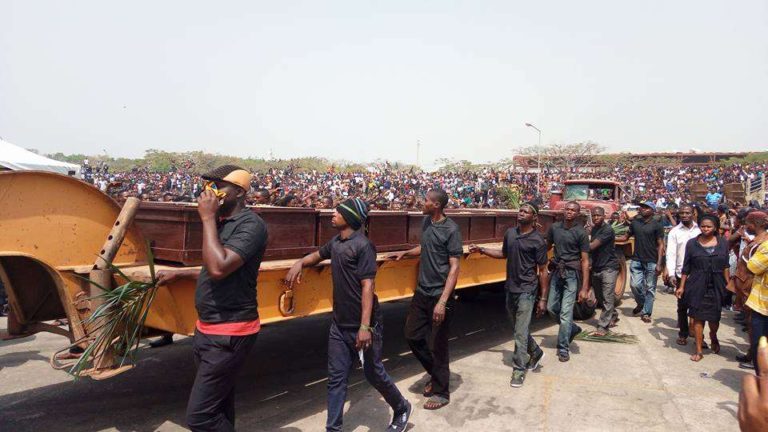
Meanwhile, serving and former political office holders, top traditional rulers and other dignitaries have continued to throng Buhari’s residence in Daura to pay their last respect.
This dignitaries include, former Katsina State governor, Aminu Masari; former Kaduna State governor, Nasir El-Rufai; former Ogun State governor, Ibikunle Amosun; former communication minister, Isa Pantami; Sultan of Sokoto Sa’adu Abubakar, and the Emir of Kazaure, Ahmad Dangiwa.
The ICIR reported that both the federal and Katsina state governments had declared Tuesday a public holiday to allow Nigerians to mourn the former president, who died at 82 after a prolonged illness.
IN this investigation, The ICIR exposes high-level, multi-billion-naira trans – border trading activities at the Saki-Benin border in Oyo State. The border is open to human movement but shut against the movement of goods by the Nigerian government. The report also reveals how scores of overloaded vehicles move with impunity in Saki town.
Moshood* makes a net gain of N400,000 monthly from petrol and other goods he smuggles into the Republic of Benin through the Saki-Okerete border.
He had worked as a motor mechanic in Saki but quit the job after realising how his friends had suddenly become prosperous hauling goods along the border. He acquired a Peugeot 504, mostly used for transporting goods in the town, and his income and lifestyle changed.
“I had worked as a mechanic for about ten years with nothing meaningful to show for it. Then, one day, I realised that my friend, Kazeem, had built two houses and bought another car within three years while transporting goods along the border. That was when I decided to join him,” Moshood, who sought identity protection for fear of arrest, said.
He is among hundreds of motorists who transport Nigerian goods through the unpaved, decrepit and dangerous Saki-Okerete border. Tonnes of food and drinks are smuggled through Saki to the Republic of Benin in clear violation of the Nigerian government’s order banning goods movement along the route.
A Peugeot 504 loading for Okerete in Saki. Photo credit: The ICIR/Marcus Fatunmole
Economists who reacted to these findings said smuggling contributed to skyrocketing food prices in Nigeria. They also argued that the nation’s failure to protect its borders encouraged smuggling.
Former Director General of the Lagos State Chamber of Commerce and Industry, Muda Yusuf, and a development economist, Celestine Okeke, said the activity was fuelled by depreciation of the Nigerian currency, which allows traders to make more gains by selling their goods to buyers outside the country, including Benin Republic whose currency – the CFA – is stronger than the naira.
Nigeria has scores of unprotected borders. In 2022, the former Chief of Defence Staff (CDS), Lucky Irabor, said northern Nigeria alone had 137 unprotected borders out of the 261 approved by the Federal Government.
“There are about 364 approved international border points in Nigeria, with about 261 in the North-East and North-West regions. Out of this, only 124 are manned, leaving the remaining 137 unmanned by security agencies,” Irabor said.
In June 2025, during a media briefing at the Defence Headquarters in Abuja, the current CDS, Christopher Musa, called for the fencing of the nation’s borders to curb insecurity and other crimes Many Nigerians believe fencing the borders is a white elephant project for a nation battling revenue deficits, high debts, and ballooning corruption.
But Musa disagrees.
“Those thinking that building a border fence to protect our country from these crisis-infested countries and end porosity would be too expensive should learn from countries like Pakistan, which built a border wall separating the country from Afghanistan, a double border wall in a square size that is bigger than Nigeria,” he said.
Major goods smuggled from Nigeria along the Saki-Okerete route include beverages, petrol, yam, processed cassava, beans, and onions. These are cheaper in Nigeria. Similarly, Nigerians import mainly rice from the Benin Republic, where it is sold at about half of its price in Nigeria.
Nigerians used to smuggle vehicles through the border from Benin. Many people interviewed stated that the poor condition of the roads along the border, coupled with the declining value of the Nigerian currency, no longer makes car smuggling a lucrative business.
The ICIR findings showed that traders in both countries make between 60 and 100 per cent gross profit from the smuggled commodities.
Here is a brief analysis that proves this claim
A thousand naira in Nigeria is approximately 370 West African CFA. While a litre of petrol sells for N900 – N950 in Nigeria, it is 550 CFA in Benin republic, which is N1,435when converted to naira.
A survey carried out by The ICIR indicates that a crate of canned malt (24 pieces) is N12,000 in Nigeria, but it is 6,500 CFA in Benin. This amount translates to N17,550 in Nigerian currency. While a can of malt is sold for N700 in Nigeria, it sells for 300 CFA (N810) in Benin.
Dozens of vehicles load around the Okere’s palace in Saki to different borders linking the Benin Republic. Photo credit: The ICIR/Marcus Fatunmole
Similarly, a pack of Coca-Cola and Fanta containing twelve 60CL plastic bottles is sold for N5,000 each in Nigeria. Each of the bottles goes for N500. In Benin, it sells for 2,500 CFA per pack (N6,750), and a bottle goes for 250 CFA (N675).
Borders currently open in Nigeria
Former President Muhammadu Buhari shut all Nigerian borders in August 2019 to boost local production and consumption of commodities produced in the country. The decision also coincided with the high level of insecurity in Nigeria, worsened by the nation’s porous borders.
He opened four of the borders a year later. These are Seme in the South-West, Ilela and Maigatari in the North-West, and Mfun in the South-South. Two more were later opened by the current government.
The Saki-Okerete-Benin border
A few Nigerian Immigration Service (NIS) officials man the Saki-Okerete border on the Nigerian side, while Beninese Immigration officials mount their post a few metres away from their Nigerian counterparts. The two nations are separated by the River Okparu, which flows between the Nigerian and Beninoise Immigration posts.
The Okparu River separates Nigeria and the Benin Republic. Photo credit: The ICIR/ Marcus Fatunmole
Border officials from both nations collect bribes from anyone who cannot produce any of the travel documents acceptable to the two countries on the border. The documents include an ECOWAS passport and a national identity card. While the Nigerian Immigration officials charge N1,000, their counterparts in Benin demand N1,500 (approximately 550 CFA). Neither payment is receipted.
Because of the bribes, many people go through the border without documents. To buttress this fact, many people on the streets of Saki are quick to tell visitors how easy it is to go through both Immigration posts and how much each party takes as a bribe.
Several locals who spoke with The ICIR in Okerete said they did not have travel documents and could travel to Benin at any time. Findings further showed that border officials do not conduct checks on goods and other items transported through their posts after ‘settlement.’
A report said Nigeria lost N60 billionyearly to uncoordinated trading at the border as of 2023.The Saki-Okerete is just one of scores of borders aiding smuggling and revenue losses for the country.
Efforts by both nations to develop the border and construct a market to be known as Okerete International Market have failed to yield fruit.
While the Nigerian section of the border is in poor shape, the Benin Republic has cleared its part of the border with bulldozers. Benin citizens who live in Okerete said the work done on the road by their government showed the seriousness it attached to the border.
A section of the Okerete community before the local market, where goods from Saki are sold to buyers from the Benin Republic. Photo credit: Marcus Fatunmole
Nigerian petrol, beverages, foods, other products smuggled to Benin
Several drivers interviewed confirmed to The ICIR that they make huge fortunes from transporting goods from Nigeria to the Benin Republic.
Petrol as hot cake
The most common item transported out of Saki is petrol. Thousands of kegs of petrol depart the ancient town daily for different routes linking Benin. The product is kept in the popular yellow 30-litre kegs used for selling vegetable oil (and palm oil in Nigeria)
Scores of motorcyclists are also involved in the smuggling business. They travel with up to a dozen kegs, which they fasten to both sides of their motorbikes and their seats. While most vehicles coming from the Nigerian side stop at Okerete, motorbikes ply both nations through Saki, Kilibo, and other towns in Benin.
A motorcylist with smuggled petrol and rice along the Benin Republic’s border with Nigeria. Photo credit: Marcus Fatunmole
When returning to Nigeria, the motorcyclists come with bags of rice, sold at just about half the Nigerian price in Benin. While the price of a bag of rice in Nigeria ranges from N54,000 to N70,000, it is between N24,000 and N30,000 in Benin.
At least three major routes link Saki with Benin. The first is Okerete. The second is Saki through Bukuro, a border town in Kwara State. The third route is from Saki through Budu Ariki, another border town in Kwara. This route leads to Kuyi in Benin, according to drivers who provided insights into the illegal trade.
Saki – where Peugeot 504 remains a luxury
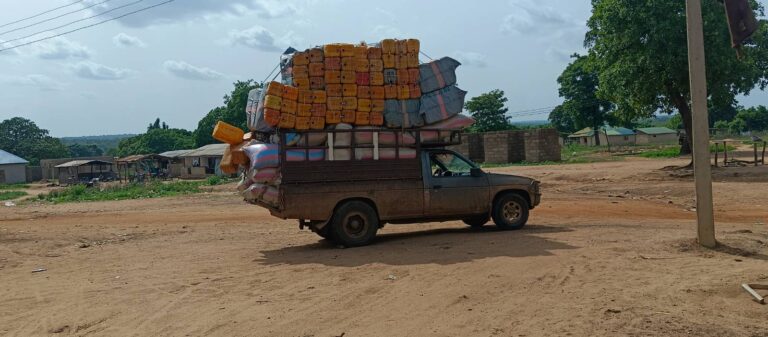
Saki is arguably the only town in Nigeria with the largest number of Peugeot 504s. It is the most common vehicle used for transporting goods across borders in the town. The car, popular in Nigeria in the early 1970s and the late 1980s, is reinforced by the Saki people to enable it to convey large goods.
“In Saki, we don’t believe that the Peugeot 504 can turn into scraps. That’s the car that has turned many of us into millionaires,” said one of the drivers, Olufemi Adeyemi.
Adeyemi said a Peugeot 504 parked for a long time anywhere in Nigeria could sell for up to N1 million if its engine had no issues.
Awolu, while loading his Peugeot 504 behind the Okere’s Palace in Saki. Photo credit: Marcus Fatunmole
To enable the car to carry many goods and passengers, the owners reinforce it by replacing its shock absorbers with springs from bigger vehicles. They also weld iron rods on the vehicle roof and support the rods with long ropes for fastening goods to the car. With these, the vehicles carry as much load as small trucks can.
In addition to conveying goods, about 10 passengers could sit on the load strapped to the vehicle’s roof. People involved in the business said many passengers had fallen off the car and died.
Saki – a community of people from two nations
Though Saki is a major town in Yorubaland, checks by The ICIR show that some of its residents are from the Benin Republic. They engage in commercial motorcycling, farming and other businesses.
There are also many residents from other parts of Nigeria, especially the North. They are mostly traders and commercial motorcyclists.
Despite the increasing economic activities inSaki, the town lacks good internal roads and electricity. Residents said they only enjoy electricity once a month.
The journey through Saki and Okerete
On May 7, 2025, at about 7:am, it was the turn of Wasiu Awolu to load his Peugeot 504 to Okerete from the second gate of Okere’s Palace in Saki. Little did he know that the journey would end on a sad note for him.
One of the parks in Saki. Photo credit: Marcus Fatunmole
As of 8 a.m., he already had six passengers, four of whom were Benin nationals. There were also four children waiting to make the trip. The ten passengers were more than enough to fill his vehicle. But the driver would not take off until he had goods almost double the size of his vehicle.
First, Awolu left the park and brought about 15 bags of flour. He dropped them and returned to pick up beverages and other goods packaged in special sacks sewn by smugglers for conveying large goods.
At 1 pm, he began loading the goods. He kept some under the car’s seats, some in the boot, and loaded the rest – several sacks – on the vehicle. These were in addition to the passengers’ luggage.
Four adult passengers sat on the goods atop the car while six others and four children squeezed themselves into the vehicle with the driver. Awolu left the park at 3 p.m. to proceed on a six-hour journey to Okerete.
Another loading area in Saki town. Photo credit: Marcus Fatunmole
This is the situation for many vehicles leaving Saki for different destinations. Some carry loads meant for nearly a dozen of their type, and they do this in the full glare of Federal Road Safety Corps (FRSC) officials.
Despite being lucky that there was no rain, which makes vehicles ‘swim’ for hours on the Saki-Okerete road, Awolu’s struggle to move his car to Okerete came to an abrupt end at about 5:30 pm. He had yet to reach halfway through the trip when his car drifted and fell with a bang, causing some of its parts to shatter.
Before then, the driver had always filled the car’s radiator with water almost every 30 minutes, and the vehicle had developed faults twice. It was the rear shocks that first pulled off, followed by the car’s exhaust pipe, which was damaged by a stone. Awolu later realised that one of his tyres had lost pressure. Unfortunately, he had no spare. As the car rattled and teetered, he hoped to manage it to the Edera community where he would repair the exhaust and shock, and also inflate the tyre.
While approaching Edera, Awolu tried repeatedly to drive through a puddle. He succeeded after his third attempt. But luck eluded him while climbing a hill afterwards. The vehicle tipped over and flipped on its side.
Many of the goods tied to the car’s roof, including bags of flour, burst and littered the ground.
Awolu was pulled out of his car by passers-by, as he gasped for breath. His passengers, too, were rescued from death.The ICIR reporter, who was in the car, had to find his way back to Saki and look for other means the following morning to begin the journey to Okerete afresh.
Awolu and many Saki residents told the reporter how dangerous the road is. They said there had been several cases of armed robbery along the border.
The journey from Saki to Okerete takes people through Edera, Ayemojuba, and Orisunmibare. Apart from a platoon of soldiers and a handful of Customs officers stationed with a van at Ayemojuba and Orisunmibare, respectively, the border is free from any security checks from Saki to Okerete.
Distraught Awolu with his car after it fell. Photo credit: Marcus Fatunmole
From Okerete, Oke-Odo enroute to Kilibo in Benin Republic
Okerete is the last border town where major buying and selling take place between Nigerians and the people of Benin. A big market, constructed with wood and palm fronds in the community, serves as the trading point. People trade at the market every Sunday.
There is a ‘Garage’ near the Okerete Market where traders from Nigeria offload their goods for onward passage to buyers from Benin. The Nigerian and Beninese Immigration Service posts are about one kilometre from the Garage.
History has it that one of the forefathers of Okere, the king of Saki town, founded Okerete town, whose full name is Okeretedo, meaning the town founded by Okere. West African traders have reportedly used the route as a key crossroad between Dakar, Bamako, Ouagadougou, Djougou, Kilibo, Saki, Ilorin, Ibadan, among others.
In addition to trading, many residents of Okerete, especially pregnant women and sick children, seek medical care in Benin. This is because this service is closer to them in Benin than in their country.
At least ten traders, including Olokerete’s wife, Rashidat, expressed delight with economic activities in the community. Others are Wosilatu Yinusa, Aliratu Yekini (Iyaloja of Okerete), Alfa Abdulakeem Demi, Aliu Fulani, Ratu Ismaila, and Adeagbo Adam. They appealed to the Nigerian government to construct a good road on the border to boost commerce between the two nations.
However, at Kilibo, in Benin republic, where many traders patronise the Okerete Market, none agreed to speak with The ICIR on trading activities with their Nigerian counterparts. “They know that what they’re doing is very bad,” the motorcyclist who took the reporter to the town said. The journey from Okerete to Kilibo is about two hours on a motorbike, while it is less than five hours from Saki to Okerete.
A section of Okerete Market. Photo credit: Marcus Fatunmole
Nigerian Immigration officers demand travel documents, including ECOWAS passport and national identity card, from people moving across the border, but The ICIR observed that most people who go through the border do not have the documents. People without documents are made to pay N1,000 before being allowed to pass.
At the Benin end of the border, immigration officials only communicate with their nationals who convey the visitor because they only speak French. Before taking off at Okerete, the driver or motorcyclist would have collected N1,500 from the passenger who does not have a passport. He converts the money into nearly 6 CFA and hands it to the Benin Immigration officials.
With the N1,000 and N1,500 bribes for the Nigerian and Benin Immigration officials, respectively, nationals of the two countries can move freely into either country without a travel document.
Even though the Economic Community of West African States (ECOWAS) Protocol on Free Movement guarantees the right of ECOWAS citizens to enter, reside, and establish economic activities in the territory of other member states, it, however, offers a three-step roadmap to achieve freedom of movement of persons after fifteen years. The protocol allows citizens of ECOWAS countries to move freely and visit any other member state without requiring a visa.
For up to 90 days, citizens can stay in any ECOWAS member state without any prior administrative or police formality linked to the stay. The right to reside in an ECOWAS member state is based on the presentation of a residence card or residence permit issued to all citizens who desire one. Many people who go through the Saki-Okerete border do not possess the documents.
The Garage at Okerete with kegs used for loading petrol and vehicles for conveying goods. Photo credit: Marcus Fatunmole
Deforestation of the Nigerian border
The ICIR noted that hundreds of hectares of land along the Nigerian border are used for farming, with different crops planted on the land, including yam, cassava, maize, and melon. The land appears very fertile as the crops grow well.
It was gathered that many of the farmers are from the Benin Republic; they collaborate with their Nigerian neighbours. Most of the farmers work in groups.
However, a major blow to Nigeria is the huge deforestation taking place on those farms. While no such farming activity takes place on the Benin land linking Nigeria, hundreds of trees have been burnt by farmers on the Nigerian land. The reporter moved from Okerete to Fesomu (a Yoruba-speaking town in Benin) and Kilibo (a French-speaking community) in Benin and could not see any trees slashed and burnt as done on the Nigerian side of the border.
A section of Kilibo in the Benin Republic. Photo credit: Marcus Fatunmole
Reactions from experts
Yusuf said managing Nigerian borders “is an extremely challenging responsibility because we have too many illegal routes, and the borders are very porous. I don’t know what we can do about that.
“You’re only talking about one side; you’re not even talking about the North. The same thing in South-South, from Calabar to Cameroon. We need to do strong capacity building and invest more if we really want to police the border. Our borders are very vast and our inability to police them properly is contributing to the problem of insecurity and some extent, to food inflation and the rest.”
He added, “From the economic point of view, the depreciation of the currency has created a very strong incentive for export to neighbouring countries. N1 used to buy about 2.5 CFA. Now, one CFA is buying about N3. You can see that the thing has been completely reversed. From an economic point of view, this situation has created something positive for export development.”
He said many traders along the Saki-Okerete route would be informal sector traders who did not register with the government. He said that there was a need to encourage them to formalise their businesses.
“If you look at all these people that you are talking about, they are informal sector people. That is the way they do their own business. They don’t have that scale. They only buy and sell small goods. How can they register? So the informal nature of our trade is also a problem. That is why some of these things are not formalised because some of the products that are being taken out under ECOWAS protocol, some of them may be legitimate.”
Asked if ECOWAS protocol allows informal trading, he said, “We have a long list of products that we can trade in,” adding that such goods would not be sold along unauthorised borders.
Similarly, a development economist, Celestine Okeke, said the Nigerian borders had remained loose for a long time.
According to him, when the government says a border is closed, it should not be used for smuggling goods.
“Nigerian borders can hardly be closed. I’m not sure of the number, I think we have over 200 open border points where one can move things out of the country. The question we should be asking ourselves is, why are they moving these goods to go sell in another country? There is a better market for the producers or the traders. If Benin Republic is not offering them a better market, they will not move their products to go and sell there.”
He said Nigeria was not structured in a way that the movement of goods out of the country could be tracked.
However, he opined that the sale of Nigerian food products to other countries was just a contributory factor to food inflation in Nigeria, and not fully responsible for it. He blamed declining productivity in the agriculture sector for food inflation.
A section of the Okerete-Kilibo border being upgraded by the Benin government. Photo credit: The ICIR/ Marcus Fatunmole
Nigerian Customs, Immigration react
The ICIR contacted the spokesperson of the Nigeria Customs Service, Abdullahi Aliyu Maiwada, Assistant Comptroller of Customs, on Friday, April 18. He confirmed that the border was closed to the movement of goods by the Federal Government.
Confronted with our findings, Maiwada said that the service was doing its best.
“I can say without doubt that there is no Customs in the world that has ever brought smuggling to an end. Our role is to suppress smuggling to the barest minimum. This is evident in the interceptions we’ve had in Oyo, given the records available in the state,” the Customs spokesperson said.
Similarly, when contacted, the spokesperson of the Nigerian Immigration Service, Akinsola Akinlabi, an Assistant Comptroller, said the border was open to human movement.
Told about our findings, Akinlabi said that nobody sent immigration officers to collect bribes from anyone.
He, however, said given the closeness of communities along the border, the officials could be considerate to people within communities along the border.
“The standard practice is that if you want to cross the border, you need to show an identity card to prove your nationality. It doesn’t have to be a passport. It could be an ECOWAS travel certification. It could be a national ID. The ECOWAS is trying to launch an ID that will cut across the region. I think it’s coming up very soon. These are things that are required, especially if you’re an ECOWAS citizen; you do not need to carry your national passport.
“All I know is that standard procedure requires that if you want to cross a border to another border, you need to show proof of ID…I assure you, the Service has not sent anyone to collect N1,000 or whatever the amount to facilitate crossing along international border line.
“Some of them may not have documents because they are local people. What are they using documents for? There has always been interconnectivity within those border communities. For them, the concept of bringing travel documents will look so strange. At the same time, we need to facilitate their movements without any form of restrictions or burden.
THE Federal Government has declared Tuesday, July 15, a public holiday in honour of the late former President Muhammadu Buhari.
This was announced by the Minister of Interior, Olubunmi Tunji-Ojo, a doctorate holder, in a statement issued on Monday, July 14, following the approval of President Bola Ahmed Tinubu.
He noted that the declaration was part of the ongoing seven-day national mourning period earlier announced by the president to commemorate the life and legacy of the former Nigerian leader, who died on Sunday, July 13, at the age of 82.
Tunji-Ojo described the public holiday as a mark of respect for Buhari’s “service to the nation, his contributions to Nigeria’s democratic journey, and his enduring legacy in governance and national development.
“President Muhammadu Buhari served Nigeria with dedication, integrity, and an unwavering commitment to the unity and progress of our great nation. This public holiday provides an opportunity for all Nigerians to reflect on his life, leadership, and the values he upheld,” the minister said.
He urged citizens to use the day to promote peace, patriotism, and national unity, ideals he said the late president championed during his years in public service.
As part of the mourning period, national flags across the country and Nigerian missions abroad have been directed to fly at half-mast from Sunday, July 13, through Saturday, July 19.
The government also extended its condolences to the Buhari family, the people of Katsina State, and all Nigerians, praying for the repose of the late president’s soul.
Buhari, who served as Nigeria’s military Head of State from December 1983 to August 1985 and as a two-term civilian president from May 2015 to May 2023, died in a London hospital, where he had been receiving medical care.
The nature of the illness leading to his death is still sketchy as of press time, but the president had reportedly travelled to London since April for what was described as a routine medical check-up.
The ICIR recalls that throughout his presidency, Buhari frequently travelled to London for treatment, a pattern that attracted widespread criticism and reignited conversations about the state of Nigeria’s healthcare system.
Particularly, during his first time as president, from 2016 to 2018, Buhari spent extended periods in London for undisclosed medical treatment, fuelling speculation about his health and capacity to govern.
Buhari is scheduled to be buried in his hometown, Daura, Katsina State, on Tuesday.
NIGERIA’S former leaders and incumbent President Bola Tinubu reacted to the death of former President Muhammadu Buhari shortly after the news of his passing was announced on Sunday.
Former leaders who reacted include Olusegun Obasanjo, Goodluck Jonathan, and Ibrahim Babangida.
Buhari died at a London hospital on Sunday, July 13, after a protracted illness.
Buhari’s death a national loss – Babangida
Babangida, a former military president, described Buhari as “a symbol” whose life captured Nigeria’s journey from military tradition to civilian rule.
He said Buhari was fiercely loyal and patriotic from their earliest days in service, adding that Nigeria lost a “symbol and a man whose life embodied the transition of Nigeria from the old guard to the new republic.
“We may not have agreed on everything, as brothers often don’t, but I never once doubted his sincerity or his patriotism. His passing today is not just the loss of a former Head of State or a two-term civilian President,” he said.
Buhari will be sorely missed – Obasanjo
Obasanjo, who severally disagreed with Buhari’s policies while the latter was president, said the late leader “played his role as a soldier; as an administrator, he played his role as an administrator; as a statesman, he played his role as a statesman.”
In an interview shortly after Buhari’s passing, Obasanjo noted Buhari would be “sorely missed” and prayed for the repose of his soul.
“His demise comes at a time like this that we need the totality of the experience and what I may call statesmanship of all of those who have had the opportunity to run the affairs of this country in the past to get us out of the situation we are in.
“He will be sorely missed, and may his soul respect in perfect peace,” he said.
He’s a courageous leader – Jonathan
Similarly, Buhari’s predecessor, Goodluck Jonathan, penned a glowing tribute for the late president, describing him as a “courageous leader, a disciplined officer, and a committed public servant.”
He stated that his contributions to Nigeria’s peace and progress would be long remembered.
Jonathan said he received the news of Buhari’s passing “with a heavy heart and profound sense of national loss,” noting that the late president was a patriot who served Nigeria to the best of his ability.
“He will be remembered as a courageous leader, a disciplined officer, and a committed public servant who made considerable contributions towards the peace and progress of our dear nation,” Jonathan said.
Buhari, a true patriot – Osinbajo says
Meanwhile, Yemi Osinbajo, a professor who served under Buhari from 2015 to 2023 as his vice president, described the late Nigerian leader as “a true patriot,” adding that his life was marked by discipline, honesty, and an unwavering commitment to public service.
Osinbajo condoled the Buhari family and all Nigerians mourning the former leader.
“Dolapo and I received, with profound sadness, the news of the passing of His Excellency, former President Muhammadu Buhari, GCFR,” he said.
Buhari’s life was defined by unflinching patriotism – Atiku
Similarly, Former Vice President Atiku Abubakar said Buhari’s life was defined by “unflinching patriotism, stoic discipline, and a lifelong commitment to the sovereignty and unity of our great nation,” calling his death “a profound national tragedy.”
He said Buhari was a symbol of Nigeria’s resilience, adding that “from the battlefield to the corridors of power, he served with the kind of austere conviction and firm belief in duty that marked him as a soldier of principle and a leader of formidable will.”
THE funeral of the late President Muhammadu Buhari has been scheduled for Tuesday, July 15, in his hometown, Daura, Katsina State.
This was announced by Katsina State Governor, Dikko Radda, on Monday, July 14. He said the late leader’s body would arrive in Nigeria on Tuesday, July 15, at noon.
Meanwhile, crowds of mourners have gathered at Buhari’s residence in Daura.
Among those who have visited the late former president’s residence ahead of his burial are Katsina State Deputy Governor Faruk Jobe; Deputy Chief of Staff Mukhtar Saulawa; Katsina APC Chairman Sani Daura; Commissioner for Internal Security and Home Affairs Nasiru Danmusa; former SUBEB Chairman Lawal Daura; and Assistant Inspector-General of Police (AIG) Zone 14, Aliyu Musa.
Despite reported heavy security presence across Daura, including the entrance of the Daura Emirate Council, commercial activities continued without disruption along the major road leading to the late president’s residence.
The ICIR reported that Buhari, who served as Nigeria’s military Head of State from December 1983 to August 1985 and as a two-term civilian president from May 2015 to May 2023, passed in London, on Sunday, July 13, where he had been since April for what was described as a routine medical check-up.
Earlier on Monday, Vice President Kashim Shettima and Femi Gbajabiamila, the Chief of Staff to President Bola Tinubu, arrived in London to receive the body of the late president.
PRESIDENT Bola Tinubu and Ogun State Governor Dapo Abiodun have reacted to the passing of the Awujale of Ijebu, Sikiru Adetona, who joined his ancestors on Sunday, July 13, at 91.
The monarch died hours after the announcement of the death of his longtime friend and former president, Muhammadu Buhari.
According to Buhari’s spokesperson, Garba Shehu, the former president died in a London clinic on Sunday.
In a tribute to the Awujale, Tinubu described the monarch as an iconic and dignified traditional ruler.
He praised the Awujale’s 65-year reign, which he claimed was marked by unwavering duty, honour, and selfless service to his people.
“The passing of Oba Adetona has created a huge vacuum within traditional institutions in Yorubaland and Nigeria as a whole.
“Oba Adetona was a towering ruler who served with grace, dignity, and a firm sense of duty,” the president said.
The president noted that Adetona’s leadership impacted not just Ijebu-Ode but the wider Ijebu community, promoting unity and development across the region.
Tinubu also reflected on his personal relationship with the traditional ruler, describing it as a bond filled with wisdom and strength.
He lauded the late traditional ruler’s enduring legacy in public service and extended his condolences to the royal family, the state governor, the people of Ogun Stateand the Ijebu community.
Also speaking on the Awujale’s death on Sunday, the state governorsaid the sad development that coincided with the passing of former President Buhari marked a profound loss not just for Ogun State but for the entire nation.
“Oba Adetona, who ascended the throne in 1960, was a symbol of unity, wisdom, and development. Under his reign, Ijebuland witnessed unparalleled cultural renaissance, infrastructural growth, and economic advancement,” Abiodun said.
According to the governor, the Awujale’s role in elevating the Ojude Oba festival to global recognition, alongside his enduring commitment to education, health, and tradition, would remain a timeless legacy.
The governor described the exit of the foremost traditional ruler as an end to a great era.
“Oba Sikiru Kayode Adetona was a remarkable royal father who ascended the throne in 1960, marking the beginning of a transformative era for Ijebuland.
“Throughout his reign, he was a beacon of unity, cultural preservation, and progressive development. His dedication to the welfare of his people was evident in his efforts to foster educational advancements, healthcare improvements, and economic growth within the state and Nigeria,” Abiodun stated.
He added, “Under his guidance, Ijebuland witnessed remarkable strides in infrastructure and community development, establishing itself as a model of progress in Ogun State.”
Oba Adetona was born on May 10, 1934, and became the Awujale on April 2, 1960, at 25 years old.
He reigned for over 65 years, making him one of the longest-serving traditional rulers in Nigerian history.
The late Adetona was born into the royal family of Prince Rufai Adetona Adeleke and Alhaja Ajibabi Adetona.
His death came almost a week after the passing of the Olubadan of Ibadanland, Owolabi Olakulehin, at the age of 90
The Olubadan died in the early hours of Monday, July 7,when activities marking his 90th birthday celebrations and first anniversary coronation were still ongoing.
The late monarch received the staff of office from Oyo State Governor Seyi Makinde on July 12, 2024. He was the 43rd Olubadan of Ibadanland.
THE passing away of Nigeria’s immediate past president and military ruler, Muhammadu Buhari, came on Sunday, July 13.
He died at a London hospital, according to his spokesperson, Garba Shehu. He was aged 82.
Late Buhari was Nigeria’s president between May 29, 2015, and May 29, 2023. He was also a former military head of state between December 1983 and August 1985.
He handed over leadership to the incumbent president, Bola Tinubu, on May 29, 2023.
As tributes and reflections pour in his honour, The ICIR highlights a few metrics on how his eight years of administration impacted the Nigerian economy.
Trade surplus
In the first quarter of 2015, Nigeria had a foreign trade surplus of N1,584.9 billion. The total merchandise trade value was N4,875.4 billion, with total exports valued at N3,230.2 billion, while total imports were N1,645.3 billion.
By the first quarter of 2023, Nigeria’s total merchandise trade had improved to N12.05 trillion. Specifically, total exports were valued at N6.49 trillion, while total imports were N5.56 trillion, resulting in a trade surplus of N927.2 billion.
Inflation
Headline inflation rose from a single digit of nine per cent as of May 2015 to 22.41 per cent as of May 2023. It rose 59 times in the eight years of his administration.
Gross domestic product (GDP)
As of the first quarter of 2015, real GDP grew by 3.86 per cent year-on-year to $493 billion in monetary terms.
By the first quarter of 2023, it stood at a 2.31 per cent growth rate, having declined to $363.8 billion in monetary value.
The 2016 recession was primarily driven by a decline in oil revenue and a shortage of foreign exchange. It was the first annual contraction in GDP in 25 years at the time.
In 2020, it experienced another recession, largely due to the COVID-19 pandemic, which significantly impacted global economic activity, including oil prices and supply chains.
The economy contracted in the second and third quarters of that year due to the COVID-19 pandemic.
Exchange rate
The economy also saw an exchange rate volatility as the value of the naira to the dollar depreciated significantly.
The naira weakened from an average of N192.64 per dollar in 2015 to an average of N461.28 per dollar in 2023.
Debt profile
The public debt profile rose from N12.06 trillion in March 2015 to N49.85 trillion in March 2023, impacting debt servicing, which also rose from N1.06 trillion in 2015 to N5.24 trillion as of 2022.
The debt-service-to-revenue ratio grew from 29 per cent to 96 per cent as the percentage of Nigerians living in poverty increased from 40.1 per cent to 63 per cent of the population.
In June 2023, the World Poverty Clock put the number of Nigerians living in extreme poverty at 71 million.
PRESIDENT Muhammadu Buhari died on Sunday, July 13, aged 82.
His spokesperson, Garba Shehu, said the former leader died at a London hospital.
The ICIR highlights insecurity challenges that Nigeria faced during the former president’s tenure, 2015 – 2023. Tackling insecurity was one of his three major promises under the ‘change’ mantra in 2015.
Buhari’s eight-year struggle with insecurity
When he assumed office as President of Nigeria on May 29, 2015, Buhari promised that his administration would concentrate on the economy, fight corruption, and tackle security. As of May 2023, when his tenure wound down, despite claims of progress on security by his government, data shows that 31,821 people were killed by non-state actors during his tenure, contradicting the government’s claim of containment of security threats.
The data from the Council on Foreign Relations’ Nigeria Security Tracker (NST), checked by The ICIR, showed that non-state actors killed 31,821 people between May 2015 and April 2023.
The NST website tracks violent incidents related to political, economic, and social grievances directed at the state or other affiliated groups.
Under Buhari, according to NST data, Nigeria’s fatalities peaked in 2021 with 10,575 deaths, while the lowest was in 2017 with 4,618 deaths.
Major insecurity issues during his administration had their roots in violence by Boko Haram, ethnic militia, farmers-herdsmen clashes, bandit attacks, and activities of the Indigenous People of Biafra (IPOB)
Major killings under Buhari During Buhari’s first year in office, at least 55 people were killed in two Boko Haram raids near Maiduguri, the state capital.
In the same year, 21 people were also killed in Takum.
In Benue State, on February 29, 2016, there was Agatu Massacre, leading to the displacement of thousands. In 2017, an attackby cultists led to the death of at least 10 persons in Akure.
Similarly, five persons were killed by armed robbers during a bank robbery in Ogbagi Akoko in the state that year.
Again, over 70 people were killed by gunmen in Benue in January 2018while in July 2018, the Nigerian Army suffered heavy casualties as Boko Haram killed 62 personnel in an attack on a military base in the Geidam Local Government Area. Elsewhere in Kaduna State herdsmen on a rampage killed 21 people in Anguwan Aku, Kajuru, in April 2019.
In Katsina, the home state of the former leader, at least 36 people were killed by bandits in Kankara in April 2019.
Also April, bandits killed 47 people in Safana, Dutsinma and Danmusa Local Government Areas of the state. On July 29, near Baga, Boko Haram militants attacked the convoy of Borno State Governor Babagana Zulum.
In Ebonyi State 14 people were reportedly killed in 2021 when gunmen attacked Effium, Ohaukwu Local Government Area.
In Anambra State, February 26, 2022, witnessed the tragedy of about 20 people who were killed at a burial ceremony in Ebenebe, Akwa North Local Government Area.
In Niger State, the security situation worsened in 2022. The former Governor, Abubakar Bello, disclosed that terrorists wreaked havoc and killed over 300 people in two weeks.
In 2022, records showed that Ogun State had the highest number of deaths from violence in five months in the South-West region of the country.
A total of 165 deaths were recorded from 122 incidents of violence that occurred in the region between January and May 2022.
Again, inApril 2023, the Kaduna State government disclosed that bandits killed 1,266 persons in 15 months in the state.
Also, 746 persons were kidnapped in the state between January and March 2023.
In May 2023, in the Bwoi District of Mangu Local Government Area, gunmen killed around 30 people.
Attacks on worship centres
There were also attacks on some worship centres during Buhari’s eight-year rule.
For instance, over 289 people were killed in worship centres within 18 months during his tenure.
An attack on St. Francis Catholic Church, Owo, Ondo State, on June 5, 2022, shook the country to its foundations and caused outrage. No fewer than 40 worshipers died in the attack.
During Buhari’s administration as elected president, there were attacks on security personnel, including when gunmen ambushed and attacked an Army patrol van in Aba, Abia State, burning the vehicle and causing several casualties. 138 police officers were also killed in eight months, highlighting the risks and challenges faced by law enforcement under his watch.
Attempts to impeach Buhari over insecurity
Following his failure to contain the activities of non-state actors unleashing mayhem on citizens, some federal lawmakers attempted to impeach Buhari in July 2022.
The lawmakers were mainly those of the opposition Peoples Democratic Party (PDP). They staged a walkoutafter a move to commence impeachment proceedings against him was blocked by the former Senate President, Ahmad Lawan.
‘Missed opportunity’
Speaking with The ICIR in 2023 on insecurity in Nigeria under Buhari’s watch, a security analyst with the SBM Intelligence, Emeka Okoro, said the former leader missed the opportunity to fix Nigeria’s security crisis.
Okoro said that despite the increased budget on insecurity, the situation only got worse.
“And despite rising budgetary commitments to the security sector since his first term in office, the reality on the ground paints the picture of a battle that has been lost,” Okoro said.
TRIBUTES have continued to pour in for Nigeria’s former president, Muhammadu Buhari, who died on Sunday, July 13, in London at the age of 82.
World leaders and citizens are reflecting on the life and legacy of a man who served Nigeria in both military and civilian capacities.
President Bola Tinubu led the national mourning, describing him as ‘a patriot’ whose legacy he said would endure, and directed all flags to be flown at half-staff nationwide.
Many foreign leaders and regional institutions have joined in mourning the late president, with some also defining him as a principled leader who embodied discipline, resilience, and integrity in public service.
The United Nations Deputy Secretary-General, Amina Mohammed, said serving under Buhari was an honour guided by the values he lived by.
“Serving as Minister in his government was an honour — and one guided by the values he lived: discipline, humility, and a deep love for our country,” she said.
Senegal’s President Bassirou Diomaye Faye paid tribute to Buhari, describing him as “a leading figure in Nigerian and African political life,” while Tanzanian President Samia Suluhu noted that he was “deeply saddened” by his death.
Also, Somalia’s President Hassan Sheikh Mohamud hailed Buhari for his role in regional stability and his commitment to progress.
“His lifelong service and commitment to Nigeria’s stability and progress will be remembered. May Allah grant him Jannatul Firdaus.”
Nigerian leaders mourn
At the national level, several political leaders lauded the late former president for championing governance reforms and anti-corruption efforts, while others hailed his ‘courageous’ service.
Buhari’s predecessor, Goodluck Jonathan, praised Buhari’s courage and selflessness.
Jonathan also described him as a “disciplined officer and a committed public servant,” acknowledging their political differences but recognising Buhari’s contribution to Nigeria’s democratic journey.
“He will be remembered as a courageous leader, a disciplined officer, and a committed public servant who made considerable contributions towards the peace and progress of our dear nation.
“The late President was deeply admired across the strata of society for his decency, integrity and exemplary life of service. As a leader, he was selfless in his commitment to his duty and served the country with character and a deep sense of patriotism,” Jonathan wrote.
Former Vice President Atiku Abubakar said Buhari’s life was defined by “unflinching patriotism, stoic discipline, and a lifelong commitment to the sovereignty and unity of our great nation,” calling his death “a profound national tragedy.”
He said Buhari was a symbol of Nigeria’s resilience, adding that “from the battlefield to the corridors of power, he served with the kind of austere conviction and firm belief in duty that marked him as a soldier of principle and a leader of formidable will.”
Similarly, the Vice President Kashim Shettima described the deceased as a moral compass and mentor.
“Nigeria has lost more than a leader. We have lost a compass. In this moment of national mourning, may we find solace in the legacy he left behind. It is a legacy that reminds us that honesty, simplicity, and integrity are not relics of the past but blueprints for a more honourable future.
“As one who came of age politically within the very structure shaped by his reputation and integrity, I must say this: I learnt much from him, and so did a generation of others. His life gave us a path, his values gave us a foundation, and his passing gives us a charge to carry forward the virtues that made him different,” he said.
Former Kaduna State Governor Nasir El-Rufai also described Buhari as his political mentor and encourager.
“President Buhari was my political mentor. He nudged me to contest for the governorship of Kaduna State, encouraged me by attending the flag-off of my campaign in November 2014, and stood by me to victory. I am profoundly grateful for his support during my tenure as governor and for the remarkable access he afforded me, even during rare moments of disagreement on policy matters.”
Garba Shehu, Buhari’s longtime spokesperson, said the former president was “an incorruptible servant of the people whose simplicity and refusal to interfere in political affairs after office was rare. “We will all be less without Buhari,” he wrote.
The late president will be laid to rest in his hometown, Daura, Katsina State, today, Monday, July 14.
NIGERIAN Grammy Award-winning singer Temilade Openiyi, popularly known as Tems, etched her name into the history books on Sunday night as she became the first African artiste to perform at the FIFA Club World Cup Final Halftime Show.
The groundbreaking performance took place at the MetLife Stadium in East Rutherford, New Jersey, during the final of the 2025 edition of FIFA’s newly expanded 32-team Club World Cup.
Tems shared the stage with global music heavyweights Doja Cat and J Balvin, delivering a vibrant 15-minute set that featured surprise appearances by Coldplay and singer-activist Emmanuel Kelly. The star-studded show, co-produced by FIFA and Global Citizen, captivated over 81,000 spectators in the stadium, including former U.S. President Donald Trump and First Lady Melania Trump.
The show kicked off with J Balvin’s energetic performances of “Mi Gente” and ‘Reggaeton,’ followed by a powerful rendition of Tems’ Grammy-winning hit “Love Me JeJe.” Doja Cat then took the stage with her smash single ‘Woman,’ before Coldplay closed the show with an emotional performance of “A Sky Full of Stars,” joined by Emmanuel Kelly.
While Tems has yet to speak publicly about the performance, her appearance further cements her growing influence on the global stage,from gracing the Met Gala red carpet to contributing to high-profile Hollywood soundtracks.
The musical celebration was matched by on-field drama, as Chelsea FC defeated European champions Paris Saint-Germain with a dominant 3–0 victory in the final.
With this triumph, Chelsea became the first-ever champions of FIFA’s expanded Club World Cup, capping off a remarkable season that also saw them lift the UEFA Conference League and finish fourth in the English Premier League.
From music to football, the night marked a celebration of global talent, unity, and unforgettable milestones, with Tems standing tall among the legends.