THE relative stability in the foreign exchange (FX) rate and moderation in petrol prices boosted the Nigerian private sector businesses for the third consecutive month in February.
The improvement, analysts believe, supports the ease in inflationary pressures and helps to strengthen consumer demand in the month.
In its Purchasing Managers’ Index (PMI) report released on Monday, March 3, Stanbic IBTC Bank showed that Nigeria’s private sector businesses improved by 1.7 points compared to the previous reading.
It shows that headline PMI rose to 53.7 in February from 52.0 in January, signalling a solid monthly improvement in business conditions, and one that was the most pronounced since January 2024.
According to Stanbic IBTC, a reading above 50.0 signals an improvement in business conditions on the previous month, while readings below 50.0 show a deterioration.
It indicates that the health of the private sector has now strengthened in three consecutive months, and output increased for the third month running in February.
It pointed out that the rates of expansion in output, new orders and purchasing activity all quickened as demand picked up and inflationary pressures showed signs of moderating.
It said, however, that with costs continuing to rise sharply, some companies were reluctant to hire additional staff and employment increased only marginally.
It noted that the latest expansion was sharp and the fastest since January 2024.
“Respondents linked the rise in activity to higher sales amid an improving demand environment.
“Output was up in agriculture, manufacturing, services and wholesale and retail, although in wholesale and retail the rise was only fractional,” Stanbic IBTC stated.
It said the signs of strengthening demand coincided with moderating inflationary pressures as overall input costs increased at the slowest pace in 10 months.
Although the pace of inflation remained elevated amid higher prices for raw materials and a rise in staff costs that was the sharpest since March 2024, the report pointed out.
It added that companies were optimistic that output would increase further over the next 12 months on plans to expand businesses through the opening of new plants and increased export operations, among other supporting factors.
Commenting, the head of equity research West Africa at Stanbic IBTC Bank, Muyiwa Oni, said, “Activity in Nigeria’s private sector improved for the third consecutive month with the latest PMI reading of 53.7 points in February at its highest level since January 2024 (54.5 points).
“A relatively stable exchange rate and moderation in fuel prices are supporting the ease in inflationary pressures, which in turn helped strengthen consumer demand in the month.”
The Nigerian gross domestic product (GDP) improved in the fourth quarter of 2024 and the non-oil sector of the economy is poised to improve further in 2025 as the lingering FX stability and improved FX liquidity bodes well for the real sector activities, including manufacturing.
Oni added that this, in addition to the anticipated reduction in borrowing costs, should further support the growth of the non-oil sector in 2025.
The National Bureau of Statistics (NBS), following the rebasing of the country’s economy, put Nigeria’s headline inflation rate to have declined sharply to 24.48 per cent in January from 34.80 per cent in December 2024.
Also, the Central Bank of Nigeria (CBN), at the end of its 2-day monetary policy committee meeting, retained the benchmark interest rate at 27.5 per cent and held all other parameters.
The CBN governor, Olayemi Cardoso, attributed this to improved macroeconomic developments, which he believes are expected to positively impact price dynamics in the near to medium term.
These include the stability in the foreign exchange market with the resultant appreciation of the exchange rate and the gradual moderation in the price of petrol, The ICIRreported.
SENATE spokesperson, Yemi Adaramodu, said the Red Chamber had yet to take action on the sexual harassment allegations levelled by the senator representing Kogi Central, Natasha Akpoti-Uduaghan, against the Senate President Godswill Akpabio.
Adaramodu stated this on Monday, March 3, while appearing on Arise TV’s Morning Show.
He said the only case between the two feuding lawmakers currently under review by the Senate Committee on Ethics, Privileges, and Public Petitions was Akpoti-Uduaghan’s alleged refusal to comply with Senate standing orders.
He explained that the issue of sexual harassment was not officially before the legislative body, stressing that any new complaint would only be reviewed if formally submitted.
His words, “The only matter before the Senate is between Senator Natasha and the rest of the senators, that she is not complying with the standing orders of the Senate. No other issues.
“Then, if there is anything that comes tomorrow about any senator in the National Assembly, the Ethics, Privileges and Public Petition Committee will review once it is referred to them. It is going to be taken as an internal affair.
“In the hallowed chamber, whatever we do or say is not actionable in the court, so because of that, the committee will treat the issue as it comes. The Senate does not run the committee with senators. The Senate President does not even run with its members. It is an independent committee.”
The ICIRreports that the dispute between the Akpabio and Akpoti-Uduaghan began after the latter discovered her seating position had been changed without prior notice at the Senate.
The controversy escalated on Friday, February 28, when she appeared on Arise Television’s Morning Show and accused Akpabio of sexually harassing her.
She claimed some colleagues had advised her to accept the seat change as part of a larger scheme against her.
Meanwhile, while Akpabio has yet to officially comment on the allegations, his wife Unoma denied the claims, calling them false and baseless.
“My husband is a disciplined man who respects women,” she said.
She also filed separate lawsuits against Akpoti-Uduaghan at the Federal Capital Territory High Court, Abuja, alleging defamation and violation of fundamental human rights.
In one lawsuit (Suit No: CV/814/25), she contended that Akpoti-Uduaghan’s accusations had caused emotional distress and put her and her family in danger.
She is seeking ₦250 billion in damages and a court order barring the senator from making further claims.
In a separate defamation lawsuit (Suit No: CV/816/25), she described Akpoti-Uduaghan’s allegations as false and malicious, arguing that they had damaged her family’s reputation.
She is further demanding N1 billion in damages and a public apology to be published in two national newspapers.
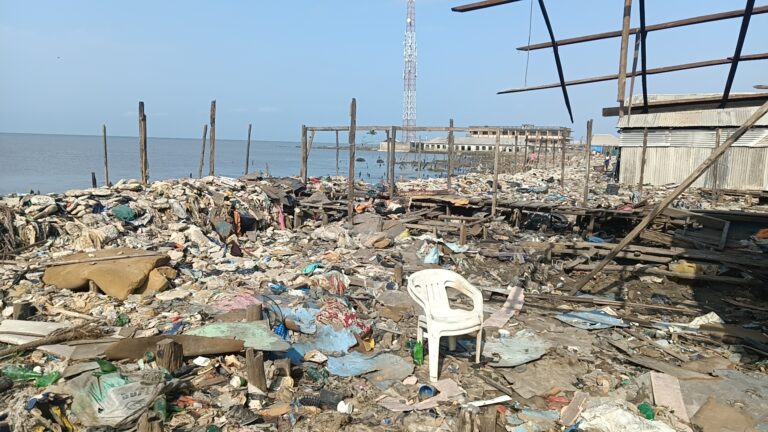
ATLANTIC Ocean is rapidly driving many Ondo communities into extinction. In this report, The ICIR visited the Ilaje Local Government Area (LGA) of the state recently, and captured the magnitude of devastation and displacements that coastal flooding is causing in the area.
Obe-Nla
A drowning legacy: Obe-Nla’s battle against the rising tide
When Ikuesan Lucky, a Law student and son of Obe-Nla’s monarch, Andrew Kolawole Ikuesan, was a child, he could easily go with his siblings behind their home to cast a net into the creek and catch a bowl of fish within minutes.
Lucky said fish was much in Obe-Nla’s surrounding waters like grasses in the field. Residents could eat as much fish as they wanted and sell enough to meet their needs, he added as he pointed at different parts of the community floating on water.
He recalled how fisherfolks returned home daily with large harvests and his community revelled in abundance.
Ondo State Governor, Lucky Aiyedatiwa, hails from Obe-Nla, one of the communities now sinking into the sea.
Ikuesan Lucky
Lucky, who spoke on behalf of his father, and in the company of several community leaders, told The ICIR that oil exploration on the Atlantic Ocean, worsened by climate change, was destroying his town.
“Way back when I was a kid, I remember that under this walkway, if you placed a little net under the water, a lot of fish would come out. But as a result of the oil exploration here, the whole thing started degrading. Things are no longer the way they used to be.
“I remember in 2005 when I was writing my senior WASSCE, if you went to the fishermen at the seashore, they would give you fish that when you got home, your family would think you went to fish. Things are no longer like that. Even going to the sea and coming back, some of them will go like two, three or four times before they could get half of what they used to bring home when things were still okay.”
Obe-Nla and its neighbours used to be proud owners of large farms. There is no longer any land for planting crops. Land previously used for farming is now either in the sea’s belly or have become sloughs. This makes food unaffordable for most families who now survive on fishing.
While water covers every community in the area, there is no clean water to drink or use for household chores.
We are on top of water and don’t have water to drink; is it not funny? The only water here is from the rain.
“We are on top of water and don’t have water to drink; is it not funny? The only water here is from the rain,” Lucky said.
Goveror Ayedatiwa’s house in Obe-Nla, Ilaje Local Government Area of Ondo State. His town is among communities facing extinction by the Atlantic Ocean. Photo credit: Marcus Fatunmole/The ICIR
The seawater is salty and has a sandy brown colour across its banks, making it unusable for washing and bathing in homes.
Water from swamps in the communities is worse. It has different colours, including green and black. Because of the inundation, residents cannot dig the ground for well or to bury their dead.
Many residents depend on rainwater which they store in tanks from one rainy season till the following year because they cannot afford sachet water and other packaged water. A bag of sachet water sells for as high as N1,500 compared to other parts of the state where it sells for a maximum of N400.
This disparity is seen mostly in prices of foodstuffs namely rice, beans, yam, and cassava flour, not only because they cannot be cultivated in the area but because the cost of transporting them by water is very high.
The cost of transport on water in the area is more than what passengers pay for land transportation. A journey on the water for an hour costs an average of N5,000, while a similar journey from Igbokoda to Igbo-Nla in the LGA, which is more than an hour, is N2,000.
One of the streets in Obe-Nla, Ilaje LGA of Ondo State. Photo credit: The ICIR/Marcus Fatunmole
Lucky is more concerned about education and health which appear to have collapsed in the area. He lamented that doctors and nurses were not willing to work in hospitals while teachers turned down posting to schools because of the sea’s incursion.
All hospitals and schools visited by The ICIR in the coastal communities in the LGA, including Obe-Nla, Ayetoro, Awoye, Moluteyin, Abereke, and Idi-Ogba, floated on water.
Lucky said a lot of people died in his town because of lack of functional hospitals. “I remember one of my brother’s wives lost her son and daughter because they ran to the health centre and there was no doctor or nurse to take care of them.”
Lucky reasoned that these crises would have been averted had oil exploration not taken place on the sea, and if the Nigerian government had responded to contain the ocean as it did in Lagos State.
Community leaders in Obe-Nla
He continued, “We were managing ourselves here but the multinationals that came for greener pastures are not helping matters.”
People of Obe-Nla who spoke with The ICIR on the challenges posed by the Atlantic Ocean on the community mentioned states where firms support their host communities and urged the state governor to work with the Federal Government and other partners to rescue the area from the sea.
Every resident of the coastal communities lives on water or very close to it. Most homes and roads are built with planks on water or mud.
Locals said dozens of settlements in the area face coastal flooding, namely Mese, Gbagira, Alagbon, Oroto, Bijimi, Ilowo, and Ilepete, among others.
“There are dozens of communities along the waterway that leads from here to Delta State,” said the general secretary of Obe-Nla, Ikuenomore Oluwasinaayomi.
The ICIR saw the governor’s home built with planks with a wooden pathway as others. But Obe-Nla now has a concrete pathway under construction, the first in the area. The pathway is linked to the governor’s house. Sources said work began on the project after the governor joined the administration of the late Governor Rotimi Akeredolu.
Meanwhile, one of the first questions that run through a visitor’s mind is how the people get the huge planks they use for their buildings and road construction given that there are no forests close to them, and all transportation is done on water.
Many of the woods are ferried from Delta and other parts of Ondo State, The ICIR findings showed.
Another section of Obe-Nla community in Ilaje LGA of Ondo State. Photo credit: The ICIR/Marcus Fatunmole
Ayetoro
Ayetoro’s vanishing shore: How the Ocean is erasing a historic town
The ocean’s waves splash furiously on the debris of buildings it submerged across its banks in Ayetoro, leaving the remaining structures surviving on planks and their occupants in perennial despair.
At least 90 per cent of the community’s landmass has been devoured by the rampaging water, said Akingboye Thomson, the community’s youth spokesperson and personal assistant to the town’s monarch and spiritual leader, Oba Oluwambe Ojagbohumi, the Ogeloyinbo of Ayetoro.
“The sea consumes a large portion of the town yearly, and the once famous community may be no more in a few years if nothing is done to salvage the situation,” Thomson said.
He blamed the crisis on oil exploration on the sea and global warming.
Akingboye Thomson, Ayetoro community’s youth spokesperson spoke on Atlantic Ocean’s incursion into the town
Akingboye said of the town, “Ayetoro community is a theocratic communist Christian settlement founded by a conglomeration of believers known as the apostles on January 12, 1947. This community in its heydays had the highest per capita income in the whole of West Africa. It was the community that put Nigeria in the comity of boat-building nations. The first fishing boat that was built in Nigeria was here in 1964.
“We had industries that were established by the community. We had soap and ice-making factories, bakery, shoe factory and textile industries. All these industries were put together through communal efforts. Ayetoro was a self-sufficient community because we had everything; the town was a centre of attraction for its peers.”
The sea has swallowed all the factories and many schools, including about 1,000 residential homes.
The community started observing that the ocean took some of its land in the 90s. But the rate at which it was expanding at that period was negligible.
However, the trend changed in 2000 when it began to sweep the town at an alarming rate, Adegboye noted.
“During this period, we started making passionate appeals to government at all levels. At that time, the Federal Government established an interventionist agency, which is Niger Delta Development Commission (NDDC). It was created in 2000.
One of the community-funded companies in Ayetoro destroyed by the Atlantic Ocean. Picture credit: Marcus Fatunmole/The ICIR
“We started crying, writing letters to the government at all levels. In 2004, NDDC awarded a shoreline protection contract. At the time, it had not affected any of our buildings, but the rate at which it was getting closer to the communities was like 20 metres away from our buildings. The NDDC awarded the contract to Gallet Nigeria Limited at the sum of N3.5 billion. This we saw on the pages of newspapers. We didn’t see contractors and any equipment.
“After one or two years, we didn’t hear anything. Then the ocean kept eroding and submerging our buildings and land. We started another cry. After a series of petitions and protests, they re-awarded the contract to Drenji Atlantic Limited at the sum of N6.5 billion in 2009.”
He said the company got N2.5 billion from the contract fund before it began work.
The firm brought some equipment and did a shoddy job that was blown away by the sea in a few days. That was all Ayetoro saw from the company to date, Akingboye alleged.
Several government organisations and committees have visited Ayetoro and its environs to assess the damage caused by the sea. They include the NDDC; Federal Ministry of Environment; Senate Committee on Environment; House of Reps Committee on Ecology; and Ondo State government agencies.
Aeriel view of Ayetoro community, Ilaje LGA of Ondo State in late November 2024 Picture credit: Marcus Fatunmole/The ICIR
Adegboye opined that the land taken by the sea is reclaimable if the government is determined to stop the incursion.
“We are appealing to the government at all levels to come to the rescue of Ayetoro community as a matter of urgency. In a month from now, if urgent action is not taken to address the devastating effects of the ocean surge, where you stand as you’re speaking with me, you will not locate it again.”
Limamu Lawrence, leader of the Holy Apostle Church in Ayetoro, who doubles as second in command to the town’s monarch, said the ocean overrun communities at night and had taken three people away in their sleep.
“As I speak with you, this palace is not my home. I became a tenant in my own town. I was born here. The ocean has taken away my house and those of my parents.
“Before now, only an average of three people lived in a house. But now, up to 15 people struggle to live in a house. The sea has destroyed people’s property. The worst part is that the ocean often comes at night when people sleep. We’re only lucky to know how to swim. If not, we would have had many causalities,” he stated.
He said because of the persistent attacks by the ocean, many people had left the town.
Leading a debate on devastations caused by the ocean on the Ayetoro community and its environs, a member of the House of the Representatives for Ilaje and Ese-Edo LGA of Ondo State, Donald Ojogo, averred that Ayetoro is not just a major revenue source in Nigeria, but a community rich in history and culture in Ondo State.
He said it accounted for 5.4 per cent of the 60,000 barrels per day (BPD) of crude oil extracted in the state, averaging 3.7 per cent of Nigeria’s total oil production.
The only public primary health centre in Ayetoro ravaged by water
Awoye
When the Ocean rejects sacrifices: Awoye’s desperate fight for survival
Due to the failure to stop the ocean encroachment, some of the people resorted to appeasing it with sacrifices but they said the sea rejected their oblations.
A community leader in Awoye, Tobashe Aribo, said, “We make sacrifices for the ‘Olokun’ (The Goddess of the sea) We appease it, but it often rejects our propitiation. We make the sacrifices once yearly. Part of what we give the ocean includes chicken, pounded yam, banana and biscuits.”
Like Ayetoro, the ocean has ripped through Awoye town – the largest of several communities in the area. Except for those who would swim, crossing from one part of a community to the other, especially in Awoye, requires boarding a boat for a fee. This further worsens the cost of living in the area.
The ICIR found that residents are clutching to the communities for two reasons. The land going into the sea’s paunch is their ancestral heritage and their only major occupation is fishing. They do commercial fishing, selling fish, crayfish and other sea foods which are transported by vehicle from Igbo-Nla to different parts of Nigeria.
One of the wooden pathways in Moluteyin town, Ilaje LGA, Ondo State. Photo credit: Marcus Fatunmole/The ICIR
Water crisis
Surrounded by water, but none to drink: The Community waiting for hours at borehole for coloured water
One of the worrying scenes in Awoye is how residents wait for hours to fetch borehole water that is darker than the water on their soil.
Residents seen at one of the boreholes said they had no other source of water. “This is the water that we drink here. The people you see here arrived at 5:am. It takes over an hour for us to get a bowl. We have to use force to pump the water out. That is how we suffer every day.
“A bag of sachet water is between N2,000 and N2,500. Sometimes, we don’t see the water to buy. Our children would have no option but to drink this one. When they drink it, they will fall sick and we begin to run from one hospital to the other,” a women leader in the town, Mowumi Ayetoba, said.
She decried the lack of electricity, functional schools and hospitals in the community.
Coloured water from a borehole in Awoye town, Ilaje Local Government Area of Ondo State. Photo credit: Marcus Fatunmole/The ICIR
Some children waiting for their turn at the borehole described the water as a ‘miracle’. By this, they imply the effort it takes them to get a cup of water from the borehole. Unlike boreholes elsewhere where water gushes out when pumped, residents push the pump in Awoye about five times to get a cup filled.
Schools and Health
Toilets on water
What could constitute a health crisis is the manner of defecating in the communities.
Checks by The ICIR showed that households defecate in enclosed areas built with wood in rectangular shapes on the water for bathing and defecation. The wastes drop in the water underneath through gaps created in between the floor planks and spread into the neighbourhood.
A major revelation about the toilets is that some of them have a small jug tied with a rope to the wood on the toilets’ floors. To clean themselves up, users have to draw the rope and fetch water from the same spot where their faeces dropped. Users are also likely to fetch up almost the same water that dropped from their anus again and again, depending on the number of times they fetch water with the jug and how fast the process runs.
A section of Awoye community in Ilaje LGA of Ondo State. Photo credit: The Marcus Fatunmole/The ICIR
“Pray that you don’t have to come to the toilet at night when a legion of mosquitoes is on the loose,” a resident Moneyin James remarked.
Moluteyin
Education on the brink:A headteacher’s travails in Moluteyin
The ocean has also destroyed the majority of houses in Moluteyin, another town in the LGA.
The head of the community, Nomiye Amapopomi, said many children had pulled out of school and several families are living in extreme hardship.
Amapopomi, also the town’s religious leader, said schools and other important buildings in the community had been consumed by water.
“We have government offices here where people are supposed to be working. Nobody has come there to work because of much water flowing within the structures,” he said.
Over 1,000 houses have been overrun by the sea and fishing activities disrupted by water, said Orofin Temihan, a youth leader in the town.
Part of Moluteyin community, Ilaje LGA of Ondo State. Photo credit: Marcus Fatunmole/The ICIR
Another youth, Ajimosan Ikuemehinlo, concurred, noting that there were no roads and a few children attending school often fell off the wooden pathways and broke their legs.
Ayemimowa Elisha Innocent is the headteacher of the Local Education Authority (LEA) Primary School in Moluteyin.
He met 400 pupils in the school when he resumed in 2019. Following the sea incursion, the school’s population has reduced to less than 70. The sea is a few metres away from the school.
“Since 2021 when I became the headteacher, I have been a permanent classroom teacher to primary five and six till date. We want the government to help us. Everything is not good at all. The school is gone, even the staff quarters is also gone,” he scowled.
“No parents will like to see their children swimming in the class,” he replied in reaction to why the pupils ran from the school.
The school has only three staff – the headteacher and two others.
One of the classrooms at the LEA Primary School, Moluteyin, Ilaje LGA, Ondo State.Photo credit: Fatunmole/The ICIR
The ICIR observed that all classrooms in the school were dilapidated. Water got to half of the classroom’s walls during the rainy season, as indicated on the walls. Most of the woods used as the class floors have rotten. The ceilings were also falling off.
The situation is worse at the staff quarters where the headteacher, his wife and two children live. No other staff lives at the quarters.
He covered several planks on the building’s floor with heaps of nylon because snakes often took shelter within the building. The reporter saw shed skins from snakes in the building.
Besides, the quarter is more dilapidated than the school building, as his family is at risk of being consumed by the sea and harmful aquatic creatures.
State government fails to react to findings
The ICIR contacted the state Commissioner for Environment, Oyeniyi Oseni, for a reaction to its findings. He urged the reporter to call him later because he was scheduled to attend a meeting. He declined all calls from the reporter thereafter until the governor sacked him and several other cabinet members in the government on January 15.
The ICIR also contacted the Chief Press Secretary to the governor, Ebenezer Adeniyan, for comments on the findings. He promised to respond to a WhatsApp message sent to him on the findings. Several reminders and calls to his line attracted no response for over two weeks.
Contractor – Dredging Atlantic Limited – wants story ‘killed’
The reporter contacted Dredging Atlantic Limited through one of the phone numbers on its website. The official who spoke with the reporter, Emmanuel Enyia, requested that the report be killed, arguing that publishing such a work would damage his company’s reputation.
“You know Nigeria; we don’t like any publication. This is Nigeria, we wouldn’t want any publication…The thing (contract) is from NDDC. We want to stop it at your table,” he said before the reporter interjected him and made him understand that The ICIR would never stop its investigation for pecuniary or other reasons.
The reporter urged him to state his company’s part by explaining how it spent the N2.5 billion it allegedly received from the contract.
The Dredging Atlantic official, Emmanuel Enyia (Picture cropped from his WhatsApp displayed pictured
The man later promised to send the contact of his colleagues in Port Harcourt whom he said handled the Ayetoro contract. Rather than send the number, he sent the reporter’s phone number to a prominent indigene in Ondo State, who came pleading on the company’s behalf.
The ICIR reports that Dredging Atlantic Limited was registered on November 8, 2006, with RC – 672448, according to its information on the Corporate Affairs Commission.
NDDC declines comments
Similarly, the reporter contacted the NDDC through its spokesperson, Seledi Thompson-Wakama, to know why the contracts awarded for shoreline protection in Ayetoro failed.
She requested the details, and they were sent to her on January 14, 2025, via WhatsApp. She failed to respond to the message despite several reminders and calls to her line from the reporter.
THE Federal Government on Saturday, March 1, approved the appointment of Lucian Chukwu as the substantive vice chancellor (VC) of Admiralty University of Nigeria (ADUN), Ibuzor, Delta State, after the confusion and controversy that trailed the selection.
The announcement was made by the Director of Press, Ministry of Education, Folasade Boriowo, in a statement on Saturday, March 1.
Boriowo noted that the Governing Council of the university conducted the selection exercise for the appointment of a substantive vice chancellor on February 26 and 27.
At the end of the exercise, Chukwu emerged first with the highest score of 83.41 per cent among the five interviewed candidates.
“In line with the principle of merit being upheld by the Federal Government, the Minister of Education, Maruf Tunji Alausa, has approved the appointment of Professor Lucian O. Chukwu as the substantive Vice-Chancellor of Admiralty University, Ibuzor.
Minister of education, Tunji Alausa
“The appointment is for a single tenure of five years with effect from February 28, 2025,” Boriowo stated.
Intrigues, power play that ensued
The Admiralty University, which is owned by the Nigerian Navy and based in Delta State, had recently been enmeshed in a crisis following the process of selecting a new VC.
The process was mired in controversies due to intrigues and vested interests, which some stakeholders in the sector have described as an attempt to ditch merit in the selection process.
The ICIR’s findings revealed that the university posted a job advertisement for vice chancellor on October 7, 2024, and by the deadline, 52 candidates had applied.
To get the most qualified candidate for the role, the services of KPMG, a globally renowned management consultancy firm, were sought by the university for the recruitment and selection of the best among the candidates.
According to the information gathered, KPMG completed the task by February 5, 2025, and handed the report to the management through the Registrar on February 6, 2025.
Thereafter, the Joint Selection Board (JSB) was constituted, and the report from KPMG was reviewed.
The joint selection committee members included a former Chief of Naval Staff, Dele Joseph Ezeoba; a retired Rear Admiral, A. Ogunleye; a representative of the Federal Ministry of Education in the council, Mary Omokhomion; a representative of the Federal Character Commission who was there to observe the process, Moses Anaughe; and the university’s registrar, Isaac Mankilik.
Others are the acting VC of the university, Dili Ofuokwu, a professor; Emmanuel Okwechime; GSM Aligwe, a Rear Admiral; and O.A. Odiansiye, a captain.
According to a document obtained by The ICIR titled “Notice of Meeting for the 2nd Extra-Ordinary Meeting of The Governing Council for the Consideration of Report of the Joint Selection Board On the Appointment of a Substantive Vice Chancellor for the Admiralty University of Nigeria” dated Wednesday, February 26, 2025, the first candidate based on the scoring of KPMG was Chukwu, a professor of Marine Biology and current deputy vice chancellor (Management Services) at the University of Lagos.
Professor Lucian Chukwu, newly elected VC of ADUN
Apart from Chukwu, the other four candidates that were shortlisted after the interview were Lawrence Omo-Aghoja, Provost of the College of Medicine, Delta State University (DELSU), Abraka; Ifeoma Ijeh, a professor of Biochemistry and director of the Centre for Molecular Bioscience and Biotechnology at the Michael Okpara University of Agriculture, Umudike, Abia State; Christopher Bankole Ndubisi Ogbogbo, a professor of history; and Sunny Iyuke, a professor of Chemical and Process Engineering and Chief Executive Officer of the Petroleum Training Institute (PTI), Effurun, Delta State.
At the end of the interview by the Joint Selection Board, the Council was collapsed into its whole for members to consider the report of the interview. At the end, the candidates’ score were reported as follows:
Lucian Obinnaya Chukwu: 83.41 per cent: Sunny E. Iyuke: 60.83 per cent; Christopher Ogbogbo: 72.5 per cent; Lawrence Omo-Aghoja: 59.5 per cent; Ijeoma Ifeoma Irene: 69.16 per cent.
Accordingly, three candidates were shortlisted in the order of their performance. They are: Lucian Obinnaya Chukwu: 83.41 per cent; Christopher Ogbogbo: 72.5 per cent, and Ifeoma Irene Ijeoma: 69.16 per cent.
At this point, the overall best was supposed to be declared winner, but the larger members of the Selection Committee insisted on picking Ogbogbo, who came in second in the recruitment process.
According to sources, this led to a fracas at the council meeting, with the council chairman, Ezeoba, insisting that the best candidate in the recruitment process be picked. He reportedly disagreed with the decision that Ogbogbo, who came second,be presented as the new VC.
The council chairman, Ezeoba, later informed the Education Minister Tunji Alausa about the situation, and the minister reportedly ordered a report to be filed, promising that the ministry would take necessary action.
But in a dramatic twist, the institution, in a statement released on Friday, February 28 and signed by the Registrar Isaac Mankilik, announced the appointment of Ogbogbo, who came second in the recruitment process, as the substantive VC.
This reportedly occurred when the chairman of the council, Ezeoba, and some other members were outside the university.
In their absence, a few members of the council convened a meeting, which it tagged an “extraordinary meeting,”and announced the appointment of Ogbogbo as the institution’s substantive vice chancellor.
But, in the statement released on Saturday, the Federal Government, through the Minister of Education, rescinded the decision and appointed Chukwu, who came in first at the interview, as the substantive VC of the institution.
Attempts by The ICIR to speak to the Registrar of ADUN, Mankilik, on the controversy were unsuccessful, as he did not pick up his call nor respond to messages sent to his phone.
THE Rivers State Governor, Siminalayi Fubara, has asked the heads of local government administration to immediately take over the affairs of the 23 councils pending fresh elections by the state electoral body.
The embattled governor gave the order in a state-wide broadcast on Sunday, March 2, following the Supreme Court judgement on the matter.
He said, “Furthermore, given the outlawing of caretaker arrangements in the local government system, I hereby direct the heads of Local Government administration to immediately take over the affairs of the 23 local government councils pending the conduct of fresh elections by the Rivers State Independent Electoral Commission.
“I further direct the outgoing local government chairmen to formally hand over the levers of power to the Heads of Local Government Administration by Monday, March 3, 2025.”
The apex court had passed a judgment over the lingering political disputes in the administration of the local government affairs against the state government.
It overturned the October 5, 2024, local government election in the state, declaring it null and void.
In a unanimous ruling on Friday, February 28, a five-member panel of the Supreme Court upheld an appeal by the All Progressives Congress (APC).
It overturned a November 21, 2024, Court of Appeal ruling in Abuja that had upheld the election results.
In the lead judgment delivered by Jamilu Tukur, the apex court ruled that there was no evidence proving that the conditions outlined in Section 150(3) of the Electoral Act were met before the Rivers State Independent Electoral Commission (RSIEC) conducted the elections.
“Although we disagree with the judgments, we are bound to obey the orders made therein as a law-abiding government,” Fubara said.
According to the governor, he has had a meeting with his team of lawyers and has assured him that the certified true copy of the judgements might be available to them by Friday, March 7.
“I assure you that upon the receipt of certified judgements, we shall study their ramifications and implement them without reservations to move the State forward.
“Although our dear State seems to be back in trying times, I urge everyone to remain calm and peacefully go about with their legitimate daily activities as we continue to do everything in our power to advance our responsibilities to the citizens,” Fubara added.
The ICIR can report that Fubara has faced strong opposition from a faction of the State House of Assembly and has been at loggerheads with his predecessor and current Minister of the Federal Capital Territory, Nyesom Wike.
THE Nigeria Labour Congress (NLC), has directed its affiliates to be on alert for a nationwide protest should the federal government fail to implement the telecommunication services charge as agreed.
It threatened to embark on a strike action should the government forcefully migrate electricity customers from lower bands to band A.
The National Executive Council decided this during its meeting in Yola, Adamawa State.
The meeting focused on the economic challenges facing Nigerians and workers and was aimed at inaugurating its compressed natural gas-driven mass transit buses for the Northeast zone.
In a communique released on Sunday, March 2, the NLC warned that any further increase in electricity tariff would be met with strong resistance.
It asked all industrial unions and progressive allies to be prepared for decisive mass action against anti-people policies if the government acted otherwise.
It said having extensively discussed the existential threats to the working class and the broader Nigerian masses, the NEC took the resolution.
“On the 35 per cent tariff hike in telecommunications services: NEC acknowledges the agreement reached on February 21, 2025, between the Nigeria Labour Congress and the Federal Government through the Joint 10-man committee, which reduced the initially proposed telecommunications tariff hike from 50 per cent to 35 per cent.
“However, congress remains vigilant, recognising the long history of infidelity. NEC categorically warns that should the implementation of the agreement on March 1, 2025, fsils, the National Administrative Council is mandated to immediately deploy all necessary instruments to enforce compliance in line with the February 10th, 2025 Central Working Committee directive,” the union stated.
The NLC had suspended its earlier planned nationwide protest against a 50 per cent hike in telecoms services and entered into a negotiation with the government, The ICIRreported.
Forceful migration of electricity customers to band A
On the migration of electricity consumers aimed at increasing tariff, the NEC unequivocally rejected the reclassification of electricity consumers by the Nigerian Electricity Regulatory Commission (NERC).
This plan which was disclosed by the minister of power, Adebayo Adelabu, on Thursday, February 27, seeks to forcefully migrate consumers from lower bands to A under the guise of service improvement while, in reality, imposing unjustified extortion on the masses.
“This systematic exploitation, sanctioned by the Ministry of Power, is nothing short of economic violence against the working class and the broader Nigerian populace.
“It is evident that the ruling elite, acting as enforcers of global monopoly capital, are determined to further deepen the misery of the Nigerian people through incessant tariff hikes, increased taxation, and relentless economic strangulation,” it said.
The committee noted that whereas inflation has soared, wages remain stagnant, and the cost of living has become unbearable, the ruling class continues to transfer the burden of their fiscal irresponsibility onto the already impoverished working masses.
“NEC-in-session warns that any attempt to announce further electricity tariff increases will be met with mass resistance. “Consequently, the congress resolved to immediately mobilise for a nationwide protest should the Ministry of Power and NERC proceed with their exploitative plan to further hike electricity tariffs under any guise.
“The NLC shall not stand idly by while the Nigerian people are subjected to the unholy machinations of capitalist profiteers and their state collaborators,” it warned.
The NEC also reaffirmed the historical responsibility of the working class to resist all forms of exploitation and oppression.
It called on all affiliates, industrial unions, and progressive allies to remain on high alert and fully prepared to engage in decisive mass action against all anti-people policies of the state.
“The Congress reiterates that no society can sustainably develop under a regime of corporate plunder and neoliberal enslavement. The Nigerian working people must, therefore, remain resolute, organised, and uncompromising in the collective struggle for a fair and equitable Nigeria where the dominance of fat cats at the expense of the masses will be greatly reduced to create a socioeconomic balance.”
PRESIDENT Bola Tinubu has condoled with the family of Adenike Ebunoluwa Oyagbola, who died at the age of 94.
Late Oyagbola, a distinguished educationist and diploma, was Nigeria’s first female minister of cabinet rank.
In a statement on Sunday, March 2 by his special adviser on Information and Strategy, Bayo Onanuga, the president described Oyagbola as a trailblazer and a beacon of inspiration for women in Nigeria.
“As the nation’s first female minister of cabinet rank, she broke barriers and paved the way for countless women to aspire to and achieve leadership roles in the country,” Tinubu remarked.
According to him, Oyagbola, who served as the Minister of National Planning from 1979 to 1983, made “significant contributions to national development.”
“Her impact was felt on youth development, empowerment, and the promotion of arts and culture, adding that Oyagbola’s efforts laid a foundation for Nigeria’s sustainable growth and progress.
“Her legacy will continue to inspire generations, particularly in the creative industry, where her impact remains deeply felt.
“In an era where threats to ethical standards are increasing, we shall miss Oyagbola’s steadfast commitment to these principles,” Tinubu said.
Similarly, the Ogun State Governor, Dapo Abiodun, described her life as a model of shrewdness, courage, humility, and an unwavering passion for service.
He said Oyagbola paved the way for African women to pursue gender equality and active participation in politics.
“We thank God for her eventful and glorious years of service to humanity as a leading politician and a celebrated diplomat of high repute.
“May God Almighty rest her soul and grant her family the strength to bear this irreplaceable loss,” Abiodun said.
Late Oyagbola, born on May 5, 1931, was a native of Igan Alade, in Yewa North local government area of Ogun State, south-western Nigeria.
She trained as a teacher and taught at schools in Yewa and Mushin before becoming the headmistress of an elementary school in Mushin.
In December 1979, she became Nigeria’s first female cabinet minister after she was appointed Minister of National Planning under the Shehu Shagari-led administration, a position she held until October 1983.
She later became Nigeria’s. Ambassador to the United Mexican States of Panama, Costa Rica and Guatemala and also served as the president of the Nigerian chapter of Attitudinal Healing International at the time of her death.
THE National Union of Road Transport Workers (NURTW), on Sunday, March 2, reportedly staged a protest in Jos, Plateau State, over the alleged killing of northern truck drivers by members of the Indigenous People of Biafra (IPOB) in Nigeria’s South-East region.
The protesters were seen carrying placards with inscriptions such as; “Enough is enough,” “End the carnage, ensure smooth passage of northern truck drivers,” and “We are united against violence, protect all drivers regardless of origin.”
The state coordinator of Heavy Trucks Plateau State Council, Janedu Ahamad Zaki, was quoted to have described the attacks as “senseless and barbaric.”
“For the past eight years, truck drivers from northern Nigeria have been consistently targeted, killed, and had their trucks destroyed or burnt while transporting goods to the South-East. We are still trying to understand what offence we have committed to deserve this kind of barbaric killing.
“Between January and December 2024 alone, in communities such as Ihube, Okigwe, and Isuochi in Imo State, more than 20 drivers were brutally killed, and their trucks either burned or damaged. Some bodies were recovered, while others remain missing,” Zaki reportedy said.
He stressed that on January 28 this year, four drivers — Haruna Jibril, Bala Muhammad, Dalladi Jafaru, and Auwal Muhammad — were ambushed between Lokpanta in Imo State and Umuahia in Abia State while transporting tomatoes to Port Harcourt.
He said all four were killed, and their trucks were emptied by the assailants.
“The perpetrators, after unloading the tomatoes, filmed the empty truck and sent the videos to us to confirm that they had killed the victims. When we called them to release the bodies, they told us to forget about them,” Zaki recounted.
Zaki lamented that no security action has been taken despite the incessant attacks and reports to security operatives.
“Just yesterday, suspected IPOB members in the Four Corner community of Nkanu West LGA of Enugu State opened fire on a truck carrying perishable items heading to Port Harcourt. Luckily, the driver and his assistants survived. These sad incidents continue unabated without any serious move to stop them,” he added.
He asserted that Enugu to Lokpanta, Lokpanta to Okigwe, and Okigwe to Umuahia in Abia State, are the most dangerous routes.
He also lamented that the destruction of trucks has led to the loss of billions of naira by truck owners and worsening economic hardship among union members.
“Despite continued reports of these incidents to various security agencies, including the police and military, no concrete actions have been taken to address the issue,” he stated.
The protesters called on the federal government, under the administration of President Bola Tinubu, the National Security Adviser, the Chief of Defence Staff, the Chief of Army Staff, and the Inspector General of Police, to take immediate action.
They further warned that truck drivers might be forced to suspend the transportation of goods to the Southeast, urging the government to hold IPOB leaders accountable for the alleged atrocities.
The ICIR has reported severally on the spat of insecurity in the region fuelled by the activities of the proscribed IPOB.
In November 2024, the federal government, through the minister of defence, Mohammed Badaru, said it had renewed its determination to intensify efforts against all forms of insecurity in the southeast.
Over the years, the IPOB had continued to enforce a sit-at-home order in the southeast, as Nigerians in the region appear helpless amidst the presence of security operatives.
In 2023, micro-businesses in the region lost an average of N4.618 trillion ($10.495 billion) in one year to the sit-at-home order; The ICIRcaptured in a report.
RECENTLY, TikTok released its latest Community Guidelines Enforcement Report which underscores the platform’s reinforced commitment to maintaining a safe, creative, and authentic online environment.
Focusing on the third quarter of 2024 and published in December 2024, the report reflects updated Community Guidelines that took effect in May 2024 —guidelines designed to provide the community with enhanced transparency about the rules and their enforcement.
The report notes that the Community Guidelines are continuously updated, with adjustments that range from minor to substantial ones like AI-content labelling etc. For instance, the May update involved revising policy titles and replacing ampersands (&) with the word “and,” while more significant updates have addressed emerging issues and shifts in online behaviour.
“Sometimes our changes are more substantive, reflecting emerging issues or trends in online behaviour. This most recent update included specific language about our AI-generated content policies, consistent with growing interest in AI and AI tools across the internet.
“In addition to revising our Community Guidelines, TikTok evaluates and updates our enforcement tools on a regular basis. One of TikTok’s eight Community Principles is to apply our content polices consistently, equitably, and transparently,” the report stated partly.
To achieve this, the platform continually assesses its automated moderation tools with the aim of enhancing both accuracy and speed, thereby fostering a broad spectrum of creative expression, it noted. It added that previous reports have shown that these investments are yielding tangible improvements, evidenced by a higher proactive removal rate and an increased number of videos restored.
The FactCheckHub observed that content removals in the third quarter of 2024 targeted accounts promoting sexual and explicit content, misinformation, fake engagements, suicide and self-harm, gambling, frauds and scams, drugs, hate speech, harassment, and bullying, among others.
Data from the report indicate that 147,875,561 videos were removed in the third quarter, compared to 178,827,465 in the second quarter. Of these, 118,268,578 videos were removed by automation, and 5,161,074 videos were restored during the third quarter.
Additionally, 187,309,345 fake accounts were removed, along with 24,304,797 accounts under the age of 13 and 3,266,134 other accounts. Live sessions saw 12,299,711 suspensions and 858,674 restorations, while 1,325,259,497 comments were removed within the period under review.
The policy distribution of removals, according to TikTok, were classified into six categories namely:
Integrity and authenticity
Privacy and Security
Safety and Civility
Mental and Behavioral health
Regulated and commercial activities
Sensitive and mature themes
Sensitive and mature themes accounted for 29.1 per cent of removals, regulated goods and commercial activities 26.6 per cent, and mental and behavioural health 19.5 per cent. In contrast, the integrity and authenticity category comprised the lowest share at 2.0 per cent.
The report also highlights a noticeable decline in the number of ads removed for advertising policy violations: 1,925,560 ads were removed due to policy breaches and 3,683,135 ads due to account-level enforcement actions in the third quarter, compared to 2,252,084 and 5,319,552, respectively, in the previous first and second quarters.
So, how can users avoid falling foul of the platform’s community guidelines? Experts react below:
Speaking with The FactCheckHub, a TikTok influencer Benita Peters (@benitapeters_) noted that TikTokers should simply adhere to the community guidelines, noting that they exist for a reason.
Sunday Awosoro, a fact-checker with Dubawa also shared the same view with Peters noting that TikTok users should carefully review the platform’s community guidelines and refrain from sharing misinformation or harmful content.
Verify Before Sharing
Ensure that any content you create or share is authentic. Avoid posting unverified, digitally-altered or manipulated media, especially if it touches on sensitive issues like politics, health, or religion.
“If you’re unsure about the accuracy of what you’re sharing, don’t post it at all. And if you must, fact-check it first or consult a fact-checking organisation,” Awosoro advised.
Use Reporting Tools
If you encounter content that appears to violate TikTok’s policies (such as misinformation, hate speech, or manipulated videos), report it immediately using the platform’s built-in reporting features. This helps maintain a safe community.
Engage Responsibly
Recognize that enforcement actions are applied to accounts repeatedly sharing problematic content. By following the guidelines and verifying sources, users help foster an environment that rewards creativity and respectful engagement.
Another TikTok influencer, Favour Obetta a.k.a. facetacy reiterated that TikTok users should avoid prohibited content and stay informed about policy updates.
“TikTokers should avoid prohibited content like suicide, eating disorders, bullying, nudity, contents that mislead people, using music videos or pictures without proper rights and stuffs like that and then staying updated on policy changes,” Obetta warned.
In conclusion, don’t forget that TikTok consistently reviews and upgrades its systems to detect new trends and promptly remove content and ads that violate its policies, reinforcing its continuous commitment to protecting the community from fake, fraudulent, or misleading content and ads.
THE Bauchi State Police Command has launched an investigation into an alleged case of culpable homicide involving a businessman, Nuru Isah.
He was arrested for allegedly killing his wife, Wasila Abdullahi, following a dispute over Ramadan meal preparations.
According to a police statement issued on Sunday, the incident occurred on March 1, 2025, at about 11:30 pm near Government Girls College, Fadamam Mada Area, Bauchi.
The disagreement reportedly stemmed from a dispute over the handling of food ingredients and fruits meant for breaking the Ramadan fast.
“This unfortunate event arose from a misunderstanding between one Nuru Isah, aged 50, a businessman at Central Market Bauchi and his second wife, Wasila Abdullahi, aged 24, concerning handling food ingredients and fruits designated for breaking the Ramadan fast, which escalated into a violent confrontation,” the police stated.
Preliminary investigations indicate that Isah allegedly struck his wife with a cane during the altercation, causing her to collapse and lose consciousness in their home.
She was rushed to the Abubakar Tafawa Balewa University Teaching Hospital, where medical personnel confirmed her death.
“The Bauchi State Police Command has initiated a thorough investigation into this incident and has apprehended the suspect, Nuru Isah. The cane purportedly used in the assault has been recovered as evidence, and the deceased has been placed in the mortuary pending autopsy procedures,” the statement added.
The Commissioner of Police, Auwal Musa Muhammad, assured the public that justice would be served.
“Domestic violence constitutes a serious offence with potentially devastating repercussions. Every individual is entitled to reside in a safe and secure environment.
“Collectively, we can foster a community that prioritises respect, empathy, and understanding,” Muhammad said.
The police reiterated their commitment to safeguarding lives and ensuring that perpetrators of criminal activities are held accountable.
The ICIR reports that the incident adds to a chain of femicide cases in the country.
In February, the Federal Capital Territory (FCT) Police Command rescued a 25-year-old lady, Promise Eze, from a suspected ritualist and armed robber at an hotel in the Wuse area of Abuja.
The command said it had launched a manhunt for the fleeing suspect.
Earlier in January this year, The ICIRreported how Eliojo Salomey, a 24-year-old serving National Youth Service Corps (NYSC) member based in Mararaba, a fast-growing community near Abuja, was allegedly butchered by her boyfriend, a gospel singer, Timileyin Ajayi.