Home Blog Page 37

Workers’ Day 2026: Atiku, Obi knock Tinubu over hardship, failed promises, others

0

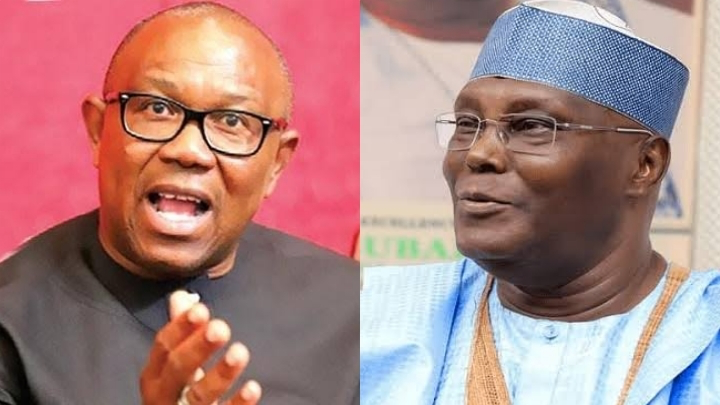
FORMER Vice President, Atiku Abubakar, and Labour Party’s 2023 presidential candidate, Peter Obi, on Thursday criticised the economic policies of President Bola Tinubu’s administration, saying his government pushed Nigerians into deeper hardship. 

In separate Workers’ Day messages, on Friday, May 1, both opposition figures said the government’s reforms, especially the removal of fuel subsidy, worsened living conditions for workers across the country. 

In a statement titled “Broken Promises, Shattered Hopes: The Nigerian Worker’s Burden Under the Tinubu Administration,” Abubakar said this year’s Workers’ Day should be a moment of grief rather than celebration.

He argued that the “Renewed Hope” slogan of the government had translated into “renewed hardship” for citizens, adding that Nigerian workers, including teachers, nurses, civil servants, artisans and factory workers, had borne the brunt of economic reforms without adequate protection.

Abubakar acknowledged that the removal of fuel subsidy was, in principle, a necessary reform but faulted the manner of its implementation, describing it as “reckless and callous.” 

He said the policy was introduced without proper planning, social safety nets or cushioning measures, leading to a sudden spike in transport, food and living costs.

According to him, while the government claimed to have saved trillions of naira from the subsidy removal, ordinary Nigerians have yet to feel its benefits. 

He alleged that instead, the funds were largely shared among tiers of government and directed toward projects such as the controversial Lagos-Calabar Coastal Highway, which he claimed lacked competitive bidding and due process.

“While the Nigerian workers pay more to transport themselves to and from work, more to eat, more to keep their children in school, the administration is signing off on an $11 billion contract that bypassed every safeguard of transparency and accountability that should protect the public purse,” he wrote.

He added that “increasing taxes during an economic crisis, when citizens are already struggling to survive, is not fiscal responsibility. It is an act of cruelty masquerading as policy.

“What makes this administration’s economic record even more alarming is that, alongside all the new revenues generated, from subsidy savings, from a floating exchange rate that boosted naira receipts on dollar-denominated revenues, and from aggressive taxation, government borrowing has also increased dramatically. Nigeria’s debt profile has worsened. And, yet, for two consecutive years, the government has been unable to fully fund its own budget. Nigerians are owed a full and transparent account of where all this money has gone.”

In his remarks, Obi described workers as “the backbone of every nation,” but lamented that Nigerian workers are increasingly unable to survive on their wages due to rising inflation and cost of living.

He said the minimum wage could no longer guarantee a decent standard of living, stressing that no country could develop beyond the strength and welfare of its workforce.

“It is deeply painful that those who wake up every day to teach, heal, build, farm, produce, transport, protect, and serve our nation are still denied the dignity and fair reward their labour deserves. In today’s Nigeria, the minimum wage can no longer guarantee even the most modest standard of living, as inflation, rising food prices, transportation costs, and economic hardship continue to erode the value of honest work.

“No nation can truly develop beyond the strength, productivity, and wellbeing of its workforce. The progress of any society rests on the quality of its human capital, the skill of its people, and the commitment of its workers. When workers suffer, the nation suffers. When workers are empowered, the nation prospers,” he wrote.
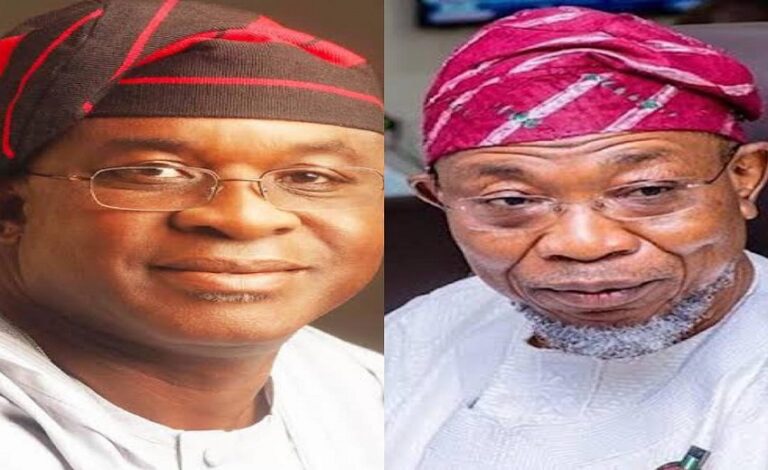
INEC reinstates Mark, Aregbesola as ADC chairman, secretary

0

THE Independent National Electoral Commission (INEC) has updated its website to reflect David Mark as the National Chairman of the African Democratic Congress (ADC) and Rauf Aregbesola as the party’s National Secretary.

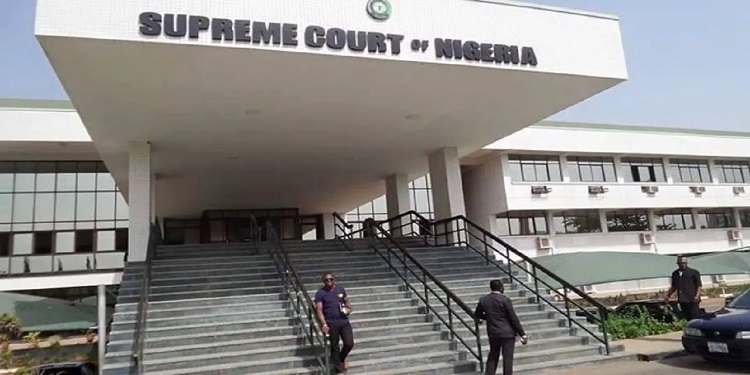
The decision followed Thursday’s Supreme Court’s ruling on the party’s leadership dispute.

The change reverses the electoral body’s earlier stance in April to remove the Mark-led leadership from its portal after citing an Appeal Court judgment on the party’s leadership tussle.

The ICIR reported that the appex court set aside the Court of Appeal’s order directing parties to maintain the status quo ante bellum.

In a unanimous ruling, the court ordered the return of the litigation on the crisis to the Federal High Court for determination.

It held that the matter must proceed at the trial court for full hearing and determination. The court frowned at the “unnecessary, improper and unwarranted” ante bellum order by the Appeal Court.

The leadership crisis in the party had deepened after controversial orders were issued by courts.

In the suit before the Federal High Court, the party’s factional leader, Nafiu Gombe asked the court to restrain Mark’s faction from parading itself as the party’s leaders and compel INEC to recognise him instead.
Upon hearing the matter, the Federal High Court ordered all parties to maintain the status quo pending the determination of the substantive suit, to prevent actions that could undermine judicial process.
Dissatisfied with the proceedings at the trial court, Mark’s faction approached the Court of Appeal, challenging the jurisdiction of the Federal High Court to hear the case.
However, the Court of Appeal dismissed the challenge and upheld the proceedings at the trial court, affirming that the Federal High Court was competent to entertain the suit.
The appellate court further directed all parties, including INEC, to maintain the status quo to avoid rendering the outcome of the case useless.

Relying on the Appeal Court’s directive, INEC announced it would not recognise any faction of the ADC and subsequently removed the names of Mark and his executives from its official portal, effectively leaving the party without a recognised leadership.

Dissatisfied, the Mark-led faction approached the Supreme Court to challenge the decision.

In a unanimous ruling on Thursday, the Supreme Court described the ante bellum order as “unnecessary, improper and unwarranted,” while it asked parties in the suit to return to the Federal High Court for proper hearing of the case.

Tinubu nominates Joseph Tegbe as power minister

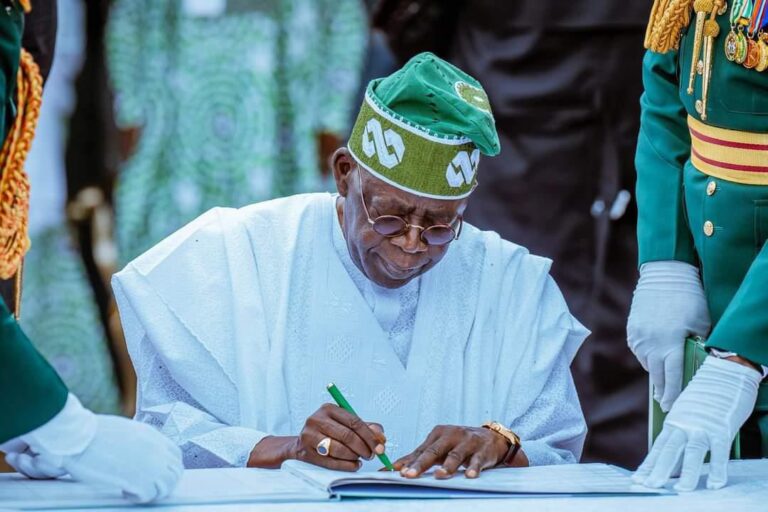
PRESIDENT Bola Tinubu has nominated Joseph Olasunkanmi Tegbe as Nigeria’s Minister of Power.

Tegbe will succeed immediate past power minister, Adebayo Adelabu, if his appointment is confirmed by the Senate.

Announcing his appointment in a statement on Thursday, April 30, Tinubu’s Special Adviser on Information and Strategy, Bayo Onanuga said Tegbe was expected to strengthen ongoing efforts to reform the nation’s power sector, enhance grid stability, and attract sustainable investment.

It also noted that the nomination had been forwarded to the Senate in line with constitutional procedures.

Tegbe, from Oyo State, is an experienced economist and policy expert with over three decades of work across government and private sector.

“He is a former Senior Partner and Head of Advisory Services at KPMG Africa, where he led wide-ranging initiatives in fiscal policy reform, institutional transformation, and governance. He has also advised key government institutions and private sector organisations on strategic reforms, regulatory frameworks, and investment structuring.”

“He is currently serving as Director-General and Global Liaison for the Nigeria-China Strategic Partnership, where he coordinates development efforts between Nigeria and China,” the Presidency said.

The ICIR reported that the former minister Adelabu resigned to pursue governorship ambition in Oyo State.

Another report by The ICIR highlighted the challenges in the nations’ power sector and tasks awaiting the new minister.


UPDATED: Supreme Court returns ADC leadership case to Federal High Court, affirms Mark’s leadership

THE Supreme Court has ordered the return of the leadership dispute rocking the Africa Democratic Congress (ADC) to the Federal High Court for determination.

In a unanimous ruling delivered on Thursday, the apex court set aside the Court of Appeal’s order directing parties to maintain the status quo ante bellum.

The court held that the matter must proceed at the trial court for full hearing and determination and frowned at the “unnecessary, improper and unwarranted” ante bellum order by the Appeal Court.

It also refused to entertain the appellant’s argument challenging the jurisdiction of the Court of Appeal, ruling that the lower appellate court acted within its powers.

With the decision, the Supreme Court effectively restored the David Mark-led executive of the ADC, pending the outcome of the substantive case at the Federal High Court.

In the suit, Gombe asked the court to restrain Mark’s faction from parading itself as the party’s leadership and to compel the Independent National Electoral Commission (INEC) to recognise him instead.

Upon hearing the matter, the Federal High Court ordered all parties to maintain the status quo pending the determination of the substantive suit, to prevent actions that could undermine the judicial process.

Following the earlier ante bellum order by the Court of Appeal, INEC had announced that it would not recognise any faction of the ADC. It proceeded to remove the names of Mark and his executives from its official portal, citing the need to comply with the court’s directive.

The Mark-led faction subsequently escalated the matter to the Supreme Court, again challenging the jurisdiction of the lower courts.

INEC decision effectively left the ADC without a recognised leadership at a crucial period in the build-up to the 2027 general elections.

The development also sparked protests in Abuja, with party members accusing the electoral commission of bias and warning that the crisis threatened the party’s internal democracy. The ADC stalwarts led a protest to the INEC headquarters in Abuja, calling on its chairman, Joash Amupitan, to resign.

Despite INEC’s refusal to rescind on its decision, the Mark’s faction went ahead with its planned congresses and national convention, accusing INEC of bias and interference in its internal affairs.

However, a Federal High Court in Abuja, on Thursday, April 30, barred INEC from recognising or participating in any congress organised by the disputed caretaker leadership of the ADC.

 The ICIR reports that today’s ruling came two days after the Mark’s faction wrote to the Chief Justice of Nigeria, Kudirat Kekere-Ekun, appealing for urgent and timely delivery of judgment in the pending case concerning the party’s leadership.

The faction, in a letter dated April 28, 2026, addressed to the CJN by its counsel, S.E. Aruwa, SAN & Co., said the unresolved appeal threatened its constitutional right to contest the 2027 polls and could leave it without recognised leadership.

NOTE: This report has been updated to reflect that the Supreme Court ruling returned David Mark as the ADC National chairman.


Supreme Court voids PDP Ibadan convention

THE Supreme Court has nullified the national convention of the Peoples’ Democratic Party (PDP) held in Ibadan in November 2025 over what it described as deliberate disobedience of subsisting court orders.

The convention was organised by the party’s faction, led by Kabiru Tanimu Turaki.

In a split judgment of three justices to two, the apex court, on Thursday, April 30, held that the convention, which produced a parallel leadership structure within the party, was conducted in clear violation of judicial directives, making it legally untenable.

Delivering the lead judgment, Stephen Adah faulted the Turaki-led faction for going ahead with the exercise despite a court order restraining it. 

The court said the group ignored instructions from a trial court that had specifically directed that the convention be suspended until all qualified aspirants were given the opportunity to purchase nomination forms and participate.

The justices in the majority, Mohammed Garba and Chidioma Nwosu-Iheme, concurring with the lead judgment. They held that such conduct amounted to a disregard for the authority of the court and could not be allowed to stand.

Adah described the decision to proceed with the Ibadan convention as condemnable, stressing that obedience to court orders is fundamental to the rule of law.

The ruling is the latest development in the prolonged leadership crisis rocking the PDP following its controversial national convention in Ibadan and ill troubles that had bedeviled it.

The convention produced a leadership team led by Turaki. However, some members loyal to the Minister of the Federal Capital Territory (FCT), Nyesom Wike, were suspended during the convention. The suspended members challenged their sack in the court.

On December 22, 2025, the Independent National Electoral Commission (INEC) rejected requests by the Turaki-led team that the commission recognise the party’s new National Working Committee (NWC), citing existing court judgments and unresolved legal processes.

The INEC referenced two Federal High Court rulings in Abuja in October and November 2025, which restrained it from giving effect to the outcome of the Ibadan convention.

The electoral commission noted that pending appeals did not automatically stay the execution of these judgments and emphasised that it remained bound by the law.

A letter signed by INEC Secretary, Rose Oriaran-Anthony, explained that, in light of the suits, the commission could not update or recognise the list of national officers elected at the Ibadan convention.

The Federal High Court sitting in Abuja, in January 2026, had nullified the convention and barred Turaki and other officials who emerged from the exercise from acting as national officers of the party. 

In March 2026, the Court of Appeal dismissed the PDP faction’s attempt to overturn an earlier judgment that restrained INEC from recognising the outcome of the convention. The appellate court upheld the lower court’s decision and imposed costs on the Turaki-led faction.

Following the decision, the party announced that it had instructed its lawyers to file an appeal and pursue all available legal options to defend its position.

Despite these rulings, the Turaki-led faction continued to insist on the legitimacy of its leadership, while the rival Wike-aligned bloc also laid claim to the party’s national structure, following a separate convention in Abuja.

The PDP’s internal crisis has been deepened by long-standing political divisions that emerged after the 2023 general elections, particularly disagreements over presidential zoning and the party’s primary election. 

FG declares May 1 public holiday for Workers’ Day

0

THE Federal Government has declared Friday, May 1, as public holiday to commemorate 2026 International Workers’ Day.

The Permanent Secretary, Ministry of Interior, Magdalene Ajani, signed the statement containing the announcement on behalf of the Minister, Olubunmi Tunji-Ojo.

Tunji-Ojo applauded Nigerian workers for their commitment and contribution to the nation’s development, noting that their roles remained crucial to Nigeria’s progress and economic stability.

He also reassured workers of the government’s efforts to improve their welfare and ensure their safety while working toward economic prosperity for all citizens.

He encouraged Nigerians to remain peaceful during the holiday, adding that Workers’ Day should serve as a time to reflect on unity, diligence, and the collective effort needed for nation-building.

The ICIR reports that the International Workers’ Day is a moment for workers worldwide to reflect on their work and call on government to improve their welfare. The day is marked in many countries by rallies, parades, and speeches by labour unions and governments.

Nigerian workers, through the Nigeria Labour Congress (NLC) and the Trade Union Congress (TUC) have continued to appeal to the President Bola Tinubu-led Federal Government to support their members following increasing hardship in the country.

The government had in 2024 raised the minimum wage from N33,000 to N70,000, but the workers said the new wage was inadequate to meet prevailing economic realities.

Responding to the appeals, the government approved increased allowances for the workers earlier this month, though many workers believe the package could only address some of their challenges.

Tinubu appoints Bianca Ojukwu as Foreign Affairs minister

0

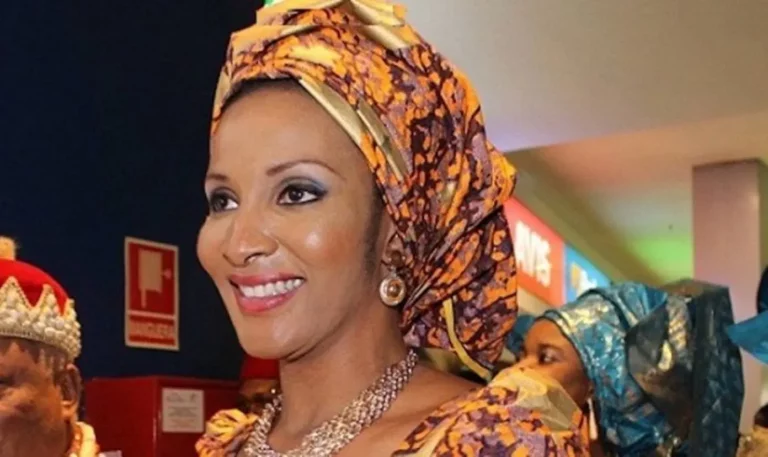
PRESIDENT Bola Tinubu has appointed Bianca Odumegwu-Ojukwu as Nigeria’s Minister of Foreign Affairs.

The appointment followed the resignation of the former minister, Yusuf Tuggar.

The ICIR reported in March that Tuggar resigned from Tinubu’s cabinet to pursue the governorship of Bauchi State ahead of the 2027 general elections.

Odumegwu-Ojukwu, who previously served as Minister of State for Foreign Affairs, now takes over the ministry.

Tinubu also nominated Sola Enikanolaiye as Minister of State for Foreign Affairs.

The appointments are subject to Senate confirmation.

Until his nomination, Enikanolaiye, from Kogi State, served as Senior Special Assistant to the President on Foreign Affairs and International Relations.

He is a career diplomat with over three decades of service. He has held several positions, including Permanent Secretary in the Ministry of Foreign Affairs.

He also served in diplomatic missions in Addis Ababa, Belgrade, Ottawa, London, and New Delhi.

Tinubu said the appointments were part of efforts to reposition Nigeria’s foreign policy for greater efficiency and stronger global partnerships.

He urged the appointees to promote Nigeria’s national interest, advance economic diplomacy, and protect the welfare of Nigerians at home and abroad.

The ICIR reported in March that Tuggar resigned from the cabinet of President Bola Ahmed Tinubu, as he moves to pursue the governorship of Bauchi State ahead of the 2027 general election.


Tinubu sacks NMDPR boss Saidu Mohammed, nominates Rabiu Umar as replacement

0

PRESIDENT Bola Tinubu has sacked Saidu Mohammed as head of the Nigerian Midstream and Downstream Petroleum Regulatory Authority (NMDPRA)

Consequently, he has nominated Rabiu Abdullahi Umar to replace him, but the appointment still requires Senate approval.

This was disclosed in a statement signed by the Special Adviser to the President on Information and Strategy, Bayo Onanuga, on Wednesday, April 29.

The Presidency said the decision was taken in the public interest and in line with the Petroleum Industry Act 2021 to improve regulation of the sector.

Part of the statement reads: “This decision, made pursuant to the Petroleum Industry Act 2021, is aimed at strengthening regulatory effectiveness in the midstream and downstream petroleum sector, in line with the Renewed Hope Agenda.

“Mr Umar is a seasoned executive with over 25 years of experience across the energy, manufacturing, and infrastructure sectors and a proven track record in strategic leadership, operational transformation, and large-scale project delivery. He is a graduate of Accounting from Bayero University and an alumnus of Harvard Business School,” it added.

Until the Senate confirms the new nominee, the most senior official at the agency will act as head.

Tinubu thanked the outgoing chief executive for his service and wished him well.

He also said his administration remained focused on strengthening leadership in key institutions to support energy security and economic growth.

In the past weeks, the NMDPRA, the foremost petroleum regulatory agency in Nigeria, has been involved in some controversies.

For instance, the former NMDPRA CEO, Farouk Ahmed, resigned his position almost immediately after Dangote Refinery allegations thrust the agency into controversy.

The developments came amid a petition filed by Aliko Dangote, the president and chief executive of Dangote Industries Limited, to the Independent Corrupt Practices and other Related Offences Commission (ICPC), alleging abuse of office, corrupt enrichment, and unlawful diversion of public funds by the NMDPRA chief.

On the heels of the allegation, the ICPC said it would investigate a petition filed by billionaire Aliko Dangote against the Chief Executive Officer of the Nigerian Midstream and Downstream Petroleum Regulatory Authority (NMDPRA), Farouk Ahmed, The ICIR reported.


Police dismiss officers involved in Delta shooting

THE Nigeria Police Force said it had dismissed officers involved in the shooting of a suspect, Mene Ogidi, in Effurun, Delta State, on Sunday, April 26.
In a statement signed by the Force Public Relations Officer, Anthony Placid, a deputy commissioner of police, on Wednesday, the Force said the Inspector-General of Police, Tunji Disu, approved the dismissal, following the recommendation of Force Disciplinary Committee (FDC) which investigated them in Abuja.
However, the Force did not provide the officers’ details, including their names.
The Force said all the officers involved in the shooting were moved to Abuja for questioning and would face prosecution after their dismissal.
“The Force Disciplinary Committee (FDC), alongside other internal disciplinary processes, has concluded its review. Findings established unequivocally that the principal officer, ASP Nuhu Usman, acted in gross violation of Force Order 237 and other extant regulations governing the use of firearms. His actions were unlawful, unprofessional, and a clear betrayal of the oath to protect life and uphold the law.
“Consequently, the FDC has recommended the immediate dismissal of ASP Nuhu Usman and other officers found culpable. The Inspector-General of Police has approved the recommendations and forwarded same to the Police Service Commission for ratification in line with due process.
“Upon completion of the administrative procedures, the affected officers will be handed over to the appropriate judicial authorities for prosecution for their roles in the extrajudicial shooting,” part of the statement said.
It noted that the IGP reiterated, in the strongest terms, that the Nigeria Police Force maintained a zero-tolerance stance on extra-judicial actions and abuse of power.
The IGP stated that no uniform conferred the right to take life outside the provisions of the law. stressing that any officer who violated this fundamental principle would face the full weight of disciplinary and legal consequences.
While condoling with the deceased family, the IGP assured the family that incident would not be treated lightly.
“The Force is fully committed to ensuring that justice is not only served but seen to be served, in a manner that reinforces public confidence and institutional accountability.”
“Members of the public are urged to remain calm and law-abiding, as the Nigeria Police Force remains steadfast in its commitment to discipline, professionalism, and the protection of the rights and dignity of all citizens while ensuring accountability at all levels.”
Backstory

The shooting, captured in a widely shared video, had caused strong public condemnation.

Reacting to the video and accompanying public outrage against the killer-cop while featuring on Channels TV “Morning Brief,” on Wednesday, April 29, the command spokesperson, Bright Edafe, said the officer, Nuhu Usman, would face the full wrath of the law.

Edafe stated that the officer’s actions were unprofessional and unjustifiable.

The iCIR reports that the victim was 28 years old. He was said to be an upcoming artiste.

The dismissed officers had acted on intelligence suggesting that the suspect had been caught while trying to send a package containing “a Beretta pistol with four rounds of ammunition.”

However, the police confirmed that the officer in charge of the operation for his arrest violated official rules. “The police officer leading the team, ASP Nuhu Usman, in clear violation of Force Order 237 and the Standard Operating Procedure of the Nigeria Police Force, discharged his firearm, leading to the death of the suspect,” the command spokesperson said in a statement after the video of the killing went viral.

The ICIR reports that the incident adds to a pattern of extra-judicial killings by police officers and other armed state actors in Nigeria.

Efforts to halt the illicit act have failed to yield results as activists, lawyers, journalists, civil society organisations and other citizens frowning at the menace have been tracked, apprehended, tried in court and jailed.

The most notable attempt by Nigerians to halt the police inhumane treatment of Nigerians culminated in the #ENDSARS Protests in 2020, in which many Nigerians were brutally attacked and killed.

Supreme Court sets Thursday for ruling on ADC leadership crisis

0

THE Supreme Court has fixed Thursday, April 30, for judgment in the leadership dispute rocking the opposition African Democratic Congress (ADC)

The apex court had earlier reserved judgment in the matter after parties adopted their final written addresses.

However, on Tuesday, April 28, the David Mark faction of the opposition party petitioned the Chief Justice of Nigeria (CJN), arguing that time was not on its side and urged for expedited ruling.

On Wednesday, the court announced that the judgment would be delivered by 2 p.m. on Thursday.

A five-member panel of the apex court, led by Justice Mohammed Garba, had fixed the matter for judgment after hearing arguments from all parties involved in the dispute.

The case, which has generated tension within the party, centres on the leadership tussle over the control and direction of the ADC ahead of future political activities.

In a letter addressed to the CJN through its counsel, S.E. Aruwa (SAN) & Co., the Mark-led faction warned that further delay in the judgment could jeopardise the party’s constitutional right to participate in the 2027 elections.

According to the letter, the unresolved appeal threatened to leave the party without recognised leadership, especially as the Independent National Electoral Commission (INEC), listed as the fourth respondent, had allegedly begun acting on the lower court judgment by moving to withdraw recognition of the ADC leadership.

The counsel argued that the development stemmed from Appeal No. CA/ABJ/145/2026, which sought to de-recognise the party’s leadership, creating what it described as a leadership vacuum despite ADC remaining a registered political party.

The party further noted that with INEC’s revised timetable for the 2027 general elections already released, ADC risked being shut out of the electoral process if the Supreme Court failed to deliver judgment promptly.

The ICIR reports that the leadership crisis in ADC began in 2025 following the influx of major opposition figures into the party as part of efforts to build a coalition platform ahead of the 2027 presidential election.

Among those who joined the party were former Vice President Atiku Abubakar, former Kaduna State Governor Nasir El-Rufai, former Minister of Transportation Rotimi Amaechi, former Osun State Governor Rauf Aregbesola, and David Mark.

The politicians, many of whom defected from the Peoples Democratic Party (PDP) and the All Progressives Congress (APC), adopted the ADC as a platform to challenge President Bola Tinubu in the next general election.

The crisis deepened after the resignation of the party’s former executives led by Ralph Nwosu and the emergence of a new National Working Committee headed by Mark on July 29, 2025.

This triggered a legal challenge by Nafiu Bala, a former vice-national chairman of the party, who approached the Federal High Court in Abuja, seeking recognition as the legitimate national chairman under the party’s constitution.

While the Federal High Court initially ordered parties to maintain the status quo, the Court of Appeal later upheld the order and directed all parties, including INEC, to maintain existing arrangements pending further hearing.

Following the ruling, both factions wrote to INEC on March 16, each seeking recognition.

INEC later removed Mark’s name as national chairman and Aregbesola as national secretary from its website on April 1, stating that it would not recognise any faction until the legal dispute was resolved.

The development triggered protests in Abuja, with party members accusing the electoral commission of bias and warning that the unresolved crisis threatened the party’s internal democracy.

The Mark-led faction subsequently approached the Supreme Court to challenge the Court of Appeal ruling, with the apex court reserving judgment on April 22 before fixing Thursday for final determination.