Home Blog Page 47

Terrorists’ incursion in Southwest: Akure North residents in growing panic

TERRORISTS are staging increasingly audacious incursions into Nigeria’s South-West, turning Ondo State into another testbed for their pernicious operations. While Akure North LGA is the most notorious for banditry and kidnapping in the region, its neighbour, Owo LGA, has had its share of the crises.<

A widow’s pain from kidnappers’ strikes

ENO Offordum, a mother of four and resident of Ilu-Abo, Akure North, is currently mourning the killing of her husband by kidnappers who stormed the community in February 2026.

John Offordum, 36, was about to drive into his home while returning from a burial in his home state, Anambra, when terrorists gunned him down. Another resident, identified as Mama Christianah, and her daughter were also shot. The woman, hit by bullets in the womb, was pronounced dead at the Federal Medical Centre, Owo, according to the Chairman of Ilu-Abo Landlords Association, Johnson Adaja, a clergyman.

During the operation, the gunmen whisked away, a proprietress in the community, who was later freed after coughing up a 15-million-naira ransom. She never returned to the village after regaining her freedom but fled to Lagos, abandoning her school, Adaja said.

For Mama Christianah and Offordum, the Federal Medical Centre could not attend to them because its staff were on strike when they were rushed there.

While the former died at the facility, the latter was moved to Afe Babalola Teaching Hospital, Ado-Ekiti, where he died after two days at the hospital.

Eno Offordum. PC: Marcus Fatunmole/The ICIR

He left behind his 31-year-old wife and children, including a two-month-old boy in perennial pain. He will be buried on April 25, 2026, in his hometown, Unubi, Nnewi South, his wife told The ICIR in Oba-Ile town, near Akure, where she runs her husband’s small shop.

Eno lamented the challenges she would face in fending for the four children, including paying their tuition fees. The children are Godswill (15), Mary (four), Esther (three), and John (four months).

“We were together struggling to make it, but things were not easy,” the woman said.

“Before this thing, the community was not safe because every day, you heard stories of kidnapping, shooting, and killings. He was a businessman selling building materials. My husband was a very calm person. He hardly talked, and he never had a problem with anyone.

“His death has been affecting our four children and me very badly; even to feed is hard for us. We are even thinking about how we will pay school fees because school resumes soon. Life has never been easy for us since my husband’s death. Currently, three of the children are in school,” Eno, an indigene of Ibam, Ini LGA, Akwa Ibom State, added.

The terrorist attack that led to Offordum’s death was one of the deadly onslaughts on Ilu-Abo in 2026, the community monarch, and former Secretary to the Government of the Federation, Olu Falae, told The ICIR.

The attacks and thousands of others across Nigeria are the reasons the country currently ranks as the fourth most terrorism-impacted nation in the 2026 Global Terrorism Index. It has also culminated in more than half of its 36 states being declared unsafe.

John Offordum’s shop in Oba-Ile community now managed by his wife.  PC: Marcus Fatunmole/The ICIR

Nigeria sees deadly terrorist and other criminals’ attacks almost on a daily basis, especially in the North-East, North-West, and North-Central. Terrorists, whom the Federal Government once claimed it had degraded, are making a brutal comeback, taking the fight to military bases, and killing scores of soldiers, including generals.

With the additions of other terror groups, namely Lakurawa, the Indigenous People of Biafra (IPOB) and bandits, Nigeria, which also battles herders-farmers conflicts and other crises, has remained more unsafe than ever. The crisis keeps ballooning despite the Nigerian government declaring all criminal groups in the country as terrorists.

From Sokoto to Maiduguri, Plateau to Niger and other parts of the nation, thousands of women, men and children have been left in agony after losing their loved ones, since the beginning of insurgency in the country at the start of this century.

Celestial Church in debt over ransom to secure abducted members

The ICIR contacted more victims of terrorism in Akure North, including the Celestial Church of Christ in Uso community, Owo LGA. They opined that insurgents were attempting to gain entry into the entire South-West through Ondo State.

Two of the church leaders declined to give their names when contacted. They said abductors whisked away 18 members from the church on February 25, 2026, after dropping those who were too weak to trek in the bush.

“It was those people who alerted the rest of us and prompted us to call soldiers. We felt that the soldiers would get them, but they had gone too far into the forest,” one of the leaders said.

Celestial Church of Christ in Uso, Owo LGA. PC: Marcus Fatunmole/The ICIR

The church said it paid the kidnappers N9 million after days of negotiations. The gunmen had demanded N100 million.

“We thank God that they escaped from their captors’ den. We are aware of other incidents where abductees were killed. A pregnant women kidnapped in our church was released and put to bed four days later. We saw an abducted person on social media who gave birth to twins, and her captors threw the babies to dogs.”

The leaders accused the Nigerian government of abandoning the citizens to kidnappers. They said the church still owed debts because it borrowed the ransom.

“We sold cars to raise that money. We took contributions from members to raise that money. We also borrowed from people outside the church. Did anyone in the government contribute a dime to the ransom? The most important thing is that God should take absolute control. This fight is not ours here but God’s,” the church leaders stated.

The 34-year-old worship centre serves as a residence for some of its leaders, while scores of its members come there for prayers daily.

Ex-SGF, now community monarch, Olu Falae, speaks

Olu Falae expressed shock at the turn of events in Nigeria’s security architecture, especially in his village.

The monarch, who was kidnapped by herders on his farm in 2015, showed the reporter a scar on his hand. He narrated how safe he and other Nigerians lived without fear of insecurity when he was growing up.

“At the age of 77, I was kidnapped on my own farm. As a child, I was free to travel throughout Nigeria. That summarises the story for you,” the 87-year-old monarch stated.

He said recent attacks occurred in Ilu-Abo because the community was too accommodating to visitors and was not prepared for the onslaughts. He vowed that his people, with government’s support, were ready to defeat the assailants.

A major road in Ilu-Abo community. PC: Marcus Fatunmole

The ICIR reports that five people were killed in the community, while several others were whisked away by gunmen in the past months, leading to protests by residents and blockage of the Akure-Owo Road.

Ilu-Abo (meaning a place of refuge) is an agrarian village that accommodates every Nigerian who cherishes farming. The community’s land, like that of others in the LGA, is very fertile for agriculture. But it has turned into an epicentre of abductions and killings by terrorists.

The monarch explained that kidnappers had attacked the community three times in recent months, killing and abducting residents.

He blamed the attacks on herders and Fulanis, vowing that his community was prepared to face anyone who dared the current security architecture in the community, including trucks of soldiers, police and Amotekun corps officers who patrol the community day and night and have bases in the village.

Ilu-Abo also has its own security network, which mounts checkpoints in different locations and protects the community.
But the initiative comes with a price for every household, which pays a N5,000 levy monthly to support security operations in the village.

“With what we are doing, we hope that no kidnapping will ever take place here again. If any kidnapper comes, those security forces will deal with him,” Falae said.

There is collusion from within

The monarch, however, revealed that indigenes were colluding with herders to abduct residents in the LGA because “they see the crime as ‘good business”.

For instance, he denounced the attribution of the abduction of nurses at the primary health centre at Oke-Ijebu, Akure, as the handiwork of herders.

“Those were not Fulani people. Fulanis don’t operate in towns. They operate in the bush. These were our own people. They’ve learnt from the Fulani that there’s money in this business.

Herders, locals behind abductions, killings in Ilu-Abo, Akure North - Olu Falae
Oba Olu Falae, former Secretary to the Government of the Federation

“Yes, the Fulanis are the main perpetrators of these criminal acts, but some of our own indigenous people have learnt from them and are making money. They are organising kidnappings on their own. Some are even kidnapping themselves and announcing they’ve been kidnapped to make money.”

A farmer in the community and former supervisory councillor in Akure North LGA, Biodun Adefela, lamented how farmers could no longer farm in Ilu-Abo.

He named several residents who were abducted in the community, including a US-based Nigerian who established a fertiliser firm in the village and was kidnapped. N30 million was paid to rescue him, he stated.

Between 10 and 15 people have been kidnapped since the crisis started. Five others have also been killed; he said, calling for the establishment of a military base near Ilu-Abo to scare the gunmen.

Leaders raise concern over residents’ safety on farms

The security committee in Iju, one of the two towns serving as the headquarters of Akure North,  expressed worry about the safety of people on the community’s farms.

The ICIR met some of the town’s Security Committee members, namely Solomon Ogunbuyide (a clergyman and the committee chairman), Kola Omoloju (a former supervisory councillor), Ezekiel Enikanoselu (a chief), and the community youth leader, Ogundeji Jimoh.

They said insecurity was crippling farming activities in the town.

Ogunbuyide said, “This thing is happening every day. The issue of the Fulani coming into the South-West has been on for a long time. In our community here, apart from the experience of Dele Fagoriola (former Akure North LGA chairman who was kidnapped in 2018), we had the children of Baba Gabriel Olotu in 2023, whose son was abducted alongside his bride-to-be.

Some members of the Iju Community Committee Chairman. PC: Marcus Fatunmole/The ICIR

“There was another farmer, Akinmeji from Okitipupa, an engineer, who was kidnapped on his farm in 2020. In the course of searching for Akinmeji, another boy here in the town, Daniel, was killed by the abductors.

Enikanoselu recalled another victim, an Igbira man and his boss’ friend who were kidnapped. The man paid N4.5 million ransom, while his boss friend parted with N2.5 million before he was freed, he stated.

The community has had four incidents of abduction and two killings, said its youth leader.

He explained that herders used the Iju community, bordering Ikere Ekiti, to navigate Ekiti State and other parts of Akure North.

The community appreciated the efforts of security agencies, but said Amotekun, which it said was very effective in the town, lacked the weapons that matched those of the kidnappers.

Insecurity is keeping farmers at home because of kidnappers waiting to whisk them away from their farms for ransom, Omoloju noted.

Olu of Eleyowo

Another monarch in the LGA, Olu of Eleyowo, Adesina Agunbiade, told The ICIR that his community suddenly observed that bandits had stormed the area, abducting people and taking over everywhere.

“Right now, it has become a big problem for us because nobody can go to the farm again. Our children are afraid to go to school, and market women live in perpetual fear.”

Olu of Eleyowo Community, Adesina Agunbiade. PC: Marcus Fatunmole/The ICIR

He appreciated Amotekun and other security agencies for ensuring that the criminals do not have full control of the LGA.

The monarch decried the influx of criminals in forests and communities in the LGA, calling on traditional institutions in the state to rise to the challenge and ensure that insecurity does not subdue the state.

“These kidnappers don’t demand little money. Their ransoms are in millions, and they can keep their hostages for weeks or even kill them. Most times, we ask ourselves where we get such money.”

He confirmed that at least five people had been killed in Ilu-Abo, which borders his community.

“They have taken over our farms. Fulanis are the major perpetrators. They are the herders. The criminals always hide among the cows. They also hide their weapons and personal effects among the cows while transporting them. I’m appealing to the Federal Government to help us. Very soon, it may be very difficult for our children to go to school. People no longer sleep in the community at night.

“During the day, farmers will be unable to go to their farms. We are farmers. You can imagine our agonies. And this is the gateway to the state secretariat and the South-West. The airport is very close to us here. It will be a disaster if these people take over this place and the South-West from us.”

The road linking Eleyowo, Akure Airport to Oba-Ile and Akure town. PC: Marcus Fatunmole

Northern youth behind kidnappings, – Amotekun

The Corps Commander, Ondo State Security Network Agency, Adetunji Adeleye, blamed the crisis on the influx of youth from northern Nigeria. He said the youth without jobs troop into the state, hiding among cows and loads before vanishing into forests and different communities in the state.

“I raised an alarm about a year ago on the heavy influx of young men coming from the North into the state. The majority of them don’t really have any work to do. The best you can find them with is coming with motorbikes, and most of the time, they hide under cows and loads.

“Last year alone, we sent back well over 1,000 of them. The state government would hire trucks and take them back since they don’t know where they were going or why they were coming this way.”

While acknowledging Nigerians’ right to live or choose to work wherever they like in any part of the nation, he expressed fears that allowing jobless youth from the North into the state without restriction could threaten security.

“You are supposed to justify why you are coming, why you are going, and somebody must be able to receive you. There must be work, school or something. The majority of these people came in their thousands into the state. They are the architects of the problems we have today.”

Corps Commander, Ondo State Security Network Agency, Adetunji Adeleye

He explained that Akure North had some of the biggest forests in the South-West, making them a refuge for herders and criminals. According to him, Ondo State is a gateway into the South-West, making attacks high and persistent.

He said the state government had embarked on profiling all herders and occupants of its forests.

While noting that some indigenes of communities were collaborators by providing logistics to kidnappers and other criminals, he expressed Amotekun’s readiness to contain the crisis, working with other sister agencies.

No terrorists in Ondo but there are abductions-Police 

The Ondo State Police Command denied the presence of terrorists in the state, while admitting there had been abductions and other attacks.

“For record purposes, we do not have terrorists or bandits in Ondo State,” the command spokesperson, Ayanlade Olushola, a deputy superintendent of police, told The ICIR, when contacted in his office.

When asked by the reporter to name the actors behind recurring kidnapping and other criminal activities in the state, Olushola was evasive.

“The command is aware of pockets of crime we are having, and we have been facing them head-on…The geographical nature of Akure North is the presence of large forests and rocky area. Those forests are places where we have the farmers’ tents and camps,” he stated.

Spokesperson, Ondo State Police Command, Ayanlade Olushola. PC: Marcus Fatunmole/The ICIR

We’re addressing challenges – LG chairman

Chairman of Akure North Local Government, Johnson Ogunbolude, said his administration was working with all security institutions in the state to surmount the challenge.

“We are trying to put up our own local police, that is vigilantes. I have hired a retired general to help me train them. That’s what we’re currently working on. We’re hoping to equip them with kits and ammunitions they will need to carry out their responsibilities.

“I contacted traditional rulers in the local government, and they gave me responsible people who will ensure we have capable local police. I’m assuring our people that with collective support, peace will return to our communities by God’s grace.”

Arewa, Myetti Allah fail to react to allegations

The ICIR contacted Ondo State leaders of Arewa (a group comprising mostly Hausa people) and Myetti Allah, a prominent association of herders.

Goniya Garba is the Arewa leader and doubles as chairman of cattle markets in the state. Similarly, Maunde Aliyu is the state leader of Myetti Allah.

Garba refused to speak with the reporter on the phone excepts he sees him face to face. He said he had to assemble his people with him to address the reporter. He rebuffed all appeals that the reporter was unable to get his phone number while on the field for the report in the state.

The reporter also sent the questions he wanted to ask him to his phone through text and WhatsApp messages. He refused to respond to them.

Likewise, the Myetti Allah leader did not respond to the reporter when contacted on the phone. He listened to the issue but asked the reporter to call him back. He didn’t answer subsequent calls. He also did not respond to text and WhatsApp messages sent to him on the issue.

Akure Airport gate at Eleyowo community. PC: Marcus Fatunmole/The ICIR

Timelines of high-profile abductions, attacks in Akure North, Owo LGAs  

The rate of killings and abductions by terrorists has risen sharply in Akure and Owo LGA in recent years.

Notable kidnappings in the LGAs include the abduction of former Akure North LGA, Dele Fagoriola, on his farm in 2018. He was whisked away by herders, and his family paid N1 million ransom to secure his release.

In 2022, terrorists attacked St Francis Catholic Church in Owo, killing 40 people and injuring many others. The suspected insurgents are currently facing trial in court.

Since 2025, kidnappings and killings have risen sharply in the two LGAs.

In March 2025, suspected terrorists swooped on Aba Alajido, Aba Sunday, Aba Pastor and Ademekun communities in Akure North LGA and reportedly killed 20 people.

On January 1, 2026, bandits attacked a police station in Ipele, Owo, and set it ablaze.

On February 19, 2026, gunmen killed the monarch of the Agamo community in Akure North.

Two days later, bandits reportedly swooped on the Eleyowo community in Akure North and abducted a couple.

Less than a week later, terrorists stormed a Celestial Church in Owo and whisked away 18 worshippers.

In March, the Federal Airport Authority of Nigeria (FAAN) and the Nigeria Police Force disagreed over the arrest of four suspected bandits at the Akure Airport by security forces.
Most recently, suspected bandits reportedly killed a woman and her daughter at a poultry farm at Igushi, Ala, Akure North on April 9.

ADC affirms Mark’s leadership as Atiku, Obi say democracy under threat

THE African Democratic Congress (ADC) has concluded its national convention with delegates overwhelmingly voting to amend the party’s constitution.

The convention, held on Tuesday in Abuja, featured many stalwarts in the party such as the former vice president, Atiku Abubakar, former governors Peter Obi, Rabiu Kwankwaso, ministers  among others.

At the end of voting, the Chairman of the ADC Electoral Sub-Committee and former Governor of Imo State, Emeka Ihedioha, announced the result.

He said 1,576 delegates were accredited, while 11 votes were voided. A total of 1,471 delegates voted ‘yes’ to amend the constitution, representing 94 per cent.

“Distinguished delegates, by virtue of this result announced, it means that the constitution of the African Democratic Congress has today been duly amended by this convention that took place at the Rainbow Event Centre, Abuja,” he said.

Earlier, before voting commenced, the Chairman of the Legal and Convention Processes Committee, Olumide Apata, led the ratification of resolutions on key issues concerning the party at the 97th, 98th and 99th National Executive Committee (NEC) meetings.

Chinedu Idigo, the National Organising Secretary, outlined the resolutions passed, including a waiver of membership requirements, the suspension of zoning provisions for executive positions, and the suspension of the rule requiring that a vacant office be filled by someone from the same zone as the previous occupant.

The 99th NEC meeting of the ADC dissolved the Chief Ralph Nwosu-led National Working Committee with immediate effect, while the David Mark-led NWC assumed full responsibility for running the affairs of the party. The resolution was ratified by the convention.

At the convention, the party also announced the expulsion of factional chairman Nafiu Bala and the member representing Yagba Federal Constituency of Kogi State, Leke Abejide.

It confirmed the expulsion of other members, including Kingsley Temitope, Noman Obinna, Kennedy Odion, Stella Chukwuma, and four others over alleged anti-party activities.

The motion for their expulsion was moved by Binos Yaroe, a senator, and seconded by Abdussamad Dasuki.

At the convention, former vice president Atiku Abubakar accused the Independent National Electoral Commission (INEC) of undermining Nigeria’s democracy, alleging that the electoral body was being used to frustrate the will of the people.

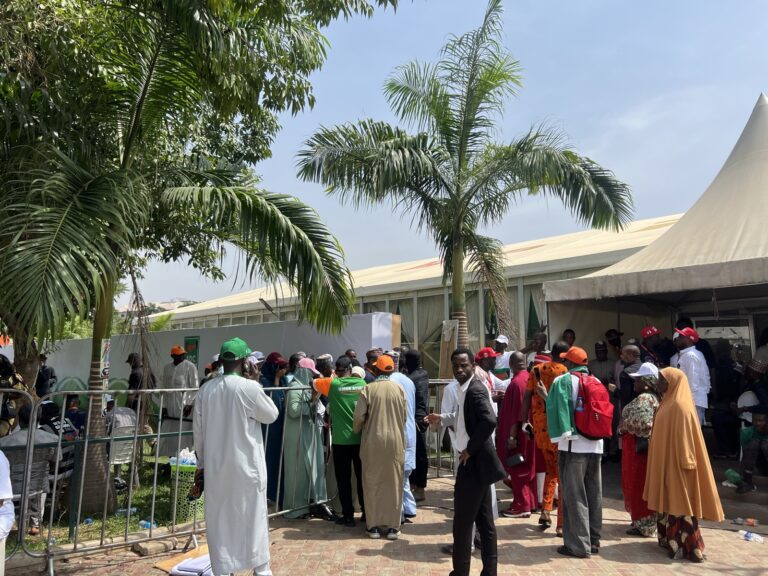
Participants at ADC convention

“I will not end this without indicting the chairman of INEC and INEC itself,” he said. “It is clear, it is obvious, the evidence is there. INEC is being used to scuttle democracy in this country.”

Atiku warned that Nigerians would resist any attempt to undermine democratic governance, drawing parallels with the country’s struggle against military rule.

“We fought the military to bring democracy in this country, and we are going to fight to defend it,” he said.

Also speaking, former Labour Party presidential candidate Peter Obi warned that Nigeria was becoming increasingly divided and drifting towards deeper economic and security crises.

“We need to work as a united Nigeria. For the sake of Nigeria, the country is so divided; we need unity. The present government has ensured that it remains more divided,” he said.

Obi cautioned that worsening insecurity and rising poverty levels were signs of a country in decline, urging Nigerians and political leaders to act in the interest of future generations.

“We have huge debts, and we have borrowed more, and we are heading to disaster… we are drifting,” he added.

Similarly, in his remarks, the party’s National Chairman David Mark said he had, as a member of the Peoples Democratic Party, attended several national conventions, none of which he said matched the organisation of Tuesday’s ADC convention.

He described the convention as an “excellent performance” and said it marked the beginning of the party’s journey to Aso Rock in 2027.

“Today marks the beginning of our journey to the Villa, and all of you here are part of this history. By next year, when we move to the Villa, I will remind you again,” Mark said.

Police arrest 33 over Kwara church attack, recover anti-aircraft launcher

0

OPERATIVES of the Force Intelligence Department’s Intelligence Response Team (FID-IRT) have arrested 33 suspected members of a criminal network believed to be behind terrorism, kidnapping, and armed robbery in Kwara and neighbouring states.

The police recovered an anti-aircraft launcher and other sophisticated weapons in the process.

The Force Public Relations Officer, Anthony Placid, a deputy commissioner of police, made this known on Monday while addressing journalists at the FID-IRT headquarters in Abuja.

He explained that the arrests followed a series of coordinated operations carried out across Kwara and Kogi states, stemming from investigations into the November 20, 2025 attack on a Christ Apostolic Church in Eruku, Kwara State.

The ICIR reported that the incident, saw armed bandits storm the church during an evening service. At least three worshippers were killed, while 38 others, including the pastor, were abducted. The attack, which was broadcast live, drew widespread outrage across the country. All the victims were later rescued through a joint security operation.

According to Placid, early findings from the investigation indicate that the suspects were involved in a range of serious crimes, including criminal conspiracy, armed robbery, kidnapping, cattle rustling, culpable homicide, illegal possession of firearms, arms trafficking, and terrorism.

Items recovered from the suspects include seven AK-47 rifles, seven magazines, one anti-aircraft launcher, 32 rounds of 7.62mm live ammunition, five walkie-talkie communication devices, and a camouflage hydration backpack.

Providing more details, Placid said: “Following the attack on the C.A.C in Eruku Town, Ekiti LGA of Kwara State on 20th November 2025, operatives of the IRT, acting on credible human and technical intelligence, conducted coordinated operations across Kwara and Kogi states.

“Preliminary investigation revealed that the gang was involved in criminal conspiracy, armed robbery, kidnapping, cattle rustling, culpable homicide, unlawful possession of firearms, arms dealing, and acts of terrorism, for which a prima facie case has been established.

“The gang members were arrested at multiple locations, including Gbugbu, Ora-Ago, Baballa, Kaiama, Awi, Charagi, Patigi, and Okeode. During operations, the suspects abandoned an anti-aircraft rifle and three AK-47 rifles, which were subsequently recovered by the police. Investigation is ongoing to apprehend any fleeing members of the gang to recover additional operational weapons.”

The police also released the names of the 33 suspects arrested in connection with the case. They include: Abubakar Usman, also known as Siddi, 26; Ibrahim Sa’idu, alias Idi Soho, 35; Adamu Mohammad, aka Baushe/Dogo, 58; Abdullahi Abubakar, aka Bature, 35; Abubakar Abdullahi, aka Turke, 35; Yusufa Isah, aka Munyaye, 50; Zubairu Abubakar, 35; Shaibu Usman, 35; Mohammed Lawai, aka Jalel, 40; Dahiru Adamu Mohammedu, 50; and Mohammadu Audu, aka Alti, 40.

Others are: Dahiru Alh Ahmadu, 25; Iliyasu Umar, aka Magaji, 38; Usman Alh Mati, aka Saidu, 30; Umar Mohammed, aka Mulandan, 25; Shehu Usman Mohammedu; Umar Mohammed Jos, 25; Mohammadu Ali, aka Jabbi/Ruwa, 30; Abubakar Mamman, 28; Mohammadu Alti, 32; Idris Auwal, aka Samaila, 26; Ajiboye Biodun, 20; Lawali Shehu, 32; Mohammadu Sani, aka Kachalla Ruga, 65; Musa Ado, aka Maidu, 65; Abubakar Adamu, aka Buba, 26; Mohammadu Zangina, aka Zangina, 23; Abubakar Shaibu, aka Jijji, 20; Mohammadu Salihu, aka Fulani, 25; Mohammadu Musa, aka Musa, 23; Abubakar Sani, aka Siddi, 25; Yusufa Isah, aka Leriya, 22; and Mohammadu Ibrahim, aka Iro, 21.

The 33 suspects are part of a larger group of 50 individuals paraded by the police on Monday as part of ongoing nationwide efforts to dismantle criminal networks.

In a separate statement issued on Tuesday, Placid said the arrests were made during what he described as a “strategic offensive against syndicates that have long threatened the peace of the nation” since January.

He added that key suspects were being prepared for prosecution, while security operatives were still tracking other fleeing members of the group and working to recover more illegal weapons.

Days after the incident, President Bola Tinubu announced via a post on X that all those abducted from the church had been rescued.

More knocks for World Bank over petrol imports advisory for Nigeria

THE World Bank’s petrol imports advisory to Nigeria is attracting more condemnations as Nigeria’s local refineries continue to meet demands and have excess for export.

The World Bank, in its Nigeria Development Update released on April 7, recommended that Nigeria should prioritise petroleum imports.

According to the World Bank, imported fuel is cheaper than the domestically refined version, with Dangote Refinery already registering its footprint in petroleum export worldwide.

Days later, the World Bank deleted from its website the Nigerian Development Updates report and clarified that its recommendation was not a blanket stamp on fuel importation but a broader one on energy security.

“In the case of Nigeria, the focus should be to provide targeted support to support the vulnerable people through their functioning social safety net system, and the World Bank Group stands ready to step up its existing support,” the Bank had said.

The importation advisory has continued to draw criticism from several industry stakeholders put the World Bank’s suggestions under intense scrutiny.

“The submission by CPPE is that instead of talking about increasing importation, we should focus on domestic production, energy security, self-reliance and conservation of foreign exchange. Focus should be on supporting private refineries to cover importation gaps, not the World Bank’s model of importation,” former Director General of Lagos Chamber of Commerce, Muda Yusuf, told The ICIR.

He stressed that countries that are affected by the blockade of Strait of Hormuz are currently going through crises.

“Dangote and other modular refineries must be supported for energy security, and not importation. There’s a need to protect domestic production and the domestic economy. As we speak now, many farmers haven’t recovered from temporary importations that were done years ago,” he added.

He noted that the World Bank’s focus should be to give technical and technological support to Nigeria to increase local production.

Already, Dangote Petroleum Refinery & Petrochemicals has recorded a major milestone in Nigeria’s energy history. It exported 44,000 barrels per day (b/d) of gasoline in March 2026.

This record has positioned the country as a net exporter of petrol for the first time, with a surplus of about 3,000 b/d.

The landmark development marks a decisive turnaround for Nigeria, Africa’s largest oil producer, which for decades depended heavily on imported refined petroleum products.

Industry analysts say the export surge, driven by rising refinery output, is expected to generate significant foreign exchange inflows, easing pressure on the forex market and supporting macroeconomic stability.

“This is a good development for the deregulated market in Nigeria as local demands are almost being met without complete reliance on imports,” a professor of energy economics, Adeola Adenikinju, told The ICIR.

In a notable expansion of its international footprint, the refinery also exported gasoline to East Africa for the first time, shipping a 317,000-barrel cargo to Mozambique.

The move reflects growing regional demand as buyers diversify supply sources away from the Middle East amid ongoing disruptions. Another gasoline cargo is scheduled for delivery to Beira, Mozambique, in April, informed sources at the refinery told The ICIR.

Data from market intelligence firm Kpler showed that Nigeria’s gasoline imports dropped sharply to 41,000 b/d in March—the lowest level on record.

Meanwhile, crude supply to the refinery rose to about 565,000 b/d, the second-highest intake since the 650,000 b/d-capacity facility began operations in late 2023.

The figures indicate strong processing rates and improving product yields.

Analysts say Nigeria’s transition from a major petrol importer to an exporter is set to reshape regional trade flows and intensify competition in global fuel markets.

UPDATED: Delegates flee Abuja heat as ADC convention struggles to start

THE African Democratic Congress (ADC) convention was thrown into disarray on Tuesday after intense heat inside the event hall forced delegates and dignitaries to step outside intermittently.

Despite the presence of air conditioning units, attendees said the systems were either not working, leaving the packed hall stifling and uncomfortable.

As of 1:30 p.m., proceedings had yet to fully commence, with many dignitaries still being awaited.

Several delegates were seen fanning themselves and rushing out for fresh air, while others poured water on their heads to cope with the heat. Among them was a former Kogi governorship candidate and senator, Dino Melaye, who emerged visibly drenched in sweat and was observed cooling off outside the venue.

The situation disrupted sittings, with constant movement in and out of the hall as participants struggled to endure the conditions.

The disruption adds to the controversy trailing the convention, which had earlier been hit by a last-minute venue crisis.

The ICIR reports that the discomfort arose largely from the Federal Capital Territory Administration’s (FCTA) alleged refusal to approve the venues requested by the party for the convention.

Venues including the Eagle Square and the Velodrome at the Moshood Abiola National Stadium were allegedly denied the party.

Consequently, the ADC, which had at least 3,000 delegates for the convention had to make do with the Rainbow Event Centre at Area 8, which organisers said was not conducive for the convention.

The party had raised the alarm, Thursday night, less than 20 hours to the convention, that the FCTA was threatening to revoke the licence of the venue should the event hold on the premises.

However, the party vowed it would go ahead with the convention, arguing that it had a contract with the facility and had made all payments to use the venue.

NOTE: This report was updated to show that the discomfort suffered at the convention by delegates was largely caused by the party’s failure to get a conducive venue for the event.

Supreme Court fast-tracks PDP appeals, sets April 22 for hearing

THE Supreme Court of Nigeria has fixed April 22, 2026, to hear appeals arising from the protracted leadership crisis within the Peoples Democratic Party (PDP).

The appeals were filed by a faction led by former Minister of Special Duties, Kabiru Tanimu Turaki, contesting the March 9 judgment of the Court of Appeal, which upheld earlier rulings barring the party from proceeding with its controversial national convention outcomes.

A five-member panel of the apex court, headed by Mohammed Garba, granted an application for accelerated hearing on Tuesday, April 14.

The presiding judge ordered a shortened timeline for filings, directing respondents to submit their briefs within five days, while the appellants are to respond within two days.

Backstory

On March 9, 2026, the Court of Appeal in Abuja dismissed the Turaki’s PDP attempt to overturn a Federal High Court judgment that restrained the Independent National Electoral Commission (INEC) from recognising the outcome of its Ibadan convention.

Delivering judgment, a three-member panel of the appellate court unanimously resolved all four issues raised by the appellants against them, ruling that the appeal lacked merit and affirmed that the lower court acted within its jurisdiction.

According to the appellate court, the plaintiffs had the legal standing to institute the suit as part of efforts to protect their democratic rights.

The court further rejected the PDP’s claim that it was denied fair hearing during the proceedings at the trial court.

As part of its ruling, the appellate court ordered the Turaki-led PDP to pay N2 million as costs, describing the appeal as frivolous.

Earlier, the Federal High Court  had held that the party must comply with the Electoral Act and its internal regulations before any convention outcome could be recognised.

On December 22, 2025, INEC also declined to recognise the new leadership, citing existing court orders and ongoing legal disputes. The commission maintained that pending appeals did not invalidate subsisting judgments, reinforcing its refusal to update the party’s National Working Committee list.

The INEC referenced two Federal High Court rulings in Abuja in October and November 2025, which restrained it from giving effect to the outcome of the Ibadan convention.

The electoral commission noted that pending appeals did not automatically stay the execution of these judgments and emphasised that it remained bound by the law. A letter signed by INEC Secretary, Rose Oriaran-Anthony, explained that, in light of the suits, the commission could not update or recognise the list of national officers elected at the Ibadan convention.

In January 2026, another ruling nullified the convention and barred officials who emerged from it, including Turaki, from acting as national officers.

Roots of dispute

The PDP’s internal crisis predates the Ibadan convention. The crisis in the party traces back to the build-up to the 2023 general elections when a rift emerged between supporters of former Vice President Atiku Abubakar and a group of governors led by the Minister of the Federal Capital Territory, Nyesom Wike, who was Rivers State governor at the time.

During the party’s presidential primary, a powerful bloc of governors led by Wike, known as G5, demanded that the party’s presidential ticket be zoned to the South following the eight-year administration of former President Muhammadu Buhari, who was from the North.

Abubakar and several stalwarts of the party in the North disagreed with the proposal, leading to protracted rift among party members. The former vice president eventually secured the PDP presidential ticket after defeating other aspirants, including Wike, at the party’s primary.

The outcome deepened divisions within the party. Wike and some of his allies withheld their support for Abubakar during the 2023 presidential election.

The election was eventually won by Bola Tinubu of the All Progressives Congress (APC), after defeating Atiku and Peter Obi of the Labour Party.

After the election, Tinubu appointed Wike as Minister of the Federal Capital Territory, a move that further intensified internal disagreements within the PDP. Although Wike accepted the ministerial position in an APC-led administration, he retained his membership in the PDP.

Some party leaders, including Oyo State governor Seyi Makinde, Bauchi State governor Bala Mohammed, and PDP chieftain Bode George, have publicly criticised Wike’s role in the party and accused him of engaging in anti-party activities.

The Wike faction of the PDP recently held a parallel convention in Abuja and now reportedly occupies the party’s headquarters after it was sealed for weeks by the Nigeria Police Force.

El-Rufai granted bail, to remain in custody pending fulfilment of conditions

0

THE FEDERAL High court in Kaduna has granted bail to former Kaduna State governor, Nasir El-Rufai, following his arraignment on charges brought against him by the Independent Corrupt Practices and Other Related Offences Commission (ICPC).

El-Rufai was taken into custody after a court session earlier in April 2026, as the court fixed a later date to rule on his bail application. The court had adjourned the matter to April 14, 2026, for a decision on whether he should be granted bail or not.

According to reports, during earlier proceedings, journalists were not allowed into the courtroom. This development raised concerns about how the trial was being handled. The case also faced delays after the prosecution introduced an amended nine-count charge against El-Rufai.

The amended charge made changes to the earlier case, removing Amadu Sule, who was initially listed as a co-defendant, and leaving El-Rufai as the only accused facing trial. His lawyer, Ubong Akpan, a senior advocate, said the defence team was not informed ahead of time about the new charges.

“The charges are entirely new to us. They were given to us this morning while we were already in court. That is why the matter could not proceed,” Akpan had said.

Following this development, the judge, Darius Khobo, adjourned the matter to April 14, for the hearing of the bail application.

During the bail hearing, El-Rufai’s legal team asked the court to grant him bail, stating that he is willing to comply with any conditions set by the court. The prosecution opposed the application, arguing that he could interfere with witnesses.

After hearing both sides, the court granted bail to the former governor. The court granted him bail in the sum of N100 million with sureties, including conditions that he must provide responsible guarantors. Details of the full bail conditions were not immediately made public at the time of reporting.

El-Rufai is facing charges filed by the ICPC, including allegations that he approved the release of about N11 billion from Kaduna State funds to an unregistered company for a light rail project that was not carried out. He is also accused of approving and receiving about N289.8 million as severance allowance beyond what is allowed by law.

Further allegations include the handling of more than $1.08 million from a World Bank loan, the award of a N4.6 billion CCTV contract in Kaduna in violation of procurement rules, and involvement in an alleged plan to bribe federal investigators.

The former governorhas denied all the allegations and pleaded not guilty in court.

The ICIR reports that he is also facing a separate 10-count charge before a Federal High Court, where he was earlier arraigned before a judge, Rilwan M. Aikawa, on allegations related to money laundering and unlawful handling of public funds.


ADC alleges pressure to revoke Abuja venue licence ahead of convention

0

THE African Democratic Congress (ADC) has alleged that its planned national convention venue in Abuja is under threat, claiming that the Federal Capital Development Authority, FCDA, is mounting pressure on the facility’s owner to withdraw hosting rights less than 24 hours to the event.

The party’s National Publicity Secretary, Bolaji Abdullahi, raised the alarm in a statement Monday night.

He stated that the owner of the Rainbow Event Center in Garki Area 8 had been warned against allowing the party to use the facility.

According to him, the venue owner was allegedly told that his licence could be revoked by the Federal Capital Development Authority (FCDA) and the Minister of the Federal Capital Territory, Nyesom Wike, if he proceeds with hosting the convention.

Abdullahi said the party had already fulfilled all financial obligations and signed a contract with the venue before the development.

“After paying all the fees required, setting up for our convention tomorrow, the owner of Rainbow Event centre has just informed us that he has come under pressure from the FCDA and Minister of FCT, Nyesom Wike that if he allows the ADC the use of his facilities, his licence will be revoked,” he said.

Despite the alleged threat, the ADC insisted that its convention would go ahead as scheduled at the venue.

“We have already signed the contract with him. We will hold our convention tomorrow as planned at the Rainbow event centre. We will not bow to this creeping tyranny. And definitely not to this petty tyrant,” Abdullahi added.

The latest development comes amid mounting challenges facing the party ahead of its convention.

The ADC had earlier fixed the Rainbow Event Center, located at Plot 1193A, off Southern Parkway in Garki Area 8, as the venue for the convention scheduled for Tuesday, April 14, 2026.

The location, behind the FCDA/AGIS building and near the NTA headquarters in Area 11, was announced after the party raised concerns over its inability to secure a venue in Abuja.

Chairman of the party’s media sub-committee for the convention, Kola Ologbondiyan, had disclosed that the ADC initially applied to use Eagle Square but received no response, despite submitting a request to the FCT Minister’s office.

He added that efforts to secure an alternative venue at the Moshood Abiola National Stadium were unsuccessful, while some private event centres allegedly declined the party’s requests over fear of repercussions.

However, Wike dismissed the claims, stating that no political party would be denied access to public facilities if due process was followed, and maintained that he was unaware of any formal application by the ADC.

Atiku described development as “shameful” “cowardly abuse of public office”

Reacting to the development, former Vice President, and one of the leaders of the ADC, Atiku Abubakar, described the development as a “shameful and cowardly abuse of public office.”

Atiku said attempts to coerce a private business owner into denying an opposition party access to a venue amounted to an attack on democratic principles and the right to free assembly.

“The ADC has paid every fee. The ADC has signed every contract. The ADC has broken no law. Our only offence is that we are organising, we are growing, and we are preparing to retire this failed government at the ballot box in 2027,” he said.

He warned that such actions could undermine Nigeria’s democracy, alleging that they reflect a broader pattern of suppressing opposition voices.

“This is how democracies are strangled, not in a single dramatic blow, but in a thousand petty, vindictive acts against opposition parties, against free assembly, and against the sacred right of citizens to choose their own leaders. To the international community, and every democratic partner of Nigeria: take note of what is being done here tonight, and in whose name,” Abubakar added.

Retired police officers protest at Force Headquarters over pension management

0

RETIRED officers of the Nigeria Police Force on Monday April 13, trooped to the Force Headquarters in Abuja to protest the handling of their pension.

They called for an immediate exit from the Contributory Pension Scheme (CPS) and a comprehensive review of their retirement benefits.

The protesters expressed dissatisfaction with the CPS, which they said had failed to meet their financial needs since they left active service.

According to them, pension payments under the scheme are often delayed and too small to cope with the country’s rising cost of living. The retirees insisted that after years of service to the nation, they deserve a more reliable and adequate pension system.

This demonstration is not an isolated incident. For several years, retired officers, particularly under the Association of Retired Police Officers under CPS, have repeatedly called for reforms. Their demands have largely centered on the need to either restructure the current scheme or remove police personnel from it entirely.

Tension rose during the protest when a senior police officer, Alonyenu F. I., addressed the group. His remarks were met with visible frustration from the retirees, who felt their concerns were not being taken seriously. In a heated response, one of the protesters said: “We are fighting for our rights, and you say you will deal with people? You cannot intimidate us.”

Despite the confrontation, the protesters remained at the headquarters, maintaining their demand for immediate government action.

Efforts to address the issue have been made at the legislative level. On October 22, 2025, the House of Representatives passed a bill seeking to remove the police from the CPS. The Nigerian Senate subsequently adopted the bill, raising hopes among retirees. However, the proposed law is yet to be signed by President Bola Tinubu, leaving the matter unresolved.

Although the federal government has announced the clearance of ₦97 billion in pension arrears, there are concerns among retired officers that this has not significantly improved their wellbeing. They continue to press for a system that ensures timely and adequate payments.


ADC fixes Abuja venue for convention amid leadership crisis, venue row

THE African Democratic Congress (ADC) has fixed the Rainbow Event Center in Garki Area 8, Abuja, as the venue for its national convention scheduled for Tuesday, April 14, despite ongoing controversies surrounding its leadership.

A statement on Monday, April 13, by the party on its social media noted that the proposed venue, located at Plot 1193A, off Southern Parkway, is behind the FCDA/AGIS building and close to the NTA headquarters in Area 11.

The announcement was made by the David Mark’s faction of the ADC, and came hours after some members of the party raised alarm over its inability to secure a venue in the Federal Capital Territory.

Chairman of the party’s media and publicity sub-committee for the convention, Kola Ologbondiyan, had said earlier on Monday that the ADC was yet to receive approval for a venue despite applying to use Eagle Square.

He noted that a letter was submitted to the office of the FCT Minister, Nyesom Wike, but no response was received.

He added that efforts to use the Moshood Abiola National Stadium also failed, with the party allegedly denied access to the Velodrome, while some private event centres reportedly declined requests over fear of repercussions.

“As the bromide has shown, a letter was presented to the Office of Federal Capital Territory (FCT) Minister, Chief Nyesom Wike, for a permit to use the Eagles Square. The letter was acknowledged but no response.

“The ADC team paid several visits to the Ministry of Sports officials at the MKO Stadium. At the end, ADC was refused the use of the Valedrom. To make matters worse, privately owned event centres in Abuja are turning down the @ADCNig requests for fears of harassments in various forms from the government,” he wrote.

However, they FCT minister Nyesom Wike has dismissed the allegations, stating that no political party would be denied access to public facilities if due process was followed.

He said he was unaware of any formal application by the ADC to use Eagle Square and described the claims as unfounded.

Backstory

The ICIR reports that the development came amid a deepening leadership crisis within the party, following a decision by the Independent National Electoral Commission (INEC) to stop recognising its leadership led by David Mark.

INEC had cited an Appeal Court ruling to justify removing the party’s leadership from its portal, pending the determination of a suit before a Federal High Court in Abuja.

Reacting, the ADC accused the electoral body of interference and bias, insisting it had complied with all legal requirements, including notifying INEC ahead of its congresses and convention.

The party’s National Publicity Secretary, Bolaji Abdullahi, maintained that the ADC would proceed with its planned activities regardless of INEC’s stance, describing the commission’s interpretation of the court ruling as flawed and politically motivated.

According to him, the party’s internal processes, including its leadership transition, were conducted in line with due process and should not be subjected to external influence.

The leadership of Mark’s ADC faction on April 8, protested against the electoral body and its chairman asking him to vacate office.

The rally featured Mark, former vice president Atiku Abubakar, former governors Rauf Aregbesola, Peter Obi, Aminu Tambuwal among other dignitaries.

The ADC has continued to position itself as a major opposition platform ahead of the 2027 general elections.