Home Blog Page 55

Violent protests hit South Africa over alleged Igbo king coronation

TENSION erupted in KuGompo, Eastern Cape, South Africa, on Monday as protests over alleged coronation of an Igbo traditional leader escalated into violence, property destruction, and looting.

Media reports indicate that the protest was organised by one of South Africa’s political parties called ActionSA alongside traditional leaders and residents against claims that a Nigerian man, Solomon Eziko, had been crowned as a traditional leader of the Igbo community in the province.

They claimed that the crowning violated South Africa’s constitutional and traditional governance systems.

According to SABC News, ActionSA’s Eastern Cape chairman, Athol Trollip, said the party stood firmly with recognised traditional authorities, insisting that due process must be followed in matters of cultural and traditional governance.

The protesters reportedly destroyed vehicles and vandalised buildings believed to be owned by foreign nationals, as they marched through affected areas demanding urgent government intervention and warned that inaction could trigger wider unrest.

Some participants issued threats of armed resistance, while others called for the deportation of Nigerians allegedly linked to the incident.

Videos circulating online showed protesters smashing vehicle windscreens and damaging property, prompting criticism from residents who questioned the justification for the destruction.

The Economic Freedom Fighters (EFF) emphasised that only South Africa’s Department of Cooperative Governance and Traditional Affairs (COGTA), through a process involving presidential approval under the Traditional and Khoi-San Leadership Act of 2019, has the authority to recognise kings or queens. The party described any self-declared coronation, particularly by a foreign national as both unlawful and provocative, while also calling for those responsible for the violence to be held accountable.

“It is not to be taken lightly, nor should it be declared by individuals without any legal authority. Coronation of a foreign king in the Eastern Cape, this irresponsible act has led to a rightful and justified outcry by the people of KuGompo, the Eastern Cape, and South Africa at large,” the group said.

However, Nigeria’s High Commission in South Africa clarified that no Igbo traditional ruler was crowned, noting that the gathering in East London was merely a cultural event intended to celebrate Igbo heritage, not to establish political or territorial authority.

The commission acknowledged that cultural practices such as festivals, masquerade displays, and chieftaincy titles could be misunderstood outside Nigeria, stressing that the event carried no political agenda and did not challenge South Africa’s sovereignty or traditional institutions.

While expressing regret over the tensions caused, the Nigerian mission called for calm and mutual understanding, highlighting the longstanding diplomatic ties between both countries.

The ICIR reports that this is the second time Igbo kingship coronation causing crises outside Nigeria in recent times.

The ICIR reported that the “Nigerians must go” protest in Ghana was triggered by the installation of a Nigerian traditional leader, Eze Chukwudi Ihenetu, as the “Eze Ndi Igbo Ghana” King of the Igbo People in Julu last year.

Ghanaian youth groups and cultural advocates opposed the installation, saying that the presence of a foreign monarch undermined Ghana’s sovereignty and traditional chieftaincy institutions.

The title ‘Eze Ndi Igbo’ is widely recognised within Igbo diaspora communities as a symbolic representation of cultural leadership.

The protesters urged the Ministry of Chieftaincy and Religious Affairs to intervene and clarify whether Ghanaian law allowed foreigners to assume royal titles within the country.

What FONER’s inauguration means for power sector regulations

On Wednesday, March 25, the Nigerian Electricity Regulatory Commission (NERC) inaugurated the Forum of Nigeria’s Electricity Regulators (FONER) to facilitate coordination and effectiveness in electricity regulation.

The inauguration seeks to promote regulatory alignment between the states and the NERC in accordance with the unbundling of the electricity sector under the Nigerian Electricity Act, 2023, as amended, which has given states regulatory responsibilities in the electricity reforms.

The ICIR reports that the forum is also meant to address regulatory conflicts that could arise from tariff resets and complications of state regulatory responsibilities.

It should be noted that NERC previously rejected the Enugu Electricity Regulatory Commission (EERC) over its controversial Multi-Year Tariff Order, which reduced the tariff for Band A to N160.4 per kilowatt-hour from N209, effective from August 1, 2025.

NERC’s intervention comes amid the confusion in the country’s electricity industry after EERC announced a tariff drop mandating MainPower, Enugu Distribution Company, to comply.

Analysts say that EERC’s action generated controversies that needed constant check through seamless harmonisation of regulatory procedures between states and NERC.

NERC Chairman, Musiliu Oseni, who spoke at the inauguration and the first-quarter 2026 regulatory meeting with State Electricity Regulators (SERs), described the initiative as a major step in Nigeria’s transition to a multi-level electricity market.

He stressed that the initiative was aimed at enhancing coordination and effectiveness in electricity regulation across Nigeria.

He described the initiative as a major step in Nigeria’s transition to a multi-level electricity market and emphasised the need for collaboration to prevent regulatory loopholes within the sector.

“We must work collaboratively to avoid regulatory arbitrage by operators. I charge all of us to carry out this mandate with the utmost responsibility. Pursuant to Section 230(9) of the Electricity Act 2023, I hereby declare the Forum of Nigerian Electricity Regulators duly inaugurated,” he said.

FONERS’ focus and experts’ concerns

FONER is expected to drive key regulatory objectives, including fostering dialogue between NERC and SERs, promoting harmonised approaches in tariff setting, market operations, and consumer protection, and supporting capacity-building through peer learning.

The forum will also serve as a consultative platform for electricity market reforms while advancing transparency, accountability, and national regulatory benchmarks.

A power sector governance expert, Kunle Kola Olubiyo, told The ICIR that the forum would ensure states address issues regarding conflicts of interest in the sector.

“We had issues recently, whereby Enugu State Regulatory Commission had a conflict of interest with NERC on the tariff to Enugu electricity consumers.

“The forum is focused on creating harmony and seamless corroboration in cost of electricity and tariff-related issues and overall progress of the sector,” Olubiyo said.

He stressed the importance of alignment of technical experience and expertise of appointees of states regulatory commission on improving the sector.

NERC’s Chairman, Musiliu Oseni, Chijioke Okonkwo of the Enugu State Electricity Regulatory Commission, and Aisha Mahmud are members of the FONER.

Oseni serves as chairman of FONER, while serves as vice chairman, and Mahmud is secretary.


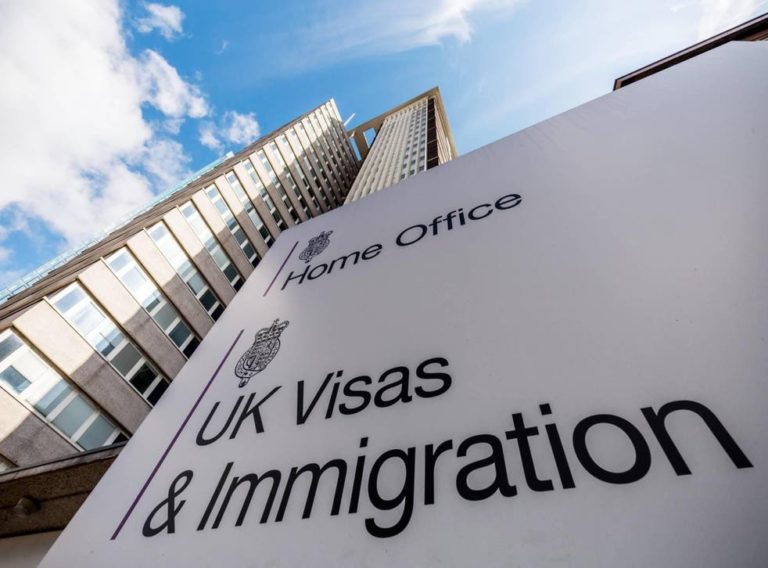
UK hikes visa fee up to £222 starting April

0

THE United Kingdom is set to significantly increase visa fees to £222 across multiple categories, affecting visitors, students, workers, and individuals seeking permanent residency, as part of a broader push to curb immigration.

According to the UK Home Office, the new fee structure will take effect on April 8, also introducing an “emergency brake” on student visas for migrants from Afghanistan, Cameroon, Myanmar, and Sudan.

UK Home Secretary, Shabana Mahmood, informed that the decision followed a surge in asylum applications from citizens of those countries.

Among the proposed actions, the government plans to offer up to £10,000 to failed asylum seekers who voluntarily leave the country, noting that migrants found working illegally will lose access to taxpayer-funded accommodation.

Under the revised fee system, short-term visit visas up to six months will increase from £127 to £135. Longer-term visit visas will also see notable hikes: two-year visas will rise to £506, five-year visas to £903, and ten-year visas to £1,128.

Similarly, applications for British citizenship will become more expensive, with naturalisation fees increasing from £1,605 to £1,709. Settlement visa costs will also rise, with the standard route increasing from £1,938 to £2,064.

Meanwhile, family-related applications, fees for individuals requiring care from relatives in the UK will jump by £222 to £3,635, while settlement visa fees for refugee-dependent relatives will increase to £452, and Skilled worker visa fees for applications made outside the UK for up to three years will rise from £769 to £819, with similar percentage increases applied to longer-term visas and dependants.

The ICIR reported in early 2025 that the UK announced a rise in visa fees for students, tourists, and other travellers, from £363 to £490, reflecting a 35 per cent rise.

Tuggar resigns as foreign affairs minister, eyes Bauchi governorship

0

NIGERIA’S Minister of Foreign Affairs, Yusuf Maitama Tuggar, has resigned from the cabinet of President Bola Ahmed Tinubu, as he moves to pursue the governorship of Bauchi State ahead of the 2027 general elections.

The resignation was confirmed on Monday in a brief statement by the Ministry of Foreign Affairs.

The statement, signed by the ministry’s spokesperson, Kimiebi Ebienfa, stated, “The resignation of the Honourable Minister of Foreign Affairs is confirmed.”

Former presidential aide, Bashir Ahmad, also referenced the development in a post on X, noting that the minister would be stepping down and bidding farewell to the Federal Executive Council.

“The Foreign Affairs Minister, Yusuf Tuggar, will bid farewell to the Federal Executive Council today as he steps down from his position to pursue the governorship of Bauchi State,” Ahmad wrote.

Although Tuggar has yet to personally announce his decision, indications of his planned exit had been circulating for some time.

Sources said Tuggar submitted his resignation on Monday, with the letter expected to be formally acknowledged at a meeting of the Federal Executive Council.

His exit comes just ahead of the March 31, 2026, deadline set by President Tinubu for political appointees seeking elective office in 2027 to resign from their positions.

The move effectively clears the path for Tuggar to focus on his gubernatorial ambition in Bauchi State, an intention that had earlier been confirmed by his media aide, Alkasim Abdulkadir.

According to Abdulkadir, the minister has long shown interest in the race.

“The minister is interested and aspires to run for the governorship seat of Bauchi State,” he had said.

Tuggar, who hails from Gamawa Local Government Area of the state, previously served as Nigeria’s ambassador to Germany before his appointment as foreign affairs minister in 2023.

With his resignation now confirmed, attention is expected to shift to his formal declaration and the emerging political contest in Bauchi as preparations for the 2027 elections heat up.

 US signals visa restrictions review for Nigeria

0

THE United States Mission to Nigeria has said visa restrictions are not permanent, travel policies remain under review and can be eased if security and identity management standards improve.

In a statement shared on X on Monday, March 30, the mission noted that strengthening systems around screening, vetting, and information-sharing would enhance global safety, suggesting that Nigeria could see changes in its status if it meets required benchmarks.

“Visa restrictions are not permanent, and travel policies are subject to review. Strengthening security and information-sharing standards for screening, vetting, identity management, and immigration make all of us collectively safer,” the statement read.

Analysts said that Washington appears to be encouraging Nigeria to strengthen its systems in areas such as identity management, border control and migration tracking, and data sharing on travellers and security risks, noting that this positions the restrictions less as punitive measures and more as leverage to push reforms.

Indicating that whether the restrictions are eased will likely depend on how quickly Nigeria addresses the concerns raised by US authorities and rebuilds confidence in its travel documentation and security processes.

The development comes amid growing concerns over a travel policy introduced by former US President Donald Trump in December 2025, which placed Nigeria on a list of countries facing partial entry restrictions into the United States.

On December 16, 2025, the White House announced a sweeping expansion of US travel restrictions affecting dozens of countries. Nigeria was not fully banned but placed under partial restrictions, limiting Nigerians’ entry for several visa categories, including B-1/B-2 business and tourism visas, and F, M, and J student visas,  citing concerns over national security, visa overstays, and gaps in identity verification systems.

Nigeria was grouped among about 15 countries facing partial restrictions, while others, mostly in Africa and the Middle East, faced outright bans.

The US government argued that the move was necessary due to “persistent deficiencies” in screening and information-sharing frameworks among affected countries.

Washington cited terrorism threats, religious violence, and instability as part of the broader justification for tightening immigration controls involving Nigeria.

In late December 2025, US forces conducted coordinated airstrikes with Nigerian authorities targeting Islamic State militants in Sokoto State, a few days after recalling several ambassadors across Africa, including its envoy to Nigeria, Richard Mills Jr.

The recall was part of a wider policy shift by the Trump administration affecting nearly 30 diplomats globally, aimed at restructuring the foreign service and installing new envoys aligned with its agenda.

Following his departure in January 2026, the US embassy in Abuja has since been led by a chargé d’affaires, reflecting a temporary downgrade in diplomatic representation.

Opposition gets boost as Kwankwaso officially joins ADC

0

THE former Kano State governor, Rabiu Musa Kwankwaso, has on Monday, March 31, formally joined the African Democratic Congress (ADC) given the opposition the needed boost ahead of the 2027 general elections.

This marked a significant shift in Nigeria’s evolving political landscape ahead of the 2027 general elections.

The development was publicly acknowledged by former Vice President Atiku Abubakar, who shared an image of Kwankwaso holding the ADC membership card. Captioning the post, Atiku wrote: “When men of conviction come together, power trembles. Welcome aboard, @KwankwasoRM.”

Some of the notable dignitaries at the ceremony were the ADC interim chairman, David Mark, former Labour Party presidential candidate Peter Obi, Rotimi Amaechi, John Oyegun, Rauf Aregbesola and Aminu Tambuwal.

Kwankwaso’s defection came days after he announced his resignation from the New Nigeria Peoples Party (NNPP), where he served as national leader and presidential candidate in the 2023 elections.

He had described the move as a “difficult decision,” citing the need for strategic political realignment.

“I seize this opportunity to express my profound gratitude for the honour and privilege of serving as the party’s national leader and its presidential candidate in the 2023 general elections. As a committed and bona fide member of the party, this was not an easy decision to make.”

He said the current political climate informed his decision to leave the party for another platform.

“I extend my deepest appreciation to the national chairman, Ajuji Ahmed and the entire National Working Committee for their steadfast support throughout my time. I also thank the Board of Trustees (BoT), the National Executive Committee (NEC), and all levels of leadership across the party — from the ward to the state level, as well as the legacy members of the party and all followers of the Kwankwasiyya Movement for their dedication and commitment to our shared mission.”

Before his formal registration, the Kwankwasiyya Movement had directed its members nationwide to join the ADC, signalling a coordinated shift. The group said the decision followed consultations and was aimed at advancing democratic values and building a broader political coalition.

It urged members to follow suit across their wards, local government areas, and states.

The ICIR reports that the move is part of ongoing realignments among opposition figures seeking a united front against the ruling party.

Why Zulum sacked commissioners, dissolved cabinet

0

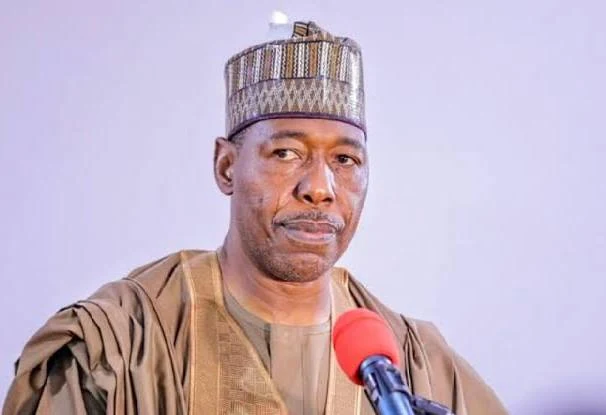
BORNO State Governor Babagana Zulum, a professor, on Monday approved the immediate dissolution of the State Executive Council.

The Secretary to the State Government, Bukar Tijani, explained in a statement that the decision was intended to “provide an enabling environment for any member of the council who may wish to contest elective positions in the forthcoming general elections.”

Following the dissolution, Zulum instructed all commissioners to handover the management of their ministries to the permanent secretaries on or before Friday, April 3.

The governor also expressed gratitude to the outgoing commissioners for their service, “dedication, commitment, and invaluable contributions to the development and service of the people of Borno State.

Zulum’s decision came on the heels of a directive by President Bola Tinubu and some state governors to their cabinet members who are interested in vying for elective offices in the 2027 election to resign, latest by March 31.

Kano, Zamfara, Niger, Cross River and Delta state governors ordered all their appointees seeking election in the coming polls to resign after Tinubu’s order.

Since the directive by Tinubu, none of his cabinet member has resigned. However, reports claimed that the Minister of Foreign Affairs, Yusuf Tuggar, will quit his position in the president’s cabinet any moment from now.

Tuggar, a former of House of Representatives member and Nigeria’s former ambassador to Germany, seeks to become the next governor of Bauchi State after contesting for the office twice and failed.

Nigeria will hold presidential and national assembly elections between January and February 2027.


National convention: INEC recognises Wike-backed PDP leadership amid deepening factional crisis

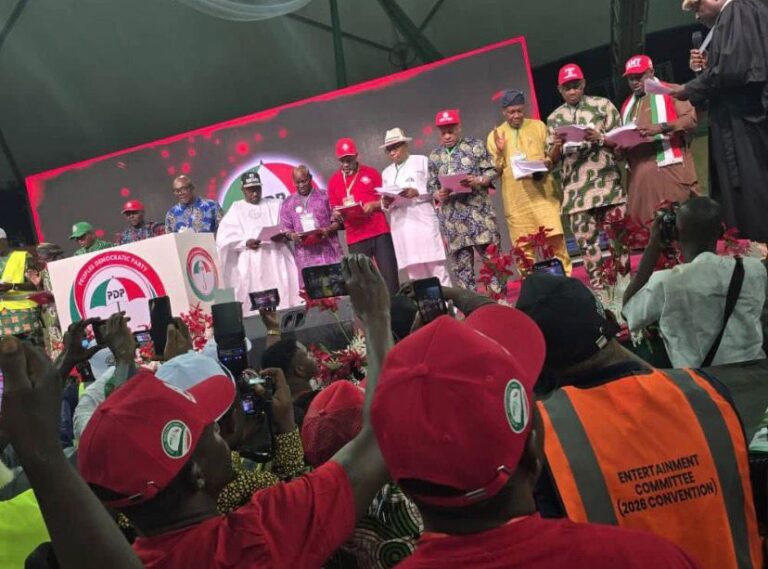
THE Independent National Electoral Commission (INEC) has recognised the faction of the Peoples Democratic Party (PDP) National Working Committee (NWC) aligned with the Minister of the Federal Capital Territory, Nyesom Wike.

INEC reflected the updated leadership structure on its official website on Monday, March 30, listing Abdulrahman Mohammed as National Chairman and Samuel Anyanwu as National Secretary, alongside other national officers said to have emerged from the party’s recent convention in Abuja.

The development followed a disputed national convention held at the Velodrome of the Moshood Abiola National Stadium, Abuja, where a new leadership was elected through consensus after the dissolution of a caretaker committee.

The emergence of the Wike-backed leadership has further polarised the PDP, which has remained divided into rival factions laying claim to the party’s national structure.

A rival bloc led by Kabiru Tanimu Turaki had earlier challenged the legality of the convention, approaching the Supreme Court to stop the exercise and contesting moves by the opposing camp to take control of the party’s national leadership.

The crisis is rooted in a series of court decisions that have shaped the party’s internal struggle over legitimacy and control.

In a judgment delivered on March 9, 2026, the Court of Appeal in Abuja dismissed an appeal filed by the Turaki’s PDP against an earlier Federal High Court ruling that barred INEC from recognising the outcome of the party’s national convention held in Ibadan, Oyo State in November 2025.

The appellate court upheld the lower court’s decision, ruled that the appeal lacked merit, and ordered the Turaki-led faction to pay ₦2 million in costs.

The Ibadan convention had produced a leadership structure led by Turaki, but it immediately triggered internal resistance, particularly from members loyal to Wike, who rejected the outcome and challenged their suspension during the exercise.

The dispute deepened when INEC, in December 2025, declined to recognise the leadership produced at the Ibadan convention, citing existing court orders restraining it from acting on the outcome.

The commission maintained that pending appeals did not amount to a stay of execution and insisted it was bound by subsisting judgments.

In a further development, the Federal High Court in Abuja, in January 2026, nullified the Ibadan convention entirely and barred Turaki and other officials who emerged from it from acting as national officers of the party.

Despite the rulings, the Turaki-led faction insisted that its leadership remained valid and continued to pursue legal remedies to challenge the decisions.

The PDP crisis has its roots in the build-up to the 2023 general elections, when a major rift emerged between supporters of former Vice President Atiku Abubakar and a bloc of governors aligned with Wike over the party’s presidential zoning arrangement.

The disagreement deepened during the party’s presidential primary, where Atiku secured the ticket, defeating other aspirants, including Wike. The outcome triggered internal divisions, with Wike and some allies withholding support during the general election.

The situation contributed to the eventual victory of President Bola Tinubu of the All Progressives Congress (APC), while further weakening the PDP’s internal cohesion.

Tensions escalated after Tinubu appointed Wike as Minister of the Federal Capital Territory, a move that intensified accusations of anti-party activity while he retained membership of the PDP.

Since then, the party has remained fractured, with key figures including governors Seyi Makinde of Oyo State and Bala Mohammed of Bauchi State, alongside other senior members, openly criticising Wike’s role and accusing him of undermining party unity.

Police confirm 14 dead in Jos North attack, as Mutfwang imposes 48-hour curfew

THE Plateau State Government has imposed a 48-hour curfew in Jos North Local Government Area following an attack in Angwan Rukuba community, on Sunday, March 29. 

The state Commissioner for Information and Communication, Joyce Ramnap, announced the curfew in a statement, noting that it would take effect from midnight of March 29 to April 1, 2026.

“Following the tragic security incident that occurred at Gari Ya Waye community, Angwan Rukuba, today, Sunday, 29th March 2026, resulting in the loss of lives, while several others sustained varying degrees of injuries.

“‎The Plateau State Government, in conjunction with security agencies, wishes to inform the general public of the imposition of a 48-hour curfew within Jos North Local Government Area with immediate effect,” Ramnap said.

The ICIR reports that residents shared videos online showing gruesome scenes with bodies lying on the ground. According to eyewitness accounts, the attack reportedly occurred around 8:30 p.m., accompanied by the sounds of gunfire.

The Plateau State Police Command in a statement on Monday, revealed that 12 victims, 10 men and two women, were initially killed, noting that two additional bodies were discovered during follow-up search operations morning, bringing the death toll to 14.

“The Commissioner of Police, Plateau State Command, CP Bassey Ewah psc(++) FCAI, MSPSP, commiserates with the people of  Angwan Rukuba Community Jos North Local Government Area, over the unfortunate attack which took place on March 29, 2026, and claimed the lives of Twelve (12) persons – Ten (10) men and Two (2) women. As at this morning, additional two corpses were found while our men were combing the bushes and trailing the suspects for possible arrests,” the State Police Public Relations Officer, Alfred Alabo said in a statement.

Alabo explained that the victims’ bodies had been evacuated to a mortuary for autopsy, while the process of identifying the deceased was still underway. He noted that the Commissioner of Police, Bassey Ewah, said he personally led a joint security team including tactical units, divisional police officers, and other security agencies to the scene shortly after receiving a distress call.

He said the deployment was aimed at restoring calm and preventing further escalation of violence.

“As we speak, the Police and all other security agencies within the State have organised a joint operation and are currently combing the nearby bushes to ensure that the suspects are arrested or dislodged in accordance with the law. The corpses of the deceased have been evaluated to the mortuary for autopsy and efforts are being intensified to arrest the culprits,” he added.

He also appealed to the public to provide credible information that could aid ongoing investigations, stressing that community cooperation remained vital in tackling insecurity.

“While the identities of the victims are still being verified, the CP assures families of the deceased that investigations are underway to track the perpetrators of this dastardly act and ensure that the law take its course. He therefore calls on all citizens with accurate and useful information to contact the Command immediately through the following GSM numbers: 07059473022, 08038907662, 08075391844, PPRO. 08060545670, PCB, 08067884627, 07068890355,” he added.

Meanwhile, reactions from residents in the area on social media differ from the number of casualties given by the police. Some residents claim dozens of people died in the attack.

Reacting to the situation, the management of the University of Jos on Monday rescheduled examinations earlier scheduled for Monday and Tuesday.

“The Vice Chancellor has directed that all examinations scheduled to hold on Monday and Tuesday will be rescheduled. This is in view of the Sunday night attack by gunmen on residents of Angwan Rukuba and the consequential tensions it has generated in and around the area,” the Deputy Registrar, Information and Public Relations of the university, Emmanuel Madugu said in a statement on Monday.

Madugu urged staff and students to remain vigilant and avoid unnecessary movements, noting that students should report any security breaches to the university’s security unit.

Plateau State have endured recurring waves of violence in recent years, including attacks, kidnappings, and cattle rustling, with residents consistently demanding a stronger security presence.

The ICIR reported in January that nine people were killed during a crossover night celebration in Chigwi village, Vwang District of Jos South Local Government Area, Plateau State.

In 2025, coordinated assaults across several Plateau communities in Bokkos and Barkin Ladi left more than 100 people dead and forced thousands from their homes.

Small performers, big shadows: a new generation expands stage storytelling in Nigeria

NIGERIA’S arts scene is vibrant, anchored by established, content-driven festivals such as ALITFEST, KabaFest, LIPFest, the Ake Arts & Book Festival, and the WRR ‘Words Rhymes & Rhythm’ Poetry Festival.

While these platforms largely spotlight literature, poetry, and spoken word, often through poetry slams, their prominence does not signal a lack of innovation in stage performance. Instead, they exist alongside a quieter but growing wave of experimental theatre.

One visible bridge between these worlds is Dike Chukwumerije’s ‘Simply Poetry’, a hybrid form that blends theatre, choreography, and poetry. Beyond such mainstream expressions, smaller collectives are pushing the boundaries of storytelling in ways still emerging within the Nigerian performance landscape.

Among them is the Hearts Heartist Foundation, led by creative movement artist Bukunmi Olukitibi. Through community-based programmes, the group introduces young people to performance as a tool for expression, confidence-building, and storytelling. Their work took a striking turn with the adoption of shadow theatre; a form rarely explored in Nigeria.

Shadow theatre uses light, silhouettes, and movement to construct layered narratives behind a translucent screen. In 2013, a shadow theatre group, Attraction, became a viral sensation following their performing to Emeli Sandé’s “Read All About It” during their audition on Britain’s Got Talent. They acted a story of a couple who fell in love, marry, and had a child before the father left for war and died. The performance ends with the mother and child at the father’s burial place. Attraction eventually won the competition bringing global attention to shadow theatre.

Attraction Shadow Theatre Group performing to Emeli Sandé’s “Read All About It” during their audition on Britain’s Got Talent.

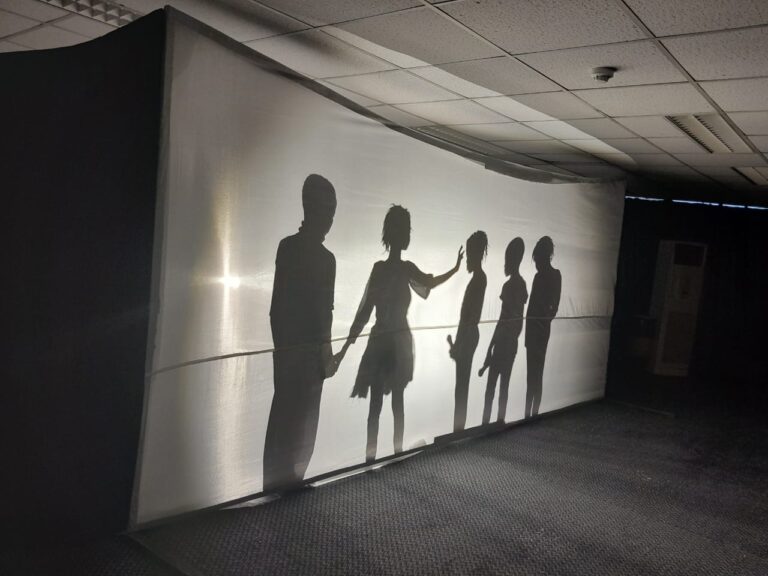
In ‘Journey of Dreams’, one of the foundation’s productions, children served as the primary performers, transforming their bodies and simple props into shifting visual canvas. The result was a performance that diverged sharply from conventional stage drama.

The staging itself reflected this departure. The performance space was split in three. The audience sat informally on rugs and throw pillows, while the stage hidden behind a large white curtain became a canvas for light and shadow. The third part, behind the stage, is the changing and transition room.  Rather than acting in front of the curtain, the story unfolded through silhouettes behind it, demanding a different kind of discipline from the performers. Beyond memorising lines and choreography, the children had to understand spacing, timing, and the interplay of light and form.

Directed by David Olukitibi, the production was the culmination of weeks of rehearsals involving about 20 children from communities around the Federal Capital Territory, including Dei-Dei, Saburi, Kubwa, Gaduwa, and Utako. For many, it was their first encounter with shadow theatre.

According to Olukitibi, the choice of form was a deliberate attempt to experiment with new storytelling possibilities. The narrative itself reflects contemporary Nigerian realities, exploring themes of unity, conflict, and the consequences of ethnic intolerance. The piece shows how two communities lack of tolerance for each other led to incessant clashes resulting in fatalities, including that of the princess. 

For the children, the experience extended beyond performance. The programme, which spans over 10 weeks, combines theatre with other activities such as tie-dye and environmental projects, creating a holistic creative environment. The aim, Olukitibi explains, is early exposure embedding artistic discipline and confidence at a formative stage.

“It’s a way to engage them from a very early stage,” Olukitibi said, so that by the time they get older, they become professionals. 

Amina Ezekiel, whose two children participated, described the programme as transformative, noting increased confidence, social exposure, and a stronger sense of self-expression.

“The impact is that they are able to stand on their own to be able to defend themselves. It exposes them to the world positively,” she said. 

Another parent, Juliet Michael, said she had never encountered shadow theatre before but was impressed by the production’s creativity and execution.

A scene from Journey of Dreams. Photo: Bamas Victoria

The process was not without its challenges. Diana Liabo, a theatre practitioner from Germany who worked with the group, noted that shadow theatre requires performers to exaggerate gestures and rethink presence, since facial expressions are invisible. Learning to “act with light” proved to be one of the most demanding aspects for the young cast.

For the performers, the format offered unexpected freedom. Solomon Joseph, who played multiple roles, including a warlord, prince, and dancer, explained that quick transitions were possible with minimal costume changes, thanks to the anonymity of silhouettes.

Despite its novelty, creative practitioners believe shadow theatre holds promise in Nigeria. Samson Kukogho, an award-winning poet, novelist and literary promoter, sees potential for the form to become commercially viable. 

“I’ve seen this before”, he told The ICIR, “I think it does have potential to be commercially viable. The problem, as you well know, is the enabling environment for it to thrive.”

He explained that there were many viable art forms in the country “but so little support, from both government and private sector, to encourage anyone to take on their development as a full-time hustle.”