SUPER Eagles goalkeeper Stanley Nwabali has expressed concerns about the condition of his injury, saying that he is still in pain.
He, however, informed that the official medical team would ascertain the level of injury and advise the Super Eagles officials on the possibility of him playing in the next round.
Nwabali, who has been between the sticks since the commencement of the 2023 Africa of Cup of Nations, AFCON sustained an injury after colliding with Cameroon player Georges-Kevin N’Koudou in an aerial challenge.
The shot-stopper has endeared himself to many Nigerian fans with his confidence at the goalpost and marginal error at the continental championship so far.
The collision led to him being carried out with a stretcher, and he could not continue the match.
He was replaced by Francis Uzoho.
Giving an update after the 2-0 win over Cameroon on Saturday, the Chippa United goalie in an interview with newsmen, said he was still feeling some pain but awaited the doctor’s report.
“I don’t know, but maybe the doctor would tell me, but I’m still feeling pain. You know, when the injury is new, you always feel pain,” he said.
Also, the Super Eagles coach Jose Peseiro was uncertain about Nawabali’s chance of playing in the quarter-finals, saying that the team’s medical staff was yet to assess the extent of the injury.
Nwabali conceded only one goal in four matches, while Nigeria recorded four goals.
The Super Eagles will face Angola at the Felix Houphouet-Boigny Stadium on Friday, February 2, in the quarter-finals.
THE Nigeria Police Force has arrested a suspected kidnapper reportedly linked to the abduction and murder of Nabeeha, one of the victims kidnapped in Abuja.
The Force Public Relations Officer, Olumuyiwa Adejobi, disclosed this in a press statement on January 28.
According to him, Bello Mohammed, 28, of Zamfara state was apprehended on January 20, 2024 in Kaduna with N2.25 million in suspected ransom money.
Part of the statement reads, “The Divisional Police Officer, Tafa Division, acting on intelligence, raided one hotel in Tafa Area, Kaduna, where he arrested Bello, with the sum of #2.25m (Two Million, two hundred and fifty million naira) only, suspected to be proceeds of ransoms collected from kidnapped victims within the area.”
“The suspect, during interrogation, confessed to be part of the gang that kidnapped the family members of one Barrister Ariyo in Bwari, FCT, on 2nd January 2024, and killed some kidnapped victims, including Nabeeha, F, daughter of the legal practitioner, on 13th January, 2024, in a kidnappers camp, in Kaduna State.
‘’The suspect, in a dramatic situation, offered #1,000,000 (one million naira only) to induce the DPO, who rejected the offer and carried out his duty diligently,” the statement said.
Adejobi said the Inspector-General of Police, IGP Kayode Adeolu Egbetokun, had ordered that the suspect, be handed over to the Department of Force Intelligence Tactical Teams (DFI-IRT) in Abuja for discreet investigations.
The ICIRreported how Nabeeha, a 400-level student of biological science at Ahmadu Bello University (ABU), Zaria was abducted alongside six other siblings.
After about two weeks in captivity, the bandits killed Nabeeha over the inability of the family to pay the ransom demanded. The remaining five girls regained freedom after spending 18 days in captivity.
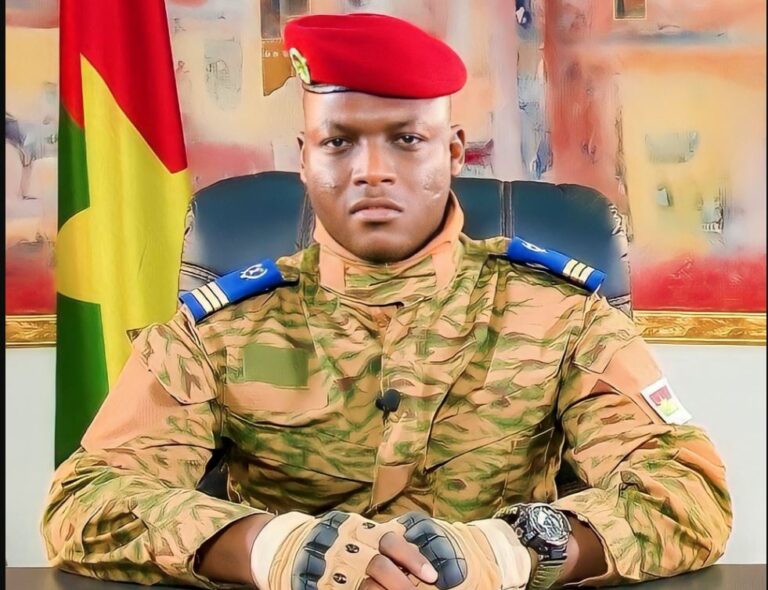
THE military regimes in Burkina Faso, Mali, and Niger have announced their immediate withdrawal from the Economic Community of West African States [ECOWAS].
In a joint statement on Sunday, January 28, the leaders of the three Sahel nations said they had taken a sovereign decision to pull out their countries from ECOWAS.
“After 49 years, the valiant peoples of Burkina Faso, Mali, and Niger regretfully and with great disappointment observe that the (ECOWAS) organisation has drifted from the ideals of its founding fathers and the spirit of Pan-Africanism,” Niger junta spokesman, Amadou Abdramane said in the statement.
“The organisation notably failed to assist these states in their existential fight against terrorism and insecurity,” Abdramane added.
ECOWAS imposed sanctions on the countries following the takeover of the military junta but has sustained negotiations and demanded transitions to civilian rule.
The announcement is the latest development following a series of efforts by the regional bloc to return the countries to civilian rule.
Niger, Mali and Burkina Faso still members, ECOWAS insists
Reacting to the development via a communique issued on Sunday evening, the ECOWAS commission said it was yet to receive any direct formal notification from the three member states about their intention to quit the regional bloc.
It insisted that Niger, Mali and Burkina Faso remained important members of the Community, and the Authority of Heads of State and Government remained committed to finding a negotiated solution to the political impasse.
“The ECOWAS Commission remains seized with the development and shall make further pronouncements as the situation evolves,” the commission concluded.
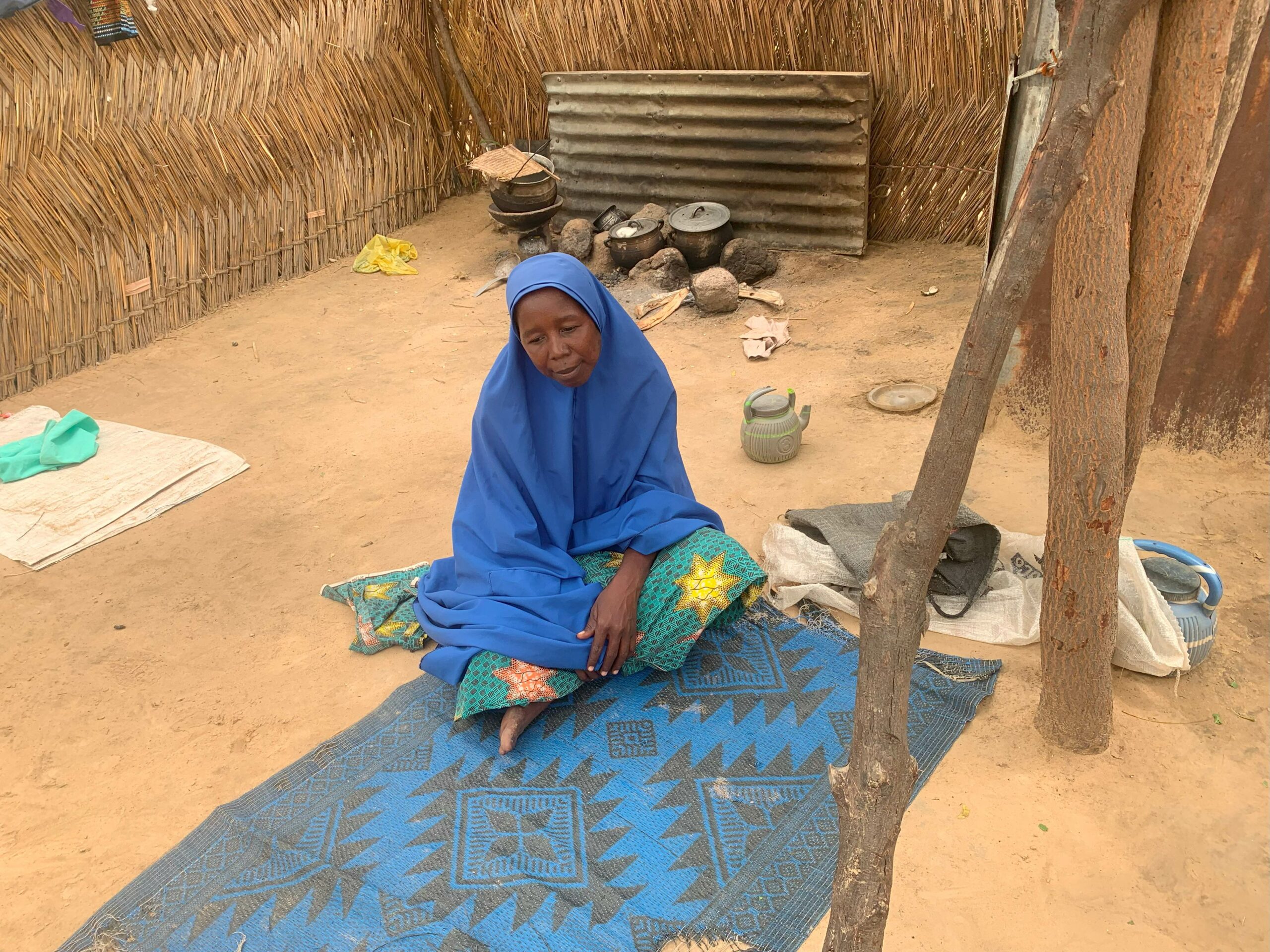
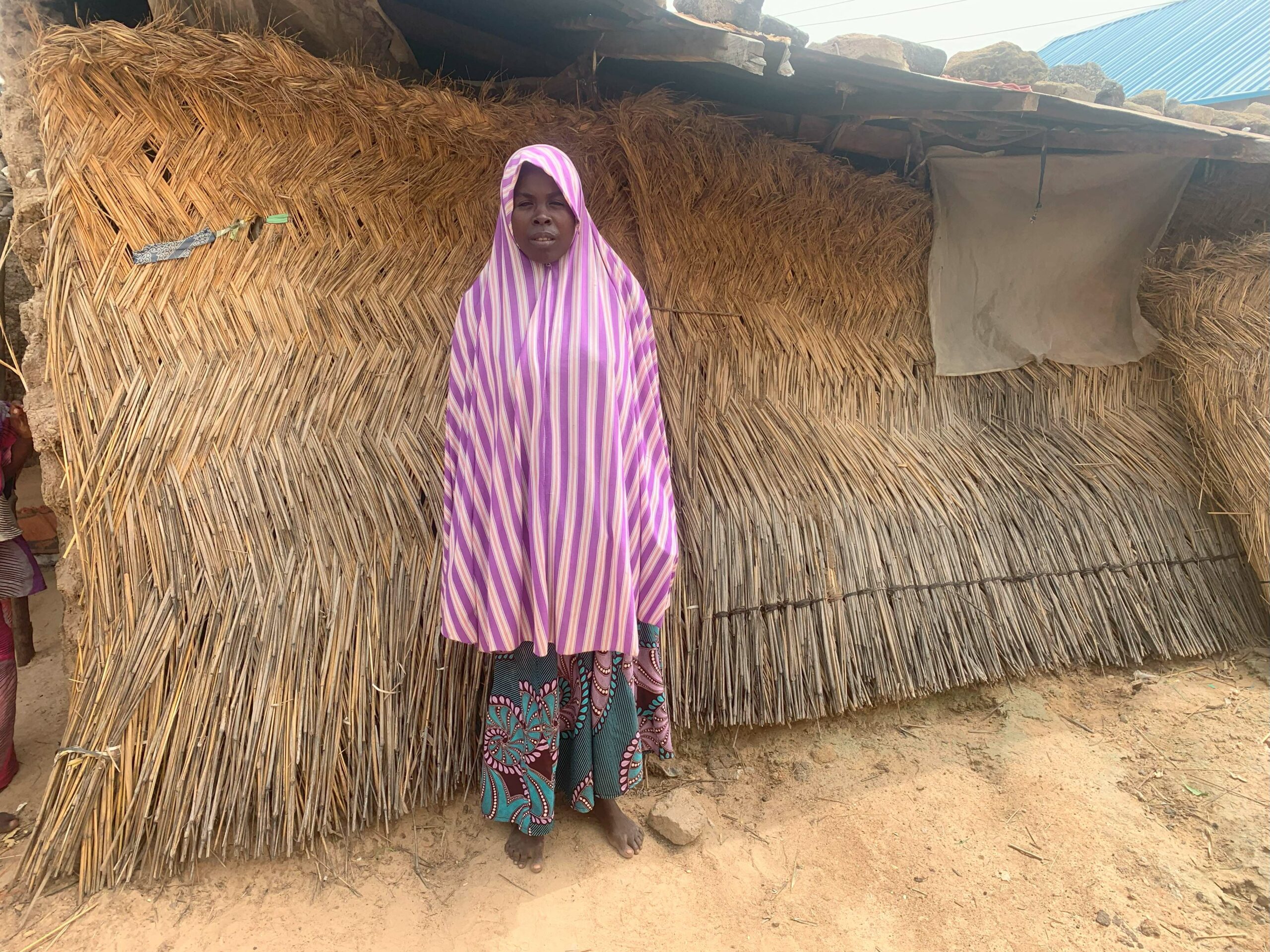
By the start of the 2023 rain season, Zara Bulam, a 50-year-old returnee IDP, had saved enough money to buy seeds for her new farm. She could only afford five ‘mudu’ of bean seeds, but it was a good start.
Zara Bulam sitting outside her tent
It took a while to get a farm nearby in Alajiri, a hamlet under Kaga local government area. And getting seedlings at a point when she could barely afford food was hard.
In mid-April, Bulam cultivated her farm and began to envisage an easier life. Five ‘mudus’ of bean seeds would give her three bags of beans in 65 days. She’d keep some for food and sell the rest at the main market in Maiduguri, the state capital. With her profits, Bulam will buy more seeds to recultivate before this season is over. And by the last quarter of the year, she would have more food, a stable source of income, and the prospect of a bigger farm. But her hopes were dashed.
For reasons Bulam cannot identify, it stopped raining in May and stayed that way till August. At first, she considered it a short delay, but by June, she knew it was a drought that would destroy her farm. And it did.
It rained a few times in Borno between April and May, and stopped. Farmlands turned to dust. The dry spell lasted over 21 days, just as the Nigerian Meteorological Agency (NiMet) for
Drought in Borno
The dry spell affected the productivity of farmers, especially IDP returnees who sought to rebuild their lives through farming. This is not the first dry spell. Changing precipitation has threatened rain-fed agriculture in Borno in the last decade.
According to the United Nations Food and Agriculture Organisation (FOA), Borno has experienced multiple severe droughts caused by climate change, negatively impacting the state’s agricultural productive capacity.
The IDP returnees are unprepared and ill-equipped for this after being displaced by insurgency for years and abruptly being relocated by the state government two years ago.
The Borno government began implementing its resettlement Scheme in 2021. According to a report by the UN Migration Agency, IOM, as of November 2022, it had relocated over 900,000 people out of the 1.8 million people displaced by the insurgency in Borno.
Some settled in new communities, and others settled in their ancestral homes. Most returnee IDP farmers who spoke to The ICIR said they began farming in 2023, as they could not afford to in the previous year, and the dry spell impeded their effort to recover.
In Bulam’s words, “the lack of rain means no farm, and no food for us,” referring to herself and her five children.
“I saved up for months to buy the groundnut seeds, and everything dried up. Everything,” she said.
The changing rain pattern is a problem that affects farmers’ productivity. In areas where returnees are rebuilding their lives, it affects resilience and adaptation, says Murtala Abdullahi, a Climate researcher.
Farmers experienced flooding the previous year, and a dry spell lasted two months this year.
“This shows the complexity of the issue in a region that has always had few rainfall and an arid type of vegetation,” Murtala Abdullahi, a Researcher with Humangle Media, said.
“In hinterland areas where returnees are rebuilding their lives, accessing livelihood support is difficult, and security restrictions’ impact is usually higher. This affects resilience and adaptation.”
Food crisis, poverty among returnees
When it began to rain again in August, farms owned by returnee farmers had dried up, and most could not afford to recultivate. They turned back to wage labour. They had spent the previous year saving for seeds and land rent, with some working as labourers for landowners who leased farmlands.
Returnees who spoke to The ICIR said this was a chance to become self-sufficient and have more food. The drought meant continued hunger.
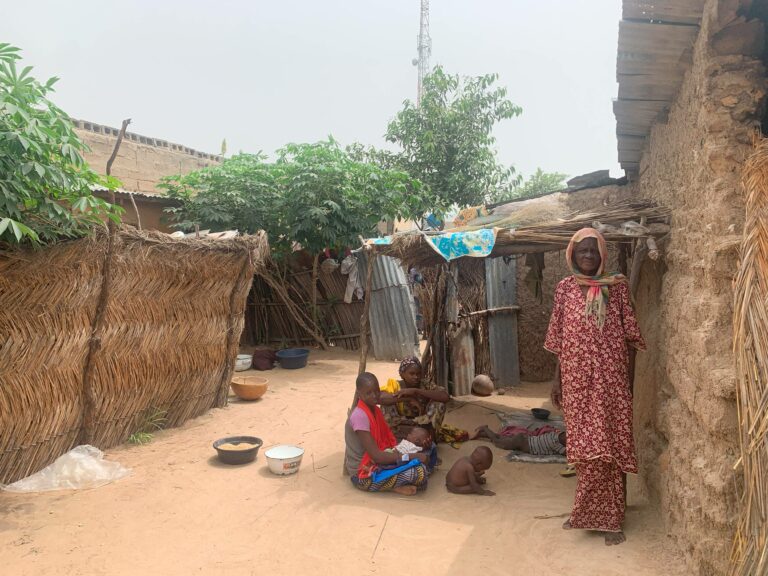
Hafsat Goni, another returnee in Alajiri, earns between N300 – N1000 from selling firewood or working as a labourer on farms outside her community. Her daily income is below the international poverty line of $1.90 daily.
Hafsat Goni
With this amount, Goni has to feed herself and her three children. “We never have enough money for food. How much can one do with that amount?”
Often, Goni’s children go to neighbouring communities, like many other IDP children, to beg for food, money or anything that could provide a meal.
There are days when they are fully dependent on alms, and sometimes, the kids, after roaming under the scorching sun for hours, return with nothing.
“Sometimes I look at my children and feel heartbroken by my inability to provide for them,” she said.
Goni had considered farming to be a way out.
“We are supposed to be preparing for harvest. By now, I should get some food at home. But nothing. We eat what we see when we see it, the 33-year-old returnee IDP said.
The ICIR found that the resettlement scheme did not address food insecurity among the returnees. Also, while it encouraged farming among the IDPs, it did not consider climate and other farming challenges that could set the people backwards.
Food insecurity is high among displaced persons and returnees as a result of the violence that ravaged the northeast. Borno is one of the states with the highest food insecurity, which, according to the United Nations, affects around 4.3 million people in the state, Adamawa and Yobe combined.
A World Food Programme (WFP) report showed that returnees have a high level of poor and borderline food consumption. Also, Households dependent on daily wage show elevated levels of inadequate food consumption.
Returnees are unsure of how to feed themselves and their children. With their farms destroyed by drought, they must wait till the next rainy day before they can try farming again, as dry-season farming is expensive and requires tools and unavailable land spaces.
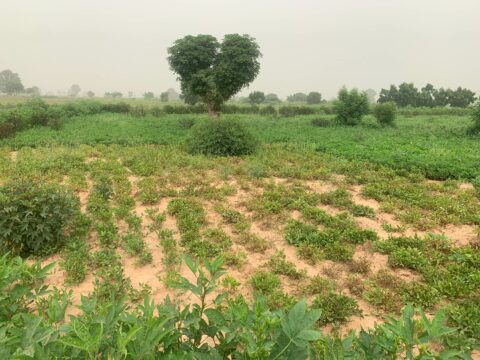
A returnee farmland after recultivating on a smaller scale
To survive, the returnees have to remain heavily dependent on wages.
“Before the Boko Haram insurgency, I used a pumping machine and generator for dry season farming. Now, they are all gone. And I can’t afford it anymore.
I have to wait till the next rainy season. And while I remain, my struggle for food continues,” Bintu Tobolo, another returnee, said.
Pest and land infertility worsen the crisis.
Compared to most returnees, Hassan Umara (68), in Abduri village, farmed on a relatively large scale. Before the drought, he planted groundnuts, beans, millet, and watermelon. He was among the few returnees in Abduri village with the finances to reinvest in his farm when the dry spell ended.
Abduri is a small community in Konduga LGA, about 134km away from Kaga.
Konduga residents had been forced to abandon their homes in 2013 after a Boko Haram attack. Between 2013 and 2021, most villagers, including Umara, lived in Matari IDP camp in Maiduguri.
At that time, Umara kept his wages, hoping to return home someday. Umara said his savings reached over a N100,000 in 8 years.
He combined this with the N100,000 cash gift from the Borno government and parts of his post-relocation wages to cultivate at the beginning of the season. But like the others, a significant part of the farm died.
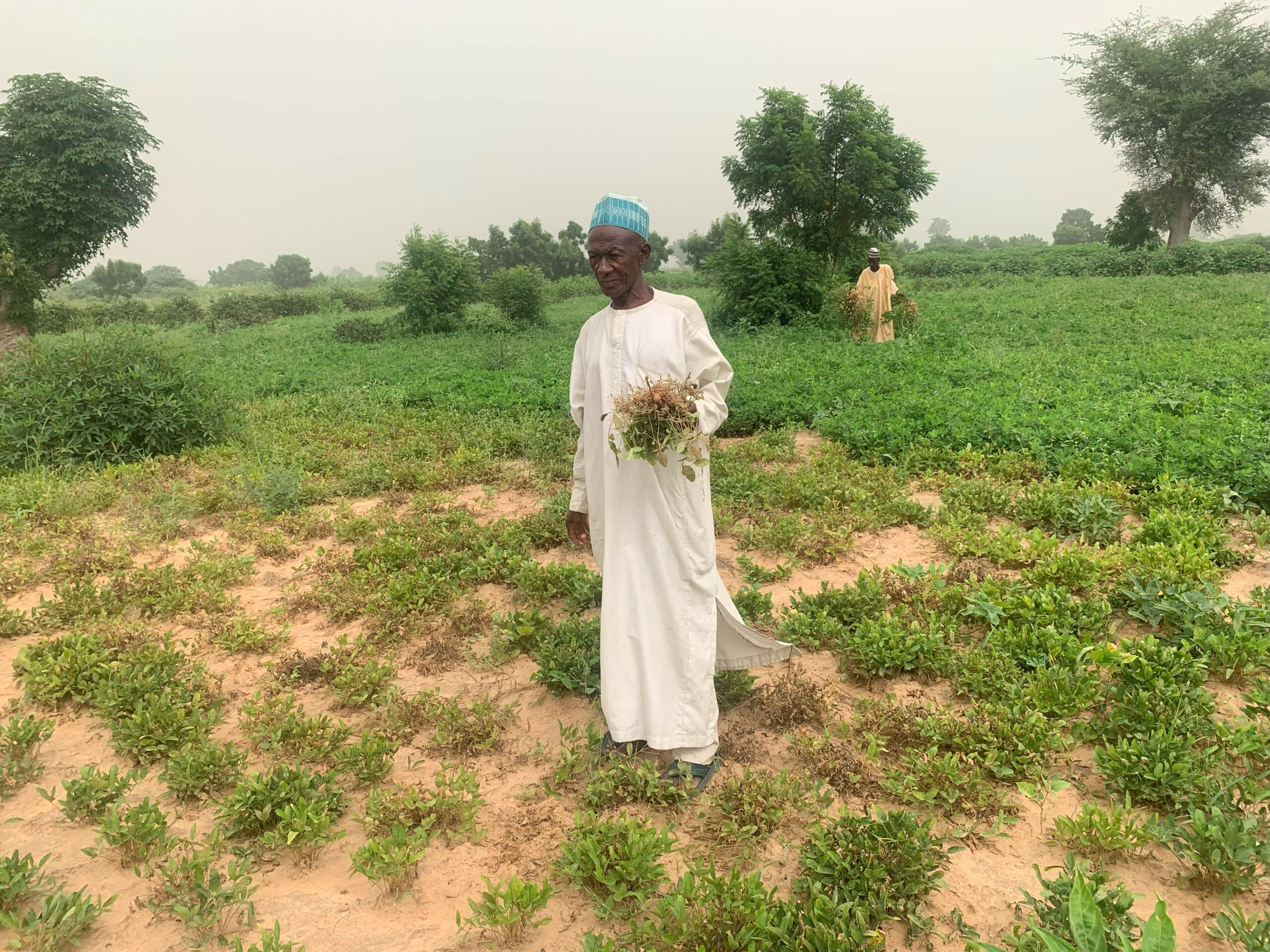
Hassan Umara on his farm with a dead groundnut plant
In August, when it started to rain, Umara farmed again. This time on a small scale. But there was another challenge. Pests. The land was infertile.
When The ICIR inquired why he did not get fertilisers and pesticides, a substance used for destroying harmful organisms on farmlands, Wakil responded, “After the first one collapsed, I only had small change left, that can only be recultivated. I didn’t have money for fertiliser or any chemical.”
We have not seen food to eat; you are talking about fertilisers,” Wakil Garba, an older returnee farmer, interrupted. Garba, who had been watching from a distance, walked closer and began to narrate his ordeal.
Garba, Whose second attempt at farming wasn’t going the way he hoped, said, “The land is weak, and there are insects everywhere. We don’t have money for food, not to talk about buying chemicals or fertilisers.”
Fighting the Climate Crisis
According to the National Policy on Climate Change, Borno is highly exposed to the impact of climate change. It recommended using drought-resistant crops, crop diversification, and irrigation farming.
It also highlighted the creation of awareness of adaptation measures and financial assistance among farmers.
However, The ICIR found the IDPs have no knowledge of climate change and are unable to finance climate-sensitive farming.
On October 6 2023, The ICIR visited the Borno Ministry of Agriculture to get information about the state effort to promote climate-smart agriculture among Returnees. The commissioner, Bawa Musami, asked to be contacted through a WhatsApp text.
The entrance to Borno Ministry of Agriculture
But Bawa did not respond to the message after it was sent. He also did not pick up his phone calls or respond to text messages sent afterwards.
However, the information officer for the state Ministry of Reconstruction, Rehabilitation, and Resettlement (RRR), Saleh Habib, spoke to The ICIR over the phone on November 7 2023. He contradicted himself by claiming the state-supported drought-resistant agriculture for IDP returnees while admitting they were unprepared for the drought.
Habib stated that “the Borno supported the IDPs to carry irrigation farming in Kaga and Konduga,” and then followed up with, “the rain pattern affected farms across the state, and many IDP farmers suffered. They will need government support to carry out farming activities in the following year.”
Irrigation farming is capital-intensive. According to this report, irrigation farming on an acre of land costs between one hundred thousand and N3 million.
This means that each has at least N100,000, aside from other farming-related expenses, to carry out irrigation farming as an adaptation measure against climate change.
The returnees told The ICIR that they struggle to accumulate the money for seedlings and, as a result, cultivate crops that they believe will serve their immediate needs.
“Irrigation farming costs too much money,” Garba said to The ICIR. “Is it not those who have eaten that can consider these things?”
Independent findings by The ICIR show that returnee farmers in both Kaga and Konduga did not get support for climate-smart agriculture. They are also heavily dependent on rainfed farming.
Also, there’s no financial intervention programme exclusively for returnees to adopt climate-smart farming or boost farming.
There is funding from international donors to support farmers in the state, but these projects do not target returnees, and as a result, they are easily excluded.
In Konduga LGA, The ICIR found that some residents were beneficiaries of the European Union Dry Season Farming Intervention project in 2022.
The residents received farming tool kits to aid dry season farming. But the returnees in this local government received nothing.
Also, the Head of Fadama Ngcare in Borno, Maina Mustapha Arjinoma, told The ICIR that none of the agency’s previous or ongoing intervention programs is targeted at supporting returnee farmers.
“We provide farming support to vulnerable farmers in the state. We have people in each local government who identify these farmers. They don’t have to be IDPs or returnees.”
However, Konduga and Kaga LGA residents told The ICIR that the beneficiaries of such interventions are often residents with close ties to local government officials.
“The vulnerable farmers they choose are people with access to local government officials. They picked only the people they know.” Musa Umar, a resident, said.
This report was sponsored by the Centre for Journalism Innovation and Development, with funding support from the Public Diplomacy Section of the U.S. Embassy, Abuja.
LAGOS, Osun, Enugu, Lagos, Akwa Ibom, Rivers, Delta, and Kogi states have commenced the implementation of the New Electricity Act.
The implementation ushers the respective states into a new era of decentralised electricity market regulation, devoid of the Federal Government’s monopoly.
The Electricity Act, 2023 (“the Act”) was signed into law by President Bola Ahmed Tinubu, on 6 June 2023. The Act was passed in light of the Federal Government’s initiatives to accelerate Nigeria’s energy transition process as well as consolidate the regulation of the Nigerian Electricity Supply Industry (NESI) for optimum functionality and effective service delivery.
By taking steps to domesticate this law at their respective state Assemblies, the aforementioned states now have the power to regulate mini-grids, embedded power, and independent electricity distribution and transmission networks.
Commenting on this development, a power sector governance expert and President of the Consumer Protection Network, Kunle Kola Olubiyo, confirmed to THE ICIR that the aforementioned states have commenced the domestication processes of the Electricity Act in their respective states.
“They are doing so to bring about decentralisation of the monopoly hitherto enjoyed by the Federal Government of Nigeria in the Generation, Transmission, and Distribution of Electricity in Nigeria,” he said.
He noted that the respective state governments are expected to grant licenses to prospective local and foreign investors to collaborate with the states in the areas of generation, transmission, and distribution of electricity in areas within their state jurisdiction.
Also, an energy lawyer and Power sector governance expert, Chuks Nwani, posits that with the new Act, states can now expand opportunities and play key roles in building power plants and complementing the Federal government’s efforts on the transmission expansion project, while also curbing energy theft in the power industry.
“Section 209-224, for instance, talks about the power theft law in detail. This is an area where I expect states to establish power theft agencies. Once this is done, investors’ confidence in investing in the sector will grow. Remember that revenue collection is a major challenge, and the Act addresses that,” a power sector governance expert and energy lawyer, Chuks Nwani, told THE ICIR.
Nwani further said that states can now establish their electricity boards as provided by the Act to look at areas of infrastructure protection, metering, and network expansion investment with the Transmission Company of Nigeria (TCN).
For years, Nigeria has grappled with the challenge of inadequate power supply, hindering its economic growth. The country also relies on multi-lateral interventions of the World Bank and the African Development Bank to sustain the sector. Already, N1.6 trillion has been earmarked for subsidies by the Federal Government in 2024, a concern that could be addressed should states enact laws that enable grid-decentalisation and investment sourcing with the New Electricity Act.
Accordingly, the Act empowers communities and individuals to build their power plants and mini-grids, increasing energy self-sufficiency.
The new Electricity Act mandates the Nigerian Electricity Regulatory Commission (NERC) to prepare and provide feed-in tariff rates for electricity generated from renewable energy sources as a way of encouraging investment in renewable energy power generation.
Essentially, the Act repeals the Electric Power Sector Reform Act of 2005, consolidates the laws relating to the NESI, and provides a comprehensive and institutional framework for the power sector in Nigeria.
Areas covered by the Act include electricity generation, transmission, distribution, supply, trading, system operations, electricity offences, and the enforcement of consumer rights and obligations.
It also makes provision for a holistic, integrated resource plan and policy that recognises all the sources for the generation, transmission, and distribution of electricity, including the integration of renewable energy into Nigeria’s energy mix.
NO less than six children were reportedly killed on Saturday, January 27, after an improvised explosive device (IED) exploded near a Qur’anic school in Gubio Local Government Area (LGA) of Borno state.
A counter-insurgency publication, Zagazola Makama, focused on the Lake Chad region, confirmed and said the incident occurred at about 2 p.m.
The publication said an undetonated IED was collected among scraps stored in a building by a metal scavenger.
“An improvised explosive device (IED) has detonated in Gubio town, Borno, resulting in the tragic deaths of six Quranic school pupils popularly known as Almajirai,” the publication said.
“The incident took place on Saturday, January 27, when a metal scavenger unknowingly collected and stored various metallic items in a building close to a Tsangaya school,”the
According to the Publication, the scavenger did not know that among the collected metal was an abandoned undetonated IED, which exploded at approximately 2 pm, claiming the lives of the children and causing severe bodily harm.
In 2022, the Borno police said about 55 scrap metal collectors were killed by insurgents within three weeks in the state.
In 2023, Babagana Zulum, governor of Borno, banned activities of metal scavenging in all LGAs of the state.
Zulum had said metal scavenging activities had caused the death of thousands of citizens in the state.
IN the face of economic uncertainties, some women in the FCT, through their laborious yet ‘profitable’ cassava processing business, are navigating various challenges to empower themselves, provide jobs for others and sustain livelihoods. The ICIR’s Mustapha Usman reports on how they go about it.
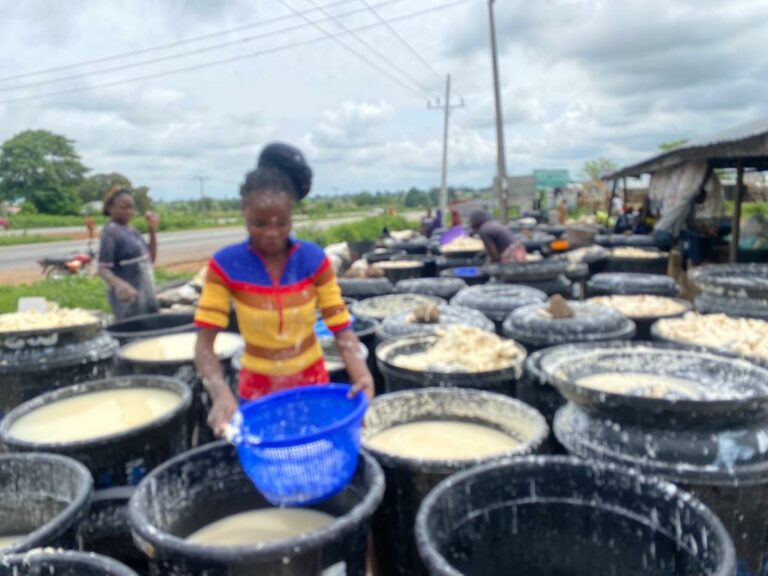
Mama Favour, as she is fondly called, had her hands firmly on the sack under the morning sun on one Sunday in late 2023. She had just spent two hours on the job that morning, but her face said otherwise as she continued filling the sack stacked with cassava.
Mama Favour’s determination shone through as the morning sun beat down relentlessly. With each step she takes, it is evident that she is in the midst of an arduous task. But then, she expressed delight amidst the stress when she began taking The ICIR through their world of cassava processing in Sheda, a suburb in Kwali an area council in Federal Capital Territory, Nigeria’s capital.
A whiff of heavy cassava odour fills the air as both young girls and old women strive to get the portion of their work completed. This is how the women, who are mostly the breadwinners, fend for their families.
Just like Mama Favour explained, there are different sections of girls and young women clustered in sizeable buckets filled with cassava, with their hands embedded in it washing the cassava tuber. Meanwhile, another group of women sit on sacks peeling cassava, while others use mallets to pound it repeatedly.
In a small shop made of corrugated metal sheets, behind the large group of women peeling cassava, are the different types of machines used to process cassava flour (locally called Lafun), another end product of the cassava.
Cassava flour-making machine at the processing site. Photo: The ICIR
Cassava, grown almost exclusively by smallholder farmers, contributes significantly to Nigeria’s agriculture sector, with the country being one of the world’s largest cassava producers. It is one of the few staple crops that can be produced efficiently on a small scale in the country.
According to the Food and Agriculture Organisation (FAO) 2018 report, as of 2018, world cassava production stood at about 278 million tonnes, and Africa’s total production was about 170 million tonnes (about 56 per cent of world production). Out of the 170 million tonnes, Nigeria produced about 60 million tonnes.
“Cassava is the only business that moves around this place. They can’t patronise you in other businesses as they patronise you here,” Mama Favour says as she pounds on the cassava inside a small sack. This, she says, breaks down its fibres and loosens the peel.
After the whole process, she explained to The ICIR that she makes a profit of about N30,000 monthly, which she uses to help her family. “When they bring the cassava, we peel it, and after peeling it, we put it inside our black rubber for four days, and after four days, we wash it, after that, we put it inside sack to drain it and then package it for sale,” she explained.
Women in the business said the processed cassava is sold per load for N19,000, with six pieces of sack making one load. The remnant, being the chaff, is also sold to those in the flour-making industry at the same site.
The ICIR gathered that a full pick-up truck of cassava from Kogi state, where they mostly farm it, costs N140,000, while a full Golf car goes for around N45,000 to N50,000.
Meanwhile, the profit differs for most women who work at the plant, as some make as much as N50,000 or more in a month, depending on their workforce.
With over 133 million Nigerians living in multidimensional poverty, the business has saved many, particularly women, from being unemployed, earning well above the country’s minimum wage monthly.
Enoh Grace with processed cassava after draining excess water. Photo: The ICIR
Enoh Grace, 40, a Gwari indigene who lives in Sheda, explained that in a month, she gets as much as N100,000 from the business after paying all menial workers.
“We are up to 50, and if you must join us, you have to pay N5,000. It is the government that gave us the land. Since I chose the cassava business, I am no longer hungry. Because if we put cassava for water, you go get Elubo, Akpu, and garri,” Grace, who is also the Secretary of the hub, stressed.
Also, in the midst of this booming business are young girls who, by helping their parents, grandparents and themselves, juggle education with the cassava processing.
At the time of the reporter’s visit, schools were on holiday, and many children were seen either manning a bucket filled with cassava or peeling it. It’s from this menial job that they earn as little as N800 for for a few hours of work, though this amount could vary based on their strength, the time invested and how much they can go.
Nafisat, alongside other young girls washing out chaff from fermented cassava. Photo: The ICIR
Ten-year-old Idris Nafisat, mainly helps her grandmother to peel cassava and wash it tuber. She has been doing it since she was nine, and even though she works all through the week with her old guardian, she has never missed school.
Nafisat, who is also from Sheda, explained that she gets N1,000 every day and uses the money to pay her and her younger sibling’s school fees.
“I go to school, and after I come back from school, I come here to wash Casava. I wash Casava, peel and pack. They pay me N1,000 every day. I use the money to feed and take care of my siblings. I have one junior sister. We are three, I have an elder sister who also peels cassava. I give my grandma the money, and it is from that money that we eat and buy all the stuff,” Nafisat said.
The ICIR gathered that washing a 120-litre bucket of cassava goes for N100 while two goes for N250. Most of the young girls at the place disclosed that they wash as many as eight buckets in a day, thus earning N1,000.
Children as seen offloading cassava from a golf motorcar. Photo: The ICIR
In the case of Emma Joy, 15, her mother sews clothes, but due to the rising inflation, Joy says she engages in washing cassava every Monday and Friday to assist her parent.
“I come here to wash so I can earn. I wash eight buckets per day. One is N100, and two is N250,” she told The ICIR as she deeps her hands into the bucket. She continued, ‘My mother does another business; she is a tailor. And she takes care of me…I am in SS3, and it does not really affect my academics.”
Both Nafisa and Joy and a few other young women hope to own their cassava plant, where they employ people to process it into various end products.
Behind the processed cassava are women waiting for customers to patronise them. Photo: The ICIR
Scaling up the business has been challenging for most of the women at the cassava processing site for several reasons, especially over the last 12 months. Like many other small-scale businesses in the country, the business has felt the impact of scarcity and the effects of fuel subsidy removal in the latter half of the year.
Women say the negative impact of fuel subsidy removal has significantly reduced the number of customers that patronise their site and consequently affects their income.
On May 29, the new President, Bola Tinubu, declared in his inaugural address that his administration would be removing the fuel subsidy.
The development has, however, led to a sharp rise in the cost of transportation on the different routes as commercial cab drivers transfer the additional cost of petrol on passengers, consequently impacting the prices of farm produce.
“The cash scarcity affected us. Some cassava farmers do not have account numbers and would refuse to sell us cassava. Likewise, some drivers also had the same problem, affecting our business. We go through a long process to get some of these things.
“During this fuel subsidy removal now, if we call the driver to carry your goods to the town, like the one that normally carries four loads before have refused to carry that, adding that it won’t pay him because the fuel price hike,” Mama Favour explained.
This consequently affects the price of Akpu and other end products of Cassava. The ICIR gathered that in the rainy season, Akpu is supposed to be cheaper but is not because of fuel price hikes.
Mama Favour, who has also experienced these limitations, said, “We only hike Akpu price during the dry season. During the rainy season, the casava has enough high starch but it is different during dry season.”
Despite the challenges they face in transporting cassava from Kogi to the capital city and the rising cost of the tuber, rather than increasing the price for the Akpu makers and wholesalers, they have chosen to lower the price to attract customers.
“Fuel subsidy removal affected us because before, customers used to come here but could not come here again because of transport fares. Like last year, by this time around, we sold a sack of Akpu for N4000, but now we are selling it for N3300 because of the fuel hike.
“We reduced the price because they were complaining that they don’t get their own gain because of the fuel price. So we are also facing the brunt, instead of us increasing it, we are reducing it so as to bring the customers closer,” Joy, the secretary, said.
Hoodlums have kidnapped the Deputy Vice-Chancellor of the Abia State University, Godwin Emezue.
According to a statement signed by the Public Relations Officer of Abia State Police Command, Maureen Chinaka, on Saturday, January 27, Godwin was kidnapped while purchasing fuel at a filling station at Umuopara in Umuahia.
Part of the statement read, “On 26/01/2024, at about 9.30 p.m., the Abia State Police Command received information that on the same date, at about 7 p.m., the Deputy Vice-Chancellor of Uturu ABSU, ProfGodwin Emezue, while in the company of his wife in their vehicle, was abducted by hoodlums while purchasing fuel at a petrol station in Umuopara, Umuahia South LGA.”
She said that the hoodlums confiscated the victim’s wife’s ATM card, dragged the Deputy Vice-Chancellor into a Lexus SUV, and drove away with him.
She noted that the Command is deploying resources and assets, including intelligence and technical aid, towards unravelling the crime, and safely rescuing the victim from his captors.
The police urged Abia residents to remain calm and continue their legitimate activities while maintaining vigilance and being security conscious.
The Command further appealed for the cooperation of the public, especially by way of providing any useful information that could be helpful in these particular circumstances and in generally attaining enhanced security in the state.
THE winner of the November 2023 governorship election in Kogi, Usman Ododo, was sworn in as the governor of Kogi state on Saturday.
Ododo was sworn in on January 27 at the Muhammadu Buhari Civic Centre and took the oath of office and allegiance.
The event had in attendance the Vice President, Kashim Shettima, Ododo’s predecessor, Yahaya Bello, the National Chairman of the All Progressives Congress (APC), Abdullahi Ganduje and other top members of the party.
Speaking at the event, the Kogi new governor eulogised his immediate predecessor, Yahaya Bello, for giving him the opportunity to govern the state.
The governor promised that the state under his administration would be made a hub for economic growth in line with President Tinubu’s renewed economic policies.
Ododo urged the people of the state to stem the tide of greed and be prepared to make hard choices with unity and cooperation, assuring that it is a new dawn for the people.
He assured the people of the state that he would work to meet the yearnings and aspirations of the people and stressed that the era of bitter politics is over.
Part of his statement reads, ”There would no longer be politics of bitterness in the state, as taught by President Ahmed Bola Tinubu. I urge all the people of the state to join hands with me in building a vibrant Kogi State.
“I will build on the solid foundation of unity existing in the state. I will strive not to undermine the trust placed in him to lead the people of the state.
”Our administration will strive to complete all ongoing projects and focus on solid minerals, steel development, marine, and digital economy.”
“We will work to sustain the ideals of the founding fathers, delivering on the dreams of a prosperous Kogi State that will lead to the progress of Kogi State as envisioned by the founding fathers.”
He expressed optimism about a better Kogi State that will meet the expectations of the people, with Kogi State made better under his administration”.
Ododo said he will build on the achievements of his predecessor, described former Gov. Bello as the father of modern Kogi State, and praised him for his life transformation achievements and for building a modern Kogi State.
He called on the people to join hands with him in building the unity of the state, acknowledged the efforts of former Gov. Idris Wada, Ibrahim Idris, and said history will remain kind to them for their roles in shaping the state on the basis of unity.
Ododo was declared the winner of the November 11, 2023, election by the Independent National Electoral Commission (INEC).
He won with 446,237 votes, defeating his closest rival, Murtala Ajaka of the Social Democratic Party (SDP), who scored 259,052, while Dino Melaye of the Peoples Democratic Party (PDP) polled 46,362 votes.
THE New America National Fellows Programme invites fellowship applications for initiatives aimed at establishing a new public policy, which will run from September 2024 to May 2025.
The application is open to journalists, scholars, filmmakers and public policy analysts who who generate big, bold ideas that have an impact and spark new conversations about the most pressing issues of our day.
Fellows are expected to promote ideas through research, reporting, analysis, and narrative. Projects must be unique, ambitious and viable.
The goal of the fellowship is to find bold, impactful thinkers and to fund them for a year, long enough to make progress on a book, develop a series of articles, produce a documentary or work on another project that is accessible.
Fellows will stay in their current career and city, but attend two events in Washington.
Stipends range from US$15,000 to $30,000.
Deadline for application is February 1. Interested persons can apply here.