THE Federal Capital Territory (FCT) Police Command has got a new Commissioner of Police (CP) amidst the rising spate of kidnapping in the Territory.
The new CP is a former Deputy Commissioner of Police (DCP) Operations of the Command, Beneth Igwe, according to a statement by the Head, Press and Public Relations of the Police Service Commission (PSC) , kechukwu Ani, on Wednesday, January 31.
“CP Beneth Igwe mni has returned to the Federal Capital Territory Command as the Commissioner in charge of the Command. He was once DCP, OPs in the FCT Command,” Ani noted.
Nine other CPs have also been appointed in other states, including Peter Ukachi Opara (Osun), Olughemiga Emmanuel Adesina (Benue), Akinwale Kunle Adeniran (Ekiti), and Mohammed Umar Abba (Adamawa.)
Others are Abaniwonda Surajudeen Olufemi (Delta), Ademola Waheed Ayilara (Akwa Ibom), David Iloyanomon (Taraba), Abayomi Oladipo Peter (Ondo), and Hassan Abdu Yabnet (Plateau.)
Residents of the FCT have been struggling with a rising spate of kidnapping in the Territory’s Area Councils, especially Bwari.
On Sunday, January 28, gunmen abducted two teenage sisters in Chikakore, a community in Kubwa, Bwari Area Council of the FCT.
The ICIRreported that many residents of the area council fled their homes due to the rising spate of abductions in the area.
As of January 19, at least 42 people had been abducted within the area council in 2024 alone.
Before the current spike in cases of abduction, there have been other security concerns among the FCT residents, especially since members of the Islamic State West Africa Province (ISWAP) blew up the Kuje medium correctional facility on July 5, freeing all 64 suspected terrorists and over 800 other inmates.
The gunmen also ambushed the Presidential Guards Brigade in the Bwari area of the nation’s capital days later, killing nearly a dozen officers.
GUNMEN have abducted two teenage sisters in the Federal Capital Territory (FCT) and demanded a N30 million ransom for their release.
The incident occurred in the Chikakore community in Kubwa, Bwari Area Council, on Sunday, January 28.
According to a report, the sisters, 16 and 14, were taken into the forests in the area by the abductors, who were about six in number.
They had broken into their residence and abducted the two girls along with their brother, who was sent back home with a message to the family demanding the ransom.
The kidnapping occurred despite the heightened security presence in the area.
The ICIR contacted the FCT Police Public Relations Officer (PRO) Josephine Adeh on the issue.
“Please let me call you back later,” she said.
Adeh is, however, yet to respond to a text message sent to her phone lines on the incident.
Recently, residents of the community protested against bad roads in the area, which they said was contributing to the successful kidnapping activities carried out by criminal gangs in the area.
According to the letter of protest jointly signed by community members, the road project had been abandoned by the contractor for over a decade.
“That the menace created by the deplorable condition of the said road has become the bane of our underdevelopment since residents, Small & Medium Scale Enterprises/Businesses (SMEs) in these areas do not have access road to the metropolis,” the letter read.
The ICIRreported that many residents of the Bwari Area Council fled their homes due to the rising spate of abductions in the area.
As of January 19, at least 42 people had been abducted within the Bwari area of the FCT in 2024 alone.
On January 2, a father and his six daughters were abducted in the Zuma 1 Area of Bwari. The abductors also proceeded to shoot two Police officers and a family member who had made attempts to rescue the victims.
The family member died from the shooting, while the two security operatives sustained gunshot injuries.
The kidnappers demanded N60 million as ransom, and the father was released to source for the sum.
After about 12 days in captivity, one of the sisters was killed, leading to outrage by Nigerians.
Despite billions of naira spent on registration of the National Identification Number (NIN) and the insistence by security experts that the technology be used to fight terrorism by former President Muhammadu Buhari’s administration, his Minister of Communication and Digital Economy Isa Pantami, who supervised the NIN registration said he raised N50 million through his friends to for the abductees’ release.
Many residents of the FCT have expressed concerns over heightened rates of abductions and banditry in the Area Councils.
THE Nigerian Football Federation (NFF) has said the Super Eagles players and the coaching crew at the ongoing African Cup of Nations in Ivory Coast have not experienced any form of delay in the payment of their bonuses and allowances by the Central Bank of Nigeria (CBN).
The federation stated this on Tuesday, January 30, to debunk insinuations that the apex bank delayed payment of match bonuses and allowances due to the Super Eagles at the tournament.
“That is sheer idle talk without substance. The NFF is grateful to the CBN for the way and manner they have continued to expedite action on payment requests that we have sent to them about this competition. It is unfair for anyone to concoct lies against the institution for whatever reasons.
“We have not experienced any delays or complications of processes at the CBN this time, and we give kudos to them for their diligence and great sense of duty,” NFF General Secretary, Mohammed Sanusi said.
The Nigerian team has endeared itself to the fans, having reached the quarter-final of the continental championship in Ivory Coast.
They will clash with the Angola national football team in the quarter-finals on Friday, February 3, by 9 p.m. Nigerian time.
According to Sanusi, based on a prior agreement with the NFF, the Super Eagles will be paid a qualification bonus for reaching the knockout rounds and not the match-by-match payment option.
“Their match bonuses are also graduated as they progress in the tournament,” he added.
THE Supreme Court has affirmed the victory of Ahmadu Fintiri as the duly elected Governor of Adamawa State.
The court dismissed the appeal filed by the governorship candidate of the All Progressives Congress (APC) in the state’s 2023 governorship election, Aisha Dahiru.
On March 11, Fintiri, who contested on the Peoples Democratic Party (PDP) platform, was declared the election winner by the Independent National Electoral Commission (INEC).
However, Dahiru, known as Binani, contested Fintiri’s victory in court.
In a judgement read by John Okoro on Wednesday, January 31, the court dismissed Binani’s appeal for lacking in merit.
According to the five-member panel, the Resident Electoral Commissioner (REC) of Adamawa state, Hudu Ari, acted recklessly and criminally when he declared Dahiru the election winner before INEC reversed his decision.
According to Okoro, to prevent mayhem and disorder, the returning officer should be the one to declare the results.
He said the Electoral Act vested the responsibility of who to announce election results, and this power solely rests on the returning officer.
Consequently, the court addressed every point brought forth in the appeal against the appellants.
The apex court reserved judgment in the case between Fintiri and Binani on Monday, January 29 after hearing the parties’ arguments.
The state Election Petition Tribunals and the Court of Appeal had thrashed Binani’s appeals against Finitiri’s victory.
On December 18, 2023, the Court of Appeal in Abuja affirmed Fintiri’s victory in the poll.
The court dismissed the APC and Dahiru’s petition.
Dahiru and the APC, in their petition, sought to nullify Fintiri’s election as the Adamawa State governor.
In its judgment, the court held that the tribunal was right in declaring Fintiri as the poll winner.
PRESIDENT Bola Tinubu has expressed sadness over the killing of two traditional rulers and the abduction of school pupils and teachers in Ekiti State.
A statement on Tuesday, January 30, by the President’s Special Adviser on Media and Publicity, Ajuri Ngelale, said the President condemned the “mindless and brutal bloodletting in the state and pledged that the perpetrators will be brought to book.”
The ICIRreported how gunmen abducted six pupils and three teachers of a private school in Emure, headquarters of Emure Local Government Area of the State on Monday, January 29.
Confirming the abduction on Tuesday, the state government said the school bus driver was also kidnapped, bringing the number of people abducted to 10.
The incident happened the same day armed men shot dead two traditional rulers in the Oke-Ako axis of Ikole Local Government Area of the state.
The rulers were said to have been attacked along Oke Ako – Ipao Ekiti – Aiyedun road while returning home from a meeting.
The two traditional rulers – the Onimojo of Imojo Ekiti, Oba Olatunde Samuel Olusola and the Elesun of Esun Ekiti, Oba David Babatunde Ogunsola – were killed in an ambush by armed men while another traditional ruler, the Alara of Ara-Ekiti, Oba Adebayo Fatoba, escaped the attack.
Meanwhile, Tinubu condoled with the families and subjects of the two traditional rulers, as well as the state Governor Biodun Oyebanji, describing the situation as a “deeply agonizing development.”
The President also directed the immediate rescue of pupils and teachers kidnapped around the Eporo-Ekiti area of the state.
“President Tinubu assures Nigerians that the nation’s security architecture is being robustly fortified for better and expected outcomes,” the statement added.
STAKEHOLDERS have suggested strengthening Nigeria’s National Anti-Corruption Strategy (NACS) in the fight against corruption.
They made the recommendation at a sensitisation workshop convened by the Bureau of Public Service Reforms (BPSR) in Abuja on Tuesday, January 30.
Speakers at the conference with the theme: “Strengthening The OGP And NACS Implementation In Nigeria: A Workshop For Sensitisation And Feedback ” proposed a quick implementation of the strategies in the NACS document.
In his opening remark, the Director General of BPSR, Dasuki Arabi, said the workshop aligned with the United Nations Convention against Corruption in promoting good governance, fostering economic growth, and adherence to best practices.
Arabi said findings revealed a low awareness of the NACS among many states, departments, and government agencies.
He added that the agency collaborated with states to replicate reform milestones and build competencies and strong institutions for better service delivery in states and local governments.
“This workshop is therefore designed to bring together relevant stakeholders to, among others, familiarise themselves with the objective, indicators and implementation mechanism for the national anti-corruption strategy and discuss the progress, challenges, best practices and lessons learned upon its implementation,” Arabi stated.
He added that the meeting was also to discuss the strategic priorities and explore ways to strengthen the collaboration and coordination among stakeholders for effective monitoring evaluation.
He said as a member of the Open Government Partnership, Nigeria developed and implemented various national actions to improve public service delivery, enhance transparency, combat corruption, and empower Nigerians.
Arabi claimed Nigeria had made significant strides towards transparency, accountability and citizen engagement through its commitment to open government.
While delivering his goodwill message, the Secretary to the Government of the Federation (SGF), George Akume, commended the BPSR for the workshop.
Represented by Simon Tyungu, a director in the SGF’s Office, Akume said Nigeria had grappled with the effects of corruption for too long, which he said had rubbed off on successive administrations in the country.
“Nigeria’s commitment to the application of the National Anti-Corruption Strategy and the Open Government Partnership reflects its dedication to building a government that is transparent, inclusive and responsive to the needs of its citizens.
“The real agenda of this administration is committed to eradicating corruption in our society,” the SGF stated.
He added that the government had established the necessary machinery for citizen participation in government as a ‘powerful’ mechanism for promoting collaboration between government and civil society.
A European Union (EU) representative at the event, Emmanuel Oche, said he was surprised that little progress made on implementing the anti-corruption strategy was through the support of foreign governments.
“Why will it take the rest of the world to control us? We keep talking about the national anti-corruption strategy, and to the best of my knowledge, there is no critical finger that has been lifted to support its implementation other than what other partners have helped us to do,” he stated.
He said the NACS was the cornerstone for an all-inclusive approach in the fight against corruption in the country and should be given its right of place.
THE Central Bank of Nigeria (CBN) has confirmed the conclusion of the verified backlog owed foreign airlines with an additional $64.44 million release.
The ICIR confirmed that this latest disbursement brings the total verified amount paid to airlines to $136.73 million.
The CBN’s Acting Director of Corporate Communications, Hakama Sidi Ali, in a statement on Tuesday, January 30, affirmed that the CBN governor Olayemi Cardoso and his team were determined to tackle outstanding forex obligations across other sectors.
Ali added that the CBN aimed for a robust and liquid forex market, warning participants against manipulative activities that could harm the naira.
She, therefore, called for collaborative efforts and adherence to regulations to ensure market forces rightfully determine exchange rates.
Part of the statement reads, “The Governor, Olayemi Cardoso, and his team were doubly committed and would stop at nothing to ensure that the verified backlog of payments across all other sectors was cleared and confidence was restored in the Nigerian foreign exchange market.
“Furthermore, she assured that the CBN was working with stakeholders to ensure liquidity improves within the forex market, thereby reducing pressure on the naira.
“While expressing optimism that the market would respond positively with the latest injection of over $64 million, she admonished actors in the foreign exchange market to guard against speculation as such actions could hurt the naira.”
She further called on the public to support the reforms in the foreign exchange market, adding that the CBN would continue to promote orderliness and professional conduct by all Nigerian Foreign Exchange Market participants to ensure market forces determine exchange rates.
Notably, in the last three months, the CBN successfully cleared over $2.5 billion in overdue foreign exchange forwards, aiming to resolve the backlog of dollars in Africa’s largest economy.
However, this has not impacted Nigeria’s currency market as the naira continues on a downward spiral.
For instance, the naira reached a historic low of N1,348.63 at the official market and N1,450 at the parallel market on Monday, January 29.
The ICIRreported threats by foreign Airlines to exit the country due to a backlog of about $800 million.
GUNMEN have abducted six pupils and three teachers of a private school in Emure, headquarters of Emure Local Government Area of Ekiti State.
Confirming the abduction on Tuesday, January 30, the Ekiti State Government said the school bus driver was also kidnapped, bringing the total to 10.
A statement by the government quoted the state Governor Biodun Oyebanji as describing the kidnap as callous and unacceptable.
He vowed that his government would deploy everything at its disposal to rescue the victims.
He also said the security agencies in the state were already on the trail of the abductors with a mandate to bring the pupils and their teachers back safely.
Oyebanji also called on the state residents to remain calm and be vigilant.
Although the state government didn’t disclose the name of the school, a post by a popular local blog that tweets majorly about Ekiti state, Ekititrend on X, indicated that the victims were from Apostolic Faith School, Ekiti.
The incident happened the same day armed men shot dead two traditional rulers in the Oke-Ako axis of Ikole local government area of the state.
The ICIR reports that the rulers were said to have been attacked along Oke Ako – Ipao Ekiti – Aiyedun road on Monday evening, January 29, while coming from a meeting.
The two traditional rulers- the Onimojo of Imojo Ekiti, Oba Olatunde Samuel Olusola and the Elesun of Esun Ekiti, Oba David Babatunde Ogunsola were killed in an ambush by armed men while the traditional ruler, the Alara of Ara –Ekiti, Oba Adebayo Fatoba escaped the attack.
Reacting to the killing in a separate statement on Tuesday, the state governor said security agents had been dispatched to the area to fish out the perpetrators.
The governor said no stone would be left unturned in the bid to bring the perpetrators to justice, charging the security agencies in the state to remain vigilant and resolute in the efforts to stamp out crime and criminality from the state.
CSO urges Tinubu to declare state of emergency
Meanwhile, the civil society organisations (CSOs) in Nigeria have appealed to President Bola Tinubu to declare a state of emergency on the nation’s insecurity.
Expressing concerns over worsening wave of insecurity across the country, the group advised the Federal Government to further recommit to tackling the menace.
The CSOs, under the auspices of Civil Society Joint Action Group, stated this during a world press briefing on Monday, January 29, in the Federal Capital City, Abuja.
The ICIR reports that Nigeria has continued to grapple with cases of insecurity, with many citizens reported dead and over 380 persons kidnapped between December 1, 2023, and January 3, 2024, across the country under President Bola Tinubu.
With the recent cases of kidnapping and ethno-communal clashes in Plateau state, the country has been further plunged into crisis, leading many Nigerians and stakeholders to question the competence of the competence of the Tinubu-led Federal Government.
FORMER Vice President Atiku Abubakar has advised President Bola Tinubu to resign if he could not handle insecurity challenges currently bedevilling Nigeria.
Atiku, who contested the last president election against Tinubu on the platform of the Peoples Democratic Party (PDP), said this in a post on his X handle on Tuesday, January 30.
He decried the numerous incidents of kidnapping and other attacks that had occurred across Nigeria in the past months.
He accused the President of being a fiddler when the nation was insecure.
“If the shoes are too big for Emilokan, he should step aside. Nigeria does not need another Tourist-in-Chief,” Atiku stated.
He added: “The country needs 24/7 leadership to confront the pervasive insecurity and collapsing economy,” recalling the various kidnapping episodes in several parts of Nigeria since Tinubu became president on May 29, 2023..
He listed the kidnapping and killing of a nursing mother and grandmother in Abuja for failing to pay N90 million ransom and the killing of two monarchs in Ekiti, among other security issues that needed the President’s intervention.
He added that it’s worrying “to imagine that the Commander-in-Chief is on a so-called private visit while kidnappers kill a nursing mother and grandmother in Abuja for failing to pay N90 million ransom and two monarchs in Ekiti, among other regular tragedies besetting Nigerians.”
President Tinubu came to office with the vow to tackle Nigeria’s insecurity among other agenda,
Insecurity, which takes the forms of armed robbery, kidnapping, and banditry attacks, among others, has been rampant since Tinubu assumed office.
On Monday, January 29, civil society organisations (CSOs) in Nigeria appealedto Tinubu to declare a state of emergency due to the nation’s insecurity.
They expressed concerns over the worsening insecurity nationwide and advised the Federal Government to further commit to tackling the menace.
The CSOs, under the auspices of the Civil Society Joint Action Group, stated this during a world press briefing on Monday, January 29, in the Federal Capital City, Abuja.
They highlighted the implications of insecurity that had overwhelmed the country, particularly in the northern region.
The ICIR reports that Nigeria has continued to grapple with cases of insecurity, with many citizens reported dead and over 380 persons kidnapped between December 1, 2023, and January 3, 2024, across the country under Tinubu’s watch..
On August 14 2023, 36 military personnel were reported dead in a series of attacks in Kundu and Chukuba communities in Niger State. This generated public outrage; however, the reactions barely covered the plight of the residents of these communities. How did they fare? What happened, and what were the casualties? These are the questions answered by Mustapha Usman and Olayinka Fatunbi in this report.
If Talba Zainab had known that she would lose her three children to the cold hands of bandits, she would have clung to them tightly and run with them through the same route when the gun-wielding bandits, who often rustle cattle from all the surrounding communities, put Akere town into chaos.
Akere residents were going on with their daily routines in August when terrorists on motorcycles stormed their town and quickly turned it into a war zone.
A bullet caught one of Zainab’s sons and six other people. But she was able to join other people and ran for three days inside the forest of the community, situated in Kundu, Zungeru Local Government Area of Niger state.
As most fled through the bushes and the nearby river, some didn’t make it out. They drowned, including two of her other sons.
Like Zainab, the villagers, running for safety, left their loved ones, who had been hit by a bullet behind.
“We live in the forest; just recently, we spent over four days in the forest, we didn’t drink or eat,” she said. Beyond that, they also lost hundreds of cows during the traumatic attack.
For three days, the terrorists were conducting a house-to-house search for those in hiding.
It was not the first time bandits would be storming their town to rustle their cattle and inflict pain on them. In fact, this year alone, they have witnessed over 18 attacks. Every day, this community of herders went about their daily activities with one of their eyes opened due to the continuous attacks by bandits.
Talba Zainab (at the front) mourns the devastating loss of three of her children in the recent attack by cattle rustlers in Akere. Weeks after the incident, the pain of their absence remains palpable. Photo credit: The ICIR
Over the course of three years, bandit attacks occurred approximately every two weeks. However, more recently, they have intensified, happening once a week, resulting in the theft of hundreds of cattle.
“We spend three years without peace, we don’t have enough food to eat, we don’t have shelter,” she continued as she fought hard to stop tears coming out from her eyes.
The community, which is roughly 15 kilometres away from the main town Kundu and would take about two hours on the bike, has been visibly deserted by residents, and the then community of over 5,000 people now battle with extinction.
Aftermath of one of the attacks by bandits in Akere. Most community members, including the owners of this compound were forced to desert their homes. Photo Credit: The ICIR
Zainab’s situation resonates with the sentiments of many other residents who shared their experiences with The ICIR. Forty-five-year-old Muhammed Maryam is one of those who lost their loved ones during one of such attacks. Much like Zainab, Maryam’s husband fell victim to the assault by cattle rustlers in Akere.
On that day, Maryam and her husband sought refuge in a bush and endured two days of sleeping in the rain while also battling hunger. It was when Maryam’s husband, Muhammed, returned to their village to gather food that he met his doom.
Maryam resolves to sell dry fish to take care of her children after the loss of her husband. Photo credit: The ICIR/September
“When we were in the forest, we were very hungry, and he said he would go back to the house and bring us food. On the way to the house, they killed him,” Maryam said while attempting to turn the dry fish over the fire.
Now, she has to fend for her family in spite of the challenges. “When my husband was alive, I did not do any business, but everything he left for us was stolen, including his money,” she stated.
Cheji’s heartbreaking toll from insecurity
Cheji is some metres away from Akere and has also witnessed a wave of insecurity attacks by bandits and cattle rustlers. In the past three years, the community, together with other neighbouring communities, have been besieged by continuous attacks from terrorists.
The consequences could be seen, with the community struggling not only with the loss of lives but also the rustling of their livelihood—cattle. Although locals who spoke to The ICIR could not give a specific number of lives lost, people missing and displaced, they all said it’s well over a thousand.
The attack on August 11, 2023, saw over a hundred people leave the community, and about 11 people died, while over a hundred cows were stolen, locals stated.
The ICIR reports that the cattle rustlers, who carried out attacks in Cheji and neighbouring towns, made off with over 900 cows. Operating in groups during the three-day assault, the bandits moved from one community to another.
Some of the affected communities in that area are Akare Central, Cheji and Pakara.
Amidst the incident, the displaced residents fled for as far as ten kilometres, having to cross the river Kaduna that surrounded the village. This proved to be a tedious task, with many residents who couldn’t swim falling victim to heavy rainfall and drowning.
Ishu Mainmuna, 25, was fighting for her life and that of her child but was unaware that he had taken his last breath. She was beaten by the rain while taking refuge inside the bush. Photo Credit: The ICIR
In one of such attack, twenty-five-year-old Maimuna Ishu was among those forced to flee for their lives into the forest. With rain pouring down relentlessly, her son was not spared. He was beaten by the rain till his last breath.
Maimuna, engulfed by the situation, was unaware that her son had taken his last breath. It was only at dawn the next day, when she felt safe that the reality hit her. “when I was running for safety, my son died on my back, it was raining at that time, I didn’t even realise he died until the following day,” she said.
For three days, Maimuna endured the hardships in the bush and hoped that her remaining four children would be safe with their father.
Others like Mallam Musa and Abubakar Mohammad lost millions of naira as their cows were taken away from them. “They stole 14 of my cows,” Musa laments, his voice heavy with resignation. Before, when the news of bandits moving towards their community reached their ears, the community had an escape plan—crossing the surrounding River Kaduna with their cattle.
Mallam Musa lost 14 cows worth millions of naira to the bandits in a recent attack on Ceji village. Unfortunately, this wasn’t the first time he experienced such a loss to these armed terrorists. Photo credit: The ICIR/September
This strategy has proven effective in the past. However, the last encounter with the gun-blazing bandits took another turn. “Before we could even reach the river, they had us surrounded,” Musa said.
Ambushed by bandits, soldiers killed facing off with terrorists
Helmets struck by a bandit’s bullet in Anguwa Adidi, where Nigerian Military officers were ambushed. Photo Credit: The ICIR/September
The sight of the broken soldiers’ helmets and remnants of fallen bandits could still be seen at Anguwa Adidi of Kundu ward, Kagara local government area, where the cattle rustling bandits ambushed the Nigerian Army on Sunday, August 13.
The local security, Abdullahi Adamu, 35, who had led The ICIR crew to the scene, said he learnt about the presence of the cattle rustlers in Akere, Cheji and two other villages through an intelligence source.
Adamu was under his roof, as it was raining heavily on that day, with a few other men in his town, Kundu, Wushishi LGA, when the message came through. He communicated the information to the village head and promptly sought the intervention of the Nigerian Army-based Government Science College, Kadara, in Rafi Local Government.
They had been informed that the bandits were heading towards Zungeru-Tegina road, where they could easily pass through a bridge with hundreds of cattle.
Knowing that the soldiers were stationed around the area, the bandits couldn’t cross the road and were about a half kilometre away.
Here is the battlefield between the soldiers and the bandits. According to local security personnel, the bandits were on the other side of the trees (in the picture), occupying strategic locations and shooting at the soldiers. Some of the military personnel were also able to take cover behind some trees and avoid the shots. Photo credit: The ICIR/September
“When the soldiers arrived, we chased after the bandits. That is how we got ambushed.” Describing how the gun duel went, he continued, “This thing you are seeing is the blood of our people that died; the bandits ambushed us in this forest.”
“We were walking in this forest with army personnel when we got under this tree. One Oga (boss) among the soldiers said we should stop, and we stopped, but we were unaware that the bandits were there already. Before we knew it, they opened fire on us.
The sheer number of bandits and their scattered positioning across the terrain made it a challenging confrontation. Some of the bandits sought refuge behind the cover of trees, as they shot indiscriminately, and rendered the situation even more precarious.
“When the fight got hot, we retreated because the bandits were many, and they lay scattered over the grasses, and some hid behind the trees,” he stated.
The ICIR gathered that the gun duel lasted for 13 hours, starting around 5 p.m. till around 6 a.m., according to residents who live very close to the area.
A bullet captured at the site of the gunfight.
However, there were casualties, according to Adamu and other vigilantes who spoke to The ICIR. Adamu disclosed that, although they were safe, four out of ten vigilantes who helped in the fight against the cattle rustlers were severely injured.
Adamu was not spared either; he was hit by bullets in the shoulder at first, but the bullet did not pierce through his body until he was hit again in the back while trying to help a colleague. The bullet pierced through his back and got stuck inside a bone. This, he said, could have died if he had not been fortified.
By fortified Adamu is referring to ‘spiritual powers’.
Abdullahi Adamu, 35, was hit by a bullet in the back during a gunfight. Photo credit; The ICIR/September
According to Adamu, only one soldier died at the scene, and a few others who were struck by bullets were later pronounced dead at the Federal Medical Centre Zungeru. On Thursday, August 17, the Defence Headquarters (DHQ), confirmed that three officers and 22 soldiers were killed in the face-off with the bandits.
When asked if there were vigilante casualties, the Kundu village head, Ahmad Musa, confirmed to The ICIR that no vigilante died during the attack.
“The soldiers actually tried because they killed those bandits. We have been seeing bandits’ corpses in the bush, inside farms, somewhere very close to the river. Everywhere,” he proffered.
Over 2500 people died in Niger in the past three years
Between July 2020 and June 2023, at least 18 Local Government Areas in Niger State have been affected by insecurity, with more than 2,500 deaths, according to an analysis of reports by The ICIR.
Although there is no specific data to support cases of missing persons and numbers of internally displaced persons over the past four years, several reports suggest that no fewer than 5,000 persons have been displaced by banditry in the state.
Analysing data gathered from the Council on Foreign Relations’ Nigeria Security Tracker (NST), a website that tracks violent incidents related to political, economic, and social grievances directed at the state or other affiliated groups, showed that over 2,500 people have been killed in 264 attacks across the state.
In 2023 alone, the state recorded 376 deaths, while 319 persons were kidnapped between January and June. In 2022, there were 1,176 reported deaths, and 725 persons were abducted by bandits.
The ICIR, however, gathered that the insecurity-related deaths and attacks in both Akere and Cheji only stood far above the reported figure. This discrepancy is attributed to the fact that everyday cases of murder and abductions of ordinary citizens within communities rarely gain significant attention in the country’s newspapers, except for ‘major’ cases.
An infographic showing the numbers of deaths and kidnapped persons from July 2020 to June 2023.
Chukuba: paying multimillion naira for freedom
A Chukuba resident, Usman*, recounts his ordeal with the Dogo Gide’s men.
“From time to time they ask us to raise money weekly or monthly for them if we don’t want them to disturb us, sometimes when they come to our place and rape our wives and children, seize all our cell phones and money,” These were the words of a forty-one-year-old Usman*, who lives in Chukuba, a town that has since been taken over by a terrorist group led by Abubakar Abdallah, popularly known as Dogo Gide.
Dogo Gide is a bandit kingpin known to be very ruthless, terrorising some northern parts of the country, particularly Kaduna and Niger states.
Residents from Chukubu, Kwaki, Kusasu, Kwaki, Gulana, Nakuna, Yanka, Kurebe, Zumba and some other communities in Shiroro LGA have been living under the notorious bandits, paying millions of naira as taxes to carry on with their daily activities.
Google earth imgae of Chukuba. The village’s primary healthcare centre, as disclosed by sources, has been transformed into a kidnapping den, thus preventing the provision of healthcare services in the area.
The tax imposed by the bandits is vaaries and is usually demanded whenever they face a shortage of resources, require food, or need to acquire new weapons. According to a few residents of Chukuba and Akere who shared their experiences with The ICIR, they are compelled to make payments to terrorists every month without fail.
“There was a time they asked us to pay them one million naira for us to get peace, sometimes two million naira; there was a time we raised eight million naira and paid them in order to get peace. When they kidnap our people, we sell everything we have in order to pay them ransom and secure the freedom of our brothers.”
While this carried on, the terrorists raped their wives and their daughters with no one to confront them.
Similar to John’s experience, other individuals residing in the conflict-ridden Shiroro LGA find themselves subjected to forced labour under the control of armed groups.
Although the Nigerian constitution expressly forbids forced labour, with the exception of compulsory labour ordered by a court or imposed as sanctions by armed forces in the execution of their duties, this particular region has seen no impact of the law. Instead, it has been replaced by the harsh and oppressive rule of violent non-state actors.
However, the bandits often operate outside the agreed terms with the communities’ residents, launching attacks or ambushing residents without any ‘specific’ reason.
Luka Samari, a victim of the incessant bandits’ attack in Chukubu, Niger state.
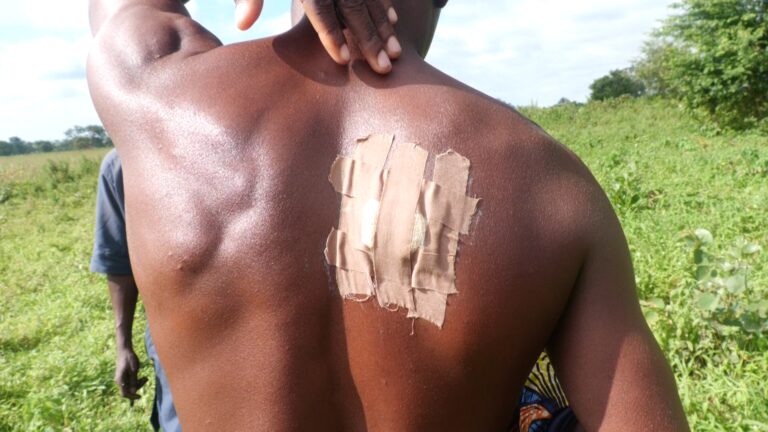
Luka Samari was one of those who fell victim to such an attack. On that fateful night of October 29, 2023, around 9 p.m., he encountered Dogo Gide’s men near a river in the community when he was making his way home from a friend’s house.
The terrorists shot Samari in his right leg, resulting in a severe bone fracture and was subsequently moved to Shallon Hospital, Zumba, where he was later discharged to recover at his brother’s residence within Zumba town.
Community pays a heavy price for bandits’ attack on soldiers helicopter
Google Earth image of Kwaki town.
Meanwhile, in the aftermath of the clash between Dogo Gide’s men and the military, Kwaki, another town in Shiroro LGA, bore the brunt. Multiple houses were damaged, and at least six people were injured, with one woman said to have died in an alleged reprisal attack by the Nigerian Army.
Kwaki is a few metres away from Chukuba, where bandits gunned down the NAF helicopter on an evacuation mission.
The helicopter, on Monday, August 14, was flying back from Zungeru LGA, where the cattle rustlers ambushed the Nigerian soldiers and killed 25 (including three officers), when Bandits’ affiliated Dogo Gide crashed the helicopter in Chukuba according to sources.
Sources in the town explained that the bandits made a first attempt to take down the helicopter when it was on its way to Zungeru but could not because the helicopter was maintaining enough foot range to avoid attacks from guns.
In the crash were 14 of the previously killed in action personnel in that ambush, seven of the previously wounded in action personnel, two pilots of the helicopter and two crew members.
Although the community and a few nearby communities (including Kwaki) are hideouts of Dogo Gide and his men, there are hundreds of civilians who are still camped in the areas and can’t risk releasing information to the security forces.
Following the attack, the military allegedly dropped what seemed to be an explosive artillery shell, covering the atmosphere with smoke.
The attack led to the death of a woman, Aisha Yahuza, while an eleven-year-old boy, Gambo Jibril, was among the injured civilians.
Ibrahim Madaki.
A resident of the Kwaki/Chukuba ward, Ibrahim Madaki, listed some of the injured victims as Fati Shaba, Rabiatu Jibrin, Hajara Basiru and Alhaji Bala Garba.
Although the Shiroro Council Secretary could not confirm the incident that happened in Kwaki, he, however, explained that the Military led by the Air commander and Chief of Army staff visited the location of the helicopter crash on Tuesday, August 15, to retrieve the remains of the dead soldiers and also launched attacks on the bandits.
Efforts by The ICIR to get the NAF officials and Military authorities to speak on this proved abortive, as calls and SMS were not picked up or returned.
Insecurity in Niger state is long-standing
The Deputy Governor of Niger state Yakubu Garba. Photo The ICIR
The Deputy Governor of Niger state Yakubu Garba, while speaking to The ICIR on the state of insecurity in the state, explained that the issue of insecurity in Niger has been haunting people of the state for so long, adding that the current administration is demonstrating a commitment to significantly reduce the menace and pave the way for a return of normalcy.
“The issue of insecurity in Niger state is something that has been bedevilling us for a long time, but with the coming of this present administration led by Muhammad Umaru Bago, we are doing everything humanly possible to see that we curtail to the barest minimum.”
Addressing the areas most affected by insecurity, the government bemoaned the situation, confirming that it has led to the abandonment of certain areas.
The Council Chairman, Alkilu Isiaku Kuta, also explained that out of the 15 wards in Shiroro Local Government Area, eight have been particularly affected by insecurity.
He noted that a significant portion of the population in these troubled wards has been forced to flee their homes, seeking refuge in neighbouring regions such as Biligwari, Ribwa and Kaduna state.
‘As people all know, when we are talking about insecurity, it is not Shiroro as a whole. Shiroro has 15 wards, but the areas where they are facing insecurity are eight wards. And the eight wards are across the rivering side.
Speaking on villagers paying dues to the bandits, Isiaku stressed that the council has unequivocally stated its stance against supporting payments to bandits, adding that efforts are being made at the local level to mitigate the situation.
Police react
The Niger State Police Command Public Relations Officer Wasiu
Reacting to some of The ICIR findings, the Niger State Police Command Public Relations Officer Wasiu Abiodun, said about four Local governments are constantly facing the menace of insecurity.
“This challenge is being noticed in about 3-4 LGAs. I think Shiroro, Raffi, area and part of Munya LGA. We have adopted a synergy with other security agencies, the military, the DSS, Civil Defence and other Security agencies, the military, the DSS, Civil Defence and other security outfits in the state.”
He noted the state mostly faces insecurity crises in locations bordering Zamfara and Kaduna state.
When asked about why there are no police officers around Akere, Cheji, Chukuba and other insecurity-prone axis, he stated that most of the places aren’t motorable.
“How do you tend to govern or police ungoverned spaces that are very wide and the forest nature is hilly, swampy nature, that even vehicles cannot penetrate into some of these areas because they are very swampy in nature.
He, therefore, noted that the state command has deployed officers to some strategic locations “to serve as an assurance for members of the Public to know that wherever they are, the security men are with them to ensure that they are protected and they are safe.”









 Luka Samari, a victim of the incessant bandits’ attack in Chukubu, Niger state.


