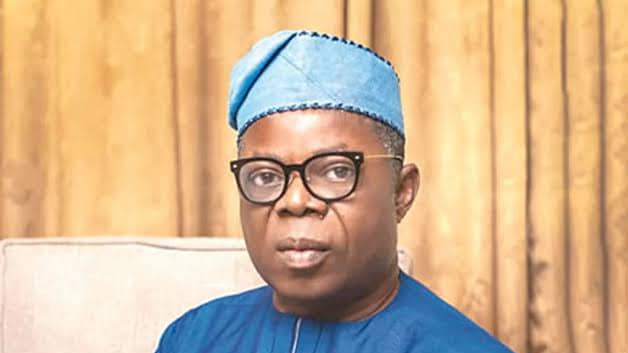
FORMER Deputy Clerk at the National Assembly Olayide Adelami has been sworn in as deputy governor of Ondo state.
Adelami was sworn in by the Chief Judge of the state, Olusegun Odusola, at the International Culture and Event Centre in Akure, the state capital, on Thursday, February 1.
The new deputy governor pledged his loyalty to his principal and the people of the state.
“Mr Governor, I hereby wholeheartedly accept to be your deputy, and my loyalty to you will be total. To the good people of Ondo State, I’m here to join hands with Governor Lucky Orimisan Ayedatiwa to serve you and ensure that lives are made more meaningful for you in all facets.
“To our good people of Ondo State, by the Grace of God Almighty who, in His will, arranged this day to come, we will not let you down. I want to, therefore, appeal to all our good people of Ondo State at home and abroad to kindly support Mr Governor and myself in our sincere desire to entrench good governance in our Sunshine State,” Adelami said.
On Wednesday, January 24, Aiyedatiwa nominated Adelami as his deputy. He forwarded his name to the state Assembly for confirmation.
The Assembly confirmed his appointment on Thursday, January 25, after screening him.
The Assembly’s Deputy Speaker, Abayomi Akinruntan, said during Adelami’s screening that he displayed an understanding of the office and qualified for it.
Adelami hails from Owo Local Government Area (LGA), the same LGA where the immediate past governor of the state, Rotimi Akeredolu, hailed from.
Aiyedatiwa appointed him as deputy after the governor took over the state’s leadership, following Akeredolu’s death.
Some of Akeredolu’s aides tendered their resignation letters upon Aiyedatiwa’s assumption of office, citing loyalty to the deceased as the reason for their decision, and hours before the new governor appointed Adelami, he dissolved the executive council appointed by his predecessor.
During Adelami’s swearing-in ceremony, Aiyedatiwa explained that the dissolution of the executive council was to introduce fresh hands into his government and urged Adelami to embrace accountability during his tenure.
GUNMEN suspected to be bandits have reportedly kidnapped a director of the Federal Housing Authority (FHA), Aondo Ver, in the Federal Capital Territory (FCT) Abuja.
According to Punch Newspaper, Ver was kidnapped from his residence in the Bwari Area Council of the FCT’s Pambara Extension, some 200 meters from a military post.
The bandits were reported to have struck on Thursday at 1:30 a.m., intermittently firing and inciting fear across the neighbourhood.
They made their way into the nearby bush with the victim.
According to residents who confirmed the incident on Thursday, February 1, military personnel were stationed at a facility known as ‘Camp’, located roughly 200 meters from the location where the official was abducted.
Attempts to confirm the incident from the FCT Police Command spokesperson, Josephine Adeh, were unsuccessful as she neither picked up calls The ICIR put across to her nor responded to messages sent to her mobile line.
The ICIR reported that FCT residents fledtheir homes in Bwari Area Council over bandit attacks and kidnappings.
In Nigeria, gunmen make fortunes from kidnapping citizens on highways, homes, schools and farms.
Between July 2022 and June 2023, a total of $387,179, translating to N302 million, was paid as ransom to kidnappers in the country, according to SBM Intelligence.
This amount represents six per cent of the total N5 billion ($6,410,256 as of June 30 2023) the kidnappers requested within the period, the intelligence gathering platform revealed.
Despite being Nigeria’s seat of power, more than four hundred residents of FCT have been kidnapped from 2018 to June 2023, according to the Nigeria Security Tracker (NST).
According to media reports, residents of Abuja experienced an upsurge in kidnapping activities towards the end of 2023, and it continued into the new year.
Kidnappings, one-chance activities and other security challenges in the FCT symbolise similar crises across Nigeria.
According to data obtained by The ICIR, over 380 personswere kidnapped between December 1, 2023, and January 3, 2024, across Nigeria under President Bola Tinubu.
Data obtained from the Armed Conflict Location & Event Data Project (ACLED), a data bureau collecting data on the locations, dates, actors, fatalities, and types of all reported political violence and protest events worldwide, shows that those abducted include men, women, farmers, children, and students.
The victims were taken hostage at various events that happened during the last month of 2023 and the first week of the new year, illustrating the escalating number of kidnapping cases in the country.
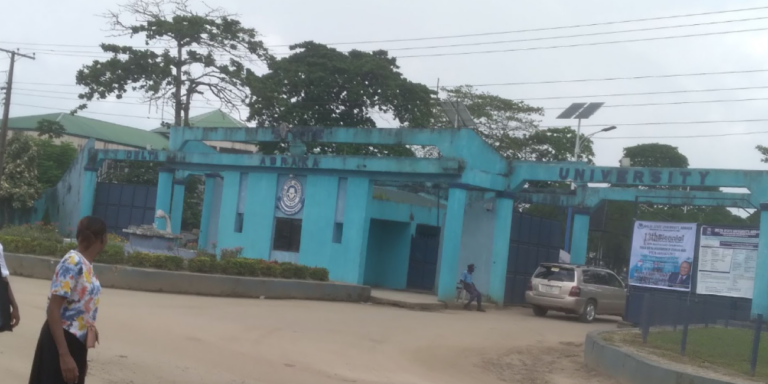
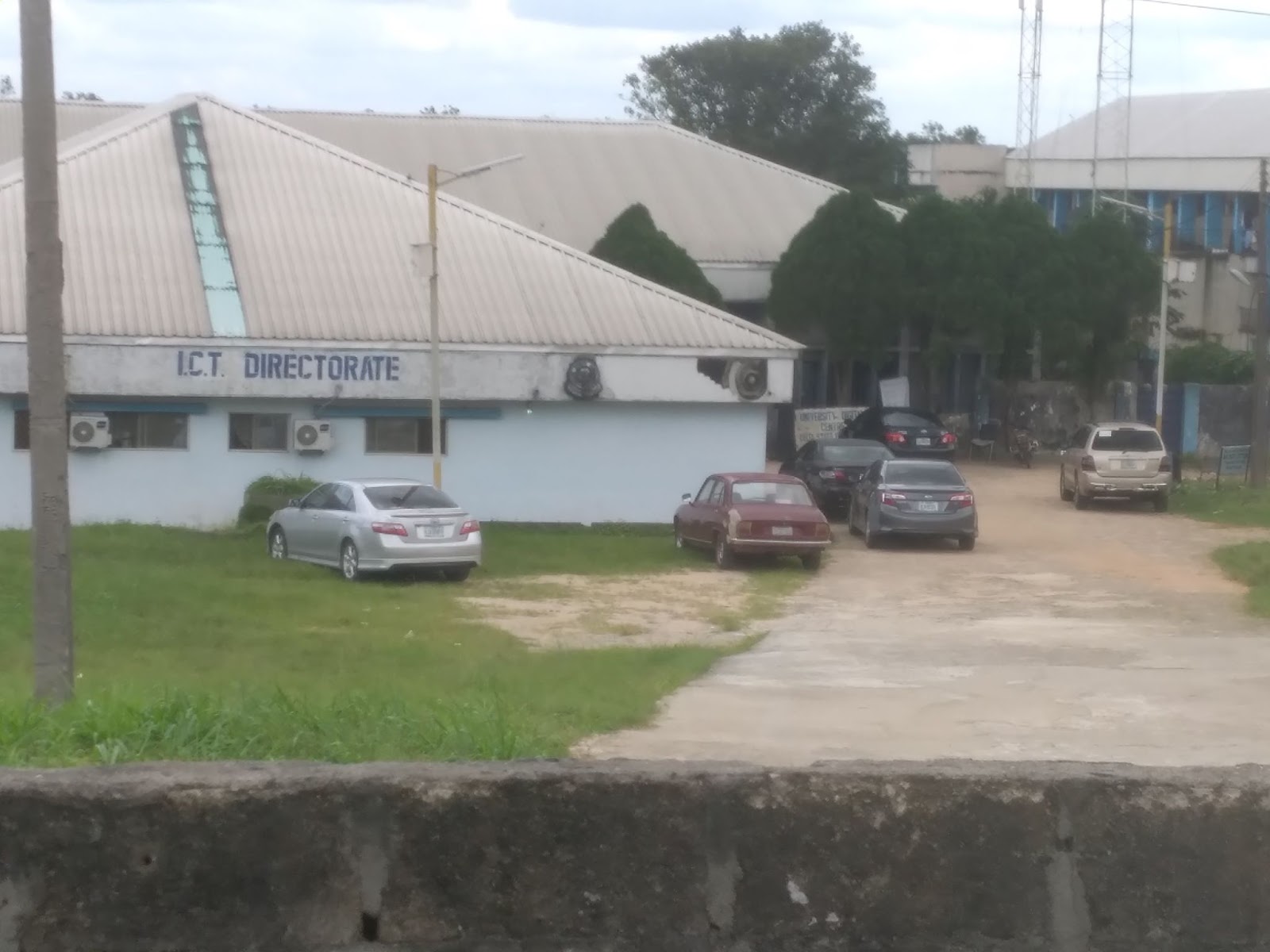
*JONATHAN Chris was smiling to himself as he watched with keen interest some postgraduate students receiving training inside a section of the Information and Communication Technology (ICT) Directorate Hall in Campus II of Delta State University, Abraka (DELSU), where he works as an ICT staff.
With a burning desire to sit like them one day and receive training that would either lead to his promotion or better employment opportunity in a big tech or ICT firm, Chris regularly watches people – sometimes students and staff of the university or others outside the university being trained.
Of course, Chris would have received at least such training between April and July 2019 if the contract awarded to Goldmark Concepts Limited by his employer, DELSU, which included training of the institution’s ICT staff, had been fully executed.
Every year, the Delta State government budgets billions of naira and awards several projects in the state’s university in Abraka and other tertiary institutions across the state to improve the teaching and learning system of institutions of higher learning.
However, just like the abandoned procurement, installation and testing of equipment and training projects awarded by Delta State University, Abraka, some of these projects, despite their anticipated benefits, have ended up abandoned or poorly implemented.
Unfortunately, some low-income and financially deprived citizens send their children and wards to the state government-owned tertiary institutions, including DELSU, because it is believed that tuition fees are more affordable in public institutions.
According to the documents of approved budgets of Delta State, the state government in 2019 allocated the sum of N4.8 billion (N4,890,879,366) to the Delta State University and in 2020, the state government allocated a total of N15.3 billion (N15,683,390,489) to the Ministry of Higher Education.
The 2021, 2022 and 2023 budget documents showed that Delta State government allocated a total of N82.9 billion (N82,969,569,193.75) to the Ministry of Higher Education, while Delta State University got the sum of N14 billion (N14,147,020,880) budget for the three years.
However, despite the huge amount of money budgeted and disbursed yearly by the state government to provide optimum teaching and learning environments for students of these schools, people have continued to be denied dividends of their state’s resources with the multiple abandoned projects across many tertiary institutions in the state.
Contract first awarded to Goldmark Concepts Limited
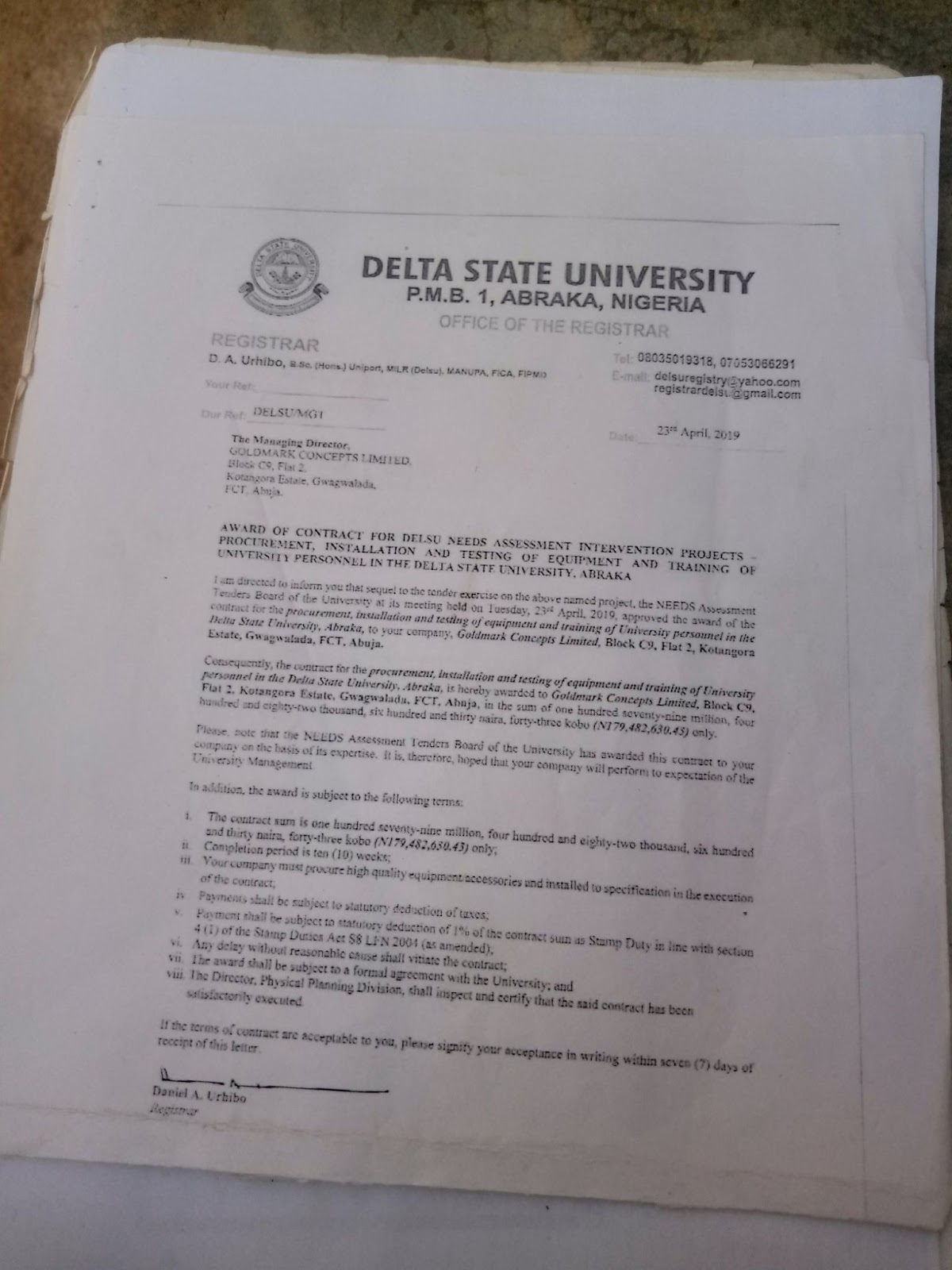
On April 23, 2019, the office of the Registrar of DELSU, Abraka issued a contract document for procurement, installation and testing of equipment and training of some university personnel to Goldmark Concepts Limited at the sum of N179.4 million (N179,482,630.45).
The contract document signed by the then Registrar, Daniel A. Urbibo, stated that the contractor must procure high-quality equipment accessories and install them according to the specification in the execution of the contract and that the completion period of the contract was 10 weeks.
The letter stated that the contract was awarded to Goldmark Concepts Limited following the decision of the NEEDS Assessment Tenders Board of the University at its meeting held on Tuesday, April 23, 2019.
Contract document issued to Goldmark Concepts Limited by DELSU management
“In addition, the award is subject to the following terms: the contract sum is one hundred seventy-nine million, four hundred and eighty-two thousand, six hundred and thirty naira, forty-three kobo (N179,482,650.43) only, its completion period is ten (10) weeks. Your company must procure high-quality equipment accessories and installed to specification in the execution of the contract.
“Payments shall be subject to statutory deduction of taxes. Payment shall be subject to statutory deduction of 1% of the contract sum as Stamp Duty in line with section (1) of the Stamp Duties Act $8 LFN 2001 (as amended). Any delay without reasonable cause shall vitiate the contract.
“The award shall be subject to a formal agreement with the University; and the Director, Physical Planning Division, shall inspect and certify that the said contract has been satisfactorily executed,” the Registrar added.
Goldmark Concepts Limited re-awards contract to another company
In May 2019, the contractor, Goldmark Concepts Limited, a company which identified its focus as general contractor and supply of entrepreneurship equipment, laboratory equipment, computer equipment, building and construction and with offices in Zaria, Lagos, Benin, Lokoja and Abuja, re-awarded the contract to Bigo Computers and Ventures (Information Technology) at the sum of N39,090,000.00 to be completed within four weeks.
Alaba Ifeoluwa, who signed the contract letter dated May 22, 2019, on behalf of Goldmark Concepts Limited, simply reproduced the entire details of the N179 million contract letter given to Goldmark Concepts Limited by the Delta State University, Abraka, except for the contract sum.
Contract document issued to Bigo Computers & Ventures by Goldmark Concepts Limited
The letter given to Bigo Computers & Ventures by Goldmark Concept added that the award of the contract was “Sequel to the submission of your Pro-forma Invoice on ICT equipment, your company has been awarded the contract for the Procurement, Installation and Testing of Equipment and Training of University Personnel in the Delta State University, Abraka.
“Consequently, the contract for the Procurement, Installation and Testing of Equipment and Training of University Personnel in the Delta State University, Abraka, is hereby awarded to Bigo Computers and Ventures, 6, Kaduna Dye-Pass, Wusasa, Zaria, Kaduna State, in the sum of Thirty-nine million, ninety Thousand Naira (N39,090,000.00) only for a completion period of four (4) weeks.”
DELSU, Goldmark Concepts refuse to account for the project
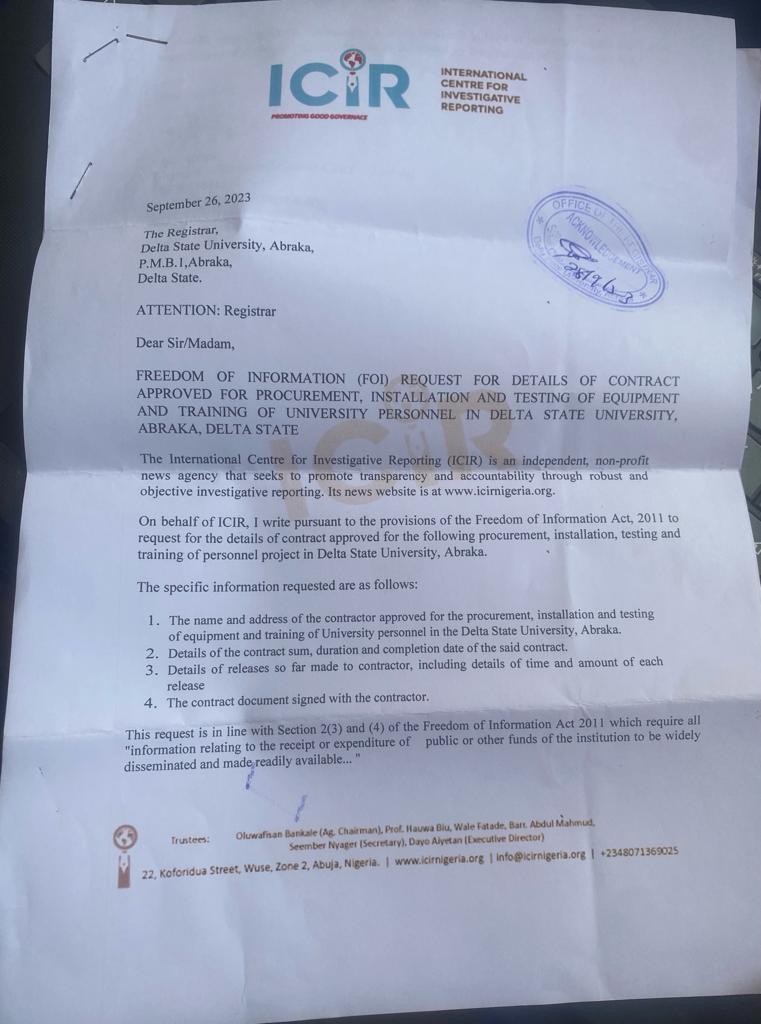
Following our findings before and during a visit to DELSU in Abraka, a Freedom of Information letter was submitted to the office of the Registrar of the University on September 28, 2023, requesting details of the contract, including payment details, as required by the Freedom of Information Act (FOIA) 2011.
Although the Act specifies seven days to provide the information requested, till the time of filing this report, DELSU acknowledged the letter but never provided the requested information on the contract nor offered any explanation as to why it would not or may not provide the details of the contract as requested.
Also, when contacted for an explanation on the contract, the former Registrar, Urhibo, who signed the contract letter, simply told the reporter that he could not answer any questions as he has since retired.
“I am no longer in service. I have retired and I can’t speak about the contract. Go to the university and get your information,” he stated.
Freedom of Information letter sent to DELSU
Similarly, when contacted, the Manager of Goldmark Concepts Limited, Samuel Adams, claimed that the project was executed but refused to give details of how this was done, saying that he was not in the right position to speak about the matter.
“I am the manager of Goldmark Concepts but I am not in the right position to speak about the project. It is the director that can give you the details but all I know is that the project has been completed and the university has approved it,” Adams said on the phone.
Efforts to reach the director of Goldmark Concepts Limited, Sunday Ifeoluwa, and the former Vice Chancellor of DELSU, Prof Victor Peretomode, failed as neither of them answered several calls made to their phone numbers.
To get Delta State University to speak on the state of the contract and our findings, several calls were made to the phone number of the current Public Relations Officer of the university, Clinton Sagboje, for three days but none of the calls were answered.
Text messages and a WhatsApp message were sent to him but though the messages were delivered, he had not replied to any of them as of the time of filing this report.
While making further attempts to get reactions from DELSU, during his visit to the University’s campuses in Abraka, our reporter met with the Deputy Director of ICT at Campus 2, who refused to disclose his name or speak about the project but directed our reporter to the office of the Registrar.
When our reporter submitted the FOIA letter, he requested to speak with the Registrar, but he was turned down with a promise that the university would respond to the letter appropriately. However, it had not done so as of the time of filing this report.
Also, at the Asaba campus of the university, our reporter was denied access to the ICT Centre but a middle-aged man at the entrance of the ICT Centre who confirmed that he was a staff member of the school and simply gave his name as Johnson, said, “There were some ICT equip supplied to the campus in 2020 but that I cannot say anything about its standard or who exactly procured it.”
He, however, also said that “there was never any training conducted for the ICT staff on the campus by any company identified either as Goldmark Concepts Limited or Bigo Computers and Ventures.”
Goldmark Concepts provided non-existing address to CAC
Following failed several attempts to get details of the contract the Goldmark Concepts Limited Manager, Samuel Adams, claimed has been completed and approved by the university, our reporter visited the company’s registered address in Zaria, Kaduna State to see if he could speak with one of its officials.
However, our reporter’s visit to Goldmark Concepts Limited’s registered address at 11d Aminu Road, Sabon-Gari, Zaria, Kaduna State showed that the company has no office at the location.
It was discovered that Aminu Road in Sabon Gari- Zaria is a road from Muchiya Roundabout to Sabon Gari Market, while No. 11D, Aminu Road is a building facing Sabon Gari Central Market, beside Kasuwan Mata Divisional Police Headquarters.
The ground floor of the building (No. 11D Aminu Road) is a block of shops selling kitchen utensils while the 1st and 2nd floors are residential apartments. There is nothing like Goldmark Concepts Limited office at the said location.
Bigo Computers speaks on deal with Goldmark, procured substandard equipment with no training conducted
When contacted for an explanation on the contract awarded to his company by Goldmark Concepts (the contractor DELSU originally gave the contract), the Director of Bigo Computers & Ventures, MrOlalekan S. Adegoke, explained how he got the contract, procured some equipment which he confessed were below the standard recommended by the Tertiary Education Fund (TETfund).
Adegoke said, “I was in Goldmark’s house on a Sunday before a letter (of the contract) was awarded to me to discuss the project and the following week, I started the project.
“The letter he gave to me was not part of the contract initially. I was only to help him get the equipment and he would move it to wherever he wanted to move it to.
“But in the course of doing that, he couldn’t release all the money as we discussed. I then said that for me to get the remaining equipment for him, he has to give me a letter to show that we have a deal which is why I was to get the equipment. The letter would show details of what he wanted to use the equipment for.
“When I got to his house, he confirmed to me that the contract was for the former Vice Chancellor, Prof Victor Peretomode.
“He made a verbal promise to me that I would be paid N5 million if I ccarried out the contract for them. At that point, I agreed because I was after what I would get, not after what anybody was doing.”
Adegoke further explained, “When he couldn’t get the money to me, when he sent the letter as I requested, instead of sending a Memorandum of Understanding (MoU) that he had given me the responsibility to buy the equipment, with the list of the equipment and even adding price tags with his company name and my company, he sent a letter of contract award.
“He duplicated the letter the university gave to him. He edited the letter, removed the price the university awarded the contract to them and put my own price.
“So, if the university didn’t know that he gave me a letter, when the problem started, the Commissioner for Education invited the university, Goldmark and I twice with formal letters.
“The Registrar (former) and the Bursar were at the meetings, and they knelt down begging me not to go to the EFCC (Economic and Financial Crimes Commission), therefore, the school knows now.”
He told our reporter that the Delta State Ministry of Education invited the Managing Director of Goldmark Concepts Limited, Sunday Ifeoluwa, but he ignored the invitations. He added that according to the letter Goldmark gave him, DELSU’s director of physical planning must validate whatever he did before payment can be made to Goldmark.
He also said that Goldmark Concepts Limited is a book-selling company, not an IT company, hence, “it is not qualified to carry out the kind of contract awarded to it by DELSU.”
“The former DELSU Vice Chancellor owns the contract which he gave to Goldmark and they shared the N140 million they have stolen,” Adegoke also alleged.
He, however, claimed that he procured the equipment in the list Goldmark gave to him from one Mr. Ifeanyi of Vintage System Ventures in Ikeja Computer Village, but because of price difference and balance of the equipment he bought on credit, Mr. Ifeanyi told him that he was arrested on June 26 and 27, 2019 respectively by the operatives of the State Security Service (SSS) in Lagos for interrogation to ascertain the prices he bought the equipment.
“But I also know that it was not the TETFund (Tertiary Education Trust Fund) specification that he bought for the school. I have their invoice but I have decided not to give it to anyone.”
Adegoke said still owed Mr. Ifeanyi for the equipment he bought following Goldmark’s refusal to pay him.
He said, “The university has said they have asked Goldmark Concepts Limited to pay me, that if Goldmark fails to pay me, it is not their business.
“The university called Goldmark and I together in a panel review, and the university knows what really happened and what has not been done in the contract, and the university recommended that I should be paid,” he said.
However, he refused to provide evidence of the equipment he said he procured from Mr. Ifeanyi in Lagos including invoices for the equipment.
He insisted that all the documents and evidence he has are what he will present in court and every effort to get him to release the evidence to substantiate his claims failed as he refused to release the evidence.
Meanwhile, he said that the university gave the contractor, Goldmark Concepts, a certificate of job completion “because the management shared the money with him. N140 million was shared by these people, yet the contract was not carried out to the latter.
“As I speak to you, DELSU has dropped documents showing N130 million was paid to Goldmark Concepts Limited with respect to this contract. The university has not been able to explain what happened to N49 million.
“The contract till today is not completed. I was the one who purchased the equipment. Some of the equipment supplied is never TETFund specifications.
“On my letter of N39 million (N39,090,000), there is installation and training which till today was not carried out, plus other things detailed to that contract. Till now, it was not done, yet the university gave contract completion certificate to Goldmark Concepts Limited because I know they shared the remaining N140 million.
“I didn’t conduct any training for anyone. Bigo Computers & Ventures did not conduct any training for anybody.
“They wrote training on the contract letter but training on what? Training for how long? Training with what? Samuel Adams should explain who conducted the training, where they conducted the training, number of DELSU ICT staff that were trained, what they were trained on.”
When contacted, Ifeanyi confirmed that Adegoke approached him with a contract of over N30 million but had N18 million.
Ifeanyi lamented that after a long time when Adegoke failed to pay him the money, the colleague from whom he collected some of the equipment and gave to Adegoke mounted pressure on him, forcing him to sell off his car to pay the woman.
He added that Adegoke had been presenting different invoices he got from where he did not buy equipment as evidence.
“There is a woman I collected some equipment from and gave to Adegoke and the woman’s balance was about N8 million. I had to sell my car to settle the woman, yet, I’m still owing her about N2.7 million,” he said.
Ifeanyi said that Adegoke took four processors that were sold for N800,000 then, and two servers that were sold for N2.6 million.
However, like Adegoke, Ifeanyi promised to provide evidence for the transactions but subsequent efforts to get the evidence including the invoice from him failed as he no longer answered calls made to his phone number nor replied to messages sent to him till the time of filing this report.
Violation of procurement law
Section 15(1) (a) and (b) of the Procurement Act, 2007 provided that “The provisions of this Act shall apply to all procurement of goods, works and services carried out by (a) the Federal Government of Nigeria and all procurement entities;
“(b) all entities outside the foregoing description which derive at least 35% of the funds appropriated or proposed to be appropriated for any type of procurement described in this Act from the Federation share of Consolidated Revenue Fund.”
However, without obtaining a “Certificate of ‘No Objection’ to Contract Award” from the Bureau of Public Procurement, Delta State University, Abraka failed to revoke the contract it awarded Goldmark Concepts Limited when it (DELSU) found out that the contractor had rewarded the project to another contractor without its written approval.
Also, according to the Procurement Act provision on entities that are qualified to engage in public procurement, it was a violation of the law for Goldmark Concepts Limited to award a contract to Bigo Computers & Ventures.
Goldmark does not fall into the category of entities that derive at least 35% of the funds appropriated or proposed to be appropriated for any type of procurement from the Federation share of Consolidated Revenue Fund.
With an estimation of about 22,000 students in Delta State University, Abraka, according to 2019/2020 population figure of the institution, underfunding and underequipped of higher institution facilities, corruption leading to the abandonment of several projects and unaccountability, have, to a large extent, subjected the academic lives of students of DELSU and other institutions in the state to certain level of deprivations and difficulty.
This investigation, republished from Sahara Reporters is supported by the John D. and Catherine T. MacArthur Foundation and the International Centre for Investigative Reporting.
THE National Bureau of Statistics has said that the number of electricity customers in Nigeria increased to 11.71 million in the third quarter of 2023.
The revenue from the customers within the quarter was N260.16 billion. The amount was lower than the N263.08 billion generated by the distribution companies in the second quarter of the year when the electricity customers were 11.47 million.
In addition, the energy supplied within the quarter dropped to 5,731.60 (Gwh) in Q3 2023 from 5,909.83 (Gwh) in the previous quarter.
The NBS also reported that metered customers in the quarter under review stood at 5.68 million. This indicates a growth of 3.77 per cent from 5.47 million recorded in the preceding quarter.
Also, estimated customers during the quarter were 6.03 million, higher by 0.53 per cent from 6.00 million in Q2 2023.
In the third quarter, the Ikeja, Eko and Abuja DisCos collected the highest revenue with N56.8 billion, N42.5 billion and N39.9 billion, respectively. However, Yola and Kaduna DisCos generated the lowest revenue, with N5.59 billion and N7.57 billion, respectively.
The ICIRreported how Lagos, Enugu and six other states commenced the implementation of the Electricity Act. The Act was signed into law by President Bola Ahmed Tinubu on 6 June 2023 to accelerate Nigeria’s energy transition process and consolidate the Nigerian Electricity Supply Industry (NESI) regulation for optimum functionality and effective service delivery.
Also, another report disclosed how the Nigerian Electricity Regulatory Commission (NERC) approved new electricity tariffs for the 11 DisCos in the country.
NIGERIA, Mali and the host nation of the 2023 Africa Cup of Nations (AFCON), Cote d’Ivoire, are currently the three top-ranked African countries by the Confederation of African (CAF), the ICIR check reveals.
According to the CAF ranking, the top ten countries include; Morocco, Senegal, Tunisia, Algeria, Egypt, Nigeria, Cameroon, Mali and Ivory Coast.
Despite being rated the best on the continent, seven of these countries have bowed out of the ongoing continental football showpiece.
Egypt and Senegal played in the final of the 2021 edition of the tournament, which Senegal won.
Similarly, Morocco, Burkina Faso, Cameroon, and Tunisia reached the quarterfinal stage of the competition.
However, the ongoing AFCON tournament is witnessing dramatic eliminations of some of these strong footballing nations and giving hope for a new champion to emerge.
As the quarter-final knockout stage begins tomorrow, Friday, February 2, the eight teams that advanced into the phase include Nigeria, Côte D’Ivoire, Angola, Cape Verde, DR Congo, Guinea, Mali and South Africa.
The quest to secure a spot in the semi-finals will begin between Nigeria’s Super Eagles, who will slug it out with Angola’s Palancas Negras, ranked 20 by CAF at the Stade Félix Houphouët-Boigny in Abidjan at 6.00 p.m.
DR Congo, ranked 13th, defeated Egpyt via penalty shootout 8-7 after a 1-1 draw in regular time, which will square up against Guinea, ranked 15th.
Other matches that will be played on Saturday, February 3, will see Mali face Côte d’Ivoire at the Stade de la Paix Bouake stadium at 6.00pm.
Also, Cape Verde, who narrowly sailed through a 1-0 victory against Mauritania, will battle South Africa at the Stade Charles Konan Banny de Yamoussoukro at 9.00pm.
Friday
Nigeria vs Angola (Stade Felix Houphouet-Boigny Stadium in Abidjan by 6.00pm.)
DR Congo vs Guinea (Olympic Stadium of Ebimpe at 9.00pm.)
Saturday
Mali vs Côte d’Ivoire (Stade de la paix Bouake at 6.00pm.)
Cape Verde vs South Africa (Stade Charles Konan Banny de Yamoussoukro at 9.00pm.
THE Central Bank of Nigeria (CBN) has yet to appoint new external monetary policy committee (MPC) members as it is set to hold its first policy meeting this month.
On January 19, CBN announced that it would hold its first MPC meeting under the new leadership of its governor, Olayemi Cardoso, on February 26 and 27.
The MPC meeting was last held in July 2023 as the apex bank consecutively postponed the bi-monthly statutory function used to consider, recommend, and take critical economic decisions in September and November 2023 and could not hold it in January 2024.
The apex bank had resolved to hold its first MPC meeting in February and hinted that it would be replacing the five external members of the committee.
In a report on January 26, Bloomberg said some of the committee members said they had been sidelined ahead of the meeting.
It disclosed that four of the five external members said they had not been invited to the scheduled meeting and did not anticipate being there as they had been excluded from the usual planning of the MPC ahead of the February gathering.
It further disclosed that the external members said they had not been paid since August 2023 and had last heard from the Central Bank in September.
Meanwhile, CBN’s acting director of Corporate Communications, Hakama Sidi-Ali, had said the appointment of new independent MPC members was in the pipeline without details.
Former President Muhammadu Buhari and former CBN governor Godwin Emefiele appointed the five external members.
However, Sections 10 and 11 of the CBN Act 2007 provide the condition under which the external directors can be appointed, removed or replaced a legal practitioner, Tim Ngbejume, told The ICIR.
“If the provision of the law is not followed, it means the statuesque remains.” He said that implied that the former directors still hold their positions.
Section 10(1) of the CBN Act states that the five directors of the Bank shall be appointed by the President subject to confirmation of the Senate, and in appointing the five external directors of the Bank, the President shall have due regard to a fair representation of the financial, agricultural, industrial and commercial interests and the principle of federal character.
Section 10(2) states further that a director appointed pursuant to this section shall be a person of recognised standing and experience in economics, law, public administration, business administration, accounting, banking and finance, but as a director of the Bank, he shall not hold office as a director of the board of any federal, state or local government or of any other body.”
Also, according to the CBN Act, to facilitate the attainment of the objective of price stability and to support the economic policy of the Federal Government, there shall be a committee of the bank as MPC, which shall consist of the CBN governor who shall be the chairman of the committee, the four deputy governors of the CBN, two members of its board of directors, three-member appointed by the President, and two members appointed by the CBN governor.
“The appointment of a member of the MPC pursuant to Sub-section 2(d) and (e) of this section, the remuneration, filling of temporary vacancies, qualification, tenure of office and disqualification shall be subject to the same terms as are stipulated as a director under sections 10 and 11 of this Act,” the Act states.
The CBN’s proposed decision to replace its MPC’s external members has raised questions about possible interference in monetary policy decisions.
An economist, Muda Yusuf, had toldThe ICIR that the external MPC members are vital to making independent decisions about Nigeria’s monetary policy issues.
“Let’s give the President and the CBN governor the benefit of the doubt regarding the nomination of external members before the February meeting date, he said, adding that “there is a reason for some members’ external competition into the MPC to enable external and balanced perspectives on issues on monetary policy.”
Another economist, Omobola Adu, said holding February’s MPC meeting without any independent member would likely raise questions concerning the credibility of the decision and that having external members reduces the bias that internal or political pressures can influence the Central Bank.
THE Central Bank of Nigeria (CBN) has expressed concerns over banks’ growth in foreign currency position.
It said the position exposed the banks to foreign exchange (FX) and other risks.
The CBN disclosed this in a circular on Wednesday, January 31, stating that banks’ growth in foreign currency exposures comes through their Net Open Position (NOP).
“The Central Bank of Nigeria (CBN) has noted with concern the growth in foreign currency exposures of banks through their Net Open Position (NOP).
“This has created an incentive for the banks to hold excess long foreign currency positions, which exposes the banks to foreign exchange and other risks,” the CBN said.
An NOP is the aggregated sum of the net short or long positions across any particular foreign currency or all foreign currencies for banks; a long position indicates a net foreign currency asset position, while a short position indicates a net foreign currency liability position reports The ICIR.
In the circular, CBN recommended new prudential requirements for the banks to comply with to ensure banks manage the risks and avoid losses that could pose systemic challenges.
It said the NOP limits of the overall foreign currency assets and liabilities, taking into cognisance both those on and off-balance sheet, should not exceed 20 per cent short or zero per cent long of shareholders’ funds unimpaired by losses using the gross aggregate method.
Banks whose current NOP exceeds 20 per cent short and zero per cent long of their shareholders’ funds unimpaired by losses must bring them to the prudential limit by February 1, 2024.
The apex bank also directed the banks to compute their daily and monthly NOP and foreign currency trading position (FCTP) using approved templates.
It urged the banks to have adequate stock of high-quality liquid foreign assets, including cash and government securities in each significant currency, to cover their maturing foreign currency obligations.
The CBN stated that banks should also have an FX contingency funding arrangement with other financial institutions.
Other recommendations are that banks borrow and lend in the same currency to avoid currency mismatch associated with foreign currency risks.
All the banks are also required to adopt adequate treasury and risk management systems to provide oversight of all FX exposure and ensure reporting on a timely basis.
“Banks are expected to bring all their exposures within the set limits immediately and ensure that all returns are submitted to the CBN, provide an accurate reflection of their balance sheets,” CBN said, promising to sanction erring banks.
Implication of the new CBN’s guidelines
Analysts at Comercio Partners said the guidelines are expected to impact the liquidity dynamics of the dollar rate and the overall economic landscape.
“This regulatory initiative underscores the CBN’s proactive approach to addressing mounting concerns related to excessive foreign currency speculation and hoarding practices observed within Nigerian banks.”
According to the analysts, the immediate impact would be that as the banks adjust their positions on NOP by February 1 and liquidate their net long positions, it could lead to a sudden influx of FX into the market.
However, the increased supply of foreign currency may put downward pressure on its value in the short term.
“If banks comply, it could lead to an immediate reprieve for the forex market and potentially trigger currency appreciation. Investors might witness a strengthening of the local currency against major foreign currencies, including the dollar.”
Nigeria’s banks have profited from FX revaluation gains since the apex bank floated the Naira to the dollar exchange rate.
However, the new regulations may impact their profitability, especially if banks hold significant net-long positions that need to be liquidated, the analysts pointed out, urging that the banks might have to adjust their strategies to comply with the guidelines.
The analyst said compliance with the new CBN’s guidelines could contribute to economic stability.
“A more stable forex market enhances predictability for businesses, investors, and consumers, fostering a favourable economic environment.”
Comercio Partners added that the new rule was a significant regulatory intervention to curb speculative practices in the banking sector.
“The impact on liquidity and the economy will depend on the extent to which banks comply with the guidelines and how swiftly the market adjusts to the new regulations.
“In the coming days, it is crucial to closely monitor market reactions, compliance levels among banks, and any potential ripple effects on broader economic indicators.”
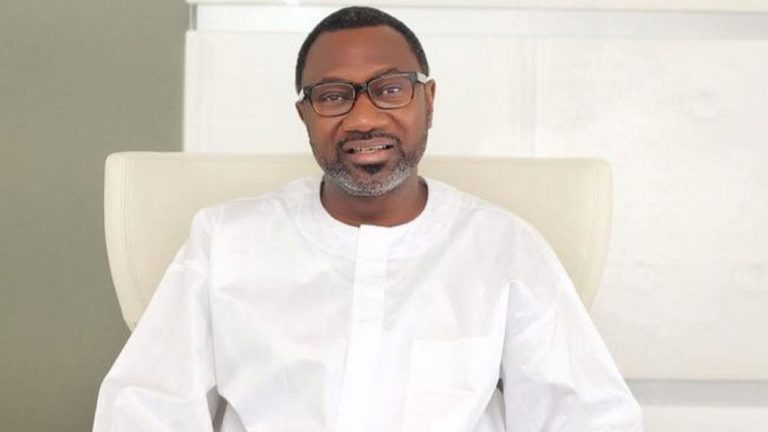
BUSINESS Mogul and billionaire, Femi Otedola, has been appointed as the new chairman of First Bank Nigeria (FBN) Holdings’ board of directors.
The firm announced this in a corporate filing on the Nigerian Exchange Limited (NGX), where it notified investors about the new development.
According to FBN Holdings, Otedola, who is also the chairman of Geregu Power, was appointed after a meeting by its board of directors on January 31, 2024.
The bank said Otedola joined its board on August 15, 2023, as a non-executive director.
“FBN Holdings Plc (the Company) hereby notifies the Nigerian Exchange Limited and the investing public that at the meeting of the Board of Directors of the Company held today, January 31, 2024, the Board appointed Mr. Olufemi Peter Otedola, CON as the new Chairman of the Board of Directors.
“He was appointed to the Board of FBN Holdings Plc on 15 August 2023 as a Non-Executive Director. He is a visionary entrepreneur with a track record of pioneering businesses, growing and transforming corporations,” the bank said.
Otedola, who recently expressed his excitement about his return to the Forbes African Billionaires list after a seven-year hiatus, takes over from the outgoing Chairman of the board, Alhaji Ahmad Abdullahi.
Stakeholders and analysts are also watching closely for the potential impact of this development on FBN holding.
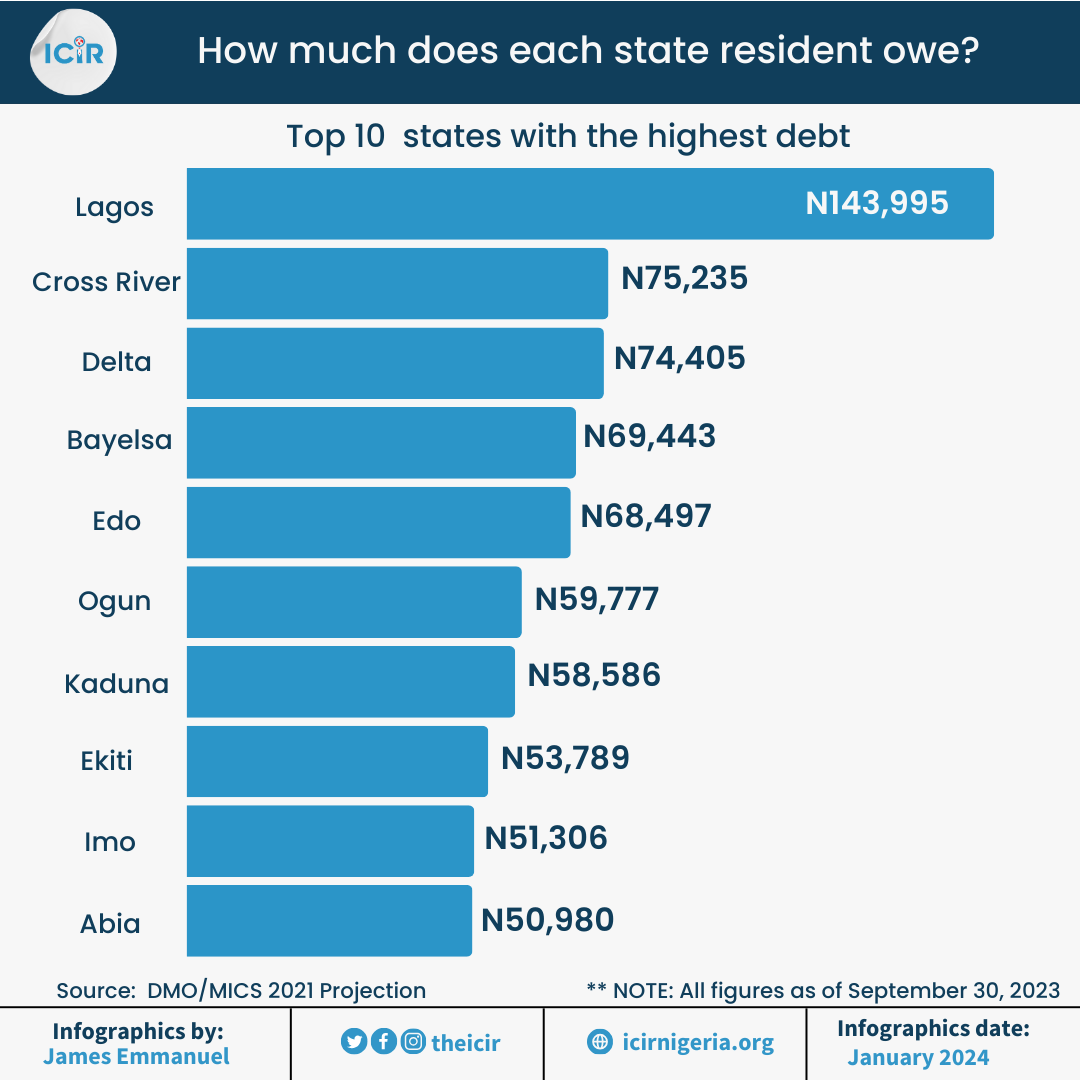
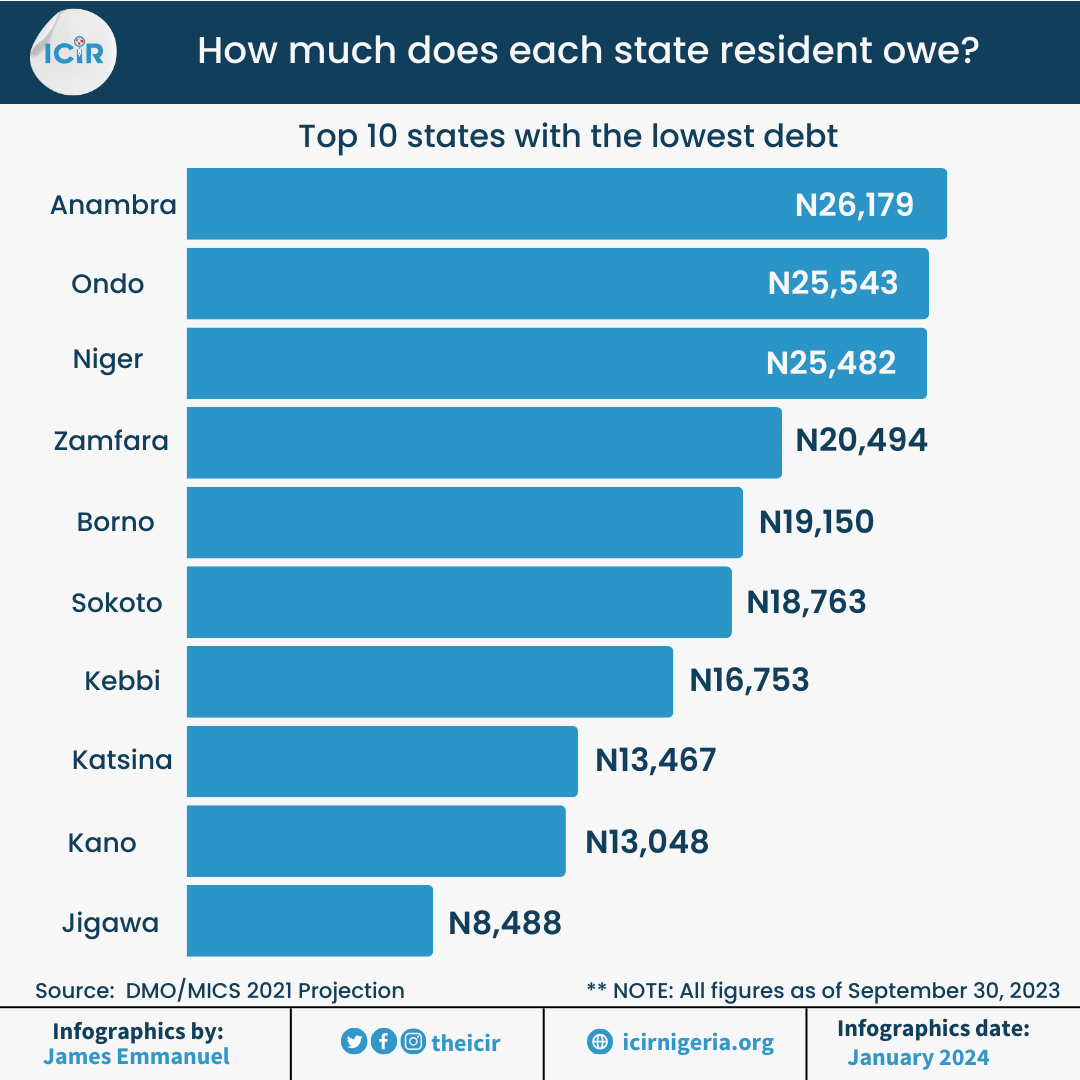
FOR every N8,488 owed by a resident in Jigawa state, another resident living in Lagos State owes about 17 times more, an analysis by The ICIR has shown.
The ICIR analysed the public debt stock, juxtaposing it with the projected population of each state, using data released by the National Bureau of Statistics (NBS).
While public debt is calculated by adding a nation’s domestic and external debts together, debt per capita is calculated as the total public debt of a country divided by the country’s population.
According to NBS, as of the third quarter of 2023, Lagos, with a population of 13.4 million, had a total public debt of N1.93 trillion, while Jigawa, with a population of 7.4 million, had a debt stock of N63.14 billion.
By calculation, this means that each resident living in Lagos state owes N143,995 in debt per capita, while Jigawa state residents owe N8,488 each.
The NBS data show that as of the third quarter of 2023, Nigeria’s public debt stock stood at N87.91 trillion ($114.35 billion). When broken down, the total external debt was N31.98 trillion ($41.59 billion), while the total domestic debt was N55.93 trillion ($72.76 billion).
Interpreting the figures in percentages, 36.38 per cent of the total debt stock is external debt, while the domestic debt is 63.62 per cent.
As of the second quarter of 2023, The ICIR reported how each Nigerian owed N396,376.19 in terms of debt per capita when the country’s public debt stock was N87.38 trillion ($ 113.42 billion).
If the country’s debt per capita is calculated as of the third quarter of 2023 with a projected population figure of 216,783,381, each Nigerian will owe N405,520.
This is a growth of N9,143.81 in the space of three months.
Nigeria’s states debt per capita
State’s debt analysis
Data by NBS showed that the total domestic debt for the 36 states and FCT was N5.74 trillion, while the external debt stood at N3.35 trillion ($4.35 billion).
This brings the total public debt of the states to N9.09 trillion.
If states’ debts are calculated within the period, the states with the highest debt are Lagos state with N1.93 trillion, Kaduna state with N525.58 billion, Delta state with N417.38 billion and Ogun state with N379.26 billion.
Meanwhile, the states with the lowest debts are Jigawa, Kebbi and Taraba, with N63.14 billion, N92.40 billion and N99.01 billion, respectively.
Based on this analysis, residents living in Lagos State would pay almost 17 times more than those in Jigawa State.
For instance, Lagos State has a population of more than 13 million residents, making it the second most populated state in Nigeria, compared to Jigawa, with a population of 7.4 million.
Despite the wide gap between the two states in population and debt stock, there is also a wider margin in revenue generation.
Nigeria’s states debt per capita
As of 2022, Lagos state had a total revenue of N812.07 billion, of which 80 per cent was generated internally. If channelled into paying off debt, this amount could drop the current debt figures by 58 per cent.
Meanwhile, Jigawa state, with total revenue of N91.10 billion as of 2022, depended on the Federal Government’s intervention for 77 per cent of its revenue. If this is channelled into debt repayment, only 44 per cent of the debt will be cleared off.
Additional findings showed that Kano state, the most populated state in Nigeria with more than 15 million people, had a debt per capita of N13,048. It is the second-lowest debt per capita for the third quarter of 2023.
Also, Bayelsa state, which has the lowest population in Nigeria, was ranked among the first four states with high debt per capita. This is N69,443 for each of the 2.5 million residents in the state.
A senior research & policy analyst for BudgIT, Vahyala Kwaga, told The ICIR that between 2018 and 2022, the 36 states and FCT total debt grew by 45.89 per cent. With the recent policies across the exchange rate devaluation, there are possibilities that the debts would increase.
He said, “It must be mentioned that debt is not bad, per se. Where debt is acquired for demonstrably revenue-generating projects, one can support such borrowing. But where loans are taken to pay salaries, overheads, or white elephant projects that are the pet projects of governors, such should be discouraged.”
He added that states with high debt burdens should borrow only for developmental projects, while governors should cut down the cost of governance by plugging leakages and ensuring tax and non-tax revenue administration.
[The sheet used for this analysis can be accessed here and here]
NIGERIA will likely face more security and economic challenges following the exit of Burkina Faso, Mali, and Niger as the country’s fight against insurgency and dwindling economy bite harder.
The three countries were sanctioned by the Economic Community of West African States (ECOWAS) for enforcing a military regime and severing diplomatic ties with France, their colonial masters.
They officially took a sovereign decision on Sunday, January 28, to pull out their nations from ECOWAS.
Diplomatic analysts believe that ECOWAS will have applied diplomacy and persuasion more for the countries, stressing that their exit has far-reaching implications on both the economy and security of the Sahel region, with rising concerns of terrorism.
Some of the countries have also raised issues with the regional body’s derailment from the ideals of the ECOWAS founding fathers, accusing it of tilting more to the ideals and political direction of their Western allies.
Exit to weaken alliance of member countries
For some foreign Affairs analysts, the main focus of establishing ECOWAS on May 28, 1975, was to deepen the integration of member states and provide regional economic cooperation. This has also evolved to include political and military cooperation.
A professor of Political Science and International Relations and Director of Strategic Partnership at Al-Muhibbah University, Abuja, Muhktar Imam, told THE ICIR that the exit of these countries would weaken the cooperation of the regional bloc in security and economy.
Economy
“This is going to deal a blow on trade integration. The main concern is that there is a diplomatic failure, which could have a spiral effect on other member countries. There is a tendency for more countries to withdraw from ECOWAS because they don’t see the consequences of this action.
“Look at the issue of Eco, for instance. It has been an issue at the front burner. Also, look at cross-border trade and other regional trade like the African Continental Free Trade Area Agreement (AfCTA); this issue would create many problems for regional trade integration,” he said.
Mali, Niger, and Burkina Faso corridor is a trade corridor that has strong business links from Northern Nigeria through the Sahel countries and stretching to Libya. The exit will affect the trade route, The ICIR findings show.
The ICIR recently reported a concern raised by Adamu Aliero, a senator, that several states in Northern Nigeria bothering Niger were facing acute hunger as a result of border closure and restrictions of trade routes.
Foreign policy perspective
The exit of these countries at a point when Nigeria heads ECOWAS leadership, some diplomatic analysts said, was a result of “poor exploration of diplomatic channels.”
“There is a need for foreign policy drive to re-strategise and think around the foreign policy. The grievance of some of the exited countries is that the management and leadership of ECOWAS are beginning to derail from the founding fathers’ vision,” Muhkar observed.
Cultural and economic ties with Niger punctured
Also, a security and Economic Analyst, Majeed Dahiru, who spoke to The ICIR on the issue, said Nigeria is almost the greatest loser in the countries’ exit because of the strong economic and cultural ties it has with the Niger Republic.
“For many years, Niger has proven to be a strong ally to Niger. It also has strong cultural and economic ties with Nigeria. Also, a war against insurgency will only be won with strong ally forces working together. In terms of hydro-power generation, Niger Republic contributes to the West African power pool. All these should have been considered diplomatically before such sanctions were imposed on these countries.
He suggested that Nigeria should initiate a diplomatic meeting with Niger Republic to address some of these key problems and to be headed by the Nigerian Minister of Foreign Affairs.
“In foreign policy, countries’ national interest comes before anything else. Nigeria’s interests and others’ interests should be guaranteed by member nations, which was why ECOWAS was established.
Security concerns
The Sahel has been a fragile region over time, and the influx of weapons by terrorist groups is largely untamed. Analysts say this development could see international alliances of terrorists exploiting the loopholes.
For Salihu Dantata Mohammed, director of publicity, Arewa Youths for Peace and Security, the situation will increase the influx of insurgents through the border area with Niger around Kastina State since Niger Republic gendarmes were hitherto part of the multinational task force that is helping Nigeria in the fight against the Boko haram insurgency.
“It will deter the surveillance and checkmating by Burkina Faso, Mali, and Niger that has been helpful in intelligence sharing with Nigeria on the cross-border movement of insurgents like Isis and Iswap.
He further said that most bilateral treaties on policing and regional security would be jeopardized as the earlier joint policing tactics and strategies shared would be halted.
He noted that the entire security cooperation in West Africa would suffer setbacks, which could increase arms proliferation in the Sahel region.
“The termination of the previously shared joint methods and strategies will jeopardise most bilateral treaties and regional security,” he added.