THE Federal House of Representatives has resolved to introduce legislative instruments to halt crude oil theft that has led to the loss of over one billion dollars in revenue.
Deputy Speaker of the Federal House of Representative Benjamin Kalu made this submission on October 19, 2023, during the presentation of the report of an ad-hoc committee investigating crude oil theft and loss of revenue from Oil and Gas at the end of the week’s legislative activities.
The motion was referred to the ad-hoc committee chaired by Rep. Kabiru Rurum following the adoption of a motion sponsored by Rep. Phillip Agbese (APC-Benue)
The deputy speaker stated that oil theft accounts for the loss of over $1 billion, which represents a huge percentage of the national budget.
He stressed that the scourge of oil theft impedes government’s ability to carry out critical projects for Nigeria’s prosperity.
Kalu said the menace also reduced the confidence of investments in the oil and gas sector.
He added that it hindered the ability of the government to procure loans from Development Partners for expenditure on critical developmental projects.
Kalu said the 10th Assembly would do all within its powers to support all relevant ministries, departments and agencies (MDAs) of government.
This is to ensure the halting of this economic sabotage do their job.
The ICIR has earlier reported that Nigeria lost over 619.7 million barrels of crude oil valued at $46.16 billion or N16.25 trillion from 2009 to 2020, according to a report from the Nigerian Extractive Industries Transparency Initiative (NEITI).
This loss is from theft and sabotage, amounting to losing over 140,000 barrels of crude valued at $10.7 million daily.
THE Otukpo Divisional Police Officer, Chief Superintendent of Police (CSP), John Adikwu and three other officers have been confirmed dead by the Benue State police on Saturday, October 21, 2023 during an armed robbery raid on commercial banks in Otukpo town.
Residents of Otukpo were alarmed when the armed robbers broke into some banks on Friday October 20,2023 in the afternoon.
In a statement, the Benue state Police Public Relations Officer (PRO),Catherine Anene, confirmed that five banks were robbed successively.
Anene said that as the criminals were being pursued, security personnel shot and killed two of the armed robbers while they were still pursuing the other thieves who had abandoned their car and fled into the woods along the Otukpo–Taraku axis.
‘On 20/10/2023 at about 1615hrs, armed robbers invaded Access, First, Zenith, UBA and Stanbic bank Otukpo simultaneously.
The Otukpo Divisional Police Officer, CSP. John Adikwu and other Police teams in the area engage them in a gun dwell but were unable to prevent their attack on the banks.
More police teams in collaboration with other security agents have been deployed to Otukpo to assist in stabilising the area and prevent these robbers from escaping.’ Part of the statement read.
Anene added that the DPO who sustained a gunshot injury on his stomach and three other police officers have been confirmed dead at the hospital while other persons who sustained injuries in the bank have been moved to the hospital for treatment.
Although she stated that an inquiry had begun, she remained mute regarding the number of civilians that were slain during the robbery incident.
Meanwhile, the Governor of the state Hyacinth Alia, has condemned the armed robbery attack.
In a statement released by his spokesperson, Tersoo Kula, Alia called the robbery event an insult to the state, noting in particular that it took place at the same time the security council meeting was being held at Government House in Makurdi.
The governor expressed his sympathy to the families of those who had been brutally killed by the culprits during the robbery
‘It is an unfortunate development that people who were on duty, especially police officers, were shot and killed in cold blood by those mindless robbers.
But they cannot get away with this. Already, security agencies are on their trail and must apprehend and bring them to justice’. He said
Alia consequently urged the state’s citizens to exercise vigilance and make every effort to report any suspicious activity going on around them.
PRESIDENT Bola Tinubu has approved the appointment of two new Chief Executive Officers of Agencies under the Federal Ministry of Health and Social Welfare.
The president appointed Muyi Aina as the Executive Secretary of the National Primary Health Care Development Agency (NPHCDA) and Kelechi Ohiri as the Director-General of the National Health Insurance Authority (NHIA).
In a statement issued on Friday, October 20, the presidential spokesperson, Ajuri Ngelale, announced the ratification of the appointment.
The President had earlierapproved the appointment of Shaakaa Chira as the substantive Auditor-General of the Federation and Adewale Adeniyi as the Comptroller-General of the Nigeria Customs Service.
In order to provide outstanding medical care to all segments of Nigerian society, President Tinubu asked the new leadership of these two crucial organizations to place a high premium on quality, justice, and accountability.
The latest appointment follows Tinubu’s nomination of chief executive officers for some agencies and parastatals under the Federal Ministry of Information and National Orientation, on October 19.
OVER the past six years, Nigeria has witnessed a troubling trend in boat accidents, with 1,204 lives lost between January 2018 and October 2023; data collated by The ICIR Data shows the grim reality of safety concerns on the nation’s waterways.
This means 17 people die monthly from boat mishaps when 1,204 is divided by the 70 months within the review period.
In the past six years, media reports have recorded boat accidents and casualties in 25 of Nigeria’s 36 states, plus the Federal Capital Territory (FCT). Fatalities include women and children, although efforts were made to rescue many.
The top 10 affected states with the highest number of fatalities from boat mishaps between January 2018 and October 2023 are:
Niger 275,
Kebbi 144,
Kwara 125,
Sokoto 117,
Lagos 92,
Anambra 80,
Bauchi 76,
Kano 45,
Bayelsa 40,
and Benue 34.
The ICIR Data collated the data by monitoring online media reports on boat mishaps. This data collation is limited to online news reports. Boat mishaps that may have been reported only via offline media platforms were not captured in this report.
Timeline of boat mishaps
In 2018, there were 111 fatalities due to boat accidents. The following year, 2019, recorded 97 lives lost under similar circumstances. In 2020, the situation worsened, resulting in 161 casualties.
The year 2021 saw Nigeria sustain the trajectory of boat accident fatalities, as a staggering 307 lives were lost to the crisis, one of which was the boat mishap in Niger State, where more than 100 lives were lost. The trend continued in 2022, with 244 reported deaths.
Over 100 lives have also been lost in a single incident in Kwara State this year, making a total of 284 people who have lost their lives in boat accidents in 2023. Data reveals that Lagos, Niger, Sokoto, and Kebbi States are susceptible to experiencing boat accidents almost annually.
The recurrence of this tragedy emphasizes the gravity of the situation. It is noteworthy that not only were lives lost, but properties and goods worth millions of naira perished in the accidents.
Emergency services have attributed these accidents to factors like overcrowding, inadequate boat maintenance, reliance on ageing vessels, and neglecting safety gear during water travel.
Meanwhile, President Bola Tinubu ordered a thorough investigation into the tragedies.
The President also assured the affected families and communities of the government’s continued support and his commitment to preventing such tragic incidents from occurring in the future.
TROOPS of the Nigerian armed forces have rescued 53 kidnapped hostages, neutralised 37 and apprehended 124 terrorists across the country in one week.
A statement by Director of Defence Media Operations, Edward Buba, on Friday, October 20, disclosed that those apprehended included 95 suspected terrorists and their collaborators, as well as 19 individuals involved in oil theft in the Niger Delta region.
The troops, during the operations, recovered 100 assorted weapons and 1,207 assorted ammunition, which included 45 AK-47 rifles, 11 locally fabricated AK-47 rifles, six pump action guns, 12 dane guns and two AK-47 rifles loaded with 34 rounds of 7.62mm special ammo.
Others, according to Buba, included two locally made guns, two locally fabricated pistols, two locally made revolvers, 925 rounds of 7.62mm special ammo, 28 rounds of 9mm ammo, 157 live cartridges. and 23 magazines.
He also disclosed that 27 vehicles, 25 motorcycles and 38 mobile phones amongst others, were also recovered from the criminals.
Giving details of the operations, the DHQ spokesperson said that troops of Operation Hadin Kai neutralised 20 terrorists, arrested 57 and rescued 16 kidnapped hostages in different operations across the North East.
Buba added that the troops also recovered 13 AK-47 rifles, five dane guns, four magazines, two fabricated guns, 203 rounds of 7.62mm special ammo, eight motorcycles, four mobile phones, two bicycles, medical supplies, and assorted food items among others, adding that one Boko Haram terrorist, identified as Bulama Bukar, on Oct. 17, surrendered to troops in Gubio Local Government Area of Borno.
In the North Central region, he pointed out that Operation Safe Haven (OPSH) forces had eliminated three terrorists, apprehended 53 individuals, and successfully freed 16 kidnapped hostages through various operations conducted during that time.
During the operations, the troops also recovered three AK47 rifles, two AK47 rifle magazines loaded with 34 rounds of 7.62mm special ammo, two fabricated AK47 rifles, 34 rounds of 7.62mm special ammo, 28 rounds of 9mm ammo and 37 live cartridges.
“Also recovered are 12 empty cartridges, four magazines, two motorcycles, two mobile phones, one Boafeng radio and charger, and the sum of N451,360,” the defence spokesman said.
He also said that troops of Operation Whirl Stroke neutralised two terrorists, arrested six and rescued 13 kidnapped hostages while recovering one dane gun, three mobile phones, eight bags of substances suspected to be cannabis and the sum of N114,500.
In the North West, Buba said troops of Operation Hadarin Daji neutralised 17 terrorists, arrested 10 and rescued 19 kidnapped hostages in raid operations carried out in Katsina, Sokoto and Zamfara States and recovered several ammunition and motorcycles.
According to him, troops of Operation Whirl Punch eliminated 10 terrorists and arrested 31 others, while 10 kidnapped hostages were rescued.
In the South-South, he said the troops of Operation Safe Haven, apprehended 19 perpetrators of oil theft and destroyed 56 illegal refining sites, 42 dugout pits, 82 boats, 143 storage tanks, 234 cooking ovens, 61 hoses, 17 drums, one pumping machine, two outboard engines and one vessel.
In the South East, Buba said the troops of Operation UDOKA neutralised four terrorists, arrested 21 criminals and rescued one kidnapped hostage in raids on IPOB/ESN hideouts.
Buba added that all recovered items, arrested suspects and rescued hostages were handed over to the relevant authority for further action.
“The military is in a good fight and is winning in this war. Our operations have killed or captured several terrorist and insurgent leaders as well as their facilitators and key associates. Accordingly, the insurgents and terrorists are in perpetual mourning as they constantly bury their dead and would continue to do so.
“Our communities across the country have risen to the occasion in exposing these elements and it is making a tremendous impact on operations as they no longer have a hiding place,” he said.
THE European Union (EU), has donated two long-range drones and a vehicle to the Multinational Joint Task Force (MNJTF), with the aim of enhancing security in the region affected by the activities of Boko Haram and other terrorist groups.
The Multinational Joint Task Force (MNJTF) is a combined multinational formation, comprising units, mostly military, from Benin, Cameroon, Chad, Niger, and Nigeria, and mandated to bring an end to the Boko Haram insurgency.
In a statement issued by the force Public Information Officer, Abubakar Abdullahi, on Friday October, 20,2023,the head of the Multinational Joint Task Force headquartered in N’Djamena within the Lake Chad Basin, Ibrahim Sallau Ali, a major general, expressed his enthusiasm for the generous gesture.
The EU made the donations during the graduation ceremony for the second batch of drone pilot training for troops in Sector 1, and it was conducted in N’Djamena on Friday, October 20, 2023.
The statement added that the donation of the drones was made possible through the Stablac Project of COGINTA Non-governmental Organisation.
Abdullahi, subsequently recalled that a donation of two drones and a utility vehicle was also made to Sector 2 in Chad in July 2023.
Earlier in his remarks, the MNJTF head, Ali, announced that the MNJTF is actively enhancing its surveillance capabilities to achieve its mandate.
He also extended his thanks for the partnerships established with the European Union, underscoring the importance of collaboration in advancing the MNJTF’s objectives.
Ali reiterated the MNJTF’s unwavering commitment to fulfilling its mission, applauding the collaborative endeavors of all sectors within the MNJTF to collectively enhance regional security.
The MNJTF was established in 1994 by the Nigerian Government to checkmate trans-border armed banditry around the general area of Lake Chad Basin (LCB) and facilitate free movement along Nigeria’s northeast border.
At the outset, the Force primarily consisted of troops from the Nigerian Army but operated in coordination with the armed forces and security agencies of member countries in the Lake Chad Basin Commission (LCBC).
Nonetheless, in 1998, the Force received significant reinforcement, becoming fully multinational with the addition of Chadian and Nigerien troops. Together with their Nigerian counterparts, they were tasked with addressing shared cross-border security challenges within the Lake Chad Region.
While there have been reported success stories by the Force, the region still faces security challenges with attacks from groups like Boko Haram, ISWAP, and Bandits affecting communities across the region.
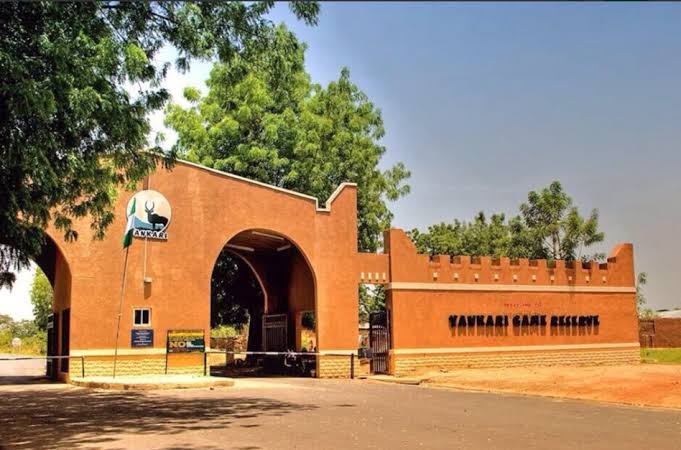
Like Sambisa Game Reserve, now taken over by Boko Haram insurgents and rival fighters of Islamic State of West Africa Province (ISWAP), Kamuku National Parkand Kainji National Park where predatory armed bandits camp; Yankari Game Reserve now harbours terrorists, poachers and other intruders, upending eco-tourism fortunes in the reserve. These, WikkiTimes’ YAKUBU MOHAMMED, reports are bare footprints of the negligence and maladministration by the successive governments of Bauchi State where the reserve sits on an estimated 2,244 square kilometres of land in Alkaleri LGA.
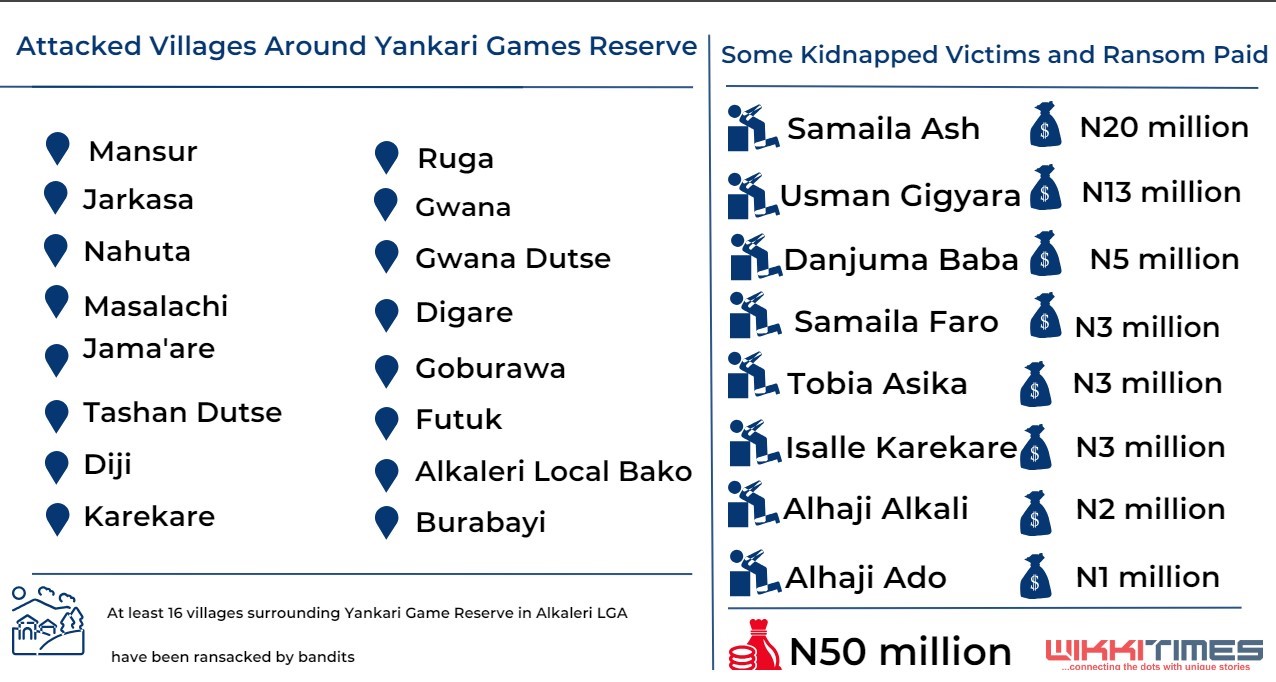
More than 16 villages have experienced the simmering waves of killings and kidnapping for ransom by bandits lording over the forest of Yankari Game Reserve. At least, N50 million had been paid in ransom across these villages, according to locals interviewed.
Before the general elections, locals in Diji, Gwanan Dutse, Digare, Nahuta, and Jarkasa among other villages, fled their homes to escape banditry attacks. A temporal peace was enjoyed when Bala Mohammed, Bauchi State governor toured some of the troubled areas for his reelection campaign.
The governor hails from Duguri, a district in the LGA which also had a share of the attacks.
An infographic showing numbers of villages arrested including some kidnapped victims and the ransom paid/ Yakubu Mohammed
Earlier this year, Bauchi Police Command paraded some terrorists who confessed to having kidnapped locals from some villages and camped them in Yankari forest. Last year, in December, bandits killed at least 21 villagers in Rimi, a village within the reserve.
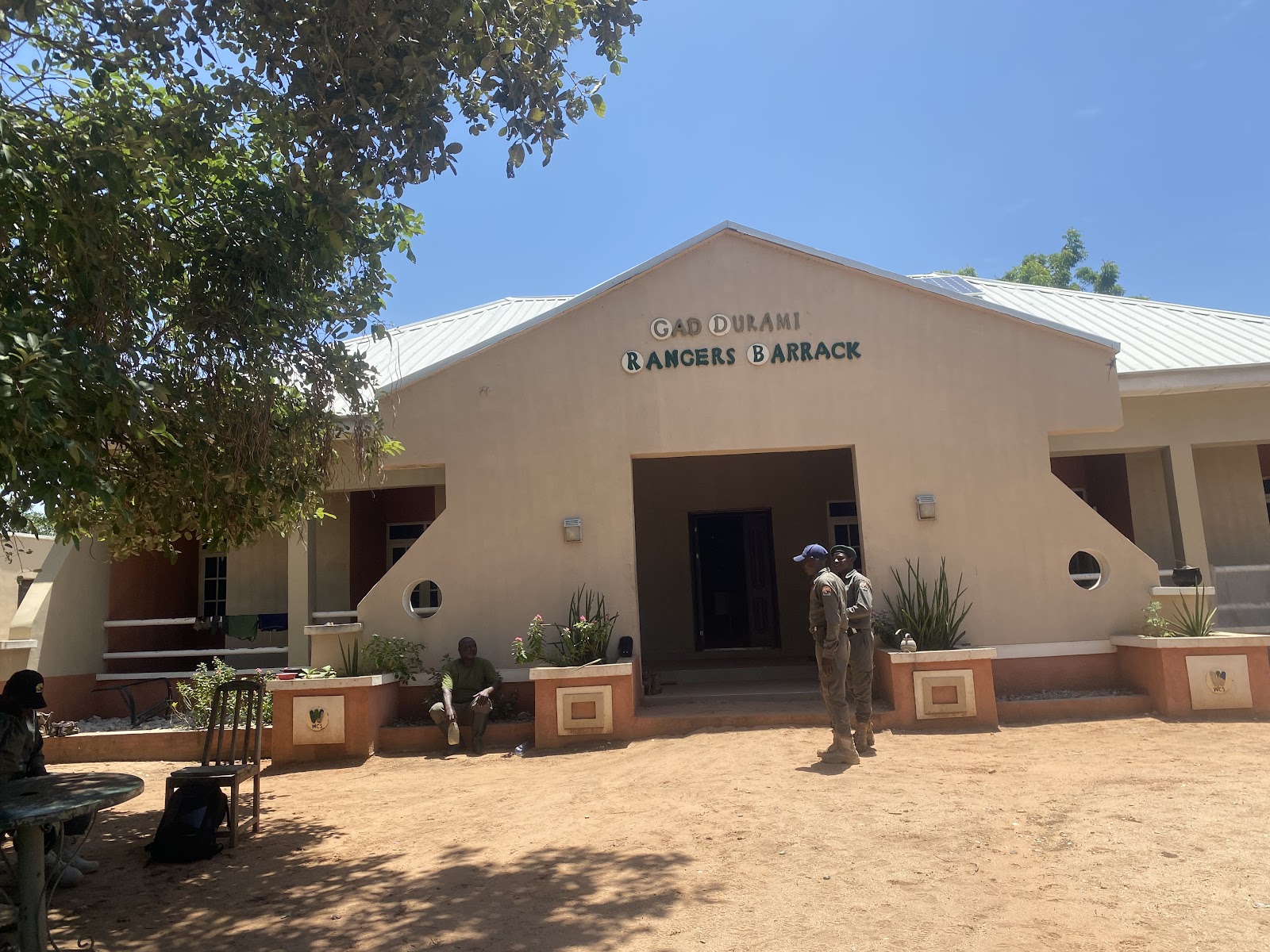
Wildlife Conservation Society (WCS), a pro-wildlife international not-for-profit organisation, supporting poorly armed rangers in the reserve, confirmed this in its 2022 third quarter report.
“A recent and developing threat within Yankari, its neighbouring communities as neighbouring states, is the issue of kidnappings by armed bandits,” it bemoaned. “Armed with AK-47 type assault rifles, these criminals have staged many attacks in communities surrounding the reserve, killing a number of individuals and collecting huge ransom fees from the already struggling family members of the victims.”
“These criminal elements are believed to escape into Yankari Game Reserve with kidnap victims, to hide for a period before moving on,” the report continued. “These criminals pose a significant threat to our patrol staff as they often move in large gangs with each individual heavily armed.”
The reserve was founded in January 1956 as a Game Preservation Unit of the Northern region. It was handed over to the federal government and converted into a National Park in the early 1990s. The ownership control was in 2006 reverted to the Bauchi State government.
However, in 2014, the state government signed a co-management agreement with the WCS.
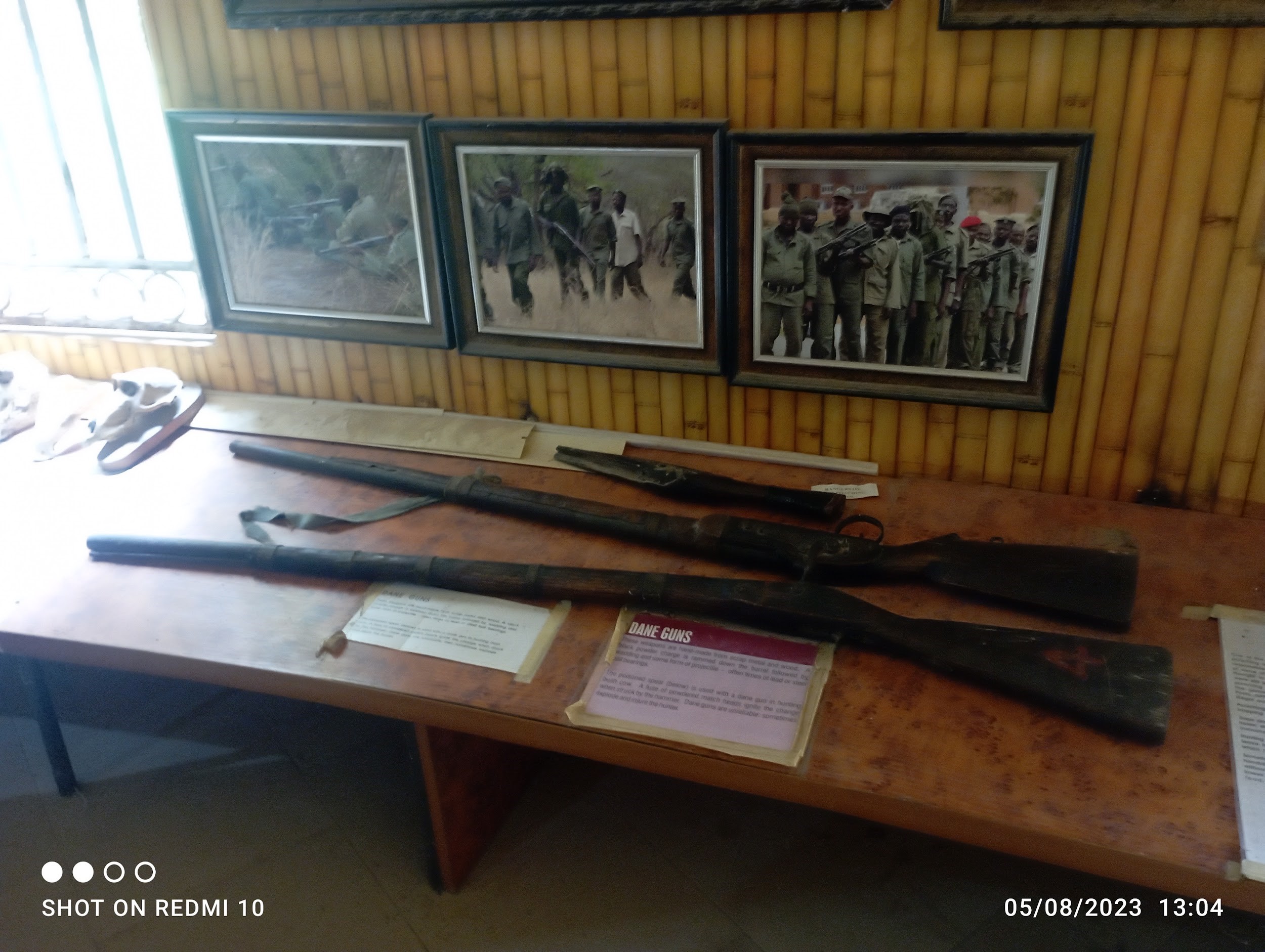
The reserve also suffers from mounting activities of poachers, grazing herders and loggers who sometimes dare the rangers that secure the reserve and its forest. Despite efforts by the rangers supported by WCS, the activities of the intruders would not stop. At least 213 intruders were arrested by the rangers between January 2019 and September 2022, according to data obtained from WCS website.Various weapons, particularly Dane guns were recovered from the intruders. Some of them were spotted by our reporter when he visited a museum at the reserve.
Some of the guns confiscated from intruders. They are reserved in the museum for display / Yakubu Mohammed
Some of the traps seized from poachers. They are reserved in the museum for display / Yakubu Mohammed
In 2019, not fewer than 103 intruders were arrested in a total of 189 patrols. Among them are 35 armed poachers [hunters], 33 livestock grazers, a bushmeat trader, seven Borassus seeds collectors, nine Gum Arabic collectors, seven loggers and 11 firewood fetchers.
The number of arrests, evidently, decreased in the subsequent years as the 2020 WCS’s annual report showed that 37 intruders were arrested between January and December. A total of 168 patrols were completed within the period. The arrests, in a total of 143 patrols, sum to 53 in 2021 and tremendously reduced the following year with a total of 20 arrests [within 69 patrols] made between the second and third quarters. WikkiTimes could not get the reports of the first and fourth quarters as they were not found on WCS’s website.
According to WCS reports, weak wildlife laws encourage poachers and other intruders to target animals in the reserve. It argues that penalties against the intruders are “not tough enough to completely deter offenders.”
The WCS Project Manager, Nurudeen Ahmed, explained this further. “Basically, the punishments are very soft, the fines are very soft and, although there was a revision to create a separate Yankari special law which imposes an automatic six-month sentence to these offences,” he said, adding the law was rarely implemented in courts.
Documents reviewed confirmed this. Some intruders that were arraigned in court got a week’s jail term. Some end up paying between N10,000-N20,000 fine. A few of them [caught with Dane guns and other exhibits] were sent to six months in jail.
Rangers who spoke to WikkiTimes in confidence [for fear of being victimised], said the government needs to upgrade their firearms from shotguns to assault rifles as criminal activities intensify in the reserve.
Some rangers protecting wildlife in the reserve / Yakubu Mohammed.
The rangers also lamented low wages. And because of this, their turnout is negligibly low during the rainy season — some of them prefer farming to patrols. Although, the rangers augment their meager salaries with stipends.
WikkiTimes gathered that the rangers’ monthly salaries range between N33,000 to N46,000. There are four ranks of rangers — The Park Ranger, Higher Park Ranger, Senior Park Ranger and Chief Ranger. This is way below what their counterparts make in Kenya and South Africa.
The monthly average salary for a park ranger in South Africa is R8,415 [$435.82]. Similarly, a park ranger in Kenya earns a monthly salary of KES14,500 [$97.71].
“The salary is very poor compared with the nature of our job,” said a park ranger. “All the rangers in Yankari are Bauchi State government staff, so the salary is very poor.”
“There’s no ranger that earns up to N50,000, not even the senior ones among,” he disclosed.
Each time a team of rangers go for patrol, WSC supports them with N2,000 per night, Ahmed, the project manager, explained. “So if they spend nights, each of them has N14,000 and if it is eight nights, they get N16,000.”
Return of banditry
Locals told WikkiTimes the governor sought the intervention of a Taraba-based warlord, famously known as Babangida, to help confront, alongside military operatives, the bandits that have held his homeland hostage. The intervention yielded a result, locals acknowledge, but they argue it was done in the bid of his reelection as banditry now returns gradually.
In the wee hours of July 21, terrorists kidnapped the ward head of Gigyara, Alhaji Usman Gigyara. This was the second time the monarch would be abducted. In 2022, he was kidnapped and later set free after his family paid N6 million ransom.
His abductors, who demanded N20 million, would later settle for N7 million before he was released a week later.
The ward head who was still recovering from the trauma of his abduction declined an interview. Locals close to him said “the authorities” warned against speaking to the press about it.
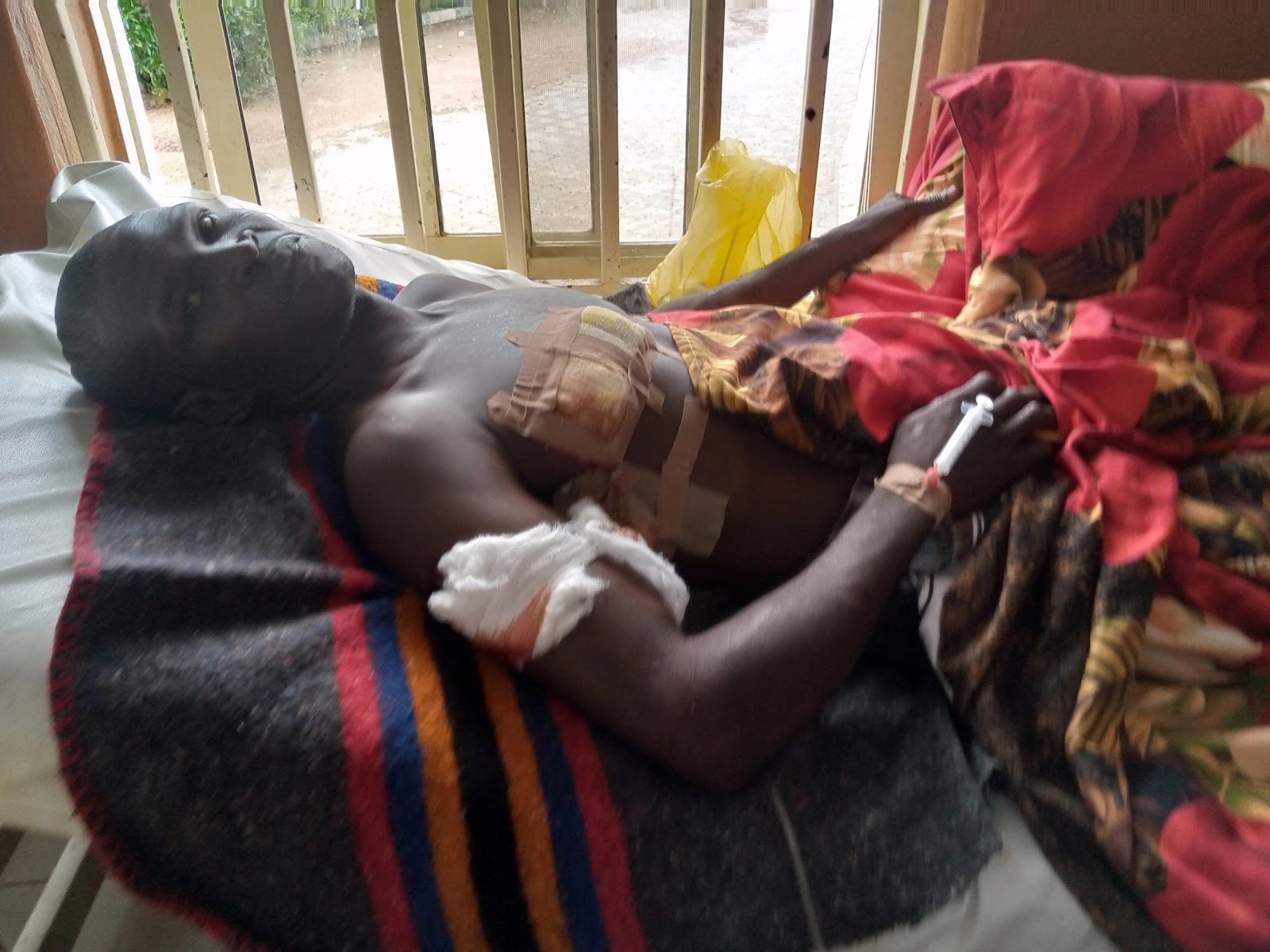
James Danjuma, a park ranger and his colleagues were on a routine patrol along the Duguri axis of the reserve when bandits waylaid them and shot him multiple times on August 23. His colleagues, poorly armed with shotguns, dispersed into the bush when the AK-47-wielding terrorists ambushed them.
James Danjuma was placed on blood support after he survived seven gun wounds by bandits who waylaid him and his patrol team inside Yankari Game Reserve / Yakubu Mohammed
The field ranger survived seven bullet wounds: one on his back, three on his right arm, one each on his chest and right ribs and one on his left arm. He was placed on blood support when WikkiTimes visited him at Abubakar Tafawa Balewa University Teaching Hospital (ATBUTH) a day after.
The terrorists would have shot him dead, one of his colleagues who lives in Yashi, a hamlet of the reserve, told WikkiTimes.
“They had fired at him several times before he fell down and one of the terrorists wanted to blow off his head, but one of them said there was no need to waste the bullet,” the ranger said, adding the terrorists believed Danjuma would not survive.
“They also thought they had killed Danjuma’s colleague, Baba Ali, but God saved his life. He was laying low in the forest while the terrorists fired in his direction,” he added.
His superior, a chief ranger, Sulainman Saidu, told WikkiTimes poaching, and illegal grazing among other criminal activities, are no longer common in the reserve, “but the activities of bandits who use the reserve as their cover.”
Saidu said the terrorists could be flushed out if the government provided the rangers with superior firearms.
“WCS had trained us well, but the arms are not there to face the bandits,” he lamented, adding the WCS as an NGO is not permitted to purchase arms for the rangers.
The Bauchi Police Command said its operatives, specifically the anti-kidnapping team, are trying their best to fight the menace, its spokesman, Ahmed Mohammed Wakil, told WikkiTimes.
“The Commissioner of Police, Auwal Musa, at his resumption, invited some stakeholders including the rangers to discuss some security measures,” Wakil said, noting the collaboration led to the arrest and neutralisation of “some bandits in the reserve,” last year.
According to him, the police in partnership with some quasi security outfits are making tremendous success against the bandits.
“We have 18 units of anti-kidnapping and many of them are in Alkaleri, Ningi and many many other forests,” he said. “The issue of establishing a police post in the reserve(s) was also considered.”
Bala Mohammed, Bauchi State governor recently lamented the presence of the terrorists in the reserve, vowing to “die” than bandits taking over the reserve.
“We have been battling with bandits inside Yankari. I will never allow them to take over Yankari from me, under my time, no, no way! I will either die or they die. They will not be there. I am assuring you, the people of Bauchi,” he had said.
His words were motivated by the fact that British investors were planning to take over the tourist center and invest $18 million.
“Today, we are happy, we’re being recognised by the international community. Bauchi has become the next investment destination,” he had said. “Our biodiversity, which is Yankari, has attracted British investors that came here, discussed with us seriously and are ready to take over Yankari to save our Fauna and Flora, to save our animals with an initial investment of $18 million of their own money and to bring security.”
Footprints of successive governments of Bauchi State
The last time Yankari Game Reserve saw significant intervention from the government was during the administration of Muazu Abubakar, workers and ex-rangers who had worked in the reserve, told WikkiTimes. This was the time lodges and other facilities in the reserve were renovated, they said.
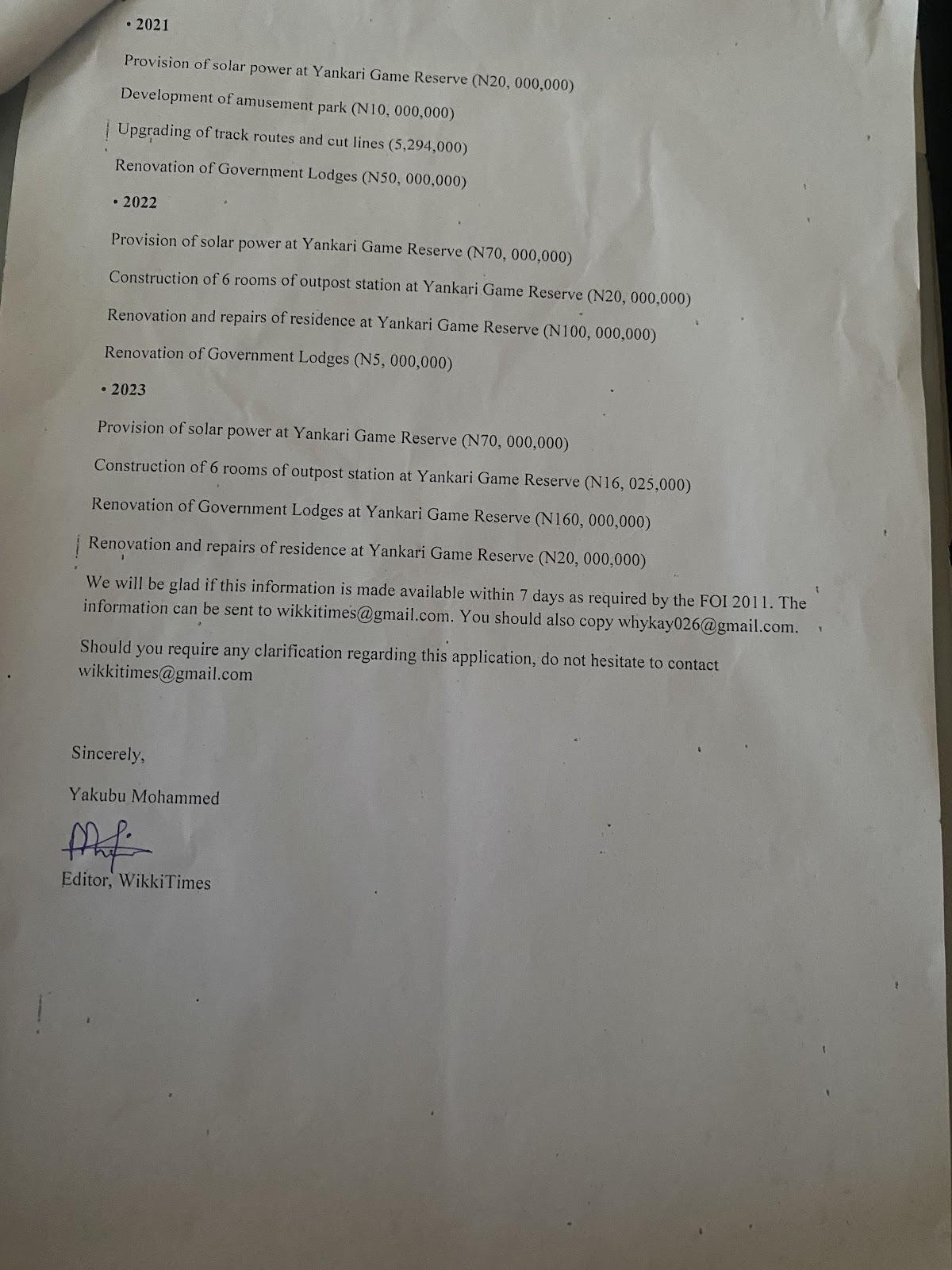
Although the budget documents we reviewed showed allocations for various projects in the reserve. However, the budget performance reports proved that the state governments under the leadership of governor Mohammed failed to release funds for many of the projects. Hence, the ministry keeps pitching and the government would not stop approving. This trend continues concurrently between 2019 and 2023.
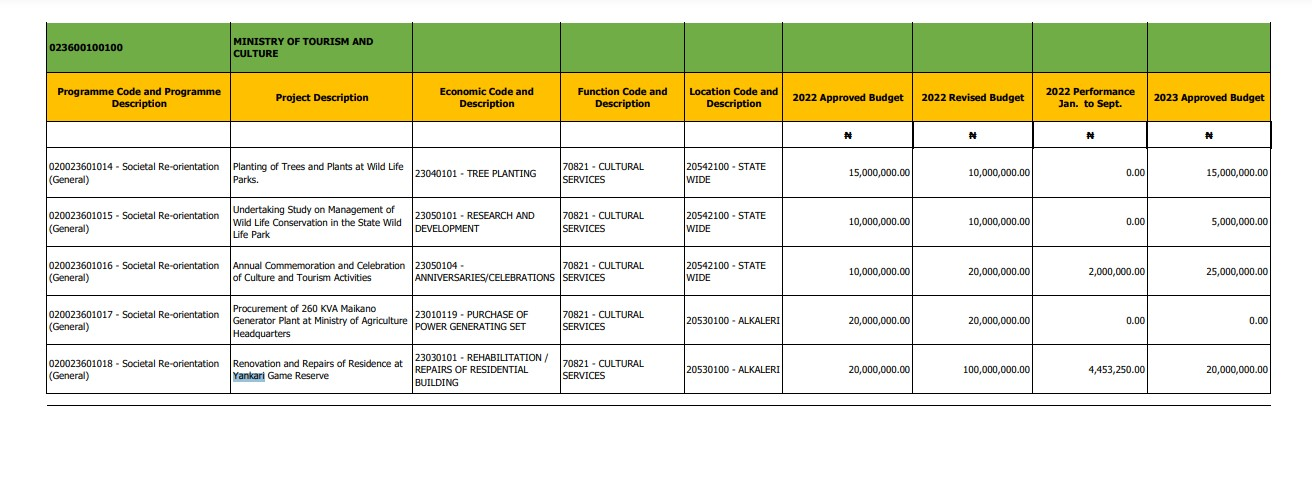
An approval made in Bauchi State 2023 budget for the renovation of residences in Yankari
In 2019, at least, N31,376,000 million was approved for three projects in Yankari Game Reserve, but none of them was funded, according to the reviewed budget performance reports.
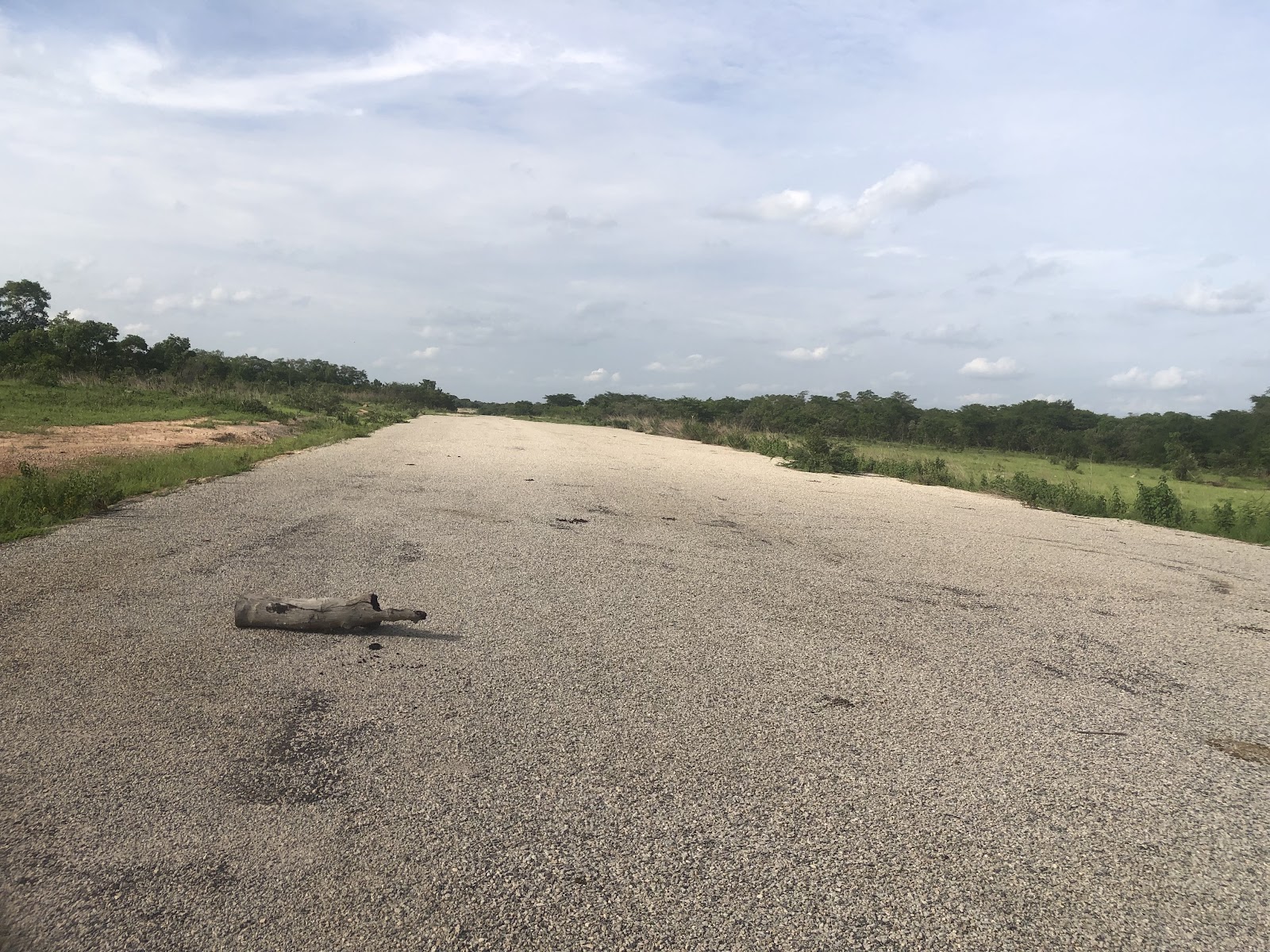
Notably, N26,376,000 was approved for the ‘Construction of Airstrip at Yankari Game Reserve’. However, the same amount was expended on the same project between January and June 2018.
When WikkiTimes visited the site of the project, our reporter saw an open field filled with gravel stones.
The airstrip filled with gravel / Yakubu Mohammed
The 2022 budget performance report shows that N4,453,250 million was spent on ‘Renovation and Repairs of Residence at Yankari Game Reserve’. This was out of N100,000,000 million approved for the project. Yet, N20,000,000 million was approved for the same project in the 2023 fiscal year, but checks show that the money had not been released.
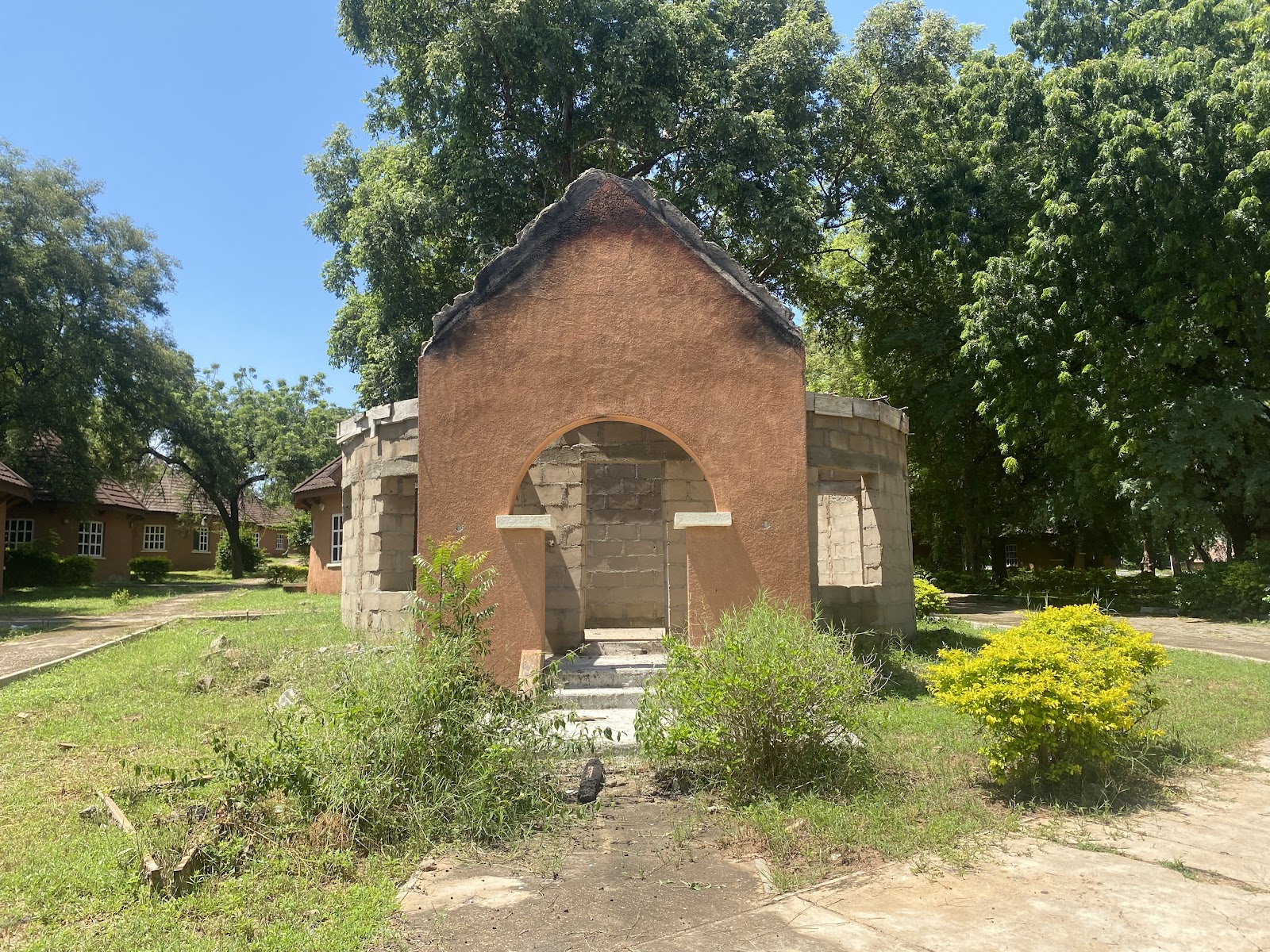
Further investigation shows that only one VIP lodge gutted by fire in 2021, is being renovated. An insider in the Ministry of Culture and Tourism revealed that the project had gulped over N4 million and an additional N7 million is needed to complete the chalet.
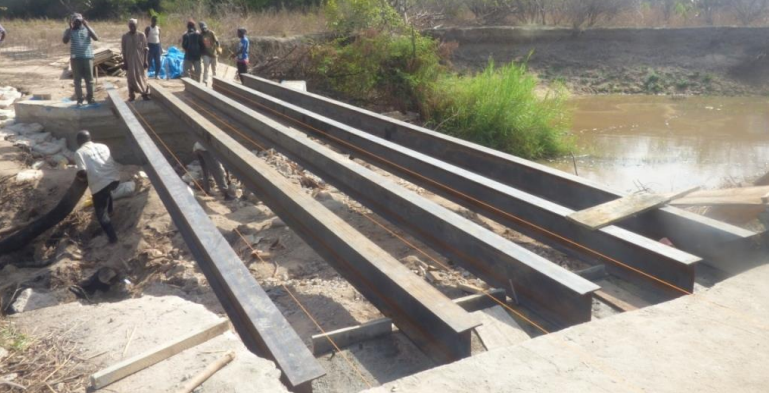
WikkiTimes gathered that a number of bridges and track routes in the reserve are in bad shape. For instance, Borkono bridge which links ranger to some part of the reserve has collapsed.
Rangers said there are over 100 tracks “including jeep and game-viewing tracks” in the serve. Although the game-viewing ones are safe, many tracks the patrol rangers ply are “bad.”
The Borkono bridge, according to a file picture attached to WCS’s 2019 annual report, was renovated by the organisation.
File picture: Repair of Borkono Bridge, April 2019/ WSC’s annual report
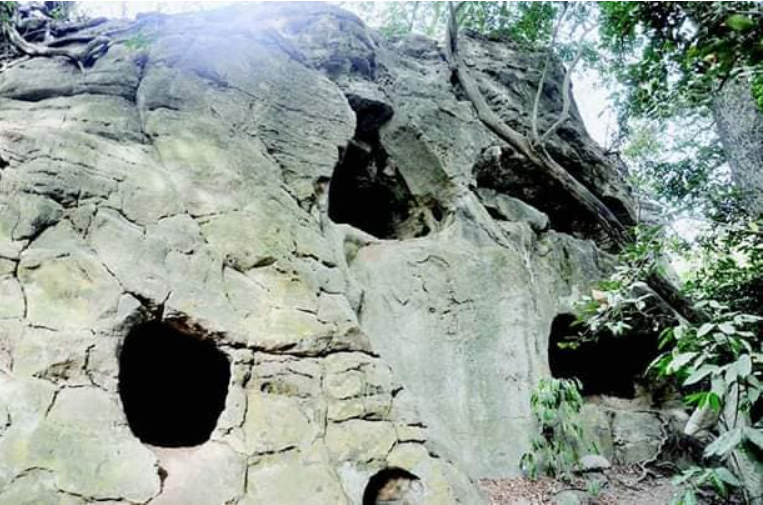
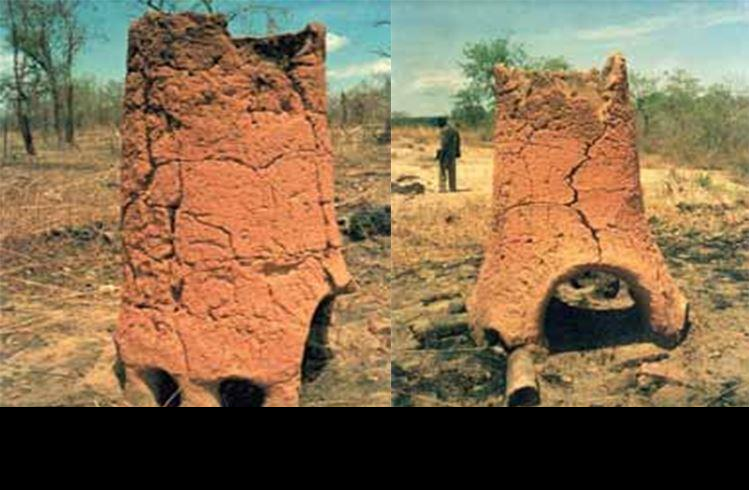
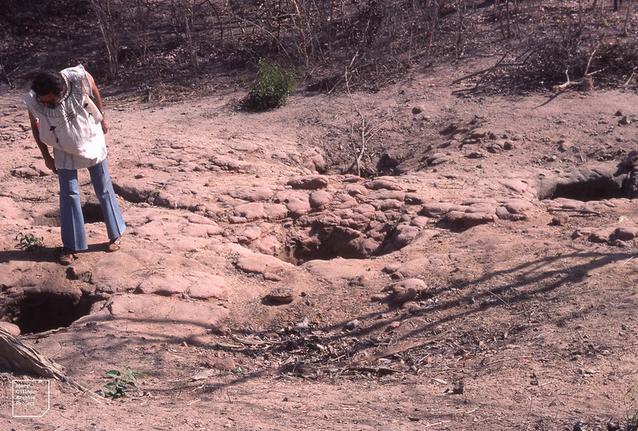
As a result of poor road networks and collapsed bridges, visitors who wish to go for game-viewing could not go to tourist sites like Dukkey Wells, Machido Stone Wall, Marshall Cave and Shau Shau Iron Smelting Site.
File Image: The Marshall Caves located 7km east of Wikki Camp in Yankari are a set of 59 interconnected dwellings believed to have provided shelter to ancient people during the slave trade. It was dug out of sandstone escarpments. The caves has rock paintings & engravings. / Yankari Game Reserve’s website
File Image: The shau shau iron smelting works is located in Yankari it has about 60 standing shaft furnaces, one of the world’s most extensive concentrations of early iron smelting sites, also the largest historical industrial complex of its time in the West Africa Sub-region / Yankari Game Reserve’s website
Dukkey wells in Yankari is a resting place for slave traders when traveling from Duguri to Pali during slave trade period. it’s a historical attraction that shows how the settlers managed their water supply. It is a channel of 139 wells linked underneath each other by shafts. Yankari Game Reserve’s website
Muhammad Ladan, General Manager for Yankari Game Reserve, declined comment when our reporter met with him at the Ministry of Culture and Tourism on August 23. He requested a written enquiry to be submitted at his office located along the Maiduguri bypass.
Subsequently, WikkiTimes submitted an FOI to his office but it was not responded to. When he was reminded on September 9, Ladan said he no longer had the mandate to speak. “I’m no longer the GM of Yankari,” he wrote via SMS.
Acknowledged copy of the FOI
“About the questionnaire [FOI], I submitted it to the ministry in order to get approval to grant you the interview then, but it proved abortive, please,” he added.
Abdu Hassan, Commissioner for Culture and Tourism also declined comment. He scheduled an interview [in his office] on September 7 and he failed to show up. Workers in the ministry told WikkiTimes he was “not on seat.”
When contacted, the commissioner said he had travelled. “I am not around. I travelled,” he said before hanging up. He never responded to calls afterwards.
A screenshot of a WhatsApp messages sent to the commissioner
For many years, the Bauchi State government has been evading what WCS referred to as “counterpart funding,” according to publications reviewed by our reporter. WCS’s project manager further clarified this, saying, it was part of the agreement signed with the government.
Inside Yankari
Journeying from Bauchi metropolis to the first gate of Yankari Game Reserve was a daylight nightmare that would soon be effaced by a 43-kilometre ride, on a tarred road, to the second gate.
File Image: Wikki Warm Spring is the largest of the 4 warm springs in Yankari. It is a natural spa with constant temperature of 31.1°C through the year during both day & night, crystal clear & 13 meters wide, 2 meters deep perfect for a swim. Dimmil, Gwana, & Mawulgo are the other spring / Yankari Game Reserve’s website
The route was decorated with seven roundabouts, purposely to slow down vehicles along animal-crossing zones of the road. But what used to be a busy tourism site is now a shadow of itself solely surviving on one of the accessible Wikki Spring Waters [where visitors go for swimming], a room-sized museum [where artefacts are displayed] and Safari game viewing.
Warthog pigs and waylaying baboons among other animals often stroll into the Wikki camp [the main environment of the reserve].
VIP Room 2 under renovation / Yakubu Mohammed
There are 78 chalets in the reserve where visitors can lodge during their stay. Among them are 36 Luxury chalets, 36 Studios, four VIPs and two diplomatic rooms. One of the VIP rooms was razed by fire and is currently under renovation.
Conservation-focused WCS to the rescue
Insiders and visitors who spoke to WikkiTimes believe the reserve would have been worse than its current situation if not for the presence of organisations like WCS.
The project manager further explained the conservation work WCS is doing in the reserve, saying they have been supporting the state government since 2009. “It was in 2014 that both parties signed a Memorandum of Understanding (MoU) to manage the law enforcement activities within the reserve — supporting rangers patrols and protection of the wildlife,” he told WikkiTimes. “In 2018 a new MOU was drafted which further gave WCS the jurisdiction not just for the protection but all conservration activities within the reserve including research.”
Ahmed explained that WCS understands that poachers and other intruders frustrating conservation in the reserve were not aliens, hence, the organisation sensitise the host community, especially school children.
“We are also involved in educating children, bringing them on field trips to Yankari, explaining about the biodiversity and the importance of the reserve to them,” explained Ahmed. “We bring them in, we give them a short presentation about the work that WCS is doing, we take them on a game viewing drive, we provide them with lunch and then transport them back to their schools.”
“As we all know, they are direct stakeholders of this reserve and the future,” Nurudeen continued. “We can raise them to grow up to support conservation rather than becoming hunters or collecting firewood or doing other illegal activities in the reserve.”
The project manager said the rangers carry out their patrols with a device called SMART [Special Monitoring and Reporting Tool] which automatically records where “our rangers have tracked, what areas they have covered and we can download it and analyse the data.”
Yankari is a home for the largest surviving elephant population in Nigeria, one of the largest remaining in West Africa, according to WCS.
Its project manager, Ahmed, decried how anti-conservation activities affected the population of animals in the reserve. Although more than 100 elephants were believed to be in the reserve, the organisation could not tell the population of other animals surviving therein.
“We have not done a formal population census [for the other animals], but nevertheless, we estimate between a 100 or 150 elephants are left in Yankari,” Ahmed estimated.
The presence of elephants in the reserve is another challenge WSC has been managing due to what conservationists described as “humans-elephants” conflict.
“Crop raiding by elephants was reported from Yalwan Duguri and Shafa communities only during the reporting period,” it said in its latest report. “Rangers were sent to the area concerned, however, typically the elephants raid crops at night and have returned to the reserve by the following morning when rangers respond to the scene…”
Tourism expert harps on partnership
Chuks Nwanne, a tourism expert and general manager, Abuja and northern operations of the TheGuardian newspaper, was not surprised about what the reserve has turned into.
He said the Bauchi State government does not know the treasure it has. According to him, the tourism potentials in places like Kenya and South Africa do not have what “we have here in our country.”
“Those countries understand the business of tourism and its importance to their economy,” he said, adding the Nigerian government is yet to see tourism as a business.
Nwanne noted that insecurity might be scaring tourists away, but when the needed facilities like airstrips are provided, it will not be “impossible for us to develop tourism.”
Contrary to the privatisation plan by the government, the tourism expert advised that the government could opt for management partnerships with other entities that have potential in the tourism business.
“You can invite people from Kenya who have been doing it right and partner with them,” he advised.
He also advised that the federal government could be part of the management system.
“As a state government, you don’t control the army or the police, so bringing in the federal government would help address the security situation in the reserve,” he said. “Infrastructure is another reason the federal government should be considered as part of the partners.”
“For instance, if a road that connects to Yankari is in bad shape, the federal Ministry of Works could help fix that,” he continued. “Also, the Nigerian Tourism Development Corporation (NTDC), though a federal body, has a role to play in the reserve. But if its officials go to Yankari today, they may be faced by some bottlenecks revolving around ownership and control of the reserve. They will tell them the place belongs to the Bauchi State government and with that things can not really work.”
Nwanne’s words were illustrated in a research work done byDr Dele Jemirade, a consultant and a researcher at Department of History, York University, Toronto, Canada.
The scholar who specialises in defence and security, arms control, war, conflict, violence, terrorism and, insurgency among others, contended that Nigeria’s laxity in developing its tourism potential earned it a place behind other countries considered to be smaller and less populated. He identified corruption and insecurity among many other factors setting back the country’s tourism industry.
“Nigeria is regarded as one of the most dangerous countries to live in the world because of the activities of fundamental Islamic group known as Boko Haram and the numerous splinter groups that came out of them,” the research stated. “These terrorist groups have killed many people and destroyed several communities in the country. The World Economic Forum’s Travel and Tourism Competitiveness Report’ published every two years has been listing Nigeria since 2015 as one of the most dangerous countries to visit in the world.” The latest report ranked Nigeria 110.
Tourism: Nigeria behind Kenya, Tanzania and Uganda
“One can see that from 1960 to the present day, Nigeria had
the opportunity and the potential to develop its tourism industry to an enviable, viable and sustainable stage, but the chances were wasted due to the factors mentioned above,” the researcher stated in the concluding part of his work.
He added: “Countries like Kenya, Tanzania, and Uganda, which are smaller, less populated and have fewer resources, developed their tourism industry to an appreciable level while Nigeria was groping in the dark. Some of the reasons could be the fact that Nigeria foolishly got carried away with oil revenues, and countries like Kenya did not have any petroleum resources to depend on, needing instead to utilise the resources they had, such as tourism.”
Although the three countries compared to Nigeria are more climate-friendly and suitable for tourists, the research noted. He argued that the country can still utilize its abundant opportunities to develop tourism into an enviable, viable and sustainable industry.
This investigation is produced with support from the Wole Soyinka Center for Investigative Journalism (WSCIJ) under the Collaborative Media Engagement for Development Inclusivity and Accountability Project (CMEDIA) and funded by MacArthur Foundation
PRESIDENT Bola Tinubu has approved the appointment of Shaakaa Chira as the substantive Auditor-General of the Federation.
The President has also appointed Adewale Adeniyi as the Comptroller-General of the Nigeria Customs Service.
Announcing the approval of the Auditor-General of the Federation’s appointment, the presidential spokesperson, Ajuri Ngelale, in a statement on Friday, October 20, said the appointment was in line with the powers vested on the President by Section 86 of the 1999 Constitution (as amended).
According to him, the appointment was also as recommended by the Federal Civil Service Commission (FCSC).
“The President approved Mr. Chira’s appointment after the Federal Civil Service Commission (FCSC) conducted a screening exercise that identified Mr. Chira as the most qualified candidate who had also scored the highest in the examination amongst all qualified candidates for the office.”
President Bola Tinubu charged the new Auditor-General to justify the confidence reposed in him and live up to expectations that Nigerians have regarding the execution of the Federal Government’s Renewed Hope Agenda.
In the same vein, Tinubu, in a statement on Friday, October 20, by the Director of Information in the office of the Secretary to the Government of the Federation’s , Willie Bassey, appointed Adewale Adeniyi to lead the Nigeria Customs Service.
The President tasked the new Comptroller-General to bring his wealth of experience to bear on his new assignment.
According to Bassey, the appointment takes effect from October 19, and his tenure is in accordance with the extant provisions of the Public Service Rules (PSR).
The latest appointment follows Tinubu’s nomination of chief executive officers for some agencies and parastatals under the Federal Ministry of Information and National Orientation, on October 19.
MANY Zamfara State residents have accused Governor Dauda Lawal of abandoning the troubled state for the Peoples Democratic Party’s (PDP) governorship campaign in Imo State.
Lawal was in Imo State on Wednesday, October 18, to attend the campaign rally of Samuel Anyanwu, who flies the PDP flag in the governorship poll slated for Saturday, November 11.
Ishaq Jibril, an Anka Local Government Area resident of Zamfara State, alleged that the governor abandoned the state when many families were mourning their beloved killed by bandits and others kidnapped, including girls and women.
He said, “Honestly, I am not happy; he is supposed to sympathize with us or make adequate arrangements to rescue our brothers and sisters before he proceeded to the political rally.
“He should protect our lives before going to Imo for the PDP rally. How can a serious governor leave his people in this situation and use our resources to charter a flight with the money he should have used to secure our lives and develop the state?”
Another resident, Hajia Zainab Zabarma, also accused the governor of neglecting his primary responsibility and said many villagers were in a dilemma over continued attacks by bandits “while the governor has been busy with campaigns.”
The ICIR reports that the state has been under frequent banditry attacks, which have escalated to major towns such as Kaura Namoda, where the terrorists invaded and kidnapped four women this week.
On Monday, October 16, bandits attacked Bagega village in Anka Local Government and abducted over 50 residents, including the district head.
On October 18, The ICIRreported how angryyouth blocked the Gusau-Kaura Namoda highway at the Sakajiki community on Tuesday, October 17, over recurring bandit attacks, killings, abductions and other insecurity issues in the state.
The ICIR reported that bandits abducted women from the Sakajiki village after killing several others and setting many houses on fire. They also allegedly used a Police patrol vehicle (Hilux) they snatched to loot foodstuffs from the community.
Residents have fled the community with houses, schools, mosques, and shops spared by the bandits’ inferno shut by owners.
During his election campaign, Governor Dauda Lawal promised to visit any village attacked by bandits, which residents alleged he failed to fulfil.
The ICIR reports that nine students of Federal University Gusau, alongside other construction workers, are still in captivity after over 30 days of abduction from their hostels at Sabon Gida village.
Reports also indicate the governor’s failure to appoint local government sole administrators or hold an election for new chairmen contributed to the insecurity crisis in the state.
The ICIR reports that Zamfara is one of the North-West states facing protracted insecurity.
The state’s immediate past governor, Bello Matalle, lost re-election in March after battling unsuccessfully throughout his four years in office to secure his state.
In August, The ICIRreported how President Tinubu appointed him a Minister of State for Defence despite failure to protect his people.
Zamfara has faced attacks from terrorists, lost hundreds of residents to insecurity, and had thousands of others displaced.
In October 2022, this organisation reported how 30 schools remained shut after one year because of insecurity.
PRESIDENT Bola Tinubu has approved the partial waiver of the “No Work, No Pay” order instituted against striking members of the Academic Staff Union of Universities (ASUU).
The order was imposed on ASUU following its eight-month industrial strike, which started on February 14, 2022, and was suspended on October 14.
A statement signed on Friday by the President’s Special Adviser on Media and Publicity, Ajuri Ngelale, revealed that the waiver “will allow for the previously striking members of ASUU to receive four months of salary accruals out of the eight months of salary which was withheld during the eight-month industrial action undertaken by the union.”
The President directed the granting of a waiver, with a mandatory requirement for the Federal Ministry of Education and the Federal Ministry of Labour and Employment to secure a Document of Understanding, establishing that the “exceptional waiver” granted by the President will be the final one provided to ASUU and all other education sector unions.
Part of the statement read: “In view of his determination to mitigate the difficulties being felt during the implementation of key economic reforms in the country, as well as his recognition of the faithful implementation of terms which were agreed upon during the fruitful deliberations between ASUU and the Federal Government of Nigeria, President Bola Tinubu has directed the grant of an exceptional last waiver of the ‘No Work, No Pay’ Order on ASUU, which will allow for the previously striking members of ASUU to receive four months of salary accruals out of the eight months of salary which was withheld during the eight-month industrial action undertaken by the union,” the statement added.
The ICIR reports that ASUU embarked on strike on February 14 over unmet demands by the Federal Government, resulting in the suspension of academic activities in most public universities in the country.
This subsequently resulted in Federal Government announcing that the lecturers would not be paid for the period they were on strike in accordance with the “no work, no pay” order.
The Federal Government took ASUU before the National Industrial Court when it demanded payment of salaries from February 14 to October 14, 2022, when its members were on strike.
Among other prayers, the Federal Government asked the court to declare that the eight-month ASUU strike was unlawful because it flouted the law.
THE National Industrial Court (NIC), on Tuesday, May 30, upheld the ‘no work, no pay’ policy implemented by the Federal Government against the union.
The court, however, held that Federal Government violated the autonomy of universities by imposing the Integrated Payroll and Personnel Information System (IPPIS) platform on members of ASUU who reserve the right to determine how their salaries should be paid.