THE Independent National Electoral Commission (INEC) said it would deploy 46,084 officials for the governorship election in Bayelsa, Kogi and Imo States on November 11.
The Commission’s chairman, Mahmood Yakubu, disclosed this at a meeting with Residents Electoral Commissioners in Abuja on Friday, October 20.
Yakubu said 11,000 observers from recognised national and international organisations would be deployed to the off-cycle election.
The INEC Chairman explained that 137,934 agents, comprising 130,093 polling and 7,841 collation agents, would be used by the 18 political parties participating in the poll.
He added that the electoral body would ensure adequate preparation for the election.
“The Commission plans to deploy a total of 46,084 regular and ad hoc staff for the election. We have so far accredited 126 national and international organisations collectively deploying 11,000 observers for the election,” Yakubu stated.
He said that although the portal for media accreditation would close on Tuesday, October 24, INEC had received applications from 80 media organisations seeking to deploy 1,203 personnel made up of journalists and technical/support staff to cover the elections.
While lamenting insecurity in the three states, Yakubu pointed out that such a large-scale deployment required a secure environment, which he said was outside INEC’s mandate.
“As we said repeatedly, we are concerned about the prevailing insecurity and election-related violence in the three states. We have been reassured of adequate deployment by the security agencies.
“On our part, we will continue to deepen our engagement with the security agencies, and more meetings are planned in the next few days.”
He noted that all non-sensitive materials for the election had been delivered to the three states, adding that other preparations, including training, were on course.
He claimed essential lessons for better performance in the upcoming elections had been learned from the February and March elections.
On October 16, The ICIR reported how the Commission raised the alarm over rising fake news and misinformation ahead of the election.
According to INEC, fake news might severely affect how the country manages its elections if not stopped early.
The ICIR had in a report presented the top candidates for the election in the three states and their chances.
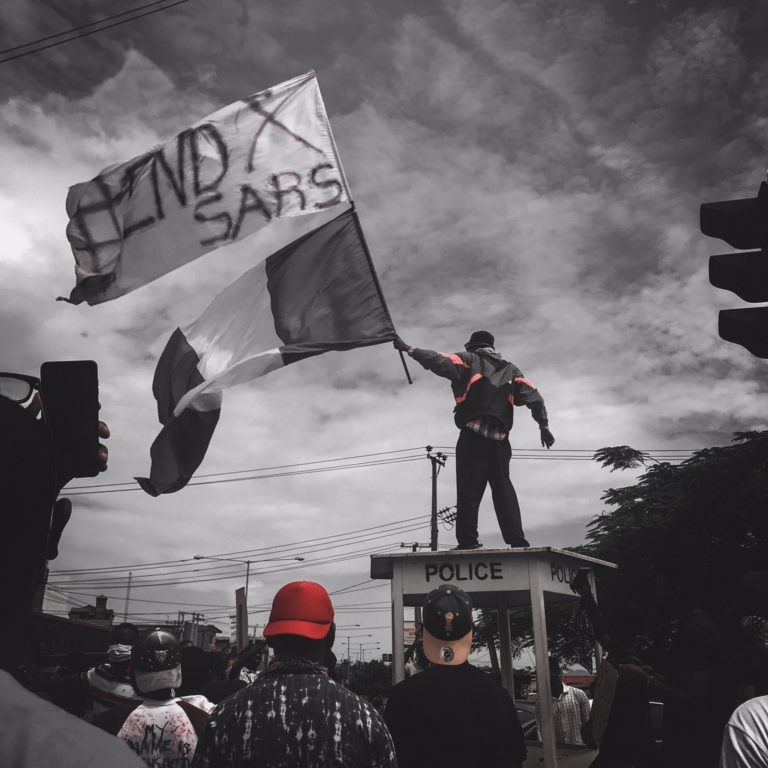
NIGERIANS have taken to the streets of Lagos state and social media to mourn the death of some unarmed protesters shot by the military during the #EndSARS protests on October 20, 2020.
As the citizens hold remembrance services and reiterate the need to stop harassment by the Nigerian Police, they continue to demand justice for the dead and injured during the protests.
The EndSARS protests, aiming to address the constant Police brutality, peaked on October 20, 2020, when the military gunned down protesters on the night of October 20 at the Lekki Toll gate, where thousands of peaceful protesters converged.
The protests targeted the Special Anti-Robbery Squad (SARS), a Police unit accused of constant harassment and extortion of citizens.
The Nigerian government denied the killings.
However, findings of the Lagos State Judicial Panel on #EndSARS indicted the Nigerian Army of the Lekki Toll Gate massacre.
The ICIR reports that despite the protests and subsequent actions by the Nigerian government and citizens to make the Police more responsible and committed to securing lives and property, the institution still parades crops of corrupt officers, who are often punished when caught.
On April 15 this year, the Lagos State Police Command dismissed the Divisional Police Officer of the Okokomaiko Division, Emmanuel Edebagha, over his failure to monitor the officials in his unit efficiently.
Edebagha’s men were indicted for extortion and misconduct.
Similarly, on October 18, the state Police Command, through its Commissioner, Idowu Owohunwa, ordered the immediate removal of the Divisional Police Officer of the Meiran Police Station in the state over extortion.
Nigerians react
Mohammed Taoheed, a social justice advocate and a freelance journalist, explained that despite the EndSARS protest, numerous reports have highlighted the persistent harassment and extortion of young Nigerians by the Police.
“As a concerned Nigerian and advocate of social justice, I must confess that I’m at loggerheads with the Nigerian government because of how they treated the issue of #EndSars. With no regret, I must say that I count the government as one that lacks the needed understanding of running a heterogeneous entity like this because of the nonchalant attitude displayed over this serious issue.
“We are talking about the lives of human beings — the youth we expect to grow and rule us. Their lives were wasted, and nothing meaningful has been done yet. I reiterate, nothing!”
Also, an X user with the handle Obinna Toochukwu mourned the deceased, adding that Police brutality “is a thing in Nigeria.”
“Remembering the 2020 #EndSARS
“Today, we remember those young Nigerians who fell by Police bullet. Their only offence is being a Nigerian citizen. The rogue organization has not stopped k!ll!ng, maiming, extorting and brutalizing Nigerians. Police brutality is a thing in Nigeria,” he wrote.
Another user, @Chi4Obidatti03, noted that Nigerians were yet to know who gave the order to shoot peaceful protesters in Lagos State.
“On this day, three years ago, the people who were saddled with the responsibility of protecting us pointed the gun at us and shot even when we were holding the national flag and singing the national anthem…until today, we still don’t know who gave the order #EndSARS.”
Although there have been committees’ reports and recommendations across states where the protest happened, Nigerians have continued to ask for the identification and prosecution of those who shot and gave the order to shoot the protesters.
Some other Nigerians, via social media posts, also demanded justice for those in prison and compensation for the bereaved families.
At least 15 protesters still languish in Lagos jail – Amnesty International
Amnesty International, in a report to commemorate the third anniversary of the ENDSARS protest, noted that at least 15 protesters arrested in 2020 were still being arbitrarily detained – the majority of them without trial – in Kirikiri Medium Correctional Centre and Ikoyi Medium Security Correctional Centre in Lagos State.
According to the report, the Nigerian government filed trumped-up charges, including theft, arson, possession of unlawful firearms, and murder, against many of the protesters, adding that some detained alleged that they had been tortured.
“Our investigation shows the Nigerian authorities’ utter disdain for human rights. Three years in detention without trial is a travesty of justice. This shows the authorities’ contempt for due process of law. The protesters must be immediately and unconditionally released,” said Isa Sanusi, Director of Amnesty International Nigeria.
“Seven #EndSARS protesters – Daniel Joy-Igbo, Sodiq Adigun, Sunday Okoro, Olumide Fatai, Oluwole Isa, Shehu Anas, and Akiniran Oyetakin – arrested in Lagos in 2020, are being arbitrarily held in Kirikiri Medium Correctional Centre.”
The ICIR, in a series of reports (which can be read here and here) in the last three years, reported how, despite the disbandment of SARS, Nigerian youths continue to face abuse and harassment by the Police.”
THE House of Representatives has asked the federal and state governments to ban the Queen Primer textbook, used in primary schools, over what it described as ‘sexual perversion’ content
The House passed the resolution during a plenary session on Thursday, October 19, following the adoption of a motion presented by Sulaiman Gumi, a representative from Zamfara state.
Gumi, while presenting the matter to the House, claimed that the textbook “subtly introduces the terms — ‘gay’, ‘eros’ — that communise sexual perversion and immoral behaviours”.
According to him, the textbook exposes children to inappropriate sexual content for their age.
He described some of the book’s contents as “unlawful, unethical, highly immoral and antithetical to child upbringing.”
The legislator also bemoaned the “influx” of foreign educational materials that promote and teach “certain morals” that are “alien and inimical” to the nation’s norms and values.
He emphasized the necessity of nurturing and safeguarding moral values in children and society by opposing behaviours that contravene the nation’s laws.
Consequently, the House called on the Federal Government to place a “total ban on the local production, importation and use of any educational material” that contains words that teach or promote “lesbianism, gay, bisexual and transgender (LGBT)” in schools across the country.
The House also urged the Education Ministry, Nigeria Educational Research and Development Council, and the Education Research Council (ERC) to “carefully vet and censor” the contents of educational materials used in nursery and primary schools in the country.
The Green Chamber asked the Ministry and the two agencies to ensure that the education materials are “appropriate and devoid of any connotation of pervasive culture”.
The ICIR reports that Nigeria has laws that criminalise same-sex sexual activity, including organisations and individuals that support or promote it.
The Same-Sex Marriage (Prohibition) Act, also known as the “Anti-Gay Law,” signed into law in 2014, imposes severe penalties on individuals engaging in same-sex relationships or supporting LGBTQ rights.
Under the law, same-sex marriages are explicitly prohibited, with penalties including imprisonment for up to 14 years.
The Act also criminalizes the formation of organizations supporting LGBTQ rights or public displays of same-sex affection, imposing penalties on individuals who facilitate or participate in same-sex unions.
MORE than a decade has passed, but a proposed cottage hospital in New Kutunku, Gwagwalada, meant to be completed within a year, has remained an abandoned structure despite significant investment and its supposed health benefits to the community.
Bosede Olosa was elated when she learnt that the Federal Capital Development Authority (FCDA) had begun the construction of a hospital in her community, but her joy began to fade a year after the project failed to reach its completion.
After several years of staying in the area, she thought her prayers had been accepted and would now stop going several kilometres to access secondary healthcare, but the project has remained uncompleted for over a decade.
She has given up on the hospital but now worries about her and her family’s safety as the building sometimes houses smokers and ‘criminals.’
Abandoned hospital project that has been a security concern for residents of the New Kutunku community
“I know that if they build a hospital, it will surely help those who are sick and also help in emergencies. The government should try and complete the project since they already started it. The abandoned building has also led to many people hiding in the place and causing harm to people staying in that area.”
For the people of New Kuntunku, a town tucked away in Gwagwalada, this medical facility was not just a structure; it was a lifeline and an economic booster. However, the initial excitement that surged through the community gradually faded into frustration and despair after their efforts to get the contractors back to the site proved abortive.
As the years passed, residents of this community watched how the building began to rot away.
If Muhammad Jafar, 31, had been informed that the hospital wouldn’t be operational in 2023, he would have found it hard to believe, given the swift progress showcased by the contractor at the commencement of construction.
“When the contractors first started the project, it was fast, and they were able to take it up on time. We were so happy when we knew it was a hospital of that size and believed it would help the town grow, but what can we do?”
Although Jafar could not ascertain if the house owners on the hospital’s land violated the Abuja master plan, he said some houses were demolished when the government wanted to start executing the project, displacing some people.
“Some people already built houses in the place where the hospital is now, but they demolished them, so it would be unfortunate and unfair if they, at the end of the day, did not complete the construction,” he added.
Background to the project
Another view of the abandoned hospital
In 2010, during the first early term of former President Goodluck Ebele Jonathan, the Federal Government proposed a cottage hospital project being spearheaded by the Health and Human Services Secretariat (works unit) of the Federal Capital Development Authority.
This was according to a document published on Issuu, a digital publishing platform that allows users to share and upload their publications online, by the Federal Ministry of Information in May 2013.
The project was awarded to The Solid Concrete Nigeria Limited at a contract sum of N677 million (N677,879,466.60) on November 18, 2010, with the scope of the work being the construction of a 60-bed main hospital building.
The hospital project’s details, according to document shared by the federal ministry of information.
The hospital was also expected to comprise several wards, a theatre, a pharmacy, a laboratory, an accident & emergency unit, antenatal, and maternal and residential quarters.
According to the document, the project commenced in February 2011 and was expected to be completed in 2012. However, as of 2012, when the then minister of the FCT, Bala Abdulkadir Mohammed, presented reports on the FCT projects to commemorate National Democracy Day 2012, the project has only reached 15 per cent.
The picture embedded in the document showed that the building was still under construction.
The level of the proposed cottage hospital in 2012. Pc: FCTA report
Meanwhile, the budget allocations of the hospital project were not on the Public space as checks by The ICIR on Budget Office for the budgetary allocation to Federal Capital projects between 2010-2015 did not include the details of the cottage hospital.
This was despite some activities on the project site.
It was gathered that the contractor was last seen on the site in 2020 during COVID-19, but the site has been visibly abandoned as there was no project office and plant of equipment on the site.
Hospital rots away, turns farmland
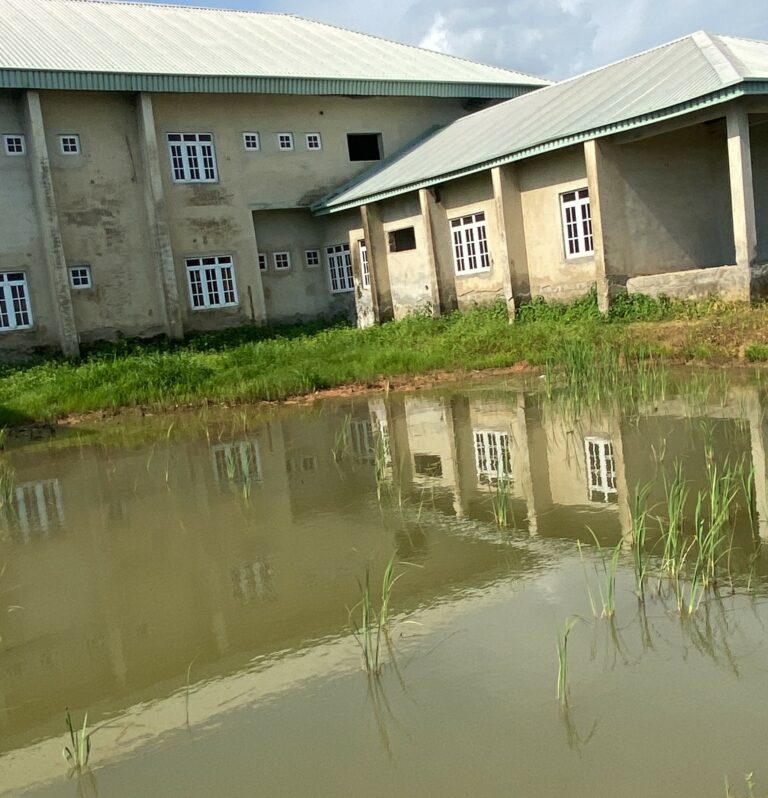
At the abandoned Cottage Hospital, situated at the back of the abattoir of the new Kutunku area, there are already five roofed and plastered buildings, consisting of two-story buildings, one-story building and two structures of what looks like a flat.
Picture showing the state of one of the hospital rooms.
When The ICIR visited the project’s location, some of the buildings had begun to peel away, while tiles in some of the structures were also confirmed to be in a bad state. The roof of one of the story buildings was in tatters, depicting total neglect from the authority in charge.
Shockingly, the hospital premises have been transformed into farmland and a fishing pond. The land that once served as a beacon of hope for the community is now utilised for agricultural activities.
In an interview with The ICIR, Aliyu, who identified himself as the on-site engineer, said he and the security men were responsible for turning the hospital vicinity into farmland due to its inactivity.
According to him, the hospital has been laid to waste for over three years now with no activity on the project, stressing that they keep the place secure and cultivate some farm products.
View of the hospital surrounding tuned into farmland, fish pond
Yahaya Bello, 34, a resident of the community, also explained that the project has been wasting away for years, with no health and economic benefits to the host communities.
Just as The ICIR observed, he also explained that bushes have taken over the hospital while part of the two-story building has deteriorated.
“As you can see, the building houses bushes and all sorts of farm products. The hospital has since been abandoned and left to waste away for no reason. I do not understand how a project of this status will be abandoned by the government.”
Abandoned project raises security concerns
Some residents in the community have voiced their concerns that the site poses a threat to the community’s safety as unauthorised individuals gain access to the premises, according to residents who spoke to The ICIR.
Nuhu Talhanu, one of the residents who shows displeasure over the non-completion of the hospital project
Nuhu Talhanu, a resident of New Kutunku, said, “The government refused to continue with the project. They left this project after Goodluck’s administration. It has been eight years since he left, and the project is still here. We are hoping for the current administration to help us continue the hospital and finish the project. The hospital would help the people here.
“Since it’s uncompleted, we are having security issues when it is nightfall as people enter into the uncompleted building. We are hoping for this current administration to help us with the hospital as everyone would be happy.”
Also, another resident, Hassan Lawal, shared his frustrations, saying, “If actually, it is a project that is meant for the benefit of humanity, it is meant to have been completed since, but unfortunately, I do not know what is hindering its completion.”
Hassan Lawal, another resident who spoke on how the abandoned project has remained a big concern to the community.
He stated that the project would significantly improve the socioeconomic potency of the community if completed and put to use.
“If this project is completed, the socioeconomic potency of this area will improve significantly because a facility like this is supposed to bring people across the country. If you look at the facility, you will understand that it is meant to accommodate more than 300 patients, and you will see patients coming from Niger, Kaduna, Kogi, and Kwara. And it will definitely promote the socio-economic aspect of the community.”
Our women are dying- District Head
Amidst the growing concern over maternal mortality birth, the District Head of New Kutunku, Mohammed Sabiu, said they have lost many pregnant women during delivery due to the long distance of commute the specialist hospital and the nature of the road.
He said, despite their attempts to draw attention to the dire need for a functioning hospital, their pleas have fallen on deaf ears, with the government seemingly unresponsive to their concerns.
He said,“It has affected us very well because sometimes, if our women want to deliver or have malaria, or whatever, especially pregnant women, before we got to the hospital, we lose many women. We lost many of them.
“The hospital is far from here; we have to go to a specialist, and it’s about three kilometres away from this place. You know there’s a bad road, and before we got to the hospital, some of them died.”
According to him, the community visited the FCT Minister’s office at the beginning of former president Mohammadu Buhari’s office to complain about the long-abandoned hospital and was promised that the project would be completed, but has not seen any positive results.
“At the beginning of Buhari’s tenure, we went to the Minister’s office, and they promised us that. So they later came to check the hospital, and since that time, we haven’t seen them again. The community has been trying their own, but the government is not listening to us. “
“At that time, they started the project; they mentioned a few other places they were doing the same project, the one for Kwali, one for Gwagwalada here, one for Abaji, and another for Zuba. They finished Zuba and Abaji own but abandoned the one here in Gwagwalada for almost 15 years now.”
This situation also mirrors some other cases of maternal mortality in Nigeria. World Health Organisation (WHO), in 2020, revealed that 788 women and children died per thousand in India, while 540 women and children per thousand died in Nigeria.
In its 2023 report, WHO also showed that there were a combined 4.5 million maternal, stillbirths and newborn deaths in 2020.
Sub-Saharan Africa and Central and Southern Asia are the regions experiencing the largest number of deaths across all regions. India and Nigeria lead with 17 per cent and 12 per cent of global maternal and neonatal deaths and stillbirths, respectively.
On the plausible causes of the mortality rate, the National Primary Health Care Development Agency (NPHCDA), listed inadequate health facilities, shortage of critical human resources, inadequate power or water supply, commodity stock-outs, equipment inadequacy, weak standards/quality, and very low demand for critical services primarily driven by the loss of confidence in the system as the causes.
FCDA flouts FOI Act, hides project details, reason for delaying project completion
The Federal Capital Development Authority (FCDA) boasts of having the responsibility of overseeing “the infrastructural and physical development (planning, design and construction) of the new Federal Capital. It seeks further to ensure conformity to the global standards of new Capital cities around the world, while paying special attention to inclusivity, functionality, design and aesthetics.”
In an attempt to investigate the reason the project has been abandoned and uncompleted thirteen years after it was awarded, The ICIR sent the Federal Capital Development Authority (FCDA), requesting the project details and the current status of the hospital.
In the letter, which was dated March 28, 2023, The ICIR wrote in pursuant to the Freedom of Information Act (FOI) act and requested information on open and competitive bidding, budget provision, approved threshold, amount paid, and level completion, among others, for the Cottage hospital, situated in New Kutunku, Gwagwalada, that was awarded in 2010 by the FCDA.
However, six months later, the Agency, under the FCDA, has failed to respond to the FOI.
In another attempt to get the details of the project, The ICIR sent another FOI request to the Ministry, in which FCDA is domiciled, Federal Capital Territory (FCTA), on May 2, 2023, but has gotten no response.
This was despite the FOI act that mandates all ministries, Departments and Agencies to respond to such requests. The FOI act emphasised the right of both individuals and organisations to obtain information from government ministries, agencies, and departments, as outlined in its different sections.
Section 1, subsection (1) of the FOI act, states that “Notwithstanding anything contained in any other Act, law or regulation, the right of any person to access or request information, whether or not contained in any written form, which is in the custody or possession of any Public official, Agency or institution howsoever described, is established.”
Also, section 2, subsection 4, of the same act mandates Public institutions to ensure that information requested by an individual or organisation is widely disseminated and made readily available to members of the Public through various means, including print, electronic and online sources, and at the offices of such Public institutions.
Should there be a valid reason for denying a Freedom of Information (FOI) request, the act stipulates that the respective Agency must provide written notification to the requester, clearly stating the denial and referencing the specific section of the FOI act under which the refusal is based.
Beyond the FOI requests sent, The ICIR also sent several reminders which stressed the importance of the information and why the Ministry must adhere to the FOI Act.
Similarly, The ICIR reached out to the chief press secretary (CPS) of the FCTA, Tony Ogunleye, on three different occasions to seek a reaction on why the Ministry and its Agency failed to respond to its FOI requests and why the project was abandoned but he asked that the request be sent via text which was done promptly, but he is yet to respond.
Contractor evades scrutiny, shifts blame
Solid Concrete Nigeria Limited was subjected to a public search via the Corporate Affairs Commission (CAC) portal, but the result displayed three companies with similar names.
Even though the company name above was the contractor’s appellation as contained in the on-site signpost, the addresses therein were not of Kaduna but rather of Lagos, Bauchi and Benue states.
It is, however, uncertain if the company was delisted by the CAC or didn’t register in the first place.
Sadly, the contact number provided in the contractor signpost was unreachable as the service provider indicated it was out of service.
Meanwhile, The ICIR reached out to Aliyu (earlier mentioned), but he refused to provide the contractor’s contact details.
After multiple unsuccessful attempts to convince Aliyu to share the contractor’s contact number, he instead asked that the reporter speak to the contractor via his (Aliyu) phone. However, the contractor declined to answer all questions or grant The ICIR an interview.
He directed The ICIR to the FCDA, stating that he didn’t have any information to provide as he hadn’t been mobilised in the past three years.
Also, a source familiar with the project construction said the government is yet to pay the contractor money used to fix tiles and ‘other things’ in 2020.
“Before the previous administration handed over, the contractor asked me to take pictures. They do come and evaluate, and if they don’t owe you money, they won’t come to do that. If they come and evaluate, the contractor will be hoping to hear an alert. They even told him to continue his work and that they would pay him, but he said no, they had to pay him the one they owed him first. They came for an evaluation early this year and even wanted to come for the second time before they asked the contractors to send pictures instead. The fault is not on the contractor,” the source said.
This investigative story is produced with support from Safer-Media Initiative under The Collaborative Media Engagement for Development, Inclusiveness, and Accountability Project of the Wole Soyinka Centre for Investigative Journalism (WSCIJ), funded by the MacArthur Foundation.
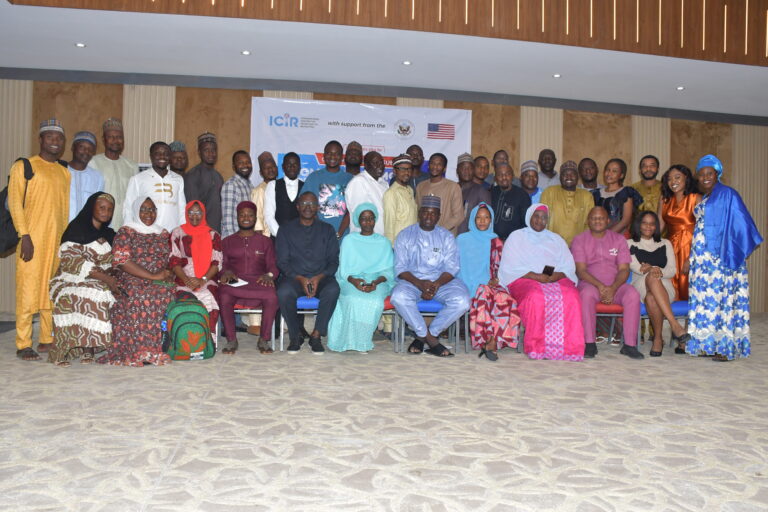
THE International Centre for Investigative Reporting (ICIR) has trained civil society organisations (CSOs) in the North-West on Promoting Democratic Governance Project.
Speakers at the training, held in Kano state on Thursday, October 19, emphasised the importance of collaboration between media and CSOs to promote good governance by making leaders accountable.
The training, part of The ICIR Promoting Democratic Governance Project, was sponsored by the US Embassy in Abuja.
The Centre organised it to build media practitioners’ and CSOs’ capacity to collaborate, promote accountability and good governance, and make the CSOs understand social media as a critical advocacy tool.
In his opening remark, the Executive Director of The ICIR, Dayo Aiyetan, urged the CSOs to collaborate with the media to achieve accountability and promote good governance.
“Regardless of the sector in which civil society organisations work, there should be a collaboration with the media to achieve the common goal of accountability and good governance. We should be able to promote transparency and amplify our impact in society,” he said.
The Executive Director of The ICIR, Dayo Aiyetan
In his remarks, the U.S. Embassy spokesperson Gilbert Morton commended the Centre for bringing civil society organisations and journalists together for the second part of the project. “As you well know, CSOs, just like the press, play an important role in promoting transparency and accountability by government”.
I quite like the idea of having them work together on specific projects, as this will deepen the reports and provide more insight for the public.
He stated that the United States supports journalists and CSOs that promote transparency and advocate accountability, “as evidenced by our support for this workshop and other capacity-building programmes. In addition, by fostering an environment where investigative journalism can thrive, the U.S. government contributes to creating a robust and vibrant civil society.”
The ICIR Promoting Democratic Governance project was launched earlier this year.
Media/CSOs at the event
It was designed to build journalists’ capacity in investigative reporting, fact-checking, solutions journalism, using the Freedom of Information Act, reporting in hostile or unsafe environments, and sensitising journalists on safety and security.
The Centre also organised it to equip journalists with the requisite tools and techniques to uncover sleaze and ensure public officials are held accountable.
FEDERAL civil servants who gathered in the Federal Capital Territory (FCT) to be captured by the Integrated Personnel and Payroll Information System (IPPIS) have accused the government of neglecting them.
The verification exercise, which brought civil servants from all over Nigeria to Abuja, is meant to verify their appointments.
The exercise, meant for employees not yet captured by the IPPIS, is ongoing at the Public Service Institute at Kubwa and the Conference Hall of the Head of Civil Service of the Federation.
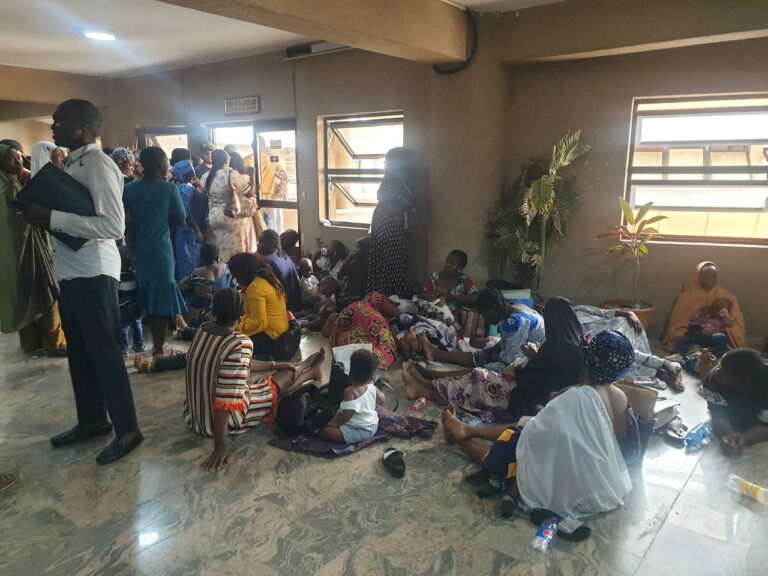
A civil servant from Cross River State who chose to remain anonymous for fear of being victimised told The ICIR that nobody was attending to the workers at both venues, adding they had been stranded at the venues since Monday, October 16, when the exercise began.
He also lamented the suspension of their salaries by the Federal Government because the IPPIS did not capture them.
“Federal staff salaries have been stopped for two months. Staff are mandated to come to Abuja without salary. Pregnant women and breastfeeding mothers are suffering here.
“Even if you do that, are you supposed to stop people’s salaries? What they are doing is extremely wrong. You asked federal staff to move from their stations to Abuja, and the verification portal is not working,” the worker said.
Another civil servant who preferred anonymity told The ICIR that no provision was made for accommodation, transportation and feeding despite the increasing costs of living and transportation in the city and the nation.
“I saw a woman and her little child sleeping on the floor when I left the venue around 8:30 p.m. yesterday.
“I also saw a woman with her newborn baby at the verification centre on Monday. It is a very serious issue,” said the worker.
But speaking to The ICIR on the matter, the Director of Information and Communication at the office of the Head of Civil Service of the Federation, Mohammed Ahmed Abdullahi, blamed the unruly attitude of the civil servants for the delay in the verification.
He said the portal was working effectively.
“They are not being fair at all. We are supposed to be civil servants; we are supposed to be civil in all our conduct, both in the office and at home. They cannot control themselves, so they want us to get the Police or Civil Defence to go and put them on the line for them to be verified.
“They are all mature people; they have children at home. If they cannot control themselves, what moral justification do they have to control their children? They are adults. See them fighting, jumping fences, jumping railings, breaking properties, for what?’ Abdullahi asked.
He advised the workers to be calm and orderly. He said seven teams were at the Public Service Institute to attend to the workers.
Abdullahi added that the verification exercise was mainly to free the civil service of ghost workers.
But responding to Abdullahi’s claims, the civil servant who spoke to The ICIR said it was wrong to gather17,000 people in a place without proper and adequate preparation.
“We are not the ones that are supposed to be organised; we have close to 17,000 people there from across Nigeria. What can seven teams do? he asked.
He said there was no plan for accommodation, food, or other needs, even though the verification started on Monday.
The Federal Government directed all civil servants and workers whose details were yet to be captured by the IPPIS to partake in the verification exercise.
About 17,000 affected federal civil servants nationwide were expected to participate in the activity.
A circular dated October 3, 2023, was issued by the Office of the Head of Service of the Federation with reference number HCSF/HRM/M.1125/T4/194 regarding the activity.
The ICIRreported that the Head of Service of the Federation (HoSF), Folashade Yemi-Esan, said 61,446 civil servants from various government ministries, departments, and agencies were verified on the IPPIS.
Yemi-Esan disclosed this during the 43rd Ministerial Media Briefing organised by the Presidential Communications Team at the State House, Abuja, in July 2022.
She added that 3,657 civil servants were dragged to the Independent and Corrupt Practices and Related Offenses Commission (ICPC) over their failure to get verified on the platform.
According to her, at least 1,618 applicants floated illegal or fake appointment letters.
She added that 874 officers were suspended from the IPPIS platform.
MINISTER of the Federal Capital Territory (FCT), Nyesom Wike, has insisted that he would not return the lands of the Nigeria Customs Service revoked by the FCT administration.
The minister made this known while responding to the plea by the Customs’ Acting Comptroller-General, Adewale Adeniyi, who visited him on Wednesday, October 18, to make a case for the affected lands.
Wike had ordered FCTA to revoke unused plots of land, including those belonging to some top politicians, organisations and government agencies.
Responding to the plea, Daily Trust quoted the minister as saying, “I read your letter on the revoked land, very bad; very bad; very bad, but what do I do? When we gave you the land, you refused to use it; FCT will now sell it to you, and when we give you a Certificate of Ownership, you pay our ground rent.
“I will give you the opportunity to buy the land from FCT and give you the value of the land now,” he said.
Wike lamented how government agencies were allocated lands in FCT and refused to develop them.
The Customs boss also requested land to build primary and secondary schools for the children of the more than 2,000 Customs officers residing in the FCT.
The minister assured his guest that he would consider the second request but on the condition that it would be developed within a specific period.
He asked the Customs to bring the application for authorization by the FCT administration.
Wike also said the land would be revoked if Customs failed to develop it on time.
Another condition the minister gave was for the organisation to pay ground rent when due.
PRESIDENT Bola Tinubu has appointed new chief executive officers for some agencies and parastatals under the Federal Ministry of Information and National Orientation.
In a statement released by the President’s spokesperson, Ajuri Ngelale, on Thursday, October 19, the President tasked the new leaders to create new opportunities for Nigerians through robust reforms of their respective institutions.
The President stated that the purpose of the institutions is to unify Nigerians, reshape their mindsets, and showcase the nation to the rest of the world.
According to the statement, the appointments take immediate effect.
The appointees are:
1. National Orientation Agency (NOA) — Director-General / CEO — Mr. Lanre Issa-Onilu
2. Nigerian Television Authority (NTA) — Director-General / CEO — Mr. Salihu Abdulhamid Dembos
3. Federal Radio Corporation of Nigeria (FRCN) — Director-General / CEO — Dr. Muhammed Bulama
4. National Broadcasting Commission (NBC) — Director-General / CEO — Mr. Charles Ebuebu
5. Voice of Nigeria (VON) — Director-General / CEO — Mr. Jibrin Baba Ndace
6. Advertising Regulatory Council of Nigeria (ARCON) — Director-General / CEO — Dr. Lekan Fadolapo
7. News Agency of Nigeria (NAN) — Managing Director / CEO — Mr. Ali Muhammed Ali
8. Nigerian Press Council (NPC) — Executive Secretary / CEO — Mr. Dili Ezughah
The appointments are the latest among several that Tinubu has made since assuming office on May 29.
The latest appointment follows Tinubu’s nomination of new chief executive officers for some agencies and parastatals under the Federal Ministry of Industry, Trade, and Investment on October 13.
THE Police Service Commission (PSC) has said the Special Constabulary in Kano are not Police officers and would not be recognised as such by the Commission and the Federal Government.
Nonetheless, the Commission said as the country battled to break criminals’ hold on the nation, the constabulary actions were legitimate and protected by the Police Act.
In a statement by its spokesperson, Ikechukeu Ani, on Thursday, October 19, the PSC said it was in touch with the Kano State Police Command and was aware that the use of the constabulary was to support the Police in building a crime-free Kano State.
The statement followed the controversy trailing the recruitment of repentant criminals as constabularies, who do a similar job as the Police.
“It is necessary to state that the men and women recruited as special constabulary are posted to work in their locality where they will be in a better position to fish out the criminals terrorising the place.
“Some of the repentant influential youths previously used in the past as political thugs and abandoned have realised that crime does not pay and have voluntarily offered themselves to assist in the fight for a crime-free state.
“The Commission is also aware that the Kano Special Constabulary has received adequate training and are working in their local government areas as required by law but under strict supervision of the State Police Command.
It added that their engagement was to promote sustainable peace, economic growth and development of the state.
L-F: Alleged notorious criminal Nasiru Abdullahi and the spokesperson of the Kano Police Command, Abdullahi Kiyawa. PC: X
According to the statement, the Commission’s chairman, Solomon Arase, will continue to partner with the Police to ensure improved security of lives and property in the country.
He revealed that the Commission, in collaboration with the Inspector General of Police, will guarantee that the constabularies’ uniforms are distinguishable from those of the Nigeria Police Force to prevent identity crises and specify their distinct functions within the country’s security framework.
The ICIRreported that the recruitment of repentant criminals as constabularies by the Kano state government sparked outrage among Nigerians on social media.
Several Nigerians, particularly on X, expressed dismay over recruiting individuals with criminal records and shady pasts to police communities.
On Monday, October 16, The ICIR saw pictures of Nasiru Abdullahi, popularly known as Chile Maidoki, donning a Kano State constabulary uniform alongside the State Police Command Public Relations Officer, Abdullahi Kiyawa.
Sometime this year, Abdullahi and two other notorious criminals were declared wanted by the Kano State Police Command with a bounty of N100,000 each.
A subsequent statement by the command confirmed that he surrendered himself to the Police upon hearing the bounty placed on his head.
Also confirming the recruitment, a report shared by Nigeria Police Force spokesperson Ademuyiwa Adejobi via his X handle revealed that 50 repentant thugs were selected from the 222 thugs that decided to embrace peace offered by the State Command’s Commissioner of Police, Muhammad Usaini Gumel.
FORMER Deputy Governor of the Central Bank of Nigeria (CBN), Kingsley Muoghalu, has recommended 50 per cent salary cut for Nigeria’s political class while also condemning their flamboyant lifestyle despite Nigeria’s economic distress.
Muoghalu stated this while featuring on Channels Television’s magazine programme “Politics Today” on October 17.
Nigeria has hugely relied on borrowing to fund its budget amid fiscal crisis, with the latest being $1.5 billion from the World Bank. Muoghalu believes such borrowings should not be reciprocated with the flamboyant life of politicians and the buying of costly imported jeeps amid Nigeria’s economic crisis.
“I recommend a 50 per cent cut in salaries for all political office holders. Also, all excessive demonstration of power stands condemned with the current economic distress we are going through,” he said.
He added that Nigeria’s political class must seriously consider what posterity will say of them when making crucial decisions.
According to Muoghalu, the general cost of governance must come down to avert further fiscal troubles amid rising borrowing.
He stressed that the tone of a good governance culture had to be set by President Bola Tinubu and spread through the other levels of government, including the National Assembly.
He argued that the solution to Nigeria’s economic problems lay in the broader culture of governance, which creates an inclusive sense of nationhood where everyone has a shared sense of purpose.
He said that issues of political economy, nationhood and culture of waste and corruption had to stop for Nigeria to move forward.