THE Nigeria Police Force, Federal Capital Territory Command, has announced the deployment of officers and assets across the nation’s capital ahead of the Area Council elections scheduled for Saturday, February 21.
The Command also declared a restriction of movement on the election day from 6am to 6pm, except for accredited officials and essential service providers.
In a statement on Wednesday, February 18, the FCT Police Commissioner, Miller Dantawaye, assured residents that the measures were aimed at guaranteeing a peaceful, free, and fair electoral process.
Dantawaye said the operation would be carried out in collaboration with sister security agencies, including the Nigerian Army, Nigerian Air Force, Nigerian Navy, Department of State Services (DSS), and the Nigeria Security and Civil Defence Corps (NSCDC)
“Consequently, FCT residents are urged to co-operate fully with security personnel and comply with security operations guidelines during this period. The Command also uses this opportunity to enjoin all residents of the FCT to remain law-abiding and come out to exercise their civic responsibility peacefully and without fear, as adequate security measures have been put in place,” he added.
While urging all personnel to exhibit the highest level of professionalism and neutrality while providing adequate security at polling units and collation centres, he warned that officers must remain vigilant, impartial, and courteous in the discharge of their duties while respecting the rights of all citizens
“Members of the public are also encouraged to remain vigilant and promptly report any suspicious persons or activities to the police through the following emergency numbers: 08032003913, 08061581938,” Dantawaye said.
The ICIR reported that the Independent National Electoral Commission (INEC) fixed February 21, for the poll across the six councils namely Abaji, Abuja Municipal Area Council (AMAC), Bwari, Gwagwalada, Kuje and Kwali.
Political parties started campaigns after INEC released the final candidates list in September 2025.
The contest is expected to shape grassroots governance in the nation’s capital, where the Peoples’ Democratic Party (PDP) and the All Progressives Congress (APC) shared the councils in previous elections.
The African Democratic Congress (ADC), Action Alliance (AA), All Progressives Grand Alliance (APGA) and others are fielding candidates in the poll.
The INEC had cleared more than 1.6 million registered voters to participate in electing six chairmen and 62 councillors across the councils.
According to the figure released by the Resident Electoral Commissioner (REC) for the FCT, Aminu Idris, the expected voters stand at 1,680,315.
THE Pulitzer Centre is launching a special call for journalism grants focusing on transparency and governance topics in the environmental sector.
Journalists, editors, and media organisations are invited to submit proposals.
The Centre aims to support projects that shed light on how the global environment and ecosystems are regulated, the impact of regulation on communities that depend on ecosystems, the interests that endanger these ecosystems, and key policies and actions that need enforcement.
The organiser says, “The special call for grants seeks journalism proposals that focus on how governments manage natural resources; harmful industrial and corporate practices; potential conflict of interest and corruption; and the impact on biodiversity, nidigenous communities, human rights, and climate”.
“We particularly welcome applications from the Global South and seek reporting from Africa, Latin America, and South and Southeast Asia.
The Centre is interested in stories that expose financial institutions, investors, and companies that are financing unsustainable deforestation, mining, fishing, or other natural resource exploitation.
It encourages projects that reveal how the lack of regulation and enforcement is facilitating criminal activity such as smuggling, illegal logging, greenwashing, poaching, and illegal, unreported, and unregulated fishing (IUU)
“We will prioritise clear investigative and data-driven methodologies that approach a topic systemically to expose wrongdoing, loopholes, corruption, and other abuses in the management of natural resources”.
Successful applicants will be notified by March 20, 2026. For approved projects, half of the grant amount is generally paid after the contract is signed, and the remaining will be paid upon submission of the principal material for publication or broadcast.
Submission deadline is February 28, 2026. Interested applicants can apply here.
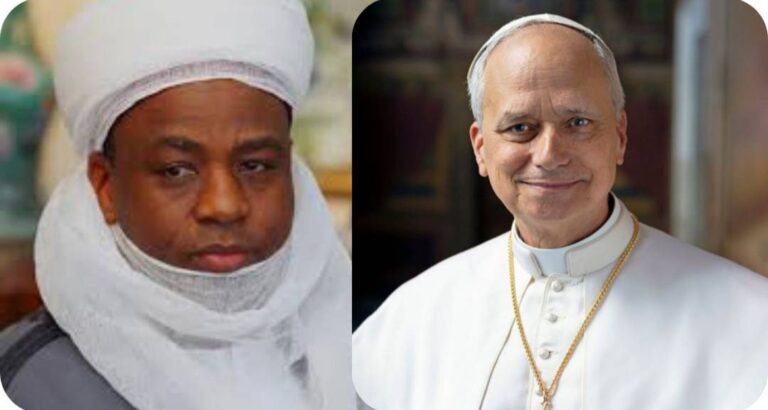
MUSLIMS and Christians in Nigeria, on Wednesday, February 18, joined their counterparts globally to commence the Islamic holy month of Ramadan and Lent respectively.
Leader of the Nigerian Supreme Council for Islamic Affairs, NSCIA, and the Sultan of Sokoto, Sa’ad Abubakar, made the announcement on Tuesday, following the sighting of the crescent moon in various places in the country.
“The Sultanate Council Advisory Committee on Religious Affairs in conjunction with the National Moonsighting Committee received reports from various Moonsighting Committees across the country confirming the sighting of the new moon of Ramadan 1447AH, on Tuesday,” a statement signed by the Chairman Advisory Committee on Religious Affairs of the Sultanate Council, Sambo Wali Junaidu, said.
The Sultan congratulated the Muslim Ummah in Nigeria and urged them to use the holy month to pray for peace and progress of the nation.
“His eminence, the Sultan felicitates with the Nigeria Muslim Ummah and wishes them Allah’s guidance and blessings. The Sultan while urging the Muslim Ummah to continue to pray for peace, progress and development of the country also wishes all Muslims a happy Ramadan kareem. May Allah (SWT) accept our religious deeds. Amen.”
The ICIR reports that Ramadan is the ninth month of the Islamic lunar calendar.
During the period, Muslims are required to spend a period of 29 or 30 days abstaining from food and drink, including water, during daylight hours, as a means of celebrating and reflecting on their faith.
Lent, a significant season in the Christian liturgical year, begins today with Ash Wednesday.
The liturgical year is the Church calendar observed by Catholics, Anglicans, Lutherans, Orthodox Christians, and several other denominations.
On Ash Wednesday, worshippers receive a cross-shaped mark on their foreheads made from ashes. These ashes are obtained by burning palm fronds from the previous year’s Palm Sunday, according to the Catholic News Agency.
The 40-day duration mirrors the fasting periods of Jesus Christ before his public ministry, as well as those of prophets Elijah and Moses, who each fasted for 40 days at different times.
The devotion progresses into the Palm Sunday, the Sunday before Easter. It is marked by the use of palm fronds, which worshippers wave during processions or fashion into crosses to take home.
This tradition marks Jesus Christ’s Triumphal Entry into Jerusalem when his followers laid palm branches before him, as recounted in the Gospels of Matthew, Mark, Luke, and John.
The week ushers in the Good Friday, Easter Sunday and Monday, when faithful commemorate the death and resurrection of Jesus Christ.
OPPOSITION lawmakers in the House of Representatives, on Tuesday, staged a walkout after disagreeing with the ruling party members’ position on the Electoral Act Amendment Bill.
The development arose from the proposed change to Section 60(3) of the bill which requires that election results be sent electronically to the Independent National Electoral Commission’s (INEC) Result Viewing (IReV) portal, The section also allows manual transmission if electronic transmission fails.
It states: “The presiding officer shall electronically transmit the results from each polling unit to REV portal and such transmission shall be done after the prescribed Form ECSA has been signed and stamped by the presiding officer and/or countersigned by the candidates or polling agents where available at the polling unit.
“Provided that if the electronic transmission of the result fails as a result of communication failure and it becomes impossible to transmit the result contained in form: EC&A signed and stamped by the presiding officer and countersigned by the candidates or polling agents where available at the polling unit, the form EC&A shall remain the primary source of collation and declaration of the result”.
Opposition members demanded that this condition be deleted. They argued that election results should only be uploaded electronically, without alternative method or a backup. Their pleas were rejected, leading to the walkout.
The House eventually had its way and concurred with the Senate’s position on the amendment.
The House had in 2025 passed a bill requiring election results to be sent to IReV in real-time.
The clause stated that the “presiding officer shall electronically transmit the results from each polling unit to the IReV portal in real time, and such transmission shall be done after the prescribed form EC8A has been signed and stamped by the presiding officer and/or countersigned by the candidates or polling unit agents, where available at the polling unit”.
Prior to the walkout by the lawmakers, The ICIR reported that the House was thrown into chaos on Tuesday as lawmakers clashed over a motion seeking to reconsider the Electoral Act Amendment Bill 2025.
Francis Waive, Chairman of the House Committee on Rules and Business, moved to withdraw the bill passed on December 23, 2025, citing the need to address irregularities in the electoral system before the 2027 general elections.
Even with the ‘nays’ exercising dominance over the voice vote, Speaker Tajudeen Abbas ruled in favour of the ‘ayes’, leading to protests from lawmakers. The session was eventually moved to an executive session, in the face of opposition from some members.
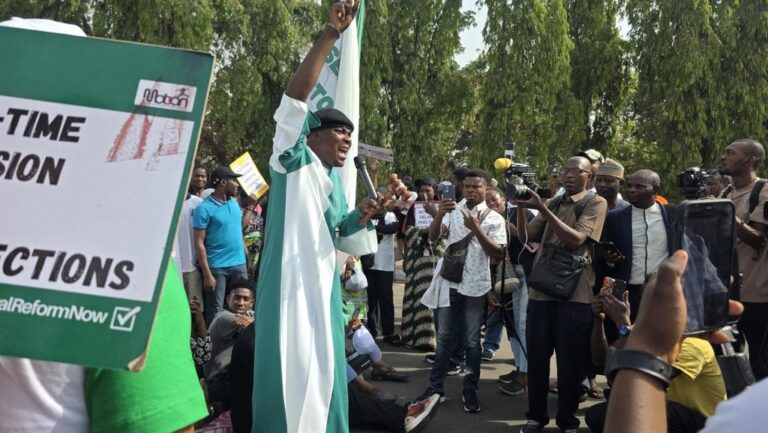
THE Nigeria Police Force on Tuesday, February 17, dispersed demonstrators who gathered at the National Assembly in Abuja with tear gas, as tensions mounted over proposed amendments to Nigeria’s electoral framework.
Among those affected by the dispersal were activist and former presidential candidate Omoyele Sowore and former minister Solomon Dalung, who were present at the protest demanding reforms to strengthen electoral transparency ahead of the 2027 general elections.
Sowore alleged that police used force against peaceful demonstrators, describing the action as an assault on democratic expression.
He claimed some protesters collapsed following exposure to tear gas and called on Nigerians to mobilise in defence of electoral integrity and civil liberties.
“This has translated now to a total declaration of war on Nigerians. This is a coup against democracy…for the first time the police is using compressed containers that penetrate through your skin on Nigerians. Over two people have collapsed in this place now. This is not going to be accepted. We are calling on Nigerians to be heading down to the National Assembly,” Sowore said.
The protesters’ key demands included real-time electronic transmission of election results, restoration of a 360-day statutory timeline for issuing election notices, and tougher penalties for vote buying.
Demonstrators insisted the measures were necessary to enhance transparency, improve preparation by electoral stakeholders, and rebuild public confidence in the electoral process.
Despite the dispersal, protest organisers insisted citizens would continue to press their demands, urging lawmakers in the Conference Committee of the National Assembly to act in the public interest and strengthen electoral transparency.
Meanwhile, civil society organisation YIAGA Africa, in a post on its X handle, said reports reaching it indicated that the National Assembly had adopted the Senate’s position on Clause 60(3) regarding electronic transmission of results, contrary to public expectations and the earlier stance of the House of Representatives.
The group added that both legislative chambers had also agreed to shorten the statutory timeline for issuing the election timetable from 360 days to 300 days, warning that the decisions could affect transparency, preparedness, and the credibility of the 2027 electoral process.
“In addition, both chambers have resolved to reduce the statutory timeline for issuing the election timetable from 360 days to 300 days. These decisions carry significant implications for transparency, preparation, and the overall credibility of the 2027 electoral process,” it noted.
Chaos at House of Reps
The confrontation outside the complex unfolded on the heels of rising tensions within the National Assembly over provisions in the Electoral Act Amendment Bill, particularly the clause mandating real-time electronic transmission of polling-unit results to the electoral results portal.
The ICIRreported that lawmakers clashed during a rowdy session on Tuesday, after a motion was introduced to rescind the earlier passage of the bill in line with the Senate’s position.
When the House of Representatives passed the Electoral Act in December 2025, it adopted the compulsory real-time transmission of election results to IReV.
Although dissenting voices were louder during a voice vote to rescind the earlier passage, the presiding officer ruled in favour of rescission, triggering protests and an executive session.
While the House version of the bill required compulsory real-time transmission of results after completion of polling-unit documentation, the Senate initially rejected making the provision mandatory, instead allowing transmission in a manner determined by the electoral commission, with manual collation permitted in cases of technological failure.
The ICIR reports that to resolve the differences, Senate President Godswill Akpabio had on February 10, named a 12-member conference committee to harmonise the Senate and House versions of the amendment bill with their counterparts in the lower chamber.
THE HOUSE of Representatives was thrown into chaos on Tuesday as lawmakers clashed over a motion seeking to reconsider the Electoral Act Amendment Bill 2025.
Francis Waive, Chairman of the House Committee on Rules and Business, moved to withdraw the bill passed on December 23, 2025, citing the need to address irregularities in the electoral system before the 2027 general elections.
Even with the ‘nays’ exercising dominance over the voice vote, Speaker Tajudeen Abbas ruled in favorr of the ‘ayes’, leading to protests from lawmakers. The session was eventually moved to an executive session, in the face of opposition from some members.
The controversy centres on the real-time transmission of election results to the Independent National Electoral Commission’s (INEC) Result Viewing Portal (IReV). The House had accepted this proposal, but the Senate initially rejected it. However, the Senate later withdrew its decision and approved electronic transmission with a fallback to manual collation if technology fails.
“The presiding officer shall electronically transmit the results from each polling unit to the IReV portal in real time, and such transmission shall be done after the prescribed form EC8A has been signed and stamped by the presiding officer and/or countersigned by the candidates or polling unit agents, where available at the polling unit,” the approved clause states.
A conference committee has been established to align the differences between the House and Senate versions. Civil society organisations are urging the National Assembly to adopt the House’s version on result transmission.
The National Assembly has assured INEC of its support for the 2027 general elections, with Senator Simon Lalong and Representative Bayo Balogun cautioning INEC against making unachievable promises.
“IReV was not even in the Electoral Act; it was only in INEC regulations. So, be careful how you make promises,” Balogun advised.
THE ICIR reported that the Senate President Godswill Akpabio issued the directive in a memo signed by the Clerk of the Senate, Emmanuel Odo, dated February 8, and circulated to senators, announcing the emergency sitting without stating the reason for the emergency plenary.
Although the amendment introduced several changes to the law, public debate has centred largely on one contentious provision: the rejection of mandatory electronic transmission of election results from polling units to INEC’s Result Viewing Portal (IREV).
However, many political parties, politicians and civil society actors have criticised the clause and called on lawmakers to reverse it, as some advocacy groups have also threatened mass action. A coalition operating under the banner Enough is Enough has begun mobilising supporters for a protest at the National Assembly, using the hashtag #OccupyNASS.
THE South-east region of Nigeria has lost an estimated N17 trillion in almost five years because of the enforcement of sit-at-home orders from non-state actors, comprising mainly the Indigenous People of Biafra (IPOB), according to research data from The ICIR.
The enforcement of the sit-at-home order every Monday was an approach IPOB adopted to protest the federal government’s continued detention of its leader, Nnamdi Kanu.
While reaffirming the colossal loss to the region, the Onitsha Chamber of Commerce, Industry, Mines and Agriculture (ONICCIMA) reported that over N12 trillion was lost in businesses and related investments in the Southeast region due to the enforcement of the sit-at-home directives.
In counting the cost of the enforcement, they said the investment climate in the region was all time low, as some investors severed investment and supply chains
The enforcement of the Monday sit-at-home order lasted for almost 5 years, with its commencement on August 9, 2021. However, there was respite following the intervention of Governor Chukwuma Soludo and other governors in the region, who issued a directive for economic activities to resume on Mondays, with sanctions for violators already being enforced.
Other states, such as Enugu, Ebonyi, Imo, and Abia, have also been assuring businesses and banks of security provisions on Mondays as banks and traders cautiously return to business.
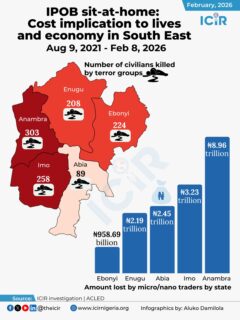
Infographics data on economic losses due to the sit-at-home
Currently, businesses, banks and schools ‘cautiously’ go about their economic activities on Monday, as most Southeast governors have issued a directive calling for an end to the sit-at-home.
The President of ONICCIMA, Chinedu Nwonu, who recounted the loss to businesses and affirmed the over N12 trillion losses, said many businesses lost supply chains, which affected investors’ confidence.
He recalled that Onitsha, as a trading and business hub with transport, logistics and banking systems interconnected, got weakened because of the directives largely enforced by non-state actors.
“Onitsha has transportation links to every part of Nigeria for business linkups. This is why logistics, banking and textile industries were adversely affected. Investment confidence and supply and logistics chains got broken as a result of the sit-at-home enforcement,” he said.
“In most cases, clients have to incur extra costs by staying in Asaba from the weekend to Monday to meet up with their business partners at the Onitsha main market and other link-up markets, which inflates trading costs,” he added.
While admitting that people still express fears about their activities, he described the days lost to the sit-at-home as a national tragedy.
“It would still take time for most of the businesses to recover and consolidate fully as a result of the sit-at-home. Onitsha is a big West-African market hub and has linkages across the country and beyond. Logistics and business match-making links are broken.
He also noted that industrial and hospitality hubs are gradually finding their feet, adding that banks are some strategic businesses are still opening with caution.
What data says
Notably, The ICIR data highlighted colossal losses from micro, small and medium enterprises agencies.
The data relied on figures from the National Bureau of Statistics (NBS), Nigeria’s data agency, and the Small and Medium Enterprise Development Agency of Nigeria (SMEDAN) 2021 survey reports.
The survey classified Nigerian businesses into four categories: nano, micro, small and medium enterprises.
In Anambra, The ICIR data showed micro businesses lost N1.3million on Mondays. It also said individual micro traders lost N29,409 each Monday. The amount lost in the State for every sit-at-home is N38.1 billion. For a period of 235 days, the state lost N8.96 trillion to the sit-at-home.
In Enugu, micro businesses lost N1.1 million on Mondays, while individual traders lost N8,090 on each Monday.
Enugu State lost N9.3 billion every Monday and N2.19 trillion for a period of 235 days that the site at home lasted.
In Imo state, micro businesses lost an average of N1.2 million every Monday, and each trader lost N11,156 on Mondays.
The state lost N13.7 billion every Monday in businesses, while N3.23 trillion was lost cumulatively in the 235 days traders sat at home for five years.
In Abia, another commercial hub, small businesses lost N764,844 on Mondays to sit at home. Individual traders lost N13,613 and N10.4 billion each Monday to sit at home. The state lost N2.4 trillion cumulatively in 235 years that made up the five years.
In Ebonyi state, small businesses lost N561,284 each Monday to sit-at-home. Each trader lost N7,268.18.
The state lost N4.1 billion every Monday to sit at home and N958 billion in 235 days that made up the five years of every Monday lost to sit-at-home.
Meanwhile, an earlier report by the SBM Intelligence titled: ‘Four Years of Disruption’. The report shows how a protest that started to demand freedom for IPOB leader Nnamdi Kanu has become a long-lasting economic and humanitarian crisis. The crisis includes violence, fear, and destroyed jobs.
In most parts of Abia, Enugu, Imo, Ebonyi, and Anambra states (which make up the south-east), SBM said Mondays now have no business activity. Streets stay empty, and businesses remain closed.
People stay home not just because they support the cause, but also because violent groups attack anyone who tries to work on Mondays, the report said.
“The sit-at-home protests, enforced by IPOB since 2021, have transformed from a symbolic act of dissent into a protracted crisis with devastating socioeconomic and security consequences for Southeast Nigeria,” the report reads.
According to the report, the region has suffered staggering losses, including N7.6 trillion in economic damage, 776 fatalities, and systemic disruptions to education, governance, and livelihoods.
“Initially rooted in legitimate grievances over marginalisation and the detention of Nnamdi Kanu, the movement has been hijacked by violence, criminality, and internal fragmentation, eroding public support and deepening instability,” the report stated.
Small businesses lose about N4.6 trillion every year, while transport companies lose between N10 billion and N13 billion every Monday when groups force the shutdown, the SBM report said.
SBM Intelligence said IPOB started the weekly Monday shutdown across the south-east in 2021. At first, people followed it mainly to show support.
“These losses stem from widespread market closures, disrupted supply chains, and the inability of businesses, particularly SMEs, to operate effectively,” the report said.
“Micro-businesses have been particularly hard-hit, with annual losses reported at approximately N4.6 trillion due to the recurring sit-at-home days.
“The impact is evident in both urban and rural areas. Large commercial hubs like Onitsha Main Market, one of Africa’s largest, have been repeatedly forced to close, resulting in missed transactions and financial strain for traders and consumers.”
The report also found that 776 people died and 332 violent attacks happened between 2021 and 2025. Imo and Anambra states had more than half of these deaths.
IPOB’s armed wing — the Eastern Security Network (ESN) — and other criminal gangs force people to follow the sit-at-home order by burning buildings, kidnapping people, and killing targeted victims, according to SBM Intelligence.
SBM said government forces have tried to bring things back to normal in states like Enugu and Ebonyi. Peter Mbah, the governor of Enugu, imposed penalties for compliance with the sit-at-home order, which helped bring some normalcy back to Enugu.
FORMER Kaduna State governor, Nasir El-Rufai, has spent his first night at the headquarters of the Economic and Financial Crimes Commission (EFCC) in Abuja after presenting himself for questioning over corruption allegations.
His media aide, Muyiwa Adekeye, confirmed the development in a statement on Monday, February 16, noting that the former governor honoured the commission’s invitation and held discussions with its officials.
According to the statement, El-Rufai had a “frank and fruitful interaction” with EFCC investigators, adding that his legal team described the officials’ conduct as professional.
Adekeye added that the former governor remained with the commission after the engagement.
“Malam Nasir @elrufai today honoured the invitation extended to him by the EFCC.
“He had a frank and fruitful interaction with the EFCC officials, whom his counsel noted were entirely professional in their approach and conduct,” he wrote.
The ICIR on Monday reported how El-Rufai’s appearance drew opposing groups of demonstrators to the EFCC headquarters in Abuja.
The former FCT minister arrived at the complex around 11am with a group of supporters and lawyers.
The anti-El-rufai group of protesters, who had gathered long before El-rufai arrived, carried placards and banners with bold inscriptions, demanding that the anti-graft agency investigate and prosecute the former governor over alleged financial impropriety.
Some of the inscriptions read: “El-Rufai cannot hide behind politics. Let the law catch up,” and “No one is above the law.”
However, tensions escalated when another group of demonstrators, who identified themselves as El-Rufai’s supporters stormed the area and displayed placards with the inscription: “El-Rufai is a citizen not a suspect,” “We stand with El-Rufai”, and We stand with the law.”
The ICIR reports that the former minister has also been charged with 3-count charges bordering on unlawfully interception of the phone communications of the National Security Adviser, Nuhu Ribadu.
The three-count charge, instituted at the Federal High Court, Abuja, and dated February 16, 2026, stemmed from statements El-Rufai made during a February 13 appearance on Arise TV’s Prime Time programme.
In count one, prosecutors alleged that the former governor admitted during the interview that he and unnamed associates “unlawfully intercepted the phone communications” of Ribadu, an offence said to be punishable under Section 12(1) of the Cybercrimes (Prohibition, Prevention, etc.) Amendment Act, 2024.
Count two further accused him of acknowledging knowledge of individuals responsible for the interception but failing to report them to security agencies, contrary to provisions of the same law.
In count three, the prosecution alleged that El-Rufai and others still at large used technical systems that compromised public safety and national security by intercepting the NSA’s communications, an offence punishable under Section 131(2) of the Nigerian Communications Act, 2003.
THE Nigerian government, through the Nigeria Data Protection Commission (NDPC), has ordered an immediate investigation into the data processing activities of Chinese-owned e-commerce platform Temu over alleged violations of the Nigeria Data Protection Act (NDPA).
The decision raises fresh concerns about how foreign technology companies collect, store, and transfer Nigerians’ personal data.
In a press release dated February 16, the NDPC said its National Commissioner and Chief Executive Officer, Vincent Olatunji, authorised the probe following mounting concerns around online surveillance, excessive personal data collection, lack of transparency, weak accountability mechanisms, and cross-border data transfers.
“The investigation of Temu was triggered by concerns around online surveillance through personal data processing, accountability, data minimisation requirement, transparency, duty of care and cross-border data transfer,” the statement read in part..
Preliminary findings by the Commission indicate that Temu processes the personal data of an estimated 12.7 million Nigerian users, while serving about 70 million daily active users globally, raising serious questions about how Nigerians’ data are collected, stored, shared, and protected.
“The National Commissioner warned that processors who engage in processing activities on behalf of data controllers without verifying their compliance with the NDP Act may be liable under the NDP Act,” the Commission added.
According to data, Nigeria is Africa’s most populous country and one of the continent’s fastest-growing digital markets with millions of its citizens relying on mobile apps, social media platforms, fintech services, and e-commerce sites for daily transactions often with little understanding of how their personal information is being used.
Civil society groups and digital rights advocates say the Temu investigation represents a crucial test of Nigeria’s willingness to enforce its data protection laws against powerful global technology companies.
The ICIR reports that in January 2019, the National Information Technology Development Agency (NITDA) established the Nigeria Data Protection Regulation (NDPR), the country’s first comprehensive framework governing how organisations collect, process, and store personal data.
The NDPR introduced consent requirements for data collection, rights of data subjects, obligations for organisations to implement security safeguards, sanctions for data breaches and non-compliance, but because the NDPR was a regulation rather than an Act of Parliament, enforcement powers were limited, and penalties were often contested.
In February 2022, the Federal Government established the Nigeria Data Protection Commission to replace NITDA as the primary data protection authority – a move aimed at strengthening independence, enforcement capacity, and regulatory clarity.
In June 2023, President Bola Ahmed Tinubu signed the Nigeria Data Protection Act (NDPA), 2023 into law. The Act gives the NDPC statutory backing, expands enforcement powers and penalties, establishes lawful bases for data processing, regulates cross-border data transfers, and mandates data protection impact assessments for high-risk processing.
Analysts believe that the NDPC probe sends a message that Nigeria is no longer a soft landing for companies that treat user data carelessly.
THE National Bureau of Statistics (NBS) said the Nigerian inflation rate has sustained a downward trend and dropped to 15.1 per cent in January, from 15.15 per cent recorded in December 2025.
The NBS announced the increase in its consumer price index (CPI) on Monday, February 18.
According to NBS, the January 2026 headline inflation rate showed a decrease of 0.05 per cent compared to the December 2025 headline inflation rate.
“On a year-on-year basis, the headline inflation rate was 12.51 per cent lower than the rate recorded in January 2025 (27.61 per cent). This shows that the headline inflation rate (year-on-year basis) decreased in January 2026 compared to the same month in the preceding year (i.e., January 2025).
“On a month-on-month basis, the headline inflation rate in January 2026 was -2.88 per cent, which was 3.4 per cent lower than the rate recorded in December 2025 (0.54 per cent),” the statistics office said.
The NBS also explained that the rate of increase in the average price level was lower than the rate of increase in the average price level in December 2025.
It disclosed that the food inflation rate for January was 8.89 per cent on a year-on-year basis.
This, the bureau said, is 20.74 points lower compared to the rate recorded in December 2025 (29.63 per cent).
“On a month-on-month basis, the food inflation rate in January 2026 was -6.02 per cent, down by 5.66 per cent compared to December 2025 (-0.36 per cent),” the report said.
The NBS explained that the inflation ease could be attributed to the rate of decrease in the average prices of water yam, eggs, green peas, groundnut oil, soya beans, palm oil, maize (corn) grains, guinea corn, beans, beef meat, melon (egusi) unshelled, cassava tuber, cow peas (white), etc.
“The average annual rate of food inflation for the twelve months ending January 2026 over the previous twelve-month average was 20.29 per cent, which was 18.18 per cent points lower compared with the average annual rate of change recorded in January 2025 (38.47 per cent),”it said.
The NBS further said that in January 2026, food inflation was the highest year-on-year in Kogi (19.84 per cent), Benue (18.38 per cent), and Adamawa (17.29 per cent).
On the other hand, states such as Ebonyi (1.69 per cent), Abia (3.23 per cent), and Imo (3.74 per cent) recorded the slowest rise in food inflation on a year-on-year basis.