Home Blog Page 826

How to make money from Twitter ads revenue sharing programme

Several content creators in Nigeria woke up to receive credit alerts from X (formerly Twitter) as part of its ad revenue-sharing initiative.

The development follows the commencement of payouts for U.S. users last month, as X extended the programme globally by the end of July.

The microblogging platform had earlier announced that through its monetisation programme, “creators across the globe can now sign up and earn a living on the platform.


READ ALSO:

Nigerian creators react as Twitter begins ads revenue payment

Threads: Meta set to new launch app to rival Twitter

Elon Musk introduces daily reading limits on Twitter


The platform said users who subscribe to Twitter Blue can access new features and apply to enable Subscriptions on their account and earn income directly on Twitter by tapping on monetisation in settings to apply.

Verified users who met impression thresholds are now benefiting from this. Many of these creators have expressed gratitude to Elon Musk, the platform’s owner, stating that his support encourages them to stay on the platform and keep producing compelling content.

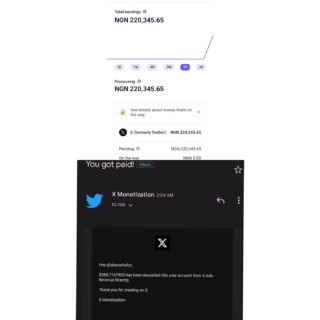
For instance, a verified Twitter user, Abbaz announced that he received an alert of N220,000 from Twitter this morning.


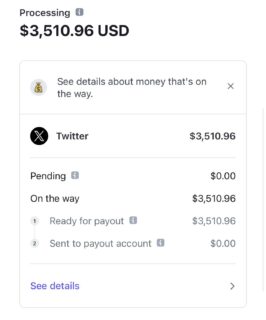
A Twitter influencer, @TalentedFGB, with over 800,000 followers on Twitter, shared that he received an alert of $92,765 as revenue.

Similarly, a Twitter user, @Solomon_Buchi announced that he received his share of the payout.

“I got paid by Twitter, now known as X. I Twitter my opinions, commentators, views, and people are blessed, however, it’s also nice to be paid for it!”

Following the development, a lot of X users have been looking for a way to join the trail and benefit from the mouthwatering incentives introduced by Elon Musk.

What is Twitter ad revenue sharing?

Twitter ad revenue sharing is the latest feature added to the platform that helps creators get a share of Twitter’s revenue from the sponsored posts appearing under their tweets. This initiative allows verified creators to access a share of the revenue generated by advertisements displayed within the comments section of their posts.

While the exact methodology for calculating reimbursements and the portion retained by Twitter remains somewhat unclear, it is a requirement for accounts to have accrued a minimum of 5 million impressions on their tweets within the preceding three months in order to qualify for participation. This criterion ensures that eligible creators have achieved a certain level of engagement and exposure before being able to participate in the revenue-sharing arrangement.

The monetisation requirements and steps to apply according to Twitter:

Creators who monetise on Twitter must meet the following requirements:

  1.  You must reside in a country in which Twitter’s monetisation programmes are available.
  2. You must be 18 or older. 
  3. You must have a Twitter account that has been active for at least three months. 
  4. You must have a complete profile inclusive of an account name, a bio, a profile picture, and a header image.
  5. You must have a verified email address.  
  6. You must have secured your account with two-factor authentication. 
  7. You must not be designated a state-affiliated media account. 
  8. You must be in good standing with Twitter, which means that:
  • I. You have not repeatedly violated the Twitter User Agreement or Twitter’s Content Monetisation Standards. 
  • II. You have not previously been removed as an advertiser on Twitter for violations of our Ads policies or as an Amplify publisher on Twitter for violations of our Amplify Pre-Roll Guidelines 
  • III. You have not previously been removed as an advertiser on Twitter for violations of our Ads policies or as an Amplify publisher on Twitter for violations of our Amplify Pre-Roll Guidelines

9. You must connect a verified Stripe account.
10. Maintain at least 500 active followers or more.
11. You must have posted Tweets in the past 30 days before the application

12. Subscribe to Twitter Blue.

13. After verification, click on the monetisation column under settings and apply after ensuring that the requirements listed above are met.
Nigerian creators react as Twitter begins ads revenue payment

FOLLOWING Twitter’s (Now X) announcement, creators worldwide have started getting paid leading to Nigerian creators receiving their payments.

On Friday, July 28, the CEO of Twitter(X) announced that X premium users will start receiving payments for being active on the platform.

“Today is the day: Ads Revenue Sharing is now live for eligible creators globally. Set up payouts from within Monetisation to get paid for posting. We want X to be the best place on the internet to earn a living as a creator and this is our first step in rewarding you for your efforts. Find out more on our Help Center”,  the tweet says.

This situation has generated attention on Twitter, with some Nigerian creators sharing payment screenshots, while other users express interest in subscribing to Twitter Blue.

Reacting to this, a Twitter influencer, @abazwhyllz tweeted that he woke up to a credit alert from the X app.

“Woke up to receive alert, Thank you Elon ❤️

Payment proof from Twitter user. Credit: Twitter

Similarly, another verified user, @kceeonyekachi1 shared that he also got paid.

“Thanks @elonmusk. Never thought I’d get paid for doing good🙏 Let’s pay more school fees‼️

Payment proof from Twitter user. Credit: Twitter

According to the guidelines by X, qualifying users should be subscribed to Twitter Blue or verified organisations, have accumulated a minimum of 15 million impressions across posts in the last 3 months, and possess at least 500 followers.

In July  The ICIR reported that Twitter launched a new logo, “X” – a white X on a black background, dropping the blue bird symbol as part of a wider rebranding process.

Senate meets with organised labour over fuel subsidy removal

0

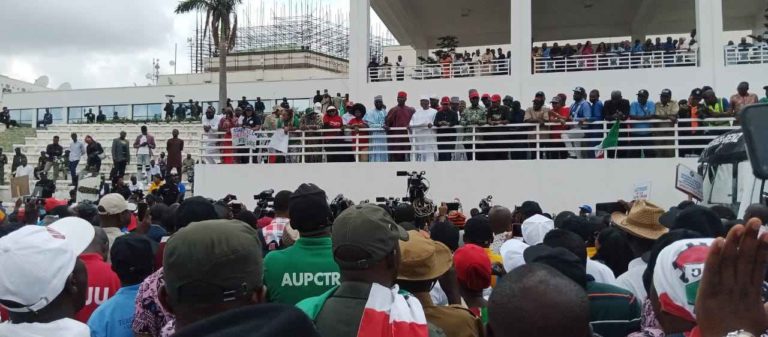
MEMBERS of the Senate are meeting with organised labour at the National Assembly complex on Tuesday, August 8.

President of the Nigeria Labour Congress (NLC) Joe Ajaero said the lawmakers invited members of the unions for the meeting due to their agitations over the removal of fuel subsidy.

Organised labour in Nigeria declared a nationwide protest over economic challenges in the country occasioned by the removal of petrol subsidy, held on Wednesday, August 2.

Ajaero noted that the protest was necessary because negotiations between the federal government and labour over the issues raised did not yield any positive results.

“We are here for the protest and to make a statement to Nigerians that since we started negotiations, there is nothing we have in our hands,” Ajaero said on Wednesday.

During the protests, the protesters pulled down one of the National Assembly Complex gates and gained access to the premises in defiance of security operatives, who earlier denied them entry.

The Senate then sent a three-person committee, including Senate Chief Whip Ali Ndume and senators representing the Federal Capital Territory (FCT) and Anambra North Ireti Kingibe and Tony Nwoye, to dialogue with the protesters.

Ahead of the protests, Nigerian President Bola Ahmed Tinubu assured the country that measures would be put in place to mitigate hardships caused by the subsidy removal during an address on Monday, July 31, but the labour unions insisted that the promises made were not in tune with the challenges confronting citizens.

They also stated that Tinubu failed to address the problem of nonfunctional refineries in the country, which was considered to be the solution to the problems in the oil sector in Nigeria.

The protest was called off at the end of the first day after Nigerian President Bola Tinubu had a meeting with the agitators.

However, the ministry of justice sued organised labour for contempt of court, which provoked leaders of the unions into declaring a nationwide strike that would commence on August 14.

The contempt suit was withdrawn on Monday, August 7, though the decision of the labour unions over the planned strike is not yet certain.

Tinubu inaugurates tax committee, targets 18% tax-to-GDP ratio in 3 years

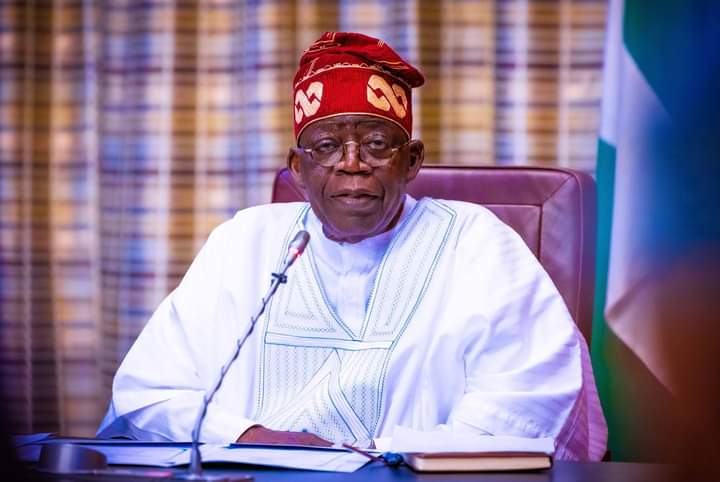
PRESIDENT Bola Tinubu has inaugurated the presidential committee on Fiscal Policy and Tax Reforms with a mandate to achieve an 18 per cent tax-to-GDP (tax to gross domestic product) ratio within three years.

The inauguration took place on Tuesday, August 8, in Abuja.

Tinubu had, on Thursday, July 6, signed four Executive Orders on tax relief and, the following day, set up a presidential tax committee chaired by Taiwo Oyedele.

The move was to amend Nigeria’s tax laws and fiscal policy to improve government revenue.

Nigeria’s tax administration faced many issues arising from multiple taxation, poor administration, tax touting, non-payment of tax refunds, and other complex natures of the tax laws.

But a financial expert, David Adonri, had told The ICIR that the reforms proposed by the government should adequately address the welfare of the average Nigerian to engender trust.

Adonri explained that tax as a core fiscal policy does not constitute the only primary source of government revenue but also as income redistribution to incentivise investment in critical sectors of the economy.

In his address at the inaugural meeting of the tax reforms committee, the President said the members comprise experts from both the private and public sectors.

According to him, the aim is to transform the tax system to support sustainable development while, at the same time, achieving a minimum of 18 per cent tax-to-GDP ratio within the next three years.

“The Committee is expected to achieve its mandate within a period of one year. They are, in the first instance, expected to deliver a schedule of quick reforms which can be implemented within thirty days.

“Critical reform measures should be recommended within six months and full implementation will take place within one calendar year,” Tinubu said.

The committee is mandated to address three broad fiscal challenges facing the economy: fiscal governance, tax reforms, and growth facilitation.

Their report will also cover tax reform, fiscal policy design and coordination, and harmonisation of taxes and revenue administrations.

The president said, “Within the scope of this mandate, the Committee shall have as its objective the advancement of viable and cost-effective solutions to issues such as the multiplicity of revenue collection agencies, the high cost of revenue administration, the excessive burden of compliance on ordinary taxpayers, the lack of effective coordination between fiscal and other economic policies within and across levels of government and poor accountability in the utilisation of tax revenues.”

Tinubu has, in his less than three months in office, introduced other drastic reforms, including fuel subsidy removal and foreign exchange unification.

The president stated clearly that the committee should be empowered not merely to make recommendations but also to provide practical support for the government in the execution and delivery of the recommended changes.

“We should no longer tax investment or production; but focus on returns, income and consumption. This government will tax fruits, not seeds,” Tinubu added.

Note: The headline Was updated to reflect 3 years instead of one.

Dije Aboki: Meet Kano’s first substantive female Chief Judge

0

ON Monday, August 7, Kano State Governor Abba Yusuf swore in Dije Aboki as the state’s substantive Chief Judge.

The ceremony was held at the Government House in Kano, with the governor calling on the judiciary to support his administration’s demolition of illegal structures and recovery of public assets allegedly acquired through unlawful means by the past government.

Aboki is the state’s first female chief judge.

Before the swearing-in ceremony, she had occupied the position as Acting Chief Judge since March 2023, following her appointment by the immediate past governor, Abdullahi Ganduje, which the Kano State House of Assembly confirmed in July 2023.

Aboki an alumnus of Ahmadu Bello University, Zaria, had her the one-year mandatory National Youth Service Corps (NYSC) programme in Kano between 1984-1985, after which she began her career and rose to the position of High Court judge in 2006.

Aboki’s swearing-in comes amidst calls by female lawyers for a gender balance in leadership positions within the legal profession, including the Nigeria Bar Association (NBA).

In 2022, The ICIR reported that factors such as marriage affect the rise of female judges in Nigeria.

Despite the many achievements of female judges in Nigeria, a major stumbling block in attaining leadership positions in the judiciary is the issue of state as it relates to Nigerian women upon marriage.

Many women who transfer service to their husbands’ states after marriage often encounter problems when they attempt to become judges or assume other leadership positions at the bar.

A 2023 Women in Law and Leadership Report by the Institute of African Women in Law (IAWL) also identified other factors that hinder female lawyers from ascending to leadership positions, including religious and cultural biases, stereotypes and discrimination.

The report also stated that inadequate representation of women in legal leadership would make female lawyers continue to suffer from institutional and structural challenges due to marginalisation.

Super Falcons assured to get unpaid bonuses from NFF

0

SEQUEL to unpaid bonuses of the Super Falcons, who bowed out at the round of 16 of the ongoing 2023 FIFA women’s world cup, the International Federation of Professional Footballers, FIFPRO has assured support in pressing demand on the Nigeria Football Federation  (NFF) to get their bonuses.

Nigeria’s women’s football team crashed out of the World Cup losing 4-2 on penalties to England on Monday.

It could be recalled that before the tournament, the Super Falcons had threatened to boycott their opening game against Canada which attracted the intervention of the country’s National Assembly that waded into the unpaid bonuses saga.

However, the association representing professional footballers body, FIFPRO in statement released on Tuesday via its website revealed that Super Falcons have not been paid their bonuses.

Also, the body promised to get unpaid bills from 2021.

“FIFPRO can confirm it is assisting players in a disagreement with the Nigeria Football Federation concerning bonus payments, camp allowances and expenses, some of which date back to 2021.

“During the World Cup, the players expressed the desire to remain focused on their performance without making public statements or facing other distractions.

“However, the Super Falcons believe that it is now time for the Nigeria Football Federation to honour their commitments and pay the outstanding amounts,” the statement read partly.

The body stressed that the ladies are frustrated having to resume the battle of unpaid bonuses after their world cup exit.

“The team is extremely frustrated that they have had to pursue the Nigeria Football Federation for these payments before and during the tournament and may have to continue doing so afterwards.

“It is regrettable that players needed to challenge their ration at such an important time in their careers.

“FIFPRO will continue to work with the players to ensure their contractual rights are honoured, and the outstanding payments are settled, ”the statement read.

Fashola petitions IGP over allegation of drafting Tribunal judgement

THE former Minister of Works and Housing, Babatunde Raji Fashola, has petitioned the acting Inspector-General of Police (IGP) Kayode Egbetokun over allegations that he wrote the yet-to-be-released tribunal judgement.

A few days ago, some posts on Twitter accused Fashola and some lawyers of the All Progressives Congress (APC) of drafting the judgment for judges at the Presidential Election Petition Tribunal (PEPT), a claim Fashola has described as “baseless and defamatory”.

The 2023 Nigeria’s presidential election is currently at an election tribunal, with at least two candidates contesting the validity of the election.

In a petition addressed to the IGP and written by Olanrewaju Akinsola, his counsel, Fashola, claimed that the allegation was spread using the microblogging website Twitter by Jackson Ude, Yoruba Sheikh, and Reportera.NG.

The former governor of Lagos stated that the assertion constitutes character assassination and has grossly violated the decent fundamentals of public enlightenment.

“It is the position of our client that the publications by the said Jackson Ude, @yorubasheik, and @ReporteraNew are false in their entirety and have excessively breached the decent fundamentals of public enlightenment that freedom of the press is constitutionally about.

“It is our client’s position that the totality of the three publications amount to nothing less than character assassination with a calculated view to achieving damaging effects against him in his profession as a legal practitioner.

“Having regard to the importance of judicial independence in general and the sensitivity of the judicial proceeding of the presidential election petition court in particular, it is the position of our Client that the publications by the said Jackson Ude, @yorubasheik, and @ReporteraNew are false,” the petition stated.

According to the petition, the allegations were made to cause inconvenience, danger, criminal intimidation, enmity, hatred and needless anxiety toward Fashola, contrary to the provisions of section 24 of the Cybercrimes (Prohibition, Prevention, Etc.) Act 2015.

“In the light of the foregoing, we hereby request your office to cause the publications to be investigated with utmost urgency and seriousness as they have implications not only for the person of our client but for the independence, impartiality, and integrity of the Nigerian judiciary which is guaranteed by Section 17 of the Constitution of the Federal Republic of Nigeria 1999,” the petition added.

In an earlier statement released on Monday, August 7, by his special adviser for media, Hakeem Bello, Fashola voiced his disgust with how the information was conveyed on social media.

The former minister urged security organisations to take legal action against people who propagate false information.

Fashola responded to the accusation by stating that the charges were entirely baseless because he has been away from Abuja for a considerable time.

He branded the people responsible for these troubling accusations as destabilising agents.

Fashola said that he has started submitting legal petitions to the National Communications Commission (NCC) and the operator of the microblogging website Twitter in response to the tweets and online publications.

NIN: Over 60 million Nigerians registered in 4 years

In four years, the National Identity Management Commission (NIMC) has issued 60.14 million National Identification Numbers (NIN) to Nigerians.

This translates to 30.07 per cent of the estimated 200 million population of Nigeria. 

The ICIR collated the data from a recent report by the National Bureau of Statistics (NBS) on NIN registration. The data showed that between 2019 and 2022, NINs have been registered and issued to 32.8 million males and 27.3 million females.


READ ALSO:

Court orders NIMC, NIS to release kidney donor’s biodata to Ekweremadu

False claim circulates online that NIMC has approved NIN self-registration

False claim circulates online that NIMC is giving out 5GB free data

FACT-CHECK: Is NIMC behind mobile app capable of integrating BVN, NIN and other security numbers?


Also, by geographical region, the Northern states had a total registration of 36.5 million Nigerians while the Southern states had a total of 23.6 million Nigerians.

Recall that in December 2020, the former president, Muhammadu Buhari, had given a directive to withdraw the licence of any service provider who failed to link NIN to subscribers’ SIM cards. This announcement, since then, has increased the registration of Nigerians to get their NIN. 

The ICIR reported how mobile subscriptions increased from 225.9 million in January 2022 to 226.8 million in February 2023. 

Also, The ICIR reported how the Corporate Affairs Commission (CAC) also said that NIN would soon replace the current forms of identification required for applicants for business and company registration.

Breakdown of the data

By geopolitical region, the North-West region had the highest registration with 19.2 million. It was followed by the South-West and North-Central with 13.6 million and 9.1 million respectively.

However, the North-East, South-South and South-East had 8.2 million, 5.8 million and 4.2 million registrations respectively. 

Breaking down by state, in 2022, the top five states with the highest number of registrations and issuance of identity numbers were Kano (2,444,224), Lagos (2,097,912), Kaduna (1,256,479), Katsina (1,156,149) and Ogun (1,075,942).

As of 2021, Kano state recorded the highest number with 3,415,421, followed by Lagos state with 3,002,693, and Kaduna state with 1,434,331. Meanwhile, in 2020, Lagos state recorded the highest number of registrations and issued national identity numbers with 523,901, followed by Kaduna state with 471,858, and Kano state with 373,352.

In 2019, the highest number of NIMC registered people were in Kaduna with  595,284, 560,757 in Lagos state, and 485,912 in Kano state.

Shareholders protest plan to stop First Bank’s AGM

SOME minority shareholders on Monday, August 7, rallied support for FBN Holdings Plc to hold its annual general meeting (AGM) scheduled virtually for August 15.

The chairman Trusted Shareholders’ Association, Mukhtar Mukhtar, led the protest at the bank’s headquarters in Lagos, according to a Punch report.

“We are here at the First Bank office to register our displeasure, our discontentment, and rejection of the attempt by some shareholders to prevent the Annual General  Meeting of First Bank from holding and preventing the consideration of some very important resolutions for the progress of the bank.

“These shareholders have approached the court to stop First Bank from raising capital like other banks are doing and then not to admit some directors onto the board of the bank. Those who have gone to court to stop the AGM know that it is illegal. AGMs are statutory meetings,” Mukhtar said.

FBN Holdings has, in a notice on July 22, revealed a plan to raise additional capital subject to shareholders’ approval and to appoint billionaire investor Femi Otedola as a non-executive director, among other concerns.

Coming by way of a rights issue, the lender would raise funds via the creation of 8.974 billion Ordinary shares at 50 kobo each.

“That the company’s issued share capital be and is hereby increased from NGN17.95bn made up of 35,895,292,792 ordinary shares of 50 Kobo each to N22.35bn by the creation of 8.973,823,198 ordinary shares of 50 Kobo each,” the Nigerian oldest bank said in the notice.

Arising from its decision to hold a virtual session, some shareholders are questioning why the bank planned to avoid a physical meeting bearing in mind the crucial agenda expected to be reached at the AGM.

According to some shareholders, a physical AGM would allow them to express their views unhindered, either for or against the critical agenda already proposed by the bank.

A shareholder of First Bank, Timothy Adesanyi, believed that a virtual AGM would allow shareholders to express their minds on their investments.

“What is going on in the bank is enormous. So, if the AGM is still to be held virtually, it is not to the pleasure of shareholders,'” Adesanyi, a former chairman of Nigerian Shareholders’ Solidarity Association, said in a chat with The ICIR.

He, however, considered that if the AGM is not held, significant decisions would not be taken or approved, including the proposed annual dividends.

“I think that the meeting should be allowed to hold because it is at that meeting we will get the approval for the payment of dividends the bank has approved for shareholders.

“Over the years, this declaration (proposed dividend) has been the highest. They should hold the meeting to allow us to collect our dividends, whether a virtual or physical meeting,” He submitted.

Adesanyi asserted that most people like him, who have been company shareholders for over 40 years, acquired the bank’s shares when the price was about N34.

The share price has fallen to as low as N3 but is now growing to about N20 as of last week.

Knowmad short film festival seeks entries

Entries are being accepted for the Knowmad Short Film Festival (KSFF), organised by North Luzon Cinema Guild and the Knowmad Institut.

The third edition of KSFF seeks to raise awareness of the state of the culture of peace and human dignity today.

Short films from both professional and amateur filmmakers around the globe can submit to compete for awards.

Entries must be clear and convey how human rights and dignity have advanced thanks to the democratization of cinematography and the inclusion of perspectives from historically marginalized groups.

Documentary, fiction, animation, and vertical are some of the subcategories.

The movies must be released after March 2020 and cannot last seven minutes. A film cannot be published online before it is screened at a festival.

Entry is free while the regular deadline is October 10, final deadline is November 2, 2023.

Interested applicants can submit entries here