THE 8th season of Africa’s biggest reality television show, Big Brother Naija, is scheduled to make a comeback on Sunday, July 23 with an“All Stars” edition, featuring former housemates from previous seasons.
During a press conference on Friday, July 14 in Lagos, the Executive Head, Content & West Africa Channels, MultiChoice Nigeria, Busola Tejumola, confirmed that the show will be back on television screens.
“We are here today to confirm to you that the 8th edition is an All Stars edition”, she said.
As stated by Tejumola, the premiere of the show is scheduled for Sunday, July 23, and will be broadcasted on all African Magic Channels.
Following the premiere, the show will continue on the dedicated Big Brother channel for a thrilling 70-day run, concluding on Sunday, October 1.
Furthermore, she emphasised that the housemates for this season were meticulously chosen from past editions, taking into account their unique personality profiles.
The ultimate winner of the show will have the opportunity to claim a grand prize of N120 million, in addition to other exciting rewards.
“The 8th edition will have a grand cash prize of a hundred and twenty million naira and there are other prizes that will be won”, she added.
In addition, it was confirmed that Ebuka Obi-Uchendu will be reprising his role as the show’s host for this season, marking his seventh consecutive year hosting the show.
Originally known as Big Brother Nigeria, the reality TV show later evolved into Big Brother Naija. It made its debut in 2006, but after an 11-year hiatus, it made a return to television screens in 2017.
Over the years, the show has served as a launching pad for numerous individuals in the entertainment industry.
Despite early warnings by relevant federal agencies of imminent flooding in 2023 than previous years, Benue and Kogi states have mostly ignored mitigation strategies ahead of the impending disaster, Ijeoma OPARA, who visited the states, reports.
MERCY Faga relocated to Makurdi from her village, Tse Ikyaan, Benue state, in January 2022 after losing some of her family members to terror attacks that plagued her community.
She moved with her only surviving family and brother, Terfa Fagar, who secured a single-room apartment at Wadata Rice Mill by River Benue.
Eight months later, parts of Makurdi got submerged in a flood that claimed many lives, including her brother’s.
Benue Resident, Mercy Faga. Photo: The ICIR.
“Terfa was ill and just got discharged from the hospital a week before. It was the neighbours that called to say they couldn’t find my brother. I rushed there; the door was locked from inside. I called some neighbours to help me open the door. That was how we discovered his body,” she said.
Terfa’s death has now made Mercy the only surviving member of what used to be a large family.
Photo of Terfa Faga provided by Mercy.
The 2022 flood rendered many residents homeless, includingGabriel Yev, who lived in Wurukum, Makurdi, before the disaster.
Yev lost his home to the flood and now lives in a tent made from mosquito nets at the Internally Displaced People (IDP) camp with his wife, mother and six children who no longer attend school.
Benue resident,Gabriel Yev. Photo: The ICIR
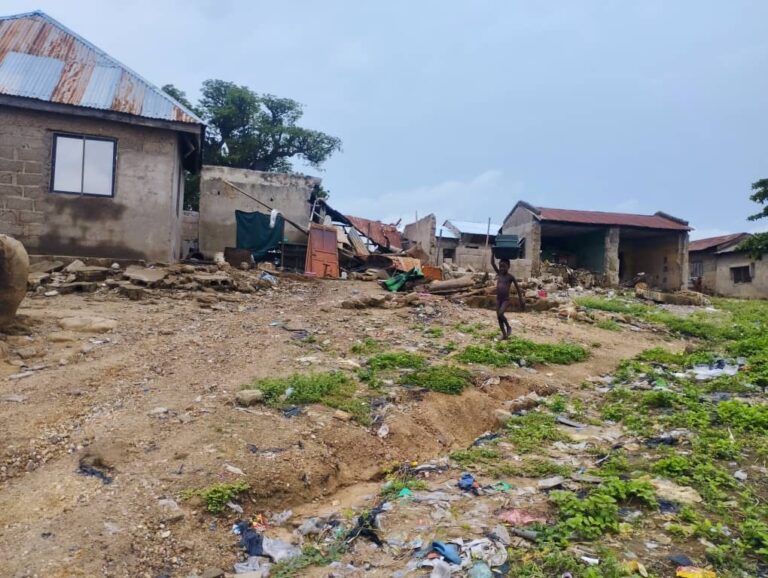
In the Confluence state of Kogi, where the Niger and Benue Rivers meet, the situation is similar. Many residents of Adankolo, Ganaja village, Ojila and other communities fell upon hard times after the flood washed away everything they owned.
The flood, the worst in over a decade, was caused by excessive rainfalls and contributions from external flows by the release of excess water from the Lagdo Dam in Cameroon. Over 600 people died, and more than a million were displaced.
This is not the first flood incident in Nigeria linked to the Lagdo Dam. In 2012 over 400 people died hundreds of thousands were displaced due to floods caused by heavy rainfall and water from the Cameroonian dam.
According toreports, Nigeria reached an agreement with Cameroon in 1977 to build the Dasin Hausa Dam in Adamawa state, which would contain water from the Lagdo and prevent flooding. Over forty years after construction began, Nigeria is yet to complete the Dasin Hausa, leaving citizens at risk of regular flooding. Though the governmentdenies the existence of such an agreement. Environmentalists think the dam will reduce flooding in Nigeria.
The National Emergency Management Agency (NEMA)said water from the Lagdo Dam was not entirely responsible for the 2022 flood, as climate conditions played significant roles. Before the flood, there werewarnings of possible disasters in 32 states and the FCT by the Nigeria Hydrological Services Agency (NIHSA) and Nigeria Meteorological Agency (NIMET).
These warnings were ignored, bringing hardship to affected residents, and NIHSA Director-General Clement Nze blamed sub-national governments for not being proactive.
Nearly a year later, many people are still devastated, including Mimi Wanev, whose son drowned in the flood that submerged North Bank, Benue.
“Till today, we are struggling. My children could not go to school. We are lucky that we found refuge in the IDP camp. That is how they went back to school. We cannot even talk about home any longer. We are homeless, roaming about in our own place,” she said in tears.
Mimi Wanev recalls her experience. Photo: The ICIR
2023 flood prediction
Again, NIHSA and NIMET have predicted that Benue, Kogi and 30 other states are at high risk of flooding in 2023. Based on this, NEMA introduced the 2023 Climate-Related Disaster Preparedness and Mitigation Strategies, an early warning document with recommendations to minimise flooding.
NEMA recommended that governments should desilt major rivers, dams and establish standard drainages. Parts of the mitigation strategies include efficient sensitisation, relocation of residents in areas perennially affected by flooding, expanding and unblocking drainages and proper waste management.
However, findings by The ICIR show that the level of preparation in Kogi and Benue is low.
Blocked waterways, poor waste management
Despite how badly Benue and Kogi were affected by the 2022 flood, waste management is quite poor, as The ICIR observed that refuse dumps littered roadsides in both states.
Gboko road, Makurdi. Photo: The ICIR
Along Gboko Road, Makurdi, where several heaps of refuse littered the streets, The ICIR observed that there were no rural buckets for waste disposal.
Drainages had also been converted into dump sites, which seemed worse in Kogi.
Dumpsites along in Benue, Kogi roads. Photo: The ICIR
Beyond the health implications of improper waste disposal, it also increases the risk of flooding, as refuse gets washed by rains into waterways, leading to clogging.
By the Local Government Education Authority (LGEA) school in Ganaja village, The ICIR observed that a box culvert constructed to aid water flow was partially blocked, as the entire area had been converted into a dump site.
Blocked culvert in Ganaja village, Ajaokuta. Photo: The ICIR.
Many other drainage systems in Kogi were clogged with waste, even in flood-prone communities.
Inadequate awareness for rural dwellers
Rekia Abdullahi, who lives by River Benue in Makurdi, told The ICIR that her family left home to squat with relatives for two months in 2022 after their community was submerged.
She has not recovered from the previous flood, as the property destroyed are yet to be replaced. Her family is also regularly confronted by snakes and other reptiles that have found homes within the neighbourhood since the disaster.
Yet, Abdullahi said she was unaware of the impending disaster and expressed surprise when asked about her level of preparation.
“I did not know that this year would be worse. I have not heard of that. The government did not tell us anything since then. We have just been on our own,” she said.
Benue resident Rekia Abdullahi. Photo: The ICIR.
This was the case with several other residents that spoke to The ICIR.
In Agatu, Benue state, the monarch Godwin Onah, who lost his rice farm, which he estimated to be over N200,000, to the flood, said though he was expecting another disaster, there was no sensitisation programme by the state government on the impending flood.
However, Onah reached out to The ICIR days later, saying a chief confirmed to him that there were announcements by the state over the flood.
“One of my chiefs just told me they heard the announcement on the radio in Makurdi. You know we are in the village. We don’t hear anything,” he said.
Communities in Agatu, including Oweto and Utugolugu, perennially experience flooding due to their proximity to the River Benue.
Although the residents claim that sensitisation is inadequate, many are weary of farming due to the losses caused by the 2022 flood.
The ICIR reached out to the Benue State Ministry of Water Resources and Environment over inadequate awareness and poor waste management. The Information Officer of the Ministry Enokela Sule Onum, said efforts had been made to inform residents in affected areas of the predicted flood.
“Over the radio, we keep sending warnings. I think we have sent it three times since last year. Every year, we keep sending. NIMET gives us the prediction, and the moment we receive this, we release a statement. This year, I sent to three radio stations. That was on the 28th of February this year.”
“Benue has three zones, and each of these zones have a major radio station. When we visited Zone C, we used Joy FM, the dominant radio station there. In Makurdi, we used Radio Benue. We use Ashiwaves to cover the side of Zone A; two radio stations in Makurdi,” Onum said.
Information Officer, Benue State Ministry of Water Resources Enokale Sule Onum. Photo: The ICIR
He blamed what he described as the human factor for residents’ ignorance, adding that some fishermen ignore warnings, hoping that the flood might lead to a bountiful harvest.
Although The ICIR observed many clogged gutters, Onum said the Ministry carried out desilting exercises on drainages and waterways in the past year.
He said many residents do not comply with proper waste disposal methods. However, Onum also said efforts by the Ministry may not yield desired results until the Benue River is dredged.
In Kogi, some residents of Lokoja, the state capital, said they received warning messages on the impending flood via television and radio stations. But those tucked in remote areas such as Ibaji said they did not.
On Thursday, June 30, a local government official in Ibaji Onalo Achimugu called The ICIR to verify if there would be a repeat of the 2022 flooding. The response was affirmative, and The ICIR shared the 2023 flood predictions by NIHSA.
Meanwhile, speaking to The ICIR, Sani Yusuf, who lives by the Niger in Adankolo, Lokoja, said he was aware of the 2023 flood prediction.
“Last year, the flood was very bad. This year, they are telling us that another one more than last year is coming. We are hearing it from the news and even the radio,” he said.
Kogi resident Sani Yusuf. Photo: The ICIR
In Lokon-Goma, Lokoja, a trader Aisha Mohammed also said she learnt of the impending flood through her transistor radio.
However, residents of Ganaja village, a community under the Ajaokuta LGA, say they were unaware of the flood predictions.
“We have not heard anything like that. I’m not aware that we are expected to relocate this year,” a resident Kamilu Shuaibu told The ICIR, an indication that people in rural areas of both states are less informed than those in the towns.
While sensitisation in both states is quite low, those aware of the impending disaster are barely making efforts to leave flood-prone areas, as they have nowhere else to go.
Residents remain in flood-prone areas
Although NEMA recommended that governments relocate inhabitants of communities perennially affected by the flood, residents, most of whom are poor, have been left to their own means, and continue to live in these areas.
The Agatu monarch, Onah, said relocation from flood-prone areas was a major challenge facing his subjects.
“The movement of the people is my major headache now. We have tried to educate them; some say they have nowhere to go,” Onah said.
He said the state had not shown adequate commitment to the people but expressed optimism that with the change of government, there would be some assistance.
Similarly, Benjamin Ochohepo, who resides in Wadata, Markudi, said he did not receive any help from the government after the 2022 flood that left him stranded.
“I packed from that house with my mother, my nine children and siblings. We were sleeping in the church for almost three months. Up till now, the government did not come to my aid. Whether they gave palliatives, we don’t know.”
“Till now, there is no campaign from the SEMA or the federal government,” he said.
The District Head of Ankpa/Wadata in Markudi, Samuel Asema, also said he was not aware of any plans by the state to relocate residents of his community ahead of the flood.
“I am not aware of the government’s planned support in terms of relocation. No. Many people have died, their houses destroyed. It is only God that helped them,” he said.
District Head, Ankpa/Wadata Samuel Asema.
In Adankolo, Kogi, the story is the same.
“Last year, the government didn’t show up, but some NGOs came here and helped people with roofing sheets, cement, things like that,” a resident Ojochide Daniel told The ICIR.
Daniel is aware of a possible reoccurrence of the previous year’s disaster. But she said she had no relocation plans, as she could not afford it.
Ibaji Local Government Chairman Williams Iko-Ojo Obiora confirmed to The ICIR that there was barely any assistance from the government following the 2022 flood. He also called for the dredging of the Niger River.
“The major problem we have is the dredging of River Niger, because the Niger has been so shallow that a little flood will spread everywhere. Nigeria should build more dams and carry out proper dredging. That is the only solution that can take us out of this mess,” he said.
Drama around dredging of River Niger and Benue
It is not the first time stakeholders in the environment sector would be calling for the need to dredge Rivers Niger and Benue, and it has often been presented as a lasting solution to the perennial flooding in both states.
The ICIRreported that the Umar Musa yar’Adua administration awarded N36b for the dredging of the Niger River. The contract was awarded to Messrs Fung Tai Nigeria, Dredging International; William Boyd; and Van Oord.
Several years after, while defending the 2017 budget, then Minister of Transportation Rotimi Amaechi said the federal government has awarded a contract to dredge the Benue River.
He, however later said that N100m will be used for dredging the Niger River.
“People are wondering how on earth we are going to dredge the River Niger for N100m when the previous government awarded the same contract for N47 billion?”
“But we are going to dredge the River Niger, using dredgers owned by the National Inland Waterways Authority, NIWA. NIWA has dredgers, but the previous government preferred to give contractors money to dredge the river with private dredgers while NIWA’s dredgers were lying idle somewhere in Port Harcourt.”
“I told the NIWA MD that I will look for money to fuel their dredgers, and work has started. That is why we are dredging the River Niger with just N100 million,” Amaechi said.
But stakeholders, including the Nigerian Indigenous Ship-Owners Association (NISA), are doubtful that the exercise was carried out.
In March, the then Minister for Water Resources Suleiman Adamu said though the process for dredging both rivers had been initiated, it would take a long time to achieve.
Managing Director of Hydroelectric Power Producing Areas Development Commission (HYPPADEC) Abubakar Yelwa also said in May that dredging will be difficult without the intervention of foreign donors due to the financial implication.
Proposed projects for flood control ignored
The budget performance reports for flood control in Kogi and Benue states have been significantly low, despite the pressing need to prioritise mitigation.
According to the Budget Performance Report (archived here)for the first quarter of 2023, N101m was budgeted for erosion and flood control in Kogi state. The report showed that a total of N36.9m was budgeted for post-flood housing estates and social amenities and N53.8m for procurement of emergency tender for flood-related disasters.
Also, N10m was budgeted to relocate communities in flood-prone areas. However, no money was spent on these mitigation measures.
The Budget Performance Report for the four quarters in 2022 also show that out of N106.3m, only N4m was spent on erosion and flood control in Kogi.
The ICIR visited the Kogi State Ministry of Environment on plans being made ahead of the predicted flood.
The Information Officer, Mariam Adams, was not available at the time of the visit. During subsequent phone conversations, she did not respond to questions on the Ministry’s plans to mitigate the impending flood but directed The ICIR to the State’s Emergency Management Agency.
Similarly, N896.9m was budgeted for erosion and flood control in Benue, but no money has been spent on this, according to the Benue State Budget Performance Report(archived here)for the first quarter of 2023.
Speaking on the issue on May 23, Information Officer, Benue State Ministry of Water Resources and Environment Enokale Onum said the state had not received funds for 2023’s budget.
“The budget for this year, as far as I am concerned, has not come. But with the new government, maybe erosion control will become the major concern,” he said.
Onum further said residents of flood-prone areas are not being relocated due to paucity of funds, adding that the state was already overwhelmed by the presence of so many IDPs due to insecurity.
An IDP Camp in Makurdi. Photo: The ICIR
Koton-Karfe residents resort to self-help
It is a different situation in Koton-Karfe, a town in the Kogi LGA, where the 2022 flood also wreaked havoc.
The effect was felt not only by residents of the community but Nigerians in other states, as the traffic gridlock caused by the flood led to fuel scarcity in the Federal Capital Territory (FCT) and neighbouring states. The flood blocked the highway leading to the FCT, restricting the movement of fuel transporters.
National President Koton-Karfe Descendants Association Abdulkareem Shuaibu confirmed that the community was aware of another impending flood disaster, and while there has been minimal support from the state, residents were doing their best to stay prepared.
“We have been hearing from the radio; we read newspapers; we have heard that this year’s flood is likely to be more than that of last year.”
“So far, we don’t want to be caught napping this time. His Royal Majesty, as a way of mitigating against this thing, set up a committee of which I am a member. The committee is saddled with the responsibility of preparing towards cases of emergency as a result of this flood,” Shuaibu said.
He noted that the community had secured highlands in neighbouring areas where residents will relocate in the event of another flood.
“We have a hilly place in Adangiri. If it happens, we’ll move them to that side. We have another one at Okpaka here; there are four to five places that have been designated in case it happens,” he said.
However, Shuaibu noted that funding was a significant challenge in making designated areas habitable for residents.
“It is one thing to secure a place; it is another to maintain it. Our challenge is that we cannot have an ordinary camp. What of the tents, drinking water, and health facilities?
“It is not palliatives we need. We are calling on the government to please come to our aid. There is an extent to which we can go alone as a community. Let us have preventive measures instead of waiting for when it happens to give out palliatives. Enough of palliatives,” Shuaibu stated.
He added that the community had written letters to both the federal and state government with minimal response. He, however, noted that HYPPADEC had commenced some projects in the area.
Project by HYPPADEC in Koton-Karfe. Photo: The ICIR
Shuaibu commended HYPPADEC for the expansion of waterways in the area, which was ongoing during the time of The ICIR’s visit.
Ongoing construction by HYPPADEC in Koton Karfe. Photo: The ICIR
Until Kogi and Benue governments fully adhere to recommendations by relevant agencies, residents remain at risk of losing lives and properties in the impending disaster.
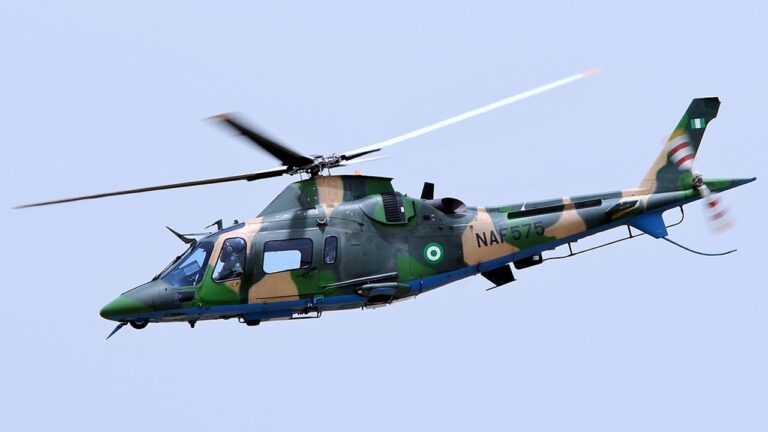
A NIGERIAN Air Force (NAF) FT-7NI trainer aircraft has crashed in Makurdi, Benue State capital, while on routine training exercise.
Details about the incident are still sketchy as of the time of filing this report.
NAF Director of Public Relations and Information, Edward Gabkwet, confirmed the incident in a statement on Friday, July 14.
According to Gabkwet, two pilots onboard the aircraft survived and were being observed in a military facility.
He said: “Luckily, the two pilots on board survived the crash after successfully ejecting from the aircraft. Additionally, there was no loss of lives or damage to any property around the area of impact.
“Both pilots are currently under observation at NAF Base Hospital, Makurdi. Meanwhile, the Chief of Air Staff, Air Vice Marshal Hasan Abubakar, has constituted a Board of Inquiry to determine the immediate and remote causes of the crash.”
On May 30, The ICIRreported that NIgeria under former President Muhammadu Buhari experienced series of military air crashes.
Data garnered from media reports in the last seven years shows that the incidents resulted in the loss of 14 aircraft and claimed the lives of 35 people, including civilians and military personnel.
The report noted that the crashes also imposed significant financial costs on the military and diminished the number of operational aircraft in its fleet.
EBONYI State Government has approved a N10,000 salary increase for workers as a form of palliative following the removal of fuel subsidy in Nigeria.
The state’s Commissioner for Information and Orientation Jude Okpor disclosed this in a statement on Friday, July 14.
Okpor said the decision was reached during the State Executive Council meeting chaired by Governor Francis Nwaifuru on Thursday, July 13.
“His Excellency also mandated SSG, Professor Grace Umezuruike, to look into the finances of the state University (EBSU) to know what comes out and goes into the University to help determine the upwards review of subvention to the institution.
“The Council also approved the employment of 1,454 into the state civil service to fill in vacancies created in the services over the years,” Okpor noted.
Following the removal of fuel subsidy in May, some state governments have put certain measures in place to cushion the hardship confronting Nigerians.
In Kwara State, the government reduced work days for its staff from five to thrice a week due to the surge in transport costs occasioned by the subsidy removal.
The state governor Abdulrahman Abdulrazaq also approved the provision of buses to support the transportation of students and workers in tertiary institutions within the capital city, Ilorin.
Federal government plans N500 billion cash palliatives
Nearly two months after he announced the removal of fuel subsidy, Nigerian president Bola Ahmed Tinubu wrote to the National Assembly seeking to amend the 2022 Supplementary Appropriation Act and include a N500 billion loan for palliatives.
The loan, to be sourced from the World Bank, would be shared among 12 million poor families for 6 months.
“You may also wish to note that the purpose of the facility is to expand coverage of shock responsive safety net support among the poor and vulnerable Nigerians. This will assist them in coping with basic needs.
“You may further wish to note that under the conditional cash transfer window of the programme, the federal government of Nigeria will transfer the sum of N8,000 per month to 12 million poor and low income households for a period of six months, with a multiplier effect on about 60 million individuals,” Tinubu noted in a letter to the lawmakers.
Many Nigerians have criticised the cash transfer palliatives, including Peoples Democratic Party (PDP) presidential candidate in the 2023 elections Atiku Abubakar, who described it as an attempt to divert funds, through his Special Assistant on Public Communications to Phrank Shaibu.
“The so-called palliatives that Tinubu seeks to share with the poor are just another avenue to divert public funds. For years, the Nigerian government has rejected calls to publish the list of the beneficiaries of the so-called palliatives but this has never been done because it is all a scam.
“Tinubu should stop trying to deceive Nigerians who are still suffering from the effect of his lacklustre economic policies,” Atiku noted.
THE National Broadcasting Commission (NBC) has filed a motion at a Federal High Court in Abuja to set aside a judgment which stopped it from imposing fines on broadcast stations.
In the motion filed by its counsel, Babatunde Ogala, a Senior Advocate of Nigeria (SAN), the Commission is seeking to set aside the judgment, claiming that the court lacked the jurisdiction to render the verdict and that it arrived at a decision in ignorance of relevant facts.
The ICIRreported that a Federal High Court in Abuja, on May 10, stopped NBC from issuing fines to broadcast stations nationwide.
Following a March 1, 2019 announcement by the then-Director General of the Commission, Ishaq Kawu, that the Commission had imposed a fine of N500,000 each on 45 broadcast stations for alleged contraventions of the Nigeria Broadcasting Code, an Abuja-based lawyer Noah Ajare filed the lawsuit on behalf of Media Rights Agenda (MRA), challenging the NBC’s authority to fine broadcast stations.
The presiding judge, James Omotosho, in his judgment, declared that the NBC does not have judicial powers to impose penalties.
The judge held that the NBC Code, which gives the Commission the power to impose sanctions, conflicts with Section 6 of the 1999 Constitution, which vested the authority in the law courts.
The judge also set aside fines imposed on 45 broadcast stations by NBC.
But contrary to the finding of the judge in his judgment that the NBC “was served with the Originating Summons on 24th February, 2022 and served with several hearing notices but failed to file any process”, the Commission is alleging that the originating summons in the suit, which led to the judgment, was not served on it.
It is also claiming that MRA “has two un-appealed, subsisting and binding decisions of the Federal High Court on the same issues and parties” and that rather than appeal those decisions, it brought a fresh suit, setting the court on a collision course with judgments of the other Federal High Court in the same complex.
The NBC cited a lawsuit brought by MRA in 2021, in which the organisation contested the constitutionality and legality of the Commission’s action on May 27, 2020, in fining Breeze FM radio, based in Lafia, Nazarawa State; Adaba FM radio, in Akure, Ondo State; and Albarka FM radio, in Ilorin, Kwara State, N250,000, N500,000, and N250,000, respectively. The presiding judge, Obiora Atuegwu Egwuatu, ruled against the lawsuit on March 2, 2023.
The Commission noted that a similar lawsuit was brought by seven groups, including the Socio-Economic Rights and Accountability Project (SERAP), the Centre for Journalism Innovation and Development (CJID), MRA, HEDA Resource Centre, the International Centre for Investigative Reporting (ICIR), the African Centre for Media and Information Literacy (AFRICMIL), and Premium Times.
In that lawsuit, the seven organisations contested the NBC’s decision to fine Channels Television, Arise Television, and Africa Independent Television (AIT) each N3 million for covering the #EndSARS protests, as well as the NBC’s decision to fine Nigeria Info 99.3 N5 million, without giving the stations a chance to refute any of the accusations made against them. According to NBC, the presiding judge, Nkeonye Maha, dismissed the suit on April 26, 2022.
The NBC is claiming that these suits and their outcome were not brought to the attention of the court and that if the court had been aware of them, it would have reached a different decision in its May 10 judgment.
The suit filed by the NBC to set aside the order stopping it from fining broadcast stations has been fixed for hearing on October 5.
In 2019, NBC fined 45 broadcast stations the sum of N500,000 each over alleged ethical infractions in the year’s general elections. The Commission said the stations had to be sanctioned for allowing politicians to utter abusive, inciting and provocative statements during broadcast programmes.
Displeased, the Media Rights Agenda (MRA), a non-governmental organisation, filed a suit against NBC in 2020.
The group asked the Court to declare the sanctions procedure applied by NBC in imposing the fine on the broadcast stations a violation of the right to a fair hearing under Section 36 of the 1999 Constitution (as amended) and Articles 7 of the African Charter on Human and Peoples Rights (Ratification and Enforcement) Act (Cap AQ) Laws of the Federation of Nigeria, 2004.
Ruling on the N500,0000 fine, the presiding judge, Omotosho, said the Commission acted as the complainant, court and judge when it acted on the alleged infractions.
The judge noted that the Nigerian Broadcasting Code cannot confer judicial powers on NBC to impose criminal sanctions or penalties.
He pointed out that NBC has no power to conduct a criminal investigation that would lead to a criminal trial and imposition of sanctions.
“This will go against the doctrine of separation of powers. The action of the respondent qualifies as excessiveness as it had ascribed to itself the judicial and executive powers,” he said.
The ICIR reported in May that the NBC said it would challenge the court order, which restrained it from imposing fines on broadcast stations.
Reacting to the judgement in a statement dated May 11, the Director General of the NBC, Balarabe Shehu llelah, said the Commission would appeal against the judgment.
He noted that the court order conflicted with the previous judgment of a court which empowered the Commission to regulate broadcasting in Nigeria.
Some lawyers who spoke to The ICIR after the Abuja Federal High Court barred the NBC from imposing fines on radio and television stations said media houses sanctioned by the Commission in the past can go to court to seek a refund.
The lawyers insisted that the NBC lacked the power to impose fines on broadcast stations.
AT least 289 children died while attempting to travel across the Mediterranean Sea from North Africa to Europe in 2023, according to the United Nations Children’s Fund (UNICEF).
This number, according to UNICEF, equates to nearly 11 children dying or disappearing every week.
The UNICEF global lead on migration and displacement, Verena Knaus, disclosed this on Friday, July 14.
According to her, the figure is double that recorded in the first six months of 2022. It is likely higher as many shipwrecks in the central Mediterranean leave no survivors or go unrecorded.
She called for expanded safe, legal and accessible pathways for children to seek protection in Europe.
UNICEF also said that in the first three months of 2023, around 3,300 children, which is 71 per cent of all children arriving in Europe on the central Mediterranean route, were recorded as unaccompanied or separated.
“These children need to know they are not alone. World leaders must urgently act to demonstrate the undeniable worth of children’s lives, moving beyond condolences to the resolute pursuit of effective solutions,” said Knaus.
Illegal migration is a major crisis across the globe as many people often attempt to cross the Mediterranean Sea to reach Europe.
Last month, dozens of people died and many others were unaccounted for after an overcrowded fishing boat carrying around 750 migrants capsized in the Mediterranean Sea, 45 miles off the coast of Greece.
The missing people were primarily women and children.
According to UNICEF, about 11,600 children this year have made the dangerous crossing to Italy from North Africa.
This is a two-fold increase compared to the same period in 2022.
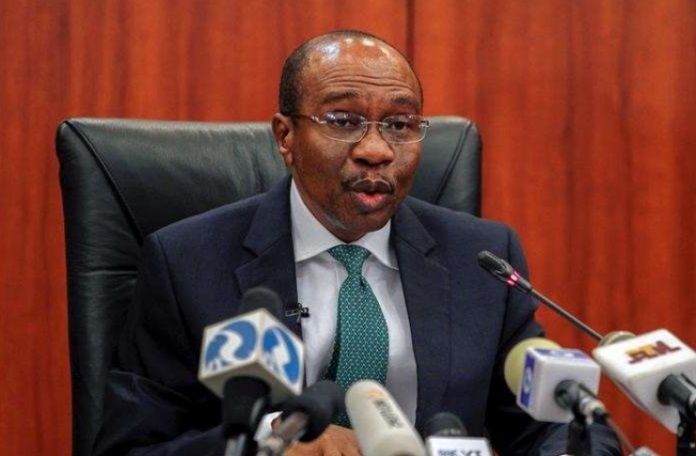
A High Court in Abuja has nullified the arrest, detention and interrogation of the suspended governor of the Central Bank of Nigeria (CBN) Godwin Emefiele by the Department of State Services (DSS).
The court, presided by Bello Kawu, ordered Emefiele’s release.
The judge described Emefiele’s arrest and detention as illegal.
Emefiele had filed a motion against his arrest and detention, with the Incorporated Trustees of Forum for Accountability and Good Leadership, the Attorney General of the Federation (AGF), the Economic and Financial Crimes Commission (EFCC), the Inspector General of Police, State Security Service (SSS) and the Central Bank of Nigeria as respondents.
His counsel, Peter Abang, asked the court to set aside, quash, invalidate and the arrest and detention of the suspended CBN governor for being illegal.
Delivering judgment, on Friday, July 14, the presiding judge, Kawu, held that the arrest, detention and interrogation of Emefiele violated the subsisting decision and orders of Justice M. A. Hassan in Suit No. FCT/HC/GAR/CV/41/2022.
He nullified the warrant of arrest obtained or procured by the DSS and other agencies for the arrest, detention and interrogation of the suspended CBN governor that are in connection with the allegations of terrorism financing, fraudulent practices, money laundering, and round-tripping levelled against him.
The court also granted an injunction restraining the security agencies, particularly the DSS, from interfering with Emefiele’s personal liberty and freedom of movement or taking other steps against him.
The court also ordered asked the DSS to “forthwith release and unfetter Mr Emefiele from any arrest, detention, custody, interrogation with regard to allegations of terrorism financing, fraudulent practices, money laundering, round tripping, threat to national security before or from any court in view of the subsisting judgment of Justice M. A. Hassan”.
This judgement is coming barely 24 hours after another High Court in Abuja ordered the release of the suspended CBN governor.
The ICIR had reported that the FCT High Court ordered the DSS to file charges against Emefiele, or release him within one week.
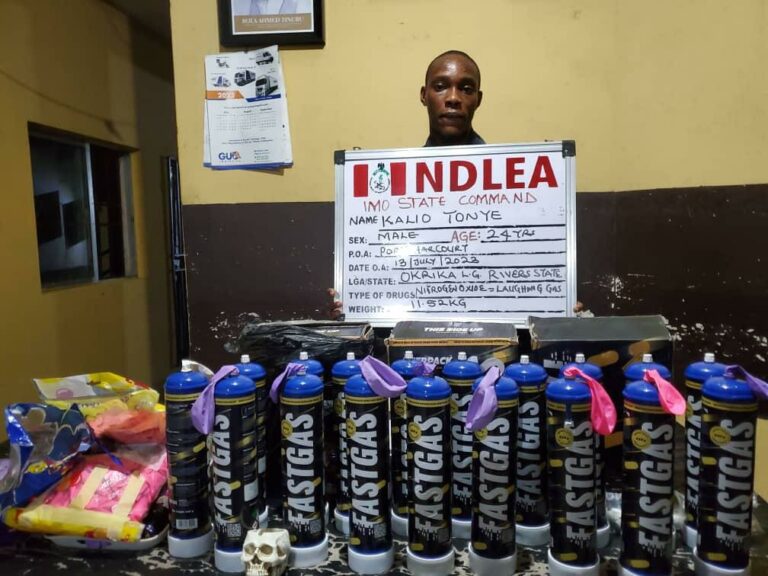
OPERATIVES OF THE National Drug Law Enforcement Agency (NDLEA) have intercepted over 64, 863.5kg of nitrous oxide, otherwise known as ‘laughing gas’, at the Apapa seaport in Lagos and in Imo State.
A statement by NDLEA Director, Media and Advocacy, Femi Babafemi on Friday, July 14, stated that the development followed an intelligence-based joint examination by the Agency’s operatives and officers of the Nigeria Customs Service.
Part of the statement read: “Following credible intelligence, NDLEA operatives at the Apapa seaport on Wednesday 12th July intercepted two containers marked MSKU 7626856 and MSKU 7689448 suspected to contain cartons of Nitrous oxide and plastic pressure release nozzles imported from China. As a result, a joint examination of the containers was carried out by NDLEA officers, men of the Customs Service and other stakeholders the following day, Thursday 13th July.
“During the search of the two containers, a total of 522 cartons of Nitrous Oxide, containing 16,366 packages weighing 64,852kgs were recovered along with the paraphernalia for recreational use. The importer of the consignment, 30-year-old Stephen Eze and his agent, Michael Chukwuma were thereafter arrested and detained for further investigation.”
Similarly, NDLEA operatives on Thursday July 13, intercepted three cartons containing 18 canisters of the same substance weighing 11.5kg along the Owerri – Onitsha expressway in Imo State
The suspects arrested with the consignment were heading to Port Harcourt, Rivers State, according to the statement.
“A swift follow up operation was conducted in the stadium road area of Elekahia, Port Harcourt same day leading to the arrest of the owner of the shipment, 24-year-old Tonye Kalio.”
While commending the officers and men of the Apapa Port, and their Imo State Command counterparts for being pro-active and swift, NDLEA chairman Muhammed Buba Marwa said the clampdown on illegal sale and use of nitrous oxide will continue nationwide to protect young Nigerians from the devastating effects of abusing the substance and in the overall interest of public health.
He also commended the cooperation of other sister security’s agencies and stakeholders towards achieving the set objective.
This recent development followed the directive issued by the NDLEA boss ordering a clampdown on illegal sale of nitrous oxide across the country.
On July 11, Marwa directed all commands and formations of the Agency to begin an immediate clampdown on illegal sale and use of nitrous oxide, otherwise known as laughing gas following its abuse by people who use it for recreational purposes,
”The NDLEA CEO directed all commands and formations of the agency to begin an immediate clampdown on the illegal sale and use of nitrous oxide, otherwise known as laughing gas following its abuse by people who use it for recreational purposes.
“It is fast emerging as a drug in demand in Nigeria by young party-goers or fun-seekers to feel intoxicated or high. The gas is often transferred from its containers into balloons, where it’s inhaled.
“The decision to clampdown on those involved in the illegal sale and use of nitrous oxide follows an analysis of the effects on those who abuse the substance, which include: dizziness; disorientation, headache; lightheadedness; fainting spells; hallucinations; falling unconscious and/or suffocating from lack of oxygen; and other neurological complications, especially psychiatric symptoms,” part of the statement read.
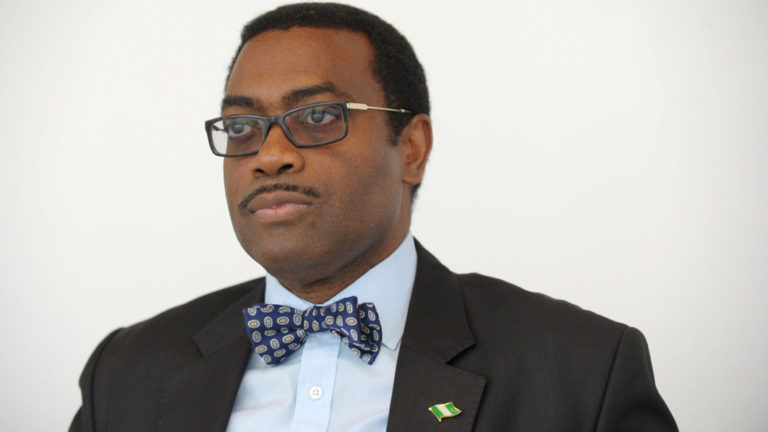
NIGERIA urgently needs to revolutionise its industrial sector to bounce back and regain its status as an economic giant, the President of the African Development Bank (AfDB), Akinwunmi Adesina, said in Lagos on Thursday, July 13.
Adesina, citing country experience, pointed at how Malaysia and Vietnam used aggressive horizontal and vertical diversification of industrial production to move from low-value to high-value market products.
“The result is reflected in the comparative wealth of the three countries. While the per capita export value is $7,100 for Malaysia and $3,600 for Vietnam, it is only $160 for Nigeria,” he said.
The AfDB head told an audience of top government officials, leading industrialists, and other stakeholders that for now, Nigeria was developing too slowly and far below its potential.
Adesina, who spoke at the 2023 BusinessDay CEO Forum, appealed to Nigeria’s new president, Bola Tinubu, to revive what he called the country’s comatose manufacturing sector and reposition Nigeria as an industrial hub.
Speaking on the theme, ‘The Day the Lion Roared: Making Nigeria a Global Industrial and Economic Giant,’ Adesina emphasised that Nigeria’s prosperous future could only be secured by it strongly supporting the private sector to unlock wealth that would lift all its people.
He said, “Nigeria should never be a poor country, and Nigerians are tired of being poor,” Adesina said, adding, “Nigeria must move decisively from managing poverty to managing wealth The challenge is for the lion to roar. Then we will have the making of an economic giant. Industrial manufacturing can earn Nigeria 10 times what it earns from oil dependence.”
To achieve this, Adesina urged decision-makers to implement the right policies on investments, infrastructure, logistics, and financing frameworks, driven by a highly skilled, dynamic, and youthful workforce.
He said this involved closing the huge gap between policy ideas and action. He called on the Nigerian government to transform its ports and remove administrative hurdles to improve their efficiency.
He stressed, “Ports are not military zones; they are zones of economic and industrial transformation.”
Adesina illustrated his position by drawing from the popular motion picture, ‘The Lion King’, in which Simba, the young lion cub, grew up to become the Lion King after his late father was murdered by his uncle Scar, ruling the kingdom, and restoring its glory.
He encouraged Nigeria to be proactive and ambitious in its manufacturing sector by integrating it into global and regional value chains. He explained this would involve rapidly moving up the value chain in areas of comparative advantage and greater specialisation and competitiveness.
He added that a well-developed and policy-enabled manufacturing sector, with export orientation, would spur greater innovation, industrial policy for export market development, and structural transformation of the economy.
“Instead of being consumed with conserving foreign exchange, the focus would shift to expanding foreign exchange through greater export value diversification,” he said.
Adesina, harping on the Malaysia and Vietnam examples, said that while both countries had moved into “global manufacturing growth,” creating massive wealth and jobs for themselves, Nigeria had remained in “survival mode,” still unable to replace its imports of petroleum products, despite being one of the largest exporters of crude oil.
He warned that Nigeria’s industries would remain uncompetitive if the country did not resolutely address the shortage and reliability of electricity supply.
ELEVEN electricity distribution companies (DisCos) have applied for a review of their respective electricity tariffs, the Federal government has disclosed.
The Nigeria Electricity Regulatory Commission (NERC), who disclosed this on Friday, June 14, in a published public notice, said the request for rate review was premised on the need to incorporate changes in macroeconomic parameters like inflation, and other factors affecting the operations and sustainability of the companies.
NERC stated that DisCos’ request for rate review was in pursuant to Section 116 (1) and 2(a&b) of the Electricity Act 2023 and other extant rules.
A recent attempt by some electricity distribution companies to hike tariff from July 1 had elicited condemnation from Nigerians, who are still reeling from the economic squeeze of foreign exchange unification and fuel subsidy removal.
The Nigerian Labour Congress (NLC) had asked the government to shelve the intention, describing it as “insensitive.”
Following the public outcry, the Discos shelved the planned tariff increase, as reported by The ICIR.
However, the increment may still happen, in the light of the NERC notice that the Discos have now applied for a review.
“DisCos would be justified to effect the upward tariff review because there is a template for such review every six months as directed by the multi-year-tariff-order of the NERC,” a power sector governance expert and energy lawyer, Chuks Nwani, told The ICIR.
The regulatory body also stated it would be conducting a rate Case Hearing on the applications, prior to making a ruling, as part of the rule-making process and in the exercise of the powers conferred on it by the Electricity Act.
“Accordingly, the Commission hereby invites the general public for comments on the rate review applications by the distribution licensees. Interested stakeholders are advised to review and take into consideration the excerpts of the Rate Review Applications filed with the Commission by the respective licensees,” NERC stated.
The Commission called on members of the public and stakeholders to send their comments or representations before the close of business on July 20, 2023.
The NERC tariff review process was designed with the intent of undertaking major reviews every five years.
An extraordinary tariff review is triggered when a Disco requires additional investment beyond the permitted capital expenditure, or when unforeseen operational, legal, or regulatory costs need to be reasonably passed on to consumers.
Minor reviews are also scheduled every six months to adjust tariffs based on changes in gas prices, foreign exchange rates, generation output, and inflation.