THE Armed Forces of Nigeria (AFN) has finally confirmed that some of the 16 officers previously arrested over ‘indiscipline and service breaches’ were implicated in plotting to overthrow the government of President Bola Tinubu.
A statement signed by the Director of Defence Information Samaila Uba, on Monday, January 26, stated that the officers would face formal trial before a military judicial panel following its investigation, which it said was conducted according to established military procedures. It also said the probe examined all circumstances surrounding the officers’ conduct.
“It would be recalled that the Defence Headquarters issued a press statement in October 2025 regarding the arrest of sixteen officers over acts of indiscipline and breaches of service regulations. The Armed Forces of Nigeria (AFN) wishes to inform the general public that investigations into the matter have been concluded, and the report forwarded to appropriate superior authority in line with extant regulations.
“The comprehensive investigation process, conducted in accordance with established military procedures, has carefully examined all circumstances surrounding the conduct of the affected personnel. The findings have identified a number of the officers with allegations of plotting to overthrow the government which is inconsistent with the ethics, values and professional standards required of members of the AFN,” the statement read.
While some officers were found with cases to answer, others were cleared of wrongdoing.
The AFN said the arraignment would proceed under the Armed Forces Act and other relevant service regulations, to ensure fairness and due process.
“The AFN reiterates that measures being taken are purely disciplinary and part of ongoing institutional mechanisms to preserve order, discipline and operational effectiveness within the ranks,” it added.
The official admittance came after months of public speculation and denials of the aborted putsch by the military. Sahara Reporters, an online news medium, had on Saturday, October 18, claimed that 16 officers arrested and detained by the Nigerian Armed Forces planned to topple Tinubu’s government.
Another report by Premium Times also claimed that top intelligence sources provided insights into how the coup was to be hatched before the officers plotting it were apprehended.
The reports also alleged that key government officials, including Tinubu, Vice President Kashim Shettima, Senate President Godswill Akpabio, and House Speaker Tajudeen Abbas, were targeted for assassination.
The development reportedly created tension within the government, prompting the Presidency to cancel the National Independence Day parade usually held on October 1.
At the time, the Defence Headquarters denied the claims, stating that the arrests were part of routine disciplinary measures linked to career stagnation and repeated failures in promotion examinations, and not politically motivated.
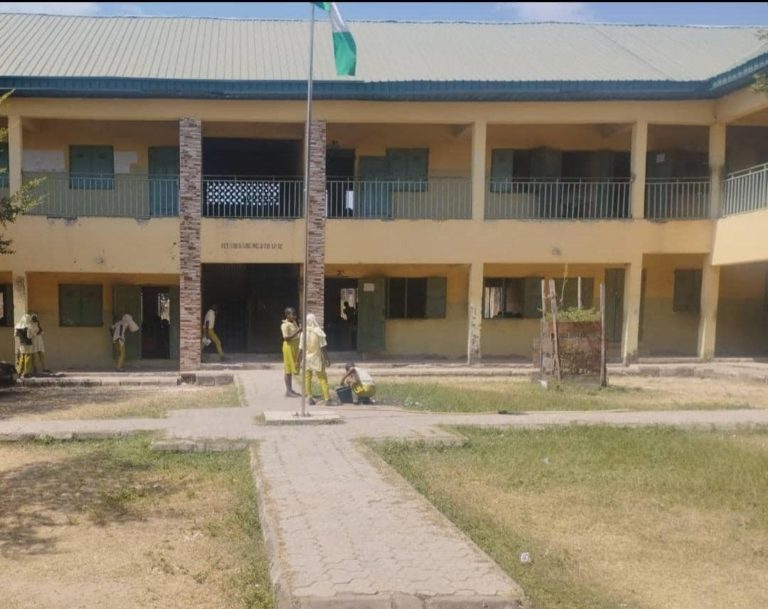
PUBLIC primary and secondary schools across the Federal Capital Territory (FCT) are expected to shut down immediately following a directive by the Nigeria Union of Teachers (NUT) ordering its members to join the ongoing strike by the FCTA workers.
The Joint Union Action Congress (JUAC) gave the directive as contained in a communiqué signed by the FCT NUT Chairman, Secretary, and Publicity Secretary, Abdullahi Shafas, Margaret Jethro, and Ibukun Adekeye, respectively.
The union said the decision followed a directive by the Nigeria Labour Congress (NLC) instructing all its affiliates in the FCT to comply with the strike.
“All teachers in FCT primary and secondary schools are to stay away from classrooms starting Monday,” part of the communiqué read.
“In pursuit of justice and to demonstrate our collective resolve, we must stand together. A people united can never be defeated,” the union said.
The NUT added that it would continue to engage with relevant authorities until all outstanding issues affecting teachers are resolved, urging members to remain disciplined during the strike.
The ICIR reported that the strike followed a directive issued by JUAC President, Rifkatu Iortyer, and Secretary, Abdullahi Saleh, dated January 8, ordering workers across all cadres to withdraw their services from Monday, January 19, in protest against what they called the government’s continued neglect of their demands.
The union said an earlier ultimatum issued on January 7 had elapsed without meaningful engagement from the authorities.
According to the JUAC, key grievances include the non-payment of outstanding promotion arrears, delays in the conduct and release of promotion exercises, and what they described as the continued extension of service for retired directors and permanent secretaries, a practice they said was blocking career progression for serving officers.
The workers also accused the administration of failing to remit statutory deductions, including pension contributions and National Housing Fund payments, warning that the situation could jeopardise the future welfare of affected staff.
JUAC further expressed dissatisfaction with the outcome of the 2024 promotion examinations, describing the exercise as largely unsuccessful and alleging that a significant number of its members were adversely affected.
It condemned the handling of the 2024 promotion examinations, describing the exercise as deeply flawed and largely unsuccessful.
On Monday, the striking workers, backed by the Nigeria Labour Congress (NLC), picketed the Nigeria Industrial Court in Abuja.
They also reportedly attempted to block the motorcade of the FCT Minister, Nyesom Wike, who allegedly escaped through the FCTA’s back gate.
ANAMBRA State Governor Chukwuma Soludo has ordered the closure of the Onitsha Main Market for one week after traders allegedly failed to open their shops on Monday, despite the state government’s directive to end the sit-at-home.
The governor gave the order during a visit to the market on Monday, January 26, where he met many shops locked.
The ICIR reports that state government had ordered traders to resume their business on Mondays as against the sit-at-home ritual.
However, during his visit to the market on Monday, the governor expressed concerns over the continued closure, saying the closure of businesses was hurting the state’s economy.
Soludo said, “The government cannot stand by while a few individuals willfully undermine public safety and disregard official directives meant to restore normalcy. This is plain economic sabotage.”
He warned that the closure could be extended if traders did not comply. According to him, “You either decide that you are going to trade here or you go elsewhere. I am very serious about this.”
Security operatives were deployed to enforce the shutdown, and the market gates were sealed.
The Onitsha Main Market is one of the largest markets in the South-East and plays a key role in trade across the region. Any disruption affects traders, transporters, and suppliers who depend on daily business activities.
The shutdown comes amid long-standing economic losses linked to the sit-at-home order in the South-East.
The ICIR reports that Anambra generated ₦42.69 billion (₦42,689,648,058.74), as Internally Generated Revenue (IGR) for 2024. This placed the state at 17th out of 37 states, including the Federal Capital Territory.
Many argued that the continued disruption of business activities, especially on Mondays, has affected revenue generation.
Also, a report by The ICIR in January 2024 showed that micro businesses in Anambra, Enugu, Ebonyi, Imo, and Abia lost an average of ₦4.618 trillion ($10.495 billion) in one year due to sit-at-home.
The investigation found that estimated revenues of micro businesses in the five states were added together and multiplied by 52 weeks, representing the number of Mondays in a year. The analysis used data from the National Bureau of Statistics (NBS) and the Small and Medium Enterprises Development Agency of Nigeria (SMEDAN) 2021 survey reports.
Another ICIR-funded report published by Dataphyte showed that micro businesses in the South-East lost ₦5.375 trillion ($12.215 billion) after wasting 71 Mondays between August 9, 2021 and December 19, 2022.
In the same vein, a report by The Guardian newspaper noted that sit-at-home observances every Monday since August 9, 2021 have cost the South-East an estimated ₦7.6 trillion in lost productivity, potential investments, and losses of lives and property.
Babajide Candide-Johnson became a judge of the High Court of Lagos State at 45. The son of the third Chief Judge of Lagos State, he is polyglot, fluent in several languages; including French. When his judicial tenure came to an end on 27 June 2021, 20 years after he became a judge, Babajide Candide-Johnson was the head of the family court in the High Court of Lagos State.
At his retirement, the Chief Judge of Lagos State, Kazeem Alogba, described Babajide Candide-Johnson as “a brilliant, hardworking, meticulous and fearless judge, an intellectual who delivered judgments without fear or favour.”
Those words describe a model judge. Yet, nine months later, in March 2022, he was back in court, this time to sue the government of Lagos State, whom he had served without blemish in judicial office for two decades, for “his pension, severance gratuity, and other entitlements.”
The government of Lagos State initially demurred, disingenuously arguing that responsibility for judicial pensions under the Pension Right of Lagos State Judicial Officers Law of 2015, lay with the state Judicial Service Commission. The state government later saved itself from a public unraveling of an embarrassing position and the parties agreed to an amicable settlement.
In 2022 alone, at least five other former judges of the High Court of Lagos also sued the state government over the same issue.
The year before the retirement of Babajide Candide-Johnson in Lagos, 22 retired judges of the High Court of Abia, the self-described “God’s own State” in south-east Nigeria, had similarly sued before the National Industrial Court of Nigeria, (NICN), claiming to have been shafted by a succession of three governors going back nearly a decade and a half, who claimed mandates from God to ruin the state. It appears that in response to the case, the then state government “reportedly promised to pay N10 million to the retired judges every month, but only did so for one month.”
Three years after this case began, it was still stuck in the NICN, with little progress. Meanwhile, five of the retired judges had died in penury while waiting for the case to rescue them. In May 2023, Abia State installed a newly elected governor. Two months later, he and the retired judges reached an agreement to clear the back-log of 16 years of judicial pensions liability.
Around the country, retired judges are increasingly resorting to judicial proceedings to call attention to a crippling and chronic crisis of judicial pensions for judges who retired before June 2023. In Ondo State, retired judges sued in April 2016 for similar issues. Their peers in Imo, Ogun, and Oyo have as well.
For long, the constitution provided for how to compute judicial pensions but not necessarily for how to finance or administer it effectively. Effective from June 2023, a new constitutional amendment transferred to the National Judicial Council (NJC), responsibility for the administration of judicial pensions. This has not, however, alleviated or addressed the crisis of judicial pension obligations arising from before then and may, indeed, have surfaced new problems of its own.
In Kogi, eight retired judges of the state High Court have recently served notice on the state government of their intention to return to court as litigants to enforce their pension rights. They include a former Chief Judge of the State John Bayo Olowosegun; a former President, Customary Court of Appeal, Hon. Justice Yunusa Musa; and a former senior judge, Professor Andrew Alaba-Ajileye.
The NJC has to accept some responsibility for the historical liabilities. It has been an indifferent and perfunctory advocate for retired judges. On his way out of office as then chairman of the NJC and Chief Justice of Nigeria and after much handwringing, Olukayode Ariwoola, in January 2023 finally tabled the issue before the Council at its 100th meeting.
In a statement at the end of the meeting, the Council described as “worrisome, the situation whereby many judicial officers of the states are being owed their retirement benefits, including severance pay/gratuity and pensions”, and warned that this undermined the rule of law without clearly saying how so.
Even worse, the Council failed to disclose which states were involved, for how long or by how much. Instead, the NJC directed state chief judges from across the country to report on compliance with this resolution without indicating what it had previously done to compute the quantum of liabilities involved.
On the whole, the NJC lost an opportunity to show that it cared about the subject matter; that it had indeed bothered to do its homework; or that this was an issue on which it desired to enlist any support or reinforcement for the affected retired judges. Since then, the Council does not appear to have seriously monitored or re-engaged with this issue.
The consequences of the chronic accumulation of pension debts in the public service are quite corrosive of both morale of existing personnel and effectiveness of service delivery. Serving officers just need to behold that situation in order to appreciate the urgency of the need to take their own destinies into their own hands while they still have the opportunity to do so.
The judiciary presents a somewhat special case because the average age of intake into the bench of the superior courts of record is higher than in any other branch of pensionable service in Nigeria. The consequences of the deliberate neglect to fulfill pension obligations can, therefore, be quite dire. In states, like Taraba in the north-east, for instance, many judges who retired before 2023 have died waiting endlessly for their pensions and terminal benefits.
The uncertainties about judicial benefits have also created other problems of their own, with crooks cashing in on the vulnerabilities of retired judges. In March 2024, the NJC went public with the complaint that “fraudsters had been bombarding retired judges with phone calls demanding various sums of money to help them fast-track the payment of their retirement benefits.” It vowed that the Council “would never demand money from any judicial officer to fast-track the payment of his retirement benefits.” The jury, at best, is still out on this.
The problem remains that this crisis of judicial pensions and terminal benefits fosters a system of perverse incentives conducive to bartering judicial outcomes for material benefit.
Some may view as uncharitable a strand of public opinion that suggests that there is a law of Karma at work and that the destitution of retired judges in this way is the natural consequence of a deepening crisis of judicial integrity and politicisation of the judiciary. Others have gone as far as to accuse judges indiscriminately of feeding upfront while in service the political lion with the menu of their pensions.
Even if the conduct of some judges in service could conceivably deserve the attentions of a hypothetical Karma, there remain many judges who do their best not to fall into that category. Such points of view should, however, demonstrate for all involved the urgency of addressing this issue with finality.
For the judiciary, it is existential at both personal and institutional levels. For the citizens and court users, it is the only way to guarantee the possibility of minimal credibility to the work of the courts. For the country, it should ensure that the promise of an independent judiciary stands a chance of not disintegrating into a constitutional hoax. The distinction between judges who retired before June 2023 and those retiring thereafter is artificial and unnecessary. The NJC can work constructively with government at the federal and state levels to close it.
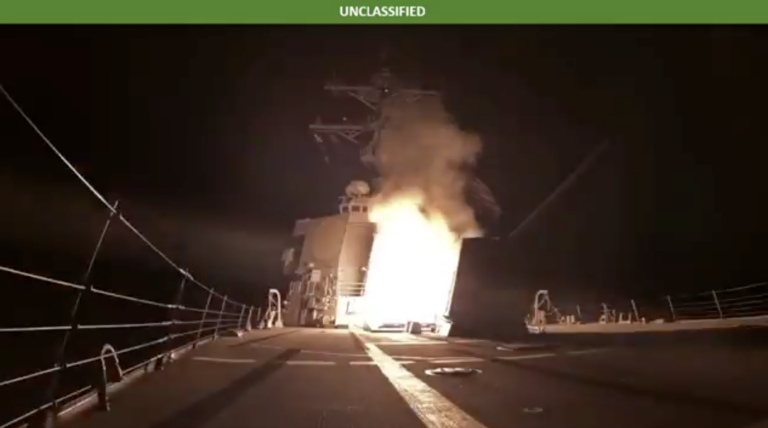
WHEN United States (US) President, Donald Trump carried out a “powerful and deadly strike” against ISIS militants operating in Nigeria on Christmas Day, the justification he gave was to strike ISIS-linked fighters for “killing innocent Christians.”
Acknowledging Trump’s announcement of the strike, Nigerian authorities said the attack followed existing counter-terrorism cooperation, suggesting the decision was driven by classified intelligence rather than an activist’s publications as the New York Times would later report.
The Nigerian government’s position on the attack conflicts with the claim that unverified reports of an individual who manages a screwdriver store in Onitsha, Anambra State, triggered Trump’s resolve to unleash strike on a terrorists’ base in Nigeria.
An assessment of public records, official statements and long-running lobbying efforts raises a more complicated question: can a single local activist plausibly sit behind a US president’s decision, or is this a case of ideology marketing in global reporting?
New York Times claim with missing decision chain
The New York Times published a story on January 18, claiming that a screwdriver trader in Onitsha, Emeka Umeagbalasi, is “an unlikely source of research cited by US Republican lawmakers promoting the narrative that Christians are being targeted for “mass slaughter” in Nigeria.
It said that 56-year-old Umeagbalasi, who also runs a small organisation called International Society for Civil Liberties and Rule of Law, otherwise known as Intersociety, in his home, published reports claiming that more than 125,000 Christians were killed in Nigeria since 2009.
According to the report, the figures in Umeagbalasi’s research works were referenced by prominent US Republicans, including Senator Ted Cruz, Representative Riley Moore, and Representative Chris Smith, triggering Trump to order airstrikes on parts of northern Nigeria on Christmas Day.
The US president vowed that his country would not tolerate what he described as “massacre of Christians by radical terrorists.”
The New York Times explained that Umeagbalasi admitted that he rarely verified his data and almost never travelled to the regions where most of the attacks occurred.
However, one of the things the report did not demonstrate was to detail how Umeagbalasi’s claims influenced US decision-making.
The report did not show evidence of classified intelligence briefing, Pentagon or National Security Council memo based on Umeagbalasi’s data, or State Department official confirming that the screw driver’s reports informed operational planning of the strike.
The ICIR reported in October that Trump announced on Truth Social that he had designated Nigeria a “Country of Particular Concern,” citing what he described as “an existential threat to Christianity,” even though the Nigerian government rejected his claim.
Days later, Trump threatened that the US Department of War would invade Nigeria “guns-a-blazing”, to completely wipe out the Islamic terrorists if the Nigerian government did nothing to curtail the alleged genocide.
Afterwards, the Nigerian Government revealed that it held a series of meetings with senior US officials resulting in improved security ties and new commitments aimed at protecting civilians and tackling violent extremism across Nigeria.
The delegation, led by National Security Adviser (NSA) Nuhu Ribadu, met officials from the US Congress, the White House Faith Office, the State Department, the National Security Council, and the Department of Defense in Washington, DC over the issue, until Trump issued a directive to strike on December 25 midnight.
In modern US foreign policy, military operations are typically authorised through a dense web of classified intelligence assessments, inter-agency reviews, diplomatic consultations, and security briefings. The absence of publicly demonstrated links between Umeagbalasi’s work and these processes leaves a critical gap at the centre of New York Times’ narrative.
To seek clarification on how the report established a direct cause-and-effect relationship between Umeagbalasi’s research and Trump’s decision to authorise the Christmas Day airstrikes in Nigeria, The ICIR sent an email to the New York Times on January 21 but have yet to receive a response as of press time, Jan 26.
The missing history
Findings shows that the idea that Christians are being systematically targeted for extermination in Nigeria did not originate with Umeagbalasi, nor did it enter US politics through him or only him. There are also instances of advocacy that predates the current Trump’s government.
For more than a decade, American conservative and evangelical groups have lobbied Washington to designate Nigeria a “Country of Particular Concern” over religious freedom.
Congressional hearings, petitions, policy briefings, and advocacy campaigns have repeatedly focused on attacks in the Middle Belt and the North-East, often framing Nigeria’s complex security crisis primarily as religious persecution.
US lawmakers including Chris Smith and organisations namely the US Commission on International Religious Freedom have consistently pushed this narrative across successive administrations.
Catholic leaders and Christian advocacy groups have also appeared before US committees over the years, testifying about violence against Christian communities in Nigeria.
Against that backdrop, Umeagbalasi’s publications did not enter a neutral policy space but entered an already active ecosystem of lobbying, ideology, and political interest.
During his first term, his administration designated Nigeria a “Country of Particular Concern,” a decision later reversed by his successor, Joe Biden.
Seen in that light, the Nigeria strike falls under the continuation of a narrative Trump has long deployed.
Nigerians’ reactions on NYT claim
Reacting to the NYT story, Former Minister of Aviation, Femi Fani-Kayode, accused Western media of distorting Nigeria’s security crisis and feeding interventionist narratives. Others warned that exaggerations about religious genocide risk inflaming sectarian tensions in the country.
Similarly, Former chairman of Nigeria’s National Human Rights Commission, Chidi Odinkalu, questioned how any serious observer could conclude that a local activist’s reports, rather than classified security intelligence, drove a foreign military operation.
“States do not go to war based on Google searches,” he wrote, arguing that the framing trivialises both the complexity of US war-making structures and Nigeria’s security engagements.
Similarly, Kalu Aja claimed that the article was written by a Nigerian who later worked for the government, noting that “Remember ‘ineffectual buffon’? That was how the Economist magazine described the then-President of Nigeria, Goodluck Ebele Johnathan. Excerpt: Everyone in the know understood that the article was written by a Nigerian who later worked for the government.
‘This is international lobbying 101. A white liberal American lady does not know Nigerian dog whistles like “Igbo trader”. Once I read that @nytimes article, I knew a Nigerian wrote it,” he noted.
The Igbo socio-political group Ohanaeze Ndigbo strongly condemned the NYT article, describing it as dangerous, misleading and ethnically inflammatory. They argued that portraying an Igbo trader as a central figure in US military policy “resurrects old tropes” and is insulting to the Igbo community. The group demanded an apology and retraction from the newspaper.
Human rights lawyer and lead counsel to Nnamdi Kanu, the leader of the Indigenous People of Biafra (IPOB), Aloy Ejimakor, lambasted the Nigerian government for shifting its messaging on intelligence sources, suggesting that previously, officials took credit for information later being attributed to the advocacy article. That, he said, was “a national embarrassment.”
Similarly, former presidential aide, Denge Josef Onoh, frowned at the NYT report as oversimplifying the factors that informed US military action and risked inflaming domestic tensions. He pointed to long-standing security intelligence cooperation between Nigeria and the US as the real driver behind counter-terrorism operations.
Experts have warned that narratives lacking robust empirical support can have real geopolitical consequences.
Intersociety reacts
Meanwhile, Intersociety in a statement released on January 23, rejected the New York Times report describing it as a “perfidy of lies” and a gross misrepresentation of a marathon interview held on December 16, 2025, at its facilities in Anambra State.
The organisation accused the New York Times of falsely attributing statements to its Executive Director, whom it described as a criminologist. It noted that the interview was conducted by Ruth Maclean, the West African Bureau Chief of the New York Times, who visited privately alongside a female photographer from Kwara State, and ThisDay Newspaper correspondent Dave Eleke.
Intersociety strongly objected to the New York Times’ decision to frame the interview around United States airstrikes in Sokoto State, nine days after the interview, describing the linkage as “mischievous and dangerous.”
THE University of Nigeria, Nsukka (UNN), Ahmadu Bello University, Zaria (ABU), and the University of Calabar (UNICAL) received the highest allocations among federal universities in the 2026 proposed budget breakdown analysed by The ICIR.
The President Bola Tinubu-led government allocated over N1 trillion to 69 federal universities in the proposed 2026 budget, with UNN receiving the highest share of N49.74billion.
According to the allocations, UNN was followed by ABU, with N48.76 billion, while UNICAL got N43.83 billion.
While the budget line in the university allocations specifically proposed amounts for university-related projects, The ICIR gathered that a few projects were inserted into the university line items despite falling outside the institutions’ mandates.
For instance, Ahmadu Bello University (ABU), which received N48.76 billion in allocations, has N280 million earmarked for the supply of solar water pumps, chemical sprayers, fertilisers, and food grains for people and farmers in Katsina North Senatorial District.
Our analysis showed that although this was the only line item outside the university’s mandate, the University of Calabar (UNICAL) also allocated N30.56 million for the establishment of a fish farm in Akamkpa/Biase Federal Constituency of Cross River State, while the University of Maiduguri earmarked N140 million for the construction of primary healthcare centres (PHCs) across Akko Federal Constituency in the state. For UNICAL and the University of Maiduguri, the projects were the only ones earmarked outside their mandates, according to our findings.
The ICIRreported that Tinubu’s 2026 budget proposal earmarked N3.52 trillion for education, representing 6.1 per cent of the total N58.18 trillion appropriation bill. While he insisted during his budget presentation that the move supported his Renewed Hope Agenda, experts argued that such allocation was insufficient to address the sector’s structural weaknesses and pressing needs.
The allocations came amid the recent agreement between the Federal Government and the Academic Staff Union of Universities (ASUU), replacing the controversial 2009 pact that had triggered repeated strikes across Nigeria’s public universities.
The agreement, signed on Wednesday, January 14, Abuja, was unveiled in the presence of senior government officials, including the Minister of Education, Tunji Alausa, the Minister of State for Education, Suwaiba Ahmad, and the Minister of Labour and Employment, Mohammed Dingyadi, alongside ASUU leaders led by its president, Chris Piwuna.
Under the new framework, the Federal Government approved a 40 per cent upward review of university academics’ emoluments, alongside the introduction of a Consolidated Academic Tools Allowance (CATA) to support research activities such as journal publications, conferences, internet access, and professional memberships.
The agreement also introduced, for the first time, a professorial cadre allowance, under which full professors are entitled to N1.7 million annually, while academics at the rank of Reader will receive N840,000 per year, a move the government said was aimed at recognising senior academics’ administrative and research responsibilities.
Meanwhile, other top universities that received significant share of the education budget include the University of Ibadan, which received N39.57 billion, the University of Maiduguri with N37.75 billion, and Nnamdi Azikiwe University, Awka, which got N37.16 billion. The University of Benin and the University of Jos were also allocated over N32 billion each, while Bayero University, Kano, was billed to get N31.72 billion.
Others are University of Uyo, which received N26.53 billion, the University of Lagos and the University of Port Harcourt taking N25.26 billion and N25.22 billion, respectively.Obafemi Awolowo University, Michael Okpara University of Agriculture, Umudike, and the University of Ilorin were to take allocations ranging between N23 billion and N25 billion.
The funding breakdown also shows significant disparities between older federal universities and newer or specialised institutions. The University of Abuja received N21.74 billion, while the National Open University of Nigeria (NOUN) was allocated N20.81 billion.
Allocations to top 20 federal universities in 2026 budget
Several newer federal universities had budgetary allocations below N10 billion. For instance, the Federal University of Health Sciences, Katsina, received N7.27 billion, while the Federal University of Transportation, Daura, was allocated N7.18 billion. Similarly, the National University of Science and Technology, Abuja, got N6.84 billion.
At the bottom of the scale, the Federal University of Agriculture, Zuru, received N3.94 billion, while the Federal University of Environment and Technology, Ogoni, got N3.85 billion. The International Centre for Biotechnology, University of Nigeria, Nsukka, recorded the lowest allocation, taking N1.62 billion.
The ICIR reports that the 2026 proposed allocations represent an increase from the previous fiscal year, when Tinubu earmarked over N500 billion for 20 federal universities in the 2025 budget, according to an earlier analysis by The ICIR. In that proposal, UNN also topped the list with N44.38 billion, followed by UNICAL (N37.26 billion) and ABU, Zaria (N36.74 billion)
In 2025, the Federal Government allocated N3.52 trillion, about 7.3 per cent of the total ₦47.9 trillion budget, to education, an increase from 5.5 per cent in 2024 but still far below the UNESCO-recommended 15–20 per cent benchmark. Sector-wide allocation figures for 2026 have yet to significantly close that gap.
TETFund allocates N6.452bn to 271 tertiary institutions for 2026
Beyond direct federal budgetary allocations, public tertiary institutions of learning are also expected to benefit from the 2026 intervention programme of the Tertiary Education Trust Fund (TETFund), which approved N6.452 billion for 271 public tertiary institutions nationwide.
The intervention, approved by Tinubu, is designed to support infrastructure development, teaching and learning, research capacity, and innovation across universities, polytechnics and colleges of education.
Under the disbursement framework announced by TETFund, universities will collectively receive N2.525 billion, polytechnics N1.871 billion, while colleges of education will get N2.056 billion during the 2026 cycle.
According to TETFund, the allocations will be paid directly to beneficiary institutions, with annual direct disbursements accounting for over 90 per cent of the total intervention funding through a combination of regular and special interventions.
The 2026 intervention includes expanded support for research and digital infrastructure, as well as the introduction of the Nigerian Research and Education Network (NgREN), aimed at improving access to global academic resources and strengthening research collaboration among institutions.
TETFund also warned institutions against leaving funds unutilised, stressing that future allocations would be tied to the effective use of existing resources, as part of efforts to improve accountability and ensure measurable impact.
THE Joint Admissions and Matriculation Board (JAMB) has announced that registration for the 2026 Unified Tertiary Matriculation Examination (UTME) will run from January 26 to February 28 at all approved Computer-Based Test (CBT) centres across the country.
The JAMB Registrar, Ishaq Oloyede, made this known in Lagos on Saturday during a meeting with Commissioners for Education ahead of the 2026 UTME and Direct Entry (DE) exercises.
He explained that the sale of UTME application documents would commence before the official registration period.
“The sale of UTME application document which is the ePIN, will start earlier than commencement of actual registration which is January 19 to February 26,” Oloyede said.
“Actual UTME registration period is between January 26 to Febuary 28 at all approved CBT Centres.”
He further disclosed that the window for selecting the mock examination would close on February 16, while the sale of Direct Entry application documents and ePIN vending would begin on March 2 and end on April 25.
“The close of mock selection is February 16 hile the sale of DE application documents and E-PIN vending will commence on March 2, and close by April 25,” he said.
Oloyede also noted that, unlike the previous year, the UTME results of underage candidates would only be released after the completion of the full evaluation process, to allow for proper assessment of candidates seeking age waivers.
On monitoring arrangements, he said all CBT centres involved in the UTME registration would be monitored live from JAMB.
headquarters, warning that any centre whose activities could not be viewed would face sanctions.
“Any centre whose registration activities cannot be viewed from the headquarters will not be paid, while such registration may be invalidated,” he warned.
The registrar revealed that 924 CBT centres had been screened and provisionally listed, adding that they would still be subjected to a final test before receiving full accreditation.
“They will go through the final test before final accreditation,” he said.
He also clarified that candidates are not required to pay any service charges to CBT centres, stressing that only the registration fees approved by the board apply.
Addressing complaints about distant examination postings, Oloyede said JAMB does not post candidates to towns outside those selected during registration. He advised candidates to register early, noting that delays could reduce their chances of securing preferred towns.
“The choice of a group of towns implies that candidates can be posted to any of the towns in the chosen group,” he added.
Oloyede further cautioned candidates to truthfully declare their previous registration and admission history with the board, noting that some candidates were involved in examination malpractice during the last UTME.
He also warned that it is a criminal offence to run more than one undergraduate programme simultaneously.
“Failure to disclose such prior admission is an offence which will be sanctioned,” he said.
On age eligibility, the registrar stated that only candidates who will be at least 16 years old by September 30, 2026, are generally qualified to apply for the UTME and be considered for admission.
He added, however, that underage candidates would be subjected to a rigorous evaluation process to determine whether they qualify for a waiver.
BOAT accidents have become a recurring tragedy on Niger State’s waterways, claiming hundreds of lives in incidents that many say were largely preventable.
Under the scorching sun in Mokwa town of Niger State, a 55-year-old farmer, Abdulhamid Umar watched helplessly as rescuers pulled lifeless bodies of his two sisters and a teen boy from the river after a capsized boat claimed over 60 lives. Their deaths, like many before, were seen as not accidents of fate but of failures of safety oversight, regulation, and enforcement in Niger’s fragile water transport system.
“This ugly incident is now exactly one year and a month when thousands from Gbajibo Mubi to Gbajibo here were consumed by the boat accident,” Umar, told ICIR, starring at the boats on the river.
Abdulhamid Umar speaking to ICIR in Gbajibo. PC: Mustapha Usman/ICIR
On October 1, 2024, when several Nigerians were flying the country’s flag, Umar’s family had already been consumed by the boat ferrying them from Mubi, Kwara State to Gbajibo in Niger State for Mawlid celebration.
“I lost three family members – a teen boy and two females to the ill-fated accident,” the 55-year old farmer said, adding: “The boat operator was almost close before the water began to swallow occupants.”
Life almost fled out of Umar when the tragic news was broken to him. Until his family members were buried, he continued to question the cause of the incident resulting in their death.
He, however, resigned to fate, saying: “We accept it in good fate as we all found their lifeless bodies when the rescue team searched for us. We buried them closer to water”, he told The ICIR, sobbing.
Findings’ reveal that after two ill-fated accidents in Gbajibo village, claiming over 200 lives, a regulatory body was set up to checkmate over-loading of passengers and goods.
He said, “There was a NIWA committee formed after the two accidents occurred, comprising a water marshal and a marine to check boats. The union also checks the condition of boats before leaving. The rule is still in force.”
Boats overloading unabated
During a visit in October, several boats docking at Gbajibo’s Friday market were seen overloaded with passengers despite the tragic accidents previously linked to such dangerous excesses. Umar urged authorities to provide them with flying boats and lifejackets to ferry without fear of being drowned.
“If we can get a flying boat, we can get to the accident scene within minutes, and that will be commendable. They provided a few lifejackets, but we need more,” he said.
One late evening, Nuhu Usman, one of the survivors of boat accident that claimed many lives in Gbajibo village under Mokwa, set out to his farm. He joined the crowd toppling into boats to celebrate the Annual Mawlid in Gbajibo.
Usman’ during interview. PC: Mustapha Usma/ ICIR
“We moved from Gbajibo Mubi to Gbajibo for the annual Mawlid. Others were coming for Mawlid but were heading back home after naming ceremony”, Usman said, adding: “We were eight in our family-five men with one little child that we lost to the incident. Two women also lost their lives.”
Usman, who survived the accident, had been left with a permanent scar of how he and other family members survived the incident.
Recounting how the incident happened, Usman said, “The boat had two engines but one was used while moving. The fault started from the engine and the spare engine started but didn’t work. It switched off immediately.”
He further narrated that the driver pushed on with the journey, even as the boat lurched from left to right before it finally began to sink.
According to him, the victims shouted for help while the water began to sink the engine and the boat. Suddenly, the victims began to drop inside the water as the boat sank.
Amidst battling on how to survive the accident, Usman picked a water-flask and handed it to his brother. “Before I jumped out, I made sure the boat almost sank. My brother could not swim so I had to assist him.
“I told him not to jump into the water as he could not swim then; I handed him the flask.”
Commenting on overloading of passengers, he said each of the boats meant to carry about 20-30 passengers had been conveying more than 100.
Niger leads in boat mishap
Data reviewed by The ICIR shows that Niger State has consistently ranked among states with the highest number of fatal boat accidents in the country over the last decade. Between January 2023 and October 2025, boat mishaps in Niger state have accounted for a significant share due to heavy reliance on river transport.
Infographic showing cases of boat accidents in Niger since 2023
Also, media reports reviewed by The ICIR show Niger state has reported no fewer than 189 deaths across 11 separate boat mishaps within the year in review, making it one of the states with the highest number of reported incidents nationwide within the period reviewed.
It also shows a pattern of recurrent mass-casualty incidents concentrated around Mokwa, Shiroro, Borgu, Lapai and Agaie LGAs. The deadliest incident occurred at Gbajibo River, Mokwa, in October 2024, where about 60 people were confirmed dead, followed by another incident in Gausawa community, Borgu, in September 2025, which claimed 32 lives.
Several other incidents recorded unspecified fatalities, suggesting the actual death toll may be significantly higher than reported. Community leaders and water transport unions estimate that many people beyond what was reported in the news died in boat-related incidents between 2023 and 2025, many of them during market days, religious festivities, or night journeys.
Double tragedy for survivor
Twenty five-year businessman, Muhammadu Nazuli almost died in the tragic boat accident on Oct.1 2024 when the boat was carrying over 200 passengers to Gbajibo in Mokwa town.
Nazuli narrating his traumatic experience. PC: Mustapha Usman/ICIR
“The ill-fated boat had over 200 passengers going for Mawlid celebration. When we started our voyage, it was smooth until we were about to alight.I heard a sound as I was very close to the boat when it was about to capsize.
Like Usman, Nazuli almost drowned as he suffered double tragedy when his boat crashed again after the survivors were transferred to rescued boats.
According to Nazuli, when the boat came, the rescue team transferred them to the new boat. “They transferred some victims into the second boat. The boy and I got the second one and a rope was tied on it to draw us. While drawing the boat as a form of help, we hit the boat that came to save us,” Nazuli said.
“It was after the incident that life jacket was enforced. Now, when leaving from Mubi, the passengers wear life jackets even when returning,” he added.
Despite engine faults, overloading persists
Through extensive interviews with eyewitnesses, The ICIR found that boat drivers charged with ensuring passengers safety merely reduced their load slightly, prioritising their own struggle for survival over full compliance with safety measures.
Mohammed Alhassan, a boat driver who has been conveying farmers since he started working as boat drivers two years ago, told The ICIR that the enforcement team urged them to renew their registration and slightly reduce the number of passengers.
Alhassan, a boat driver. PC: Mustapha Usman/ICIR
The 20-year-old driver narrated that enforcement officers regularly told them to fix their engines, checking out everything before conveying large passengers to their farms. “They often enforce stickers for us to buy but the registration costs N10,000 and regular checking of boats”, he said.
Before now, boat drivers, according to Alhassan, took overloaded passengers, including about seven motorcycles in a single boat. But due to recurring accidents, the number of motorcycles has now been reduced to five.
“When there are passengers, we don’t even take bikes; we take little number of passengers since the accident happened”, he said, adding that five motorcycles does not amount to overloading.
Engine of small boat: Mustapha Usman: ICIR
He stated that the most affected victims over recurring boat mishaps, were male, saying that he had not been a boat driver when the first incident happened.
Abubakar Mahmud, a 28-year boat driver said that his small boat conveys over 32 passengers.
Abubakar Mahmud speaking with our reporter. PC: Muatapha Usman/ICIR
His boat conveys peasant farmers to nearby villages across Niger and Kwara States, charging N300 for each passenger.
“My boat conveys over 32 passengers,” he said, adding, “I registered with the response team. The regulatory body does check on us as they are often stationed at the riverbank.”
Iliyasu Abdullahi, a rescue team member was engulfed with fear when he joined others to recover dead bodies from the water. His independence day celebration on October 1, 2024 was cut short when he was told about the accident.
“On that fateful day a boat accident occurred amid celebration of independence in Gbajibo. It was a sobbing day for the village. The boat capsized and we swiftly moved to the scene but we could not do anything.”
“The next day, I was among the rescue team and recovered lifeless bodies. Twenty four boats were used to search for the missing passengers. On the first day, we got 24 bodies and I could not continue due to fear. I didn’t join them the next day.”
According to him, a similar boat incident occurred in September 2023, where victims, particularly women, lost their lives to the mishap as 26 of them out of 29 were females breastfeeding babies.
“The commissioner of transportation came and promised us life jackets, flying-boats, ambulances and that Marine police would be deployed. Since then, a rule has been set up for them including boat drivers and passengers. We talked to them about the dangers of overloading, but they are ignored. Passengers are part of the causes accidents, and they will tell you that it is their life.
“When NIWA came (after the September incident), they gave guidelines with the Niger State government supporting us with 200 lifejackets. In the October’s incident, 350 lifejackets were provided for us. We shared 150 lifejackets to Mubi village and we took 200”, he narrated.
Enforcement team withdraws
Abdullahi was not well pleased with how the government allegedly neglected the enforcement team in Gbajibo, after working for months enforcing lifejackets by passengers.
“The ream worked for more than five months, leaving their families in hunger and that was how the local regulatory began not to function again”, he explained.
Muhammad Nakubi, the secretary of boat drivers union in Mubi village narrated how his union often organised training for boat drivers plying the river for safety reasons.
Nakubi, narrating his drivers’ ordeal. Mustapha Usman/ICIR
The middle-aged-man saidthat wheneverit was cloudy, they advised boat drivers to reschedule their trip, citing that the breeze had caused boat mishaps in the past.
“We show them how they navigate the river to avoid accidents and overload the passengers. When it is cloudy, they should find a place of comfort,” he said, stressing that a life-jacket is made compulsory among them.
“We sit with NIWA to further discuss local ways of preventing accidents, training them on how to ply the river.” He noted that accidents come in many ways, especially wooden boats.
“We have a market leader. When the boat driver overloads, he will return the passenger even when they encountered a breeze along the way. When we see them with overload, we force them to reduce the number,” he said. He commended the government’s effort on the life-jackets provided.
Abubakar Ibrahim, a member of regulatory body of National Inland Water Authority, (NIWA), who spoke to The ICIR said that his union is still enforcing overcrowding of boat passengers.
He said that women were affected in the recurring boat accident but men lead as most victims.
Emergency boats.PC: Mustapha Usman/ ICIR
Nearly 900 people died in boat accidents in 2 years
Between January 2023 and October 2025, at least 857 people died in boat accidents across Nigeria, according to The ICIR’s analysis of media-reported incidents. That translates to an average of more than 26 deaths every month, or one fatal boat accident every three weeks, on waterways.
Infographic showing cases of boat mishap since 2023
The toll peaked sharply in 2024, accounting for 458 deaths, more than half of the fatalities recorded within the period. In 2023, boat accidents claimed 253 lives, while 146 deaths were recorded between January and October 2025 alone.
Boat mishap fatalities in Nigeria per year
State-level data further highlight Niger State as one of the country’s most dangerous corridors for inland water transport. While Kwara State recorded the highest fatalities (about 300 deaths) from just three reported incidents, Niger State followed closely with 189 deaths across 10 separate boat mishaps. The frequency of accidents, particularly around Mokwa, Gbajibo, Shiroro, Borgu and Lapai, suggests that authorities were repeatedly alerted to danger zones but failed to act decisively.
Other states with similar accidents are Kogi, which recorded 68 deaths, and Zamfara and Sokoto with 49 fatalities each.
Gunu mishap: Survivors struggle for life
On July 26, 2025, a boat carrying commodities and passengers capsized in Gunu village of Shiroro area of Niger State while the boat was heading to Kwata-Zumba market.
Sanusi Jagaba who survived the accident, struggled to recount how he survived. Luckily, the 38-year-old fishmonger who resides in Munya area, wore his lifejacket when his boat hit a trees log, tilting his boat before sinking into the deep Shiroro river.
Jagaba speaking on how he survived. Mustapha Usman/ICIR
“I truly thank God for how I survived through a lifejacket provided by the authorities before leaving. When we fell inside the water, I was lucky to have the lifejacket on,” he said.
Jagaba now struggles to rebuild his life after losing his capital in the accident. He added that although the boat was not overloaded when the accident occurred, only a few were wearing lifejackets.
Another survivor, Somalia Tanko, in Munya area of Niger State, was pulled out of Shiroro River while heading for his daily market business in Zumba of Shiroro area.
“I was pulled out of the water, but I didn’t know how it happened. We were heading to the market from Kabula to Gwata when our boat collided with a log of tree. I often buy fish then return immediately to resell them. Everything I do for business has perished and life is difficult.
“If there were no life-jackets, more lives would have been lost than recorded. If it wasn’t a life jacket, I would have drowned.”
The tragedy shattered Tanko’s life, leaving him with no savings and forcing him to start again from zero.
Abubakar Dan Maimuna, 38-year old resident of Zumba village in Shiroro area of Niger State, witnessed how bodies of the dead victims were recovered.
Dan-Maimuna was plunged into deep mourning the moment the tragic news reached him, shattering the fragile calm he had managed to hold onto. Surrounded by relatives and neighbours who gathered to console him, he struggled to process the loss, his world thrown into a state of unimaginable sorrow.
“We tried our best to reach the scene. It was a tree that caused the accident as the loggers didn’t completely cut it all. Water covered the log of the tree, the driver never thought the tree was there,” he narrated.
“Now, the regulatory body becomes more serious than before as accidents occur yearly. When the boat drivers ignore warnings, they are severely punished. There was no breeze when the accident happened”, he stated, amidst robbing his palm hands..
Hamza Abdullahi, a 39 – year old resident of Zumba attributed recurring menace of mishap in Shiroro river to negligence. He said, “Before the incident, there was negligence as many people do not have life-jackets and there was excess water.”
He said, “When the incident happened, the commissioner of transportation came immediately the next day to witness all that happened. The accident was because of a tree inside the river and the water swallowed them without knowing the exact spot of the tree.
A boat ferrying some passengers. PC: Mustapha Usman/ICIR
“The tree broke the wooden bridge and it changed their plan. The passengers began to drop inside the water”, he added, commending the rescue workers. “Immediately, we were mobilized to the area. We witnessed the whole process, and 8 dead bodies were recovered.
“A week before the incident, NIWA officials were here, educating boat drivers and others on the importance of wearing life jackets,” he said. “They also urged the operators to strictly limit the number of passengers each boat should carry.”
Umar Isha, the Sarkin Ruwa (Water Chief) of Zumba, recounted that eight boat accidents had occurred during his ten years as the community’s foremost water overseer. The 50-year-old leader described the grim realities of frequent mishaps on the river, painting a stark picture of the dangers boat users in the area continue to face.
“From 10 years back to now, we have about 8 boat accidents. The casualties within the timeframe should be more than 150 persons as the last incident was caused due to log of tree”, the leader said, noting that his team and government do check on boat drivers.
“The water from the dam was released into the river. Then, its second week, the boat drivers forgot the direction of where the water would be coming from. So they were on top of ravaging water when the boat turned.”
He stressed that neither the breeze nor the cloudy weather triggered the tragedy. Instead, it was a submerged tree trunk that claimed several lives. He appealed urgently for the dangerous tree lodged beneath the water to be cut down before it leads to more deaths.
NIWA decries disregard for safety regulations
The National Inland Waterways Authority (NIWA) in September, raised alarm over widespread noncompliance with safety regulations by local boat operators and passengers.
Olawale Adetola, NIWA’s General Manager for Business Development, said many people ignore life jackets and other safety guidelines, putting lives at serious risk during water transportation.
Adetola noted that the agency has continuously carried out sensitisation campaigns to educate boat operators on safety measures.
According to him, life jackets and other protective equipment have been distributed widely, but adherence remained low, and many operators still flout established safety rules.
MEDICAL negligence in Nigeria came to the fore when author Chimamanda Ngozi Adichie accused a Lagos hospital of negligence after the death of one of her 21-month-old twin boys. Nkanu Nnamdi died on 6 January 2026 after a brief illness.
Friday Okonofua, emeritus professor of obstetrics and gynaecology and vice-president of the Nigerian Academy of Science, answers some questions about medical negligence in the country and how it can be curbed.
What is medical negligence?
Medical negligence is said to occur when a healthcare professional or a health institution fails to provide the expected standard of care, thereby causing harm to the patient. It can also be defined as improper, unskilled, or negligent treatment of a patient by a physician, dentist, nurse, pharmacist, or any other healthcare professional.
In Nigeria, the standard of care is set by the Medical and Dental Council of Nigeria. The Rules of Professional Conduct for Medical and Dental Practitioners, also known as the Code of Medical Ethics, stipulate several instances that would amount to medical negligence.
It can include wrong diagnosis, incorrect or inappropriate treatment, surgical errors or failure to inform patients of possible risks. The act or mistake has to be proven through review of medical records by an expert professional team. Such teams are set up by the specific hospital management or the Medical and Dental Council of Nigeria if the case is reported to the council. It cannot be insinuated because a patient said so, but must be accurately proven with facts and real-time evidence. And the harm has to be documented with assurance that such harm could not have occurred other than through the medical mistreatment.
How widespread is it in Nigeria?
As elsewhere in the world, it is common in Nigeria. Around one in every 10 patients worldwide is harmed in healthcare. In low- to middle-income countries, as many as 4 in 100 people die from unsafe care. Specific figures are hard to come by in Nigeria.
However, in Nigeria, a large proportion of medical errors are unreported or even unknown to patients. I speak from my experience as a doctor. Only those that result in severe complications and death are known and reported. Therefore, only a few cases come to the public’s attention. Incidentally, some patients sometimes perceive negligence when in fact there has been no negligence. A large proportion of such cases are reported due to the ignorance of our populace on medical matters. Therefore, only a few true cases come to the public’s attention.
What are the common examples of medical negligence in Nigeria?
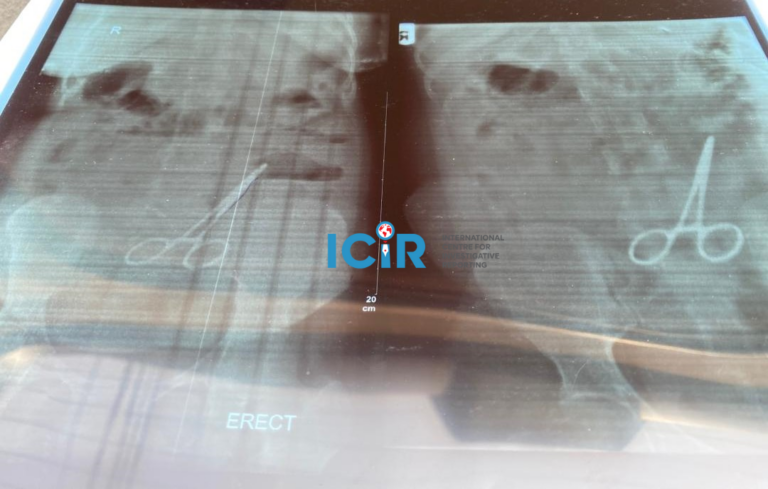
Some examples of medical negligence that have been reported in Nigeria include wrong prescriptions and surgical errors like wrongly tying the ureters (tubes that pass urine from the kidney to the bladder to excrete waste products). Others are inability to control bleeding during surgery and forgetting surgical instruments inside the bodies of patients. Recently, the Kano State Hospitals Management Board confirmed that surgical scissors were mistakenly left inside a patient’s body during surgery. It admitted negligence in this case.
Other types of negligence are substandard monitoring of patients and not promptly attending to patients during emergencies. Wrong diagnosis is another one. For example, a patient with cancer being diagnosed as not having cancer.
However, for medical negligence to be recognised by the law and professional codes, it needs to be proven that a doctor breached a duty of care, that the breach resulted in an injury, and that the patient suffered damage.
It is worthy of note that some patients sometimes encourage negligence, for example by refusing appropriate treatment. An example is when a patient with severe anaemia refuses blood transfusion for religious reasons. If such a patient dies without being transfused, the Medical and Dental Council of Nigeria would consider such a medical practitioner as being negligent. The council regulates the practice of medicine, dentistry and alternative medicine in Nigeria.
What are the factors responsible for medical negligence in Nigeria?
Some factors that lead to medical negligence in Nigeria include:
human resources – shortage of healthcare providers, leading to exhaustion and increased risk of errors
inadequate infrastructure – poorly equipped health facilities, inadequate medical facilities and lack of essential medicines
leadership and weak health governance of many of the health facilities
poor service delivery, due mainly to limited opportunities for continuous physician training in line with global standards.
What are the options for redress by patients or their family members?
Some may decide not to take action, recognising that in all aspects of life, mistakes do occur. In my experience in Nigeria, some families opt not to take further action and “leave everything to God”. They rationalise that no death occurs without God’s decision that such a death should take place.
However, in our increasingly westernised world, we have seen families deciding to take such matters to court or seeking redress from the Medical and Dental Council of Nigeria. Some may decide with the doctors to settle the matter out of court. In my experience, only a few succeed in court because an enormous amount of evidence is required to prove cases of negligence. The council is quite active on such matters and often provides a prompt response based on technical investigations.
What should be done to prevent negligence?
The capacity of the regulatory agencies (like the Medical and Dental Council) to enforce standards can be strengthened. This can be through regular exposure to global standards. And healthcare infrastructure can be improved by providing better facilities.
Other approaches include promoting a culture of safety among practitioners, encouraging continued learning, skills building and certification of health practitioners, and promoting patients’ education. There are abundant sources of information that patients can seek before accepting medical treatments recommended by their practitioners.
AMID record funding for Nigeria’s Basic Health Care Provision Fund (BHCPF), many primary healthcare centres in Kano remain neglected and under-resourced, leaving families to pay for treatment from their pockets.
The wooden shelves inside Tshohuwar Rogo Primary Healthcare Centre (PHC) in Rogo Local Government Area (LGA), tell a silent story. A few dusty boxes of Augmentin and paracetamol lay beside syringes and empty cartons. They are the remnants of a pharmacy that once served its purpose.
Seven years after Nigeria launched the Basic Health Care Provision Fund (BHCPF) to guarantee essential medicines and affordable healthcare, residents in rural Kano communities still face reality of insufficient drugs, poor infrastructure and out of pocket expenses for patients that keep soaring high.
Khadija Auwal, a mother of three, has grown used to walking home from her PHC in Tshohuwar Rogo with prescriptions instead of medicine.
“The hospital is working, but we hardly get essential drugs,” she says, clutching a small nylon bag of medicines bought from a nearby chemist under a neem tree. Neglected rural health clinic compound with unpaved grounds and basic infrastructure exposes gap between urban and rural healthcare acces
“It pains us whenever we have to buy drugs outside. They are expensive here, but what other options do we have?” she says, adding that she resorts to local herbs. “Sometimes I just buy what I can and use herbs to manage the rest,” she said.
Across many villages visited in Rogo and Gari LGAs, Khadija’s story is a familiar one. The BHCPF promised free and accessible healthcare to vulnerable Nigerians, but it has given way to a deepening crisis of drug scarcity. Families are forced to pay out of pocket for drugs that public funds were meant to provide or subsidise.
Maryam Musa, a pregnant mother, also in Tshohuwar Rogo community, Rogo LGA, who sold her goats to buy malaria drugs said: “I came to the PHC at dawn as I was feeling feverish and was suspecting malaria. But there were no malaria drugs in the facility, the doctor only prescribed some drugs for me to buy.”
‘We sold our goat to buy drugs’
Maryam’s husband rushed to the nearest chemist, about seven kilometres away, where he spent ₦4,800 on drugs the PHC should have had in stock.
“We had no cash that morning, so we sold one of our goats to pay for the drugs,” she says, adding: “Women die here because of small things like medicines and equipment. These things can be avoided if our PHC worked like it should.”
The National Primary Health Care Development Agency (NPHCDA) outlines minimum standards that every Primary Health Care Centre (PHC) is expected to meet. These cover the basic requirements for staffing, infrastructure, essential services and utilities.
According to the NPHCDA, standard PHCs should have consulting rooms, a reception and waiting area, a delivery room, a lying-in ward, an injection and dressing area. It also includes a pharmacy or dispensary, records section, stores and gender-segregated toilets.
Maryam
Facilities are also expected to have a functional water source, electricity supply with alternative backup, waste-disposal systems, perimeter fencing and staff accommodation to support round-the-clock service delivery.
Despite these national benchmarks, many PHCs in Kano still fall short of the minimum standards required for effective primary healthcare.
Lurwan Hassan, of Tshohuwar Rogo PHC, Ward Development Committee, expressed concerns over the Basic Healthcare Provision Fund (BHCPF).
He said that while funds are sent monthly for capitation, essential drugs and other hospital services remain insufficient. “Whenever we inquire, the health workers tell us that the money is not enough,” Hassan explained.
He added that the PHC faces numerous challenges, including shortages of drugs, inadequate infrastructure, and the need for extensive renovations. “If these issues are addressed, women in our community wouldn’t have to travel all the way to the general hospital. They could access necessary drugs and services right here at the PHC,” Hassan emphasised.
Funds released, shelves still empty
The Officer-in-Charge (OIC) of Rogo PHC, Rogo LGA, Ibrahim Yakubu, admits that while the facility receives funding through the BHCPF, it is far from enough to sustain operations.
“From July to September, there was no release of funds until October. Two years ago, we used to receive around ₦1 million, but now it has dropped to between ₦600,000 and ₦700,000. I asked why, but till today, there’s no feedback.”
Yakubu explains that what comes in is barely sufficient to keep the health centre running. “Most of the money goes into maintaining the building or buying small supplies. There’s little left for drugs,” he says, glancing toward the nearly empty dispensary.
Outside the facility, the Village Head, Mustapha Lawal, shakes his head as he walks around the PHC’s premises. “Our PHC is in great trouble. There is no equipment, no drugs, and the management is poor. We spend at least ₦2,000 every time someone falls sick, just to buy medicines from chemists. Many people have died because we lack emergency drugs,” he laments.
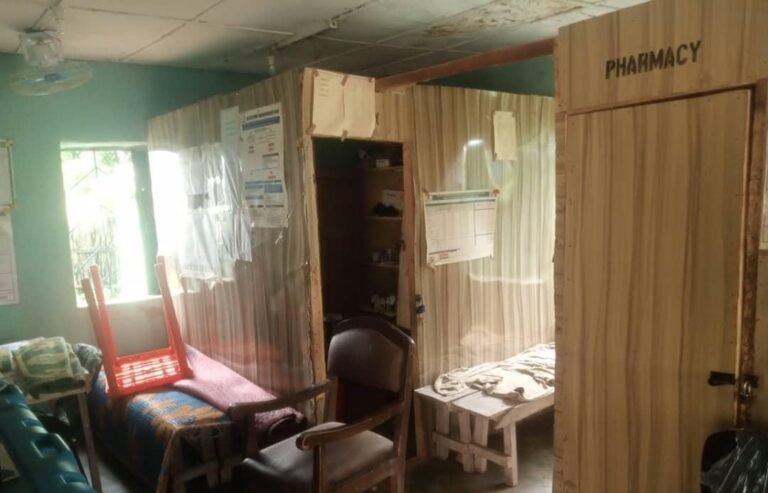
Makeshift pharmacy area with torn curtains and inadequate storage exposes poor healthcare standards and lack of proper medical facilities
At Liman PHC, a cramped room serves as the pharmacy. The shelves are nearly empty, cluttered with paperwork and half-used bottles instead of medicines.
The Officer-in-Charge, Anas Shazali Garba, insists that funds do come in regularly. He said the facility is paid ₦453,720 every month for drugs and ₦300,750 quarterly for renovations. But the visible stock hardly reflects those figures. When asked why, he replies quietly, “We will buy the drugs soon.”
For residents like Yusuf Ibrahim, a 45-year-old maize farmer in Liman ward, those promises mean little. According to him, illness is no longer just a health concern; it has become an economic crisis and stocking up the appropriate medicines should be treated with urgency.
“Every time I fall sick, I go to the PHC first but there are no drugs, only prescriptions,” he says, stressing that each episode forces him to spend between ₦1,500 and ₦3,000 at private chemists.
“Last year, I missed two weeks of farming because I couldn’t afford full treatment. Due to this, I lost most of my crops and ran at a loss,” he says, adding that he now keeps a small box of leftover malaria drugs at home, rationing them for emergencies.
Where did ₦425,790 go?
At Yandadi PHC in Kunchi, LGA, the situation is no different. Records show that the facility received ₦425,790 on October 6, 2025, for drug procurement. Yet, a visit to the centre reveals only a few cartons of syringes, paracetamol, and antibiotics stacked inside torn boxes.
The value of the visible drugs does not appear to justify the amount reportedly spent, raising concerns about inflated procurement costs or possible diversion of funds. A health worker who sought identity protection expressed concern over the lack of accountability in the disbursement process.
“There is no proper tracking. Once the funds hit the accounts, there’s no effective monitoring of what is bought or delivered. Some people use the money for personal things, and nobody checks,” the source said.
Financial transfer evidence shows minimal funding (NGN 425,790) revealing inadequate government investment in rural healthcare services and infrastructure
In Yandadi town, Kunchi LGA, Hauwa Bello, a widow with four children, recalled an emergency when she struggled to keep her youngest daughter alive.
“It was about two years ago that my girl, Safiya, was suffering from vomiting and diarrhoea. When we went to the PHC, she was given Limotil and O.R.S. Some injections were written for us to buy from the chemist.
“I went to the chemist, and everything was almost N7,500, which I don’t have. I believe these basic medications ought to be available in the hospital for free or even subsidised. So, I bought a few that I could afford from the chemist and returned home without getting the injections.”
Hauwa who said she earns less than ₦3,000 daily selling bean cakes, adds: “Sometimes I give Safiya only half the dose or skip days. The nurses are kind, but they say they don’t have the drugs. What can they do? The government says healthcare is free, but we are the ones paying the price.”
Abubakar Haruna, the Ward Development Committee (WDC) chairman of Yandadi PHC expressed deep concern over the persistent shortage of essential drugs at the facility.
Speaking during an interview, he explained that community members arrive at the clinic hoping to receive care, only to be told to buy basic medicines elsewhere.
Severely under-equipped examination room with aging hospital beds and minimal medical equipment highlights critical healthcare service gaps
According to him, this situation discourages people from visiting the health centre and weakens trust in the healthcare system, noting that the problem has continued despite regular allocation of funds meant to support primary health services.
“Every month, we hear that money has been sent, but when you come to the PHC, you don’t see the impact,” he said, adding that patients still struggle to access routine medication, while critical supplies remain unavailable.
The WDC chairman also raised questions about how the funds are being managed, pointing out that there is little transparency around spending and that the community is rarely given reports or explanations. “We ask where the money goes, and the answer is always that it is not enough but nobody shows us accounts or records.”
He emphasised that accountability is important not only for the government, but also for health workers and committees responsible for managing the facility.
At Shuwaki, Rogo LGA, 31-year-old Abubakar Rabiu sits beneath a mango tree, recovering from typhoid fever. He is a security guard earning ₦25,000 a month. He says the illness wiped out nearly half his salary.
“The doctor gave me a prescription, but the drugs weren’t available. I went to a private pharmacy and spent ₦12,600 on treatment. I had to borrow money from a colleague and delayed paying my child’s school fees for me to be able to treat myself. In reality, our healthcare is just talk.”
Kano healthcare expenditure vs service reality
Between 2020 and 2025, Kano State consistently allocated significant portions of its annual budget to the health sector, but implementation has lagged, undermining real improvements in care.
For example, in 2024, the Ministry of Health’s original budget was about ₦8.3bn, but by the third quarter of the year roughly 32.5 per cent of that amount had been spent.
In the 2025 budget, the state primary healthcare board was allocated ₦10.75billion. Yet only ₦72.99 million, representing 0.7 per cent had been spent by the first quarter.
Deteriorating Kauyen Liman Health Clinic exterior shows years of neglect with damaged roof and poor maintenance of critical community healthcare facility
Independent fiscal analysis by BudgIT shows that between 2021 and early 2024, Kano State executed less than 20 per cent of its approved health budget on average.
The mismatch between what is budgeted and what is actually spent has serious consequences. Many PHCs remain under-equipped and understaffed, forcing patients in vulnerable communities especially in rural areas to go without care.
A promise broken
Created under Section 11 of the National Health Act, the Basic Health Care Provision Fund is meant to push money down to the primary health-care level, paying for essential drugs, basic upgrades and frontline services.
The releases are not automatic, but where facilities are accredited, the fund is designed to ease the cost of care and cut the crippling out-of-pocket spending that pushes many, especially in rural areas, away from the health system.
In 2024 alone, the federal government disbursed around ₦45.4billion under the BHCPF. Kano State was among the largest individual beneficiaries, receiving approximately ₦2.67bn of the total.
Five years into implementation, the results tell a different story.
A study of selected PHCs in Kano found deep structural problems. Nearly two-thirds of facilities surveyed reported delays in receiving funds, close to nine in ten operate with poor infrastructure, and more than half struggle with weak financial oversight and accountability.
Healthcare worker manages insufficient pharmaceutical inventory in cramped conditions revealing critical medicine shortages affecting patient care
Despite the steady inflow of BHCPF allocations, many PHCs across Kano still lack essential medicines, basic equipment, and adequate staffing. In places like Rogo, the absence of drugs has turned what should be a life-saving facility into a referral point for private chemists.
Experts argue that these gaps point to persistent problems of transparency and accountability in how funds are managed. Although the BHCPF now incorporates a digital tracking platform to improve monitoring, its impact will depend entirely on how strictly it is enforced at the facility level.
“The problem is not funding; it is what happens after the money is released. Without community monitoring and public disclosure of spending, corruption will always find a way,” says Kabiru Sabo, a health policy researcher at the Bayero University Kano.
Gali Sule, a pharmacist and Director-General of Kano State Drugs & Medical Consumables Supply Agency (KDMCSA), offered a contrasting view. He noted that drug availability in public health facilities has improved significantly in recent years. He attributed earlier shortages to diversion by staff.
Sparse hospital ward with outdated beds and broken equipment exposes dangerous lack of proper inpatient care facilities and medical resources
“Some workers get drugs cheaply but direct them outside for personal gain. We have strong monitoring now, and anyone caught will face the law,” he says. He highlighted ongoing reforms, including the establishment of a pharma-grade warehouse, direct procurement from registered suppliers, and the expansion of the Drug Revolving Fund (DRF), designed to strengthen accountability, ensure cost recovery, and guarantee drug quality across the state.
Ibrahim Rayyahi, public health advocate, noted structural challenges. He says, “PHCs are under local governments that lack financial autonomy. Weak governance and limited community oversight make stock management difficult.”
He recommended financial empowerment of PHCs, expanded DRF coverage, stronger community monitoring, and staff training to curb leakages.
Also, Omoniyi Adewoye, Program Manager, of Resource Centre for Human Rights and Civic Education (CHRICED) highlights that the possible reason for this unfortunate development is diversion of funds or even drug supplies by government officials or health workers at the facility level.
The DG, Drugs Supply Agency alluded to this, saying, “We have consistently advocated for strict monitoring of funds allocated for the healthcare sector in the state. While the state government deserves some commendation for scaling up financial allocation to the healthcare sector in recent times, it is disturbing that there is still acute shortage of drugs in our PHCs.
Inadequate medical supplies stored in deteriorating cardboard boxes expose poor inventory management and substandard storage conditions at underfunded health facility
“The government and Civil Society Organisations need to do more in tracking these funds to ensure that the funds released are used for the specific purposes they were allocated for. The Kano State Ministry of Health and all its relevant agencies need to urgently activate functional tracking and monitoring mechanisms to track funds released and ensure that any official or health worker found culpable is prosecuted.”
Kano PHC responds
Nura Sharif, a Program Officer at the Kano State Primary Healthcare Management Board (KSPHMB), explained that the funds were allocated on a facility-by-facility basis, with each of the 484 eligible PHCs receiving ₦300,750 per quarter, t0talling ₦601,500 for the first and second quarters of 2025.
He added that facilities also received capitation payments of ₦570 per enrolee from the Kano State Contributory Health Management Authority (KSCHMA), which is responsible for covering patients registered under the state insurance scheme.
Despite these allocations, Sharif said late disbursements continue to undermine operations. According to him, the National Primary Healthcare Development Agency did not release funds for first and second quarters for 2025 until August 18. This delay, he says, disrupted service delivery across PHC facilities in the state.
FOIA request Ignored by health ministry
A Freedom of Information Act (FOIA) request was sent on November 4, 2025 to the Kano State Ministry of Health, seeking clarification on how funds from the Basic Health Care Provision Fund (BHCPF) have been managed and disbursed to select PHCs in Rogo and Ghari LGAs.
The request specifically asked for records of allocations and expenditures for Tshohuwar Rogo, Liman and Yandadi PHCs, including details showing how much was released for drug procurement, facility maintenance and staff welfare.
It also requested invoices for drugs purchased, names of suppliers, as well as monitoring, audit and disciplinary reports relating to the facilities.
The FOIA application was submitted in line with Sections 1, 2 and 4 of the Freedom of Information Act, which guarantees citizens access to public records and requires government institutions to respond within seven days.
However, despite the legal requirement and follow-up efforts, the ministry failed to provide any response to the request and it did not transfer the application to any other relevant agency as required under Section 5(1) of the Act.
The lack of response raises further questions about transparency in the management of BHCPF resources, particularly in communities where residents continue to report persistent drug shortages and underfunded health facilities.
This report was made possible with support from the International Centre for Investigative Reporting (ICIR) under the Strengthening Public Accountability for Results and Knowledge (SPARK 2.2) project.