Home Blog Page 1077

How Buhari sacked sole administrator over naira redesign in 1984 – Buba Galadima

A CHIEFTAIN of the New Nigeria Peoples Party (NNPP), Buba Galadima, has narrated how President Muhammadu Buhari fired a sole administrator over naira redesign in 1984.

Buhari served as Nigeria’s military head of state from December 31, 1983 to August 27, 1985 after taking power through a military coup d’état.


READ ALSO:
Naira redesign: Ekiti seeks to join other states in suit against FG

Naira Redesign: Buhari has limited knowledge of economics – Shehu Sani

Naira redesign: Ekiti seeks to join other states in suit against FG

Kano asks Supreme Court to stop FG’s naira redesign policy


Speaking with Trust TV on Sunday, February 12, Galadima described the present hardship faced by Nigerians as a fallout of the naira redesign policy.

He also narrated how a sole administrator who served under Buhari was sacked after suggesting that the period of naira swap be extended in 1984, when Buhari, as military ruler, also implemented the redesign of the naira.

“Hassan Albadawi, who was Buhari’s commissioner for education when he was the governor of North Eastern State and later became the sole administrator at Gamboru Ngala on the border with Chad and Cameroon, appeared on television 9 o’clock news and begged the President to extend the time of naira swap because people in his constituency had no access to banks. Before the news ended, another message came, a special announcement, that he (Buhari) has dismissed the chairman of that local community,” Galadima said.

The ICIR reported that the National Council of State expressed its support for the naira redesign policy introduced by the Central Bank of Nigeria (CBN) during a meeting at the State House, Abuja, on February 10.

The Council faulted gaps in the implementation of the policy which has led to acute agonies in accessing cash by people at commercial banks and ATMs, and asked the CBN to make new naira notes available to the public, or allow the new and old banknotes to circulate concurrently to ease the tension caused by the scarcity of cash.

Why Tinubu is not responding to calls for debate – Onanuga

SPOKESPERSON of the Presidential Campaign Council (PCC) of the All Progressives Congress (APC) Bayo Onanuga has said the party’s presidential candidate Bola Tinubu is not responding to calls for debate because some section of the media has an agenda against him.

Speaking during a Twitter Space organised by The ICIR on Saturday, February 11, Onanuga said the anti-Tinubu agenda is noticeable from the type of reports being published by the concerned media outfits.

The Twitter Space was themed, ‘The APC Strategy: Defining The Tinubu Manifesto.


READ ALSO:

Some G5 governors working for Tinubu – Onanuga

Onanuga rejects rerun projections, says Tinubu to win at first ballot

2023 and Tinubu’s bosom enemy

Akwa-Ibom condemns Tinubu’s comments on governor, demands apology


Onanuga, however, said Tinubu would respond to such requests if media organisations in the country come together to organise a debate.

“The media should come together and have one debate, while pre-informing the candidates ahead with the questions to get ready.

“Our candidate has been speaking in rallies, interacting with business communities, farmers groups while unveiling his programmes and policies,” Onanuga said.

Commenting on the controversy surrounding the party’s Muslim-Muslim ticket, Onanuga said Tinubu’s antecedents show he has the capacity to manage diversity.

“During his administration as the Lagos State Governor, Tinubu has officials from different parts of the country who worked with him irrespective of their region or creed.

“He is not a fanatic in his approach to faith,” Ononuga added.

NDLEA arrests General Overseer, student for drug trafficking

0

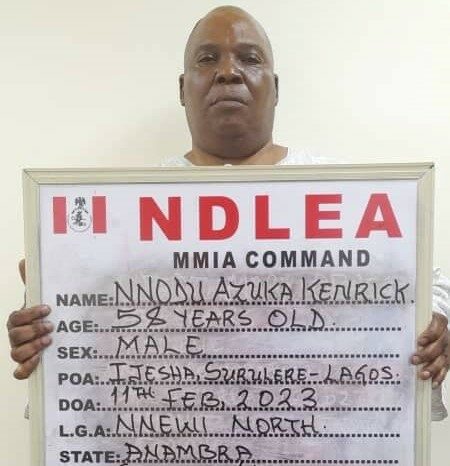
THE National Drug Law Enforcement Agency (NDLEA) has arrested the founder and General Overseer (GO) of Seraphic and Sabbath Assembly, Lagos, Nnodu Azuka, for drug trafficking.

The GO was arrested along with a student of Emmanuel College of Theology, Ibadan, Udezuka Udoka and their freight agent Oyoyo Obasi.

NDLEA spokesperson Femi Babafemi, disclosed this in a statement on Sunday, February 12.

Azuka was arrested at his church in Lagos on Saturday, February 11, after his accomplices were apprehended on Thursday, February 9.

According to the NDLEA, the suspects had attempted to export methamphetamine and skunk concealed in gallons of palm oil to Dubai, United Arab Emirates (UAE) through the Murtala Muhammed International Airport, Ikeja, Lagos.

The statement said the freight agent, Obasi, confessed that she is a member of the GO’s church.

“Spilling the beans on how she was recruited by her church’s GO, Obasi said the clergyman and his son used threats to compel her to take the job after they knew she had known their secrets, adding that Nnodu was always referring to the illicit drugs as Ice and Bible, (Street names for Methamphetamine and Cannabis) in their telephone text message chats.

“The theology student, Udezuka, was introduced to Obasi to assist her because she was new in the illicit business. Udezuka said he was paid N2 million for his role and had to do it because he needed the money for his education,” the NDLEA statement said.

In 2022, the NDLEA had arrested the General Overseer of Christ Living Hope Church, Lagos, Ugochukwu Ekwem, for drug trafficking.

Ekwem was on his way to a three-week crusade in Nairobi with 54 sticks of cannabis wrapped around his body.

NBC condemns use of children in political adverts

0

THE National Broadcasting Commission (NBC) has condemned the use of children in political advertisements by broadcast stations.

Director-General of the NBC Balarabe Ilelah frowned at the practice during a stakeholders’ meeting on Saturday, February 11, in Abuja.

Ilelah said the NBC has observed that children are bring used by politicians in broadcast advertising contrary to the provisions of Section 7.7.1(d) of the Broadcast Code.

He also expressed concern at how sponsors, producers and broadcasters rely on foreign content for children’s programmes, especially cartoons.


READ ALSO:

MRA asks NASS to investigate NBC’s regulatory activities

Court grants MRA permission to challenge NBC’s non-disclosure of licence fees payment

MRA asks NBC to disclose licence fees payments, debts owed by TV stations

Zamfara govt pays N25m license fee debt to NBC


He said, “Instead of developing local content, some broadcasters still rely on foreign children’s content, particularly cartoons which often are laced with themes of violence and immorality.”

Ilelah further lamented that broadcast stations deliberately violate the provisions of Chapter Four of the NBC Code.

“NBC is deeply concerned about how some provisions under Chapter Four of the NBC Code are being ignored or deliberately violated by broadcast outfits.

“Let me refer you to Section 4.2.2 (k) which requires broadcasters to devote at least 10 per cent of their total airtime to children programmes.

“This provision is grossly violated as the Commission had clearly established this through programme audits it regularly undertakes,” he added.

The NBC director-general urged stakeholders to critically appraise the performance of broadcasters in children programming to come up with a holistic policy direction.

Police lift ban on rallies in Kwara

0

THE Kwara State Police Command has lifted the ban on rallies, protests and other public gatherings in the state.

This was disclosed in a statement by the Public Relations Officer (PRO) of the Command Okasanmi Ajayi on Saturday, February 11.


READ ALSO:
Kwara: Family of late Mogaji Ara-Oyo maintain he is not kidnapper

Kwara State Govt approves recruitment of medical practitioners to boost healthcare delivery

Multi million waterworks project wastes away in Kwara community

Court remands two journalists in Kwara over petition by governor’s spokesman


“This press release is to inform the public that their cooperation and strict compliance with the order of temporarily banning rallies and processions in the state has helped the Command in quickly preventing criminal elements from taking advantage of the fuel and naira note swap challenges.

“Consequently, the Command wishes to lift the imposed ban on rallies and processions in the state as all necessary security arrangements have been put in place across the state to forestall any security breach, now, during, and after the general elections,” the statement said.

Ajayi urged residents to remain cooperative with the police while it’s officials carry out their duties.

“The Command is fully ready to continue to discharge her constitutionally assigned duty of protecting the lives and property of citizens and residents alike,” the statement added.

The Kwara State Police Command had banned rallies, protests and gatherings in the state on February 8.

The Command said it had received intelligence reports suggesting that lawbreakers had plans to hijack such gatherings and cause chaos within the state.

What I like and hate about Nigeria’s election campaigns – political scientist

0

By Damilola Agbalajobi, Obafemi Awolowo University

Election campaigns are an important aspect of the democratic process in Nigeria. They give voters a chance to learn what a candidate or party stands for.

In Nigeria, according to the Electoral Act 2022, election campaigns start six months before the election. The country goes to the polls in February and March this year, so campaigning began on 28 September 2022.

The last day of campaigns for the presidential and national assembly elections is 23 February 2023 and the last day of campaigns for the governorship and state assembly elections is 9 March 2023.

Candidates vying for the office of the president have been advertising in the media, stating their plans on various platforms. There have also been rallies and marches. Colourful posters adorn Nigeria’s streets, showing candidates decked out in their various traditional attire.

As a political scientist who has studied election campaigns in Nigeria, I’ve got some personal likes and dislikes about them. This time, I’m glad to see citizens taking more interest in the elections than before. But I wish the campaigns were more informative.

Negative aspects of election campaigns

Top of my list of dislikes is disinformation, misinformation and fake news. When you listen to most of the campaign managers of most of the political parties, you hear them propagating false information to discredit their opponent. This can influence public opinion negatively. This is not good.

I also dislike the way campaigners turn each other into adversaries. Looking at the three major political parties contesting the presidential election, emphasis has been placed on the candidates and not the issues at stake or what they will do if elected. An example of the threatening way they speak is a state party chairman who said his party would win by “hook or crook”. Another said voters who failed to vote for his party would be dealt with.

Party politics with no benefit to the general populace is another “dislike.” Political office holders only return to the people when seeking office. Once they get into power, they forget the people who have voted for them. A House of Representatives member was stoned in Taraba State, north-east Nigeria, for abandoning his constituents, who vowed not to vote for him again.

Self centredness is now the order of the day. I’m talking about how political office holders use their offices to satisfy personal needs at the expense of those who voted them into office. Why should they wait till the election period before making basic social services available to the people? It is sad that we only see people getting welfare packages at election time.

Another unfortunate aspect of electoral campaigns in Nigeria is that people tend to look to politicians to solve all their problems. Politicians have consistently abused this dependency to cajole people for support. We see this in the distribution of food and clothing at campaign rallies. Sometimes, votes are “bought” rather than based on beliefs about ideologies, as most of our political parties have no ideology to sell. The parties have made vague promises without concrete ideas on moving Nigeria forward.

Positive aspects of election campaigns in Nigeria

The media are doing a lot to educate the public and to set agendas. They have been organising debates and discussions in various forms.

Social media are useful and influential too – they make it cheaper to reach more people and create awareness. They also help construct communities, which is valuable for minorities.

The media serve to inform people about what the candidates and parties are planning. And they act as a watchdog. The media are doing their best to inform the populace and they are giving each candidate an opportunity to present themselves to the public.

Another positive aspect of election campaigns is that they are opportunities for politicians to reach out to remote areas they would not have reached ordinarily. This opens up opportunities for the poor to engage with politicians.

I also like the fact that election campaigns increase citizens’ awareness of the political system. People are more aware of the different choices available to them. In the current election season, people are queuing to obtain their voter’s cards, and engaging with campaigns. I haven’t seen this level of awareness before – it’s commendable.

Even in areas where some parties are not strong, they are campaigning. Politicians are not leaving anything to chance. This has increased awareness and given voters more options.

Another thing I like is that citizens have greater access to politicians. There have been debates, town hall meetings, rallies and roadshows allowing citizens to interact more with candidates.

What needs work

I think a sense of cultural heritage ought to be reintegrated into our beliefs, values and political activities.

The use of social media can be positive or negative. The idea of it becoming the voice of the people is good. But technology has also been used to create and circulate misinformation. I have seen many video clips being circulated that carry negative information. An example was a fake video of a presidential candidate whose speech was twisted. A BBC investigation has discovered that political parties are secretly paying social media influencers to spread disinformation about their opponents ahead of the elections.

It’s sometimes hard to know what is correct information and what is false. This can lead to poor decision making. Campaigning on social media can also be a dirty game in which politicians deliberately make each other look bad.

Too much of the campaigning so far has been more like hate speech and irrelevant talk, devoid of real political issues. It should rather be constructive, sharing ideas about how to fix and improve the country.The Conversation

Damilola Agbalajobi, Lecturer, Political Science, Obafemi Awolowo University

This article is republished from The Conversation under a Creative Commons license. Read the original article.

Military not plotting with politicians to scuttle polls – DHQ

THE Defense Headquarters (DHQ) has dismissed reports that military officers are planning to disrupt the 2023 general elections in connivance with some politicians.

The military high command dismissed reports alleging a meeting with a presidential candidate by serving military officers on Thursday, February 9.


READ ALSO:
More than 13,000 terrorists surrendered to troops in two weeks -DHQ

DHQ reacts to alleged killing of 20 fishermen by military air strike

More than 2700 Boko Haram, ISWAP terrorists surrendered to troops in September -DHQ

DHQ reacts to viral video of NYSC member assaulted by soldier, vows to deal with erring officer


In a statement released on Saturday, February 11, by the acting Director, Defence Information, Brigadier General Tukur Gusau, the Armed Forces described the claims as wicked and very malicious propaganda.

The military also said speculations of a plot by military officers to oust the present civilian government and throw the country into a constitutional crisis were unfounded.

“The Armed Forces of Nigeria notes with dismay the story being peddled around by some unscrupulous elements alleging that some military officers met with a Presidential candidate with the aim of disrupting the general elections and setting the country on fire. The wicked and very malicious propaganda indicated that a so-called Thursday meeting was plotting a Coup d’etat to establish unconstitutional order.

“The Armed Forces of Nigeria is disheartened that even politically exposed persons can denigrate themselves into joining agents of destabilisation and violence in making false claims to heighten tension in the polity.”

The DHQ added that the force’s professional body has remained non-partisan and is loyal to the country’s Constitution.

The military warned against fabricating and spreading unfounded claims, noting that law enforcement agencies will invite those caught doing such to substantiate their claims.

The Presidential and National Assembly polls will be conducted on February 25, while the governorship and state assembly elections will be conducted on March 11.

We will apologise to all victims of police brutality – Peter Obi

0

PRESIDENTIAL candidate of the Labour Party (LP) Peter Obi, on Saturday, February 11, said his government will apologise to all victims of police brutality, if he is elected in the forthcoming February 25 presidential election.

Obi made the promise while addressing his supporters during a campaign rally at the Tafawa Balewa Square (TBS), in Onikan, Lagos.

“For those who have suffered in the hands of government, we will apologise to them. We will make sure that it never happens again. Nigeria will be a peaceful country.”


READ ALSO:

Nigeria has suffered enough – Peter Obi

Peter Obi’s structure is rooted in the people – Spokesperson

Fiscal rascality, not Emefiele, responsible for Nigeria’s monetary problems – Peter Obi

2023: After Obasanjo, Clark, Ortom endorse Peter Obi for presidency


According to him, the country’s security agents will no longer be used for harassing citizens.

Obi assured that security outfits will do their jobs professionally, pledging that more training will be provided for them if he gets elected.

According to the former Anambra State governor, “The police will be a friend, not an enemy. They will do the work of policing. We will not have all these problems we currently have.”

The 61-year-old candidate pledged to ensure the supremacy of law and order, while the country’s security and unity would be paramount.

He further assured his supporters that his administration would ensure press freedom as journalists would be allowed to constructively criticize government programmes and policies.

Obi’s promise is coming two years after the October 2020 #EndSARS protests which involved thousands of Nigerians across the country demanding extensive police reforms.

Commenting on the economy, the Labour Party flagbearer derided the ruling All Progressives Congress (APC) for its management of the economy, saying the number of people in poverty had risen from 65 million before it came into power in 2015 to 85 million about seven years after.

He accused the current government of producing poverty, joblessness, university lecturers’ strikes, and “one form of suffering or the other”.

Obi promised to increase the nation’s foreign reserves through agriculture and stability of the currency.

“No Nigerian will be ethnocentric but a Nigerian. We want Nigerians to celebrate their passport,” he said.

The former Anambra State governor said if elected, his administration would work hard to secure people from poverty, moving Nigeria from consumption to production.

“Lagos will remain the centre of excellence and finance,” he said. “Nigeria has all the endowment to be a great country.”

According to him, under an Obi administration, there will be an enabling environment for business and “our gas will be developed to give more money than oil”.

He added that his government will support the youth for enterprise, saying, “Our achievements will be measurable.”

Police rescue abductee in Zamfara

0

THE Zamfara State Police Command has rescued a 20-year-old abductee along the Tsafe-Kucheri-Yankara road.

Police Public Relations Officer (PPRO) of the Command Mohammed Shehu disclosed this in a statement on Saturday, February 11.


READ ALSO:
2023: Zamfara govt shuts down media houses for covering PDP rally

Sokoto, Zamfara: The hard realities of being disabled and displaced in Northwest Nigeria

Insecurity: 30 schools remain shut in Zamfara one year after

Police arrest three bandits in Zamfara, reassures citizens of protection


“On 10th February 2023, Police Tactical Operatives on confidence building/rescue mission operation along Tsafe – Kucheri – Yankara road successfully rescued a 20 year old Abdulrahman Abubakar, a native of Gwandu Emirate in Kebbi State.

“The rescue of the victim is part of the Command’s ongoing effort to stem the tide of kidnapping and other related crime in Zamfara State,” Shehu disclosed.

The PPRO noted that the abductee had already been reunited with his family after medical examination at the police clinic.

“In the course of debriefing the victim, he informed the Police that he was abducted on Monday 7th February, 2023 in Gwandu by unidentified people on motorcycle, where he was taken to the forest and spent three (3) days in captivity.

“The Commissioner of Police CP Kolo Yusuf psc congratulates the rescued victim for regaining his freedom, and assures for Police continuous commitment to rescue other victims in captivity,” he said.

Shehu also noted that the Commissioner of Police in the state Kolo Yusuf reassured residents of Command’s commitment to ensuring their safety.

Supreme Court warns Farooq Kperogi against ‘attacks’ on judiciary

THE Supreme Court has warned Farooq Kperogi, a Nigerian professor based in the United States (US) against “unwarranted attacks” on the Nigerian judiciary.

Kperogi had criticised the Supreme Court over its recent judgment that confirmed former Governor of Akwa Ibom State, Godswill Akpabio and Senate President Ahmad Lawan as senatorial candidates of the All Progressives Congress (APC) in the February 25 elections.

In an article titled “Lawan and Supreme Court of Shameless Judicial Bandits” which Kperogi authored and shared on social media platforms, he described the apex court “as the most hopeless Supreme Court in the history of the world’s supreme courts”.

However, in a statement issued by the Supreme Court’s Director of Press and Information, Festus Akande, the apex court warned Kperogi and other Nigerians against attacking the judiciary, especially the Chief Justice of Nigeria (CJN) Justice Olukayode Ariwoola.

Justice Olukayode Ariwoola, CJN

Akande described Kperogi’s piece as an “an ineptly poorly scripted toxic article” that exposed “his irredeemable  ignorance” about the law “with a view to pleasing his paymasters”.

He added that the silence of the Supreme Court over unwarranted attacks “must not be mistaken for weakness or cowardice”.

Akande frowned at Kperogi’s choice of words and cautioned Nigerians against violating the rights of others in the course of expressing their sentiments.

“Even in a state of emotional disequilibrium, we should be reasonable enough to make a good choice of decent words, as every word employed by the pen-happy Kperogi only succeeded in portraying the kind of vacuum that sign-posts all that he has as academic accomplishment.


READ ALSO:


“Certainly, every Nigerian citizen has an inalienable right to express his or her opinion without any encumbrance; but even in the course of expressing such fundamental right, we should be circumspect enough to observe the caution gate of self-control in order not to infringe on another person’s right,” the Supreme Court spokesman said.

Akande explained that all matters brought to Nigerian courts are thoroughly analysed and considered based on their merits “and not the faces that appear in court or sentiments that attempt to becloud the sense of reasoning”.

“So, for anyone in his or her right frame of mind to insinuate that the Justices have been bought over by some unknown and unseen persons is, to say the least, a bizarre expression of ignorance, which definitely has no place in law or even in the realm of pedestrian reasoning,” he added.