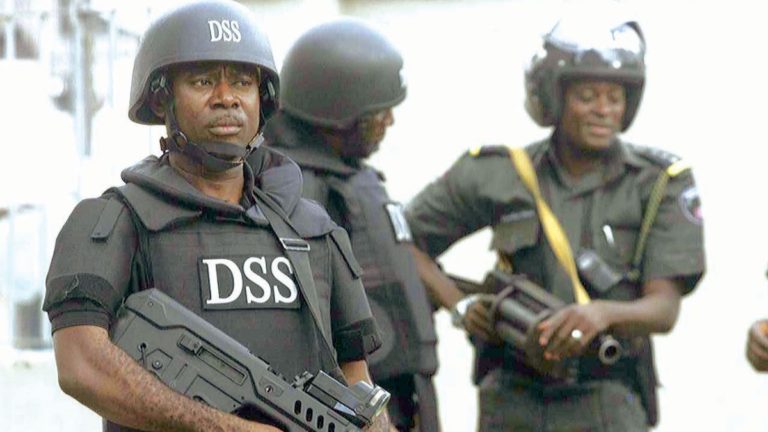
THE Department of State Services (DSS) says it has arrested some members of organised syndicates involved in selling the newly redesigned naira notes.
The security agency further disclosed that its operations across the country has established that some Commercial Bank officials are aiding the trade in the new currencies.
Spokesperson of the DSS Peter Afunnaya disclosed these in a statement on Monday, January 30.
“The Department of State Services (DSS) hereby informs the public that it has intercepted some members of organised syndicates involved in the sale of the new redesigned naira notes.
“In the course of its operations, in this regard in parts of the country, it was also established that some Commercial Bank officials are aiding the economic malfeasance,” the statement said.
The agency warns the currency racketeers to desist from the act, or face the wrath the law.
“Appropriate regulatory authorities are, in this same vein, urged to step up monitoring and supervisory activities to expeditiously address the emerging trends.”
The DSS added that the it had ordered its Commands and formations to further ensure that all persons and groups engaged in the illegal sale of the notes are identified.
The agency urged anyone with useful information relating to the issue to pass the same to the relevant authorities.
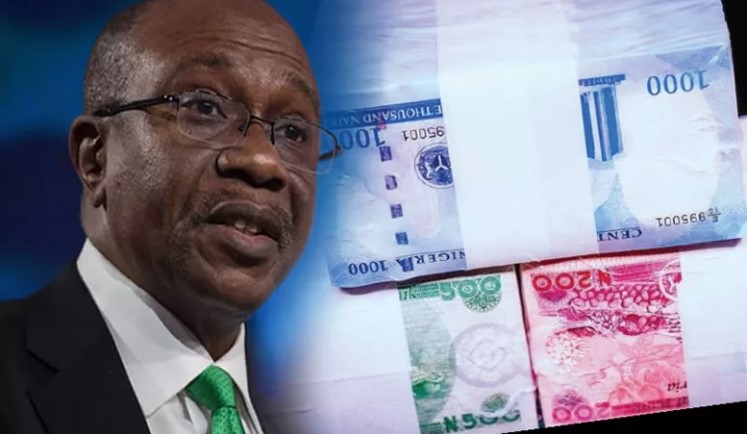
The Central Bank of Nigeria (CBN) finally bowed to pressure on Sunday, January 29 and extended the deadline for swapping old naira notes at commercial banks.
CBN governor Godwin Emefiele announced that the new deadline is now February 10.
He added that Nigerians will still be able to deposit their old notes directly with the CBN until February 17, 2023.
The CBN has been under immense pressure from Nigerians calling for the extension of the January 31 deadline due to their inability to swap their old N200, N500 and N1000 notes for the new ones.
THE Federal Government has backed the United States (US) government’s decision to impose visa ban on politicians and others who undermine the 2023 general elections.
The Minister of Information and Culture Lai Mohammed expressed the Federal Government’s endorsement of the plan while speaking at the 20th Edition of President Mohammadu Buhari Administration Scorecard Series (2015-2023) in Abuja, on Monday, January 30.
Mohammed stressed that the Buhari administration was committed to ensuring free, fair and credible elections.
Reacting to the statement issued by the United State Secretary of State, Antony Blinken on plans to slam a visa ban on some Nigerians believed to be responsible for undermining democracy and credible election in Nigeria, the minister said: “Let those who undermine our democracy be sanctioned, and let them carry their own cross.
“As a government, we have no reason to worry because our hands are clean.”
He added, “As a government, we are proud to say that no administration, since Nigeria’s return to democratic rule in 1999, has shown more fidelity to the democratic process than ours.
“No President, since 1999, has been as unambiguous as President Muhammadu Buhari, in word and in deed, with regards to leaving office after the constitutionally-stipulated two terms.”
Mohammed noted that Buhari had given unparalleled support to INEC by signing the Electoral Act 2022 into law and introducing other electoral innovations.
AN Abuja Federal High Court on Monday, January 30, dismissed a suit by a former presidential aspirant, Ambrose Owuru, to challenge President Muhammadu Buhari’s emergence as candidate of the All Progressives Congress (APC) in 2019.
Owuru contested the 2019 presidential election on the platform of the defunct Hope Democratic Party (HDP)
According to Punch Newspaper, the presiding judge, Justice Inyang Ekwo, threw out the suit on three significant grounds.
According to the judge, the suit constituted a gross abuse of the court process.
He also held that it was statute barred and an affront to the supremacy of the Supreme Court of Nigeria.
Justice Ekwo further held that the suit was baseless and frivolous.
Owuru had, in the suit, asked the court to declare the seat of the President vacant and swear him in as the authentic winner of the 2019 presidential election.
A British-trained constitutional lawyer, Owuru had instituted legal action against Buhari and the Independent National Electoral Commission (INEC).
Additionally, he asked the court to rule on the legitimacy or otherwise of INEC’s 2019 decision to move the poll from February 16 to March 23.
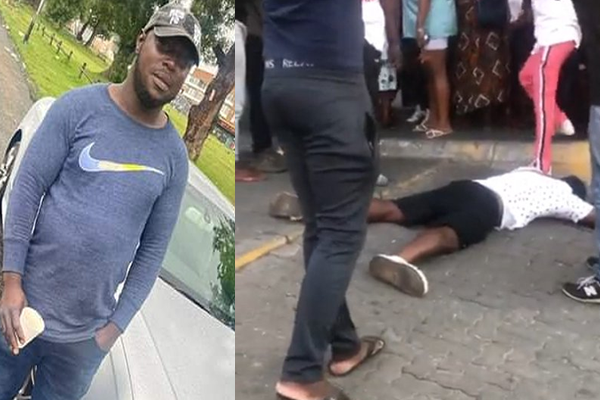
TWO Nigerian nationals were reportedly killed in Johannesburg, South Africa at the weekend amid a resurgence of attacks on foreigners in the country.
Although details of the incident are still sketchy at the time of filing this report, it was gathered that one of the deceased identified simply as Dashu was shot dead at Midrand Hyper in Johannesburg on Saturday, January 28.
Dashu is said to be a well-known trader around the Boulders Mall area in Johannesburg and was reportedly married to a Congolese woman with whom he had two children before he was brutally murdered.
The other deceased was gunned down at is a suburb of Johannesburg same day after the suspects allegedly called him by name to confirm his identity, before shooting him multiple times.
Recent reports of xenophobic violence and discrimination have continued to escalate in the country as migrants, refugees and asylum seekers remain at risk of attacks and hate speech.
Members of Operation Dudula march down a street in the Hillbrow neighborhood of Johannesburg and demand that businesses stop employing undocumented immigrants, on Feb. 19, 2022. //Source: NPR.ORG
Under the auspices of an anti-migrant group named “Operation Dudula” whose slogan is “Put South African First”, citizens of the country have united to force out immigrants who they claim, without evidence, are taking jobs, driving up crime and putting a strain on public services. South Africans turn their ire on immigrants from other African countries often resulting in violence.
In the World Report 2023, Human Rights Watch noted that these vigilante groups conduct door-to-door searches for undocumented foreign nationals, whom they blame for South Africa’s high crime and unemployment rates.
“In April, an anti-migrant mob killed a 43-year-old Zimbabwean national in Diepsloot, Johannesburg: in June, another mob set fire to the Yeoville market in Johannesburg, where mostly migrant shopkeepers rented stalls; and in September, a group of South Africans burned the homes of two migrant men in Plettenberg Bay, Western Cape,” the report noted.
It added that despite South Africa’s strong legal and human rights framework on refugees and asylum seekers, its asylum management system continued to fail many in need of protection.
In a memo dated 24th August, the Nigerian High Commission in Pretoria alerted Nigerians in South Africa to be vigilant and be cautious of their activities, in view of a planned attack on foreign citizens.
THE increasing number of invalid votes has been a major concern for Nigerians going into the 2023 general elections, as there may be a run-off of elections if the invalid votes are above or close to the margin of victory.
An invalid vote is a vote that doesn’t count when deciding who wins the election.
A closer look by The ICIR’s into the past presidential elections reveals that the number of invalid votes recorded in 2019 was higher than that of 2015.
Data obtained from the Independent National Electoral Commission, INEC, shows that the number of invalid votes gathered during the 2011 Presidential election was 1,259, 506 out of the 39,469,484 total votes cast.
The number dropped in 2015, as the electoral body recorded 844,519 invalid votes out of the total number of votes cast (29,432,083).
The invalid votes represent 3.19 and 2.87 per cent of the 2011 and 2015 presidential elections, respectively.
Infographics showing the number of invalid votes in the previous elections
However, the invalid vote was on the rise again in the 2019 presidential election as the electoral body recorded 1,289,607 invalid votes, which translates to 4.5 per cent of the total votes cast (28,614,190).
The All Progressive Congress (APC) won the election with a margin of about 3.9 million votes after gathering 15,191,847 votes across the country. The PDP emerged runner-up with 11,262,978 votes.
Meanwhile, The ICIR gathered that the invalid votes recorded in the 2019 election were far above the number of votes gathered by the other 71 parties.
The 71 parties altogether polled three per cent of the total votes cast by Nigerians.
The situation is no different despite multiple sensitisations and voter’s education before the recent gubernatorial elections that took place in Anambra, Ekiti and Osun state.
During the Anambra Governorship election in 2021, INEC recorded 8,108 invalid votes out of the 249,631 total votes cast.
In 2022, both Ekiti and Osun recorded 8,888 and 18,674 rejected votes during their gubernatorial elections, respectively.
What makes your vote invalid:
When assessing the validity of a vote, below are what makes a vote invalid and such will be rejected by INEC:
Disruption at the voting point will lead to the cancellation of votes.
Using ballot paper which is not officially produced.
A ballot paper having marks or any form of indentation.
Double thumbprint/ multiple thumbprints on a ballot paper.
Thumb printing outside the delegated box for thumbprints.
Using blank ballot paper to vote.
When a person intentionally spoils his or her ballot paper
The ballot is valid for a different constituency or polling unit
How can invalid vote be minimised
Speaking to The ICIR on how to minimise invalid votes in the 2023 elections, one of the officials of GoVote – a platform that educates Nigerians on how to register to vote, Aminu Muhammad Daban, said the best way to reduce the menace is by exposing the electorate to adequate awareness and voter’s education.
“I think it all boils down to electoral education and lack of adequate awareness on how to vote correctly without tendering their votes invalid,” Daban said.
Daban added that “It’s also because most people vote with their thumbs which are usually bigger than the box. At GoVote, we educate electorates on the need to vote correctly and how to vote correctly using their index fingers. We do this by carrying demo sessions with dummy ballot papers.”
According to him, the solution is to increase awareness and advocacy in rural areas, adding that INEC should also make the boxes in the ballot paper larger for an average thumb.
He said, “The solution is two ways: increase awareness and education on how to vote correctly through grassroots advocacy in rural and hard-to-reach communities. Also, INEC could try to make the boxes larger for an average thumb to fit in comfortably without exceeding or touching the lines.”
*Additional research was done by James Emmanuel.
Produced in partnership with the Centre for Democracy and Development (CDD) with support from Foreign and Commonwealth Development Office (FCDO).
NIGERIANS in the Diaspora have been excluded from the ongoing cash swap programme launched by the Central Bank of Nigeria (CBN) and are left stranded with the old banknotes as no provision has been made to accommodate them in the programme.
The cash swap programme is part of efforts by the CBN to fast-track on its naira redesign initiative by facilitating the circulation of the new naira notes, especially across local government areas and unbanked communities in Nigeria through agency banking that allows banks to offer their banking services without having traditional branches in areas that do not have easy access to financial services.
Governor of the CBN Godwin Emefiele, disclosed last December that more than 80 per cent of the currency in circulation was outside the vaults of commercial banks and that the naira redesign policy would aid cash mop-up.
“The integrity of a local legal tender, the efficiency of its supply as well as its efficacy in the conduct of monetary policy are some of the hallmarks of a great Central Bank.
“We believe that redesigning the N200, N500 and N1000 bank notes, will certainly reduce the cost of cash management, reduce the volume of cash in circulation, disrupt counterfeiting activities and enhance the adoption of digital and electronic transactions,” Emefiele said.
Reacting to the cash swap programme, some Nigerians in the Diaspora have lamented the lack of provision for them to also exchange their old banknotes for new ones, as the CBN has announced that all old N1000, N500 and N200 notes would cease to be legal tender after February 10.
A Nigerian residing in the United States, Colin Udoh, has asked the Nigerians in Diaspora Commission (NIDCOM) to intervene in the situation as many Nigerians abroad are stuck with old banknotes with nowhere to exchange them.
“I have some old naira notes with me. So far, I haven’t seen or heard of any plans by the Central Bank of Nigeria for folks in Diaspora with old naira notes to exchange theirs,” Udoh said.
Another Nigerian in the Diaspora, Johanna Fadeyi, explained that many Nigerians abroad have what they call “loose change” that can range between N1000 and N100,000, which they use to sort out expenses at the airports since Nigeria was still largely a cash economy.
Responding to the appeal, Chairman and Chief Executive Officer of NIDCOM Abike Dabiri-Erewa expressed utter surprise to hear that Nigerians abroad were in possession of naira notes.
Tweeting with her official handle @abikedabiri she wrote: “Do Nigerians in Diaspora keep or spend Naira notes abroad? Am I missing something??”
Dabiri-Erewa’s reaction confirmed that more than 17 million Nigerians living abroad were not considered in the naira redesign policy.
A Nigerian physician Pedus Eweama has been bestowed with the Community Citizen of the Year Award in Australia, in recognition of his work on community development and the health sector.
The Citizen of the Year Awards are presented at Australia Day events in Councils across South Australia, to acknowledge unsung heroes across communities who through their contributions make the society a better place.
Eweama, who was among 12 outstanding nominees, is a Nigerian-Australian medical practitioner and community leader who has made meaningful contributions to the Australian community within the multi-cultural leadership space.
In a congratulatory letter by the Chairman and Chief Executive Officer of the Nigerians in Diaspora Commission (NIDCOM) Abike Dabiri-Erewa, she described the recognition of Eweama’s service as not only well deserved but timely.
According to her, earning the prestigious recognition of “The Community Citizen of The Year” in a foreign land showed that Eweama was a grassroots person, working for the progress of humanity.
“As part of the 2023 Australia Day celebrations across Australia, local governments recognize community heroes who have made significant contributions to the development of their local communities.
“It was in keeping with the tradition that Dr. Pedus Eweama was announced as 2023 ‘The Community Citizen of The Year’ for the City of Swan in Western Australia,” she said.
Dabiri-Erewa implored all Nigerians in the Diaspora to keep the flag flying and be good ambassadors of Nigeria through their character, conduct and attitude.
Eweama who hails from Imo State in South Eastern Nigeria, is a leading authority in strategic health policy reforms and innovation, with close to 20 years’ experience working in healthcare delivery and administration of public, private enterprises and not-for-profit organizations.
He is the current Chairperson of Nigerian Association of Western Australia (NAWA) and the Chairperson of the Council of Nigerian Associations Presidents in Australia (CoNAPA), the peak leadership forum for all Nigerian national associations in Australia.
NOT less than 11 persons were burnt to death in an auto crash involving a commercial passenger bus and a truck in in Ondo State on Sunday, January 28.
The incident, according to the Federal Road Safety Corps (FRSC), happened on Soka Bridge along the Benin-Ore Expressway in Odigbo Local Government Area of the state.
FRSC Commander, Ore Unit, Sikiru Alonge, blamed the accident on “one-way driving”.
He said the truck had a head-on collision with a passenger bus.
“The trailer passed through one way and, in the process, collided with the Marcopolo bus which was coming from Benin Road,” Alonge said.
“The bus caught fire in the process.”
He said the incident caused traffic congestion along the route.
“The fire has been extinguished, while the traffic is being controlled on the Benin/Lagos lane,” he added.
The FRSC commander noted that efforts were on top gear with other security agencies to remove crashed vehicles from the road.
Alonge urged motorists to always obey all traffic rules to avert further tragedy.
THE Federal Capital Territory (FCT) Police Command foiled an armed robbery attack in the Kabusa area of Abuja on Saturday, January 28.
Spokesperson of the Command, Josephine Adeh, in a statement released on Sunday, January 29, said the police responded to a distress call when members of an armed robbery gang were operating in the area.
The statement said the operatives of the Kabusa Police Division responded to the incident at ECWA 2 community of Kabusa Village.
“On receipt of the report, the police operatives swiftly mobilized to the scene in collaboration with the locals. The hoodlums, on sighting the police team, opened fire at them, and a gun duel ensued,” the statement said.
The statement added that the superior gunfire of the police led to one of the armed robbers being killed while others fled with bullet wounds.
Two residents injured by the hoodlums were taken to the hospital, where they were treated and discharged. The armed robber was confirmed dead by the medical doctor on duty.
The statement further noted that efforts are being made to arrest the fleeing gang members.
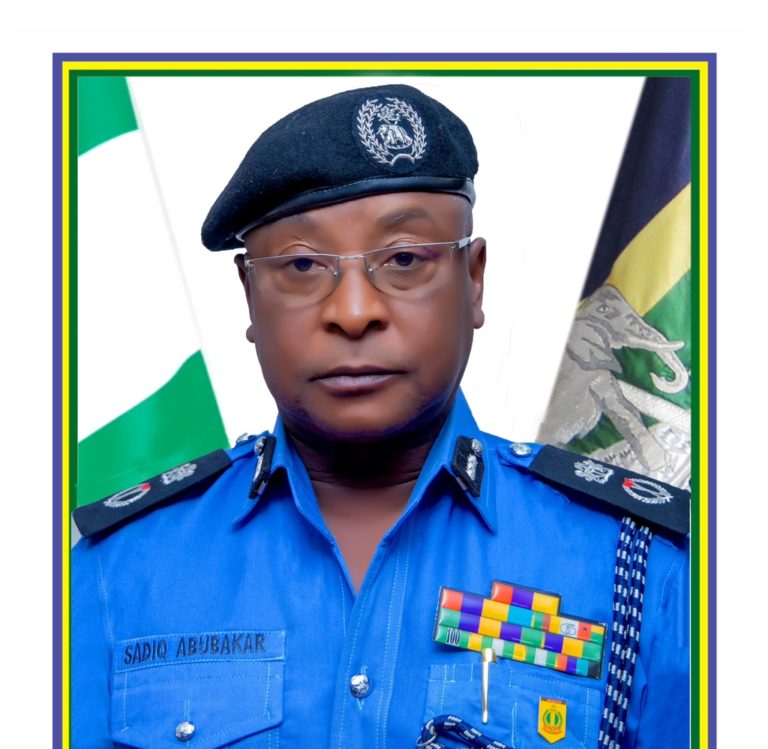
Meanwhile, the Commissioner of Police in FCT, Sadiq Abubakar, has applauded residents for their prompt notification and support to the police.
He assured that, while efforts are intensified to prevent any threat to public safety, incidents of crimes as such would be appropriately confronted and promptly nipped in the bud.
The Commissioner urged the public to maintain vigilance and report suspicious activities to the police.
OPERATIVES of the National Drug Law Enforcement Agency (NDLEA) have dismantled a trans-border drug cartel and arrested five leaders of the syndicate.
NDLEA, in a statement signed by Femi Babafemi on Sunday, January 29, said the members of the syndicate, which operate in different parts of the world, were arrested in a special operation that lasted for weeks.
He added that different quantities of drugs and air compressors used to conceal and distribute them globally were recovered during the operation.
“The special operation came on the heels of a warning by the Chairman/Chief Executive of the Agency, Brig. Gen. Mohamed Buba Marwa (Retd) said that drug barons and cartels would have it rough in 2023 if they fail to back out of the criminal business.
“Leaders of the cartel, which spreads across Dubai, UAE; Cotonou, Benin Republic; Togo; Oman, Thailand and Europe, as well as Lagos, Imo and Onitsha in Anambra state, had while on Christmas and New Year holidays in their villages were still coordinating efforts to send their illicit consignments to Dubai and other parts of the world.
“Their lid was blown open on Thursday, 29th December 2022, when their freight agent, Onyeisue Collins Chukwudi, was arrested by NDLEA officers at the SAHCO export shed of the Murtala Muhammed International Airport, MMIA, Ikeja Lagos, for attempting to export three big automobile air compressors to Dubai,” Babafemi said in the statement.
Arrested Freight agent, Onyeisue Collins Chukwudi
The statement added that a quick follow-up operation led to the recovery of additional five compressors at Chukwud’s home at 24 Legacy road, Ayobo area of Lagos.
According to the Agency, 27.50kgs of skunk were taken out of the air compressors after welding equipment was used to cut them open.
Further investigations by the NDLEA revealed that the freight agent was working for a bigger organized criminal group.
“As a result, extensive operational tools were deployed to track the first kingpin, Onuoha Peter Obioma, who lives in the Benin Republic and Togo but comes occasionally to do business in Lagos.
“The efforts paid off on Saturday, 7th January 2023, when Obioma walked into the waiting arms of NDLEA operatives with a bag containing additional air compressors used to conceal 15.7kgs skunk and a crystalline substance that later tested positive to methamphetamine after the Agency’s sniffer dogs identified compressors with drug concealment.”
According to the NDLEA, Obioma’s statement led to the unravelling of two other leaders of the cartel: Dubai-based Ugo Kelechi Alex (aka KC) and Iwueke Ugochukwu (aka Odugwu), an Onitsha, Anambra based businessman.
The anti-narcotic Agency said in a well-coordinated operation carried out on Tuesday 10th, January at the ancestral homes of the Kingpins in Imo State, the arrowhead of the cartel identified as Ezenwekwe Obinna Nicodemus, an automobile parts dealer at Alaba International market, Lagos was put under surveillance.
“A Lexus SUV and a Toyota jeep were recovered from Kelechi and Iwueke.
“After so many dramatic bids to evade arrest, NDLEA operatives eventually pinned Obinna down at a bar in Mazamaza, Mile 2 area of Lagos on Saturday 14th January.
The Agency added that a search of his home led to the recovery of 607 grams of ephedrine, a handful of Cannabis weighing 20 grams, and other paraphernalia, including 271 grams of dimethyl sulfone used as a cutting agent for ephedrine.
Also recovered were a chemical precursor, an active ingredient for the production of methamphetamine, a weighing scale and an International passport.
Meanwhile, the NDLEA said no fewer than 2,601.5 kilograms of Cannabis and 102,500 pills of pharmaceutical opioids were seized during interdiction operations across Plateau, Edo, Delta, Taraba, Kogi, Kano, Lagos, and Adamawa states in the past week.