CHIEF Press Secretary (CPS) to the Governor of Anambra State, Christian Aburime, has said Governor Chukwuma Soludo’s appeal for the release of the detained leader of the Indigenous People of Biafra (IPOB), Mazi Nnamdi Kanu, was not politically motivated.
The ICIR had earlier reported that Soludo appealed to the Federal Government to release the leader of the Indigenous People of Biafra (IPOB), Nnamdi Kanu, in order to resolve security challenges bedeviling the South-East.
Soludo specifically urged the Federal Government to release Kanu to him, saying he was willing to stand as surety for the IPOB leader.
However, IPOB had faulted the governor’s gesture. The group said it rejected Soludo’s offer to stand as surety for Kanu.
The governor has also come under attack over the offer, with many describing his gesture as politically motivated.
Reacting to the development, Aburime stated that Soludo’s call for Kanu’s release was borne out of a genuine desire to restore peace to the South-East.
Aburime added that the governor understood the need for the IPOB leader to speak to the people of the South-East in order to address the high level of insecurity in the region.
The Press Secretary expressed regrets that some people had attached wrong motives and political meaning to the “genuine” appeal made by the governor.
He stressed that Soludo neither consulted other South-East governors nor spoke on their behalf “but spoke in his capacity as the governor of Anambra State”.
According to him, the governor observed that insecurity in the region has continued to surge since the detention of the IPOB leader.
Although Information and Communication Technology (ICT) has become a relevant part of human life, availability and access to ICT education is a challenge to many pupils and students in the FCT. In some government-owned schools, shortage or absence of devices, dilapidated computer labs and teachers with inadequate ICT training limit the quality of education acquired by students and pupils, IJEOMA OPARA reports.
Maryam Ibrahim had always hoped that her first son, Kareem, would pursue a career in technology when he grew up.
She had heard about young people doing innovative things in technology, which sparked her interest in having one of her children explore the sector.
“One of my boss’ children lives in Europe. The last time he came to Nigeria, he told me he was into tech. I think that is what the world is focused on now, and I want my own son to be a part of it,” she said.
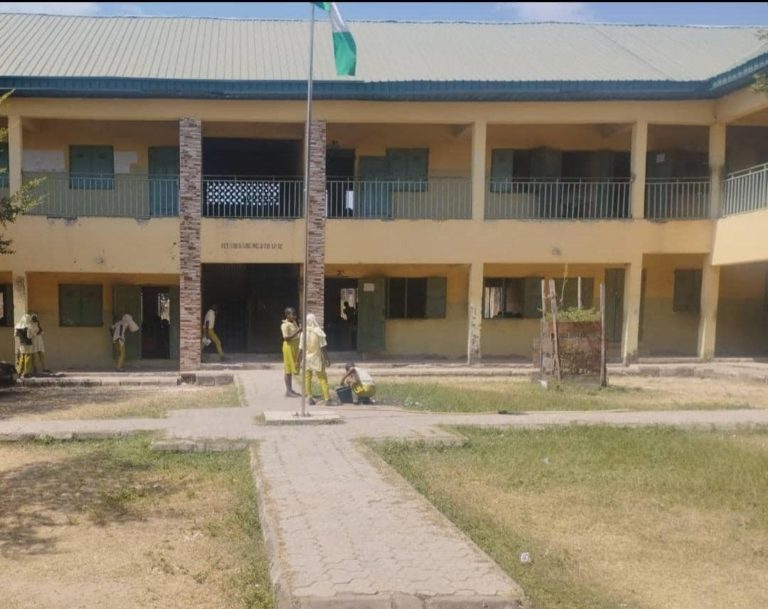
However, her dreams hang in the balance because her son’s school, LEA Nomadic Primary School, Wassa in the FCT, does not have a computer laboratory.
LEA Nomadic School, Wassa. Photo: The ICIR.
She told The ICIR that when she realised her son’s school did not properly teach him computer studies, she attempted to find a special class for computer studies but could not afford it.
“I asked one man around my place if he could teach him computer studies, but I could not afford his fees because I also have to pay for the school fees of my other children,” Ibrahim said.
Her son is one of the many pupils and students in the FCT that are denied quality access to computer studies.
Beyond the opportunities that ICT offer as a career path, computer studies have also been found to improve learning for children.
A United Nations Children’s Fund (UNICEF) report stated that the learning process, especially for children, could be enhanced by technology, even in pre-schools, to improve learning skills.
“One of the critical areas where technology has highly improved understanding is critical thinking, as students are empowered to approach and exploit opportunities with courage and potential. Further, digitisation has enabled students to move into an era of digital learning, spearheaded by ICT’s adoption as an interconnected environment.
“ICT has helped institutions make more informed decisions that have led to the adoption of measures responsible for upholding the economy and environment’s integrity. Through this, a transformative, comprehensive, and higher quality education system is brought forward,” the report read in part. However, this is not the reality in government-owned primary schools within the FCT.
To ascertain the state of ICT education in the FCT, The ICIR visited some government-owned primary schools in the FCT, including the LEA Primary School, Karon-Majigi.
Like Kareem’s school, it was also observed that pupils had no access to computer education.
No practical computer studies in secondary schools
While ICT is rarely taught in government-owned primary schools, it is often not treated as a practical subject in junior secondary schools.
In some junior secondary schools visited by The ICIR, it was observed that students are only taught the theoretical part of computer studies with minimal practice.
The ICIR visited the Junior Secondary School, Life Camp, where it was observed that computer studies are mainly limited to theory.
One of the teachers at the Junior Secondary School, Life Camp, who refused to disclose their identity for lack of authorisation to speak, confirmed to The ICIR that Computer Science was being taught mostly as a theory than a practical subject.
“We have a lab. But if you want the child to be all that literate, maybe you will enrol them in extra classes. What we really do here is more of theory at their level. But when they go to the senior level, they start practical theory,” the teacher said.
When confronted with possible difficulties with understanding, the teacher said that was the training required at their level.
“All those private schools teaching practicals in junior secondary and primary levels are just stressing the children’s brains. There is a procedure to education, and there is what you give to a child at a particular age. If you read education very well, you will know what you are supposed to give to a child.
“We are not in the western world. We teach according to the scheme. That is the problem that private schools have. They know the practicals but they don’t know the theory. But if they learn the theory well, when they see the practical, they can perform it. For junior schools, it is alternative-to-practical,” the teacher said.
A student of the school who spoke to The ICIR said although she had basic computer skills, she mostly learnt from her brother.
“They teach us computer in school, but most of what I know, I learnt from my brother at home. He teaches me with his laptop. Our teachers teach us on the board, and we do a bit of practical. But my brother teaches me more with his laptop,” she said.
The National Policy on Education (NPE), as revised in 1988 and again in 2004, requires teaching computer science as a discipline and integrating the same into school administration and instruction.
The NPE further states that at every level of the educational system, modern education techniques shall be increasingly used and would be improved on. However, this is not the reality in some FCT schools.
According to a report by the Universal Basic Education Commission (UBEC) titled “2018 National Personnel Audit Report on Public and Private Basic Education Schools In Nigeria,” released in October 2019, only about 3,609 computers are available to pupils in 63,798 public primary schools.
A visit to the Junior Secondary School, Gwagwalada, showed that the situation was similar.
The ICIR was restricted from accessing the computer lab, but some staff members noted that the subject was being taught at the school.
Students also confirmed that there were occasional practical classes on the subject, but many admitted to having limited ICT skills.
Junior Secondary School, Gwagwalda.
Speaking to The ICIR, a director at the FCT Universal Basic Education Board (FCT-UBEB) Bashir Abubakar said concerted efforts were being made by the government and some Non-Governmental Organisations (NGOs) to train both teachers and students in ICT.
He noted that a lack of funds was making results relatively slow.
“Concerning computer education for students, we have collaborations with some NGOs. And training is ongoing on a termly basis and in different subjects too. In fact, at the beginning of this month, we, the management, were invited for a one-day training in Nassarawa by one of our collaborators that handle computer issues with the primary section.
“JSS Gwarinpa Estate, the last point I served, I was privileged to get a centre, Digital awareness centre, built by the NCC. They provided computers, generators, and everything in total for that school on ICT. This is besides what the FCT-UBEB does. We have a professional training department headed by a director. As I speak to you, quality education evaluators are attending training at JSS Jabi 2 right now.” he said.
The National Coordinator of Education Rights Campaign, an organisation focused on improved education advocacy, Hassan Soweto, told The ICIR that ICT studies must be effectively integrated into education for Nigerian schools from the primary level.
“Primary school is the foundation of learning. If you look at other economies where ICT has become a major factor in their economic development, you will see that teaching ICT starts in primary and secondary schools.
“If Nigeria is to harness the potential of ICT with regards to the fast-changing nature of the economy, it must ensure that it funds ICT education right from the primary and secondary schools,” he said.
Soweto added that a lack of funding and commitment contributed significantly to the poor state of ICT education in Nigeria.
He also said education in Nigeria did not match the changing realities of the country’s economy.
“This only goes to show that the Nigerian education system is not in any way linked to Nigeria’s economic goals. The syllabi of Nigerian schools are completely outdated.
“The crisis of education underfunding is responsible for the problem that we are facing now. Without developing the capacity of the teachers, establishing the infrastructure like the computer labs, you are not going to be able to achieve the reforms. So, funding is an extra factor at the level of primary, secondary and tertiary education,” he noted.
Until education is properly funded, ICT practically taught, and infrastructure adequately provided, children like Kareem may not be able to achieve their dreams.
*This report is a part of Youth Hub Africa’s Basic Education Media Fellowship 2022 with support from the Malala Fund and Rise Up.
THE Centre for Journalism Innovation and Development (CJID), in collaboration with the Canadian Funds For local Initiative (CFLI), will on January 31 hold a conference on ‘Media Freedom Symposium: Elections 2023 Security, Media and Safety’ to commemorate the International Day to End Impunity for Crimes against Journalists.
According to a statement released by the CJID on Tuesday, January 24, the conference is in response to the continued threats to the safety of journalists and fear of what could emerge in the wake of the 2023 elections.
The event will bring together a range of experts in media policy, the media industry, judicial/legislative sectors, security personnel, frontline actors, and relevant international and local non -governmental organisations to reflect and proffer insights on how to protect journalists and media workers ahead of, during and post-2023 general elections.
Deputy Manager of the Media Freedom Project, Ms Stephanie Adams-Douglas said, “The question of safety is central to journalists’ performance of their duties without fear or interference, yet more and more democratic governments and elected officials resort to authoritarian tendencies in the resolution of media-state conflicts.
“Additionally, election periods are typically notorious for attacks on journalists and for stifling the media ecosystem in the hope of constraining the spaces of democratic accountability, human freedom, and citizens’ liberties.”
The Centre added that the symposium aims to push an agenda for engaging security personnel and political parties regarding the protection of the Nigerian Press.
The security agencies and political parties will hopefully join in drafting and adhering to a pact to protect journalists and the press ahead of and during the elections, according to the CJID.
THE Coalition for Whistleblower Protection and Press Freedom (CWPPF) has condemned the recent attack on the Lagos office of the Media Rights Agenda (MRA) by unknown persons.
In a statement released on Tuesday, January 25, the Coalition described the attack as one of many repressive practices in the coordinated onslaught against media and press freedom in Nigeria.
Parts of the statement read: “Over the years, the MRA has remained a critical pillar advancing the protection of digital rights and press freedom in Nigeria – two defining components of our nascent democracy. We are deeply concerned by the carting away of laptops, hard drives and other devices worth millions of naira, containing sensitive information from years of diligent and impactful work.
“This attack is one of many repressive practices in the coordinated onslaught against the media and press freedom in Nigeria. However, like other ones in the past, it will not dampen our spirit, affect our capacity to carry out our work of promoting and defending media freedom, freedom of expression and access to information in Nigeria.”
The Coalition called on the police and other security agencies to intensify investigations to arrest the attackers, unravel the motive behind the act and recover the items that were carted away.
CEWPF further reiterated the unwavering commitment of the MRA and its partners in supporting and entrenching the ideals of democracy in Nigeria.
THE Central Bank of Nigeria (CBN) maintains there is no going back on its January 31 deadline for the old N200, N500 and N1,000 notes to expire as legal tender.
The CBN Governor, Godwin Emefiele, reiterated the apex bank’s stance after the Monetary Policy Committee meeting, today.
Emefiele, seemingly unbothered about wide concern on unavailability of the redesigned naira notes, argued that the apex bank had given the people enough time to swap their old naira notes for new ones.
To him, kidnapping and ransom-taking had reduced since the three bank notes were redesigned.
Many Nigerians have been lamenting unavailability and scarcity of the new notes, saying banks were still giving out the old naira notes to customers, with the deadline barely a week away.
Some automated teller machines our correspondent visited today were not even dispensing any note. At the Stanbic IBTC on Ijaye Road, Ogba, and the Zenith Bank at Ogba Aguda, both in Lagos, the machines had no money in them. There were five empty machines at the Zenith Bank branch and three at the Stanbic IBTC.
Also, there was no naira note in the two ATMs at the Zenith Bank branch on Acme Road, Ikeja-Ogba.
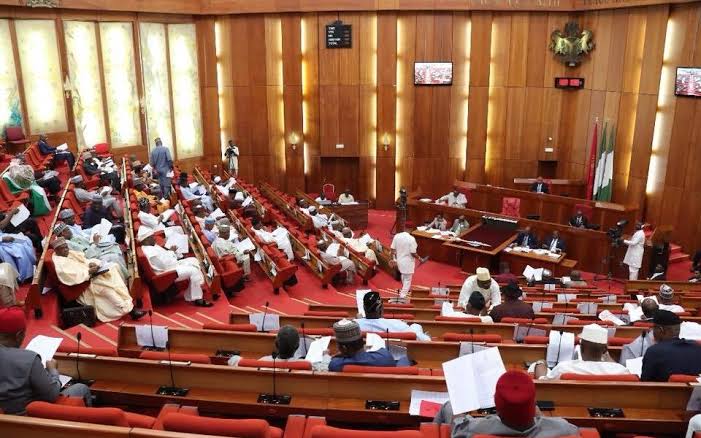
Meanwhile, the Senate at plenary today urged the CBN to extend the withdrawal date of the old naira notes from January 31 to July 31.
Moving the motion, Sadiq Suleiman, (APC Kwara), recalled that the Senate had resolved on December 28, 2022 to urge the CBN to extend the use of the old notes from January 31 to June 30, 2023.
Suleiman said there should be worry the apex bank had insisted on terminating the use of the old naira notes by the end of January.
He said there were not enough of the new naira notes in circulation and as such, moved a motion that the date should be extended to July 31.
He said, “Experiences around the world have shown that such abrupt decision, if not controlled, usually created chaos.”
Supporting the motion, Senator Ibrahim Hadejia (APC-Jigawa) said that the call for extension was for their constituents, and not for their (lawmakers) personal benefits.
Hadeija said, “In my constituency, no Automated Teller Machine (ATM) is dispensing the new notes.”
Similarly, Senator Adamu Aliero (PDP-Kebbi) said that the policy would inflict untold hardship on people living in the rural areas.
“The CBN governor should be invited,” Aliero said.
Senator Adamu Bulkachuwa (PDP-Bauchi) said that the extension was necessary otherwise there would be chaos.
Senator Biodun Olujimi (PDP-Ekiti), who said about 90 per cent of people in her local government area had not seen a glimpse of the new naira notes, called on the apex bank to “look away from the elections.”
Olujimi said that if the date was not extended, it would lead to collateral damage, which she believed would not augur well for the economy.
Senator Ali Ndume (APC-Borno) called on the Senate to use its oversight responsibility on the CBN to “order the CBN governor to extend the date.”
Saying that the power of the senate should not be played down, he called on the senators to stand firm on the call for extension.
Senator Sam Egwu (PDP-Ebonyi) was, however, the only senator who opposed the motion.
“Nigerians do not have the culture of keeping their money in the bank,” Egwu said.
“It is in Nigeria where cash is used arbitrarily; other countries use electronic means,” he added.
In his remarks, the Senate president, Ahmad Lawan, said that most of the senatorial districts did not have banks.
He said, “In rural Nigeria, there are no banks and people transact businesses with cash more often. There is no doubt that we must have a window for exchange. We must have policies by the CBN to have bank branches established in rural areas.
“We need this extension for the most ordinary Nigerians,” Lawan said.
CHILD rights organisation Save the Children (SCI) has called on the Nigerian government to increase funding for the educational sector.
The organisation also condemned the rising number of out-of-school children in a statement released on Tuesday, January 24 to commemorate the International Day of Education.
It urged the government to resolve the literacy crisis plaguing the country.
“Save the Children International (SCI) Nigeria calls upon the government to ensure accessible, inclusive, safe, quality and free primary and secondary education that promotes lifelong learning opportunities for all children to realise and release their full potentials.
“To this end, we reiterate our demands for the Nigerian government’s fulfilment of H.E. President Muhammadu Buhari’s commitment at the GPE Global Education Summit to increase education funding to 14% by 2022, 16.7% in 2023, 20% by 2024, and 22.5% by 2025,” the statement signed by Media and Communications Manager Kunle Olawoyin, said.
The organisation also called for the implementation of the National Plan on Financing Safe Schools to guarantee safety of staff and students.
SCI noted that funding the education sector would hasten economic growth in the country and harped on the importance of investing in girl-child education.
“Education has been recognized globally as a veritable and strategic venture pivotal to the economic transformation of any nation. Save the Children urges for the prioritization of girl child education and investing more in it to ensure no one is left behind in the race to agenda 2030.
“Save the Children encourages the training and retraining of teachers to be prioritized so that the children can get better life skills and knowledge required to make their future brighter. Education offers children a ladder out of poverty and a path to a promising future,” the statement added.
Nigeria is battling a literacy crisis with over 20 million out-of-school children, according to the United Nations Educational, Scientific and Cultural Organization (UNESCO).
The ICIRreported that fees demanded by government-owned schools in the FCT are contributing to the rise in the number of out-of-school children in the country. Many parents are unable to afford the cost of education due to harsh economic realities.
THE private sector and bank debtors may have further been exposed to higher risks of manufacturing costs and loan repayment interests, with the Central Bank of Nigeria (CBN) raising, today, interest rate to 17.5 per cent.
The Monetary Policy Committee (MPC) of the CBN voted at its meeting to increase the benchmark interest rate by 100 points to 17.5 per cent. This was a 10 per cent increase from the previous 16.5 per cent hike fixed in November 2022.
This is the fifth time the CBN would be increasing the interest rate.
The CBN governor, Godwin Emefiele, announcing the new rate when reading the communique of the first MPC in the year, said previous increases were beginning to yield results with the slight drop in the inflation rate recorded in December 2022.
Emefiele stressed the need for the apex bank to keep tightening its fiscal policy.
Economists and industry watchers did not see the rate hike as a good development for the private sector, saying high lending rate would suffocate businesses.
“The hike in interest rate will hurt investors and the private sector, especially those in the real economy and enterpreneurs. As long as you are in production, and you borrow from the bank for your business, this hike in interest rate will hurt you, for it exposes your risk,” an economist and Executive Director, Centre for the Promotion of African Economies, Muda Yusuf, told The ICIR.
Yusuf says private sector will be strangulated by rate hike
“This is a time businesses are going through various challenges in exchange rate, high cost of diesel, cost of transportation and insecurity. Hiking of rate is compounding their problems,” Yusuf said.
He disagreed with Emefiele on increasing lending rate as a strategy to curb inflation.
Another economist, Kelvin Emmanuel, said overlending to the Federal government through unregulated means was a major factor that fuelled the current hike in interest rate.
“Inflation has continued to accelerate because of this unregulated lending through ways and means to almost N23 trillion. Inflation is now taking its toll on lending rate. This will choke the private sector further and put them in more distress,” Emmanuel said.
The CBN also retained the Cash Reserve Ratio (amount of cash commercial banks are expected to keep in CBN’s vault) at 32.5 per cent, while the liquidity ratio was kept at 30 per cent.
The apex bank had increased the MPR from 11.5 per cent earlier last year to 16.5 per cent across four consecutive rate hikes in 2022.
Emefiele said the committee took the decisions to rein in inflation.
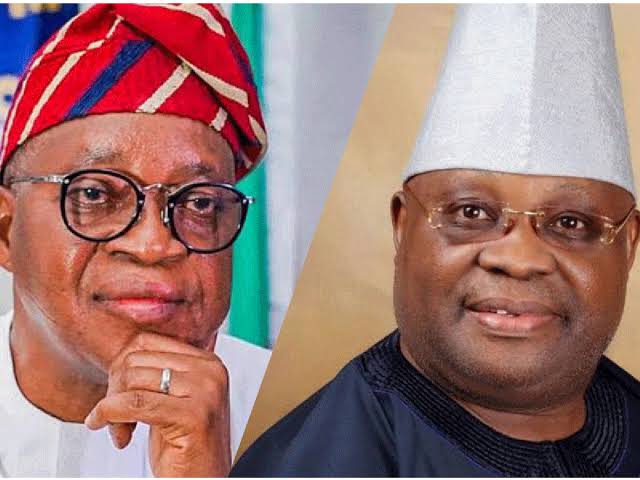
THE Osun State Governorship Election Petition Tribunal will on Friday, January 27, deliver judgment on the petition filed by former governor Gboyega Oyetola against Ademola Adeleke’s victory in the poll.
The Justice Tertse Kume-led panel issued the notice through the tribunal Secretary, David Umaru, on Tuesday, January 24.
Umaru stated in a short message pasted on the tribunal’s notice board that proceedings will commence by 9:00 am.
“EPT/OS/GOV/01/2022 Adegboyega Isiaka Oyetola & Anor and Independent National Electoral Commission (INEC) & 2 ORS”.
“The tribunal will deliver judgement in the above matter on Friday, January 27, 2023 at 9am,” the notice read.
Oyetola and the All Progressives Congress (APC) had challenged the outcome of the July 16 poll, won by Adeleke of the Peoples Democratic Party(PDP), alleging irregularities and over voting in 749 polling units across ten local government areas of the state.
Parties in the matter, which include the Independent National Electoral Commission (INEC), had on Friday, January 13, adopted their final written addresses after calling of witnesses and tendering of evidence before the panel.
THE Police Service Commission (PSC) has said extending the tenures of senior retiring police officers is against existing laws.
The PSC insisted that every police officer due for retirement before the general election must leave.
It added that there could never be any leadership vacuum in the Nigeria Police Force (NPF).
The Commission said this in a statement signed by Ikechukwu Ani, Head, Press and Public Relations on Tuesday, January 24.
“Rising from a Management Meeting on Monday, January 23rd 2023, in Abuja, the Commission said the ongoing campaign for the extension of the tenures of some Deputy Inspectors General (DIGs), Assistant Inspectors General (AIGs), Commissioners (CPs) and other senior Police Officers was an unnecessary distraction and an affront on all the existing laws in the country guiding entry and exit in the public service.
“The Commission took a decision that it will not extend the tenures of the retiring senior Police Officers, stressing that even when requested, it can not do so as it is against all existing laws, the Police Act, the Police Service Commission Act and the Constitution of the Federal Republic of Nigeria,” the PSC said.
The PSC stressed that there is an institutional succession plan in the Nigeria Police Force, especially with the current injection of 10,000 Constables and several thousands of cadet ASPs from the Police Academy every year.
The Commission assured Nigerians that there would be no vacuum in the hierarchy of the Police with the touted retirement of hundreds of senior Police Officers.
The statement added that the Commission would rigidly uphold the provisions of the law, which stipulate that a serving public Officer, whether in the Police or any other Government Agency, must exit the service at the age of 60 or after having served for a period of 35 years.
Meanwhile, on Monday, January 24, the PSC denied ever endorsing the tenure elongation of the Inspector General of Police Usman Alkali Baba.
Baba is to attain the retirement age of 60 years in March 2023.
The Commission, in a statement, said it would commit itself to the letters and spirit of the laws of the land and would not at any time support or encourage any attempt to subvert the law.
This is coming after the Police Affairs Minister, Mohammed Dingyadi, said last week that the IGP would not be retiring when he turns 60 on March 1.
.
President Muhammadu Buhari appointed Baba as IGP in April 2021 after former IGP Mohammed Adamu turned 60.
The PSC is saddled with the Constitutional mandate to recruit, promote, dismiss and exercise disciplinary control over persons holding offices in the NPF.
THE National Assembly has transmitted 35 Constitution amendment bills to President Muhammadu Buhari for assent.
The Senate on Tuesday, January 24, directed the Clerk of the National Assembly to transmit the amendment bills that met the requirement for assent as provided in Section 9(2) of the 1999 Constitution.
According to the Senate, the concerned bills have been approved by at least 24 state assemblies as required by law. A total of 44 amendment bills were considered but 35 met the requirement.
The state assemblies did not vote on the alteration of the Constitution and as a result, the two bills that seek to grant financial and legislative autonomy to local governments did not meet the requirement for being assented into law.
Presenting the report, Senator Opeyemi Bamidele identified Abia, Adamawa, Akwa-Ibom, Anambra, Bauchi, Bayelsa, Benue, Borno, Cross-River, Delta, Ebonyi and Edo states as some of the states who have presented their resolution on the bills.
Others are Ekiti, Enugu, Imo, Kaduna, Kano, Katsina, Kogi, Lagos, Nasarawa, Niger, Ogun, Ondo, Osun, Rivers and Yobe.
The Senate also asked nine state assemblies yet to submit their resolutions on the bills to do so.
The states yet to forward their resolutions are Gombe, Jigawa, Kebbi, Kwara, Oyo, Plateau, Sokoto, Taraba and Zamfara.
Here is a complete list of the bills considered by the 27 states.
1. Constitution (Fifth Alteration) Bill No 3 (Change of Names of Afikpo North and Afikpo South Local Government Areas (Ebonyi State)
2. Constitution (Fifth Alteration) Bill No 4 (Change of Name of Kunchi Local Government Area (Kano State)
3. Constitution (Fifth Alteration) Bill No 5 (Change of Names of Egbado North and Egbado South Local Government Areas (Ogun State)
4. Constitution (Fifth Alteration) Bill No 7 (Correction of the name of Atigbo Local Government Area (Oyo State)
5. Constitution (Fifth Alteration) Bill No 8 (Correction of Name of Obia/Akpor Local Government Area (Rivers State)
6. Constitution (Fifth Alteration) Bill No 9 (Financial autonomy of State legislatures and State Judiciary)
7. Constitution (Fifth Alteration) Bill No. 10 (Enforcement of Legislative Summon)
8. Constitution (Fifth Alteration) Bill No. 11 (Inauguration of Members-Elect)
9. Constitution (Fifth Alteration) Bill No. 21 (Deletion of reference in the Constitution to the provisions of the Criminal Code, Penal Code, Criminal Procedure Act, Criminal Procedure Code or Evidence Act)
10. Constitution (Fifth Alteration) Bill No. 22 (Provision for Intervening Events in the Computation of Tine for the Determination of Pre-Election Petitions, Election Petitions and Appeals therefrom)
11. Constitution (Fifth Alteration) Bill No. 24 (Expansion of the Interpretation of Judicial Office)
12, Constitution (Fifth Alteration) Bill No. 25 (Appointment of Secretary of the National Judicial Council)
13. Constitution (Fifth Alteration) Bill No. 29 (Devolution of Powers (Airports))
14. Constitution (Fifth Alteration) Bill No. 30 (Devolution of Powers (Fingerprints, identification and criminal records)
15. Constitution (Fifth Alteration) Bill No. 31 (Devolution of Powers (Correctional Services)
16. Constitution (Fifth Alteration) Bill No. 32 (Devolution of Powers (Railways)
17. Constitution (Fifth Alteration) Bill No. 33 (Devolution of Powers (National Grid System)
18. Constitution (Fifth Alteration) Bill No. 39 (Power to enforce compliance of remittance of Accruals into the Federation Account and Review of Revenue Allocation Formula)
19. Constitution (Fifth Alteration) Bill No. 40 (Independence of Certain bodies)
20. Constitution (Fifth Alteration) Bill No. 41 (Removal of Transitional Law-making Powers of the Executive
21. Constitution (Fifth Alteration) Bill No. 43 (Domestication of Treaties)
22 . Constitution (Fifth Alteration) Bill No. 44 (Timeline for the Presentation of Appropriation Bills)
23. Constitution (Fifth Alteration) Bill No. 45 (Timeframe for the Submission of the Names of Ministerial or Commissioner Nominees)
24. Constitution (Fifth Alteration) Bill No. 48 (Power to summon the President and Governors)
25. Constitution (Fifth Alteration) Bill No. 49 (Authorization of Expenditure)
26. Constitution (Fifth Alteration) Bill No. 50 (Replacement of the Consolidated Revenue Fund of the Federation with the Consolidated Revenue Fund of the Federal Government)
27. Constitution (Fifth Alteration) Bill No. 51 (Creation of the Office of Accountant-General of the Federal Government)
28. Constitution (Fifth Alteration) Bill No. 53 (Separation of the office of the Attorney-General of the Federation and the State from the office of the Minister or Commissioner for Justice)
29. Constitution (Fifth Alteration) Bill No. 54 (State of the Nation and State of the State Address)
30. Bill No. 55 (Composition of Members of the Council of State)
31. Bill No. 57 (Restriction on Formation of Political Parties)
32. Bill No. 62 (Correction in the Definition of the Boundary of the Federal Capital Territory Abuja)
33. Constitution (Fifth Alteration) Bill No. 63 (Fundamental Human Rights)
34. Constitution (Fifth Alteration) Bill No. 65 (Food Security)
35. Constitution (Fifth Alteration) Bill No. 66 (Nigeria Security and Civil Defence Corps)