Home Blog Page 115

Okonjo-Iweala reacts after her Forbes recognition among world’s most powerful women for 8th time

0

WORLD Trade Organisation Director-General, Ngozi Okonjo-Iweala, has celebrated her recognition on Forbes’ 2025 list of the 100 World’s Most Powerful Women, marking the eighth time she has been named among the global power elite.

In a post shared on her verified X account on Thursday, December 11, Okonjo-Iweala appreciated Forbes for the honour and noted that such recognition came with greater sense of duty and responsibility.

“Nice to make (for the eighth time) the @Forbes List of the 100 most powerful women of the world 2025 and to be on the cover of the magazine. With power comes responsibility! We are doing our best to fight for and reform the rules-based multilateral trading system, which the world needs to avoid a chaotic approach to world trade that would hurt the smallest and the least powerful countries,” she wrote.

The WTO DG also extended her appreciation to the other African women featured on the list, including Namibia’s President Netumbo Nandi-Ndaitwah, the Democratic Republic of Congo’s Prime Minister, Suminwa Judith, Bidvest Chief  Executive Officer (CEO) Mpumi Madisa, EbonyLife Group CEO Mo Abudu, and Barbados’ Prime Minister, Mia Mottley.

The ICIR reports that Okonjo-Iweala, ranked 92nd on the annual Forbes list that recognises women who hold significant influence in business, politics, culture, and global leadership.

Forbes described her as “an economist and international development professional” with over 30 years of experience across Asia, Africa, Europe, Latin America, and North America.

The 71-year-old born, in Ogwashi-Ukwu in Delta State, is the first woman and first African to serve as WTO Director-General, a position she assumed in March 2021.

Okonjo-Iweala contested against seven other big profile candidates from Africa, Europe, the Middle-East, North America, and Asia, and after the initial selection processes, the WTO selected her and Yoo Myung-hee of Korea’s Republic for the third and final stage.

On October 28 2020, Okonjo-Iweala was selected by the Walker-led WTO General Council as the organisation’s next DG and was confirmed on Monday, 15 February 2021, to serve from 1 March until 31 August 2025 when she might renew her tenure.

She previously served two terms as Nigeria’s Finance Minister, briefly held the position of Foreign Affairs Minister in 2006, and chaired the Board of Gavi, the Vaccine Alliance, which has helped vaccinate over 760 million children worldwide.

Okonjo-Iweala earned her bachelor’s degree from Harvard University and a doctorate from the Massachusetts Institute of Technology. She is widely respected for her steadfast belief that trade can drive developing countries out of poverty and advance sustainable development.

Oluremi Tinubu’s dangerous Osun power game

0

By Ikechukwu  AMAECHI

OLUREMI Tinubu’s dangerous Osun power game: Tinubu’s wife insult to Governor Adeleke is not just about being rude, it is a carefully calibrated power game. The fact that she got away with it portends grave danger for Nigeria’s democracy. The path to power absolutism is not a 100-metre dash and does not happen overnight. It is one step at a time. Every little concession made by those who ought to resist executive impunity becomes a building block to the skyscraper of autocracy.

At the time Lucy Kibaki, wife of Mwai Kibaki, the third President of Kenya, died at the Bupa Cromwell Hospital, South West London, on April 26, 2016, aged 75, she had the unenviable reputation of being Kenya’s grouchiest First Lady. In the ten years her husband was in office (2002-2013), she was, in the words of a popular 1974 song by Mac Davis, “One hell of a woman.” Worse still, that came with a violent streak.

Power inebriated her so much so that as First Lady, she became a terror – uncontrollable and tyrannical. Many Kenyans swore that she ran the show. She was not the power behind the throne, the kind of soft power that spouses of presidents wield. She was the real deal, who humiliated government officials at will. Story was told of how, without reference to her husband, she forced Matere Keriri, her husband’s Private Secretary, to resign in their first year in office.

In May 2005, three years into Kibaki’s presidency, she made international headlines when she invaded the Daily Nation, Kenya’s largest daily newspaper. Angered by what she perceived as negative reportage, she stormed the newspaper’s Nairobi headquarters at night, along with her security details, and held the entire staff hostage. Footage from the encounter showed her slapping a cameraman who was tape-recording the bizarre invasion.

As Kenya’s First Lady, Lucy Kibaki was generous with slaps. Some said her husband was not spared what became known as the “Lucian slaps.” When it came to the misappropriation of state power by presidential spouses, Lady Lucy Kibaki was peerless. Her tendency for aggressive, hostile and physically harmful behaviour, was beyond compare, or so people thought.

But if what transpired in Osun State on Sunday, December 7, is anything to go by, Nigeria’s First Lady, Oluremi Tinubu, is in a pole position to snatch the trophy of Africa’s most irreverent First Lady from Lucy Kibaki by not limiting her wacky behaviour to her husband’s appointees as the former Kenyan First Lady did but also extending it to elected officials, including governors.

On Sunday, the Ooni of Ife, Oba Adeyeye Ogunwusi, Ojaja II, marked the 10th anniversary of his coronation, during which he conferred the title of Yeye Asiwaju Ile Oodua, previously held by the late Hannah Idowu Dideolu Awolowo, wife of Chief Obafemi Awolowo, on Oluremi. Ife, Ooni’s kingdom, is in Osun, which made Ademola Adeleke the host governor. In his goodwill speech, Adeleke not only extolled what he described as the Ooni’s remarkable decade of transformative leadership but also praised Oluremi as a pillar of national development whose contributions have facilitated numerous impactful initiatives across the country.

But not even such fulsome accolade could dissuade her from a bizarre power overreach – interrupting the governor’s speech and threatening to switch off the microphone as he sang a Christian song. Shortly before the “mo maa pa mic yin,” (I will switch off your microphone) threat, she had physically mounted the stage to order Adeleke to wrap up his speech in five minutes. Many Nigerians are outraged and rightfully so. But what Oluremi Tinubu did, though true to character, was a dangerous power signalling, which import should not be lost on Nigerians.

Her grotesque show of disrespect to Adeleke is typical. Oluremi Tinubu is not only every inch Lucy Kibaki, she is frighteningly worse. She loves picking fights in the market square. And she fights dirty. As the senator representing Lagos Central (2015 – 2023), she once embarrassed the then Senate President, Bukola Saraki, when on June 10, 2015, she refused to shake his outstretched hand during her inauguration together with 27 other lawmakers, including George Akume and Ahmed Lawan.

On Wednesday, November 18, 2015, she wilfully took over the seat of the then Deputy Senate President Ike Ekweremadu who was not at the plenary that fateful day having survived an alleged assassination attempt the previous day. It took the vehement protestation of the Peoples Democratic Party (PDP) senators to stop her from using the microphone on the DSP’s seat when Saraki asked her to second the $200 million Lagos State loan request.

On yet another occasion, she almost slapped Senator Rafiu Ibrahim from Kwara State. But it was her verbal assault on Senator Dino Melaye who she called a thug during an executive session in July 2016 that threw the Red Chamber into a tailspin of confusion.

Melaye narrated how “just after she was first elected into the senate, one of the commissioners, who went to pay homage and congratulate her ‘mistakenly’ referred to her as “distinguished senator.” She took everyone aback when she flared up and warned never to be addressed like that again, asking the commissioner: “What happened to Yeye? Do you know how many senators we have made? You probably should have called me by name.”

She is an unapologetic ethnic bigot, which explains her disparaging remarks against Ndigbo in 2019. That was four years before the 2023 elections.

Like Lucy Kibaki, she is loutish and her disdain for journalists is legendary, all pretensions to the contrary, notwithstanding. Once at a town hall meeting in Yaba during her first term as a senator, a journalist had asked: “We have heard of a few things about you and your husband and some of the things you have been doing in Lagos…” But she wouldn’t let him ask his question before she retorted. “Who are you and where are you from? You heard a few things about us? We are Lagos.”

But all these pale into insignificance, as disconcerting as they are, when compared with the Ife show of shame. Oluremi Tinubu, with no mandate other than her proximity to power – by virtue of being the president’s wife – has neither the right nor powers to walk up to the executive governor of a state to physically interrupt his speech. The office of the First Lady is at best ceremonial. But there is an undisguised sense of entitlement. Today, she may well exclaim, “We are Nigeria.” I digress.

Granted, the First Lady wields some influence but not to the extent of enforcing rules at state functions. To that extent, giving a sitting governor an ultimatum is beyond the pale. Tragically, the governor obeyed, with a smile to boot, what to all intents and purposes is an ineffectual order. By complying, Adeleke unwittingly played into the hands of the Tinubu family.

Make no mistake about it. Oluremi Tinubu is no fool. She knows that she has no moral, political and constitutional right to do what she did. But she did it all the same. And Nigerians must pay attention. Lucy Kibaki was far better than Oluremi because despite her overreach, she was not a power monger in the strict sense and Kenyans were luckier because President Kibaki had no appetite for power maximisation. Contrarily, both Tinubu and his wife are Machiavellian. They covet power for its own sake. Their personality traits – prejudice plus power – is a dangerous combo, a hazardous blend.

Nigerians should be eternally vigilant because unlike the power dynamics between President Nwai Kibaki and his wife, Tinubu is very calculating, his wife, Oluremi is very calculating, his daughter, Folasade Tinubu-Ojo, is very calculating and his son, Seyi, is even more so. And in all this scheming, no thought is spared on the cost to Nigerians.

Her insult to Governor Adeleke is not just about being rude, it is a carefully calibrated power game. The fact that she got away with it portends grave danger for Nigeria’s democracy. The path to power absolutism is not a 100-metre dash and does not happen overnight. It is one step at a time. Every little concession made by those who ought to resist executive impunity becomes a building block to the skyscraper of autocracy.

The Tinubus are indubitably on a mission. The First Daughter is in-charge of all markets in Nigeria. The First Son attends Federal Executive Council meetings and when on goverment’s delegations abroad, ministers defer to him. The security architecture around him is more sophisticated than that of state governors. What we are witnessing under Tinubu’s watch is the unravelling of Nigeria’s democracy. Every institution of the Nigerian state has either been compromised or overwhelmed that if today, Tinubu takes an executive bill for the amendment of the constitution and removal of term limits, it will pass easily.

But I blame the governors – men without political balls. Tinubu couldn’t have taken the rubbish he is dishing out to them when he was governor. Imagine President Shehu Shagari’s wife telling a Michael Ajasin, Bisi Onabanjo, Lateef Jakande, Sam Mbakwe, Abubakar Rimi, etc., to shut up at a public function in the Second Republic. Who even knew who Shagari’s wife was? Could Stella Obasanjo, Turai Yar’Adua, Aisha Buhari have tried it? Dame Patience Jonathan once crossed Governor Rotimi Amaechi’s path. She regretted it.

Unrestrained power is avaricious and incapable of self-restraint. It thrives on impunity. What is more, the subservience of the state governors is an elixir. Every well-meaning Nigerian should be worried about the direction this democracy is headed right now with these insufferable humiliations which rather than being frowned at are applauded in certain quarters.

Amaechi can be reached via Ikechukwuamaechi@yahoo.com or 08055069065

This is a republication of Candor’s Niche.

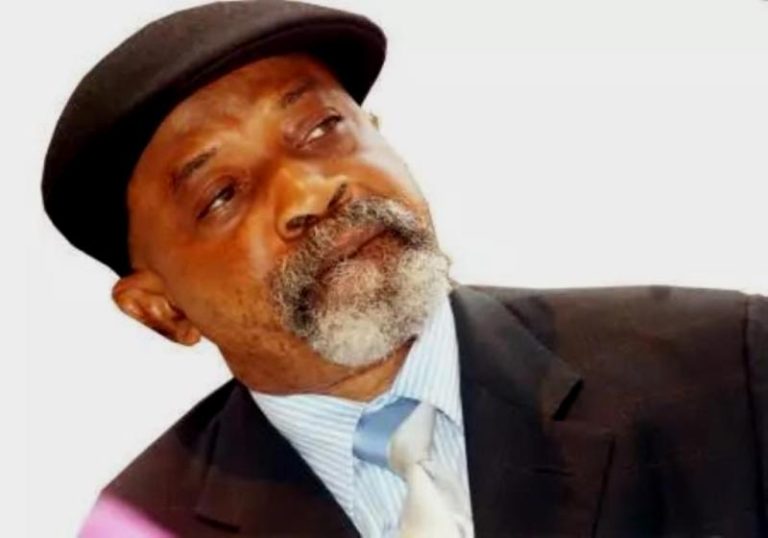
Ngige not kidnapped, in EFCC custody – Aide

0

MEDIA aide to former Minister of Labour and Employment, Chris Ngige, has dismissed reports suggesting that the former Anambra State Governor was kidnapped.

In a Facebook post on Wednesday, December 10, Ngige’s aide, Fred Chukwuelobe, said he had received several calls from journalists and acquaintances seeking clarification on claims that the former minister had been abducted.

He described the reports as false, explaining that the former governor was with the Economic and Financial Crimes Commission (EFCC), not in the custody of kidnappers.

“I have been receiving calls in the past hour from friends and journalists seeking the veracity of the news making the rounds that His Excellency, Dr. Chris Ngige, former Governor of Anambra State and immediate past minister of labour and employment, has been kidnapped.

“Ngige is with the EFCC.  He was not ‘abducted’ or ‘kidnapped,”’ Chukwuelobe wrote, adding that more details would be provided later.

Details of Ngige’s detention are still unclear as of press time. When The ICIR reached out to the commission’s spokesperson, Dele Oyewale, for information on the alleged detention, he didn’t respond to calls and texts.

Ngige’s invitation by the EFCC makes him the second minister in the Muhammadu Buhari administration to face interrogation by the anti-graft agency in recent weeks.

Last month, former Attorney-General of the Federation and Minister of Justice, Abubakar Malami, was questioned for days by the EFCC over alleged irregularities in the recovery of the $310 million looted by former nHead of State, Sani Abacha, which accrued to about $322.5 million with interest.

The commission reportedly seized Malami’s passport and placed him under a one-month reporting restriction. Malami, however, dismissed the allegations, describing them as “baseless, illogical and lacking in substance.”

He insisted, through a statement by his media aide, Mohammed Bello Doka, that no funds had been recovered before he assumed office in 2015, arguing that the EFCC’s claims “collapse when subjected to facts and elementary logic.”

Malami explained that the funds repatriated between 2017 and 2018 were properly channelled through the National Social Investment Programme under World Bank supervision, while an additional $321 million recovered in 2020 was earmarked for major infrastructure projects, including the Lagos–Ibadan Expressway, Abuja–Kano Road and the Second Niger Bridge.

Sexual harassment awareness takes centre stage at Bingham University

0

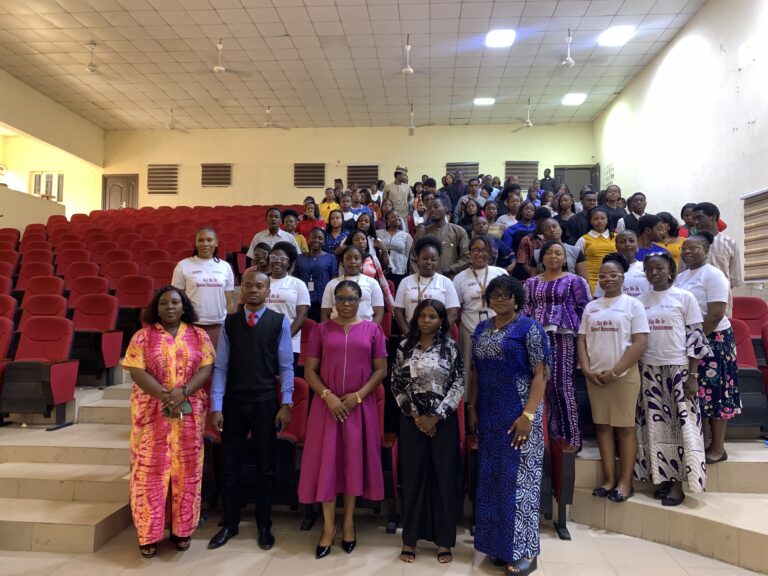
THE International Centre for Investigative Reporting (The ICIR), with support from the Development Research and Projects Centre (dRPC), on Wednesday, December 10, organised an awareness event focused on sexual harassment at Bingham University, Abuja.

The event themed, “Empowering Female Students to Challenge Sexual Harassment”, is part of ongoing efforts to curb sexual harassment on Nigerian campuses, educate students about its various forms, and the appropriate channels for reporting incidents.

It provided students with valuable insights into recognising and addressing sexual harassment. Participants learned that harassment could take many forms – verbal, physical, or even subtle actions that may seem harmless but are inappropriate.

In his welcome address, the Vice Chancellor of the university, Haruna Ayuba, a professor, represented by the Dean of the Faculty of Communication and Media Studies, Desmond Okocha, a doctorate holder, noted that universities must not mirror the negative behaviours in the society but instead serve as models of ideal conduct where harmful practices, including sexual harassment, are not tolerated.

“This training is not only meant to inform you, it is to equip you with the right tools to understand the concepts, the issues, the dynamics, the dimensions, and the strategies for pushback when confronted with sexual harassment,” Ayuba said.

He noted that the training aligned with the institution’s efforts to ensure students safety.

The Executive Director of The ICIR, Dayo Aiyetan, represented by the Senior Programmes Officer, Chukwudi Iwuoha, explained that the training was not to incite conflict between students and lecturers, but to empower students with knowledge about safety and sexual harassment.

He stressed that every student had potential and deserved a safe, supportive environment to thrive, both on campus and beyond, while encouraging them to speak up against harassment and to educate others. He emphasised that silence would embolden perpetrators.

Aiyetan further highlighted that the visit coincided with the global 16 Days of Activism Against Gender-Based Violence, noting that the campaign’s goal was to build a society where men and women coexist with mutual respect.

In her presentation, The ICIR Senior Programme Officer, Eunice Enoch, described sexual harassment as not only physical but also verbal and non-verbal, including inappropriate comments, unwanted touching, or suggestive behaviour. She listed common examples in Nigerian universities to include demands for sex in exchange for grades, offensive jokes, or displaying sexual content.

Enoch emphasised that anyone could be harassed regardless of whether they are female or male students, or even lecturers.

She also outlined the psychological, academic, social, and institutional impacts, noting that victims might struggle with fear, anxiety, poor concentration, and distrust in the university system.

“Sexual harassment doesn’t need to happen twice. Your gut is almost always right, so when something feels wrong, trust that instinct and remove yourself, because silence only puts the next person at risk,” Enoch stated.

Similarly, the Programmes Officer at Gender Mobile, Confidence Ezeala, in her presentation titled “The New Nigerian Legislative Bill on Sexual Harassment and Its Legal Implications”, explained that the 2024 Anti-Sexual Harassment Bill sets out clear definitions, penalties, and institutional responsibilities to address sexual misconduct in Nigerian higher institutions.

She highlighted that the bill reinforced existing school policies and introduced nationwide legal standards.

“The Anti-Sexual Harassment Bill is not here to replace university policies; it is here to strengthen them and hold institutions and offenders accountable. This bill gives a clear legal framework so that sexual harassment on campuses is no longer treated as a normal part of school life,” Ezeala stated.

She emphasised the fiduciary duty of educators, stating that lecturers hold authority, trust, and influence over students, making any romantic or sexual involvement a violation even when outwardly consensual. Ezeala used practical scenarios to illustrate how power imbalances could lead to coercion, manipulation, or fear of academic consequences.

“The penalties are clear. Offenders can face five to 14 years in prison, depending on the offence. There is no statute of limitation. Survivors can report at any time, and the law will still protect them,” she concluded.

A representative of the Bingham University Gender Office, Hope Cole, a doctorate holder, in her presentation on the university’s policies on sexual harassment and reporting mechanisms, said harassment could be subtle or overt and that silence often enables perpetrators, while urging students to speak up immediately when they sense inappropriate behaviour. Cole explained that “there are clear channels for reporting”, including the Gender Office, Legal Officer, and Student Disciplinary Committee, all of which handle cases confidentially and impose sanctions on both students and staff when necessary.

The official recounted several incidents to illustrate how harassment could escalate when students remain silent and how digital behaviour, such as sharing revealing photos or responding to inappropriate messages, could expose students to exploitation. She further emphasised that staff would be equally held accountable, noting that disciplinary actions, including suspension or termination, apply when staff violate the harassment policy.

Mercy Okafor and Praise Ikhayere, both campus ambassadors for the initiative, explained that many students were unaware of where to report harassment.

They said verbal, physical, or minor aggressive actions constitute sexual harassment, adding that the event helped sensitise students and increase awareness on the issue.

Oladiran Dorcas, a 400-level Nursing student, and Joshua Samuel, a 400-level Mass Communication student, remarked that they found the event very informative, explaining that they had previously thought of sexual harassment as a single concept, but the training helped them understand its various forms and how even seemingly minor actions could constitute harassment.

Shettima to lead national ranch initiative, says Tinubu

0

PRESIDENT Bola Tinubu has tasked Vice-President Kashim Shettima to use the National Economic Council to identify and transform the nation’s grazing reserves into ranches, as part of efforts to diffuse farmer-herder crisis and formalise the nation’s livestock economy.

Tinubu gave the directive on Wednesday, December 10, minutes before presiding over the Federal Executive Council at the State House in Abuja.

“Again, especially livestock reform, I think the Vice President should get the NEC first of all to see which villages or grazing reserves can be salvaged or rehabilitated into ranches and livestock settlements,” said the president.

Tinubu explained that he had directed the National Security Adviser, Nuhu Ribadu, to arm forest guards.

“I have directed the NSA to arm our forest guards, too. Take it seriously,” the president stated, adding that “We must eliminate the possibility of conflicts and turn the livestock reform into economically viable development. The opportunity is there. Let’s utilise it.

“And, it is in NEC, if we exercise the constitutional requirement which states that the land belongs to the states, whichever one they can salvage, convert to a livestock village, let us stop this conflict area and turn it into economic opportunities and prosperity.”

Nigeria has experienced a considerable increase in farmers-herders’ conflicts since the early 1990s , especially in wetland areas of the Middle Belt, North-Central Nigeria. 

Herders and farmers clashes occur in states like Plateau, Taraba, Benue and other states, and has led to the killing of thousands of people, displacement of residents, and destruction of properties. 

The crisis is one of the issues worsening insecurity in the country. Banditry and kidnapping are some of the facets of insecurity militating against the nation.

The ICIR reported that the Tinubu administration said it would name individuals and networks behind terrorism financing in Nigeria, noting that it had begun taking “far-reaching decisions” on national security.

As part of efforts to guarantee the security of lives and properties, the president directed police officers attached to VIPs to be withdrawn and returned to core policing duties.

He urged VIPs seeking protection to contact the National Security and Civil Defence Corps (NSCDC)

He also directed the National Security Adviser, Nuhu Ribadu, and the Department of State Services to provide further guidance and ensure full implementation of the directive.

Tinubu orders ministers to seek presidential approval before using police escorts

0

PRESIDENT Bola Tinubu on Wednesday insisted that his directive withdrawing police officers from VIP and VVIP protection was final, warning ministers and top government officials to comply immediately.

Speaking at the opening of the Federal Executive Council (FEC) meeting at the State House in Abuja, Tinubu instructed ministers to approach the Inspector-General of Police (IGP) for clearance whenever their assignments require police escorts.

“If you have any problem because of the nature of your assignments, please contact the IGP and get my clearance,” a statement by the Special Adviser to the President on Information and Strategy, Bayo Onanuga, quoted the president to have said.

Tinubu noted that police officers were trained to protect the lives and property of Nigerians, especially the most vulnerable.

He explained that redirecting police officers back to core policing duties was necessary as the country battles insecurity, including kidnapping, banditry, and terrorism.

He stressed that operatives of the Nigeria Security and Civil Defence Corps (NSCDC) would take over VIP protection.

According to him, the Minister of Interior, Olubunmi Tunji-Ojo, has been tasked with making the necessary arrangements.

“”The National Security and Civil Defence Corps are trained for VIP protection, and they are armed too,” he added.

He directed the National Security Adviser, Nuhu Ribadu; the Minister of Police Affairs, Senator Ibrahim Gaidam; and the IGP, Kayode Egbetokun, to ensure full enforcement of the order.

The president said the security structure would be reviewed to allow police officers return to the frontline and better protect vulnerable communities.

“We face challenges here and there of Kidnapping, banditry and terrorism. We need all forces utilised. I know some people are exposed; we will make the exceptions. The Civil Defence is very much around,” Tinubu stated.

His insistence came against the backdrop of the expected full enforcement of his earlier order directing the Nigeria Police Force to redeploy officers attached to VIPs back to core policing duties.

On November 24, the Nigeria Police Force, acting on Tinubu’s directive, issued a circular withdrawing all escort personnel under its Special Protection Unit (SPU) Base 16 in Lagos.

The circular, referenced AB:4087/DOPS/SPU/816/LAS/VOL.3/147 and signed by Assistant Superintendent of Police Neji Veronica, ordered affected officers to “report back before the end of today” and attend a mandatory lecture parade.

The ICIR reported on Sunday, November 23, that Tinubu directed the police authorities to withdraw all their officers serving as escorts to VIPs nationwide to core duties.

He advised anyone seeking police protection to request well-armed personnel from the Nigeria Security and Civil Defence Corps (NSCDC).

The president gave the directive during a security meeting he held with the Police, Air Force, and Army chiefs, as well as the Director-General of the Department of State Services, DSS, in Abuja.

Adeleke clinches Accord Party’s governorship ticket for 2026 poll

0

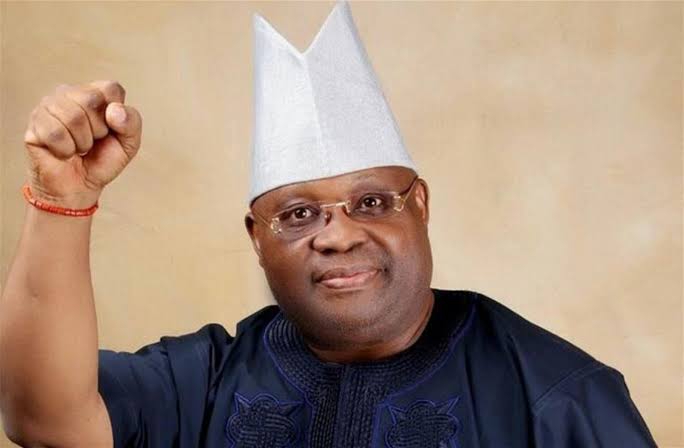
OSUN State Governor Ademola Adeleke has clinched the Accord Party’s governorship ticket for the August 8, 2026, election.

Adeleke, who ran unopposed in the primary conducted in Osogbo on Wednesday, secured 145 of the 150 delegate votes from the state’s 30 local government areas.

Announcing the outcome, the Secretary of the Electoral Committee, Abdulazeez Salaudeen, said five ballots were declared invalid.

“The electoral committee has delivered on its mandate. After voting and counting, witnessed by the agents of the candidate and the officials of the Independent National Electoral Commission.

“Having the highest number of votes, I declare Senator Nurudeen Ademola Adeleke as the winner of the primary,” Salaudeen said.

The ICIR reported that on Tuesday, December 9, that Adeleke announced his intention to seek re-election for a second term on Accord Party’s platform, days after dumping the Peoples’ Democratic Party (PDP)

The governor said he had joined Accord Party on November 6, after weeks of consultation and deliberations with stakeholders and opinion leaders.

Adeleke, his deputy, Kola Adewusi, and several political appointees were present at the primary election exercise as armed police, Department of State Services operatives were deployed, and INEC officials observed the exercise.

The Accord Party’s national leadership, led by its chairman, Maxwell Mgbudem, also attended the primary.

The ICIR reported that Adeleke announced his resignation from the PDP in a letter dated November 4, addressed to his ward chairman, in Sagba Abogunde, Ward 2, Ede North Local Government Area.

The governor becomes the latest top member of the leading opposition PDP to be toppled by tsunami that has swept several stalwarts and leaders out of a party that once prided itself as “Africa largest” political group.

He thanked the party and its members for the platform on which he rose to political prominence, first as a senator and now as governor.

Kwara kidnap surge leaves families in terror as ransom calls ring

0

By Dare Akogun, Ilorin

SHORTLY after daybreak on Tuesday, December 2, 2025, a phone rang in a small farming settlement tucked between the forests of Igbofe and Ora in Ifelodun Local Government Area of Kwara State.

Young worshippers exiting the church after a special Sunday service held for the kidnapped worshippers.

For Sakariyau Alabi, a yam and cassava farmer, that call would alter his life forever.

The trembling voice on the other end belonged to his kidnapped wife whispering through pain, telling him she had been shot twice and patched up in the bush by the same men who abducted her.

“She told me only God can rescue them,” Alabi told The ICIR, fighting tears.

“My son was lying in blood when I returned home. They carried my wife, my daughter and my brother’s wife. They also took a Fulani visitor.”

Hours earlier, armed men had stormed the compound, shooting his 28-year-old son in the stomach before dragging four people into the surrounding forest.

Then came the ransom demand: ₦500 million.

After pleading, they reduced it to ₦100 million still an impossible sum for a subsistence farmer.

“Even if I sell all my crops and land, it will never reach that amount,” he said.

Alabi’s story is no longer an exception. It is the new reality of rural Kwara. Kwara’s forest belt: From farmland to fear zone.

The ICIR’s review of recent incidences shows a disturbing pattern: Kwara’s rural communities once considered transit corridors have now become active operational bases for kidnappers.

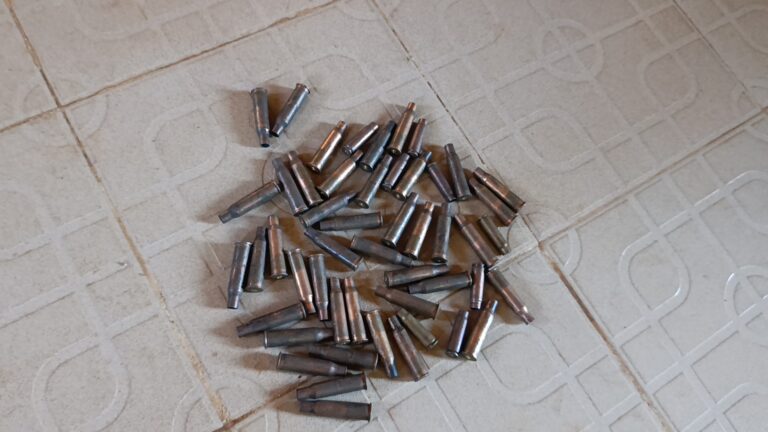
Expelled bullets shells used by the attackers on the Church

Igbofe, Koro, Moro, Patigi, Asa and Kaiama LGAs share porous boundaries with Kogi, Niger, Ekiti and parts of the North-Central forests.

Security analysts say these routes have become safe havens for criminal cells fleeing military pressure in neighbouring states.

Armed security men mounting guard at the church few days after the attack

“What we are witnessing is a spillover,” said Ilorin-based security analyst, Abdulrasheed Abdullahi, in an interview with The ICIR.

“These groups are no longer passing through they are settling, forming cells and launching repeated attacks.”

The attacks now follow a predictable pattern, dawn or late-night raid, rapid gunfire, abduction into deep forests, impossible ransom demand, negotiations under fear and silence and families like Alabi’s are left to negotiate alone.

In Koro, a historic border community in Ekiti LGA, the crisis is already decades deep.

On Tuesday the same day Alabi’s family was abducted a 25-year-old Miss Abigael Obagbemi and 35-year-old, Abiodun Olawale, were kidnapped on their way to a local market.

Bullet ridden windows aftermath of the attack 

A relative, who asked to be identified only as Segun, told The ICIR: “The kidnappers are asking for ₦100 million each. These are traders. They are not rich. They just want to destroy families.”

Koro is still grieving from the 2024 assassination of its traditional ruler, HRH Retired General Segun Aremu, who was murdered in his palace by masked gunmen.

Kwara State Commissioner of Police CP Adekimi Ojo addressing residents of Eruku

Residents say the violence has only intensified since then.

On Monday, December 1, 2025, two Chinese expatriates working on the BUA Bode Saadu–Kaiama–Kosubosu road project were abducted in Ejidongari after gunmen invaded the construction site.

Kwara State Commissioner of Police, CP Adekimi Ojo, confirmed the incident.

Armed security men mounting guard at the church few days after the attack.

“The police are doing everything within our power to rescue all abducted individuals. Our detectives are working day and night,” he said.

But for many communities, those assurances feel distant.

‘We negotiate alone’

Security researcher,  Musbau Ajeigbe, says the kidnappers’ strategy is shifting and more deadly.

“Families now negotiate directly because kidnappers threaten to kill victims if the police are involved,” he explained.

“This is extremely dangerous. It deepens poverty and emboldens criminals.”

He warned that the abductions of foreign workers, repeated raids on rural homes, and attacks on places of worship show a transformation in the criminal networks’ sophistication.

“This is organised terrorism,” he said.

Kwara’s silent emergency

Across the state’s rural LGAs, fear now dictates daily life, farmers are abandoning farmlands, women avoid early morning travel and vigilante groups, armed with dane guns and courage, face attackers with automatic weapons

Madam Felicia who lost a family member to the attack
Also, children no longer walk alone at dawn and communities sleep lightly waiting for the next knock.

The ICIR found that some villages have created informal levies to fund emergency ransom contributions.

But for Alabi, there is no community levy big enough to match the kidnappers’ threats.

As he sits outside the hospital ward where his son fights for life, Alabi’s voice trembles.

“I cannot sleep. I cannot eat,” he said, adding: “They told me to choose — pay or lose my family. I beg Nigerians, please help me.”

Somewhere in the thick forest stretching from Kwara to Kogi, his wife, daughter and sister-in-law are waiting hungry, wounded, and unsure if help will come.

For now, all he can do is wait for another phone call and pray it is not another threat.


Soyinka raises concern over ‘armed to teeth’ security escort for Seyi Tinubu

0

NOBEL Laureate Wole Soyinka has questioned the scale of armed protection attached to Seyi Tinubu, son of President Bola Tinubu, describing his convoy he encountered in Lagos State as excessive and troubling for a country struggling with overstretched security resources.

Soyinka made the remarks on Tuesday, December 9, while presenting an honorary award to poet Odia Ofeimun at an event hosted by the Wole Soyinka Centre for Investigative Journalism.

He recounted walking into a Lagos hotel and seeing what he initially believed was a film shoot, until one of the men stepped forward to greet him.

It was only after the encounter, he said, that his driver informed him the individual was Seyi Tinubu and that the heavily armed group “about 15 or so, armed to the teeth,” was his security escort.

Soyinka, who said was disturbed by the scene, immediately contacted the National Security Adviser, Nuhu Ribadu, to register his concern.

“I was so astonished that I started looking for the national security adviser. I said track him down for me. I think they got him somewhere in Paris. But he was with the president; he was in a meeting.

“Then, I said I’ve just seen something I can’t believe I don’t understand, and I described the scene to him. I said, ‘Do you mean that a child of the head of state goes around with an army for his protection or whatever’,” he said.

Soyinka added that further inquiries suggested this level of security had become routine for the president’s son. He warned that such deployments divert critical personnel from areas where they are urgently needed.

“Later on, I did some investigative journalism. And I enquired and I found that apparently, this is how this young man goes around with his battalion, his heavy armed soldiers,” he said.

“Children should know their place. They are not potentates,” he stressed, arguing further that Nigeria’s security system could be weakened if large teams were continually attached to individuals who hold no public office.

Soyinka sarcastically suggested that if another attempted coup or insurrection occurred, the president might simply “send his son and the troops that follow him around” to put it down.

Meanwhile, Soyinka’s criticism came a few weeks after Tinubu withdrew police officers from very important persons.

In November, President Tinubu ordered police officers assigned to VIPs to be withdrawn and redeployed to core policing duties amid the ravaging insecurity.

Adeleke to seek re-election in Accord Party after dumping PDP

OSUN State Governor, Ademola Adeleke, has announced his intention to seek re-election for a second term on the platform of the Accord Party, days after dumping the Peoples Democratic Party.

The governor made the announcement Tuesday evening at the Government House in Osogbo in the presence of national and state leaders of his new party.

“I joined the Accord Party more than a month ago, precisely on November 6, as a platform to seek re-election in 2026. This was after weeks of consultation and deliberations with stakeholders and opinion leaders.

“Stakeholders and residents of Osun state are aware of why we are taking this important decision. We intend to pursue a second term in office on the platform of the Accord Party to complete ongoing delivery of good governance and democratic dividends, which have been applauded at home and abroad,” the governor said.

Adeleke explained that he opted for the party because its mission of welfarism aligned with his focus on citizens’ and workers’ welfare.

“I welcome our party leaders into the Osun State Government House. You are now part of us, as I am also now part of you. We are united in progress and good intentions for the good people of Osun State and Nigeria at large.

“At this historical point, our task is to sustain a united front as we prepare for the elections. We have a duty to ensure an inclusive leadership where the interests of all groups are cared for. Our party, Accord Party, is here to take over Osun governance and sustain the delivery of good governance in our dear state,” the governor added.

Explaining that the primary function of a government is the welfare and well-being of the people, Adeleke emphasised that since he joined the party, he had been fascinated by its philosophy .

“As a governor, I have prioritised the welfare of our people, from workers to the entire citizenry. Day and night, we implement policies and programmes to elevate the well-being of our people. From infrastructure to social services, Osun has never had it so good in governance and service delivery.

“Today, we unveil the new platform for the good people of Osun State. From Osun West to Osun East to Osun Central, this is our party, our new platform for victory come August next year,” he explained.

The ICIR reported that Adeleke announced his resignation from the PDP in a letter dated November 4, addressed to his ward chairman, in Sagba Abogunde, Ward 2, Ede North Local Government Area.

The governor becomes the latest top member of the leading opposition party to be toppled by tsunami that has swept several stalwarts and leaders out of a party that once prided itself as “Africa largest” political group.

He thanked the party and its members for the platform on which he rose to political prominence, first as a senator and now as governor.

The ICIR reported earlier today that Rivers State Governor, Siminalayi Fubara, announced his defection from the PDP to the All Progressives Congress (APC) during a stakeholders’ meeting at the Government House in Port Harcourt, days after a wave of defections hit the Rivers State House of Assembly.

The development came barely 24 hours after the Rivers’ governor held a closed-door meeting with President Bola Tinubu at the State House, Abuja.

His decision followed the defection of 16 lawmakers from the PDP to the APC during a plenary on Friday, December 5.

PDP stalwarts, including Delta State Governor Sheriff Oborevwori, and his counterpart in Bayelsa, Douye Diri, are among leaders who have quit the party this year.

The ICIR reported a pattern of defections from the PDP to the ruling APC, particularly among governors and lawmakers seeking to align with the APC ahead of the 2027 polls.