Home Blog Page 152

Anambra election: 6 misconceptions about BVAS and IReV voters should know

0

By Nigerian Fact-checker’s Coalition 

ELECTIONS in Nigeria have often been accompanied by allegations of irregularities, including issues such as ballot snatching and result sheet manipulation, which have posed challenges to the nation’s democratic process. However, in 2015, the Independent National Electoral Commission (INEC) introduced the Smart Card Reader, which sought to verify voters electronically for the first time. It was far from perfect. Machines failed, networks crashed, and officials reverted to manual accreditation in many places. In fact, BusinessDay reported how over 5.8 million people had to without digital accreditation. 

Learning from those mistakes, INEC launched the Bimodal Voter Accreditation System (BVAS) in 2021 to replace the card reader. Alongside it came the INEC Result Viewing (IReV) portal, where Nigerians could log on to see polling unit results in real time. 

Both systems played significant roles during the 2023 general elections. While some hailed them as milestones in electoral transparency, others criticised them as flawed, particularly after the prolonged delay in uploading the presidential results

With the Anambra governorship election approaching, these two acronyms, BVAS and IReV, are beginning to brew controversies and confusion. To help clear the air, here are six misconceptions about BVAS and IReV. 

  • “BVAS means we now vote electronically”

This is perhaps the most common misunderstanding. This misconception spread during the 2021 Anambra governorship election, where BVAS was first tested. Many voters arrived at polling stations expecting electronic voting, where you press a button and your vote goes directly to a server. But that was not the case. 

In reality,  BVAS has not replaced the traditional ballot paper system. You will still thumbprint on paper, and your votes will still be counted manually at the polling unit.

What then is BVAS meant for? BVAS simply ensures you are who you claim to be before you can vote. The machine verifies your identity by scanning your fingerprints or face to ensure you are not impersonating anybody. Apart from that, it is also used to transmit results to IReV after everyone has voted.

Therefore, for the 2025 Anambra election, you should be prepared for manual voting supported by digital checks.

  • “If my fingerprint fails, I won’t be able to vote”

This fear is valid but rooted in Nigeria’s long history of faulty machines on election day, especially with their repeated experiences with the Smart Card Reader failures pre-2023. Nigerians still carry that trauma. 

However, BVAS has two verification methods: fingerprint and facial recognition. If one fails, INEC says the other steps in. Unfortunately, when both fail, you may be unable to vote.

However, the multi-accreditation mode of BVAS represents a significant improvement over the smart card reader. 

  • “Results are counted and declared on IReV”

Because we have established that BVAS accredits you and IReV lets you see results, many voters may still assume that IReV is a digital collation centre where winners are announced. This is false. 

The INEC result viewing portal is more like a public notice board, but in digital form. After polling unit officials count votes and record them on paper, they scan the result sheet and upload it to IReV for everyone to see. 

Therefore, it is important for you to understand that IReV does not declare winners. Results are still counted and declared manually at the ward, LGA, and state collation centres, and that has not been replaced.

  • “Once results are uploaded to IReV, rigging is impossible”

While many expected IReV to eliminate election fraud, the 2023 general elections revealed otherwise. Watchdogs observed discrepancies between some results uploaded on IReV and the figures later announced at collation centres

Some Civil Society Organisations (CSOs) argued that the promise of real-time transparency was undermined. INEC later admitted technical glitches delayed uploads, which further fuelled suspicion.
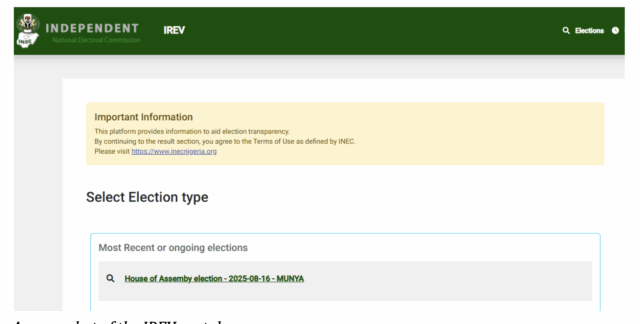
A screenshot of the IREV portal.

Although uploading results to IReV has made it more difficult to tamper with polling unit outcomes, manipulation remains possible during collation, where figures from hundreds of units are aggregated.

  • “IReV is for politicians”

IReV was created for everyone in Nigeria, not just politicians, party agents or INEC. As long as you can access a smartphone and the internet, you can monitor uploaded results from different polling units by logging onto the IReV portal.

That means you can view results uploaded on the portal and compare what was uploaded from your unit with what was later announced at collation. By doing this, you are also taking ownership of the election and demanding accountability from people who may want to manipulate results.

  • “BVAS always works perfectly”

Nigerians who witnessed the 2023 general elections know this is untrue. On the contrary, BVAS was reported to have malfunctioned in several states due to poor connectivity and unskilled officials. In some polling units, accreditation stretched for hours and left voters frustrated.  

While INEC insists it has learned lessons and improved its systems, it may not be out of place to expect some form of glitches on election day.

Written & edited by Nigeria Fact-Checkers Coalition (NFC) ahead of the Anambra 2025 election.
EFCC recovers ₦500bn, secures 7,000 convictions in two years – Shettima

0

VICE President Kashim Shettima has said that the Economic and Financial Crimes Commission (EFCC) recovered assets worth over ₦500 billion and secured about 7,000 convictions in the past two years under the administration of President Bola Tinubu.   

Shettima, who represented the President at the opening of the 7th Capacity Building Workshop for Judges and Justices jointly organised by the EFCC and the National Judicial Institute (NJI) in Abuja on Monday, October 20, said the results were achieved due to the administration’s policy of non-interference in the work of anti-graft agencies.

According to Channels TV, Shettima said the EFCC’s progress demonstrated the government’s commitment to strengthening accountability and transparency within public institutions.

“As an administration, we have prioritised public accountability by empowering the anti-corruption agencies and giving them the independence required to perform their statutory roles.

“This enabling environment has yielded impact in the last two years, as the EFCC has recorded over 7,000 convictions and recovered assets worth over ₦500 billion,” Shettima said.

He explained that recovered proceeds from corruption cases were being channelled into development projects and social investment programmes such as the student loan and consumer credit schemes.

“The proceeds of crime are being reinvested into the economy to fund critical social interventions.

“We are also working within the separation of powers to improve the welfare of judicial officers. Judges’ remuneration has been increased, and we remain committed to enhancing their working conditions,” he said.

The vice president reaffirmed that the Tinubu administration would not shield any political ally or official from investigation or prosecution. “There is no person or group who can accuse this administration of protecting political actors. Both the judiciary and anti-corruption agencies have been given freedom to dispense justice without interference,” he added.

Shettima also called on members of the judiciary to demonstrate patriotism and integrity in the discharge of their duties, stressing that corruption affects every part of society.

“Corruption is no respecter of persons,” he said, adding that “Judges are not insulated from its consequences. There are no special hospitals, roads or communities for judges; we all face the same risks from the effects of corruption. It is in the enlightened interest of all Nigerians to join hands to defeat this menace.”

He further urged collaboration among the executive, legislative and judicial arms to consolidate recent gains and deliver an effective anti-corruption framework that supports national development.

While the government celebrates recent achievements, data obtained by The ICIR show that the EFCC’s long-term performance raises concerns about the quality and sustainability of its anti-corruption outcomes.

Between 2019 and 2023, the EFCC investigated 58,165 cases but secured only 10,935 convictions, which is about 19 per cent of all cases investigated. This means that 81 per cent of its probes did not result in convictions, according to EFCC operational statistics obtained by The ICIR.

However, when compared to the 16,115 cases filed in court, the agency achieved a 68 per cent conviction rate, suggesting stronger results only after cases reach judicial determination.

Lagos led as the most active EFCC zone, recording 2,180 convictions between 2019 and 2023, followed by Abuja, Port Harcourt and Kano zones. Sokoto recorded the lowest figures, with only 164 convictions.

The EFCC has faced criticisms for employing aggressive tactics, including arbitrary arrests, raids and intimidation of suspects. The ICIR reported in March 2025 that these methods often violate the fundamental rights of citizens and undermine due process, leading to avoidable case dismissals in court.

Experts interviewed by The ICIR emphasised that the quality of investigations, rather than the quantity of arrests, determined success in anti-corruption efforts.

Senior Policy Analyst at BudgIT, Vahyala Kwaga, noted that the EFCC’s conviction rate would improve if it adhered to global best practices that prioritise intelligence gathering and evidence-based prosecution over publicised arrests.

He urged the agency to increase transparency by documenting and publishing arrest records, reasons for detention, and details of interrogations to ensure accountability.

Reaction trails public feud between Regina Daniels and husband, Ned Nwoko 

0

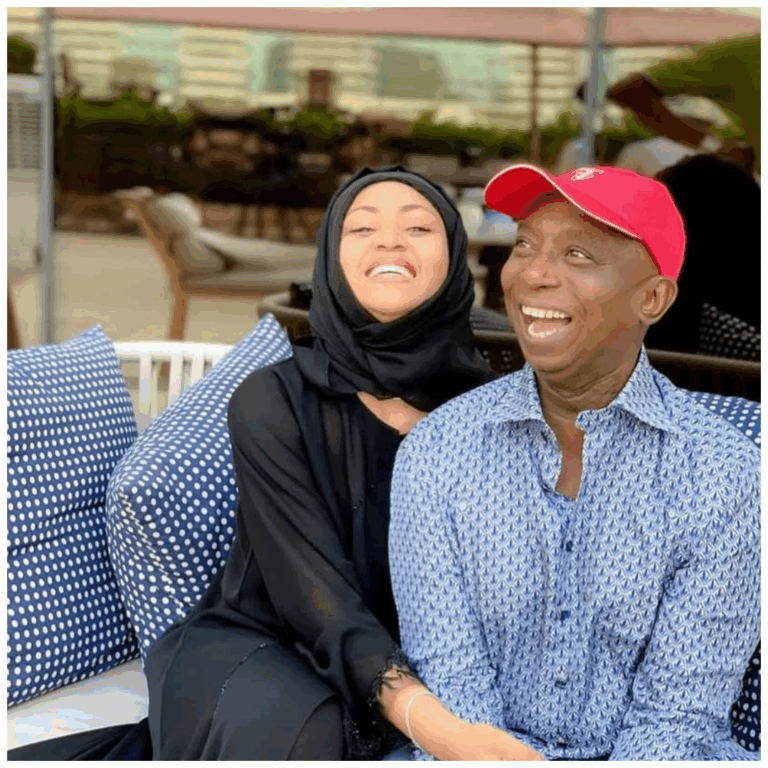
A public feud between a senator, Ned Nwoko and his wife, actress Regina Daniels, has sparked outrage on social media following mutual allegations of violence and drug abuse.

After a viral video showed Daniels in a confrontation at their home on Saturday, October 18, Nwoko accused her of violence and long-term drug abuse, claiming it had affected her health.

“In Ned Nwoko’s house, I am nothing but, in my house, I am a queen, … what again! I cannot stand the violence. It’s too much! Ned sent his thugs,” the actress could be heard saying in the video.

In response, Nwoko took to his X handle on Sunday, October 19, to release a statement along with a video showing showing damage to his home, alleging that Daniels’ recent actions caused significant destruction and that she was being supplied drugs by two individuals, Sammy and Ann.

“Regina was not always like this. Her current battle with drugs and alcohol abuse is the root of our problem. She must continue her rehabilitation programme, or I fear for her life and safety. Now she has moved to a place where she will have unrestricted access to drugs. 

“I have other wives, and none will ever accuse me of violence. Regina is the violent one here, slapping and hitting three staff in the past 48 hours and destroying property, including cars and windows, for no just cause.  The truth is, I have set a clear condition for her to accept rehab in Asokoro or outside Nigeria especially Jordan where she will not have access to drugs,” he stated.

He said while he took their child – Moon – to the hospital, a scene of chaos unfolded at home, orchestrated by Sammy, whom he described as her main drug supplier. 

Nigerians react

Nigerians have since flooded social media with divided opinions. Some accused Nwoko of using drug allegations to divert attention from domestic-violence claims. Others urged both parties to seek professional help and protect their children from public scandal, while others are calling for both parties to be investigated for domestic violence and drug-related offences.

Ed Jacobs advised the lawmaker to show restraint and dignity in handling his marital issues, stressing that true leadership both at home and in public required responsibility and compassion.

“As a senator of the Federal Republic of Nigeria and as a husband, sir, leadership whether in public office or within the home demands restraint, responsibility, and a commitment to dignity, especially in moments of crisis.

“The situation you described is deeply troubling. If your wife Regina is indeed battling substance abuse, then your first duty is to prioritise her safety and recovery, not to publicly vilify or shame her. Addiction is a medical condition, not a moral failure, and it requires structured intervention, compassion, and confidentiality not public condemnation.

“Let me remind you that domestic crises should be handled privately, with legal and medical professionals involved. Public airing of such matters risks reputational harm to all parties, including innocent children,” he said.

Collins cautioned that the senator’s submission raised possible legal concerns. He noted that if he knew about individuals supplying his wife with illegal drugs, failing to report them could amount to aiding and abetting such crime. 

Another user, Maazi Chukwudi, called for the arrest of the senator, Regina and the drug suppliers. He accused the senator of concealing the drugs until his wife’s outburst.

“Sammy, supplier of hard drugs, Ann, supplier of hard drugs” Regina, consumer of hard drugs. What are NDLEA and other law enforcement agencies waiting for to arrest them? Meanwhile, you, as a lawmaker, covered them till it got to social media? You have questions to answer!,” he wrote.

Lord of Charlse wrote, “One salient takeaway is that NDLEA should be investigating and prosecuting some people from this post. But we all know that won’t happen.”

Similarly, Nonso opined that “A senator openly agreeing to his wife doing drugs and as well knows the dealer of the drugs. This one won’t lead anywhere because he’s a senator.”

Meanwhile other commenters referenced the age gap in the marriage, power dynamics, and questioned why these issues were made public with such explicit allegations.

The ICIR reported that Nwoko and Daniels have been married since 2019. Their marriage was a constant subject of discussion by Nigerians due to the age difference between them.

The couple have two children.

Canva, Signal, others hit by major global outage

0

TWO popular digital platforms, Canva and Signal, are among services currently facing major disruptions globally, preventing users from accessing key features and sparking concerns about the increasing frequency of such outages.

Other affected platforms include Roblox, Snapchat, Fortnite, Amazon, Coinbase, Ring, Duolingo, Zoom, and Slack.

The disruption started with Signal, which experienced downtime on October 20, 2025, about an hour before the platform officially acknowledged the outage.

Signal’s president, Meredith Whittaker, later confirmed the incident in a post on social media.

“We’re aware that Signal is down for some people. This appears to be related to a major AWS outage. Stand by,” she wrote.

Canva also issued multiple updates acknowledging widespread errors across its platform. The outage disrupted users’ access to key features, including opening projects, using tools, and performing essential design functions.

Screenshot of Canva's updates to its users PC: Fatimah Quadri/The ICIR
Screenshot of Canva’s updates to its users PC: Fatimah Quadri/The ICIR

“We are currently experiencing increased error rates, which are impacting functionality on Canva. Our team is actively investigating the issue and working to restore full access as quickly as possible,” Canva said.

Meanwhile, Amazon Web Services (AWS) announced it had identified a possible root cause behind the high error rates affecting DynamoDB APIs in the US-EAST-1 region. The company said its teams were working on several recovery measures simultaneously to restore normal service.

For context, AWS is Amazon’s cloud computing arm, powering millions of major websites and online platforms worldwide.

Heavy security presence triggers gridlock across Abuja as #FreeNnamdiKanu protest kicks off

0

COMMUTERS across Nigeria’s capital city were trapped in hours-long gridlock on Monday morning following the massive deployment of security operatives across key entry points into Abuja ahead of the planned #FreeNnamdiKanuNow protest.

Security checkpoints and road barricades mounted by the police, military, and other security agencies caused traffic paralysis along major routes, including Nyanya, Karu, Mararaba, Mpappe, Dei-Dei, Dutse, Bwari, and Kubwa, leaving thousands of residents stranded on their way to work.

From as early as 7a.m., commuters approaching the city centre through Nyanya-Karu axis encountered long queues of vehicles stretching for several kilometres, as officers restricted movement toward Berger, Wuse, Aso Rock, the Federal Secretariat, and the Central Business District, among other areas.

The ICIR gathered that many motorists heading toward the city were forced to turn back, while others parked their vehicles by the roadside as security personnel diverted traffic and tightened patrols around strategic locations such as Eagle Square, Shehu Shagari Way, and the National Assembly complex.

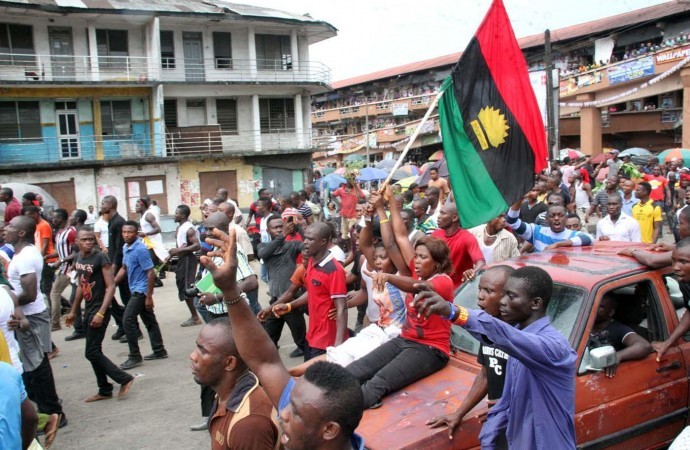
The #FreeNnamdiKanuNow protest, spearheaded by activist Omoyele Sowore, kicked off earlier in the morning to demand the release of the detained leader of the Indigenous People of Biafra (IPOB), Nnamdi Kanu. 

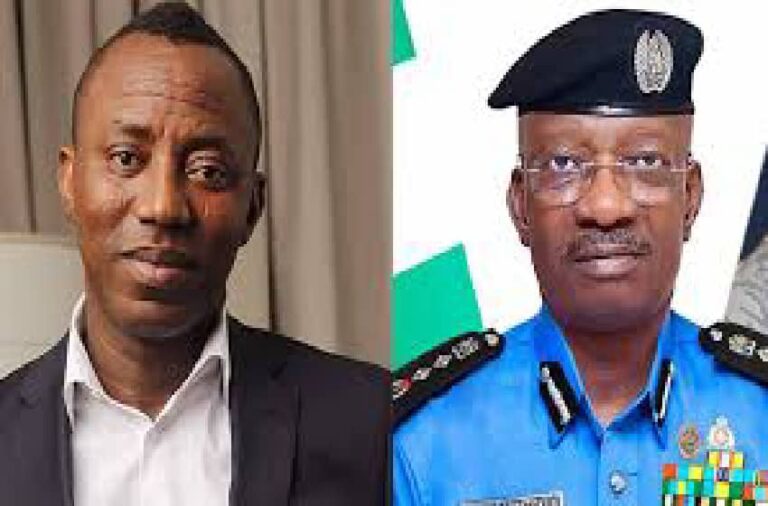
Last week, the Inspector General of Police, Kayode Egbetokun, directed officers to enforce existing court orders restricting protests around key government sites. The Nigeria Police Force warned that protests must not take place near Aso Rock Villa and other restricted government zones in the nation’s capital.

Force Public Relations Officer CSP Benjamin Hundeyin said the directive followed a Federal High Court order restraining gatherings around sensitive areas such as the National Assembly Complex, Force Headquarters, Eagle Square, and Shehu Shagari Way.

Hundeyin advised protesters and counter-protest groups to avoid restricted zones and to channel their grievances through lawful and peaceful means.

Meanwhile, as of mid-morning, movement into the Central Area and Three Arms Zone remained partially restricted, with heavy police patrols and armoured vehicles stationed at multiple junctions. 

Many residents heading to work have returned home, while others trekked long distances into the city centre.

Security operatives disperse #FreeNnamdiKanuNow protesters in Abuja

0
A JOINT team of security operatives on Monday, October 20, forcefully dispersed protesters participating in the #FreeNnamdiKanuNow march led by human rights activist Omoyele Sowore in the Maitama area of Abuja.

The demonstration, which began around the Nigeria Communications Commission (NCC) headquarters, drew several activists, including Sowore and Nnamdi Kanu’s lawyer, Aloy Ejimakor. The protesters chanted “Free Nnamdi Kanu Now,” demanding the release of the detained leader of the proscribed Indigenous People of Biafra (IPOB).

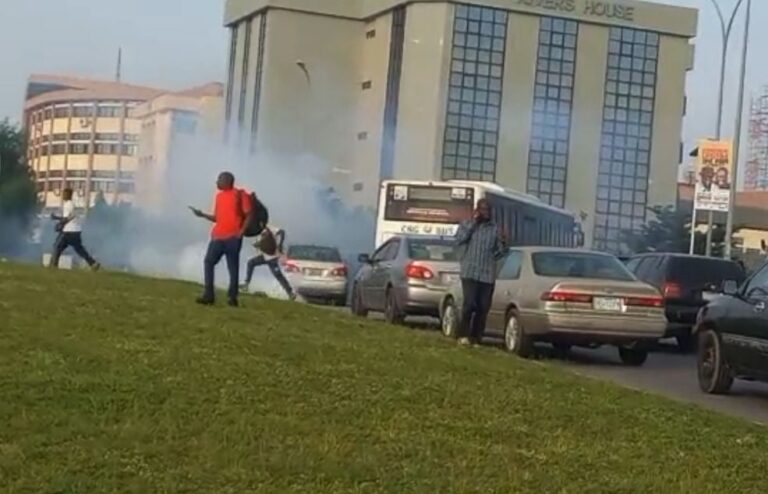
Eyewitnesses said security agents fired teargas and live rounds into the air to disperse the crowd. Commuters and bystanders at the Central Business District were also caught in the chaos as officers reportedly released multiple teargas canisters, forcing many to flee.

Sowore later alleged that police officers arrested several protesters, including Ejimakor and Kanu’s brother, and took them to the Federal Capital Territory (FCT) Police Command. “They were beaten and taken to the FCT command. The police must release them immediately,” he wrote on his social media accounts, including Facebook and X.

Ahead of the protest, the Nigeria Police Force (NPF) had warned groups planning demonstrations to respect a court order restricting gatherings around sensitive areas in Abuja.

The Federal High Court had restrained protesters from converging near Aso Rock Villa, the National Assembly Complex, Force Headquarters, the Court of Appeal, Eagle Square, and Shehu Shagari Way.

Force spokesperson Benjamin Hundeyin reiterated that the police would enforce the order and ensure the protection of lives and property. He warned that any individual or group attempting to use the protest as a cover for violence would face decisive action.

Inspector-General of Police (IGP) Kayode Egbetokun also directed the FCT Commissioner of Police, Miller Dantawaye, to ensure adequate deployment of personnel across the city to maintain order.

But in a statement on Sunday, October 19, Sowore cautioned the police against the use of excessive force or unlawful arrests during the demonstration. He said any officer found guilty of brutality against peaceful protesters would be held accountable.

“Any use of excessive force or unlawful arrests will attract repercussions.

“We are calling on CP Dantawaye and every officer of the Nigeria Police Force to uphold their oath of allegiance to Nigerians, protect citizens, and respect the right to peaceful assembly,” Sowore said.

The planned protest marks five years since the #EndSARS demonstrations against police brutality in 2020. Sowore, a former presidential candidate and publisher of Sahara Reporters, has consistently organised protests against rights abuses and government policies since the #EndSARS movement.

He launched the #FreeNnamdiKanuNow campaign earlier in the year to demand the release of Kanu, who has been in the custody of the State Security Service (SSS) since June 2021 after being re-arrested in Kenya and returned to Nigeria under controversial circumstances.

Kanu was first arrested in 2015 on charges including treasonable felony and incitement. He fled the country after being granted bail in 2017 but was later brought back to face terrorism-related charges.

In October 2022, the Court of Appeal discharged and acquitted him, ruling that his extraordinary rendition violated international law. However, the Federal Government appealed to the Supreme Court, which ordered the continuation of his trial at the Federal High Court in 2023.

Kanu currently faces a seven-count charge bordering on terrorism, treason, incitement, and defamation of Nigerian authorities. A judge, James Omotosho of the Abuja High Court, recently dismissed Kanu’s no-case submission, ruling that the prosecution had established a prima facie case requiring him to open his defence.

The ICIR also reported that Kanu’s trial has been marked by multiple adjournments, judicial recusals, and disputes over his medical condition and access to treatment.

The #FreeNnamdiKanuNow protest comes amid heightened public concern over government handling of civil dissent, recalling memories of the #EndSARS protests, when security forces opened fire on unarmed demonstrators at the Lekki Toll Gate in Lagos, leading to deaths and injuries despite official denials.

Pro-Nnamdi Kanu groups brace for protest, five years after #EndSARS

0

FIVE years after the #EndSARS protests that shook Nigeria, Human rights activist Omoyele Sowore is leading some Nigerians in a protest to demand the release of the detained leader of the proscribed Indigenous People of Biafra (IPOB) Nnamdi Kanu.

The protest tagged #FreeNnamdiKanuNow, is scheduled for Monday, October 20, 2025, in Abuja.

In the buildup to the protest, Sowore, on Friday, October 10, met with former President Goodluck Jonathan in Abuja, as he rallied support from prominent leaders in the country to back the demonstration.

Sowore, while addressing the public after the meeting, stated that Jonathan “agreed that there is an urgent and compelling need to address this matter decisively and justly.”

The activist had also called on political, traditional, and religious leaders across Nigeria, including Former Vice President Atiku Abubakar, Labour Party’s Peter Obi, Anambra State Governor Charles Soludo, Abia State Governor Alex Otti, and Ebonyi State Governor Francis Nwifuru, to join in demanding Kanu’s release.

Backstory 

Nnamdi Kanu was first arrested in 2015 on charges including treasonable felony and incitement. 

He fled the country after being granted bail in 2017 but was later re-arrested in Kenya and repatriated to Nigeria in June 2021 under controversial circumstances.

Since then, he has remained in the custody of the State Security Services (SSS), despite multiple court rulings ordering his release or the discontinuation of his trial.

In October 2022, the Court of Appeal discharged and acquitted him of terrorism charges, ruling that his extraordinary rendition from Kenya violated international law. 

However, the Federal Government appealed the decision at the Supreme Court, which later ordered that his trial resume at the Federal High Court in 2023.

The ICIR reports that Kanu is facing a seven-count charge bordering on terrorism, treason, incitement, and defamation of Nigerian authorities. In a recent ruling, An Abuja High Court judge, James Omotosho, dismissed his no-case submission. He said the prosecution had established a prima facie case warranting that Kanu opens his defence.

His trial has been marked by repeated adjournments, judicial recusals, and controversies surrounding his detention and access to medical care.

‘Stay away from Aso Rock, others’

Meanwhile, the Nigeria Police Force warned that protests must not take place near Aso Rock Villa and other restricted government zones in Abuja.

Force Public Relations Officer CSP Benjamin Hundeyin said the directive followed a Federal High Court order restraining gatherings around sensitive areas such as the National Assembly Complex, Force Headquarters, Eagle Square, and Shehu Shagari Way.

Hundeyin advised intending protesters and counter-protest groups to avoid restricted zones and to channel their grievances through lawful and peaceful means.

He said the police would ensure the free flow of traffic, protection of lives and property, and security of all law-abiding citizens.

“Any person or group that uses protests as a cover to incite violence, carry or use offensive weapons, vandalise public or private property, or engage in acts likely to cause loss of life or serious injury will be dealt with decisively,” Hundeyin warned.

He added that the Inspector-General of Police, Kayode Egbetokun, had directed the FCT Commissioner of Police to ensure strict enforcement of the order and strategic deployment of officers across the city.

Sowore warns against brutality

Following the warning by the NPF, Sowore in a statement on Sunday, October 19, cautioned the Federal Capital Territory Commissioner of Police, Miller Dantawaye, and officers of the Nigeria Police Force against using force or making unlawful arrests during the protest. 

He warned that any officer found guilty of brutality against peaceful demonstrators would face consequences.

“Any use of excessive force or unlawful arrests will attract repercussions,” Sowore said on his X handle. “The Nigerian people will hold accountable those who attempt brutality swiftly.”

Sowore urged the police to respect citizens’ rights to peaceful assembly and uphold their constitutional duty to protect lives and property.

October 2020 EndSARS protests

Recall that on October 20, 2020, security forces opened fire on unarmed protesters gathered at the Lekki Toll Gate in Lagos State. 

Although the Nigeria government denied the shooting at protesters, Amnesty International and several media investigations confirmed that live rounds were fired, leading to multiple deaths and injuries.

The shooting ignited nationwide outrage and international condemnation. 

The nationwide protests had started as a call to end police brutality and reform the disbanded Special Anti-Robbery Squad (SARS) but spiraled into one of the most traumatic events in Nigeria’s history.

The protest began with many youths taking to the social media platform to share their experiences and videos of abuses by SARS operatives.

The online grievances gathered momentum and moved to the streets as young people started converging in major cities across the country, demanding that the Federal Government put an end to the deployment of SARS operatives.

In the aftermath, several states reported death and arrest of protesters. According to Amnesty International, which joined other concerned entities, home and abroad, to condemn the crackdown. Not less than 12 protesters were killed during the shooting.

The aftermath also saw a massive government crackdown on citizens, frozen bank accounts, and surveillance of activists.

In addition to protesters and other civilians who were killed, the country lost a number of police officers. Police stations were attacked by hoodlums who hijacked the protest. In several states, shops and warehouses were looted, while public infrastructures were destroyed.

In Lagos State, many high-capacity public vehicles were burnt, while other public and private buildings were torched.

Although the protest led to the disbandment of SARS’ and partial police restructuring, many protesters remain detained without trial, facing trumped-up charges despite multiple denials by the authorities.

While the Human Rights Organisation and individuals, including former senator, Shehu said that some protesters were still being detained, the Nigerian government has continued to deny that protesters are still in custody.

The ICIR report Sowore, the #RevolutionNow convener, has led protests over human rights abuses in Nigeria since after the EndSARS demonstrations, including the #EndBadGovernance protest in August 2024.

NOTE: The headline of this report was updated. 

English, Mathematics compulsory for all O-Level students – FG

0

THE Federal Government (FG) has clarified that English Language and Mathematics remained compulsory subjects for all students registering for the Senior School Certificate Examination (SSCE), despite the recently announced adjustments to tertiary admission requirements.

The clarification followed public rage that greeted a previous announcement by the Federal Ministry of Education’s on October 14 that Mathematics would no longer be mandatory for admission into Arts and Humanities programmes in Nigerian tertiary institutions.

In a new statement on Sunday, October 19, signed by the Director of Press and Public Relations, Boriowo Folasade, the ministry explained that the revised admission guidelines did not exempt any student from registering or sitting for English and Mathematics in their O-Level examinations.

“All students must continue to register and sit for English Language and Mathematics in their O-Level examinations.

“The adjustment affects only admission criteria for certain programmes, not the requirement to take these subjects,” the statement read.

The ministry said the policy reform was introduced to make tertiary education more inclusive and flexible, allowing students who have not earned credit passes in subjects unrelated to their chosen fields to still be considered for admission.

The Minister of Education, Maruf Tunji Alausa, was quoted as saying the streamlining of O-Level requirements aimed to modernise the country’s education system in line with global best practices.

“The reform was designed to promote flexibility, inclusiveness, and fairness in tertiary education admissions. It ensures that capable and deserving students are not denied access to higher education because of deficiencies in non-relevant subjects,” Alausa said.

He added that the reform aligned with the Federal Government’s commitment to equity, human capital development, and access to learning opportunities for all.

The ministry stressed that English and Mathematics remained essential to communication, reasoning, and lifelong learning, and every student must sit for both subjects in their O-Level examinations. The adjustment, it said, merely allows institutions to decide whether a credit pass in either subject is compulsory for specific programmes.

Responding to questions about whether the clarification signified a reversal of the earlier announcement, Boriowo said it was not a U-turn but a clarification of the streamlined policy.

“It is not a reversal; it is a clarification on the streamlined admission requirements to expand access to tertiary education,” she said.

The ministry also urged students, parents, and education stakeholders to depend only on official government communication channels for verified policy information.

The initial announcement on October 14 that Mathematics was no longer compulsory for Arts and Humanities candidates generated widespread debate among educators, students, and parents.

Some stakeholders welcomed the move as a long-overdue step toward inclusivity, while others warned it could lower academic standards and discourage mastery of essential subjects.

Under the revised National Guidelines for Entry Requirements into Nigerian Tertiary Institutions, English Language remains compulsory for all programmes, while Mathematics is mandatory for Science, Technology, and Social Science fields. For Arts and Humanities, credit in Mathematics is not a prerequisite for admission, but remains a required subject to sit for during O-Level examinations.

The Federal Ministry of Education reiterated its commitment to building a credible, inclusive, and globally competitive education system that balances quality with access, ensuring every Nigerian youth has a fair opportunity to learn and succeed.

Ned Nwoko reacts to wife Regina’s outburst, accuses her of drug abuse

0

BUSINESSMAN and senator representing Delta North, Ned Nwoko, has accused his actress wife, Regina Daniels, of engaging in violent behaviour and substance abuse. 

He alleged that her recent actions caused significant damage to his home in his absence.

This came after Daniels shared a video of her in a confrontation in Ned’s home on social media on Saturday, October 18.

In the now viral video, Daniels could be heard saying, “In Ned Nwoko’s house, I am nothing but in my house, I am a queen, … what again! I cannot stand the violence. It’s too much!”

The scene eventually became chaotic, with the actress saying: “Ned sent his thugs.”

Nwoko and Daniels have been married since 2019. Their marriage was a constant subject of discussion by Nigerians due to the age difference between them.

Reacting to his wife’s outburst on his Instagram page in a long post alongside a video of a car windshield allegedly bashed by the actress, Nwoko claimed that Daniels’ alleged struggle with drug and alcohol abuse had strained their marriage and endangered her well-being.

“Regina was not always like this. Her current battle with drugs and alcohol abuse is the root of our problem. She must continue her rehabilitation programme, or I fear for her life and safety,” he wrote.

Nwoko said he had urged the actress to resume rehabilitation, either in Asokoro, Abuja, or abroad, particularly in Jordan, where she would not have access to drugs.

“The truth is, I have set a clear condition for her to accept rehab in Asokoro or outside Nigeria especially Jordan where she will not have access to drugs. Now she has moved to a place where she will have unrestricted access to drugs. I have other wives, and none will ever accuse me of violence,” Nwoko added.

The politician further accused Daniels of physically assaulting three members of his domestic staff within 48 hours and damaging cars and windows in the family’s residence.

While stressing that the actress had allegedly threatened a resident nurse for exposing her drug abuse, he linked two individuals, identified only as Sammy and Ann, to the alleged supply of drugs to Daniels.

He also claimed that a chaotic scene erupted at home while he was away taking their son, Moon, to the hospital.

Protest: use of force, unlawful arrests will attract repercussions – Sowore tells Police

0

HUMAN rights activist and convener of the #RevolutionNow movement, Omoyele Sowore, has urged the Federal Capital Territory (FCT) Commissioner of Police (CP) Miller Dantawaye, and officers of the Nigeria Police Force to protect the rights of protesters ahead of Monday’s planned #FreeNnamdiKanuNow march in Abuja.

The demonstration is aimed at demanding the release of Nnamdi Kanu, leader of the proscribed Indigenous People of Biafra (IPOB), who has been in detention since June 2021 despite multiple court rulings ordering his release.

In a post on his X handle on Sunday, October 19, Sowore cautioned security agencies against using excessive force or carrying out unlawful arrests during the protest. He said any officer involved in brutality against peaceful demonstrators would be held accountable.

“Any use of excessive force or unlawful arrests will attract repercussions. The Nigerian people will hold accountable those who attempt brutality swiftly.

“We are calling on CP Dantawaye and every officer of the Nigeria Police Force to uphold their oath of allegiance to Nigerians, protect citizens, and respect the inalienable right to peaceful assembly,” Sowore said.

The warning followed a statement by the Inspector General of Police, Kayode Egbetokun, directing officers to enforce existing court orders and maintain order during the planned protest. Egbetokun also instructed all relevant commands to ensure visible deployments across strategic points in Abuja to prevent disruptions.

The Police Force had earlier reaffirmed its commitment to maintaining law and order, warning groups planning the protest to respect court directives and avoid any action that could lead to violence.

Nnamdi Kanu was first arrested in 2015 and later granted bail in 2017 before fleeing the country after a military operation at his home in Abia State. He was re-arrested and brought back to Nigeria in 2021 and has since remained in the custody of the State Security Service (SSS) on terrorism and treasonable felony charges.

Several human rights organisations have called for his release, citing prolonged detention and disregard for judicial orders.

The ICIR reported that prolonged adjournments, medical disputes, and legal wrangling over jurisdiction have marked Kanu’s case.