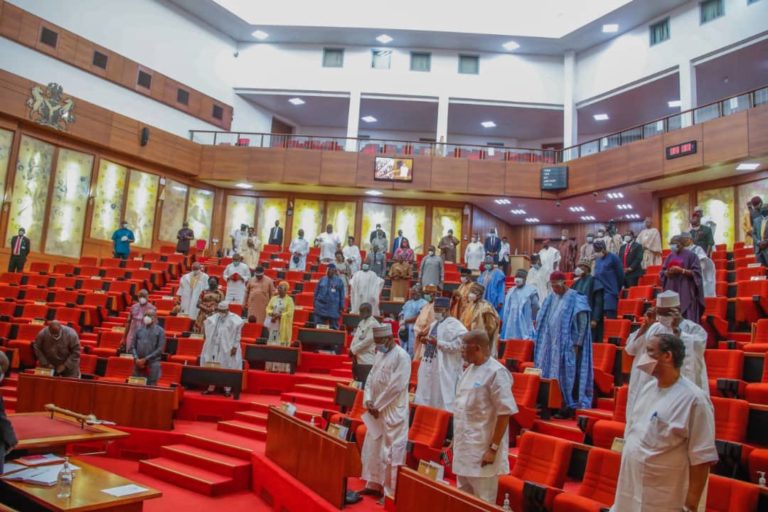
THE Nigerian Senate has adopted the three per cent allocated to host communities in the controversial Petroleum Industry Bill (PIB) amidst protest by lawmakers from the South-South region.
The southern lawmakers led by George Sekibo and Seriake Dickson, representing Rivers and Bayelsa states respectively, had urged the chamber to peg the fund to five per cent for host communities.
Sekibo said he was not part of the vote on the allocation clause and Senator Dickson said his privilege had been breached as his views were not accommodated.
However, Senate President Ahmad Lawan replied that the Senate had taken a resolution on the matter and could not go back on its decision.
The host community allocation was one of the clauses left in consideration after the National Assembly passed the PIB earlier this month.
The PIB is expected to transform Nigeria’s oil industry.
The three per cent is different from the 13 per cent derivation fund paid to oil-producing communities from the federation account.
Instead, the three per cent allocation will come from an entity’s actual yearly operating expenditure of the preceding financial year in the upstream, midstream and downstream sectors.
All contributions will be deposited in a trust fund for host communities.
According to a draft of the PIB, the trust fund will enhance peace and cordial relationship between oil companies and host communities.
According to the president, the loan would be sourced from multilateral and bilateral institutions and the issuance of Eurobonds in the international capital market.
Donor funded projects under the plan, according to the president, would be financed through sovereign loans from the World Bank, African Development Bank (AfDB), Islamic Development Bank, French Development Agency, and the China EXIM Bank.
Others included: the China Development Bank, European Investment Bank, European ECA, KfW, IPEX, AFC, India EXIM Bank and the International Fund for Agricultural Development (IFAD).
The president noted further that the projects and programmes in the borrowing plan were selected based on the technical and economic evaluation that would promote employment generation, social protection and poverty reduction.
Also, the listed projects were geared towards the realisation of Nigeria’s Economic Sustainability Plan cutting across key sectors such as infrastructure, health, agriculture and food security, energy, education, human capital development and the COVID-19 response initiatives.
According to the Debt Management Office (DMO), Nigeria’s total public debt as at March 31, 2021, was N33.107 trillion.
The DMO said the total public debt stock comprised the debt stock of the Federal Government of Nigeria (FGN), 36 state governments and the Federal Capital Territory (FCT).
The debt stock also included promissory notes in the sum of N940.220 billion issued to settle the inherited arrears of the Federal Government to state governments, oil marketing companies, exporters and local contractors.
The report said that compared to the total public debt stock of N32.916 trillion as at December 31, 2020, a marginal increase of 0.58 per cent was recorded in the debt stock.
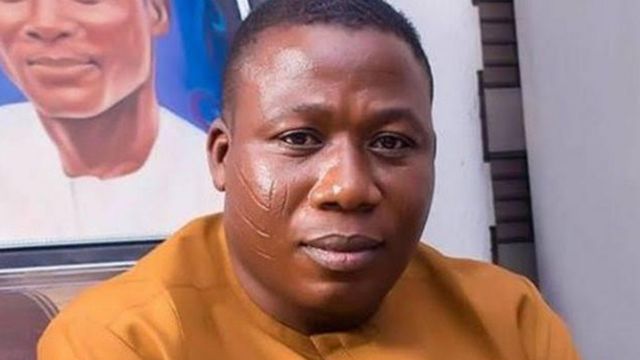
Nnamdi Kanu’s special counsel Aloy Ejimakor said those who abducted the leader of the Indigenous People of Biafra (IPOB) told him their sponsors claimed he was a Nigerian terrorist with a link to Al-Shabab, Kenya Islamic terrorists.
“The people that abducted him said that they were told by their sponsors that Kanu was a Nigerian terrorist linked to the Islamic terrorists in Kenya, presumably Al-Shabab,” Ejimakor was quoted by Premium Times to have said after a three-hour meeting with the IPOB leader in the detention facility of the State Security Service (SSS) on Wednesday.
“But after several days when they discovered his true identity, they tended to treat him less badly. Despite that, they told him they felt committed to hand him over to those that hired them,” Ejimakor added.
While stating that Kanu was arrested at the behest of the Nigerian government, Ejimakor said that Kanu was blindfolded, tortured and subjected to inhuman conditions before being driven to the Jomo Kenyatta where he was flown to Nigeria.
“Kanu was in point of fact tortured and subjected to untold cruel and inhuman treatment in Kenya. He said his abductors disclosed to him that they abducted him at the behest of Nigerian government,” the lawyer said.
“He was blindfolded and driven to the tarmac very close to the plane without passing through the airport immigration. The plane departed Nairobi at about 12 p.m. and arrived Abuja in the evening.
“Kanu was flown to Abuja in the private jet on Sunday, June 27, 2021, from Jomo Kenyatta International Airport, Nairobi and that he was the lone passenger.”
Ejimakor said although the Nigerian government had added new allegations to existing ones by which Kanu was standing trial, the IPOB leader was in high spirits despite all he had gone through.
“The interview was revealing as it contained certain new allegations that were never heard of before. But all the questions relate directly or indirectly to his status as the leader of IPOB.
“I observed that despite what he has passed through, he was in high spirits and looked forward to overcoming the extraordinary rendition that brought him to Nigeria,” the lawyer said.
The Nigerian government, through the Attorney-General and Minister of Justice Abubakar Malami, claimed Kanu was extradited two days before he was brought before an Abuja Federal High Court on Tuesday, June 29.
Kanu faces an 11-count charge of treason, treasonable felony, terrorism, and illegal possession of firearms.
Kanu jumped bail and fled Nigeria after soldiers raided his residence in Umuahia, Abia State, in 2017.
Ejimakor, however, noted before the court could find Kanu guilty of jumping his bail, it had to, first, look at the conditions and premises that made him leave the country.
“In my assessment of how the case now stands, I wager that before any court can subject Kanu to trial for any offenses, it has to first conduct a trial within trial on the grievous incident that forced him to leave Nigeria and the equally grievous incident that forced him back to Nigeria.
“No court of law, conscience and equity will overlook those two supervening incidents and proceed to trial,” Ejimakor said.
THE Catholic Bishop of Sokoto Diocese Matthew Kukah has said that insecurity in Nigeria is compounded by President Muhammadu Buhari’s nepotism and indecisiveness to deal with and bring perpetrators to book.
According to The Punch, Kukah stated during a virtual address to the United States Congress Commission on Thursday.
He noted that Buhari’s administration had failed to address the insecurity which formed the core of his electioneering campaign in 2015.
Kukah also accused Buhari of pursuing agenda and policies showing preferences for people’s of his tribe and faith, jettisoning the country’s principles of federal character as enshrined in the 1999 Constitution.
“The North, even the whole country, is invaded by armed bandits, kidnappers, among others, who attack communities at will. The fact that the government seems to be either helpless or uninterested in dealing decisively with these people has added more confusion,” he said.
“The contradiction here is that the President has blatantly pursued nepotistic agenda and policies that show very clearly his preference for men and women of his faith.
“For the first time in Nigeria, the people heading the three arms of government – President, Senate President, Speaker and Chief Justice – are all Muslims. These are all fine gentlemen, but that is not the point. The level of rivalry between Christians and Muslims has worsened. This kind of situation has never happened before.”
Kukah told the commission that the persecution of Christians in Nigeria, going on for a long time, had worsened in the past 10 years with Christian schools being attacked in the North by extremists who would convert girls to wives, sex slaves and spies while indoctrinating them.
“The story of Leah Sharibu suggests very clearly that there is, in many instances, a relationship between the conditions in which people find themselves and their faith,” he said.
“In 2020, some of our priests in the North were killed. The extremists kidnapped our children and forcefully converted them to Muslims. What is significant here is that we are in a democracy; with weak structures and institutions. These are existential issues. So, we require practical assistance that can help us and our children.”
In April, the cleric came under fiery attack by the presidency when he made similar statements during his Easter to his teeming followers in Sokoto.
Kukah had, in his reaction to the ravaging insecurity in parts of the country, expressed worries that Nigeria had become a killing field.
He lamented that both the government and citizens had become helpless in the face of incessant cases of banditry, kidnapping, terrorism and armed robbery across states in the country.
He noted that there was now a collective fear in Nigeria as to whether the glory of the country was about to depart due to the killings by the Boko Haram terrorist group, kidnappers and ‘other merchants of death.’
He blamed the lack of empathy by the Buhari- led administration as the reason for the several deaths in the country.
THE Nigerian government each year allocates billions of naira to non-statutory institutions – agencies that are not established or backed by the country’s extant laws.
Budgetary allocations to non-statutory agencies are the subject of a lawsuit that is pending before an Abuja Federal High Court.
In the suit numbered FHC/ABJ/CS/273/2021, the court was asked to determine whether, going by the provisions of the 1999 Constitution, the national budget should cater for non-statutory institutions.
The court was also asked to determine whether the Nigerian government could provide for and fund bodies not established and backed by extant laws.
The suit was filed by an activist, Sesugh Akume, through his lawyer, Rodney Adzuanaga. The originating summons was brought pursuant to sections 4, 80, 81 and 82 of the 1999 Constitution (amended) and the Appropriation Act, 2021.
According to the court papers obtained by The ICIR, some of the agencies ‘unknown to law’ that were identified to have been allocated funds in the 2021 budget (with their budget codes) included: Nigerian Institute for Education Planning and Administration 0517007001; National Metallurgical Training Institute 0233006001; National Centre for Technology Management (and all its extension and branches) 0228033001/0228034001; National Engineering Design and Development Centre 0228035001; National Horticultural Research Institute 0215011001; and National Power Training Institute 0231010001.
The National Power Training Institute was owned by the defunct NEPA/PHCN and despite the fact that there was nowhere it appeared in the Electric Power Sector Reform Act 2005, it is still being allocated funds in annual national budgets.
Other non-statutory agencies allocated funds in the 2021 budget, according to the lawsuit, were: National Board for Arabic and Islamic Studies 0517030001; National Biotechnology Development Agency (and all its extensions and branches) 0228008001-0228008039; National Institute for Tourism and Hospitality Development Studies 0123031011; Service Compact (SERVICOM) 0161019001; National Integrated Water Resources Management Commission 0252050001; National Office for Trade Negotiations 0222031001; Nigerian Army University Biu 0517021044; and National Research Institute for Chemical Technology 0228044001.
The National Research Institute for Chemical Technology was initially established by Decree 35 of 1973 but later became NARICT. The NARICT was transformed into the Nigerian Institute of Leather and Science Technology (NILEST) in 2010 and NILEST was allocated funds in the 2021 budget with the code 0228050001.
Yet, although National Research Institute for Chemical Technology is supposed to be defunct, having been replaced by NILEST, it still has an ‘operational’ status,’ receiving federal funding.
The lawsuit further identified a number of federal medical centres that were existing without enabling laws but were allocated funds in the 2021 budget.
The FMCs included: those in Abeokuta, Abuja, Asaba, Azare, Bida, Birnin Kebbi, Birnin Kudu, Ebute-Meta, Gusau, Jalingo, Katsina, Keffi, Lokoja, Makurdi, Nguru, Owerri, Owo, Umuahia, Yenagoa and Yola.
The National Centre for the Control of Small Arms and Light Weapons (NATFORCE) was not directly allocated funds in the budget but the lawsuit noted that the outfit, which was not established nor backed by extant laws, was being funded under the Office of the National Security Adviser, with a chief executive officer and staff paid with public funds.
Some of the non-statutory institutions are undergoing the legislative process for establishment but the applicant, Akume, in a supporting affidavit, argued that they could only become statutory institutions when their establishment bills were signed into law.
The National Assembly, Senate President, Speaker of the House of Representatives, Chairman of Senate Committee on Appropriations, Chairman of House Committee on Appropriations and Clerk of the National Assembly were listed as the defendants in the lawsuit.
Other defendants were: Minister of Finance, Budget and National Planning; Director-General Budget Office of the Federation, and the Minister of Justice and Attorney-General of the Federation.
Minister of Finance, Budget and National Planning Zainab Ahmed
Upon consideration of the issues for determination – whether the budget should cater for non-statutory bodies and whether the Nigerian government could fund institutions not backed by extant laws – the court was asked to make an order and declaration that the “Appropriation Bill, Supplementary Appropriation Bill and Appropriation Act does not provide for non-statutory institutions.”
The plaintiff, Akume, also asked the court to compel the Minister of Finance, Budget and National Planning and the DG of the Budget Office of the Federation to ensure that the Appropriation (or Supplementary Appropriation) Bills had the title of the establishment Act of each institution along with the expenditure submitted to the National Assembly by the president.
The court was equally asked to grant an order of perpetual injunction barring the National Assembly from attending to any appropriation bill that did not have the title of the establishment Act of the various institutions.
In the same vein, the court was asked to grant an order of perpetual injunction barring the National Assembly from allocating funds to institutions not established or backed by extant laws.
Stating grounds upon which the reliefs were sought, the plaintiff argued that the 1999 Constitution of the Federal Republic of Nigeria envisaged that only public institutions whose existence were backed by law could be provided for in annual budgets.
“In the 2021 budget (and others before it) the Federal Government and the National Assembly authorised billions of naira to be spent by bodies unknown to law,” the plaintiff added, noting that there was an urgent need to interpret relevant constitutional provisions in order to address the ‘anomalies and abuses.’
In a verifying affidavit in support of the originating summons, dated March 4, 2021, the applicant – Akume – observed that the annual national budgets of the Nigerian government were largely for recurrent expenditure used to run the machinery of government, with little or no benefit to the country’s citizens.
Linking the development to the high cost of governance in Nigeria, Akume observed that many of the concerned non-statutory institutions were duplicates of other existing agencies and as such had no clear responsibilities.
“The government of Nigeria itself has repeatedly complained that it is over-bloated with too many ministries, extra ministerial departments and agencies, with many of them doing the very same things; a large number of which are mere arrangements, unknown to law.”
The applicant further observed that despite different committees set up over the years to address the bloated and dysfunctional structure of the ministries, departments and agencies (MDAs), including the Presidential Committee on Restructuring and Rationalisation of Federal Government Parastatals, Commissions and Agencies, also known as the ‘Oronsaye Committee,’ the Nigerian government had not shown the will and determination to correct the problem.
“In spite of this over-bloating of the government with numerous public institutions (many of them doing the same things), the government further spends billions of naira yearly on public institutions not established nor backed by enabling law, therefore unknown to law,” the applicant further observed.
The National Assembly was accused of ‘promoting the recklessness’ by yearly allocating funds to the non-statutory institutions in national budgets.
“The country could have saved the billions of naira budgeted and released to such institutions unknown to law, or better channelled them for legitimate causes that benefit the citizens,” Akume noted.
He added that, in cases where the institutions were still undergoing the legislative process for establishment, the proper approach would have been for the government to first of all conclude their establishment by law “so that appropriating to them will be lawful, even if wastage by increasing the number of MDAs in most cases.”
According to the Oronsaye Report, as of 2011, out of 541 public institutions in Nigeria, 50 were non-statutory as they were not established by extant enabling laws.
“As of 2020, instead of reducing, there were 929 MDAs with the exact number of non-statutory public institutions being budgeted for unknown, and it is nearly impossible to unravel them all,” the applicant observed, noting that making budgetary proposals and appropriating funds for institutions unknown to the law amounted to an aberration, lawlessness as well as abuse and wastage of public funds.
Akume, in the affidavit, expressed concerns that if the situation was not addressed through a judicial pronouncement, the level of impunity could get to a level where private organisations would be funded with public funds through budgetary allocations.
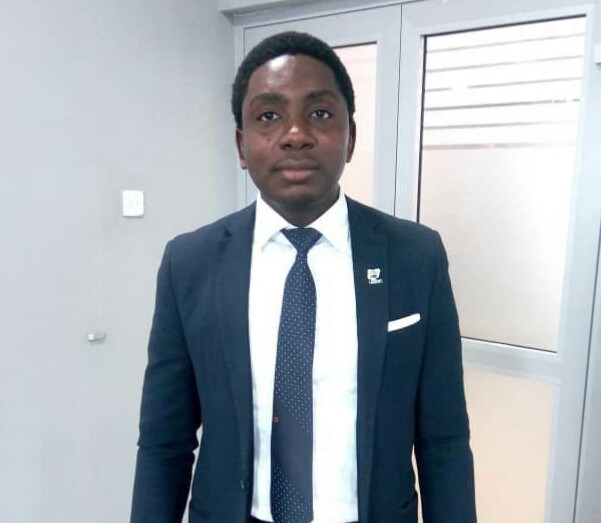
Sesugh Akume
“The organisations unknown to law funded with public funds today without legal backing are purported to be public institutions – the grave danger is if this ugly trend is allowed to continue, the impunity could grow to a level where even private organisations would be funded from the public fund without legal backing.”
Judicial workers’ strike stalls hearing, court to issue fresh date
The lawsuit, which is before Court 3 of the Abuja Federal High Court, presided by Justice Anwuli Chikere, was scheduled for mention for commencement of proper hearing, on May 10.
But the court could not sit on the date as a result of the strike action embarked on by the Judiciary Staff Union of Nigeria (JUSUN) to press for financial autonomy of the judiciary.
The strike has since been called off and the applicant, Akume, told The ICIR on July 14 that the court was to fix a new date to commence hearing on the lawsuit.
THE International Criminal Court (ICC) has acknowledged a petition filed against the Nigerian government by Sunday Adeyemo, popularly known as Sunday Igboho.
The self-acclaimed ‘Yoruba Nation’ activist together with Leader of Ilana Omo Oodua Banji Akintoye; Leader of Yoruba Strategy Simisade Kuku; Imam of Yoruba in Ilorin Raheem Aduranigba, and over 40 other Yoruba Nation groups had petitioned the Geneva-based institution to demand the seccession of the Yoruba people from the Nigerian state.
The agitators accused Nigerian authorities, including past and present heads of security agencies, of committing crimes against humanity and genocide, particularly against Yoruba people of Ekiti, Oyo, Osun, Ondo, Ogun, Okun Land in Kogi, and Kwara states.
The ICC’s Head of Information and Evidence Unit of the Office of the Prosecutor Mark P. Dilon, who acknowledged the petition, said the ICC would notify parties as soon as a decision was reached to formally commence investigation into this petition.
“This communication has been duly entered in the Communications Register of the Office. We will give consideration to this communication, as appropriate, in accordance with the provisions of the Rome Statute of the International Criminal Court,” he said.
“As soon as a decision is reached to formally commence investigation into this petition, we will inform you, in writing, and provide you, with reasons for this decision.”
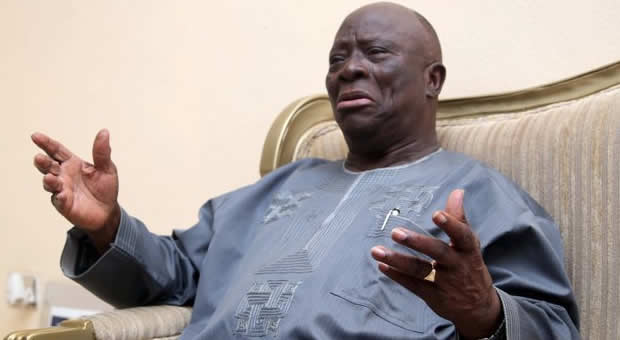
NIGERIA’s former Minister of Agriculture Audu Ogbe has suggested that the country should create a new ‘Ministry of the Future’ to deal with youth restiveness, insecurity and plummeting state of the economy.
Ogbe said the ministry would be tasked with weighing the consequences of government policies in the medium and long term, as well as creating job opportunities for youths to forestall restiveness and related crises.
The chairman of a northern socio-cultural group, Arewa Consultative Forum (ACF), gave the advice on Wednesday when he featured as a panellist in a webinar organised by The ICIR titled, ‘Solving Nigeria’s Security Conundrum: A Pan-Nigerian approach.’
He said the current insecurity, pervasive joblessness, divisions among ethnic nationalities and other issues resulted from actions taken by the country’s leaders decades ago.
“There were decisions we took three decades ago, which are having terrible impacts on us now. We are devaluing our currency almost every week for nearly three decades. Industries have collapsed. In the South-East, close to 400; in the North, about 200; in the South-West, about 200. We become a nation of importers of everything.
“Just two days ago, they gave a profile of imports: N40 trillion on imports and four trillion on exports. No country can survive by merely importing and importing,” Ogbe said.
He added: “Not finding enough foreign exchange to pay and hope to find happiness in the land. A million Naira in 1981 was $1.571 million. Today, a million naira is 2000 dollars. And, it is getting lower and lower by the day. Where are our industries? Who is responsible for the insecurity apart from the herdsmen crisis? It is the youth. How did the youth become a problem in society? They have nothing to do. They have no job, and they have no hope.”
Ogbe, who had served as a minister in 1983 under late former President Shehu Shagari (1982 – 1983) and President Muhammadu Buhari (2015 – 2019), said he had been kicking against the devaluation of the Naira since 1986.
He quoted former Brazillian President Lula da Silva as saying that a nation faced a Third World War when its schools, healthcare and economy were failing, and poverty was worsening.
While emphasising the need for his proposed ministry, Ogbe said by 2050, Nigeria population would have jumped to 450 million from the current nearly 212 million projected by the National Population Commission.
He said there might be no schools, hospitals, jobs and infrastructures for the population by then, which according to him, would further push the country into worse crises.
The former chairman of the opposition People’s Democratic Party and now a chieftain of the ruling All Progressive Congress (APC) said youths engaging in criminal activities were quick to attribute their actions to biting poverty and shrinking opportunities.
He decried the rising cost of food in the country and blamed the skyrocketing price on insecurity.
To curb the farmer-herder menace and allow agriculture to thrive, Ogbe urged the Nigerian government to review a Trans-human Treaty signed in Nigeria by the Economic Community of West African States (ECOWAS) in 1998.
He said the treaty permitted any herder to move from any ECOWAS member country with their cattle to another and depart anytime they chose.
“There is an agreement between ECOWAS countries, signed in Nigeria in 1998. They called it a Trans-human Agreement. Cattle can come from Mauritania, Senegal, Mali and graze and go back as they wish. Most Nigerians are not aware of this. It was signed here in 1998.
“In other words, cows can come from anywhere, come in here and go off. Even if you have your cattle under control, the foreign ones coming, with their herdsmen carrying AK-47 cannot be controlled. That is a law that has to be amended. Every country in West Africa has to take care of its own cattle because we can no longer afford that method of cattle rearing. It’s becoming too much a problem,” he said.
Among other issues, Ogbe backed the calls for a rotational presidency but said it was not the solution to Nigeria’s woes.
He said the North that had enjoyed power more than the South had had more challenges, adding that industries in the North had collapsed due to insecurity.
Other panellists at the meeting included: Ayo Adebanjo, leader of the South-West socio-cultural group, Aferenifer.
Adebanjo blamed the nation’s crises on its current constitution and called for a urgent review to fully restructure the country.
Former Senator from Cross Senator River State Florence Ita-Giwa said, but for the intervention of leaders of thoughts in the state and other parts of the Niger Delta, militants would have picked up guns.
President-General of Ohanaeze Ndigbo George Obiozor blamed the country’s current crises on the failure of leaders to be fair to all regions and promote justice, equity and merit.
LEADER of a pan-Yoruba group, Afenifere, Ayo Adebanjo, has said that the root cause of crisis facing Nigeria as a nation is embedded in the 1999 Constitution, saying that it should be discarded.
Adebanjo said this on Wednesday when he featured as a panellist in a webinar organised by The ICIR entitled, ‘Solving Nigeria’s Security Conundrum: A Pan-Nigerian approach.’
He said the constitution often created disunity among the citizens.
“The root of the problem we are facing today is imposed on us by the awkward constitution,” he said, emphasising that it was wrong to govern a plural society with a unitary constitution.
Adebanjo also said there would not have been Oduduwa, Bakassi and IPOB agitations if the authorities were doing their job to protect the interest of all the ethnic nationalities.
“There would have been no agitations from various regions of the country if the authourities are doing their job to protect the people.”
There have been killings of security officials and destruction of police stations in the South-East region in recent times.
The Indigenous People of Biafra (IPOB), led by the detained Nnamdi Kanu, has also arisen, creating secessionist tension in the region.
In the South-West, Sunday Adeyemo, known as Sunday Igboho, has also asked Fulani residents in the region to leave due to rising cases of kidnapping and other crimes.
Adebanjo said the solution to insecurity was to restructure the country, stressing that true federalism was the way to go.
“The moment the leaders restructure the country back to federalism is when there would be solution,” he said.
The elder statesman, however, berated the country’s constitution, saying it appropriated too much power on the president of the country.
“This constitution makes the president the most powerful president in the whole world,” he noted.
He added that every region would develop if true federalism was reintroduced, saying state police had become inevitable.
He wondered why the Federal Government in Abuja would be supervising the security situation on Anambra State, stressing that it was abnormal and unsustainable.
THE leader of Ohanaeze Ndigbo, George Obiozor, on Wednesday, said fair representation of various ethnic groups in Nigeria would create a lasting solution to the problem of insecurity in the country.
Obiozor, a professor of international relations, said the feeling of alienation by ethnic groups was a fundamental problem, noting that only fairness and equity would resolve numerous security issues bedeviling Nigeria.
At a security webinar hosted by The International Center for Investigative Reporting (The ICIR) on Wednesday, Obiozor said that no select group or region in Nigeria could do it all alone.
He attributed the insecurity in Nigeria to neglect and said there was a need to face the problem and stop denying its existence.
Likening politics to a business, he said concentrating of power in one group would eventually lead to problems.
Obiozor stated that it was necessary to strengthen the structure of Nigeria, make it fair and give everybody a chance.
Stating that Nigeria was a plural society, Obiozor said it should be governed as such.
According to him, “If Switzerland, the United States and China can manage themselves, why can’t Nigeria manage itself?”
He went on to say that Nigeria had faced crises that would have brought down empires but still overcame them.
He called on citizens to make use of their creative abilities to overcome the current insecurity crises.
Speaking about southern Nigeria providing leadership, Obiozor said the level of unity that was shown by the southern governors on anti-grazing decision came because there was shared interest.
He warned that the centre needed to be careful to avoid a proliferation of insecurity in other parts of the country.
Obiozor went ahead to tell those who questioned the need for rotation of power to stop politicking as all regions had, at one time or the other, agitated for secession.
Obiozor said the Igbos did not want to be loved as most people thought but wanted equality and fairness.
THE management of the University of Lagos (UNILAG) has ordered the closure of the institution beginning from tomorrow over the resurgence of COVID-19 on the university campus.
This decision was reached at an emergency Senate meeting held on Wednesday.
The ICIR understands that students have also been directed to move out their belongings and vacate the halls of residence latest by 12.00 noon on Thursday, July 15, 2021.
The Senate approved that lectures for the rest of the semester should be delivered virtually with effect from 26th July 2021.
UNILAG Spokesperson Nonye Oguama could not be reached for comments as calls repeatedly put across to his phone were not answered or returned as at the time of filling this report.
The university on Tuesday had announced in a statement on its website that the institution was being affected by a potential third wave of the coronavirus.
“The University of Lagos Medical Centre wishes to inform all members of the University of Lagos Community about what appears to be the start of a potential 3rd wave of the COVID-19 Pandemic in Lagos State,” it said.
“The Executive Governor of Lagos State, Mr. Babajide Sanwo-olu, in his press statement issued on July 11, 2021, stated that since the beginning of July there has been a steep increase in the number of daily confirmed cases, with the test positivity rate going from 1.1% at the end of June 2021, to its current rate of 6.6% as at the 8th of July 2021. This is with a concurrent increase in the occupancy rate at Lagos State isolation centres.
“The University of Lagos community has also been affected by this potential 3rd wave, with an increase in the number of patients presented to the University of Lagos Medical Centre with flu-like symptoms which are similar to COVID-19.
“The Medical Centre hereby assures all members of the University community, that all necessary actions in line with the Federal and Lagos State Government guidelines have been taken regarding this potential threat in our community.
“The Medical Centre will also return to providing EMERGENCY ONLY SERVICES during this period, in order to protect all members of the community from potential infection within the facility. The Medical Centre Emergency Contact line: 09095879781 remains open 24 hours a day, 7 days a week.”