Home Blog Page 1859

Lawyer narrates how Cross River DPO, officers beat him up for attempting to bail client

JOSEPH Bassey Arikpo, a lawyer and petitioner at the investigative panel on SARS in Abuja, has narrated how a divisional police officer (DPO) and other officers beat him up for attempting to bail his client, Friday Ogbor.

During the resumed sitting of the panel in Abuja on Tuesday, Arikpo said Solomon Danja, DPO of  Ikom police station under the Cross River State Command, and his officer, severely assaulted him.

He alleged that before the DPO descended on him with punches, he had reminded him of the detainee’s right to personal liberty and dignity of human person, following which the DPO got infuriated and called him a stupid man.


Read Also:


Arikpo explained to the panel that while he was about to leave the DPO’s office, the police officer allegedly rushed towards him and threw punches at him while also reiterating that he (Arikpo) was stupid.

He added that while he was trying to run away, the DPO ordered that the gate of the police station be locked,  while using teargas on him and resuming the punches.

The complainant who said he was a member of the Nigerian Bar Association, Ikom Branch, stated that while he managed to dodge one of the punches from the DPO, he fell down on the floor and that resulted in more police officers coming to beat him mercilessly.

Arikpo stated that after his statement was obtained in recording despite his objection to it, the DPO allegedly came in again with officers wielding batons and horse whips, asking that he be handcuffed to the back, while commencing another round of beating, whipping and name-calling.

After some days of detention in the police station, he informed the panel that he was reluctantly released on 9th of November, 2020, through the intervention of the elders of the NBA, Ikom Branch, after some other counsel had made fruitless efforts to get the police to release him.

The petitioner prayed the panel to dismiss and prosecute the DPO, stating that he was not fit to be an officer of the Nigeria police.

He is also requesting the panel to order that the DPO pay him the sum of N20 millio as compensation for the assault.

In addition, he sought an order of the panel mandating an apology approved by the NBA and published in two (2) national dailies .

Responding to the allegations, James Idachaba, counsel to the police, told the panel that Danja was not present at the panel.

The matter was adjourned till 15th of April, 2021 for the police to ensure the presence of the DPO at the panel.

US prioritises Nigerian visa applicants affected by Trump’s travel restrictions

0

THE United States mission in Nigeria is prioritising immigrant visa applicants in Nigeria who were affected by travel restrictions imposed by former US President Donald Trump.

This development follows the Presidential Proclamation titled ‘Ending Discriminatory Bans on Entry to the United States,’ which was signed by current US President Joe Biden on January 20, 2021.

The US consulate-general in Lagos revealed, in a statement, that it was prioritising visa applicants in Nigeria who were affected by the travel restrictions under Presidential Proclamations 9645 and 9983.

This included establishing contacts with all immigrant visa applicants whose applications were affected and with processing pending cases.

Trump had suspended entry into the United States of certain nationals, based on visa type, from various countries, including Nigerians, with exceptions for students and those with ‘significant contacts’ in the US.

It also noted that media reports claiming “Nigerians denied visas on or after January 20, 2020, can re-apply for free” were inaccurate, adding that the proclamation announcement applied only to certain immigrant visa cases and did not apply to tourist, business, student, or other non-immigrant visas.

“This ended the travel restrictions under Presidential Proclamations 9645 and 9983 that had suspended entry into the United States of certain nationals, based on visa type, from various countries to include Nigeria.

“In Nigeria, this proclamation banned entry for certain immigrant visa categories. The US Consulate -General in Lagos has already contacted all immigrant visa applicants whose applications were affected and is prioritizing the processing of these pending cases,” a section of the statement read.

The mission further disclosed that the consular sections in Abuja and Lagos were gradually restoring routine visa operations in accordance with COVID-19 safety protocol.

It also announced that the validity of non-immigrant visa payments (known as the MRV fee) had been extended till September 30, 2022, to allow all applicants who were unable to schedule visa appointments as a result of the suspension of routine consular operations to have opportunity to schedule and/or attend appointments with the already paid fees.

“Non-immigrant visa applicants who were previously refused and would like to apply again will need to submit a new visa application (DS-160) and pay a new visa application processing fee,” the mission stated.

Extend visa ban to violators of human rights, attacks on rule of law – SERAP urges US, others

In 2019, the US Mission to Nigeria indefinitely suspended interview waivers for renewals, which was known as the ‘Dropbox’ process where visa applications were no longer accepted by DHL in Nigeria.

This ensured that applicants in Nigeria seeking non-immigrant visas to the United States applied online, appearing in-person at the US Embassy in Abuja or US consulate in Lagos to submit their applications for review.

Nigeria clears 3-year contribution arrears to WTO

Nigeria has cleared a backlog of its annual contribution to the World Trade Organisation, WTO, from 2019 to 2022.

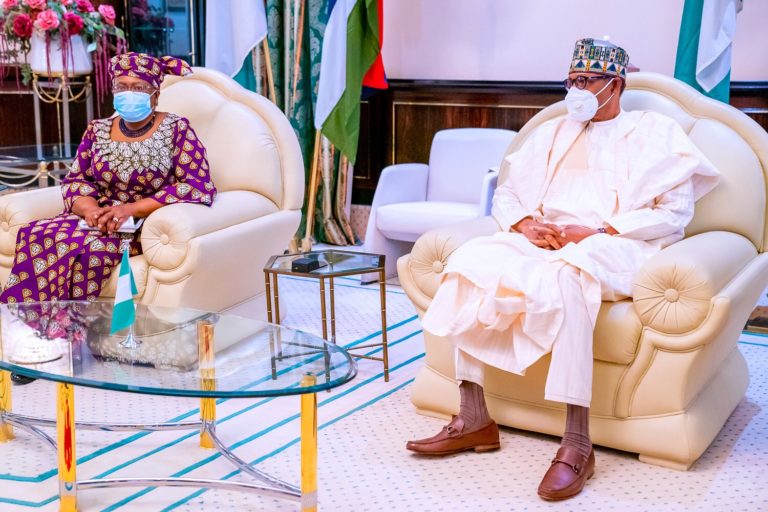
The new director-general of WTO Ngozi Okonjo-Iweala made this disclosure on Tuesday in Abuja during a meeting with finance minister Zainab Shamsuna Ahmed.

Nigeria did not only clear the areas of 2019; it paid for 2020 and 2021 and paid in advance for 2022,  Okonjo-Iweala said.

Though the former finance minister did not disclose the amount paid by Nigeria to clear the outstanding fees, contributions to WTO are determined according to each member’s share of international trade (percentage) based on trade in goods, services and intellectual property rights.

There is a minimum contribution of 0.015 percent for members whose share in all members’ total trade is less than 0.015 percent. WTO record shows that  Nigeria’s trade share among member-states has never declined to that level.

According to the WTO record between 2015 and 2020, Nigeria has contributed a total of  CHF4,306,865 (N1.8 billion) to the WTO.

Nigeria, recognised as the strongest economy in Africa, contributed CFH 586,500 in 2020, CFH 656,880 in 2019, CFH 742,900 in 2018, CFH 785,910 in 2017, CFH 752,675 in 2016, and CFH 782,000 in 2015.

The amount contributed in 2020 and 2015 shows that Nigeria’s share of international trade has dropped by 25 percent in the last five years.
In the third quarter of 2020, Nigeria economy slid into recession with a decline of 3.6 percent, leading to the second recession in five years.

Though the economy exited recession in the fourth quarter of 2020, according to the National Bureau of Statistics, Nigeria’s recovery is expected to be weak and gradual under current policies, the IMF has predicted.

“Real GDP growth in 2021 is expected to turn positive at 1.5 percent. Real GDP is expected to recover to its pre-pandemic level only in 2022”, say  Ari Aisen, Jesmin Rahman and Jiaxiong Yao of the IMF, African Department.

Many times, soldiers demanded better arms during former service chiefs’ tenure

TO the surprise of many Nigerians, Babangana Monguno, national security adviser, in an interview last Friday, said money meant for arms were missing under the tenure of former service chiefs. Hours later, he recanted his words in a statement from his office.

As denial shrouds the truth about the missing funds and arms, The ICIR chronicles some occasions where military officers demanded better arms or openly showed concerns about lack of arms and ammunition during the tenure of the former service chiefs.

President Muhammadu Buhari had, on several occasions, emphasised his administration’s commitment to properly equip the military. Putting some of his plans to action, he approved $1 billion for the purchase of military equipment, but Nigerian military officers still lamented lack of adequate weapons after the approval.

Seven months after the approval of the funds, Nigerian soldiers in Metele, Borno State, made a video crying that they were being killed due to lack of proper weapons to fight the insurgents in the region.

While filming the video, a man who spoke as one of the soldiers in the state, called for the intervention of the federal government, saying “these people (insurgents) are killing us.”

Less than a year after, amidst the fierce fight against the Boko Haram terrorist group in Borno State where thousands have been killed and hundreds displaced, a viral video emerged in January 2019, showing Nigerian soldiers pushing an Armoured Personnel Carrier (APC) as part of efforts to jumpstart it.

The voice in the background of the video encouraged the soldiers to push the armoured tank while lamenting the state of the Nigerian Army.

“Nigerian Army, there is problem o,” the voice said.


In 2020, a soldier of the Nigerian Army Lance Corporal Martins made a 12-minute video, where he said Nigerians soldiers were being killed due to lack of proper weapons to fight Boko Haram terrorists.

According to Martins, other officers of the army that had spoken against the availability of adequate weapon had been arrested on orders Buratai. He added that sometimes, the soldiers were given guns without bullets.


Also in 2020, an army commander was removed from his position for revealing the inferior military wares and poor equipment of troops in his command.

Olusegun Adeniyi, a Major-General and then commander of operation Lafiya Dole

Olusegun Adeniyi, a major-general and then commander of operation Lafiya Dole, had disclosed the state of the weapon of his troops while briefing the chief of army staff from the combat zone after successfully repelling an attack from Boko Haram insurgents.

Adeniyi was eventually court-martialled, convicted and demoted by three years on grounds of violating some sections of the policy on the use of social media for personnel of the armed forces of Nigeria.

No smoke without fire

The military does not have a clean slate on corruption. While there has been no direct corruption link to the former service chiefs, there have been reported cases where top officials were found guilty of embezzling funds meant for the Nigerian Army.

Prominent of such case is the ‘dismissal with disgrace’ of Hakeem Otiki, a major-general and former general office commander (GOC) of 8 Division, Nigerian Army, Sokoto, who was found guilty of N100 million fraud.

Lai Mohammed did not lie; superpowers are not selling arms to Nigeria, but he overstated the fact

Before his conviction by the military,  a Federal High Court sitting in Abuja had, on January 23, 2020, ordered the interim forfeiture of the sum of $376, 120 allegedly seized from Otiki to the federal government of Nigeria.

Amid concerns by European countries, NPHCDA says AstraZeneca vaccine doesn’t cause blood clot

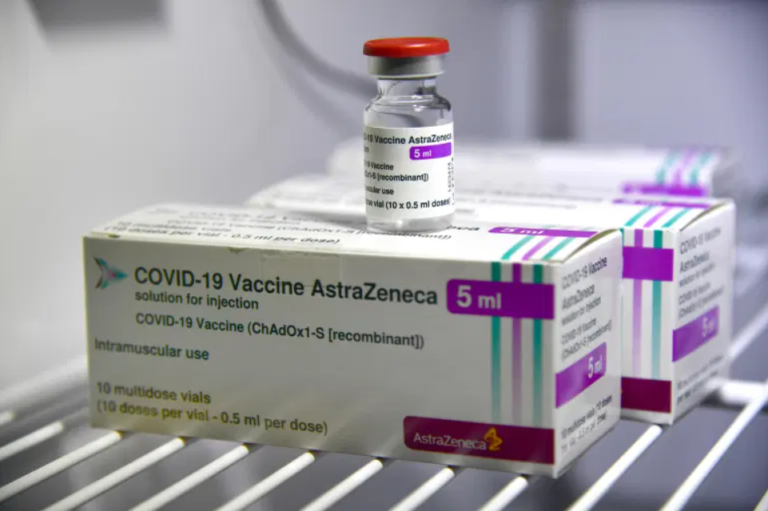
DESPITE health concerns by some European countries, the National Primary Health Care Development Agency (NPHCDA) has assured Nigerians that the Oxford/AstraZeneca vaccine does not cause blood clot.

Faisal Shuaib, executive director of NPHCDA, cited the Medicines and Healthcare Products Regulatory Agency (MHRA)’s recent research that disputed claims on the dangers of the vaccine.

“As you well know, the AstraZeneca vaccine is being used in many parts of the world. Even after the roll-out suspension by some European countries over certain concerns raised, the WHO and its vaccine advisory committee have advised that there is no reason to stop using the Oxford/AstraZeneca vaccine,” he said.

“Similarly, the UK regulators have also determined that evidence does not suggest that the vaccine causes blood clots.”

Shuaib also said the low cost of the AstraZeneca vaccine did not make it inferior.

“It is important to note that none of the approved brands of COVID-19 vaccines is inferior. Understandably, the Oxford/AstraZeneca vaccine relatively costs less than the other available brands of COVID-19 vaccines,” he said.

“However, this is not because it is inferior. It is because AstraZeneca, which partners with Oxford to produce the vaccine, decided and announced that they would not be making profit during this pandemic.”

INVESTIGATION: Bullets, Blood & Death: Untold Story of what happened at Lekki Toll Gate

Last week, Denmark, Iceland, Norway and some other European countries stopped the use of the vaccine after fatalities were recorded from a blood clot.

The Netherlands has also become the latest country to suspend the administration of the vaccine, citing the same reason.

Nigeria received more than 3.9 million doses of the vaccine two weeks ago and has since begun its vaccination exercise with over 8,000 doses administered across the country so far.

FG will no longer tolerate Emirates’ discriminatory bahaviour – Aviation ministry

THE Ministry of Aviation has said that the ban on Emirates airline, the official carrier of the United Arab Emirates (UAE), was due to its discriminatory policy on the COVID-19 test for Nigerians.

James Odaudu, spokesperson for the Ministry of Aviation, explained this during a telephone interview with The ICIR on Tuesday.

Odaudu explained that the insistence of Emirates airline on bringing passengers into the country and refusing to take them to the UAE was discriminatory and the federal government would not continue to allow that.

Earlier on Monday, Aviation minister Hadi Sirika had disclosed that the federal government placed a ban on Emirates until further notice.

Odaudu told The ICIR that other international airlines had agreed to the guidelines set up by Nigerian regulatory bodies except Emirates airline.

“Emirate has insisted on subjecting Nigerians to extra test other than the one agreed on with other airlines and the guidelines set up by the regulatory bodies.

“Now they agree to fly passengers into Nigeria but refused to fly passengers out of Nigeria, which we consider discriminatory and insensitive,” Odaudu said.

For over one month, there have been continuous bans on flights from and to Nigeria by Emirates and the federal government.

On Thursday, February 11, Emirates announced the suspension of outbound flights from Nigeria to Dubai, stating that inbound flights to Nigeria would still be in operation.

The Emirates  is insisting that for passengers to be airlifted from Nigeria into UAE, they are to conduct an RDT test in addition to the PCR test after arrival.

However, the Nigerian government had said Emirates was demanding an RDT test conducted in unapproved laboratories from Nigerians after the PCR had been done against the stipulated directive.

When asked if this could be in connection with reports of alleged fake PCR tests in Nigeria, Odaudu said there were recognised laboratories in Nigeria where authentic tests could be done.

Sirika had also argued that it made no ‘scientific sense’ for Emirates to require a PCR test for passengers within 72 hours of their flight and then subject them to an antigens rapid test at the airport and another PCR test on arrival in their countries.

Checks by The ICIR also show that it takes a flight about seven hours to fly from Lagos to Dubai.

According to the World Health Organisation (WHO), it takes at least five days for COVID-19 virus to incubate and sometimes up to 14 days. Therefore, a passenger that tests negative within 72 hours cannot test otherwise between the time of flight from Nigeria to the time of landing in Dubai, the UAE capital.

Despite growing discontent, CBN introduces N7 charge for each USSD transaction

THE Central Bank of Nigeria (CBN) has ignored economic slump and growing discontent in the country to introduce a flat fee of N6.98 per transaction every time a customer uses the Unstructured Supplementary Service Data (USSD) service.

The apex bank, in a statement released on Tuesday and jointly signed by the apex bank’s acting director of corporate communications Osita Nwanisobi and director of public affairs at the Nigerian Communications Commission Ikechukwu Adinde, said the charges were effective from Tuesday (today).

The CBN said that it was part of the agreement reached when banks and telecommunication operators met on Monday to discuss the N42 billion debt owed by the banks to mobile operators.

“Effective March 16, 2021, USSD services for financial transactions conducted at DMBs and all CBN – licensed institutions will be charged at a flat fee of N6.98 per transaction. This replaces the current per session billing structure, ensuring a much cheaper average cost for customers to enhance financial inclusion. This approach is transparent and will ensure the amount remains the same, regardless of the number of sessions per transaction.”

CBN added that the new development was targeted at ensuring transparency in its administration, adding that  the new USSD charges would be collected on behalf of mobile network operators (MNOs) directly from customers’ bank accounts.

“A settlement plan for outstanding payments incurred for USSD services, previously rendered by the MNOs, is being worked out by all parties in a bid to ensure that the matter is fully resolved.”

It also stated that the MNOs and DMBs would discuss and agree on the operational modalities for the implementation of the new USSD pricing framework, including sharing of Application Programme Interface (API) to enable seamless, direct and transparent customer billing.

CBN, however, said that the USSD channel was optional, adding that several alternative channels such as mobile apps, internet banking and ATMs might be used for financial transactions.

Nigeria spent $770m on oil imports in first half of 2020 – CBN

There is a growing discontent in Nigeria as unemployment rate reached 33.3 percent  in the fourth quarter of  2020,  from 27.1 percent in the second quarter of the same year. Inflation hit a four-year high of 17.78 percent in February 2020, with food inflation hitting 21.79 percent. Nigeria is world’s poverty capital, with 87 million living in extreme poverty. Prices of staples from bread to biscuits have risen sporadically in the last six years when President Muhammadu Buhari came in power.

#ENDSARS: Police officers frustrate proceedings, refuse to appear before panels

SINCE the constitution of special judicial panels across 36 states and the Federal Capital Territory (FCT) to look into cases of police brutality, some police officers have refused to appear before the panels, frustrating victims’ hope of getting justice. Reports say that the attitude is commonest in Abuja.

Garba Tetengi, member of the Independent Investigative Panel on Defunct SARS and other Units of the Nigerian Police Force, representing chairman of the panel, said the police were trying to frustrate quest for justice for victims of brutality.

According to him, the trend had become ‘worrying,’ making it difficult for the force to execute directives of the panel with regard to appearances in answering allegations levelled against them.

The panel had ordered for the appearance of two police officers Raymond Eku (aka ‘Death’) serving in the Lagos State Police Command and IPO Sylvester in Nassarawa State police command who were both of the defunct SARS.

Asaph Aristole, liaison officer between the Nigeria Police and the IIP-SARS, told the panel that the notice for appearance was sent to the concerned police commands, but the officers chose not to appear on their own personal volition.

Eku  and Sylvester were summoned by the panel to answer questions on allegations of unlawful arrest, detention, torture, inhuman and degrading treatment of one Richard Augustine.

Apart from the refusal of the officers to appear before the panels, the representative and counsel of the police in the Abuja panel has also been accused of negligence by the panel.

During the Monday sitting, counsel to the police respondents Malik Taiwo told the panel that the other counsel assigned to a petition was absent at the proceedings, thereby stalling the cross-examination of a petitioner.

Reacting to the counsel’s statement, Tetengi rejected what he deemed as an ‘unserious excuse’ by the police.

He argued that the police was one entity and ordered that it should “either cross-examine petitioner or forego that right and get ready for defence.”

Many police officers refuse to appear before panel

The ICIR gathered that apart from Eku and Sylvester, there have been several other police officers that have refused to appear before the panel.

The National Human Rights Commission (NHRC) had, in November, ordered the appearance of James Nwafor, a former commander of the Akwuzu SARS unit in Anambra unit, who was accused of supervising killings of more than five persons. The said Nwafor has since failed to appear before it.

Also, three police officers from Delta State police command have refused to honour the invitation of the panel in the state, thereby stalling the hearing of an alleged case of police brutality.

#ENDSARS: Osun State Panel on police brutality begins with five petitions

The police officers include one Sergeant Musa Sunday, Lucky Kehinde and Lucky Okuku who the police had earlier testified were sitting in the same vehicle the day a victim allegedly jumped off a moving van and got injured in the process. However, the panel has ordered the arrest and appearance of the three officers.

The ICIR contacted Frank Mba, spokesperson for the Nigeria police through phone calls and text messages, but he did not reply as of the time of filing this report.

After $1bn valuation, Flutterwave partners Paypal to boost Africa’s online payment

AFTER hitting $1 billion valuation, Flutterwave, a leading fintech firm, has announced a strategic partnership with PayPal, an online global payment platform. The partnership is geared towards facilitating online payments in Africa.

With the partnership, Nigerians and other Africans can now receive payments with their PayPal account through Flutterwave.

In a series of tweets on Twitter, Flutterwave said the partnership would enable over 377 million customers to bridge infrastructural weakness in doing business within Africans and the world.

The firm, in a tweet, said: “As we build the largest payment infrastructure in Africa @theflutterwave, we also know that Africa does not exist in isolation.

“We need to connect Africa to the world when it comes to payments and we took a closer step to that today.

“All Paypal users can now pay African businesses from anywhere in the world, on our gateway. We’re excited to be opening up a world of opportunities for businesses in Africa!”

This latest announcement is another big step in the fintech industry after Paystack was acquired last year.

Flutterwave secured $170 million from investors last week to expand its customer base. The fintech firm hit $1 billion valuation last week, putting it in the class of unicorn start-ups.

“We are thrilled to share news of our 170 million dollar #SeriesC funding which will be crucial in improving our technology, product, customer support, and expansion drive,” Flutterwave said on its Twitter handle last Wednesday.

#EndSARS: Why I ordered suspension of Flutterwave’s payment platform- Tunde Lemo

“The company’s valuation is now more than 1 billion dollars. The fundraise brings the total investment in Flutterwave to $225 million,” the company said in a separate statement seen by The ICIR.

NIPOST in charge of adhesive stamps, not stamp duties ― FIRS

THE Federal Inland Revenue Service (FIRS) has said that the Nigeria Postal Service (NIPOST) has not been licensed for the collection of stamp duty charges.

FIRS, in a statement signed by its executive chairman Muhammad Nami, on Tuesday, said communications minister Isa Patanmi was earlier misquoted on the subject.

“The Honourable Minister was misquoted as saying that administration of Stamp Duty was granted to NIPOST by the Finance Act 2020. The speech attributed to the Honourable Minister was definitely quoted out-of-context,” Nami said in a post on FIRS Twitter handle on Tuesday.

He stated that what the minister meant was that NIPOST would produce adhesive stamps required by FIRS to denote stamp duties, adding that the statement was in line with “S.2 of the Stamp Duties Act (as amended by Section 46 of the Finance Act 2020).”

Nami, however, urged taxpayers, tax practitioners and the general public to ignore the earlier information in circulation, saying it was an unfortunate attempt to cause confusion.

“FIRS therefore urges Taxpayers, Tax practitioners and the general public to ignore this unfortunate attempt to cause confusion by twisting the Honourable Minister’s speech.

NIPOST reclaims collection of stamp duty charges from FIRS

“The Honourable Minister for Communications and Digital Economy is a patriot whose passion for the rule of law and Nigeria is never in doubt,” he said.