MUHAMMADU Buhari, Nigeria’s president, has announced the appointment of new service chiefs.
He also accepted the resignation of old service chiefs who have supervised worsening insecurity in the country.
Buhari made this known via his official Twitter handle, Tuesday, while expressing his appreciation to the old service chiefs for offering their expertise to the nation.
“I have accepted the immediate resignation of the Service Chiefs, and their retirement from service. I thank them all for their overwhelming achievements in our efforts at bringing enduring peace to Nigeria, and wish them well in their future endeavours,” Buhari wrote.
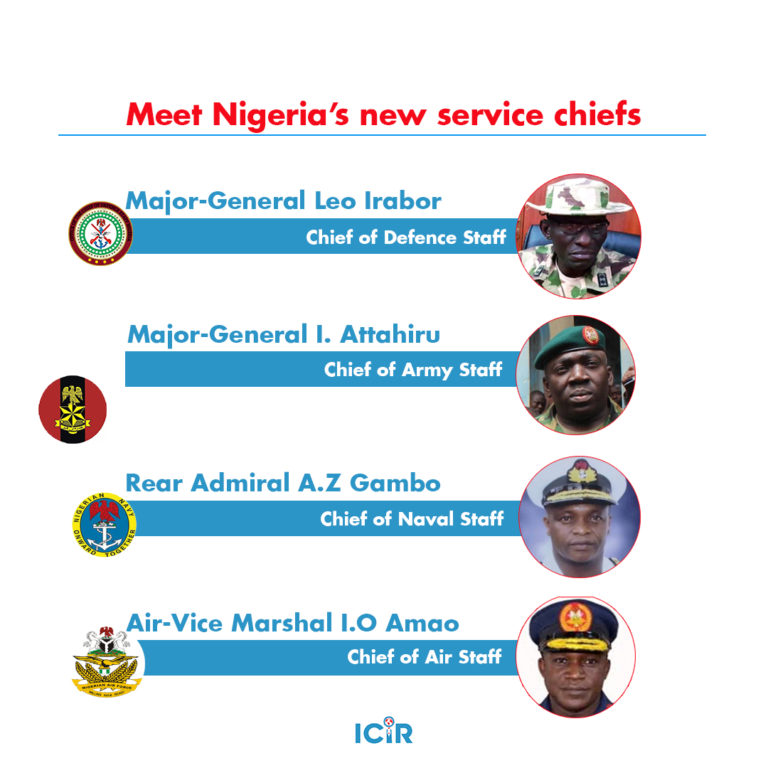
The president also announced their replacements as follows: Major-General Leo Irabor, chief of defence staff; Major-General I. Attahiru, chief of army staff; Rear Admiral A.Z Gambo, chief of naval staff; and Air-Vice Marshal I.O Amao, chief of air staff.
This is coming amidst high spate of insecurity that has affected almost all regions in Nigeria. The country is currently facing violent attacks of different forms including banditry, kidnapping, insurgency, among others.
Prior to this development, the Nigerian Senate, House of Representatives, state governors and the People’s Democratic Party (PDP) had described the service chiefs as incompetent and asked for their sack.
Earlier in July 2020, the Senate, through a motion raised by Ali Ndume, senator representing Borno South and chairman of the Committee on the Army, had called for the resignation of the service chiefs.
Ndume had prayed to the Senate demanding the resignation of Tukur Buratai, chief of army staff; Sadique Abubakar, chief of air staff; Gabriel Olonisakin, chief of defence staff, and Ibok-Ete Ekwe Ibas, chief of naval staff.
Ndume demanded that the service chiefs step aside for new appointments to be made.
Ayo Fadahunsi, vice-chairman of the Senate Committee on Customs, also proposed the stepping aside of the service chiefs, and his prayer was seconded by Senator Betty Apiafi.
Ahmad Lawan, Senate President, had ruled on the prayer, which was largely supported by all the Senators in attendance.
In its response, the presidency had said that the power to sack or appoint service chiefs was a presidential prerogative. calling the bluff of the Senate’s motion.
THE Oyo State Police Command has said unidentified hoodlums were responsible for setting ablaze Sunday Igboho’s house in Ibadan.
One of the houses belonging to the Yoruba activist located at Soka in Ibadan, the Oyo state capital was reportedly on fire in the early hours of Tuesday.
Although sources close to Igboho told newsmen that he no longer resides in the house, the source of the fire was not initially unknown.
But according to Channels Television, the police said hoodlums who came in with two vehicles set the house ablaze after firing sporadically in the air.
“At about 0620 hrs of today 26/01/2021, the report was received at Sanyo Police Station that some unidentified hoodlums came to Sunday Igboho’s house at SOKA area of Ibadan in a Hummer bus and Micra firing sporadically and set the house ablaze,” the police said.
“The mini sitting room got burnt in the process while other properties are yet to be estimated
“Immediately the DPO Sanyo got wind of the incident, he contacted Fire Service while he also went to the scene for on the spot assessment. The fire was eventually put out.
It added that “Investigation has commenced into the incident while the Police are on the trail of the hoodlums.”
Igboho, an Oyo indigene, has been in the news in recent times after he issued an ultimatum of one week quit notice to Fulani herdsmen residing in Ibarapa area of Oyo State over the spate of kidnappings and killings attributed to herdsmen in the area.
The ultimatum, which expired last week has generated tension across the polity following a massive rally by Igboho in which some houses and properties in the herder’s settlements were burnt down by angry youths, according to the police.
EVERYDAY, over the past few months, Nneka Chukwu, a principal nursing officer at the National Orthopaedic Hospital, Enugu, checks out the latest developments concerning the COVID-19 pandemic in the United Kingdom. She gets alarmed at the rising numbers, particularly the huge death toll recorded among health workers in the European country. Though she is afraid of the COVID-19 crisis in the UK, which is by far more severe than the situation in Nigeria, Nneka cannot wait to relocate to the UK, where she believes she will get the job satisfaction in nursing that has so far eluded her in her country, Nigeria.
An investigation conducted by The ICIR in the health sector revealed that despite higher risks associated with the coronavirus pandemic in the developed countries in Europe and North America, many Nigerian doctors and nurses are currently making moves to take their services outside Nigeria, with the UK, United States and Canada as the choice destinations. The investigation also revealed that although poor renumeration has been a longstanding complaint of Nigerian doctors and nurses, ‘job satisfaction’ was the major reason the medical practitioners are leaving the country.
Doctors and nurses who spoke to The ICIR in the course of the investigation said they lacked job satisfaction. They also expressed the belief that job satisfaction in the medical field would be found abroad – in countries such as the US, UK and Canada, among others.
Nneka, who spoke to The ICIR in Enugu in the course of the investigation, which focused on the South-East states, is hoping to relocate to the UK very soon. She told our correspondent that many other nurses are concluding arrangements to leave Nigeria.
“I prefer (to relocate to) the UK. I have started the process and I believe that very soon I will leave. Even though I am scared of coronavirus and some other things that are happening there, I am going to leave. At the moment I know of so many other nurses that are just waiting for their visa to come out for them to leave Nigeria,” the nurse told our correspondent.
Although it is widely believed that the opportunity to earn higher wages abroad was the major reason Nigerian doctors and nurses are leaving the country, Nneka noted that monetary consideration was a secondary factor. She stressed that the major reason was lack of job satisfaction owing to unsatisfactory working conditions.
Low nurses to patients ratio in Nigeria
Nneka specifically identified the low nurses to patients ratio in the country – a situation which forces one nurse to attend to scores of patients at a time – as the major factor responsible for lack of job satisfaction among Nigerian nurses. She told The ICIR that the low nurses to patient ratio, which imposes an unduly high workload on the available nurses, was one of the reasons nurses are practically fleeing the country for the US, UK, Canada, Germany and other countries where they will do more quality work with less effort.
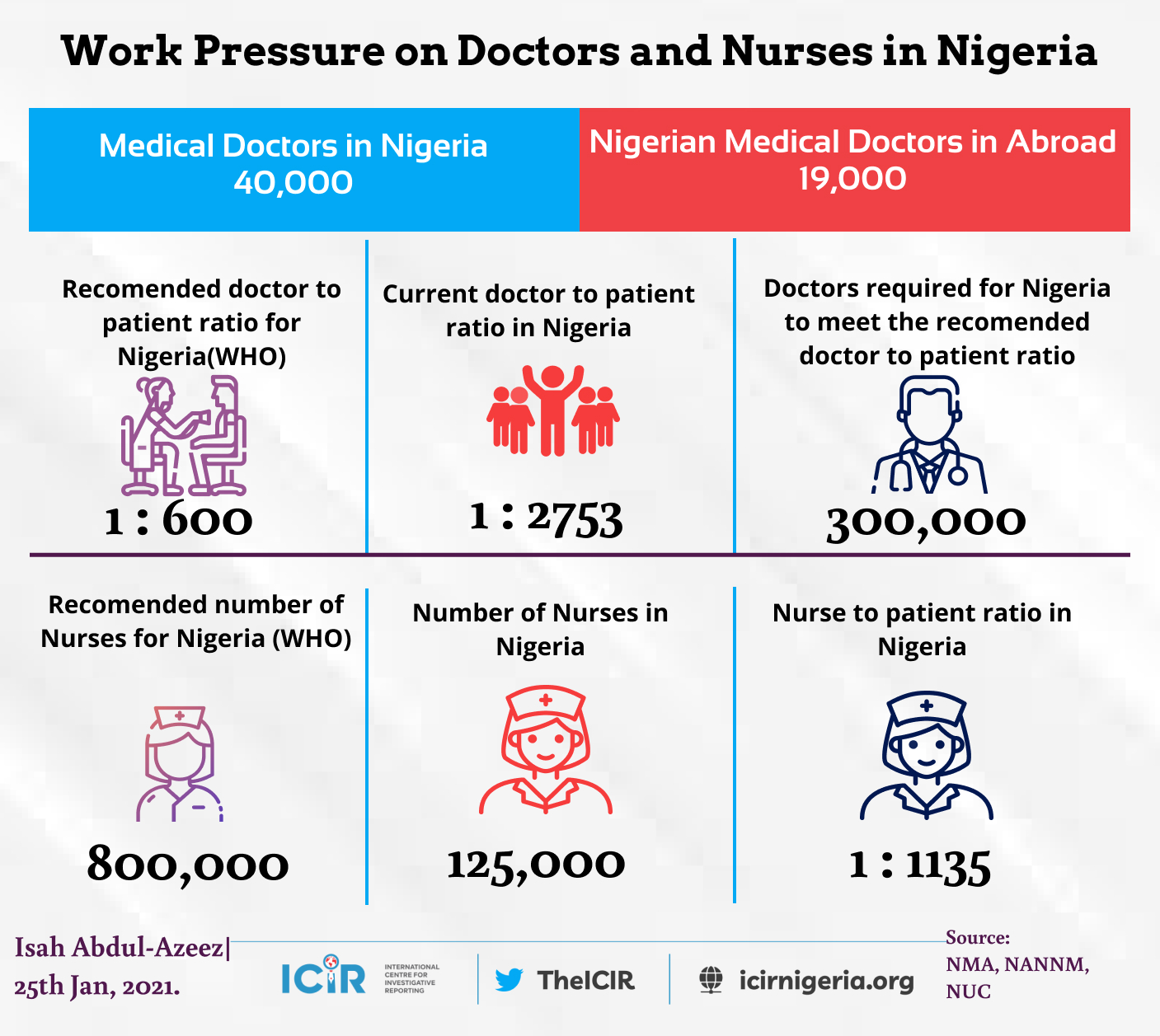
As of March 2020, the nurse to patient ratio in Nigeria was 1: 1135, which translated to 88.1 nurses per 100,000 persons. The figure was disclosed by Mr. Shakuri Kadiri, deputy director, and head of human resources for health in the federal ministry of health, Abuja.
Analysis of work pressure on Doctors and Nurses in Nigeria
The World Health Organisation (WHO) recommended that, going by population size, Nigeria should have not less than 800,000 nurses and midwives, according to President of the National Association of Nigerian Nurses and Midwives (NANNM), Abdrafiu Adeniji. But Adeniji told The ICIR that, at the moment, the country has just 125,000 nurses and midwives.
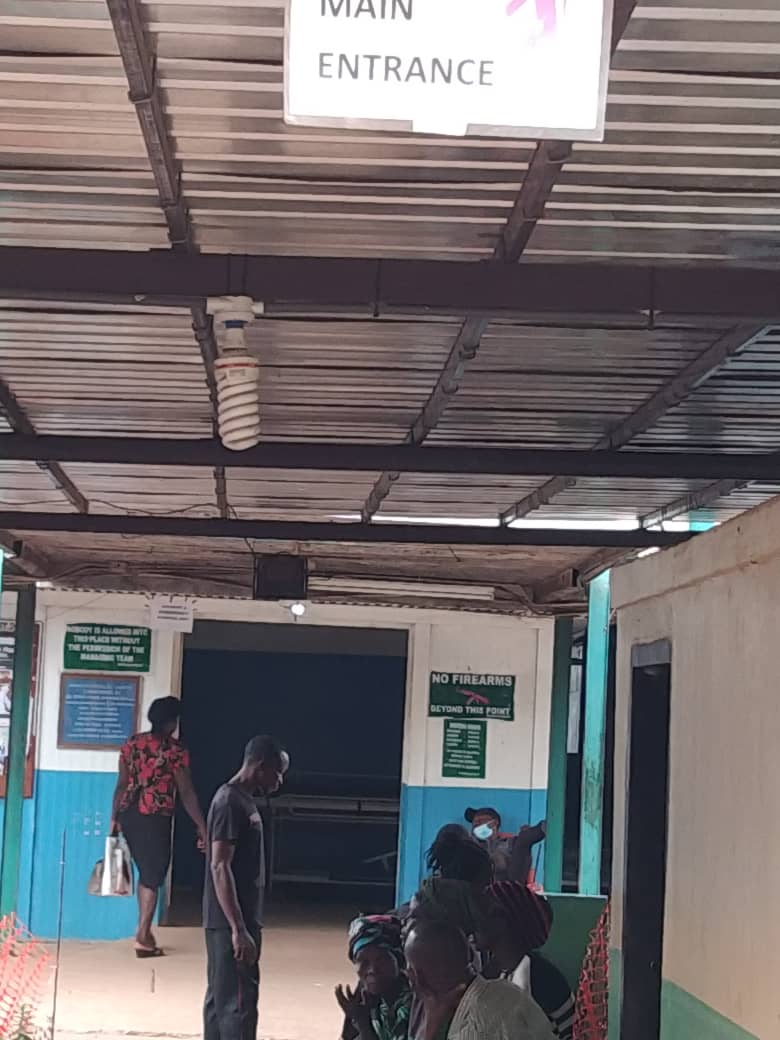
A nurse attends to more than 10 patients at a time at National Orthopaedic Hospital, Enugu
Giving further insight on how the low nurses to patients ratio affect healthcare delivery in hospitals across the country, Nneka revealed that, at the National Orthopaedic Hospital, Enugu, she and her colleagues attend to more than 10 patients at a time. “Here in the Orthopaedic Hospital (Enugu) you have a situation where as a nurse you are attending to at least 10 to 12 patients at a time,” she told our correspondent.
Nurses can’t give their best when attending to many patients at the same time
Nneka observed that the situation has had a negative effect on healthcare delivery as nurses have difficulties in handling several patients at the same time.
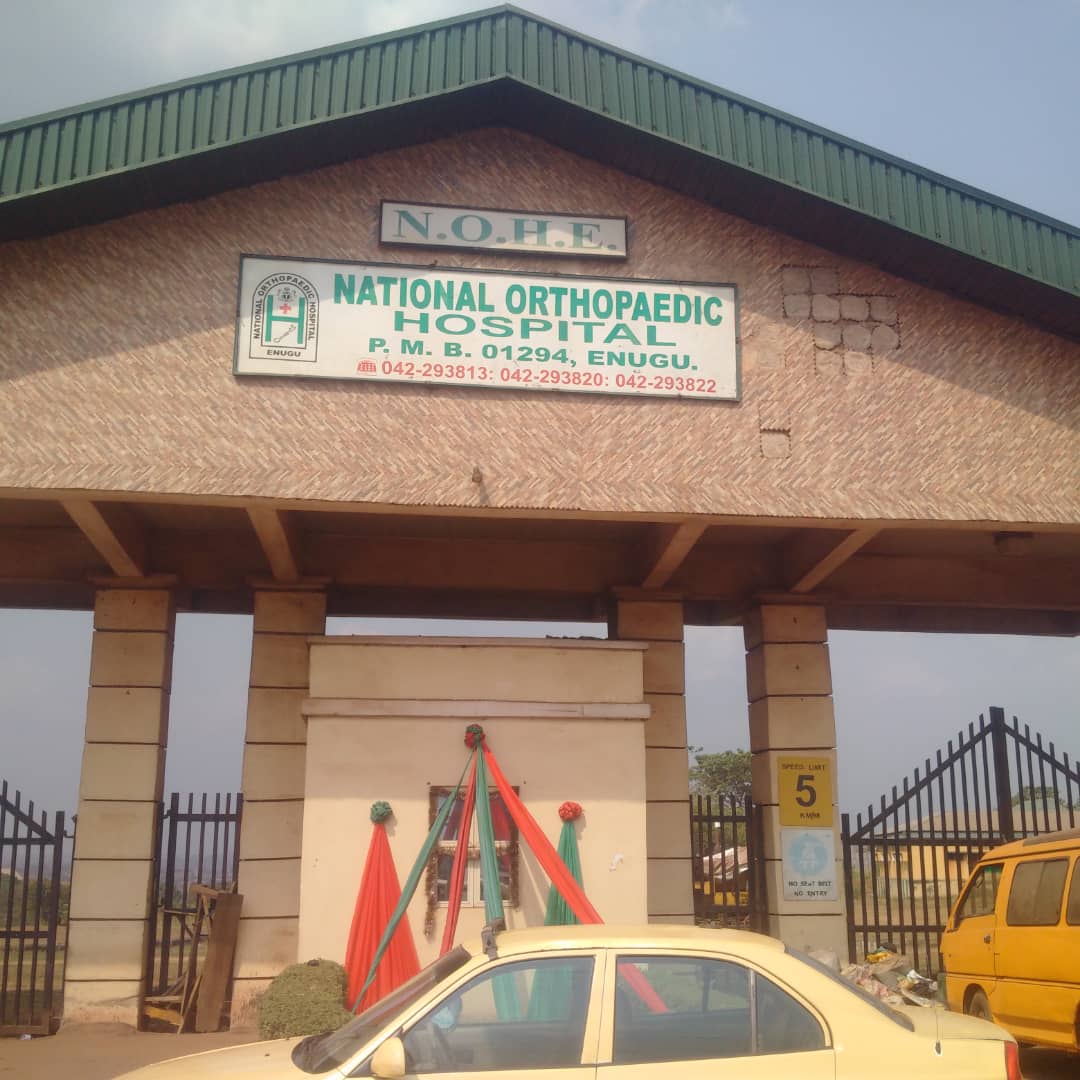
National orthopaedic hospital, Enugu
Speaking further, Nneka said, “As nurses, we are trained to give holistic care. A nurse should provide all round care and for you to be able to do that, you will have to focus all your attention on a particular patient. It is not something you can do when you are attending to more than one person at a time. That is ideal but things are different in reality. For example in this hospital, in a 24-bed ward, you have just two nurses on duty. That means 12 patients under one nurse. Even at that, had it been that the things you need are within your reach it would have been easier but sometimes you will have to take a patient out of the ward to do X-Ray, or you will have to take a patient to the theater, or you have to go out to look for oxygen.”
Continuing, she added, ”From my experience, personally you find yourself running helter-skelter in order to meet up with the care you have to provide to several patients at a time. But unfortunately, in the end, you find that you will not be able to give the care. So you find out that you are not satisfied – the job satisfaction that a nurse gets from nursing patients is not there. Everything gets tangled up and you just don’t like what you do. At the end of the day, the nurse goes home tired, weak and in fact feels like not coming to work again. That is what happens as a result of the low nurse to patients ratio. As a nurse, you are not able to do what you should do. And for me and my colleagues, it also makes us to feel sick. We work over-time most of the time. Our work is tense – the number of hours you put in is enormous and again, the pay is not commensurate to the effort put into the work but we just find ourselves doing it. If you overstay your shift, as is the case most of the time, you don’t get paid for that. And you notice that you overstay most times because you are trying to meet up with what you are supposed to do, and still, in the end, you don’t meet up.”
Unsatisfied patients
Between the nurses and the patients, there are no winners in the unfortunate situation. Nneka explained that most times, patients are not satisfied with the level of care they receive in hospitals. “Most of the time the patients are not satisfied. Most times, I will be on one bed attending to a patient and another patient will call me and I will say ‘give me some time I’m coming’ but I can’t divide myself into two so I can’t come immediately. So as a result, that other patient feels you are ignoring them”.
Due to inadequate number of nurses, patients’ relatives get involved in providing care
Patients waiting for the doctor at federal teaching hospital, Abakiliki, Ebonyi State.
Another unfortunate aspect of the situation is that, because the few nurses available have their hands full, sometimes relatives who are looking after family members in the hospital have no choice than to get involved in providing care for patients. Nneka, who expressed regrets over the development, admitted that some patients prefer their relatives to do certain things for them when they observe that the nurse, who has been over-worked, was becoming irritable.
Nurses are leaving Nigeria in droves
More than 10 nurses employed by the National Orthopaedic Hospital, Enugu, left Nigeria last year, according to Nneka. And many more are waiting to leave in 2021. “This year (2020) alone, from this Orthopaedic Hospital, more than 10 nurses left the country and more than 50 are waiting to leave,” she said.
Nneka insisted that money had nothing to do with her decision to leave. According to her, it is all about job satisfaction. “I want to leave because the work here is not giving me what I want based on what I know I can do. The environment is not just conducive and this is not just about the pay. When the things you are working with are not working, and you have this dedication to do what you are trained to do, you will want to go to a place where you will do better. The truth is when you have a lot of people (patients) under your care, you can’t be effective,” she observed.
President of the National Association of Nigerian Nurses and Midwives, Adeniji, said healthcare practitioners are not leaving the country just because they want to make more money. In an interview with The ICIR, Adeniji insisted that the ‘brain drain’ has more to do with conditions of service and job satisfaction.
He said, “Migration is a personal choice but it has a lot to do with the condition of service and job satisfaction. People are not leaving the country because of monetary considerations alone. When the condition of service does not allow you to function effectively the interest will be lost and when the interest is lost you will have to look for an alternative. The number of nurses in the country is grossly inadequate and in a situation where the few nurses available are being overworked and the condition of service is so poor, it not surprising that you see many nurses leaving the country.”
Jibe Onyekwelu
Chidiebere Okwara
Nneka Chukwu
Adeniji-Abdulrafiu-Ajani
Number of medical doctors in Nigeria not enough
Investigations by The ICIR across the South-East states further revealed that not only is the number of medical doctors grossly inadequate to meet the healthcare needs of the population, most of the doctors are also leaving the country for better working conditions abroad.
The federal government in March 2020 put the doctor to patient ratio in the country as 1: 2753, which translates to 36 medical doctors per 100,000 persons but the World Health Organisation recommends 1: 600 doctor to patient ratio.
Executive secretary of the National Universities Commission (NUC), Abubakar Rasheed, said on January 20, 2021, that Nigeria needs about 300,000 doctors to meet the 1:600 ratio recommended by the WHO.
The total number of medical doctors registered with the Medical and Dental Council of Nigeria as at March 2020 was 74,543, according to figures released by the federal government, although the NUC said less than 40,000 medical doctors are currently practicing in the country. The NUC also put the doctor to patient ratio in the country at 1:3500. However, the website of the Nigerian Medical Association (NMA) said there are over 40,000 medical doctors in Nigeria, and about 19,000 Nigerian physicians in the Diaspora.
Efforts to get the actual number of medical doctors in the South-East states were not successful but chairmen of Nigerian Medical Association (NMA) state branches provided estimates of the number of doctors in their states.
Chairman of the Ebonyi State chapter of the NMA, Ben Umezurike, told The ICIR that the state currently has about 650 medical doctors.
Jibe Onyekwelu, chairman of the NMA in Anambra, said there are about 1000 medical doctors in the state.
According to Tony Onyia, chairman of the NMA in Enugu State, there are about 1700 medical doctors in Enugu.
Chairman of the Imo State chapter of the NMA, Chidiebere Okwara, said the number of medical doctors employed by the state government at different levels was just 210. The number does not include medical doctors in the Federal Medical Centre, Owerri, and those working in private hospitals.
Okwuonu Chimezie, NMA chairman in Abia State, refused to disclose the number of medical doctors in the state. He told our correspondent that he was not authorised to disclose such information by the national body of the medical association. Chimezie referred our correspondent to the national leadership of the NMA.
Doctors suffer emotional and physical fatigue due to large number of patients, some fall sick, die
Medical doctors, who spoke with The ICIR in the course of the investigation, said most of them are suffering from ’emotional and physical fatigue’ due to the disproportionately huge number of patients they have to attend to on a daily basis.
Shedding further light on the situation, Okwara, Imo State NMA chairman, revealed that in December 2020, a medical doctor at the Federal Medical Centre, Owerri, collapsed while on duty and had to be taken to the Intensive Care Unit (ICU).
”The doctor collapsed while on call attending to patients. He was rushed to the Intensive Care Unit and it took almost a week to get him back on his feet. He overstretched himself trying to attend to so many patients at once and didn’t have any time to rest and that was what led to that. He was unconscious for two days in the ICU,” Okwara said.
Noting that all the general hospitals in Imo State do not have up to a total of 30 medical doctors, Okwara added that there are only 12 medical doctors in the primary healthcare centres across 27 local government areas in the state.
As a result of the situation, a doctor working at the primary healthcare level covers up to three local government areas at the same time.
“Many doctors are suffering from emotional and physical fatigue,” Okwara observed.
Corroborating Okwara’s account, Umezurike, NMA chairman in Ebonyi, said many doctors have developed health complications.
”If you look at the faces of medical doctors you will see that all is not well, especially health-wise. Some doctors have collapsed while some have died treating patients. We are doing more than we should do and the incentive is very poor,” Umezurike told The ICIR.
Inadequate number of medical doctors undermine healthcare delivery
Onyekwelu, NMA chairman in Anambra, said the inadequate number of medical doctors has had a negative effect on healthcare delivery. According to him, the knowledge that general hospitals in Anambra have just one medical doctor has made people to opt for patent medicine dealers rather than visiting the hospital, when they are sick.
”That is why many of our general hospitals have very low patronage. The people prefer to go to patent medicine dealers for their treatment,” he observed, adding that in most instances, patients go to the tertiary or specialist hospitals when their health challenges are already serious.
Onyia, Enugu NMA chairman, bemoaned the long period it takes medical doctors to attend to several patients, who also have to wait several hours to see the doctor. “As a result, doctors begin to get irritable and this affects the doctor-patient relationship. When you have to see patients from 8:00 am to 4:00 pm, there is no way you will give your best. It gets to a point where there will be diminishing returns,” he said, adding that some patients are taking to alternative medicine just because of the lack of easy access to medical doctors.
According to Onyia, several communities in the rural areas have no medical doctor, a situation which he said has provided an environment for quacks and unorthodox medical practitioners to thrive.
‘It is the dream of every young doctor to leave Nigeria’
At the Federal Teaching Hospital, Abakiliki (FETHA), in Ebonyi State, a young doctor, who pleaded anonymity, told The ICIR that no doctor would remain in Nigeria if there is an opportunity to relocate and practice abroad.
A federal teaching hospital, Abakiliki, Ebonyi State.
“What I can tell you now is every young doctor’s major priority is to leave Nigeria. Those that want to stay here in the long term probably have personal interests or limitations but the trend now is that young doctors are writing foreign licencing exams to leave Nigeria,” he said, adding that hospitals have gotten used to receiving resignation letters from their young doctors.
The young doctor suggested that medical practice was better, and easier, abroad. According to him, in the US, UK, Canada and other advanced countries, a doctor can only work for a specified duration at a time and there is a limit to the number of patients to be attended to.
However, going by Chukwu’s testimony, it is not only young medical practitioners that wish to leave Nigeria, but even the experienced hands are also leaving. And if nothing is done to address the situation, the ‘brain drain’ problem will only get worse for Nigeria, as, according to Nneka, “Every medical practitioner here (Nigeria) is needed out there (abroad). Doctors, nurses, laboratory scientists, physiotherapists – all of them are needed abroad”.
THE Nigerian Air Force (NAF) says its Operation Thunder Strike neutralised several bandits at Chikwale Forest in the Mangoro area of Chikun Local Government, Kaduna State.
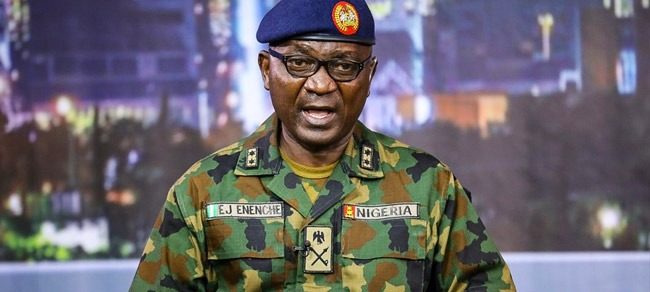
John Enenche, a major-general and coordinator of defence media operations, disclosed this in a statement on Monday. He said the operation took place on Saturday, stressing that it was carried out following credible human intelligence gathered by the Air Force that there was significant presence of armed bandits in the area. Enenche said it prompted the force to launch massive airstrikes on fleeing bandits.
”Accordingly, after series of confirmatory aerial surveillance missions, the Air Component dispatched an appropriate force package of Nigerian Air Force fighter jets and helicopter gunships to attack the location,” he said.
”Overhead the target area, the NAF Intelligence, Surveillance and Reconnaissance aircraft spotted scores of bandits, mounted on motorcycles and dressed in black attire, heading towards Niger State.
“The attack aircraft therefore took turns in engaging the bandits, who were seen firing at the attack helicopter as it strafed them.”
“Several armed bandits were accordingly neutralised in the airstrikes, while some escaped with various degrees of injuries. Meanwhile, aerial surveillance missions have been intensified, in coordination with ground troops, to locate the fleeing bandits,” he noted.
While vowing that the military would not rest until normalcy was restored to troubled parts of the country, Eneche noted that the Armed Forces of Nigeria and other security agencies would sustain the offensive against enemies of the nation.
Apart from Boko Haram, the activities of armed bandits have become another major security concern for the Nigerian state and security operatives in recent times.
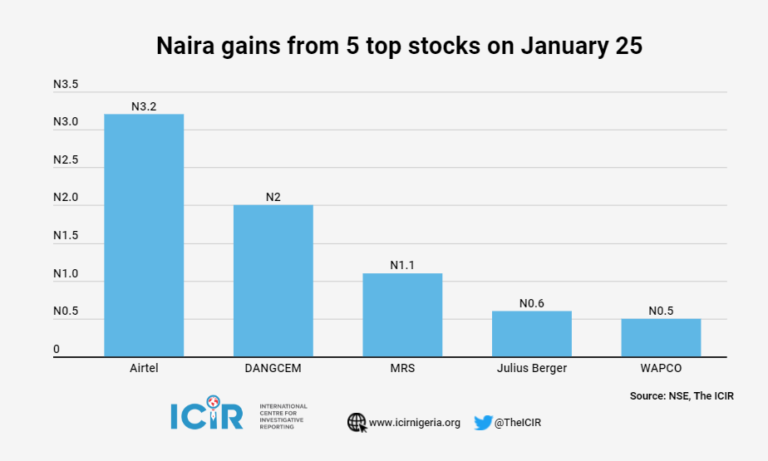
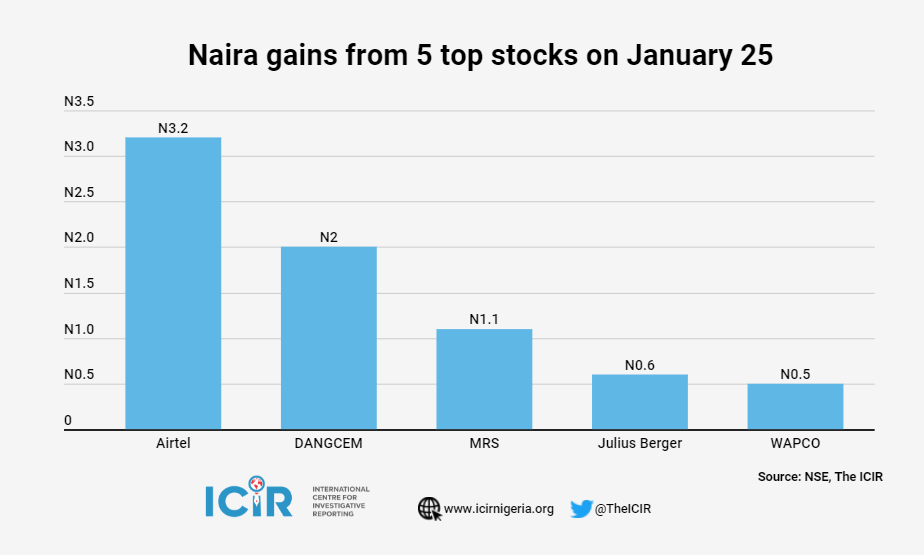
AIRTEL Africa, Dangote Cement and MRS emerged top gainers at the close of the Nigerian stock market on Monday.
Airtel stocks gained 3.2 naira, rising from 851.8 naira to 855 naira, representing 0.38 percent increase, according to a summary of market activities by the Nigerian Stock Exchange (NSE) on Monday, January 25.
This means that an investor who bought 1 million units of Airtel on Monday morning at 851.8 naira would have made 3.2 million naira by the close of the market.
Dangote Cement gained 2 naira, increasing from 234 naira to 236 naira, representing 0.85 percentage increase. Also, MRS stocks rose 1.1 naira, from 11.2 naira to 12.3 naira, indicating a 9.82 percentage point increase in a market day.
Two other stocks that were among top investors’ picks were Julius Berger and WAPCO.
Julius Berger gained 0.6 naira, rising from 18.9 naira to 19.5 naira, which was a 3.17 percent increase over 24 hours.
Similarly, WAPCO stocks saw a 1.9 percent point increase in price, rising from 26 naira to 26.5 naira over the trading day.
These stocks pushed up listed equities market by 45 billion naira, with 19 gainers helping year-to-date returns to 2.03 percent. The value of listed equities rose from 21.449 trillion naira to 21.494 trillion naira within the trading day, representing 45 billion naira increase.
The NSE All-Share Index, which tracks market movements of all the listed equities, rose by 0.21 percent, from 41,001.99 points to 41.088.96 points.
In 5,640 deals, 333,096,795 units estimated at 2.640 billion naira were traded. However, Ardova, Nascon, CI Leasing, International Breweries and Unilever emerged as top losers.
January 18-22 market activity
Total turnover of 4.288 billion shares valued at 25.989 billion naira were traded in 32,849 deals last week on the floor of the Exchange.
It was better than the previous week’s 3.447 billion shares valued at N32.725 billion.
“Trading in the top three equities, namely Transnational Corporation of Nigeria, Living Trust Mortgage Bank Plc and Japaul Gold and Ventures Plc (measured by volume) accounted for 1.582 billion shares worth 1.564 billion naira in 2,726 deals, contributing 36.9 percent and 6.02 percent to the total equity turnover volume and value respectively,” NSE said in its January 18-22 market report.
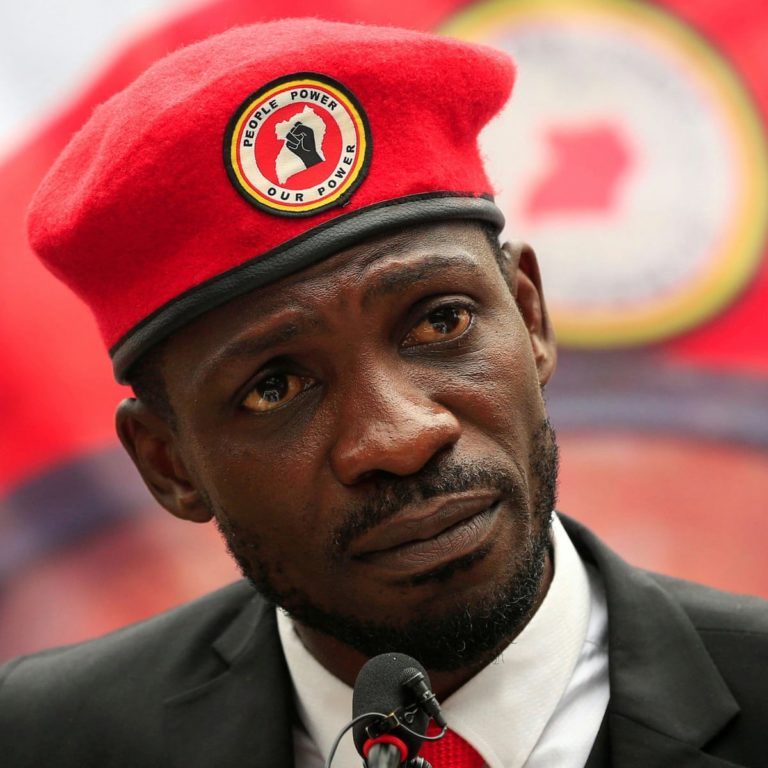
AFTER spending eleven days on house arrest, a Ugandan high court, Monday, ordered the release of opposition leader, Robert Kyagulanyi, popularly known as Bobi Wine.
Justice Michael Elubu ruled that the residence of the 38-year-old musician was not a detention centre.
Elubu stated that proper charges should be instituted against Wine if found to have disrupted public peace, rather than being placed him on an indefinite house arrest.
“The continued indefinite restriction and confinement of the applicant to his home is unlawful and his right to liberty has been infringed. Having found that the restrictions are unlawful it is hereby ordered that they are lifted,” Elubu ruled during the session.
Although Solomon Muita, spokesperson for the Ugandan Justice Ministry, confirmed the court order, he said he was yet to get the details of the ruling.
“The ruling was made today that the security forces being at Bobi Wine’s place was unlawful, I am yet to get details of the ruling but the judge ordered that the security forces need to leave his premises immediately,” Muita said.
Wine was last seen in public on Thursday 14, January 2020, after voting at the Ugandan presidential elections in his local government.
A day after the election, he tweeted that his residence was on under siege by the military who jumped the fence to gain access into his home.
“We are under siege. The military has jumped over the fence and has now taken control of our home,” Wine tweeted.
The United States ambassador to Uganda, Natalie Brown, was also denied access to visit Wine.
Brown had earlier announced the decision of the United States government not to observe the election due to denial of ‘more than 75 per cent’ of its accreditation requests.
Like the United States, the European Union also announced its decision not to send observers to the Eastern African country due to recurrent failure to heed her previous advice on making the Ugandan Electoral Commission independent and ensuring a free and fair process.
The ICIR had reported how the incumbent president, Youveri Museveni, used violent tactics to secure another term in office after ruling the country for 35 years.
During the electioneering period, Museveni ordered a ban on social media in Uganda following an unfavourable Twitter hashtag #We are removing a dictator#.
The Ugandan electoral commission declared Museveni winner of the election keenly contested amidst violence.
According to Uganda’s electoral commission on Saturday afternoon, Museveni won the election with 58.64 percent of the total votes cast while his main challenger, Wine, garnered 34.83 percent of the total votes cast.
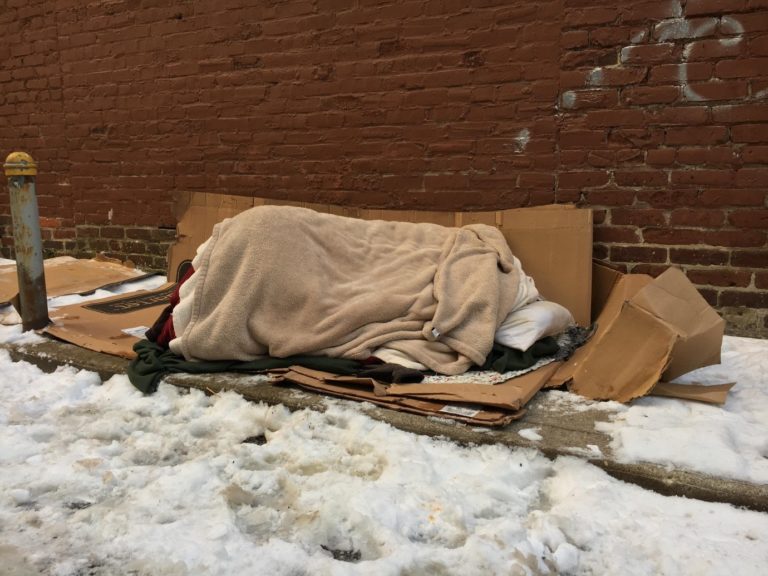
A homeless 46-year-old Nigerian man living in Rome has died from exposure to cold after he was “ignored by all (and) abandoned”, Pope Francis said from the Vatican City on Sunday, calling attention to the plight of the poor and needy.
The man simply identified as Edwin was discovered dead just a few meters from St. Peter’s Square on January 20.
“Let us think of Edwin, let us think of what this 46-year-old man felt in the cold, ignored by all, abandoned, even by us. Let us pray for him,” the Pope said before pausing for a few seconds in prayer for the deceased.
Sant’ Egidio, a Catholic charity group dedicated to social service said Edwin was at least the fourth homeless person to die of the cold in the city this year and the 10th since November.
The Charity along with other groups search the streets of Rome for the homeless to direct them to shelters and give out blankets and food.
An estimated 8,000 people are homeless in Rome, of whom only 4,000 to 5,000 are in shelters provided by the council or charities.
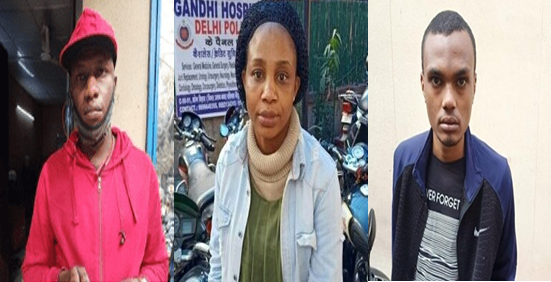
TWO Nigerians have been deported from India for overstaying their visas, the Delhi Police said on Thursday, bringing to six the total number of Nigerians expelled from the country since the beginning of this year.
According to a statement released on its official Twitter page, the Dwarka Police said the two Nigerians and a Sudanese were arrested and deported by officers from Uttam Nagar Police Station, after they were found to be living in India without valid visas and passports.
“2 #Nigerian Nationals & 1 from #Sudan were found living without having valid #Visa & #Passport during area #Patrolling duty, were deported by the staff of PS Uttam Nagar,” the statement read, using the hashtag #ActionAgainstIllegalStaying.
It was gathered that the two Nigerians recently deported were among 10 Nigerian nationals picked up by the police from the Uttam Nagar in Dwarka district on Wednesday, January 6.
Previous Deportees
Two Nigerian males were deported from the country on January 13th, 2021, by officers from the Mohan Garden Police Station and another male with one female were deported on January 11 in a similar sting operation by men from Uttam Nagar Police Division.
The deputy commissioner of police, Dwarka, Santosh Kumr Meena, who confirmed the development, described their action as a gross violation of the Indian visa norms.
“Their visas have also expired but they are continuously staying in India which is a gross violation of the Indian visa norms. They have not provided any suitable reason and supportive documents for their overstay in India,” he said.
Over the years, several Nigerians residing in the country have been arrested and deported. The offences charged against them include illegal stay, internet fraud, online romance scams and drug peddling.
SALEH Alhassan, national secretary of Miyetti Allah Kautal Hore, says President Muhammadu Buhari has done nothing for the Fulani herdsmen except create enemies for them.
In an interview with Punch Newspapers, Alhassan said herdsmen were being marginalised in the country and that Buhari as President had not in any way made their lives better.
His statement is coming on the heels of the controversy generated by Rotimi Akeredolu, Ondo State governor, who ordered herders to vacate the state forest reserves over rising insecurity in the state.
Also, Sunday Adeniyi Adeyemo, a Yoruba youth leader, also known as Sunday Igboho, had issued an ultimatum giving herdsmen seven days to leave Igangan, Ibarapa North Local Government Area of Oyo State following cases of increased kidnapping and killings by suspected Fulani herdsmen in the area.
On Friday, he reportedly stormed the Fulani settlement in the town to eject the Seriki Fulani, Salihu Abdukadir, and other herdsmen accused of fuelling insecurity in the area.
Alhassan said, “The mistake people make is that they think when they put pressure on herders they are getting at President (Muhammadu) Buhari. Buhari has no relationship with the herders. That is the truth. When people say he is our grand patron, was Jonathan from the South-South not our grand patron?”
“If the President is a Fulani, it doesn’t in any way affect the life of a herder. In fact, they are worse off under Buhari. What are they benefitting? They don’t access any government facility or social amenity, yet they are responsible for the bulk of animal protein we produce in this country. I think it’s deliberate for people to think otherwise.”
“Buhari has not done anything for us other than creating enemies for us. Herders are being chased around. Let us look at the larger picture and not allow enemies penetrate us. If Buhari loves the herders, he would have created the grazing reserves for them.”
Herdsmen in 10 years, killed 3652 people in 478 attacks
According to data obtained from Nigerian Security Tracker (NST), between 2012 and 2021, Fulani herdsmen conducted 478 attacks and killed 3,652 people in Nigeria.
The data captures the yearly number of attacks and deaths by Herdsmen across the country from 2012 to January 2021.
NST, which relies on data from media reports and verified independently by a team of researchers, shows attacks and killings orchestrated by herdsmen.
A breakdown analysis of the data indicates that in 2016, there were 56 attacks resulting in the killing of 799 people, while in 2018, the attacks rose to 147 and resulted in a bloodbath that caused 1,196 deaths.
In 2020, according to the data, there were 74 attacks, and 248 people killed.
Deaths per year, however, showed that 7 attacks with 43 deaths were recorded in 2012. In 2013, the number of attacks rose to 17 with 149 deaths. The following year, specifically in 2014, it further rose to 32 attacks with 374 deaths, while in 2015 it dropped to 14 attacks with 100 deaths.
In 2016, the number of casualties rose 56 attacks with 799 deaths. The following year, specifically in 2017, it declined to 55 attacks with 483 deaths, while in 2018, 147 attacks and 1,196 deaths were recorded. in 2019, attacks dropped to 71 with 255 deaths. In 2020, there were 74 attacks and 248 reported deaths.
As of January 2021, five attacks have been recorded with five reported deaths.
The predicament of Nigerian traders in Ghana have in recent time been an issue of debate nationally and within the West Africa sub-region. This is due to the controversial Ghana Investment Promotion Centre (GIPC) $1 million levy that mandates every foreign investor in Ghana to either provide the huge sum in cash or as raw materials before legally being recognised to do business in the country. Olugbenga ADANIKIN who recently visited Ghana reports on the dilemma of Nigerian traders.
It was 2:44 pm, on a sunny day of December 6, 2020. Godwin Anthony had just returned from the ‘street,’ sapped out. “Abeg, give me malt,” he reached out to Eric, a fellow Ghanaian trader but his request was cunningly disregarded.
Anthony, a Ghanaian by birth, trades in mobile phones and phone accessories at the popular Kwame Nkrumah Circle Market in the Greater Accra Region, Ghana. His father, a Nigerian, from Imo State married from Ujape, a local community in the Volta Region, Ghana.
Besides being born in Ghana, the 36-year-old father also married a Ghanaian, just like his father but prefers to be identified as a Nigerian and has suffered similar prejudice as scores of Nigerian business owners challenged by the $1 million investment levy promulgated by the Ghanaian government for foreign investment in the country.
His stall was shut since November 2019 by the multi-stakeholder enforcement Committee on Foreigners in Retail Trade; as a result, he lost over 80 per cent of his customers and survival has been a great challenge. He now roams street around the popular market to eke out a living.
His ties with his country of birth and marriage to a Ghanaian spouse did not spare him from the GIPC policy, mostly considered prejudicial on Nigerian businesses in the country. Nevertheless, he would sometimes help his friends involved in the same line of business to import goods from China to Ghana.
The story of alleged hostile treatments meted out at foreigners in Ghana, especially Nigerians have remained a burning discussion of public interest, and perhaps a regional concern. These worries evidently became more pronounced following the decision of the Nigerian government to shut its land borders at Seme, Illela, Maigatari and Nfun in August, 2019 – a move the federal government attributed to increased smuggling of arms and agricultural produce.
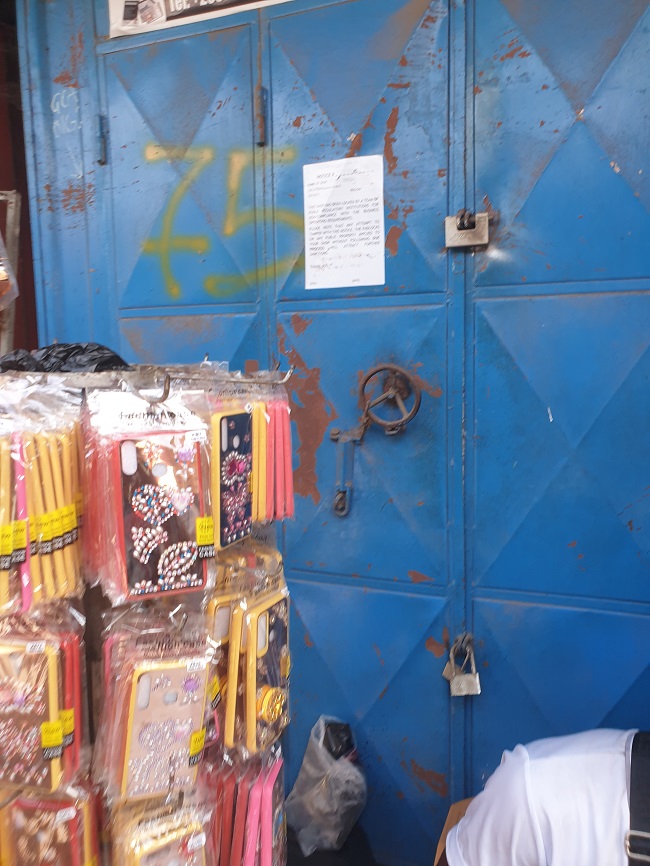
One of the locked-up stalls belonging to a Nigerian at the Circle Market, Accra. Photo Credit: Olugbenga Adanikin, The ICIR
The Ghanaian government was displeased with the border closure such that, Nana Akufo-Addo, the Ghanaian president appealed to President Muhammadu Buhari to consider Ghanaian businesses affected by the policy.
In September, 2020, Patrice Talon, Benin president also sought the suspension of the policy, but the federal government appeared adamant, as the policy remained active until December 16, 2020 – more than a year after the decision was taken.
Nigerian traders in Ghana, consequently, believed the apathy was exacerbated by the land border closure. Moreover, the decision came at a time when the continent was aiming at trade integration.
“The whole drama started around November 2019,” says Anthony, “I will tell you they basically focus on Nigerians because there were Lebanese whose shops were left untouched.”
The perceived attack, he said, led to demonstrations. Representatives of the Nigerian traders ran to the Nigerian High Commission for possible interventions. Few meetings were held by governments of both nations but nothing productive eventually emanated from the interventions.
“If a customer visits your shop and sees it locked, he will probably look for an alternative. From there, you have lost that one,” Anthony adds emphasising on the ripple effects of the Ghana Investment Promotion Centre (GIPC) law.
Like several others affected by the policy, he has lost hope, yet, he resolves to remain on the street, at least, to satisfy family needs until the policy is overturned – that is, if it would. Still, he acknowledged legal provisions in the Ghanaian law which prohibits foreigners from engaging in retail trade.
“Foreigners interested in trading business in Ghana ought to be wholesalers while Ghanaians do the retail trade. Their law disallows trading enterprises in the market,” he said.
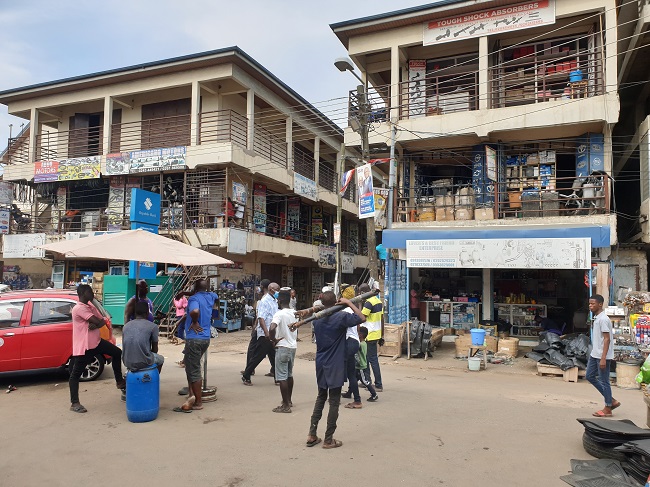
Locked-Up and Open Stalls at the popular Abusiokahi Market, Accra, Ghana. Photo Credit: Olugbenga Adanikin, The ICIR
Its Jealousy against Nigerians
Blessing Ogomeana engages in the same business as Anthony. He hails from the Niger Delta Region, Nigeria but resides in Ghana. In 2018, Ogomeana commenced his phone repair business with great expectations. He subsequently incorporates the trading of phone accessories, yet unmindful of the legal implications.
He has enjoyed a steady growth in the business until 2019 when he started encountering confrontations from the Ghanaian traders at the market. “The people were harassing us,” he said in a troubled voice. “They will say you are a Nigerian; you should return to your country,”he added.
Some of the traders were executive members of the Ghana Union of Traders Association (GUTA) working with the GIPC law enforcement committee. He said they would clamp on their stalls and shut down shops of those flouting the business registration requirements.
Ogomeana’s stall was eventually shut towards November 2019, just like Anthony. “They came to raid at about 1 am when we least expected,” he said. “We were caught unaware and at some point, the Ghana police joined in the action,” he continued. Due to the unpleasant experiences, he concluded the action against Nigerian businesses was premeditated and fuelled by “jealousy and envy”.
He averred that some Nigerians had satisfied the required conditions but were still made to face similar pitiable treatments and that even though retail trading by foreigners is prohibited in Ghana, the legislation was not new, only that it was not being enforced as at the time he commenced his business. The ICIR subsequently visited selected markets where the alleged prejudice against Nigerians was carried out but could not find a Nigerian who had met with the most controversial requirement. Though most had their tax payments receipts and other tickets from the municipal area council, the $1 million was an issue.
The ICIR’s observations show most business owners including the Ghanaians only occupy small stalls at the markets. As a result, paying the $1 million levy was a challenge to most foreign traders, particularly those who are into mobile phone and automobile spare parts businesses. Some of the affected Nigerian business owners have since resolved to sublet their shops to Ghanaians,others engaged the locals to manage their businesses while those who could not take the risks, resign to their fate; actions that are indirectly creating more jobs and opportunities for Ghanaian citizens.
Endkojo Nkrumah, Ghana’s Minister of Information, had in September, denied allegations of maltreatment against Nigerians and Nigerian businesses in his country. Responding to earlier reactions of the Nigerian government through Lai Mohammed, the Minister of Information and Culture, Nkrumah accused Nigerians of violating the Ghanaian laws. He listed some of the offences to include, “tax evasion, immigration offences, trading in sub-standard products, violation of the GIPC law and improper registration of firms.”
He alleged Nigerian business owners among other nationals engage in “underpayment of business operating permits and falsification of documents.” Earlier, on August 24, 2020, Joseph Obeng, GUTA president also reacted alleging ‘80 per cent of those who deal in illegal trade’ were Nigerians.
Nevertheless, Ogomeana was one of those who disagreed with the claims. He presumed that the prejudice was because Nigerian businesses were flourishing than those of their Ghanaian counterparts. He also suspects that Ghanaians are becoming worried about the increasing population of Nigerians in their country. Since the border closure remains inclusive, Anthony, Ogomeana like many other foreigners have lost hope.
We will leave once we can no longer cope – NUTAG
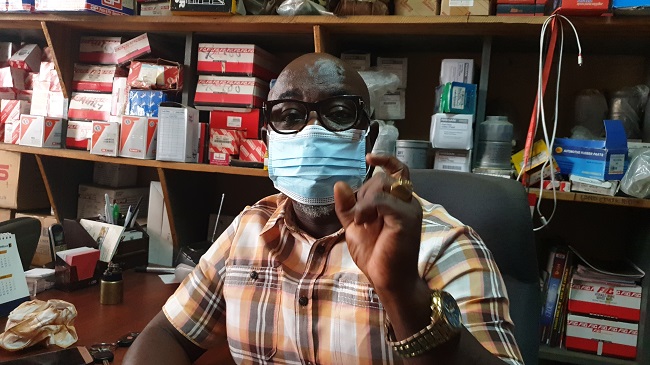
Prior to The ICIR’s visit to Ghana, the leadership of the Nigerian Union of Traders in Ghana (NUTAG), had accused the local media of partial reportage on their predicaments. In an interview with Chukwuemeka Nnaji, NUTAG’s President, he accused the Ghanian authorities of unfair treatment against Nigerians. He said, “I must tell you, it has not been easy,” decrying how members of the association were harassed and in some situations, ‘beaten’. He said there is no fair play once it comes to doing business in Ghana, as every other national living in the country is better treated than Nigerians.
Nnaji is married to a Nigerian, but relocated to Ghana almost three decades (25 years) ago, where they had their children. By 2006, Nnaji started his automobile business and for 14 years, majored in the imports and exports of vehicle parts. He said his business is now on the verge of collapsing due to what he described as ‘hostility’ against Nigerian businesses in the English neighbouring country, describing the situation as unfortunate.
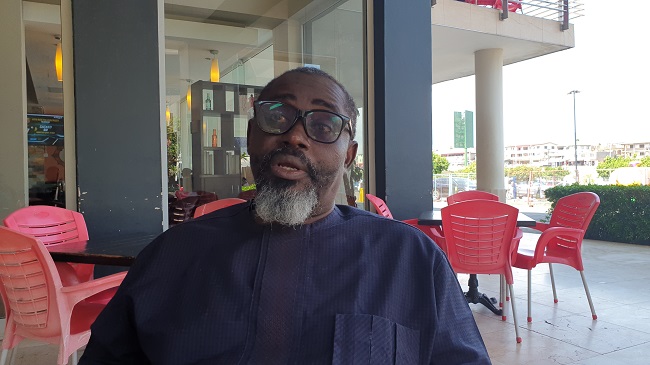
Chukuwuemeka Nnaji, President, Nigerian Union of Traders in Ghana (NUTAG) during an interview with The ICIR. Photo Credit: Olugbenga Adanikin, The ICIR
Nnaji had travelled to Nigeria in November 2020, when he received a call that his shop and 39 others had just been locked up. He said he was restless when he heard the news, but particularly concerned about his members. He is currently helping to raise funds that would help stranded traders who want to return to Nigeria to do so and has called for urgent action from the ECOWAS Commission and the Nigerian government.
“I’m ready to die if it comes to the worst situation,” a frustrated Nnaji said, explaining, “In 2020 alone, over one million Ghana Cedis was paid as taxes. I’m even the least, there are several others who import larger containers”.
Findings by The ICIR revealed Nnaji’s assertion about Nigeria’s contributions to the Ghanaian economy was valid. In 2019, Nigeria exported $4 billion worth of goods to Ghana while Ghana’s export to Nigeria in the same year was valued at $164.06 million. These trade volumes were based on data sourced from the United Nations Comtrade on International Trade in January 2021.
Nigeria imports from Ghana 1996-2019. Infographic by Damilola Ojetunde, The ICIR
Data from the Economic Community of West African States (ECOWAS) Commission also showed Nigeria’s huge contribution to the region. Nigeria accounts for 76 per cent of total trade in the region, followed by Ghana with 9.2 per cent and Cote d’Ivoire 8.2 per cent.
“The trade surplus of the region, estimated at about $47.3 billion is attributable to Nigeria ($58.4 billion) and Côte d’Ivoire ($3.4 billion) when all other Countries have a deficit in the trade balance,” the regional trade report reads.
So, as for Nnaji, the perceived hatred for Nigerians is not due to the border closure policy. Though it might have worsened the relationships between both countries, he strongly believes there was more to it.
“Since 2017, Nigerian traders have been harassed by Ghanaian traders,” he told The ICIR. The challenge, he said became worse as the Ghanaian authorities and the traders’ union allegedly became unwilling to dialogue, not to mention of reaching a consensus with the Nigerian traders and NUTAG leadership.
Nigeria’s export to Ghana 1996-2019. Infographic by Damilola Ojetunde, The ICIR
Heavy Revenue Loss
Our findings show that Nigerian stalls took the largest percentage of locked-up shops in the markets across Ghana, especially in Accra, resulting in heavy revenue loss for both the Nigerian businessmen and the Ghanian authorities. While the NUTAG President says 270 Nigerian-owned shops affecting over 1,000 traders have been shut as at December, 2020, Anthony puts the total number of Nigerian stalls shut in 2019 alone by the Ghanaian authorities at 600.
The Nigerian information minister had accused Ghana of locking up 300 shops belonging to Nigerians in 2018, 600 in 2019 and 250 shops in 2020, but responding, his Ghanian counterpart had said, “It is an incontestable fact that there are widespread abuse and disregard for local laws and regulations governing retail trade by some foreigners, including Nigerians, which need to be addressed without discrimination”.
Nigeria’s balance of trade with Ghana 1996-2019. Nigeria’s export to Ghana 1996-2019. Infograph by Damilola Ojetunde, The ICIR
Most Nigerians engaged by this reporter in the course of this investigation have argued that Nigerians should not have been a subjected to the heavy $1 million levy, considering the diplomatic relationship between both countries, and like the fact that Ghana, as an ECOWAS country, is signatory to the ECOWAS free trade and free movement treaty.
Ghanaians on the other hand, have maintained that as a sovereign nation, they are at liberty to develop a law and enforce it without interference.
The ECOWAS trade treaty, however, places emphasis on ‘rules of origin.’ This implies the treaty gives preference to products produced from member states. The ECOWAS Trade Liberalisation Scheme created in 1979 initially covered agricultural products and hand-made crafts, but, by 1990, it was extended to industrial products, which should comply with the ‘rules of origin.’
Due to non-compliance with the trade agreement, the National Approval Committee from the 15 member states met with other stakeholders last year November, between 11 – 12 to proffer lasting solutions. They re-emphasised on seeking a certificate of origin.
The ICIR further attempted to speak with Sandra Oulate, ECOWAS Director of Communications, regarding the trade dispute but she directed the reporter to send a text message as she was out of the country. The questions were forwarded to her, but she responded on January 19th, 2021, saying she was on leave and would refer our reporter to an appropriate authority. The next day, an email was sent to her as a reminder but she maintained her initial position. Her response read: “I am presently on leave with limited connectivity.”
What the GIPC law says
No doubt, foreign business ventures in any country are guarded by regulations. In Ghana, satisfying the GIPC requirement is cardinal. The law establishing the Centre created in 2013, prohibits foreigners from engaging in a retail business. And beyond this, the framework also outlines conditions that must be satisfied by foreign business owners before they are allowed to operate in Ghana.
Sections 27 and 28 of the GIPC law detail business entry requirements for foreigners and enterprises. It exclusively reserved retail trade for Ghanaians. For instance, Section 27.1. A says, “a person who is not a citizen or an enterprise which is not wholly-owned by a citizen shall not invest or participate in the sale of goods or provision of services in a market, petty trading or hawking or selling of goods in a stall at any place.”
Section 28.1. (A) allows joint partnership business with a Ghanaian but the partner must provide at least $200, 000 United States as foreign capital in cash or goods to the business; for a foreigner to wholly engage in trading enterprise, he or she, according to Section 28.1.B, must invest, “not less than $1 million US in cash or goods and services relevant to the investment.”
For the purpose of the above-mentioned sections, ‘trading’ includes the purchasing and selling of imported goods and services. Sub-section 3 of the law adds that the trader must employ at least 20 skilled Ghanaians in addition to satisfying the compulsory business registration requirement.
Foreigners who marry Ghanaian spouses are not excluded except if such an individual has been married to the Ghanian spouse for at least five years or holds an ‘indefinite’ resident permit. Some of these provisions showed the business laws have existed over time until strict implementation commenced in 2017.
Sections 40 and 41 of the GIPC law, also, clearly spelt out penalties for flouting the law. The sanctions extend to Ghanaians who serve as fronts to foreigners who want to evade the laid out requirements.
“The effect of this provision is that a person who is not a citizen of Ghana who engages in retail trade without meeting the minimum capital requirements set out in Section 28 of Act 865 commits an offence under Act 865. Ghanaians or non-Ghanaians who let out a stall or a store in a market to a foreigner also commit a breach of Act 865,” the GIPC states further on its official website.
We can’t compromise the law because Nigerians are our brothers – GUTA National Organising Secretary
Nana Kwabena Peprah, the National Organising Secretary, Ghana Union of Traders Association (GUTA) and member of the enforcement committee, was firm in making clear, positions on the matter. He said part of the mandates of the committee is to look at the investment law of Ghana and enforce it to the latter.
Nana Kwabena Peprah, National Organising Secretary, Ghana Union of Traders Association (GUTA) during an interview with The ICIR at his stall in Abbosey Okai Market, Accra, Ghana.
“All the Committee is doing is to uphold the law,” Peprah told The ICIR. “The law says if you want to do business in Ghana, you register with the GIPC. Once they issue a certificate, it will indicate the location as to where you can do business.”
According to him, GIPC emphasis has been on business locations and the $1 million levy, even though the same law prohibits foreigners from engaging in retail trade at the markets. He explained that the issuance of a certificate to an investor or foreigner implies that he/she has met all the requirement and is free to do business.
However, on the certificate, the location at which such an investor could operate would be indicated and the certificate is renewed biennially. It is from this stage that business owners could proceed to register with other agencies such as getting a work permit and the tax collection body.
“The law has come to stay and the payment is part of the major requirements which investors must satisfy, otherwise, their activities are considered illegal and could be disrupted,” Peprah maintained.
The ICIR raised a notable issue of how the global pandemic has affected nations, crippling economies and exacerbating poverty. The $1 million, for instance, could be a tough one for foreign investors, especially young entrepreneurs; but this appears to be of no concern to the official.
“No no…, it doesn’t follow,” he said with a bold face. “Are you telling me now that because Nigeria is going into recession, you are changing your laws to suit foreigners? Have you seen Ghanaians in Nigeria opening shops in your market?”, he queried.
Is the perceived attack on Nigerians a payback?
Since the Ghanaian government and trade union began to implement the GIPC law, public perception has been that the law was targeted at the Nigerian business owners and our findings revealed most Ghanaians appeared uncomfortable with the increasing population of Nigerians in their country and robbery cases, allegedly linked to Nigerians.
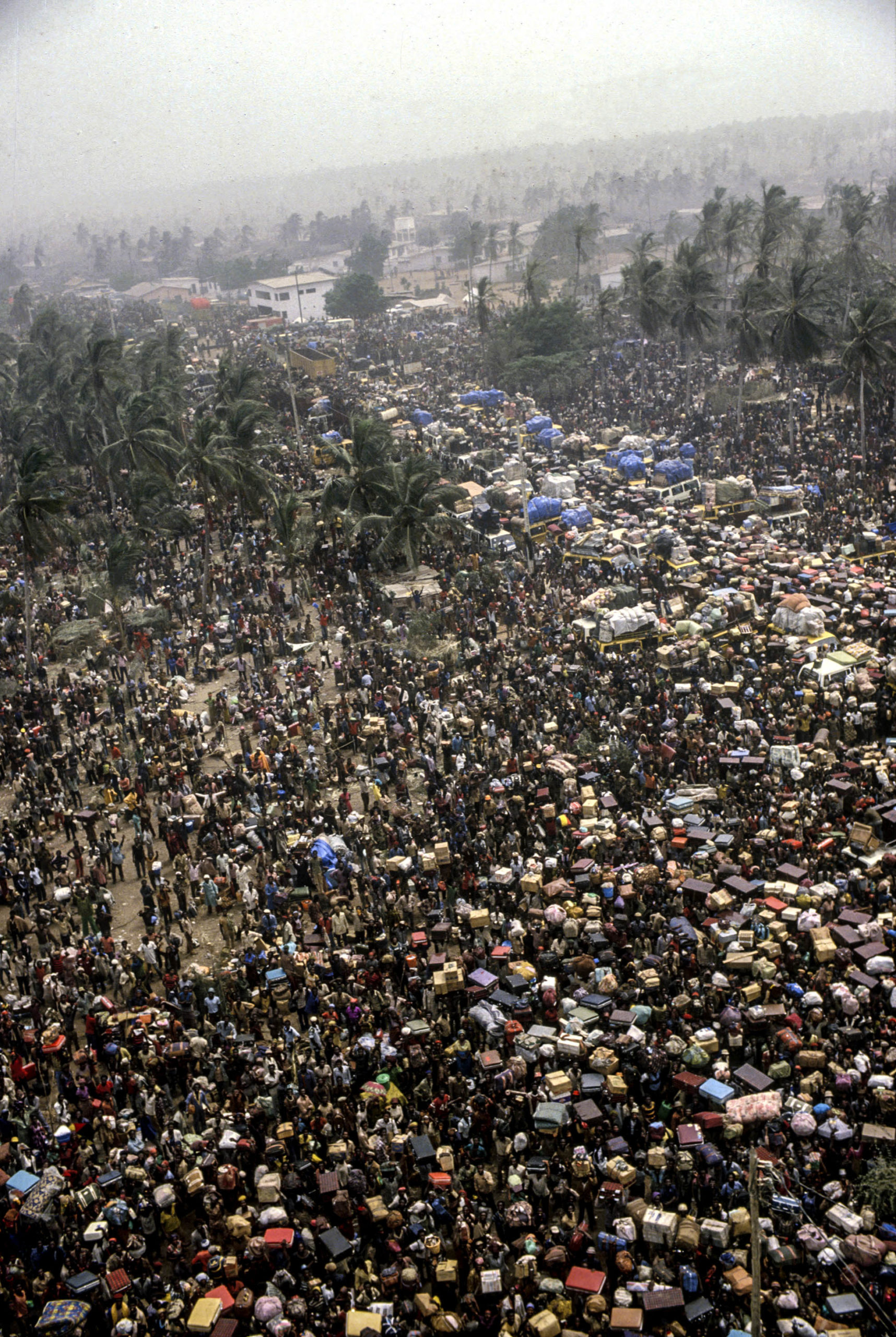
Recall that in early 2017, there were cases of robberies which after arrests, turned out that most of the suspects had Nigerian surnames. Two years after, a similar incident happened at Koans Estate, Amasama, Accra. Since then, coupled with the sad history of massive deportation of undocumented migrants from Nigeria in 1983 which gave birth to the “Ghana Must Go” phrase, some of the locals have continued to demand that Nigerians found guilty of breaching the laws are repatriated.
In 1969, former Ghanaian Prime Minister, Kofi Busia invoked the Aliens Compliance Order which led to the deportation of about 2.5 million African migrants, mostly Nigerians. Aremu Johnson and Ajayi Adeyinka, both from the Department of History and International Studies, Ekiti State University, in their paper published in a United Kingdom journal, attributed jealousy and xenophobia as factors that led to the 1969 expulsion. More Nigerians today believe the row between both nations has lingered for decades.
NIGERIA – 1982: Ghana Refugees leaving Nigeria waits at the border to enter Benin as part of their journey back to Ghana(Photo by Michel Setboum/Getty Images)
“The general sentiment has been that Nigerians should be sent back to their country,” a Ghanaian lady who pleaded anonymity told this reporter.
Somewhere around Osu Town, Accra, a Nigerian lady identified as Gladys painted almost similar scenario. After her Degree programme in Turkey, she decided not to return to Nigeria but chose to reside in Ghana for a while. Sharing her experience, she said “There is this unusual hatred once they know you are a Nigerian,” she told The ICIR. “It is worse, if you are probably doing well in a chosen career, they still feel threatened somehow and the attitude can be irritating.”
The stories were similar in the Ghanaian markets. Nigerians are perceived as naturally adept at wooing clients to their stalls. Their business skill is considered sharper and astonishing. They would not wait until customers walk into their stalls, unlike the Ghanaian counterparts. This marketing strategy and enterprising acumen, incidentally, is a common phenomenon in Nigerian markets. In what now appears like a business chain, young boys are strategically positioned to scout for customers and they get rewarded once a buyer buys a product from the stall.
As at 2019, the unofficial figure says there are over 2 million Nigerians residing in Ghana. The increasing population is more than other nationals, and due to this factor, it is believed more Nigerians would be affected by the policy. Still, GUTA members from other parts of the country want the GIPC law sustained to protect their local businesses.
On September 3, 2019, Speakers of Ghanaian Parliament and the Nigerian House of Representatives, Rt. Hon. Aaron Michael and Rt. Hon. Olufemi Gbajabiamila met in Ghana to propose a lasting solution to the trade issue caused by the GIPC Act but no clear solution has emerged from that meeting. Ghana’s Trade Minister, Alan Kyeremanteng, at the meeting insisted the GIPC law was not meant to target any particular national.
Marick Garick, a Ghaniain development expert, advised that the trade disputes should be seen as an avenue to build opportunities and consensus among the four neighbouring countries – Ghana, Nigeria, Togo and Benin Republic – since the last two countries are emerging markets and Nigeria has the largest market share in Africa. The trade problem, he said, could pose a threat to the African Continental Free Trade (AfCFTA) initiative.
“Why will I want to have diplomatic tension with a nation that will deliver the best business opportunity to my people? As a matter of fact, if we play this well, we could use Benin and Togo as a trading buffer and convert this rivalry to opportunity,” he reasoned.
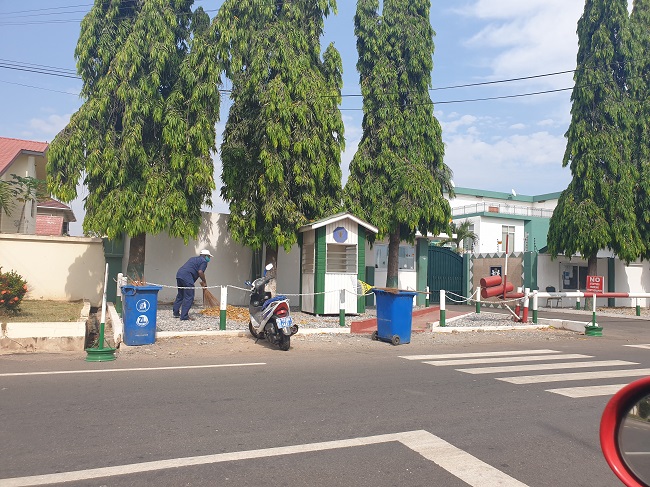
Entrance to Nigerian High Commission in Ghana. Photo Credit: Olugbenga Adanikin, The ICIRDead silence from Nigerian High Commission
To understand interventions made by the Nigerian High Commission in Ghana, several efforts made to the embassy by The ICIR proved abortive.
In November last year, The ICIR sent a letter to the Embassy requesting permission to interview Mrs. Esther Arewa, the Charge d’affaires. The letter was received. Secretary to Arewa identified as Vider advised the reporter to check back the following week. This was done repeatedly through re-appointments and phone calls but the envoy was still unreachable. An office staff member told our reporter that the envoy was not still available and no specific time was given for her availability. An email sent to her at estherarewa@gmail.com on December 30, 2020, was neither acknowledged nor replied.
Ferdinand Nwonye, Spokesperson of the Federal Ministry of Foreign Affairs told this reporter he was not privy to any new information concerning the trade issue, except that, “the matter was being discussed at the highest level.” When asked if there were efforts to seek reduction in the $1 million levy, he simply responded, “not at the moment.”
While both governments continue to explore options for a resolution of the situation, the ultimate desire expressed by Nigerian traders in Ghana, is that the GIPC law is favourably reviewed, and that the Nigerian government creates a more permanent solution by reforming the country, creating more opportunities for Nigerians to thrive in Nigeria.