THE Central Bank of Nigeria (CBN), on Tuesday, retained the monetary policy rate (MPR), which is the benchmark interest rate in the country, at 11.5 percent.
The MPR was first reduced from 12.5 percent to 11.5 percent after the Monetary Policy Committee (MPC) meeting in September 2020.
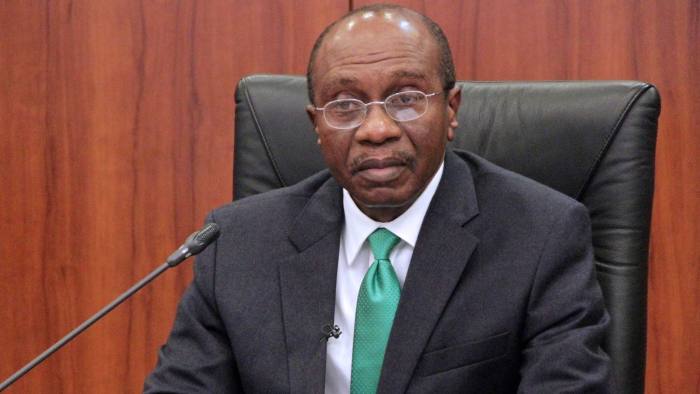
Rising from the first MPC meeting in 2021 on Tuesday, Godwin Emefiele, CBN governor, announced the retention of the liquidity ratio at 30 percent and cash reserve ratio (CRR) at 27.5 percent.
Conveying the position of the MPC, Emefiele said the committee dissuaded the federal government from having another total lockdown, stressing that such would be damaging to the Nigerian economy.
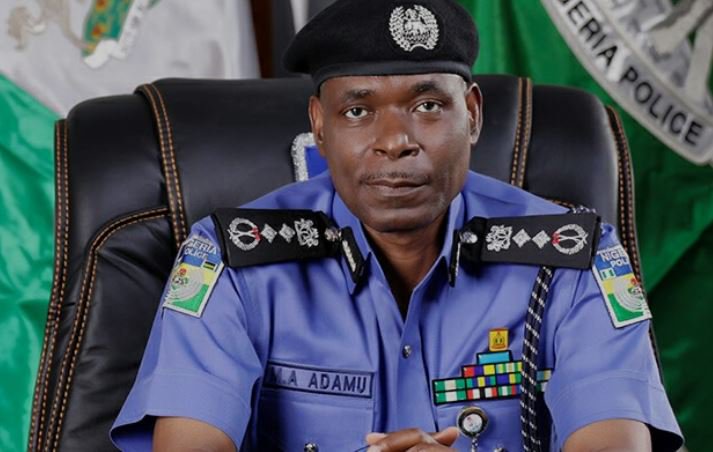
Godiwn Emefiele, CBN Governor
He noted that the MPC advised the federal government to deploy fiscal stimulus to facilitate economic recovery and put Nigeria on the growth path.
“Japan provided stimulus package valued at 66.9 percent of its 2019 GDP. The UK was 45.04 percent; the USA, 28.4 percent; Brazil, 27.6 percent; South Africa, 12.6 percent; China, 11.5 percent; India, 10.0 percent; and Russia 7.1 percent, compared with Nigeria’s paltry 4 percent,” he said.
Emefiele insisted that the CBN would continue to finance the federal government through ‘Ways and Means.’
The phrase ‘Ways and Means’ is a mechanism by which a central bank provides credit to the government to plug its budget deficit.
According to Emefiele, there was nothing wrong with providing support for the government (by this means) to enable it fulfill its obligations.
He said it would be “irresponsible on the side of the CBN as the lender of last resort not to support the government” if it could not finance its obligations, stressing that the apex bank would continue to fund manufacturing, agriculture and other development initiatives.
Through Ways and Means, the CBN supported the federal government to the tune of 2.8 trillion naira as of the end of 2020. Critics say the apex bank is breaking its own rules and simply prints money to plug the government’s budget loopholes. But the CBN government dismissed the criticism, saying that it was not unusual to do so.
A Global rating agency, Fitch, had last week said that the CBN was jeopardising Nigeria’s macroeconomic stability by repeatedly providing Ways and Means support to the federal government, pointing out that it was making inflation control and naira stability difficult. But Emefiele said it unfair and unfortunate to hold such views.
According to Vetiva research analysts. the MPC decision to hold rates and all parameters would bolster the equity market, enabling it to “be positively patronised in the short- term, as investors’ continue to channel funds to attractive counters while seeking alpha returns.”
As of the close of the stock market on Tuesday, Airtel, Flour Mills, WAPCO, MTNN and Fidson had pushed the market higher by 260 billion naira.
ON Tuesday, President Muhammadu Buhariannounced the acceptance letters of resignation of his service chiefs after he ignored pleas and calls by both chambers of the national assembly, the Nigeria governors’ forum, social-cultural organisations, and well-meaning Nigerians that they should be sacked owing to the growing insecurity in the country. terrorism
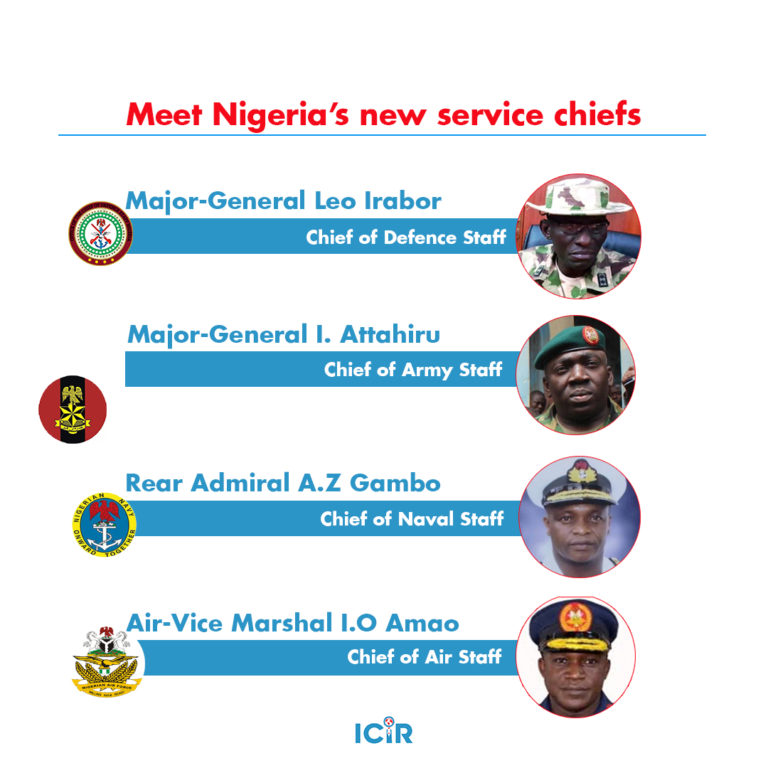
Buhari immediately announced Lucky Irabor, Ibrahim Attahiru, Awwal Gambo and Isiaka Amao as replacements for Gabriel Olonisakin, Tukur Buratai, Ibok Ekwe Ibas, Sadique Abubakar as chiefs of defence, army, navy and air force, respectively.
The ICIR profiles the new service chiefs in this report.
Lucky Irabor
Major General Lucky Irabor, the 55-years old newly appointed chief of defence, was born in Delta state in 1965. He gained admission into the Nigerian Defence Academy (NDA) Kaduna as a 34 regular course member in 1983. He was commissioned a second lieutenant on 28 June 1986 into the signals corps of the Nigerian Army.
He was trained at the armed forces command and staff college (AFCSC) for his junior staff course in 1995 and Ghana Armed Forces Staff College, Teshi, Accra Ghana for senior staff course in 2000/2001, amongst other several military courses. Also, he attended National Defence College in Bangladesh in 2010 and Harvard Kennedy School of Government, the USA in 2012 and 2017 respectively. Irabor, who holds two Masters Degrees from both University of Ghana, Accra and Bangladesh University of Professionals, Dhaka, also graduated from the Obafemi Awolowo University (OAU), as a trained engineer.
In its bid to confront Boko Haram’s activities in the Northeast, the military-appointed Irabor as the theatre commander of operation Lafiya Dole in 2016. As theatre commander, he was responsible for the capture of Alargano forest –the acclaimed spiritual base of Boko Haram. He also planned and executed the conduct of operations Crackdown 1 and 2, Rescue Finale and Deep Punch, which led to the clearance of Sambisa forest, destruction of terrorists camps and enclaves, the capture of several weapons, vehicles and equipment belonging to the group as well as rescued well over 20,000 civilians abducted by BHT, including 2 Chibok Girls. Furthermore, the impact of the operations he conducted forced the BHT to release a total of 103 Chibok Girls in two instances.
Shortly after the end of his tenure in the theatre, he was appointed as the head and field commander of the multinational joint task force (MNJTF), where he planned and conducted Operation Amni Fakat within the Lake Chad Basin area, which led to the clearance and domination of Gashigar, Arege and Metele as well the destruction of several terrorists’ camps and IED making factories in the basin. The Multinational Joint Task Force (MNJTF) is a combined multinational formation, comprising units, mostly military, from Benin, Cameroon, Chad, Niger, and Nigeria. It is headquartered in N’Djamena and is mandated to bring an end to the Boko Haram insurgency. As Force Commander MNJTF, he successfully planned
Until he was appointed Nigerian chief of defence, Irabor was the force commander of training and doctrine command (TRADOC), Minna.
Ibrahim Attahiru from Kaduna state was born on August 10, 1966. Until he was appointed chief army staff, he was the general officer commanding (GOC) of the army’s 82 division in Enugu. He was fired as the theatre commander leading the war against the sects in 2017 for failing to deliver a marching order by Tukur Buratai, the immediate chief of army staff, to capture dead or alive within 40 days, Abubakar Shekau.
Isiaka Oladayo Amao
The Osun state born Air Vice Marshal was born on 14 Sep 65 at Enugu. He got enlisted into the Nigerian Airforce on 19 Jan 1984 as a NDA regular course 35 member and was commissioned as a pilot officer on 20 December 1986.
Amao, who has served in various NAF units, was actively involved in the ongoing prosecution of the war against terror in the Northeast as a fighter pilot of Operation Lafiya Dole from 19 Jul 2015 to 16 February 2016.
He also holds a master’s degree in defence and strategic studies from the University of Madras, India, and master of Military Science and Strategy (MMSc) and an advanced diploma in defence and strategic studies from NDU, China. He also has a post-graduate diploma in international relations and diplomacy from Kaduna Polytechnic.
Until he was appointed air chief, Amao was air officer commanding, tactical air command (TAC).
Awwal Gambo
Born on 22 April 1966 and hails from Nasarawa LGA in Kano State, Awwal Gambo enlisted into the Nigerian Navy on September 24, 1984, as a member of regular course 36 and was commissioned sub-lieutenant on 24 September 1988.
He is an underwater warfare specialist with a sub-specialisation in Intelligence. He has attended several military courses, including a sub-technical course and officers long course at NNS QUORRA, Lagos. He also attended Junior Division 48/89 and Senior Course 26, both at AFCSC Jaji. Other courses attended include the national defence course at the South African National Defence College.
Gambo holds a Master’s degree in transport management from LAUTECH.
Until he was appointed the chief of naval staff, he was the procurement director at the defence space administration.
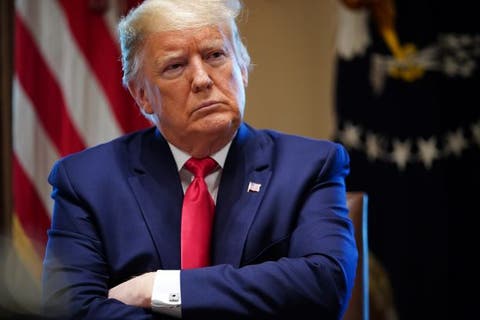
A move by Rand Paul, a Republican Senator, to stop the second impeachment trial of Donald Trump, former US President, met a bipartisan resistance of 55 senators on Tuesday.
The motion, which got the backing of 45 Republican senators, was an indication that it might be difficult to convict Trump of inciting insurrection at the Capitol Hill on January 6.
Paul’s motion on the Senate floor would have required the chamber to vote on whether Trump’s trial in February violates the U.S. Constitution, but the Democratic-led Senate blocked the motion in a 55-45 vote.
Five Republican lawmakers joined Democrats to reject the move, far short of the 17 Republicans who would be needed to vote to convict Trump on an impeachment charge regarding Capitol assault that left six people dead.
“It’s one of the few times in Washington where a loss is actually a victory,” Paul later told reporters. “Forty-five votes means the impeachment trial is dead on arrival.”
Paul and other Republicans had argued that the proceedings were unconstitutional because Trump left office last Wednesday and the trial would be overseen by Democratic Senator Patrick Leahy, instead of U.S. chief justice, John Roberts.
Leahy, 80, was hospitalised on Tuesday evening after falling sick, his spokesman David Carle said in a statement, which did not provide further details.
Some Republican senators who backed Paul’s motion, said their vote on Tuesday did not indicate how they might come down on Trump’s guilt or innocence after a trial.
“It’s a totally different issue as far as I’m concerned,” Republican Senator Rob Portman told reporters.
The senators voted after being sworn in as jurors for the impeachment trial.
Democratic Senate majority leader Chuck Schumer, who moved to thwart Paul’s motion, dismissed the Republican constitutional claim as ‘flat-out wrong’ and said it would provide ‘a constitutional get-out-of-jail-free card’ for presidents guilty of misconduct.
There is a debate among scholars over whether the Senate can hold a trial for Trump now that he has left office. Many experts have said ‘late impeachment’ is constitutional, arguing that presidents who engage in misconduct late in their terms should not be immune from the very process set out in the Constitution for holding them accountable.
The Constitution makes clear that impeachment proceedings can result in disqualification from holding office in the future, so there is still an active issue for the Senate to resolve, those scholars have said.
Fellow Republican Senator Lisa Murkowski, who has been critical of Trump, rejected Paul’s move.
“My review of it has led me to conclude that it is constitutional, in recognising that impeachment is not solely about removing a president. It is also a matter of political consequence,” Murkowski told reporters on Tuesday.
She joined fellow Republicans Mitt Romney, Susan Collins, Ben Sasse and Patrick Toomey in opposing Paul.
Trump is the only president to have been impeached by the House of Representatives twice and the first to face a trial after leaving power, with the possibility of being disqualified from future public office if convicted by two-thirds of the Senate.
He was acquitted by the then Republican-controlled Senate last February on charges of abuse of power and obstruction of Congress arising from his request that Ukraine investigate Democratic rival Joe Biden and his son.
The House approved a single article of impeachment, the equivalent of an indictment in a criminal trial on Jan. 13, accusing him of inciting an insurrection with an incendiary speech to supporters before they stormed the Capitol which claimed the lives of two police officers and four others.
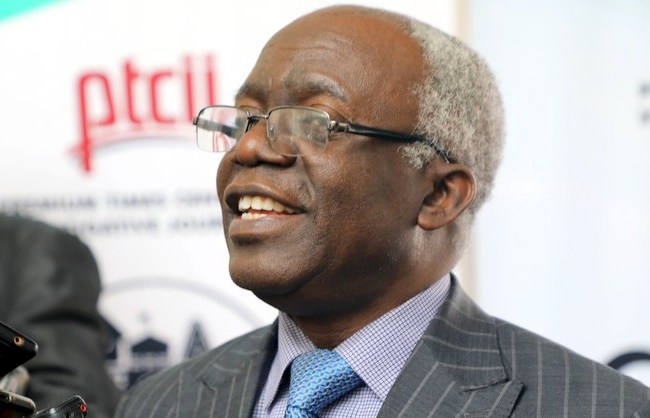
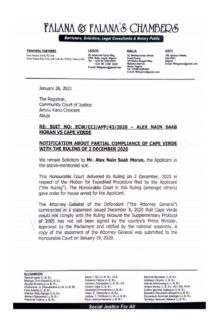
FEMI Falana, a human rights lawyer and counsel to Alex Saab, a detained Venezuelan special envoy, has written to notify ECOWAS registrar of Cape Verde’s partial compliance with its court ruling.
In a letter seen by The ICIR dated January 26 and addressed to the registrar, ECOWAS Community Court of Justice, Falana said Cape Verde had only partially complied with ECOWAS court ruling by placing his client, Alex Saab, on house arrest.
Falana, Jose M.P. Monteiro, Rutsel S. J Martha and Baltasar R. Garzon, who are legal counsels to Saab, had approached the ECOWAS court challenging the move to extradite their client to the US despite being a diplomat.
The ECOWAS regional court, in its ruling on December 2nd, 2020,had ordered the immediate release of the envoy from prison, including placing him under house arrest for health reasons. The court also stayed the extradition process.
Falana said the attorney general of Cape Verde commented in a statement issued December 8th, 2020, that his country would not comply with the ruling because the Supplementary Protocol of 2005 had not yet been signed by the country’s prime minister, adding that a copy of the statement was submitted to ECOWAS on January 19, 2020.
Letter addressed to the registrar, ECOWAS Community Court of Justice by Femi Falana
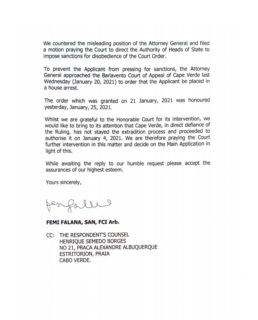
He also said the attorney general, in a bid to avoid sanctions, on Wednesday, January 20, approached the Barlavento Court of Appeal of Cape Verde to order that Saab be placed on a house arrest.
Falana, while praying to ECOWAS court for further intervention, said, in direct defiance of the ruling, Cape Verde had not stayed the extradition process of Saab.
The ICIR had reported how Saab, who was alleged by the US government to have been involved in money laundering, was arrested and detained in Cape Verde.
The US government had requested Saab’s extradition over allegations of money laundering, a move the Venezuelan government faulted with claims that the businessman was its special envoy on a ‘humanitarian mission’ and was on a mission to get food and medical supplies before he was arrested by state security operatives.
Letter addressed to the registrar, ECOWAS Community Court of Justice by Femi Falana
The ECOWAS Court of Justice has slated the hearing of the case for February 2nd, 2020, to determine if the Venezuelan would be set free.
MUHAMMADU Buhari, Nigeria’s president, has announced the appointment of new service chiefs.
He also accepted the resignation of old service chiefs who have supervised worsening insecurity in the country.
Buhari made this known via his official Twitter handle, Tuesday, while expressing his appreciation to the old service chiefs for offering their expertise to the nation.
“I have accepted the immediate resignation of the Service Chiefs, and their retirement from service. I thank them all for their overwhelming achievements in our efforts at bringing enduring peace to Nigeria, and wish them well in their future endeavours,” Buhari wrote.
The president also announced their replacements as follows: Major-General Leo Irabor, chief of defence staff; Major-General I. Attahiru, chief of army staff; Rear Admiral A.Z Gambo, chief of naval staff; and Air-Vice Marshal I.O Amao, chief of air staff.
This is coming amidst high spate of insecurity that has affected almost all regions in Nigeria. The country is currently facing violent attacks of different forms including banditry, kidnapping, insurgency, among others.
Prior to this development, the Nigerian Senate, House of Representatives, state governors and the People’s Democratic Party (PDP) had described the service chiefs as incompetent and asked for their sack.
Earlier in July 2020, the Senate, through a motion raised by Ali Ndume, senator representing Borno South and chairman of the Committee on the Army, had called for the resignation of the service chiefs.
Ndume had prayed to the Senate demanding the resignation of Tukur Buratai, chief of army staff; Sadique Abubakar, chief of air staff; Gabriel Olonisakin, chief of defence staff, and Ibok-Ete Ekwe Ibas, chief of naval staff.
Ndume demanded that the service chiefs step aside for new appointments to be made.
Ayo Fadahunsi, vice-chairman of the Senate Committee on Customs, also proposed the stepping aside of the service chiefs, and his prayer was seconded by Senator Betty Apiafi.
Ahmad Lawan, Senate President, had ruled on the prayer, which was largely supported by all the Senators in attendance.
In its response, the presidency had said that the power to sack or appoint service chiefs was a presidential prerogative. calling the bluff of the Senate’s motion.
THE Oyo State Police Command has said unidentified hoodlums were responsible for setting ablaze Sunday Igboho’s house in Ibadan.
One of the houses belonging to the Yoruba activist located at Soka in Ibadan, the Oyo state capital was reportedly on fire in the early hours of Tuesday.
Although sources close to Igboho told newsmen that he no longer resides in the house, the source of the fire was not initially unknown.
But according to Channels Television, the police said hoodlums who came in with two vehicles set the house ablaze after firing sporadically in the air.
“At about 0620 hrs of today 26/01/2021, the report was received at Sanyo Police Station that some unidentified hoodlums came to Sunday Igboho’s house at SOKA area of Ibadan in a Hummer bus and Micra firing sporadically and set the house ablaze,” the police said.
“The mini sitting room got burnt in the process while other properties are yet to be estimated
“Immediately the DPO Sanyo got wind of the incident, he contacted Fire Service while he also went to the scene for on the spot assessment. The fire was eventually put out.
It added that “Investigation has commenced into the incident while the Police are on the trail of the hoodlums.”
Igboho, an Oyo indigene, has been in the news in recent times after he issued an ultimatum of one week quit notice to Fulani herdsmen residing in Ibarapa area of Oyo State over the spate of kidnappings and killings attributed to herdsmen in the area.
The ultimatum, which expired last week has generated tension across the polity following a massive rally by Igboho in which some houses and properties in the herder’s settlements were burnt down by angry youths, according to the police.
EVERYDAY, over the past few months, Nneka Chukwu, a principal nursing officer at the National Orthopaedic Hospital, Enugu, checks out the latest developments concerning the COVID-19 pandemic in the United Kingdom. She gets alarmed at the rising numbers, particularly the huge death toll recorded among health workers in the European country. Though she is afraid of the COVID-19 crisis in the UK, which is by far more severe than the situation in Nigeria, Nneka cannot wait to relocate to the UK, where she believes she will get the job satisfaction in nursing that has so far eluded her in her country, Nigeria.
An investigation conducted by The ICIR in the health sector revealed that despite higher risks associated with the coronavirus pandemic in the developed countries in Europe and North America, many Nigerian doctors and nurses are currently making moves to take their services outside Nigeria, with the UK, United States and Canada as the choice destinations. The investigation also revealed that although poor renumeration has been a longstanding complaint of Nigerian doctors and nurses, ‘job satisfaction’ was the major reason the medical practitioners are leaving the country.
Doctors and nurses who spoke to The ICIR in the course of the investigation said they lacked job satisfaction. They also expressed the belief that job satisfaction in the medical field would be found abroad – in countries such as the US, UK and Canada, among others.
Nneka, who spoke to The ICIR in Enugu in the course of the investigation, which focused on the South-East states, is hoping to relocate to the UK very soon. She told our correspondent that many other nurses are concluding arrangements to leave Nigeria.
“I prefer (to relocate to) the UK. I have started the process and I believe that very soon I will leave. Even though I am scared of coronavirus and some other things that are happening there, I am going to leave. At the moment I know of so many other nurses that are just waiting for their visa to come out for them to leave Nigeria,” the nurse told our correspondent.
Although it is widely believed that the opportunity to earn higher wages abroad was the major reason Nigerian doctors and nurses are leaving the country, Nneka noted that monetary consideration was a secondary factor. She stressed that the major reason was lack of job satisfaction owing to unsatisfactory working conditions.
Low nurses to patients ratio in Nigeria
Nneka specifically identified the low nurses to patients ratio in the country – a situation which forces one nurse to attend to scores of patients at a time – as the major factor responsible for lack of job satisfaction among Nigerian nurses. She told The ICIR that the low nurses to patient ratio, which imposes an unduly high workload on the available nurses, was one of the reasons nurses are practically fleeing the country for the US, UK, Canada, Germany and other countries where they will do more quality work with less effort.
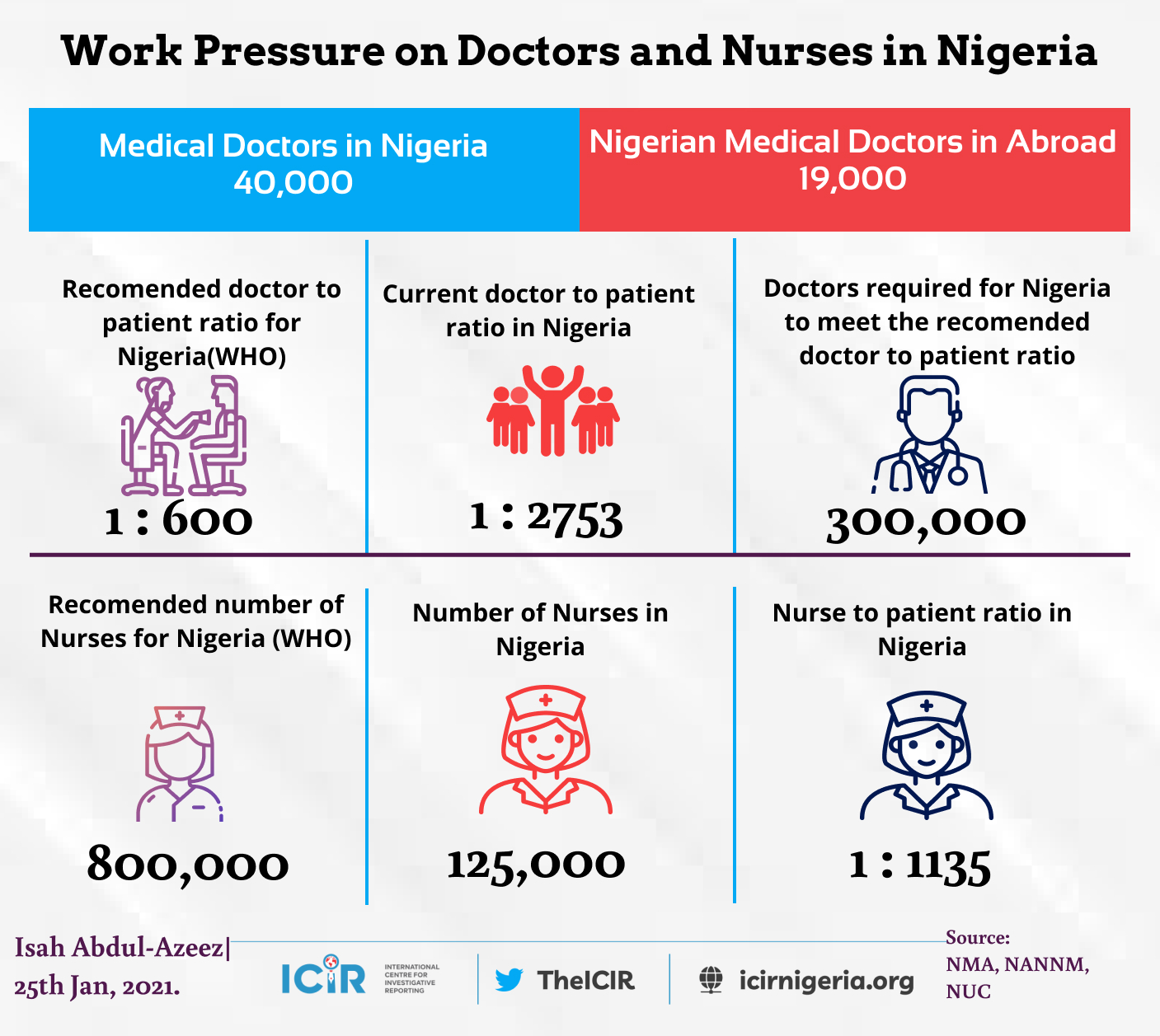
As of March 2020, the nurse to patient ratio in Nigeria was 1: 1135, which translated to 88.1 nurses per 100,000 persons. The figure was disclosed by Mr. Shakuri Kadiri, deputy director, and head of human resources for health in the federal ministry of health, Abuja.
Analysis of work pressure on Doctors and Nurses in Nigeria
The World Health Organisation (WHO) recommended that, going by population size, Nigeria should have not less than 800,000 nurses and midwives, according to President of the National Association of Nigerian Nurses and Midwives (NANNM), Abdrafiu Adeniji. But Adeniji told The ICIR that, at the moment, the country has just 125,000 nurses and midwives.
A nurse attends to more than 10 patients at a time at National Orthopaedic Hospital, Enugu
Giving further insight on how the low nurses to patients ratio affect healthcare delivery in hospitals across the country, Nneka revealed that, at the National Orthopaedic Hospital, Enugu, she and her colleagues attend to more than 10 patients at a time. “Here in the Orthopaedic Hospital (Enugu) you have a situation where as a nurse you are attending to at least 10 to 12 patients at a time,” she told our correspondent.
Nurses can’t give their best when attending to many patients at the same time
Nneka observed that the situation has had a negative effect on healthcare delivery as nurses have difficulties in handling several patients at the same time.
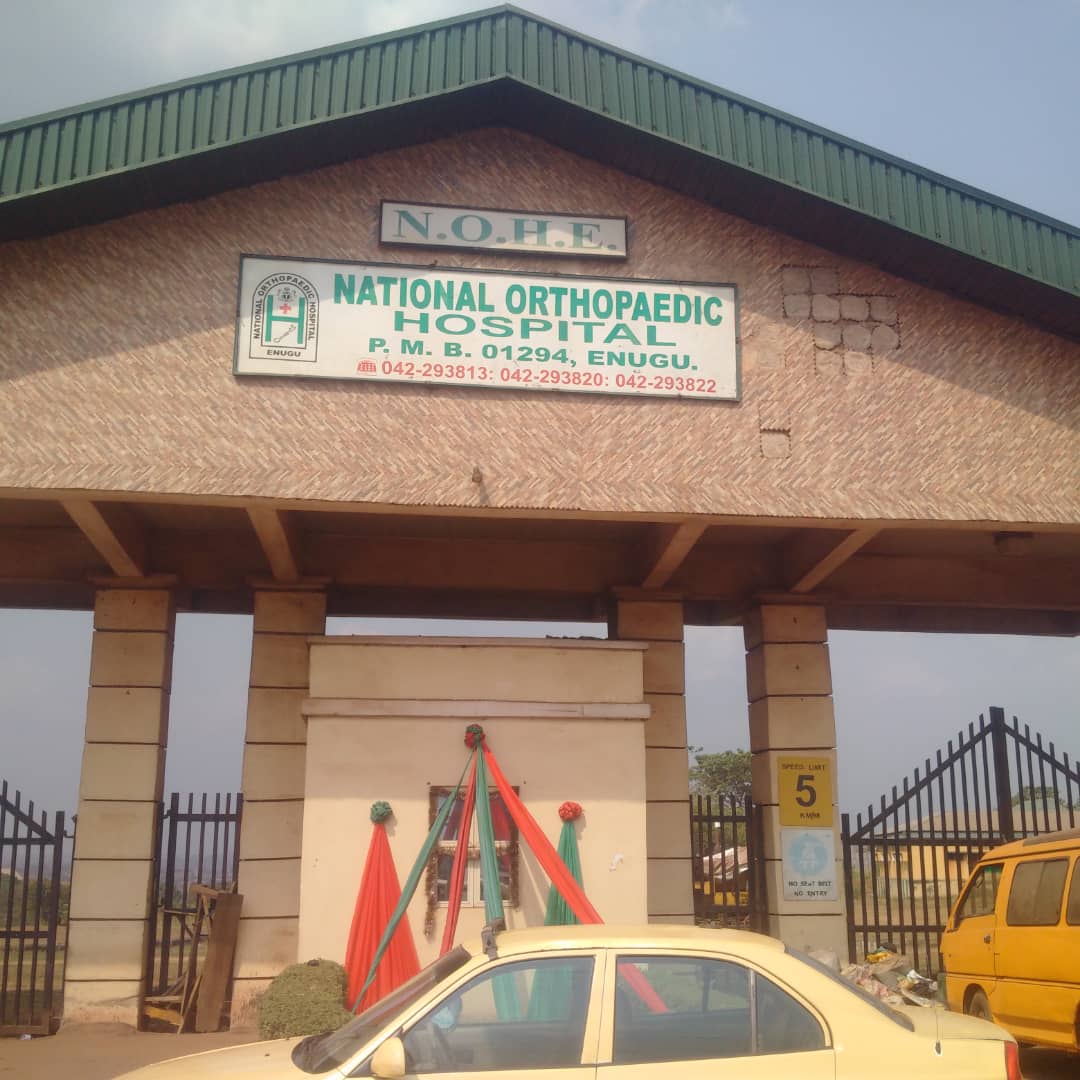
National orthopaedic hospital, Enugu
Speaking further, Nneka said, “As nurses, we are trained to give holistic care. A nurse should provide all round care and for you to be able to do that, you will have to focus all your attention on a particular patient. It is not something you can do when you are attending to more than one person at a time. That is ideal but things are different in reality. For example in this hospital, in a 24-bed ward, you have just two nurses on duty. That means 12 patients under one nurse. Even at that, had it been that the things you need are within your reach it would have been easier but sometimes you will have to take a patient out of the ward to do X-Ray, or you will have to take a patient to the theater, or you have to go out to look for oxygen.”
Continuing, she added, ”From my experience, personally you find yourself running helter-skelter in order to meet up with the care you have to provide to several patients at a time. But unfortunately, in the end, you find that you will not be able to give the care. So you find out that you are not satisfied – the job satisfaction that a nurse gets from nursing patients is not there. Everything gets tangled up and you just don’t like what you do. At the end of the day, the nurse goes home tired, weak and in fact feels like not coming to work again. That is what happens as a result of the low nurse to patients ratio. As a nurse, you are not able to do what you should do. And for me and my colleagues, it also makes us to feel sick. We work over-time most of the time. Our work is tense – the number of hours you put in is enormous and again, the pay is not commensurate to the effort put into the work but we just find ourselves doing it. If you overstay your shift, as is the case most of the time, you don’t get paid for that. And you notice that you overstay most times because you are trying to meet up with what you are supposed to do, and still, in the end, you don’t meet up.”
Unsatisfied patients
Between the nurses and the patients, there are no winners in the unfortunate situation. Nneka explained that most times, patients are not satisfied with the level of care they receive in hospitals. “Most of the time the patients are not satisfied. Most times, I will be on one bed attending to a patient and another patient will call me and I will say ‘give me some time I’m coming’ but I can’t divide myself into two so I can’t come immediately. So as a result, that other patient feels you are ignoring them”.
Due to inadequate number of nurses, patients’ relatives get involved in providing care
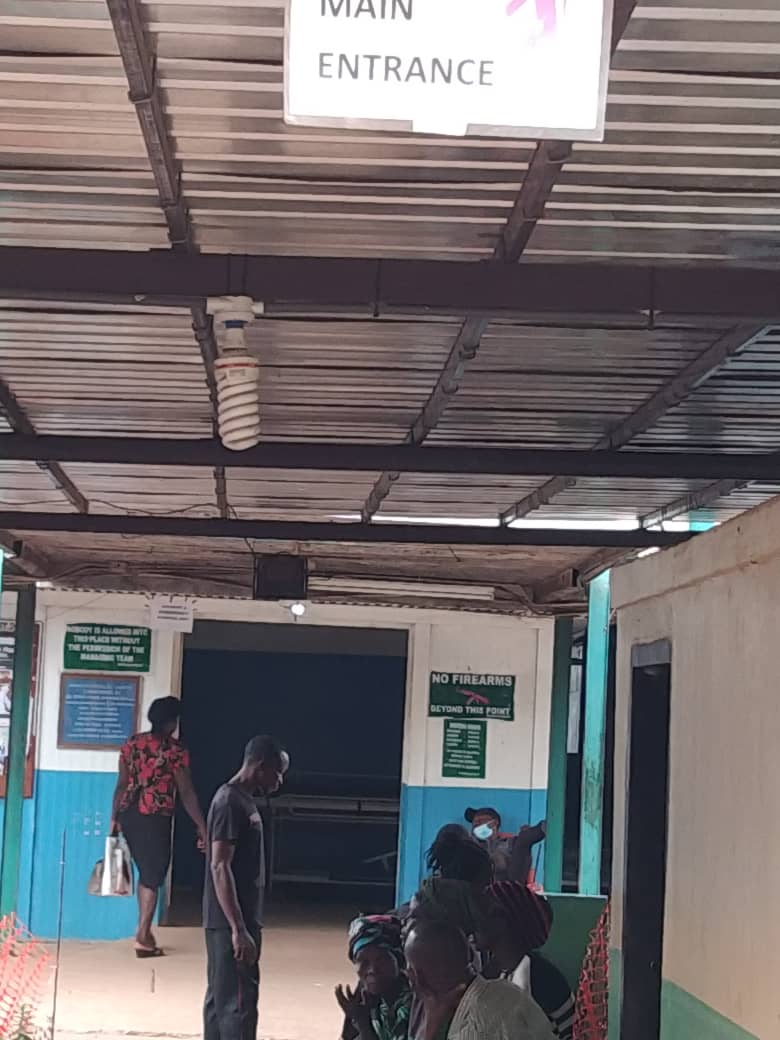
Patients waiting for the doctor at federal teaching hospital, Abakiliki, Ebonyi State.
Another unfortunate aspect of the situation is that, because the few nurses available have their hands full, sometimes relatives who are looking after family members in the hospital have no choice than to get involved in providing care for patients. Nneka, who expressed regrets over the development, admitted that some patients prefer their relatives to do certain things for them when they observe that the nurse, who has been over-worked, was becoming irritable.
Nurses are leaving Nigeria in droves
More than 10 nurses employed by the National Orthopaedic Hospital, Enugu, left Nigeria last year, according to Nneka. And many more are waiting to leave in 2021. “This year (2020) alone, from this Orthopaedic Hospital, more than 10 nurses left the country and more than 50 are waiting to leave,” she said.
Nneka insisted that money had nothing to do with her decision to leave. According to her, it is all about job satisfaction. “I want to leave because the work here is not giving me what I want based on what I know I can do. The environment is not just conducive and this is not just about the pay. When the things you are working with are not working, and you have this dedication to do what you are trained to do, you will want to go to a place where you will do better. The truth is when you have a lot of people (patients) under your care, you can’t be effective,” she observed.
President of the National Association of Nigerian Nurses and Midwives, Adeniji, said healthcare practitioners are not leaving the country just because they want to make more money. In an interview with The ICIR, Adeniji insisted that the ‘brain drain’ has more to do with conditions of service and job satisfaction.
He said, “Migration is a personal choice but it has a lot to do with the condition of service and job satisfaction. People are not leaving the country because of monetary considerations alone. When the condition of service does not allow you to function effectively the interest will be lost and when the interest is lost you will have to look for an alternative. The number of nurses in the country is grossly inadequate and in a situation where the few nurses available are being overworked and the condition of service is so poor, it not surprising that you see many nurses leaving the country.”
Jibe Onyekwelu
Chidiebere Okwara
Nneka Chukwu
Adeniji-Abdulrafiu-Ajani
Number of medical doctors in Nigeria not enough
Investigations by The ICIR across the South-East states further revealed that not only is the number of medical doctors grossly inadequate to meet the healthcare needs of the population, most of the doctors are also leaving the country for better working conditions abroad.
The federal government in March 2020 put the doctor to patient ratio in the country as 1: 2753, which translates to 36 medical doctors per 100,000 persons but the World Health Organisation recommends 1: 600 doctor to patient ratio.
Executive secretary of the National Universities Commission (NUC), Abubakar Rasheed, said on January 20, 2021, that Nigeria needs about 300,000 doctors to meet the 1:600 ratio recommended by the WHO.
The total number of medical doctors registered with the Medical and Dental Council of Nigeria as at March 2020 was 74,543, according to figures released by the federal government, although the NUC said less than 40,000 medical doctors are currently practicing in the country. The NUC also put the doctor to patient ratio in the country at 1:3500. However, the website of the Nigerian Medical Association (NMA) said there are over 40,000 medical doctors in Nigeria, and about 19,000 Nigerian physicians in the Diaspora.
Efforts to get the actual number of medical doctors in the South-East states were not successful but chairmen of Nigerian Medical Association (NMA) state branches provided estimates of the number of doctors in their states.
Chairman of the Ebonyi State chapter of the NMA, Ben Umezurike, told The ICIR that the state currently has about 650 medical doctors.
Jibe Onyekwelu, chairman of the NMA in Anambra, said there are about 1000 medical doctors in the state.
According to Tony Onyia, chairman of the NMA in Enugu State, there are about 1700 medical doctors in Enugu.
Chairman of the Imo State chapter of the NMA, Chidiebere Okwara, said the number of medical doctors employed by the state government at different levels was just 210. The number does not include medical doctors in the Federal Medical Centre, Owerri, and those working in private hospitals.
Okwuonu Chimezie, NMA chairman in Abia State, refused to disclose the number of medical doctors in the state. He told our correspondent that he was not authorised to disclose such information by the national body of the medical association. Chimezie referred our correspondent to the national leadership of the NMA.
Doctors suffer emotional and physical fatigue due to large number of patients, some fall sick, die
Medical doctors, who spoke with The ICIR in the course of the investigation, said most of them are suffering from ’emotional and physical fatigue’ due to the disproportionately huge number of patients they have to attend to on a daily basis.
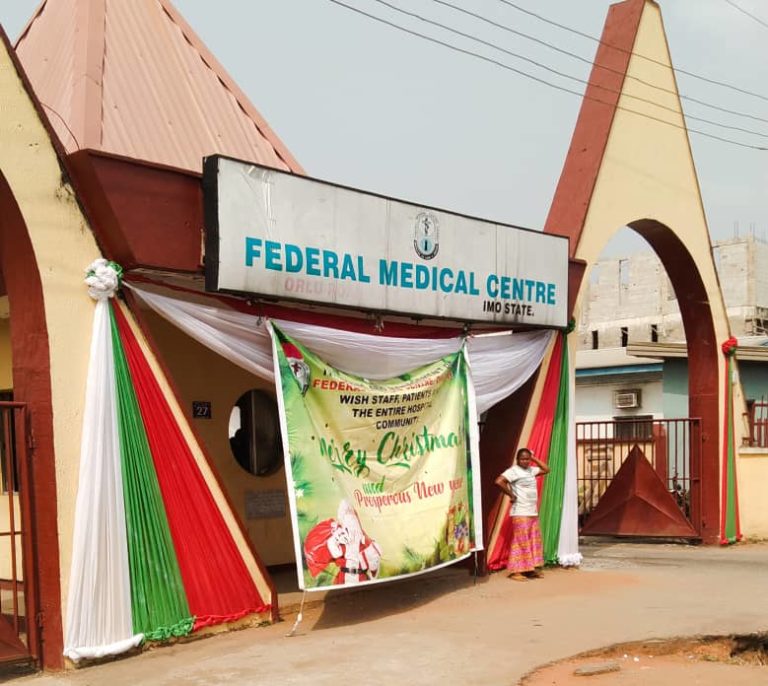
Shedding further light on the situation, Okwara, Imo State NMA chairman, revealed that in December 2020, a medical doctor at the Federal Medical Centre, Owerri, collapsed while on duty and had to be taken to the Intensive Care Unit (ICU).
”The doctor collapsed while on call attending to patients. He was rushed to the Intensive Care Unit and it took almost a week to get him back on his feet. He overstretched himself trying to attend to so many patients at once and didn’t have any time to rest and that was what led to that. He was unconscious for two days in the ICU,” Okwara said.
Noting that all the general hospitals in Imo State do not have up to a total of 30 medical doctors, Okwara added that there are only 12 medical doctors in the primary healthcare centres across 27 local government areas in the state.
As a result of the situation, a doctor working at the primary healthcare level covers up to three local government areas at the same time.
“Many doctors are suffering from emotional and physical fatigue,” Okwara observed.
Corroborating Okwara’s account, Umezurike, NMA chairman in Ebonyi, said many doctors have developed health complications.
”If you look at the faces of medical doctors you will see that all is not well, especially health-wise. Some doctors have collapsed while some have died treating patients. We are doing more than we should do and the incentive is very poor,” Umezurike told The ICIR.
Inadequate number of medical doctors undermine healthcare delivery
Onyekwelu, NMA chairman in Anambra, said the inadequate number of medical doctors has had a negative effect on healthcare delivery. According to him, the knowledge that general hospitals in Anambra have just one medical doctor has made people to opt for patent medicine dealers rather than visiting the hospital, when they are sick.
”That is why many of our general hospitals have very low patronage. The people prefer to go to patent medicine dealers for their treatment,” he observed, adding that in most instances, patients go to the tertiary or specialist hospitals when their health challenges are already serious.
Onyia, Enugu NMA chairman, bemoaned the long period it takes medical doctors to attend to several patients, who also have to wait several hours to see the doctor. “As a result, doctors begin to get irritable and this affects the doctor-patient relationship. When you have to see patients from 8:00 am to 4:00 pm, there is no way you will give your best. It gets to a point where there will be diminishing returns,” he said, adding that some patients are taking to alternative medicine just because of the lack of easy access to medical doctors.
According to Onyia, several communities in the rural areas have no medical doctor, a situation which he said has provided an environment for quacks and unorthodox medical practitioners to thrive.
‘It is the dream of every young doctor to leave Nigeria’
At the Federal Teaching Hospital, Abakiliki (FETHA), in Ebonyi State, a young doctor, who pleaded anonymity, told The ICIR that no doctor would remain in Nigeria if there is an opportunity to relocate and practice abroad.
A federal teaching hospital, Abakiliki, Ebonyi State.
“What I can tell you now is every young doctor’s major priority is to leave Nigeria. Those that want to stay here in the long term probably have personal interests or limitations but the trend now is that young doctors are writing foreign licencing exams to leave Nigeria,” he said, adding that hospitals have gotten used to receiving resignation letters from their young doctors.
The young doctor suggested that medical practice was better, and easier, abroad. According to him, in the US, UK, Canada and other advanced countries, a doctor can only work for a specified duration at a time and there is a limit to the number of patients to be attended to.
However, going by Chukwu’s testimony, it is not only young medical practitioners that wish to leave Nigeria, but even the experienced hands are also leaving. And if nothing is done to address the situation, the ‘brain drain’ problem will only get worse for Nigeria, as, according to Nneka, “Every medical practitioner here (Nigeria) is needed out there (abroad). Doctors, nurses, laboratory scientists, physiotherapists – all of them are needed abroad”.
THE Nigerian Air Force (NAF) says its Operation Thunder Strike neutralised several bandits at Chikwale Forest in the Mangoro area of Chikun Local Government, Kaduna State.
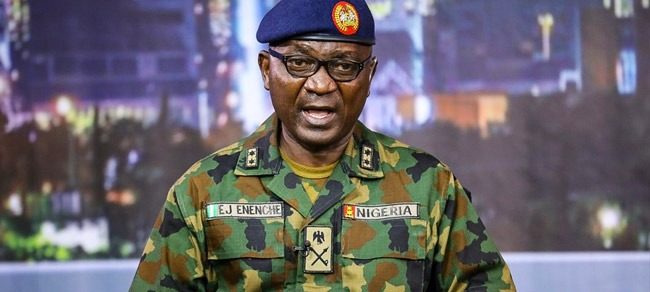
John Enenche, a major-general and coordinator of defence media operations, disclosed this in a statement on Monday. He said the operation took place on Saturday, stressing that it was carried out following credible human intelligence gathered by the Air Force that there was significant presence of armed bandits in the area. Enenche said it prompted the force to launch massive airstrikes on fleeing bandits.
”Accordingly, after series of confirmatory aerial surveillance missions, the Air Component dispatched an appropriate force package of Nigerian Air Force fighter jets and helicopter gunships to attack the location,” he said.
”Overhead the target area, the NAF Intelligence, Surveillance and Reconnaissance aircraft spotted scores of bandits, mounted on motorcycles and dressed in black attire, heading towards Niger State.
“The attack aircraft therefore took turns in engaging the bandits, who were seen firing at the attack helicopter as it strafed them.”
“Several armed bandits were accordingly neutralised in the airstrikes, while some escaped with various degrees of injuries. Meanwhile, aerial surveillance missions have been intensified, in coordination with ground troops, to locate the fleeing bandits,” he noted.
While vowing that the military would not rest until normalcy was restored to troubled parts of the country, Eneche noted that the Armed Forces of Nigeria and other security agencies would sustain the offensive against enemies of the nation.
Apart from Boko Haram, the activities of armed bandits have become another major security concern for the Nigerian state and security operatives in recent times.
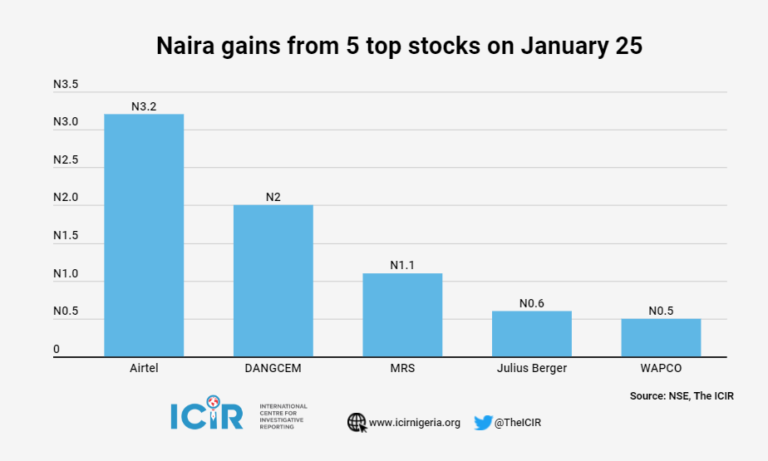
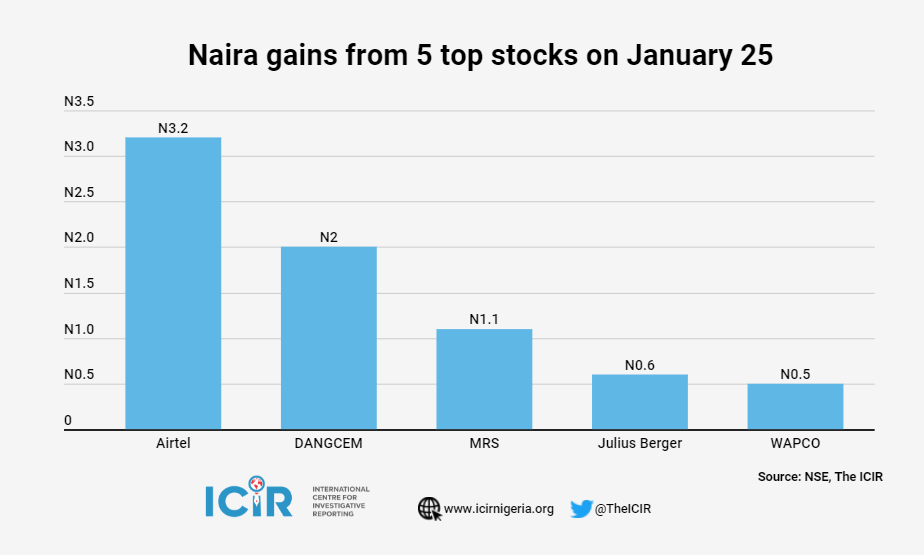
AIRTEL Africa, Dangote Cement and MRS emerged top gainers at the close of the Nigerian stock market on Monday.
Airtel stocks gained 3.2 naira, rising from 851.8 naira to 855 naira, representing 0.38 percent increase, according to a summary of market activities by the Nigerian Stock Exchange (NSE) on Monday, January 25.
This means that an investor who bought 1 million units of Airtel on Monday morning at 851.8 naira would have made 3.2 million naira by the close of the market.
Dangote Cement gained 2 naira, increasing from 234 naira to 236 naira, representing 0.85 percentage increase. Also, MRS stocks rose 1.1 naira, from 11.2 naira to 12.3 naira, indicating a 9.82 percentage point increase in a market day.
Two other stocks that were among top investors’ picks were Julius Berger and WAPCO.
Julius Berger gained 0.6 naira, rising from 18.9 naira to 19.5 naira, which was a 3.17 percent increase over 24 hours.
Similarly, WAPCO stocks saw a 1.9 percent point increase in price, rising from 26 naira to 26.5 naira over the trading day.
These stocks pushed up listed equities market by 45 billion naira, with 19 gainers helping year-to-date returns to 2.03 percent. The value of listed equities rose from 21.449 trillion naira to 21.494 trillion naira within the trading day, representing 45 billion naira increase.
The NSE All-Share Index, which tracks market movements of all the listed equities, rose by 0.21 percent, from 41,001.99 points to 41.088.96 points.
In 5,640 deals, 333,096,795 units estimated at 2.640 billion naira were traded. However, Ardova, Nascon, CI Leasing, International Breweries and Unilever emerged as top losers.
January 18-22 market activity
Total turnover of 4.288 billion shares valued at 25.989 billion naira were traded in 32,849 deals last week on the floor of the Exchange.
It was better than the previous week’s 3.447 billion shares valued at N32.725 billion.
“Trading in the top three equities, namely Transnational Corporation of Nigeria, Living Trust Mortgage Bank Plc and Japaul Gold and Ventures Plc (measured by volume) accounted for 1.582 billion shares worth 1.564 billion naira in 2,726 deals, contributing 36.9 percent and 6.02 percent to the total equity turnover volume and value respectively,” NSE said in its January 18-22 market report.
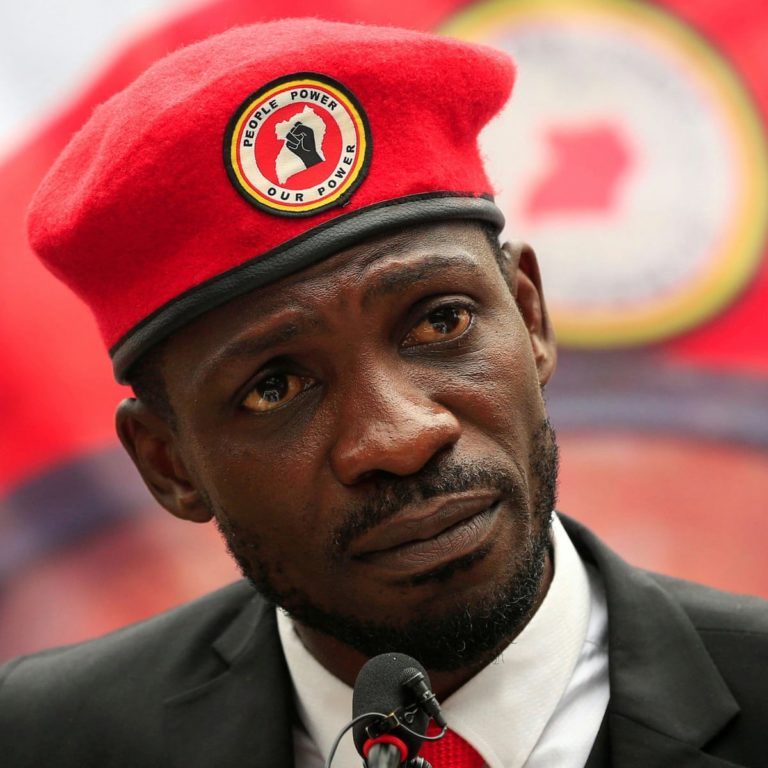
AFTER spending eleven days on house arrest, a Ugandan high court, Monday, ordered the release of opposition leader, Robert Kyagulanyi, popularly known as Bobi Wine.
Justice Michael Elubu ruled that the residence of the 38-year-old musician was not a detention centre.
Elubu stated that proper charges should be instituted against Wine if found to have disrupted public peace, rather than being placed him on an indefinite house arrest.
“The continued indefinite restriction and confinement of the applicant to his home is unlawful and his right to liberty has been infringed. Having found that the restrictions are unlawful it is hereby ordered that they are lifted,” Elubu ruled during the session.
Although Solomon Muita, spokesperson for the Ugandan Justice Ministry, confirmed the court order, he said he was yet to get the details of the ruling.
“The ruling was made today that the security forces being at Bobi Wine’s place was unlawful, I am yet to get details of the ruling but the judge ordered that the security forces need to leave his premises immediately,” Muita said.
Wine was last seen in public on Thursday 14, January 2020, after voting at the Ugandan presidential elections in his local government.
A day after the election, he tweeted that his residence was on under siege by the military who jumped the fence to gain access into his home.
“We are under siege. The military has jumped over the fence and has now taken control of our home,” Wine tweeted.
The United States ambassador to Uganda, Natalie Brown, was also denied access to visit Wine.
Brown had earlier announced the decision of the United States government not to observe the election due to denial of ‘more than 75 per cent’ of its accreditation requests.
Like the United States, the European Union also announced its decision not to send observers to the Eastern African country due to recurrent failure to heed her previous advice on making the Ugandan Electoral Commission independent and ensuring a free and fair process.
The ICIR had reported how the incumbent president, Youveri Museveni, used violent tactics to secure another term in office after ruling the country for 35 years.
During the electioneering period, Museveni ordered a ban on social media in Uganda following an unfavourable Twitter hashtag #We are removing a dictator#.
The Ugandan electoral commission declared Museveni winner of the election keenly contested amidst violence.
According to Uganda’s electoral commission on Saturday afternoon, Museveni won the election with 58.64 percent of the total votes cast while his main challenger, Wine, garnered 34.83 percent of the total votes cast.