Home Blog Page 2688

State House Clinic got N9.14bn in 10 years,yet no paracetamol, syringes

Over the years, it has become a norm, or some unwritten law, for members of the first family in Nigeria to embark on frequent trips abroad to receive medical attention.

This is in spite of the fact that every year, billions of Naira are allocated to the State House Clinic.

On Monday at a stakeholders meeting on Reproductive, Maternal Nutrition, Child Advocacy and Health Nutrition (RMNCAH+N), Aisha Buhari, wife of President Muhammadu Buhari, said that the state hospital could not boast of a single syringe on her visit to the hospital.

Last week, Zahra Buhari, daughter of the president, had purportedly made same observation via her Instagram handle, calling out Jalal Arabi, the Permanent Secretary of the State House clinic, whom she claimed not provide ordinary Paracetamol despite a budget of N331.7million allocated to the state clinic.

Following the comment made by Mrs. Buhari, Daniel Bwala a Legal Practitioner said that the Aso Villa Hospital is “a scam”.

“If a place is called a hospital and it does not have the basics like syringe and hand gloves, you do not have a hospital then, it is a scam,” Bwala said.

He also said that the N3.1billion allocated to the state hospital can be used to construct a world class hospital, depending on the size.
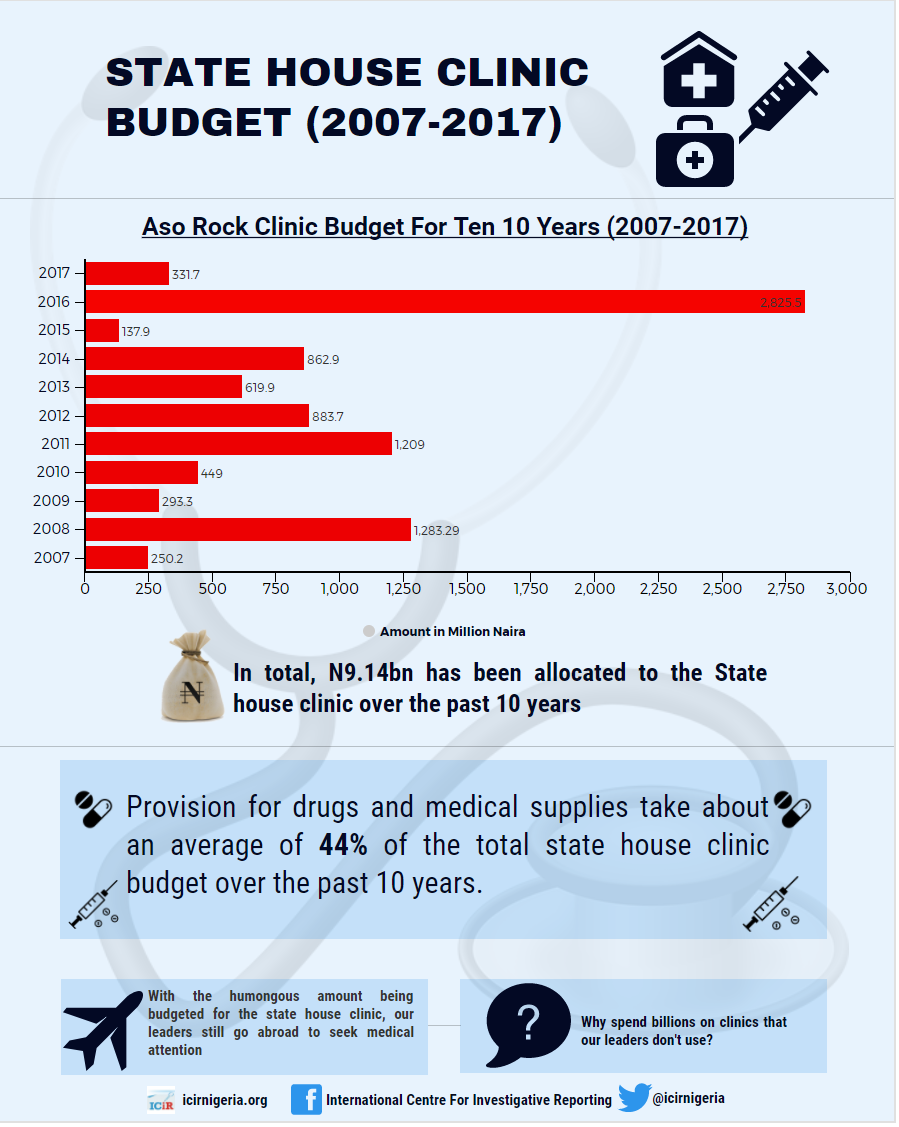
Budgetary allocation to the state house clinic for 10 years (2007-2017)

A look at the budgetary allocations to the State House clinic in the last 10 years show that higher percentage of funds has been for the procurement of drugs and medical equipment but this has not translated into improved service delivery.

Every year members of the first family as well as senior government officials travel abroad in search of medical treatment.

Between November 2009 and February 2010, Umaru Yar’ Adua, former President of Nigeria, spent three months outside the country on medical tourism, despite the fact that the sum of N449 million was allocated to the State House clinic in the budget. Sadly, Yar’Adua passed on in May of 2010.

In August 2012, Patience Jonathan, wife of former President Goodluck Jonathan, travelled to Germany for medical treatment, spending almost three months.

Throughout Jonathan’s tenure, between 2011 and 2015 a total sum of N3.71 billion was budgeted to the State House clinic.

Then enter the change era of President Buhari, who had promised during his campaign to “ban medical tourism by politicians”.

But Nigerians were dealt a rude blow when Buhari announced in February 2016 that he was embarking on a 10-day medical trip to London to treat an “ear infection”.

This is in spite of the N3.1 combined billion budgetary allocation to the State House clinic for 2016 and 2017, higher than the allocation to all the tertiary healthcare centres in the country combined.

Buhari left again in January 2017 and came back in March, spending almost 50 days in what was supposed to be a 10-day leave. Yet again, Buhari jetted off to London in May and returned in August, creating a new record as the Nigerian President that has spent the longest straight days outside the country.

Just last week, the news broke that Anthony Awnukah, Minister of State for Education, is in the United States receiving treatment for an undisclosed illness.

Meanwhile, Nigerian doctors and health workers continually embark on strikes because of non-payment of salaries and poor working conditions. Every year, thousands of newly graduated doctors travel out of the country, to the US and UK especially, in search of ‘greener pastures’, and there seems to be no end in sight to the embarrassment that the Nigerian health sector has become over the years.

I approved NNPC’s joint venture financing contracts, Osinbajo admits

Vice-President Yemi Osinbajo says he approved the NNPC joint venture financing contracts as claimed by the corporation in a statement on Monday.

Laolu Akande, Senior Special Assistant to the Vice President on Media and Publicity,made this known via his verified twitter handle on Thursday.

Akande said Osinbajo approved the recommendations for the contracts in his capacity as the Acting President when President Muhammadu Buhari was away on medical leave.

He said that the Osinbajo gave his approval after due diligence and adherence to established procedure.

“In response to media inquiries on NNPC joint venture financing, VP Osinbajo, as Ag President approved recommendations after due diligence and adherence to established procedure,” the tweets read.

“Action was necessary to deal with huge backlog of unpaid cash calls which Buhari administration inherited and also to incentivise much needed fresh investments in the oil and gas sector.”

In a memo to Buhari, Ibe Kachikwu, Minister of Sate for Petroleum Resources, had accused Maikanti Baru, Group Managing Director of the NNPC, of unilaterally approving the contracts without due process.

“Mr. President over one year of Dr. Baru’s tenure, no contract has been run through the Board,” Kachikwu alleged.

“The following major contracts were never reviewed by or discussed with me Board of NNPC: The Crude Term contracts- value at over $10bn; The DSDP contracts- value over $5bn; The AKK pipeline contract- value approximately $3bn; Various financing allocation funding contracts with the NOCs – value over $3bn; Various NPDC production service contracts – value at over $3bn–$4bn.

“There are many more Your Excellency, in most of these activities, the explanation of the GMD is that you are the Minister of Petroleum and your approvals were obtained.

“However, the correct governance should be that the Minister of the State and the Board review the transaction and give their concurrence prior to presentation to you.”

But the NNPC issued a statement denying the allegations and insisting that the projects were duly approved by the President who also doubles as the substantive Minister of Petroleum Resources.

Borno IDPS: We don’t want to go home now…it’s too soon

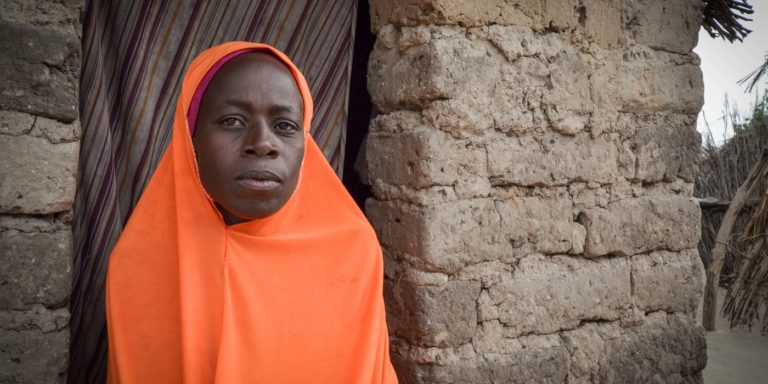
Picture courtesy of NRC

Eighty-six percent of the 1.8 million Internally Displaced Persons (IDPs) in the North East are not ready to return home, a new report by the Norwegian Refugee Council (NRC) reveals.

The council said findings contained in the report are indisputable, adding that movements of people to their communities “must be voluntary, safe and informed.”

Jan Egeland, NRC Secretary General, who is currently in Nigeria, said coercing the displaced persons to return home is a deadly recipe that could worsen the conflict.

“When 86 per cent of people tell us they aren’t ready to go home yet, we must listen. This cannot fall on deaf ears,” he said.

“People must decide to return of their own free will. Coercing communities to move home is a deadly recipe set to worsen the conflict.”

The report, titled ‘too scared to return’, comes at a time when about a dozen persons from Bama Local Government Area, one of the largest communities displaced by Boko Haram, are being held in prison custody as they face trial for leading IDPs to stage a street protest asking government to allow them return home.

The NRC said it talked to 27,000 IDPs in the research which it said was one of “the largest pieces of research carried out on the displaced population”.

“60 per cent of people who are unwilling to return home in the immediate future cite insecurity as the main reason for staying put. Attacks against civilians are on the rise, and communities feel scared,” Egeland said

“The Nigerian military recently gained ground in the fight against the Islamic extremist group Boko Haram. In response, the armed group has stepped up attacks on soft targets, including markets and sites sheltering displaced people,” he added

The report noted that many officials in Nigeria’s government are keen to see communities move back home.

“While the end game is for communities to return home, the unfortunate truth is that pushing people back now will have harmful consequences,” said Egeland.

“An overwhelming 85 per cent of people living in formal camps tell us they feel safer there than where they were before, despite the deplorable attacks on camps.

“Today I met a woman in Monguno town who fled her village two years ago after Boko Haram set it ablaze. She’s eager to bring her six children home, but she told me it’s too soon, that the armed group are still present.”‎

The report based on research largely carried out in September this year also stated that some of the IDPs would still insist on remaining in the city even if the Boko Haram insurgents are totally wiped out.

“Even if the security situation improves, half the displaced people interviewed say their houses were destroyed in the conflict,” the report said.

“About 48 per cent of people interviewed do not have information about the current state of their homes, indicating that this figure could be much higher,” added Egeland.

The report recommends measures needed before Nigeria’s displaced can return home.

“Firstly, the overall security situation must improve so communities feel safe. In addition, resources must be channeled into rebuilding homes and re-establishing livelihoods. It is important that displaced communities are involved in developing these programmes.

“People need a roof over their heads and the prospect of making a living, if they are to have any chance of rebuilding their lives,” he said.

“We are ready to work with the government to help displaced Nigerian’s return home. But movements must be voluntary, safe and informed.”

The Boko Haram insurgency, according to a recent situation report by the NRC, has left “8.5 million people in need of humanitarian assistance in Nigeria”.

About 80 per cent of the internally displaced are in Borno State, with over half living outside of camps in local communities.

Some ‎220,000 people have fled to Cameroon, Niger and Chad, while 5.2 million people are food insecure in northeast Nigeria.

An estimated 450,000 children are suffering from severe acute malnutrition; while 20,000 people have been killed since the start of the conflict 8 years ago. Over 4,100 cases of suspected cholera and 56 deaths have been reported”.

The report says at least 57 per cent of schools in Borno State are still closed due to conflict.

The challenges of managing the humanitarian conflict are still enormous because the $1 billion 2017 global aid appeal for Nigeria is only funded by 64 per cent.

The ‘Too Scared to Return’ report was written in collaboration with the REACH Initiative, the Danish Refugee Council and the protection sector in Nigeria.

The NRC says it has provided aid to tens of thousands of Nigerians since the start of the year.

“This includes food, water and sanitation to 40,000 people, shelter for 20,000 people and legal assistance to 18,000 people,”Egeland said


Read also:

EFCC says N2.1 billion found in bank account belonging to Patience Jonathan’s late mother

The Economic and Financial Crimes Commission (EFCC) says it traced N2.114 billion to a bank account belonging to a company owned by Charity Oba, the late mother of Patience Jonathan, wife of former President Goodluck Jonathan.

The commission said Patience became the sole signatory to the company’s account following the passing on of her mother. It also said that the total amount that has been traced to Patience is now N17 billion, which was siphoned using several of her NGOs.

According to documents seen by journalists, the company, Magel Resort Limited, was incorporated by Patience’s mother as a resort agency, but was later used to secure an IT contract from the National Information Technology Development Agency (NITDA).

“Another company owned by Mrs Jonathan is Magel Resort Ltd. It was incorporated by Mrs. Jonathan’s late mother. But Patience Jonathan became the sole signatory to the account of the company by board resolution upon the demise of her mother,” read a report by the EFCC which was made available to The Punch.

“Though registered as a resort agency, sources at the EFCC disclosed that the agency was probing the circumstances in which the firm secured over N200m IT contract from the National Information Technology Development Agency.

“The contract was allegedly bankrolled through the National Information Technology Development Fund.

“Several other persons under investigation for money laundering by the anti-graft agency were discovered to have made payments into the company’s account including a hotelier in Central Area, Abuja, who has been invited for questioning.

“The total sum allegedly laundered through the account of Magel Resort Limited, owned by Mrs Jonathan and her late mother, is put at N2.114bn.”

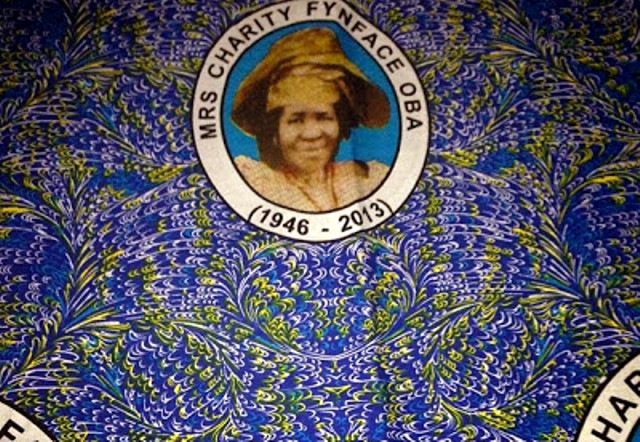
Picture of the material used during the funeral of Patience Jonathan’s mother


The EFCC also alleged that several government agencies made payments into an account belonging to Ariwabai Aruera Reachout Foundation, another NGO owned by Patience.

A total inflow of N2.4 billion was allegedly paid into the account between 2009 and 2015.

“Investigations equally discovered that Mrs. Jonathan maintains a dollar account with Diamond Bank which received huge financial inflow from her domestic aides,” the report read.

“Some of the domestic aides that made payments into the accounts are also trustees of her so-called NGO and director in her companies. The balance in the account was $12,831,173.

“Another dollar account of the former First Lady was discovered in Skye Bank. Inflows into the account came through deposits by domestic aides of Mrs. Jonathan.

“Intelligence reports indicate that most of the purchase of luxury items by the former First Lady was through the Platinum card of the account. The total amount in the account is $7.9m.”

“Another discovery was the N2.1bn and N1.8bn deposited into the accounts of AM PM Global Network Limited and Pagmat Oil and Gas Limited respectively, between 2009 and 2015. Both companies are linked to the former First Lady.

“Another N1.140bn was also allegedly laundered by Mrs. Jonathan through the account of Lawari Furniture and Baths Limited, whose address is given as 100 Akamfa Road, Yenagoa, Bayelsa State.

“The bulk of the money was deposited by Bureau de Change operators.”

The EFCC said it has invited the Bureau de Change operators for questioning.

The report also noted that most of the companies that were linked to Patience Jonathan had false addresses and mails sent to their emails could not deliver.

When contacted, Belema Meshack-Hart, Patience Jonathan’s media aide, said that the allegations were false.

He asked Ibrahim Magu, EFCC Acting Chairman, to go and clarify himself before the House of Representatives’ committee which invited him over the matter.

“I won’t exchange words with them (the EFCC) since the matter is in court,” Meshack-Hart said.

“The House has invited the EFCC chairman many times but he has refused to honour the invitations. Let him go and tell the National Assembly what he knows.

“However, it is not true that Dame Jonathan used her foundations to launder funds. The foundations helped over 700 people with heart diseases.”

Schools shutdown in the South East over alleged killer injections by soldiers

There was panic in the South East region of the country on Wednesday following claims that some people dressed as soldiers were going around schools for “immunization”.

Parents and guardians rushed to the schools to take their wards home and the streets were littered with hundreds of school children rushing back home.

The development could be connected to the free medical outreach launched by the army as part of its just concluded ‘Operation Python Dance II’ in the region.

The panic was reported across almost all the states of the South East, including Abia, Anambra and Imo.

A parent who spoke to ICIR on the condition of anonymity from Umuahia, the Abia State capital, said she recieved a call from her a friend who told her to rush to her son’s school and take him home.

She said her friend told her that some soldiers were sighted in a primary school in Afara and they said they were there to immunize the children.

“I was at home when somebody called me and said that people were running in Afara, that was the first place they mentioned,” She said.

“When I went to collect my child, you need to see how the main road was filled with people who were rushing to collect their children.

“And one of the teachers in my school, because that’s the school where I teach also, said that a teacher who called her from Afara said soldiers came to their school and said they wanted to immunize the pupils.

“According to the person that called her, when the school turned down the immunization offer, the soldiers got angry and started shouting at them.

One of the pictures sent by the source from Umuahia

“I just picked my child and went back home. You needed to see the main road how it was filled with people running helter scelter.

“I just hope people won’t even get injured while running for their lives. I don’t know exactly what happened but I’m waiting for my husband to return. I know he will have details.”

Afara is the hometown of Nnamdi Kanu, Leader of the now proscribed Indigenous People of Niafra, IPOB.

There have been rumours that the outbreak of the monkeypox disease was as a result of free medical outreaches being organised by the federal government.

However, Lai Mohammed, the Minister of Information and Culture described the allegations as baseless and the handiwork of unscrupulous persons.

”The Federal Government has not conducted any free medical service or care in either Bayelsa or Rivers state, as alleged in the fake report being circulated. So that could not have been the cause of the outbreak of Monkey Pox in both states,” Mohammed said on Sunday.

But the Nigerian Army has not issued any statement to refute the rumours.

Some Nigerians took to twitter to express their fear, yet there was no reaction from the Army whose verified twitter handle is @HQNigerianArmy.

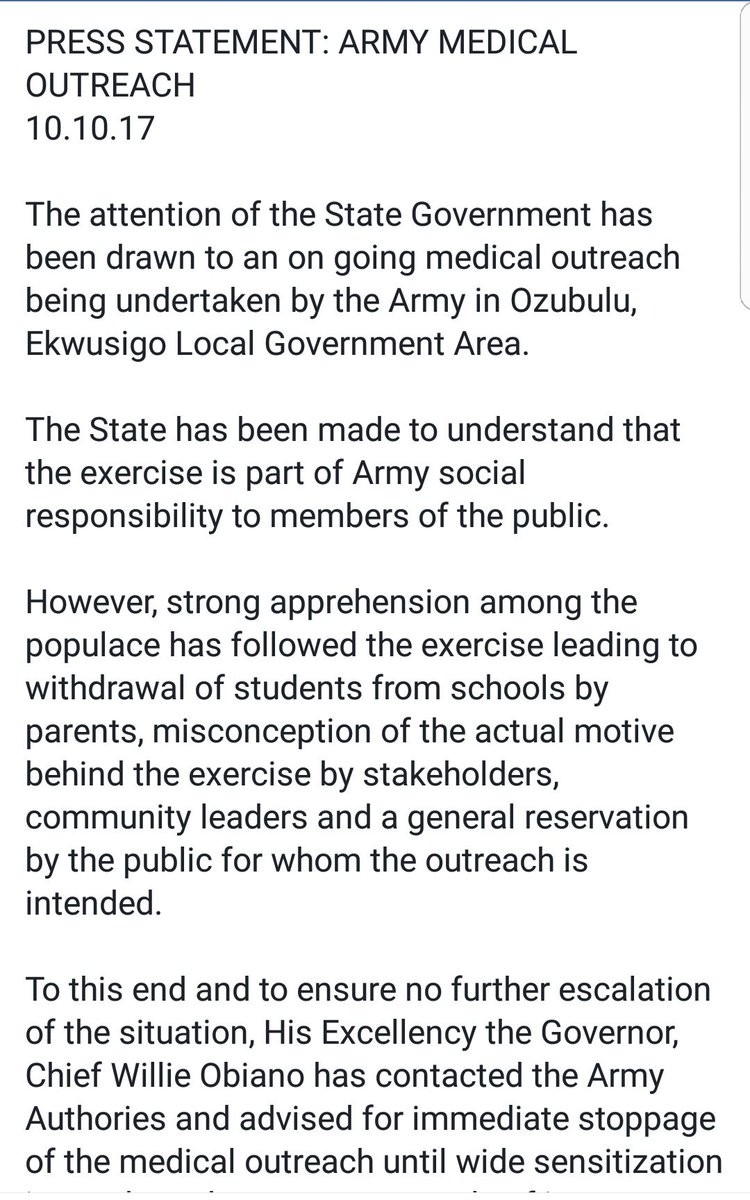
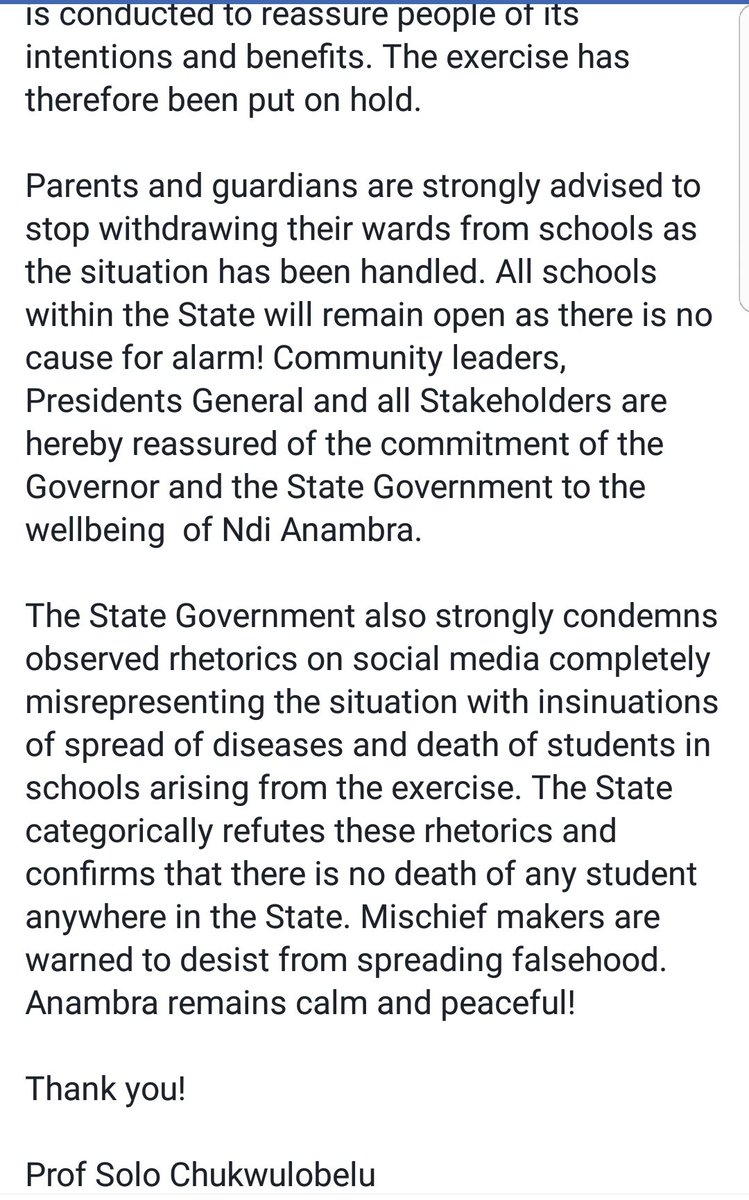
However, a press release purportedly from the Anambra State government explained that the exercise was part of the Army’s social responsibility to the members of the public.

The statement added that Willie Obiano, the State Governor had directed that the exercise be discontinued until appropriate sensitisation has been conducted to educate the people on the benefits.

Hit and run driver kills FRSC official in Abuja

A hit and run driver has knocked down and killed an official of the Federal Road Safety Commission (FRSC), in Abuja.

Boboye Oyeyemi, Corps Marshal of FRSC, who disclosed this to NAN, said the late official whose name was not mentioned was knocked down and killed on patrol at Idu area of Abuja.

Oyeyemi did not give details of the incident and whether the hit and run driver was arrested

He expressed sadness at the event and called for prosecution of culprits involved in such acts.

There have been several similar attacks on FRSC officials across Nigeria despite the efforts and campaigns of the commission.

Nigeria makes more, promises less funding on agriculture, says Oxfam

The international humanitarian organization, Oxfam, says funding levels for agriculture and climate change adaptation by the Nigerian government are significantly lower than promises.

In a report titled, “fine words do not produce food,” presented in Abuja on Wednesday, Oxfam lamented Nigerian government’s vision of economic transformation through agriculture which has no focus on small-scale farmers.

It says money is skewed toward larger scale projects and research.

The report was a policy brief on the impact of investment in agriculture and climate change adaptation on small scale farmers in Nigeria between 2010 and 2015.

“With adequate support, small-scale farmers throughout Nigeria could overturn rampant malnutrition and move the country toward food security,” said Constant Tchona, Country Director of Oxfam in Nigeria while presenting the report.

“But as the Nigerian proverb goes, ‘fine words do not produce food.

“The government is pursuing a vision of economic transformation and commercialization with agriculture at the centre, yet small-scale farmers are not the focus of investments”.

He explained that “the support that small-scale farmers need is straightforward—ranging from fertilizer to market access to climate change adaptation strategies—and the Nigerian government must escalate investments to deliver these vital resources.”

Tchona said Nigerian government should increase spending in the agricultural sector to at least 10 percent of the national budget.

He lamented that agriculture share of national budget between year  2010 and  2015  ranged between 0.9% and 1.8%; with a mean share of 1.5%, adding that  it was way below the benchmark of 10% of national budget annually stipulated at the Maputo declaration of 2003.

He quoted from the policy brief, that “Nigeria received a total sum of $2.22 billion  Official Development Assistance (ODA) between 2014 and 2015 from foreign donors to increase investment in agriculture”.

According to him, “total ODA disbursed to Nigeria in financial year 2014-15 was $2.22b, of which 89% ($2.09b) was from multilateral donors, 11% ($ 0.4970) from bilateral donors; 88% of multilateral donations was from World Bank group while UNICEF provided 10.9%. The top bilateral donors for the financial year 2014-15 were USAID, UK DFID, EC and Canada in that order.”

The Deputy Country Director  explained further that ODA to agriculture fluctuated between 2011 and 2015, while  health and education sectors received largest shares of ODA, stressing that agriculture had 0.08% of the ODA disbursed to Nigeria‎.

“As a matter of urgency, the government in partnership with donors should work toward boosting dedicated climate adaptation funds in the agricultural sector to match investments in other African countries,” he said

‎He added that the government should redirect investments to align with the needs of smallholder farmers, especially women farmers who face additional constraints in accessing agricultural inputs and extension services.

His words: “Farmers need support to ameliorate the high cost of fertilizers, machinery, water pumps, and other resources.

“Farmers who access inputs through credit may achieve more economic independence, especially when they are setting funds aside through savings groups. Nigerian farmers also need weather information, market access, land tenure, and adaptation strategies.”

He also urged the government to enact policies to scale up private sector involvement noting that public-private programs that have demonstrated success in enhancing food production.

“Providing a ready market for products should be sustained and improved to support smallholder farmers. These programs should consider conducting a needs assessment to provide the kinds of inputs, credit programs, and timely delivery that farmers need,” Tchona said

Tchona said despite the fact that Nigeria was ranked  as the world’s fourth most vulnerable country to  climate in 2015 which has brought additional uncertainty and risk to Nigeria’s ‎small scale-food system, Nigeria has not benefited from multilateral climate funding because it has not established a sufficient instistitutional framework to access funding.

He emphasised that the financing to support ‎climate change adaptation was drastically below expectations, as Nigeria only  received  $15 million in funding from multilateral institutions.

‎Tchona stressed that Nigeria’s population size is about equal to the combined populations of the six countries receiving the largest share of multilateral climate adaptation funding- Niger, Tanzania, Mozambique, Zambia Mali and Uganda, saying these countries have received a combined of 47 times the amount of finance for adaptation as the population of Nigeria.

‎The Deputy Country Director said recent estimates suggest that in the absence of adaptation, climate change could result in losses of between 2% and 11% of Nigeria’s GDP by 2020, adding that these loss estimates are projected to range between 6% and 30% by the year 2050.

Another Nigerian “killed” by South African police

Ibrahim Badmus, a 25-year-old Nigerian has been killed during a police raid in Vaal Vreneging, a town close to Johannesburg, South Africa.

Confirming the incident to newsmen, Godwin Adama, Nigeria`s Consul General in South Africa, said Badmus, who hails from Lagos State, was allegedly killed by operatives of the South African Police

“Information at our disposal said that the deceased was killed by a South African police officer,” Badmus told NAN.

“I led a delegation from the mission to visit the scene on receipt of the information. When we arrived the scene, the place was tensed up because Nigerians there were not happy.

“We immediately met with the Station Commander in the area with some selected Nigerians. The police assured that a thorough investigation would be carried out.

“The investigation will be done by the Independent Police Investigating Department.”

An eyewitness told a correspondent of Channels Television that Badmus was his tenant and that the police accused him of being a drug dealer.

“I found Omo (Badmus), my tenant on handcuff. There was a plastic where they put paper spray on him.”

“I asked the police ‘why are you doing this to him’? They said he’s a drug dealer, he must take out the drug and I was like ‘no, he doesn’t sell drugs’.

“My tenant was on handcuff and he started calling ‘Steve, I can’t breathe’. I started fighting with them and tried to help the guy but the other one (police officer) took me out as well.

“So when I went back inside, Omo was sleeping, looking at them and the police officers were like ‘he just fainted’ that they would call the ambulance.”

Last week, Jelili Omoyele, a 35-year-old Nigerian, was shot dead in Johannesburg over an alleged 300 Rand  parking lot debt.

Over the years many Nigerians have been killed in South Africa, most of them accused of dealing in drugs.

Nigerians have accused the federal government of not doing enough to protect citizens living in foreign countries.

Court orders final forfeiture of N3 billion Diezani properties

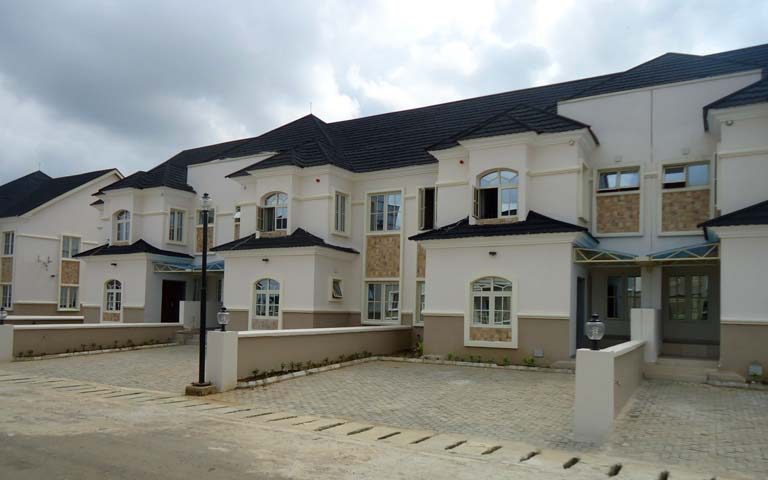
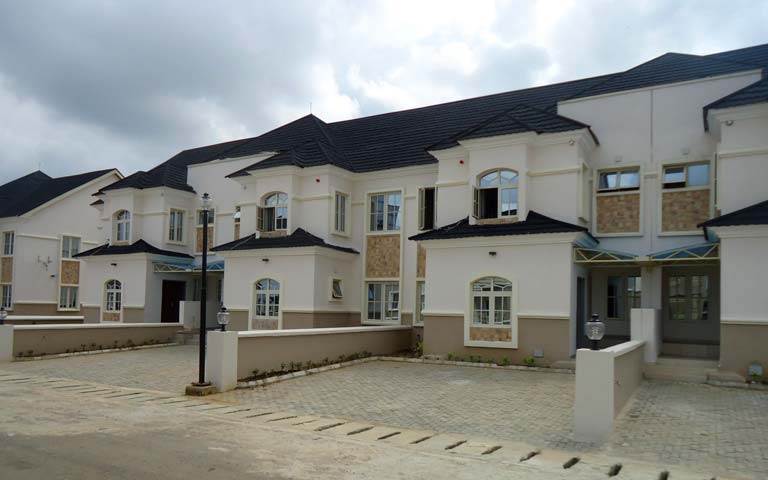
Picture of an estate used to illustrate the story


The Federal High Court in Lagos has ordered the final forfeiture of assets worth about N3 billion purportedly belonging to Diezani Allison-Madueke, former Minister of Petroleum Resources.

Joined as respondents in the suit are one Donald Amamgbo, and four firms – Chapel Properties Limited; Blue Nile Estate Limited; Azinga Meadows Limited; and Vistapoint Property Development Limited.

Justice Abdulaziz Anka delivered the judgement on Wednesday following an interim forfeiture placed on the properties in August.

The assets comprised of 56 houses located in Lagos and Port-Harcourt which were allegedly acquired by Alison-Madueke using proxy companies between 2011 and 2013.

According to the Economic and Financial Crimes Commission (EFCC) alleged that the properties were purchased for $21,982,224 which is believed to be proceeds of crime.

The properties include 29 terraced houses comprising eight four-bedroomed penthouse apartments, six three-bedroomed apartments, two three-bedroomed maisonettes, two twin bedroomed apartments and one four-bedroomed apartment.

Others are 16 four-bedroomed terraced houses in Heritage Court Estate, Plot 2C, Omerelu Street, Diobu, Government Residential Area (GRA) Phase 1 extension, Port-Harcourt, Rivers State.

Also forfeited are 16 four-bedroomed terraced houses in Heritage Court Estate, Plot 2C, Omerelu Street, Diobu, Government Residential Area (GRA) Phase 1 extension, Port-Harcourt, Rivers State.

When the interim forfeiture order was granted by Justice Anka in August, he ordered the EFCC to appoint a firm to be managing the properties on a temporary basis.

The EFCC said that a total of N47.2 Billion and $487.5 Million in cash and properties have been traced to Allison-Madueke as at August 2017.

FG sues Misau over allegations against IGP

The Office of the Attorney General of the Federation and Minister of Justice has filed two sets of charges against Isah Misau, Senator representing Bauchi Central in the National Assembly, at the Federal High Court and the Federal Capital Territory High Court, Abuja.

One of the set of charges had to do with the series of allegations of corruption and abuse of office made by Misau against Ibrahim Idris, the Inspector General of Police, while the other borders on falsification of vital documents which Misau submitted to the Independent National Electoral Commission, INEC.

In the suit filed before the FCT High Court, Misau, a retired Deputy Superintendent of Police, was accused of making claims containing “injurious falsehood” against Idris and the Nigeria Police Force.

Misau, among other things, alleged that police officers pay as much as N2.5 million to the Police Service Commission for special promotion and posting.

He also accused the IGP of diverting money meant for the purchase of Armoured Personnel Carriers, Sport Utility Vehicles and other exotic cars.

Misau was also said to have falsely accused the IGP of making almost half of the mobile commanders in the country the people of his Nupe extraction.

The offences were said to be contrary to Section 393(1) of the Penal Code.

In the other set of charges, Misau was accused of “uttering” false documents including affidavits, statutory declaration of age deposed to at FCT High Court and the Bauchi State Health Management Board Birth Certificate, which he allegedly submitted to the Independent National Electoral Commission in 2011 and 2014.

The offences in the seven counts were said to be contrary to the Miscellaneous Offences Act Cap M17, Laws of the Federation of Nigeria, 2004 and punishable under the same section of the Act.

The two sets of charges were signed on behalf of the AGF by an Assistant Chief State Counsel, Mr. Aminu Alilu, who is of the Department of Public Prosecutions of the Federation, the Federal Ministry of Justice.

Misau, a retired Police Officer, has been accused of deserting the force and dubiously acquiring a retirement letter.

According to Jimoh Moshood, the Force Public Relations Officer, Misau was known as DSP Mohammed Hamman when he was in the Force.

He was posted for training two times between 2009 and 2010 but he failed to attend the trainings and was subsequently issued a query which he never replied.

“The retirement letter presented to journalists by DSP Mohammed Hamman is suspiciously forged and dubiously obtained,” Moshood told journalists in August.

“The letter, which was dated March 5, 2014, a period of more than four years after AP No 57300 DSP Mohammed Isa Hamman deserted the Force is now being investigated by the Force.

“His case file is still marked ‘Pending Disciplinary Matter,’ meaning he would not be allowed to retire until the issues against him have been resolved.”