THE Federation Account Allocation Committee’s (FAAC) allocation to the tiers of government fell to N1.578 trillion in March 2025.
The committee said in a statement on Tuesday, April 15, by the Director of Press and Public Relations at the Office of the Accountant General of the Federation, Bawa Mokwa.
It attributed the continuous decline to reductions in oil and gas royalty, Value-Added Tax (VAT), electronic money transfer levy (EMTL), excise duty, import duty, and common external tariff (CET) levies.
The ICIR reports that the continuous drop in the monthly allocation to the federal, state, and local governments raises a growing concern about fiscal sustainability, especially for state and local governments that rely heavily on FAAC monthly disbursements for salaries and capital expenditure.
The drop could also worsen Nigeria’s budget crisis as the government plans a budget reset with dwindling oil revenue resources, which has seen oil prices drop below $75/barrels per day, which is the official benchmark for the 2025 federal budget.
In January, the FAAC allocation, which stood at N1.703 trillion, fell to N1.678 trillion in February and now to N1.578 trillion in March.
“A total sum of N1.578 trillion, being March 2025 Federation Account Revenue, has been shared with the Federal Government, States, and the Local Government Councils.
“The revenue was shared at the April 2025 Federation Account Allocation Committee (FAAC) meeting held in Abuja,” the committee said.
A breakdown of the distributable revenue
According to the statement, the amount of money shared among the tiers of government comprised statutory revenue, VAT, EMTL, and exchange difference earnings.
It revealed that out of the N1.578 trillion shared, the federal government received N528.696 billion, state governments received N530.448 billion, and local government councils received N387.002 billion.
It added that N132.611 billion was allocated to oil-producing states as 13 per cent derivation revenue.
The committee stated further that the statutory revenue formed the largest share at N931.325 billion, from which the federal government received N422.485 billion, the states N214.290 billion, and local councils N165.209 billion.
It said that from the VAT revenue of N593.750 billion, the federal government received N89.063 billion, the states N296.875 billion, and the local councils N207.813 billion.
The federal government also received N3.746 billion from the N24.971 billion EMTL, while states and local governments received N12.485 billion and N8.740 billion, respectively.
From the N28.711 billion exchange difference revenue, the federal government received N13.402 billion, the states N6.798 billion, and the local councils N5.241 billion.
Also, an additional N3.270 billion was disbursed as derivation revenue from this category.
A total gross revenue of N2.411 trillion was available in March 2025, from which N85.376 billion was deducted as the cost of collection and N747.180 billion for statutory transfers, refunds, and interventions.
All of these left the amount shared at N1.578 trillion, the lowest since the start of the year.
THE Federal Government has declared Friday, April 18, and Monday, April 21, 2025, public holidays to mark Easter celebrations.
This was announced by the Minister of Interior, Olubunmi Tunji-Ojo, on Tuesday, April 15 in a statement by the Permanent Secretary in the ministry, Magdalene Ajani,
The minister in the statement called on Nigerians to use the period to pray for the peace, unity, and stability of the Nigeria.
He stressed the importance of incorporating the purity of the sacrifice and love displayed by Jesus Christ, having to die for the redemption of man.
He reassured citizens of President Bola Ahmed Tinubu’s unwavering commitment to the Renewed Hope Agenda, which seeks to foster national growth and development.
He encouraged Nigerians to extend love and goodwill to their neighbours through acts of kindness and generosity.
He reassured citizens of President Bola Ahmed Tinubu’s unwavering commitment to the Renewed Hope Agenda, which according to him seeks to promote national growth and development.
He encouraged Nigerians to extend love and goodwill to their neighbours through acts of kindness and generosity and wished all Christians a blissful Easter celebration and extended warm holiday greetings to all Nigerians.
The ICIR reports that the Easter celebrations brings to an end the lenten season, observed significantly by Orthodox Christians, and a period of reflection on the passion, death and resurrection of Christ.
Lent a significant season in the Christian liturgical year, began this year March 5, with Ash Wednesday. It is usually marked by fasting and abstinence from sin and deep reflection on the supreme sacrifice by Jesus Christ as the saviour of the world, according to the tenets of Christian faith.
The liturgical year is the Church calendar observed mostly by Catholics, Anglicans, Lutherans, Orthodox Christians, and several other denominations.
ON January 28, 2025, a curious post surfaced on the social media on a page with over 38,000 followers. Apparently referring to perceived internal wrangling within Aso Rock Villa, the post quoted Nigeria’s Vice President, Kashim Shettima as lamenting that, “It feels like I am only in office to appease the North and prevent political instability…”
Although a fact-check later reviewed the post with a verdict titled: “No proof that Nigerian vice presidentShettima suggested internal struggles in the presidency,” signals and soundbites emanating from the seat of power have indicated a ‘no smoke without fire’ scenario.
Against this backdrop, when Hakeem Baba Ahmed unceremoniously threw in the towel as the Political Adviser to Vice President Shettima, not a few political watchers, viewed it as another symptom affirming the perception that there is no more love lost between President Bola Tinubu and his Vice, Shettima.
Although he cited personal reasons, the political adviser’s sudden resignation equally raised questions about internal dynamics within the polity, especially against the backdrop of the next general elections.
A political pressure group, Kaduna Solidarity Vanguard, had insisted that the former NEF spokesperson resigned on the heels of a realisation that the Vice President himself has been sidelined by President Bola Tinubu.
In a statement signed by its Chairman, Lawal Tanimu, the group said that Baba-Ahmed’s recent political manoeuvring raised significant concerns regarding the gullibility of the northern populace.
“It is important to highlight that Baba-Ahmed’s departure comes on the heels of a realisation that the Vice President himself has been sidelined in the current political landscape,” Tanimu said.
Checks by The ICIR reveal that Baba Ahmed became uncomfortable because, like his principal, he was becoming a mere shadow at the seat of power. It was gathered that the former spokesperson of the Northern Elders’ Forum (NEF) had his functions severely restricted as he was not given any schedule and befitting office in the villa.
“As an outspoken person, he could not even engage the media on the VP’s political perspectives; he was virtually a glorified desk officer in the office,” a source told The ICIR.
According to the source, who sought identity protection because of the sensitive nature of the matter, the political adviser’s plight as well as other staff of his principal reflected the low esteem with which the VP is being regarded in the presidency.
Vice President Kashim Shettima at the UN Food Systems Summit +2 in Rome, Italy/@officialSKSM
To many analysts, therefore, Shettima’s lamentation as exemplified by the social media post as well as the political adviser’s resignation were among enduring symptoms that the gulf between the president and his vice had reached the point of a fingernail biting hysteria.
Although the ruling APC has ruled out any rift even as the President and his vice are carrying on as if there are no qualms, sources in the presidency have described unfolding events at the seat of power as an indication that Tinubu and Shettima have become political strange bedfellows.
“Tinubu no longer trusts or have confidence in his Vice President whom he had picked as a running mate despite heavy criticisms over same faith ticket,” said a source.
Recall that following his emergence as the APC Presidential ticket bearer after defeating Rotimi Amaechi, a former Rivers State governor and Minister of Transportation; former Vice-President Yemi Osinbajo; ex-Senate President, Ahmad Lawan; and ex- Kogi State Governor, Yahaya Bello, among others, Tinubu was faced with the delicate choice of choosing his running mate.
In order to beat the June 17, 2022, deadline set by the Independent National Electoral Commission (INEC) for presidential candidates to submit names of their deputies, Tinubu had quietly submitted his forms with the inclusion of Kabir Ibrahim Masari as a ‘placeholder’(running mate). A relative of former Katsina State governor and ex-Speaker of the House of Representatives, Masari had served as the National Welfare Secretary during the tenure of Comrade Adams Oshiomhole as the ruling party’s national chairman.
In spite the outrage from some quarters over the suitability of the APC running with a Muslim-Muslim, including within the ruling APC, Tinubu eventually settled for Shettima. A former Governor of Borno State from 2011 to 2019, Shettima who later served as the Senator representing Borno North was the Director General of the Tinubu Presidential Campaign Organisation. He was one of the financial backers of Tinubu for the APC presidential ticket.
In a bid to promote Tinubu’s candidature in the build-up to the APC presidential primary in 2022, Shettima had caused a political stir when he reportedly said the then vice president Yemi Osinbajo-one of the co-contestants for the APC presidential ticket- was too nice to be a leader because nice people should be selling “ice cream”.
“Osinbajo is a good man. He is a nice man. But nice men don’t make a good leader. Nice men should be selling popcorn and ice cream,” he said, in a statement, he later recanted saying he was misquoted.
While defending his choice of Shettima, during a visit to former President Muhammadu Buhari in Daura, Tinubu said he opted for the former Borno State chief executive as his running mate because he is “competent and reliable”.
“Here is where politics ends, and true leadership must begin. Today, I announce my selection with pride because I have made it not based on religion or to please one community or the other. I made this choice because I believe this is the man who can help me bring the best governance to all Nigerians, period, regardless of their religious affiliation or considerations of ethnicity or region.”
However, not too long after the pomp and ceremony that greeted their inauguration on May 29, 2023, signs began to emerge suggesting that there was trust deficit and decline in the relationship between the President and his Vice.
A source privy to the issues confided in The ICIR that things got so bad to the level that the president hardly met Shettima face-to-face even as the Vice-President was said to have been placed only on a “need to know’’ basis on sensitive polices.
“Even at that not all the details of such policies were disclosed to him as his memos and those of his staff were subjected to levels of scrutiny and toned down such that when they eventually got to the president’s desk for his attention, they were devoid of their essence and meaning,” said the source who pleaded anonymity.
Another source familiar with the matter said all Ministers and appointees of the presidency were restricted from giving the Vice President detailed briefs on their tasks even as they tried to limit their involvement with him to a cursory level.
Like Osinbajo, unlike Shettima
Unfolding development at the presidency have prompted some analysts to draw parallels between Shettima’s current experiences and those of Yemi Osinbajo, a professor and Vice President under the immediate past administration of President Buhari.
The Nigerian Constitution recognises and specifies roles for the Vice President in the functioning of the administration. However, in reality the VP’s relevance can only be subject to the president’ disposition.
Former Nigeria’s Vice President Yemi Osinbajo dispensing fuel into a car at a filling station in Lagos in December 2017.
For instance, although the constitution provides for the VP to chair the National Economic Council (NEC) made up of state governors, the president can make the council irrelevant. This is what happened when Shettima as head of the NEC led the governors to present their inputs on the Tax Reform bill. Tinubu curtly told them he preferred his own version which he would send to the National Assembly.
Observers say reverse was the case with Osinbajo who was in full charge of the NEC as its chair and did not only recommend but actively implemented economic and social programmes running into billions of naira.
“Apart from not being allowed such powers under Tinubu, Shettima has literarily had the door shut firmly against him with regards to economic and social matters which the constitution grants him,” one observer said.
Other observers have drawn the comparison that unlike Tinubu, President Buhari had given Osinbajo the support and trust to be the face of his government, frequently representing him at public and private occasions.
The First Lady, Ribadu factor
Two prominent figures in the Villa fingered to be pulling the strings over the severance in the relationship between the president and his vice are the First Lady, Remi Tinubu, and the National Security Adviser (NSA), Nuhu Ribadu.
Sources in the Villa said the First Lady is among those close to President Tinubu who have been made to believe that Shettima is an unreliable VP who patronises marabouts for political capital. Remi is said to have severally confronted the vice president, accusing him of plotting against her husband.
Added to this is the role of the Ribadu who is believed to weigh more influence in the presidency than the vice president. Ribadu, who hails from the same region with Shettima, is said to have ingratiated himself in the presidency to the extent that many believe he is undermining the vice president and scheming to replace him in 2027.
File picture of Nuhu Ribadu, National Security Adviser (NSA). Photo source: Daily Trust
His perceived scheming is coming amid the push by some political stakeholders from the North for Tinubu to replace his same faith ticket with another running mate in 2027. This is even as there are growing demands from the North Central zone for either the presidency or vice in 2027.
At a recent press conference in Abuja, representatives from Plateau, Nasarawa, Benue, Niger, Kogi, and Kwara States, led by Nghargbu K’tso, a professor, urged major political parties to zone their presidential or vice-presidential tickets to the region.
In a communiqué issued after their meeting, the stakeholders argued that if APC grants Tinubu the “right of first refusal” for the presidential ticket, the vice-presidential slot should be allocated to North Central.
Maintaining that since Nigeria’s return to democracy in 1999, North Central has yet to produce a democratically elected president or vice president, Nghargbu said, “Of Nigeria’s six geopolitical zones, only North Central and South East have not occupied the positions of president or vice president in the past 26 years of the Fourth Republic.”
No rift between Tinubu, Shettima – APC
The All Progressive Congress (APC) has refuted claims of a rift between President Tinubu and Vice President Shettima, dismissing speculation that Tinubu is considering a new running mate for the 2027 elections.
The ICIR reports that Tinubu has not formally declared his bid for a second term, but his loyalists and key party stakeholders have begun mobilising support for his re-election. The presidency has distanced itself from series of billboards promoting a 2027 re-election campaign for President Tinubu and Vice President Shettima.
The APC National Director of Publicity, Bala Ibrahim, dismissed the reports as baseless, saying, “This is pure speculation without foundation. These are beer-parlour discussions that should not be taken seriously.”
“Even if for any reason the president were to consider replacing the vice president, he cannot do so singlehandedly. Such a decision would require extensive consultation with critical stakeholders,” he reportedly said.
‘Next level’ or ‘next casualty’, will Tinubu sacrifice Shettima?
Although Shettima may not have committed any weighty official breaches of official protocol in the presidency, checks indicate that his approval rating from his zone may have waned. Apart from being accused of not attracting development projects to his region, critics say the Muslim-Muslim ticket has not benefitted the poor masses of the area.
“Aside from the current economic hardship in the country, just take a look at the appointments in the administration and you will realise that the Christians are the ones enjoying most,” said a political commentator from the North-East who wouldn’t want his name in print.
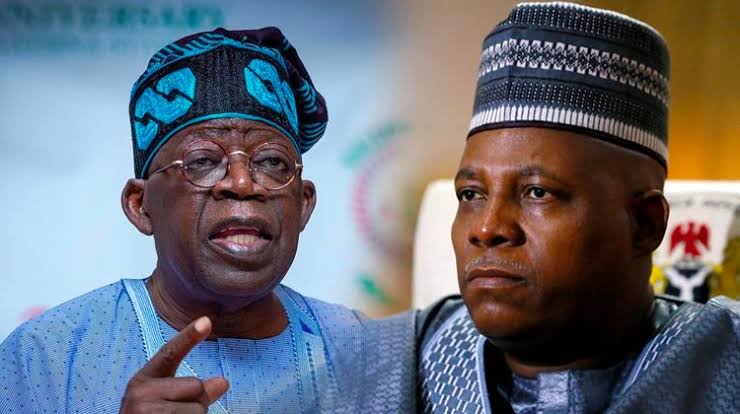
Tinubu and Shettima.
The pertinent question is whether Tinubu will retain or dump Shettima as his running mate in 2027.
Tinubu faces a delicate choice in what to do with VP Shettima. Going by his body language, he is obviously not enamoured with the VP and may not retain him as his running mate in the next general elections.
But some analysts say that dropping the VP off the ticket presents a very delicate and dangerous political manoeuvre. “Having navigated the difficult challenges of the 2023 presidential race with Shettima and won, removing Shettima now would amount to a tactical political miscalculation,” a political analyst said.
Dare Glinstone Akiniyi, spokesperson of the opposition PDP National Youth Group, reportedly said President Tinubu could replace Shettima in a bid to garner support from northern Christians and the north-central region ahead of the 2027 polls.
He, however, said that such a move could lead to a fresh crisis even within the ruling APC. According to him, Shettima’s substitution would reflect desperation and political miscalculation amid the north-central’s demand for inclusivity in the current government and nation’s leadership.
“He said, “President Tinubu is likely to substitute VP Shettima ahead of 2027. He needs to capture northern Christians and the north-central. Unfortunately this will cause another trouble for the APC.
“I will advise him to stick to his current choice, so as to have a moderate defeat tin 2027, as against a new running mate and loosing woefully.”
Another question arises as to who would likely replace Shettima that will give Tinubu the political traction with northern voters? Ribadu is among the names that have been thrown into the equation in the event that Tinubu keeps the Muslim-Muslim ticket. Others include a former governor of Kano State and National Chairman of the APC, Abdullahi Ganduje and a former Kano State Governor and chieftain of the NNPP, Musa Kwankwaso.
Some analysts posit that anybody Tinubu chooses to replace Shettima now will be a hard sell to northern voters because the mere fact of replacing Shettima with another figure will reinforce the feeling that Tinubu cannot be trusted to respect political agreements. This could even rupture the ruling APC.
Christian/Muslim ticket?
There are also talks that President Tinubu may change tack and go for a Muslim/Christian ticket. Names like former Speaker Yakubu Dogara, former Secretary to the Government of the Federation (SGF), Boss Mustapha, or a senator, Simon Lalong have been touted as options on the cards.
However, an analyst said If Tinubu is not sure of huge northern Christian votes to tip the scales in his favour he had better think twice about this option as, according to the source, “This is political suicide to say the least.”
Amid Shettima’s political fate hanging in the balance ahead of the 2027 election is Tinubu’s dilemma in making a decision that will either make or mar his next presidential ambition. Will he retain the same faith ticket or bow to pressure from Christians in the North Central who are demanding for change? The pertinent question remains: Will Tinubu dump Shettima in 2027? Only the vicissitude of time can tell.
NIGERIA has set the stage for direct flights with the signing of a Bilateral Air Services Agreement (BASA) with Trinidad and Tobago, according to the Minister of Aviation and Aerospace Development, Festus Keyamo.
By signing this agreement and with direct flights in the works, the deal potentially reduces travel time and costs between West Africa and the Caribbean.
The signing puts to rest a deal that had been in the process for over 20 years, making Nigeria the first African nation to enter into such an aviation partnership with a Caribbean country.
In a statement via his official social media account on Tuesday, April 15, the signing ceremony, which took place in Trinidad and Tobago, saw Keyamo sign the agreement on behalf of the Federal Government of Nigeria.
While revealing that negotiations for the deal began more than two decades ago but had remained stalled until now, Keyamo described the finalisation of the BASA as a major milestone in Nigeria’s effort to open up the trans-Atlantic route and expand its air connectivity to South America and the Caribbean.
“In our continued effort to open up the South American and Caribbean routes to Nigeria, earlier today. I signed the Bilateral Air Services Agreement (BASA) between Nigeria and Trinidad and Tobago that has been in limbo for more than two decades when negotiations began,” Keyamo stated.
The minister also underscored the broader significance of the agreement, calling it a strategic step toward strengthening economic and social cooperation among Global South nations in response to shifting global dynamics.
In February 2025, Nigeria and the United Arab Emirates (UAE) amended their Bilateral Air Services Agreement (BASA) to enhance code-share arrangements, allowing airlines to share flights and sell tickets on each other’s networks while boosting interlining opportunities and strengthening bilateral aviation ties.
In March 2025, Nigeria and Canada finalised a Code-sharing Agreement under a new Bilateral Air Services Agreement (BASA), aimed at improving air connectivity and offering greater convenience for passengers traveling between the two countries.
Nigeria and Brazil have also advanced discussions to activate their Bilateral Air Services Agreement (BASA), which will establish direct flights between the two countries. This follows a commitment made in February 2024 by Presidents Tinubu and Lula da Silva in Addis Ababa to strengthen air connectivity between Nigeria and Brazil.
The ICIR reports that Nigeria is determined to expand the bilateral trade deals between Nigeria and Trinidad and Tobago and other Caribbean countries.
Currently, Nigeria’s trade volume with the Caribbean is relatively small compared to its overall trade activity, though there’s potential for growth.
In 2023, Nigeria exported $256.51 million worth of goods to Jamaica alone, according to Trading Economics. Merchandise imports from low- and middle-income economies in Latin America and the Caribbean represented 1.1668 per cent of Nigeria’s total merchandise imports in 2020.
Nigeria’s exports to the Caribbean region are primarily focused on mineral fuels, oils, and distillation products.
THE Federal Government has gazetted and transmitted the Economic Community of West African States (ECOWAS) schedule of tariff offers for Trade in Goods under the African Continental Free Trade Area (AfCFTA).
The Minister of Industry, Trade and Investment, Jumoke Oduwole, made this known in a statement on Tuesday, April 15.
The gazetting of the ECOWAS tariff came ahead of the 16th meeting of the AfCFTA Council of Ministers (COM) responsible for trade, held in Kinshasa, DRC, on Tuesday.
Oduwole noted that the agreement establishes zero duties on 90 per cent of tariff lines for trade in goods, enhancing Nigeria’s market competitiveness and expanding trade opportunities across Africa.
“Nigerian goods are now competitively positioned in the African market, ensuring greater business access and profitability.
President Bola Tinubu signed the ‘ECOWAS Schedule of Tariff Offers’, which reinforces Nigeria’s commitment to regional trade expansion.
This move under the AfCFTA framework will strengthen Nigeria’s role in shaping the future of intra-African trade and boosting export
competitiveness.
It will further enable the seamless shipment of goods to and from Nigeria, unlocking new opportunities for businesses, manufacturers, and exporters, the minister pointed out.
“Implications of Nigeria’s ECOWAS Tariff offer the gazetting of the schedule of tariff concessions is expected to yield significant benefits,” she stressed.
Oduwole highlighted the benefits to include boosting economic growth and job creation by reducing trade barriers, strengthening regional integration and trade relations through enhanced economic ties
Other include supporting Nigerian Small and Medium Enterprises (SMEs) by lowering costs and encouraging market expansion.
She said Nigeria’s commitment to AfCFTA implementation makes it an attractive destination for foreign and intra-African investment, reinforcing the country’s role as a trade hub in West Africa.
She stated, however, that stronger engagement was required from African trade ministers to address seemingly barriers, including non-tariff barriers that could hinder market access.
“Additionally, improving productive capacity and ensuring compliance with international standards remain imperative to maximise the benefits of the AfCFTA.
“Nigeria is open for business. The gazetting and transmission of the ECOWAS schedule of tariffs to the AfCFTA Secretariat signals Nigeria’s readiness for trade under the agreement,” Oduwole said.
She believes this milestone will enable Nigerian exporters to leverage preferential tariff access across African markets, positioning Nigeria as a key player in regional and global trade.
It will also underscore the country’s dedication to leveraging Africa’s single market for economic transformation.
“After initiating its first shipment under AfCFTA in July 2024, Nigeria has solidified its leadership in regional trade and integration with the formal gazetting of the schedule of tariffs for trade in goods.
”This is to ensure that Nigerian goods can access other markets competitively and profitably. As a result, other AfCFTA State Parties can now accept consignments from Nigeria under the Agreement,” she said.
The minister noted also that under its preferred classification, Nigeria’s tariff reductions for trade in goods follow a phased approach over 10 years beginning in 2021.
By 2025, the fifth year of AfCFTA implementation, a 50 per cent tariff reduction on NGN, implemented at a rate of 10 per cent per year, should immediately affect goods in trade with least developed countries in Africa.
“For trade with developing countries on the continent, Nigeria retains the flexibility of complete tariff elimination (0 per cent) effectively immediately under AfCFTA, applying a 20 per cent
reduction annually.
The ICIR reports that the gazetting follows the AfCFTA digital trade mandate announced in February in Addis Ababa.
There have been concerns about the full implementation of the AfCFTA, which started on January 1, 2021, particularly on trade facilitation.
Stakeholders have gathered for the Afreximbank Annual Meetings (AAM2023) in June 2023, calling for more intra-African trade synergy.
Against the backdrop of this call, the national president of the Association of Micro Entrepreneurs of Nigeria (AMEN), Saviour Iche, toldThe ICIR then that “the AfCFTA has not worked.”
Iche, who produces cosmetics, had lamented on trade restrictions in taking products from Nigeria to Togo, Ghana and other neighbouring countries, stressing that it was easier for manufacturers to carry goods to China than to neighbouring African countries.
A FORMER governor of Plateau State, Jonah Jang, has stated that the recent crisis that has engulfed the state is beyond an ordinary communal clash. He described the attacks that have claimed over 100 lives in a week as a ploy orchestrated by a known group with a secret agenda.
Jang, who once represented Plateau North in the senate, issued a statement on Tuesday, April 15, saying the killings have caused pain and suffering for the people of the state and calling for immediate action to put an end to the violence.
Jang expressed disapproval over a directive from President Bola Tinubu that the state governor, Caleb Mutfwang, should solve the communal part of the crisis, saying the violence shouldn’t be oversimplified as a “communal issue”. He said he believed this misunderstanding stemmed from incorrect information provided to Tinubu.
“The attacks in Plateau State are not merely communal disputes; they are perpetrated by a known group with a specific agenda,” he stated.
He expressed his condolences to the people of Plateau State and called on President Tinubu to call for an expanded meeting with community leaders to fully understand the sincerity and intricacy of the security situation in the North-Central state.
He praised the state governor, Mutfwang, for his continued efforts to address the crisis.
Meanwhile, in response to the attacks on Zikke and Kimakpa communities in the Bassa Local Government Area (LGA) of Plateau State, Governor Mutfwang has acted by convening an expanded state security council meeting on Monday, April 14, to address the insecurity in the area.
Mutfwang held the security meeting at the Government House in Jos to discuss the recent attacks in Bassa and Bokkos LGAs, where gunmen invaded communities, killing innocent residents.
The meeting is aimed at finding lasting solution to the crisis and prevent further bloodshed across Plateau State.
This development comes as part of ongoing efforts byMutfwang’s administration to address the recurring violence, particularly in areas like Barkin Ladi, Bassa, Bokkos, Mangu, and Riyom, which have experienced heightened tensions between herders and farmers.
The ICIR reported that forty persons were killed in another attack on the Zike community, Kimakpa, in the Kwali district of the Bassa Local Government Area of Plateau State.
According to Channels TV, in the early morning of Monday, April 14, gunmen attacked the community and started shooting at residents.
Media reports said vigilantes responded to the attack and repelled the assailants, but not before 36 people were killed, with 4 more dying later.
Plateau State in Nigeria is experiencing recurring violent attacks, with a recent incident following the killing of 52 people in the Bokkos Local Government Area. The ongoing violence has resulted in significant loss of life, destruction of property, and erosion of trust in governance, demanding urgent national attention.
CONTROVERSIAL singer, Badmus Okikiola, popularly called Portable has been freed as Fuji Star, Okunola Saheed, called Osupa dropped his defamation case against him.
According to Punch, Osupa’s lawyer, Ahmed Opalekunde, confirmed the withdrawal of the case on Tuesday, April 15.
He added that the filing for withdrawal of the case was done at the Upper Area Court 1, High Court, Ilorin, Kwara state.
Osupa withdrew the case against Portable but warned him to refrain from making further disparaging comments or publications about him.
Osupa through his lawyer also urged the court to warn the defendant to desist from any further publications, utterances and any other acts aiming at disparaging his person and businesses.
The ICIR reported that Kwara State police on Sunday, April 13, arrested singerPortable, over allegations of criminal defamation, threat to life, and incitement against Osupa.
The controversial musician was also accused of character assassination by the police.
The spokesperson of the Kwara Command Adetoun Ejire-Adeyemi, in a statement released on Sunday, April 14, said the command acted by the law after receiving credible evidence to support the petition.
According to the police, the petition borders on serious allegations, which include criminal defamation, threat to life, incitement, character assassination, conduct likely to cause a breach of peace, and the use of abusive and insulting words.
The police said Portable was arrested in Abeokuta, Ogun State, on Saturday, April 13, 2025, around 7:25 pm, by Kwara State Police officers who had obtained an arrest warrant from a Magistrate Court in Ilorin.
Portable was later remanded at the Oke Kura Correctional Centre in Ilorin, the Kwara State, for failing to meet bail conditions set by an Upper Area Court.
The singer was arraigned on Monday, April 14, before the Area Court sitting in Ilorin over allegations of defamation character levelled against him by a Fuji musician Akorede Saheed, also known as Saheed Osupa.
The court granted him bail of N1 million among other conditions, shortly after the charges were read, but the singer was unable to meet the bail requirements as of the time of filing this report, according to media reports.
The singer was also asked to provide two sureties in like sum. The sureties must be either the Chairman or Secretary of the Performing Musicians Association of Nigeria (PMAN) and the other must be a resident property owner in a Government Reserved Area (GRA) in Ilorin, with a valid Certificate of Occupancy as proof.
The ICIR reported that Portable surrendered to the Lagos State Police Command in February 2025 after he was declared wanted by the Ogun State Police Command.
His then arrest followed an incident on February 5, 2025, in which he was accused of leading a violent attack on government officials from the Ogun State Ministry of Physical Planning and Urban Development during an enforcement exercise in Ota.
NIGERIA headline inflation has increased to 24.23 per cent in March 2025 after dropping for the last two consecutive months.
The National Bureau of Statistics (NBS) reportedly revealed in its latest consumer price index data on Tuesday, April 14.
This shows that headline inflation inched up in March from 23.18 per cent in February, reflecting mounting pressure on household incomes and the cost of living.
The reversal in the inflation figure came after the sharp decline witnessed in January and a subsequent slight drop in February, resulting from the rebasing of the country’s economy.
In January, the statistics office went into a rebasing exercise in which the items in its reference basket were reweighted and updated in its comparison period from 2009 to 2024.
This exercise saw the annual inflation rate fall from 34.80 per cent in December 2024 to 24.48 in January this year.
In February, headline inflation eased to 23.18 per cent from 24.48 per cent in January, The ICIRreported.
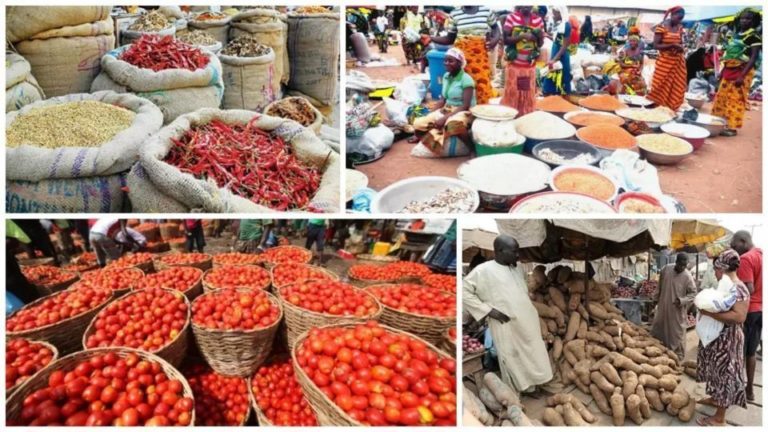
Prices of food and non-alcoholic beverages were the biggest contributor to the latest annual inflation figure.
Nigeria’s inflation had soared to a repeated 28-year high last year, spurred by President Bola Tinubu’s reforms on subsidy removal and unification of the exchange rate windows after assuming office on May 29, 2023.
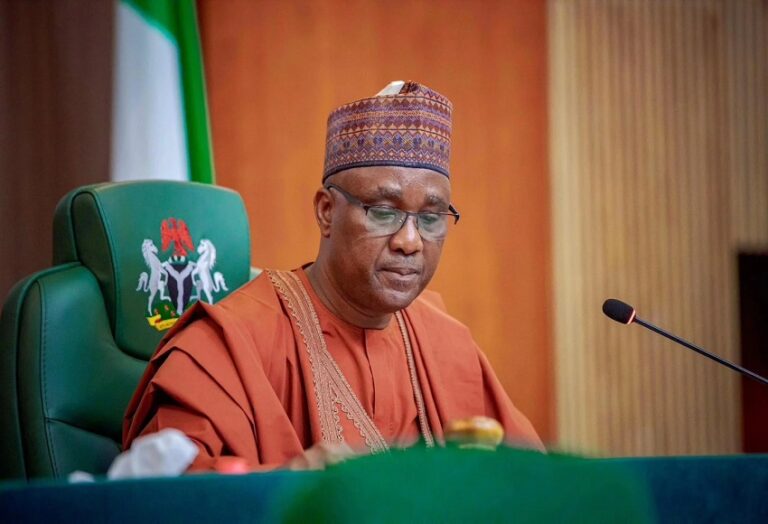
AMID the political crisis that led to the suspension of Governor Siminalayi Fubara, his deputy, and the entire Rivers State House of Assembly, the Speaker of the House of Representatives, Tajudeen Abbas, has inaugurated an ad-hoc committee to take over legislative functions in the State.
The inauguration, held at the National Assembly Complex in Abuja on Tuesday, April 15, followed President Bola Tinubu’s March 18 proclamation of a state of emergency in Rivers State.
Tinubu, in his nationwide broadcast, invoked Section 305 of the 1999 Constitution (as amended) to justify the move and appointed Ibok-Ete Ekwe Ibas, a retired vice admiral, as the state’s sole administrator.
Tinubu cited prolonged political instability in the state as the reason for his decision, vowing to restore governance, peace, and security to the oil-rich state.
The president also appointed retired Vice-Admiral Ibok-Ete Ekwe Ibas as the sole administrator to oversee the affairs of the state.
To fill the legislative vacuum, the Speaker constituted the emergency 21-man panel with representatives drawn from Nigeria’s six geopolitical zones.
Addressing the panel on Tuesday, Abbas urged members to put aside partisan interests and focus on ensuring peace, governance, and stability in Rivers State.
“Your task is to oversee Rivers State following Mr President’s emergency proclamation.You must not be partisan or biased,” Abbas said.
The committee is chaired by the House Leader, Professor Julius Ihonvbere, with Ali Isah (PDP, Gombe) serving as deputy chairman.
Other members include Idris Wase, Aliyu Muktar, Sada Soli, Iduma Igariwey, Shehu Rijau, Wole Oke, Akara Hi Amadi, Patrick Umoh, Isa Anka and James Faleke.
The ICIR reports that this development followed the House of Representatives’ and the Senate resolution endorsing Tinubu’s emergency declaration.
During a plenary on March 20, lawmakers gave their backing via a voice vote after the president formally informed the National Assembly of his decision.
The lawmakers further agreed to authorise the formation of an ad hoc committee, with members from both chambers of the National Assembly, to oversee the situation in the state.
They also tasked Tinubu to review or terminate the state of emergency at any time, but no later than six months from now.