Home Blog Page 621

UniJos students protest poor hostel, health facilities

0

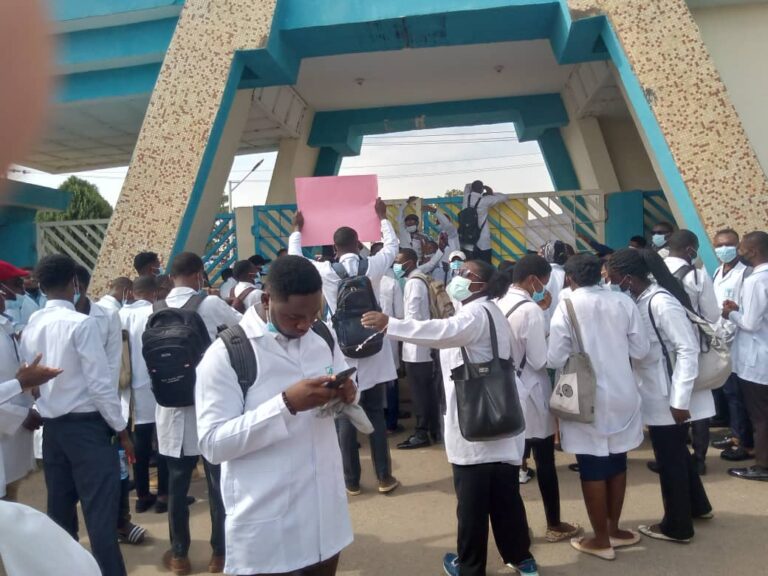
MANY students of the University of Jos (UniJos) took to the university’s main campus on Monday, April 15, to protest what they described as poor health and hostel facilities and understaffing at their school clinic.

As seen in videos shared with The ICIR, the students climbed the school gate that was shut down against some of the school staff, chanting protest songs and calling on the school management to meet their demands.

They protested the lack of drugs, proper medical equipment, poor toilets and leakage of their hostels despite the astronomical’ increase in their school.


Read Also:


The students also carried placards with different inscriptions, including “insufficient medical facilities in the school clinics, and yet school fees were increased.”

Sources who spoke to The ICIR said the protest was the second in two weeks, adding that Monday’s agitation was prompted by the deaths of two students who died in the school facilities, with one shortly after being taken to the Jos Teaching Hospital.

They said although the university management argued that the deaths were not a result of medical negligence and poor health facilities, they would not agree with such a claim.

“The school management rendered poor services to us, which has left our hostel accommodations in bad shape.

For example, the Abuja hostel, which formed largely part of today’s protest, is leaking from the roof, has blocked and broken soakaway, and sewage is floating around the hostel, polluting the environment.

“We do not have adequate water and light in the hostel. Our school clinic is poorly equipped. This was why management opted to increase our school charges from 45,000 naira to one between N105,000 and N1 135,000.

There have been protests in the institution in the past over poor infrastructure and hike in school tuition fees.

In September 2023, the students blocked roads leading to the campus in protest following increased school fees and other services rendered by the institution.

Led by the students’ union leaders, the students called for an urgent reversal of the hike in school fees and other university services.

According to reports, the school fees and other charges were hiked from N40,000 to N160,000 per academic session, with some expected to pay more based on department and level.

Meanwhile, efforts by The ICIR to get the Dean of the university’s Students’ Affairs, Chris. Piwuna, a professor, to speak on the allegations against the school proved abortive. His known phone number was unreachable, and he did not reply to a text message sent to the line.
 

Oromoni’s death caused by medical, parental negligence – Coroner

0

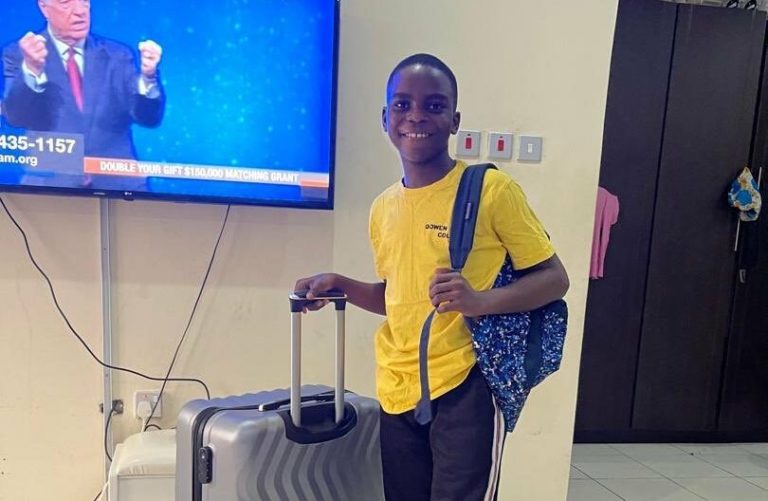
THE Coroner Inquest sitting in Ogba Magistrate Court, Lagos State, to examine the death of a 12-year-old student of Dowen College, Lekki area of the state, Sylvester Oromoni, has absolved the five students of the school implicated in the incident. 

The inquiry, while determining that the students played no role in Oromoni’s demise and should not have been implicated in the case, attributed his death to his parents and doctor’s negligence.

The Coroner Magistrate, Mikhail Kadiri, in a judgment, stated that Oromoni’s death was avoidable and was a result of failed treatment for his enlarged liver.

Kadiri further urged for enhanced collaboration between the police and medical professionals, emphasising the importance of police discretion before making arrests in subsequent cases.

In his judgement, the Coroner also recommended that the management of Dowen College should ensure thorough documentation of students’ entry and exit from the hostel, along with conducting comprehensive psychological evaluations for the five students accused of bullying the deceased.

The latest development came about 15 months after the Lagos State government cleared the five students and staff of Dowen College linked to the death of Oromoni.

The clearance was contained in legal advice of the Director of Public Prosecution, Adetutu Oshinusi addressed to the Deputy Commissioner of Police in charge of the State Criminal Investigation Department and the trial magistrate, Olatunbosun Adeola.

According to the advice, the interim and final autopsy reports issued by the Lagos State University Teaching Hospital and the toxicology report of post-samples and that of the Central Hospital, Warri, were in agreement as to the cause of death, namely septicaemia, lobar pneumonia with acute pyelonephritis, pyomyositis of the right ankle and acute bacteria pneumonia due to severe sepsis.

The toxicology result is also not indicative of any toxic or poisonous substance in the deceased’s body, it added.


Read Also:


The DPP’s legal advice concluded that based on these findings, there was ‘no prima facie case of murder, involuntary manslaughter and or malicious administering of poison with intent to harm against the five students.’

The students cleared by the state government are: Favour Benjamin (16), Edward Begue (16), Ansel Temile (14) and Kenneth Inyang (15) and 15-year-old Micheal Kashamu, the son of the late Senator Buruji Kashamu.

The government cleared the following school officials through the director of public prosecution: Adesanya Olusesan Olusegun, Hammed Ayomo Bariyu, Celina Uduak, Valentine Igboekweze, and Adeyemi.

Oromoni’s death

On November 30, 2021,  Sylvester died following an alleged attack by ‘some of his senior colleagues’ for refusing to join a cult group. 

Oromoni allegedly mentioned five senior students of Dowen College as responsible for the injuries he sustained when he was attacked at the college. 

He was also reported to have sustained internal injuries that led to his death on November 30, 2021.

The death of Oromoni sparked various reactions from celebrities, civil society organisations and Nigerians alike.


READ ALSO:


Oromoni’s family alleged he was bullied and beaten by fellow students, and the injuries sustained from the beating led to his death.

The Lagos State Government had ordered Dowen College’s indefinite closure pending the outcome of an investigation into the case.

However, the school has denied all allegations, stating that Oromoni was neither bullied nor beaten but only complained of hip pain after playing football.

Kano State APC reacts as ward leaders suspend national chairman, Ganduje

THE National Chairman of the All Progressives Congress (APC), Abdullahi Umar Ganduje, has been suspended by the party leaders in his ward at the Dawakin Tofa Local Government Area of the state.

The party’s legal adviser at the ward, Halliru Gwanzo, made this known while addressing journalists in the state on Monday, April 14.

Gwanzo cited the state government’s allegations of bribery against Ganduje as the grounds for his suspension.


Read Also:


“We decided to suspend Dr. Ganduje from the party due to the seriousness of the allegations against him,” Gwanzo said.

The ICIR reports that Ganduje, the immediate past governor of the state, is set to face charges in court on Wednesday, April 17, regarding allegations of bribery, diversion, and misappropriation of funds, which include diversion of funds, criminal conspiracy, misappropriation, and criminal breach of trust.

State APC suspends Ganduje’s ward committee leaders

In a swift response, the state APC Working Committee has taken drastic actions against party leaders who suspended Ganduje.

On Monday, the APC Dawakin Tofa Local Government Chairman, Inusa Dawanau, told reporters that those responsible for suspending the national chairman engaged in anti-party activities.

He claimed there was evidence of their meetings with the opposition party in the state.

Dawanau announced a six-month suspension on the ward leaders, adding that a special investigations panel had been constituted to probe allegations against them.

Reacting to the development, the Kano APC Chairman, Abdullahi Abbas, said the state APC adopted the party’s Local Government’s decisions.

“We have evidence of meetings between the state government officials and those that suspended the National Chairman. The state working committee has agreed to sanction them for six months and they stand now suspended,” he stated.

State allegations against Ganduje

The State Government had dragged Ganduje, his wife, Hafsat Umar, and five others to court over eight corruption charges, amounting to billions of naira during his eight years in government.

The charges were contained in a charge sheet dated 3rd April, which also attached a list of 15 prosecution witnesses.

According to the lawsuit, the other respondents are Abubakar Bawuro, Umar Abdullahi Umar, Jibrilla Muhammad, Lamash Properties Ltd, Safari Textiles Ltd, and Lesage General Enterprises.

The lead charge reads, “That you, Abdullahi Umar Ganduje, sometime between the period of January 10th, 2016 or thereabout at Kano, in the Kano Judicial Division, while serving as the Governor of Kano State and being a public servant in the government of Kano State corruptly asked for and received the sum of $ 200,000, being benefit for yourself from one of the beneficiaries of contracts awarded by the Kano State Government on your instruction and approval as part of your function as the Governor of Kano State thereby committed the offence of official corruption contrary to and punishable under Section 22 of The Kano State Public Complaints and Anti-corruption Commission Law 2008 (as amended), Law N02 of 2009, Laws of Kano State of Nigeria.”

Other charges bordered on diversion of funds, criminal conspiracy, and loss of government’s properties, among others.

Police parade 21 Yoruba nation agitators over Oyo secretariat invasion

0

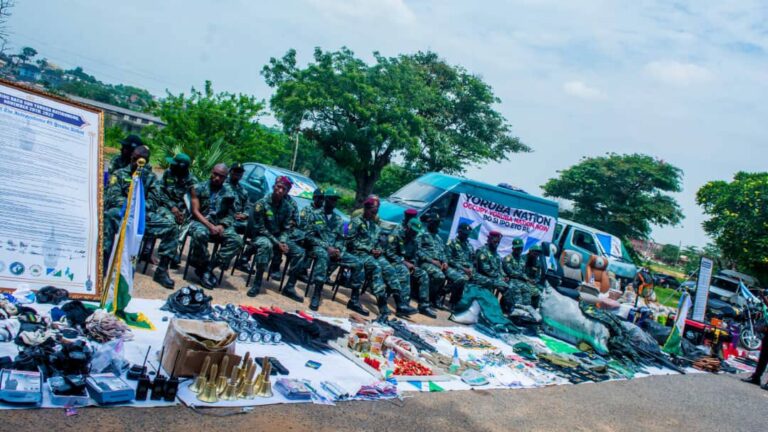
THE Oyo State Police Command has paraded 21 suspects in connection with the invasion of the Oyo Government Secretariat on Saturday, April 13.

The state commissioner of Police, Adebola Hamzat, told journalists on Monday, April 15, that the suspects would be charged with treasonable felony and terrorism.


Read Also:

According to the commissioner, the command received information on Saturday that some people dressed in military camouflage, armed with pump-action semi-automatic rifles, and riding on motorcycles were sighted moving into the main city from the Olomi axis of Ibadan, the state capital.

Hamzat said the ‘hoodlums’, later identified as members of the Yoruba Nation Agitation Group, were trailed to the State Secretariat.

They spread from the Flyover to within the premises of the Governor’s Office and hoisted their flag at the House of Assembly, proclaiming the creation of a “Democratic Republic of the Yoruba.

“With Police re-inforcement, the miscreants were warned to dispatch. The agitators turned violent and opened fire on the Police, and a detachment of Amotekun corps.

“The Police responded and were joined by Operation Burst Patrol teams and Personnel of other security agencies, who suppressed the treason and dealt with the agitators in accordance with Standard Operating Procedures (SOP).

“A Total of 21 suspects were arrested, seven rifles made up of five English Pump Action semi-automatic rifles, two wooden double-barreled guns and other items of exhibits as displayed were recovered,” Hamzat stated.

While declaring the act criminal, unpatriotic, and a clear case of treasonable felony and terrorism, the commissioner reassured the people of the state that the Police remained unwavering in their commitment to protecting lives and property.

He added that the continued existence of Nigeria as a sovereign, indivisible entity must be sustained.

He also assured the state residents that the command’s security architecture had been reviewed to enable it to address present-day realities.

The suspects were paraded alongside seized exhibits such as guns, ammunition, plaques with the Yoruba nation insignia, cutlasses, walkie-talkies, and other communication gadgets.

ICIR announces fellows for Open Contract Reporting Project

0

THE International Centre for Investigative Reporting (ICIR) has announced successful fellows for its Open Contract Reporting Project (OCRP). 

The OCRP which is in its 7th year is funded by the John D. and Catherine T. MacArthur Foundation under its “On-Nigeria Anti-corruption Programme.” 

The OCPR is the Centre’s accountability reporting project, seeking to promote fiscal transparency and accountability in Nigeria’s budget and procurement processes.


Read Also:

Announcing the list of the successful fellows on Monday, April 15, The Programmes Officer of The ICIR, Alfred Akerele, said that in the last seven years, the Centre had worked to build the capacity of journalists to effectively investigate and report on budget and procurement issues, thus strengthening open contracting processes and engendering effective service delivery for the welfare of citizens, particularly at the subregional level. 

He added that the OCRP had trained over 250 journalists across different newsrooms in Nigeria and produced over 300 investigative reports holding power to account across sectors. 

“In this seventh and final year of the OCRP, the project will build capacity and provide mentoring and financial support for 20 selected journalists to work with The ICIR to undertake investigative and data-driven reports on budget and procurement issues,” Akerele stated. 

The ICIR is an independent, non–profit media organisation that aims to promote good governance in Nigeria through robust investigative, data-driven reporting. 

The organisation aim to build a culture of watchdog reporting for the media in Nigeria. 

“We achieve this by building the investigative/data journalism capacity for journalists in newsrooms nationwide. For this project, 20 journalists were selected from different states in Nigeria in all six geopolitical zones across print, electronic and digital media,” Akerele added.

The list of the 20 successful candidates and their respective organisations is below: 

  1. Simon, Ekemini Enobong – TheMail, Akwa Ibom 
  2. Abdulrasheed Hammad – Freelance journalist, Sokoto 
  3. Abdulmalik Lukman – Stallion Times, Kano 
  4. Chijioke Arinze – Ripples Nigeria, Enugu 
  5. Adeyemi Adekunle – Lens Africa TV, Abuja
  6. Idris Kamal Ibrahim – WikkiTimes, Bauchi
  7. Adam Zainab Yetunde – Freelance journalist, Borno 
  8. Fatola Taiwo – Osun Defender, Osun 
  9. Bello Bahara Hafsat- Premier Radio, Kano 
  10. Archibong Jeremiah – TheInvestigator Cross River 
  11. Oyedeji Olanrewaju – WikkiTimes Abuja 
  12. Isma’il A’isha Ahmad – Premier Radio, Kano
  13. Bawas Khadija Ishaq – KAMED TV, Jigawa 
  14. Lawal Sofiyyat Bolanle – Pen Press, Osun 
  15. Ibunge Blessing Iruoma – THISDAY, Rivers 
  16. Abe Timothy Bankole – ICIR, Abuja 
  17. Medinat Kanabe – Voice of Naija Communications, Lagos 
  18. Elom Sunday – Sahara Reporters, Anambra 
  19. Muhammad M.Ali – Yerwa Express News, Borno 
  20. Oyedibu Enoch – PIJAlance Magazine, Oyo 

TCN confirms grid restoration after sixth collapse in 2024

THE Transmission Company of Nigeria (TCN) has confirmed the restoration of the national grid after a record sixth collapse in 2024.

TCN clarified that the collapse was caused by a fire at the Afam Power Generating Station, which partially disturbed the national grid.

“At 02:41 hrs today, 15th April 2024, a fire erupted at the Afam V 330kV bus bar coupler, leading to the tripping of units at Afam III and Afam VI. This resulted in a sudden generation loss of 25MW and 305MW, respectively, destabilizing the grid and causing a partial collapse,” said the company’s general manager of Public Affairs, Ndidi Mbah.


Read Also:


Mba explained that the Ibom Power Plant was isolated from the grid and was supplying parts of the Port Harcourt region.

She added that the isolation of the Ibom Power Plant further minimized the effect of the system disturbance.

The TCN also confirmed that the affected section of the grid had been fully restored and stabilised.

Meanwhile, Nigeria’s incessant grid collapse appears to have no end in sight. Most Nigerian homes and offices were thrown into darkness, with the latest collapse on Monday, April 15, at around 3 a.m.

The national grid has witnessed its sixth collapse in 2024.

Nigeria generates an average of 4,000MW of electricity for an estimated 200 million citizens nationwide.

But this is hardly sustainable, as the grid continues to record incessant collapse due to gas supply constraints, transmission infrastructure vandalism, and liquidity crisis, among others.

Data from the Independent System Operator, an arm of the Transmission Company of Nigeria, showed that only one electricity generation company, Ibom Power, was active at the time of the grid collapse on Monday.

Power generation on the grid crashed further to 44.5MW around 4 a.m. before crawling to 132.29MW an hour later.


Insecurity: Niger governor declares state of emergency

0

NIGER State Governor Umaru Bago has declared a state of emergency on insecurity in Minna, the state capital.

The governor’s order follows the return of thugs’ operations on Friday night in the capital, which resulted in two deaths and multiple injuries.

The governor also ordered security officers to shoot criminals on sight.


Read Also:

Bago stated this while speaking at a Sallah Durba festival organised by Babangida Aliyu, the state’s former governor, on his farm in Minna.

” We have zero tolerance for insecurity and thuggery. We have also closed the sites of those artisan miners causing this menace within the state. Anybody found there will be shot to death. Those sponsoring them will also be dealt with decisively,” the governor stated.

Due to insecurity, the Minna Emirate suspended the yearly traditional Sallah Durba for the past few years.

Consequently, the Durban lovers have since relied on Aliyu’s independently organised events.

However, violent incidents returned on Friday in Minna, which is known to be the home of violent gangs like Yandaba. 

Speaking on the incident, Aliyu said insecurity was prevalent in some parts of the state. 

He said he was happy that the governor declared the emergency.

Niger is one of the states facing insecurity challenges in Nigeria. In 2022, The ICIR reported how parents withdrew their children from schools in the state and its neighbour, Kaduna, when the crisis peaked in the states.

The challenge, which escalated during the administration of former President Muhammadu Buhari, has persisted under the incumbent President Bola Tinubu.

The ICIR reported that over 5,000 Nigerians were killed in Tinubu’s first seven months in office, underscoring the threat posed by the nation’s insecurity.

According to data gathered by The ICIR from the Armed Conflict Location & Event Data Project (ACLED), about 5,135 people were killed between May 29 and December 31, 2023.

Borno, Zamfara, Plateau, Niger and Kaduna were mostly affected, while Ekiti, Jigawa, and Gombe states were the most peaceful place to live in, according to ACLED.


At 33.2% under Tinubu, Nigeria inflation hits highest rate since 1996

For the tenth consecutive time since President Bola Tinubu assumed office in May 2023, Nigeria’s headline inflation rose to 33.2 per cent in March 2024. 

Additional findings showed that the inflation rate is the highest the nation has recorded since March 1996. 

Tinubu, upon his assumption into office, met the inflation rate at 22.41 per cent. The new figures show that the president’s policies have increased the rate by 10.79 per cent within his first ten months in office. 


Read Also:


The last time Nigeria’s inflation rate dropped was December 2022, when the figure fell from 21.47 per cent in November to 21.34 per cent in December 2022. However, since December 2022, the country’s inflation rate has spiked. 

According to the National Bureau of Statistics, the March inflation rate increased by 1.50 per cent when compared to 31.70 per cent reported by the bureau in the preceding month, February 2024. 

The NBS data showed that the rising inflation rate was majorly driven by food and non-alcoholic beverages, the cost of housing, water, electricity, gas and other fuel, as well as the prices of clothes and transportation. 

The increase is coming despite several palliative measures and interventions by the president to alleviate the prices of goods and transport after the removal of the fuel subsidy in May 2023. 

NBS said that the urban inflation rate was 35.18 per cent, which was 12.11 per cent points higher compared to the 23.07 per cent recorded in March 2023. Also, the rural inflation rate in March 2024 was 31.45 per cent on a year-on-year basis; this was 10.37 per cent higher compared to the 21.09 per cent recorded in March 2023. 

Meanwhile, the food inflation rate for the month under review in March 2024 was 40.01 per cent. This was driven by increases in prices of the following items garri, millet, akpu uncooked fermented (which are under the bread and cereals class), yam tuber, water yam (under the potatoes, yam, and other tubers class), dried fish sardine, mudfish dried (under fish class), palm oil, vegetable oil (under oil and fat), beef feet, beef head, liver (under meat class), coconut, watermelon (under fruit class), Lipton tea, bournvita, milo (under coffee, tea and cocoa class).

“The government is concentrating more on naira appreciation against the dollar. It’s not enough. Inflation is highly triggered by high energy prices and high costs of doing business. It is still a problem. Naira is appreciating against the dollar, and the cost of doing business and high interest rates are affecting commodity prices,” a development economist and consultant to The British Department of International Development (DFID) Celestine Okeke, told The ICIR.

Also, a Development Economist, Kalu Aja, speaking on the development, said the high costs of doing business were affecting the rise in inflation despite the naira’s appreciation against the dollar.

“When we are celebrating the Naira appreciation, the cost of doing business in Nigeria’s still very high. You see why prices of goods are not coming down. There is epileptic power and you see people pay high costs to run their business. These are factors pushing up commodity prices and inflation,” Kalu said.

ILO opens media contest on voices against child labour

THE International Labour Organisation (ILO) is hosting the “Voices against child labour” media competition and calling on filmmakers, journalists, photographers, media professionals and students to contest.

Media professionals and students are to contribute their voices and skills to a crucial global cause, leveraging their influence to make a real difference in the fight against child labour.

It is opened to media professionals from Côte d’Ivoire, Mali, Nigeria, Ghana, Kenya, Uganda, Malawi and Egypt.

ONA opens entry for 2024 journalism awards

AFYMP seeks applications for media fellowships

NED seeks application for media projects’ grants

African Institute accepts applicants for 2024 writers fellowship

The themes for the competition include: ‘The realities of child labour in Africa’, ‘Online and offline technology innovations in eradicating child labour in Africa’ and ‘Gender perspectives in child labour in Africa’.

Submissions can be video, written media or photo stories and must focus on one or more of the child labour themes.

Winner will receive a grand prize of an all-expense paid trip to the ILO’s Knowledge Sharing Forum in Nairobi, Kenya in May while 10 best participants will be invited to a knowledge sharing and capacity development event in Kampala, Uganda in October.

To qualify, participants must be above 18 years. Also, all entries must be accompanied by the corresponding signed consent forms as attached.

Participants are recommended to undertake an online training by ITC-ILO on, “SELF-GUIDED COURSE ON REPORTING ON CHILD LABOUR FOR MEDIA”.

Applicants must be employed by either African or international media outlets focusing on African topics. Students must be enrolled in any African university, whether within their home country or abroad.

Deadline for submission is April 30. Interested persons can apply here.

No! Photo of Bobrisky inside detention centre is not recent

An image purportedly showing controversial cross-dresser Okuneye Idris, also known as Bobrisky, inside the custody of the Economic and Financial Crimes Commission (EFCC) has surfaced online. 

The image is circulating alongside a claim that his masculine features have begun to surface amid his travail in the custody of the anti-graft agency.

Bobrisky was arrested on April 3 and convicted by a Federal High Court sitting in Lagos on Friday, April 5, 2024, after pleading guilty to the charges of naira abuse levelled against him by the EFCC.


Read Also:


The EFCC filed a six-count against Bobrisky, with the first four counts related to Naira abuse and the last two counts concerning alleged money laundering.

However, the EFCC prosecutor later requested from the court to dismiss counts five and six.

Bobrisky pleaded guilty to the four-count charge of Naira abuse. He, however, asked to be pardoned.

The court, however, reserved sentence until April 9 but ordered that Bobrisky be remanded in custody of the EFCC pending the sentence.

However, the case could no longer proceed following the declaration of Tuesday, Wednesday and Thursday as public holidays by the Federal Government to mark Sallah.

An X user, @Irunnia posted the image purportedly showing Bobrisky in custody with a caption :

Bobrisky hairline and beard don dey show in prison. You can never cheat nature.”

The post has generated over 300 reposts and more than 1000 likes as of April 11, 2024.

Another X user, @drpenking posted the image with a caption :

“Nigeria prison is not where anyone should go to. Guess who is in the picture.” 

The post has generated over 100 reposts and more than. 600 likes as of April 11, 2024.


THE CLAIM

Photo shows the current state of Bobrisky inside EFCC custody.

Viral photo of Bobrisky inside detention centre

THE FINDINGS 

Findings by The FactCheckHub show that the claim is MISLEADING.

When subjected to Google Reverse image search, the result shows that the image has been online since 2017 when he was first arrested. An earlier version of the image can be seen here and here.

In November 2017, Bobrisky was arrested in Lekki, Lagos after a petition written against him by Toyin Lawani that he stole her customers.

The image was circulated online by bloggers after the incident.

THE VERDICT 

The claim that the image shows Bobrisky’s current state in the detention is MISLEADING. Findings show that the image has been online since 2017.

This report is republished from the Factcheckhub.