THE Minister of the Federal Capital Territory (FCT), Nyesom Wike, has approved the nullification of 485 land documents in the nation’s capital due to failed verification.
Consequently, the affected land titles have been removed from the regularisation database, after an extensive review conducted by the Department of Land Administration in collaboration with the Abuja Geographic Information Systems, according to a public notice issued by the FCT Administration.
The notice targets applicants who submitted area council land documents for validation. Part of it read, “This is to inform the general public, particularly applicants who submitted area council land documents for regularisation, that the Minister of the Federal Capital Territory has approved the nullification or cancellation of applications that failed the necessary official checks for genuineness and have been confirmed to be fake.”
The cancelled documents cover various area councils and layouts, including Ushafa Village Expansion Scheme, Ushafa Extension, and Dawaki Extension 1 in Bwari Area Council; Kurudu-Jikwoyi Relocation, Kurudu Commercial, Karu Village Extension, Nyanya Phase IV Extension, Jikwoyi Residential, Sabon Lugbe, and Lugbe I Extension in Abuja Municipal Area Council; and Kuchiyako One layout in Kuje Area Council.
Affected parties include the Redeemed Christian Church of God and Ministry of Justice Staff Multi-Purpose Cooperative Society.
The cancellation forms part of ongoing land administration reforms aimed at addressing issues like forged documents and irregular grants.
This follows a review showing only 8,287 of 261,914 Area Council land documents submitted between 2006 and 2023 were screened, with 96.8 per cent pending clearance, according to a Punch’s report.
The FCTA under Wike has been tough with people who have allegedly breached laws relating to land use in the nation’s capital.
THE ICIRreported that the FCTA recently released the names of 1,095 individuals and organisations whose properties’ titles were revoked over their failure to settle statutory land charges.
In a notice signed by the FCTA, the agency stated that enforcement actions would begin after the 14-day final grace period ended on November 25.
Most of the affected properties listed in the properties were mostly in highbrow neighborhoods such as Asokoro, Maitama, Garki, and Wuse area of the nation’s capital.
According to the administration, of the revoked titles, 835 properties defaulted on ground rent payments while 260 failed to pay violation and land use conversion fees.
Among those affected were former governor of Kano, Abdullahi Ganduje; former governor of Cross River, Donald Duke; wife of former President Goodluck Jonathan, Patience Jonathan; former Senate President, David Mark; and former deputy governor of Osun State, Iyiola Omisore.
The FCTA had urged the properties owners to settle outstanding charges to avoid enforcement of its threat to revoke their titles.
In May 2025, the administration announced the takeover of 4,794 properties in the heart of the city. The properties include the Peoples’ Democratic Party (PDP) National Secretariat, the Central Bank of Nigeria (CBN), and the Independent National Electoral Commission (INEC). The FCTA cited decades of unpaid ground rent, some stretching 10 to 43 years.
The Nigerian Government owns all land within the FCT, and land titles are processed through the FCT Minister’s office and formalised by AGIS.
THE killing of Nemesio Rubén Oseguera Cervantes, better known as “El Mencho” has unleashed a wave of coordinated violence across Mexico, plunging large swathe of the country into chaos and stoking fears of a brutal power struggle within one of the nation’s most feared criminal organisations.
El Mencho, 59, was the founder and leader of the Jalisco New Generation Cartel (CJNG), widely regarded as Mexico’s most powerful and militarised drug trafficking group. For more than a decade, he built a sprawling empire trafficking fentanyl, methamphetamine and cocaine into the United States, while orchestrating brazen attacks against Mexican security forces and government officials.
One of the world’s most wanted fugitives, with a $15 million bounty placed on his head by the Drug Enforcement Administration, El Mencho had repeatedly evaded capture. His defiance came to a violent end on Sunday during a high-stakes military operation in the town of Tapalpa.
According to officials. Mexican special forces, supported by intelligence from the United States, moved into a property in rural Jalisco State where El Mencho was believed to be hiding and cartel gunmen opened fire as troops approached, triggering a fierce shootout.
Authorities said four CJNG members were killed at the scene and El Mencho was seriously wounded. He died while being flown to Mexico City for medical treatment.
Officials added that security forces seized armoured vehicles, high-calibre rifles and rocket launchers during the raid.
President Claudia Sheinbaum praised the armed forces, declaring there was “absolute coordination” among federal and state authorities. “We work every day for peace, security, justice, and the wellbeing of Mexico,” she wrote on social media.
Al Jazeera reported that within hours after the news broke, suspected organised crime groups launched coordinated attacks across at least 20 of Mexico’s 32 states. In cities spanning Jalisco, Michoacán, Guerrero, Nuevo León and Tamaulipas, buses were torched, highways blocked with burning vehicles, and businesses forced to shut their doors.
Authorities in Jalisco, Michoacán and Guanajuato reported at least 14 additional deaths in the unrest, including seven members of the National Guard.
In Guadalajara, the capital of Jalisco and a host city for the upcoming 2026 World Cup, streets emptied as residents sheltered indoors. Schools were closed, public transport stalled, and much of the city appeared paralysed.
The United States Embassy in Mexico issued a security alert urging American citizens in several affected states to remain indoors.
With El Mencho gone, uncertainty looms over who will control the CJNG’s vast criminal enterprise. The cartel expanded aggressively under his leadership, moving into new territories and confronting rivals with extreme violence. Without a clear successor, regional commanders could splinter, igniting internal conflict.
Such fragmentation often results in spikes in extortion, kidnappings and forced recruitment as rival cells scramble for resources and dominance.
The timing is especially sensitive as Mexico prepares to co-host the 2026 FIFA World Cup, with Guadalajara among the selected venues. What appears to be a major triumph for the government could evolve into a prolonged security challenge.
The fall of a kingpin has removed one of Mexico’s most wanted men. But in a country long scarred by cartel violence, it may also have opened a volatile new chapter.
THE Solutions Journalism Network is seeking pitches from journalism trainers, editors, reporters, and journalism school educators interested in (or already) leading solutions journalism trainings for journalists.
This is an opportunity to develop solutions journalism training skills and to support solutions journalism projects with SJN’s accreditation and support.
During five online sessions* held over the course of two weeks, the group works together to come up with ideas and strategies for teaching solutions journalism: rigorous reporting on how people are responding to problems.
The programme kicks off with the official solutions journalism training, which leads to an exploration of how to teach what solutions journalism is, why it matters, and how to practice it (and teach it) in particular contexts.
The programme also digs into the four criteria of solutions journalism, case studies of worldwide practices, and exercises that will help participants teach journalists and newsrooms how to engage meaningfully and embrace the practice.
The group works together to set training goals and outlines to help each participant become a successful solutions journalism trainer for their newsroom, students or communities of journalists.
The deadline to apply is March 1, 2026. Interested applicants can apply here.
ENTRY submissions are open now for the 2026 Covering Climate Now Journalism Awards.
“This is the sixth year for our annual awards programme, and every year we’re amazed by the quality and variety of work entrants send our way. Last year, we received more than 1,200 entries from journalists in dozens of countries.
“Winners came from outlets big and small, and together, their work has represented the leading edge of climate reporting,” said the organiser.
Work published or broadcast anytime in 2025 is eligible. There is no fee to enter. Entries will be accepted through Monday, March 31, at 11:59 pm US Eastern Time. (That’s 03:59h UTC, on April 1.)
Entry submissions will cover 14 subject-based categories. This helps elevate work on specific and important aspects of the climate story. For example, solutions, justice, and health. We plan to honour multiple winners in each category, reflecting a range of styles, story lengths, outlet sizes, and geographic regions, to showcase the many ways journalists across the world explored similar subjects.
The deadline for applications is March 31, 2026. Interested applicants can apply here.
A viral claim circulating widely on WhatsApp, TikTok and other social media platforms suggests that Nigeria will abolish the naira and replace it with a regional currency called the “Eco” in 2027.
According to the claim, this change is imminent and will coincide with Nigeria’s 2027 general elections. The claim has generated anxiety, debate and confusion among Nigerians.
But is there any truth to this claim? The short answer is no, at least not in the way it is being presented online. There is a grain of truth behind the broader topic, because West African countries have for decades discussed a regional currency named the Eco.
To understand why this claim is misleading and what the real story is about the Eco, we need to unpack the facts.
What is Eco currency?
The Eco (short for the Economic Community of West African States single currency) is a proposed common currency that West African countries plan to adopt in place of separate national currencies.
It is being developed by the ECOWAS to make trade and business easier among its member countries. The idea is that if countries like Nigeria, Ghana, Senegal, and others use the same currency, it would reduce exchange rate problems, lower transaction costs, and strengthen economic cooperation in the region.
The idea of a single regional currency in West Africa, originally called the “Eco”, has been around for decades. It stems from a long-standing policy goal of ECOWAS to foster deeper economic integration among its 16 member states, including Nigeria, Ghana, Senegal, Togo, Sierra Leone and others.
A common currency is intended to make trade easier, reduce transaction costs, enhance monetary stability and strengthen the economic ties across the region.
To accelerate the regional integration, on April 20, 2000, the Heads of State of five West African countries (Gambia, Ghana, Guinea, Nigeria and Sierra Leone), decided to establish the West African Monetary Zone (WAMZ) in Accra by signing the ‘Accra Declaration’ which defined the objectives of the Zone as well as, an action plan and institutional arrangements.
It is planned to merge this zone with the West African Economic and Monetary Union (WAEMU) to form a single monetary zone in West Africa. The eight (8) French-speaking members of WAEMU are using the CFA franc since 1945.
In the early 2000s, leaders of the bloc proposed a monetary union as a step toward these goals. Over the years, various plans, frameworks and convergence criteria were agreed upon to guide the process.
Part of that plan included meeting specific economic conditions, such as low inflation, controlled fiscal deficits and stable foreign reserve positions, collectively known as convergence criteria. These are designed to ensure that nations joining a single currency have sufficiently aligned economic fundamentals.
The West African single currency was initially planned to be launched in January 2003. However, this was postponed several times, to 2005, 2010, 2014 and now 2027 due to Member States’ inability to maintain a single digit inflation rate at the end of each year; a fiscal deficit of no more than 4% of the GDP; a central bank deficit-financing of no more than 10% of the previous year’s tax revenues and a gross external reserves that can give import cover for a minimum of three months as the four primary criteria for the single currency to be implemented.
At the 11th ECOWAS Convergence Council in Abuja in March 2025, Wale Edun, Nigeria’s finance minister and coordinating minister of the economy, emphasised the need for monetary and fiscal discipline, citing security challenges, inflation, and global economic disruptions as hurdles to the region’s monetary convergence.
“This is our opportunity to shape the future of our region. We must work together to drive economic stability, growth, and prosperity,” Edun stated.
According to him, the successful implementation of the Eco currency will not only enhance regional integration but also position West Africa as a major global economic player, driving growth and innovation for generations to come.
However, it is important to note that this timeline was always conditional, not automatic. It depends on countries meeting economic criteria and finalising operational frameworks such as how the currency would be governed, managed and introduced without causing financial disruption.
These conditions have proven difficult to meet consistently, and they remain a key part of the discussion.
Misconceptions in the claim
Despite the 2027 timeline mentioned in some official plans, none of the following is true:
1. Nigeria will not automatically abolish the naira in 2027
There is no official statement from the CBN, the Federal Government or ECOWAS declaring that the naira will cease to be legal tender in 2027. The claim circulating online misrepresents the status of the Eco project.
2. Nigeria’s adoption of the Eco is not guaranteed
Even if the Eco were introduced, Nigeria, like other member countries, would have to meet defined convergence criteria and voluntarily agree to join the monetary union as part of the larger ECOWAS framework. Adoption would not be automatic or unilateral.
3. The 2027 target date is a goal, not a legal deadline
While ECOWAS leaders reaffirmed a push to have the Eco introduced in 2027, this is a target date tied to long-term monetary planning and has been delayed in the past. Previous launch timelines for the Eco were postponed because member states failed to achieve the convergence benchmarks required for a smooth rollout.
For instance, the proposed Eco currency has had multiple launch dates since the early 2000s, 2003, 2005, 2009, 2015, 2020, and all were postponed due to failure to meet economic convergence criteria and policy disagreements. It is now tentatively targeted for 2027.
4. No official communication confirms the immediate end of the naira
Neither the presidency nor the Central Bank of Nigeria has released a policy statement indicating that the naira will be replaced by any single currency in 2027. The viral claims have no basis in official announcements or legally binding policy documents.
In essence, the viral claim takes an ongoing regional economic integration plan and reframes it as an imminent national policy, which it is not.
What the Eco plan really means and what it doesn’t
1. It’s still a project, not a switch-over date
The plan for a single currency has been evolving for years and requires extensive policy alignment among ECOWAS members. Recent meetings of finance ministers and central bank governors, including those involving Nigeria, reaffirmed the intention to continue working toward the Eco’s introduction by 2027. These discussions emphasise macroeconomic reforms, fiscal discipline and institutional preparation, not abrupt currency replacement.
2. It depends on meeting economic benchmarks
Before any common currency can be launched sustainably, countries must meet agreed convergence criteria covering inflation, fiscal deficits, external reserves and other economic indicators. Progress has been uneven across the region, with some countries lagging. Achieving these benchmarks is considered essential to avoid destabilising any potential unified currency system.
For context, Wale Edun clarified that to launch the Eco currency, each ECOWAS Member State must meet specific convergence criteria (four primary and six secondary) as set by the West African Monetary Institute (WAMI), some decades ago.
The primary criteria include a single-digit inflation rate at the end of each year; a budget deficit of not more than 4% of GDP; Central bank deficit-financing limited to 10% of the previous year’s tax revenues; and Gross external reserves sufficient to cover at least three months of imports.
The Secondary Criteria are, prohibition of new domestic debt arrears and liquidation of existing ones; tax revenue equal to or greater than 20% of GDP; wage bill to tax revenue ratio of 35% or less; public investment financed from internal resources equal to or greater than 20% of tax revenue; a positive real interest rate; and a stable real exchange rate.
According to WAMI, meeting these criteria is essential for achieving macroeconomic stability and facilitating the successful adoption of the single currency.
3. It would require institutional frameworks
A shared currency requires governance structures, for example, a regional central bank or monetary authority to manage policy and stabilise the currency. None of these institutional arrangements is fully in place yet, and they require careful negotiation and legal groundwork.
4. Its introduction, if it happens, would be phased
Even discussions around the Eco acknowledge that rollout might happen in phases, such as first among a subgroup of countries forming a West African Monetary Zone (WAMZ). The process would not be a single event on one date, but a gradual integration requiring coordinated implementation efforts.
5. Participation may be voluntary
Not all ECOWAS members have historically fully embraced the Eco plan at the same pace. In 2020, Nigeria and several other countries even objected to unilateral actions around the currency before a comprehensive roadmap was agreed.
What this means for the Naira
For now, the naira remains Nigeria’s official currency and legal tender. The CBN continues to manage monetary policy, issue banknotes and regulate the financial system under the existing framework. There is no policy directive from the CBN or the Federal Government indicating an imminent replacement of the naira.
Economic discussions around the Eco are part of a long-term regional integration goal, not an immediate threat to the naira’s existence in 2027.
Talatu Mado, 25, who arrived at the Vesicovaginal Fistula (VVF) ward of Jahun General Hospital, in Jigawa state, was done fighting death after days of obstructed labour, a delayed referral and a surgery that failed and cost her womb.
Talatu was left with a condition that stripped her of sleep, dignity and hope, the constant, uncontrollable leakage of urine, the smell clung to her clothes, her bedding and her sense of self.
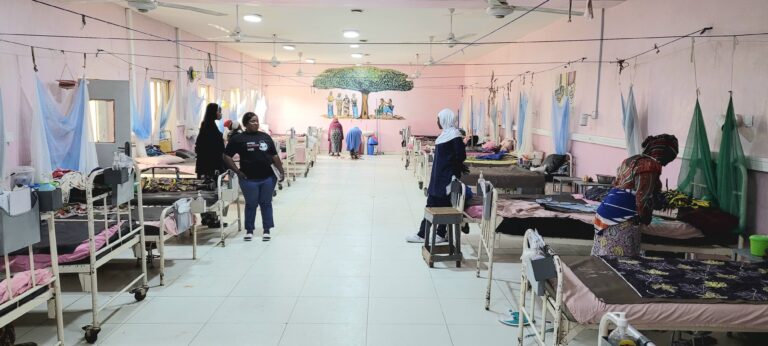
VVF Ward at Jahun General Hospital provides specialized care and rehabilitation services for obstetric fistula patients across Northern Nigeria
“I told them to give me death medicine. I felt my life was already over,” she told The ICIR, quietly. Instead, a nurse looked her in the eye and replied, “Here, we only give medicine for life.”
That moment marked the beginning of Talatu’s slow return, not just to health, but to humanity.
Talatu, VVF surgery survivor, benefits from integrated care model combining medical treatment with psychosocial support and livelihood training
The ICIR reports that across Northern Nigeria, obstetric fistula continues to sentence thousands of women to silent suffering. UNICEF estimates that between 50,000 and 100,000 new cases occur annually in Nigeria alone. For many, fistula brings a double tragedy, the loss of a child, followed by rejection by family, friends and even husbands.
In Jigawa State, however, a comprehensive fistula-treatment programme centred at Jahun General Hospital is quietly rewriting these painful stories, one woman at a time.
Fistula patients who once arrived broken now sit upright, sharing food, stories and hope. Some of the patients return home with sewing machines strapped to the roofs of buses. Others carry new skills, fresh confidence and a renewed sense of belonging.
To Talatu, the woman who once begged for death, life now feels possible again.
“I can sleep. I can walk outside. I can talk to people. I feel human again,” she said.
At Jahun, healing goes beyond surgery. It restores dignity, rebuilds identity and proves that even in the most forgotten corners, compassion can change lives.
Pain meets possibility
The Jahun VVF unit, run through a partnership between the Jigawa State Ministry of Health and Médecins Sans Frontières (MSF), offers free, holistic care to women living with fistula. Over the past six years, the centre has recorded a cumulative continence rate of 76 percent, meaning nearly eight out of every ten women leave the ward dry.
Key findings from VVF program evaluation showing 76% continence rate, 5,000+ surgeries performed, and holistic approach addressing social stigma and economic reintegration
But healing here is not measured only in medical success. Inside the ward, women form a fragile sisterhood, sharing stories, tears, prayers and laughter. They wash clothes together, cook, learn new skills, and, slowly, relearn how to trust themselves and others.
“It is like another society,” said Aisha Muhammad 29, who travelled from Zaria for treatment. “Here, nobody insults you. Nobody laughs at you. You are free.”
For women who have spent years hiding indoors, sleeping apart from their families and avoiding public spaces, that freedom is revolutionary.
For Hadiza Shuaibu, fistula costs her more than her health; it costs her marriage.
After four days of labour, a caesarean section and a failed first surgery, her relationship with her husband collapsed under family pressure.
Hadiza receives comprehensive post-operative care including counseling and vocational training as part of holistic VVF rehabilitation programme
“My mother-in-law told him that if he did not divorce me, she would curse him,” Hadiza said.
She added, “And he listened.”
Stories like Hadiza’s are painfully common. In communities where a woman’s value is tied to domestic and reproductive roles, fistula becomes a justification for abandonment.
To counter this, Jahun’s fistula treatment treats emotional healing as seriously as physical recovery. Peer-support groups, counselling sessions and daily interactions in the ward help women rediscover confidence.
“They come here broken,” said Gloria Dabit, MSF’s Newborn Unit Supervisor. “They feel isolated, ashamed and worthless. Our job is to help them see that they still matter.”
Returning home, not empty-handed
Yet healing the body and mind is not enough if a woman returns to poverty after a successful fistula treatment. That is why fistula treatment at Jahun integrates vocational training into recovery. Survivors learn trades such as tailoring, soap-making and local food processing. Some leave with basic equipment to start small businesses.
Rahana Muhammad remembers the day she was given a macaroni-making machine, flour and a small start-up capital.
“I felt like I was given my life back,” she said. Today, she earns an income and supports her household. “Now, people respect me again.”
Hauwa, VVF patient and program beneficiary, participates in post-surgical follow-up care and peer support activities at Jahun General Hospital
Economic independence often determines whether reintegration succeeds. Women who return home with skills are more likely to regain dignity, rebuild relationships, and avoid the social isolation that once defined their lives.
Still, some say follow-up support has been inconsistent, limiting long-term growth. For many, true reintegration remains fragile, shaped by poverty, stigma and lingering trauma.
Barriers remain
Despite its impact, the Jahun programme faces serious challenges. Transportation costs and distance still delay access, and socio-cultural barriers persist, with fistula often viewed as a “curse.”
Jahun is increasingly overwhelmed. Since 2020, the unit has managed over 6,400 total exits and 2,883 OPD visits. Yet, as demand surges, the surgical team has thinned from three specialists to just two. This has forced theater sessions to drop from bi-weekly to once a month. While 2,928 women have achieved final discharge, hundreds more remain trapped in a “bottleneck of hope,” their recovery delayed by a lack of specialised hands.
“For a woman with a fistula, every extra day is another day of shame,” said Halima Umar, the VVF Unit in-charge.
Mustapha, medical specialist at Jahun General Hospital, leads clinical services and surgical interventions for VVF patients in Jigawa State
Socio-cultural barriers also persist. In some communities, fistula is still seen as a curse or divine punishment, discouraging women from seeking care early.
Yet, even this success has its limits. Rahana points out a significant ‘wait’ in the system after her training and equipment were provided five years ago, in 2021. Since then, follow-up capital and advanced training promised to many have been inconsistent and distant.
“If they had continued with the skill training… our lives would have been better than what they are now,” she lamented. It is a subtle but vital critique for policymakers: a one-time donation of a machine is a start, but true reintegration requires a sustained economic ecosystem.
Also, there is the issue of timing. Gloria Dabit, the Supervisor, notes that many women still arrive at Jahun far too late, often after days of obstructed labour at home or in ill-equipped primary health centres (PHCs).
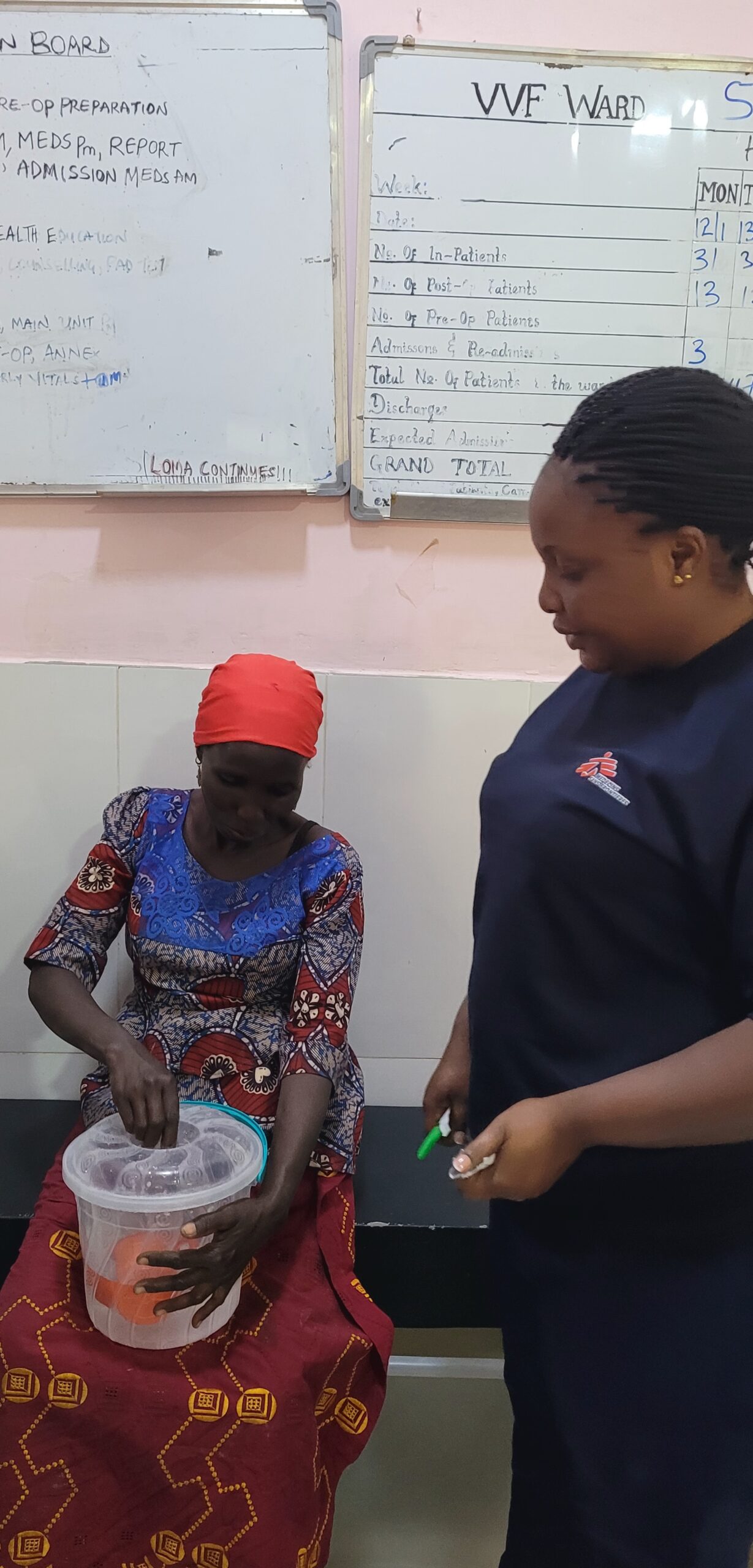
Healthcare provider demonstrates patient education and therapeutic intervention at the VVF Ward, supporting long-term recovery and rehabilitation outcomes
“We only cover about four (catchment areas), Garki, Gwaram, Jahun, and Aujara. But we receive complicated cases from all over,” Dabit told The ICIR.
The solution, according to the experts on the ground, isn’t just more surgeons in Jahun; it’s replicating this model across regions. If the government can equip PHCs to handle emergency obstetric care and make those services truly free, the “menace” of fistula could be stopped at the source before the first drop of urine is ever leaked.
Despite these obstacles, Jahun stands as proof that fistula is not a life sentence.
Its success lies in combining free surgery, emotional support, economic empowerment, and community outreach—an approach that addresses not just the injury, but the woman behind it.
Health experts, Dr. Mustapha Umar, Medical Activity Manager for MSF, say replicating this model across underserved regions could dramatically reduce fistula-related suffering. Strengthening primary healthcare, improving emergency obstetric care, and investing in trained surgeons would shift the focus from treatment to prevention.
THE candidate of the All Progressives Congress (APC), Danjuma Samuel Shekwolo has emerged winner of the Kuje Area Council chairmanship election after securing a slim victory over his rivals, according to the final results officially declared by the Independent National Electoral Commission (INEC).
INEC announced that out of 147,271 registered voters, only 39,799 voters were accredited, representing a turnout of about 27 per cent, and indicating relatively low participation in the poll.
The All Progressives Grand Alliance (APGA) placed third with 4,305 votes, while other political parties got lower votes.
The victory in Kuje is the fifth for the APC, as the party lost only Gwagwalada Area Council to the Peoples’ Democratic Party (PDP)
The ICIRreported that the APC chairmanship candidate, Zakka Christopher won in the Abuja Municipal Area Council (AMAC) with 40,295 votes to defeat his closest rival, Paul Moses, of the African Democratic Congress (ADC), who garnered 12,109 votes. In total, 62,861 valid votes were recorded in the contest.
Similarly, Joshua Ishaku of the APC won the Bwari Area Council chairmanship election, as Nuhu Daniel emerged victorious in the Kwali Area Council, while Umar Abdulahi Abubakar of the APC was declared elected as the Abaji Area Council chairman.
As the newly elected council leadership prepares to assume office, many voters said their election promises must quickly translate into visible impact.
The ICIRreported that INEC conducted elections across the six area councils of the FCT, namely Gwagwalada, Abuja Municipal Area Council (AMAC), Abaji, Kwali, Kuje, and Bwari on Saturday, February 21.
The newly elected chairmen and councillors who will oversee grassroots administration in the nation’s capital – the closest level of governance to Abuja residents.
The election covered 2,822 polling units across 62 wards, where voters chose leaders for six area councils and 62 councillorship seats.
Breakdown of results in Kuje Area Council as declared by INEC
THE Independent National Electoral Commission (INEC) has declared Umar Abdulahi Abubakar of the All Progressives Congress (APC) as the winner of the Abaji Area Council chairmanship election.
He defeated other contenders, including Sakodabo Bilyaminu of the Peoples’ Democratic Party (PDP) and Mohammed Ibrahim of the African Democratic Congress (ADC).
The ICIR reports that Abubakar, who polled 15,536 votes, defeated the PDP candidate, who got 4,547 votes, while the ADC’s came third with 37 votes.
The APC also recorded victory in the Kwali Area Council, where its candidate, Daniel Nuhu, secured 17,032 votes to defeat the PDP’s Haruna Pai, who polled 8,575 votes.
The results were announced by the returning officer Sunday morning, following the conclusion of counting of votes collated across the polling units and wards in the area council.
In the Kwali area council, The ICIR confirmed that the All Progressive Grand Alliance (APGA), Yakubu Dogara, stepped down for the APC candidate.
“We are political friends and both of us have come a very long way in politics. I have also supported him with my own manifesto of lifting Kwali, which is a largely agrarian community, in agriculture. I will work with him to provide incentives to our people in agriculture,” he said.
The ICIR, while monitoring the election, observed that most public schools in Kwali were not in good condition, and required urgent attention.
“It is part of the suggestions that I have made to him (the APC candidate) about the state of schools in our area so that our people can have basic and affordable education in the area council,” Dogara said.
In the Abuja Municipal Area Council (AMAC) the APC candidate, Christopher Maikalangu, emerged as the winner after polling 40,295 votes.
He defeated the ADC candidate, who scored 12,109 votes, while the PDP candidate came third with 3,398 votes.
Similarly, in Bwari Area Council, the APC candidate, Joshua Ishaku, won the chairmanship seat with 18,466 votes.
The ADC candidate polled 4,254 votes to place second, while the Zenith Labour Party, ZLP, candidate garnered 3,515 votes to finish third.
However, the PDP claimed the Gwagwalada Area Council chairmanship seat, with its candidate, Mohammed Kasim, polling 22,165 votes to beat the APC candidate, Yahaya Shehu, who scored 17,788 votes.
The APGA candidate, Biko Umar, came third with 1,687 votes.
THE candidate of the All Progressive Congress (APC), Nuhu Daniel, has won the Kwali Area Council chairmanship election.
The results of the poll, conducted by the Independent National Electoral Commission (INEC) in the Federal Capital Territory (FCT) on Saturday, February 21, saw Daniel polling 17,032 votes to defeat his closest rival, Haruna Pai of the Peoples’ Democratic Party (PDP). Pai secured 8,575 votes.
The results were announced by the Returning Officer Sunday morning following the conclusion of counting of votes collated across polling units and wards in the area council.
THE ICIRreported that the APC secured victory in the Abuja Municipal Area Council (AMAC) chairmanship election, with incumbent chairman Christopher Zakka Maikalangu declared winner.
Announcing the result on Sunday, INEC Collation Officer for the area council, Andrew Abue, said Maikalangu, currently the incumbent chairman, polled 40,295 votes to defeat his closest rival, Paul Moses of the African Democratic Congress (ADC), who garnered 12,109 votes. In total, 62,861 valid votes were recorded in the contest.
The AMAC election was part of the broader FCT Area Council poll, which involved 1,680,315 registered voters across 2,822 polling units.
Despite the scale of the exercise, turnout in many polling units was noticeably low.
The ICIRreported that INEC conducted the poll across the six area councils of the FCT, namely Gwagwalada, Abuja Municipal Area Council (AMAC), Abaji, Kwali, Kuje, and Bwari on February 21.
The APC has cleared four out of the five area councils where the election results have been announced.
It was declared winner in AMAC, Kwali, Abaji and Bwari.
The PDP won in Gwagwalada, while another major party in the country – the African Democratic Congress (ADC) – has yet to win the chairmanship seat in any of the area councils.
FOR nearly five years, Abia State has been the site of a bewildering contest over the crisis of corruption that now bedevils Nigeria’s judicial appointment process. Essentially, the appointment of judges in Nigeria has become something akin to a life-and-death contest, not for or on behalf of those seeking to get justice from the courts but for people who see judicial appointment as a meal-ticket for life or as leverage in the dark arts of Nigeria’s rentier theatre.
Those who control the process now seem very much to use it only to benefit their families and networks; those on the outside of this circle feel entitled to the good life that they believe judges now seem to get. The contest between these two camps is increasingly embittered and publicly so. In Abia State, this contest has been raging for nearly five years. In the past fortnight, the Court of Appeal has weighed in.
The facts are both simple and complicated.
With consent of the National Judicial Council (NJC) in 2021, the Judicial Service Commission (JSC) of Abia State initiated a process leading to the appointment of new judges. As required by the Constitution, the JSC was to conduct initial sifting of the applicants with a view to presenting a long-list to the NJC who were to undertake final interviews and selection in Abuja.
Before the completion of the process at the state level, however, an advocacy group, Access to Justice, lodged a petition with evidence showing that it “was marred by corruption”.
Indeed, “a Chief Magistrate slumped and died over reports that her name was not included in the final list of candidates submitted to the NJC after she had borrowed funds to pay bribes for that purpose.” In response, the JSC was forced to abort the 2021 judicial recruitment process in Abia State.
The following year, in 2022, the Commission re-opened the process and once again invited interested persons to apply for judicial vacancies in the High Court of Abia State. This time, the Abia State JSC concluded the process at the state level and forwarded names to the NJC for the final screening. The State Security Service (SSS) screened the candidates and, on 17 October 2022, the NJC reportedly interviewed them.
Thereafter, however, some persons who had applied in the cancelled 2021 process initiated legal proceedings effectively asserting a right of first refusal to the judicial vacancies the subject of the 2022 recruitment. Access to Justice also intervened, alleging that the list of candidates sent to the NJC “included person(s), who have falsified their ages, as well as those implicated in financial malpractices during the time they held certain positions.” The group also claimed that during the selection exercise “no tests or examinations were conducted for the candidates before they were shortlisted.”
The NJC never completed the process.
By May 2023, when a new administration came into office in Abia State, the burden of work created by the deepening crisis of judicial vacancies in the state was intolerable. To address this, the Abia State JSC returned to the NJC to obtain fresh authorisation for the recruitment of 10 new judges but this triggered a fresh avalanche of litigation.
In January 2024, the Attorney-General of Abia State initiated proceedings before the National Industrial Court of Nigeria (NICN) asking it to decide whether the state government could proceed with a fresh round of judicial recruitment. Joined in the suit were two aggrieved candidates from the previous processes, Eusebius Agwulonu and Ijeoma Oluchi, as well as the State JSC and the NJC.
In its judgment, the NICN established that under the Nigerian Constitution, the Federal High Court did not have powers to decide upon employment matters of this sort. It also upheld the constitutional duty of the relevant institutions of the government of Abia State and the NJC to conduct fresh judicial recruitment in the 2024 process.
Very importantly, the court held that where a process of judicial recruitment is tainted by “corruption and impropriety” such as in this case, that would warrant a cancellation of the process and the “commencement of a fresh exercise.” The court, therefore, granted the state government permission to proceed with the fresh judicial recruitment.
Separately, however, Uzoamaka Ikonne and Victoria Nwokeukwu, two ostensibly aggrieved candidates from the inconclusive round of judicial hires in 2022, had approached the Federal High Court to restrain the state government from recruiting any more judges until the completion of the stalled 2022 process. Nine months after the decision of the NICN, in April 2025, the Federal High Court issued an order suspending the process pending the determination of the case.
From the judgment of the NICN, Eusebius Agwulonu and Ijeoma Oluchi eventually sought permission to proceed to the Court of Appeal. On 4 February 2026, the Court of Appeal ruled denying their application for permission to appeal. In reaching its decision, the Court of Appeal upheld the duty of the state to cancel a process of judicial recruitment tainted “with any form of corruption or illegalities in any procedure.”
The court took a very dim view of the conduct of the aggrieved candidates from previous processes of judicial recruitment in Abia State and accused them of wilfully and deliberately seeking to “stall any…. future judicial appointment exercise, thereby holding the process ad infinitum in perpetual abeyance without lawful justification.” Unlike the NICN, which did not award any costs, the Court of Appeal awarded costs of three million naira against the candidates, after making the quite weighty finding that they had “lied on oath” in their filings, effectively killing any aspirations they had for judicial office.
It is a thing of utmost regret that judicial appointments in Nigeria these days are now beset with the kinds of allegations that have brought the tortured tale of frustration which has cost Abia State the better part of five years to resolve. This is not to mention the untold hardship this situation must have inflicted on the serving judges who have had to deal with an unmanageable toll of judicial dockets caused by rising judicial attrition.
Those who have responsibility for judicial recruitment would do well to pay heed. It is the only way to ensure that judicial appointments are saved from the mire of corruption into which they have fallen. It will also preclude a test for an observation contained in the ruling of the Court of Appeal in this case. With neither provocation nor foundation in its judgment, the Court of Appeal claimed that “employment or appointment of judicial officers are (sic) not justiciable.” The court felt no need to follow up this observation with any explanation, justification or authority.
With this sentence, the court claims that it is not possible to undertake lawful proceedings in court to challenge judicial appointments. It said this in a decision in which it also affirmed a duty on the part of relevant authorities to set aside any process of judicial appointment that is tainted with corruption.
But it is not at all difficult to see how a corrupt or corrupted process of judicial appointment can claim impunity under this observation to afflict the judicial system with crooked judges from a crooked process. Unquestionably, we have not heard the last of this issue.
In the interim, the Court of Appeal granted the JSC in Abia State permission to proceed to completion with a fresh round of judicial hires for the 10 vacancies in respect of which it has received the sanction of the NJC. Hopefully, the JSC will learn from the previous experience and undertake the process with transparent standards that alone can eschew a repeat of the scandal of corruption which destroyed the previous processes.