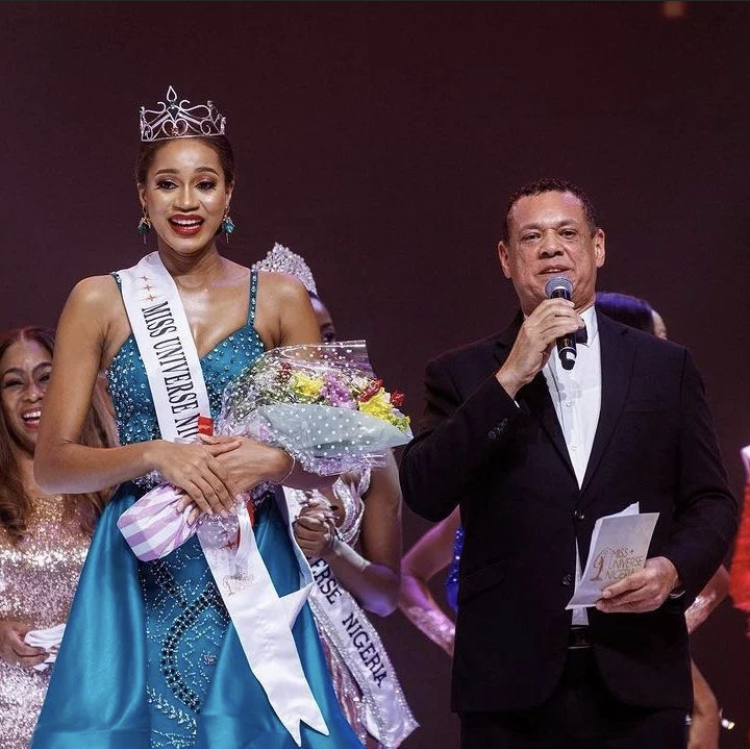
FORMER Most Beautiful Girl in Nigeria (MBGN), Ugochi Mitchel Ihezue, has been crowned Miss Universe Nigeria (MUN), 2023, on Sunday, September 10.
Ihezue was crowned during the grand finale of the pageant show, which took place at Eko Hotels and Suites in Victoria Island, Lagos, surpassing 36 other girls, each representing a state in Nigeria.
Victory Wilson and Winfrey Agbelese co-hosted the show with the theme “Speaking for Women by Women” to advocate for and uplift women for a noble cause.
At the inaugural edition, following its separation from MBGN, Guy-Murray Bruce, the president of Silverbird Group, announced that MUN had adopted a new format, prioritising inclusivity without regard to marital status, body type, skin tone, height or weight.
At the grand finale, Miss Zamfara, Sectra Sede emerged as the first runner-up, earning her the title of Miss Supranational Nigeria and representing Nigeria at the Miss Supranational pageant in Poland in 2024.
While Miss Ekiti, Princess Agunbiade emerged as second runner-up, Miss Nasarawa, Aisha Abubakar, clinched the award for Miss Photogenic, Miss Taraba, Precious Marcus, won the Best Traditional Costume award and Miss Borno, Chinaza Miracle got the Miss Amity award.
In 2017, Ugochi Mitchel won the Most Beautiful Girl in Nigeria pageant, representing Nigeria at Miss World in China. After making it to the top 15, she also won the top model competition, earning her the title Miss World Top Model 2017.
As the new Miss Universe Nigeria, she will represent Nigeria at the Miss Universe competition in El Salvador in November.
THE United Arab Emirates (UAE) has lifted its visa ban on Nigerian travellers after almost a year.
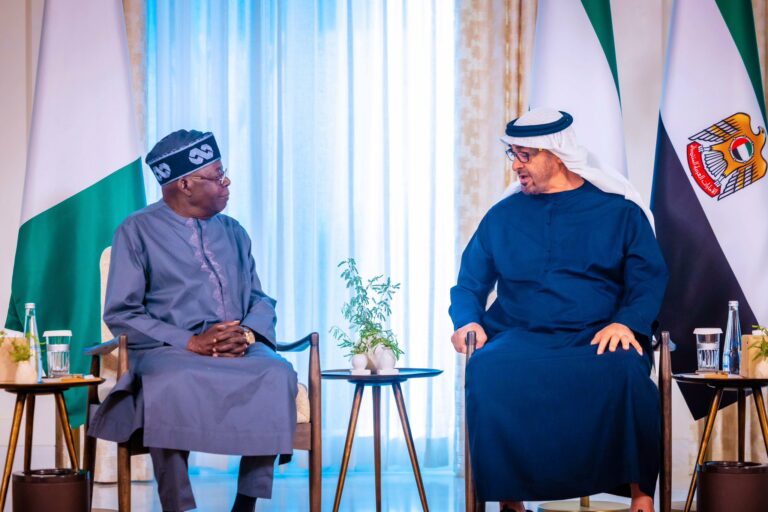
On Monday, September 11, in Abu Dhabi, Nigerian President Bola Ahmed Tinubu and the President of the United Arab Emirates, Mohamed bin Zayed Al Nahyan, reached an agreement, lifting the ban.
A statement released by the President’s spokesman, Ajuri Ngelale, stated that Etihad Airlines and Emirates Airlines were to resume flight schedules into and out of Nigeria immediately.
The statement clarified that the agreement reached between the two leaders for the flight resumption via these airlines didn’t require immediate payment by the Nigerian government.
Nigeria is one of the 20 African countries banned from entering UAE’s capital city, Dubai.
Although former President Muhammadu Buhari admitted that some Nigerians might be violating UAE’s laws, he said that was not enough to impose a blanket ban.
He said no country, including Nigeria, would condone criminalities and illegal behaviours.
Meanwhile, that wasn’t the first time the UAE would place a visa ban on Nigerians, as The ICIR had in different reports documented the rift between the two countries.
In July 2020, the UAE imposed restrictions on Nigerian visas after two rival cult groups – The Neo-Black Movement of Africa (also known as BlackAxe) and the Aromate Group (also known as Barggas) – had a clash in Sharjah, which resulted in deaths, including the number one leader of the Aromate Group.
During that period, the UAE denied blacklisting Nigerians seeking visas to enter the country as its Embassy in Abuja clarified that the ‘temporary suspension’ of visas was a preventive measure to address the spread of the COVID-19 virus.
“At the onset of the COVID-19 pandemic, the UAE took several precautionary measures to combat the virus’ spread, including the temporary suspension on issuing UAE visas for all nationalities as of March 17, 2020,” the embassy tweeted.
The restriction was lifted in September after Nigeria agreed to allow the operation of Emirates Airlines in Nigeria, suspended due to the pandemic, as disclosed by the then Minister of Aviation Hadi Sirika.
However, in May 2021, flights between Nigeria and the UAE were halted due to a dispute related to COVID-19 testing protocols, with Sirika noting that these measures were specifically directed at Nigeria.
The ICIR, in a follow-up report, highlighted how Nigerians were losing their jobs and living in the streets due to discrimination and work permit issuance/renewal restrictions by the UAE.
Between July and September 2021, more than 300 Nigerians saw their employment terminated in the UAE due to the government’s limitations on issuing and renewing work permits for Nigerians, according to a report by this organisation.
Apart from restrictions on flights from and to Nigeria, the UAE arbitrarily restricted visas from Nigerians without official communication, Nigerian officials said.
A statement by a group known as Nigerians in Diaspora Organisation United Arab Emirates (NIDO-UAE) in 2021 said hundreds of Nigerians in the UAE were frustrated with no hope due to the work permit issuance/renewal restrictions and were taking to the streets.
Subsequently, The ICIRreported that the rift took a different dimension in July when the Arab country barred Nigerians from applying for work permits and placed visa restrictions on them.
Although an official at the Ministry of Labour (MOL) in the UAE confirmed that work permits were being regulated in view of precautionary and preventive measures for COVID-19, The ICIR gathered that the regulation imposed by the ministry seems to target only Nigerian nationals.
Director of the Nigerian in Diaspora Organisation (UAE) Fernando Judel told The ICIR that the restriction was an internal arrangement restricted only to the ministry, and Nigerians seeking to apply for work permit renewals were barred from doing so.
GUNMEN have killed ten people in a fresh attack on the Mangu Local Government Area (LGA) of Plateau state.
The attack, which occurred in the Kulben community of the state on Sunday, September 10, left many other residents of the city injured.
A resident who confirmed the incident to The PUNCH said several houses were destroyed during the attack.
“Armed Fulani militia group attacked our community in Kulben village within Kombun District of Mangu Local Government Area of Plateau State. The gunmen came to the village at about 10:00 p.m. on Sunday, September 10, and killed 10 of our people. They also injured many others and destroyed our properties, including houses.
“Currently, our people are mourning the gruesome killing of their kinsmen, and arrangement is ongoing to conduct mass burial for the victims,” the resident Moses Fwan said.
The ICIR contacted the Plateau State Police Public Relations Officer (PPRO) Alfred Alabo to confirm the incident.
Alabo said he was at a meeting at the time of the call and did not confirm the incident.
While Plateau state was always confronted with terrorism during the administration of former President Muhammadu Buhari and the state’s former Governor Simon Lalong, Mangu has witnessed a rising spate of banditry and terrorism since the inauguration of the incumbent President Bola Tinubu in May.
Over 200 deaths in four months
On June 9, Plateau State Governor Caleb Mutfwang said at least 150 people were killed in similar attacks in three weeks.
The ICIR traced at least 72 other deaths from terror attacks since June 9 from news reports, including the latest killings. here. Some of the reports are here, here and here.
This brings the number of deaths from terror attacks in Mangu LGA alone to at least 222 in less than four months.
Mutfwang, who spoke a few weeks after his inauguration, described the attacks as deliberate efforts to destroy the state. He also said the arable nature of Plateau’s land and mineral resources were factors fueling the incessant killings.
“Plateau has come into serious contention for some of these reasons. So, we can look at the economic, political, and social factors behind the continuation of these insurgencies. But I can assure you that we are doing our best to tackle these issues,” he said.
THE governors of the North-East states have called for Federal Government support to help tackle the increased activities of bandits in the region.
The North East Governors’ Forum (NEGF) made the appeal in a communique issued at the just-concluded 8th meeting of the Forum in Maiduguri at the weekend.
Babagana Zulum of Borno State signed the statement.
The leaders called for the Federal Government’s prompt intervention and claimed that the bandits were individuals who had been chased out by the military in other parts of the nation and were heading towards the region, notably around the states like Gombe, Taraba and Bauchi.
“The forum calls on the Federal Government to urgently intervene to address the issue,” the communique stated.
The meeting claimed it was aware that some traditional rulers and other local authorities were conniving with the bandits, giving them cover to commit crimes.
“The forum unanimously resolved to decisively deal with any traditional ruler or community leader that is found to be harbouring or conniving with the bandits,” the group added.
Additionally, it raised concerns over the expansion of illicit mining in the area, which it said was becoming an issue “due to the connection between mining operations and instability, notably the exploitation of mining leases.”
It urged governments at all levels to ensure adherence to the local content requirements outlined in Nigeria’s Mining Policy and the need for strict adherence to the Land Use Act’s requirements.
The group also noted the region’s problems with climate change and environmental degradation, as well as last year’s flood, which destroyed homes and livelihoods and worsened people’s suffering.
The governors added that the region’s silting rivers and the deforestation brought on by the large charcoal industry worsened the climate change problem.
The governors of Adamawa, Bauchi, Borno, and Yobe were present at the conference, and the governors of Gombe and Taraba were represented by their deputy.
The country’s North-East region has suffered a lot of devastation due to the activities of Boko Haram terrorists and banditry.
According to a report, over 40 per cent of teachers in the region have lost their lives due to the Boko Haram insurgency.
The Managing Director of the North-East Development Commission (NEDC), Mohammed Alkali, said teachers in the zone were the primary target of terrorists.
The Commission also disclosed that Internally Displaced Persons (IDPs) in the North-East were unwilling to return to their ancestral homes.
In a 2020 report, The ICIR detailed how over 600 people died in the region in six months from insurgent attacks.
UNITY Bank Plc shows signs of financial distress as its total liabilities exceeded total assets in its half-year results, raising concern that it may default on its obligations to creditors and be headed for bankruptcy.
The bank’s unaudited financial statements for the six months ended June 30, 2023, showed that total liabilities at N688.826 billion exceeded total assets at N509.998 billion.
Checks by The ICIR on the company’s profit lines revealed that the bank posted negative growth.
Financial analysts say the bank’s position could cause a publicly traded company to be delisted from a stock exchange.
Unity Bank reported a negative net operating income of N23.359 billion, a loss before tax of N38.705 billion and a net loss of N38.865 billion.
In its 2022 audited results for the year ended December 31, 2022, and 2021, the 17-year-old lender also posted negative performances as liabilities exceeded its assets.
In 2022, the bank posted an unfavourable financial position as the total liabilities of N785.092 billion exceeded its total assets of N510.143 billion by N274.948 billion.
In 2021, the bank reported a similar unfavourable financial position as total liabilities at N815.022 billion exceeded its total assets at N538.868 billion by N276.153 billion.
In its 2022 independent auditor’s report signed by its professional services chartered accountants, Akinyemi Ashade, KPMG raised concerns over the bank’s financial health after total liabilities exceeded its assets.
The KPMG noted that Unity Bank did not meet the required minimum Capital Adequacy Ratio (CAR) of 10 per cent and the minimum capital requirement of N25 billion for a national bank as required by the Central Bank of Nigeria.
Pointing to Note 35 in the financial statement, it said the conditions and other matters outlined in the note indicated a material uncertainty that might cast significant doubt on the bank’s ability to continue as a going concern.
“We draw attention to Note 35 of the financial statements, which indicates that the bank made a profit of ₦941.4million for the year ended 31 December 2022. As of the same date, the bank’s total liabilities exceeded its total assets by ₦274.9billion, and the bank did not meet the required minimum Capital Adequacy Ratio (CAR) of 10 per cent and the minimum capital requirement of ₦25 billion for a national bank as required by the Central Bank of Nigeria (CBN).
“As stated in Note 35, these events or conditions, along with other matters as set forth in Note 35, indicate that a material uncertainty exists that may cast significant doubt about the bank’s ability to continue as a going concern,” KPMG noted.
Unity Bank had forecast gross earnings of N23.46 billion and profit after tax of N230.182 million for the second quarter of 2023.
TechCabal reported that Unity Bank, alongside TeamApt and Access Bank, were victims of a data hack, although the banks did not confirm this.
In a statement to The ICIR, the managing director/chief executive officer of Unity Bank, Tomi Somefun, said the operating environment impacted the positions of the bank in income generation on the back of the revaluation of the bank’s net foreign liabilities following the Naira devaluation.
She stated, “In the light of the prevailing FX revaluation in the financial system, what we have is a market-driven impact which is adjustable envisaged from the positive economic outcomes of the government policies in the near term. Be that as it may, the negative shareholders’ fund has improved considerably through the injection of N135billion which moderated the negative shareholders’ fund from (-ve) N275Billion in December 2022 financial year-end to (-ve) N178Billion as at the end of June 2023, after absorbing the FX revaluation loss suffered in Q2/2023. We are, however, focused with clear-cut plans to close out on our recapitalization programme very soon to enable us do business as expected in the fast-growing markets in Nigeria.”
She hinted that the bank has accelerated measures to ramp up asset creation and liability generation in the short and medium term.
“The Bank is aggressively driving its retail growth in every segment of the market, expanding strategic partnerships; and growing commercial banking business to develop new and sustainable income lines for the Bank as well as pay sufficient attention to fast-paced process automation, cost and resource efficiency, targeted value chain relationships, and product marketing to enhance value creation in the market,” Somefun added.
Update: This report was updated to reflect the comment by Unity bank CEO, Tomi Somefun.
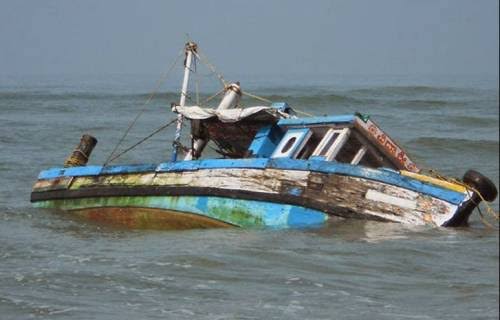
Atleast 26 people on Sunday, September 10, died in a boat mishap carrying over 100 persons in communities between Jebba and Kainji dam in Mokwa local government area (LGA) of Niger State, The ICIR gathered.
The victims, said to be from Gbajibo, Ekwa, and Yankyade communities, were going for farming activities when the incident occurred between 7:30 a.m. and 8:00 a.m. on Sunday.
The incident has left the affected communities in mourning as the indigenes search for the whereabouts of their loved ones.
Over 30 people had been rescued in the boat, said to be carrying primarily women and children, by a combined operation of the marine police and local divers in collaboration with the State Emergency Management Agency.
While the fate of the remaining passengers is yet to be determined as at the time of filing this report, the chairman of the Mokwa LGA, Jibrim Muregi, also confirmed the unfortunate incident to the Punch.
In a statement on Sunday, September 10, the state governor, Umaru Bago, described the incident as terrible and undesirable.
He said, “This is quite a shocking and sorrowful situation to the people of the affected communities, and I share in their sorrow.”
Commiserating with the victims who survived and the families of those who died, Bago stressed the importance of using life jackets when boarding boats and for people to desist from overcrowded boats.
In May 2021, more than 100 passengers were missing following a boat that capsized on the Malale River in the Borgu Local Government Area of Niger State, The ICIR reported.
This happened barely three weeks after another boat mishap that led to the deaths of over 28 people returning from a local market in Shiroro Local Government Area of Niger State.
Recently, in June this year, over 50 persons were dead in a boat said to be returning from a marriage ceremony at a neighbouring Egboti village in Niger state, conveying no fewer than 100 persons, including a father and his four children, capsized.
In another incident, The ICIRreported a boat mishap on River Niger near Malilli village in Borgu local government area of Niger State that claimed about 42 lives with over 100 missing.
THE chairman of the Presidential Fiscal Policy and Tax Reforms Committee, Taiwo Oyedele, had said that the committee intends to achieve a tax-to-GDP (gross domestic product) ratio of 18 per cent within the next three years and close the tax gap of about N20 trillion.
Oyedele said in a statement, tagged the 10 most frequently asked questions about the committee, posted on his Twitter handle on Sunday, September 10.
“The average tax to GDP ratio for Africa excluding Nigeria is about 18 per cent. This is the basis for the target of 18 per cent and the estimated tax gap of N20 trillion,” he said.
According to him, there is a huge opportunity to generate revenue by leveraging technology and tax intelligence to close the tax gap.
“In addition, we will rationalise incentives, reduce the cost of collection, and optimise revenue from government assets and natural resources.
“This way we can generate more revenue without introducing new taxes,” the tax expert explained.
On August 8, The ICIRreported that President Bola Tinubu had inaugurated the presidential committee on tax reforms with a mandate to achieve an 18 per cent tax-to-GDP ratio within three years.
The committee is expected to achieve its mandate within one year and, in the first instance, deliver a schedule of quick reforms which can be implemented within thirty days.
Oyedele had said that Nigeria has a significant tax gap in the region of N20 trillion, The ICIR also reported.
He said to close the gap, Nigeria can raise more revenue if it lessens its revenue collection cost, which is about the highest globally.
He lamented that all manners of agencies numbering up to 63 ministries, departments and agencies (MDAs) of the government in the tax collection pool.
President Tinubu set up the committee to review and redesign Nigeria’s fiscal system concerning revenue mobilisation, tax and non-tax, quality of government spending, and sustainable debt management, Oyedele added.
We have curated the 10 most frequently asked questions about the Presidential Fiscal Policy and Tax Reforms Committee. I am glad to say that we are making progress with our work and on track to meet our deliverables on time according to plan.
The presidential tax reforms chairman hinted that the committee would engage various stakeholders, including people living with disabilities, artisans, Nigerians in the diaspora, multinational companies, and the international investment community.
He reiterated that the government does not intend to introduce new taxes or impose higher tax rates on Nigerians, maintaining that the committee mandate was to reduce the number of taxes and levies while harmonising revenue collection to reduce the burden on the people and businesses.
“The objective is to avoid taxing investment, capital, production or poverty. We plan to review and re-enact the major tax laws in a holistic manner, thereby limiting the necessity for frequent changes through annual finance acts,” the tax committee chairman said.
He clarified that no agency of the government has been stopped from collecting revenue; however, many of the agencies would rather focus on their primary functions while the committee harmonises the fragmented revenue collection functions into one agency for each government.
“This is the case in many countries, including the leading tax regimes in Africa. This reform will help to improve efficiency and enable the agencies to focus on their primary mandates for the overall benefit of the economy,” the tax reforms committee chairman said.
He also answered whether the government can be trusted to implement the committee’s recommendations.
“The committee was set up not just to advise the government but also to support the implementation of recommended reform measures. The committee’s assignment is being carried out to the highest degree of independence driven by national interest within the context of modern-day economic realities and emerging issues within the international community,” Oyedele said.
The shortage of bed space in the emergency units of some public hospitals in the Federal Capital Territory (FCT), combined with the ‘incessant’ doctors’ strike, has had a detrimental impact on healthcare delivery. Consequently, numerous patients have been turned away from accessing proper medical services. The ICIR’s Mustapha Usman reports.
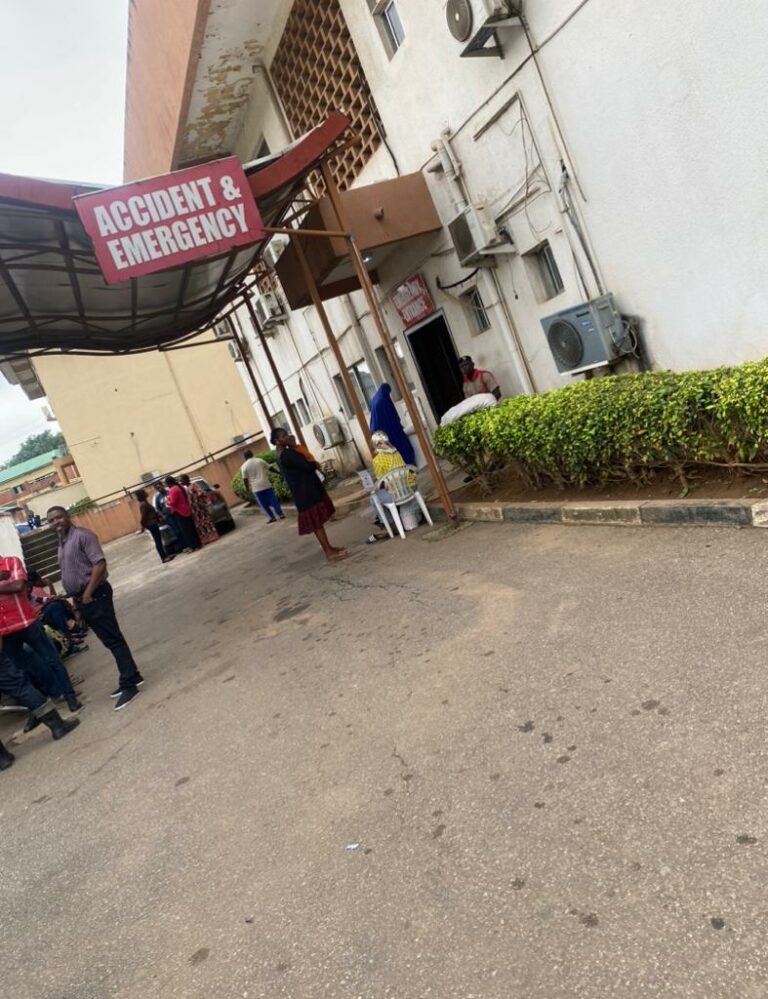
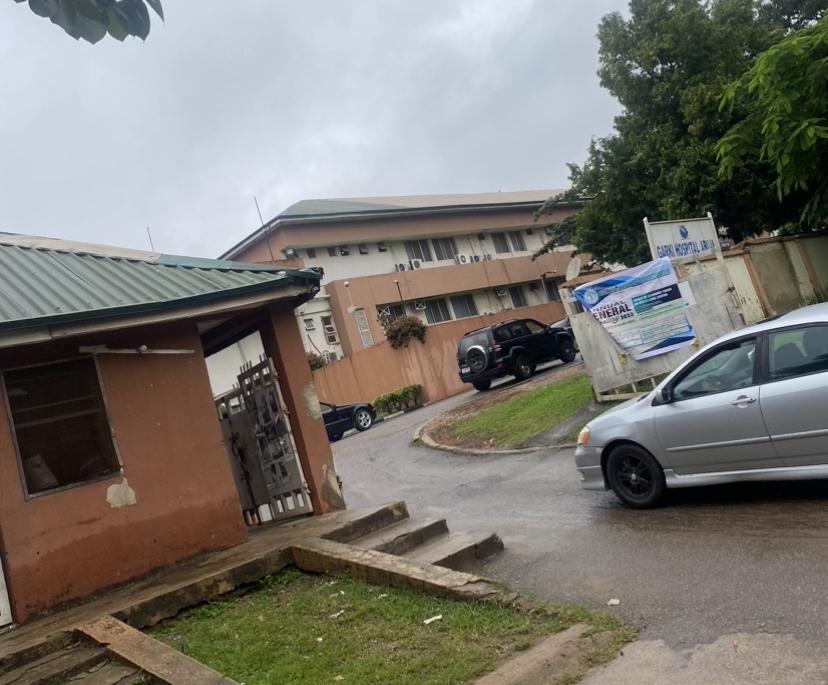
HAKEEM Dan Azunmi could not believe his eyes at the Garki General Hospital in the FCT. Some patients were helped out of their vehicles only to be told no one would attend to them. Others loitered in the facility, especially at its Accident and Emergency Unit. At its front doors were a group of people struggling to gain the attention of the medical staff, who appeared overwhelmed.
Hakeem’s brother, Jamiu, was sick and seeking treatment at the facility. He had waited for over two hours, but no one attended to him. The doctors were on strike, putting more pressure on the health workers, as patients and their relations competed to have their attention.
Besides the dearth of human resources, The ICIR observed that the facility lacked adequate bed spaces. This, the hospital argued, was not due to inadequate bed space but the small capacity of the ward.
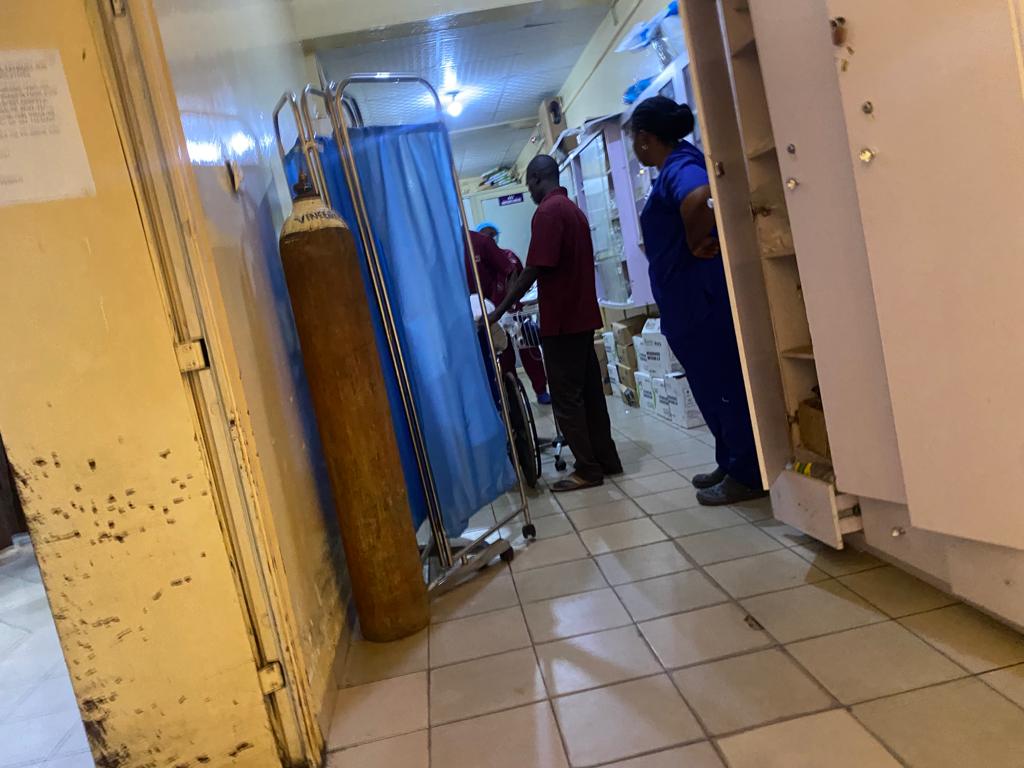
For instance, the Emergency Ward for adults only had four beds separated by cotton and another two in a small room.
Lucky patients got space after queuing for hours. There was also a small room for treating minor injuries, and another called the ‘Resuscitation Ward’ outside the adult emergency room.
Hakeem, alongside three others, had just driven in from Wuse District Hospital, another public hospital a few kilometres away, where a young nurse turned them back. The nurse attributed her action to the strike and many patients waiting at the facility.
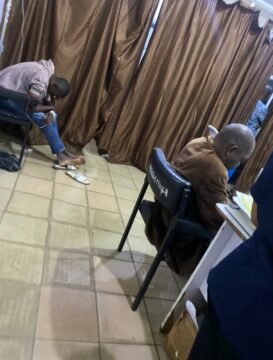
A patient receives emergency care while seated in a chair at Garki Hospital’s Adult Emergency Room amidst overcrowding. Photo: The ICIR/August 2023
“The situation is terrible,” Hakeem said as he walked out of the Garki emergency unit, searching for his driver.
“They did not even check the patient and the scan we brought,” he stated.
The Nigerian Association of Resident Doctors (NARD) had, on Wednesday, July 26, embarked on strike to air their grievances over the Federal Government’s failure to meet their demands. The strike followed the expiration of a two-week ultimatum they issued the government earlier.
The doctors downed tools for two weeks, putting the lives of many patients at risk.
The combination of the now-suspended strike by the doctors and an acute shortage of hospital bed space culminated in a dire situation for patients seeking medical attention across the FCT.
The doctors posit that their strike was for the public good, arguing that their welfare and improved health infrastructures would translate to better service delivery and reduce brain drain.
Rejected in Wuse, Garki due to inadequate bed spaces, Maitama out of service
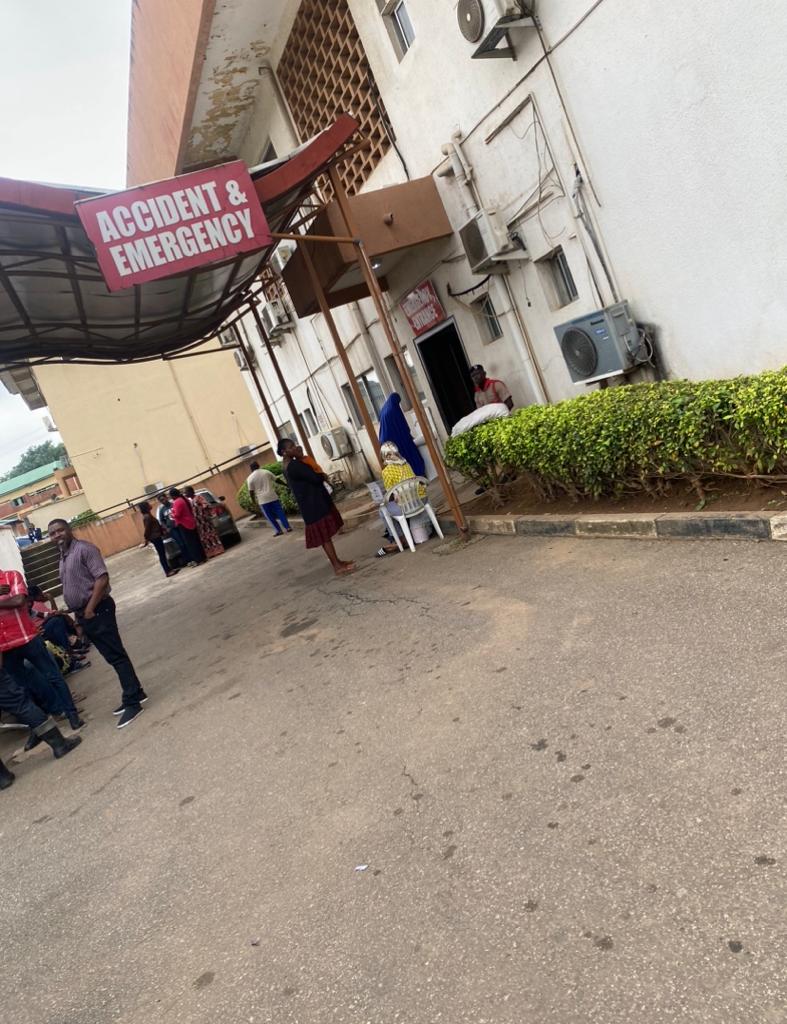
Some patients and caregivers hang around the Emergency Unit of the Garki hospital. Photo: The/ICIR
Eburire Akpo’s father, Emmanuel, was unconscious in the early hours of Monday, August 7, which led the family to rush him to Garki General Hospital. While the hospital had been like a “family hospital” for Akpo, the perception changed that day because the facility couldn’t admit his father but referred him to a private hospital.
Because of the unfriendly situation at the hospital, Akpo took his father to Wuse District Hospital, hoping to get the care he needed. However, the situation in Wuse was the same as Garki’s as he could not secure a bed space for his father.
“We then went to Maitama Hospital, but it was out of service,” said Akpo as he bemoaned the unfortunate situation across the country. “It was later in the evening that we secured a bed space in Garki hospital since 5:30 a.m. that we had set out.”
Due to the inadequate hospital beds at the emergency unit, patients queue to get the health workers’ attention, leading to overcrowding at the unit’s entrance.
A patient waiting to receive care from medical workers at Garki Hospital. Photo; The ICIR/2023
This situation mirrors other patients’ plight as some who could not wait because of their condition were referred to private hospitals which charge exorbitant bills.
The ICIR also met another patient who had to wait more than two hours in Wuse District Hospital before being wheeled out to Garki Hospital because he would not be attended to.
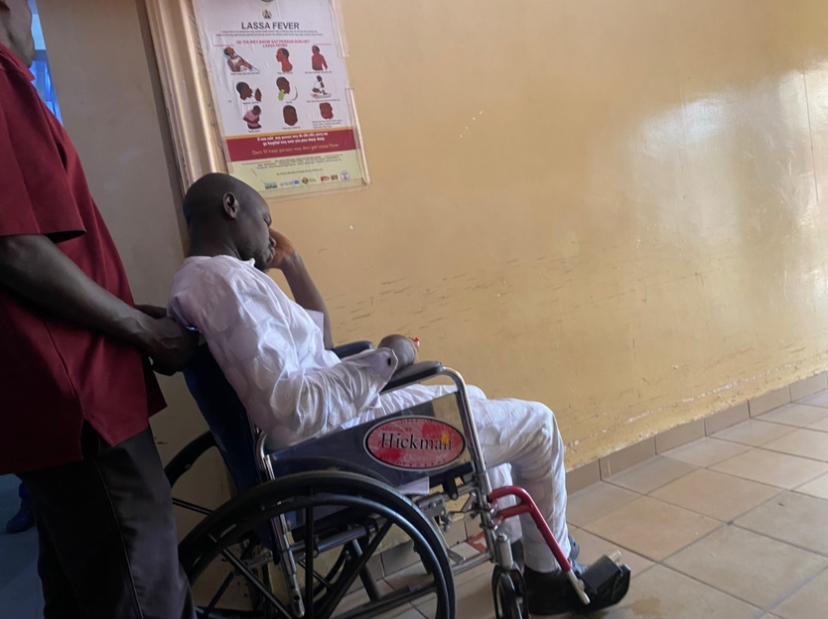
Another patient denied admission at Wuse Hospital due to the NARD strike receives treatment at Garki Hospital in a wheelchair.
Meanwhile, at Garki, the patient was not lucky to get a bed space and had to be attended to in a wheelchair in the corridor of the emergency unit. The medical attendants on duty placed him on a drip and gave him other first-aid care.
His guardian told the reporter that the patient had been sick for days without getting attention from the hospital due to the strike. He said they had visited Wuse Hospital more than two times before leaving because nobody attended to him.
In Garki Hospital, only six-bed spaces were in the adult emergency room, while Wuse has eight-bed spaces earmarked for emergencies.
At least, check if she’s alive, guardian urges nurse on duty in Asokoro
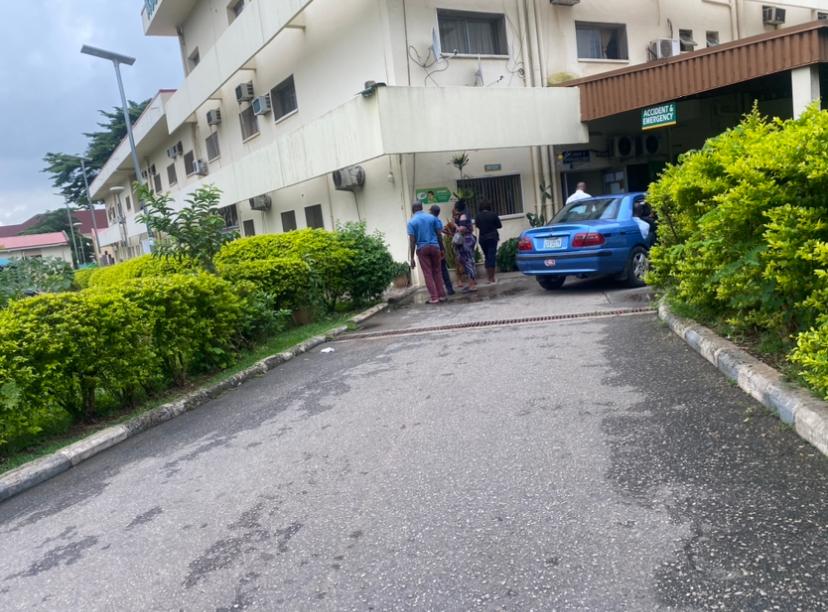
Asokoro Emergency unit. Photo: TheICIR/2023
On a rainy Friday afternoon, the atmosphere at Asokoro District Hospital was tense as a guardian of a female patient urgently called for a nurse’s attention. The female patient was unconscious in a car and needed to be checked by the health worker, but the health workers on duty told the guardian that the doctors were on strike.
The guardian subsequently pleaded with the nurse, in a very pitiful voice, to at least check if the patient was still alive. Addressing The ICIR, the guardian decried the situation, adding that he never anticipated an emergency unit would lack doctors.
Meanwhile, the patient was attended to inside the car that brought her nurses on duty.
Amidst this, The ICIR discovered other emergency cases couldn’t be properly attended to at the hospital due to the industrial action and inadequate bed space.
Uba was one of the six individuals who brought in a man in his early 20s. The patient was rushed in after he was involved in an accident around the Asokoro axis. He was left stranded in the lobby area of the hospital’s emergency unit.
“He has been inside the car for 10 minutes, but they would not take him in. Even after we pleaded with them, they only said they would treat some of the minor injuries because the doctors that should attend to him are on strike,” Uba said.
Situation the same in Kubwa Hospital
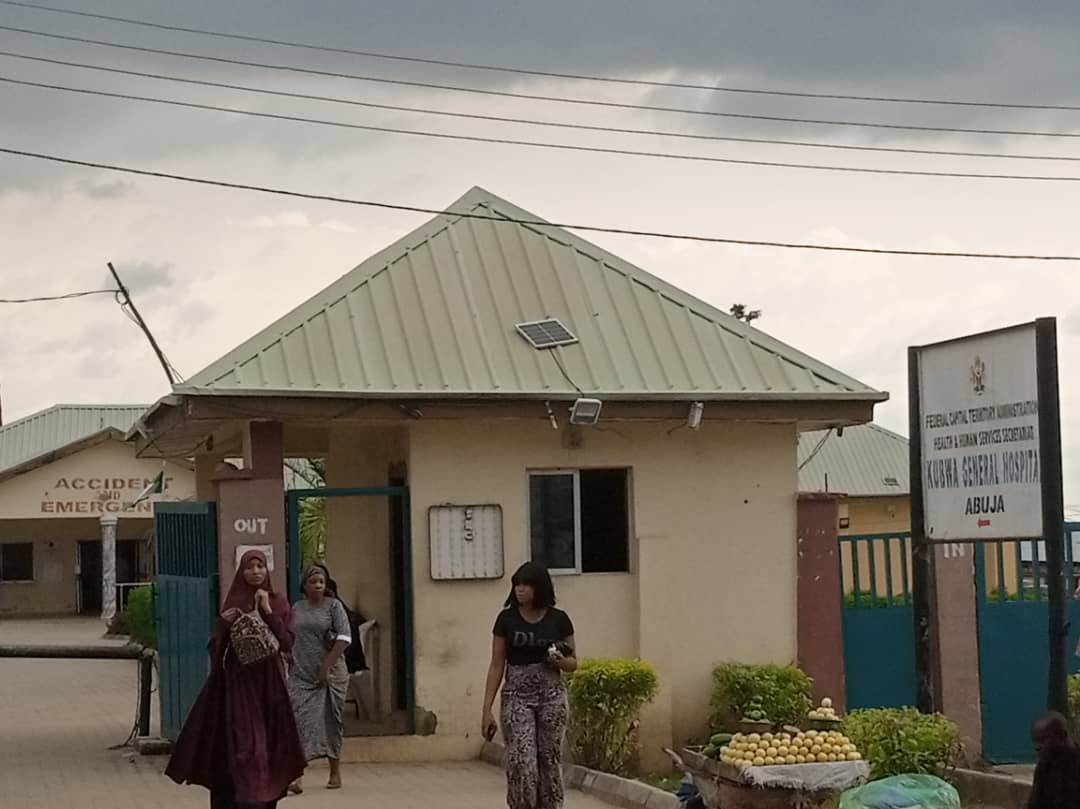
Kubwa hospital. Pc: The ICIR
On Saturday, August 12, The ICIR visited Kubwa Hospital to assess the situation of the emergency/unit. Patients and their relations were seen loitering around the premises while some were sent back and asked to report back on Monday.
The waiting patients criticized the hospital management for inadequate bed spaces. Some of them, like Fatimah, who spoke to The ICIR, stated that the doctors were not attending to them due to the NARD strike.
Although the NARD had directed its members to resume work after it had suspended the two-week-old strike a day earlier, The ICIR confirmed that some patients who visited Kubwa Hospital were sent back home.
Kadir Fatimah lay helplessly on an iron chair. She could barely speak loudly as her body shivered from the cold. Her face looked pale, showing the severity of the illness.
She explained that she had been sick for some days before visiting the hospital but could not get her desired treatment.
“They did not give me a card. They asked me to wait, which I did for some minutes before telling me and others to return on Monday. I tried explaining to the nurse, who was attending to people, but he said the doctors were not at work.”
What the authorities had to say
Garki hospital entrance. Pc: The ICIR
When confronted with our findings, the Secretary of Kubwa Hospital, Omolade Omoniyi Johnson, explained that the government’s inability to implement or agree with Doctors’ associations, leading to incessant strikes, always affects healthcare delivery in the hospital.
The “National Association of Residents Doctors and NMA are the ones that normally go on strike. So it normally affects us because during that period…you know, they are the majority and they have a very strong association.
Speaking on inadequate bed space, he argued that the hospital does not suffer from a shortage of beds but rather lacks a spacious room to accommodate as many beds as needed.
“It’s not inadequate bed space, it’s based on the capacity of each hospital. What the problem is the rate of the population trooping to this place. People come from Karo, Maraba and Nyanyan to this place because it’s easier for them.
He also stated the hospital always filled up and often witnessed around 100 or 50 people seeking emergency services.
Similarly, on Friday, September 8, the Garki Hospital Clinical Director, Director of Operations, agreed with The ICIR findings, stating that the hospital sometimes refers patients to another hospital when the emergency unit is filled up.
He explained that emergency needs are meant to be attended to on time. “We refer the patients to another hospital; that’s the standard,” he said. “As long as there’s no bed space, we tell the person to go to another hospital that has space. We can’t keep an emergency case, because if he dies while waiting, it’s not nice,” he added.
He also contended that the hospital possessed an ample number of beds, yet it was operating at full capacity, noting that the situation is not a matter of insufficient bed availability; rather, the hospital is currently accommodating its maximum bed occupancy.
Asokoro hospital. Pc: The ICIR
Meanwhile, when The ICIR disclosed its findings to the Asokoro hospital secretary, Angelina Effiong, she referred the journalist to the Hospital Head Clinical Services.
The head of Clinical Services, however, asked The ICIR to provide its contact information for possible appointments, stating that they are busy and can’t provide necessary information on the situation.
In Wuse Hospital, efforts to get the Hospital secretary to speak on our findings proved abortive as she did not want to speak on record.
In an attempt to seek the reactions of the government officials in charge of the FCT Healthcare delivery, The ICIR reached out to the FCT Director of Health, Abdulrahman Sadiq, but the efforts proved abortive.
All calls directed to his phone line were not picked while text message was also not returned.
On Friday, September 1, The ICIR visited the Department of Health Federal Capital Territory Authority but was referred to the FCT Hospital Management Board’s Public Relations Officer, Samuel Winnie.
Upon arriving at her office, this organisation discovered that she wasn’t on seat and had to make a phone call to reach her. However, she declined to comment, stating that a letter should be sent to the Director of FCTHMB.
Hospitals poor, dilapidated – NMA
The Nigerian Medical Association (NMA) FCT branch said Public health facilities in the nation’s capital were dilapidated states, adding that the doctor-population ratio in Nigeria kept decreasing over the years due to the failure of the Federal Government to prioritise healthcare.
Its chairman, Charles Ngwuanyi, said “When you tell me that they don’t have bed spaces in hospitals, even if there are bed spaces, who will look after them? Yes, I know there are no bed spaces because the facilities are low and don’t match demand. And the facilities are dilapidated. They are not meeting the minimum standards for reasonable care in a decent society and environment. And the whole thing is borne down to healthcare finance.
According to him, Nigeria has consistently failed to meet up with the Abuja Declaration for allocating 15 per cent of the annual budget to healthcare. He explained that the country “has never gone beyond five per cent for the annual budget allocated to health since then.”
Speaking on how the Federal Government’s failure to fulfil its promises and meet doctors’ demands is affecting healthcare delivery, he said there were less than 25,000 registered doctors in the Medical and Dental Council registry of Nigeria.
Hundreds of doctors thronged Sheraton Hotel, Abuja, for a Saudi interview on August 25. Only seven of the applicants were needed from the exercise that lasted two days.
“If you go to the MDCN’s registry, there were up to 110,000 doctors registered and practising in Nigeria (in the past), but as I speak to you, they have less than 25,000 that are registered and paid their practising licence fee, and this number is decreasing.
“The problem is premised on doctors, nurses and other paramedics leaving the country. It’s not about clamping down on the salaries of doctors. We are simply asking you to pay us what you promised to pay. And then you’re further threatening them.”
According to him, the action of the Federal Government has made matters worse.
“Let me tell you that the government’s action has made matters worse. And if you check this data in the next year, you will see that about 20,000 doctors are left behind to look after more than 220 million people. All the young doctors, residents and erudite doctors are leaving, but the number of patients is increasing. “
THE cause of death of a young Nigerian lady, Remilekun Toyosi Meshioye, onboard an Egyptian airline connecting Egypt to the United Kingdom has remained sketchy.
Remilekun reportedly took the flight, EgyptAir MS 876, from the Murtala Muhammad International Airport (MMIA), Lagos, on Monday, September 4.
She was travelling on a student visa and was expected to get to Egypt and connect to London using another EgyptAir MS777 flight the following day, Tuesday, September 5.
She reportedly died in Egypt, but her family said she died en route from Nigeria, and the airline allegedly dropped her corpse off in Cairo, Egypt’s capital.
According to the International Air Transport Association’s Medical Manuel (March 2015) on the handling of deaths on board, close cooperation needs to be established with national governments and airport authorities to ensure that procedures are properly communicated to ground staff when a serious medical emergency has occurred on board, resulting in the death of a passenger, The ICIR can report.
EgyptAir is a national airline of Egypt, based in the cosmopolitan city of Cairo, operating since May 7, 1932.
Family alleged foul play, demands daughter’s corpse
A statement on Friday, September 8, signed by the elder sister of the deceased, Olufunmilola Olaniyi-Alabi, blamed the airline for not contacting the family earlier about the death of their daughter.
According to Olaniyi-Alabi, the family got to know after a message from the consular office in Cairo informing them of the death of their daughter on board the flight.
The family demands to know what caused her death and how to return her corpse to Nigeria.
“My sister left Lagos for the UK on Monday at 14:00 via Egyptair line and eventually died during her transit from Lagos to Cairo, according to the little information we got,” she said.
EgyptAir failed to contact family
Olaniyi-Alabi asserted that the deceased’s family made several efforts to contact EgyptAir customer care without success.
“It was only once that a man picked up the call that we put through to the EgyptAir Region Office in London, and he said the London office was unaware of what happened and they didn’t have information to share with us.
“So we were left with no choice but to report to the UK Police Department on Wednesday, and they later confirmed that our sister was not in the UK. They advised us to contact Cairo or Lagos airports. We contacted the agent who sold the ticket to her, and the agent sent us proof that she did not board the plane going to Heathrow from Cairo,” she said.
Olaniyi-Alabi travelled to London (Heathrow) on Wednesday night and arrived in London on Thursday morning.
She and the deceased’s husband, residing in Leeds, demanded to see the EgyptAir regional manager in their London office, who made some calls on Thursday afternoon in her office to the airline’s Cairo office.
“She later informed us that Remi fell sick in the plane, and on landing in Cairo, they rushed her to the hospital in town, where she later died,” said Olaniyi-Alabi.
She stressed that efforts to obtain more information from the Cairo office were not entirely successful regarding the cause of Remilekun’s death.
She explained that the Cairo office said it had informed the Nigerian Embassy and was in the position to have contacted the family.
“I strongly feel that EgyptAir should have contacted us as the passenger’s next of kin against us struggling to get information, which, as of this time that I am writing, they are yet to provide.
“We spoke to the Nigerian Embassy in the person of Saliu Agraza, who responded that EgyptAir only informed them on Tuesday that Remi was dead and handed over her body to them but did not have any other information or any contact of her relatives,” noted the deceased’s sister.
The EygptAir office further told them that only the Nigerian Embassy would write and demand what happened on the plane and at the airport to Remilekun and request all her belongings, including the CCTV footage in the aircraft and at the airport.
Olaniyi-Alabi, however, alleged that EgyptAir was hiding the truth of what happened to her sister on the plane and landing at the airport on Monday night and did not want to take responsibility for what happened to Remilekun.
“As a family of Remilekun, we are demanding for her body to be returned to Nigeria by EgyptAir at their own expense, and they should return all her luggage to Lagos, where she boarded the plane on Monday 4th of September,” she maintained.
Remilekun reportedly sick
In a statement, EgyptAir said the deceased reported being sick when she arrived at the transit area while the airport quarantine department was called to check her.
After the checkup, she was recommended to be hospitalised before she passed away.
“The Airport authorities cleared and stamped her into the country and transferred her to hospital.
One Mr Tarek from the Public Relations Department at the Nigerian embassy in Cairo was contacted and was informed about the case,” the airline stated.
The procedure to evacuate the body back home, however, would be provided by the Nigerian embassy in Cairo, the airline added.



![[UPDATED] Half-year results cast doubt on Unity Bank’s financial health](https://www.icirnigeria.org/wp-content/uploads/2023/03/Unity-bank.jpg "[UPDATED] Half-year results cast doubt on Unity Bank’s financial health")