Home Blog Page 853

‘Drug hawkers are merchants of death’, NAFDAC warns Nigerians

0

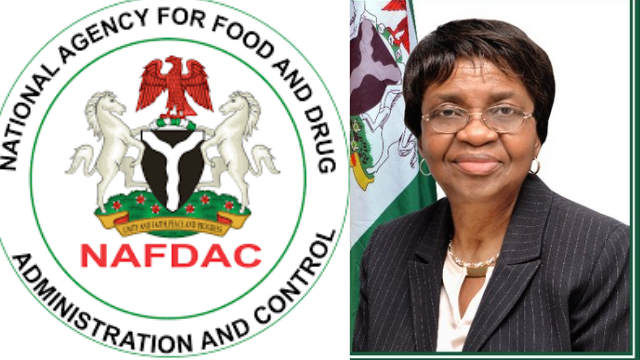
THE National Agency for Food and Drug Administration and Control (NAFDAC) has warned Nigerians against buying drugs from hawkers.

The Director General of NAFDAC Prof Mojisola Adeyeye said this on Tuesday, July 11, at the official flag-off of the agency’s media sensitisation workshop on the dangers of drug hawking and ripening of fruits with calcium carbides.

Adeyeye, who described the drug hawkers as merchants of death, vowed to work with the National Drug Law Enforcement Agency (NDLEA) to prosecute offenders.

According to her, most of the drugs sold by hawkers are counterfeit, substandard, and expired. 

The ICIR on June 10 published a report detailing how many residents in Nigeria’s Federal Capital Territory, consume ‘Baba Aisha Herbal Medicine’, a low-end herbal product that sells for just N100 and is touted to cure common diseases. 

The investigation revealed how the chemical compositions expose the users to different health complications such as cancer. 

Speaking further, Adeyeye bemoaned the menace of drug hawking in the country, noting that the practice poses a serious challenge to the healthcare delivery system.

She stressed that the agency was determined to eradicate the illicit trade.

“Many drug hawkers are knowingly or unknowingly merchants of death who expose essential and life-saving medicines to the vagaries of inclement weather which degrade the active ingredients of the medicine and turn them to poisons thus endangering human lives.

“Most of the drugs sold by the illiterate and semi-illiterate drug hawkers are counterfeit, substandard or expired, and therefore do not meet the quality, safety, and efficacy requirement of regulated medicines.

“Prescription drugs are also sold by the itinerant drug hawkers who also hold consultation, recommend and prescribe medicines to their gullible patients.”

The NAFDAC boss added that most drug hawkers are major distributors and suppliers of narcotic medicines to criminal networks such as armed bandits, insurgents, kidnappers, and armed robbers.

“Drugs are sensitive life-saving commodities which should not be sold on the streets, motor parks or open markets just like any other article of trade. In this regard, we solicit the cooperation and support of all other Law Enforcement Agencies, Nigerian journalists, and well-meaning Nigerians in ridding the country of this harmful and shameful practice,” she said.

Also, speaking on the danger of ripening fruits with chemicals Adeyeye said NAFDAC has noticed the dangerous practice of sale and consumption of fruits artificially ripened with calcium carbide.

“The ripening of fruits with carbides is another public challenge facing us today and the Agency has deployed a multifaceted approach to tackle the menace.”

According to her, consumption of fruits such as mango, banana, plantain, guava, orange, grape, etc, or any other fruits ripened with calcium carbide is dangerous to health.

“Fruits artificially ripened with calcium carbide may be ripe on the skin, but the inside remains unripe. You can identify such artificially ripened fruits if you notice that the fruits are all yellow whereas the stem is dark, this is true, especially with bananas and plantains. In addition, naturally ripened fruits usually have brown or black spots, while those artificially ripened have traces of powdery substances and peel off quickly”.

Estimated billing: DisCos overbilled 5.96m electricity customers in Q1 2023 — Report

THE 11 electricity distribution companies (DisCos) operating in Nigeria overbilled 5.96 million out of 11.27 million electricity consumers in the first quarter of 2023 through estimated billing, the Nigerian Bureau of Statistics (NBS) has revealed.

The revelation was captained in the NBS report on the proportion of metered to total customers during the reviewed period.

The development happened despite a cap on charges by the Nigerian Electricity Regulatory Commission (NERC) on unmetered electricity consumption.


READ ALSO:
DisCos insist on electricity tariff hike, apply for review of charges

Relief for consumers as DisCos, NERC shelve electricity tariff hike

NLC condemns planned electricity tariff hike

57% of electricity consumers overcharged with estimated billing


The NERC cap estimated billings, which took effect on February 20, 2020, ordered that all unmetered Residence 2 -R2 and Customer 1-C1, basically residential and small business users, shall not pay more than N1,870 per month for energy consumed. Single-phase small users are not to pay more than N200 per month till they are metered.

The enforcement of the order has been weak, a knowledgeable energy analyst said, raising concerns about the DisCos’ arbitrariliness in charging unmetered electricity consumers.

Q1 2023: Metred and unmetered customers in Nigeria

“The dilemma is that while the NERC acknowledges that there are issues with the implementation by the Meter Asset Providers (MAP), they still need to protect consumers,” said Dolapo Kukoyi, energy lawyer and partner at Lagos-based law firm, Detail Commercial Solicitors.

According to the NBS report, the 5.96 million figure represented 53 per cent of electricity consumers in the country.

The report showed that consumers were overcharged without proper regulation to ensure accurate billings, and that only 47 per cent of customers, or 5.31 million, were metered during the first quarter of 2023.

According to the report, Ikeja Electric led with 76 per cent of its customers having prepaid meters, followed by Port Harcourt DisCo with 63 per cent, and Eko DisCo with 61 per cent.

Abuja DisCo had 59 per cent, Benin DisCo 51 per cent, Enugu DisCo per cent, Ibadan DisCo 42 per cent, Jos DisCo 32 per cent, Kano DisCo 30 per cent, and Kaduna DisCo 24 per cent, with Yola DisCo the least performing with only 21 per cent of metered customers in the first quarters of 2023.

The report pointed out the need for President Bola Tinubu’s administration to ensure that all customers are accurately metered and billed for their electricity consumption.

It urged the regulatory authorities to compel the DisCos, urgently, to address the issue.

Ondo govt disagrees with APC chairman over Akeredolu’s health

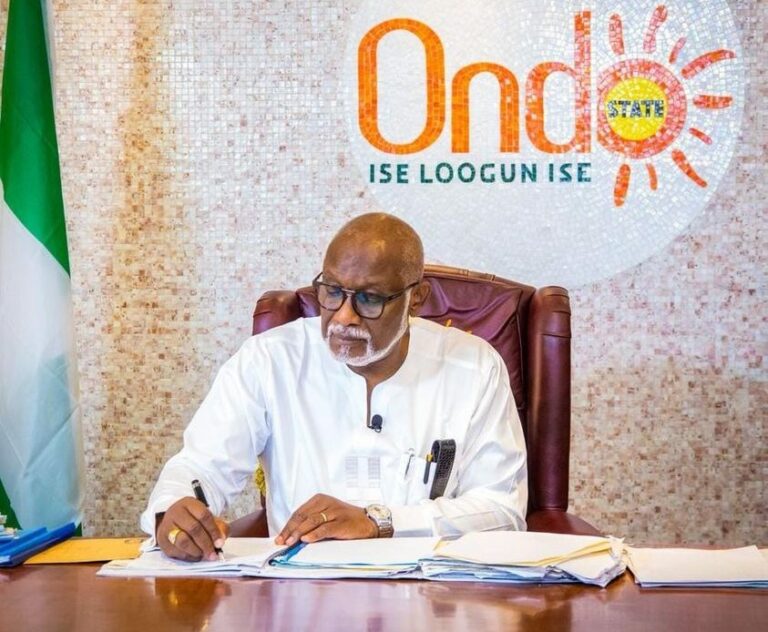
THE Ondo State government and the national chairman of the All Progressives Congress (APC), Abdullahi Adamu, have disagreed over the health condition of Governor Rotimi Akeredolu.

Akeredolu had embarked on a 21-day medical leave on June 7. He travelled abroad to treat an undisclosed illness and was expected to return, and resume his official duties, on July 6.

However, the governor forwarded a letter to the state House of Assembly on July 10 to extend the leave.

Speculations about Akeredolu’s well-being has continued to generate a lot of controversies both within and outside the state.

In a meeting with the chairmen of the party from 36 states of the country, Adamu had said Akeredolu was hospitalised and in a state of “extreme incapacity”, while also praying for his speedy recovery.

“We regret to announce the extreme incapacity of the Governor of Ondo State, who we understand has been hospitalised overseas. We wish and pray for him for a speedy recovery,” he said.

But in a swift reaction on Tuesday, July 11, the state Commissioner for Information, Bamidele Ademola-Olateju, said the governor was not in a critical situation as portrayed by the APC national chairman.

“The national chairman was indeed excited at the reports on the rate of recovery of the Governor of Ondo State, Arakunrin Oluwarotimi Akeredolu, SAN, CON, and urged all those present at the meeting to pray for his quick return,” Ademola-Olateju said.

“He is, evidently, not in any critical state that should warrant this clearly reprehensible conduct as he still sent a post to the executive council committee platform yesterday.

“Mr Governor is not incapacitated. He will return to his duty as soon as the doctors certify him fully fit to do so.”

The ICIR reported that Ondo State deputy governor Lucky Orimisan Aiyedatiwa has continued to head the government in Akeredolu’s absence.

Simon Ekpa declares 2 weeks sit-at-home in South-East

FINLAND-BASED pro-Biafra agitator, Simon Ekpa, has announced that there will be a two-week sit-at-home in Nigeria’s South-East region from July 31.

In a tweet on Tuesday, July 11, Ekpa also demanded the immediate and unconditional release of Indigenous People of Biafra (IPOB) leader Nnamdi Kanu who was arrested and detained for charges bordering on terrorism, treasonable felony, managing an unlawful society and publication of defamatory matter, amongst others.

“Following the demand by the Biafra people for more sit-at-home civil disobedience, the Biafra Republic Government In-Exile (BRGIE) and Biafra De Facto Government In Homeland wish to notify Biafrans that there will be a sit-at-home civil disobedience starting from 31 July, 2023 to 14 August, 2023,” Ekpa said.

Ekpa warned that failure to comply with the order will attract ‘heavy consequences’.

He added: “From Monday, 7th August to Friday, 11 August, there will be total lockdown in Biafraland while on Saturday, 12 August and Sunday, 13 August 2023, there will be a break as all Biafran markets will open.

“On Monday, 14 August, there will be lockdown in Biafraland. We hereby call on all market leaders to strictly adhere to this order and treat it with utmost seriousness.

“We also call on all oil companies operating in the Biafran territory to shutdown oil exploration on these dates to avoid the anger of the Biafran people, which may come with heavy consequences.”

However, the President, Concerned Nigerians Network (CNN) in Diaspora James Erebuoye has warned Ekpa to desist from issuing any such ‘sit-at-home’ orders in the South-East.

“He can’t be in his comfort zone and be instigating crisis in Nigeria by ordering sit at home in the Eastern region thereby depriving people of their daily businesses all for his selfish interest,” Erebuoye stated.

Several lives were lost, and properties destroyed, in parts of the South-East during the just concluded one-week sit-at-home ordered by Ekpa’s faction of IPOB from July 3 to July 10.

The spokesman of IPOB Emma Powerful had distanced the group from the sit-at-home ordered by Ekpa, but hoodlums who enforced the directive attacked persons who ventured out for work and business during the period.

FIRS extends deadline for filing Company Income Tax returns

COMPANIES that were unable to file their income tax (CIT) returns for the 2023 year of assessment (YOA), which fell due on June 30, have been given up till August 31, 2023 to submit their returns to the Federal Inland Revenue Service (FIRS).

Company income tax is imposed on the income of all companies operating in the country, except those specifically exempted under the Company Income Tax Act (CITA).

The FIRS, in a Public Notice signed by its Executive Chairman Muhammad Nami and issued on July 10, stated that it had received numerous calls from companies requesting for the extension of time to submit their CIT returns as they were unable to meet up with the June 30 deadline.

The Service noted that as a measure of goodwill and in line with relevant provisions of CITA, “all companies whose CIT returns for 2023 year of assessment that fall due between 30th June and 31st August 2023 (both days inclusive) are given up to 31st August 2023 to submit the returns to the Service”.

The FIRS clarified that the relevant CIT returns would not attract late filing penalties or interests if payments were made on or before August 31, 2023, noting further that where companies failed to file by the extended date, the penalty and interest for late payment would be computed from the original due date.

The Service also stated that the extension of filing date was for only CIT and did not include returns for withholding tax, value added tax (VAT), and personal income tax (PAYE), among others.

“The Service invites all relevant taxpayers to take the opportunity afforded by this extension to submit their CIT returns within the specified time, pay the taxes due and avoid payment of penalty and interest,” the notice read.

NDLEA boss orders clampdown on illegal sale, use of ‘laughing gas’

0

THE Chairman of the National Drug Law Enforcement Agency (NDLEA), Mohammed Buba Marwa, has ordered a nationwide clampdown on the illegal sale and use of nitrous oxide, otherwise known as ‘laughing gas’.

Marwa directed all Commands and formations of the Agency to begin an immediate clampdown on the substance following its abuse by people who use it for recreational purposes.

This was disclosed in a statement released on Tuesday, July 11, by NDLEA spokesperson, Femi Babafemi.

According to the NDLEA, nitrous oxide is a colourless gas commonly used for sedation and pain relief, more often by dentists and medical professionals to sedate patients undergoing minor medical procedures.

“Popularly called laughing gas or N20, it is fast emerging as a drug in demand in Nigeria by young party-goers or fun-seekers to feel intoxicated or high.

“The gas is often transferred from its containers into balloons, from where it’s inhaled for euphoric effects,” the Agency said.

The NDLEA said the decision to clampdown on those involved in the illegal sale and use of nitrous oxide follows the analysis of the effects on those who abuse the substance, which include: “dizziness; disorientation, headache; lightheadedness; fainting spells; hallucinations; falling unconscious and/or suffocating from lack of oxygen; and other neurological complications, especially psychiatric symptoms”.

The anti-narcotic agency said pending when other measures are taken in consultation with stakeholders, especially the Federal Ministry of Health, to curb the menace, it will not hesitate to wield the big stick against anyone, no matter their social status, involved in illegal sale or use of nitrous oxide in the overall interest of public health.

The NDLEA warned parents, guardians and other stakeholders to be vigilant and caution their young ones against attempting to experiment or abuse the substance, for the sake of their mental and overall well-being.

Alleged vote buying: FG arraigns Adebutu, others

CANDIDATE of the Peoples Democratic Party (PDP) in the 2023 governorship election in Ogun State, Ladi Adebutu, was arraigned on Monday, July 10, over alleged vote buying.

Adebutu was arraigned in absentia by the Federal Government alongside Tiamiyu Waliu, Egunsola Owolabi, Ogunbona Hammed, Sanni Adegoke, Dayo Fasina, Wasiu Enilolobo, Malik Badmus and Dare Lukman Ogunleye.

According to Punch Newspaper, Yemi Sanusi, a chieftain of the All Progressives Congress (APC), petitioned the Inspector General of Police over the accused persons’ alleged involvement in vote buying during the election.

According to the particulars of the offence, Adebutu and the co-accused “on or about 18th of March at Ibara, within the jurisdiction of this Honourable Court did conspire among yourselves to corruptly give gifts in form of verve prepaid cards which had inscribed on them ‘Dame Caroline Oladuni Adebutu Memorial Endorsement Scheme for Less Privileged’ in order to induce voters to endeavour the return of PDP candidates during the gubernatorial and State Assembly elections in Ogun State”.

Additionally, Adebutu was charged with distributing 200,000 prepaid Verve cards using the same name and loaded with N10,000 each “for the purpose of corruptly influencing voters to vote for PDP candidates” during the elections.

Adebutu did not attend the hearing on Monday, but the other defendants—Hammed, Waleed, Owolabi, Badmus and Adejoke — were present.

They all pleaded not guilty to each of the four charges, and their lawyer, Muyiwa Obanewa, then petitioned the court to release the defendants on bail.

The accused were then granted bail in the amount of N100,000 with one surety per accused person, who had to be a bondsman or a member of the defendants’ family and have documentation of tax payment.

The court adjourned the matter for hearing on September 26, 2023.

Earlier in June, The Federal Government charged Adebutu, a leading Deposit Money Bank and its managing director to court for alleged conspiracy, bribery and money laundering.

Adebutu and eight other people were charged with four counts in the case with no AB/10C/2003, including one count of criminal conspiracy contrary to Section 121 of the Electoral Act, 2022, one count of bribery contrary to Section 121 of the Electoral Act, 2022, and two counts of undue influence contrary to Section 127 of the Electoral Act, 2022.

The charges were filed on behalf of the Attorney-General of the Federation and Minister of Justice by M.B. Abubakar, Director of Public Prosecutions of the Federal Republic of Nigeria, Aderonke Imana, Assistant Chief State Counsel, and Bagudu Sani, Senior State Counsel.

The bank and its official were accused of violating section 7(1)(a) of the Money Laundering (Prevention and Prohibition) Act 2022 by failing to report suspicious transactions on Verve cards with the inscription Dame Oladunni Memorial Endorsement Scheme for Less Privileged between February and March 2023.

They were also accused of failing to confirm the identity of customers making electronic payments on Verve cards with the inscription Dame Oladunni.

“On or about 18th of March at Ibara, within the jurisdiction of this Honourable Court, did conspire among yourselves to corruptly give gifts in form of verve prepaid cards which had inscribed on them ‘Dame Caroline Oladuni Adebutu Memorial Endorsement Scheme for Less Privileged’ in order to induce voters to endeavour the return of PDP candidates during the Gubernatorial and State Assembly elections in Ogun State,” the charge read.

Adebutu, who lost the governorship election to the incumbent Dapo Abiodun in March, filed a petition challenging the victory of the APC.

He filed a petition before the Election Petition Tribunal alleging manipulation of results in the state election in April.

The Independent National Electoral Commission (INEC) declared Abiodun as the winner of the March 18 governorship election.

Abiodun pulled 276,298 votes to defeat Adebutu, who scored 262,383.

28 states have no capital importation in Q1 2023

A NATIONAL Bureau of Statistics (NBS) report states that only nine states were destinations for capital importation that came into Nigeria between January and March 2023. 

These states are Adamawa, Akwa-Ibom, Anambra, Ekiti, Lagos, Niger, Ogun, Ondo and the Federal Capital Territory, Abuja. This means that no capital importation came through 28 states within the month in review. 

The NBS disclosed that the total capital importation within the first three months of 2023 rose to $1.13 billion. This is a 6.8 per cent increase from the $1.1 billion recorded in the fourth quarter of 2022. 

Capital importation, according to this research, is the influx of external resources into the local capital resources for the purposes of investment, trade and business production. The NBS divides it into three main investment types: Foreign Direct Investment (FDI), Portfolio Investment and Other Investments, each comprising various sub-categories.

According to the report, the largest capital importation came from Portfolio Investment, which accounted for 57.32 per cent ($649.28 million). It was followed by Other Investments with 38.31 per cent ($435.76 million), and then Foreign Direct Investment (FDI) with 4.20 per cent ($47.60 million). 

The NBS stated that sectorally, “Capital importation into the banking sector recorded the highest inflow of $304.56 million, representing 26.89 per cent of total capital imported in the first quarter (Q1) of 2023. This was followed by capital imported into the production sector, valued at $256.12 million (22.61 per cent), and IT Services with $216.06 million (19.08 per cent).”

Citibank Nigeria, Standard Chartered Bank Nigeria Limited and Stanbic IBTC Bank led the list in the banking sector with $424.13 million (37.45 per cent), $360.33 million (31.81 per cent) and $151.85 (13.41 per cent) respectively. 

Destination of Investment

According to the NBS data, Lagos State was the highest point of investment in Q1 2023 with $704.87 million. This is  62.23 per cent of the total capital investment that came into Nigeria. 

Adamawa had $4.5 million, Akwa-Ibom $5.21 million, Anambra $4 million, Ekiti $0.01 million, Niger $1.5 million, Ogun $2.09 million and Ondo $0.20 million. 

Meanwhile, by country of origin, the United Kingdom ranked top in Q1 2023 with $673.64 million. It was followed by the United Arab Emirates and the United States valued at $108.28 million and $95.36 million respectively. 

Why Seychelles imposed travel ban on Nigerian passport holders

THE Republic of Seychelles has reportedly imposed a ban on Nigerian passport holders applying for short-term visas or holiday purposes, causing protests among Nigerian Twitter users.

The travel ban was confirmed when a travel content creator shared a screenshot of a rejection email received from the Seychelles immigration authorities.

The rejection email shared by Twitter user @Munachimsoooo stated: “We regret to inform you that your application has been denied, as per immigration regulation, for now, we are not accepting any NIGERIAN passport holder for holiday purposes.”

Sample of AI generated rejection messages showing Nigerian passport holders allegedly banned from Seychelles.

This decision comes as a surprise, given that just six months ago, Nigeria and Seychelles signed an agreement for direct flights between the two countries.

Prior to this ban, Nigerian citizens enjoyed a long-standing visa-free agreement with Seychelles, allowing them to enter the country without a visa for up to 30 days.

This sudden change in policy has caught many Nigerians off guard, leading to widespread frustration and disappointment.

It also sparked a larger conversation about the limitations and obstacles faced by Nigerian passport holders when it comes to visa applications and global mobility.

@Munachimsoooo added: “There is something that travel does to you and we won’t let the colour of our passport stop that.

“If one country stops us from coming, there are other countries with similar features for us to visit. If we can’t visit Seychelles, we sure can visit Mauritius”.

However, it appears the ban does not affect other categories of travel or long-term immigration to Seychelles.

While the rejection email did not provide specific reasons for the travel ban, it is speculated that the decision to impose the travel ban may have been driven by various factors, such as concerns over security, immigration control, or a reassessment of bilateral agreements.

Seychelles, a country known for its stunning beaches and vibrant marine life, has been grappling with the scourge of drug-related crimes and abuse within its borders, including trafficking.

The country’s strategic location along drug trafficking routes, combined with its tourism appeal, has made it an attractive destination for illicit drug networks and authorities have been working tirelessly to curb this menace.

There are speculations that the alleged ban imposed by Seychelles was prompted by a growing concern over the involvement of Nigerian nationals in drug-related activities within the country.

According to the President of the Nigerian community in Seychelles Mathias Adidi, a drug syndicate in Nigeria is using Nigerians to smuggle drugs into Seychelles.

“I am Mathias Adidi the President of the Nigerian community in Seychelles. Please help us inform Nigerians. Someone in Nigeria is sending Nigerians to bring drugs to Seychelles. And is not safe they are been arrested every day,” he wrote.

Another Nigerian Steven Ndukwu, who is resident in the country said: “Let me clear the air. The news about Seychelles ban on Nigerians hasn’t been officially confirmed yet. I’m still in Seychelles at the moment.

“What triggered this is because of the Nigerians that brought in drugs into their country, but as you know Seychelles is the number one consumer of heroin in the world and this drugs primarily is produced majorly in Afghanistan, Pakistan and Lebanon then trafficked into Seychelles.”

Ndukwu believes the measure is a result of the government’s determination to address a pressing issue and protect its citizens and visitors from the devastating consequences of drug abuse.

Ondo: Akeredolu remains on sickbed, Aiyedatiwa continues as acting governor

LUCKY Orimisan Aiyedatiwa has continued to head the Ondo State government following the inability of Governor Rotimi Akeredolu to return to Nigeria after exhausting his three-week medical leave

In early June, Akeredolu wrote the state House of Assembly requesting a 21-day medical leave to enable him attend to his health. 

He consequently transferred power to his deputy, Aiyedatiwa. He was to travel on June 7 and return on July 6.

Because he could not return to the state as promised, the governor wrote a letter addressed to the people of the state on July 6 and appreciated everyone for their good wishes for him.

He also thanked President Bola Tinubu and other leaders in the country and expressed hopes to return to governance when discharged.

However, he said only his doctors would decide when he would be fine to return home.

The ICIR reports that the governor had proceeded on a two-week working vacation as part of his annual leave on April 3, a window many believed he used to cater to an undisclosed ailment troubling him. 

Akeredolu’s ill health became noticeable shortly after his mother died in September 2022.

In January, he admitted he was sick but did not disclose the nature of his sickness. 

Akeredolu’s letter to the people of Ondo State on July 6

The Social Democratic Paty (SDP) in the state was among the stakeholders that expressed concerns over the governor’s health early in June when it became glaring that he could no longer discharge his official duties.

Speaking through its chairman, Stephen Adewale, in Akure, the state capital, the party said being a public officer, the governor’s health status should not be shrouded in secrecy.

The governor’s health has been concerning not only to governance but to the governorship election coming up in the state in 2024.

The ICIR reports that Akeredolu was sworn in for a second term of four years on February 24, 2021.

The governor appointed Aiyedatiwa in 2020 after a running battle and subsequent impeachment of his former deputy Agboola Ajayi.

Akeredolu is the 18th person to lead Ondo State since its creation in 1976 and the sixth elected governor of the state.