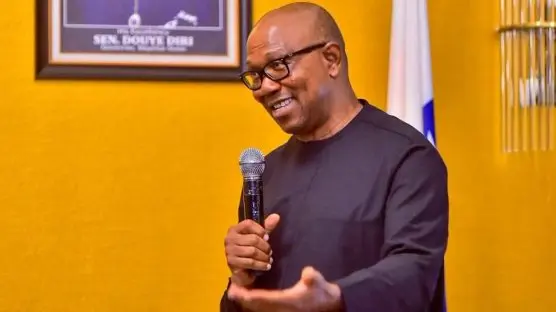
PRESIDENTIAL candidate of the Labour Party for the 2023 election, Peter Obi, has appealed to Nigerians to endure the pains of the ongoing currency swap that the Central Bank of Nigeria (CBN) introduced.
In a series of tweets on his Twitter page on Sunday, the former Anambra State governor said despite the challenges associated with the policy, it had long-term gains.
“The currency redesign is not peculiar to Nigeria. It is an exercise that comes with some inconvenience and pain, but it has significant long-term economic and social benefits even though there are improvements that can be made.
“I urge Nigerians to bear with the CBN and Federal Government with the hope that the general populace and Nigeria will harvest the gains that will come with the reforms,” Obi stated.
He appealed to the CBN and the banks to expedite efforts to make the new currency available to small depositors and those who do not use the banks to reduce the pains the people in the country go through, especially those living far away from banks in the rural areas.
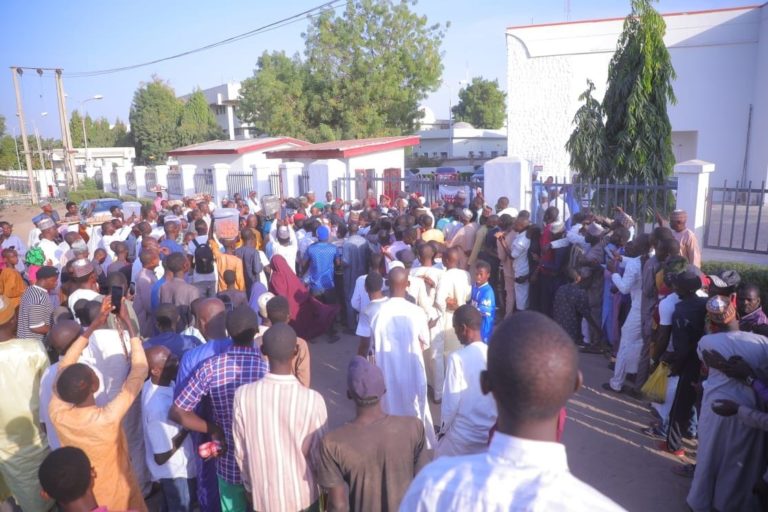
The ICIR reported how people in the country besieged banks because they could not get money.
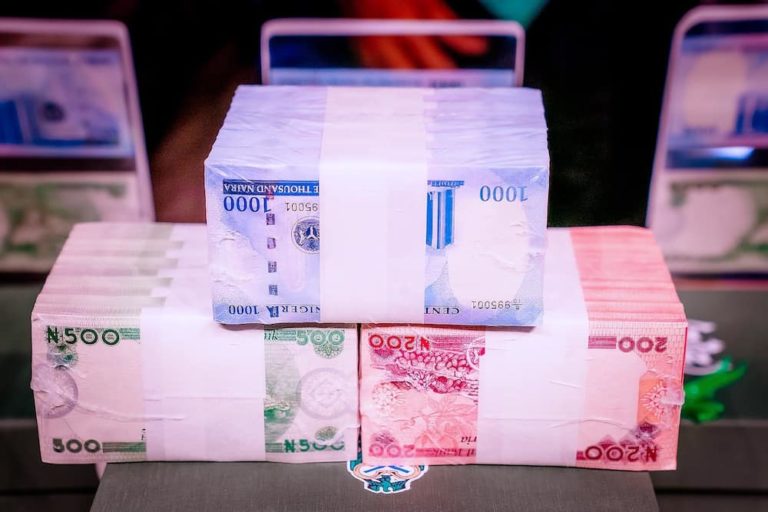
The CBN introduced the new N200, N500 and N1000 notes on December 15, 2022, and initially announced that the old notes would cease to be legal tender from January 31, 2023.
Following pleas and protests from Nigerians, the apex bank extended the deadline by two weeks and said people with the old notes could take them to the bank to exchange for new ones, or save them after the deadline.
Despite the deadline extension, the currency swap has caused multi-dimensional harm to businesses, households and individuals.
Many banks could only issue one N1000 at their counters, while some were giving out bundles of N5 notes.
Many ATMs had no cash in them, while people queued for hours with the hope they would get some money.
Point-of-sale (POS) operators have been collecting commissions as high as ten-fold what they used to charge their customers on cash transactions.
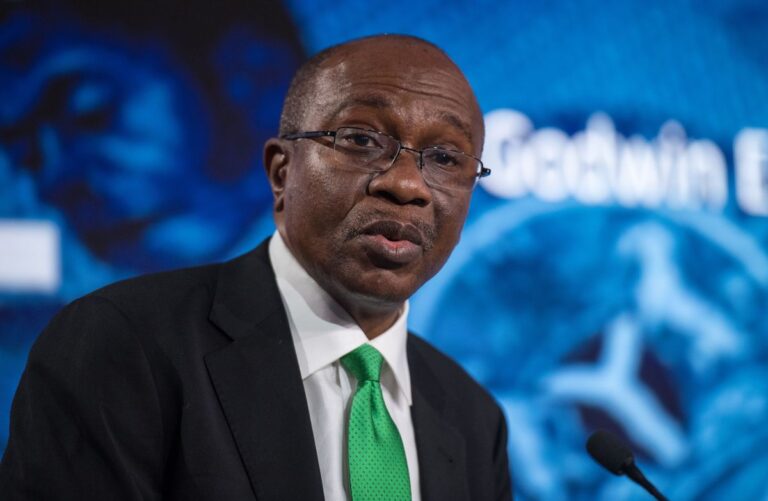
GOVERNOR of the Central Bank of Nigeria (CBN) Godwin Emefiele on on February 3, 2023 said the sum of N2.7 trillion is still hidden in many Nigerian homes, despite the call to return old notes of N200, N500 and N1000.
Emefiele gave the information while fielding questions from journalists on the current crisis being faced by Nigerians in accesssing money from commercial banks and point-of-sale merchants.
He noted that the hidden N2.7 trillion outside the banking vault (not monitored as currency in circulation) had created crisis in Nigeria’s macroeconomics and monetary policy.
“This is why we are appealing to Nigerians to remain calm with us as we resolve challenges of access of the new notes before the set deadline,” he said.
He assured that the current pains being faced by Nigerians would be temporary, while he called for an end to the protest and destruction of banking halls, as noticed in some parts of the country.
“Don’t descend to wanton destruction of bank properties. Those properties are there to serve you. At the moment, we are facing this temporary and transient situation and we crave everyone to remain calm,” Emefiele appealed.
He said that the apex bank was monitoring the situation real-time through the cash and electronic channels.
“We cannot run away from the fact that bank channels can be down sometimes, but we are assuring you that through our consumer protection unit, we are communicatting with the banks and resolving the issues,” he said.
He also called on petrol stations and other essential service providers not to reject transfers from customers, amid concerns of poor network and difficulties in accessing cash.
Nigerians have been going through excruciating pains trying to access their cash from the deposit money banks and PoS agents in the past few weeks.
The CBN currency redesign policy has subjected many Nigerians, their businesses and entire economy into confusion, while threatening lots of livelihood.
The policy initiated on October 15, 2022 by the apex bank to redesign N200, N500 and N1000 was geared towards mopping up unregulated money outside the banking vault, which the CBN estimated to be 80 per cent.
Since the initiation of the policy, there have been distortions in the economy, with businesses facing scarcity of cash from both deposit money banks and PoS.
The gaps in the policy since its initiation has led to scarcity of both the old and new currency, which has led to more than 100 per cent hike in the transaction cost for withdrawal through PoS.
Emefiele, however, assured Nigerians that the consumer protection unit of the apex bank was working to resolve the current challenge.
He disclosed that top CBN officials were in the field to facilitate cash-swap policies (swapping the new notes for the old ones) in some communities.
THE Kaduna State Christian Association of Nigeria (CAN) has demanded the probe of banks hoarding the new naira notes.
In a statement issued by the CAN chairman, Rev. John Hayab, on Sunday, February 5, the association lauded President Muhammadu Buhari for insisting that the 2023 general elections would be devoid of vote-buying.
The association also commended Buhari for extending the swap of the old naira notes by 10 days.
CAN called on the Central Bank of Nigeria (CBN) to do everything possible within its power to ensure that the new notes circulate well to end the stress being faced by the Nigerian masses in accessing them.
Part of the statement read: “Notwithstanding CAN believes that despite the temporary pains Nigerians face, the citizenry is prepared to support the President on the matter of the deadline, especially if it would assist to ease the tension in the country.
“Therefore, managers of banks who are found to hoard the new naira notes to create artificial scarcity, but are behind the public arena helping money-bag politicians to get the new notes, set the public up against the CBN’s new policy; such banks and bankers should be investigated, and if found culpable, be made to face the wrath of the law.
“Nigerian citizens are yearning for the best and should not be made to suffer more hardships. Accordingly, CAN will continue to sensitise and mobilise our faithful to support any programme which its results could bring about good service delivery for a better nation.”
THREE persons may have died after a two-storey building collapsed in Rivers State on Saturday.
The incident occurred at Nbodo Community, Aluu, in the Ikwerre Local Government Area of the state.
According to the Punch, some people were working within the building when it caved in.
Some persons who sustained injuries from the incident were evacuated and rushed to the hospital.
The state’s Nigerian Security and Civil Defence Corps (NSCDC) confirmed the collapse.
Speaking through its Public Relations Officer in the state, Olufemi Ayodele, the Corps, in a statement, said the building collapsed because the builders used substandard materials.
The Corps said preliminary investigation revealed that the rods, pillars and blocks used in the building construction were far below the required specifications.
“The collapse of the two-storey building at Aluu in Ikwerre Local Government Area could have actually been avoided if standardised materials and the right specifications were used.
“Owners of buildings and landlords are hereby advised to be wary of desperate and quack building contractors who care only about their pockets and not the lives of innocent people.
“The Rivers State Commandant lauded the Chairman Ikwerre Local Government Area, Hon. Samuel Nwanosike, for mobilising three pay loaders and providing the necessary logistics.”
The Corps said the council chairman’s effort enhanced the rescuing of the victims and recovery of three corpses during a joint rescue operation by the National Emergency Management Agency, other security agencies, its officers and well-meaning Nigerians.
The building environment has been cordoned and sealed to prevent further disaster, said the NSCDC.
Meanwhile, the Minister of the Federal Capital Territory, Mohammed Bello, has ordered the arrest of some Federal Housing Authority (FHA) officials and the developer of a two-storey building which collapsed in Abuja last Friday, where 23 persons were rescued.
The building collapsed at 6th Avenue in Gwarimpa Estate, with three persons confirmed dead.
MANY dramas have been playing out since the January 31, 2023 date the Central Bank of Nigeria (CBN) initially announced as deadline for recognising the old N200, N500 and N1,000 notes as legal tender in Nigeria.
Many people have been besieging banks daily to get the new notes but have been enraged by what they meet at both the halls and automated teller machines (ATM).
The scarcity of the new notes implies that most people in the country are finding it difficult to transact and will go hungry. Businesses have suffered, and jobs are threatened.
The ICIR reports that scarcity of the new notes has exposed the weaknesses of internet banking in the country, as transactions across the banks’ channels via the internet and Unstructured Supplementary Service Data (USSD) have largely failed.
There are no funds in the automated ATMs, and some banks can only issue a thousand naira at the counter.
Though the CBN directed that banks pay the new notes, some of the banks maintained that the apex bank did not make the money available to them.
On Saturday, The ICIRreported how Borno State Governor Babagana Zulum threatened to revoke the land of banks failing to issue the new notes without credible reasons.
Videos obtained from social media by The ICIR show people fighting or going naked inside banks in protest against the banks’ failure to make the new notes available. There are others where aggrieved customers damaged banks’ infrastructures or laid on banks’ counters to express their frustrations.
Such incidents would pass for an oddity when things were normal.
A man completely goes nude in one of the videos. He claimed to have deposited N520,000 but could not withdraw new notes.
Wailing profusely, he said he had a wife at the hospital he could not cater to. He also claimed to have four and seven-year-old children he could not attend to because he had no money.
The man pleaded that the police officers appealing to him should shoot him so he could die.
“Please, shoot me; let me die so that I can forget my children and wife,” he told the officers.
The policemen and others inside the bank convinced him until he returned to a section of the bank where he had dumped his clothes.
In another video, a woman went half-nude in a bank. He had only her bra and tight shorts on.
She said, “Close my account; I don’t need it again. Return my money, I don’t need the account again. My children did not go to school yesterday. They did not also go today.”
There are also two videos of students and soldiers fighting at the University of Benin.
In the first, soldiers and students clashed after the students allegedly stopped the soldiers from jumping the queue at one of the ATMs in the university.
In yet another video, some men engaged each other in a banking hall, flinging every available object at each other.
Videos have also emerged of Nigerians protesting the naira scarcity in Oyo State.
It is unclear what more dramas will unfold in the next few days as President Muhammadu Buhari requested seven days to attend to the issue when governors elected on his party – the All Progressives Congress – visited him in Abuja on Friday, February 3.
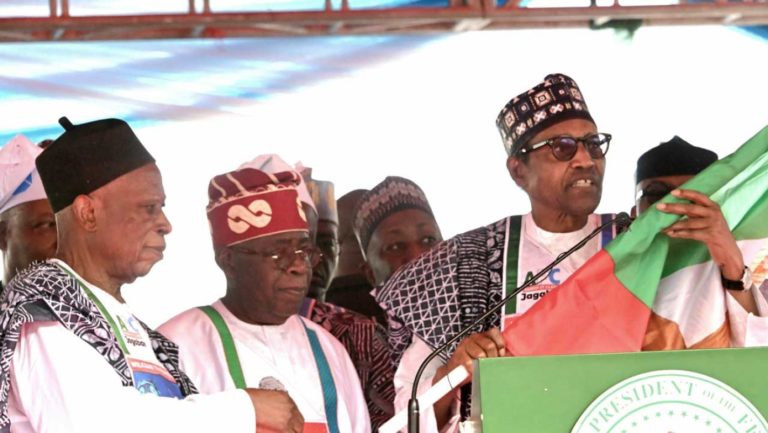
PRESIDENT Muhammadu Buhari on Saturday joined the All Progressives Congress (APC) presidential campaign in Nasarawa State to campaign for its candidate, Bola Tinubu.
Buhari, addressing the crowd, assured them that the APC would win the presidency, as the Nasarawa State Governor, Abdullahi Sule, would win his second term bid.
The president said, “I assure you that God willing, we are going to win through and through. I will continue to campaign for Bola Ahmed Tinubu. He is a committed Nigerian. I believe he will give all he has to this country.”
Earlier, Tinubu had expressed delight that the president attended the campaign. He said those thinking there could be cracks in his friendship with Buhari would continue to be disappointed.
“Ours is not about individuals; it is about nation-building. It is about honesty, integrity and character,” he quipped.
The former Lagos State governor described Buhari as “a great man of political credentials.”
He said the president’s administration had been turbulent because of the crisis in the country.
According to him, no one ever thought a former military general like Buhari would be democratic.
He likened Buhari to a former United States President, Abraham Lincoln, whom he said endured civil war and other unrests and yet built infrastructures.
“There are only very few leaders who faced dissidents, civil disobedience and civil war and at the same time continued to build infrastructure. One of them in that class is Abraham Lincoln.
“You will join the history of those men. Great men. Courageous men who can stay focussed in the midst of distractions and enemies,” Tinubu told Buhari.
The APC candidate promised to invest in agriculture and create wealth by exploring the nation’s resources more if elected president.
Describing Nigeria as a great nation, he said the country would recover from its challenges.
Tinubu faces candidates of the Peoples’ Democratic Party (PDP) Atiku Abubakar, Labour Party’s Peter Obi and New Nigeria Peoples Party’s Rabiu Kwankwaso, among others in the presidential election coming up on February 25 this year.
BORNO State Governor Babagana Zulum has threatened to revoke the land of any bank that starves people in the state of the new naira notes.
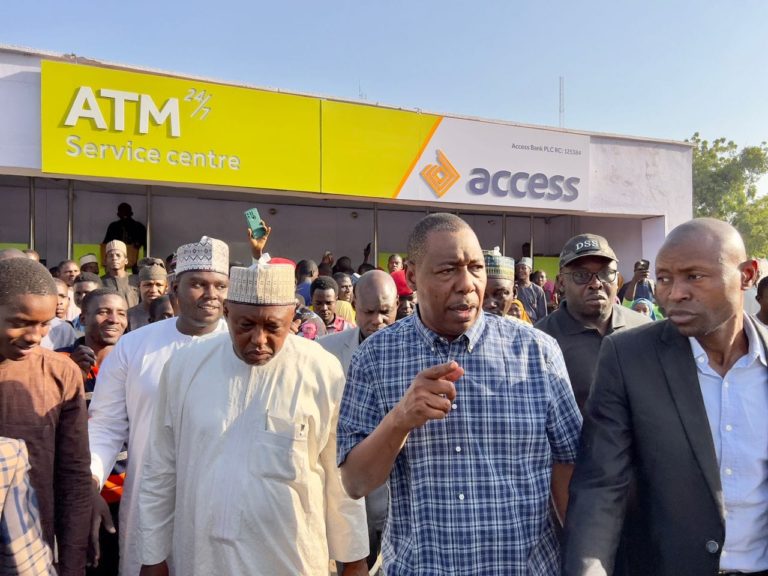
Zulum issued the threat on Friday after visiting 10 automated teller machines (ATMs) in the state and observing they had no cash to dispense, as hundreds of people queued for the money.
The governor said his government would spare only banks with genuine reason(s) for not dispensing the notes.
A large crowd of Borno residents queuing for money at the ATM of a new generation bank in the state when Governor Babagana Zulum visited on February 3, 2023.
The Central Bank of Nigeria (CBN) introduced the new N200, N500 and N1000 notes into circulation on December 15, 2022, and announced that the old notes would cease to be legal tender from January 31, 2023.
Following pleas and protests by Nigerians, the apex bank extended the deadline till February 10 and said people with the old notes could take them to the bank to exchange for new ones or save them after the deadline.
Despite the deadline extension, the currency swap has caused multi-dimensional harm to businesses, households and individuals, with the 2023 general elections three weeks away.
Many banks could only issue one N1,000 at their counters. Some gave out bundles of N5 notes.
Many ATMs had no cash, while people queued for hours, hoping they would get some money.
Point-of-sale (POS) operators have been charging as high as ten-fold what they used to charge their customers – a development that has worsened the crisis.
The ICIR reports that many people had hurriedly taken all the old notes on them to the bank before the initial deadline. But getting a fraction of what they saved in new notes has been impossible.
Network failure and a complete shutdown of internet banking services are commonplace across the country, leaving most of the nation’s nearly 220 million people in a desperate search for cash.
Zulum, in a statement on his social media page Saturday afternoon, expressed sadness seeing hundreds of people queuing at a bank’s branch, with only one out of 10 ATMs dispensing cash.
Governor Babagana Zulum sympathised with Borno residents who had waited for hours at a new generation bank in the state on Friday, February 3, 2023
“As you can see here, only less privileged people are queued up. I didn’t see rich people here. Many people are said to be here since 3am. Some could not even eat anything. The new naira note and even the old ones are not available, and that is adversely affecting commercial activities in the state. People are suffering,” Zulum decried.
He added, “We just released salaries of about N5 billion, and the banks don’t have money. Some of the ATMs are not working. We don’t have any problem with the CBN policy or the withdrawal limit. They said individuals could only withdraw N20,000, but why can’t everyone have access to that N20,000?”
According to him, he was in Gubio, a community he said had over 70,000 people, but it was impossible to source N100,000 in the entire local government.
The governor was sad that neither the new notes nor the old notes was available for people to collect.
He explained that a ram worth N100,000 was being sold for N35,000 because people were desperate for cash, “and some wicked rich people are going to rural areas to exploit poor people.”
The governor urged the CBN to ensure the availability of new notes at commercial banks for people to access their money.
When the federal government commenced the Zauro polder irrigation project in 2007, the hope of the farmers in the community was that the project would ease irrigation farming. However, over 15 years after, the project is yet to see the light of day, exposing farmers in the community to more difficulty. The ICIR’s Nurudeen Akewushola reports.
Zauro Polder irrigation project is a joint venture project between the Federal Government of Nigeria and the Kebbi State which was targeted at developing an irrigation scheme within the Fadama area of Argungu and Birnin Kebbi covering about 10,572 hectares of farmland.
The project is expected to ease farming in Kebbi communities and generate employment opportunities and increase the country’s food production.
According to a 2017 verification report by the fiscal responsibility commission, a body saddled with promoting transparency and accountability in the government’s financial management, the project has been abandoned despite multi-million naira spent on it.
According to the report, the project contract was signed between the Federal Ministry of Water Resources and CGC Nig. Ltd. at the contract figure of N18,585,949,298.53 on May 22 2007, and an advance payment of ₦3,975,586,275.00 was paid to the contractor.
In 2016, N207,585,600.00 was appropriated for the project, but only ₦157,000,000.00 was released and utilised according to the report.
However, despite the budgetary allocations, the investigation by The ICIR shows that the project has not been completed in over 15 years despite the immense benefits it could have been for the people of the community.
The project site of Zauro Polder Irrigation Project
When The ICIR visited the site of the project in Birnin Kebbi in November 2022, there was no visible infrastructure on the ground, and there was no signage indicating that the project has been executed or is still ongoing.
Peasant farmers frustrated
Peasant farmers who spoke with The ICIR in Zauro town narrated how they struggle to facilitate farmland irrigation despite billions of naira spent by the Federal Government on the construction and provision of the irrigation system.
The farmers in Zauro cultivate rice, millet, watermelon and other Agricultural product. They narrated how they spend a large chunk of their income on manual irrigation systems and boreholes despite the scarcity and high cost of fuel in the country.
A section of the river gradually drying as dry season approached in November, 2022
Expressing his frustration, Umar Bawa, a peasant farmer in Zauro said the failure of the government to complete the project is creating a crisis for the farmers as the river dries faster than before.
Umar Bawa
“What they told us is that they would build a dam that will help farmers to do irrigation, but yet the project remains incomplete for reasons not known to us, and our expectation is that the project is meant to reserve water to help us to do irrigation farming.
“Before they brought this project, water can last long within the Fadama during the rainy season, but now there’s rapid drying of water. This is because the project remains abandoned.
“If the Federal Government can intervene to complete this big project, many irrigation farmers will be happy, for example, places like Mafara of Zamfara and Kano State have similar issues, but their governments build a dam to enable irrigation farming where they create mutual benefits between the farmers and the government whereby the farmers are paying taxes to the government for the maintenance of the dam, and if our government can do so, we can feed ourselves, state and neighboring state,” he said.
Fifty-six-year-old Muhammad Sani Sardauna explained that before the project was initiated, people normally travel to nearby villages such as Gulma, Birnin lafiya, Sawwa, among others, with the aid of boats but that cannot happen anymore due to rapid drying of the river.
Sardauna
Sardauna added that if the government completes the project it will help irrigation farming as farmers will be using the dam as a source of water for their farms.
One of the leaders of the farmers in the community, Bagudu Bahillace, 60, explained that the project has been long planned, and it was revived by the former senator in the state, Adamu Aliero, but it was unfortunately stopped.
Bagudu also explained that he relied on watering machines and local boreholes as a source of water as the uncompleted project now causes rapid drying of the Fadama area.
Bagudu
Bugudu reflected on several attempts to reach the government, which proved abortive. With a voice that reflects loss of hope, he said:
“I don’t have any call to the government because, we tried several times, but it proved very abortive. We don’t have trust in government’s interventions because they do not fulfil their promises.
Nigerian government and failed interventions
Irrigation practices enable year-round farming, but several Nigerian farming communities still lack quality irrigation.
Farmers find it difficult to access water for dry season farming even as the federal government spends billions of Naira on dams and irrigation projects.
Nigeria is endowed with vast Arable land. A total of 3.4 million hectares of land has irrigation potential in Nigeria. A large part of it is in the North. However, only 169, 718 hectares currently benefit from the irrigation practice despite acute food insecurity in the country.
In most rural communities in Nigeria such as Zauro town, farmers are often jobless during the dry season due to a lack of access to water.
Zauro irrigation project joined the list of several abandoned government dams and irrigation projects which are not beneficial for the residents.
A 2018 investigative series by The ICIR detailed how farmers struggle to access water for dry season in several parts of the country despite billions spent on dams and irrigation projects. Similarly, a 2021 investigation exposed how irrigation project wastes away in Bauchi, Jigawa and Kano states,
In 2022, The ICIR investigation exposed how the abandoned Katanga dam in Nasarawa threatened livelihood and how the uncompleted Shagari dam causes trouble for residents of Sokoto.
Contractor evades scrutiny
As earlier stated, Zauro polder Irrigation project was awarded to CGC Nigeria Limited in 2007 at a contract sum of N18 billion.
The CGC Nigeria Limited is a Chinese company headquartered in Abuja. A search on the website of the Corporate Affairs Commission shows that the company is inactive. Though it was not certain whether the company was active when it was awarded the project in 2007.
A further search on NG Check shows that it’s a company registered on December 8, 1992, with a registration number RC 210299. It was incorporated in Kaduna.
CGC Nigeria Limited office
The company specialises in Borehole Drilling and Water Works with its registered office address located in Plot 3016 Katampe Hill, Kubwa Road, Abuja.
Information on its LinkedIn says it specialises in the construction of Roads and Bridges, Agriculture, Mining, Water Supply, Irrigation, Drilling, Real Estate, Manufacturing and Trade and it has about 1000 employees.
The Directors of the company are Ji Weimin, Ye Shuijiin and Li Xuhui.
This reporter visited the office of the company in Abuja to submit an FOI request about the details of the project and to speak with the contractor on how the company spent N3bn it received and why the project failed, but this reporter was denied access to the company despite valid proof of being a journalist which was provided upon request.
Copy of FOI request sent to CGC Nigeria Limited
A security man who identified himself as Musa Aliyu confirmed the reception of the letter on January 9, 2022 and told this reporter contractors said they would contact The ICIR, but there is no response as of press time.
The FOI Act (FOIA) 2011 states that response to information requests should be made available promptly, but in any event, not later than seven days from the date of receipt of the request.
Section 2(7) of the act provides that the act is applicable to private companies such as CGC Nigeria Limited utilizing public funds or providing public services or public function.
On November 17, 2022, The ICIR wrote a Freedom of Information (FOI) request to the Federal Ministry of Water Resources to establish the details of the projects and two other projects that were facilitated by the ministry.
The required information includes the contract description, the date of advertisement and media organisation the notice was placed, the approved threshold, procurement method, the bid opening date, name of the contractor, and the date the contract was awarded.
Others are the contract period, contract value, budgetary provision, amount paid for the contract, and the level of completion of the projects.
The letter was acknowledged but it’s only the details of one project in the letter that was acknowledged; the remaining two were not responded including details of Zauro polder Irrigation project.
This reporter visited the ministry of water resources five times to follow up with the request, and it was confirmed that the letter has been delivered to the office of the Director of Irrigation. However, this reporter was always asked to check back again anytime he visits the ministry.
File showing the reception of The ICIR letter by ministry of water of resources on November, 22.
On January, 23 this reporter visited again, but the officials in the office again said he should check back as one Engineer Usman who was supposed to provide the details was not on the seat. This reporter asked for his contact details, but the officers refused to disclose it.
The ICIR has earlier reported how Nigerian government agencies flout the FOI Act despite annual budgetary provisions and how it could hamper accountability governance in Nigeria.
Copy of the FOI request sent by The ICIR to the Federal Ministry of Health
The FOI Act provides that a response to the request of an applicant should be submitted within seven days, with a reminder of an additional seven days. Otherwise, such agency of government is considered to have breached the law.
Section 2 Subsection 4 of the Act states that such public information as requested by The ICIR should be “widely disseminated and made readily available to members of the public through various means, including print, electronic and online sources, and at the offices of such public institutions.”
Section 4(b) of the act states that in a case where a public institution such as the ministry of water resources considers that the application should be denied, the institution shall give written notice to the applicant that access to all or part of the information will not be granted, stating reasons for the denial, and the section of this Act under which the denial is made. However, the ministry do not provide any justification.
The FOI Act was signed into law on 28 May 2011 to make available, more freely, public information, and protect such information in order to promote accountability in government and aid the decision-making process but public institutions such as the ministry of water resources have continued to disregard the provisions of the law.
THE presidential candidate of the Social Democratic Party (SDP), Adewole Adebayo, has said many Nigerians across the country would vote for him in the forthcoming presidential election.
Adebayo said this at a Twitter space organised by The ICIR on Friday while responding to questions on the visibility of his party among other political parties in the country.
“I can’t tell those people (people who believe SDP is not visible) to educate themselves. They should go around the country and not assume what they are discussing in their house or in their group is what’s going on all around the country.
“Today, I have attended up to 1,810 events that have taken place today. People marching on the street, people canvassing around and all of that. So, I’m aware that everybody knows. I have more than three meetings today as a presidential candidate and my VP has gone round the country,” he said.
Adebayo accused other political parties of paying for publicity and followers.
“I believe people who are going to the ballot know how to find the white horse and you will see how they will vote for us,” he said.
THE presidential candidate of the Social Democratic Party (SDP), Adewole Adebayo, has outlined security, education and eradication of poverty as his main priorities if he emerged the president of Nigeria.
Adebayo said this while responding to questions at a Twitter space organised by The ICIR on Friday.
He said Nigeria’s problem was easy to solve but successive Nigerian governments lacked the right approach to tackle them.
“I would work towards eradication and not alleviation of poverty. Nigeria is rich enough not to have poor people around. If you have 133 million people of your citizens in poverty, there is no greater agenda. You can’t look away,” he said.
He further pledged to make education affordable, bridge infrastructural gaps in schools and create jobs for young people.
On insecurity, he said, “I would make everyone safe. Nobody would be running away from bandits and terrorists,” he said.