A TOTAL of 27 migration ministers under the European Union (EU) are meeting to review strategies to curb irregular migration which has continued to soar, posing economic challenges for the continent.
EU border agency Frontex reported some 330,000 unauthorised arrivals last year, the highest since 2016, with a sharp increase on the Western Balkans route.
About 160,000 people are believed to have crossed the Mediterranean to Europe in 2022, fleeing wars and poverty in the Middle East, Africa and Southeast Asia.
European Commissioner for Home Affairs Ylva Johansson, said on Thursday that the increase in irregular arrivals of migrants was huge and the bloc received 924,000 asylum applications, but the return rate remained low and the meeting was to discuss ways to make “significant progress” in deportation.
“That means we have three times more asylum applications than irregular arrivals, and these are overloading the reception capacities and many of those [migrants] are not in need of international protection,” she said.
Denmark, the Netherlands and Latvia were among those to call for more pressure through visas and development aid towards the roughly 20 countries – including Iraq and Senegal – that the EU deems fail to cooperate on taking back their nationals who have no right to stay in Europe.
The ministerial talks come ahead of a February 9-10 summit of EU leaders who will also seek more returns, according to their draft joint decision seen by Reuters.
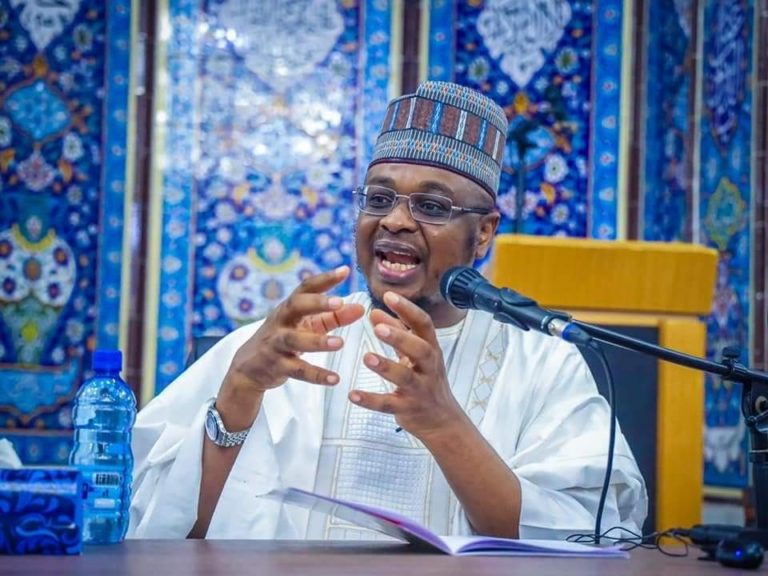
EUROPEAN hackers made 66 attempts to compromise virtual meetings held by the Federal Executive Council (FEC) in the last three years, according to Isah Pantami, the Minister of Communications and Digital Economy.
The minister disclosed this at the 19th edition of the President Muhammadu Buhari (PMB) Administration Scorecard Series (2015-2023) in Abuja on Thursday, January 26.
Pantami said the federal cabinet held over 108 virtual meetings since the unveiling of the National Policy on Virtual Engagements for Federal Public Institutions in October 2020.
He disclosed that 66 attempts were made by European hackers to compromise the meetings.
However, according to him, the attempts were successfully thwarted while the hackers were reported them to the authorities.
Pantami also said the Federal Government created more than 2.2 million jobs in the digital sector despite the nation’s telecommunications challenges.
He attributed the telecommunications problems to infrastructure deficit and vandalisation of fibre optic cables, noting Nigeria recorded 13,000 vandalism cases in a particular year.
Speaking further, Pantami said the government is working to stop criminals from using technology to commit crimes.
“Our role in cyber security is to ensure we minimise the possibility of a criminal deploying technology to commit a crime. So our work is proactive. At the same time, if the offence is committed and our intervention is required officially, then we will intervene.
“So, here, when it comes to minimising the probability of criminals committing a crime, we need to reintroduce the national NIN and civil registrations. Two, we enforce the NIN registration. NIN registration is by our law in Nigeria. NIN is mandatory for all citizens,” he said.
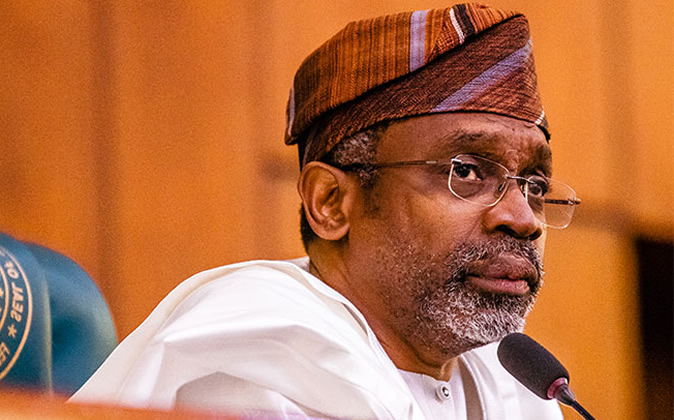
THE Speaker of the House of Representatives, Femi Gbajabiamila, has threatened to issue a warrant of arrest on the Governor of the Central Bank of Nigeria (CBN), Godwin Emefiele, if he fails to appear before the House committee investigating the scarcity of the redesigned naira notes across the country.
Most Nigerians have complained of the slow circulation of the redesigned N200, N500 and N1000 notes, with the deadline to the expiration of the old notes five days away, on January 31.
Many Nigerians have also expressed worry that most commercial banks’ automated teller machines (ATM) are not dispensing the new notes as expected.
In a bid to resolve the seeming crisis, the lawmakers had set up a committee to investigate these claims and seek ways to resolve them.
On Wednesday, January 25, the committee invited Emefiele for him to explain issues around the scarcity, but he failed to appear before it.
Expressing his displeasure at the CBN governor for that failure, Gbajabiamila said he would not hesitate to ask the Inspector-General of Police to arrest him.
He said instead of the House adjourning plenary till February 28 for the elections as planned, the lawmakers would reconvene on Tuesday to take an action against Emefiele and other bank chiefs who failed to show up.
He informed the house that the CBN had written to the Clerk, informing the House of Emefiele’s failure to appear before the committee on Thursday, January 26. The Speaker said the House would exercise its powers as contained in Section 89 of the 1999 Constitution.
Gbajabiamila also noted that the CBN Act allows the admittance of an old naira note by banks, even after it had ceased to be legal tender.
The House, besides asking the CBN to extend the window for spending the old notes while the redesigned ones take firm circulation root, had also invited bank chiefs to a meeting on Wednesday, January 25 over scarcity of the new naira notes.
SOME point-of-sale merchants (PoS) have resorted to increasing the commission on transactions regarding the new notes by 100 per cent barely five days to the expiration of the old N200, N500 and N1000 as legal tender.
The ICIR investigations today revealed that as most Nigerians scramble in a last-ditch effort to obtain the new notes, PoS merchants who have those notes are already making brisk business from them.
For a cash withdrawal of N5,000 that normally attracts a N100 commission, some PoS merchants with the new notes are now charging N200, just as they have upped the normal commission of N200 on a N10,000 withdrawal to N400.
“We are still not getting enough of the new notes from the banks. Even getting these new notes is a business secret now.That is why I have to increase my cost of transaction. I don’t even know how soon I will get new ones when I run out of these,” a PoS merchant, Yusuf Abdulraman, told The ICIR.
Yusuf attending to a client in Kubwa market
Abdulraman said he would stop collecting old notes on January 29, 2023, citing uncertainties surrounding slow circulation of the new notes as a reason.
Another PoS merchant, Nkemdirim Okafor, operating in the Kubwa area of the Federal Capital Territory, told The ICIR that he and his colleagues were not getting sufficient new notes from the banks, citing it as a reason for the 100 per cent rate hike.
“I have to do the rate hike to sustain my business. As we speak, people are still coming and looking for the new notes. I don’t even have much of them,” she said.
Checks with some other PoS merchants in Nigeria’s capital, Abuja, indicated many of them had also set target dates to stop collection of the expiring notes.
“By Sunday, I will stop collecting the old notes. Banks are still issuing the new to us sparingly, lower than what was requested,” another PoS merchant, Uju Ezenwa, at the Central Market in Kubwa, Abuja, told TheICIR.
There is widespread concern across the country as the legal tender deadline for the old notes gradually sets in. Many automated teller machines (ATMs) our correspondent visited this week were not dispensing the new notes at all. A few of them seen dispensing, like the Stanbic IBTC branch on Ajose Adeogun Street, Victoria Island, Lagos, were giving out only the redesigned N1,000 note.
First Bank ATM in Kubwa with people on long queue for new currency
Many citizens said they were yet to set their sight on the redesigned N200 and N500 notes.
Arising from the deadline concern nationwide, the two chambers of the National Assembly at plenary on Tuesday, January 24, 2023, asked the Central Bank of Nigeria (CBN) to extend the street life of the old notes.
The House of Representatives and the Senate, in separate resolutions, on Tuesday asked the apex bank to extend the deadline till July 31, citing possible economic dislocation of several unbanked Nigerians in their constituents.
Besides the National Assembly, Governor Samuel Ortom of Benue State also on Wednesday, January 25, 2023, called for the extension of the deadline, saying even he was yet to see the newly redesigned notes.
Meanwhile, the CBN has denied scarcity of the new naira notes, as is the complaint by some Nigerians.
The CBN Governor, Godwin Emefiele, represented by its Director, Payment System Management Department, Musa Jimoh, debunked the scarcity allegation in a news conference held on Wednesday, January 25, 2023 in Jos, the Plateau State capital.
”The CBN has massively supplied the new notes to commercial banks to dispense, both at counters and ATMs.
”This is to enable quick circulation, and we want to advise commercial banks to desist from keeping the cash away from the public, or face stiffer sanctions,” Jimoh said.
Emefiele advised citizens to deposit their old notes at any commercial bank and acquire new ones with immediate effect, while insisting that the January 31 deadline remained sacrosanct.
The CBN governor explained that the decision to redesign the currency showed that the apex bank was in tandem with global standard, adding that currency notes ought to be redesigned every five years.
Speaking during a ‘monitoring and sensitisation’ exercise held in some locations in Jos on Wednesday, January 25, Emefiele said that the decision to redesign the country’s higher denominations of currency was a national project aimed at addressing problems related to cash circulation.
He added that it would also solve the challenge of prolonged savings in piggy banks, cash hoarding, and incidences of fake currencies.
“The Monitoring and Sensitisation project was activated by the apex bank for investigation of the attitude of banks towards the spread of the new currencies.
”We are equally using it to create awareness on the use of agents to circulate the cash in communities with few or no bank branches available,” he explained.
He advised that distorted currencies should be returned to banks for replacement, and cautioned people entertaining the thought that the apex bank might extend the deadline to banish such thinking as they could face losses.
NIGERIAN inmates in Kaliti prison, a maximum security prison in Addis Abba, Ethiopia, have called on the Federal Government to facilitate their transfer to prisons in Nigeria.
The inmates are asking to be allowed to serve the rest of their jail terms in Nigeria.
The detainees said they suffer grave human rights abuses in prison.
There are over 200 Nigerians in the Ethiopian prison facility, some of whom are still awaiting trial.
In a letter addressed to President Muhammadu Buhari and the Nigerian embassy in Ethiopia, the inmates appealed to the Federal Government to come to their rescue.
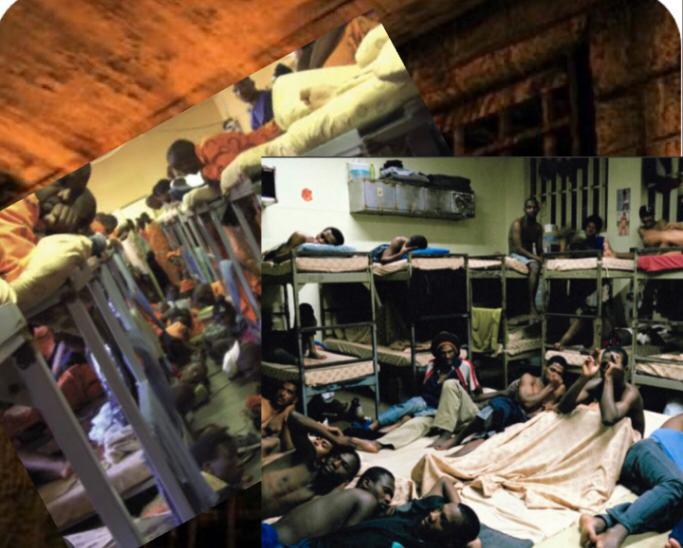
They complained of starvation, lack of access to medical care, corporal and capital punishment, and overcrowding.
“The Nigerian inmates in Kaliti maximum prison Ethiopia are soliciting help from the Nigerian government; we ask that the government come to our aid urgently.
“We lack access to water, food and medical care.
“We are asking the government to intervene so we can serve the rest of our jail terms in Nigeria. Many of us have fallen ill due to malnourishment, the health infrastructure is weak, and inmates are suffering from precarious health issues,” parts of the letter read.
The inmates said communication with families and friends outside Ethiopia is impossible.
They expressed remorse for their actions and appealed for a “second chance at rehabilitation”.
This is not their first appeal for a transfer to a Nigerian prison facility. In 2021, the detainees had decried their poor living conditions, begging for the Federal Government’s intervention.
Also in 2019, one Chika Nwachukwu raised the alarm over the horrible condition of Nigerians detained in the facility. However, their efforts did not yield the desired result.
There are multiple reports detailing the travails of Nigerians incarcerated in the Kaliti prison. The inmates are reported to be enduring conditions at odds with human rights standards.
In August 2019, a Nigerian detainee Odemu Efe reportedly died due to an undisclosed ailment at the facility.
The prisoners are in cramped and dirty quarters, with insufficient food allocations, horrible hygiene with little or no clothing and other amenities.
Authorities speak
The government can push for the transfer of a prisoner from Ethiopia or any other country to Nigeria only through diplomatic means, according to AbdurRahman Balogun, spokesperson of the Nigerians in Diaspora Commission (NiDCOM).
The NiDCOM spokesperson was responding to enquires by The ICIR concerning the Nigerian inmates’ request for repatriation.
Balogun said the transfer or swapping of prisoners is under the jurisdiction of the Ministry of Foreign Affairs and involves memoranda that have to do with Diaspora prisoners.
He disclosed that the government had established a committee headed by the Ministry to draft the MOUs. He, however, could not ascertain how much progress the committee had made.
“I understand that some Nigerians have a difficult time in foreign prisons because of the condition of living. The government has set up a high powered committee headed by the minister of Foreign Affairs and minister of Internal Affairs, and chairman Diaspora Commission and the like.
“The transfer of prisoners to Nigeria is diplomatic and bilateral and is strictly in the hands of the Ministry of Foreign Affairs.
“Prisoner swapping is under Foreign Affairs, and as far as I know, the high powered committee is working on drafting memoranda that have to do with Diaspora prisoners.
“Nigeria cannot interfere in the internal affairs of another country except through diplomatic means. And the government can only do that if there is an important reason for it,” the NiDCOM spokesperson told The ICIR.
The NIDCOM spokesperson also noted that it is within the rights of Diaspora prisoners to raise the alarm and call for help from the government if their fundamental human rights are being violated or abused.
When The ICIR reached out to the Ministry of Foreign Affairs, the Ministry’s spokesperson, Francisca Omayuli, said efforts are being made to resolve the issue.
Omayuli said the Ministry was liaising with Ethiopian authorities on the matter.
He noted that the Nigerian prisoners’ requests can be achieved using legal frameworks.
“The Nigerian government is already engaging the Ethiopian authorities to ensure an amicable resolution of the matter.
“The plea for a transfer is practicable and desirable, but it requires a legal framework to be in place, and Nigeria is working towards that,” she said.
THE Independent Corrupt Practices and Other Related Offences Commission (ICPC) has re-arrested a former Registrar of the Joint Admission and Matriculation Board (JAMB), Adedibu Ojerinde.
Ojerinde, a professor, was re-arrested on Thursday, January 26, following a warrant issued by the Federal High Court, Abuja.
This was disclosed in a statement signed by the spokesperson of ICPC, Azuka Ogugua.
Ojrrinde is expected to face a team of investigators over new evidence uncovered concerning his ongoing trial for the diversion of funds while he was a public officer.
Parts of the statement read, “ICPC operatives uncovered two accounts opened in the names of Trillium Learning Centre Ltd and Sapati International Schools Ltd into which funds were diverted using fictitious names of students.
“The Commission had, on the 12th December 2022, invited the former JAMB Registrar for questioning over the new evidence, but he wrote through his solicitor requesting for 14 days grace to enable him honour the invitation. Ojerinde, however, refused to honour the invitation as undertaken by his counsel after the expiration of the 14 days grace on 27th December 2022.
“In the course of its ongoing investigation, the Commission unearthed new evidence that suggests that Ojerinde is the sole signatory to various bank accounts operated in the name of Trillium Learning Centre Ltd and Sapati International School Ltd. Ojerinde reportedly operated those accounts using false identities and forged documents in the names of Joshua Olakulehin Olaniran and Akanbi Lamidi respectively.”
The Commission said Ojerinde also reportedly used another false identity, Adeniyi Banji, to operate a separate account in the name of Standout Institutes Ltd.
The ICPC added that it had recovered the cheque books of the companies’ accounts from Ojerinde, who has been taken into custody at the Commission’s headquarters.
The Commission said it will prosecute the former Registrar before a court of competent jurisdiction for offences bothering on forgery of documents, stolen identity, money laundering and concealment of gratification if the new evidence is confirmed.
The ICPC is currently prosecuting Ojerinde at the Federal High Court Abuja and Federal High Court Minna on an 18-count charge bordering on abuse of office and fraud to the tune of about N10 billion while serving as heads of two government agencies, the National Examination Council (NECO) and JAMB.
According to the ICPC, Ojerinde had allegedly conferred corrupt advantages upon himself at different times while being Head of JAMB and NECO, thereby violating Sections 19, 24, 25 (1) (a) and (b) of the Corrupt Practices and Other Related Offences Act 2000 and Section 1 (1)(b) of the Advance Fee Fraud Act, 2006.
On March 15th, 2021, ICPC arrestedOjerinde for allegedly misappropriating N900 million.
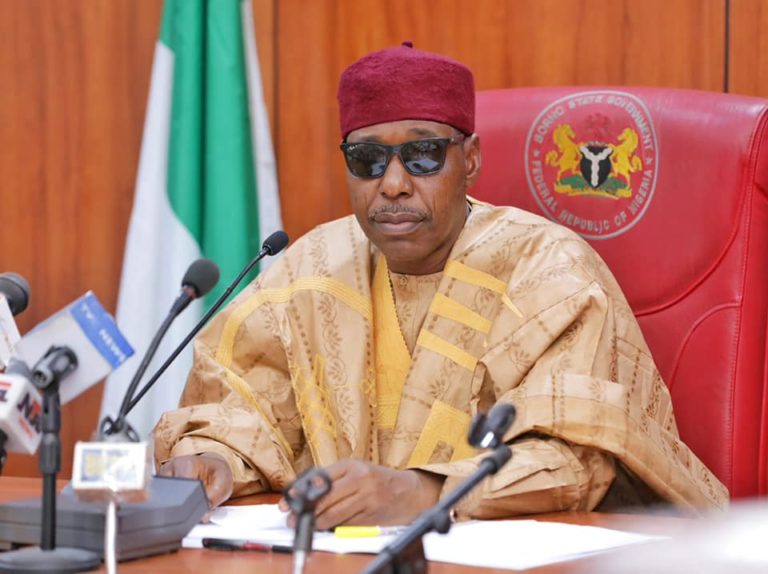
BORNO State Governor Babagana Zulum has directed the immediate expansion of the state-owned Borno Renaissance Microfinance Bank to the state’s 27 Local Government Areas (LGAs).
The order followed the Central Bank of Nigeria (CBN) announcement on October 26, 2022, and its insistence that the old Naira notes of N1000, N500 and N200 would cease to be legal tender from January 31, 2023.
Zulum revealed that only two LGAs, Maiduguri and Biu, had banks operating in them since the Boko Haram insurgency hit the state over a decade ago.
He said the currency swap (changing old notes for new ones) would affect people of the state because they needed access to tender the notes with them and collect new ones before the January 31 deadline.
The governor directed the state Ministry of Finance and its counterpart in Higher Education, Science, Technology and Innovation to, in accordance with regulatory procedures, ‘hastily’ establish branches of the microfinance bank, as well as/and information and communication technology (ICT) centres across the state’s LGAs.
Zulum gave the order in a statement published on Thursday on his Facebook Page during an extraordinary stakeholders’ meeting in the state on Wednesday.
He said the ministries should establish the microfinance bank branches this week in Monguno and Gwoza Local Government Areas, if possible.
The governor decried the impact of insecurity in the state and how it has scared investors, including those in the banking industry.
“Despite a great improvement of the security in Borno, there are still challenges for banks to start operations. Banking is a very delicate industry, and I am sure none of them is willing to take the risk of establishing branches in our LGAs for now.
“Therefore, to support our people, Borno State Government has to take the risk. I have directed the ministry of finance to ensure the recapitalization of Borno Renaissance Microfinance Bank to qualify it to have the capacity to open branches in all the 27 LGAs. This, I believe, will greatly alleviate the suffering of our people,” he said.
The governor also directed the Ministry of Finance to immediately develop a template to organize and ensure people in rural communities deposit their old naira notes before January 31 deadline.
Besides, he directed the Ministry of Higher Education, Science, Technology and Innovation to support mobile telecommunication providers towards improving their network coverage for internet connectivity across all 27 local government areas.
The ICIR reports that the CBN has maintained its stance on the deadline for using the old notes as legal tenders.
The Senate had on Tuesday, January 24 appealedto the CBN to extend the deadline to the end of July this year.
But in a swift response the same Tuesday, the apex bank stood its ground.
Meanwhile, the House of Representatives on Thursday vowed to compel the Inspector-General of Police, Alkali Usman, to arrest the CBN Governor Godwin Emefiele because he shunned the House invitations seeking his explanations on the currency swap.
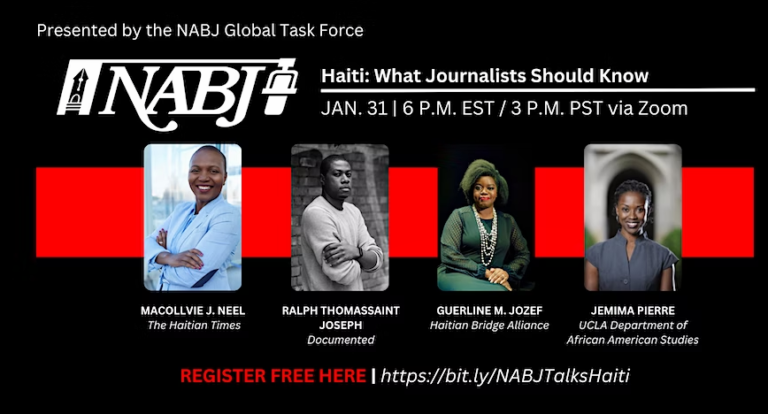
The webinar panel features leading editors, reporters, academics.and advocates who have extensive experience working with Haitian communities on the island and in the United States.
They will present tips and critical information for those interested in knowing more and carrying out trauma-informed reporting on the country and migration.
Journalists interested in carrying out trauma-informed reporting on Haiti can register for a free webinar.
The online event will be held on January 31, 2023.
Registration is ongoing and interested applicants can apply here.
ON May 29, Muhammadu Buhari will cease to be Nigeria’s President and will, expectedly, hand over to his successor.
When he hands over, it will be without disclosing the identities of individuals and companies that his administration said it had uncovered as financing terrorism in Nigeria and had promised to expose.
On assuming office in 2015, President Buhari promised to make security and the economy the focal points of his administration, as he admitted that insecurity was part of the major challenges facing the country.
He vowed to defeat Boko Haram insurgents in the north of the country by providing government forces with better equipment and lots more.
“I will urgently secure the territorial integrity of the nation. I will never leave the defence of the nation in the hands of hunters, children, and civilian JTF,” were some of the promises of the Buhari campaign that ran on a ‘CHANGE’ mantra.
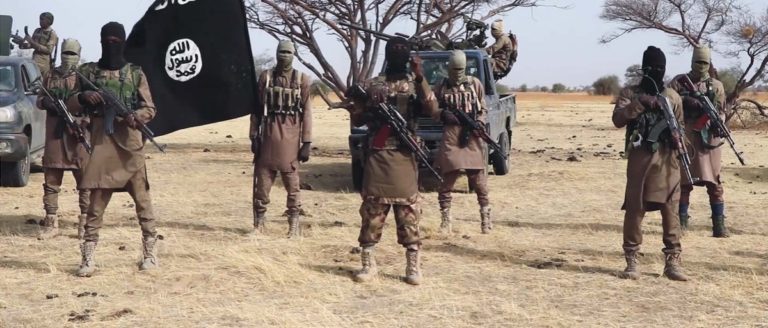
Almost eight years after, Nigeria continues to face multiple challenges posed by various terrorist groups with devastating human costs that are difficult to assess.
In spite of government counter-terrorism efforts, the prevalence of insecurity in Nigeria had risen, from the Boko Haram insurgency and its splinter group, the Islamic State West Africa Province (ISWAP), to the proscribed separatist group, Indigenous People of Biafra (IPOB), and the Yoruba self-determination agitators under the platform of Ilana Omo Oodua Worldwide (IOOW), to the killings and abductions witnessed around the country.
On July 5, 2022, armed men attacked a minimum security prison in Kuje, a community in the Federal Capital Territory, about 40 kilometres from the city centre, and freed about 900 inmates that included more than 60 Boko Haram suspects. One of the terrorist groups, ISWAP, claimed responsibility for the attack.
Again, on July 25, unidentified assailants killed six officers of the presidential guard brigade responsible for protecting the President, in Bwari, another community in the FCT where a campus of the Nigeria Law School is located.
The ICIR reported that a terrorist group in the Northwest threatened, in a video, to kidnap President Muhammadu Buhari and Governor Nasir El-Rufai of Kaduna State.
These incidents, as well as many others on kidnapping, spread fear, panic and apprehension among the citizens.
In 2020, the Federal Court of Appeal in the United Arab Emirates (UAE) sentenced six Nigerians for funding the Boko Haram terrorist group.
Also, in March 2022, the United States Department of the Treasury’s Office of Foreign Assets Control (OFAC) named and blacklisted six Nigerians on its terror list for their involvement in sponsoring terrorism.
In Nigeria, the minister of Information and Culture, Lai Mohammed, disclosed in February 2022 at a press conference in Abuja that the Nigerian Financial Intelligence Unit (NFIU) had compiled a list of 96 financiers of terrorism.
Muhammed said about 123 companies and 33 bureaux de change were linked to terrorists, in addition to 26 suspected bandits/kidnappers and seven co-conspirators who had been identified.
He disclosed that an “analysis has resulted in the arrest of 45 suspects who will soon face prosecution and seizure of assets.”
However, till now, neither President Buhari nor Mohammed has disclosed the names of the terrorism sponsors. They have also failed to name the companies linked with terrorism.
With about 125 days to Buhari’s exit from office, the incoming President will be faced with the recurring and growing phenomenon of insecurity to grapple with.
Data shows fall in terrorism in Nigeria under Buhari
Nigeria has seen an increase in cases of insecurity since 2015 according to Nigeria Security Tracker (NST), a project of the Council on Foreign Relations (CFR) that presents data on violent incidents in Nigeria from 2015-2022.
The ICIR observed a growing trend in the number of deaths, attacks, mass abductions and the total number of kidnappings across the country.
Factcheckdone by The ICIR revealed that Buhari’s government registered more 41,000 insecurity-led deaths since he assumed office in 2015.
His administration has recorded the highest number of security-related attacks since 1999 when Nigeria transitioned from military rule to civilian rule.
However, terrorist attacks have reduced from what was recorded in 2015.
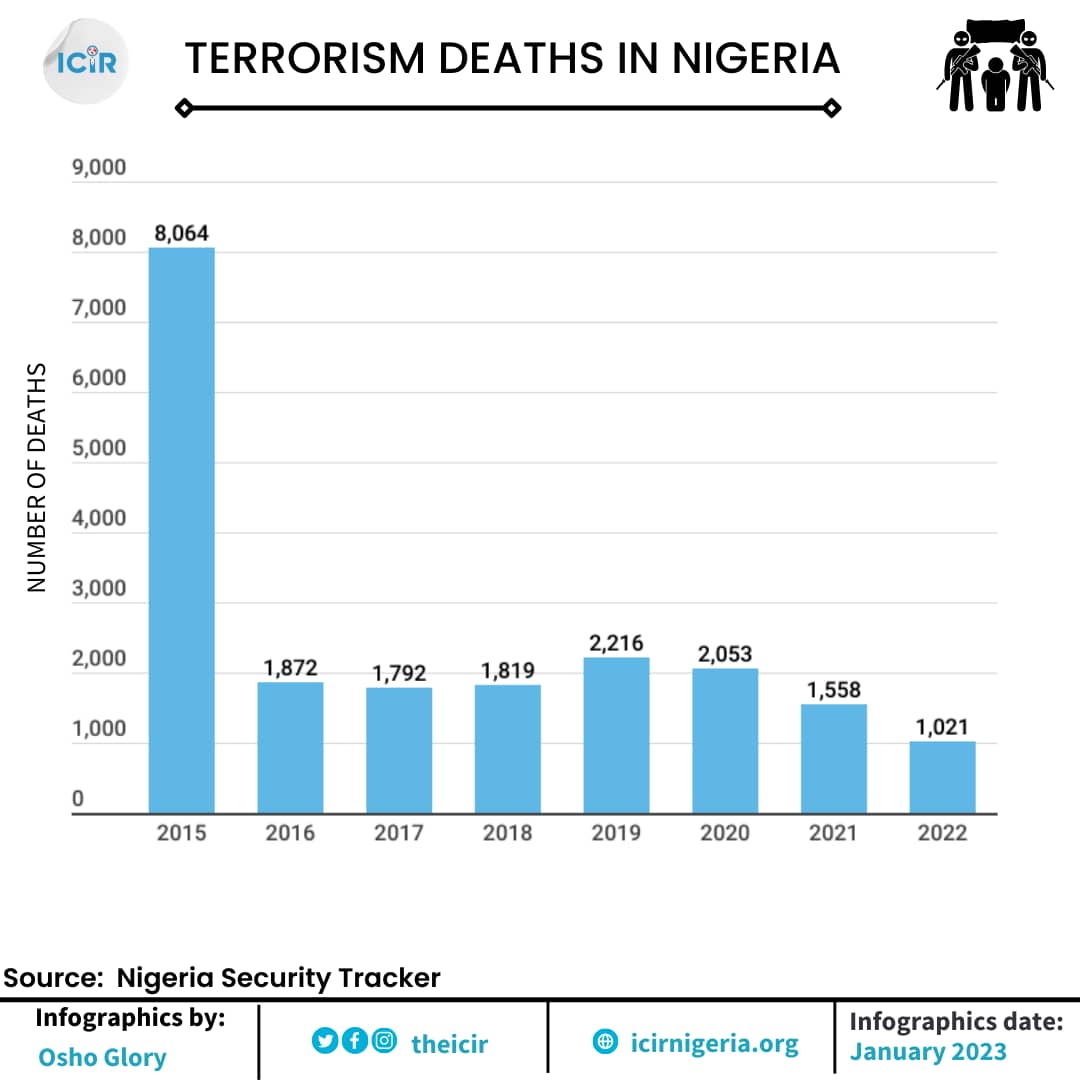
Terrorism deaths in Nigeria
Nigeria experienced an estimated 20,395 terrorism-related deaths and over 1,000 incidents between 2015 and 2022.
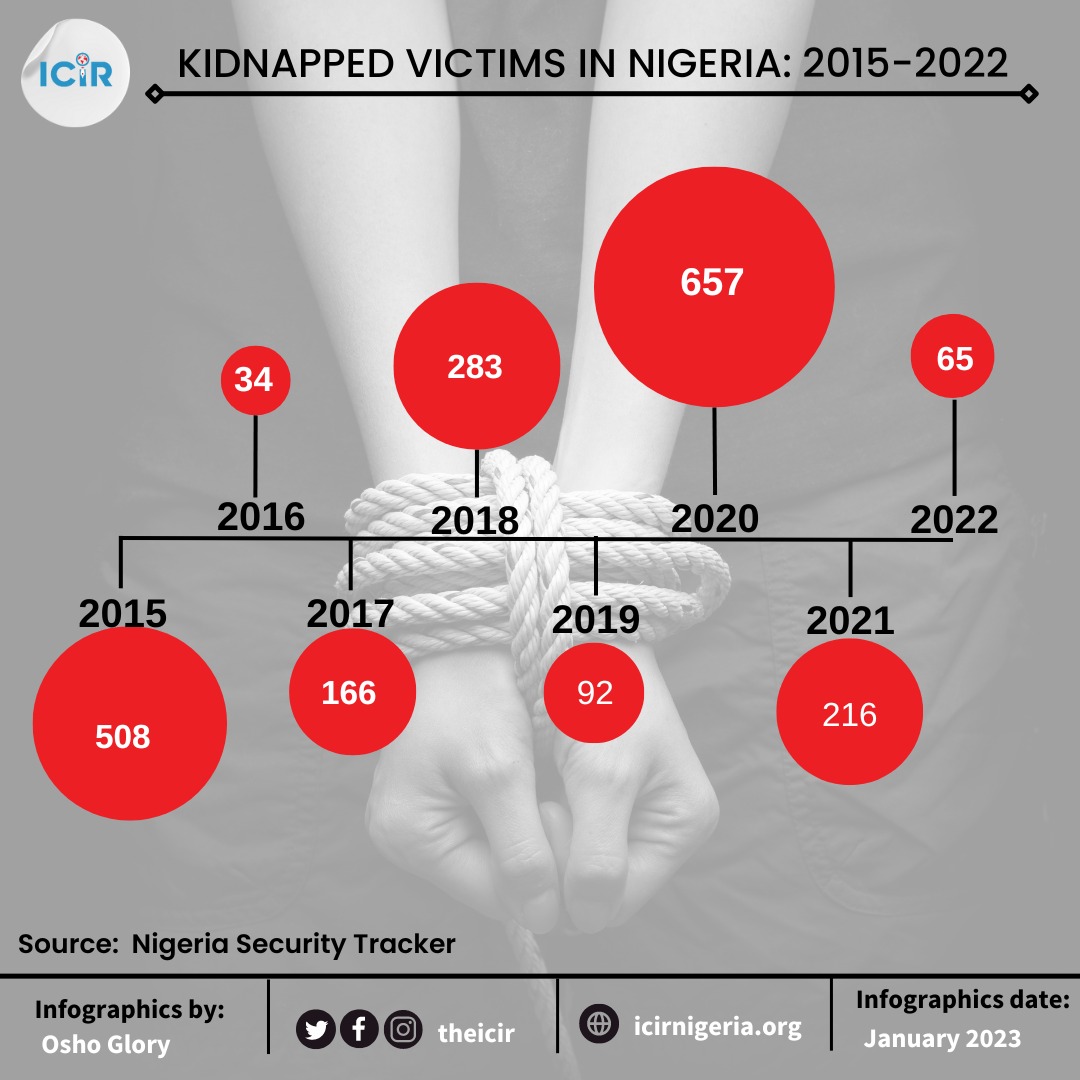
In 2015, Nigeria recorded 8,064 terrorism-related deaths, while the number of Nigerians kidnapped during the year was 508.
The following year, 2016, she recorded a decrease in terrorism-related deaths at 1,872 while kidnap victims declined by 34.
In 2017, the country recorded another decline in terrorism-related deaths at 1,792, but saw an increase in kidnappings at 166 victims.
While in 2018, the total number of deaths recorded was 1,819, the number of victims of kidnap stood at 283.
Recorded terrorism-related deaths increased in 2019 to 2,216, while kidnapping dropped to 92.
In 2020, terrorist-induced deaths were 2,053, while there was an increase in kidnappings to 657.
Kidnapped victims in Nigeria: 2015 – 2022
There was a decline in terrorism-related deaths and kidnappings in 2021, as 1,558 deaths were recorded and 216 people were kidnapped, while in 2022, terrorism deaths reduced further to 1,021, with 65 recorded kidnap victims.
Buhari government spends $1 billion on captured territories
Recently, at an award ceremony in Abu Dhabi, President Muhammadu Buhari said the Federal Government had spent $1 billion to regain some northern parts of the country that terrorists captured in 2015.
Despite investment to reclaim these territories, the nefarious activities of banditry and terrorism seem not to be abating, and security remains unstable.
Southern Kaduna has been a hotbed of waves of attacks and killings, which the Southern Kaduna People Union (SOKAPU) has severally tagged “ethnic cleansing” by terrorists.
In October 2022, the embassies of the United States, United Kingdom, Canada, and Australia issued warnings on an elevated risk of terror attacks in Nigeria, specifically in Abuja.
The foreign missions, while issuing foreign travel advice to their citizens in Nigeria, noted that suspected terrorists would target government structures, marketplaces, worship centres, police stations, and international organizations.
“If you are going to campaign and rallies, wear your masks to get protected. These are things, we need to do together,” he said.
Tomori stressed the need for the Federal Government to test travellers at the point of entry to mitigate the surge in the number of COVID-19 infections
According to him, conducting tests at the point of entry is more effective than vaccinating people as they arrive the country.
He said, “There is no vaccine that takes effect the day you give me the injection, the fact that you vaccinated me today does not mean that I am developing immunity that day you gave it to me. It will take some time.
“I don’t see the rationale behind vaccinating people at the point of entry, there is no vaccine that takes effect a the point of entry. It does not have any immediate effects on the person at all.
“I don’t understand the scientific base of it. If one gets vaccinated it takes a week or ten days before one gets immunity, and it would have spread over the country. It doesn’t make sense to me at all.
“What we need to do is to test those who are not vaccinated at the point of entry, if you are positive, I will put you in isolation. If you are not I will tell you to monitor yourself for seven days.
“We need to take action immediately by testing travellers at the point of entry.”
He stressed the need for Nigerians to take proactive actions to prevent the spread of the virus.
“Get yourself protected; you are the most important person in this disease. When I travel in the country, I need to double-check myself.”
The Nigeria Centre for Disease Control and Prevention (NCDC) had earlier confirmed the resurgence of COVID-19 in the country with 13 additional COVID-19 infections between December 31, 2022 and January 6, 2023.