He noted that the government gave series of queries before issuing the new directive.
The commissioner said, “Tuition fee in the state is free, but some Cross River teachers and principals connived to alarmingly inflate other charges, which is not acceptable at all.
“We have suspended six principals so far over the unusual and inflated charges on students. We have given several queries to others involved in illegal charges and dealings, including bribing and acceptance of bribes to be posted to township schools.
“These principals collect a hefty sum of N40,000 from each student, as against N1,200. They collected fees for three terms upfront, claiming that many students abandon school after taking the WASCE exams.
“We are monitoring defaulting teachers and principals, and won’t hesitate to wield the big stick.”
According to him, the school principals were also paying as much as N300,000 to be transferred.
He disclosed that the government was already deploying officials to curb the menace of cultism in secondary schools, adding that it had also employed 1000 teachers.
Amanke said, “If I had my way, I would make education free in the state. I did it as a local government chairman.”
THE Nigeria Police have denied knowledge of the sit-at-home order across states in the southeast region.
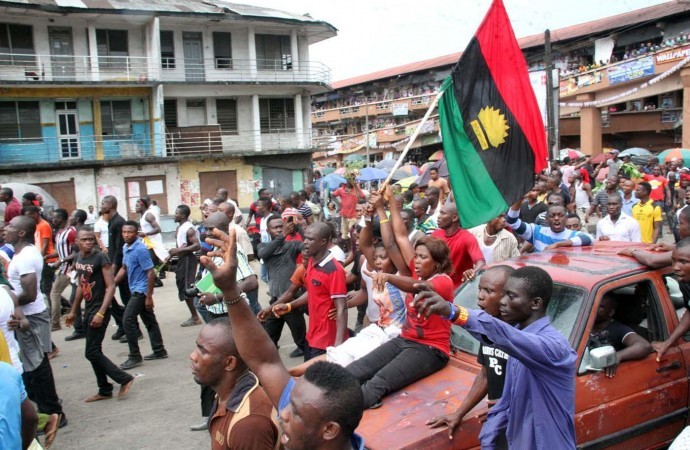
The ICIR reports that the the Indigenous People of Biafra (IPOB) initiated order has been active for over a year ago.
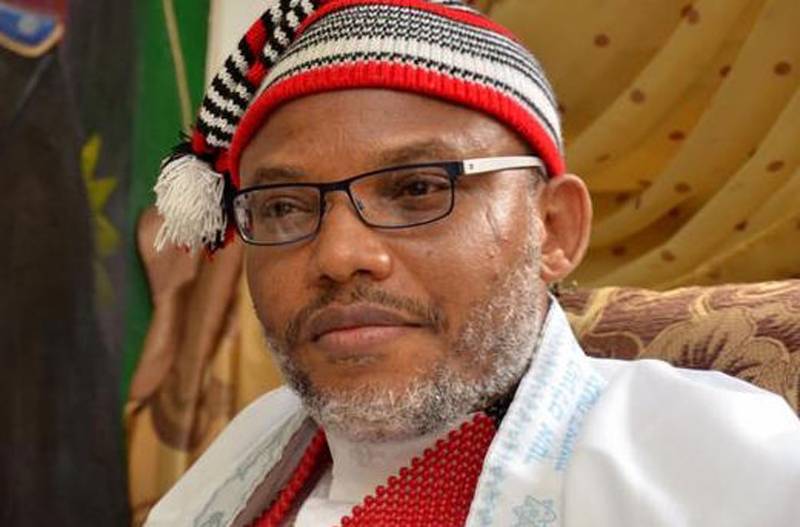
In August 2021, the IPOB introduced a sit-at-home order to compel the Nigerian government to release its leader, Mr Nnamdi Kanu, whose arrest the Nigerian Federal government initiated in Kenya, and who has been standing trial in Nigeria for alleged treasonable felony and terrorism.
Since then, social and commercial activities in the region have been disallowed by IPOB enforcers every Monday.
A two-part investigation by The International Centre for Investigative Reporting – read the investigation here and here – has shown the human and economic cost of the order, particularly on small businesses.
The findings showed that the South-East region has sat at home for over 71 Mondays since the exercise began.
During the investigation, The ICIR interviewed 22 small businesses in each of the five states under the region.
However, when The ICIR contacted the Anambra state police spokesman, Deputy Superintendent Tochukwu Ikenga, he dismissed the practical existence of the order in the state.
According to Ikenga, business activities are active in the state.
“I don’t have such information. I go to work every day,” he replied when asked why the police had failed to quash the sit-at-home order.
“I go around with public vehicles. I don’t have such a report. Anybody that has an engagement should go out. Being a security man is a secondary factor,” he added.
Similarly, the Ebonyi State police spokesperson, Chris Anyanwu, said there was no sit-at-home exercise in the state.
Anyanwu said, “There is no sit-at-home now, except in the earlier period. We have been maintaining it. We do our routine show of force to make the assurance double sure in case there is any attack.”
The ICIR was unable to speak with the police spokesmen in Enugu and Imo states, Daniel Ndukwu and Michael Abattam, respectively, as the two men did not respond to calls or WhatsApp messages.
The Abia State police spokesperson, Godfrey Ogbonna, also refused to answer repeated calls.
The governor of Ebonyi State, David Umahi, has inaugurated a nine-man commission of enquiry to probe the killings and vandalism in Ekoli and Amoso Edda, Afikpo south local government area of the state.
This was made known in a statement issued in Abakaliki on Wednesday, January 18 by the Special Assistant to the Governor on Media, Chooks Oko.
There have been series of attacks and destruction in the two areas of the local government, which led to the death of some persons on Boxing Day last year.
The victims included the younger brother of a leader of the All Progressives Congress in the state and a police officer.
Members of the enquiry commission are Nkama Nkama as the secretary, while Mike Okoro, Etta Uka, Kalu Mba, John Igwe, Ibiam Ekpe, Ufere Okoroafor and Ama Kalu Ikwor will serve as members.
During the inauguration, Umahi urged members of the commission, headed by Sonni Ogbuoji, to carry out their responsibilities with utmost conscientiousness.
Responding, Ogbuoji assured the governor that they would perform their duties with diligence, and without panic or indulgence.
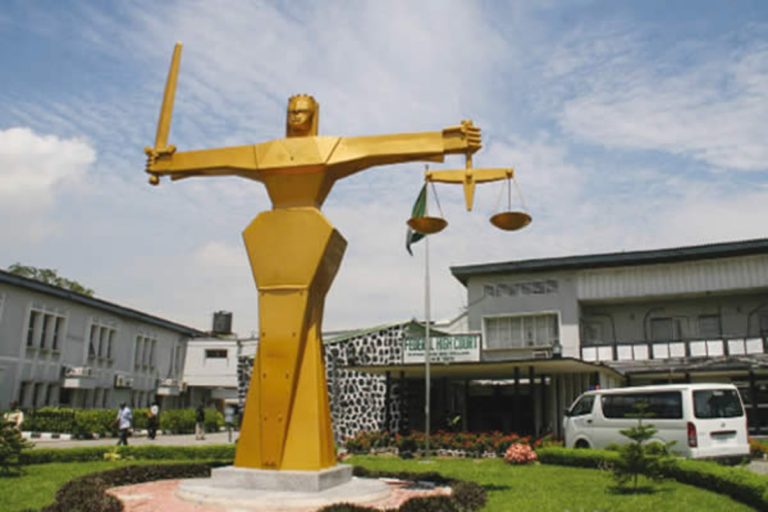
THE FEDERAL High Court, Lagos, has convicted and jailed a nursing mother, Fatimah Adeoye, to six years imprisonment for drug trafficking.
Justice Tijani Ringim sentenced Adeoye after she pleaded guilty to a two-count charge of unlawful export of 1.10 kilogrammes of cannabis sativa, also known as marijuana, and 17 grammes of rohypnol, a psychotropic substance, brought against her by the National Drug Law Enforcement Agency (NDLEA).
The NDLEA counsel, Abu Ibrahim, told the court that the convict was arrested with the prohibited drugs on November 18, 2022 at the Gate ‘C’ of the departure hall of the Murtala Muhammed International Airport, Lagos, during an outward clearance of passengers on Ethiopia Airline flight.
She had attempted to export the drug to Oman.
The ICIRreports that the NDLEA also arrested a businesswoman, Okefun Darlington Chisom, over her links with two Pakistanis, who were arrested at the Lagos airport with eight kilogrammes of cocaine.
The prosecution counsel told the court that Adeoye’s offence contravened Section 11(b) of the National Drug Law Enforcement Agency Cap. N30, Laws of the Federation of Nigeria, 2004.
The convict admitted to committing the offence and pleaded guilty to the two counts.
The prosecutor urged the court to convict and sentence her in accordance with the NDLEA law she was charged with.
After listening to both parties and citing a plethora of decided cases, the judge sentenced Adeoye to three years jail term in each of the counts.
The judge held that the jail term would run consecutively, but gave the convict an option of a fine of N500,000 on count one only.
The judge also ordered that the banned substances be confiscated from the convict and destroyed by the NDLEA after the appeal period has elapsed.
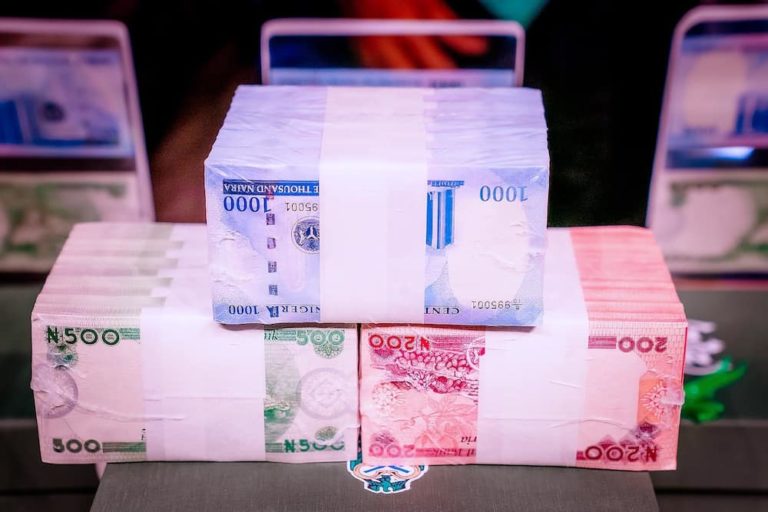
THE Central Bank of Nigeria launched new banknotes in November 2022. The new notes came into effect on 15 December 2022.
The apex bank also capped withdrawal of the new banknotes at N100,000 (US$222 at the official exchange rate) per week for individuals, and N500,000 (US$1,111) for corporations.
Reactions across Nigeria were swift and acerbic. The National Assembly called for the suspension of the policy, at least until after the 2023 general elections.
Concerns were expressed that the withdrawal limits were too low and would impose hardships on Nigerians. Following those concerns, the central bank raised the limits to N500,000 per week for individuals, and N5 million ($11,111) for corporations.
But does Nigeria need to redesign its currency? And why is it necessary to impose withdrawal limits, especially for a country that aspires to scale back regulation and liberalise its financial sector?
Why the central bank introduced the policy
The bank says the new banknotes are being introduced to rein in counterfeiting, promote a cashless economy by limiting the amount of the new banknotes that can be withdrawn, reduce the large quantity of dirty notes circulating in the economy, discourage hoarding, curb crimes like kidnapping and terrorism, and head off illicit financial transactions.
It also sees the policy as a way of addressing the huge amount of currency outside the formal financial sector; 85% of banknotes circulate outside the banking system, largely because of hoarding and illicit financial transactions.
The introduction of the Bank Verification Number system, which requires depositors to have a unique number that could be used to determine who they really are, has encouraged criminals and money launderers to operate outside the banking system. The circulation of large quantities of money outside the banking system, according to the Central Bank of Nigeria, makes it challenging to conduct effective monetary policies.
Many pundits believe there’s another, unspoken rationale for the policy’s rules around cash withdrawal: to discourage vote-buying during the upcoming elections. They suggest that limits on cash withdrawal would make it harder for politicians to monetise and corrupt the electoral process.
Not a useful policy
The central bank’s urgency is puzzling. The problems it claims the policy change will solve are not new.
I do not see how the policy as it’s been publicly explained will foster a cashless economy. Apart from politicians, top government officials and those involved in illicit financial transactions, most Nigerians don’t stash huge sums of cash away. How could they? The country’s unemployment rate is 33%; the minimum wage is N30,000 ($67) per month. Most Nigerians don’t have enough money in their bank accounts to be worried about withdrawal limits.
Besides, the country is already making progress in becoming cashless. During my recent seven-month stay in Nigeria, I was impressed by how I could pay the Uber driver through bank transfer with my phone, purchase assorted goods at the local market through transfers, and use point of sale to withdraw money when cash is necessary.
Meanwhile, if its goal, as pundits suggest, is to curb vote-buying, then the policy still likely won’t be effective.
Politicians will always find a way of using money to influence the political process. They could resort to the use of foreign currencies. There has been a surge in the demand for dollars and other foreign currencies, following the announcement of the policy.
And then there are the new banknotes. The central bank claims it redesigned the naira to head off the nationwide spate of kidnappings, terrorism and other violent crimes. But surely this will just give criminals an incentive to demand dollars or other foreign currencies from their victims.
Implementation already flawed
People have been given up till 31 January 2023 to return old naira notes to banks, central bank cash offices, and other designated financial intermediaries. But the 38 million Nigerians (or 36% of the adult population) who don’t have a bank account have no choice but to hold on to the old notes. Banks don’t have enough of the new ones to exchange for the old ones.
Unbanked Nigerians cannot deposit the old notes in an account. To avoid this dilemma, the central bank should have allowed the old and new notes to coexist as legal tender, while the former is gradually phased out.
It’s not just the banks that don’t have access to the new banknotes. Ordinary Nigerians are struggling, too.
The top Central Bank of Nigeria officer who appeared before the National Assembly to brief members about the new policy did not readily know how many banknotes had been printed. That points to the lack of planning for the implementation of the policy.
The bank failed to carry out due diligence in calculating the optimal quantity of the new notes needed to maintain stability in the financial system. The old naira notes are expected to be phased out by the end of January 2023, but there are doubts that the bank will meet this deadline.
Although the central bank has embarked on a sensitisation exercise to assure the public that things will be fine, it should have done so simultaneously with the announcement of the policy.
Jitters and uncertainty
The timing of the policy announcement and rollout is bad. Domestic and foreign investors are already jittery about the upcoming elections and the state of the Nigerian economy. This new policy will add another layer of uncertainty.
For a country that is grappling with slow economic growth, inflation and exchange-rate volatility, the last thing the central bank should do is destabilise the economy by introducing a policy whose immediate benefits are questionable.
A transnational investigation by Ngina Kirori, Emmanuel Mutaizibwa, Chief Bisong Etahoben, Elizabeth BanyiTabi, Theophilus Abbah and Brezh Malaba.
‘IT’S your man who did this!’ shouts a woman at a village meeting in Nakuru County, Kenya. She is filmed by Kenyan journalists as she points at another woman, a supporter of a powerful local politician known for associating with gangsters.
In the run-up to the Kenyan elections of August 2022, five women in this area were raped and murdered and their bodies set alight. According to the Kenyan documentary Ganglands, for which this meeting was filmed, the villagers suspect an intimidation campaign by criminals to ‘force the public to either vote for specific candidates or not to leave their home altogether’, as a former gang member interviewed in the documentary puts it.
Violent intimidation during elections has been rife for years in Kenya, where political office means joining a ruling elite with access to significant wealth and power and ambitious politicians need to get their votes in one way or another.
In 2022, however, the scare tactics seem to have been less successful than before. Though a staunch establishment figure still won the presidency, a record number of independent candidates were also elected; among them was a newcomer from Nakuru County, who was elected despite the gangsters’ tactics by voters who decided they’d had enough.
Rising protest
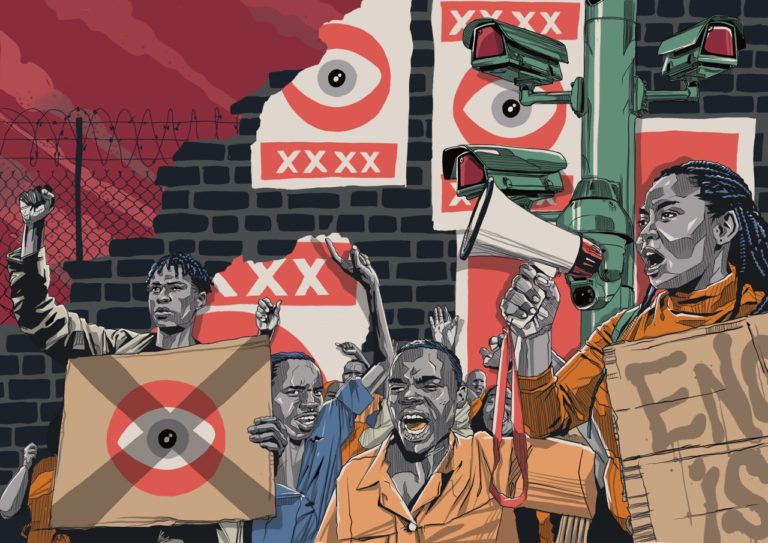
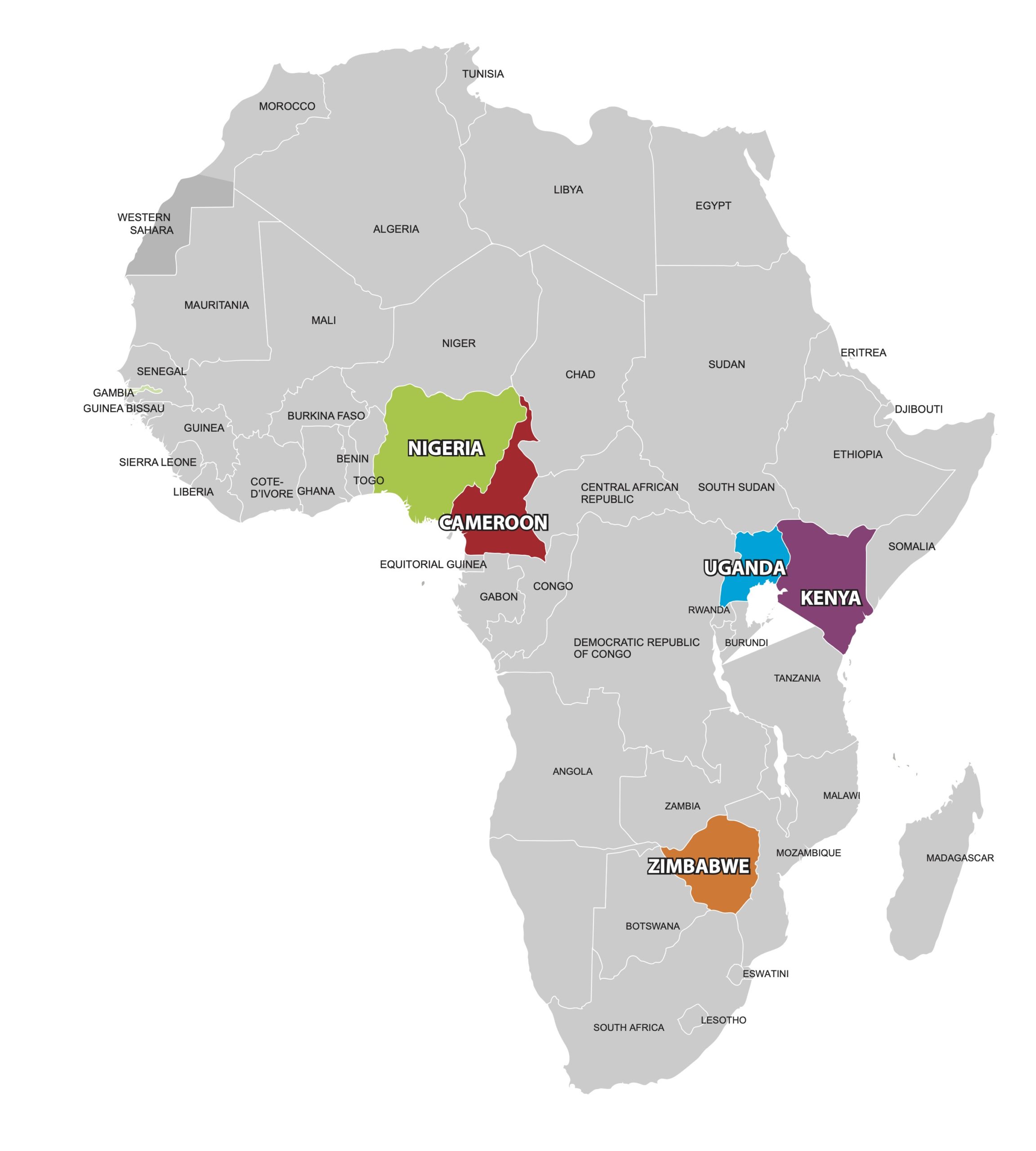
Resistance against autocratic leaders and the parties they head, as well as a rejection of the oppression of political opposition, is growing not just in Kenya. A new investigation covering Kenya, Uganda, Cameroon, Nigeria and Zimbabwe found that in each of these countries an overwhelmingly young population who are urbanised, aware and social media savvy, are staking a claim to their futures.
A new investigation covering Kenya, Uganda, Cameroon, Nigeria and Zimbabwe found that in each of these countries an overwhelmingly young population who are urbanised, aware and social media savvy, are staking a claim to their futures.
They’re vocally fed up with the lack of development and freedom, as well as the patronage systems that only benefit a political elite. They are also increasingly demanding that their leaders’ foreign development partners look more critically at who and what they’re actually supporting.
In Cameroon, for example, where a small clique centred around 89-year-old dictator Paul Biya’s clan has diverted hundreds of millions of dollars of COVID-19 relief funds into cronies’ pockets, civil society has formally requested the International Monetary Fund not to grant new loans until previous cash is accounted for.
Such international solidarity, they say, is needed because demands for accountability within the country itself are usually met with harsh action by the security forces and the state itself.
Not only are outspoken opponents and critics subject to mass arrests, abduction and torture, but even state officials who try to flag corruption and protect health budgets find themselves blocked or punished.
The doctors were transferred for ‘sticking their nose where it doesn’t belong’
ZAM’s Cameroon team spoke to two doctors working in the state health department who both described being removed from audits and transferred away as revenge for ‘sticking their nose where it doesn’t belong’.
One of the doctors, Albert Ze, experienced multiple threats and break-ins before finally being transferred to a remote office in a conflict zone where armed separatist rebels are known to attack civil servants of the central state.
Despite being forced to live apart from his wife and children for their safety, ‘Dr Ze’ continues to use his Twitter account to demand accountability from Cameroon’s leaders.
This is more than can be said for the IMF, which turned a deaf ear to protestors and granted Cameroon another loan.
The thugs were ‘acting on instruction’
Similar demands come from Nigeria, where anti-corruption activist Olarenwu Suraj and his wife were both badly beaten during a targeted attack on their home. The attackers told their victims that they were ‘acting on instruction’, a sign of political motivation.
Suraj later told reporter Theophilus Abbah that ‘the international community should do more in terms of ex-communicating those with poor human rights records from the comity of nations.’
Zimbabwe, meanwhile, has recorded close to two thousand cases of intimidation and assault by groups of governing party supporters countrywide in 2022 alone.
There, opposition and civil society also continue to appeal to the international community for support, while the state continues to try to choke off all funding and support to their organisations and activities.
‘I have spoken to other journalists, young ones, who are afraid of touching corruption stories because you can get harassed, or your camera can be taken away. It would be good if someone could say, ‘No, this is wrong, we’re going to give them another camera. […] Just to step in whenever they lose something or their constitutional rights are not respected,’ says journalist Hopewell Chin’ono to ZAM’s reporter Brezh Malaba.
Cybercrimes
The arsenal of oppressive laws used to jail outspoken critics in Zimbabwe now includes everything from ‘public incitement’ and ‘disturbing the peace’ to ‘communicating false statements’, ‘undermining or insulting the President’ and a ‘cyber crimes’ bill that allows digital surveillance of, and possible charges against, internet users.
Such ‘cybercrime’ laws have proliferated in all five investigated countries in the past decade, possibly as a response to an increasingly online population which finds its information, its voice and its community on the internet.
This development has made the internet a whole new terrain of struggle. Nigeria and Uganda joined other African countries, including Mozambique and Senegal in shutting down the internet completely to snuff out protests.
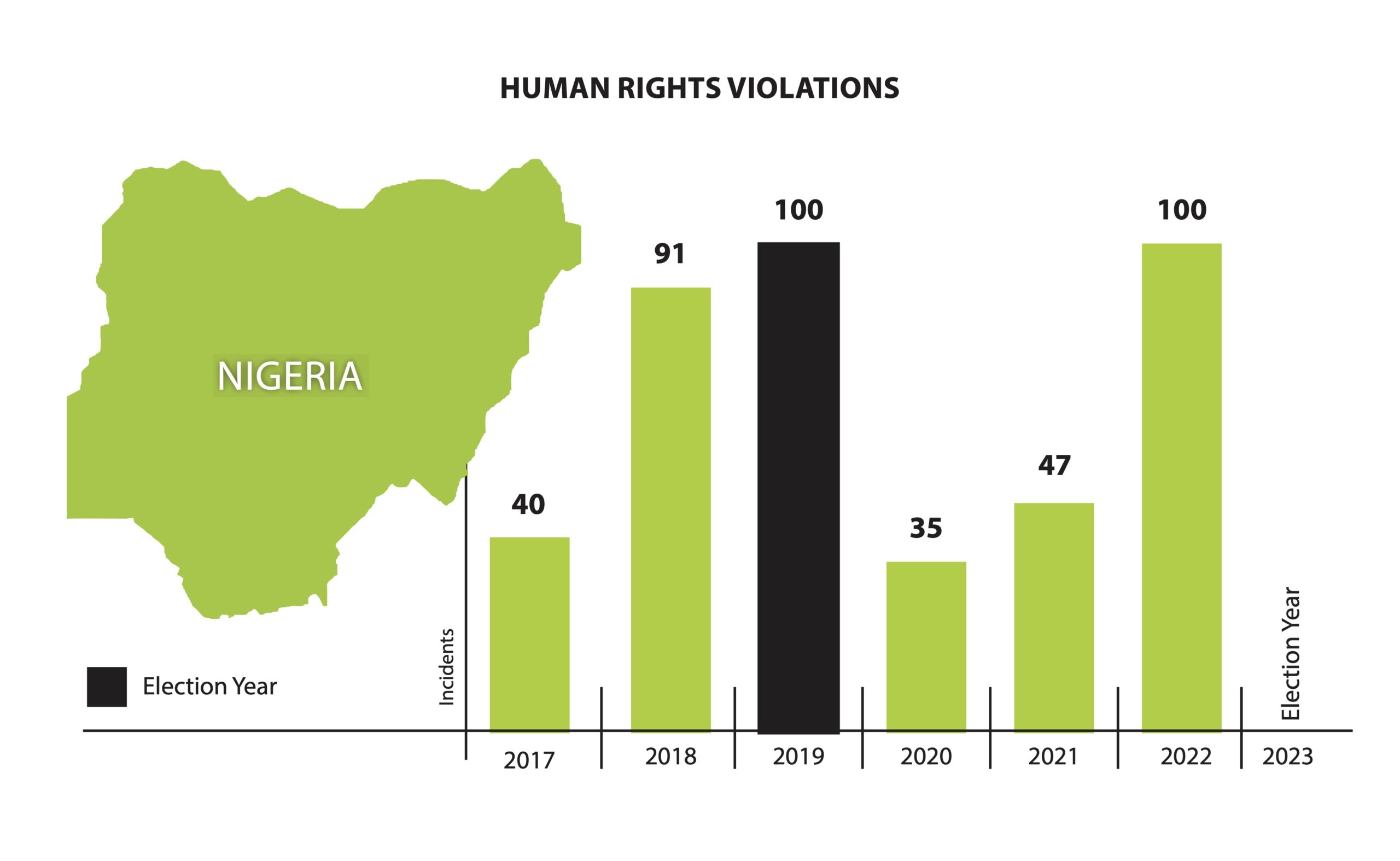
Data on recorded incidents of human rights violations by state or state-sponsored actors against critics and opponents in Nigeria over the period 2017-2022 suggest that political state violence increases during election campaigns. A new surge has been recorded in the run-up to elections scheduled for 25 February 2023.
All five countries in this investigation also acquired digital surveillance technology that enables the monitoring of smartphones and laptops. In all cases the snooping software was purchased from Israeli companies.
In Nigeria, journalists now even face possible ‘cyberstalking’ charges if they carry out background research on powerful politicians and their business associates via the internet.
‘Stop paying our oppressors’ is the battle cry
Frustrated by their states’ willingness to ignore or punish protest domestically, civil society activists in all five of the countries in the investigation have found themselves increasingly directing their appeals towards international bodies like the IMF, the United Nations and development partners.
‘Stop paying our oppressor’, is the battle cry of Ugandan opposition leader and Afrobeat musician Bobi Wine. An audience of hundreds recently attended the screening of a documentary about his life at the Carré Theatre in Amsterdam, cheering his protest songs about politics and the plight of the ‘ghetto’.
‘Stop giving money’ may be rather too simple as a slogan, however, since there is good reason to fear that the few services available to the Ugandan public would be the first to disappear if donors pulled out; the same goes for the other countries in this investigation.
Nevertheless, civil society activists in all five countries have all sincerely asked western development partners to take a long hard look at what their money is really doing.
Echoing similar demands made in Cameroon, five Ugandan opposition leaders recently asked for aid to the country to be suspended ‘in all but the most basic humanitarian sectors’.
Lucrative contracts
In Kenya, many in civil society worry that the Western appetite for lucrative infrastructure and mineral contracts may result in a hesitancy for donor nations to fund organisations that agitate for democracy, good governance and an end to human rights abuses.
‘Priorities seem to have changed’, says the leader of one civil society organisation, who asked to remain anonymous. ‘Several reports we compiled on misuse of public funds have been met with silence, very little action and reduced funding.’ Asked why he thinks this is so, he replies that Western partner countries ‘are more concerned about doing business with the Kenyan government’ nowadays, especially ‘with regard to contracts that might otherwise go to China and the East’.
Certain NGOs have been flagged as ‘terrorists’
Donor support for grassroots organisations is furthermore in danger because of a crop of new money-laundering laws recently passed across the continent, including in the five countries covered by this investigation.
These laws are designed to stem the flow of funds that might in the past have found their way to terrorist organisations, which is why the G-20’s Financial Action Task Force (FATF) backed them. But several African governments have discovered that these same laws are remarkably well-suited for blocking foreign financial support from reaching local NGOs.
In 2021 in Uganda, for example, lawyer and human rights defender Nicholas Opiyo found himself arrested along with four of his colleagues after his legal charity, Chapter Four, received money from an external source.
In Zimbabwe, ZANU-PF Information Secretary Christopher Mutsvangwa unexpectedly admitted that the real purpose of his ruling party’s proposed new Private Voluntary Organisations billwas to ‘protect Zimbabwe’s sovereignty against NGOs that have been at the forefront of subversive activities.’
An exodus of skilled professionals
These pressures are taking a toll not just on activists but also on young people, who find themselves shut out of the job market by corrupt hiring practices and moribund economies. This has led many to choose to emigrate in search of freedom, employment or safety.
In Uganda, celebrated Kakwenza Rukirabashaija, famous for his books, ’Banana Republic’ and ‘The Greedy Barbarian’ recently went into exile. He was detained and severely tortured in 2020 after mocking President Museveni’s son and anointed successor, General Muhoozi Kainerugaba. Rukirabashaija. He has taken up residence in Germany, where he joins prominent Ugandan academic and poet Stella Nyanzi, who left after being jailed for insulting the president.
‘I never wanted to emigrate but maybe I’ll have to’
‘It’s maybe just not worth it’, says Zimbabwean human rights activist Makomborero Haruzivishe, who recently spent 11 months in pre-trial detention without bail for whistling during a police round-up of unlicensed street vendors at a bus terminal in the capital Harare.
According to the police who arrested him on 17 February 2021, the whistling was intended to ‘incite’ the vendors to ‘commit public violence and resist arrest’. The effect of the jail term was profound for Haruzivishe. ’You cannot afford to spend 11 months in jail without income when you have to feed your family. I never was one of those who wanted to emigrate. But maybe I’ll have to.’ Months after our interview, we received the message that Haruzivishe had left Zimbabwe.
Back in Nigeria, Olarenwu Suraj really doesn’t want to leave his home country either, but feels that the upcoming 2023 elections might be the last chance for a new government to recognise the importance of ‘anti-corruption and human rights activists as partners in the development of the country.’
Like many other Nigerian progressives, Suraj has pinned his hopes on new presidential candidate Peter Obi, who has a relatively clean governance record as the governor of Anambra state and who, in October last year, released a manifesto containing seven pragmatic priorities in a plan for better Nigerian governance.
Obi and his Labour Party are however also not immune to attacks from powers who would like the status quo in Nigeria to remain. A month after the release of the manifesto, on 28 November 2022, Victoria Chintex, the leader of the women’s wing of Obi’s Labour Party in Kaura, Kaduna State, was killed by gunmen in what is widely suspected to have been a political assassination.
*
Colophon
Investigative team
Nigeria: Theophilus Abbah
Cameroon: Chief Bisong Etahoben and Elizabeth BanyiTabi
NIGERIA accounts for 89 per cent of Christians martyred worldwide, according to latest report on global Christian persecution.
The Open Doors World Watch List 2023, released on Tuesday, January 17, said out of the total of 5,621 Christians killed for their faith during the reporting period, Nigeria recorded 5,014, marking the country as one of the most dangerous places “to follow Jesus”.
The report tracked the period from October 1, 2021 to September 30, 2022.
Open Doors said the data was compiled from grassroots reports by more than 4,000 of its workers across over 60 countries.
Urging the United States State Department to reconsider Nigeria as a Country of Particular Concern, the report said if not addressed, persecution against Christians “will soon trigger a vast humanitarian catastrophe across the continent”.
It added that the year under review “has also seen this violence spill over into the Christian-majority South of the nation” while “Nigeria’s government continues to deny this is religious persecution, so violations of Christians’ rights are carried out with impunity”.
“Violence against Christians is most extreme in Nigeria where militants from the Fulani, Boko Haram, Islamic State West Africa Province (ISWAP) and others conduct raids on Christian communities, killing, maiming, raping and kidnapping for ransom or sexual slavery”, the report added.
In a repeat of last year’s ranking, Nigeria ranked No. 1 in the World Watch List (WWL) subcategories of Christians killed, abducted, sexually harassed, forcibly married and physically or mentally abused.
It also ranked No. 1 in homes and businesses attacked for faith-based reasons as well as No. 2 in the subcategories of church attacks and internal displacement.
The report added that Nigeria and Sub-Saharan Africa are the epicenter of jihadist violence.
“The violations of religious freedom in Nigeria are emblematic of a rapidly growing Islamist presence in Sub-Saharan Africa.
“Islamic extremism continues to cause the most persecution (31 nations), especially in sub-Sahara. Today’s report also marks 30 years of the list, first created in 1993 after the Iron Curtain fell.”
The report listed Nigeria, Pakistan, Cameroon, India, Burkina Faso, Central African Republic, Mozambique, Democratic Republic of Congo, Tanzania, Myanmar, Colombia and Niger in a chronological order as top ten countries where Christians face the highest rate of violence.
Open Doors blames Islamic suppression and extremism as the reason most of the listed countries are not safe for Christians.
Reacting, the managing director of research, Open Doors, Frans Veerman, said “the biggest threat to Christianity is that persecution brings isolation, and when it keeps going on incessantly it may cause loss of hope”.
“So the biggest threat to the church in countries with persecution is decrease of resilience caused by incessant persecution and the feeling of being forsaken by the rest of the body of Christ.”
Earlier, The ICIR reported how 11 years after surviving a Christmas Day bomb attack in 2011, a Catholic priest, Reverend Father Isaac Achi, was burnt to death by terrorists in Niger State, northern Nigeria.
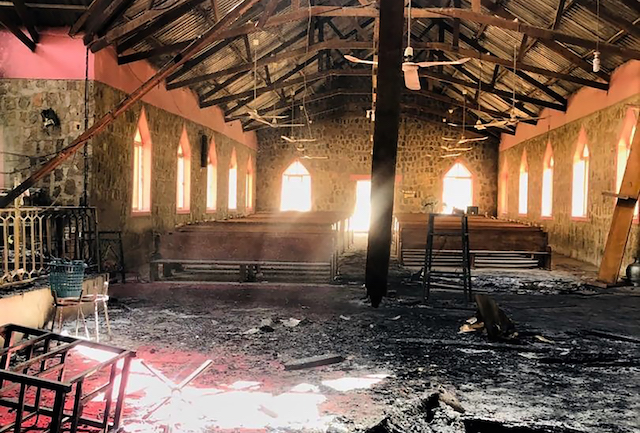
THE insecurity in the South-East region has not spared government facilities. Billions of naira have gone up in flames amid intensifying attacks in a region which hosts one of the largest markets in West Africa –Onitsha Main Market.
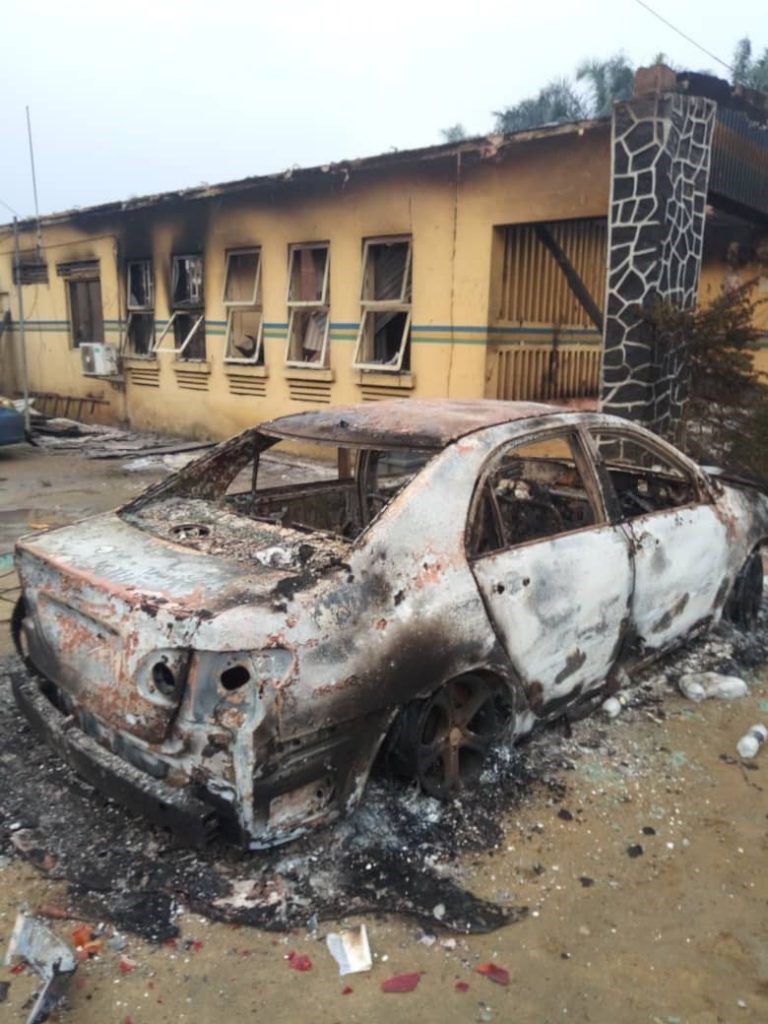
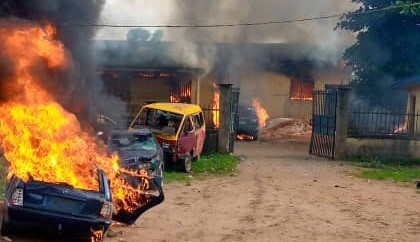
Several police stations have been razed by hoodlums who, like terrorists, kill officers and leave many maimed.
On October 9, 2022, six gunmen attacked a station at Inyi Police Division in Oji River Local Government Area of Enugu State, killing two officers.
On October 21, 2020, a day after the #EndSARS protesters were shot and killed at Lekki Toll Gate in Lagos, hoodlums attacked Nwaorieubi Police Station at Mbaitoli Local Government Area of Imo State.
The ICIR was told that more than 100 youths riding on motorbikes stormed the area and set the police station ablaze. On the same day, the Orji police Station in Owerri North was also set on fire by unknown thugs.
On October 28, 11 police stations and 20 vehicles were burnt in Anambra, according to the Commissioner of Police, John Abang.
During the #EndSARS in 2020, several police stations, security vehicles and infrastructures were destroyed in the region, leaving it vulnerable to external attacks.
The Federal Government of Nigeria estimated that 164 police stations were attacked prior to October 2021.
Structural engineers and architects contacted by The ICIR estimated that it would take between N800 million and N2 billion to rehabilitate or rebuild those police stations destroyed by hoodlums in the region.
“Building a police station can cost up to N5 million to N10 million, or even more, depending on factors such as land size, location, nature of the site, cost of building materials,” said Everest Brown, an Imo State-born structural engineer, who now works in Lagos.
Several correctional centres, local government facilities, Independent National Electoral Commission offices, among others, have also been attacked and burnt, leaving little hope of renovating them any time soon.
One of the burnt police stations in Enugu, Source: PrNigeriaOne of IPOB demonstrations in South-East Source: Premium Times
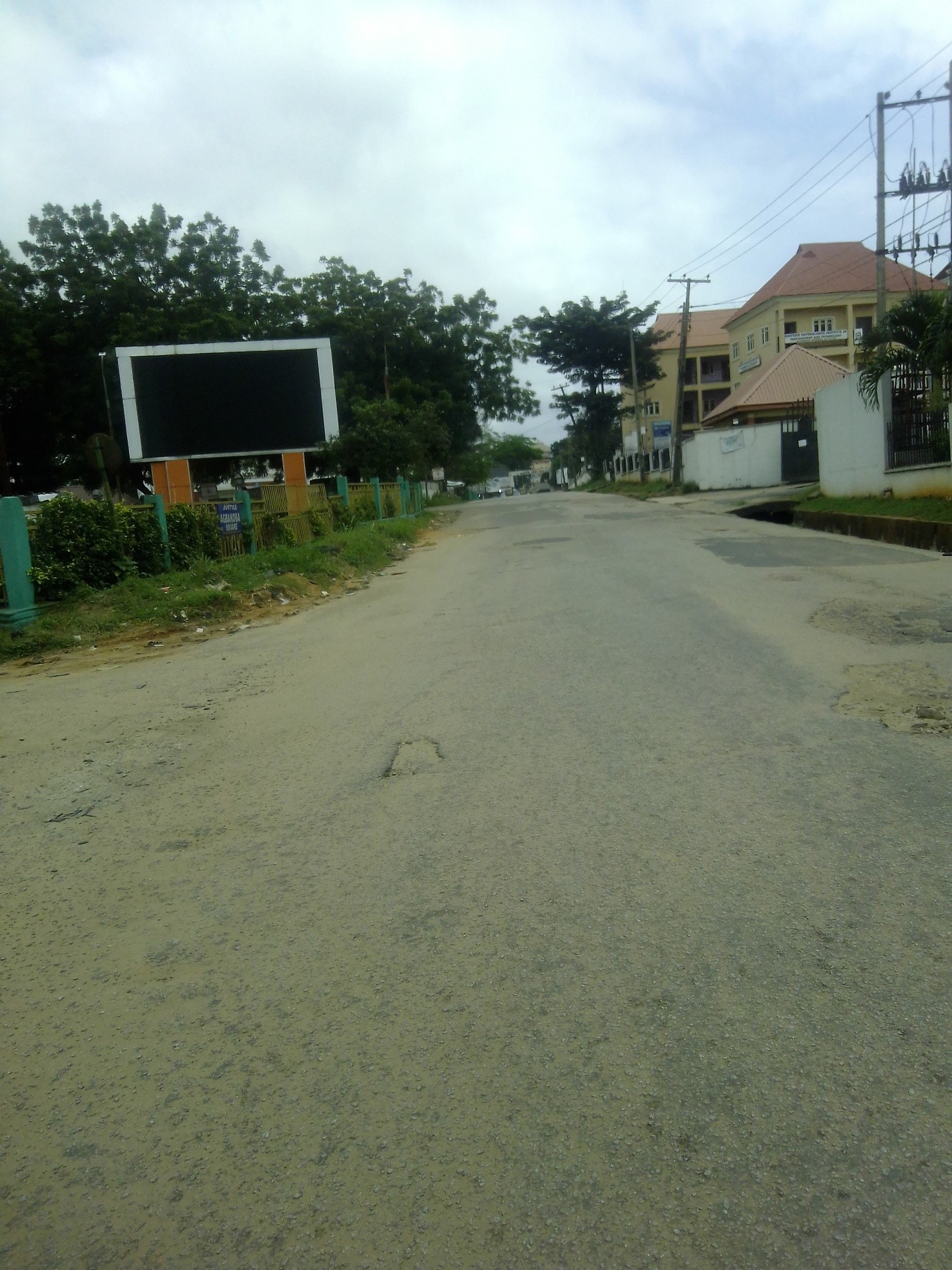
Sit-at-home day at GRA, Onitsha
Night business disappearing
Late-night business is also disappearing in the South-East region. Once it is 7 pm in various parts of the region, traders pack their wares and hurry home.
Last year, at the Holy Ghost area in Enugu on August 25, traders and hawkers made efforts to scurry home as soon as it was 7 pm. Some of them abandoned potential buyers while hastening to their parking stores. This was unusual as traders used to stay at that point till 9 pm. But that was before the insecurity crisis began.
When The ICIR met one of the traders to find out why she was parking her wares with much intensity at 7.22 pm, she replied, “Don’t you know what is happening these days in Enugu?” When probed further, Elizabeth, the trader, said someone was attacked while going home the previous week.
“They attacked him with bottles and knives, took his money and left him almost dead,” she said.
Elizabeth, who deals in women’s wear, said she used to make N3,000 to N5,000 every night, noting that the late-night boom had turned to bust.
Those who insisted on staying beyond 7 pm admitted that they were taking some risks.
Adanna Ukatu, who hails from Imo State but is based in Enugu, said she would sometimes stay till 8.30 pm before going home.
“I know I am taking risks, but what do you want me to do? I am a widow and have four children to feed and pay their school fees. Is it not better I die while feeding my children than allow them to die of hunger?” she asked, rhetorically.
“I know I am taking risks, but what do you want me to do? I am a widow and have four children to feed and pay their school fees. Is it not better I die while feeding my children than allow them to die of hunger?”
The situation was not peculiar to Enugu. At Old Market Road/ Ose Market, residents used to buy whatever they needed before this time, even at 11 pm, a passer-by said. But once it was 9.30 pm on August 27, every trader began to park, readying to go home.
One trader, Amanze Ojukwu, said he was trying to avoid being attacked by marauding robbers and unknown gunmen.
“The problem is that all manner of criminals are having a field day now. Once they get you at a dark area, you are in trouble. So, the best bet is to leave early to avoid falling victim,” he said.
The situation was the same at Mbaise Road in Owerri, where no trader was seen in the streets around 9.50pm on August 30.
“It was not like this before. We used to have them here before, but people are becoming more security-conscious due to what is going on in the South-East region,” a commercial bus driver, who simply gave his name as Nwabusomma, told the reporter.
He explained that traders used to stay around the city till 11 pm ready to be patronised by fun-seeking residents, noting, however, that the situation was changing.
Harassment of developers
While the late-night business is disappearing, one other ugly business is developing in the region. Once a developer starts a building project, a group of young men storms the area, demanding “settlement” levy. The invaders usually claim to collect the levy on IPOB’s behalf.
The IPOB leaders claim that those are not their members, but this has not put paid to the harassment. A developer at Naze in Owerri, Imo State, claimed he paid N450,000 to a similar group who claimed to be IPOB members in 2020.
He said they forced him to part with the money in cash, threatening to “finish him” if he refused to comply.
Another developer at 3-3 Onitsha, Anambra State, said he parted with N300,000 before embarking on his project.
“They threaten you and force you to pay. If you refuse to comply, you will be in trouble,” he said.
When asked if he contacted the police over the situation, he pouted and walked away – suggesting loss of confidence in the police.
Tens of police officers have lost their lives to criminals in the region who describe themselves as “unknown gunmen.”
In many cases they attack those stations with little resistance and superior weapons, according to findings.
“Who are the unknown gunmen in the region? They are just criminal groups. They range from bad elements in IPOB’s Eastern Security Network to armed robbers and kidnappers,” a senior police officer, who refused to be mentioned, told The ICIR.
The Federal Government said 175 security operatives had been killed before October 22, 2021. Several police officers have been killed since then, with many refusing to be posted to the region.
“Initially, South-East was a good place for police officers because it was easier for the corrupt in the system to collect bribes and perpetrate their crimes there. Things are no longer the same now as the region has become dangerous,” the senior police officer said.
“Initially, South-East was a good place for police officers because it was easier for the corrupt in the system to collect bribes and perpetrate their crimes there. Things are no longer the same now as the region has become dangerous,”
On why hoodlums would destroy police stations in the region, a retired police commissioner officer in the region, who did not want his name printed, said: “Once you succeed in destroying the only police station in a village, you have made residents of that village vulnerable to attacks.
“If you watch, the kidnap incidents and killings in the South-East region started after several police stations had been attacked and destroyed. Up till now, some of those police stations have not been re-built. Those who were doing the attack were deliberate, intelligent and knew what they were doing,” the police officer said.
“The idea of attacking a police station is not a happenstance,” he added
IPOB leader Nnamdi Kanu
The thriving Monday business
Besides the disruption of construction work in the region, some residents of the South-East have become millionaires for doing certain kinds of business on Mondays.
One such business is the sale of petrol. In any part of the South-East region that The ICIR monitored, a litre of petrol was sold at N500 on Mondays.
One roadside petrol seller at Awkuzu, Anambra State, told The ICIR that he sold at least 40 litres of petrol every Monday.
“I buy up to 250 litres of fuel from filling stations during ordinary days and store it for Monday business,” the petrol seller, who did not disclose his name, said.
Another group, which does brisk business every Monday, is transporters.
From Holy Trinity to Housing Gate at 3-3, both in Onitsha, the reporter paid N300 on a Monday (rather than N150 or N200 on ordinary days). Some tricycle drivers charge as high as N400, especially if there are no buses.
One tricycle driver, David, said he ran the axis every Monday and made double his usual income every Monday.
Another set of people that rake in a lot of money every Monday are those operating pubs, or what is generally known as “beer parlour.”
A proprietor of a popular pub at Brass area of Aba, Abia State, who preferred anonymity, said Mondays were usually his best days.
He said, “People relax with their friends on Mondays, and that is good business for us,” he said.
A motel operator at Fegge, Onitsha, who did not want to be named, echoed a similar sentiment, saying that he had more patronage on Sundays and Mondays than on other days.
He said he charged N5, 000 for a room, but it would be difficult for anyone to get a room at 3 pm on Mondays.
In spite of these, some residents are not happy with the development.
A school proprietor in Onitsha, who preferred anonymity, said the sit-at-home exercise had brought moral decadence and poor savings culture to the region.
She said, “The savings culture has disappeared among our young people, particularly men. They start drinking from Sunday up till Monday. The Igbo man was known for saving and investing, but what many of our youths know now is consumption. This is the culture the sit-at-home has brought.
“When you spend above your income, you will certainly look for somewhere to raise money one day, which accounts for the level of crime you see at times in the region,” the school proprietor, who once worked in one of the Tier-2 banks, said.
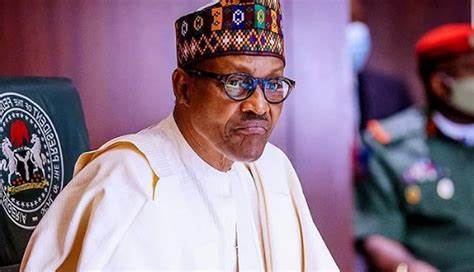
President Muhammadu Buhari
Who is responsible for sit-at-home?
The ICIR interviewed over 20 residents of the regions to understand who they felt was responsible for the Monday sit-at-home order and insecurity in the South-East region.
While many placed the blame on the doorstep of President Muhammadu Buhari, others blamed IPOB and South-East governors. A few also pointed fingers at a Finland-based Simon Ekpa, a self-proclaimed Nnamdi Kanu’s disciple.
Some said President Buhari should be held responsible for the sit-at-home in the region for keeping IPOB leader, Nnamdi Kanu, in prison even when competent courts of the land had ordered his release.
“Why are Buhari and the attorney-general Malami refusing to release Kanu if they truly want peace in the region?” a Uk-based sociologist, Nnadi Izuora, asked.
An appeal court had ordered Kanu’s release and declared his detention illegal, but the Buhari’s government has headed to court to quash the judgment.
A senior lecturer at one of the South-East universities, Osita Nnajiofor, said Buhari’s lopsided appointments, an unfair treatment of freedom fighters and the exclusion of the region from national politics were major contributory factors.
“Some of the appointments into security agencies and major government MDAs made the region feel they were not part of Nigeria,” he said.
“After the 2015 election in which the region’s candidate, Goodluck Jonathan, lost and Buhari won, the government did not make efforts to reconcile with the region,” he noted.
He said that exclusion from national politics angered the people of the region and made them seek ways to work against the government.
In 2015, the South-East region supported the then-incumbent, Jonathan, but he lost. However, based on interviews with several citizens of Igbo extraction, Muhammadu Buhari, the then new Sheriff in town, had some missteps.
In 2016, one year after he came to power, soldiers killed several IPOB members in Onitsha and Aba.
In June 2016, several IPOB members who were planning for pro-Biafran commemoration events in Onitsha, Anambra state, were killed by soldiers, according to Amnesty International.
Amnesty International said it received reports from various sources on the ground alleging that at least 40 people were killed and more than 50 injured.
“Evidence gathered from eyewitnesses, morgues, and hospitals confirms that between 29-30 May 2016, the Nigerian military opened fire on members of the Indigenous people of Biafra (IPOB), supporters and bystanders at three locations in the town.
“Opening fire on peaceful IPOB supporters and bystanders who clearly posed no threat to anyone is an outrageous use of unnecessary and excessive force and resulted in multiple deaths and injuries. In one incident, one person was shot dead after the authorities burst in on them while they slept,” said M.K. Ibrahim, Country Director of Amnesty International Nigeria.
Amnesty further said 150 IPOB members were killed between August 2015 and August 2015.
“Analysis of 87 videos, 122 photographs and 146 eyewitness testimonies relating to demonstrations and other gatherings between August 2015 and August 2016 consistently shows that the military fired live ammunition with little or no warning to disperse crowds.
“It also finds evidence of mass extrajudicial executions by security forces, including at least 60 people shot dead in the space of two days in connection with events to mark Biafra Remembrance Day,” it noted.
Former Chief of Army Staff, General Tukur Buratai
Tukur Buratai was Nigeria’s chief of army staff during this period, and many people in the region told The ICIR that he would face international war crimes someday.
A lawyer and founder of Ambassadors and Advocates Assembly, Samuel Oyigbo, said these killings must have led to an equal and opposite reaction.
“For every action, there is an equal and opposite reaction. This was a peaceful group, which was not causing trouble in the region before 2015 when Buhari came on. And then, suddenly, soldiers started killing them.
“We have deadlier groups such as Boko Haram and (militants) herdsmen in various parts of the country where the President comes from. Why not concentrate on those sects which were deadly. Why did the President concentrate so much energy on an unarmed group?
“IPOB and secessionist groups protested peacefully but were killed. When they noticed that their open protests often led to killings, they resorted to a sit-at-home protest, which is a different form of protest.
“Their leader, Kanu, had to set up radio to let the world know what was going on,” he said.
He chided the President for excluding the region from major security appointments.
“In all the security appointments from police to the interior ministry, down to army and navy, nobody from the South-East region, which is one of the three major ethnic groups in Nigeria. Is that justice or fairness?” he asked.
He concluded that the region’s marginalisation by the current administration had pushed so many young people of the region into the waiting hands of dangerous groups.
In 2017, the Federal Government declared IPOB a terrorist group.
This was the climax, according to Roy Nkwocha, a celebrated children’s books author who is based in the region.
Nkwocha wondered why militant Fulani herdsmen who killed and maimed hundreds of Nigerians were not declared terrorist groups.
Buhari is a Fulani man from Kastina state, North-West Nigeria.
More than 2,539 Nigerians, especially farmers, were killed by militant Fulani herdsmen in 654 attacks in Nigeria, according to a report.
Boko Haram has killed 35,646 in Borno State; 5,747 in Zamfara ; 5,462 in Kaduna; 4,097 in Adamawa; 3,774 in Benue, and 3,359 in Plateau, according to Statista. The group has not been officially declared as a terror group, based on findings.
Some analysts also blame the region’s governors, who they said had not played their role as the chief executive officers of the region. The South-East zone has five governors, but they lack harmony, said security analysts.
The region’s governors formed a security outfit known as “Ebube Agu” in 2021, but the group is often criticised for being used against political opponents.
The Association of Ebonyi Indigenes Socio-Cultural In the Diaspora recently said that “Ebubeagu has no place in Nigeria’s law and democracy, going by extant provisions of sections 4 and 214 of the 1999 Constitution of the Federal Republic of Nigeria,” accusing the security outfit of being used by the Ebonyi State government’s perceived enemies.
Some residents of the South-East region said they preferred the Eastern Security Network (ESN) formed by IPOB to Ebubeagu formed by governors.
An IPOB member in Onitsha told The ICIR that the group could form another security outfit “as soon as possible.”
“ESN is meant to counter terrorists who live in the bush. We will form another one that will take care of our streets,” he said.
However, a lead coordinator of the Advocates for Youth and Health Development, Patrick Enwerem, who hails from Imo state, said the governors must share in the blame.
“There is no synergy, no networking, no strategy. Everybody wants to do things within their state. So, if there is a limited security hitch in a governor’s state, he takes the praise. The violent elements understand these gaps,” he said.
Oyigbo, on his part, said even though the governors were not in control of security agencies due to constitutional gaps, they were still chief security officers of the state, who should not have allowed the crime to fester.
The IPOB is also chiefly blamed for not only the continuing Monday sit-at-home exercise in the region but also for insecurity in the region.
Enwerem said IPOB might have been infiltrated by some elements who deviated from the visions of its founding fathers.
“IPOB did not do enough. Apart from being responsible for starting the sit-at-home, it did not do enough to stop the bad eggs within its fold,” he noted.
“IPOB did not do enough. Apart from being responsible for starting the sit-at-home, it did not do enough to stop the bad eggs within its fold.”
A human rights activist in Aba, Abia State, Jane Ukatu, said security agencies were also partly to blame.
“Between 2015 and 2018, I counted more than 147 cases of human rights violations in South-East region.
“When EndSARS came in 2020, some who had one form of grudge or the other against the police had to join in unleashing their anger on security locations and personnel. Part of what you see today in the region is related to unaddressed injustices,” she said.
On the Finland-based Ekpa, many residents of the region who spoke with The ICIR said he was interfering in the affairs of the region negatively.
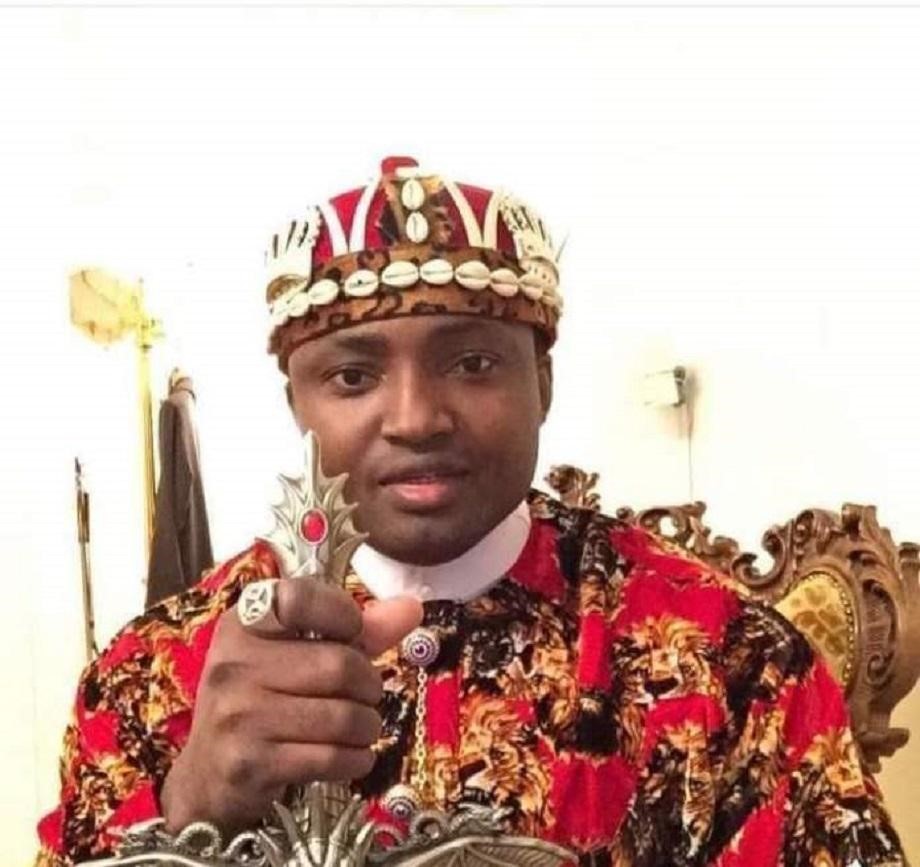
Simon Ekpa
Based on his Twitter posts, Ekpa has not hidden that he started the sit-at-home exercise and often berates those not supporting the cause.
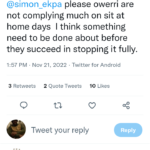
One Oliver Hilary tagged Ekpa’s Twitter handle, informing him that Owerri was not complying with the sit-at-home order, asking that something be done about it before “they succeed in stopping it fully.”
Ekpa has also made a post, saying that “Biafrans” (representing South-East people) would disrupt the 2023 general elections in the region.
Police react
The general feeling is that the police and other security agencies are overwhelmed by the sit-at-home order. However, the police dismissed that, saying they were on top of the situation.
Speaking with The ICIR, Anambra State police spokesman, a DSP, Tochukwu Ikenga, said he did not have information that there were sit-at-home exercises on Mondays in the state.
“I don’t have such information. I go to work every day,” he replied, when asked why the police had failed to quash the sit-at-home order.
When The ICIR reminded Ikenga that all Anambra traders were not police officers like him and his colleagues who could easily protect themselves, he said, “I go around with public vehicles. I don’t have such report. Anybody that has an engagement should go out. Being a security man is a secondary factor. Is it not people I am going to see?” he asked
The ICIR also reminded him that Main Market Onitsha, touted as one of the largest markets in west and central Africa, was always shut down every Monday, but he denied knowledge of that, saying that Eke Awka and other markets in the state were always open.
However, several markets in the state, including Ochanja, Ose, Iweka, are not open. Banks and parks in Onitsha, Awka and Nnewi are also not in operation every Monday, according to findings.
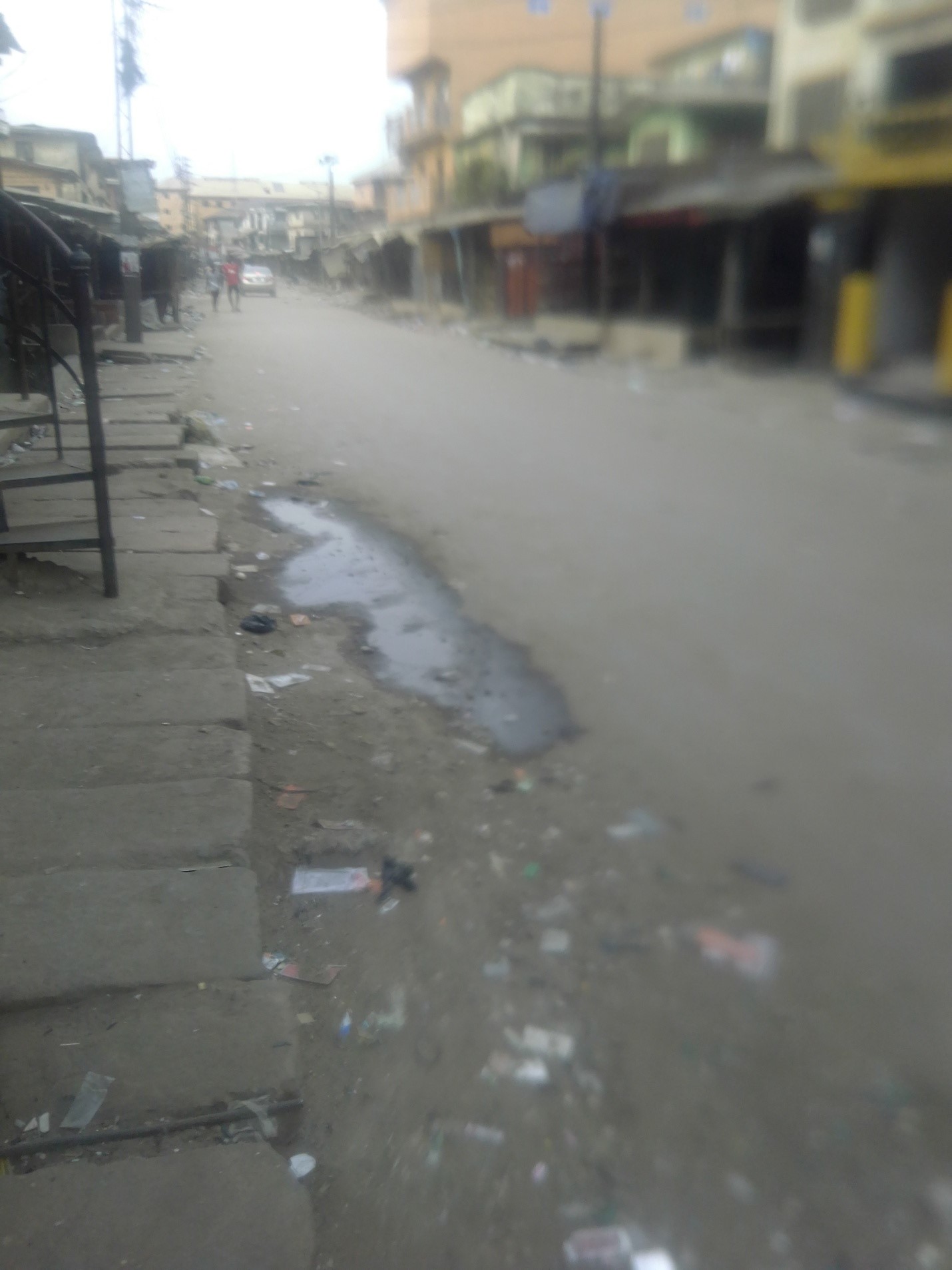
The ICIR has pictures showing that Main Market was shut on December 12, 2022.
Williams Street, Main Market, Onitsha shut down on sit-at-home day on December 12, 2022
Similarly, at Ebonyi state police spokesperson, a SP, Chris Anyanwu, said there was no sit-at-home exercise in the state.
“There has never been any sit-at-home observed here. There is no sit-at-home now, except at the earlier period. We have been maintaining it. We do our routine show of force to make the assurance double sure in case there is any attack.”
Anyanwu said this was being enforced in all area commands in the state, noting there was a joint arrangement in that regard.
When The ICIR contacted Police spokesman in Enugu State, DSP Daniel Ndukwu, he asked that a WhatsApp message be sent him.
However, he did not respond to the messages bordering on killings during the sit-at-home exercises in Enugu State.
Also, Imo State police spokesman, Michael Abattam, did not pick up his calls, nor did he respond to WhatsApp messages sent to him regarding efforts made by officers to quell the crisis.
Imo state, particularly, has been the hotbed of killings resulting from agitations and sit-at-home order in recent times.
Abia State police spokesperson, SP Godfrey Ogbonna, also did not pick up repeated calls by The ICIR.
Similarly, the spokesman for the Nigerian Army, Brig-General Onyema Nwachukwu, was called several times to respond to reasons why the exercise had continued in the South-East zone despite several military operations, but he did not pick up calls. Text and WhatsApp messages sent to him to respond to whether there were efforts to ensure those implementing it did not thwart February 2023 elections were not replied.
Soludo reacts
However, the Anambra state governor, a professor, Chukwuma Soludo, told The ICIR that nobody had any reason to stay at home every Monday.
Speaking through his Chief Press Secretary, Christian Aburime, Soludo said the Anambra State government would not play to the antics of non-state actors.
“Those who are declaring sit-at-home do not have the powers to do so. It is the government that is constitutionally recognised to do that. Moreover, IPOB, who started this whole thing, has distanced itself from it. The people have come out publicly to declare that they are not the ones ordering sit-at-home anymore. And what that means is that those who are declaring sit-at-home now are mere criminals who are looking for ways to cause chaos and disharmony,” Soludo stated.
He said everybody should come out and do their business, assuring that the state government would provide adequate security for them.
“As we speak, there is security architecture in virtually in all over the state, and they work together. We have set up a rejuvenated Anambra Vigilate Service. You find them in every nook and cranny in the state. It is now left for the people to come out and do what they are supposed to do. They should go about their normal business,” he added.
Several Nigerians of South-East extraction have proffered solutions to the Monday sit-at-home exercise and the general insecurity in the region.
According to market leaders who spoke with The ICIR, the Federal Government need to dialogue with the agitators.
The President, Leather Product Manufacturers Association (LEPMAS) covering Ariaria and shoemakers in Aba, Mazi Okechukwu Williams, said dialogue to pacify the agitators was better than aggression.
“The situation is affecting us in terms of revenue and productivity. The solution is for the Federal Government to dialogue with agitators. Also, there is a need to release Nnamdi Kanu,” he suggested.
Secretary of the Association of Leather and Allied Industrialists of Nigeria, Ken Anyanwu said, “The IPOB has relaxed its sit-at home. Simon Ekpa is engineering his own followers, but who is suffering from all these? It is the businessmen and women.”
“The IPOB has relaxed its sit-at home. Simon Ekpa is engineering his own followers, but who is suffering from all these? It is the businessmen and women.”
Anyanwu urged the government to address the issue squarely through dialogue.
“The Nigerian government should be able to know there is an agitation. Nobody should shy away from it. It is the responsibility of the government to address agitations. Let’s have a serene environment to do our business. Dialogue with them,” he suggested.
On his part, the Chairman of Johnson Street, Main Market, Onitsha, suggested that the release of Kanu would stop the sit-at-home order.
“Once you release Kanu, the exercise will disappear,” he said, with some hint of assurance.
Also, the President of Amalgamated Markets and Traders Association, Imo State, Chief Ezeanoche Emmanuel, said the solution was simply to plead with the perpetrators to call off the sit–at -home order.
“This is because the order has brought economic activities in the entire South-East to their knees. So we can only plead with them to end it,” he said.
A market leader of foods section in Nsukka area of Enugu State, Jerome Obieze, said apart from releasing Kanu, the Federal Govrnment must be sincere when dealing with the region.
“Treat the region as you do others. Let’s end the Civil War sincerely by giving the people of the region equal opportunities as others,” he said.
On his part, Izuora, earlier cited, called for the immediate release of IPOB leader, Kanu, to end the sit-at-home exercise and restore the confidence of the people in the Federal Government.
He further suggested the creation of a panel to investigate injustices in the region and punish those who had violated people’s fundamental rights.
“A sort of a truth and reconciliation panel where wounds can be healed should be set up,” he said.
“Those who have contributed to the region’s woes should be made to pay for their crimes. Also, Simon Ekpa should be reported to the government of Finland. I live in the UK. I am from the South-East and I believe in Biafra, but I do not go on making posts that can endanger my region. He needs to be checked and arrested immediately,” he said.
A prominent leader in the region and former governor of Anambra State, Chukwuemeka Ezeife, releasing Kanu would solve most of the security challenges in the region.
He said, “The insecurity bedevilling Anambra State today has its root on Kanu’s detention which was why I, together with other concerned Igbo elders, have taken it upon ourselves to consult with the Federal Government and demand his unconditional release,” he said in an interview with a newspaper.
For a Professor of Economics at Covenant University, Jonathan Aremu, the Federal Government must initiate peace moves in the region.
He said due to the region’s economic importance, the government should dialogue with its South-East leaders, douse the tension while resolving development and other social issues there.
Oyigbo, the lawyer earlier quoted, said the Federal Government needed to be fair and should give the region some sense of belonging, especially in terms of appointments.
“Don’t use guns to suppress agitations, use dialogue. If you have groups that kill up north, treat them as criminals. Don’t use force on unarmed IPOB and less force on dangerous terrorist groups up north. We are human and read between the lines,” he further said.
For the Chief Executive Officer, Centre for the Promotion of Private Enterprise, the government should dialogue with the region and make it investment-friendly again.
“It is an internal issue that can be resolved through dialogue by the leaders of the region,” he added.
Enwerem, earlier cited, said the people of the region should start electing public officers based on character and integrity.
“The region should jettison political parties and begin to elect people with character and evidence of performance. Things are not working in the region. If things are working, a lot of issues would be resolved.
“Also, IPOB should do some self-introspection. Has IPOB derailed? Are they sticking to the objectives of early Biafran agitators? I have studied conflicts and wars in several continents. Wars can’t give you anything. But we shouldn’t talk about conflict resolution without self-introspection. We should not harbour criminals and must call out those perpetrating crimes.
“Because we have developed the culture of silence, people have continued to do this and go scot-free. It is high time we went back to those things that enabled us to secure our communities. ”
The 2023 general election is three months away. One of the region’s former Governor, Peter Obi, is a frontrunner in the Labour Party. Some residents said the region was watching to see if the election would be free and fair.
“Peter Obi’s emergence is already changing the narrative in the region. The tension is subsiding. But to sustain it, the electoral body, INEC, must ensure free and fair election. If you rig him out, it may be déjà vu,” Dr Osita Mbamalu, a Lagos-based political scientist, said.
*This report is supported by the John D. and Catherine T. MacArthur Foundation and the International Centre for Investigative Reporting, The ICIR.
AS ministries, departments and agencies (MDAs) of the Federal Government begin the execution of government programmes for the 2023 financial year, The ICIR looks into what some government institutions budgeted for newspapers, magazines and periodicals within the year.
The institutions are the Presidency, Office of the Secretary to the Government of the Federation, Office of the Head of Civil Service of the Federation (OHCSF) and 12 key government ministries.
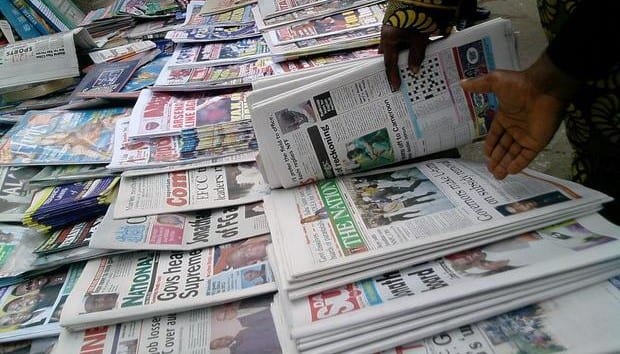
While the budgets for newspapers, magazines and periodicals run into several millions of naira in the selected ministries and other government institutions, some newspapers are sold between N200 and N300 in the country, but periodicals sell much higher.
The ICIR’s calculation shows that a budget of N1 million will purchase 4,000 copies of newspapers, meaning that a ministry that has a million naira budget for newspapers will have about 11 copies of the products every day of the year.
President Muhammadu Buhari signed the N21.8 trillion 2023 budget into law on Tuesday, January 3.
A breakdown of the budget shows the allocation of N967.5 billion for statutory transfers, N6.6 trillion for debt servicing, N8.3 trillion for recurrent expenditure, and N5.9 trillion for capital expenditure.
What the Presidency will spend on newspapers, magazines and periodicals this year
The Presidency will spend N26 million (N26,432,346) from its budget of N148 billion (N148,168,464,339) on newspapers and N3.5 million (N3,511,909) to buy magazines and periodicals.
OSGF
Office of the Secretary to the Government of the Federation has the approval to buy newspapers, magazines and periodicals worth N13.6 million (N13,650,000) and N11.2 million (N11,200,000), respectively, from its budget of N108.8 billion (N108,897,086,035).
OHCSF
The Office of the Head of Civil Service of the Federation (OHCSF) has a budget of N12 billion (12,096,559,260). It will purchase N1.5 million (N1,531,472) worth of newspapers and N13.4 million (N13,488,920) worth of magazines and periodicals.
Federal Ministry of Health
The health ministry has an approved budget of N1.075 trillion (N1,075,795,183,695. It plans to spend N2.9 million (N2,949,400) on magazines and periodicals.
Federal Ministry of Education
The ministry enjoys a budget of N1.06 trillion (N1,076,219,559,121). It will spend N7.8 million (N7,800,000) on newspapers and N8.2 million (N8,200,000) on periodicals from the fund.
Ministry of Aviation
The total budget for the ministry is N77.3 billion (N77,334,237,120).
It will purchase N3 million worth of magazines and N1 million worth of newspapers.
Federal Ministry of Finance and National Planning
From a total budget of N10.1 trillion (N10,126,444,028,859), the ministry intends to buy newspapers worth N14.2 million (N14,294,392) and magazines worth N9 million (N9,008,219).
Federal Ministry of Trade and Investment
The ministry has N48.4 billion (N48,862,789,248) to spend in the year, out of which the government earmarked N3.4 million (N3,409,043) for it to buy newspapers and N532,132 for magazines and periodicals.
Federal Ministry of Interior
Out of an approved budget of N15.1 billion (N15,744,778,061), the ministry will expend N3.5 million (N3,585,000) on newspapers and N626,200 on periodicals.
Federal Ministry of Justice
The ministry will spend N3.8 million (N3,825,000) of its N72.4 billion (N72,479,567,575) budget on newspapers. It has no budget for magazines.
Ministry of Labour and Employment
In 2023, the ministry plans to spend N8.9 million (N8,925,256) and N1.7 million (N1,785,464) of its N52.7 billion (N52,707,653,639) on newspapers and magazines and periodicals, respectively.
Federal Ministry of Works and Housing
The ministry has a budget of N534.4 billion (N534,455,695,989), from which it will spend N8.5 million (N8,579,623) on newspapers and N5.6 million (N5,651,948) on magazines and periodicals.
Federal Ministry of Power
From an approved budget of N258.4 billion (N258,494,986,301), the ministry wishes to purchase newspapers, magazines and periodicals for N1 million each.
Ministry of Defence
The ministry has a budget of N1.3 trillion (1,383,921,175,708) and a budget to purchase magazines and periodicals worth six million Naira.
Ministry of Foreign Affairs
The budget for the ministry is N98.1 billion (N98,114,501,448). It has set aside N7,336,858 to buy magazines and periodicals.
Meanwhile, The ICIR reports that the Federal Government often does not release all approved budgets to its MDAs. This consequently denies the MDAs the needed funds to meet their budgetary provisions.
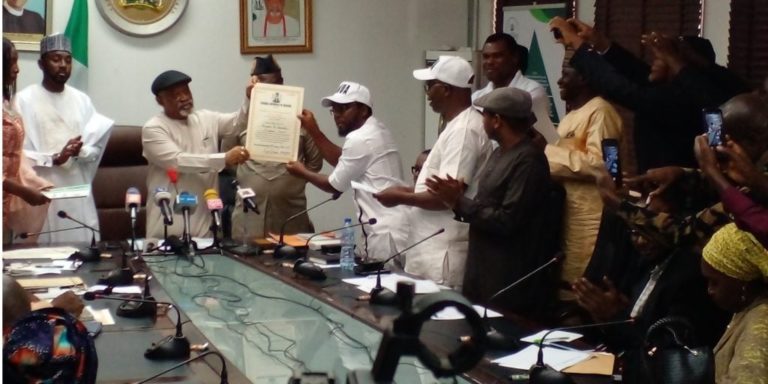
THE Nigerian government on Tuesday, January 17, issued certificates of recognition to two breakaway unions of Nigerian university lecturers and medical doctors – the Congress of University Academics (CONUA) and the National Association of Medical and Dental Academics (NAMDA).
CONUA emerged from the Academic Staff Union of Universities (ASUU) while NAMDA is a breakaway group from the National Association of Resident Doctors (NARD).
ASUU and NARD had embarked on series of strikes in recent years over disputes with the government, a development which is believed to have prompted the Federal Government to register the two breakaway unions.
At the certificate issuance ceremony in Abuja on Tuesday, Minister of Labour and Employment Chris Ngige warned members of CONUA and NAMDA against going on strike, noting that they would not be paid salaries if they embark on industrial action.
Ngige further stressed that the registration of the two unions followed due process as the Ministry received no letter from any existing union rejecting the registration of CONUA and NAMDA.
Presenting the unions with copies of their certificates of registration, he also enjoined them to fully operate as trade unions in the education sector.
The minister warned CONUA and NAMDA not to shut down Nigeria’s tertiary education like ASUU did by embarking on an indefinite strike.
“Don’t behave like ASUU. ASUU wanted to close down government business and we said no. There are consequences to strike. If you go on strike, the law is clear: no salary for you.
“If you have issues, negotiate with government, your employer. Be responsible in your demands. Education is essential service, therefore, no one should decide to shut it down for any reason.”
The Minister of Labour added that the government couldn’t sign the agreement contained in ASUU demand as there “was nowhere government will go and bring over a trillion naira to give ASUU.”
According to him, no minister or government official will sign any agreement that will not be possible to implement. He added that what happened in the tertiary education sector in 2022 will never happen in Nigeria again.
“With what we have done, no minister or government official will sign any agreement that will not be possible to implement. Unless the labour ministers after me choose to do contrary to the principles of free bargaining.”
Ngige also advised CONUA and NAMDA not to fight with other related unions.
Speaking on the development, CONUA National President Dr Niyi Sunmonu appealed to the Federal Government to pay the eight months withheld salary of the union members.
“Our concern is on the further withholding of CONUA members’ eight months’ salary. We did not call for strike neither did we go on strike. We call for an end to the withholding of salaries of our members.”
Sunmonu further explained that members of the union were unable to perform their duties due to the lock out arising from the shutdown of the universities by the school authorities.
He said: “Section 43(1b) of the Trade Disputes Act says “where any employer locks out his workers, the workers shall be entitled to wages and any other applicable remuneration for the period of the lock-out and the period of the lock-out shall not prejudicialy affect any rights of the workers being rights dependent on the continuity of period of employment”.
“In other words, there is no moral nor legal basis for the “No Work, No Pay policy to be applied to CONUA members, because we were only unable to perform our full duties due to the lock-out arising from the shutdown of the universities by university authorities who directed students to vacate the campuses.
“In this regard, even though we earlier put on notice that we shall go to any mile to seek legal redress on the payment of the withheld salaries, however, we note the salutary steps being taken recently by the Federal Government to ensure justice for CONUA members with respect to the withheld salaries.”