THE Federal government said today that it has been taking steps to stop the activities of illegal miners across the country, a concern it said had created serious economic sabotage for the country.
The Minister of Mines and Steel Development, Olamilekan Adegbite, stating this in Abuja, said part of the ministry’s steps had been to coordinate 4,000 mining cooperatives, while cracking down on unregistered miners, as well as on other illegalities in the sector.
Adegbite said, “We want to add value of beneficiation in the sector to enable us redirect it. We are de-risking the sector to make it attractive for investors.
“Our current reforms are yielding results. You need to see what the sector is contributing to the GDP 10 years ago and now to appreciate the reforms. For instance, we were doing less than a billion naira contribution to the GDP 10 years ago, but now it is more than N10 billion.”
Adegbite admitted that illegal mining remained a problem, disclosng that the ministry is currently in partnership with the Nigeria Customs Service and the Nigeria Immigration Service to curb the menace.
According to him, the current administration had intensified efforts to de-risk the sector with $100 million, which he said had heightened investors’ interest in the sector.
“These investments by the Buhari-led administration have helped us in acquiring data for the sector, which currently pushes up investors’ attraction for the sector,” he added.
Adegbite, commenting on why Nigeria does not have an economic edge on Australia and South Africa in mining benefits, said oil discovery distracted Nigeria’s concentration on growing mining investments.
“These countries have been doing mining for over 200 years without interruption. Petroleum discovery swayed Nigeria’s interest in mining, with less investments by the government on mining exploration,” he said.
He also explained that global miners were finding their way to Nigeria due to lower cost of exploration, when compared with established global mining jurisdictions.
“It takes about $400 to mine gold in Nigeria, whereas in established jurisdictions like Australia and United Kingdom, it takes to up to $1,200 to mine an ounce of gold,” he said.
The minister added that upbeat investors from Canada and the United Kingdom had expressed interest in Nigeria’s mining sector, as the government intensifies efforts to de-risk the sector.
He also said the government had commenced enforcement of the beneficiation order, as approved by the Federal Executive Council, to disallow scavenging and raw exports of Nigeria’s solid mineral resources.
“I was in Saudi Arabia and the Tesla people approached us and requested to mine our lithium. I told them to come and build their battery factory in our country rather than explore the raw resources. This is how we are growing our beneficiation strategy and adding value to our mineral resources.
“In the last two years, people have come in from the United Kingdom, Canada and the United States to advance discussions with us on investments in the mining sector. All these are because of reforms in the sector,” he added.
THE Inspector-General of Police (IGP) Usman Alkali Baba has ordered the standardisation of the Police investigation process.
The IGP also issued a directive against duplication of cases and parallel investigations in the Nigeria Police Force (NPF).
NPF spokesperson Olumuyiwa Adejobi disclosed this on his Twitter page on Tuesday, January 2.
Adejobi said the directive would strengthen the criminal justice system and standardise investigation processes in the Force.
According to NPF spokesperson, the IGP gave the directive while reviewing complaints concerning indiscriminate transfer of cases at various Police investigation outfits.
“The IGP gave the directives while reviewing and dealing with files/cases in response to complaints on indiscriminate transfers of cases from Zonal/State Commands and other investigative units of the Force by operatives of the Force Criminal Investigations Department, Force Intelligence Bureau, and other Force Headquarters-based investigation outfits under the guise of re-investigation at the prompting of indicted parties,” a statement issued by the police spokesperson said.
According to the statement, the IGP frowned at situations where parallel investigations by multiple units lead to conflicting arrests of parties and different outcomes even when such matters have been conclusively investigated and charged to court.
United Kingdom (UK) Metropolitan Police have recovered a woman’s body from a lake in Kent following a four-week search for a missing Nigerian mother from Bexley.
Taiwo Balogun, 53, was last seen in a shop in Crayford Road, Bexley at around 2:27 p.m. on December 1, with the police desperately searching for her since her disappearance.
She was described as being 5ft 9ins tall and at the time of her disappearance was wearing a black jacket with vertical stripes down the arms, dark trousers and black and white trainers.
Bexley Metropolitan Police Service (MPS) tweeted: “A woman’s body was recovered from a lake near Bluewater Shopping Centre on Friday, December 30. While formal identification awaits, Taiwo Balogun’s family has been informed.”
The body was reportedly recovered at 6.54 pm on Friday and the Met Police has said her death is being treated as “unexpected but not suspicious”.
Earlier, the police released footage from a CCTV camera in the shop where she was last seen to see if anyone spotted her or may have captured dashcam images.
The Police had also said that the 53-year-old was considered vulnerable and might be a risk to herself.
The fellowship provides international journalists with two semesters of funding to study at one of the master’s programs at the Arthur L. Carter Journalism Institute, as well as a US$16,000 stipend.
Fellows can choose one of nine concentrations: business and economic reporting; cultural reporting and criticism; global and joint program studies; literary reportage; magazine and digital storytelling; news and documentary; reporting the nation and New York; science, health, and environmental reporting and Studio 20.
Journalists with at least two years of experience and fluency in English and at least one other language can apply for a fellowship in New York.
Candidates must also complete the application for the graduate program of their choice. The GRE and TOEFL are required tests for admission to NYU. The GRE is optional for some graduate concentrations.
The deadline for the submission of the application is January 15, 2023. Interested applicants can apply here.
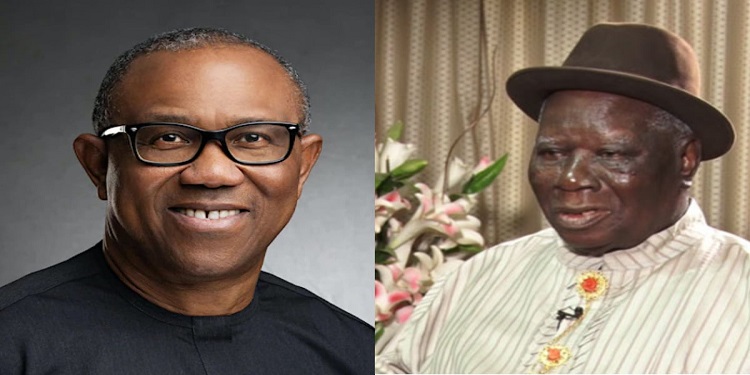
A FEW days after former President Olusegun Obasanjo endorsed the flagbearer of the Labour Party (LP), Peter Obi, for the 2023 presidential election, an elder statesman Edwin Clark has also declared him his preferred candidate.
The Ijaw national leader and convener of the Pan Niger Delta Forum (PANDEF) endorsed Obi on Tuesday, January 2, at a media briefing in his Abuja residence.
He urged Nigerians, irrespective of ethnic, religious and political affiliation, to back Obi because he is the “best hope of a new Nigeria”.
Clark said he had saddled himself with the responsibility of requesting PANDEF, and all other groups he belongs to, to give their support to the LP candidate.
“Putting His excellency Peter Obi side by side with all other candidates being presented by other political parties, I am convinced beyond doubt, that our country Nigeria has a great opportunity to elect a phenomenal team, the candidate of the Labour Party, and his deputy, senator Datti Baba-Ahmad, as President and Vice President respectively.
“I formally hereby announce that I will, therefore, personally, vote for HE Peter Obi and his vice presidential candidate on election day, February 25th, 2023, as President and Vice President of the federal republic of Nigeria,” he said.
Clark called on all Nigerians to vote for Obi without hesitation.
Meanwhile, the Benue State Governor, Samuel Ortom, has backed Obasanjo’s endorsement of Obi for the forthcoming presidential election.
The Benue governor maintained that if he were not a member of the Peoples Democratic Party (PDP), he would have personally led Obi’s campaign across the country.
Ortom, in a statement issued Tuesday in Makurdi by his Special Adviser on Media and Publicity, Terver Akase, also recommended Obi to Nigerians “as the man who has the capacity to effectively tackle the economic, security and other challenges facing the country”.
Obasanjo had earlier endorsed the Labour Party (LP) presidential candidate Peter Obi for the presidency in 2023.
Obasanjo, in a six-page letter, disclosed his position on the 2023 presidential election in his New Year Message to Nigerians on Sunday, January 1.
AMINU Yusuf was at the Federal Medical Centre Gusua, Zamfara State, in July 2018 to treat his wife, who suffered from bacteria infections during pregnancy.
The woman, Habiba, and her husband travelled from the state to the Usmanu Danfodiyo University in Sokoto State before running some tests that showed she had sepsis. The Gusau FMC did not have the equipment to run tests on her.
The couple returned to the FMC Gusau with the test result for Habiba’s treatment, covering the 213-kilometre Gusau-Sokoto Road.
That was the situation of the facility before it got theCACOVID Fund (otherwise known as the COVID-19 Intervention Fund) in 2020, which enabled it to procure some world-class equipment in its critical departments.
Screenshot of COVID-19 procurement for the Federal Medical Centre, Gusau, Zamfara State, from the NOCOPO website
For instance, the hospital did not have a molecular laboratory to conduct specialised diagnoses. It referred patients and their relations, like Yusuf’s, to other states to do the procedures.
Some of the patients travelled as far as Maiduguri to run tests before getting results that revealed their conditions. But that has stopped.
In February 2022, Danladi Mustapha and his wife, Mariam, were at the Gusau hospital to treat their five-year-old son, who had a viral infection.
Because the hospital already had all the equipment needed to run tests on the boy, the family did not have to travel elsewhere like Yusuf’s family.
Since 2021, the FMC Gusau has acquired more equipment, built a complete molecular laboratory, and upgraded its intensive care unit (ICU), among others, courtesy of the CACOVID Fund.
A section of the ten-bedded intensive care unit at the Federal Medical Centre, Gusau, Zamfara State. Photo credit: The ICIR/Marcus Fatunmole
The ICIR reports that the CACOVID fund differs from the yearly capital releases by the Federal Government to the hospital, which are used for other purposes.
The facility now hosts hundreds of patients daily because it has expanded its services. Being the only tertiary health facility in the state, it enjoys higher patronage than ever.
Some of its patients are victims of insurgency and banditry who need emergency treatment, including transfusion, and whose relations often throng the hospital.
Many primary and secondary healthcare facilities in the state have been inactive because of insecurity and other challenges, making most people in the state see the FMC as their most dependable institution for healthcare delivery.
The FMC’s medical director, Bello Muhammed, said the new equipment procured with the COVID-19 fund positioned the hospital to render services it could not previously offer, including those it had sought in Maiduguri and other places.
Because of the funding support, the hospital now has a molecular laboratory that carries out essential diagnoses.
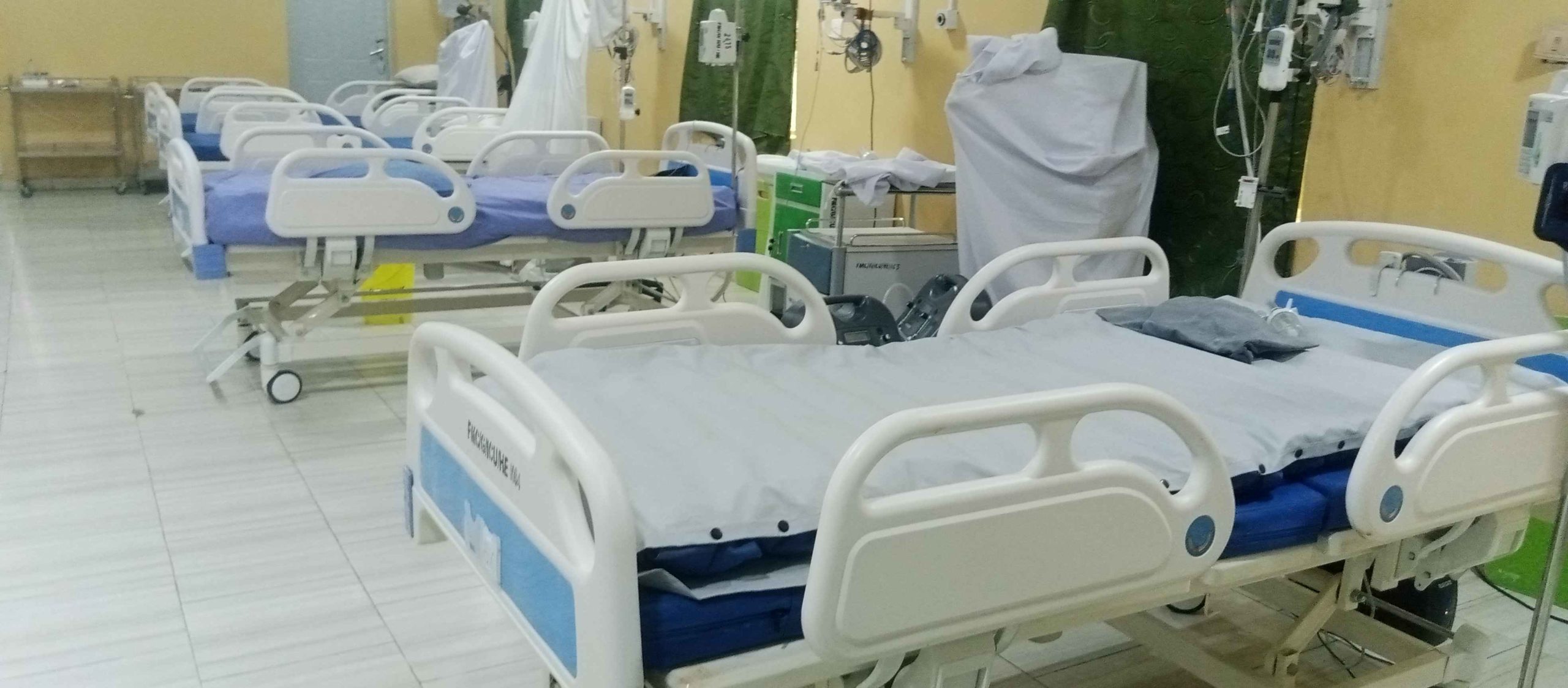
The FMC has upgraded its five-bedded intensive care unit (ICU) to a ten-bedded ICU. All the ten beds are new and have accompanying gadgets for patient care in a modern ICU, courtesy of the fund.
Besides, the hospital has a remodelled isolation ward and a gas plant funded by the fund and a chemistry analyser and blood bank.
The 80 degree centigrade machine and other equipment at the molecular laboratory department, FMC Gusau, Zamfara State. Photo credit: The ICIR/Marcus Fatunmole
The reporter found out that services have been more effective at the hospital because the management enforces discipline, such as using an attendance register in every department to curb absenteeism and lateness to work.
Every worker logs their name and the time they arrive work in the workers’ register positioned at their office’s entrance. They also sign out when closing from work.
All workers interviewed said the medical director sets the example. The reporter saw the medical director moving around the facility at 8:30 a.m. on October 18 when he visited the hospital to check the equipment purchased with the COVID-19 money.
Muhammed told the reporter that he instilled discipline in his workforce to promote productivity and ensure every worker justifies their wage.
The COVID-19 Intervention Fund
The threat posed by the emergence of coronavirus globally in early 2020, and its accompanying high morbidities and fatalities, pushed Nigerians and corporate organisations under the auspices of Coalition Against COVID-19 (CACOVID) to raise funds to strengthen the nation’s health system.
At the end of the year, the government had spent N38.59 billion from the fund.
The fund raised by CACOVID in 2020
Nigeria recorded its first case of the disease on February 27 and locked down some states on March 30, as infections from the virus spiralled nationwide.
Among other measures, President Muhammadu Buhari constituted the Presidential Task Force on COVID-19 and approved emergency procurements of pharmaceutical and non-pharmaceutical measures to combat the pandemic.
The role of Bureau of Public Procurement in managing the fund
The Public Procurement Act 2007 recommends competitive and open bidding for public contracts. The Act, however, has a caveat for emergency procurement during a crisis such as the COVID-19 pandemic.
The Federal Government expected all the fund beneficiaries to log the details of their procurements in the Nigerian Open Contracting Portal (NOCOPO).
Mechanical ventilators and other equipment at the ICU, FMC, Gusau, Zamfara State. Photo credit: The ICIR/Marcus Fatunmole
Some of the hospitals, ministries and agencies that recieved the COCAVID fund published details of what they got on the NOCOPO website. Others failed to do so.
Beneficiaries were to provide information on how they spent the money. The information includes project title, contractor, contract sum, completion period, project status and items they procured.
The ICIR reports that failure to upload the details, otherwise known as the procurement plan, is a contravention of the Bureau of Public Procurement (BPP) Act and undermines its transparency initiatives for governance.
While the Gusau hospital entered the details, it failed to name the items it bought with the money it got.
A section of the walkway at the FMC Gusau, Zamfara State. Photo credit: The ICIR/Marcus Fatunmole
The FMC’s share of the CACOVID Fund
The hospital’s medical director, Bello Muhammed, said the FMC got N949 million (949,068,634.00), but the Accountant General’s Office figures showed the facility got N1.35 billion.
“It’s not up to over one billion. It was over 900 million. The money was not paid at once. There were releases. We had to do some of the projects in phases because we were given the first tranche. We were not expecting the second tranche until when we finished executing the first release.
“Then, we heard about the second tranche. The money was released at different times for different purposes,” the medical director told The ICIR.
Some of the equipment at the Molecular Laboratory, FMC Gusau. Photo credit: The ICIR/Marcus Fatunmole
Contracts awarded with the fund
An Abuja-based firm specialising in medical equipment, DCL Laboratory Products Limited, got the contract for constructing and equipping a molecular laboratory at the sum of N345.8 million.
Another company, Sudabelt Medical Co. Ltd, dealing in medical equipment, got the contract to supply equipment for the hospital’s isolation ward at N99.8 million.
The firm got yet another two contracts, namely a contract for the supply of equipment for upgrading the ICU to 10-Bed capacity for N353.6 million and another contract to procure personal protective equipment (PPE) at N96.1 million.
Some of the beds at the remodelled Isolation Ward, FMC Gusau, Zamfara State. Photo credit: The ICIR/Marcus Fatunmole
COVID-19 fund, a blessing to Gusau FMC – MD
The medical director said the fund helped the facility purchase equipment it never thought it could buy. “You have seen the molecular laboratory, which is fully equipped. We did what we had done with the intervention. We infused essential equipment such as the chemistry analyser and blood bank in our general laboratory.
“The blood bank here is among the best we have in Nigeria.
You can see the intensive care unit. Before, we had a five-bedded intensive care unit, but with this kind of intervention, we upgraded it to a 10-bedded intensive care unit.
“Previously, we had to go as far as Kaduna and Kano to get oxygen, which was not easy. With what is going on now, soon, we will start selling to outside neighbouring states.
We may only be able to consume some of what we have produced. All these are courtesy of COVID-19.”
Dr Bello Mohammed, Medical Director, Federal Medical Centre, Gasau, Zamfara State. Photo credit: The ICIR/Marcus Fatunmole
He averred that the COVID-19 intervention provided equipment of world-class standards that encouraged the entire institution’s staff.
Muhammed said with the calibre of equipment on the ground; patients could easily have the investigative procedures and treatment they needed.
“It has cut down a lot of expenses. Before now, some of these patients travelled far to get some of these services. Along the line, they also had an accident.
“The last time I saw a chemistry analyser of this capacity was in France in 2012. Now, here we are with the equipment.
We could only do some of these investigative procedures here before the COVID-19 intervention. You had to take your patients as far as Sokoto, Zaria and Kano, which are not less than 240 kilometres each.”
Gas plant at the Federal Medical Centre, Gusau, Zamfara State. Photo credit: The ICIR/Marcus Fatunmole
Hospital has 38 consultants and others to provide services
The medical director said the FMC had 38 consultants and other health professionals.
There were 45 consultants at the facility. Seven left within the past year. Gunmen killed one of the consultants in 2021 in his home in the state.
Muhammed said the state faced insecurity more than any other in the country. “The insecurity has impacted negatively on the performance of this hospital. Some of the specialists have fled outside the country. The brain drain is affecting the hospital in two ways.
“Some specialists leave this part of the country for the southern region. At the same time, some leave for outside the country. So, our brain drain is the worst in the country because it is in two ways.
“And the victims of banditry and insurgency are also brought to the hospital. The hospital is seriously overwhelmed.”
Solar power batteries at the molecular department, FMC Gusau, Zamfara State. Photo credit: The ICIR/Marcus Fatunmole
Some of the equipment bought with COVID-19 money at the FMC
Some of the equipment at the molecular lab are the bio-safety cabinet, PCR machine, automatic extraction machine, centrifuge for manual extraction, Glove box, -80 degree Centigrade, VITEK 2 Compact, 20KV inverter, pure-water making machine, heating block, autoclave.
Head of the Molecular Laboratory Department, Shaibu Baba, told The ICIR, that the hospital should have gotten the facilities long before COVID-19 but expressed delight that they were available despite the delay.
He stated that the hospital’s molecular laboratory was the only one in the state.
“We hope the government will keep supporting molecular activities in the country because they make life easy and make things cheaper for people to access health.”
At the hospital’s ten-bedded unit are mechanical ventilators for supporting patients’ breathing, ECT machines used for diagnosing patients’ heart abnormalities, defibrillators, infusion pumps, and mobile mechanical ventilators, among others.
One of the rooms at isolation ward, FMC, Gusau, Zamfara State. Photo credit: The ICIR/Marcus Fatunmole
The hospital’s isolation ward has different wards where persons with suspected and confirmed infection cases are kept. The hospital renovated the ward with the COVID-19 fund.
Some of the equipment there are an autoclave, oxygen concentrator, suctioning machine, Ambu bag, manual suctioning machine, oxygen cylinders, infrared thermometers, and bed-side cupboard, among others.
At the FMC’s general laboratory are a haematology analyser and blood bank refrigerator (which can preserve 200 pints of blood).
Assistant Director of the Haemotology Department, Hassan Olorunfemi, said power outages were a main challenge at the department.
The blood bank at the FMC Gusau, Zamfara State. Photo credit: The ICIR/Marcus Fatunmole
Asked about the equipment’s usefulness after COVID-19 is no longer very active in the country, the hospital’s Head of Department, Community Medicine & Community Physician, Musa Yakubu, a doctor, said, “People still come with diseases. Even if there is no more COVID, we still have diseases that require isolation precautions. We have Monkeypox. We have people who come with Lassa Fever that must be isolated from the general medical and emergency wards.”
Well-policed hospital with sprawling buildings
Visitors to the hospital meet private guards at every point from the facility’s main gate.
Every department and ward has a guard manning it. Police and officers of the State Security Service (SSS) also complement security at the FMC.
Following the insecurity crisis in the state, visitors are not allowed to take pictures or loiter within the facility.
The hospital parades dozens of new buildings it built in the past few years. The mostly-bungalow structures are linked with concrete walkways.
Another section of the Federal Medical Centre, Gusau, Zamfara State. Photo credit: The ICIR/Marcus Fatunmole
Some defects observed
The reporter discovered that the haematology analyser did not work because it had a faulty UPS.
There are many packs of hand sanitisers at the hospital’s store. They could expire if left unused.
At the time of the visit, there was a bush in front of the hospital, close to the hospital’s major solar panel. The grass could harbour reptiles that might harm people who walk through the long route between the main gate and the facility’s buildings.
The reporter observed that many of the devices procured for the hospital’s isolation unit are kept in the store because there is no space to put them to use.
The molecular laboratory building at the FMC, Gusau, Zamfara. Photo credit: The ICIR/Marcus Fatunmole
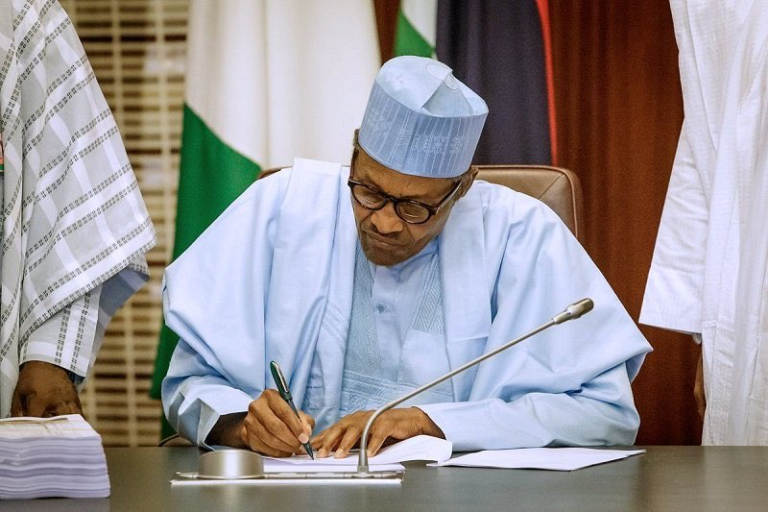
PRESIDENT Muhammadu Buharihas today signed the 2023 Appropriation Bill of N21.8 trillion into law at the Council Chambers of the State House in Abuja today.
The budget is an increase of N1.32 trillion on the President’s proposal of N20.51 trillion.
A breakdown of the budget indicates an allocation of N967.5 billion for statutory transfers, N6.6 trillion for debt servicing, N8.3 trillion for recurrent expenditure, and N5.9 trillion for capital expenditure.
The 2023 Appropriation Bill was deferred two weeks ago over what the Senate President, Ahnad Lawan, described as problems discovered in it.
The budget maintained the recurrent expenditure at approximately N8.27 trillion, while capital expenditure increased from N5.35 trillion to N5.9 trillion, and debt servicing also increased from N6.31 trillion to N6.6 trillion.
Key capital allocations include the N285 billion to the Federal Ministry of Defence, N134.9 billion to the Federal Ministry of Health, N195.5 billion to the Federal Ministry of Power, and N153.7 billion to the Federal Ministry of Education.
The Tertiary Institutions Revitalisation Fund of N300 billion and salary renegotiation of N170 billion have been captured in the 2023 budget, while N10.2 billion has also been provided for the universities pension, including arrears.
THE Presidency has said former president Olusegun Obasanjo is “jealous” of President Muhammadu Buhari’s achievements in office.
This is coming a day after Obasanjo in an open letter endorsed Labour Party (LP) presidential candidate, Peter Obi, and described the administration of Buhari as “stressful years for many Nigerians”.
Obasanjo also said Nigerians “moved from frying pan to fire and from mountain top to the valley”, during the Buhari’s tenure.
But in a statement on Monday, January 2, presidential spokesperson, Garba Shehu, claimed Obasanjo is jealous because Buhari is ahead of him in terms of national development.
According to Garba, “Mr Obasanjo’s tenure, 1999-2007, represented the dark days of Nigeria’s democracy due to a slew of assaults on the constitution.”
Parts of the statement read; “He (Obasanjo) will not stop attacking President Muhammadu Buhari because the former President won’t stop being jealous of anyone who beats him to a new record in the nation’s development process.
“President Buhari is ahead of Chief Obasanjo in all fields of national development and to do that is a cardinal sin to Obasanjo whose hallucinations tell him that he is the best ever to lead Nigeria and there will never be another one better than him.
“Having tried tenure elongation and failed, Obasanjo’s fictitious mind must be telling him that he is the one under attack. But he is not on President Buhari’s radar because experience has shown, especially lately in West Africa where there have been at least three successful coups and many other failed attempts, that third term or tenure elongation is a recipe for political instability.
“As President, Obasanjo destabilised internal democracy by orchestrating impeachment after impeachment of governors who were not compliant with his highly imperial administration”.
Shehu also said unlike Obasanjo, Buhari has received praise from the international community for his achievements.
“On the other hand, in Washington a few weeks ago, the US President Joe Biden at a meeting with African Heads of States and Government described President Buhari as a champion of democracy and role model for the leaders of African states.
“Clearly, Obasanjo has become even more jealous by adopting a vengeful attitude.
“To say that “frying pan to fire” is the situation in Nigeria at this time should be read to mean a personal experience to him and we know what that means.
“‘Hell’ for Obasanjo is when a President, any President that comes after him refuses to be his own puppet, to do as he wishes on all matters and at all times. He then keeps attacking out of frustration”, Garba said.
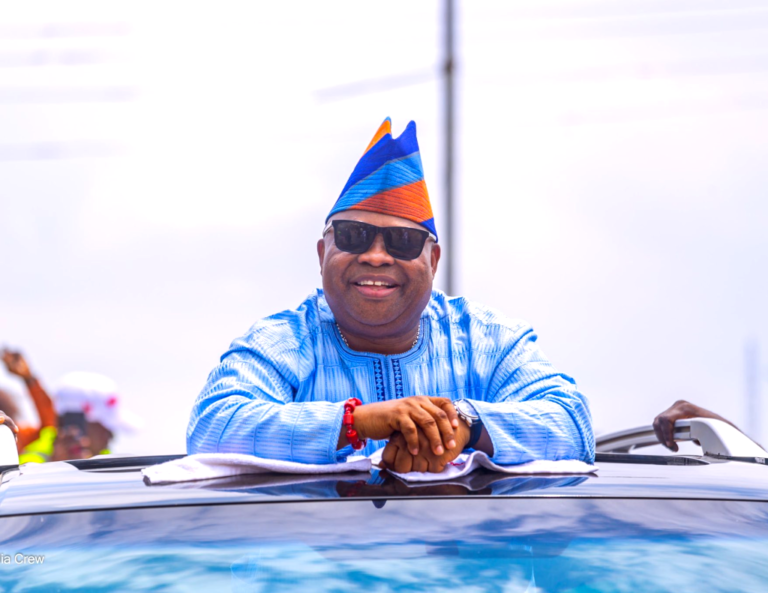
OSUN State governor Ademola Adeleke, has urged his predecessor, Adegboyega Oyetola, to face reality as the state will not be returned to ‘years of locusts’.
Oyetola had during an interdenominational prayer session on Monday, declared that he is back in the state to reclaim his mandate.
The immediate past governor also said he had a divine revelation that the candidate of the All Progressives Congress (APC) Bola Tinubu will win in the forthcoming general elections.
He added that God told him he would return as governor of Osun State, as he governed the state well while in office.
“God has made us know that this year is for two victories. We will reclaim our mandate and Asiwaju Bola Ahmed Tinubu will be elected President of the Federal Republic of Nigeria. He has returned us back to the State to reclaim our mandate soon.”
Reacting, Adeleke in a statement by his spokesperson, Olawale Rasheed, said Osun people have moved on and are now enjoying new governance of accountability and responsiveness.
“The Holy Book even noted that the devil’s whispering is real and no one should mistake the voice of the devil for God. Our Almighty God has spoken resoundingly in favour of a new Governor, Senator Ademola Adeleke. Mr Oyetola should better be reading ‘auzubilahi mina shaytani rajeem’ so he can hear the true voice of God that a true leader is anointed by divine will for the Osun people.
“Osun has launched a new chapter. This new leadership has returned state power to the people who are now feeling the new air of government of the people, by the people and for the people. Never will Osun be returned to years of locust,” parts of the statement released by Adeleke’s spokesman read.
Adeleke had on July 16, 2022, defeated Oyetola, the incumbent, in the Osun State governorship election.
Adeleke, of the Peoples Democratic Party (PDP) got 403,371 votes to defeat Oyetola, who got 375,027.
The ICIR reported that Adeleke vowed to probe Oyetola over N407.32 billion debt owed by the State government, including arrears of salaries and pension owed workers and retirees.