Home Blog Page 15

Ronaldo, Messi headline stars as World Cup 2026 kicks off in North America

AFTER a two-year qualification campaign involving hundreds of matches across six continents, the FIFA World Cup 2026 is set to kick off today, as co-hosts Mexico will face South Africa at the iconic Azteca Stadium in Mexico City.

Forty-Eight nations will compete for football’s most coveted trophy, with the United States, Canada and Mexico jointly hosting the month-long spectacle. The expanded tournament will feature 104 matches across 16 host cities before culminating in the final on July 19 at MetLife Stadium in New Jersey.

Nigeria’s quartet of superstar singers Burna Boy, Davido, Rema and Ayra Starr will perform at the World Cup.

Defending champions Argentina arrive in North America aiming to retain the title they won in Qatar four years ago. Much attention will once again focus on Argentine captain Lionel Messi, who could be appearing in his final World Cup.

Messi, 38, and Ronaldo, 41, have competed in five World Cup tournaments, with only Messi’s Argentina winning the title in 2022.

Traditional powerhouses Brazil, Germany, France, Spain, England and Uruguay are also among the favourites to challenge for the title.

Brazil, the most successful nation in World Cup history with five titles from 1958, 1962, 1970, 1994 to 2002, will seek to end a 24-year wait for another championship. Germany and Italy have won four titles each, while Argentina have notched three wins and France, two with Uruguay, the inaugural champions at home in 1930 and in Brazil 20 years later, have two World Cup titles.

England have a solitary title, which they won on home soil in 1966. Spain triumphed at South Africa 2010.

Biggest World Cup ever

The 2026 edition represents a historic expansion of the competition.

From the inaugural tournament in 1930, which featured just 13 invited teams, the World Cup has steadily grown into a global sporting phenomenon, as the competition expanded to 16 teams in 1934, increased to 24 teams in 1982 and then to 32 teams in 1998.

Now, FIFA has expanded the field to 48 teams, creating a significantly larger tournament that offers more opportunities for countries from Africa, Asia, North America and Oceania to compete on football’s biggest stage.

A total of 104 matches will be played during the tournament, nearly doubling the number contested in previous editions.

Africa will have its strongest-ever representation, with 10 teams participating after FIFA increased the continent’s allocation of qualification slots.

The financial stakes are higher than ever, as FIFA has increased the jackpot to $770 million from the $440 million in Qatar 2022, as every finalist is guaranteed at least $10.5 million, and FIFA has set aside $355 million for clubs with players in the tournament.

The winners will receive $50 million from FIFA. The cost to host the finals this time is estimated at $12 billion, far lower than the $200 billion Qatar spent to host the 2022 finals, largely due to massive infrastructure projects completed in advance.

However, before the kick-off, the tournament has been overshadowed by geopolitical tensions and controversies that threaten to blur the line between football and politics.

As the football world turns its attention to North America, several traditional football powers will be watching from home, because questions have emerged over visa restrictions and travel arrangements affecting some participating delegations and supporters.

Iran, one of Asia’s representatives at the tournament, has raised concerns over ticket access for some of its fans amid ongoing tensions with the United States, and reports have also surfaced regarding entry complications involving match officials from countries affected by diplomatic restrictions.

The controversies have reignited debates about the growing intersection of politics and international sport, particularly as FIFA President Gianni Infantino has maintained close public engagements with political leaders from host nations in recent years.

One of the most controversial cases of such restrictions is the deportation of award-winning Somali referee Omar Artan by U.S. authorities. Artan had already arrived in the United States when he was denied entry and returned to his country of departure.

Despite these distractions, anticipation remains high for a tournament expected to deliver memorable football moments, emerging stars, and dramatic storylines.

Among the most notable absentees is Italy, one of the most successful nations in World Cup history. The four-time champions have now missed multiple recent editions, extending one of the most surprising downturns ever experienced by a football giant.

Several other established football nations also failed to navigate the qualification process, underlining the increasingly competitive nature of international football.

For Nigeria, another World Cup absence will be particularly painful. The Super Eagles, once regular participants at the tournament, were unable to secure qualification despite boasting a squad filled with players competing in Europe’s top leagues.

Can Africa make history?

Africa’s best World Cup performance remains Morocco’s remarkable run to the semi-finals in Qatar in 2022, the furthest any African nation has advanced in the tournament’s history.

Before Morocco’s breakthrough, Cameroon reached the quarterfinals in 1990, while Senegal matched that feat in 2002.

With an increased number of African representatives and several highly competitive squads entering the tournament, hopes are once again high that the continent could produce another historic campaign.

Whether Morocco can repeat its heroics or another African nation emerges as a surprise package remains one of the tournament’s most intriguing questions.

As football’s biggest-ever festival begins, the countdown to crowning a new world champion has finally come to an end.

Senate orders arrest of Ex-NNPCL boss Mele Kyari over ₦210tn audit query

THE Senate Committee on Public Accounts has ordered the arrest of former Group Chief Executive Officer of the Nigerian National Petroleum Company Limited (NNPCL), Mele Kyari, over his repeated failure to appear before lawmakers investigating an alleged N210 trillion discrepancy in the company’s financial records.

The directive was issued on Wednesday, June 10, after Kyari allegedly failed, for the ninth time, to honour invitations from the Nigerian Senate Public Accounts Committee, which is probing audit queries raised by the Office of the Auditor-General covering the period between 2017 and 2023.

Chairman of the committee, Ibrahim Dankwambo, a senator from Gombe North, said Kyari should be compelled to appear before the panel, following a voice vote by lawmakers who rejected further delays.

Anywhere Mele Kyari is, he should be arrested and brought before this committee,” he declared.

Background to the probe

The investigation stems from audit queries flagged by the Office of the Auditor-General of the Federation, which raised questions about discrepancies running into ₦210 trillion in NNPCL’s accounts over a six-year period.

The matter first became public in 2025, when the Senate Public Accounts Committee began reviewing the national oil company’s audited financial statements and requested explanations for the figures submitted.

Lawmakers subsequently issued multiple invitations to Kyari and other senior officials of NNPCL to appear before the committee. 

However, his repeated absence led to multiple adjournments, with senators stating that the committee had held at least nine sittings without resolution.

Kyari was removed from office in April 2025 by President Bola Tinubu as part of a broader restructuring of the national oil company amid increasing scrutiny of its operations.

Since his exit, the Senate has continued its probe, while NNPCL’s management has provided partial explanations to the committee, including claims that portions of the disputed figures represent accrued expenses and receivables rather than missing funds.

Arguments at the hearing

At Wednesday’s session, some senators appealed for caution, citing reports that Kyari was receiving medical treatment in Germany.

Tony Nwoye, a senator representing Anambra North said he had spoken with the former NNPCL chief and was informed of his condition abroad, while Saliu Mustapha of Kwara Central urged the committee to grant him more time.

However, several lawmakers opposed any further delay.

Abdul Ningi (Bauchi Central) insisted that claims of illness must be supported with documentary evidence, while Victor Umeh (Anambra Central) argued that Kyari’s continued absence showed disregard for the committee.

“This matter has been on for sometime. We have been expecting Mr Mele Kyari to appear before us for one year or more and for us to receive information that he’s abroad. It shows that he’s not taking us seriously,” ” Umeh said.

Deputy Chairman of the committee, Peter Nwaebonyi (Ebonyi North), noted that the panel had already met nine times on the matter.

“This is the ninth time this committee is meeting on the 19 queries raised against NNPCL by the Office of the Auditor-General of the Federation, three of which were chaired by me.

“Mr Chairman, the time to issue a warrant of arrest against Mele Kyari is now because the committee must conclude its assignment and report back to the Senate.”

Also, the senator representing Edo North, Adams Oshiomhole backed enforcement action, warning that failure to compel compliance would weaken the authority of the legislature.

Following deliberations, the committee resolved through a voice vote that Kyari should be arrested and produced before it.

Dispute over ₦210 trillion figure

During the session, former NNPCL Chief Financial Officer, Umar Ajiya, challenged the allegation that ₦210 trillion was missing, describing the figure as inconsistent with the company’s financial capacity.

He said NNPCL’s total revenue within the period under review stood at about ₦54.5 trillion, making it mathematically impossible for ₦210 trillion to be unaccounted for.

 “To be clear, if money had gone missing at NNPC during our tenure, we would not have had the courage to publish audited accounts. For over 40 years, those accounts were either not prepared, not made public, or not even shared with the Auditor-General.

“₦210 trillion is an enormous sum. NNPC’s total revenue in the period under review was about ₦54.5 trillion, even before deducting production costs. It’s impossible for ₦210 trillion to be missing or unaccounted for,” he said.

Ajiya maintained that the disputed figures likely arose from accounting classifications such as receivables and accrued expenses rather than missing funds.

He urged anti-corruption agencies, including the Economic and Financial Crimes Commission (EFCC) and the Nigerian Financial Intelligence Unit (NFIU), to conduct a forensic audit to establish clarity.

He also warned that unverified allegations could damage Nigeria’s reputation and investor confidence.

The committee subsequently directed Ajiya and former Chief Upstream Investment Officer, Bala Wunti, to reappear before it within two weeks as the investigation continues.

EFCC witness alleges Nigeria Air’s launch was staged days before Buhari left office

ECONOMIC and Financial Crimes Commission (EFCC) witness, Christopher Odofin, told a Federal Capital Territory High Court on Wednesday, that the controversial unveiling of Nigeria Air days before the late President Muhammadu Buhari left office was a carefully choreographed display involving a chartered Ethiopian Airlines aircraft.

Testifying on Wednesday before Justice S.C. Oriji in Abuja, the EFCC investigator alleged that the aircraft presented to Nigerians as Nigeria Air on May 27, 2023, was merely leased for a three-day public relations exercise designed to create the impression that the long-promised national carrier had become a reality before the administration exited power.

“The aircraft will depart from Addis Ababa (ADD) late evening of May 26, 2023, for it to be positioned early morning of May 27, 2023, at the Abuja (ABV) airport. The aircraft will stay in ABV airport for static display of Nigeria Air livery until May 28, 2023,” he said, reading from a portion of contract agreement with Ethiopian Airline.

The testimony came during the ongoing trial of former Aviation Minister, Hadi Sirika, who is facing six amended counts of alleged abuse of office and misappropriation of more than N2 billion alongside his daughter, Fatima Sirika, his son-in-law, Hamma Sule, and Al Buraq Global Investment Limited.

According to documents tendered before the court, the aircraft arrived at the Nnamdi Azikiwe International Airport in Abuja on May 27, 2023, just three days before the end of Buhari’s administration and departed for Addis Ababa on the morning of May 29, the day power was transferred to incumbent President Bola Tinubu.

Odofin told the court that investigators discovered a charter agreement between Ethiopian Airlines and Nigeria Air that explicitly outlined the aircraft’s role as a temporary display item.

“The aircraft will leave ABV airport early morning on May, 29, 2023. The chartered flight will be operated by the Ethiopian Airline crew in Ethiopian Airline uniform. The Federal Government of Nigeria and Nigeria Air may put together local models who will be in Nigeria Air uniforms to pose for ceremonial pictures. The models may come to Addis Ababa so they may fly with the chartered flight to ABV,” he told the court.

The witness said the aircraft’s presence in Nigeria was deliberately timed to coincide with Sirika’s final days in office, alleging that after less than 72 hours on Nigerian soil, the Nigeria Air branding was removed and the aircraft returned to Ethiopian Airlines.

Court documents showed that the charter agreement was signed on May 24, 2023, just five days before Sirika left office, despite the government’s repeated assurances that Nigeria Air was nearing operational takeoff after years of planning and public expenditure.

Odofin testified that the contract for establishing Nigeria Air was awarded on April 4, 2022, to Tianaero Nigeria Limited, a company allegedly linked to Gabriel Tilmann, described in court as a close associate of the former minister.

The witness said the contract, initially valued at over N299 million, was later extended to more than N599 million on Sirika’s directives.

According to him, investigators arrived at that conclusion after analysing the phone of a former Permanent Secretary in the ministry, Enitan Abel. The analysis allegedly revealed a voice note sent by Sirika from Spain directing the official to ensure that the contract was awarded to Tianaero Nigeria Limited.

The prosecution tendered multiple documents, including correspondence from Ethiopian Airlines dated June 12, 2023, which reportedly confirmed the temporary charter arrangement.

Among the exhibits admitted by the court is a compact disc containing a voice note allegedly sent by Sirika. The prosecution has indicated that the recording will be played during subsequent proceedings.

Justice Oriji adjourned the case until June 17, 2026, for continuation of trial.

The testimony appears to reinforce long-standing criticisms from aviation stakeholders who questioned the legitimacy of the unveiling ceremony in 2023.

At the time, several industry groups, airline operators and labour unions argued that the project lacked the regulatory and operational foundations required for a functioning national carrier despite the high-profile launch event.

The prosecution also sought to establish a pattern of preferential treatment in contracts linked to the project.

The ICIR reports that controversies had greeted the relaunch of Nigeria Air under Buhari. The House of Representatives had grilled the Permanent Secretary of the Aviation Ministry shortly after Buhari left office.

The Reps later described the project as a fraud resulted in Sirika’s probe and trial by the EFCC.


Gunmen strike another Nigerian school, kill vice principal, two others

0

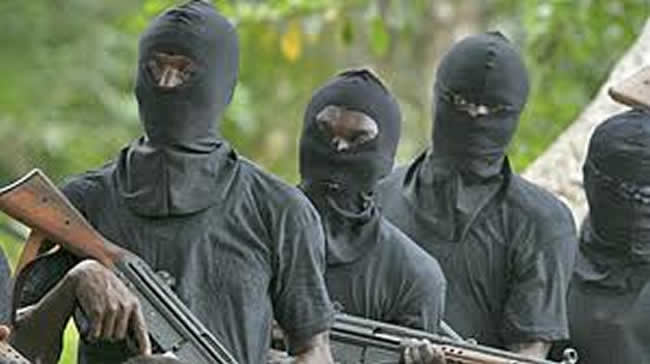
THE Kogi State Police Command has confirmed an attack on Government Secondary School, Iluke Bunu in Kabba-Bunu Local Government Area of the state, saying three persons were killed during the invasion by armed men.

The command in a statement on Wednesday, June 10, shortly after the incident, said the attackers stormed the community on about 40 motorcycles with the suspected intention of abducting students and residents.

The statement, signed by the command’s Public Relations Officer, Saliu Oyiza, said operatives received a distress call at about 10:00am and immediately mobilised a joint security response.

According to the police, personnel from the Kabba ‘A’ Division, the Police Mobile Force, tactical teams, soldiers, and local vigilantes engaged the attackers in a gun duel, forcing them to flee into surrounding bushes.

The command said one of the attackers was killed during the exchange of fire, while a member of the joint security team sustained gunshot injuries and is receiving treatment.

However, the police said preliminary investigations had yet to establish any conclusive evidence of a successful mass abduction of students or residents.

“Investigations and ongoing assessments are continuing to ascertain the full circumstances surrounding the incident,” the statement read.

Meanwhile, Daily Trust Newspaper, quoting some residents, said that the attackers invaded the school during the West African Senior School Certificate Examination (WASSCE) and abducted some of the students.

“The major target of the attack was UBE Iluke Bunu, where students from three communities were sitting for their WAEC examination at the time of the invasion,” the source was quoted to have said.

Reacting to the incident, the Chairman of Kabba-Bunu Local Government Area, Zacchaeus Michael, a lawyer, condemned the attack, describing it as “barbaric and unacceptable.”

He said the council was working with security agencies to strengthen security in affected communities and prevent further attacks.

The ICIR reports that Nigeria has continued to witness a resurgence of school attacks and mass abductions, with armed groups increasingly targeting rural communities and schools.

Earlier today, this organisation reported how Edo State Government shut some schools in the state following intelligence that kidnappers were targetting them.

In recent weeks, the Nigeria Union of Teachers (NUT) staged nationwide protests across all 36 states and the Federal Capital Territory (FCT) over the killing of a teacher and the abduction of pupils in Oyo and Borno States.

The protests followed the May 15, 2026, attack on three schools in Oriire Local Government Area of Oyo State, where armed men invaded Community Grammar School, Baptist Nursery and Primary School, and L.A. Primary School, abducting pupils and staff while killing a teacher.

The NUT also protested the abduction of students from Mussa Primary and Secondary School in Askira Uba Local Government Area, describing the attack as part of a worsening pattern of insecurity targeting schools.

The ICIR reports that school abductions, once largely concentrated in the North-East and North-West, have now spread to other regions, raising fresh concerns over the safety of educational institutions across Nigeria.

Between 2014 and 2024, over 1,000 students were abducted in various school nationwide, including the Chibok girls in 2014, Dapchi in 2018, Kankara in 2020, Jangebe in 2021, Kuriga in 2024, and Papiri in Niger State in 2025.

AXS Film Fund offers grants for documentary filmmakers, new media creators

THE AXS Film Fund is accepting applications for its 2026 grant cycle, offering awards of up to $10,000 to support documentary filmmakers and nonfiction new media creators working on projects at any stage of production.

The fund prioritises creators living with disabilities, particularly those from underrepresented communities, but welcomes applications from all eligible storytellers.

Eligible projects include feature-length documentaries (45 minutes or longer), experimental nonfiction films, and nonfiction new media projects with a video component. Applicants must be at least 18 years old, not enrolled in a degree-granting programme, and serve as the director or producer of the project.

Each year, the fund supports between three and five creators, helping them complete impactful nonfiction stories that bring underrepresented perspectives to audiences. Selected projects are evaluated based on artistic merit, feasibility, ethics, accountability, and the strength of the proposal.

Applications close on July 31, 2026, at 11:59 p.m. ET. Interested applicants can apply here.

Pulitzer Center opens applications for AI Accountability Fellowships

THE Pulitzer Centre is inviting applications for its AI Accountability Fellowship 2026–2027, a fully funded programme designed to support journalists reporting on the real-world impact of artificial intelligence systems.

The fellowship will fund in-depth investigative reporting that examines how AI is used in areas such as policing, healthcare, hiring, social welfare, and surveillance, with a strong focus on accountability, transparency, and human impact.

Selected fellows will receive financial support (up to $25,000), mentorship, training, and access to a global network of journalists working on AI-related investigations.

Open to staff and freelance journalists worldwide, the programme encourages ambitious, evidence-based reporting projects that explore how AI systems are built, deployed, and regulated—and how they affect everyday people and communities.

The fellowship runs for 10 months, beginning in September 2026, and includes additional support for engagement and impact activities to help ensure reporting reaches wider audiences.

The deadline is July 12, 2026. Interested applicants can apply here.


CSOs, stakeholders seek stronger citizen participation ahead of 2027 elections

0

CIVIL society actors, the media and youth groups have called for stronger citizen participation, intergenerational collaboration and sustained civic engagement ahead of Nigeria’s 2027 general elections.

The stakeholders warned that growing voter apathy, insecurity and misinformation could undermine the country’s democratic future.

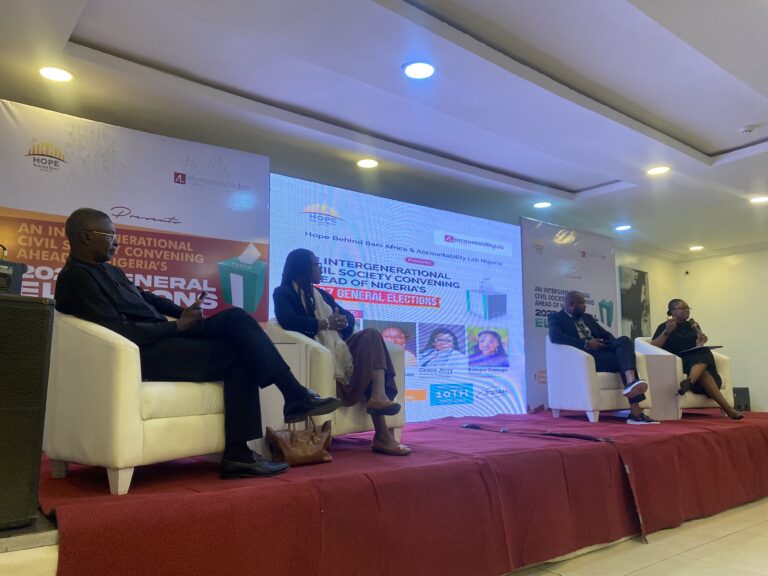
They made the call at an event organised by Hope Behind Bars Africa and Accountability Lab, with the theme “An Intergenerational Civil Society Convening Ahead of Nigeria’s 2027 General Elections,” held in Abuja on Wednesday, June 10.

The participants highlighted the need to bridge the gap between older generations of democracy activists and younger Nigerians, many of whom, they said have become increasingly disinterested with political processes following contentious elections and unfulfilled promises.

In his keynote address, the Executive Secretary of the National Human Rights Commission (NHRC), Tony Ojukwu, represented by the commission’s Director of Civil and Political Rights Department, Halilu Adamu, argued that citizen participation is not merely a political aspiration but a constitutional obligation.

According to him, Nigeria’s constitution places sovereignty in the hands of citizens and requires their participation in governance beyond elections.

He stressed that democracy should not be reduced to voting every four years, but should involve continuous engagement in policymaking, accountability processes and public affairs.

“The constitution does not envision a citizen who appears only on election day,” he said. “It envisions an active citizen who continuously participates in shaping public affairs, contributing to national development and helping to strengthen democratic institutions.”

Meanwhile, during the panel discussions, panelists reflected on the significance of the June 12, 1993 election and previous movements, as well as what younger generations could learn from the movement that followed its annulment.

Representing Grace Jerry, the Executive Director of Inclusive Friends, Molly Joshua said one of the defining features of the June 12 struggle was the unity that emerged among Nigerians regardless of ethnic, religious or political differences.

“There was one voice and one goal,” Joshua said, adding, “People came together to pursue a common objective. That unity is one of the biggest lessons we should learn from that period.”

Joshua, however, warned that many Nigerians have lost confidence in elections and democratic institutions, leading to voter apathy and disengagement.

“The sovereignty is with the people, but that sovereignty has been taken away,” he said. “This is the right time for us to take back that sovereignty moving into the 2027 election.”

He argued that civil society organisations must rethink voter mobilisation strategies by engaging citizens in more accessible ways and communicating in languages and formats that resonate with different demographics.

Joshua also advocated the formation of broad-based coalitions involving civil society groups, traditional institutions, religious organisations, youth groups and persons with disabilities to strengthen democratic participation before the next polls.

The Director of the Nigeria Youth Futures Fund (NYFF), Elisabeth Agbiti-Douglas, said the previous struggles by Nigerians during the June 12 election and occupy Nigeria, left positive legacy for younger Nigerians.

According to her, while the movements demonstrated the power of collective action, it also created a lingering sense of helplessness among many citizens who felt their votes and voices could ultimately be ignored.

“One of the lessons many Nigerians learned was that no matter what you do, those in power will do whatever they want,” she said, stressing that “Part of our responsibility is to challenge that narrative.”

Agbiti-Douglas rejected suggestions that young Nigerians are impatient in their activism, arguing that their urgency reflects the reality that they will live longest with the consequences of current political decisions.

“Social change is a marathon, not a sprint. There is never going to be a point where we can say we have arrived. Democratic gains require constant vigilance.”

Drawing from the #EndSARS protests and subsequent civic engagements, Agbiti-Douglas said many young Nigerians were already leading change in their communities through advocacy, policy interventions and accountability initiatives.

“The zeal of youth and that sense of urgency must shake hands with institutional memory and experience if this generation is going to achieve the kind of change it wants,” she argued.

On his part, the Executive Director of the International Centre for Investigative Reporting (ICIR), Dayo Aiyetan, who participated in the June 12 struggle as a journalist with Concord Newspapers, echoed concerns about declining civic participation and weak coordination among civil society actors.

Aiyetan said one major difference between the June 12 movement and contemporary activism was the existence of stronger civic leadership structures capable of mobilising citizens around clear objectives.

“There were stronger civil society organisations and stronger leadership. People were organised and rallied around common goals,” he stated.

Nevertheless, he argued that civic movements in Nigeria have achieved significant milestones despite setbacks.

“I do not think our voices have not counted. What every social movement from June 12 until now has shown is that you cannot silence the people.”

He described the 2020 #EndSARS protests as a defining moment in Nigeria’s civic history, noting that the movement created new templates for mobilisation that continue to influence activism across Africa.

Looking ahead to the 2027 elections, Aiyetan identified insecurity and misinformation as major threats to democratic participation.

“With AI, it is going to be such a chaotic thing to handle,” he said.

The participants further highlighted other key issues such as inclusion, data privacy, and cybercrime laws, among others.

Edo shuts schools over abduction fears hours after governor defended Tinubu on insecurity

EDO State Government has ordered the immediate closure of three secondary schools in Akoko-Edo Local Government Area following intelligence reports of a kidnap threat against students.

The directive, contained in a circular issued by the State Ministry of Education and signed by its Permanent Secretary, Enodolomwanyi Otamere, said the affected schools were Ososo Grammar School, Ososo Comprehensive High School and Makeke Secondary School.

The circular dated June 9, was obtained by the News Agency of Nigeria (NAN) on Wednesday in Benin.

NAN reports that the closure came against the backdrop of a security intelligence report by the State Security Service (SSS), also known as Department of State Services (DSS).

The reports in a memo dated June 5, and sighted by NAN, warned of an alleged plan by suspected bandits to carry out a mass abduction of school children in Edo North Senatorial District.

According to the intelligence memo addressed to the Nigeria Security and Civil Defence Corps (NSCDC), the SSS intercepted communications between two suspected bandits.

The two suspects allegedly discussed targeting school children after earlier attempts to kidnap wealthy individuals failed to yield expected financial gains.

The report indicates that the suspects believed abducting students will attract greater government attention and increase their chances of securing substantial ransom payments and other concessions.

The memo further revealed that a 25-year-old suspect, was arrested on June 4, while allegedly conducting surveillance around Makeke Secondary School in Makeke community, one of the schools subsequently shut by the government.

According to the document, the suspect’s activities heightened fears that preparations for the planned operation may already have been underway.

Responding to the threat, the security agency advised authorities to strengthen protection around schools and educational institutions across the state, particularly in Edo North.

The SSS also recommended the deployment of additional security personnel, enhanced collaboration among security agencies, local vigilante groups and hunters, as well as intensified patrols and surveillance in vulnerable communities.

Meanwhile in the memo directing the closure of the schools, the permanent secretary said that the decision followed security advisories from relevant agencies warning of threats to the safety of students, teachers and surrounding communities.

“The Ministry of Education has received intelligence reports and advisories from relevant security agencies regarding credible threats to the safety of students, staff, and school communities in some parts of Akoko Edo Local Government Area,” he said

He added that all academic and non-academic activities in the affected schools had been suspended until further notice as part of efforts to safeguard lives and property.

Otamare said that in spite of the closure, candidates sitting for the ongoing West African Senior School Certificate Examination (WASSCE) would continue to have access to examination centres under strict security arrangements.

“Candidates currently participating in the ongoing West African Senior School Certificate Examination (WASSCE) shall be allowed access to sit for their examinations under strict security arrangements and supervision as may be provided by the relevant security agencies and community stakeholders,” he said.

He directed school principals to ensure the orderly release of students to their parents and guardians, secure school facilities and maintain close communication with government authorities and security agencies.

He also urged parents and residents of the affected communities to remain calm and cooperate with security agencies as efforts continue to neutralise the threat and restore normal academic activities.

The ICIR reports that schools closure came hours the state Governor Monday Okpebholo blamed opposition politicians for rising insecurity in Nigeria. He alleged that they kidnap Nigerians to undermine President Bola Tinubu’s leadership.

“There is no vacancy in Aso Rock. They can even kidnap all of us. Yes, there is no vacancy in Aso Rock. What is happening today is in the hands of the opposition. They have failed. Have they not failed?

“Is it by kidnapping children? Then who are you going to govern? There will be nobody for you to govern. So, let them give us peace so that the president and other elected officials can govern effectively,” Okpebholo said.

Nigeria has seen a sharp rise in kidnapping and other criminal activities by armed non-state actors in recent months.

Schools and communities have come under repeated attacks, with pupils and residents being whisked away, respectively.

The ICIR reported the incident in Oriire Local Government Area of Oyo State, where gunmen stormed three schools and abducted dozens of pupils, students, and staff. A teacher was killed while the attack was being carried out, while another was beheaded by the assailants after the incident. The remaining victims have yet to be freed.

This organisation also recently reported how the Nigerian security forces freed 360 civilians, mainly women and children, abducted by terrorists from Ngoshe community in Gwoza Local Government Area of Borno.

Obi demands N5bn damages, apology from Kenneth Okonkwo over defamation claims

THE PRESIDENTIAL candidate of the Nigeria Democratic Congress (NDC), Peter Obi, has sued his former ally and actor-turned-politician, Kenneth Okonkwo, over comments he allegedly made during a live television appearance.

In a pre-action letter dated June 9, 2026, Obi, through his legal team led by Alex Ejesieme, a senior advocate, accused Okonkwo of making damaging allegations during an interview on Channels Television’s Sunrise Daily programme on June 8.

According to the lawyers, the statements were later circulated widely by news outlets, blogs and social media users, further amplifying their reach.

Okonkwo allegedly claimed that Obi and senior NDC figures in the South-East demanded money from aspirants seeking tickets to contest legislative positions under the party platform.

The pre-action notice notes that “Obi, together with the leaders of the Nigeria Democratic Congress (NDC) in the South-East, informed the party’s aspirants that any person seeking to contest as a member of the House of Representatives must, after paying the prescribed expression of interest fee, pay a bribe of ten million naira (N10,000,000.00) to the NDC and to the caucus leaders.”

Obi’s lawyers said Okonkwo also suggested that evidence existed to support the accusation and further alleged that Obi personally handled the selection of candidates from a hotel room.

According to the pre-action notice, Okonkwo allegedly warned party members that Obi would deceive them, adding that the presidential candidate collected funds from Nigerians abroad and was involved in unlawful activities alongside other party officials.

The legal team argued that the claims portrayed the former Anambra State governor as someone engaged in corruption, fraud and other criminal conduct.

In the letter, the lawyers stated: “The above statements, in their natural and ordinary meaning, and by necessary implication, falsely and maliciously represent our client as a person who demands, solicits, organises and collects bribes; who extorts, defrauds and swindles political aspirants of their money; who is a fraudster, a scammer and a dishonest political actor; and who, in concert with others, is engaged in criminal conspiracy and is actively perpetuating criminality.”

They maintained that the allegations lacked any factual basis and exceeded the limits of ordinary political criticism.

Describing the statements as “false, baseless, malicious, reckless, defamatory and wholly unsupported by any fact,” the lawyers insisted that the comments caused serious harm to Obi’s reputation and public image.

As part of the demands, Obi asked Okonkwo to publicly withdraw the statements and issue an apology within seven days. The apology, the notice said, must receive equal or greater publicity than the original allegations.

The letter further demanded: “Pay to our Client, through our chambers, the sum of five billion naira (N5,000,000,000.00) only, as general, aggravated and exemplary damages for the grave injury occasioned to his hard-earned reputation, character and public standing by the said false, malicious and defamatory statements; and deliver to us a written undertaking that you shall cease and desist from making, publishing, circulating or causing to be published any further false, malicious or defamatory statement concerning our client.”

The lawyers warned that failure to meet the conditions would lead to court action seeking damages, injunctive orders, legal costs and other remedies.

Reacting to the legal threat, Okonkwo dismissed the demand in a post on his X account, claiming he had yet to review the notice.

He wrote: “It has been brought to my notice that there is a letter circulating online from the hypocrite, Peter Obi, and his lawyers that I should pay him N5 billion. Hahaha! If Peter Obi is looking for money to campaign, he should privately ask me for assistance, not come from extortion, and I will help him.”

The former Labour Party campaign spokesperson, the party on which Obi vied for the presidency in 2023, added that he would provide a detailed response after reading the document.

“I will reply to the letter whenever I have the time to read it later in the day. Please, send it here if you have it. It will be a shame to Peter Obi and his lawyers if they do not take this case to court. I don’t have time or patience for scammers,” he stated.

Okonkwo also suggested that a court case could expose information he obtained while serving as Obi’s spokesperson during the 2023 election campaign.

“Anyone who decides to sue his former spokesperson for defamation is indeed very unwise,” he added.

Obi and Okonkwo were close political associates during the 2023 presidential election when the actor joined the Labour Party after leaving the All Progressives Congress (APC). He later became one of the prominent voices of Obi’s campaign team.

However, the relationship between both men has since deteriorated, leading to a series of public disagreements.

US-Iran ceasefire under strain as Trump vows response to helicopter shootdown

UNITED States President Donald Trump’s decision to retaliate after Iran allegedly shot down his country’s Apache helicopter while it was patrolling the Strait of Hormuz has put the fragile ceasefire between the two nations under threat.

In a post on social media on Tuesday, Trump said the two pilots on the jet survived unharmed after it went down near Oman’s coast, noting that a US military drone later rescued the crew.

“I have just been informed by our Great Military that last night the Iranians shot down one of our highly sophisticated Apache Helicopters while patrolling over the Strait of Hormuz. There were two pilots involved, both are safe and uninjured,” Trump said on his Truth Social.

He described the development as an attack that required a response, raising fresh concerns about the fragile ceasefire and ongoing efforts to reach truce between Washington and Tehran, following months of war.

Reacting to the claim, Iranian Foreign Minister Abbas Araghchi did not directly confirm or deny involvement but warned that foreign military forces operating near Iran’s territory risked accidents or being caught in crossfire.

Araghchi warned that foreign military forces operating near Iranian territory to leave the region following Trump’s remarks.

IAraghchi stressed that the Strait of Hormuz is not international waters but a shared waterway between Iran and Oman, adding that maritime boundaries in the area are clearly defined.

“Foreign forces operating close to our territory are constantly exposed to risks arising from their own mistakes, accidents, or the possibility of being caught in crossfire,” Araghchi said.

He noted that Iran’s armed forces remained on high alert to respond to any violation of the country’s airspace, territorial waters, or land borders.

He urged foreign forces to withdraw from the region, stating that doing so would be the best way to reduce tensions and avoid attacks.

While reiterating Tehran’s preference for diplomacy, the Iranian minister added that the country was prepared to respond through other means if necessary.

The incident comes amid heightened tensions in the Middle East, with clashes continuing between Iran and Israel, as Israeli strikes on the southern Lebanese city of Tyre on Tuesday, reportedly killed at least eight people, marking one of the deadliest attacks on the city since fighting began on February 28 this year.

The Strait of Hormuz remains a critical global shipping route, carrying a significant share of the world’s oil and gas exports, while ongoing hostilities continue to threaten regional stability and international energy markets.