Home Blog Page 1675

Buhari failed to present Nigeria’s problems at UNGA – Minority Reps

0

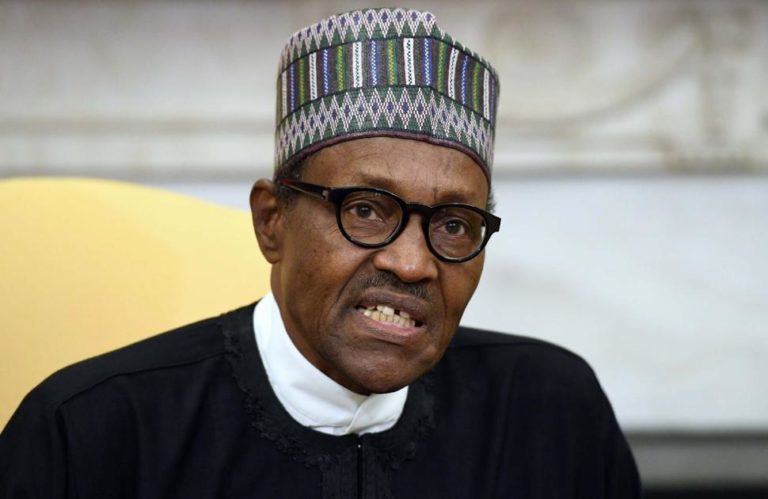
MEMBERS of the Minority Caucus in the House of Representatives have criticised the speech given by Nigerian President Muhammadu Buhari at the United Nations General Assembly on Friday.

This was contained in a statement released on Saturday by the Minority Leader of the House Ndudi Elumelu.

The lawmakers said the president’s speech was a disservice to the nation as it did not sincerely represent the chaotic situation of the country.


Read Also

They also noted that this misrepresentation had limited the chances of foreign intervention in the areas required.

“As representatives of the people, the Minority Caucus is depressed that President Buhari’s speech did not reflect on the kidnapping and killing of students and school children in Nigeria.

“The speech did not reflect on the closure of schools and crippling of education in many parts of our country, where normal life has been destroyed by terrorists, neither did it show any empathy towards the victims of terrorism attacks,” it read.

The lawmakers noted that the president had given no assurance to tackle the causes of conflicts or other economic challenges in Nigeria.

“Moreover, our caucus is worried that Mr President’s speech did not portray any decisive roadmap towards economic recovery and food security; had no personal commitment to end corruption in his administration; had no personal commitment to end borrowing or show a clear-cut plan to repay the huge debt being accumulated by his administration.”

The statement criticised the president’s lack of commitment to ensuring credible elections and enjoined him to take advantage of such platforms to capture the realities and challenges prevalent in the country.

“The minority caucus, after due consideration, urges President Buhari to always cross-check the content given to him by his handlers so as to ensure that his position, especially on the world stage, captures the reality as well as the aspiration prevalent in the country.

“This is because such addresses ought to serve as an unblemished working document for interventions and solutions at various levels of governance,” it read.

On Friday, Buhari addressed the 76th United Nations General Assembly (UNGA) in New York, the United States of America.

He said his government had shown commitment to safeguarding human rights, protection of women, children, refugees and people with disabilities, among others, but The ICIR had reported that evidence available was contrary to his claims.

Over N2bn spent on feeding school children in Adamawa -Minister

1

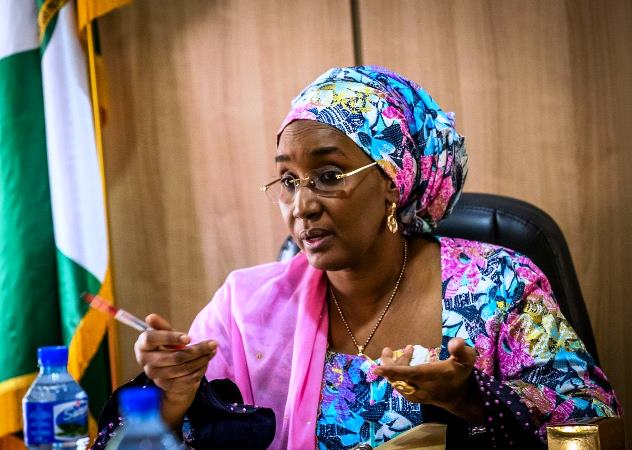
PRESIDENT Muhammadu Buhari’s Minister of Minister of Humanitarian Affairs, Disaster Management and Social Development Sadiya Farouq said her ministry has spent over N2 billion to feed school children in Adamawa State.

The minister, who was represented by the National Coordinator, Social Investment Programme Umar Bindir stated this while presenting about 50,000 branded quality feeding utensils to Adamawa Government on Saturday, in Yola.

According to her, under the National Home-Grown School Feeding Programme (NHGSFP), the total sum of ₦226 million was being spent monthly to feed school children in the state by the Federal Government.

“Over ₦2 billion expended by the Federal Government in Adamawa, under the National Home-Grown School Feeding Programme (NHGSFP),” he said.

“I m here today, to represent Mr President, to hand over an additional 50,000 branded quality feeding utensils to the Adamawa State Government, for use in feeding pupils under the National Home-Grown School Feeding Programme (NHGSFP).

She noted that a total number of 162,782 children are being fed, using 2,417 cooks and vendors, while not less than 1,286 schools have been enrolled since the launch of the programme in 2016.

Farouq noted that 182,000 utensils had been previously distributed in Adamawa.

She also stated that more than nine million pupils had registered and were benefiting from the programme nationwide.

However, several reports have indicated lack of transparency in the spending of the ministry.

The ICIR has also reported about the fraudulent practices that characterise the management of the school feeding programme.

Malami denies release of Boko Haram sponsors

1

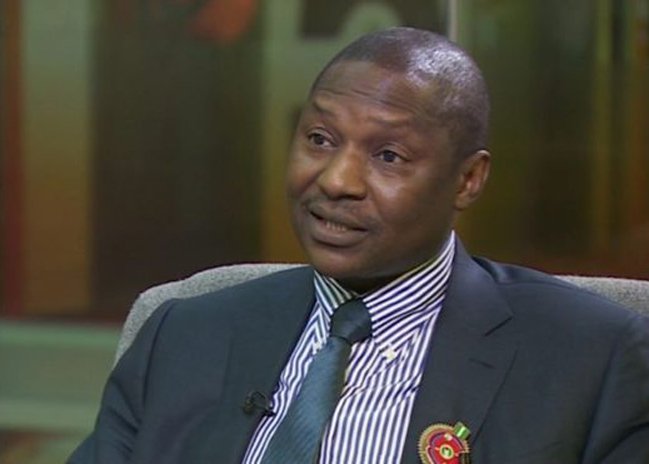
NIGERIA’S Attorney-General Abubakar Malami has denied releasing suspected sponsors of the Boko Haram terrorist group.

The Special Assistant on Media and Public Relations, Office of the Attorney General of the Federation and Minister of Justice, Umar Gwandu, disclosed this on Friday.

He described the report on the release as a “malicious misrepresentation” of the investigations undertaken by the government.

He said the Office of the Attorney General has instead sought the continued detention of financiers in custody.

“This, by implication, established that the matter is effectively submitted to the jurisdiction of the court,” he said.

Malami said his office could only take further action on the case through the proper judicial process.

“The question then arising from the claim of the report is this: When was an application filed in Court by the office of the attorney general by which the release of the purported suspects was procured?

“It amounts to approbation and reprobation for the Office of the Attorney General of the Federation to, in one breath, obtain an order seeking for the continued detention of the alleged financiers of Boko Haram and at the same time having them released,” he said.

He stated that there would have been no need to obtain a court order for the continued detention of the suspects if there had been an intention to release them.

“One needs to know by which communication or correspondence or application was their release procures since the matter is already pending before the court of Law, and they were taken to custody on account of Court order.”

The press reported two days ago that over 300 suspected terror sponsors, arrested by the Nigerian government earlier this year, had been released.

How $1.2m bribe paid to NNPC was used to finance Jonathan, Buhari’s elections

0

COURT testimonies arising in lawsuits in London and New York have revealed how a total sum of $1.2 million bribe paid by oil companies to the Nigerian National Petroleum Corporation (NNPC) was used to finance the past two elections in Nigeria.

According to Bloomberg, the money was paid by a former employee of Glencore and BP,  two British oil companies, to middlemen to help get contract awards from the NNPC.

Jonathan Zarembok, dismissed last year by BP for confessing the part played by the London-based energy firm in the scheme, said this week that the fashion in which the NNPC conducted cargo allotments might have helped plans for the 2019 elections.


READ ALSO:

How NNPC mismanages Kaduna refinery

NNPC gambles $1.5bn on financially-battered Port Harcourt refinery

Against common sense, NNPC commences $1.5bn Port Harcourt refinery repairs


“We were paying agents in Nigeria huge multiples of what we paid in other regions, even though those agents did not perform services of any real value to BP. Our proposed reasons for paying the agent these sums were a sham,” he said.

In July, another former staff of Glencore had acknowledged giving an agent $300,000 intended to obtain an oil consignment from the NNPC with the knowledge it would go to funding a general election held in Nigeria in 2015.

But regarding the 2019 elections, Zarembok stated in the suit that he sensed the bribe he paid would be directed to the 2019 elections.

In the lawsuit against his former employer, Zarembok said he was fired for raising concerns about ‘abnormally large’ amounts paid to middlemen to ease contract awards in Nigeria.

According to him, the emails a BP executive sent in 2017 were a ‘clear red flag’ and indicated “there would be pressure to pay bribes.”

Details of starting plans for the elections in 2018 were mentioned in the correspondence.

A Nigerian intermediary got two crude cargoes from the NNPC, with BP paying $900,000 to him in fees.

BP was quoted as saying it was defending in full and denied all allegations made by the claimant, Zarembok.

A related subject came to the fore two months back when another ex-employee of Glencore, Anthony Stimler, admitted to corruption and money laundering.

US court filings show Stimler got a notification in September 2014 that ‘Foreign Official 1’ demanded payment ahead of every cargo receipt from all NNPC clients regarding ‘a then-upcoming political election.’

He said Glencore transferred $300,000 to an agency used “to pay bribes to Nigerian officials.”

Prosecutors in the US have detailed how Stimler and others paid many countries millions of dollars in kickbacks from 2017 to 2018, NNPC officials inclusive.

“The conduct described in the plea is unacceptable and has no place in Glencore,” the firm said in a July statement.

When contacted, NNPC Group General Manager for Public Affairs Garbadeen Muhammad denied the allegation in a text message to The ICIR, saying it was ‘not true.’

Nigeria’s transportation cost rises amid shrinking household wallets

0

Nigeria’s
IN August, the cost of transportation rose by an average of five per cent for land, air and sea travels.

The rising transport cost occurred amid shrinking wallets of many Nigerian households.

The National Bureau of Statistics (NBS) on Thursday revealed that, on average, there was an overall increase in the transport fare through buses, aeroplanes, motorcycles and water vessels.

On a month-on-month basis, the fare that customers who transported themselves within the city by bus paid rose by 4.98 per cent, but it increased by 1.80 per cent for those who engaged in inter-city travels.

transportation cost rise nigeria
August transport watch fare on average for bus journey (per drop) – within city

For motorcycles, also known as Okada, the average fare paid for each drop on a month-on-month basis rose by 3.17 per cent.


Read Also

Average fares for travels on water, on a month-on-month basis, did increase slightly, rising by 1.97 per cent.

The increase for air travel was the least, as on a month-on-month basis, the average fare paid for single journeys on specified routes rose by 0.03 per cent.

transportation cost rise nigeria
August transport watch fare on average for bus journey (per drop) intercity

How did the increases reflect in states?

On average, a passenger paid N430.58 to commute within a city and N2588.69 for inter-city travels, the data for August show. In some states, however, the fare was higher.

The costliest states for bus travel within a city were: Zamfara (N670.28), Bauchi (N635.12) and Taraba (N550.13) states. On the other side, Oyo State was the most affordable state with an average amount of N220.48.

August transport watch fare on average for Airline (specified routes) - single journey
August transport watch fare on average for Airline (specified routes) – single journey

For bus travels that crossed into new cities, however, the states where the fares were  highest on average were Abuja (N4700.15), Lagos (N3600.04) and Sokoto (N3450.16).

With N1859.36, Bayelsa State had the lowest average price for inter-city bus trips in August 2021, followed by Bauchi (N1900.60) and Akwa-Ibom (N1950.20).

The average fare for air travels in August 2021 was N36, 805.41, with Rivers State having the highest on average, at N38,900.00.

It cost an average of N303.25 to move around on motorcycles for single drops. The state with the highest fare was Yobe with an average rate of N500.45.

August transport watch fare on average for motorcycle (Okada) per drop

Those who travelled on the water had a fare of N848.36 on average. It was highest in Delta State (N2550.46) and lowest in Borno State (N270.64).

August transport watch fare on average for journey by motorcycle (Okada) per drop

Even with a drop in the country’s inflation, Nigerians keep spending more. This is hurting several households.

Inflation was 17.01 per cent in August 2021. Food inflation was 20.3 per cent last month as many households struggled to buy basic food items.

Nigeria is today world’s poverty capital with 105 million citizens in extreme penury, said the World Poverty Clock.

nigeria’s

Despite contradictory evidence, Buhari hails his govt’s human rights records at UN General Assembly

NIGERIAN President Muhammadu Buhari, in an address during the General Debate of the 76th session of the United Nations General Assembly in New York on September 24, hailed his administration’s human rights records, despite documented evidence of state-supervised crackdown on free speech and dissent in Nigeria under his watch.

“Nigeria has been steadfast in safeguarding human rights, including the advancement of women, the protection of children, the protection of the rights of people living with disabilities, the treatment of migrants, refugees, returnees and displaced persons as well as the promotion of fundamental freedoms through all legitimate means,” Buhari said in the address he delivered a day after Nigeria’s main opposition party the People’s Democratic Party (PDP) urged the UN General Assembly to question him over his administration’s role in the escalation of rights violations, terrorism, electoral malpractices, corruption, economic difficulties and division along ethnic lines witnessed in Nigeria since he came into office in 2015.

Buhari, in his address, condemned all forms of hate crimes, including racism and xenophobia, and went ahead to demand ‘justice, fairness and equity in respect of the Palestinian people.’

According to him, “Nigeria remains unwavering in its commitment to ensuring the advancement of human rights within its shores and beyond” despite “a vicious decade-long onslaught by terrorists against Nigerians.”

In apparent reference to the Amnesty International (AI) and other global bodies which have published reports detailing rights abuses by Nigerian authorities, Buhari observed that his administration’s commitment to human rights was “quite contrary to unwholesome reports by some who hardly verify what they state against us.”

* Evidence contradicts Buhari’s claims 

Buhari’s claim that Nigeria has been steadfast in safeguarding human rights is not backed by evidence.

Recent actions taken by his administration contradict the claim that Nigeria, under Buhari’s government, is a champion of human rights.

In what came to be known as the ‘Lekki Toll Gate Massacre,’ troops of the Nigerian Army, on October 21, 2020, at the Lekki Toll Gate in Lagos, opened fire on unarmed youths who were engaged in a peaceful protest against Police brutality during the #EndSARS protests.

The Lekki Toll Gate incident was just one of several instances where the government unleashed security agents on defenceless citizens with deadly effect.

The National Human Rights Commission (NHRC) reported that law enforcement agents killed 18 persons while enforcing the first phase of the lockdown ordered by the Nigerian government to curb the spread of the COVID-19 from March 30 to April 13, 2020.

Security agencies were also mobilised to clamp down on the nationwide ‘Revolution Now’ protests against insecurity and corruption.

Leader of the protests and Publisher of Sahara Reporters Omoyele Sowore was detained for several months and charged to court for allegedly attempting to overthrow the Buhari government.

In a move that amounted to suppression of free speech, the Nigerian government, on June 5, placed an indefinite ban on Twitter, restricting it from operating in the country after the social media platform deleted tweets made by Buhari.

Three months after, the ban is yet to be lifted despite widespread condemnation by Nigerians and members of the international community.

Nigerian authorities, under Buhari’s administration, have continued to push for the enactment of laws that would allow government to monitor and regulate the social media – a move which is being resisted by Nigerians who fear that the government is intent on suppressing free speech.

The ICIR had reported that under Buhari’s watch, Nigeria has continued to slide on the Freedom in the World ranking, an annual global report on political rights and civil liberties published by Freedom House.

Freedom in the World ranks countries according to scores from an assessment of the application of the Universal Declaration of Human Rights in each country. The Universal Declaration of Human Rights, adopted by the United Nations in 1948, enshrines the rights and freedoms of all human beings.

Although Nigeria has over time been ranked as ‘Partly Free’ in different annual reports of Freedom in the World, the country’s scores for political rights and civil liberties have been dropping in recent years.

In the latest ranking, Freedom in the World 2021, Nigeria scored 45 points out of 100, giving the country a partly free status.

The 45 points scored by Nigeria in 2021 represents a drop from 47 points recorded by the country in the 2020 Freedom in the World report. Going by the Freedom in the World methodology, a drop in points means a decline in the level of political rights and civil liberties enjoyed by citizens of the concerned country.

* PDP ambushes Buhari with petition to UN General Assembly

A day before his scheduled address before the UN General Assembly, the PDP had petitioned the global body, asking it to hold Buhari to account for “the killing of innocent and unarmed protesters in various parts of Nigeria by security forces under his command, particularly the killing of youths during the EndSARS protest in 2020.”

The PDP, which disclosed the petition in a statement issued by its spokesman Kola Ologbondiyan on September 23, equally called on the UN General Assembly to interrogate Buhari over the erosion of the constitutionally guaranteed right to freedom of speech, hounding of the opposition and dissenting voices, clampdown on the media and suspension of Twitter in Nigeria.

According to the PDP, principles which the General Assembly stands for, such as sanctity of human life, respect for human rights, justice and rule of law, credible elections, democratic governance promotion of peace, accountability in governance and economic development, among others, “have all been violated by the Buhari administration.”

The opposition party also drew the General Assembly’s attention to reports by credible international organisations such as the United States Department of State and Amnesty International on cases of arbitrary arrests and detention, widespread extrajudicial killings, sudden disappearances of dissenting voices and disregard to rule of law under Buhari’s watch.

Accusing the Buhari administration of “brazen disobedience to court orders, use of security forces to suppress citizens, media gagging, and systemic injustices,” the PDP further insisted that the UN General Assembly should question Buhari over the failures and alleged compromises of the nation’s security coordination under his administration, which it said had led to ‘unabating mass killings, kidnapping, banditry, arson and marauding of communities’ across the country.

It observed that the situation had degenerated to the extent that Nigeria now ranked as the third country with the highest level of terrorism after Iran and Afghanistan.

Nigerian officials have been reluctant to name some alleged sponsors of terrorism activities in the country who the government has said it intends to prosecute.

Attorney General of the Federation and Minister of Justice Abubakar Malami on September 22 in New York noted that it was not yet time to disclose the identities of the alleged sponsors. Malami suggested that such disclosure would undermine ongoing investigations.

But, in apparent reaction to the development, the PDP in its petition asked the UN General Assembly ‘to take on’ Buhari over his administration’s alleged provision of official cover for sponsors of terrorism in Nigeria, including those recently communicated to it by the United Arab Emirate (UAE).

The PDP also urged the UN General Assembly to ask Buhari why he failed to take action concerning “a serving minister who was openly indicted as an apologist of terrorism.”

NYSC backtracks, admits asking corps members to prepare for ransom payment if abducted

0

AFTER an initial denial, the National Youth Service Corps (NYSC) has admitted to asking corps members to prepare for ransom payment in the event of being kidnapped.

According to Premium Times, the NYSC Spokesperson Adenike Adeyemi, who revealed this in a statement on Friday, said the service was investigating the development.

She, however, said that there were currently in circulation different copies of the pamphlets with some containing the clause and others not.

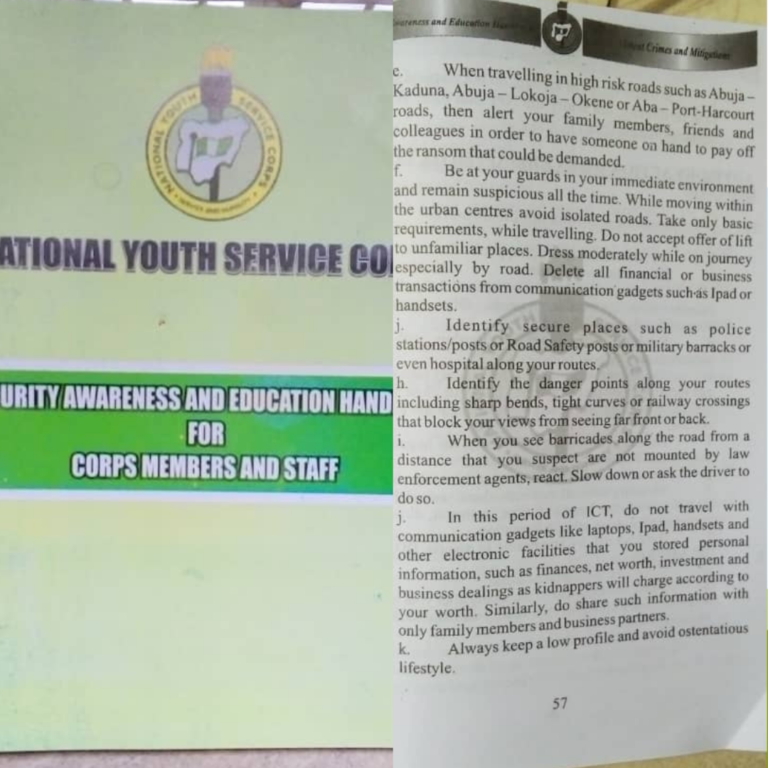
The NYSC had, in a pamphlet providing security tips to corps and staff, advised that they should call their families to prepare to pay ransoms in case “they are unfortunate to be kidnapped or taken hostage” in some selected high-risk roads across the country.

Page 57 of the book, which was obtained by The ICIR from a serving corps member (Batch B, 2020) reads:

“When travelling in high-risk roads such as Abuja-Kaduna, Abuja-Lokoja-Okene or Aba- Port-Harcourt roads, then alert your family members, friends and colleagues, in order to have someone on hand to pay off the ransom that could be demanded.”

The service had, in a swift reaction to the criticisms that greeted the directive, denied the statement, saying it was fake.

It urged members of the public to always clarify issues with the organisation in its statement.

COVID-19 forced Nigeria to grow labs from four to 140 – Buhari

NIGERIA has grown its testing and detection laboratories for COVID-19 from four to over 140, President Muhammadu Buhari claimed on Friday.

Addressing delegates at the General Debate of the 76th Session of the United Nations General Assembly, the president said the country had trained over 40,000 health care workers on infection, prevention and control of the virus.

The ICIR could not immediately confirm the veracity of the president’s claim on the number of the testing labs.


Read Also:

This newspaper could not locate any information containing data on the laboratories from the three agencies of the Federal Government working on the containment of the virus. 

They are the Nigerian Centre for Disease Controlthe Federal Ministry of Health, and the National Primary Health Care Development Agency.

In July, The ICIR reported how experts claimed Nigeria was not ready for future pandemics because of the poor state of the nation’s health system.

A Professor of Virology Oyewale Tomori said over 60 years after the nation’s Independence, it  could only boast of two laboratories for detecting diseases like COVID-19.

In his UN address, Buhari thanked the international community for responding concertedly to the pandemic and supporting one another. 

He said Nigeria’s efforts to contain the virus were rewarded with ‘moderate success.’

“At the outset, we recognised detection and contact tracing to be important tools in combating the virus. In this connection, from a mere four laboratories with testing and detection capacities, we ramped up the facilities to over 140 centres today. 

“Similarly, we built isolation centres and emergency hospitals wards in record time all over the country. We carry out genomic sequencing in designated laboratories across the country with a view to detecting variants in circulation. 

“In addition, over 40,000 health care workers have recently been trained on infection, prevention and control measures with the support of various partners. Through the Nigerian Centre for Disease Control, we have established 16 infectious disease treatment centres located within our Teaching Hospitals and Federal Medical Centres,” he said.

He said Nigeria received assistance from its partners and friends globally. 

While reiterating the need for vaccination to defeat the pandemic, the president appreciated COVAX – a global initiative that makes COVID-19 vaccines available to developing nations.

Buhari specifically thanked the United States of America, Turkey, India, China, European Union for the vaccines they provided through COVAX. 

However, he called for a ‘fairer and more equitable’ distribution of vaccines to all countries to enable the world to contain the pandemic. 

“The rising wave of newer and more contagious strains makes this even more urgent. No country can afford the socio-economic implications of a prolonged shutdown. It is imperative to underscore that no one is safe until everyone is safe.”

As of September 23, the country had 203,514 cases of the virus. About 191,942 of the cases had recovered, while 2,668 people had died from the disease.

Global confirmed cases of the virus as of that date was 230.62 million. About 4.729 million of the cases had died.

The ICIR reported in August how only one per cent of Nigerians had been fully vaccinated against the disease.

Through COVAX, the country got four million doses of the AstraZeneca vaccine in March.

Nigeria also received additional 592,880 doses of AstraZeneca from the UK in August.

Even though the country has some vaccine candidates, it is yet to produce any vaccine against the disease, and it has been a victim of vaccine diplomacy.

Meanwhile, President Buhari reaffirmed Nigeria’s commitment to addressing challenges posed by climate change in his address at the UN meeting.

He said climate change manifested in different ways in Nigeria, triggering conflicts, food insecurity, drying up of lakes, loss of livelihood, and youth migration. 

“The trend is the same in many other countries that are threatened by forest fires, rising sea levels, drought and desertification. 

“In the circumstances, we intend to build a climate-resilient economy that effectively aligns with the SDGs and that has great potentials to unlocking the full opportunities in different sectors of the economy while protecting the resources for present and future generations. I know, in several ways, this is also a familiar story in many countries,” he said.

Rape: Police embark on shooting spree, disrupt Abia poly students’ protest

0

OFFICERS of the Nigerian Police Force (NPF) attached to Aba Divisional Headquarters allegedly shot at students of Abia State Polytechnic, Aba, to disrupt a peaceful protest over the alleged rape of a female student.

The students, who protested in front of their school gate, had obstructed vehicular movement along Aba-Owerri Expressway, which halted commercial activities in Aba.

Policemen at the scene of the protest, however, embarked on a shooting spree to disperse the students, shooting as they ran for safety.

It was gathered that some students were seen throwing stones at Police operatives.

At least one student was seen on the ground near the gate. It is uncertain if he was hit by a bullet or just taking cover from the shooting.

Personnel attached to the Rapid Response Squad (RRS) in Aba on Wednesday were alleged to have raped female students during a raid on one of the off-campus apartments which prompted the protest.

A student named Chidinma was allegedly raped by three policemen and is currently undergoing treatment in an undisclosed hospital.

When The ICIR reached out to the Abia State Police Public Relations Officer Geoffrey Ogbonna to ascertain measures taken by the Police command to address the sexual harassment claim against officers of the RRS, he said he didn’t have time to speak about the matter.

“I don’t have time to talk about that issue, I will call you later,” he said.

He was yet to respond at the time of filing this report.

The Director of Information of the Student Union Government (SUG) of the polytechnic Godswill Okoro, in a Facebook post, revealed that the wife of the Governor of Abia State Nkechi Ikpeazu had promised to foot the medical bills of the sexually assaulted student.

She was represented by Suzzy Nwachukwu,  a medical personnel attached to the Office of the Wife of the Abia State Governor while visiting the medical facility where the student was hospitalised.

The Commissioner for Information John Kalu also disclosed that Governor Okezie Ikpeazu had directed the Police authorities to prosecute officers who indulged in harassment of law-abiding citizens to serve as a deterrent.

According to him, Governor Ikpeazu was actively monitoring the situation with the alleged harassment and rape of Abia poly students with a view to ensuring the protection of all law-abiding citizens.

We will not be intimidated by sponsored counter-demonstrators in New York -NINAS

0

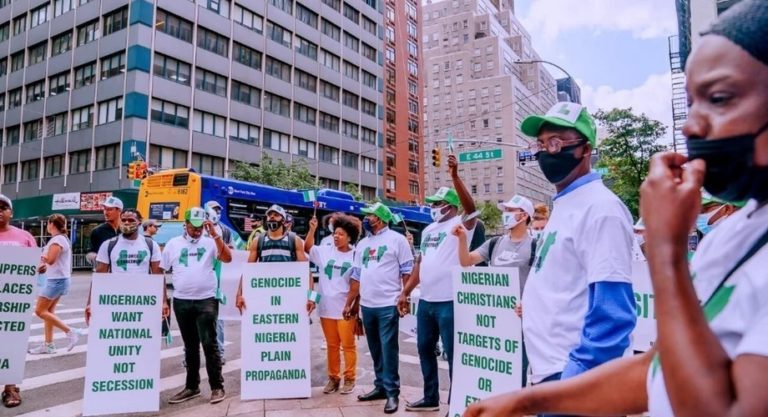
THE Nigerian Indigenous Nationalities Alliance for Self-Determination (NINAS), which has staged protests in the United States against the Nigerian government in the last nine days, has accused certain state officials of sponsoring non-Nigerian counter-demonstrators to create confusion, saying that members will not be deterred.

Chairman of the alliance Banji Akintoye alleged Thursday that some black foreigners living in the US were paid $500 by an unnamed top government official from Kwara State and a popular journalist to stage counter-protest against NINAS.


READ ALSO:

Despite contradictory evidence, Buhari hails his govt’s human rights records at UN General Assembly

Suspected Fulani gunmen kill 11 in Southern Kaduna fresh attack

NYSC backtracks, admits asking corps members to prepare for ransom payment if abducted


“The ringleader of government officials from Kwara State and a top Lagos journalist are now in New York to start hiring black people who will pretend as Nigerians to stage a Pro-Buhari and one Nigeria protest to counter NINAS on Friday,” Akintoye said.

He explained that despite the intimidation, Friday’s grand finale one-million-men march in New York would be historic as President Muhammadu Buhari, who arrived in the city on Sunday to participate in the ongoing 76th Session of the UN General Assembly, was scheduled to present Nigeria’s statement to the Assembly today.

“We refuse to be rattled and we shall not be intimidated as no oppressor has ever triumphed against the collective will of the people. The people are the government and power belongs to the people,” NINAS said.

NINAS has rejected the 1999 Nigeria Constitution and insisted on regional referendums for what it calls ‘Self-Determination.’

The group has also canvassed an end to ethnoreligious killings in Nigeria and wants the government to expose and punish those funding terrorism.

Nigeria’s Minister of Justice Abubakar Malami, told journalists in New York on Wednesday, that exposing sponsors of terrorism in the country would jeopardise ongoing investigations.

“The truth of the matter is that investigation is ongoing…I wouldn’t like to be pre-emptive in terms of making disclosures that would have the effect of undermining the successes we are recording as far as investigation is concerned,” Malami said.

Earlier, his counterpart in the Ministry of Information and Culture Lai Mohammed had defended the government’s Amnesty to repentant terrorists, explaining that in line with global best practice, ‘surrendered soldiers’ were to be treated as ‘prisoners of war.’

“You cannot just shoot them because there are international conventions that give rights also to prisoners of war. What the military is doing is that, when they surrender, they profile them to ensure that they are genuine and reintegrate them into the society,” he said.

However, many Nigerians do not trust the government to follow through with prosecuting these suspected sponsors of terrorism and are convinced they would be granted state pardons.

In 2020, 601 surrendered Boko Haram terrorists, including 14 foreign nationals from Cameroon, Chad, and Niger were pardoned and reintegrated back into the society upon the completion of a de-radicalisation programme.

Another 1,009 detained Boko Haram suspects were released by the military last July.