MEMBERS of the House of Representatives, on Thursday, urged the Federal Government to intervene and secure the release of Nigerians being held illegally in prisons abroad.
The House made the call after the lawmaker representing Ovia South West/North East constituency Dennis Idahosa raised a motion on the need to ascertain the number of Nigerians detained in foreign prisons.
Idahosa drew the attention of his colleagues to the International Conventions and Treaties which prescribed that anyone charged with a criminal offense was entitled to a fair hearing, within a reasonable time by an independent and impartial tribunal established by law.
He said he was concerned about reports that many Nigerians were languishing in foreign prisons, some of whom were being illegally detained.
He argued that others were exposed to labor exploitation, poor living conditions, discrimination, sex exploitation, and other forms of dehumanising treatments.
“From a 2019 survey report by the Legal Defence and Assistance Project (LEPAD), about 16,500 Nigerians who are in prisons outside the country were convicted without legal representation and not knowing why they are in jail,” the lawmaker said.
Idahosa urged the Federal Government to employ diplomatic means to assist Nigerians wrongly convicted and detained in various prisons abroad, saying that diaspora Nigerians had been instrumental in growing the Nigerian economy.
At the end of his motion, the lawmakers resolved to mandate the House committees on foreign affairs, justice, and inter-parliamentary relations to ensure compliance with the resolution reached.
They noted that Nigerians were in almost all countries of the world, making exploits in sports, technology, business, education, and politics, and had been ranked as some of the highest educated immigrants in foreign countries.
Sodiq Ojuroungbe visited 72 rural communities in Enugu, Cross Rivers and Ogun states to investigate a $7 billion World Bank-facilitated power project neglected for many years by the Nigerian government due to poor planning and policy failure.
NINETY-two-year-old Pa John Chukwuemeka, a native of Ikpu-Iga in Enugu-Ezike, Enugu State, has for years longed for the day electricity would come to his village.
Enugu-Ezike, a sleepy community nestled in lush green vegetation of about 37 miles off the road leading to Enugu, the capital city, has been in perpetual darkness for decades.
Unlike his grandchildren who live in cities and enjoy the shout of ‘up NEPA’ whenever the power supply is restored, Pa Chukwuemeka never had this fun as a child.
He was born in a village where darkness rules day and night. It was in Nsukka, several kilometres from his village, that he first saw an electric bulb. Then, he fantasised about the day his community of 500 households would be lit by modern electricity. Decades after, that dream remained unfulfilled.
“I was born about 92 years ago. I grew up in this community, but we have not seen the light, not even for a single day in all my life.
“Except for the few ones among us that their children can afford generators, we have not seen any government-generated electricity in this community,” said Pa Chukwuemeka, one of the oldest persons in Ikpu-Aga.
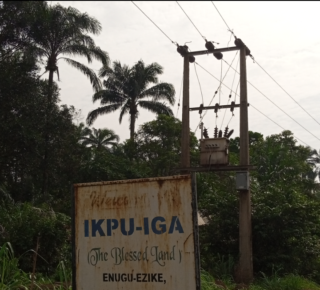
Signpost at the entrance of Ikpu-Iga with an abandoned world bank electrification project. Photo by Sodiq Ojuroungbe
At night, torch and hurricane lanterns hang loosely on walls to provide light for nighttime activities in most houses in the community.
Then, in 2011, the World Bank, in partnership with the Federal Government, launched an electrification project in Ikpu-Iga and four other communities in Enugu-Ezike. The residents went wild with joy and became hopeful again.
But, ten years after the commissioning, findings revealed that the government had abandoned the project. In various communities, the decaying transformers are the only vestiges of buried hopes, even as residents continue to lack access to electricity.
Communities grope in darkness despite installation of transformers, meters
Enugu-Ezike is located in Igbo Eze North Local Government Area of Enugu State and consists of five communities, including Amachalla, Umuachi, Uda, Ikpu-Aga and Isiugu. The communities, which share boundaries with Benue State, were selected to benefit from the rural electrification project financed through a World Bank loan.
In 2011, the government contracted East India Udyog Limited to distribute and install poles and transformers in the communities.
The announcement brought joy to many residents. But little did they know that the project would not be of use to them, despite high expectations.
Within few months, the project commenced. Soon after the workers completed installation, poles were erected across the district; cable wires were laid, transformer mounted, and meters distributed to houses. But still, there was no light, especially in three communities among the five selected for electrification. The two others have found alternative means of generating electricity.
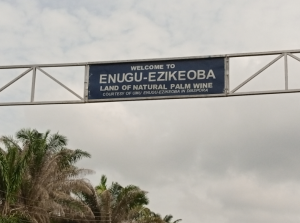
The entrance of Enugu-Ezike. Photo by Sodiq Ojuroungbe
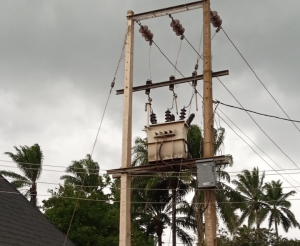
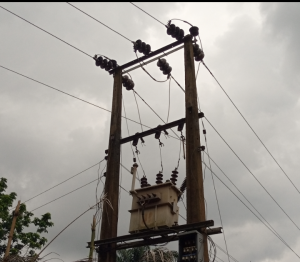
Long poles connected to high-tension wires could be sighted on the journey through Amufie, Unuadonuowo, Uroshi, Ugbele and Amachalla. Transformers were also hanged between the two erected poles but were covered with tendrils, thorns and pliant stems of climbing plants, signs of long years of neglect.
It was difficult to differentiate between trees and poles in some parts as the latter were conveniently wrapped by flower-bearing, creeping plants.
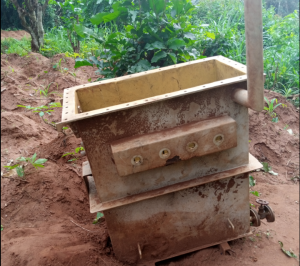
A rusted transformer turned into a water tank. Photo by Sodiq Ojuroungbe
One of the transformers sighted beside the erected poles has started to rust, and rainwater filled the hollow section of the iron. The conductors and switchgear have been removed from one transformer, and it has become a water tank for a farmer who farms nearby.
Although Amachalla is one of the primary beneficiaries, since the project passed through places like Amufie, Unuadonuowo, Uroshi and Ugbele, houses beside the road in the four communities were also provided meters. About 15 poles were also given to the communities, but there was no light.
The residents of the communities have bitter stories to tell about the lack of access to electricity in the villages.
Justice Ugwu, a welder who lives in Uroshi and has a transformer mounted in front of his shop, lamented that he has been spending a minimum of N1,000 to fuel his generator daily.
Ugwu said he buys fuel from the black market, adding that the community and its neighbours have not enjoyed electricity since it was founded.
“We don’t have light here; the ones they brought to us never work. We have not enjoyed it, not even for a single day,” he said.
Also, the town crier to the council of elders in Ugbele, Eze Solomon, said only people close to the pole-mounted transformers were given meters and electricity, and all efforts to get the government’s attention through the local government chairman have been unsuccessful.
…How it all started
In 1999, FGN began a comprehensive public sector reform and privatisation to improve performance in the power sector. The Transmission Development Project (TDP), approved in 2001 and closed in 2008, was designed to support the more significant reform effort initiated by the federal government.
Hence, the National Energy Development Project (NEDP) was launched in 2005 to scale efforts to address the urgent need for investments and improved commercial practices already started under TDP.
At the time of appraisal for NEDP, the World Bank was the only sizeable international development institution active in the sector. The bank was able to commit colossal funding and the prolonged period for which it was required to achieve visible impacts in a large country like Nigeria.
Secondly, its staff had the experience to address the sector’s key issues, such as utility management, sector regulation, strategic communications, commercialisation and privatisation of utilities.
The bank already had a long-standing relationship with the National Electricity Power Authority, NEPA, and a well-established and performing Project Management Unit (PMU) with a good track record. Finally, the successor companies needed substantial financing from private sources. The World Bank Group was uniquely positioned in terms of its deep technical expertise and global knowledge to assist the government in establishing the necessary conditions and environment to make this possible.
NEDP was presented to the International Development Association (IDA) Board of Executive Directors for approval as a flagship project along with the new Country Partnership Strategy (CPS) for Nigeria, to which it was also fully aligned. The CPS targeted long-term goals of wealth creation, employment generation, and poverty reduction.
One of the projects agreed to be financed by IDA under the NEDP was the electrification of rural communities in Ogun, Enugu and Cross River States. The project aimed to ensure rural communities have access to a stable power supply and reinforce existing distribution networks (meters, LVDS, HVDS).
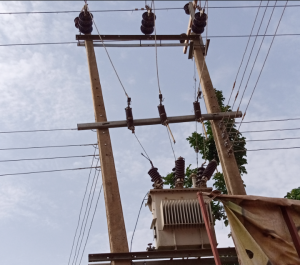
The grounded pole-mounted transformer at one of the communities IN Enugu-Ezike. Photo by Sodiq Ojuroungbe
An evaluation report by World Bank obtained by this reporter on the project revealed that the rural communities project targeted 53 rural communities in Yewa North Local Government Area of Ogun State; five rural communities in Enugu Ezike in Igbo Eze North Local Government Area of Enugu State; three rural communities in Obalinku Local Government Area of Cross Rivers State and 11 rural communities in Ogoja Local Government Area of Cross Rivers State. The document noted that 8,100 meters were installed free of charge in the benefiting communities across the three states.
Also, the contract award document obtained showed that a total sum of $7.5 million was approved for the rural electrification project.
… Communities spend millions to generate electricity after the government’s ‘failed’ project
In Uda and Amachalla, the World Bank-financed project was also abandoned, but the communities contributed funds to generate their electricity. It was learnt that they used the infrastructure built but abandoned by the government to tap power from other communities.
Nze Francis Anayo, the immediate past chairman of Amachalla Electricity Execution Committee and member of the committee monitoring the project, confirmed that it was completed but never used.
He explained that it was easy for Amachalla to utilise the available high-tension wire done by the contractor because the community already had two transformers even before the project was brought to the community.
He added that since the project failed, the community resorted to self-help by using the high tension to power the available transformers three years after.
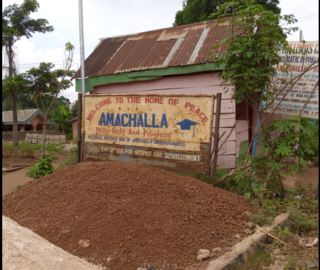
A signpost of Amachalla. Photo by Sodiq Ojuroungbe
“This project was completed but was never put to use. But, we are using the High Tension.
“The LT line and even the transformers are yet to be commissioned. The transformers have not been connected; we have another transformer, so we tapped from another area.
The story is similar in Uda, as the community was able to generate electricity through residents’ efforts. The community claimed to have spent millions in getting two transformers that generate electricity for the people.
A community leader, John Odo, said the electricity supply was possible through the assistance of one of the influential persons in the community and the money generated from community members.
Odo maintained that the community never enjoyed the World Bank project.
“It [the project ] has remained like that since the time they carried it out, it was never energised, we never enjoyed it, it has remained abandoned and since we already have electricity, we are not too concerned.”
No hope for residents of Ikpu-Iga, Isiugu, and Umachi communities
Residents of Isiugu, Umachi and Ikpu-Iga have many bitter stories to tell about how non – availability of electricity has affected their survival.
The World Bank-financed project could be seen in every corner of Ikpu-Iga, a community with about 500 households. In Ikpu-Iga, which shares a boundary with Benue State, the people have never enjoyed electricity.
This reporter learnt that even though the community youth have tried to connect electricity from a neighbouring village, their efforts have not been successful.
The Town Union chairman, Comrade Ifeanyi Ekere, disclosed that the community got a transformer from a former chairman of the local government. Still, it got spoiled the day it was commissioned and never served the people.
Ekere, who claimed it had been a fruitless effort waiting for the government to energise the project, noted that the community is presently trying to solicit assistance from notable people to get another transformer.
“We have 13 pole-mounted transformers strategically positioned in different parts of our community, but none of it is working,” he observed.
Speaking on efforts made to call the attention of the government to the situation, Ekere said several letters have been sent, and appeals made to the state government without any positive response.
In Isiugu, unlike the four other communities that did not enjoy the electricity, the electricity project was test-ran.
The people revealed that the project was test ran for a month before it stopped working and the community has since been thrown back into darkness.
This reporter observed that the community did not have any other electricity project apart from the World Bank-financed one, which has become abandoned.
The contractor reportedly test-run, the two pole-mounted transformers could be seen leaking oil, while grasses and wild plants are fighting space with others that were abandoned across the community.
Speaking with the residents, they complained that the electricity has brought more ill-luck to them. A resident, Joseph Adagwu, said “the people are still suffering as the project which cost millions of naira has become neglected, abandoned.”
“When the government just brought this project in 2012, we were happy that this will end our long time suffering of no light, unknown to us that this is just the beginning.
“I have to buy a minimum of 600 naira black market fuel daily to service my generator. It has been a complete waste of resources that the government brought this kind of project here and abandoned it.”
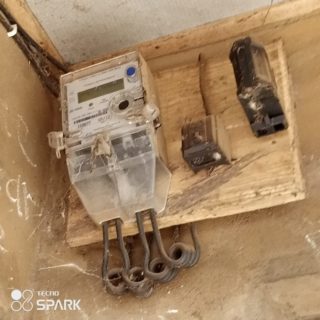
One of the meters was distributed to the benefiting communities. Photo by Sodiq Ojuroungbe
Another resident, Justin Amadora, lamented that even though meters were distributed to them, the community has continued to remain in darkness.
“The meter they give is not for everybody. Just some of the people that are very close to the transformer. Since they completed the project, there was no light in the community. Our generator has been the only source of electricity, and it is only for those that can afford it,” he stated.
At Umuachi, the community tried to get the Enugu Rural Electrification Board, REB, to fix and energise the abandoned project five years after it was left.
But, this reporter learnt the REB discovered that out of about 20 pole-mounted transformers spread across the community, only one was working.
Just like the other communities visited in Enugu-Ezike, the project was not working in Umuachi and there was no electricity.
This reporter gathered that the community tried to energise the project five years after waiting ‘endlessly’ for the government without result.
But, it was learnt that when the REB came to test the transformers to ascertain If they can be energised, it was discovered that 19 out of the 20 installed transformers were not working.
This reporter gathered this made the community go-ahead to fix a transformer reportedly brought to the community by one of its illustrious sons. However, the transformer reportedly got burnt some months back, and the community is back to darkness.
John Ugwu, the electricity coordinator in the community, told our reporter that the community once had electricity through self-help.
He, however, lamented that the community is back in darkness since the transformer got burnt over what he termed ‘overload.’
Ugwu, who claimed the community did not enjoy the World Bank facilitated a project for a single day, said it went to look for alternatives.
He said, “because the World Bank project is not working, that’s why we went to look for this one that we used for some time.
Wires connected to a pole-mounted transformer, but there was no electricity. Photo by Sodiq Ojuroungbe
“The little electricity we enjoyed was through self-help, and this government project has never been of benefit to us.
“We even try to speak with the EEDC (Enugu Electrification Distribution Company), but they say they cannot do anything except they get certification from REB (Rural Electrification Board).
“When the REB came, they tested all the pole-mounted transformers, but only one was working. They said the rest had spoilt. They cannot use just one transformer to give electricity to the whole community.”
…REB confirms transformers are bad, as lawmaker vows to track abandoned projects
Speaking with Simon Atigwe, the former Managing Director of REB, he confirmed that some of the transformers were bad when the board carried out testing on them.
Atigwe who was in charge when the project was completed, said the Enugu Electricity Distribution Company had issues with the contractor on the handing over process, which was why the project was not energised.
He, however, redirected this reporter to the director in charge of the project for further information.
“I met the project there as a General Manager. The contractor did the practical completion when I was there. The Enugu Electrification Distribution Company had issues with the contractor about energising and all these which concerned the project at that time,” he stated.
“What I am telling you now, the projects were not actually commissioned by EEDC when the contractor handed over. That time I was almost on the edge of going. So that is what I can say about the project, but some of them are already trying to fix the light on their own.
Abandoned world bank project at one of the communities. Photo by Sodiq Ojuroungbe
“You know why I said I left the thing at the verge of completion was because of my political ambition. So, somebody was the officer for that. He was doing the job even before I was appointed the GM. The World Bank recognised him, I was just there as the head of the institution. But I can give you the number so you can call him. I will send you the number, and you take it up from there. He has everything. He knows everything. He handled everything. So for details, you can find out but this is the much I have.”
Atigwe who is the present member representing Igbo EzeNorth/Udenu Federal Constituency, however, said efforts are underway to track abandoned projects in its constituency and hold necessary authorities accountable.
He disclosed that he had begun a data collection process to ascertain the number of abandoned projects in the communities and to know the next line of action in making sure the government revisits the project.
He added: “Well, I am in contact with some groups of the community on the way forward. I am collecting data on the ones in my own area and at the appropriate time, I will write to the appropriate authority for response and then that way I will take it up.”
…. Why we never energised the World Bank Electricity Project – Electrification Board
The Director of Engineering at REB, Austin Ugwu, explained that change in power policy was the major reason the project was not connected.
He insisted that the contractor completed the project, stressing that the cost of energising the project was not captured in the contract award.
Ugwu, who was the officer that supervised the project in Enugu-Ezike, revealed that it was handed over to the state for energising purposes.
A leaking transformer at one of the communities visited. Photo by Sodiq Ojuroungbe
He, however, added the state government has abandoned the project, expecting the benefiting communities to energise the electricity projects themselves
“We had a meeting in Abuja and they decided to hand over the budget to the state to complete the energisation which we took up. But ever since then, the state never supported the community for the project. And suddenly the communities resorted to self-help and started energising it. That’s why I said some were energised and some were not energised.
“Because the cost of testing given to NEMSA was not captured in the contract. But before the job would be completed, there were changes in the power sector in the country. Based on that, it was difficult up till now; the community is still finding it challenging to energise the majority of them.
“Normally, it is the rural Electrification Agency that would handle that especially now, but it has not been easy.”
* This investigation is supported by the John D. and Catherine T. MacArthur Foundation and the International Centre for Investigative Reporting
THE National Youth Service Corps (NYSC) has lied about warning corps members to have their ransoms ready in the event of being kidnapped along ‘high risk roads’ in Nigeria.
In a statement released across its social media handles on Friday, the management of the scheme had denied reports that it encouraged payment of ransoms to kidnappers, describing them as fake.
“Management wishes to emphatically state that the clause quoted is not embedded in NYSC Security Tips pamphlet which was put together by a highly respected retired security expert,” it read.
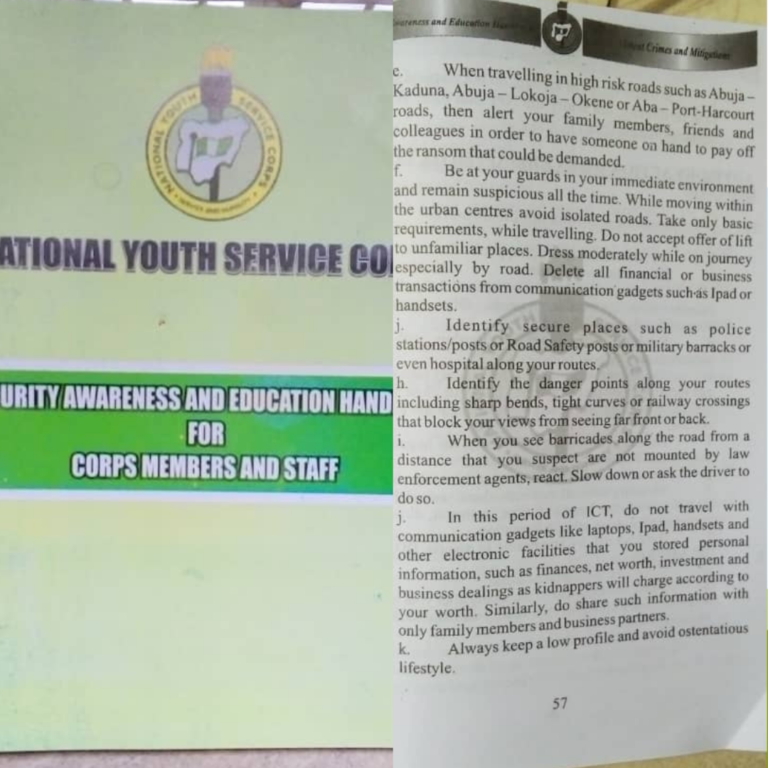
However, a pamphlet titled: ‘Security Awareness and Education Handbook for Corps Members and Staff’ given to corps members by the scheme was obtained by The ICIR from a serving corps member (Batch B, 2020).
Page 57 of the book reads:
“When travelling in high risk roads such as Abuja-Kaduna, Abuja-Lokoja-Okene or Aba- Port-Harcourt roads, then alert your family members, friends and colleagues in order to have someone on hand to pay off the ransom that could be demanded,”
This contradicts the NYSC press statement denying the specific security advice.
This was written as a tip for corps members “if they are unfortunate to be kidnapped or taken hostage.”
The NYSC had urged members of the public to clarify issues with the organisation in its statement.
However, efforts by The ICIR to contact the Director of Human Resources Management of the scheme on the conflicting information yielded no results as he did not respond to calls and text messages at the time of filing this report.
THE International Centre for Journalists (ICFJ), in collaboration with The International Centre for Investigative Reporting (ICIR), is organising a webinar on social media regulation in Nigeria.
The webinar, which aims to push advocacy on digital rights in Nigeria, is titled ‘Should Government Regulate Social Media?’ and will be held via Zoom on Wednesday, September 29, 2021, between 11: 00 AM and 1:00 PM.
Both organisations have invited members of the public to join the webinar.
The panellists include: Executive Director of Paradigm Initiative Gbenga Sesan; Director-General of the National Orientation Agency Garba Abari; Executive Director of Global Rights Biodun Baiyewu, and Affiliate at Berkman Klein Centre for Internet and Society, Havard University, Nana Nwachukwu.
All the speakers have confirmed they will be present at the webinar.
The panellists would provide a clearer understanding of social media regulation and its effect on the nation’s democracy, among others.
Interested members of the public can register for this webinar via: https://us02web.zoom.us/webinar/register/WN_RATW_JgWT4Oe56oRs5QYrg
Social media regulation has generated outrage and criticism from many Nigerians in recent times.
In 2019, a bill titled ‘Protection from Internet Falsehoods, Manipulations and Other Related Matters Bill’ was presented at the National Assembly by the Senator representing Niger-East – Mohammed Sani Musa.
The bill, popularly described as the Social Media Bill, passed the second reading on November 20, 2020, and has been described as a threat to freedom of expression.
The Federal Government recently banned micro-blogging platform Twitter after It deleted his Civil War comments targeted at South-East people of Nigeria.
NIGERIAN Police Force (NPF) said operatives have arrested three suspected bandits responsible for kidnapping students of Bethel Baptist High School, Damishi, Kaduna.
Force Spokesperson Frank Mba revealed this while parading the suspects at the defunct Special Anti-Robbery Squad headquarters in Abuja on Thursday.
According to Mba, the suspects, identified as Adamu Bello, Isiaku Lawal and Muazu Abubakar, are part of the 25-man gang that kidnapped the students.
He said the police had obtained sufficient intelligence to facilitate the arrest of other members of the gang.
He also said 47 other suspects were arrested for various offences, including murder, kidnapping, cattle rustling, armed robbery and car theft.
A total of 121 students were abducted from their hostels when bandits invaded Bethel Baptist High School on July 5.
Security operatives were able to rescue Abraham Aniya, one of the students, on July 12.
Two other students escaped on July 20 when they were tasked to fetch firewood from a nearby forest.
The bandits had subsequently said the students would be released in batches.
The first set of 28 students was released on July 25, while two more batches were released on August 27 and September 18. It remained 21 of them in captivity.
THE Defence Headquarters (DHQ) has reacted to viral footage showing a female soldier assaulting a female corp member in one of the ongoing orientation camps of the National Youth Service Corps (NYSC) in Calabar.
Director of Defence Information Benjamin Sawyerr, who confirmed the incident during an interview with The ICIR on Thursday, said she had been arrested and would be appropriately dealt with.
Sawyerr said the soldier’s action did not represent the conduct of the Nigerian Army.
“It’s true it happened and very unfortunate,” he said.
“Her action is not in any way representing the embodiment of what the Army is all about. We are guided by sets of rules and regulations which makes us control our emotions.
“She has since been charged for offences prejudiced to military discipline and will be dealt with accordingly.”
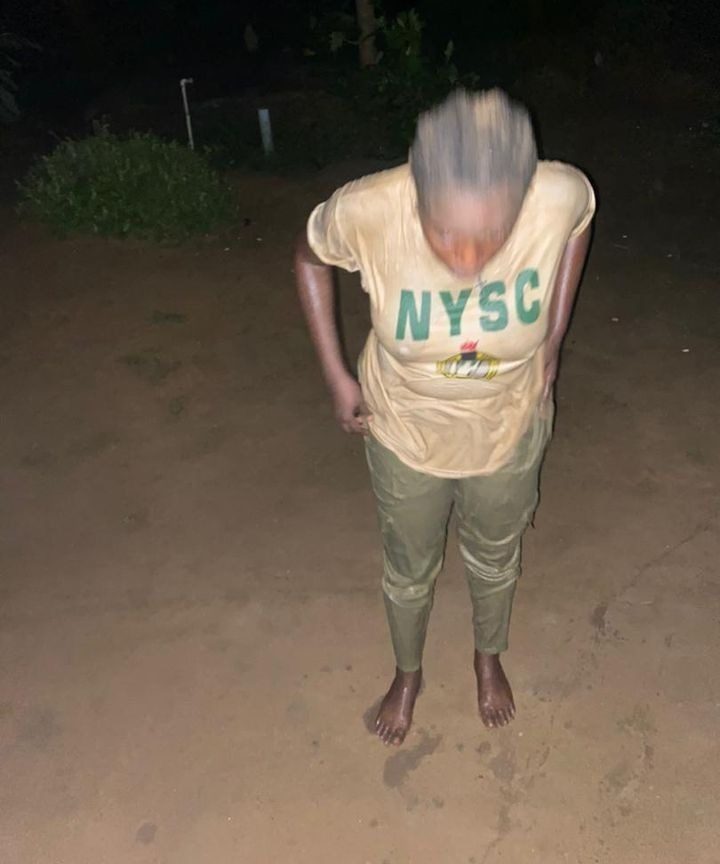
The Corp member after she had been assaulted.
The footage, which was shared by Agba Jalingo, an activist and journalist, has attracted many criticisms for the Nigerian Army on social media.
The female soldier, identified as Chika Viola Anele, a lieutenant, was seen assaulting the corp member, also identified as Ezeiruaku Ifeyinwa Fidelia, after they had an argument.
Jalingo also confirmed that that the officer had been arrested and was being interrogated over the incident.
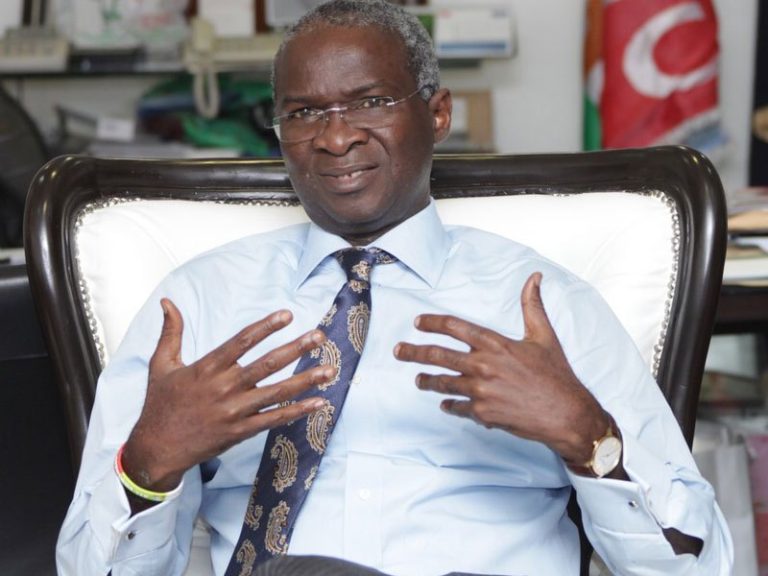
THE Minister of Works and Housing Babatunde Fashola, on Thursday, proposed a new idea of maintaining government buildings and infrastructures to sustain job creation and increase the life span of government properties.
Fashola made this proposal during the National Council on Works, held in Bauchi State. He said though the policy was initiated in 2019, the idea has become vital. Hence, it was shared with the Head of the Federal Civil Service Commission to create the Federal Public Asset Maintenance department.
The Minister, who disclosed plans to award contracts to maintain 25 federal secretariats across the country, emphasised the proposed department would be replicated across the Ministry Department and Agency (MDAs).
The MDAs with dedicated units are to carry out condition assessments of their infrastructure, develop a maintenance plan and implement procurements for an annual periodic and scheduled maintenance.
“In 9 (nine) facilities that we assessed the conditions of fittings such as fans, air conditioners, light fittings, toilets and wash hand basin, we found that out of 41,800 installations 12,459 representing 29.8 per cent were not functioning. These are people’s jobs to repair, supply, replace and install, as the case may be.
“The development of the maintenance plan and the procurement plan leading to an invitation to tender and award of maintenance contracts for rehabilitation and facility management is a sure pathway to job creation,” he said.
“Currently, we are undertaking maintenance works on 41 (Forty-One) bridges that have employed 1,157 people directly and created 3,309 indirect jobs, and we have facility management contracts for 25 federal secretariats across Nigeria after we completed renovation works. Each facility manager employs at least 40 people.
“This is only a tip of the iceberg because the supply side that supports maintenance involves the purchase and supply of paint, bleach, rakes, brooms, and other tools which create employment for small and medium-sized enterprises, which is another activity of economic empowerment.”
The country is known for poor maintenance culture, especially after executing notable projects such as roads, bridges, airport runways, and the likes until it collapses or the verge of damage; it hardly gets government attention.
The media have repeatedly exposed reports of such neglect of significant government facilities.
The Minister recalled how the Lagos State government set up the Office of the Facility Management, which later awarded contracts to manage 600 schools within the state. The contract awards, he said, were not only beneficial to the small contractors but both skilled and unskilled labours involved in the job execution.
He announced when Nigerians saw beautiful infrastructures abroad, with functional and efficient public assets, it was a product of a maintenance economy established by the government.
He said that public infrastructures such as schools, courts, hospitals, correctional facilities, and police buildings would soon be rehabilitated.
He tasked the state governments to follow the same pace to create sustainable jobs and develop the economy.
“Available data shows that in the ‘built industry’ only about 30 per cent of the manpower is employable by design and construction which lasts until the project is completed; while the remaining 70 per cent are employed in the process of ‘operation’ and ‘maintenance’ of the infrastructure.
“These are the reasons why the development of a maintenance economy must commend itself to all of us here and why we must all return home not only to think about it but to do something about it.”
THE UK’s newly appointed Minister of State for Equality Kemi Badenoch has come under criticism after private chats where she unreservedly expressed her views about colonialism were leaked to the press.
Badenoch was appointed to her new role last Thursday. She was previously exchequer secretary to the Treasury (February 13, 2020 – September 15, 2021) and parliamentary under secretary of state at the Department for Education (July 27, 2019 – 13 February 13, 2020).
The minister, who is British-Nigerian, had said in one of the chat messages that African societies had been unequal before the arrival of the European powers and those Africans who suffered from colonialism were ‘old elites not everyday people.’
“I don’t care about colonialism because [I] know what we were doing before colonialism got there. They came in and just made a different bunch of winners and losers. There was never any concept of ‘rights,’ so [the] people who lost out were old elites not every day people,” she wrote.
Badenoch appeared to argue in the leaked messages that colonialism simply replaced a system of oppression that existed in Africa before Europeans arrived.
The Labour Party instantly condemned the comments as ‘disgusting, crass, divisive and painfully inaccurate,’ and questioned her fitness for office.
However, Chairman of the Commons Liaison Committee Bernard Jenkin said her accusers were “trying to hound women like Kemi Badenoch out of politics because they know that a Conservative Party with more women and BMEs (Black and Minority Ethnicities) will become an unstoppable political force.”
Some of Badenoch messages were exchanged privately between with a former Conservative party supporter and confidante Funmi Adebayo, while others were sent to a mutual group chat called Conservative Friends of Nigeria.
Adebayo, who later leaked the messages to Vice World News, explained she did it to show that Badenoch was unqualified for her new role in the Foreign, Commonwealth and Development Office.
“I think she’s absolutely the wrong person to be sitting in this office that she has now been given. As great as it is to see a Black woman in her position of power, and as great as that is for representation, she is not equipped, she does not have the knowledge, she does not have the experience, nor does she have the empathy to be in such a role.”
“I hope that it is strongly understood that just because she is a Black woman does not mean that she can be the spokesperson for all Black people,” Adebayo said.
Badenoch’s office refused to comment. A spokesperson said the government would not comment on leaked private correspondence.
Badenoch previously faced backlash after a leaked 2018 video showed her making anti-LGBTQ+ comments, with members of the community calling for her resignation.
In the video, shared by VICE World News, Badenoch was heard saying: “Well we’ve got gay marriage, and civil partnerships, so what are transsexuals looking for?”
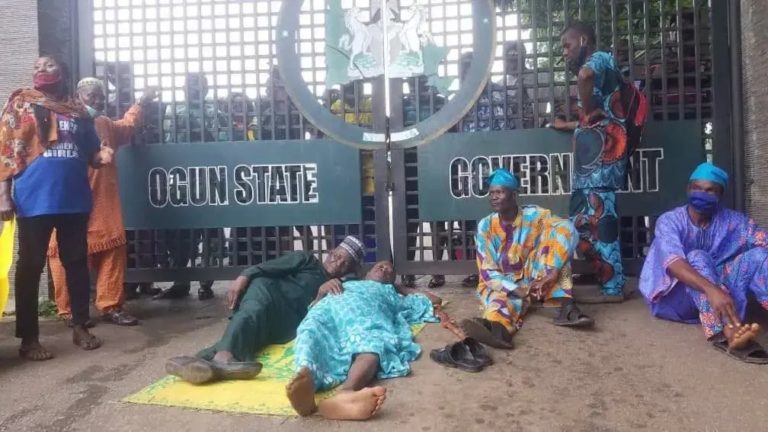
LOCAL Government Pensioners’ Association of Nigeria (LOGPAN), Ogun State Chapter, has taken to the state government’s secretariat to protest non-payment of N68 billion, 10-year outstanding gratuities.
The retirees reportedly blocked the main gates to the secretariat.
Some of the placards displayed read: ‘Gratuities are on sales to pensioners,’ ‘Governor Dapo Abiodun, honour your father and treat pensioners well,’ and ‘Governor Abiodun, we don’t deserve this worst humiliation,’ among others.
A cross-section of some of the pensioners. File credit: WithinNigeria.
LOGPAN Chairman Sikiru Ayilara, while addressing newsmen, accused Governor Dapo Abiodun of reneging on his promises to them.
Ayilara complained that some of his members still earned a paltry sum of N3,000 as monthly pension.
He said the governor’s quarterly payment of N500 million was not enough to meet the government’s obligation to pensioners in the state.
In his reaction, Secretary to the State Government Tokunbo Talabi said the government was experiencing financial hard times.
He, however, promised that the government would look into the demands of the pensioners.
OHANAEZE Ndigbo socio-cultural group has said that it is already working with all groups of people to ensure that founder and leader of Indigenous People of Biafra (IPOB) Nnamdi Kanu is released from detention.
The group stated this during a telephone interview with The ICIR on Wednesday in reaction to the growing tension, especially in the South-East part of the country, over the detention of Kanu.
Ohanaeze Spokesperson Alex Ogbonnia said the group was working with members of the National Assembly and leaders from the South-East to proffer a political solution to the matter.
“We are collaborating with all groups of people, including members of Ndigbo in the National Assembly, to ensure that there is an amicable and legal solution to this matter so that Kanu will be freed,” he said.
While reacting to the recent statement by IPOB threatening to shut down the South- East region if Kanu was not produced in his next court appearance by the State Security Service (SSS) to continue his trial, Ogbonnia appealed to the group to think about the economic pains the lockdown would have on millions of Ndigbo living in the region.
He noted that he did not believe that Kanu, whose freedom IPOB was fighting for, would want to lock down the whole South-East for a month to inflict economic pains on those he was trying to liberate.
“I don’t want to believe Nnamdi Kanu will shut down the entire South-East to inflict injuries and pains on those he claims to be liberating. I don’t think he would.
“The only purpose of the lockdown is to suffocate the Igbos. There would be a lot of problems, including losses of good services.”
Kanu was rearrested and brought back to Nigeria in June four years after his trial on charges of treasonable felony.
Trial Judge Binta Nyako had, on June 29, ordered Kanu to remain in SSS custody.
But in July, the court could not continue the trial after the SSS refused to produce him in court because of ‘logistical’ issues.



 Also, the town crier to the council of elders in Ugbele, Eze Solomon, said only people close to the pole-mounted transformers were given meters and electricity, and all efforts to get the government’s attention through the local government chairman have been unsuccessful.