THE Federal Government has explained why it cannot name and shame the sponsors and financiers of terrorism in Nigeria.
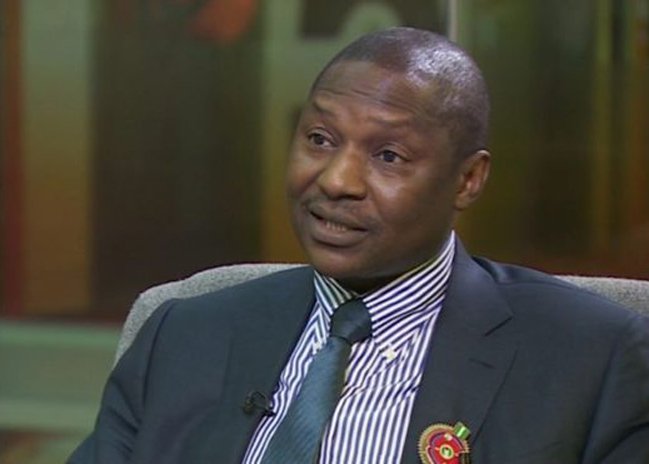
Minister of Justice Abubakar Malami, who gave the reasons to journalists in New York on Wednesday, said the government had identified the perpetrators but investigations were still ongoing.
He claimed that the investigation had impacted positively on the ongoing fight against terrorism in the country.
“We have succeeded in identifying those that are responsible for funding terrorists,” he said.
“We have also blocked the leakages associated with the funding and then embarking on an aggressive investigation that is indeed impacting positively in terms of the fight against terrorism.
“But then, the truth of the matter is that investigation is ongoing, it is advancing and for the purpose of investigation, I wouldn’t like to be pre-emptive in terms of making disclosures that would have the effect of undermining the successes we are recording as far as investigation is concerned.”
Malami had announced in May that the Nigerian government was about to begin the prosecution of about 400 suspected Boko Haram financiers and was profiling some powerful Nigerians strongly suspected to be financing terrorism for prosecution.
The delay in their prosecution and unveiling of the suspects have been criticised by Nigerians, including the opposition People’s Democratic Party (PDP).
Last week, the United Arab Emirates (UAE) named six Nigerians among financiers of terrorism globally.
The six Nigerians include: Abdurrahaman Ado Musa, Salihu Yusuf Adamu, Bashir Ali Yusuf, Muhammed Ibrahim Isa, Ibrahim Ali Alhassan and Surajo Abubakar Muhammad.
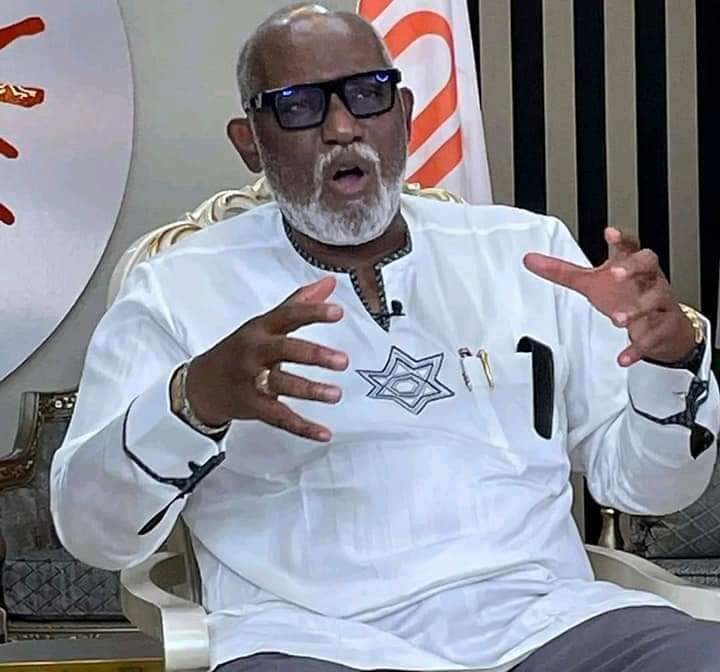
ONDO State Governor Rotimi Akeredolu has accused Kaduna State Governor Nasir El-Rufai of exporting banditry to the southern region of the country.
Akeredolu said this in a statement by his Commissioner for information and Orientation Donald Ogogo on Wednesday.
The Chairman of the Southern Governors Forum (SGF) said that El-Rufai’s statements merely sought to encourage anarchy under the guise “of resentment of a law by affected stakeholders.”
He noted that El-Rufai should not be condemning the decisions to ban open grazing after some states in the North, including Kaduna, had banned inter-border movement of cattle.
“In these days and times, anyone who makes statements such as that allegedly made by the governor belongs to a class of an unenviable ilk masquerading as leaders,” he said.
“There is no wisdom in condemning/banning open grazing, prohibiting inter-border movement of cattle in the North, including Kaduna, with an accompanying disapproval of a Law that gives bite to same, in another part of the country.
“Perhaps, it is apt to state clearly that the likes of Governor el-Rufai are already in a hysteric ‘mode’ of escalating and indeed, externalising banditry, especially as the military onslaught against criminal elements and other terror variants suffices in the North.”
He emphasised that the statement was a cleverly crafted path towards replicating in the South, the most despicable situation in the North that Nigerians of goodwill daily prayed to overcome.
While stating that the anti-grazing law had come to stay, especially in Ondo State, Akeredolu vowed that it would be zealously guarded and religiously deployed to protect all residents of the state regardless of their ethnic and religious biases.
El-Rufai had during a recent interview with journalists faulted the anti-grazing laws being enacted by state governments, especially those in the southern part of the country.
He said that banning open grazing was not the solution to perennial clashes between herders and farmers in the country.
He warned states against politicising the matter, saying they should not make legislation they would not be able to implement.
He stated that although open grazing was outdated, the only solution was ranching which required a huge financial investment.
NIGERIA’S Central Bank Governor Godwin Emefiele has been asked to resign immediately as the free-fall of the Nigerian currency continues without any end in sight.
The opposition Peoples Democratic Party (PDP) on September 23 demanded the immediate resignation of Emefiele for overseeing what it described as colossal failures of monetary and fiscal policies recorded under the President Muhammadu Buhari-led All Progressives Congress (APC) administration.
PDP National Publicity Secretary Kola Ologbondiyan who announced the demand in Abuja also said Emefiele should hand himself over for investigation and prosecution by relevant anti-graft agencies.
The PDP observed that the naira was fast approaching N600 to a dollar whereas the exchange rate as of 2014 when Emefiele took charge of the apex bank was N164 to a dollar.
Ologbondiyan said Emefiele’s failure at the CBN had brought the Nigerian economy to its knees.
“Today, in the hands of Emefiele and the APC, the naira has tumbled to near N600 to a dollar, putting the nation’s economy on its knees.
“Painfully, under the leadership of Emefiele, the CBN has failed in its core mandate of managing the economy and took a dive into propaganda, with claims that do not reflect the harsh economic reality on the ground,” the PDP spokesman said.
In accusing Emefiele of propaganda, the PDP was apparently referring to attempts by the CBN to blame an online foreign exchange rate publication platform AbokiFX for the crash of the naira.
At a Monetary Policy Committee meeting on September 17, Emefiele gave reasons for the planned shutdown of AbokiFX, accusing the website of exchange rate breaches.
Emefiele said the owner of the website Oniwinde Adedotun would be made to face the full wrath of the law for economic sabotage.
According to him, the CBN had been investigating AbokiFX for about three years and, in the process, wrote a memo to banks asking for information about the website.
The CBN governor said the proprietor of AbokiFX was conducting an illegal activity that was killing the Nigerian economy.
But the PDP said Emefiele’s resort to propaganda amounted to serious economic sabotage for which he should be prosecuted by the Economic and Financial Crimes Commission (EFCC).
Ologbondiyan stressed that sanctions for the offence are spelt out under Nigerian laws.
The naira has been on a downward slope in the parallel market for some time, trading at N570/$ on September 17.
A former Deputy Governor of the CBN, Kingsley Muoghalu, had called on the apex bank to stop subsidising import and float the naira actually to determine its market value.
“The government cannot continue to fix the price of the naira, which is what the Central Bank is doing. If you float the naira, you have to stop subsidising imports. Our country is structured in such a way that it is subsidising the country’s imports. This breeds arbitrage,” Moghalu said.
The CBN has been struggling to fix the demand side of the FX market but has been weak in developing the supply side of the FX market.
Industry analysts say Nigeria’s over-reliance on oil to boost foreign reserves and the FX market exposes it to more vulnerability.
An economist at the Centre for Study on African Economies (CSEA), Mma Ekereuche, had told The ICIR that the naira was vulnerable because Nigeria was not generating enough dollars.
Ekereuche observed that the oil market’s volatility was affecting the strength of the naira as the Nigerian economy does not have enough buffer.
She advised that government must find a way to explore the agribusiness and the manufacturing sectors in African Continental Free Trade to improve dollar access to the economy while strengthening the naira.
As part of the Monetary Policy Committee meeting resolutions on September 17, the CBN had announced the retention of the Monetary Policy Rate at 11.5 per cent.
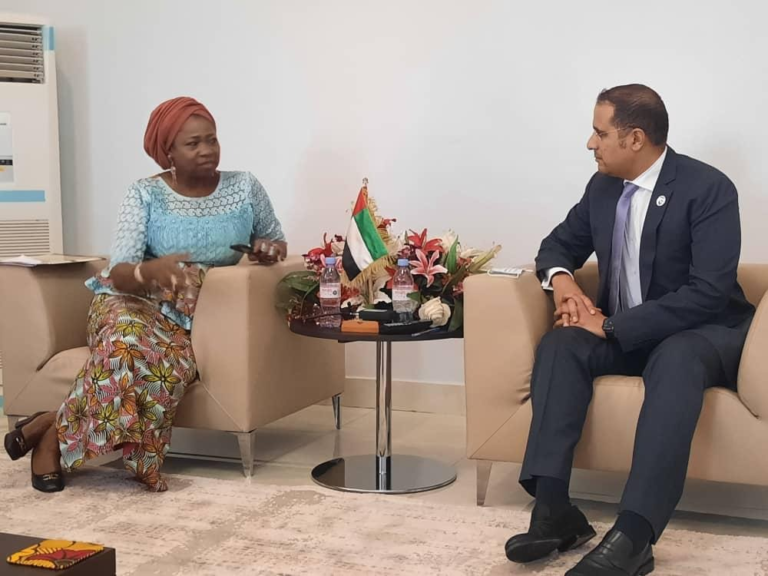
NIGERIANS residing in the United Arab Emirates have issued a passionate appeal to the government to restore its friendly diplomatic relations with Nigeria, as the effects of a massive job loss bite harder on members of the community.
Over 300 Nigerians have lost their jobs in the UAE between July and September after the government placed a restriction on work permit issuance and renewal for Nigerians, citing precautionary measures to combat the spread of COVID-19 virus.
In a statement on Wednesday, the Nigerians in Diaspora Organisation United Arab Emirates (NIDO-UAE) said: “The United Arab Emirates is our second home and we acknowledge the hospitalities and opportunities given to us… we are indebted and grateful.
“We solemnly appeal (to the UAEGovernment) to temper justice with mercy, forgive our trespasses, listen to our plights and restore to normalcy the friendly relations with Nigeria government and citizens.”
Director of NIDO-UAE Fernando Judel told The ICIR that at least 301 Nigerians legitimately working in the country had lost their jobs since July, according to data he collated after the Ministry of Resources and Emiratisation (MOHRE) blocked the work permit application portal for Nigerian nationals.
“We are yet to know the precautionary and preventive measures and why it is specific to Nigerian nationality,” Judel said.
Last month, the UAE Ambassador to Nigeria Fahad .A. Taffaq, during a meeting with chairman of Nigerians in Diaspora Commission (NIDCOM) at his office in Abuja, denied there was any restriction placed on Nigerians.
“There has been no official restriction on Nigerians from what I believe as an official position from the UAE. The UAE is a very welcoming country and does not discriminate against any nationality. Everyone is welcome to come, work, and contribute,” he said.
The diplomat said his country was proud of the huge number of Nigerian nationals going to the UAE for medical tourism, education, and employment, adding that some elite Nigerian professionals held good positions in the UAE – in medicine, engineering, and the education sectors.
Despite this official position put forward by the UAE, the reality on the ground is that many Nigerians in the country are unable to work and are now stranded. Some others who were newly offered employment said that their offer letters had been revoked.
Although the Nigerian Mission in the UAE is said to be engaging with the UAE authorities on the work restrictions, there is no telling how soon this issue, which has lingered over two months, will be resolved.
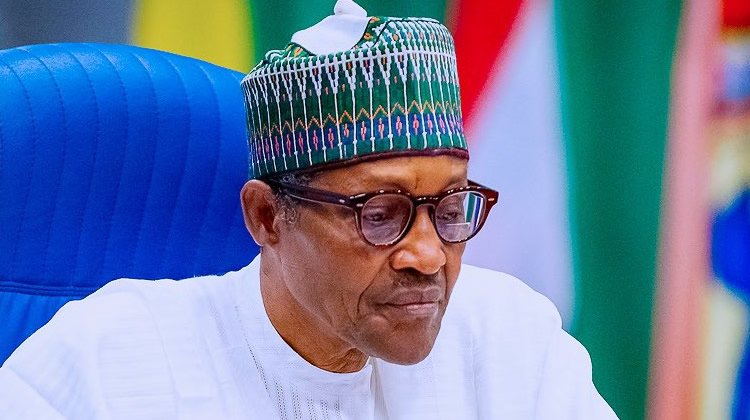
NIGERIA’S President Muhammadu Buhari has accumulated huge debts in the last six years, but he has failed to plug wastes in several corners of his administration and is also reluctant to explore alternative funding options.
External debt has grown under his administration from $7.35 billion in 2015 to $23.57 billion, according to the Debt Management Office’s data analysed by The ICIR.
Nigeria’s public debt hit N33 trillion in March 2021, but Buhari is seeking new $4 billion and €710 million loans from lenders.
The amounts are expected to be approved by the Senate.
With the new loans, the country’s debt has overshot N35 trillion.
Analysts say Nigeria can do without these debts, asking the president to plug wastages in his government’s Ministries, Departments and Agencies (MDAs) and explore other funding options to avoid plunging the nation into a debt trap – a situation in which debts are hard to repay.
Analysts are also worried that debt service-to-revenue was 98 per cent between January and May 2021, making further borrowing unsustainable.
A classic example of wastes in Nigeria is money pumped into the country’s three refineries.
In Warri, Port Harcourt and Kaduna refineries, N168.178 billion was lost in 2019, and only N1.681 billion was realised as revenue, according to The ICIR’s calculations of the companies’ financial statements.
In 2020, the moribund refineries wasted N153.084 billion, making only N5.216 billion as revenue.
In both years, Nigeria, the world’s poverty capital, lost N321.262 billion to refineries, an amount that can pay the minimum wage of 1,070 Nigerians in September 2021.
Apart from the refineries, the Nigerian National Petroleum Corporation (NNPC) pays N120 billion in opaque and corrupt subsidy regime monthly, amounting to nearly N1.5 trillion annually.
In sale of public assets, wastes have also been observed. Currently, the legislators are querrying the Presidential Implementation Committee for selling Radio Nigeria building for N100 million when its market rate is estimated at between N1 billion to N1.5 billion.
On Wednesday, there was also a discussion in the Senate regarding Nigeria’s N2 trillion loss to import waivers annually.
Hence rather than pay import duties, several companies enjoy waivers for bringing certain products into the country, the Senate said.
Political Economist Pat Utomi said that Buhari should take a cue from the military days of Olusegun Obasanjo, who had to cut wastes and spending while in government.
Speaking on Arise News’ ‘Morning Show’ on Wednesday, Utomi explained that after cutting wastes and reckless spending, Obasanjo brought down the cost of governance and stirred efficiency in governance.
He gave an analogy with a debt-ridden family, saying that a family who lived in debt would not be buying exotic cars as Nigeria would, saying that it was criminal to use borrowed funds to fund the security votes of governors and politicians.
Analysts are also asking the president to explore alternative funding options, saying some things could be done to fund projects in Africa’s most populous nation.
Economist and Chief Executive Officer of Economic Associates Ayo Teriba told The ICIR that Nigeria should enlist the government’s corporate assets into the equity market.
Director-General of the Lagos Chamber of Commerce and Industry Chinyere Almona said Nigeria’s president should turn the country’s assets into revenue generators.
She said physical assets such as idle or under-utilised properties could be repurposed and redeveloped for commercialisation to generate revenue, saying that “corporate assets should be securitised via public share issuance to raise equities.”
“There is a need to replace existing debt stocks with asset-linked debt to ease the debt
servicing burden, attract greenfield FDI into publicly-listed state-owned companies, and generate new revenue streams from commercialised real estate portfolios,” she said in an emailed statement to The ICIR, urging the president to determine the value of the country’s assets.
On his part, Partner & Chief Economist, PwC Nigeria Andrew S. Nevin said Nigeria had $900 billion worth of dead assets in residential, real estate and agriculture land that should be revitalised and converted into liquid assets.
Chief Executive Officer of Cowry Asset Management Plc Johnson Chukwu told The ICIR that the government must grow the GDP beyond what it was currently and hands off building infrastructure.
“We need to find a model that accommodates private sector and multilateral funds into infrastructural funding,” Chukwu said.
“Like the current N15 trillion Infraco funding, the government should find a legal and commercial framework to make it commercially viable.”
He also noted that the long-term solution of seeking alternatives to debt was a productive economy.
“Improving ease of doing business, global competitiveness and learning from China, Vietnam and Brazil in tapping into private equity funding for wealth creation is critically important.”
Associate Consultant for the British Department for International Development Celestine Okeke said the country must develop a framework that would attract private capital to infrastructure.
Market and Projects Analyst Ike Ibeabuchi said the long-term option was to develop each region according to its strength.
“The best way to develop alternative revenue is to grow the strength of each region. Develop Aba to attract foreign capital and tax revenue from leather. Grow cocoa and rubber in the South-West and South-South by boosting mechanised agriculture to attract chocolates and tyres manufacturers.
“Many countries today do not have oil or commodities but grew their own strengths, and later attracted capital and revenue. Once you have these investors, you will have jobs for your people, revenue from taxes, dollars from export and a strong economy that does not go cap-in-hand asking for money.”
Kano movie ban draws mixed reaction from Nollywood
By Olugbenga Adanikin and Yakubu Salisu
THE ban placed on movies that depict kidnapping, drug abuse, thuggery and other social ills by the Kano State government has drawn criticisms from players in the movie industry, even as others have defended the move.
While some have described the policy as a form of censorship of the arts and creativity, which prevents freedom of expression that speaks to the ills happening in society, others say the rule of the land should be respected, especially since most northern states practise Sharia Law.
Oloture Movie Director, Kenneth Gyang. Photo Source: Guardian Newspaper.
Director of the film, Oloture, Kenneth Gyang, said that the state government might need to understand the intentions of the moviemakers rather than impose an outright restriction.
He said arts were reflections of the society, hence, movie productions tilted to expose realities in the country should not be suppressed.
“I think they actually enforce some of these laws without knowing the true intention of the movie makers. For me, I always stand for an artist expressing himself. So, doing that is actually a huge part of the censorship,” Gyang stated.
“In understanding our society, there needs to be a form of regulations but when it comes to things like these, they say art is a reflection of the society.”
He criticised assumptions that the state government wanted actors to turn a blind eye to the new realities in the state, especially as it related to insecurity.
Creative Director of Leia Cole Studios Nsikan Issac shared a similar position with Gyang. She said movies involving crime or exposing criminalities were not peculiar to Nigeria but were global. The ban, she noted, would not help the situation, rather, it could discourage the youth from telling stories that mattered in their society.
Though she explained that a story might not be all focused on banditry and other forms of insecurity, it could interpret the negative character such as robbery or kidnapping.
“I don’t think it should be banned in any way because that is the only way you can really tell a story the way it should be told,” Isaac said.
While she questioned the rationale put forward by the state government, she advised the state officials to create more awareness on their justification, as efforts should be made on sustainable solutions and not just the ban.
“…it shouldn’t be that they want to promote those ills in the society. If they (the government) have to put a ban on the areas, I don’t think it makes any sense to me. The only thing is if the story direly puts the government in a bad light.
“If the government is not doing enough, and they (actors) decided to tell the story from what it is, the only thing I will expect them to do is to adjust rather than seize the youth from being creative.
“For me, it’s like putting another shackle on people’s feet because whether we like it or not, these are happenings. So, if they decided to put it in a story, I don’t think there should be a ban on it.”
However, she opined that the movie makers could deploy a better approach to telling such stories without breaching the legal provisions of the states.
Movie Maker, Mahmood Ali-Balogun. Photo Source: Guardian Newspaper
However, some actors have expressed contrary opinions. Chairman of Audio Visual Rights Society Mahmood Ali Balogun claimed ignorance of the incident. But he said since the state operated Sharia law, actors were expected to adhere to it.
“I know they have this Sharia law in their respective states. So whatever the law says, they should deal with it. I am not aware of this current issue but I know there were issues in the past,” he told The ICIR.
The President, Actors Guild of Nigeria (AGN), Emeka Rollas. Photo Credit: Famous People Magazine.
In his remarks, another prominent actor Emeka Rollas said if state government decided that it was the best measure to check the youths and check insecurity, actors should comply.
He said the state had every right to do so, as it would not in any way stop the actors from engaging in their craft now would it suppress their freedom of expression.
Rollas, who is the President of the Actors Guild of Nigeria (AGN), cited the instance of Bollywood where he emphasised the actors avoided mouth-to-mouth kissing. This act, he noted, did not demean the Indian movie industry as the industry had continued to grow.
“If Kano government feels it is not helping the citizens or youths, they have the right as a government to stop it. And it does not in any way stop the filmmakers from expressing themselves.”
“We have been watching Indian movies for decades. Have you ever seen two lovers kiss, promptly in a movie, as we do here? Can you answer that? Did it make their movie not successful?” he queried.
“It is still successful, even trying to be more successful than ours. So, sometimes, people shouldn’t just jump on public opinion to act.”
Rollas concluded by tasking the Kano movie makers to convince the state government or, otherwise, abide by the law.
How it started
The Kano State Government has been at loggerheads with filmmakers in the state following the ban on movies depicting criminal acts.
The decision, which was announced by the Executive Director of Kano State Censorship Board Ismai’la Muhammad Na’abba Afakalla on Tuesday said, “The board has banned the production and showing of any movie displaying kidnapping, drug abuse, phone snatching, and thuggery in the state.” But filmmakers have kicked against the decision.
He said the decision became pertinent in view of the ongoing fight against banditry and other security challenges bedeviling some parts of the country, particularly the North West.
According to Afakalla, the board in recent times had observed an increase in the number of movies depicting the act of kidnapping, thuggery, and phone snatching which his office and other stakeholders described as worrisome considering the vivid display of the criminal acts by the producers of such movies.
He said the board believed the films could lead to a setback to the ongoing fight against insecurity.
In his words, “We took the decision in order to stop the producers of some of the movie series shown in some of our TV stations because they show clearly how someone can mastermind the kidnap of people for ransom, snatching of phones and thuggery and drug abuse.”
Kano State in recent times has been faced with issues of phone snatching and thuggery which have led to the loss of lives. A man and his wife were reported to have been attacked on Sunday night on Yahaya Gusau Road, leading to the man’s death.
Afakalla stated that such movies contributed to the rising cases of crime in the state as most youths were impressionable and would learn from such movies regarding how to carry out these wicked acts the country was struggling hard to eradicate.
“We can’t allow movie producers to continue showing our youths those things that can further lead them into crimes.
“Just yesterday, a man was reported to have lost his life when some boys accosted him and his wife demanding his phone and was stabbed in that process leading to his death while the wife’s bag was snatched.”
“The government has stepped up efforts to combat these crimes in some neighboring states as you know, so we must not fold our hands and watch it shift here.
“We implore movie producers to begin to show things that promote peace, and other developmental issues and not vices and acts that contradict our religion and culture and this has nothing to do with censorship,” he added.
However, the executive director said the board would not hesitate to prosecute any producer and TV stations who violated the directive.
In his reaction, Chairman of UK Entertainment Umar Sani Kofar Mazugal kicked against the move, saying films were to create awareness on societal ills and not to teach them to get involved in the act.
He, however, admitted that some movie producers were too detailed in displaying such acts, adding that the censorship board was to blame for not working as it ought to since it was its responsibility to censor the script right from the conceptualisation stage.
He charged the Censorship Board to rather be worried about how the police recorded and released detailed interviews with kidnappers on social media handles, which he said was more dangerous.
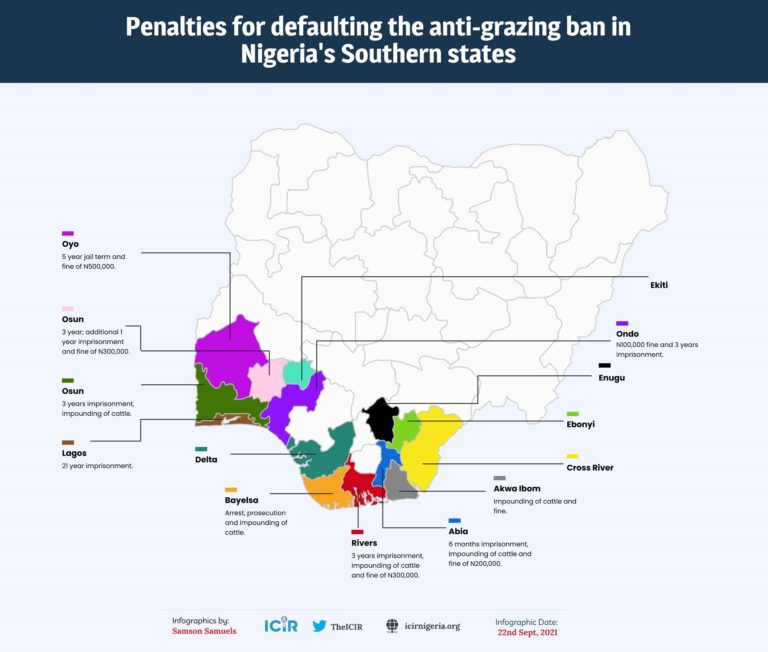
THE penalties for flouting the anti-open grazing laws in the southern states of Nigeria range from impounding cattle to arresting and fining the defaulters, The ICIR has found.
Abia State’s anti-grazing law has been existing since 2018
Any cattle found on any road in the state shall be impounded by the appropriate authority or taken to the nearest ranch as may be provided by the appropriate authority in the state.
Also, a fine of N200,000 or six months imprisonment or both will be imposed on any person that flouts the law that makes provision for ranching.
For Oyo State, its anti-open grazing law has been existing since 2019
The penalty for defaulting is a five-year jail term or N500,000 fine or both.
But Bayelsa State’s law was enacted on March 10, 2021
The penalties are that any herdsman found with arms, whether licensed or not, will be arrested and any person found engaging in open grazing of livestock on foot would be arrested and prosecuted with the livestock impounded.
Rivers State’s law was enacted on August 19, 2021
The penalties include: three-year imprisonment without the option of fine and forfeiture of the herds of cattle or livestock under their control to the state government, including a fine of N300,000 on the owner of the livestock or guardian or parent of a minor who is seen grazing, rearing or herding of livestock (without supervision).
Ondo State’s law was enacted on August 31, 2021
The penalty is a minimum of N100,000 fine or three years’ imprisonment for defaulters.
Ogun’s law was enacted on July 8, 2021
The penalties are a three-year jail term without an option of fine and the forfeiture of the herds of cattle or livestock.
Osun State’s law was enacted on September 15, 2021
The penalties include: three-year imprisonment without the option of fine and forfeiture of cattle or any livestock under the control of the offender to the state government.
Secondly, a fine of N300, 000 is imposed on anyone who flouts the law prohibiting minors from rearing cattle or doing so without adult supervision.
A conviction to a term of imprisonment of not less than one year without an option of fine is on any herdsman or pastoralist who attacks or threatens to track any farmer, person or commuter whether or not an injury is occasioned by the attack.
Akwa Ibom State’s law was enacted on September 15, 2021
The penalty is that animals (that stray into farms) would be confiscated and defaulting herder will be fined. The amount, however, is unknown.
Lagos State’s law was enacted on September 20, 2021
The penalty is 21 years imprisonment for herders found with arms.
Enugu State’s law was enacted on September 14, 2021, but there are no public details of the penalty the law stipulates.
In Ebonyi State, the governor has spoken of having laws on anti-grazing, but there is no further record of the law’s provision(s) and penalties.
In Cross River and Delta states, the bill that will bring about the ban has been passed, awaiting state governors’ assent.
SEVERAL properties belonging to former Kwara State Governor Abdulfatah Ahmed have been taken over by the Asset Management Corporation of Nigeria (AMCON) over indebtedness of nearly N5 billion.
AMCON Spokesperson Jude Nwazor, who revealed this in a statement on Wednesday, said the debt was personal.
He stated that the seizure was consequent upon an order by Justice A.M Liman of the Federal High Court, Lagos.
He also noted the judge had ordered the freezing of the bank accounts of the former governor and his two companies, including Trans Properties and Investment Limited and Trans It Consulting Limited in Suit No: FHC/L/AMC/01/2021.
Before going to court, AMCON said that all previous efforts to resolve the loan peacefully had been frustrated by the former governor, who remained recalcitrant.
According to the statement, the former governor’s house located at No. 9A Abdulrazaq Street, GRA, Ilorin, had been seized.
Other properties belonging to Ahmed in Kwara, Lagos and Abuja, seized by AMCON included: “houses at 13, Alhaji Masha Road, Surulere; No. 9 Wharf, Apapa, Lagos; Plot 3632, Cadastral Zone E27 of Apo, Abuja; Plot 4115, Cadastral Zone F14 of Bazango, Abuja; Plot 8502, Cadastral Zone E31 of Carraway Dallas, Abuja; and Plot 494, Cadastral Zone E31 of Carraway Dallas, Abuja.”
AMCON has also taken over the non-performing loans of the former governor and his companies, Trans Properties and Investment Limited and Trans It Consulting Limited, from the former Intercontinental Bank, FinBank and Bank PHB during the first phase of EBA purchases, in line with its mandate under the AMCON Act.
The development comes barely 24 hours after Ahmed, alongside a former Chairman of the Independent National Electoral Commission Attahiru Jega and foremost Nigerian Professor of Political Economy Pat Utomi unveiled the Rescue Nigeria Project ahead of the 2023 elections.
OHANAEZE Ndigbo socio-cultural group has kicked against the recent sit-at-home threat by the Indigenous People of Biafra (IPOB).
In a telephone interview with The ICIR on Wednesday, Ohanaeze Spokesperson Alex Ogbonnia urged IPOB to reconsider the decision as the proposed lockdown would have adverse economic and social consequences on residents in the region.
Ohanaeze noted that it does not believe that Nnamdi Kanu, the founder and leader of IPOB, would want to lock down the whole South-East for a month to inflict economic pains on those he was trying to liberate.
“I don’t want to believe Nnamdi Kanu will shut down the entire South-East to inflict injuries and pains on those he claims to be liberating. I don’t think he would,” he said.
“The only purpose of the lockdown is to suffocate the Igbos. There would be a lot of problems, including losses of good services.”
Ogbonnia stated that Ohanaeze was working with members of the National Assembly and leaders from the South-East to proffer a political solution to the matter and ensure that Kanu was released from detention.
He also called for unity among the Ndigbo nation for a common purpose to address issues affecting the people of the region.
“We are collaborating with all groups of people, including members of Idigbo in the National Assembly, to ensure that there is an amicable and legal solution to this matter so that Kanu will be freed.”
IPOB had in a statement on Wednesday threatened to declare a month-long lockdown in the South-East if its leader, Nnamdi Kanu, is not produced in his next court appearance slated for October 21, 2021.
The group alleged that the Federal Government had perfected plans to keep Kanu perpetually in court by not bringing him to court to continue his trial.
It warned that its peaceful disposition should not be misconstrued as a weakness by the Nigerian government, stating that Kanu’s perpetual incarceration without trial had worsened his health.
Kanu was rearrested and brought back to Nigeria in June four years after his trial on charges of treasonable felony.
Trial Judge Binta Nyako had, on June 29, ordered Kanu to remain in SSS custody.
But in July, the court could not continue the trial after the SSS refused to produce him in court because of ‘logistical” issues.
THE International Fact-Checking Network (IFCN) at the Poynter Institute, in partnership with Facebook Organizations, invites applications for an $800,000 Climate Misinformation Grant Program.
The climate misinformation grant programme aims to support fact-checkers, climate organisations and solution providers working to combat false and misleading information about climate change.
“The Climate Misinformation Grant Program allows members of the fact-checking ecosystem to present innovative proposals and launch initiatives that will reduce climate misinformation and help shape the future of accountability journalism,” the organisers said.
Grantees will have opportunities to access IFCN staff, build tools to fight climate misinformation and share their outcomes with the global fact-checking community.
The organisers accept requests from institutions around the world with demonstrated track record of detecting or disproving false climate claims.
An independent selection committee of scientists, researchers, and journalists will award recipients up to $100,000.
IFCN encourages collaborative partnerships with creative mechanisms to verify the information.
The application period will run from September 16 to October 31, 2021, and recipients of the grants will be notified by December 15, 2021.