Home Blog Page 185

No plans to implement 5% fuel tax immediately, says FG

0

THE Minister of Finance and Coordinating Minister of the economy, Wale Edun, said the Federal Government had no plans to implement the five per cent fuel surcharge contained in the newly signed Tax Administration Act 2025 immediately.

He disclosed this at a news conference in Abuja on Tuesday, September 9.

Edun clarified that the surcharge was a long-standing provision first introduced in 2007 under the Federal Road Maintenance Agency (FERMA) Act, and not a new tax measure created by the President Bola Tinubu administration.

According to him, the surcharge’s inclusion in the 2025 Act was part of efforts to consolidate and harmonise existing laws for clarity and ease of compliance.

“It is important to make this distinction; the inclusion of the surcharge in the 2025 Nigeria Tax Administration Act does not mean an automatic introduction of a new tax. It doesn’t mean fresh taxation automatically,” he said.

Edun disclosed that the new law would not take effect until January 1, 2026, noting that any implementation of the surcharge would require a formal commencement order by the Minister of Finance, published in an official gazette.

“There is a whole formal process involved, and as of today, no order has been issued, none is being prepared, and there is no plan. There is no immediate plan to implement any surcharge,” he said.

He further said that the Tax Administration Act was one of the four legislative instruments passed to improve transparency, simplify compliance for individuals and businesses, and modernise revenue collection.

He noted that the other laws include the Revenue Service Bill, the Joint Revenue Board Bill, and the overarching Tax Reform Bill.

Edun said that the process of preparing the reforms followed years of consultation, technical work and collaboration.

He also clarified that moving from legislation to implementation would also involve significant preparation, including institutional realignment, capacity building, and public sensitisation.

He said that the goal of the tax reforms was not to impose new burdens on Nigerians but to create a more transparent and effective tax system that curbs leakages, boosts efficiency, and fosters investor confidence.

“This government is fully aware of the economic pressures of the time and will not take decisions that will make things even more burdensome.

“Our priority is to strengthen tax governance, block revenue leakages, and improve efficiency rather than just levy new taxes, charges, and costs,” Edun said.

The minister explained that the ongoing macroeconomic reforms had begun to yield results, improve investor sentiment and affirmations from development partners and international rating agencies.

He said there would be a need for proper communication and implementation of the new tax framework in the months ahead.

“As you know, with all policies, once the policy is passed into law, the next step is implementation.

“There will be publicity, sensitisation, education and information on the new tax law,” Edun said.

An earlier report by The ICIR disclosed that the Trade Union Congress of Nigeria (TUC) rejected the five per cent tax on petroleum products, describing it as a “reckless proposal” which is “nothing but an act of economic wickedness against already overburdened Nigerians”.

The union said that the government policy, if implemented, would compound suffering, cripple businesses, and push millions of citizens deeper into poverty.

It stated that the Federal Government could not continue to use Nigerians as sacrificial lambs for its “economic experiments”.

NUPENG calls off strike, reaches agreement with Dangote

0

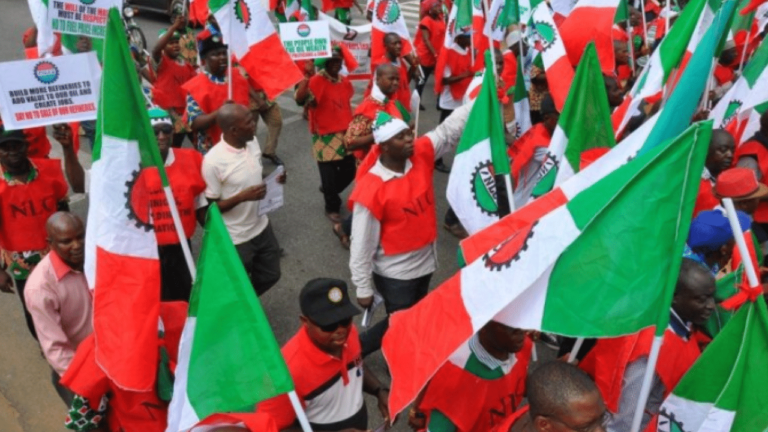
THE Nigeria Union of Petroleum and Natural Gas Workers (NUPENG) has called off its strike following an agreement with the management of Dangote Refinery to recognise workers’ rights to unionise.

The agreement was reached at a closed-door meeting convened by the Department of State Services (DSS) and attended by the Minister of Finance, Wale Edun and representatives of the Nigeria Labour Congress.

Acting Nigeria Labour Congress (NLC) General Secretary, Benson Upah, confirmed the outcome, while the Ministry of Labour said it would issue a formal statement on the decision.

The resolution followed a conciliatory meeting convened by the Federal Ministry of Labour and Employment on Monday, September 8, 2025, after NUPENG threatened to embark on strike over the company’s initial refusal to recognise workers’ rights for join existing unions.

According to the Memorandum of Understanding (MOU) signed at the meeting, both parties agreed that unionisation is a right under extant labour laws, and employees of Dangote Refinery and Petrochemicals who wish to unionise would be allowed to do so.

The agreement said the process of unionisation would begin immediately and be completed within two weeks. After exhaustive deliberations, the following resolutions were reached by both parties:

“That since workers’ unionisation is a right in line with the provisions of the extant laws, the management of Dangote Refinery and Petrochemicals agreed to the unionisation of employees of Dangote Refinery and the unionisation of employees of Petrochemicals, who are willing to unionise.

“That the process of unionisation shall commence immediately and be completed within two weeks (9th – 22nd September, 2025), and it was agreed that the employer would not set up any other union.

The notice further said that no worker or employee of Dangote Refinery and Petrochemicals will be victimised.

In line with the agreement, NUPENG suspended its strike with immediate effect, while both parties are expected to report back to the Minister of Labour a week after the conclusion of the exercise.

The ICIR reports that the memorandum was signed on behalf of the management by Managing Director Dangote Group, Sayyu Dantata, O.K. Ukoha, for Nigerian Midstream and Downstream Petroleum Regulatory Authority (NMDPRA)

Other labour union officials who signed include: Benson Upah for the Nigeria Labour Congress (NLC), N.A. Toro for Trade Union Congress (TUC), NUPENG President Akporeha Williams, and General Secretary of NUPENG, Afolabi Olawale.

The Federal Ministry of Labour and Employment was represented by Amos Falonipe, Director, Trade Union Services and Industrial Relations, signing on behalf of the minister.

An earlier report by The ICIR disclosed that the strike began with NUPENG (fuel tanker drivers’ union) on Monday, alleging that Dangote Refinery was hiring new drivers on the condition that they would not join the union.

Notably, Transport Owners’ Union previously ignored the Federal Government’s last-ditch efforts to suspend its planned industrial action, vowing to proceed with the strike in solidarity with NUPENG.

The ICIR reports that NUPENG’s strike gained both domestic and international support, including from the NLC, global union IndustriALL (Switzerland), and the International Lawyers Assisting Workers (ILAW) network (Washington).

Reps issue Transport Minister 48-hour ultimatum to either keep or lose job

0

THE House of Representatives Committee on Land Transport has issued a 48-hour ultimatum to the Minister of Transportation, Sa’idu Alkali, to appear before it over the derailment of an Abuja–Kaduna train on August 25.

The ultimatum followed the minister’s failure to honour an earlier invitation by the committee regarding the incident on Tuesday.

The Kaduna-bound train was carrying 618 passengers when it derailed.

According to the News Agency of Nigeria (NAN), the chairperson of the committee, Blessing Onuh, said it was improper for the minister toturn his back on Nigerians at a time they need him most.

“A toad does not run in the daytime for nothing. We are on recess, but many of us chose to cut our break and come all the way from Lagos due to this national tragedy,she stated.

She added that the minister had snubbed the parliament and stressed that members took strong exception to his absence. She argued that Nigerians’ lives were endangered, and the issue was not a joke.

She announced that the meeting was suspended on Tuesday and directed the minister to appear in person within 48 hours.

Similarly, the Deputy Spokesperson of the House, Philip Agbese, described the minister’s absence as a demonstration of incompetence and disregard for the Nigerian people.

He reiterated that President Bola Tinubu had warned that no minister or agency should ignore a parliamentary invitation.

“This minister has chosen contempt. If he fails to show up, Nigerians should know there is effectively no minister of transportation in this country,he said.

The committee unanimously resolved to suspend its hearing until the minister appears in person, warning that continued indifference would be reported directly to the president.

Recall that a passenger train travelling from Abuja to Kaduna derailed around Jere, Kaduna State, at about 11 a.m. on Tuesday, August 26.

The derailment triggered fear among passengers and their relatives.

The train was carrying 618 passengers when it derailed.

The ICIR reports that the Abuja-Kaduna train corridor is a very sensitive route. Despite being one of Nigeria’s most active rail corridors, used daily by hundreds of commuters, it has faced many challenges.


Nepal former first lady, 19 others killed in protests against social media ban

0

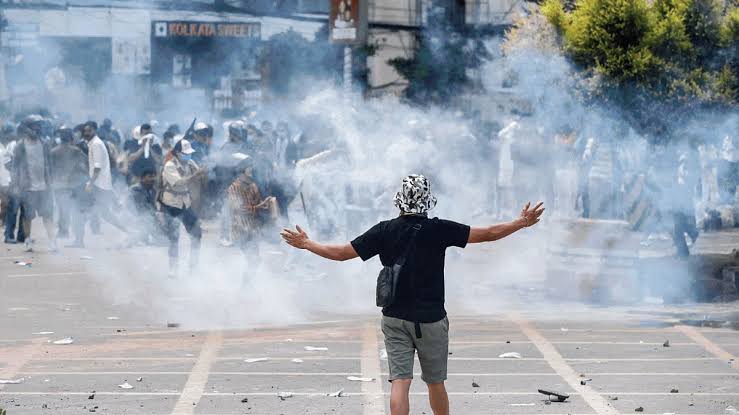
WIFE of former Prime Minister of Nepal, Rajyalaxmi Chitrakar, has been killed in violent Gen Z protests sparked by a social media ban after Monday’s killing of 19 people.

The protests began on Monday when thousands of young people stormed the city, wielding weapons and setting ablaze the Supreme Court, the Attorney General’s office, the Prime Minister’s residence, Parliament, and several homes of politicians.

Chitrakar, the wife of former Prime Minister Jhalanath Khanal, was reportedly killed after being trapped inside the residence, while at least 500 people have been injured in the violent protests that broke out earlier this week.

Young protesters carrying placards with slogans such as “enough is enough” and “end to corruption” said they were also demonstrating against what they described as the government’s authoritarian stance, while authorities have since imposed curfews in several districts.

In Damak, some protesters threw stones at Prime Minister KP Sharma Oli’s residence, prompting security forces to deploy tear gas and water cannons in an effort to safeguard politician’s homes.

“Kathmandu is burning. Smoke is emanating across the capital’s seat of power as protesters have set fire to many important offices,” a member of parliament, Rajendra Bajgain told The Telegraph.

In the weeks leading up to the ban, a “nepo kid” campaign gained traction on social media, exposing the extravagant lifestyles of politicians’ children and raising allegations of corruption.

Last week, the government directed authorities to shut down 26 social media platforms including Facebook and YouTube, after they failed to meet the deadline to register with the Ministry of Communication and Information Technology.

The government defended the social media ban as a move to curb fake news, hate speech, and online fraud, shutting down platforms which millions of Nepalis depend on for news, entertainment, and business.

After seeing the angry reaction by the protesters, the government lifted the ban hours later.

A minister said they lifted the ban after an emergency meeting late Monday night to “address the demands of Gen Z”.

Prime Minister Oli said he was “deeply saddened” by the violence and casualty toll. He blamed the incidents on infiltration by various vested interest groups”.

He announced that the government would establish a panel to investigate the protests, while also pledging “financial relief” for the families of those killed and free medical care for the injured.

Home Minister, Ramesh Lekhak, resigned on Monday evening after facing heavy criticism over his administration’s handling of the protests and the use of force against demonstrators.

Police detain FIJ reporter in Ekiti over reports on FUOYE VC’s alleged sexual harassment

0

A SENIOR Reporter with the Foundation for Investigative Journalism (FIJ), Sodiq Atanda, is currently being held at the state headquarters of the Nigeria Police Force in Ado-Ekiti after honouring an invitation by the police on Tuesday.

The ICIR reports that the police summoned Atanda on September 1 following a petition by the on-leave Vice Chancellor of the Federal University Oye-Ekiti (FUOYE), Abayomi Fasina, who accused him of cyberbullying, blackmail, and criminal defamation.

Signed by Assistant Commissioner of Police Musa Hadi, the invitation letter indicated that the petition was submitted by Fasina’s lawyers against the reporter and the FIJ.

“This office is investigating a complaint via petition from T. S Adegboyega & CO. (Solicitors, Advocates and Notary Public) of 141, Station Road, Idi-Seke, Osogbo, Osun State, Nigeria on behalf of his Client Prof. Abayomi Sunday Fasina,” Hadi wrote.

The petition was captioned “Petition Against Mr Sodeeq Atanda and Foundation for Investigative Journalism on Conspiracy, Criminal Defamation, Blackmail, Malicious Misrepresentation and Cyberbullying,” and dated August 22, 2025. It was signed by T. S. Adegboyega, a lawyer.

The letter added, “Please, note that attendance is not by proxy and you are to attend and honoured this invitation [sic] on Thursday 4th September 2025 by 12:00Hrs prompt [sic].”

Atanda’s summon followed a series of reports published by the FIJ, alleging that Fasina sexually harassed a director at the university, Folasade Adebayo, and humiliated her after she repeatedly rejected his advances.

The reports contained audio recordings in which Fasina allegedly admitted to bribing two former governing council members to secure the appointments of the current bursar and registrar of the university.

Additionally, the reports said the governing council further traumatised Adebayo by downplaying Fasina’s actions as a mere friendly relationship and demanding that she apologise to the council.

Amid these publications, Fasina allegedly secured the council’s approval for a six-month leave in April to allow a review of the earlier internal report that had cleared him of wrongdoing.

The embattled VC has filed a lawsuit against Adebayo for defamation in an Ekiti court.

The FIJ has seen a number of its reporters locked up by the Nigerian security agencies since its launch in 2021.

Among those locked up is Daniel Ojukwu, who was incarcerated in 2024.

Ojukwu was also reportedly attacked by the police in Lagos State last month.

Meanwhile, the FIJ announced on X Tuesday night that Atanda had been freed by the Ekiti Police.

Note: This report has been updated to include that Atanda has regained freedom.

Residents forced indoors as Oro festival grounds Ogun LGA

0

COMMUNITIES across Ipokia Local Government Area of Ogun State were again thrown into lockdown on Tuesday, September 9, as the annual Oro festival forced residents, particularly women and non-initiates, to remain indoors.

The ICIR gathered that the traditionalists had warned that anyone caught outside during the festival risked being killed, with no guarantee their remains would be found. 

Residents who spoke with The ICIR stressed that only male indigenes were permitted to come out, but such males should have reasons for doing so, and they must provide reasonable answers when questioned by the traditionalists.

All women and non-indigenes are compelled to stay indoors throughout the day. The restriction also crippled economic and social activities across the LGA as markets, and offices remained shut. 

The ICIR reports that only policemen were seen patrolling some parts of the towns namely Ajegunle, Idi-Iroko, among others.

The development has triggered tension in the area, where religious groups and other residents have repeatedly condemned the practice as an imposition of the wishes of one religious belief on the others. Islam and Christianity are other two dominant religions in the LGA.

In past editions, the festival had sparked violent clashes, attacks on worship centres, and mass arrests.

Tuesday’s lockdown came just weeks after Oro rites were held between July 21 and August 19, 2025, as part of burial ceremonies for the late Oniko of Ikoland, Oba John Adekunle.

During that period, similar daytime restrictions were imposed, sparking protests from religious leaders and rights groups.

This reportedly led to a petition by Muslim leaders under the League of Imams and Alfas in the state, who had opposed the curfew, describing it as unconstitutional and an imposition of traditional practices on other faiths. 

They petitioned Governor Dapo Abiodun, warning that forcing residents indoors during the day violated freedom of movement and religion, and risked triggering conflict. 

The cleric in the petition, signed by Imam Tajudeen Mustapha Adewunmi, Secretary-General of the League, also recalled 2019 and 2020 peace agreements in which traditionalists, Christians, and Muslims agreed that Oro observances should be confined to midnight hours only.

The 2019 agreement, according to the petitioners, restricted Oro rites from midnight to 4 a.m.

However, during that period, daytime curfews were said to have be enforced, despite the agreements and a 2017 Ogun State High Court ruling that also restricted Oro activities to between midnight and 4 a.m.

The High Court rulng in 2017 had declared daytime Oro curfews unconstitutional, restricting the ritual to between midnight and 4 a.m., but the enforcement of that ruling has remained a challenge.

The case was filed by the Christian Association of Nigeria (CAN) and the Muslim community against Oro worshippers, after cult members began extending rituals into towns and imposing daytime lockdowns.

The presiding judge Sikiru Owodunni, issued a perpetual injunction restraining Oro worshippers and their agents from declaring curfews that infringed on the fundamental rights of residents in Ipokia, Idi-Iroko, Ihunbo, Ifonyintedo, Ogosa, Koko, Ilashe, Ibatefin, Agosasa, Oniru, Mede, Ajegunle, and surrounding villages.

Senate blocks Natasha’s resumption, insists on due process

0

THE Senate has blocked the request of senator representing Kogi Central, Natasha Akpoti-Uduaghan, to resume legislative duties.

The Senate said her six-month suspension was still in force until the Court of Appeal rules on her case.

In a letter signed by the Acting Clerk to the National Assembly, Yahaya Danzaria, the Senate acknowledged receiving Akpoti-Uduaghan’s notice that she planned to resume on September 4, 2025, which, according to her, marked the end of her suspension.

But the Senate indicated that her suspension started on March 6, 2025, adding that the matter was subjudice since it was already before the Court of Appeal.

The Senate said that until the judicial process is concluded, no administrative action could be taken to encourage her resumption.

According to the letter, the Senate will only review her suspension after the court delivers its judgment.

Akpoti-Uduaghan’s lawyer, Victor Giwa, had told PUNCH that the senator’s six-month suspension had expired.

He said though the embattled lawmaker was on vacation in London, she was ready to rejoin her colleagues at plenary when the Senate reconvenes on September 23.

“Actually, she’s ready to resume her term. She’s in London. Everything is in place, and the six months have expired. The only thing left is her resumption,” Giwa said.

The ICIR reported on February 20 that during a plenary, Akpoti-Uduaghan caused an uproar at the Senate when she discovered that her seat had been reassigned without prior notice.

She resisted the reassignment, arguing that it was an attempt to silence her. Her refusal led to a tense confrontation with the Senate President Godswill Akpabio. The aftermath led to her suspension on Thursday, May 6, for six months, despite an interim order from a Federal High Court.

In July, there was tension at the Assembly complex when Akpoti-Uduaghan stormed the National Assembly to resume her legislative duties amidst tight security.

The suspended lawmaker, who was denied access to the complex, relied on a judgment delivered by Binta Nyako of the Federal High Court, Abuja, to resume the Senate proceedings on Tuesday, July 22, 2025.

UK Police charge suspect to court over Nigerian’s death

THE United Kingdom (UK) Metropolitan Police have arrested and charged Andre Wright-Walters, the prime suspect in the killing of 67-year-old Nigerian, James Gbadamosi.

In a statement released on Monday, the Metropolitan Police said Gbadamosi was attacked and assaulted on Balham High Road around 4 p.m. on August 24, sustaining life-threatening injuries.

“Police were called to a report that a man had been assaulted in Balham High Road at around 15:40hrs on Sunday, 24 August.

“A man aged 67 was taken to hospital with potentially life-threatening injuries and sadly died in hospital on Friday, 5 September,” the statement read.

The ICIR reported a similar incident in August, where two people were charged in connection with the fatal stabbing of 26-year-old Nigerian, Ayowale Aladejana, in New Cross, southeast London. 

The Metropolitan Police reported that detectives investigating Aladejana’s stabbing had charged a man and a woman with murder.

According to the latest incident involving the late Gbadamosi, 37-year-old Wright-Walters and a 30-year-old woman, whose identity was withheld, were arrested and charged on Wednesday, August 27, with grievous bodily harm with intent and for being in possession of a Class A drug.

“He appeared at Wimbledon Magistrates’ Court on Thursday, 28 August and was released on bail to appear at Kingston-upon-Thames Crown Court on Wednesday, 24 September.

“A 30-year-old woman was also arrested on Wednesday, 27 August on suspicion of conspiracy to commit grievous bodily harm. She was re-arrested on Saturday, 6 September for conspiracy to commit murder and has been bailed pending further enquiries,” the police explained.

The police further stated that Wright-Walters was re-arrested on Saturday, September 6, on suspicion of murder and was charged before a magistrate’s court on Monday.

“Andre Wright-Walters, 37 (05.02.1988) of Avery Hill, Greenwich, was charged on Sunday, September 7. He appears at Wimbledon Magistrates’ Court on Monday, 8 September. Wright-Walters was arrested on suspicion of murder on Saturday, 6 September.

“He had previously been charged on Wednesday, August 27, with grievous bodily harm with intent and possession of a class A drug, after being arrested the same day.”

The police added that the 30-year-old suspected accomplice had been granted bail pending further investigations.

Gbadamosi’s death adds to the growing number of Nigerians who have been killed under suspicious circumstances in the UK.

The ICIR reported on August 6 that 60-year-old Nigerian, Nkiru Chima, was found dead with multiple stab wounds in her apartment located in Romford, UK.

Similarly in May, a nurse residing in Leeds, United Kingdom, Nnena Miriam, was found dead in her apartment.

The news was confirmed in a statement released by Fellow Nurses Africa; an organisation committed to promoting the nursing profession in Africa.

It revealed that police discovered Miriam’s body following a missing person report.

When Remi Tinubu’s birthday wish exposed jinx of National Library project

0

NIGERIA’S First Lady, Oluremi Tinubu, recently stirred the Hornet’s nest when she urged  well-wishers to donate funds for the completion of the long-abandoned National Library in Abuja, saying such donations would be the most valuable gift as she turns 65 later this month.

Speaking in a video posted by her spokesperson, Bukola Kukoyi, and retweeted by the first’ lady account, Tinubu appealed to lovers to forgo trendy ‘money flower’ birthday gifts and instead channel their resources into an ‘Education Fund’ that will be used to renovate the National Library headquarters.

The former lawmaker turned 65 on September 21, 2025.

She said: “I wish to appeal that those who would like to send a birthday card, cakes, flowers, greetings in the newspapers or gifts should please send the funds to the designated account for a special project close to my heart among many others.

“The completion of the National Library would be the best birthday present I could receive. My love for education has informed my decision to dedicate my birthday to this worthy cause,” she added.

But the request  drew widespread criticism, with many questioning why individuals should be asked to fund a national institution that is constitutionally the responsibility of the federal government. 

They also argued that the appeal showed the federal government’s failure to adequately budget for the library’s completion despite repeated promises.

Although the Federal Executive Council in April 2023 approved ₦32.4 billion for the project, no significant progress has been recorded since. The ICIR checks on government spending related to the National Library through websites that details government spending such as Govspend and Nocopo, shows that there has not been budget allocations or payment made for that purpose since   2023. 

Between 2023 and 2025, budgetary allocations for the National Library have mostly gone to personnel cost, salary and recurrent expenses such as power supply.

For instance in 2024, over N5 billion was budgeted for the National Library with about N2.8 billion earmarked for the personnel cost, salary and allowances. 

Some capital projects listed include, purchase of furniture, acquisition of non-tangible materials, and purchase of computers, while no fresh capital allocation for the renovation has appeared since 2023.

A project long trapped in limbo

For more than a decade, the National Library of Nigeria has operated from rented offices in Abuja while its permanent headquarters, first awarded in 2006, remains incomplete despite billions of naira already allocated.

The NLN Headquarters, conceived as Nigeria’s flagship repository of knowledge, has been under construction since 2006. The contract, initially awarded for N8 billion, was reviewed to ₦18 billion by 2013 before work was abandoned due to poor funding.

The major headquarters located close to the Abuja National Mosque has been abandoned which in turn resulted in the agency moving to another building in  Central Business District, Abuja.

In 2019, then Minister of Education Adamu Adamu announced that N50 billion had been set aside to restart the project, citing exchange rate fluctuations and rising costs as reasons for the sharp increase. Despite the allocation, little progress was made.

Four years later, in April 2023, the Federal Executive Council (FEC) approved another N32.4 billion for the project’s “completion,” with detailed plans unveiled for the 11-floor building to house book stacks, reading areas, a data processing centre, an auditorium, and other facilities. Yet, over a year into the Tinubu administration, the site remains abandoned.

Federal ministry of education presented a memo for approval for the revised estimated total cost of the contract for the completion of the construction of the National Library of Nigeria headquarters building complex in Abuja. The revised estimated cost is N32.4 billion,” he was quoted to have said.

‘Library on quit notice’

Meanwhile, a source at the National Library told The ICIR that the institution had been served a quit notice by the owner of its rented apartment.

He stated that the agency was owing the owner rent arrears, which may have led to the building being sold to another person.

According to him, efforts are underway to vacate the premises to avoid any embarrassment.

When The ICIR reached out to the Assistant Director of Information and Public Relations of the Library, Orvell Dio, he said he was not aware of the ‘quit notice’ but promised to get back on the current situation.

“I am not aware of that (quit notice), if you hold on, I will ask the relevant office. Something like that would have gone to the legal department. I can find out and let you know,” he said.

When The ICIR reached out again about two hours later, he stressed that he had still not been able to confirm, as he was on an official assignment in Katsina.

Criticism trail First Lady’s birthday request

Following the public announcement, many Nigerians argued that the government’s failure to complete the project, coupled with fresh calls for public donations, reflected a lack of commitment to better Nigeria.

They described the appeal as ‘laughable,’ and questioned the rationale behind the call for donation.

A x user, Luz Tak wrote “I don’t understand. Is Nigeria broke? Your husband just promised USD 100,000 each to Super Falcons and D Tigresses. Why should Nigerians donate towards the NATIONAL library even if they have the money? Whose responsibility is it please?”

Awele also wrote “Listening to the president’s wife soliciting for funds under whatever guise is deeply embarrassing, to put it mildly.”

TUC to FG: withdraw 5% petroleum tax or face strike

0

THE Trade Union Congress of Nigeria (TUC) has rejected the Federal Government’s planned five per cent tax on petroleum products, describing it as a “reckless proposal” which is “nothing but an act of economic wickedness against already overburdened Nigerians”.

The union said that the government policy, if implemented, would compound suffering, cripple businesses, and push millions of citizens deeper into poverty.

It stated that the Federal Government could not continue to use Nigerians as sacrificial lambs for its “economic experiments”.
“Let it be clear: workers and citizens are still reeling from the pains of subsidy removal, skyrocketing fuel prices, food inflation, and a collapsing naira. To now introduce another levy on petroleum products is to deliberately compound suffering, cripple businesses, and push millions of citizens deeper into poverty.

“The government cannot continue to use Nigerians as sacrificial lambs for its economic experiments. Instead of offering relief, jobs, and solutions, it has chosen to further squeeze citizens dry. This is unacceptable!” the TUC said on Monday, September 8, in a statement signed by its President General, Festus Osifo, and Secretary General, N. A. Toro.

The TUC demanded that the government stop “this anti-people’s plan in its entirety,” warning that it would mobilise workers and the masses for a “nationwide resistance” if the government failed to do so.

“Failure to do so will leave us with no option but to mobilise Nigerian workers and the masses for a total nationwide resistance. Strike action is firmly on the table if the government dares to ignore this warning and go ahead to implement this policy,” it warned.

The union also directed all its state councils, affiliates, and structures nationwide to remain vigilant, watchful, and wait for further communication that might culminate in a decisive action should the government ignore its call.

“We also call on our allies, civil society organisations, professional bodies, student unions, market associations, faith leaders, and all patriotic Nigerians to stand in solidarity with us in this struggle.

“Together, we must resist policies that seek to further impoverish citizens and mortgage our future. Enough is enough. Nigerians deserve economic justice, not endless punishment,” the TUC added.

The Nigerian government has vowed to expand the tax base by tracking tax evaders’ bank accounts, National Identity Numbers (NIN), and phone numbers, under the newly enacted tax laws, The ICIR reported.

The Chairman of the Presidential Committee on Fiscal Policy and Tax Reforms, Taiwo Oyedele, who disclosed this after President Bola Tinubu signed the Tax law, stressed that the government had already projected a revenue of N50 trillion from the tax law, amid dwindling oil revenue resources.

“As long as you are captured through banking, National Identity Number (NIN), bank information, and phone number, you cannot evade tax again in Nigeria once you’re eligible,” he said.