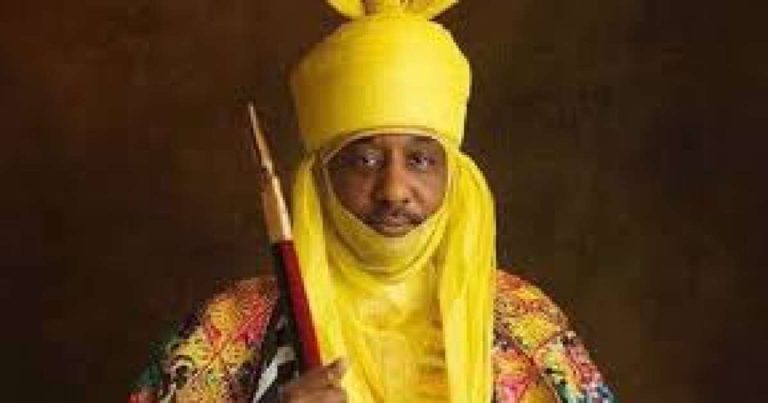
LESS than 24 hours after Nasir El-rufai, Governor of Kaduna State named Muhammadu Sanusi II the Vice Chairman of Kaduna Investment Promotion Agency (KADIPA), the Governor has again named the deposed Emir of Kano as the Chancellor of Kaduna State University (KASU).
A statement signed by Muyiwa Adekeye, Special Adviser on Media and Communication to the governor , announced the new appointment on Wednesday,
Adekeye said that Sanusi succeeds the pioneer Chancellor, Tagwai Sambo, the Chief of Moro’a, who was appointed to the position in 2005.
He praised the former emir’s strong commitment to education and service to public office which he said would be symbolic and substantive in the leadership of the University and pace its growth academically at the global level.
Malam @elrufai welcomes with gratitude the consent of HH Muhammadu Sanusi to serve as Chancellor of KASU and as Vice-Chairman of the board of KADIPA. KDSG is grateful that he continues to support and assist the realisation of its governance objectives.
‘’Malam Nasir El-Rufai welcomes with gratitude the consent of His Highness Muhammadu Sanusi to serve as Chancellor of KASU and as Vice-Chairman of the board of KADIPA,” Adekeye said.
“The Kaduna State Government is grateful that HH Muhammadu Sanusi II continues to support and assist the realisation of the governance objectives of the Kaduna State Government.’’ the statement read in part.
Sanusi’s appointment Kaduna State Government came just two days after he was deposed by Kano State Government over disrespect of the office of the governor and other agencies.
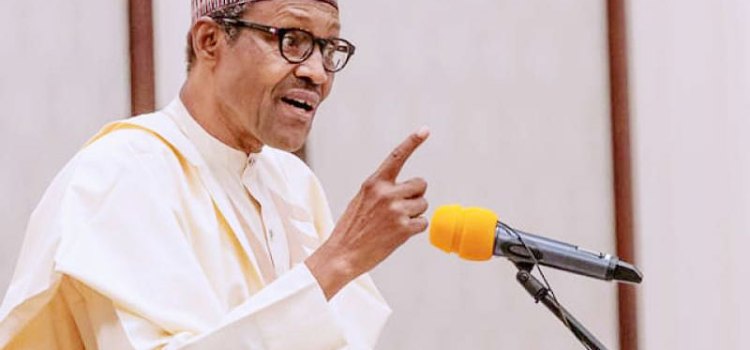
GARBA Shehu, Senior Special Assistant to the President on Media and Publicity on Wednesday exonerated President Muhammadu Buhari from being behind removal of Muhammadu Sanusi II as the Emir of Kano.
Shehu, while reacting to report that the president was behind the fate that befell the former emir described the report politically motivated, insisting that Buhari had no connection in the issue ‘whatsoever,’ even as he maintained that Kano State Government has the authority to remove or install emirs and any other traditional rulers.
“President Muhammadu Buhari has no involvement whatsoever in the dethronement of HRH Muhammadu Sanusi II from the position of Emir of Kano. All such insinuations are untrue, malicious and politically motivated,” Shehu tweeted on his verified Twitter handle.
“The President does not have a history of intervening in the affairs of any state in the country, unless the issue at hand is of national consequence. On such matters which impinge on national security, he has a duty of involvement as the law stipulates.
“As outlined in the Constitution, the appointment or removal of emirs and other traditional leaders is strictly within the jurisdiction of state governments.”
Shehu further described as ‘unfair and disingenuous,’ for politicians from the opposition party to attribute the situation to the president.
“Although a retired General and former Military Head of State, President Buhari clearly understands that under the current democratic dispensation, the government at the centre cannot read instructions or twist the arms of all or any of the 36 state governments making up the federation,” he said.
“They all have their powers specified under the Constitution.”
The presidency, however, applauded the people of Kano for being calm following the dethronement.
The Kano State Government had on Tuesday expressed excitement that the former emir accepted his fat.
It could be recalled that Kano State Government on Monday under the leadership of Abdullahi Ganduje dethroned the former governor Central Bank of Nigeria (CBN) over allegation of being disrespectful and insubordination.
But since his removal, notable Nigerians have criticised the governor’s decision. While some reacted on the legality, others insisted on Sanusi’s right to seek redress.
Meanwhile, Rabiu Kwakwaso, former governor of Kano State also accused Buhari of being an accomplice in Sanusi’s dethronement.
“Kano State government officials have been saying they were directed to dethrone Mr Sanusi ll. He (Buhari) instructed them,” Kwakwaso claimed.
AFTER the final examination of her two-year National Diploma (ND) programme, Laide Johnson (not real name), a 21-year-old student of Geology at the Polytechnic Ibadan travelled home to Ilaro, Ogun State, for a short holiday.
She was excited to be back home with her parents after about two years away from her loved ones..
As is the practice with other polytechnics, in her school, every graduate at the National Diploma level is required to undergo a compulsory one-year Industrial Attachment (IT) before proceeding for the Higher National Diploma (HND).
So, after spending a few days with her parents, Laide decided to return to school to get a letter of introduction and application for a place for an internship with an organisation of her choice.
She was accompanied by Joke Adeola, her cousin, also a student in the school. At the time, some of her colleagues had collected the same letter from the Industrial Trust Fund (ITF)/SIWES office of the institution and were already making moves to start their industrial attachment.
However, Laide’s case was different—securing a letter for her IT became a Herculean task.
She had what she described as her worst nightmare after an official of the polytechnic told her to have sex with him to collect the IT letter.
On March 3, she visited the ITF office at about 10:00 am but, to her surprise, the officer in charge, identified as Adebayo Akande, told her the collection period had lapsed.
But, after much persuasion, Akande, a non-teaching staff, demanded N1,000 rather than the N200 fee charged for the form and payable to the school’s Micro Finance Bank.
Adeola, Laide’s cousin got her IT letter as far back as December 23, 2019, and paid N200 into the same MFB account. But, Akande, according to her, demanded N1, 000.
“Last year December 23rd, when I wanted to do my IT, I visited the ITF office and I paid N200 into the school microfinance bank,” Adeola disclosed.
But in the case of Laide, at the point of collection, the school official responsible for the issuance of the letter swiftly twisted his demand and asked if he could have his way with either student.
“… he asked if my cousin can ‘play’ with him. And I asked how?” Laide recounted.
“He then responded saying if I know I wanted to get my IT letter, one of us must ‘play’ with him. So, he requested my name and that of my cousin.”
“I told him I was willing to give him any amount but he insisted that he wanted sex by all means.”
For long, Akande troubled Laide, pressuring her via phone calls. So she decided to play along in order to gather evidence against her tormentor.
The ICIR reached out to Adeola to verify claims made by her cousin and she affirmed what her cousin said.
“The man said the letter was finished, so as we were about to leave, he called us back and charged N1,000. Eventually, he collected my cousin’s number that whenever he is through, he would call her.”
Asked if Akande did make sexual advances to them, “Yes, the man said it,” Adeola affirms. “He said I should give him my number but I did not because I did not have anything to do with him, Not until this morning that he said she should come to a hotel to collect the IT letter but before that he would have to have intercourse with her.”
Laide continued with the game
In the space of one week, Akande and Laide had exchanged several phone calls while she made efforts to gather much-needed video evidence.
In one of those phone conversations, the lady recalled how she ran out of call credit and how she explained to Akande who has since been pestering her for sexual desires.
“My call card got exhausted, but I tried to reach out later, yet your number did not go through,” she was responding to queries from Akande.
I have booked a room, meet me opposite Police Station — Akande
On March 8, Akande called to inform Laide that he had already secured a room at Apete, a suburb of Ibadan that shares boundary with the Polytechnic Ibadan. This arrangement was ahead of Monday, March 9, for her to come around, if she was really in need of the said letter.
“This IT letter is one of the rights of the students. It was already paid for. And I’m sure this staff gets his salaries so why does he need to have sex with a student just to give her this letter,” said a friend of Laide contacted by The ICIR.
In a 55 seconds recorded video footage, Akande played the role of a messiah who was trying every possible means to grant unusual favour. In the video, Laide was heard asking a question;”Hope they have signed the letter.”
“Don’t worry, it would be signed by God’s grace but remember our agreement,” Akande said. “I don’t want any issue. I hope you have accepted…? I don’t want a situation I’ll get there and you tell me you are no more interested.”
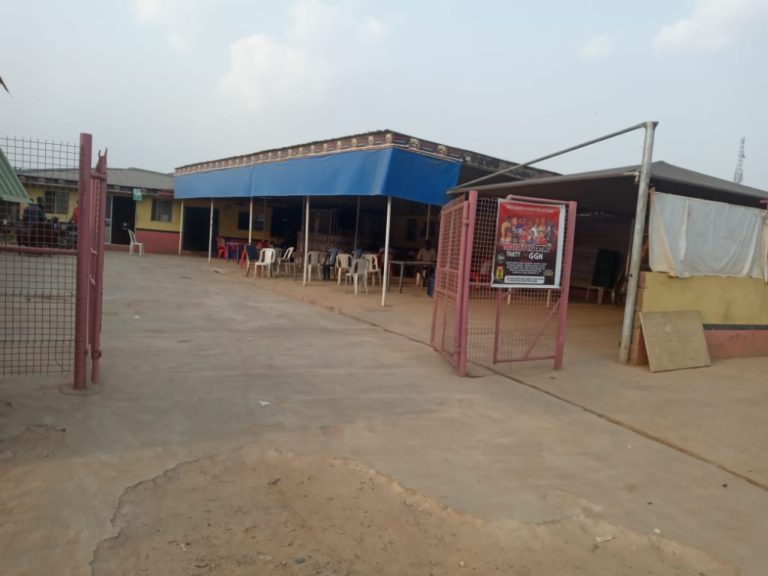
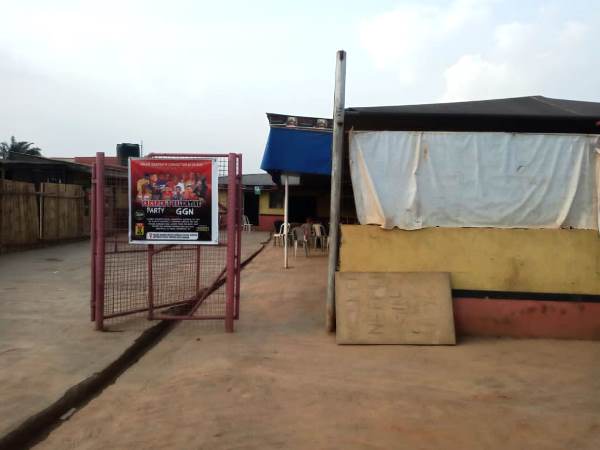
Entrance to the Holab Garden, opposite Apete Police Station Photo Credit: The ICIR
Eventually, at about 4:08 pm, Akande called Laide to meet him at Holab Garden, a relaxation spot beside Samong Filling Station, opposite Apete Police Station, Ibadan.
Meanwhile, the lady had informed the police before arriving at the agreed venue. The police, according to her, also promised to draft some officers to the relaxation centre to effect the sexual predator’s arrest. She was then asked to proceed and play along.
At about 6:00 pm, Akande arrived in a Toyota car with registration Lagos, LND 329 CF.
Few seconds after, Laide went in with him. But while seated at the bar, an unknown person purportedly walked up to the Akande to issue a warning of an impending arrest.
Immediately, Laide began a conversation and they got talking about how she struggled to locate the venue. “Sir, how much should I pay now? she asked Akande.
“At least, we had an understanding. I don’t want you to act funny,” he told her.
A female bartender cuts in, dropping a bottle of Trophy Beer. “What else do you want,” the bartender asked him but he seemed okay with the served drink.
“It’s fine,” Akande said while getting served.
Laide for the umpteenth time asked if she could pay for the form but he got displeased. So, the female student requested to see the IT letter.
At that moment, a call came in for him and he spent a few minutes on the call. But immediately he ended the conversation, Akande asked if she could pay N5,000.
“Do you have N5,000?” he asked.
N5,000? Laide exclaimed.
“I can only part with N2,000. Can I pay N2,000?” she asked again, yet Akande insisted on his price.
But in a swift, Akande became anxious as he was really ready to satisfy his lust. “Bami sere nah, she mo ugly ni?” (“Have sex with me now, or am I too ugly for you?”) he said persuasively.
As the conservation went on, Akande brought out the document and handed it to her. Laide scanned through it joyfully, if it was real. “Yes, it was,” she told herself.
“I can’t lie to you. To God who made me. Only, if you could see the risk I took before getting this. I’m not a bad person at all,” he added.
“See, it doesn’t matter if we ‘play’ together, it will only be between us,” as he pushed further saying, he already secured a room, and he won’t spend much time.
Let’s make love but you will still pay the N2,000 — Akande insists
After so much argument, Laide further pleaded with him, stressing that even while in school during her ND programme, she never had sexual relationship with any lecturer in exchange for marks.
For her, it might be difficult to engage in such an act now that she already had finished the first half of the programme.
But Akande went on with his persuasion, especially how he would remain useful to her in times of need. However, he noted that Laide would still have to pay the N2,000 sum and yet have his way.
When it became crystal clear that she would not budge, he then blamed her for the extra cost incurred to fuel his car to the venue. Then, he jerked up the sum to N5,000.
When Laide stood up to make calls to raise the money, he queried her for making the calls but she explained that she had to contact someone who will bring the N5,000 over.
At this point, Akande started getting suspicious. Sadly, the police operatives Laide had earlier informed, were yet to arrive.
Eventually, he dropped the letter and left.
Car Registration Number of Honda automobile driven to the Holab Garden by Bayo Photo Credit:The ICIR
“We got the IT letter but he escaped,” the lady told The ICIR said. “One of the staff of the bar gave him information. So by the time the police came, he already left.”
Laide also observed how unsettled Akande was since she started making calls in an attempt to raise the money he asked for. She said someone alerted Akande of a possible setup, “so he asked me to go.”
Shortly after, he entered a grey Toyota car with registration number Lagos LND 329 CF and drove off. It was later discovered the car belongs to his friend.
“The police tried to chase him, but they could not ascertain his whereabouts,” she added.
It’s not true, I didn’t demand sex — Akande denies allegation
When contacted for comments on the sexual advance allegation, Akande denied ever making any sexual demand on the student.
He gave his name as Adebayo Adetunji but the Truecaller App revealed him as Adebayo Akande. He admitted having a meeting with Laide at the venue yet denied any monetary or sexual demand from her.
“Yes, I know her but I did not have anything with her,” he said.
“I asked her to come and meet me at the bar where I normally relax to give her the form free without collecting any money,” he responded to a question on whether or not there was a meeting between him and the lady.
“So please the issue has been resolved and I am no longer working there (the ITF office).”
He was asked to identify the plate number of the car driven to the garden. But, he claimed the car belongs to his friend.
Akande later told The ICIR that he was a casual staff in the school but decided to leave his job since the parents of the victim got involved in the matter.
He said the victim’s parents eventually intervened in the matter but he was warned to avoid such behaviour in future.
Poly management keeps mum over the matter
The ICIR reached out to Soladoye Adewole, Public Relations Officer of The Polytechnic Ibadan, to clarify if the form was actually late, the right sum payable by students and the demand for sex allegation against Akande.
Adewole did not respond to calls made to his mobile phone. A text message sent to him asking him to clarify issues was delivered but he did not respond.
There have been growing cases of rape and other forms of sexual assaults across tertiary institutions in Nigeria. In most cases, lecturers and non-academic staff are the culprits.
The case of Olabisi Olaleye at the Obafemi Awolowo University (OAU) Ile-Ife, Osun State and Tene John, ex-staff of Nigerian Institute of Journalism are just two examples of sexual harassment in Nigeria’s institutions of higher learning.
The incidence of sexual abuse or what has now been tagged “sex for grades,” has been on the increase while government at the state and federal attempt to find ways to address it.
For instance, Ekiti State Government recently opened sex offenders register where those found guilty are publicly named and shamed.
According to the United Nations Children Fund (UNICEF) data on sexual violence on children and women, about four per cent of women and men between age 18 -29 experienced sexual violence by age 18 in Nigeria.
DESPITE mounting global campaigns for more participation of women in politics and economic activities, a report by the World Economic Forum (WEF) says gender gap will take 257 years to close.
The World Economic Forum in its latest report, ‘Global Gender Gap’ has shown a huge gap in gender equality especially in women participation in politics.
The WEF report benchmark 153 countries on their progress towards gender parity in four dimensions: Economic Participation and Opportunity, Educational Attainment, Health and Survival and Political Empowerment.
“The index’s rankings offer an effective means to benchmark progress. They are designed to create global awareness of the challenges that gender gaps pose, as well as the opportunities that emerge when action is taken to reduce them,” WEF noted in the report released to coincide with the 2020 celebration of the International Day of Women (IWD).
Although the report highlighted that educational attainment, as well as health and survival, enjoy much closer to parity (96.1 percent and 95.7 percent respectively), but economic participation and opportunity by women remains a concern.
“This is the only dimension where progress has regressed. Here, the figures are sobering, with a deteriorating situation forcing gender parity to a lowly 57.8 percent, which in time represents a massive 257 years before gender parity can be achieved,” the report said.
According to WEF, the primary reasons for this disparity is that “women have greater representation in roles that are being automated noting that not enough women are entering professions where wage growth is the most pronounced (most obviously, but not exclusively, technology), and women face the perennial problem of insufficient care infrastructure and access to capital.”
The report noted that as compared to 202 years in 2019, gender parity will not be attained for 99.5 years and no one will see gender parity in one’s time.
“None of us will see gender parity in our lifetimes, and nor likely will many of our children. That’s the sobering finding of the Global Gender Gap Report 2020, which reveals that gender parity will not be attained for 99.5 years,” WEF said.
The report posited that gender parity has a fundamental bearing on whether or not economies and societies thrive.
It lamented that despite a rise in women representation in politics globally, there has been little or no improvement as their male counterparts still occupy the majority of the available political positions.
“Overall, the quest towards gender parity has improved, ducking back under a century and registering a marked improvement on the 108 years in the 2018 index. Greater political representation for women has contributed to this, but overall the political arena remains the worst-performing dimension.
“At the other end of the scale, it is forecast to take just 12 years to attain gender parity in education, and in fact, overall, gender parity has been fully achieved in 40 of the 153 countries ranked.
“Drilling down into the facts and figures, it will take 95 years to close the gender gap in political representation, with women in 2019 holding 25.2 percent of parliamentary (lower-house) seats and 21.2 percent of ministerial positions.
“Positively, the so-called “role model effect” may be reaping dividends in terms of leadership and wages. Improving political empowerment for women has, as a general rule, corresponded with increased numbers of women in senior roles in the labour market,” the report stated.
The Nigerian Senate on Tuesday had called for more inclusion of women in politics and economic activities during its plenary session on the heels of the 2020 International Women Day (IWD) commemoration with the theme: #EachforEqual, which advocates for collective individualism of both genders for a better society.
The motion, raised by Betty Apiafi, senator representing Rivers West Senatorial District was supported by the lawmakers who agreed that an inclusive society where both genders are duly represented would spur a healthier society.
The Senate noted that women played a great role in the society because they are the reasons for human existence and constitute a greater percentage of voters during the election hence should be recognized for the resilience they bring to the table.
However, Senate President Ahmed Lawal on Tuesday had said there was a need for a constitutional review to ensure women in Nigeria are given better opportunities to occupy desired positions in the society.
“I urge all concerned with the amendment of Nigerian Constitution to ensure gender parity,” he said.
He urged all registered political parties to initiate policies that accord women equal opportunities in all elective and appointive positions.
Lawal further enjoined employers of labour and corporate organisations to give women equal opportunities to allow them to achieve their true potentials as well as ensure parity in top management positions and the boardroom.
Nigerian situation with women
The need for more inclusive representation of women in various sectors of the society has continued to gain momentum, especially in this jet age.
However, Nigerian women are yet to occupy 10 per cent of the country’s upper legislative arm of the government since the return of democracy in 1999.
The maximum is 6.4 per cent since 1999, and 15 per cent of elective positions in a country where the voting population of both men and women are almost equal.
In 1999, out of the 106 senators, only three were females (2.8 per cent women). There were four, nine and seven females senators in the fifth, sixth, and seventh National Assembly respectively.
Similarly, in 2015 (the eighth national assembly), only seven women out of 102 were elected into the red chamber, representing 6.4 per cent, compared to men who constituted the 93.6 per cent of the total number of the senators.
Presently, eight female senators constitute part of 109 lawmakers of the senate and the highest number of seats ever occupied by women in the House of representatives since 1999 is 27, representing a meagre 6.9% of the 360 seats.
FOR Abdulwasiu Hassan, a phone repairman, going to and fro his workplace at Alaba International Market each day is a nightmare. Though the distance to cover to his destination should not be more than 20minutes drive, Hassan usually ends up spending one and a half hour heading to work or returning home.
On some occasions, he finds it difficult to get commercial vehicles that will convey him to the market, because most commercial vehicles avoid the road networks in that neighborhood —Okokomaiko, Ajangbadi, and Sabo communities —all in Ojo Local Government Area of Lagos State.
Sometimes, Hassan has to trek back home from work because of the traffic gridlock caused by the many bad portions on the road. .
“My experience on that road has been very tough and bad,” he laments.
“Government needs to attend to us; we are suffering on that Alaba road. Normally, going to my place of work from home shouldn’t take up to 20 minutes but because of that bad road, it always takes up to one and a half hours to get there.”
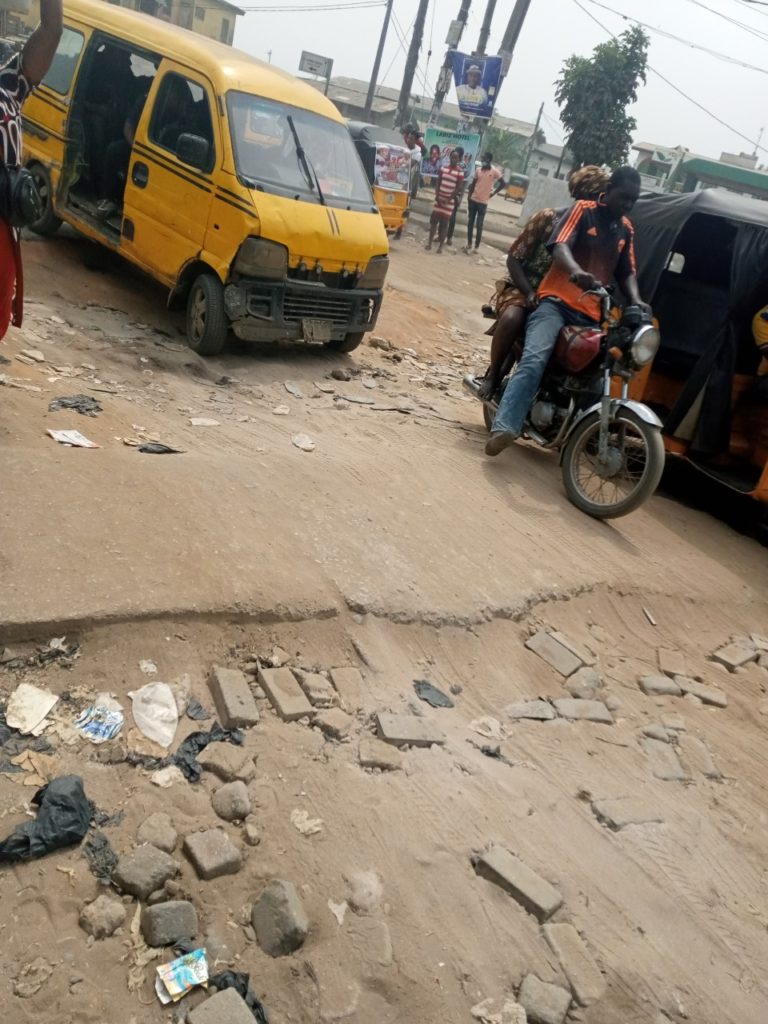
Nightmare during rainy season, Shibiri road. Photo Credit: Mujeeb Abdulwasiu
His daily experience sums up what those who reside and operate businesses in Okokomaiko, Ajangbadi, and Sabo communities, have for many years contended with. They have been living in great discomfort due to poor road networks linking the neighbourhoods.
Residents’ nightmare
These communities play host to Nigeria’s largest electronics market — Alaba International Market, yet, the lack of government intervention has put residents, commuters and motorists in avoidable distress. They often have to trek far distances because of the unpleasant state of the roads especially during the rainy season.
Findings revealed that the major roads linking the communities together, Aka, Okoko, Alaba,Shibiri, and Ilogbo,Abule roads are dotted with gaping and life-threatening craters.
Ajisafe Taibat, a trader who lives in Ilemba Awori community but had her shop situated along Shibiri road, revealed how she has lost many of her customers as a result of the poor state of the roads. She does not hope to see any intervention from the government any time soon.
“Do I even need to say anything, these governments will not come to our aid even if I do,” a frustrated Taibat said.
“I have encountered many difficulties on that road, especially when returning from the market. There are days that I will have to trek with goods on my head because I won’t want to delay customers at the shop and bus drivers will refuse to pass through the deep potholes. At the end of the day, I still lost those customers,” she recalled.
Another resident, Abdulmujib Mustapha, who has been a commuter on the road for over 15 years, said the roads in question are arguably some of the worst in the state.
“If there should be a competition for bad roads in Lagos, the Sabo and Koko will most likely outshine very many across the state, Mustapha argued.
“The large potholes in between Ajangbadi, Iyana, Sabo, Okoko road and the bus stop along the road reflect the terrible fate that has befallen those roads,” he said.
“On days when that portion of the road is flooded as a result of downpours, vehicular movement stops at the waterlogged spot, rendering many passengers stranded for hours.”
Speaking about the indifferent attitude of the Lagos State Government, he said the state government has been found wanting in proper project supervision and this encourages contractors executing those projects to do so using low-quality materials.
“The state government doesn’t really supervise the construction of these roads or ensure that the right combination of materials is used for road construction,” Mustapha noted. “Some state officials receive kickbacks from contractors to deliver poor quality roads. And on and on the cycle goes,” he alleges.
Motorists lament damages to vehicles
Jibril Uzamat, a motorist who plies the Alaba-Shibiri road everyday, narrated his ordeal in the last few months. At the moment, Uzamat visits mechanic workshops often because his vehicle has suffered a lot of damages due to bad roads.
Begging for repair, Iyana, Ojo igbede road. Photo Credit: Mujeeb Abdulwasiu
“Can you imagine I visit the mechanic workshop almost every day to fix my vehicle because if I don’t, I won’t be able to work again?” he said. “The bad road damages our vehicle, the government seriously needs to attend to us.”
“Apart from this, we do encounter losses as a result of traffic which makes us waste many hours on that road daily. We need a roundabout at the Alaba bus stop for ease of driving so that the traffic will reduce,” he appealed.
Another commercial driver who plies the Okoko-Aka road, who identified himself simply as Musiliu out of the fear of being sanctioned, also complained about the toll the roads are taking on his car.
“I wouldn’t want to say anything, let me keep quiet because it is better for me to keep managing the little I am able to do on that road than to lose it all,” he said reluctantly.
“All I know is that the road is damaging our vehicles. Look at my vehicle over there, it was just a few months ago I repaired and painted it, but the road has condemned it now,” he said pointing at a small cab parked by the roadside.
Richard Johnson, an elderly driver who lives around Ilemba Awori community, was walking along the road when he met with this reporter. He had just returned from a mechanic workshop.
According to him, the infrastructural challenges posed by Alaba, Shibiri and Okoko, Aka roads have left him without work since December 2019.
“When we look at the detriment the roads have caused, you realise that many drivers are now at home because they can’t afford to be visiting mechanic workshops everyday,” he said.
“For example now, I have been at home since last December because my bosses refused to give me their LT buses; many of could not afford their vehicles to be damaged by the bad portions all over the roads. As you can see, I am just coming from the mechanic because the one I hired just a few days ago needed to be repaired,” Johnson added.
Are the authorities showing concerns?
Findings revealed that the local government authority has at various times showed little or no concern in addressing the communities’ plights.
According to residents of the communities, the little repairs carried out on the roads were as a result of donations by philanthropists within the communities.
Rosulu Idowu, the Chairman of Ojo Local Government was , not available for comments when contacted. He did not respond to enquiries as several phone calls and texts sent to his telephone line by this reporter were not answered as at the time of filing this report.
SINCE the outbreak of coronavirus, a respiratory disease which was first recorded in Wuhan, China, became an epidemic and graduated to becoming a pandemic, it has triggered panic across the world.
Given the nature and spread of the virus which has now infected over 100,000 globally and killed 3,800 people, the absence of a known cure or vaccine has led many to result to taking drastic measures in attempt to ward off the deadly virus.
As such, a lot of misinformation and myths have been raised and the predominant tool of dissemination has been social media platforms.
There are statements being shared on Twitter, Facebook, Instagram which have garnered thousands of likes and re-shares, claiming that alcohol, garlic, bleach and even cocaine can avert or ‘cure’ the virus.
These suggested ‘cures’ have caused scores of deaths and more worrying, fake news about the virus keeps spreading at the speed of light.
Does cocaine kill coronavirus?
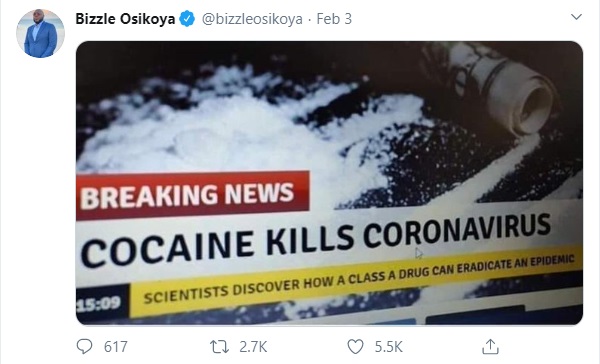
On Twitter, a verified account owned by a Nigerian music and entertainment developer with more than 190,000 followers identified as Bizzle Osikoya, tweeted a doctored image from a television breaking news segment, proposing that cocaine can cure coronavirus now known as COVID-19.
Osikoya’s tweet which was posted on February 3, has remained for over a month and has also been retweeted over 2,700 times and liked over 5,500 times, with no warning that the content is false.
According to the National Institute on Drug Abuse, cocaine is a powerfully addictive stimulant drug and some of the side effects include; constricted blood vessels, dilated pupils, nausea, raised body temperature and blood pressure, fast or irregular heartbeat, tremors and muscle twitches.
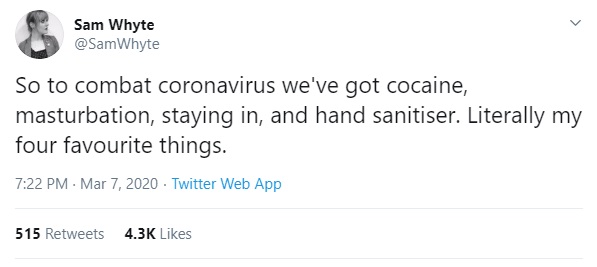
Another tweet with similar viral effect was shared by one Sam Whyte, who has over 9,000 followers. In her tweet, Whyte, submitted that to combat coronavirus, cocaine, masturbation, staying in, and hand sanitiser were effective.
Sam Whyte’s tweet Photo: Twitter
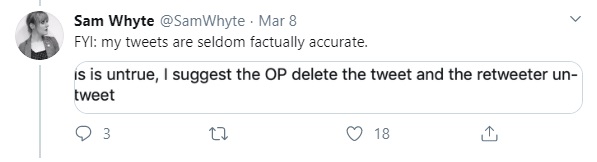
Her tweet generated over 4,000 likes and hundreds of retweets. However, unlike Osikoya, Whyte posted a disclaimer, stating that her tweet are barely ever factual, however her rebuttal got just 20 likes.
Sam Whyte’s tweet Photo: Twitter
French Government disclaims cocaine as cure to COVID-19
To suppress the false information, the French Ministry of Health shared a tweet, saying “No, cocaine does not protect against COVID-19. Cocaine is an addictive stimulant drug. Using it can seriously harm people’s health and create undesirable effects.”
It as a myth, chlorine dioxide cannot kill virus in your body — WHO
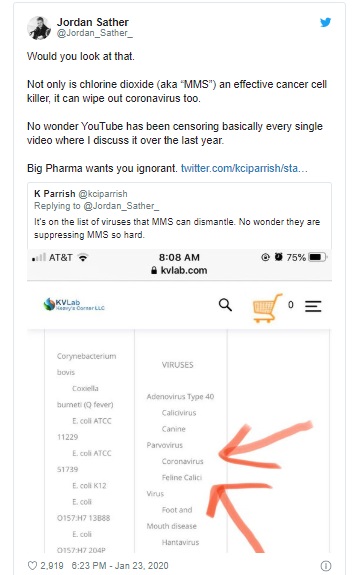
Another major misinformation declared that drinking beach or chlorine dioxide (aka ‘MMS’) can ‘cure’ coronavirus.
In a tweet by Jordan Sather, which also attracted nearly 3,000 likes and nearly 2,000 retweets, Sather, a Youtuber with over 121,000 followers, submitted that: “Not only is chlorine dioxide (aka ‘MMS’) an effective cancer cell killer, it can wipe out coronavirus too, Big Pharma wants you ignorant,” his tweet read.
Jordan Sather tweet Photo: Twitter
According to World Health Organisation (WHO); “spraying alcohol or chlorine all over your body will not kill viruses that have already entered your body.
The organisation classified it as a myth and stated that; “spraying such substances can be harmful to clothes or mucous membranes (i.e. eyes, mouth).”
It also stated that “garlic is a healthy food that may have some antimicrobial properties. However, there is no evidence from the current outbreak that eating garlic has protected people from the new coronavirus.”
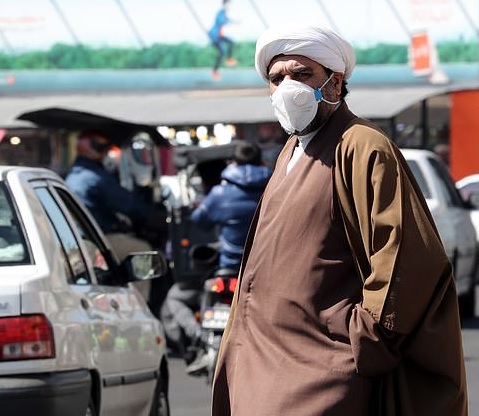
Just recently, 44 people in Iran were declared dead over alcohol poisoning. According to reports, the victims had attempted to use alcohol to avert the virus following rumours that it could ‘cure’ the virus.
WHO has shared preventive measures that can be adopted to protect one from contracting coronavirus. According to the organisation, frequent hand washing with soap and water, avoidance of direct contact with an infected persons, among many other things are the most effective ways of preventing an infection.
LAWYERS to the deposed Emir of Kano, Muhammadu Sanusi, have threatened to file a legal suit against Kano State Government for banishing the former emir to Nasarawa State after dethroning him.
Sanusi’s lead counsel, Abubakar Mahmoud in a statement issued on Tuesday said the deposed emir “was never given any opportunity to defend himself against those charges.”
Mahmoud described the dethronement of the former monarch as “illegal, unconstitutional and a clear abuse of power,” accusing the state government of violating its own laws.
“This action, in our view, is illegal and unconstitutional. The Kano State Emirate Council Law which was recently enacted by the Government of Kano State does not give the State Executive Council or the Governor of Kano State the powers to unilaterally remove the emir,” Mahmoud said.
The Kano State Executive Council chaired by Abdullahi Ganduje, Governor of the state, removed Sanusi for “total disrespect to the office of the governor,” among other allegations.
“Section 13 of the Kano Emirates Council Law 2019 cited in the letter of deposition empowers the Governor to depose an Emir only after due inquiry and in consultation with State Council of Chiefs.
“We are not aware of such due inquiry nor are we aware that the Kano State Council of Chiefs was at any time summoned to any meeting much less discuss the removal of the Emir or give any advise to the Governor on the deposition.
“Muhammadu Sanusi II was the Chairman of the Council and if such meeting was summoned, he would have been aware. He would have informed us.”
The lawyer said the choice of location by the state government “was intended to cause maximum trauma and distress” for the former emir, adding that the legal team has been unable to speak with Sanusi since he was taken to Nasarawa state.
“Be that as it may, the decision to challenge the removal is solely that of Emir Muhammadu Sanusi II. At this moment no such instruction has been given to us,” he said.
“According to instructions we received from the Emir through his Chief of Staff, we are directed to take legal action to challenge the legality of the Emirs detention and banishment.
“The archaic practice of banishment of deposed Emirs, a colonial practice has no basis under Nigerian law or the Constitution. We are totally perplexed at the resort to this practice in present day Nigeria by its political leaders.
“We call on the authorities, in particular the Inspector General, the Director General of Department State Services and Attorney-General of the Federation and Minister of Justice to ensure the immediate release of HH Muhammadu Sanusi II so that he can be reunited with his family.
“We are concerned about the personal safety and security of HH Muhammdu Sanusi II and wish to call on all well-meaning Nigerians and the International Community to bring their influence to bear to ensure that HH Muhammadu Sanusi regains his liberty immediately and to guaranty his safety and security.
“The legal team of HH are working both in Kano and Abuja and unless he is released immediately, we will be taking appropriate legal action.”
It will be recalled that The ICIRreported that the Emir reacted to his dethronement by Kano State Government on Monday, saying “it was the will of God.”
“As I always say, leadership has predetermined tenure, the days Allah destined are numbered. When the days come to an end one must leave,’ the former emir said.
THE Nigerian Stock Exchange (NSE) recorded a 2.41 per cent decline in Monday’s trading day, while the bond market was static with no price change as a result of the spread of COVID-19 known as coronavirus across the world.
Investors had a N329.39 billion loss at the close of the market which stock market traders said was majorly caused by the continued scare of the coronavirus and the unexpected 30 per cent oil price drop.
According to a report by SB Morgen, a firm of economic analysts, the banking sector index recorded an 8.95 per cent decline as the slump in oil prices raised concerns of the quality of oil and gas loans.
A portfolio manager with Traders Investment and Portfolios Limited, Tunde Martins, said “investments advice would be shifted away from stocks most especially banking stocks until there is a solution in the oil market.”
He suggested that opportunities in the bonds markets should be looked into.
The global stock decline showed the fears in investors despite public companies declaring dividends this season in Nigeria.
Eighty public quoted companies on the Nigerian Stock Exchange have declared dividends for their investors, which should make investors happy but the persistent oil price drop has been a subject of worry.
The SB Morgen report showed that the NSE, which was the best performing market at some point this year has now lost all those gains and is in the negative year-to-date territory.
“Investors would rather look at the bonds (Federal Government bond) market which is considered the safest and risk-free in all investments in the domestic debt market, the report advised.
The SB Morgen further suggested in its report that the naira should be devalued at a crucial period like this, arguing that devaluing the naira would ease the mounting pressure on the currency and foreign exchange reserves.
The National Assembly approved a $22.7 billion loan last week which the Federal Government said it plans to repay from proceeds from the sale of oil.
The major oil drop came after the trade war between Russia and Saudi Arabia on Friday.
According to CNN, Russia refused to go along with the Organization of the Petroleum Exporting Countries (OPEC) proposal to rescue the coronavirus-battered oil market by further cutting production at a meeting in Vienna on Friday.
Saudi Arabia went further to slash its April official selling prices by $6 to $8, according to analysts, in a bid to retake market share and heap pressure on Russia.
MUHAMMED Garba, Kano State Commissioner for Information on Tuesday revealed that the state government was happy that the ousted Emir of Kano, Sanusi Lamido has accepted his fate over his dethronement.
‘’One is happy that the former emir has accepted his fate, which is what is expected of him, despite that he was demoralised in his speech,’’ Garba said.
He spoke in an interview during Lunch Time Politics aired on Channels Television.
Sanusi was dethroned on Monday after a long face-off between him and Abdullahi Ganduje, Governor of Kano.
Usman Alhaji, the Secretary to the State Government (SSG) made the announcement after a special sitting of the Kano Executive Council chaired by Ganduje, who said the dethronement was over disrespect to the office of the governor and other government agencies.
The former Emir was arrested hours later after the news of his dethronement and exiled to Nasarawa state where it was revealed he would spend the rest of his life in asylum.
The commissioner further revealed that corruption was not one of the issues that led to the removal of the emir.
According to him, there was also a court order restraining the anti-corruption agency from further investigation because the state government felt that should not be part of the issue.
He added that there were other issues like that of insubordination, lack of cooperation and support from the side of the former emir, especially at a material time that the government has quite a number of policies and programmes, that need the attention and support of the traditional ruler especially the emirs, village heads.
He added that programmes requiring the cooperation and support of the emir were the free compulsory basic and secondary education, the health sector, security among others.
‘’Therefore, if you have an emir that does not support these programmes and some of these programmes play a key, especially looking at the Kano emirates you will note that the local government that comprises Kano are key local governments, they are very serious LGAs where you have the population,’’Garba added.
Speaking on sending Sanusi on exile, the Commissioner said it was part of the tradition and said he did not know if the action was backed by any law.
‘’I am personally an advocate for freedom of movement, association and speech, which everyone can testify,’’ Muhammed said.
Asked about the possibility of a reversal of the banishment, the Commissioner said he did not know precisely if the banishment was coming from the government or not, stressing that “what is certain is that there cannot be two kings in a state.”
‘’Ukolo, former emir of Gandu, was also exiled but he challenged it in the court of law and won the ruling,’’ he said.
Halima Ben-Umar, Executive Director Women in Media Initiative, who was also interviewed alongside Muhammed Garba, said the emir was an outspoken man, who spoke about children, girls and women’s rights.
She further added that almost every leader in Kano is corrupt and not just the emir, and that when a leader is outspoken he is tagged as an enemy of the government and corrupt, which she revealed was the emir’s undoing.
IRAN’s state media, Islamic Republic News Agency (IRNA) has reported that the death toll from alcohol poisoning has risen to 44, after many ingested alcohol to ward off the deadly coronavirus.
Coronavirus, officially known as COVID-19 has infected over 8,000 in Iran and killed over 291, making Iran one of the most affected countries outside of China, where the virus originated.
COVID-19, a deadly respiratory illness has infected over 100,000 globally and killed over 3,800 people since the first outbreak was registered in Wuhan, China, in December.
The news of the virus, which is now considered a pandemic, has resulted in panic and many have turned to carry out measures to prevent getting infected.
The World Health Organisation (WHO) instructs that people wash their hands regularly with soap and water or use an alcohol-based hand sanitizer to clean hands.
However, in Iran, many took to ingesting alcohol in attempt to avert the virus, Daily Mail reports.
It was gathered that rumours had made them believe that alcohol could prevent the virus. Although alcohol is banned in Iran, which is predominantly a Muslim country, many have sought means to patronise ‘bootleg alcohol’
This has now resulted in killing at least 44 people, with up to 36 of them from Southwestern province of Khuzestan, an area which has recorded a death toll of 18 from the coronavirus itself.
In the Northern region of Alborz, seven have been recorded dead over alcohol poisoning.
Meanwhile, in Nigeria, two cases of Coronavirus have been recorded in Lagos.
On Monday, President Muhammadu Buhari set up a committee mandated to make an assessment of the impact of coronavirus on the Nigerian economy.
This came up shortly after international crude oil price crashed below $57 per barrel, plunging to $30.