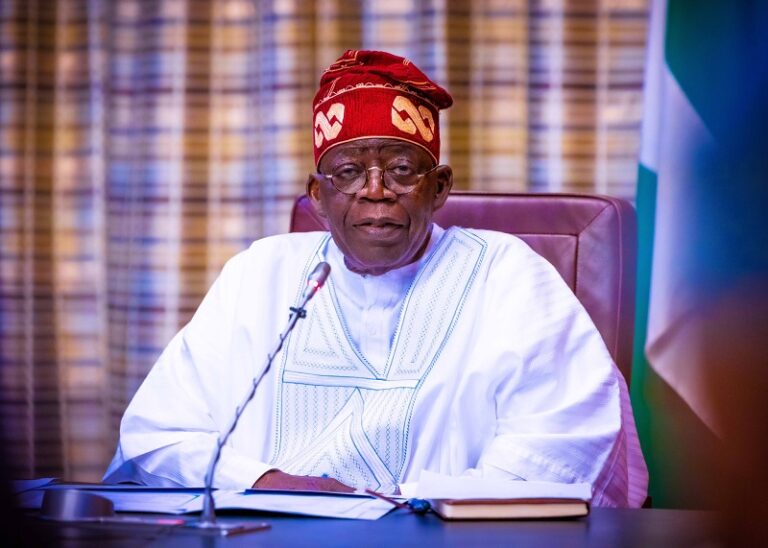
NIGERIAN President Bola Ahmed Tinubu has assigned portfolios to the ministerial nominees who passed the screening process at the National Assembly.
He appointed former governor of Rivers State Nyesom WIke as Minister for the Federal Capital Territory (FCT) and Mairiga Mahmud as Minister of State, FCT on Wednesday, August 16.
The president named Bosun Tijani as Minister of Communications, Innovation and Digital Economy, Ishak Salako as Minister of State, Environment and Ecological Management; Wale Edun, Minister of Finance and Coordinating Minister of the Economy; Bunmi Tunji, Minister of Marine and Blue Economy; Adedayo Adelabu, Minister of Power and Tunji Alausa as Minister of State, Health and Social Welfare.
Others include Dele Alake as Minister of Solid Minerals Development; Lola Ade-John, Minister of Tourism; Adegboyega Oyetola, Minister of Transportation; Doris Anite, Minister of Industry, Trade and Investment; Uche Nnaji, Minister of Innovation Science and Technology; Nkiruka Onyejeocha, Minister of State, Labour and Employment and Uju Kennedy, Minister of Women Affairs.
Former governor of Ebonyi state David Umahi was appointed Minister of Works; Festus Keyamo, Minister of Aviation and Aerospace Development; Abubakar Momoh, Minister of Youth; Betta Edu, Minister of Humanitarian Affairs and Poverty Alleviation; Ekperikpe Ekpo, Minister of State, Gas Resources and Heineken Lokpobiri, Minister of State, Petroleum Resources.
Hannatu Musawa was assigned the position of Minister of Art, Culture and the Creative Economy, John Enoh as Minister of Sports Development; Mohammed Badaru, Minister of Defence; Bello Matawalle, Minister of State Defence; Yusuf T. Sunumu, Minister of State Education; Ahmed M. Dangiwa, Minister of Housing and Urban Development and Abdullah T. Gwarzo, Minister of State, Housing and Urban Development.
There was no name attached to the Minister of Environment and Ecological Management on the list.
However, Atiku Bagudu was named Budget and Economic Planning Minister; Bello Goronyo, Minister of State, Water Resources and Sanitation; Abubakar Kyari, Minister of Agriculture and Food Security; Tahir Maman, Minister of Education; Sa’idu A. Alkali, Minister of Interior; Yusuf M. Tuggar, Minister of Foreign Affairs; Ali Pate, Coordinating Minister of Health and Social Welfare and Ibrahim Geidam, Minister of Police Affairs
Former Plateau State Governor Simon Lalong will now head the Ministry of Labour and Employment, and Lateef Fagbemi will assume the position of Attorney-General of the Federation and Minister of Justice.
Maigari Ahmadu was named Minister of State, Steel Development; Shuaibu A. Audu, Minister of Steel Development; Muhammed Idris, Minister of Information and National Orientation; Imaan Sulaiman-Ibrahim, Minister of State, Police Affairs; Joseph Utsev, Minister of Water Resources and Sanitation; Aliyu Sabi Abdullahi, Minister of State, Agriculture and Food Security.
While many anticipated that Zephaniah Jisalo would assume the position of FCT Minister, he was assigned to head the Ministry of Special Duties and Inter-Governmental Affairs.
The positions for Ministers of Petroleum Resources and Niger Delta Affairs were not indicated on the list. However, of the 48 names selected for ministerial appointments by Tinubu, three nominees are yet to be cleared by the National Assembly due to a lack of security approval.
The three nominees include Nasir El-Rufai, Abubakar Danladi and Stella Okotete.
El-Rufai, who is the immediate past governor of Kaduna state, withdrew his interest in the ministerial appointment and suggested a new nominee, Jafaru Ibrahim Sani, although he initially expressed his willingness to work with the president on issues relating to the power sector.
The list
Minister of Communications, Innovation and Digital Economy – Bosun Tijani,
Minister of State, Environment and Ecological Management – Ishak Salako
Minister of Finance and Coordinating Minister of the Economy – Wale Edun
Minister of Marine and Blue Economy – Bunmi Tunji
Minister of Power – Adedayo Adelabu
Minister of State, Health and Social Welfare – Tunji Alausa
Minister of Solid Minerals Development, Dele Alake
Minister of Tourism, Lola Ade-John
Minister of Transportation, Adegboyega Oyetola
Minister of Industry, Trade and Investment, Doris Anite
Minister of Innovation Science and Technology, Uche Nnaji
Minister of State, Labour and Employment, Nkiruka Onyejeocha
Minister of Women Affairs, Uju Kennedy
Minister of Works, David Umahi
Minister of Aviation and Aerospace Development, Festus Keyamo
Minister of Youth, Abubakar Momoh
Minister of Humanitarian Affairs and Poverty Alleviation, Betta Edu
Minister of State, Gas Resources, Ekperikpe Ekpo
Minister of State, Petroleum Resources, Heineken Lokpobiri
Minister of Sports Development, John Enoh
Minister of Federal Capital Territory, Nyesom Wike
Minister of Art, Culture and the Creative Economy, Hannatu Musawa
Minister of Defence, Mohammed Badaru
Minister of State Defence, Bello Matawalle
Minister of State Education, Yusuf T. Sunumu
Minister of Housing and Urban Development, Ahmed M. Dangiwa
Minister of State, Housing and Urban Development, Abdullah T. Gwarzo
Minister of Budget and Economic Planning, Atiku Bagudu
Minister of Environment and Ecological Management, Ishak Salako
Minister of State, Federal Capital Territory, Mairiga Mahmud Minister of State, Water Resources and Sanitation, Bello M. Goronyo
Minister of Agriculture and Food Security, Abubakar Kyari
Minister of Education, Tahir Maman
Minister of Interior Sa’Idu A. Alkali
Minister of Foreign Affairs, Yusuf M. Tuggar
Coordinating Minister of Health and Social Welfare, Ali Pate
Minister of Police Affairs, Ibrahim Geidam
Minister of State, Steel Development, U. Maigari Ahmadu
Minister of Steel Development, Shuaibu A. Audu
Minister of Information and National Orientation, Muhammed Idris
Attorney General of the Federation and Minister of Justice, Lateef Fagbemi
Minister of Labour and Employment, Simon B. Lalong
Minister of State, Police Affairs, Imaan Sulaiman-Ibrahim
Minister of Special Duties and Inter-Governmental Affairs, Zephaniah Jisalo
Minister of Water Resources and Sanitation, Joseph Utsev
Minister of State, Agriculture and Food Security, Aliyu Sabi Abdullahi.
NIGERIA’s senior men’s basketball national team, D’Tigers, failed to qualify for the 2024 Paris Olympics after suffering their second consecutive defeat 68-77 at the ongoing FIBA Pre-Olympic Qualifying Tournament in Lagos.
D’Tiger began their quest to represent Nigeria at the Olympics on Monday but lost to Senegal in their opening group stage match.
Their winless streak at the Pre-Olympics Qualifying Tournament ended their four-year consecutive appearance at the Olympics since 2012.
After they lost to Senegal in the opening match, they sought redemption against Mali, winning the first three quarters 17-15, 26-23, 18-15.
But the 4th quarter witnessed a turn in events as the Maliens dominated to stem the tide with 17 points difference, which ended 24-7, to claim a 77-68 point victory.
D’Tigers finished at the 3rd position in the group.
The loss against Mali means Nigeria’s outing at the FIBA Pre-Olympic Qualifying Tournament in Lagos has ended, with Senegal and Mail qualifying for the semifinals.
ON Tuesday, August 15, Nigeria’s highly esteemed musical awards, The Headies unveiled the list of artistes to perform at the event.
The list includes several nominees from the 2023 edition, including internationally recognized Afrobeat artistes Rema and Asake, both of whom have received multiple nominations across various categories.
The performance lineup also includes Fireboy, who is a multi-Headies winner, Ayra Starr, Johnny Drille, Seyi Vibez, Wande Coal, KCee, Oxlade, as well as Next Rated nominees Victony and Spyro, along with Blaqbonez.
As reported by The ICIR in July, the academy unveiled the list of nominated artistes for the 16th award edition. The lineup also encompassed a distinct category aimed at recognizing international artistes who have made a lasting mark on the Nigerian music scene.
Scheduled for Sunday, September 3, the 2023 edition of the Headies awards will take place at the Cobbs Energy Centre in Atlanta, Georgia, USA.
THE Nigerian government’s periodic interference on the price of Premium Motor Spiritual (PMS), through the Nigerian National Petroleum Company (NNPCL) has shown that subsidy payment on gasoline is back.
The government has kicked against a possible hike in the Price of PMS, as the Nigeria Labour Congress (NLC) has threatened to go on industrial action if the prices increase beyond the current N617 per litre.
President Bola Tinubu has at his inauguration on May 29, at his inauguration said, “Subsidy is gone”.
However, informed analysts said price dictation by the National oil company in a deregulated market does not show Nigeria has fully deregulated the Petroleum downstream sector.
Accordingly, a breakdown of the landing cost of petrol showed that while product cost, as of August 15 2023, was N627.82 per litre, finance cost was N11.61, and operations/administrative cost N12.32, bringing the total landing cost to N651.75 per litre.
Accordingly, a breakdown of the landing cost of petrol showed that while product cost, as of August 15 2023, was N627.82 per litre, finance cost was N11.61, and operations/administrative cost N12.32, bringing the total landing cost to N651.75 per litre.
Consumers in long queues at NIPCO filling stations in Kubwa. May 2023
Analysts say that with the current market price, petrol ought to sell at over N720, and someone, most probably, is paying the price differential.
Meanwhile, an assurance by both the NNPCL and an official Presidential spokesperson Ajuri Ngelale, showed the federal government has tactically brought back subsidy.
“The president wishes to assure Nigerians, following the announcements by the Nigerian National Petroleum Company Limited (NNPC), on Monday that there will be no increase in the pump price of petroleum motor spirit anywhere in the country,” Ngelale said.
“We repeat, the president affirms that there will be no increase in the pump price of petroleum motor spirit.”
The President, Ngelale said, also acknowledged that there are inefficiencies within the downstream sector that are contributing to the fuel price controversy. He assured that all loopholes associated with the smooth delivery of petroleum products in the country will be addressed without delay.
“The president also wishes to affirm that there are presently inefficiencies within the midstream and downstream petroleum sub-sectors that, once very swiftly addressed and cleaned up will ensure that we can maintain prices where they are without having to resort to a reversal of this administration’s deregulation policy in the petroleum industry,” Ngelale said.
Ajuri Ngelale, Senior Special Assistant to the President on Public Affairs.
Also, the NNPCL has confirmed through its social media that there are no plans for a PMS price hike, raising further concerns about price control in a deregulated market.
“Dear esteemed customers, we at NNPC Retail value your patronage, and we do not have the intention to increase our PMS pump prices as widely speculated. Please buy the best quality products at the most affordable prices at our NNPC Retail Stations nationwide,” NNPCL said.
Contradictions in Presidency and NNPCL Statement
In a deregulated PMS market, prices are determined by market forces, not by a government template of price interference.
This development negates the Presidential spokesperson’s assertion that prices would not be increased, even when major oil marketers have been licenced to import the product.
The ICIR has earlier reported on the dangers and of allowing the NNPCL be the sole price determinant in a Petroleum downstream deregulated market.
What government’s contradictory statements mean
For an economist and the Chief Executive Officer of Cowry Assets Limited, Johnssole Chukwu, the statement means “that subsidy has been smuggled back.”
Johnson Chukwu, CEO of Cowry Asset Management Limited believes subsidy is gone
Market forces which suppose to determine the price of PMS has been suspended, he said, adding, “More worrisome is that the pains we gone through in this subsidy has actually been for nothing as the government appears to have suspended the subsidy.”
He, however, suggested that, “The appropriate measure on the subsidy removal would have been that the government would be intervening in the foreign exchange rate, while allowing the global market movement of PMS prices of crude and refined Product.”
This, he said, would have ensured Nigeria deals with marginal increase in prices of PMS and other commodities.
For the President of Independent Petroleum Marketers Association of Nigeria IPMAN, Chinedu Okoronkwo Okoronkwo, the licenced marketers are yet to commence the importation of PMS products.
“NNPCL is still controlling the market price despite subsidy removal. NNPCL is still influencing market price and have access to the official exchange window
“We are still getting our product from the NNPCL. They have come out clearly to tell you, there is no price increase. We are largely dependent on them for our importation,” Okoronkwo said.
WOMEN and youth across 24 African countries have been invited to participate in a transformative initiative to enhance livelihoods, bolster food security, and promote climate-resilient economies.
This comprehensive training programme, set to run from September 2023 to February 2024, seeks to equip participants with high-demand digital skills, elevating their employment and income-generating potential.
The programme is divided into three phases: online training, self-led projects with virtual boot camps, and sustainability-community leadership training.
Through a blend of online and in-person components, individuals from nations including Botswana, Ghana, Kenya, Nigeria, South Africa, Tanzania, and more will cultivate socially responsible digital start-ups while honing leadership and entrepreneurial aptitudes crucial for driving change and innovation.
Individuals between 18 and 35 years are required. However, women of all ages, including those over 35, are encouraged to apply, as their unique experiences and skills are valued. They should have good oral and written English communication skills.
The application deadline is September 4, 2023. Interested applicants can apply here
NIGER State Governor Umar Bago, has appealed to the Nigerian Air Force (NAF) to deploy some detachments and fighter planes to the state for rapid response against insecurity.
The governor made the appeal on Tuesday, August 15, at NAF headquarters, Abuja, during a condolence visit to the Chief of Air Staff, Hassan Abubakar, following the reported ‘attack’ on the aircraft that claimed lives of yet-to-be-confirmed numbers of soldiers.
The ICIR earlier reported how terrorists affiliated to Abubakar Abdallah, popularly known as Dogo Gide, claimed responsibility for the Nigerian Air Force (NAF) helicopter that ‘crasheď on Monday, August 14, at Chukuba village in Shiroro Local Government Area, LGA, of Niger State.
The aircraft, carrying soldiers, was allegedly taken down while en route to evacuate and provide backup for troops confronting the terrorists in Chukuba and other neighbouring villages within the Shiroro Local Government Area.
Although the Nigerian Air Force has not released any official details of the incident, it claimed it is investigating the probable cause of the crash.
While addressing the officers of the NAF on his condolence visit, the governor expressed his sympathies to the military high command for the loss of ground troops to the enemy.
“One, to commiserate and condole with you over the death of your men and soldiers at Niger State the day before yesterday (Monday). The crash happened within the mountain of Shiroro. We deeply sympathise with you.
“We also sympathise with the Nigerian military over the losses recorded in the ambush that happened in Wushishi, which eventually brought about the evacuation by your own chopper that crashed.
He also assured NAF that the state government is ready to provide accommodations for the air force personnel in Minna close to the airport.
He said: “Your deployment of both fighter jets and UAVs have been very apt and helpful to the ground troops and our own local vigilantes. But like Oliver Twist, we need more.
“I have come here to say Minna airport was created as a backup for Abuja airport, and we have the longest runways in Nigeria. We’re calling on you to please send some detachments and some fighter planes to Minna so that we can have more rapid responses from when they are very close instead of flying from either Kainji or Kaduna.
“Let me at this juncture say thank you for giving us this time, and to say that Niger State government will support you anywhere you are. We are happy with what you’re doing and we’re behind you and we will support you.
“Our people have also asked me to tell you that we can actually give you accommodations if you can bring people. We will provide accommodations that are very close to the airport in Minna. Come and stay in Minna because we need your protection.”
The ICIR reported how bandits have been causing havoc at Chukuba and other neighbouring villages of Shiroro Local Government Area of Niger State, with the recent incident starting on Friday, August 11.
The attack, which lasted for three days, resulted in numerous casualties, with reports indicating that some soldiers, including local security officers (vigilantes), lost their lives while attempting to confront the terrorists.
Primary healthcare centres (PHCS) are meant to be the first point of call for health service delivery, but are they equipped for this role? Mustapha Usman who visited several PHCS in Kwali and Abaji area council of the Federal Capital Territory (FCT) reports the findings.
TWENTY-FIVE years-old Olaniyi Dorcas is one of the many residents who have suffered the brunt of the lack of quality healthcare delivery in Ijah Sarki of Yangoji Public Health Centre (PHC), Kwali Area Council of FCT. Dorcas lost her first child as a result of what she described as negligent and ‘nonchalant’ behaviour exhibited by the PHC staff.
On June 3, 2022, Dorcas woke up with pain in her stomach after sensing a kick from her unborn baby. Alarmed by her condition, Dorcas, together with her husband rushed to the nearest PHC at around 7:00 a.m. but there was no staff at the centre.
Suspecting she might have arrived too early, she headed back home with her husband and had to return to the Health Centre two hours later. This was despite the severe pain she was experiencing.
Still, the PHC was closed.
Dorcas and her husband had no choice but to explore an alternative, a private hospital where she would later lose her baby.
Twenty-five-years-Olaniyi Dorcas, a resident of Ijah Sarki, who lost her child due to poor healthcare delivery services in her community. Photo: The ICIR/July 2023
At the hospital, she said after some checks the health worker said he would only attend to her in the evening as that was the best period to welcome her baby.
“When we got to the hospital, the Doctor asked me to lie down, which I did. He tested me and told me that the time for my delivery had arrived. However, he called someone else to attend to me and he went inside the house to do something else. I was there till around 4 a.m. nursing the pain because the Doctor told me that I could only deliver in the evening that was the time that the child would come out.”
“Later, he came to visit me and told me the baby was fine and that I shouldn’t be worried. So when the doctor couldn’t resist people’s agitation, he attended to me, but by then, I think the child had become so weak the child couldn’t come outside. I pushed and tried, but the child didn’t come outside until after many trials before he came out. At that time, he was not crying. He gave him an injection, but the child still didn’t cry; that was when the Doctor said the child wasn’t okay. The placenta, too, didn’t come outside.”
Dorcas, couldn’t fathom that her baby had died. She said she didn’t know such could happen as she had never heard of stillbirth.
She believes that the tragic loss of her child could have been prevented if the PHC had been operating regularly and frequently holding antenatal classes for expectant mothers like herself.
The death was not inevitable as World Health Organisation (WHO), believes that most stillbirths can be prevented with proper healthcare delivery.
There are close to two million stillbirths recorded every year, equivalent to one in every 16 seconds. Sadly, over 40% of these stillbirths happen during labour, a tragic loss that could be prevented with better quality healthcare, which includes routine monitoring and prompt access to emergency obstetric care when needed, World Health Organisation stated.
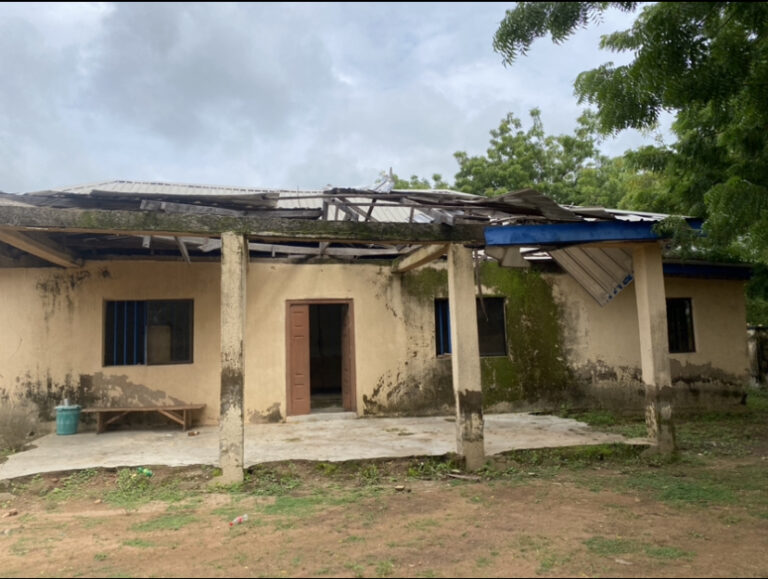
Ijah sarki PHC was closed on Wednesday, July 5, when The ICIR visited. The building was deserted and surrounded by bush. Photo: The ICIR/July 2023.
Meanwhile, a year has passed but staff of the PHC were still nowhere to be found. When The ICIR, visited the Community’s PHC, it was in a shocking state. The premises were overgrown with bushes, and there was no sign of any staff or patients inside, despite the facility having more than seven rooms, including three wards.
It was in a dilapidated state as rain has inundated the building through the collapsed ceiling and roof and visibly caused distress to the health centre. Out of the three wards The ICIR had access to, there were at least eight bunks altogether with no beds and also needing refurbishing. There were about two stores that were in a sorry state, and the reception, visibly seen with chairs, could hardly be seated under for fear of collapse.
Picture showing the dilapidated state of the Ijah Sarki PHC. Photo: The ICIR/July 2023
The staff housing facility, despite being completed, had been turned into a farm store as all the rooms in the building were not in a good state and were littered with processed cassava.
This was the usual situation of the PHC, as few residents confirmed that the staff in the hospital visited the building ‘once in a blue moon’, not minding the villagers’ plight and also failing to improve even after speaking to the government officials at the council.
Empty wards with no beds. Photo: The ICIR/July 2023
There were also conflicting narratives as to what few residents revealed to The ICIR. All the residents who spoke to The ICIR agreed with its finding about the worrying state of the building, but the village head Ibrahim Ayewon, argued that the staff were always at the hospital.
However, when The ICIR pushed further, the community head disclosed that the hospital lacks amenities and also needed the constant presence of the staff but didn’t want to expose the staff to possible backlash.
This state of the Public Health Centre cripples access to proper healthcare by residents of the community and poses many to a dire situation like Dorcas experienced.
Maternal mortality in Nigeria
The WHO in its 2023 progress report, shows that there were a combined 4.5 million maternal, stillbirths and newborn deaths in 2020.
Sub-Saharan Africa and Central and Southern Asia are the regions experiencing the largest number of deaths across all regions. India and Nigeria lead with 17 per cent and 12 per cent of global maternal and neonatal deaths and stillbirths, respectively.
According to the WHO, in 2020, 788 women and children died per thousand in India, while 540 women and children per thousand died in Nigeria.
The trend shows global progress in reducing maternal and newborn deaths and stillbirths has slowed during the last decade (2010-2020). The progress made between 2000 and 2010 was faster than they have been in the years since 2010. WHO attributed the slow progress within that period to climate change, conflicts and other emergencies, as well as the cost of living increases.
However, a report by the National Primary Health Care Development Agency (NPHCDA) on maternal and child health in 2019 revealed Nigeria has made no progress in maternal mortality for 29 years, as the country loses 2,300 under-five children and 145 women of child-bearing age daily.
The report, which was presented by the Executive Director of NPHCDA, Faisal Shuaib, at a stakeholder meeting in 2019, revealed that “Nigeria has a maternal mortality rate of 560/100,000 live births, which means 33,000 women die each year and one in nine maternal deaths worldwide is a Nigerian.”
“Infant mortality rate is 75/1,000 live births, which is eight per cent of the global total, and an estimated 70 per cent of these deaths are preventable.
“Child mortality rate is 117/1,000, which means one million deaths yearly and accounts for 10 per cent of the global total.”
The NPHCDA listed inadequate health facilities, shortage of critical human resources, inadequate power or water supply, commodity stock-outs, equipment inadequacy, weak standards/quality, and very low demand for critical services primarily driven by the loss of confidence in the system as the causes.
Meanwhile, in one of the efforts to bridge the gaps in primary healthcare delivery services, particularly for the poor and vulnerable, former president Buhari, in 2019, rolled out the Basic Health Care Provision Fund (BHCPF) and enshrined it in the 2014 National Health Act.
The BHCPF is a pool funded with at least one per cent of the nation’s consolidated revenue and other funding sources, including donor contributions.
Read the series of reports on BHCPF and MSS done by the ICIR here
The fund is disbursed through three gateways: the National Health Insurance Scheme, the National Emergency Medical Treatment, and the National Primary Health Care Development Agency (NPHCDA).
In 2019, the Federal Capital Territory Administration (FCTA)disclosedthat it has flagged off the Basic Health Care Provision Fund (BHCPF), with N100 million as counterpart funding for the programme as part of moves to alleviate the sufferings of women and children.
The programme, according to FCTA, would help improve healthcare delivery for all residents in the nation’s capital, just as it stressed that the BHCPF is an intervention by the Federal Government to improve healthcare services in the country.
However, only one PHC in a ward is expected to benefit from the fund, as confirmed by the Kwali Health Director, Samuel Adudu.
Residents who live in a very far location from the BHCPF-benefiting PHC are at greater risk whenever there’s a need for urgent medical attention, as some of the PHCs not under this intervention suffer neglect.
Yebu, another PHC in Kwali with similar woes
Another PHC in Yebu in a worse state.
Aproka Yunusa was so confused as to why the government has abandoned his community PHC since 2008, when The ICIR’s reporter approached him to ask about the status of the centre. He was visibly furious; his eyeballs swelled as he tried to find a better word to describe the situation.
When he finally did, Yunusa described the Yebu PHC as the worst in the whole of Kwali Area Council.
Meanwhile, it didn’t take long to discover the ‘worst’ and dilapidated PHC the villager had described.
A peep into the centre revealed that the building, which seems to be the main PHC building, has been worn out by rainfall and breeze. The building has at least seven rooms, but it lacks facilities, equipment, and other basic materials that a PHC should have.
Tattered roof of the abandoned PHC in Yebu. Pc: The ICIR/July 2023
The roof is in tatters, and some parts of the building have collapsed, while termites enjoy most parts of the building.
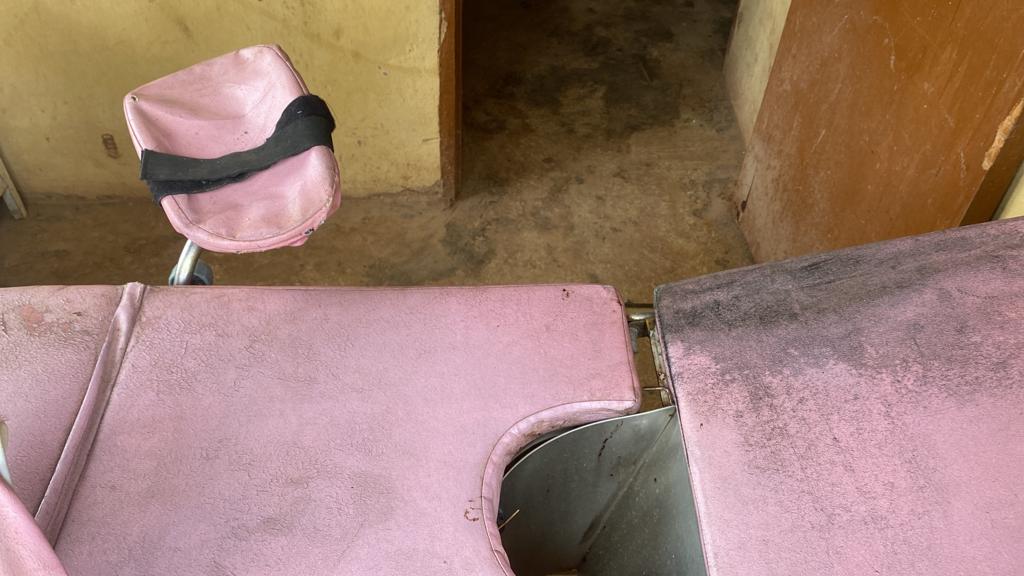
The devastating state of the PHC extends far deeper as the second building, far smaller than the first one, is devoid of equipment and basic needs.
Damaged stretcher used in attending to pregnant women at Yebu PHC. Pc: The ICIR/July 2023
At the time The ICIR visited the facility, there were no staff or patients. This, according to a volunteer worker in the community, Madaki Nasiru, could be traced to a shortage of staff.
Explaining the situation, Nasiru said the situation of the PHC has been worsening over the years, with the last time they received intervention from the government in 2008, when the now abandoned building was built.
“People use to come to complain, but honestly, there are no drugs and other things in the PHC. Just look at the hospital (pointing towards the roof); it does not have anything inside. We used to refer most of the patients to their houses and to a hospital in Kwali.”
When The ICIR spoke with the Community health essential worker in charge of the PHC, Haruna Ibrahim, with its findings via phone call, he explained that he was in training and didn’t have any person to man the facility for him.
He also revealed that the PHC lacked drugs, digital equipment and wasn’t enrolled in the BHCPF intervention.
“As you see, we are lacking wards, and the abandoned project has collapsed completely. We are lacking some equipment like a BP apparatus, digital thermometer and some beds. We are also lacking drugs; in fact, we have not been getting drugs here.
“We do not have a borehole and even a toilet in the entire building. We are attending labour here, but we don’t have a good stretcher for the labour bed. Also, we don’t have electricity. I do use rechargeable lambs to attend to patients at night.”
He added that he has been collecting money from patients to buy drugs for them since 2018 and has not benefitted from the BHCPF intervention that was meant to provide basic needs, such as drugs, in PHC across the country. Ibrahim said: “What I do get from the government is only family planning commodities”.
Pandagi PHC, where health workers fetch water from town, lacks electricity
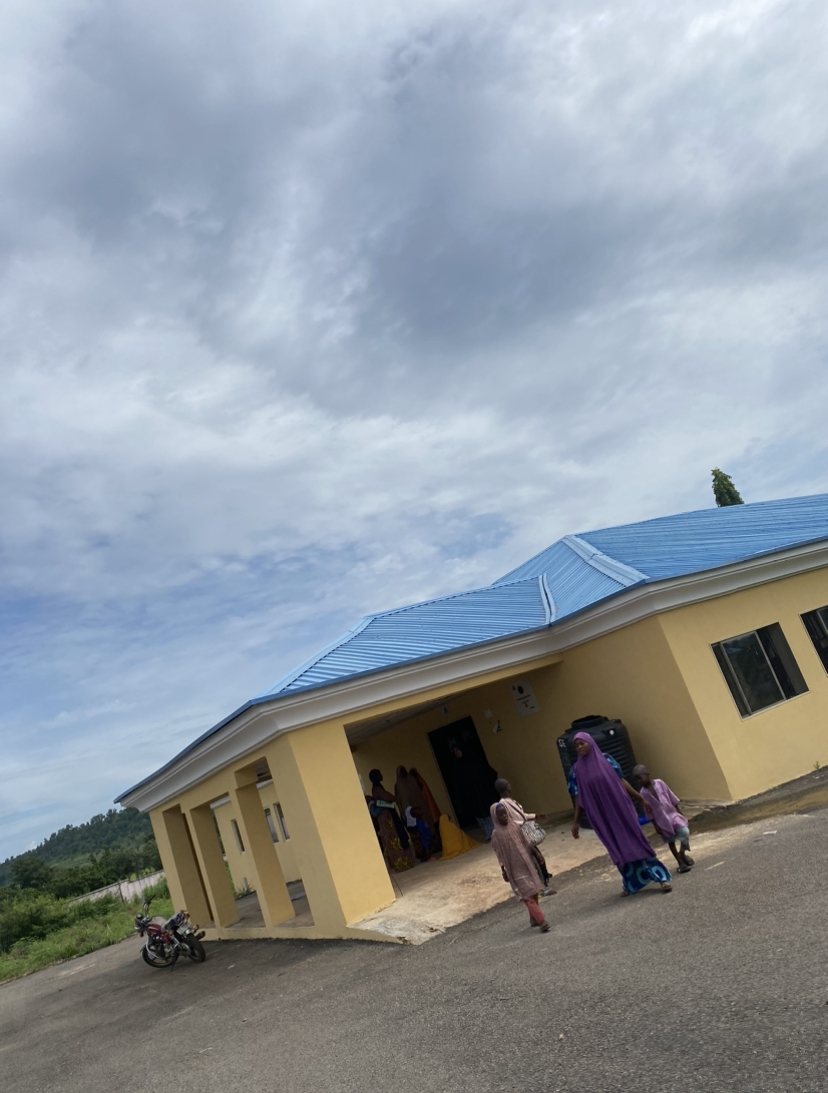
Pandagi PHC in Abaji Area Council. Photo: The ICIR/ July 2023
Pandagi health centre in Abaji Area Council is an improved version of the other two PHCs but boasts no electricity, no water, and fluctuating payment of BHCPF. The wards were observed to be in good condition, and it also has an equipped laboratory and store.
Unfortunately, the persistent lack of water and electricity has been a longstanding problem at the PHC. According to health workers, these issues have persisted for over a decade, and any expectation of finding solutions has diminished over time.
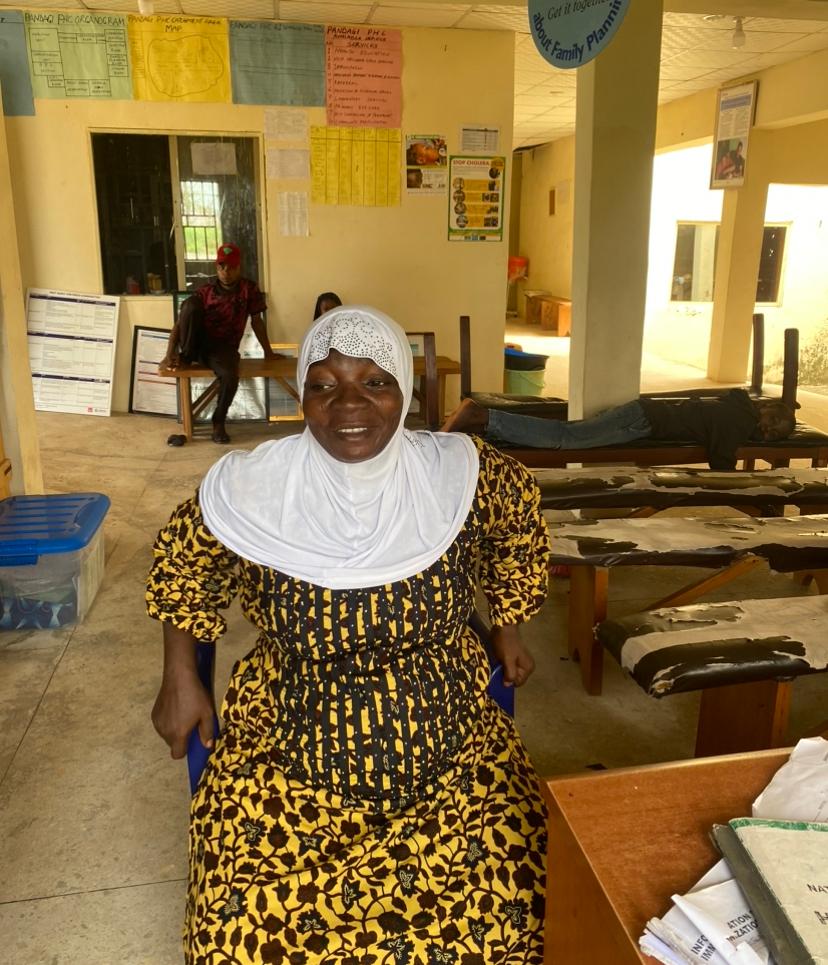
Zainab Alhassan, one of the attending health workers at Pandagi PHC.
The health worker in charge, Zainab Alhassan, however, bemoaned the lack of water and electricity in the facility, noting that they embark on about a 15-minute journey on a bike to get water to use. ‘We are lacking so many things. We don’t have water and electricity. We do fetch water from inside the town. Even for deliveries, we had to go and fetch water.”
Another health worker in the PHC, Idris Abdullah, also said there are staff shortages in the Centre as they don’t have pharmacists and recorders. “We don’t have a pharmacist and we don’t have a recorder. It’s voluntary workers that used to help us, and the hospital pays them through other intervention.”
The ICIR gathered that the hospital is one of the beneficiaries of the BHCPF intervention, but there have been fluctuations in the payment of the fund. “They didn’t give us the first quarter of this year. It was the second quarter they gave us,” Abdullah said.
The health worker also explained that the PHC received the fund till the third quarter of last year, when they stopped getting the fund.
“The ones they didn’t pay affect us because as they didn’t pay, we don’t have enough drugs, so most people stopped coming. We only use our Drugs Revolving Fund (DRF), but that one, they will have to pay a little money. And you know if you are used to freeing things, it will be hard to want to pay for such.”
This fluctuation in payment of the BHCPF fund by the government prevents residents of the community access to basic healthcare as some of them could not afford the healthcare fee.
What the authorities had to say
The Director of Public Health Kwali Area Council Samuel Adudu, blamed the dilapidated facilities on the contractors that were awarded the projects, adding that the council is also aware of the errant staff who have refused to report to work and will be sanctioned.
“That PHC was actually built during the MDG era when they were still active. They built facilities around the six area councils. The project was contracted to contractors to build and equip, but unfortunately, some of the contractors didn’t do a good job.
“As a department, we have written to the Area Council to do something about it, but they haven’t, probably due to some financial constraints. We are still pushing to see what can be done so that some repairs can be carried out there.”
Adudu explained that going around the entire facility in the council was impossible, the reason why they urged members of the communities to report any health-related issues to his department.
“Regarding the issue of staff, staff not going to work is unacceptable. We are already aware of that because it attracts sanctions, but nevertheless, we have always dialogue with the communities to monitor the staff activities. Going around all these facilities is practically impossible. We have what we called the ward development committee for each of the activities, so that forum is for the members of the community to look at the problems within the facility and the community at large, especially health-related issues and address them. “
He also agreed with The ICIR findings on the issue of the shortage of personnel in the hospital. “Another challenge we have is personnel because we have some PHCs that have only one or just two staff. There are programmes we run, and we invite staff to come to the central facility at Kwali for training,” he said.
Asked about the availability of drugs and delivery of proper treatment, he explained that 70 per cent of the entire workforce in the Kwali area council are community health essential workers who have limited skills to provide first-class treatment.
“At the PHC level, most of our staff are community health essential workers. In fact, even 70 per cent of the entire health workforce in the area council are community health essential workers. We have community health essential workers, and we have junior community health essential workers, and they all have their standards to create procedures.
“There are certain disease conditions they can handle and there are certain disease conditions they can’t handle and ideally, in the healthcare sphere of the country, the best first contact is the primary healthcare. So if you come across a patient who has a condition they can’t manage, they immediately refer him to a secondary facility. We have a general hospital in the area council, Kwali general council.”
Surprisingly, the director of health stressed that the PHCs aren’t expected to admit patients as he revealed that only about two to three facilities in the whole council can run 24-hour services.
Adudu, however, didn’t know about Idah Sarki’s PHC not having beds in the wards.
Meanwhile, he confirmed to The ICIR that the state of the two PHCs can’t be disconnected from the fact that they didn’t benefit from the BHCPF intervention.
According to him, the council has ten wards, with one PHC per ward BHCPF beneficiary, meaning that only 10 centres benefit from the intervention.
He also said that efforts are being made to increase the number of beneficiaries to 124, making it two PHCs per ward.
This, according to Adudu, will help them have wider coverage, thereby increasing accessibility to people.
Speaking on the budget allocation to health, he said, “It’s what comes in from the federal allocation that determines the project that can be done. Take, for instance, if an allocation that can barely pay salary, of course, you wouldn’t expect the area council to do anything other than just pay salaries. But we are hopeful that as things improve, we will look into these facilities and work them and also recruit more health workers to man this facility.”
On Thursday, July 20, The ICIR contacted the FCT Director of Public Health, Sadiq Abdulrahman, for his position on the state of the PHCs in FCT but refused to comment, citing that his Agency isn’t responsible for PHC.
This investigative story is produced with support from Safer-Media Initiative under The Collaborative Media Engagement for Development, Inclusiveness, and Accountability Project of the Wole Soyinka Centre for Investigative Journalism (WSCIJ), funded by the MacArthur Foundation.
ARMED terrorists, affiliated to Abubakar Abdallah, popularly known as Dogo Gide, have claimed responsibility for the Nigerian Air Force (NAF) helicopter that crasheď on Monday, August 14, at Chukuba village in Shiroro Local Government Area, LGA, of Niger State.
According to a terrorist who spoke behind the camera in a video obtained by WikkiTimes and sighted by The ICIR, the helicopter was taken down by AK-47.
This was, however, contrary to what the Nigerian AirForce disclosed on Monday, August 14, when the incident happened.
“The aircraft had departed Zungeru Primary School enroute Kaduna but was later discovered to have crashed near Chukuba Village in Shiroro Local Government Area of Niger State,” the NAF spokesman, Edward Gabkwet, said in a statement.
The ICIR further reached out to Gabkwet to confirm the number of casualties and the details of the incident, but its efforts proved futile as calls were declined, and SMS message sent to his mobile phone elicited no response.
Similarly, a story by WikkiTimes on Monday reported that the Dogo Gide-led bandits faction took down the aircraft, according to a statement signed by the Convener, Concerned Shiroro Youths of Niger State, Sani Yusuf Kokki.
Kokki reportedly said the terrorists “gunned down a surveillance jet hovering around the airspace of some Niger Communities…”
Claiming the incident, a voice behind the camera in the video that showed the horrifying sight of dead soldiers noted that they possessed the same weapons as the Nigerian army.
He said (in Hausa): “God willing, the video we are going to show you, here are the dead bodies of Nigerian soldiers who attacked us to kill us, by God willing, in order to eliminate Dogo Gide… Many of them. Here are many, even their helicopter.”
“… See by God’s will, this is Allah’s doing, with AK-47 we take down this plane. See them as many as they are. So repent and understand that it is not our will to kill anyone; our aim is for everyone to understand and fear Allah.”
“Surely, He will get them, but we are not going to fall back despite hardship, aeroplane or anything. The Dogo Gide you want to kill is alive. See this AK-47 they have, it is the one we hold, and everyone opened fire, and we exchanged fire with them fafau-fafau…And behold the plane was down,” the voice in the video claimed.
The Attack
Bandits have reportedly been causing havoc at Chukuba and other neighbouring villages of Shiroro Local Government Area of Niger State, with the recent incident starting on Friday, August 11.
The attack, which lasted for three days, resulted in numerous casualties, with reports indicating that some soldiers, including local security officers (vigilantes), lost their lives while attempting to confront the terrorists.
The terrorists were said to have ambushed and killed an unconfirmed number of soldiers along the Zungeru-Tegina road in the Madaka Ward of the Rafi Local Government Area of the state.
Similarly, the soldiers reportedly killed scores of terrorists.
WITH reactions trailing the ministerial nomination made by President Bola Tinubu, The ICIR has evaluated the profile of these nominees, predicting the portfolio the president might assign to each person.
Going by the number of people nominated, the projections are hinged on the possibility of the president creating new ministerial portfolios that would actualise his administration’s intent.
Tinubu submitted 48 names to the Senate in the last two weeks for screening and confirmation. Initially, 28 names were submitted as the first batch of nominees. A week later, an additional 19 were submitted before a review was done, which increased the list to 48 names.
After the screening exercise, the Senate confirmed 45 out of 48 nominees.
The list consists of past governors, former and present lawmakers, former state commissioners, former ministers, former directors of government agencies, aspirants during the 2023 general election and other private sector experts.
Key issues
Assuming all nominees are given a portfolio, this administration would have the largest ministerial cabinet since 1999, when Nigeria retired to uninterrupted democratic governance.
Also, the president might adopt the style of former president Muhammadu Buhari by appointing senior and junior ministers, that is, a Minister and a Minister of State.
In addition, many of the ministerial nominees come with professional and political experience, which could make them fit into any ministerial position as core administrators.
While the professionals were grilled thoroughly, their counterpart colleagues, who were either former governors or former legislative members, were told to bow and go. This development was frowned upon by many public affairs analysts.
For the Lead Director of the Centre for Social Justice, Eze Onyekpere, “no meaningful screening can be done without asking questions pertinent to the Ministries the candidate will do when he or she gets confirmed.”
According to Onyekpere, “The President needs to submit the list with the portfolios the Ministers have to hold. Also, the screening is not something that should be done in a hurry. The list needs to be submitted early to enable the National Assembly to do thorough screening through the Senate’s relevant committees while reconvening on the committee as a whole for more efficiency.
A professor of International Relations at Obafemi Awolowo University, Ile Ife, Charles Ukeje, said the drama surrounding the ministerial screening exposed the dark side of Nigerian politics and emphasized the urgent need for a more robust and rigorous screening process.
He stressed that the nation’s leadership recruitment process should not be reduced to a source of comic relief and that civil society must hold political leaders to higher standards of accountability, transparency, and integrity.
How we made the projections
For our projections, we reviewed the background profiles of each nominee and cross-examined them with the nominees’ trajectory as political officeholders. We also examined the questions asked during the screening exercises by the senators.
Also, in our projections, we considered the president’s priority and arbitraries in assigning ministerial portfolios to minister-designates. This could depend on the president’s political interests in a particular candidate and for a particular purpose. Election dynamics were also considered, and for the first time, an indigene of the Federal Capital Territory was appointed a minister since the present democratic dispensation, which started in 1999.
This may likely be connected to assertions, in some quarters, that the President is looking possibly at an all-inclusive Presidency, which saw even the nomination of opposition party members as seen in the case of a former Governor and Minister-designate, Nyesom Ezenwo Wike.
Accordingly, Wale Edun, who is projected to be the Minister of Finance, is currently a Special Adviser to Tinubu on Monetary Policies. Edun has a strong background in economics and was once a commissioner of finance in Lagos state and co-founded Stanbic IBTC Plc serving as the Executive Director.
Meanwhile, it is already being touted that there is going to be a Ministry of Energy and Power. The focus is to give more room for gas commercialisation and full utilisation of gas to power constant electricity. The former governor of Kaduna, Nasiru El-Rufai’s responses have alluded to this development. And he is projected to be the minister if he becomes a minister-designate.
In the case of Yusuf Tuggar, Lateef Fagbemi, Dele Alake, Olawale Edun, John Enoh and Adebayo Adelabu, their appointment might be connected to the ministerial functions they have been associated with before their nomination.
Tuggar, a former ambassador, might be appointed as Minster of Foreign Affairs; Fagbemi, a Senior Advocate of Nigeria who has served as legal counsel for the All Progressive Congress, appointed as Minister of Justice.
Edun and Adelabu, who have been appointed as financial consultants to the government would head the Ministry of Finance; Alake, who headed Tinubu’s communication during his election and after he became president, would be appointed as Minister of Information and Enoh, who has been in the appropriation committee for budget while in the Senate, as Minister of Budget and National Planning.
Also, during the screening, Uju Kennedy-Ohanenye was asked several questions by the lawmakers on how she would manage disasters like flooding and several developments in the Internally Displaced Camp. We project that she might be appointed to head the Ministry of Disaster Management.
This is the same case with the National Women Leader All Progressives Congress, Betta Edu, projected to head the Ministry of Women Affairs. She was quizzed on issues affecting women’s development within the country.
In the case of former governors like Dave Umahi, Nyesom Wike, Atiku Bagudu, Gboyega Oyetola and Mohammed Badaru, we project that their appointment might be based on their trajectory as governors in their respective states.
For instance, Wike, who has dealt with oil spillage in Rivers, might be given Minster of Nigeria Delta so as to manage the South-South geopolitical region best.
Umahi might become the Minster of Works due to his professional expertise in engineering and constitution. Bagudu, who is an industrialist by profession, might head the Ministry of Trade and Investment, while Oyetola, with a strong administrative background, might head the Ministry of Interior.
Ali Pate (who has links with global health funders GAVI), Heineken Lokpobiri and Joseph Utsev have respectively functioned in their professional capacities even as politicians and might be assigned to head the Ministry of Health, Environment and Water Resources, respectively.
Also, The ICIR projected Bosun Tijjani, one of the youngest nominees and tech experts, might head the Ministry of Youth and Sports; owing to his tech background, he might also be tipped for Minister of Communications and Digital Economy; Another likely candidate to head the digital economy portfolio is Olubunmi Tunji Ojo.
Zephaniah Jossalo, the only FCT indigene appointed and the first time an FCT indigene has been appointed a Minister-designate since 1999, might become FCT Minster to assuage FCT indigenes who have been pushing for the post, and Imaan Sulaiman-Ibrahim, the former director of the National Agency for the Prohibition of Trafficking in Persons might head the Minster of Humanitarian Affairs.
Ahmed Musa Dangiwa owing to his portfolio as a former CEO of the Federal Mortgage Bank of Nigeria is projected to be the Minister of Housing, while Tahir Mamman, a professor and a university vice-chancellor, is a likely candidate for Minister of Education.
Let us know what you think and what your projections are in the comment section.
See the projections below:
Names
Previous political status
Professional qualification
Projection Ministerial portfolios
Yusuf Maitama Tuggar
Ambassador to Germany
Bachelor’s degree in international relations
Minister of Foreign Affairs
Ahmed Musa Dangiwa
Fmr. MD/CEO Federal Mortgage Bank of Nigeria
Nil
Minister of Housing
Hannatu Musawa
Fmr. SA on Culture and Entertainment
Lawyer
Minister of Culture and tourism
Betta Edu
National Women Leader All progressives Congress
Public Health Expert
Minister of Culture and Tourism
Dave Umahi
Former Governor of Eboyin State
Expert on Engineering & Construction
Minister of Works
Nyesom Wike
Former Governor of Rivers State
Lawyer
Minister of Niger Delta
National Women Leader All Progressives Congress
Former Governor of Kaduna State
Quantity Surveyor
Minister of Power and Energy
Olubunmi Tunji Ojo
Member, House of Reps
ICT Expert and Consultant
*Minister of Communications and Digital Economy
Bello Muhammad Goronyo
Frm. Commissioner
Barrister
Expertise in Administration
Uju Kennedy-Ohanenye
APC Presidential Aspirant
Lawyer
Minister of Disaster Management
Dele Alake
S.A Communications, Strategy
Journalist
Minister of Information
Lateef Fagbemi
Nil
Senior Advocate of Nigeria
Minister of Justice/Attorney General of the Federation
Olawale Edun
Presidential Adviser on Monetary Policies
Economist, ED Stanbic IBTC Plc
Minister of Finance
Festus Keyamo
Fmr. Min of State, for Labour and Employment
Lawyer, Human rights activism
Minister of Labour and Employment
Adebayo Adelabu
Frm. Gubernatorial candidate
Deputy governor, CBN
Minister of State for Finance
Imaan Sulaiman-Ibrahim
Director-general NAPTIP
Human Resource Consultant
Minister of Humanitarian Affairs
Zephaniah Jossalo
Fmr. Lawmaker
Degree in Education
FCT Minister
Ali Pate
Fmr. Min of State for Health
Physician and Public Health Expert
Minister of Health
Heineken Lokpobiri
Fmr. Lawmaker
Expert in Environment
Minister for Environment
Joseph Utsev
Fmr. Commissioner
Professor of civil engineering
Minister of Water Resources
John Enoh
Fmr. Lawmaker
Nil
Minister of Budget and National Planning
Bosun Tijjani
Nil
CEO of Co-creation Hub
*Minister of Youth and Sport or Minister of Communications and Digital Economy
NIGERIAN President Bola Ahmed Tinubu has reacted to a helicopter crash which occurred on Monday, August 14, leaving some officials of the Nigerian Army dead
In a statement on Tuesday, August 15, Tinubu said the incident caused him “immense sadness.”
“These officers and men were answering the call of duty while on an evacuation mission. In their dedicated service to our beloved country, they paid the ultimate price.
“While we mourn their untimely departure, we will forever remember them, not just as servicemen, but as national heroes who gave their all for the peace and security of our country. They will always be remembered as courageous men who did not consider the perils and dangers of their national duty as paramount to their sacred mandate of ensuring that their fellow countrymen and women can live in peace,” the statement read.
Acknowledging the loyalty of the deceased officers, Tinubu condoled the families of the deceased and the Armed Forces.
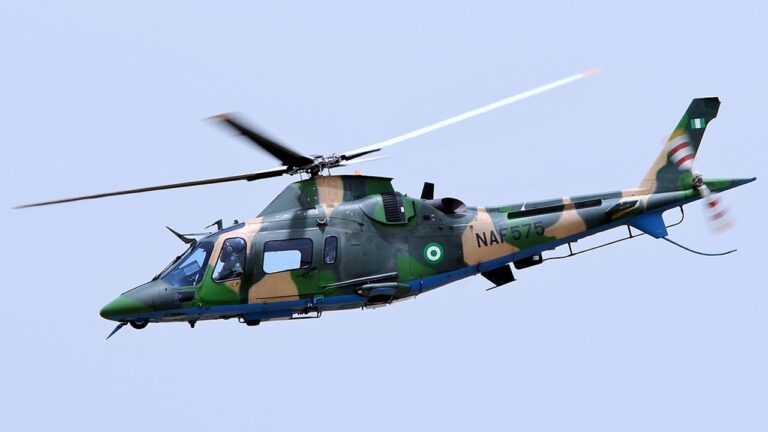
On August 14, a Nigerian Air Force (NAF) MI-171 helicopter crashed around Chukuba village in the Shiroro Local Government Area (LGA) of Niger State.
The helicopter was conveying officials of the Nigerian Army, travelling from Niger to Kaduna on a casualty evacuation mission, at the time of the crash.
This is the second military air crash recorded in 2023.
On July 14, exactly a month before the Niger incident, an aircraft belonging to NAF crashed in Makurdi, Benue, during a routine training exercise.
No tragedies were recorded in the Benue crash, as the two pilots on board ejected the aircraft quickly enough, according to a statement by NAF.
Two officers also died in an air crash involving a military trainer aircraft in Kaduna state in 2022.
In 2021, the Chief of Army Staff (COAS) Ibrahim Attahiru died in a plane crash on his way to Kaduna less than four months after his appointment. There were 10 other soldiers aboard the aircraft who also lost their lives in the crash.
The plane crash, which killed Attahiru, was the fourth such incident to claim the lives of military personnel in 2021.
NOTE: The name “Attahiru Jega” was corrected to Ibrahim Attahiru.