Home Blog Page 818

Federal govt approves N5bn palliative each for state amid severe hardship

THE Federal government, on Thursday, August 17, approved a sum of N5 billion palliative for each state and the federal capital territory (FCT) to address the impact of the fuel subsidy removal on the masses.

The total figure amounts to N185 billion for the 36 states and the FCT.

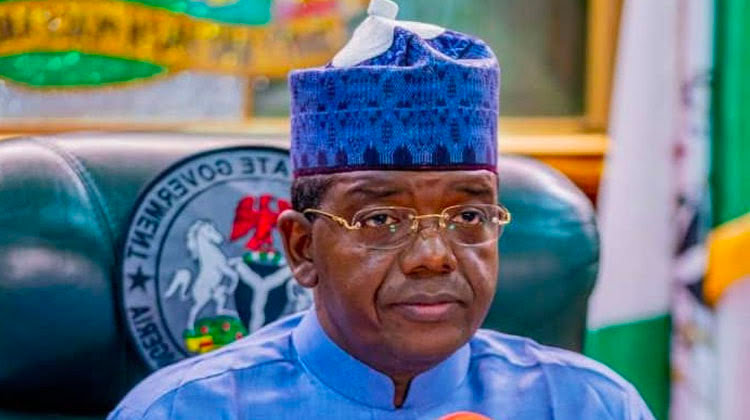
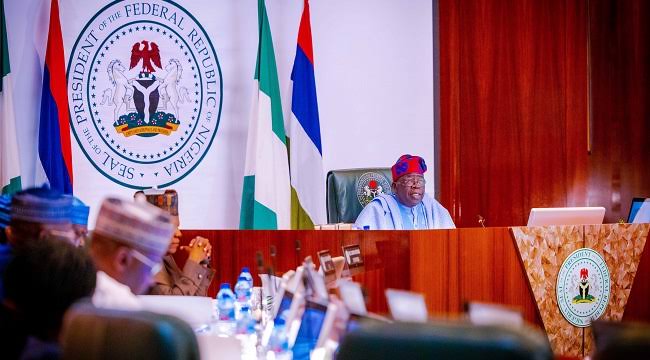
The governor of Borno state, Babagana Zulum, announced this to State House correspondents after the National Economic Council (NEC) meeting, presided over by vice president Kashim Shettima.

Zulum said each state, including the federal capital, would get N5 billion for palliatives.

The council comprises governors of the 36 states, the governor of the Central Bank of Nigeria (CBN) and other co-opted government officials.

Arising from the removal of the subsidy, the pump price of fuel has surged to over N600 per litre, causing severe hardship for individual households.

The House of Representatives has on Thursday, July 13, approved President Bola Tinubu’s request to source N500 billion from the N819.5 billion 2022 supplementary budget to fund palliatives to cushion the impact of subsidy removal on Nigerians.

The Senate also had on July 13 approved the President’s request of $800 million World Bank loan as additional funds for the financing of the national social safety net programme (NSIP) set up by the National Assembly.

A concessionary facility, the loan was to expand coverage of shock response and safety net support among the poor and vulnerable Nigerians to meet the cost of their essential needs.

An initial plan by the government to pay N8,000 to 12 million poor households was greeted with criticism, as many people assumed the plan would not be sustainable.

The government then decided that palliatives to cushion the effects of fuel subsidy removal would be implemented using new registers created by states after the council discredited the country’s national social record (NSR) supposedly used by the immediate past administration to implement conditional cash transfer (CCT) programme.

A social intervention programme is expected to jumpstart people from poverty, which makes it a temporary programme, Nigeria’s country director, ActionAid, Ene Obi, told The ICIR.

She, however, said the government needs to come clean on the issue of corruption and be accountable.

“You do not give people fish; you teach them how to fish,” the ActionAid country director said.

Also, there are concerns about the methodology and criteria the governments intend to use to select vulnerable Nigerians to benefit from the fuel subsidy palliatives.

The ICIR reported that the Federal and state governments recorded awful experiences during the Covid-19 pandemic distribution of palliatives to the citizens.

The disgruntled exercise caused a lot of controversies that trailed the entire process of the distribution of the Covid-19 palliatives.

Meanwhile, the National Bureau of Statistics (NBS) report showed that over 133 million Nigerians live in multidimensional poverty.

The figure indicates that 63 per cent of Nigerians are poor due to a lack of access to health, education, and living standards, alongside unemployment and shocks, adding that three out of five Nigerians live in poverty.

Athletics Championship: AIU clears Tobi Amusan to compete

0

THE Athletics Integrity Unit (AIU) has declared Tobi Amusan not guilty of the doping charges against her.

The Nigerian world 100m hurdles defending champion had been dragged into the mug for missing three whereabouts which left her participation at this year’s championship hanging in the balance.

In a tweet on their official handle, the AIU on Thursday night said, “A panel of the Disciplinary Tribunal, by majority decision, has today found that Tobi Amusan has not committed an Anti-Doping Rule Violation (ADRV) of three Whereabouts Failures within a 12-month period.

“AIU Head Brett Clothier has indicated the Athletics Integrity Unit (AIU) is disappointed by this decision and will review the reasoning in detail before deciding whether to exercise its right of appeal to the Court of Arbitration for Sport (CAS) within the applicable deadline. The decision is currently confidential but will be published in due course,” the statement read.

NDLEA reacts to highway extortion allegation

0

FOLLOWING recent extortion and bribery allegations along Nigerian highways, the National Drug Law Enforcement Agency (NDLEA) has stated that it will take strict action against any corrupt acts by its personnel.

This was in reaction to an investigation by HumAngle that accused officials from the NDLEA and five other security agencies – the Police, the Nigeria Immigration Service (NIS), the Nigeria Security and Civil Defence Corps (NSCDC), Nigerian Army and the Federal Road Safety Corps (FRSC) – of extorting money from drivers and other road users at checkpoints along the Maiduguri highways in Borno state.

The organisation’s director of media and advocacy, Femi Babafemi, highlighted that measures are in place to prevent internal corruption.

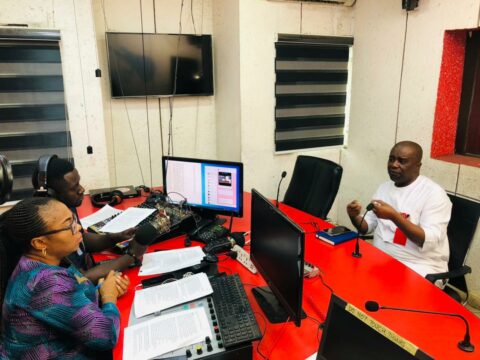
Babafemi made the statement at an episode of an anti-corruption radio show, ‘Public Conscience’, broadcast on Wednesday in Abuja and produced by the Progressive Impact Organisation for Community Development (PRIMORG).


READ ALSO:


“When you see officers of the agency on the highway, their responsibility purely is to check for drugs and not anything else, and so if you’re not trafficking or carrying drugs, you have no business with them.

“Rather, what people complain about NDLEA personnel on the roads is a delay in time used in searching vehicles which I don’t encourage,” Babafemi stressed.

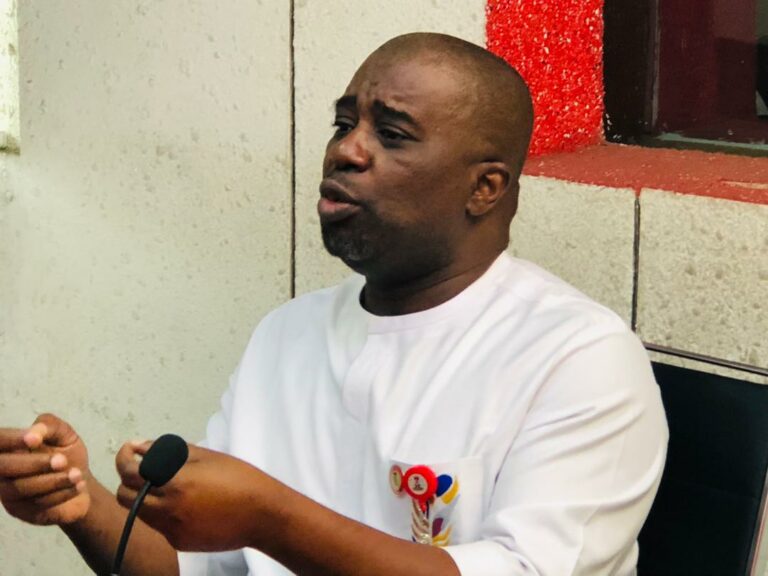
Femi Babafemi (white clothes) at the Radio studio

Femi Babafemi (white clothes) at the Radio studio

The investigative report (read here) put forward that drivers frequently feel obligated to pay security guards at checkpoints out of concern over delays. Along with NDLEA officials, the Nigerian Army, the Police, the Nigeria Immigration Service (NIS), the Nigeria Security and Civil Defence Corps (NSCDC), and the Federal Road Safety Corps (FRSC) were also included as suspects in the report.

PRIMORG in a statement made available to The ICIR said they had written to the NIS and the Nigeria Police Force for their responses to the allegation. At the same time, the Nigerian Army and FRSC failed to turn up for the radio programme despite being notified of the programme.

.

CBN rebate expenses on abolished RT200, Naira4Dollar schemes gulp N155.59bn

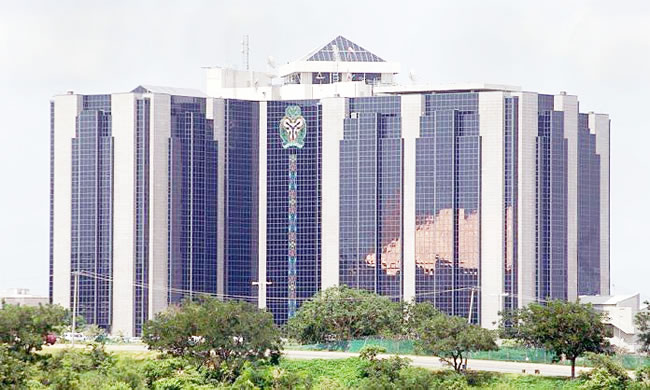
REBATE expenses on RT200 and Naira4Dollar, which the Central Bank of Nigeria (CBN) abolished some weeks ago, barely one year after introducing the schemes, gulped an estimated N155.59 billion.

Analysis of the CBN Consolidated Financial Statements for the year ended December 31, 2022, has shown.

The ICIR reported that the apex bank released its financial records for the last seven years amid public outcry and an investigation into its financial management.

A cursory look at the financial report revealed that rebate expenses formed the second largest and represented 17.51 per cent of N888.34 billion of CBN’s other operating costs.

“Rebate expenses represent expenses incurred by the CBN in connection with the RT200 and Naira4Dollar schemes which the Bank introduced to enhance foreign currency inflow, diversify the sources of FX inflow, increase the level of non-oil exports, ensure stability and sustainability of FX inflows, and support export-oriented companies to expand their export operations and capabilities,” the apex bank stated in the report.

A further look at the report showed that CBN incurred N137 billion in 2022 on the RT200 scheme and recorded zero figures for 2021.

On the Naira4Dollar expense, the apex bank incurred up to N4 billion, which was captured under intervention expenses.

Introduced by the suspended CBN Governor, Godwin Emefiele, the schemes were expected to boost non-oil exports and diaspora remittances to encourage foreign exchange inflows.

Specifically, CBN introduced the Race to $200 billion (RT200) in foreign repatriation in February 2022 to stimulate non-oil exports with a $200 billion foreign exchange income target for three to five years and was expected to increase the external reserves.

The incentive was for a rebate of N65 for every $1 of repatriated non-oil export proceeds to be paid to exporters of semi-finished and finished goods, while exporters of unprocessed items enjoy a rebate of N25/$1.

Following the implementation of the RT200 programme, Emefiele had said that as of May this year, the export proceeds repatriation into the country amounted to $5.6 billion in 2022, representing just about 2.8 per cent of the $200 target.

Similarly, the Naira4Dollar scheme, introduced in March 2021, incentivised senders and recipients of international money transfers to be paid N5 for every $1 received as a remittance inflow.

The two programmes, aimed at encouraging inflows of diaspora remittances into the country, were abolished by CBN, which took effect on June 30, The ICIR reported.

Taking a further look at the period in view, The ICIR can report that gross external reserves declined by $2.34 billion to $37.08 billion as of the end of December 2022 from $34.74 billion as of March 8, 2021, when the Naira4Dollar took effect.

Admitting the bank’s failures in managing the foreign exchange system, the acting CBN governor, Folashodun Shonubi, has threatened to punish operators engaging in illegal foreign exchange dealings, The ICIR also reported.

On Tuesday, August 15, the naira depreciated against the dollar at N774.77/$1 at the Investors’ and Exporters’ (I&E) window, while at the parallel market, it closed at N942/$1.

The CBN acting governor has revealed that most remittances were outside the legal market.

Shonubi disclosed this at a lecture entitled, ‘Diaspora Remittances and Nigerian Economic Development’ on Thursday, August 10.

“Nigeria received about $16.7 billion in remittances, with the vast majority of the money outside the legal market,” he said.

Lamenting on the shortcomings of the remittance system, Shonubi estimated that it costs 8-9 per cent of every $100 to transfer money to Sub-Saharan Africa from the diaspora, describing the cost as the highest in the world.

“We are working hard to encourage individuals to bring money into the formal sector rather than relying on informal channels, which have become difficult to manage,” he lamented.

Shonubi, however, assured that CBN was taking steps to restrict illegal remittances and that a formation of a commission would start paying unscheduled visits to banks accused of unlawful sales of dollars.

“We need to name and shame commercial banks involved in such malpractices,” Shonubi stressed.

He admitted that the apex bank’s effort to induce individuals to engage in formal market transactions by granting an N5 refund failed as the technique has been ineffective, prompting the discontinuation.

He added that CBN plan to rename the foreign exchange market, known as the I&E market, to the Nigerian Foreign Exchange Market, as it is the sole market CBN acknowledged.

Meanwhile, the president of the Association of Bureaux De Change Operators of Nigeria (ABCON), Aminu Gwadabe, had told The ICIR that unifying the exchange rate would check illegal economic activities.

Gwadabe suggested that the country could solve the foreign exchange liquidity shortfall by increasing the standardisation, packaging, and yield of its primary products.

He said, “Like the BDC, the export sector has been criminalised and has a lousy perception that many people don’t want to buy Nigerian goods because the good is seen as substandard and fake.

“So, the government has to de-risk the export market the way it de-risked agriculture.

He urged the government to reduce the documentation bottlenecks associated with our export commodities by bringing all the different agencies into a central processing area as done in other climes like Lome and Togo.

Matawalle, who governed insecurity-plagued Zamfara appointed as minister of state for defence under Tinubu

PRESIDENT Bola Tinubu on Wednesday announced the appointment of Bello Mattawalle, the former Zamfara state governor, as the Minister of State for Defence.

Mattawalle’s previous role as governor was marked by heavy criticism due to insecurity issues that plagued Zamfara state under his administration.

Others whose appointments were announced are former governor of Rivers State Nyesom Wike as Minister for the Federal Capital Territory (FCT), Mairiga Mahmud as Minister of State and several others listed here.

Mattawalle, who served as the governor of Zamfara state between May 2019 to 2023, left the state as one of the worst hit by terrorist attacks in Nigeria. Attacks by a group of terrorists known as bandits went rampant under his watch leading to the killing of thousands of people in the state and across the Northwest region of the country.

While the responsibility for safeguarding citizens’ lives and property falls under the jurisdiction of the federal government, state governments often contribute additional efforts to address security challenges within their respective states.

During Matawalle’s tenure, Agriculture which is the major source of income for the residents of the state suffered devastation as these terrorists continued to impose protection levies before being allowed to cultivate farmlands or harvest ripe crops.

Some measures which were introduced by him to address the challenge such as shutting down telecommunication, restriction of vehicular movements, shutdown of markets and directing police to allow the residents to bear arms failed to put an end to the menace. Death due to terrorist attacks rose from 307 in 2018 to 743 in 2021 and 650 in 2022.

Prior to Mattawalle’s departure from office, terrorist activities such as abductions, looting, and killings escalated throughout the state. In some parts of the state, the terrorists run parallel administrations, collecting taxes and levies and making laws.

His appointment as the minister of state defence means he’s to work with Mohammed Badaru, who would be heading the ministry of defence.

The Ministry of Defence, is a government agency with the statutory responsibility of overseeing the defence profile of the country from the perspective of the Armed Forces. It supervises the Defence Headquarters, the Services namely, Army, Navy and Air Force as well as Tri-Services Institutions/Parastatals.

Matawalle’s track record as a governor in terms of security casts doubt on his ability and capacity to oversee a ministry that focuses on protecting the lives and properties of Nigerians, however, some pundits are of the opinion that it makes him apt for the position.

President Tinubu’s list of ministerial nominees submitted to the senate had earlier been criticised as being stacked with recycled politicians rewarded for their loyalty to him and the party. The list includes a notable count of nine former state governors and other politicians who had previously held office.

Observers have raised concerns, noting that the president’s political considerations appeared to have taken precedence over his earlier commitment to forming a cabinet majorly peopled by technocrats.

Included in the list are ex-governors who are under criminal probes for allegedly embezzling public funds in their states. One is Atiku Bagudu who was accused of helping the late Sani Abacha, the brutal military dictator to loot public funds and likewise, Matawalle being investigated over alleged N70 billion theft through fraudulent contracts awarded by his administration. 

The ICIR had reported that killings by non-state actors have continued unabated in many places in Nigeria a few weeks after President Bola Tinubu was sworn in as the president of Nigeria.

Data from SBM Intelligence, an analysis platform, revealed that about 629 Nigerians were killed by non-state actors between May 29 and July 13, 2023.

In his victory speech after securing the All Progressives Congress (APC) presidential ticket in June 2022, Tinubu promised to eliminate criminals and terrorists and restore peace and harmony to the troubled states.

Despite the promise made by the President to hit the ground running, data from various sources have revealed that the insecurity issues is yet to improve under Tinubu’s administration.

According to a recent report from the civil society organization Global Rights Nigeria, approximately 555 individuals lost their lives and 267 were taken captive within six weeks after President Tinubu assumed office. The findings, as presented by Edosa Oviawe, the Country Manager of Global Rights Nigeria, during a two-day ‘Conflict Sensitive Reporting Training for Journalists’ event in Abuja, were drawn from a combination of media reports, civil society input, and security agency information.

Furthermore, Amnesty International released a report on June 14 indicating that shortly after President Tinubu’s inauguration, over 120 people were killed. 

The report decried the attacks carried out by armed assailants, emphasizing that the safety of citizens should be the paramount concern of the new administration. 

Given the persistent security issues that the nation is currently grappling with, it is anticipated that the president would select individuals with proven competence and capacity for critical security roles such as the Ministry of Defence. 

However, it remains uncertain whether Mattawalle will contribute positively to his cabinet.

DHQ: 36 military officers killed in recent attack in Niger

1

THE Defence Headquarters (DHQ) on Thursday, August 17, confirmed that 36 officers were killed in the recent terrorist attack that happened in Shiroro Local Government Area, LGA, of Niger state.

The DHQ made this known at the biweekly briefing of the Defence Media Operations.

The ICIR reports that bandits in a recent attack caused havoc at Chukuba and other neighbouring villages of Shiroro Local Government Area of Niger state, with the recent incident starting on Friday, August 11 and lasting till Monday, 14.

The terrorists were said to have ambushed and killed an unconfirmed number of soldiers along the Zungeru-Tegina road in the Madaka Ward of the Rafi Local Government Area of the state.

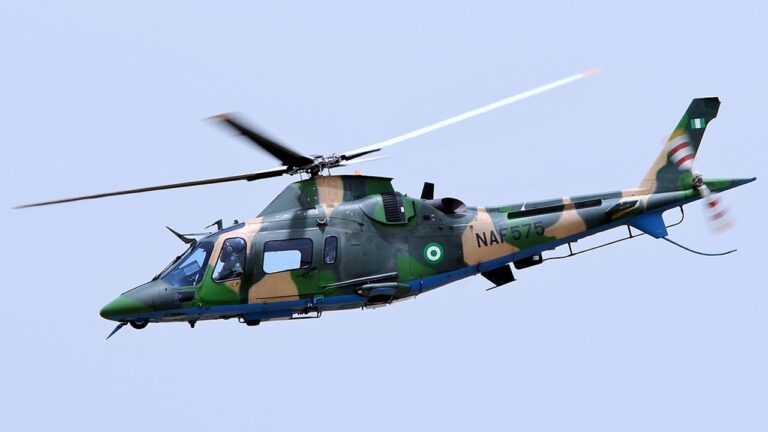
Similarly, some terrorists affiliated to Abubakar Abdallah, popularly known as Dogo Gide, subsequently claimed responsibility for the Nigerian Air Force (NAF) helicopter that crasheď on Monday, August 14, in the region. The armed terrorists made the claim in a video obtained by WikkiTimes.

The helicopter was on an evacuation mission when the incident happened. According to reports, the crash led to the death of several soldiers. 

The Director of Defence Media Operations, a major general, Edward Buba, while giving a breakdown of casualties in the ambush of troops and the crashed helicopter in Niger state, disclosed that Nigeria suffered a loss of 36 soldiers.

In response to inquiries about the helicopter cause of the helicopter crash, he reiterated that an investigation is still underway to determine the cause and urged citizens to be wary of propaganda by terrorists and remain patriotic.

Meanwhile, after the conference, while addressing journalists, he said, “Our troops entered into an ambush in the general of Shiroro Local Government Area of Niger state. The ambush led to a firefight which resulted in the death of three officers and 22 soldiers, while seven were wounded in action. As a result of this, there was a need for us to embark on a casualty operation whereby the Air Force helicopter was dispatched.

”While that process was on and inbound to Kaduna, the helicopter crashed. In the crash were 14 of the previously killed in action personnel in that ambush, seven of the previously wounded in action personnel, two pilots of the helicopter and two crew members. ”

He, however, vowed “injurious consequences ” on the bandits for attacking the troop.

The Nigerian Air Force spokesman, Edward Gabkwet, had on Monday, said efforts are currently ongoing to determine the probable cause of the crash.

“Efforts are currently ongoing to rescue the crew and passengers on board the helicopter, while preliminary investigations have commenced to determine the probable cause of the crash,” the statement added.

Lagos Court strikes out firearm charge against Emefiele

0

THE Federal High Court sitting in Lagos has struck out the charge of “illegal possession of firearm and possession” brought against the suspended Governor of the Central Bank of Nigeria (CBN), Godwin Emefiele.

The Judge, Nicholas Oweibo, in his ruling, held that the application filed by the Director of Public Prosecution (DPP) seeking the withdrawal of the case is found in Section 108 of the Administration of Criminal Justice Act (ACJA), which empowers him to withdraw and there was no need for the application to be in writing.

The judge questioned what good it would serve to the defence if the court did not permit the withdrawal of the charge.

Oweibo then struck out the two-count charges against Emefiele for lack of diligent prosecution.

The ICIR reported that the Federal Government, on Tuesday, August 15, filed fresh charges against Emefiele in Abuja.

This was disclosed to journalists after the day’s proceedings by the Director of Public Prosecutions (DPP) at the Federal Ministry of Justice, Mohammed Bakodo Abubakar.

Abubakar said the fresh charges – with 20 counts – were filed at the Federal Capital Territory (FCT) High Court.

One of the counts accuses Emefiele of “conferring unlawful advantages”.

Earlier, the Federal government applied to withdraw the “illegal possession of firearms” case it filed against Godwin Emefiele at the Federal High Court sitting in Lagos.

Meanwhile, Emefiele’s arraignment on a fresh 20 counts charge on Thursday has stalled.

The arraignment was delayed due to the absence of one of the defendants who joined in the charge.

Emefiele, who was present in court, was charged with 20 counts of procurement fraud, conspiracy, and giving corrupt favours along with Sa’adatu Yaro, a female CBN employee, and her company, April 1616, Investment Limited.

The Director of Public Prosecution of the Federation (DPPF), Mohammed Abubakar, who is prosecuting the case for the Federal Government, informed the trial judge, Hamza Muazu, that Yaro became ill and was unable to appear in court.

As a result, he requested a fresh date, and Emefiele’s lawyer, Akinlolu Kehinde, did not object.

Consequently, Justice Muazu adjourned the case till August 23.

Kano Lawmaker, Commissioner’s brother fail to execute water projects while constituents suffer illness, death (1)

0
A Kano state lawmaker misappropriated monies meant for water projects and watched his constituents suffer and die from water-borne diseases. In this first of a two-part report, Lukman Abdulmalik, tells the distressing and mind-boggling story of how a Kano legislator set up a company to get contracts for water projects in the communities he supposedly represents but never executed them. In some cases, contracts were even awarded to ghost companies that never executed any projects.

Read the second part here

By Lukman Abdulmalik
In 2019, Kano State RUWASA (Rural Water Supply and Sanitation Agency) awarded a contract worth N7 million to Safnaj Synergy WorldWide for the construction of one hand pump borehole each in five communities of Tsanyawa Local Government Area, LGA, including Kwarka, Farsa, Sabon Garin Yancibi, Kokai Gabas, and Zango.
Investigations show that Safnaj Synergy Worldwide is owned by a Kano State House of Assembly member representing Tsanyawa and Kunchi constituencies, Garba Ya’u Gwarmai.
RUWASA Constituency projects information. Source: https://kanoppb.org.ng/constituency-projects/
However, his constituents in Tsanyawa communities continue to suffer from a lack of access to clean water after the lawmaker failed to provide the boreholes.
In the Kwarkwa village in Tsanyawa LGA, residents always feel joy when the sky is cloudy, as they pray so hard for rainfall to have drinkable water for their household use. Sanusi Usman, the Village Leader of Kwarkwa, told this reporter that the community had only two boreholes, which they used their money to construct, but they have both now worked as they do not produce water.
Usman recounted, “in 2019, we contributed N1.2 million to construct boreholes, but there was no water in them. We gathered the money by selling most of our farm produce for the year.
“For the first construction, we spent N800,000, but it was unsuccessful, while for the second borehole, we paid N400,000, and there was no water underground.”
Sanusi Usman, resident of the Kwarkwa community in Tsanyawa Lga. PC: Lukman Abdulmalik
He added that due to the struggles they faced, the community members resorted to fetching water from an unclean stream.
“In 2019, we heard that there would be the construction of a borehole by our member of the House of Representatives (Garba Yau Gwarmai), but till now, there has been no provision for that.
Usman narrated that the amount of dirty water his first child, seven-year-old Aminu Usman, consumed made him spend over N150,000 for an operation at Kankia Hospital. Due to this, his child suffered from intestinal perforation, mainly caused by typhoid.
However, in 2019, to solve the community’s water problems, RUWASA gave N1.4 million to Safnaj Synergy WorldWide to construct one borehole in the Kwarkwa community. It was never built.
In Zango, another community in Tsanyawa LGA, residents also suffered from waterborne diseases due to a lack of potable water, even though the Gwarmai’s company, Safnaj Synergy Worldwide, was awarded another N1.4 million contract to construct a borehole in the community.
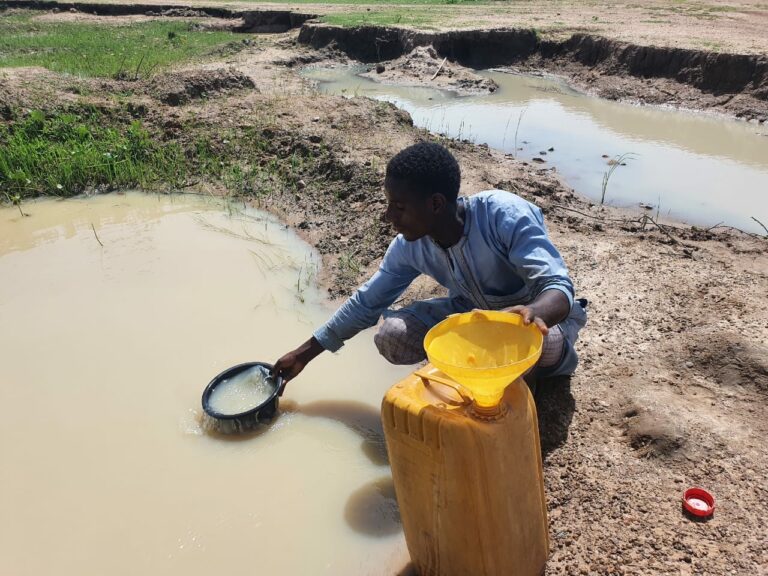
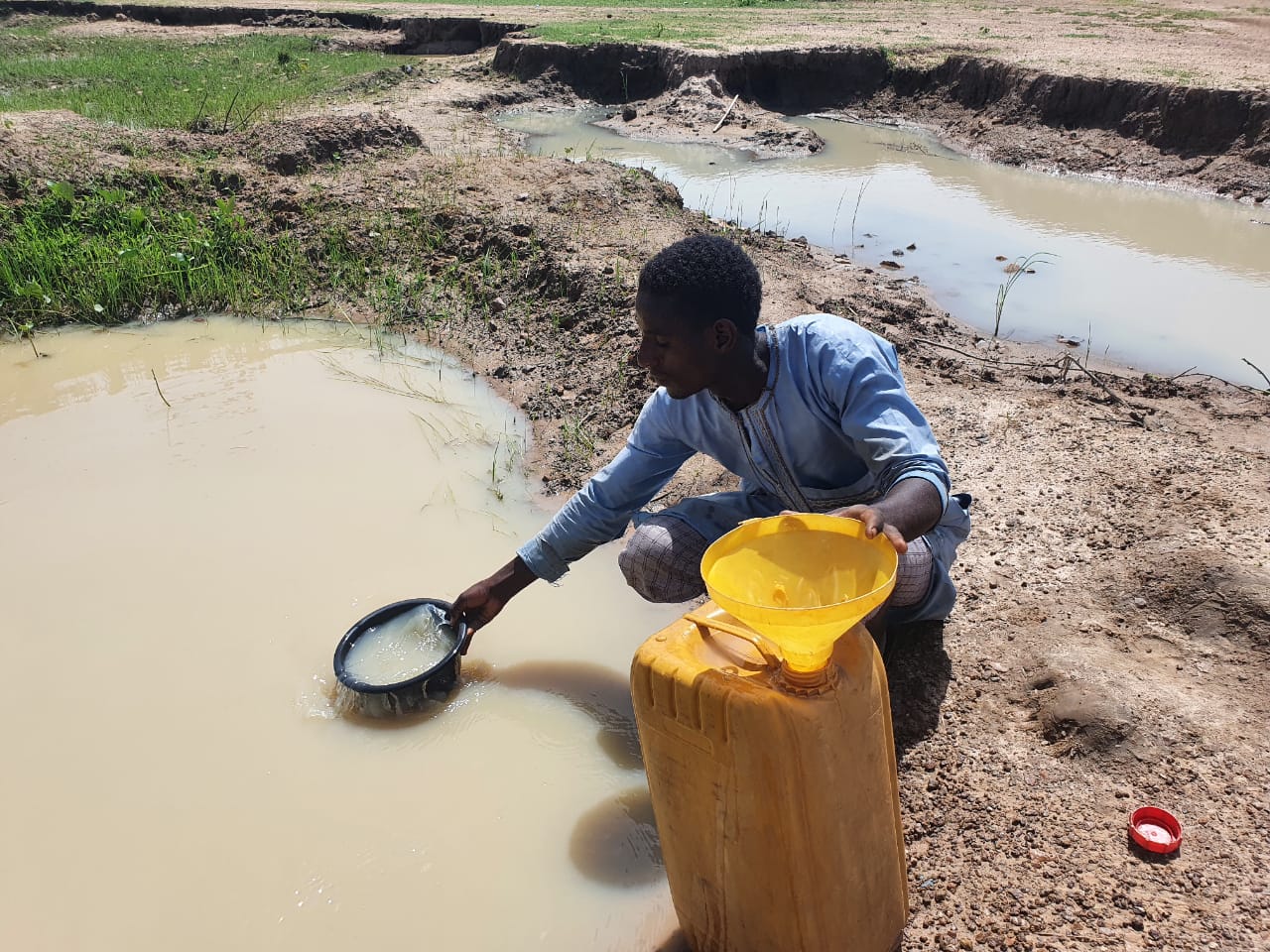
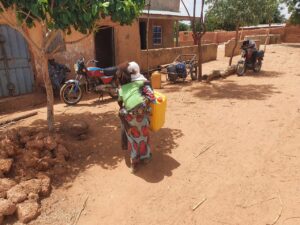
A resident is fetching water from a pond. PC: Lukman Abdulamlik

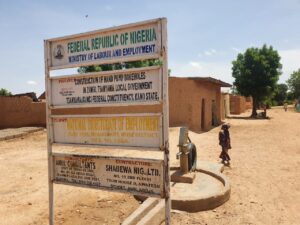
A visit by this reporter revealed that the borehole was not constructed. It was also gathered that the only government water project in the community was constructed by Sani Bala, the Federal House of Representatives representing Tsanyawa and Kunchi. However, that is also not functional.

Project board of Sani Bala. PC: Lukman Abdulamlik
Salisu Garba, a resident of Zango, said, “We don’t have boreholes, and our streams are dry. We have to travel to neighbouring communities such as Yamalawa, about an 80-minute journey.
“Our children have stopped schooling; the only borehole that RUWASA built was over 15 years ago, and it is also in a bad state.
15-year-old RUWASA borehole in Zango community. PC: Lukman Abdulmalik

How House Representatives designate charity boreholes as theirs

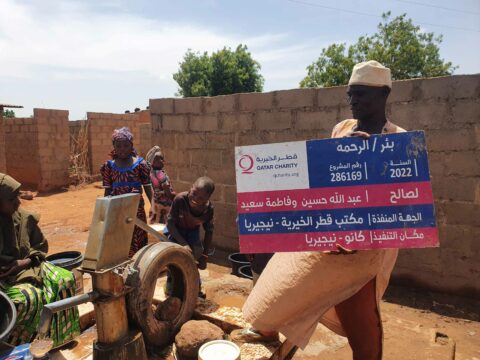
Residents of communities such as Zango, Kwarkwa in Tsanyawa LGA, and Faskarawa, Kwanyawa, of Kunchi LGA lamented that on various occasions, charity foundations such as the Qatar Foundation and the Wash Project by UNICEF construct boreholes in the communities. Still, some of the political followers in their area will dedicate the project to the politicians, especially legislators from the community.
During a visit by this reporter to Kokai Gabas in Tsanyawa, LGA, Rabiu Musa, an elder in the community, shared his experience and said that there have never been any boreholes constructed by the government in their community.
He added that all the boreholes in Kokai Gabas were constructed by the Qatar Charity Foundation.
Musa added that they somehow figured out that their representatives are not executing any projects rather than hiding under the projects done by charity foundations, which are most often sourced by our community leaders.
But, according to publicly available information, the community ought to have been the beneficiary of a borehole because in 2019, RUWASA disbursed N1.4 million to Safnaj Synergy WorldWide to construct a borehole in Kokai Gabas community.
But despite the release of funds, Gwarmai, who owns the company, has failed to execute the water project.

Farsa Community of Tsanyawa

In the Farsa community of Tsanyawa LGA, residents also suffer from a lack of borehole construction in their community.
In 2019, RUWASA awarded a N1.4 million contract to Safnaj Synergy WorldWide for the construction of a borehole in the community, but it was never built.
The lack of this borehole has pushed residents of this community into deprivation, as they only feed on one borehole provided by the Qatar Charity Foundation.
The Village Head of the Farsa community, Habibu Musa, lamented that the lack of a borehole has pushed households in the community to buy water, and those less privileged are forced to fetch dirty water from a pond for their consumption.
He observed that “our children don’t go to school anymore, because sometimes they go to the pound at 7 a.m. before they return at 2 p.m.
Daughter of Farsa community leader, Aisha Musa, returning from stream at 3:pm. PC: Lukman Abdulmalik
“Even the boreholes we had are no longer functioning and were boreholes built by some NGOs and philanthropists.
“The only surviving hand pump borehole we had is supplying over 2,000 people with water in the whole Farsa community.
“In the last four years, there hasn’t been any construction of boreholes, and it’s been over 10 years since the government executed any water project in this community.
“We used to record cholera, typhoid, and others; We have lost so many children to waterborne diseases.
Also, in Sabon Gari Yancibi in Tsanyawa, another community that should have benefited from the RUWASA borehole projects, this reporter observed that the non-availability of portable drinking water leads the residents of the community to trek about 15 kilometres to access unhygienic water. Safnaj Synergy got N1.4 million to build a borehole there, but it did nothing.
Amina Balarabe, a 45-year-old resident of Sabon Garin Yancibi, said, “Sometimes I spent 10 to 12 hours before we could get water. And the only borehole they had was constructed by an NGO, not the government.”

Who is the contractor for the Tsanyawa boreholes?

A full Corporate Affairs Commission (CAC) search conducted on Safnaj Synergy Worldwide shows that the company belongs to a member of the Kano State House of Assembly representing Kunchi/Tsanyawa constituency, Garba Yau Gwarmai.
The CAC records list two shareholders, both of whom appear to be the same person: Garba Gwarmai Yau of No. 5, Farawa Quarters, Kano, who owns 800,000 shares, and Hassan Gwarmai Garba, also of the same address, who has 200,000 shares. Truecaller, the caller ID app, lists the number given for Ya’u as belonging to Garba Yau Gwarmai ( Kunchi) and the one for Garba as that of Garba Figo.
Gwarmai was a member of the 9th Kano State House of Assembly from 2019 to 2023 and was recently re-elected to the Kunchi/Tsanyawa constituencyRegarding this contract, Gwarmai clearly breaches the law as there is an obvious case of conflict of interest.
Section 57 (9) of the Public Procurement Act 2007, states: “Every public officer involved directly or indirectly in matters of public procurement and disposal of assets shall:
(a) divest himself of any interest or relationships which are actually or potentially inimical or detrimental to the best interest of government and the underlying principles of this Act ; and
(b) not engage or participate in any commercial transaction involving the federal government, its ministries, extra-ministerial departments, corporations where his capacity as public officer is likely to confer any unfair advantage – pecuniary or otherwise on him or any person directly related to him.”
Also, Section 57 (10) states: “Any person engaged in the public procurement and disposal of assets who has assumed or is about to assume a financial or other business outside business relationship that might involve a conflict of interest, must immediately declare to the authorities any actual or potential interest.”
Furthermore, Section 57 (11) says, “Such a declaration shall be given such consideration at the relevant level as is necessary so that, where it is seen that remedial action is taken, a conflict of interest is present.
Section 57 of the Kano State Public Procurement Act (12) defines  conflict of interest as where a person :
(a) possesses an interest outside his official duties that materially encroaches on the time or attention which should otherwise be devoted to affairs of government;
(b) possesses a direct or indirect interest in or relationship with a bidder, supplier, contractor or service provider that is inherently unethical or that may be implied or constructed to be, or make possible personal gain due to the person’s ability to influence dealings ;
(c) entertains relationships which are unethical, rendering his attitude partial toward the outsider for personal reasons or otherwise inhibit the impartiality of the person’s business judgments ; (d) places by acts or omissions the procuring entity he represents or the Government in an equivocal, embarrassing or ethically questionable position ;
(e) entertains relationships compromising the reputation or integrity of the procuring entity he represents or the Government ;
(f) receives benefits by taking personal advantage of an opportunity that properly belongs to the procuring entity he represents or the Government ; (g) creates a source of personal revenue or advantage by using public property which comes into his hands either in course of his work or otherwise; and (h) discloses confidential information being either the property of his procuring entity, the Government or to a supplier, contractor or service provider to unauthorised persons.
Safnaj Synergy WorldWide got a total of N7 million to construct one hand pump borehole in five communities in his constituency, including Kwarka, Farsa, Sabon Garin Yancibi, Kokai Gabas, and Zango, but none was constructed.
Not only did the legislator influence the contract awards, he also likely established the company for the sole purpose of obtaining the contract, as it was registered shortly before the contract was awarded on June 27, 2019.
It appears that RUWASA also breached the law regarding conflict of interest by awarding the contract to Safnaj Synergy WorldWide but the agency claims that it was not aware that the company belonged to the legislator.
This newspaper called Gwarmai to react to our findings in the evening of July 7. After listening to the reporter introduce himself and the reason for the call, the lawmaker dropped the call and subsequently blocked him as he could no longer be reached on the number. This reporter called continuously six times, but Gwarmai’s phone rang busy.
Later the same day, a WhatsApp message was sent to Gwarmai, who read the message on July 8, but he still did not respond. Around 10:00 p.m., another message was sent to him, but he still did not respond.

RUWASA Responds…

On July 5, an interview request was sent to the Kano State Rural Water Supply and Sanitation Agency. On July 10, in a one-on-one interview with this reporter, Yusif Abdullahi, Director of Physical Planning at RUWASA, disclosed that Gwarmai’s company was awarded 40 contracts for boreholes in the constituencies he is representing.
“Out of those 40 boreholes, not more than 20 were constructed, and we don’t know how the other 20 boreholes were scheduled.
“Some communities have no water underground after the water survey, so in instances like that, the House of Assembly usually gives permission to construct the borehole in another location or community, and most of the time RUWASA doesn’t have knowledge of the impromptu decisions.”
Reacting to the award of a contract to Safnaj Synergy Worldwide, Abdullahi said that he was not aware that the legislator owned the company, as RUWASA does not have the responsibility to check on the status of contracting entities.
“We are not aware that the company belongs to Gwarmai, because we don’t check the status of companies, the agency claimed, adding that “It is the duty of the Kano State Procurement Bureau and Kano State Internal Revenue Service to screen companies that should or should not be given contracts.
“However, on constituency projects, the State House of Assembly members are the ones undermining the process of choosing who to award contracts to.
“So, RUWASA only works on the order given from the constituency project office under the Kano State Ministry of Works, Housing, and Transport.”
On July 11, a FOIA request was sent to the Kano State constituency office on the allegations, and despite acknowledging the request, the department has yet to respond to the request while filing this report.

Kabo residents’ lives are at stake

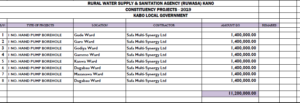
In a bid to alleviate the persistent water crisis in five local communities in Kabo LGAincluding Kanwa, Garo, Gude Dugabau, and Mansawa, in 2019, according to constituency project documents cited by our reporter, RUWASA awarded a N7 million contract to Safa Multi-Synergy Ltd. for the construction of boreholes in the communities.
Each community was allocated a hand pump borehole, costing N1.4 million each.
RUWASA Constituency Project Information Source: https://kanoppb.org.ng/constituency-projects/
A visit by this reporter to these communities revealed that no boreholes have been constructed. Even Garo, a community where the former Commissioner for  Local Government, Murtala Sule Garo, hails from, also suffers a water crisis despite the government’s efforts to provide a borehole there.
Although over 10 boreholes were constructed by WASH, UNICEF and other charity foundations in various parts of the Garo community.
Despite that, residents of Garo lamented that the boreholes were not sufficient for them, as the community has over 5,000 residents and this keeps increasing.
In 2019, the sum of N1,4000,000 million was released to  Safa Multi-Synergy Ltd., a company belonging to Mustapha Sule Garo, blood brother to Murtala Sule Garo, the former Commissioner for Local Government.
A borehole in Garo would have profoundly improved the health and well-being of Garo’s constituency, as his people are forced to look for water from the most unhygienic sources.  This was one of the major reasons that pushed Ibrahim Yahaya of the Garo community to rely on dirty water fetched from a cliff.
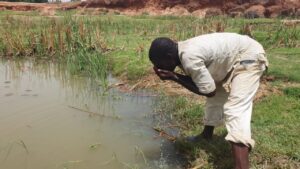
On June 18, 2023, when our reporter visited the Garo community, Yahaya was seen drinking muddy water that had gathered on a cliff for the past two weeks after rainfall.
Ibrahim Yahaya drinking unclean water from a pond. PC: Lukman Abdulmalik
Yahaya, 46, shared his experience: “I have been drinking this muddy water since my childhood, and it has caused me so many infections.
“We have boreholes in our community, but they are not enough; the state government is not contributing to ending the water crisis.
“Our children always fall sick of typhoid; they don’t go to school anymore because if they are at the borehole to get potable water sometimes at 5 a.m., it will take till 2 p.m. before they can get back home.”
Musa Bello, a 55-year-old farmer who is also an adviser to the Village Head of the Gude community, confirmed that there have been no additional hand pump boreholes or the construction of hand pump boreholes in their community in the last ten years.
He added that “we have about 16 hand pump boreholes constructed by charity foundations and other philanthropists.
The last borehole constructed by the state government was about 20 years ago.
Musa Bello narrating to this reporter on the absence of borehole construction in Gude. PC: Lukman Abdulmalik
“But still, the boreholes are not enough, which makes a lot of households rely on stream or pond water for their consumption.
“These have caused so many illnesses in our community, most especially cholera, that a lot of children have lost their lives to the disease.
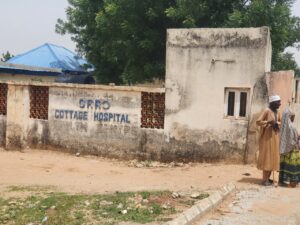
Haliru Musa, Record Officer of Kabo Cottage Hospital, told this reporter that from 2019 to 2023, he has recorded 230 cases of cholera, mostly in children aged five and below.
Garo Lga Cottage Hospital. PC: Lukman Abdulmalik
At Kanwa Community in Kabo LGA, another community that should have benefited from the borehole project, access to safe drinking water is still a big challenge as none was built there. As a result, residents often rely on water vendors, locally known as Mai Ruwa, to get water.
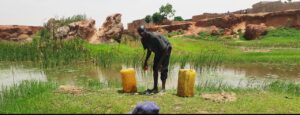
However, some of these vendors who push carts get water from sources that are close to dirty environments. For instance, the jerry cans used to store water by the vendors are left unhygienic. This can lead to the spread of germs and bacteria, which can cause serious health problems such as diarrhea, cholera, and typhoid fever.
Furthermore, residents frequently disregard the unsanitary condition of the surroundings where the water is obtained.
Water Vendor fetching dirty water for human consumption. PC: Lukman Abdulmalik
“Because of the scarcity, we just want water and don’t care where it is coming from,” he said. “We believe that borehole water is drinkable.
“Often, if their pipe falls into dirty water or on the ground, we pick it up to continue fetching the water,” said Abdulrahman, a water vendor.
Not only Kanwa, Gude, and Garo but also residents of Mansawa and Dugabau communities shared similar experiences about their horrifying lives without having access to clean water. A borehole project was approved for each of them, but the brother of Garo, Mustapha, cornered the money.

Kabo Contractor was not found

Safa Multi-Synergy Ltd. was incorporated in Kano, Nigeria, in February 2018, and even though the directors’ status is active, CAC lists the company as inactive, meaning that it has not been filing returns.
The company’s registered office address is No. 16 Along Katsina Road, Fagge LGA, Kano State. On a visit to the site, no such company was found at the address.
This report republished from Daily Focus is supported by the John D. and Catherine T. MacArthur Foundation and the International Centre for Investigative Reporting (ICIR).

Tinubu may pay over N30 million monthly to offset ministers’ salaries

FINDINGS by The ICIR, from available data, have shown that it might cost taxpayers over N29.91 million monthly to pay the basic salaries of the 46 newly appointed ministers.

The appointment of ministerial portfolios is coming barely two weeks after President Bola Tinubu submitted 48 names as nominees to the Senate for screening. 

Based on the remuneration approved by the Revenue Mobilisation, Allocation and Fiscal Commission (RMAFC), each minster should earn N650,136.65 monthly, translating to N7.8 million annually. 

Going by this, if no review has been made, the Federal government would pay N358.9 million annually to offset the ministers’ remuneration. This amount, however,  excludes other allowances and benefits for each minister appointed.

According to the commission’s data, each minister is also entitled to other allowances like accommodations, furniture estacodes, medical, severance gratuity, leave and motor vehicle loans which are paid based on application.

Also, as reviewed by the former president, Muhammdu Buhari, a minister is entitled to receive a duty tour allowance (travelling allowance) based on grade level.

By this approval, each minister is entitled to N80,000 per diem (daily) on each official travel.

In 2021, the Federal Inland Revenue Service said that Nigeria now has 41 million taxpayers.

Arithmetically, this means it would cost each taxpayer approximately N9 annually to pay the salaries of 46 ministers.

With the recent appointments, if all ministers resume office by September, the federal government would pay N119.6 million between September and December 2023, costing each taxpayer N3. This is excludes allowances.

Before leaving officer, Buhari allocated N2.9 trillion as payment of salaries and wages in the 2023 fiscal budget; which covers the expenditure on government personnel including ministers. However, while the former president ran a ministerial cabinet of 43 people, there has been pressure mounted by groups on the president to reduce the cost of governance

Recently, the National Labour Congress, while protesting the removal of fuel subsidy, requested that the federal government cut down expenses on governance and increase the minimum wage.

The ICIR has also reported the controversies (here and here) around the increase of salaries for public servants to 114 per cent. 

Ngige’s revelation 

In another twist, the former Minister for Labour and Employment, Chris Ngige, disclosed on Channels Televisions’ Politics Today interview in May that each minister earns N942,000 monthly after taxes have been removed.

“My salary is N942,000 in a month with my personal assistance. This is the gross total after taxation. My feeding, my transport, the salary of one PA, gardener and cook are all consolidated, and after heavy taxation, they pay me N942,000,” he said.

Based on this disclosure, The ICIR calculated that Tinubu might pay N43.3 million as basic salaries monthly, excluding other allowances and benefits for each minister appointed. This translates to N520.0 million annually. 

Ngige also disclosed in the interview that each minister is only entitled to duty tour (travelling allowances) allowance which has been – at the time he spoke – recently reviewed. 

However, a report, analysing the amount received by each minister under Buhari published that ministers are also entitled to estacode allowance, refundable vehicle loans, furniture allowance, severance packages, Utilities Allowance, Domestic Staff Allowance, Newspaper Allowance, Accommodation Allowance and Motor Vehicle Fueling Maintenance Allowance among others.

Ghislaine Dupont and Claude Verlon Scholarship seeks young radio journalists

THE RFI is hosting the 10th issue of the “Ghislaine Dupont and Claude Verlon Scholarship” for aspiring radio journalists.

It was established in honour of the two reporters who were assassinated in northern Mali on November 2, 2013.

French-speaking radio journalists and technicians in Africa can apply.

This scholarship provides training for 10 young radio journalists and 10 young reporting technicians each year.

The deadline is August 25, 2023. Interested individuals can apply here